Two weeks after our previous bird ringing visit, we were again at Vondeling Wine Farm. This time we focused on species diversity. We caught 26 species in four days, although the first day was rainy. A pair of Cape Batis showed the different eye colours of male and female.
A patch of flowering Leonotus provided four Malachite Sunbirds, eight Streaky-headed Seedeaters and other species.
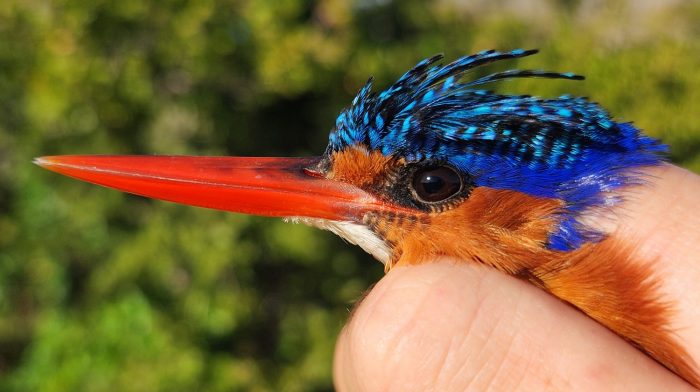
Malachite Sunbird – female and male
On the last morning, Sally led ringing in an almond grove which added numbers and the following species: Cape Turtle Dove, Cape Wagtail, Cape Canary and Southern Grey-headed Sparrow.
One of the most exciting catches was a female Greater Honeyguide, a species we had not seen or heard calling at Vondeling. The hosts of this brood parasite include several species that are at Vondeling: African Hoopoe (one ringed!), kingfishers and starlings (one Common Starling ringed!).
Links to the descriptions of previous ringing trips to Vondeling (and also elsewhere) are summarized in this blog. To join a future ringing event, see Events!
We have comfortable accommodation on the farm, in two cottages.
Cover image of African Red-eyed Bulbul by Jon Blanco – Karoo Gariep Nature Reserve, Northern Cape
Identification
The African Red-eyed Bulbul is an easily recognisable species. Its most distinguishing feature is the red eye wattle, which is diagnostic. The head is black and contrasts with the grey neck and breast. The rest of the upperparts are dusky grey-brown. The underparts are paler greyish-white and the vent is bright-yellow.
African Red-eyed Bulbul (Pycnonotus nigricans) Thabazimbi district, Limpopo Photo by Ansie Dee Reis
The sexes are alike and juveniles look similar but have duller plumage.
The African Red-eyed Bulbul can only be mistaken for the Common Bulbul Pycnonotus tricolor and the Cape Bulbul Pycnonotus capensis. The Dark-capped Bulbul, has a black, not red eye ring, and less contrast between the dark breast and white belly. The Cape Bulbul has a broader, white eye ring, and plain sooty brown underparts. The African Red-eyed Bulbul is known to hybridise with the Common Bulbul and Cape Bulbul in areas of overlap.
African Red-eyed Bulbul (Pycnonotus nigricans) Klerksdorp district, North West Province Photo by Tony Archer
Status and Distribution
The African Red-eyed Bulbul is a common to abundant resident and is near-endemic to Southern Africa. Its range extends beyond the sub-region into south-western Angola and extreme southern Zambia. It is widespread in the central and western regions of Southern Africa, occurring virtually throughout Namibia and Botswana. In Zimbabwe it is found only in the far west of the country. It occurs in the central and western parts of South Africa where it is widespread.
SABAP2 distribution map for African Red-eyed Bulbul (Pycnonotus nigricans) – February 2023. Details for map interpretation can be found here.
Habitat
Habitat in Karoo scrub – Carnarvon district, Northern Cape Photo by Ryan Tippett
The African Red-eyed Bulbul occurs in dry woodland, arid savanna, thickets, Karoo scrub, riverine bush, orchards, gardens and farmyards. It is generally found in drier habitats than other bulbuls, but regularly gathers near water during the dry season.
Replaces Dark-capped and Cape Bulbuls in arid and semi-arid regions and across a wide range of habitats.
The African Red-eyed Bulbul is usually encountered in pairs or small, loose groups. They are noisy and conspicuous, with continuous, excited contact calling from large groups gathered at fruiting trees. Flicks its wings and tail when alarmed or excited. They are prominent in mixed-species bird parties where they mob predators such as snakes and small owls. Becomes tame in gardens and camp sites, regularly visiting feeders and bird baths. Drinks regularly and is never far from water in arid country.
It forages in pairs or large, noisy groups with other fruit-eating species in trees and shrubs, but occasionally takes food from the ground. The African Red-eyed Bulbul feeds on a wide variety of wild and cultivated fruits. They are also known to eat flower petals and will probe aloe flowers and those of other plants for nectar. It also consumes a variety of arthropods, flying up to hawk insects above trees or shrubs and darts after insects flushed from foliage.
The African Red-eyed Bulbul is a monogamous species. Pair members often perch in close contact, frequently allopreening around head area. The nest is usually built only by the female and is a flimsy-looking cup of dry grass, thin twigs, rootlets and other fine plant fibres. The nest is bound together with spider web and is lined with grass fibres. The nest is placed in the fork of a bush or tree and is usually well hidden.
Two or three eggs are laid per clutch and the eggs are pinkish white with red-brown speckles. Incubation begins with the first laid egg and the incubation period lasts from 12 to 13 days. All incubation duties are performed by the female.Hatchlings are fed and cared for by both parents. The nestling period lasts around 12 days and young birds can already fly competently after 18 days or so. Broods are regularly parasitised by the Jacobin Cuckoo.
African Red-eyed Bulbul (Pycnonotus nigricans) Waterberg National Park, Namibia Photo by Carel van der Merwe
Further Resources
Species text in the first Southern African Bird Atlas Project (SABAP1), 1997.
The use of photographs by Ansie Dee Reis, Carel van der Merwe, Jon Blanco, Lappies Labuschagne, Sybrand Venter, Tino Herselman and Tony Archer is acknowledged.
Virtual Museum (BirdPix > Search VM > By Scientific or Common Name).
Other common names: Rooioogtiptol (Afrikaans); Rramorutiakolê (Tswana); Bulbul brunoir (French); Maskerbuulbuul (Dutch); Maskenbülbül (German); Tuta-de-olhos-vermelhos (Portuguese).
Recommended citation format: Tippett RM 2023. African Red-eyed Bulbul Pycnonotus nigricans. Biodiversity and Development Institute. Available online at http://thebdi.org/2023/08/16/african-red-eyed-bulbul-pycnonotus-nigricans/
List of bird species in this format is available here.
Cover image of Bokmakierie by Ryan Tippett – Carnarvon District, Northern Cape – BirdPix No. 114349
Identification
The Bokmakierie should be familiar to many due to its bright colours, loud, ringing vocalisations and its willingness to adapt to suburban parks and gardens.
Adults are brightly coloured with an eye-catching black gorget (throat/neck band) that contrasts with the bright yellow throat and supercilium.
The crown, nape and ear coverts are grey. Upperparts, including the mantle, back and rump are olive green. The lower breast and belly are bright yellow with grey flanks.
The tail pattern is striking. The tail feathers are black with broad yellow tips forming a broad yellow terminal band at the tip of the tail. The central tail feathers, from base to tip are olive-green. This tail pattern is most obvious when in flight.
The bill is strong with a hooked tip and the legs are dark grey. The sexes are alike in plumage colouration.
Juveniles are dull olive green above. The breast is greyish-green while the flanks and belly are dull yellowish green with grey barring. They have a greyish face and lack the adults yellow supercilium, black gorget and yellow throat. Juveniles share the same tail markings as the adults.
The Bokmakierie superficially resembles the Yellow-throated Longclaw (Macronyx croceus) and both have a black gorget (throat/neck band) and yellow underparts. However, the Bokmakierie has a uniform green back (not scaled brown as in the longclaw) and a stout hooked bill.
Status and Distribution
Generally common where it occurs. The Bokmakierie is near-endemic to Southern Africa, extending a short distance into south-western Angola. It is widespread in South Africa, and occurs in all provinces, although it is marginal in Limpopo. There is an isolated population of Bokmakieries in the Chimanimani Mountains of Zimbabwe and neighbouring Mozambique.
It is unlikely that the distribution of the Bokmakierie has changed in the historical past. It is not considered threatened and its preferred habitats, for the most part, do not coincide with prime agricultural land. This species has benefitted from the establishment of parks and gardens in suburbia.
SABAP2 distribution map for Bokmakierie (Telophorus zeylonus) – July 2023. Details for map interpretation can be found here.
Habitat
Habitat – Carnarvon district, Northern Cape Photo by Ryan Tippett
The Bokmakierie is most prevalent in scrubby habitats and is most abundant in the Karoo, Fynbos and Grassland biomes. It favours habitats with scattered shrubs or trees in open areas, including dune scrub, renosterveld, Nama and Succulent Karoo, Protea scrub, grasslands with bush clumps, bushy, boulder-strewn hillsides, alien tree plantations and orchards and vineyards. In the Karoo, the Bokmakierie favours wooded drainage lines, but also occurs commonly in open shrublands and around farmyards. The Bokmakierie readily enters parks and gardens in built-up areas.
It largely avoids woodlands with the exception of Valley Bushveld in the Eastern Cape in which it is common. However, around the edges of its range in KwaZulu-Natal, Mpumalanga, eSwatini and North West Province, it occurs at low densities in light mixed woodlands and savanna.
The Bokmakierie has been recorded from the coast to around 3000 m above sea level.
The Bokmakierie calls frequently and has a loud ringing call that can be heard up to two kilometres away. They have a complex and diverse repertoire of vocalisations including duets and a mix of other harsh vocalisations.
Generally resident and sedentary throughout its range. There is, however, evidence of some altitudinal migration in the Lesotho highlands and the Drakensberg Mountains of KwaZulu-Natal. Here they may move seasonally away from high altitudes to find food and to avoid winter frost and snowfalls.
The Bokmakierie is usually encountered in pairs, or in family groups of 3. They are partly terrestrial and spend much of their time foraging on the ground. They run or hop quickly between cover or when capturing prey. They also glean food from twigs and foliage and occasionally hawk flying insects, especially termite alates.
Mainly feeds on invertebrates but some vertebrate prey is also captured. Consumes a wide range of insects including but not limited to grasshoppers, beetles, antlions, caterpillars, mantids, stick insects, termites, ants, plant bugs and flies. Other invertebrates taken include spiders, centipedes, millipedes, snails and earthworms. Vertebrate prey consists of lizards, geckos, chameleons, small snakes, frogs and small birds. The diet is also supplemented with small fruit and berries when available.
Large or awkward food items are wedged between forked branches to allow the bird to dismember its prey or to tear off pieces.
Pairs are strongly territorial and can be very conspicuous in boundary disputes and involve pairs confronting each other with duetting, much posturing, exaggerated bobbing movements, wing-flicking and tail-fanning. They are often attracted to reflective surfaces such as windows and car rear-view mirrors where they ‘shadowbox’ their own image, often accompanied by guttural croaking sounds.
The Bokmakierie is monogamous and mate fidelity is strong due to well developed duets between the pair. These serve to strengthen and maintain partnership bonds. Males advertise their control of a territory by singing loudly from an elevated perch.
The nest is built by both sexes and is usually well hidden in dense foliage. The nest a neat, open cup, made from small twigs, leaves, grass and other fine plant material. Breeding can take place year-round, usually with a spring peak during August. They lay between two and six blueish eggs per clutch. Incubation starts upon completion of the clutch and incubation duties are shared by both sexes. The nestling period lasts for around 20 days Bokmakieries are usually double-brooded, meaning that they will attempt to breed more than once during the season. Some broods may, on occasion, be parasitised by the Jacobin Cuckoo (Clamator jacobinus).
They are frequently attracted to reflective surfaces where they ‘shadowbox’ their own reflections. Bokmakierie (Telophorus zeylonus) Carnarvon district, Northern Cape Photo by Ryan Tippett
Further Resources
Species text adapted from the first Southern African Bird Atlas Project (SABAP1), 1997.
The use of photographs by Alison Sharp, A.M. Archer, Gregg Darling, Lance Robinson and Pamela Kleiman is acknowledged.
Virtual Museum (BirdPix > Search VM > By Scientific or Common Name).
Other common names: Bokmakierie (Afrikaans); iNkovu (Zulu); Ingqwangi (Xhosa); Pjempjete (South Sotho); Gladiateur bacbakiri (French); Bokmakierie-klauwier (Dutch); Bokmakiri (German); Boquemaquire (Portuguese).
Recommended citation format: Tippett RM 2023. Bokmakierie Telophorus zeylonus. Biodiversity and Development Institute. Available online at http://thebdi.org/2023/08/07/bokmakierie-telophorus-zeylonus-2/
We had an enjoyable long weekend of bird ringing at Vondeling Wines. Although we are still deep in winter, the first signs of spring were evident, green shoots on a single vine in one vineyard, and on a few leaves on one of the oak trees in the werf:
Spring was just starting to start at Vondeling.
Looking at the table at the bottom of this blog, our top captured species was 77 Cape Weavers, followed by equal numbers of Cape Robin-chat, Fiscal Flycatcher and Cape White-eye (11 each). Interestingly, both a Karoo and an Olive Thrush were caught.
Both weaver species, Cape and Southern Masked, included males in full breeding plumage, but only Cape Weaver females had brood patches. The Cape Weaver was actively breeding at several different colonies. The dam below Bowwood farmhouse was full, with the reeds housing weaver nests standing in water, so we could not ring at this colony as we did in April 2023.
We also visited Schoon Farm and had a great ringing session in spite of the misty, freezing weather. Thanks to Loutjie for organising this!
Brimstone Canary
The most exciting catch was a recapture of a Brimstone Canary. When checking its ringing history, it was noted that it had been ringed on the other side of the Paardeberg Mountain in December 2019, three years and eight months ago, on an event described here!! The straight line distance between actual ringing and recapture sites was 6.0 km.
Movement of Brimstone Canary from Fynbos Estate (blue box) to Vondeling Wines (red box)
Numbers of birds of each species caught at Vondeling and Schoon, 3 to 6 August 2023
The grand total is 147 birds handled of 17 species. Unexpected highlight was the movement of a Brimstone Canary across the Paardeberg.
For the BirdPix section of the Virtual Museum, we uploaded photographic records for 38 species. Vondeling Wine Farm falls into the quarter degree grid cell called Paarl, with grid cell code 3318DB. The number of bird species record in this grid cell is 160. Together with the previous trips made here this year, the total number of 2023 records is 82. This means that more than half of the species recorded in this grid cell have been recorded this year. The BirdPix data for this grid cell can therefore be declared “up-to-date”. A map for the grid cell, together with a list of species and the last recorded dates for each of them is here. One species not seen for a surprisingly long time is the Little Stint, last recorded in March 2011. The waders that breed in the tundra in northern Siberia are known to be decreasing, so the long time period since it was last recorded here is not a surprise.
Links to the descriptions of previous bird ringing trips to Vondeling (and also elsewhere) are summarized in this blog. To join a future ringing event, see Events!
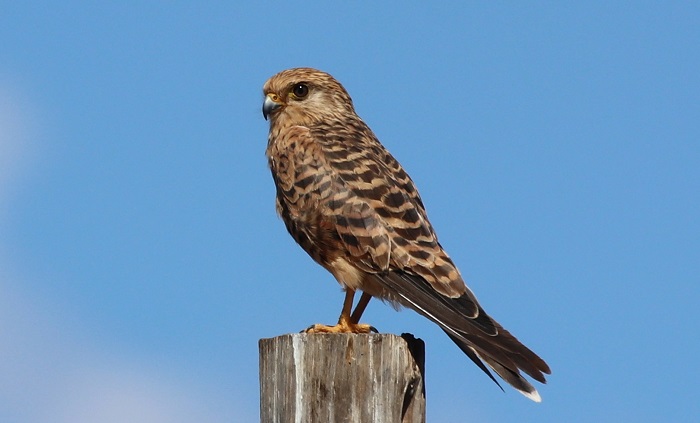
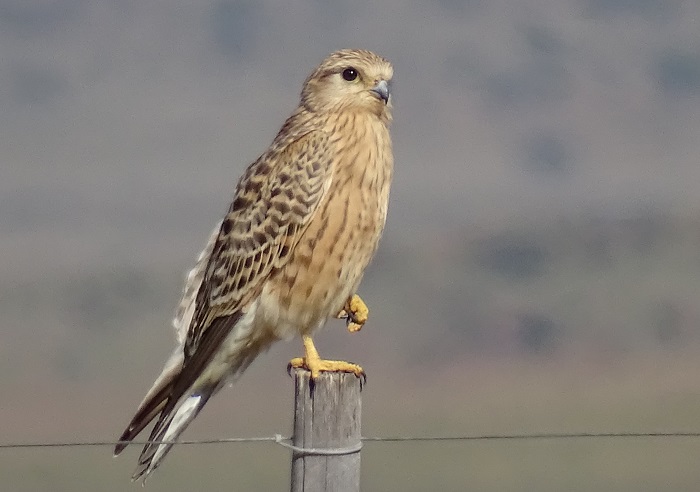
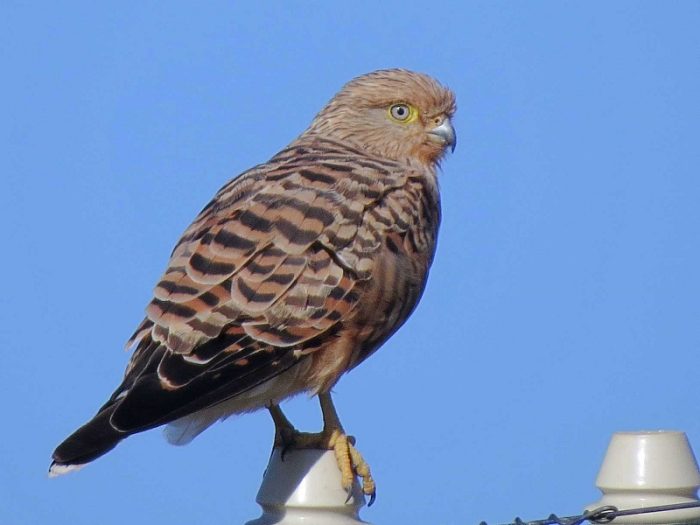
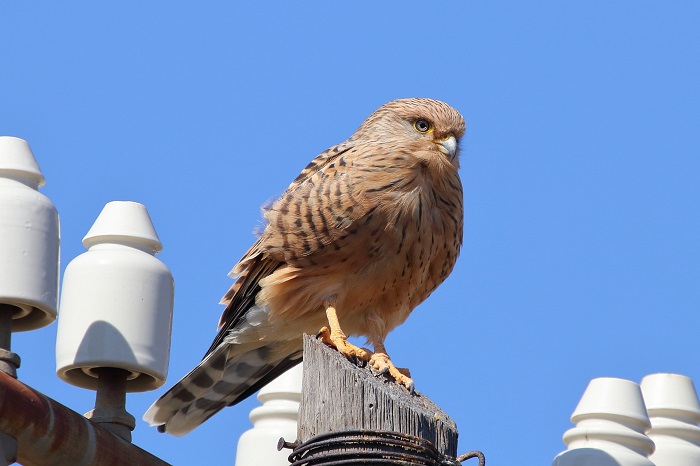
The Greater Kestrel is a smallish, attractively marked raptor. It is, however, the largest Kestrel species in Southern Africa.
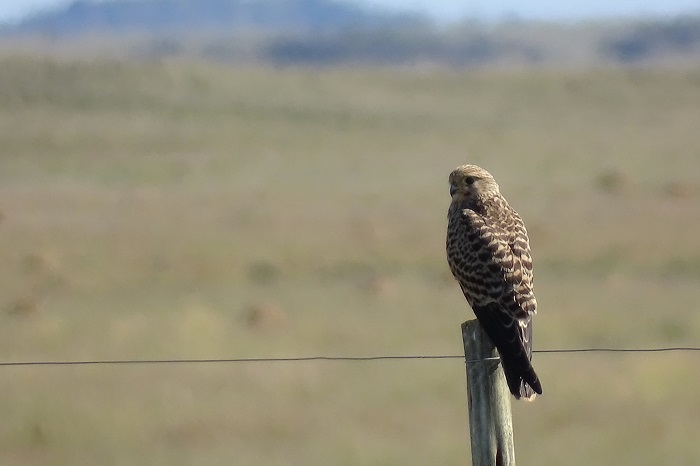
The overall colouration of the head and body is light ginger-brown covered in black barring, blotches, bands and streaks. The head, throat and neck are finely streaked. The streaks become bolder and more prominent on the breast and belly while the flanks are densely barred. The back is strongly marked with thick black barring and the tail is grey with broad black bands.
The head appears fairly large and rounded. The legs and bare skin around the eyes and cere are yellow and the bill is horn-grey. Adults have striking pale coloured eyes.
In flight the Greater Kestrel shows heavily barred upper wings and a grey and black banded tail. The under wings are white with indistinct, grey-barred flight feathers.
The sexes are alike in plumage but they differ in size, the females are slightly larger than males.
The juveniles resemble the adults but have dark-coloured (not pale grey) eyes. They are generally darker rufous in colour and have larger black markings than the adults.
The Greater Kestrel is most likely to be mistaken for females and juveniles of the Rock Kestrel (Falco rupicolis) and Lesser Kestrel (Falco naumanni). Both are smaller and slimmer than the Greater Kestrel and have smaller, less rounded looking heads.
The Greater Kestrel is locallycommon throughout its range. It has a disjunct distribution in the drier regions of Southern and East Africa. It occurs patchily in East Africa from northern Tanzania, up through Kenya to Ethiopia and Sudan. It is More widespread in Southern Africa, occurring over a large part of western and central South Africa and throughout Namibia and Botswana. It is sparsely distributed in Zimbabwe, western Zambia and eastern Angola.
In South Africa it has been recorded from all provinces but avoids the Lowveld and the higher rainfall, low-lying eastern and southern coastal regions.
The distribution of the Greater Kestrel is believed to have expanded due to the clearing of woodlands for cultivation. However the loss of natural grasslands to agriculture and bush encroachment could be a concern. The Greater Kestrel is not considered threatened.
SABAP2 distribution map for Greater Kestrel (Falco rupicoloides) – July 2023. Details for map interpretation can be found here.
Habitat
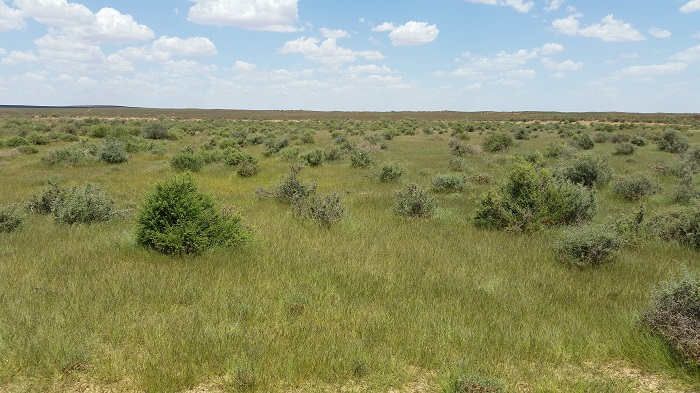
Habitat – Vanwyksvlei district, Northern Cape Photo by Ryan Tippett
The Greater Kestrel is a bird of open, arid and semi-arid areas ranging from desert scrub to dry, open woodlands and grassland. It is most abundant in the Kalahari and Karoo vegetation types. It is also widespread in the grasslands of central South Africa but is less numerous. The Greater Kestrel prefers open veld with short vegetation and moderate to low rainfall. Also occurs in cultivated areas in north-eastern South Africa where it is expanding its distribution.
Greater Kestrels are normally found singly or in pairs and sometimes in loose groups of several birds. Perches conspicuously on whatever vantage points are available, such as termite mounds, trees, and telephone poles, pylons and fences. Advertises to conspecifics that a territory is occupied by perching conspicuously. The flight is bouyant, interspersed with flapping and gliding. Seldom soars but frequently hovers in windy conditions.
Most hunting is done from a perch but they also hunt aerially, usually by hovering into the wind. Prey is generally captured on the ground but may occasionally catch small birds, termite alates and locusts in flight. Males tend to perch-hunt more often than females, and females have better hunting success from hovering than males.
The majority of the Greater Kestrels diet consists of invertebrates especially locusts, grasshoppers, solifugids and termites. They also consume small reptiles like lizards, chameleons and snakes, as well as birds such as quails, doves and small passerines. Mammalian prey consists mostly of rodents. Greater Kestrels are not known to drink or bathe.
The Greater Kestrel breeds from August to December with a peak during September and October. Most egg laying takes place just before the Summer rains in order to maximise prey availability during the nestling period.
Pairs are monogamous and show strong mate fidelity. They do not construct their own nests and prefer to use old stick nests of other raptors or crows. They are dependant on these other species for nests which may limit the distribution of breeding birds. The pair actively defend the area around their nest against conspecifics, other raptor species and corvids (crows and ravens).
From 1 to 5 (usually 3 or 4) eggs are laid per clutch. The eggs are cream or buff coloured with variable reddish-brown speckling. Incubation starts with the first laid egg, as at some nests there is a distinct difference in the age and development of the young. The incubation period lasts for 32 to 33 days and is performed mostly by the female.
Both parents provision the chicks with food. Females tend to hunt close to the nest and mostly capture insects, while males hunt further afield and bring larger prey such as rodents back to the nest. The young are fully fledged after 32 to 35 days but remain dependant on their parents for at least 30 days after their first flight.
This species text is adapted from the first Southern African Bird Atlas Project (SABAP1), 1997.
The use of photographs by Ansie Dee Reis, David Kennedy, Gregg Darling, Josu Meléndez, Phillip Nieuwoudt, Sybrand Venter and Tino Herselman is acknowledged.
Virtual Museum (BirdPix > Search VM > By Scientific or Common Name).
Other common names: Grootrooivalk (Afrikaans); Phakalane (Tswana); Grote Torenvalk (Dutch); Crécerelle aux yeux blancs (French); Steppenfalke (German); Peneireiro-grande (Portuguese).
A list of bird species in this format is available here.
Recommended citation format: Tippett RM 2023. Greater Kestrel Falco rupicoloides. Biodiversity and Development Institute. Available online at http://thebdi.org/2023/07/26/greater-kestrel-falco-rupicoloides/
The overall colouration is ash grey. The underparts, are whitish with fine grey barring while the upperparts are grey and unmarked. Bare skin, including the legs, cere and gape is bright pinkish-red to orange-red, and quite eye-catching. The legs are un-feathered and relatively long
In flight the Pale Chanting Goshawk shows black wing tips and a white rump. The underwings are light grey and the secondaries are pale and finely barred. There is a pale wing panel on the upper wing which is often visible when perched.
The sexes are alike in plumage but they differ in size, the females being noticeably larger than males.
The juveniles are brown above with paler buff-tipped feathers. The head is grey-brown with darker brown streaks. Under parts are blotched and barred in brown and buff. Like the adults, juveniles have a white rump which is most obvious in flight. The legs and bare skin are orangish becoming brighter and redder with age.
The Pale Chanting Goshawk is most likely to be mistaken for the Dark Chanting Goshawk Melierax metabates. They tend to prefer different habitats but their ranges do overlap in the northern parts of the Limpopo province, in eastern and northern Botswana and northern Namibia. The Pale Chanting Goshawk is slightly larger and has paler grey upperparts. The two are best told apart in flight. The Pale Chanting Goshawk has a white rump and a pale panel or window in the upper wing, whereas, the Dark Chanting Goshawk has a grey rump and dark wing panel. Juveniles are harder to tell apart but those of the Pale Chanting Goshawk are a little paler with a white rump and Dark Chanting Goshawk juveniles show a barred or mottled rump.
The Pale Chanting Goshawk is a common species across its distribution. It is Near-endemic to Southern Africa, its range only reaching beyond Southern Africa into south-western Angola.
It is restricted to the western and central regions of Southern Africa, mainly Namibia, Botswana and western South Africa. Its range extends marginally to western Zimbabwe and north-eastern South Africa, especially along the Limpopo Valley.
SABAP2 distribution map for Pale Chanting Goshawk (Melierax canorus) – July 2023. Details for map interpretation can be found here.
Habitat
Habitat – Carnarvon district, Northern Cape Photo by Ryan Tippett
Pale Chanting Goshawks occur in arid and semi-arid areas, especially the Karoo and Kalahari vegetation types. It is present in parts of the Namib Desert and also inhabits drier woodland and grasslands. It is typically a bird of open scrub and wooded drainage lines. They prefer flat terrain and require areas of open ground with places to perch.
Habitat – Near Vanrhynsdorp, Western Cape Photo by Les Underhill
Behaviour
Pale Chanting Goshawks are normally found singly or in pairs, and occasionally in family groups of five or more birds. They are not easily overlooked owing to their habit of perching prominently in the open on trees, bushes, telephone poles, fences and so on. Roadside telephone poles are favoured perches because they are often the tallest vantage points in their habitat and provide easy opportunities for scavenging at road-kills.
Pale Chanting Goshawks spend the vast majority of their time perched. Research has shown that they may spend as much as 75 to 89% of their time sitting. They frequently soar at midday.
Most hunting is done from a perch and they are known to change perch sites frequently. Sometimes forages on foot and may even run after insects and rodents. It has a broad diet and feeds on invertebrates (mainly insects and arachnids), reptiles including snakes, birds up to the size of korhaans and mammals up to the size of hares. They are fond of carrion and regularly feed on road kills. They can sometimes be observed following Honey Badgers and the Yellow Mongoose in the hope of snatching disturbed rodents and insects.
Breeding takes place mainly during spring and Summer (September to December) when food is most abundant. They may not breed at all during drought periods.
The nest is is a modest stick platform up to 40cm in diameter and is built by both sexes. The bowl of the nest is lined with an odd assortment of items that may include hair, dung, soil clods, bits of animal skin, ostrich feathers, grass, small bird nests and spider webs. They often use man-made items such as string, rope, old rags and bits of plastic when nesting close to roads or human habitation. Nests are most frequently placed in thorn trees but they may also nest on telephone poles in treeless regions.
Females lay one or two plain white to greenish-white eggs per clutch. Incubation duties are performed mostly by the female and the incubation period lasts for around 35 days. The young are fed mostly by the female although the male does most of the hunting at this time.
The pair are active in defence of the nest area and males in particular are quite focused on this during the breeding period. They defend the nest area from other raptors, crows, herons, mongooses and other mammalian predators. They will harass and dive at intruders and sometimes even make contact by striking with the feet.
Young birds remain in the parental territory for up to two years but they are not tolerated at or near the nest during subsequent breeding efforts.
Further Resources
This species text is adapted from the first Southern African Bird Atlas Project (SABAP1), 1997.
The use of photographs by Andrew Keys, Anthony Paton, Dawie De Swardt, Desire Darling, Kyle Finn, Les Underhill, Phillip Nieuwoudt and Vaughan Jessnitz is acknowledged.
Virtual Museum (BirdPix > Search VM > By Scientific or Common Name).
Other common names: Bleeksingvalk (Afrikaans); Zanghavik (Dutch); Autour chanteur (French); Weißbürzel-Singhabicht, Heller Grauflügelhabicht (German); Açor-cantor-pálido (Portuguese).
Recommended citation format: Tippett RM 2023. Pale Chanting Goshawk Melierax canorus. Biodiversity and Development Institute. Available online at http://thebdi.org/2023/07/21/pale-chanting-goshawk-melierax-canorus/
List of bird species in this format is available here.
Cover image of Capped Wheatear by Sybrand Venter – Near Carnarvon, Northern Cape – BirdPix No. 219360
Identification
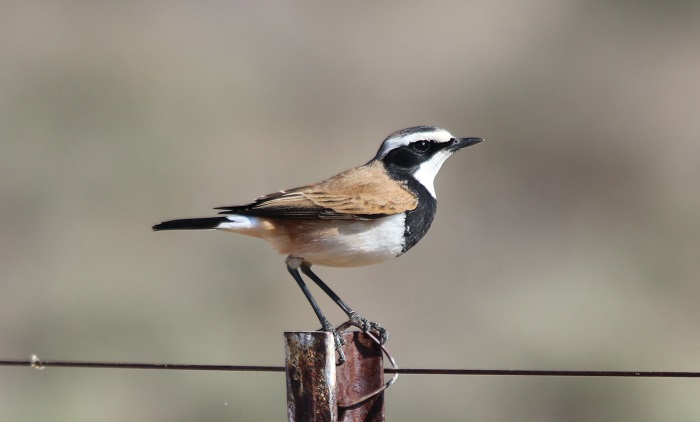
The Capped Wheatear is a strongly marked and attractive species.
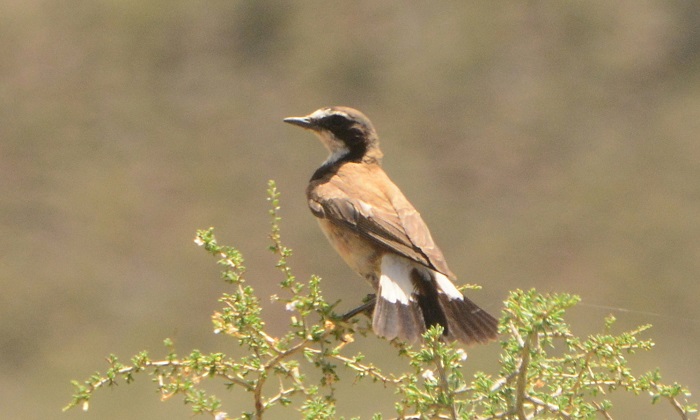
The head and facial areas are boldly patterned. The white forehead, supercilium and throat are striking and contrast strongly with the black crown, face, sides of the neck and the broad black chest-band (diagnostic).
The upperparts are warm brown grading to a richer rufous brown on the rump. The underparts are white to cream with warm buffy flanks.
Similar Species: Adults are unlikely to be mistaken for other species. Juveniles could be mistaken for those of various wheatears and chats but the diagnostic rump and tail pattern should help to alleviate confusion.
Status and Distribution
Overall the Capped Wheatear is a common species. They areresident in some areas and seasonal or erratically present in others. Their seasonal movements are not well understood but may be in response to food availability in arid areas.
SABAP2 distribution map for Capped Wheatear (Oenanthe pileata) – download in July 2023. Details for map interpretation can be found here.
It occurs widely in Southern and East Africa, its range only extending north of the equator in Kenya. In Southern Africa it has a wide but discontinuous distribution. The species is only absent from the eastern lowlands of KwaZulu-Natal, eSwatini (Swaziland), southern Mozambique, the Drakensberg Mountains, Lesotho and the former Transkei in the Eastern Cape. The highest reporting rates come from the Kalahari and the winter rainfall region of the Western Cape province. It is also present in good numbers throughout the Karoo.
It is likely in some areas that the Capped Wheatear has benefitted from bush clearance for agriculture. It is not considered threatened.
Habitat
The Capped Wheatear inhabits dry grassy plains with bare or overgrazed patches, short or recently burnt grass and semi-arid shrublands across the Karoo. They are often found around stock pens and fallow and recently harvested croplands. Capped Wheatears have a preference for flat terrain.
Habitat – Near Near Vanrhynsdorp, Western Cape Photo by Les Underhill
Its association with fynbos is largely secondary as a result of having adapted to tilled ground and wheat croplands.
Moves into arid habitats after rains but leaves again once dry conditions return.
The Capped Wheatear is a conspicuous species owing to its habit of perching boldly in the open on bushes, fence posts, rocks or termite mounds. Has a typically upright posture when perched or looking about in between foraging. Flies low between perches. Upon landing it has a habit of bobbing its head and tail up and down while bowing its body.
They are usually encountered singly or in pairs but may also be found in family groups towards the end of the breeding season.
Most foraging takes place on the ground after flying down from its perch. The Capped Wheatear prefers to search for prey on bare or recently burnt ground. Mostly consumes arthropods like insects, spiders, centipedes and millipedes. They are especially fond of ants and termites and are also known to feed on small fruits and seeds.
Capped Wheatears are monogamous and territorial. Pairs defend their territories against conspecifics as well as from other species such as the Karoo Chat (Emarginata schlegelii).
Breeding mostly takes place during Spring and early Summer, from September to December. Capped Wheatears are dependant on rodent burrows in which to nest. The nest is placed at the end of the burrow where it widens into a chamber. The nest is sometimes located as much as 2m underground but more usually at a depth of 50 to 100cm. Nest burrows are normally located on open ground. The nest is relatively large and cup-shaped. It is composed of grass, leaves and other fine plant material and lined with hair, feathers and other soft material.
Two to four eggs, or occasionally five are laid per clutch. The eggs are pale greenish-white or bluish-white and usually lack other markings. Further details regarding incubation and the nestling or fledgling periods are unrecorded.
Capped Wheatear (Oenanthe pileata) Carnarvon district, Northern Cape Photo by Ryan Tippett
Further Resources
Species text adapted from the first Southern African Bird Atlas Project (SABAP1), 1997.
The use of photographs by Johan and Estelle van Rooyen, Lance Robinson, Les Underhill, Pamela Kleiman, Sybrand Venter and Zenobia van Dyk acknowledged.
Virtual Museum (BirdPix > Search VM > By Scientific or Common Name).
Other common names: Hoëveldskaapwagter (Afrikaans); Inkotyeni, Isixaxabesha (Xhosa); Ntidi (Tswana); Traquet du Cap (French); Erdschmätzer (German); Aardtapuit (Dutch); Chasco-de-barrete (Portuguese)
List of bird species in this format is available here.
Recommended citation format: Tippett RM 2023. Capped Wheatear Oenanthe pileata. Biodiversity and Development Institute. Available online at http://thebdi.org/2023/07/17/capped-wheatear-oenanthe-pileata/
This is a list of bird ringing courses and other ringing events with reports on the BDI website. The most recent event is at the top, and we work backwards to finish with the first report, on an event in December 2019, at the bottom. Future ringing courses and events are listed here.
Dieter Oschadleus leads the majority of these bird ringing events. His main ornithological research interest is in the weavers. He is holding a Southern Masked Weaver
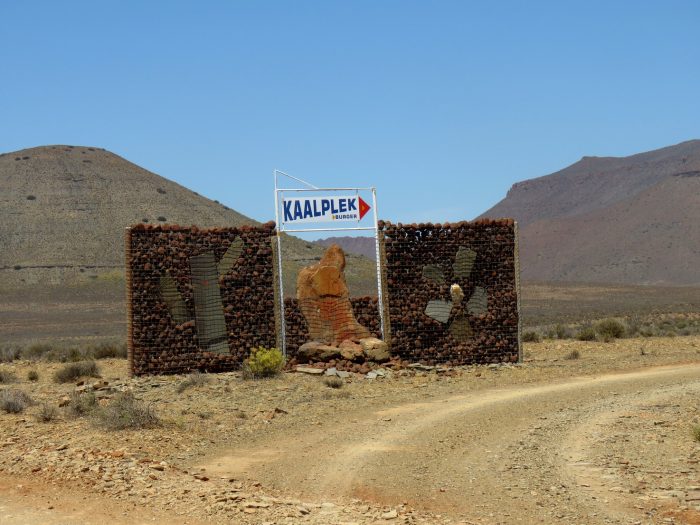
Calvinia BioBash: The entrance to the farm Kaalplek, “naked place”, i.e. almost no vegetation cover. A farm in the Hantam
Wrap!
Most of the bird ringing courses and events have been led by Dieter Oschadleus. All the ringing data collected is embedded in SAFRING, the South African Bird Ringing Unit. The value of bird ringing to our understanding of bird biology, and the contribution that bird ringing makes to conservation is described here.
A list of future bird ringing courses and events is maintained on the BDI website.
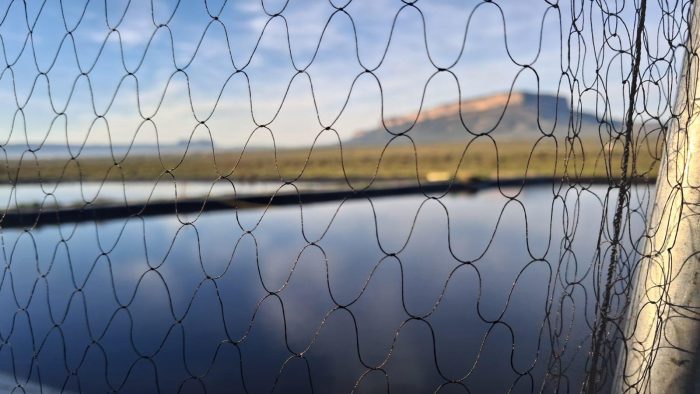
Mistnets near the interface between natural vegetation and agriculture at Vondeling Wine Estate
Cover image of Crowned Lapwing by Pieter Cronje – Moreleta Kloof Nature Reserve, Gauteng – BirdPix No. 89394
Identification
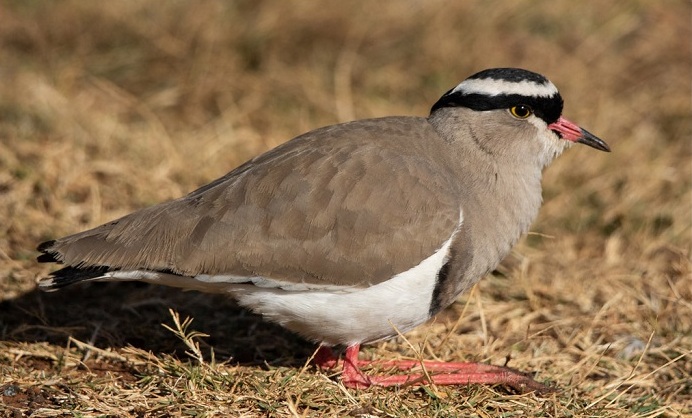
The Crowned Lapwing is a distinctively marked and conspicuous species. The black and white banded plumage on the head is diagnostic. The upperparts, neck and breast are plain sandy-brown. The belly, vent and undertail coverts are white, while the breast and belly are separated by a black band. The legs are bright pinkish red and the bill is red with a black tip.
In flight the primaries are black and contrast strongly with the white primary coverts and brown back.
The sexes are alike. Juveniles resemble the adults but have scalloped upperparts, buffy barring on the crown and yellowish, not red legs.
A juvenile Crowned Lapwing (Vanellus coronatus) showing the buffy, scalloped plumage. Mkhuze Game Reserve, KwaZulu-Natal Photo by Colin Summersgill
Status and Distribution
The Crowned Lapwing is considered a common to very common resident and local migrant.
The distribution stretches from Ethiopia and Somalia south through East Africa to southern Angola and South Africa. It is found throughout southern Africa, but is mostly absent from the arid south-west of Namibia, and is scarce in the western parts of the Northern Cape, Lesotho, the former Transkei (Eastern Cape) and parts of southern Mozambique.
SABAP2 distribution map for Crowned Lapwing (Vanellus coronatus) – June 2023. Details for map interpretation can be found here.
The core of its range lies in Botswana, North West Province, Gauteng and Free State, as well as the agricultural lands of the Western Cape.
The Crowned Lapwing is not threatened and has expanded its range as a result of human activities such as bush-clearing, overgrazing and allowing fields to lie fallow.
Habitat
Crowned Lapwing (Vanellus coronatus) – A pair in typical habitat with short grass and bare patches. Pilanesberg National Park, North West Photo by Phillip Nieuwoudt
Crowned Lapwings inhabit dry, open grassland, sparse woodland and open areas in Karoo scrub, favouring sites with short grass. It has adapted well to man-modified habitats, including short pastures, open fields, airports, golf courses, sports fields and roadsides. It is frequently attracted to burnt grasslands and normally avoids areas of tall grass. The Crowned Lapwing is not generally associated with water, but occurs in dry salt-marsh vegetation and around pans and usually avoids mountainous areas.
The Crowned Lapwing is typically encountered in loose flocks of varying sizes but is found in pairs during the breeding season.
It is mostly a dry season visitor to regions of higher rainfall but it can remain year-round in dry years. It frequently undertakes local movements but neither the scale nor regularity of these movements is understood.
When feeling threatened, Crowned Lapwings will call whilst bobbing the body up and down. They stand in a hunched posture or sit on the ground when not foraging. Bathes by standing in water up to breast and using the wings to flap and splash water onto the body. Crowned Lapwings roost on the ground, usually in slightly elevated places.
Forages by standing or walking slowly, while scanning for potential prey and then dashing in to peck at it in typical plover fashion.
Foraging groups often move in a regularly spaced line. They feed primarily on harvester termites. Other prey taken includes ants, beetles and small numbers of grasshoppers, spiders and millipedes. Also consumes earthworms after heavy rain showers.
Frequently associates or forages with other Lapwing species, most notably the Black-winged Lapwing (Vanellus melanopterus). The two species show few aggressive interactions and sometimes defend feeding territories together. This association is mutualistic in that both species benefit from from the interaction. The larger and more aggressive Crowned Lapwing helps to defend the less aggressive Black-winged Lapwing. The Black-winged Lapwing is the more alert and vigilant of the two and this allows the Crowned Lapwing to spend more time feeding.
Crowned Lapwings become largely inactive when temperatures rise above 24°C or fall below 10°C.
They are monogamous and only rarely polygynous. Crowned Lapwings are territorial and solitary nesters, but often breed in small, loose aggregations. Breeding in groups provides an advantage against predators through group mobbing and safety in numbers. Males defend small territories which they acquire by calling continuously from an elevated position and also during circular display flights around 50 m above the territory.
The nest is a shallow scrape in the ground, lined with dried grass, roots, small stones and dried dung. Nests are often situated among large stones in order to disguise the shape of the incubating bird. The nest site is usually located within 10-20 m of shade, and is frequently reused in successive years.
Egg laying can occurat any time of the year with apeak from August to December, but is slightly earlier in the winter-rainfall regions of the Western Cape. The female lays 2 to 4 eggs per clutch. The eggs are yellowish-brown to olive-brown, boldly spotted with black and grey. The female usually lays a replacement clutch if the previous clutch fails and up to 6 clutches may be laid in a single season.
Incubation begins after the full clutch has been laid in cool conditions but starts after the first-laid egg during hot conditions. The incubation period lasts for around 30 days and the female is responsible for most of the incubation duties. Pairs will aggressively defend the nest site from threats including terrestrial and aerial predators as well as large herbivores that could trample the nest. Nest defence also includes false-brooding and other distraction displays to lure terrestrial predators away from the nest. The intensity of their nest defence grows as incubation progresses.
Eggs hatch within a 4 to 6 hour period. The female removes broken eggshells, carrying them 20-30 m from the nest before breaking them up and discarding them. Newly hatched young are precocial and covered in down. They are speckled buff and black above with a black stripe down the back. Hatchlings remain at the nest for around 4 hours until their down has dried, after which they will then join and follow the parents. Chicks self-feed from their first day, but the adults still direct them to food items. The parents will defend the chicks vigorously through distraction displays and aerial mobbing, often almost striking intruders with trailing legs or wings.
The fledging period lasts for about 30 days but some chicks remain with the parents for almost a year, leaving before the start of the next breeding season. Fledglings from the first brood sometimes help with nest defence during the second breeding attempt.
Species text from the first Southern African Bird Atlas Project (SABAP1), 1997.
The use of photographs by Colin Summersgill, Gerald Wingate, Karis Daniel, Lia Steen, Neels Jackson, Phillip Nieuwoudt and Pieter Cronje is acknowledged.
Virtual Museum (BirdPix > Search VM > By Scientific or Common Name).
Other common names: Kroonkiewiet (Afrikaans); iHoye (Zulu); lgxiya (Xhosa); Nghelekele (Tswana); Diadeemkievit (Dutch); Vanneau couronné (French); Kronenkiebitz (German); Abibe-coroado (Portuguese)
A list of bird species in this format is available here.
Recommended citation format: Tippett RM 2023. Crowned Lapwing Vanellus coronatus. Biodiversity and Development Institute. Available online at http://thebdi.org/2023/07/07/crowned-lapwing-vanellus-coronatus/
Although mid winter, we had a great bird ringing course at Botuin, in Vanrhynsdorp. The days were shorter and colder, and the migrants had left (except for one! see below). Two trainees with no previous experience did very well getting started on their ringing training adventure.
Ringing training on the go!
Very unexpectedly a Eurasian Golden Oriole was found in a net at Botuin near a fig tree. This oriole is a migrant species, breeding in the northern hemisphere. The bird we caught was an immature bird that was overwintering in South Africa. Trevor Hardaker comments: “Eurasian Golden Oriole turns up annually in the Western Cape and I saw them at Somerset West and Mamre earlier this year. They have also been seen at several places on the Garden Route this past summer. I don’t know of any records from Vanrhynsdorp though, but they have previously been recorded as far north as Citrusdal. As far as I recall, this record is the northernmost on the West Coast”. This is the first time a Eurasian Golden Oriole has been ringed in the Western Cape.
Weavers and sparrows
As usual weavers and sparrows were the most ringed species, with more Laughing Doves caught than usual. One male Cape Weaver had started nest building in the large Prosopis tree in the Botuin garden, but most breeding activity was in the next door garden and at the sewage works. Several females had brood patches. A few juveniles were also ringed, suggesting that these birds had been breeding for the last few weeks.
A few Southern Masked Weaver males were in near full breeding plumage and 3 females had brood patches. Southern Red Bishops showed no brood patches, but one male was completing his moult into breeding plumage. Several recently fledged Cape Sparrows were also ringed – the gape flanges were distinct.
Southern Red Bishop – male with last vestiges of non-breeding plumage
Laughing Doves
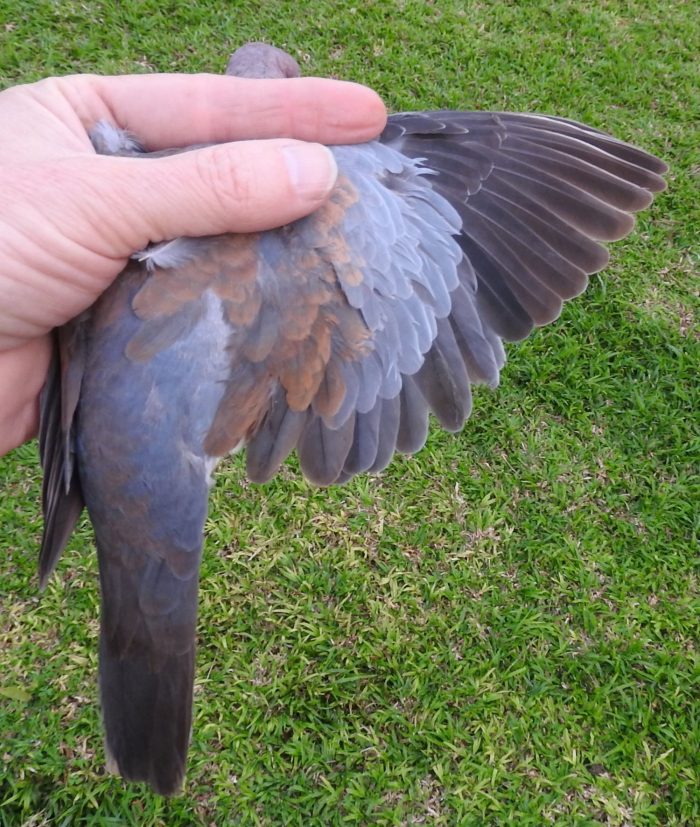
We had a larger mesh net up in the area that they scattered to when disturbed from the seed in the driveway – we only discovered this on the second last day! So next time these doves may be at the top of the list. Some of the doves were showing primary moult.
Laughing Dove with the first primary newly replaced (black) and the outer nine primaries older (dark brown)
Sewage works
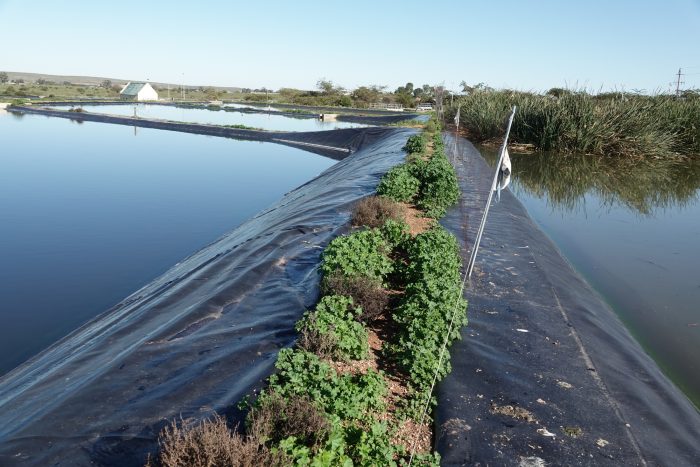
The Vanrhynsdorp Sewage Works is about a kilometre out of town. It consists of a series of plastic lined pans. By the time the “water” reaches them it has been through the main processing stages! We have special permission to ring here. We put mistnets up along the dividing walls between pans. One of the pans has a substantial reedbed, used both as a roost and as a breeding colony by Cape Weavers and Southern Masked Weavers. About half the birds we handled were weavers.
The neatly maintained Vanrhynsdorp Sewage Works. Mistnets along the dividing walls target species moving between pans
There was a roving flock of starlings at the sewage works, and we caught a few African Pied and Wattled Starlings. There was a variety of ducks at the sewage ponds, but we did not catch any this time. However, two adult moorhens that flushed into the nets were exciting catches. A Three-banded Plover was also great to catch and ring.
The brightly coloured beak of the Moorhen contrasts with its black body plumage. Note the large legs and long slender toes, in comparison with the size of the bird
Karoo birds
We spent one morning in nearby karoo veld. It gave us a chance to get close up to the block of rock that defines Vanrhynsdorp. The !Khoi name for the mountain is Maskam, “the mountain that gives water”. It is most widely known as the Gifberg, because this is the only place in the world where the Gifboom Hyaenanche globosa grows.
We had a very long line of nets …… and a gazebo to keep us out of the sun!
In spite of the very long line of mistnets, the catch, as expected, was low. But we come here because the site offers some great birds that cannot be caught anywhere else. This time it delivered two Sickle-winged Chats. Until you have the bird in the hand, and have a chance to inspect the outermost primary, the motivation for the name is a mystery! Look at the shape of the primary with the arrow in the photo below:
Sickle-winged Chat – outer primary indicated by arrow; note also the rump pattern differs from the similar Familiar Chat
Recaptures
We ringed 202 birds and caught 49 birds with rings, giving a high recapture rate of nearly 20%. All recaptures had been ringed at the same site (except some Cape Weavers) and within the last three years, when ringing at Botuin first started (see blog).
Four Cape Weavers (two males and two females) had been ringed at Botuin previously and were recaptured at the sewage works, presumably to breed here. The distance is only 1.5 km as the weaver flies, but no other ringed species seems to have traversed this distance.
The district had had the most amazing rainfall in the weeks before the course. The countryside was uncharacteristically green. The upcoming flower season in Namaqualand will be spectacular. It will also be early. The photo below was taken on 3 July …
.. and the spring flowers had already started … over the next couple of weeks, this scene will morph into a carpet of colour. And all the birds will be breeding!
THANKS, Salome. for hosting us so well at Botuin! This was our second bird ringing course at Botuin; the blog on the first one, in February this year. is here. That course had two interns from the Global Training Programme of the Basque Country, Spain … in exchange for learning skills in bird ringing, they gave us the skills to make Spanish omelettes:
Salome, Spanish omelettes, and some red wine at the end of a superb day’s ringing!
Since 2019, we have done increasingly regular ringing at Botuin. Here is a summary. This course brought the ringing total to almost one thousand birds. Continuing ringing here will soon enable us to estimate survival rates for at least the most commonly caught species. Estimating survival is one of the values of bird ringing.
For more ringing courses and other opportunities, go to Events on the BDI website! Do join us on a future event. There will be another bird ringing course at Botuin early in 2024.
Total catch at three sites in Vanrhynsdorp, 28 June-4 July 2023