
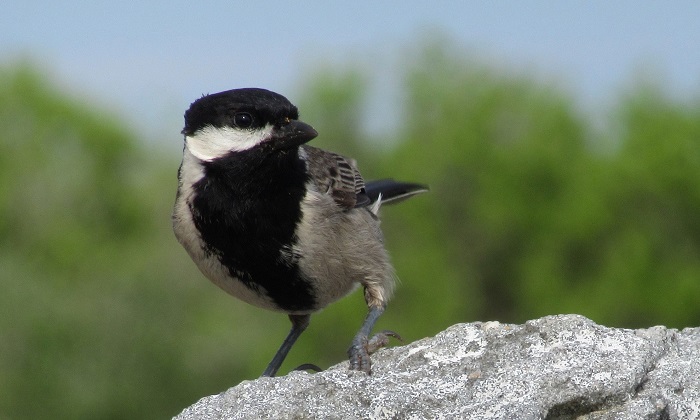
Cover image of Grey Tit by Felicity Ellmore – Vredendal district, Western Cape
The Grey Tit is a member of the Family PARIDAE (Tits, Chickadees, and Titmice). They are mainly small, stocky, woodland species with short, stout bills. Some species have crests. Overall, the Paridae are very similar in general morphology. They are mostly adaptable birds, with a mixed diet including seeds and insects. Most tits live in forested habitats, from boreal coniferous forests in the north to humid tropical forests in the south. A small number occupy desert scrub and other arid habitats. All species require cavities in which to nest. This family comprises 62 species from 13 genera. 7 species occur in southern Africa.
Identification
The Grey Tit is a fairly small grey, black-and-white passerine. Its common name is misleading, as it is not as grey as the closely related Ashy Tit (Melaniparus cinerascens).

Near Smithfield, Free State
Photo by Lance Robinson
The sexes are similar but differ slightly in plumage colouration.
In adult males, the crown, lores, upper cheeks, and nape are black with a slight gloss. A broad buffy-white band extends from the base of the bill across the cheeks and ear coverts to the sides of the neck. There is a buffy-white patch at the edge of the upper mantle. The rest of the mantle, scapulars and rump are dark greyish-brown. The tail is dusky-brown with buff-white outer tail feathers. The lower cheeks, chin, throat, and sides of the foreneck are black. The black extending as an ‘arrow’-shaped bib onto the upper belly. The sides of the breast, lower belly and flanks are pinkish buff. The bill is black, the eyes are dark brown, and the legs and feet are grey.
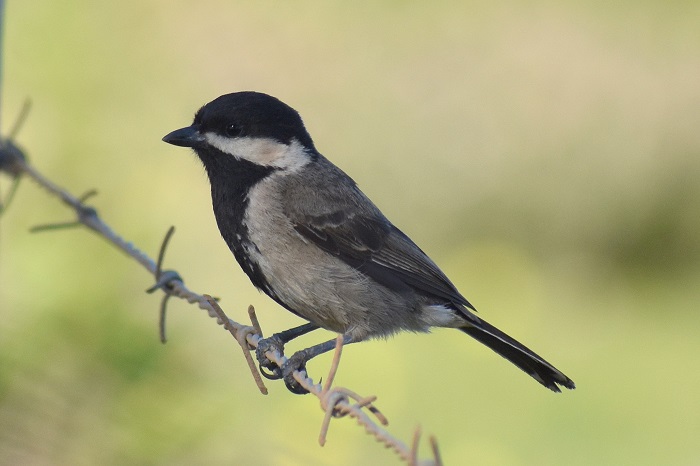
Near Lamberts Bay, Western Cape
Photo by Zenobia van Dyk
Females are similar to males, but the cap is sooty black and less glossy. The throat and bib are brownish-black and less extensive than in males. Juveniles resemble the adults but have a brownish black cap, a browner back, and the primaries and secondaries have buffy edges.
The grey Tit is quite similar to the Ashy Tit (Melaniparus cinerascens). However, the latter has a white, not buffy-white, patch from the base of the bill to the hind neck. The Ashy Tit also has a bluish-grey, not grey-brown, back, and its flanks are grey, not pinkish buff.
Status and Distribution
The Grey Tit is fairly common across most of its range but is uncommon in very arid regions. It is endemic to southern Africa and occurs in south-western Namibia, the Northern and Western Cape, east to the south-western Free State, the Eastern Cape and the Lesotho highlands.
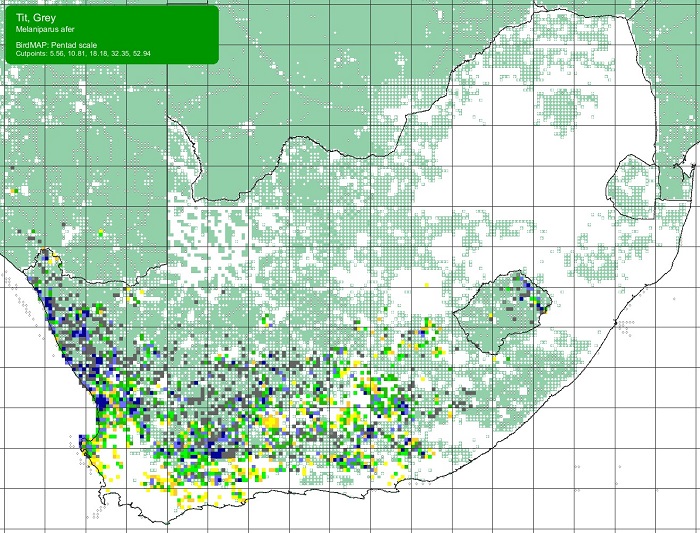
Details for map interpretation can be found here.
The Grey Tit is not threatened. It is common and occupies habitats that are not presently under threat.
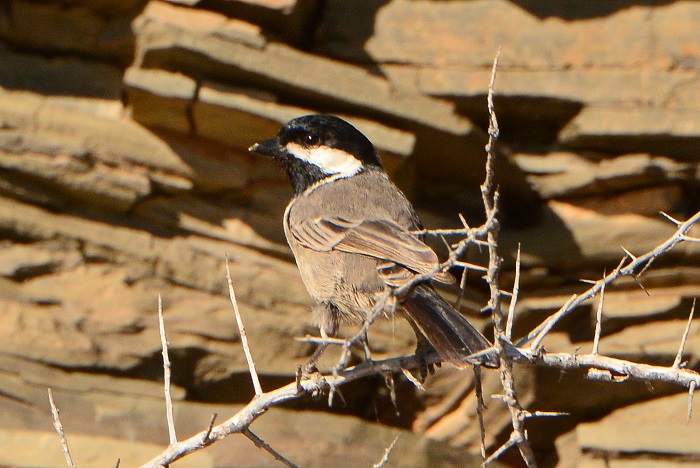
Carnarvon district, Northern Cape
Photo by Ryan Tippett
Habitat

Carnarvon district, Northern Cape
Photo by Ryan Tippett
Across much of its range in the Nama and Succulent Karoo, it is associated with karroid scrub, usually in rocky places, on hillsides and around koppies. The Grey Tit also inhabits dry woodland along seasonal rivers, dwarf shrublands, strandveld, renosterveld and farmyards. In Lesotho, it occupies rocky areas and slopes with moderate to thick scrub cover.
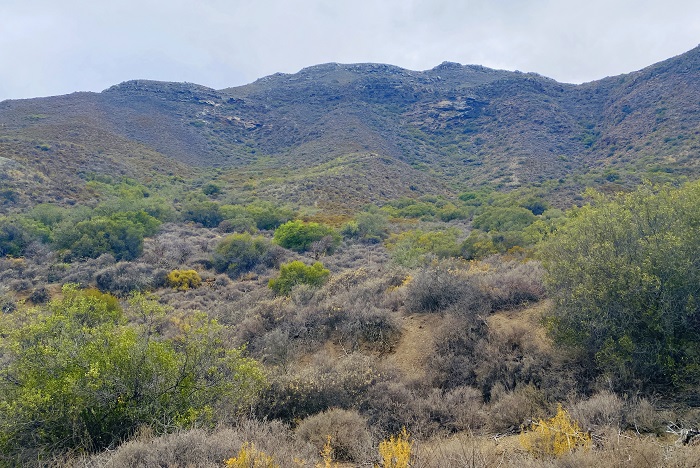
Photo by Karis Daniel
Behaviour
The Grey Tit is resident but often locally nomadic in drier areas. It is usually seen in pairs or small family groups of 3 to 6 birds. They roost singly in cavities in trees and stone walls, and in steel pipes.
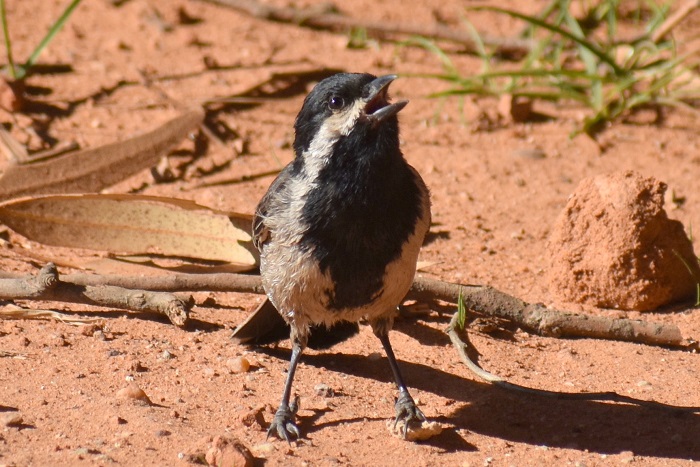
Near Lamberts Bay, Western Cape
Photo by Zenobia van Dyk
The Grey Tit is an active species that moves restlessly through vegetation. It is rather vocal and calls frequently while foraging. Forages on branches and among the foliage of trees and bushes, hopping about and hanging upside down to glean items from crevices in bark and twigs. They often break open thorns to extract insect larvae and peck at the bases of dry seed heads to test for the presence of insect larvae or seed parasites.
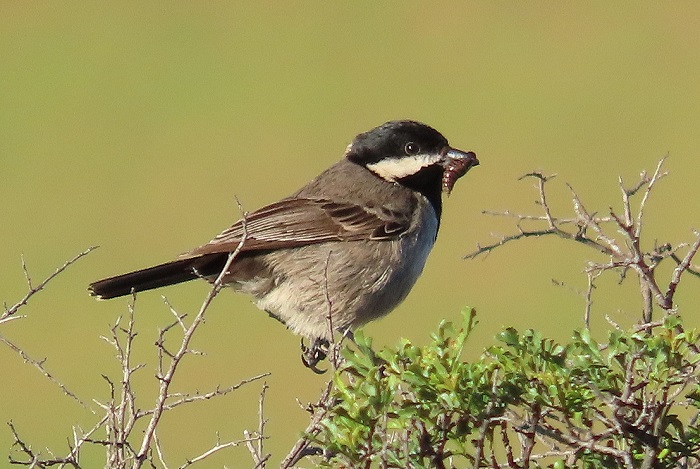
Kamieskroon, Western Cape
Photo by Johan van Rooyen
The Grey Tit eats mostly insects, especially butterfly and moth caterpillars. It also consumes ants and termites as well as their alates. They also feed on beetles, spiders, and sometimes small berries. Some food items are first stunned by bashing them against a stone or branch before swallowing them whole. Larger items, including large caterpillars, are first bashed, then held down with a foot to be eaten in manageable chunks.
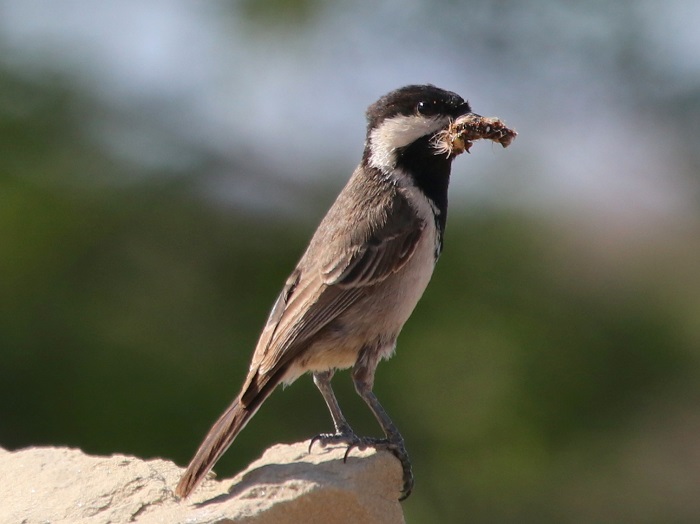
Carnarvon district, Northern Cape
Photo by Sybrand Venter
The Grey Tit is a facultative cooperative breeder, and all group members participate in searching for suitable nest sites. The nest is built by both sexes in around 14 days. The nest is a thick pad of hair, feathers, sheep’s wool and grass or other fine plant material. It is located at the bottom of a cavity in a tree, in an earthen bank, a stone wall, or a steel pipe. The Grey Tit sometimes also uses old nests of the Greater Striped Swallow (Cecropis cucullata).
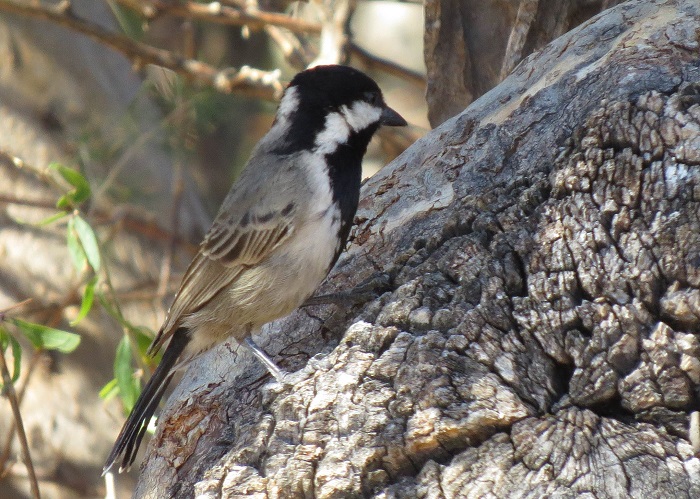
Near Middelburg, Eastern Cape
Photo by Tino Herselman
Eggs are laid from Jul to Oct in the winter rainfall region of the Western Cape and from August to March across the rest of its range. 2 to 5 eggs are laid per clutch. The eggs are white, finely spotted with reddish, purple and grey, and are oval in shape. The incubation period lasts for around 12 days. All incubation is done by the female. She is fed throughout by the male, who calls the female out of the nest to receive food.
The newly hatched young are undescribed. The nestling period lasts around 20 days. Nestlings are fed mainly caterpillars by the parents and 2 or 3 helpers. Almost fully fledged nestlings come to the nest entrance to receive food.
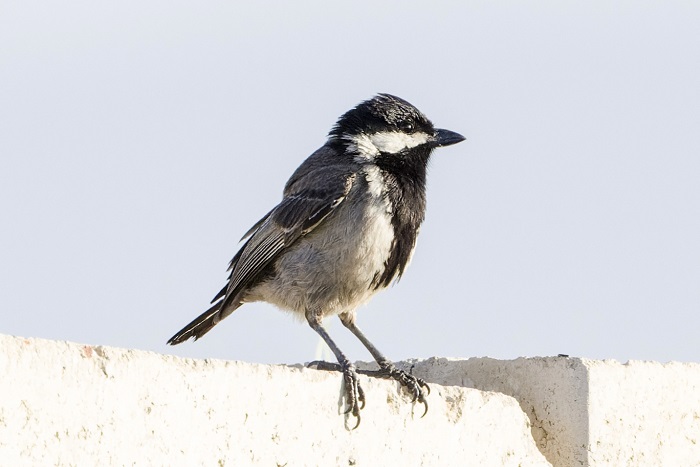
Yzerfontein, Western Cape
Photo by Marna Buys
Further Resources
This species text is adapted from the first Southern African Bird Atlas Project (SABAP1), 1997.
The use of photographs by Felicity Ellmore, Johan van Rooyen, Karis Daniel, Lance Robinson, Marna Buys, Ryan Tippett, Sybrand Venter, Tino Herselman, and Zenobia van Dyk is acknowledged.
Other common names: Southern Grey Tit (Alt. English); Piet-tjou-tjou-grysmees (Afrikaans); Mésange petit-deuil (French); Kaapse Mees (Dutch); Kapmeiseerman); Chapim-cinzento-meridional (Portuguese).
Recommended citation format: Tippett RM 2026. Grey Tit Melaniparus afer. Biodiversity and Development Institute. Available online at https://thebdi.org/2026/08/31/grey-tit-melaniparus-afer/
A list of bird species in this format is available here.
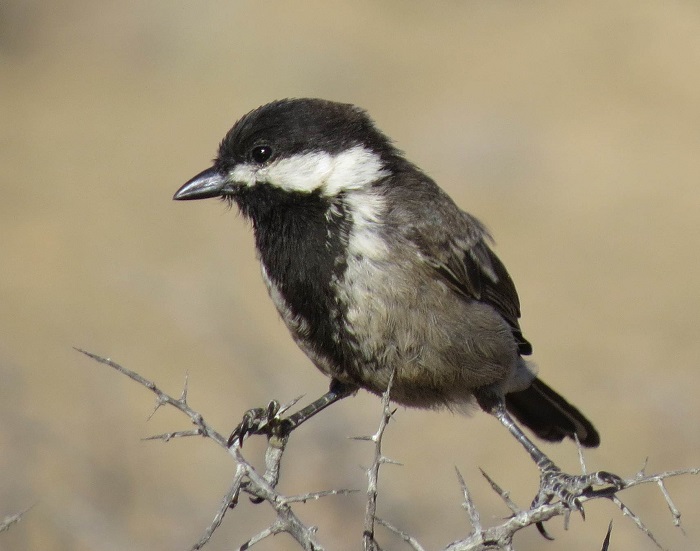
Williston district, Northern Cape
Photo by Tino Herselman
