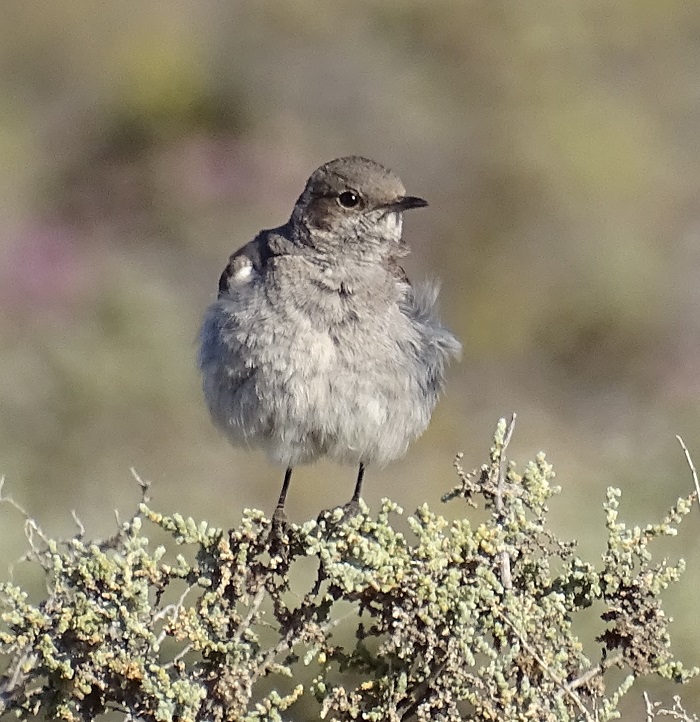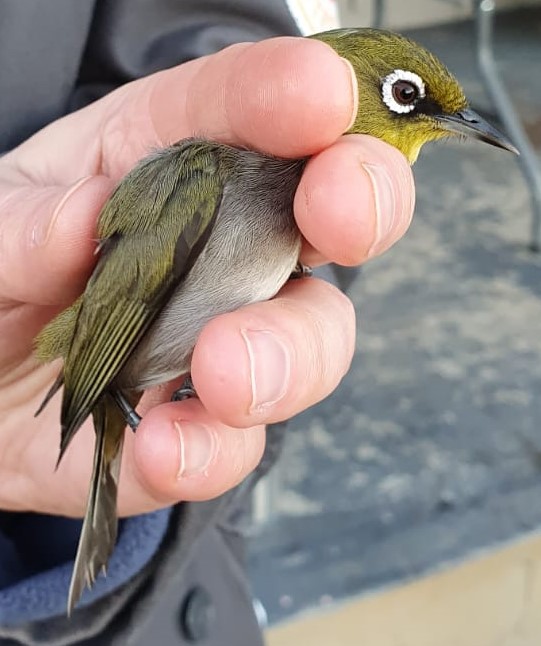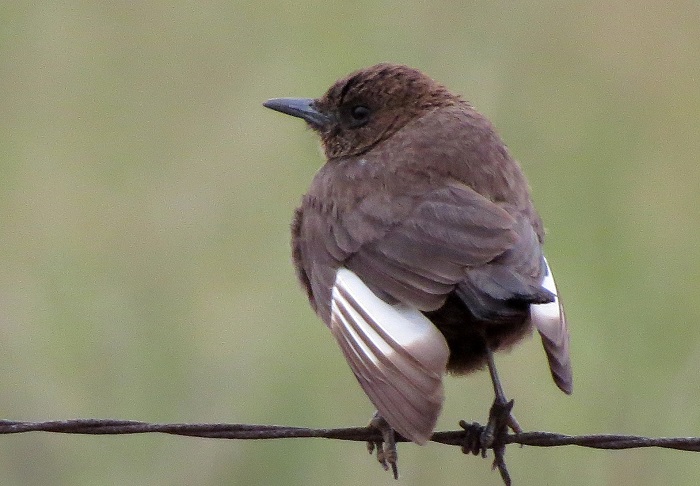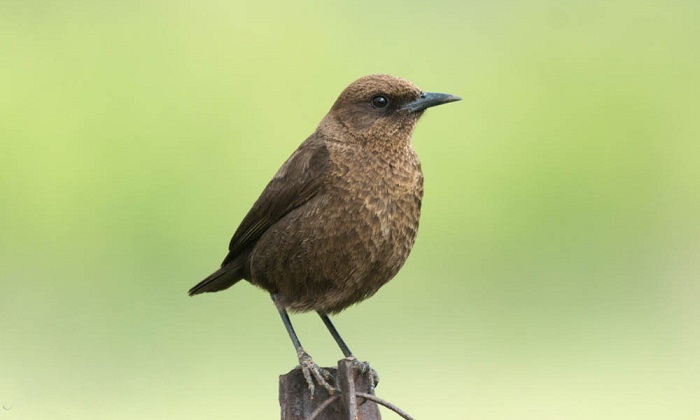
Bird ringing course at Ouberg Private Nature Reserve, 10 to 16 May 2023

A cold and sometimes wet Karoo week was not the best for a ringing course, yet everyone thoroughly enjoyed the course! We caught 219 birds of 29 species at the Ouberg bird ringing course of May 2023, including lots of recaptures, enjoyed wonderful meals, and great camaraderie.

The course was part of a series of bird ringing courses run by the Biodiversity and Development Institute. The overall aim and structure of these events is described here. Future courses are listed under “Upcoming BDI Events” and you are welcome to join. The purpose of bird ringing is described here.

Ouberg Private Nature Reserve
Ouberg Private Nature Reserve. The farmhouse where we stay is on the left. The drainage line in front of the house stretches off to the right and is filled with riverine bushes and a few small reedbeds, used as night time roosting sites. Great ringing site!

The course was held in the foothills of the big mountains north of Montagu, Western Cape. For background to the Ouberg Private Nature Reserve and its objectives, listen to this conference presentation. Ouberg is a good place for birding in general, but it is the species richness we get while ringing makes it a chosen spot for courses! The drainage line in front of the farmhouse (see the drone photo above) is a highway for bird movement, and provides great mist netting sites.

An innovation on this course was to catch five Cape Spurfowl in noose traps – three males and two females (read more here). Only the males have spurs on their legs, making sexing easy. The spur lengths of the three males were 12, 18 and 21 mm and those with longest spurs were the heaviest (around 1 kg).

We were surprised at the number of mousebirds we caught. Mousebirds often escape from the nets. With a good catch, we looked at biometrics – the wing (mean 96.2 mm) of Speckled Mousebird was slightly larger and the tail (mean 206 mm) slightly shorter than these measurements for White-backed Mousebird (mean 92.7 mm and 222 mm respectively).

mousebird tails at the Ouberg bird ringing course of May 2023
Long tails of the White-backed Mousebird (top) and Speckled Mousebird (below)


There were two pairs of Rock Martins roosting on the farm house. They carefully avoided the mist nets, so one was caught by hand on the last morning at dawn, while it was roosting on the rafter of the veranda. Its partner escaped!

Rock Martin at the Ouberg Bird Ringing Course of May 2023
Rock Martin


Three Olive Thrushes were caught and a Karoo Thrush was seen.

Olive Thrush
Olive Thrush, showing the extensive orange on the flanks


We also caught a relatively large number of tit-babblers, nine Chestnut-vented Warblers and two Layard’s Tit-babblers. The two species are similar in size and plumage; the difference is the colour of the undertail coverts (the “vent”): white in Layard’s and chestnut (of course!) in Chestnut-vented! See the photos below.

Chestnut-vented Tit-babbler
Chestnut-vented Warbler, with chestnut vent
Layard's Tit-babbler at the Ouberg Bird Ringing Course of May 2023
Layard’s Warbler, with white vent

The Southern Fiscals consisted of four males and a female.

Cape Sparrows were very common around the farm house. This was the most caught species – 14 males and 24 females (two of the females were recaptured on later days, to make a capture total of 40 birds for the course).

Cape Sparrow showing no primary moult at the Ouberg Bird Ringing Course of May 2023
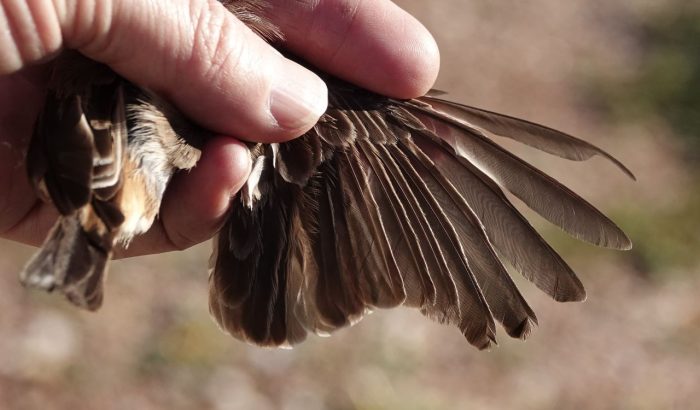
Cape Sparrow, one of 40 caught. This photo clearly shows the nine primary feathers on the wing of this male; they are all new, with smooth unworn ends. It has completed primary moult. Most of the birds we caught had completed this feather replacement process; birds try to avoid moulting during the cold winter.


Weavers and waxbills roosted in reeds near the farmhouse, and a good number were caught – six Cape Weavers, 37 Southern Masked Weavers and 14 Common Waxbills. But many flew out in the wrong direction; now we know where we will put mist nets next time! Two male Southern Masked Weavers were in partial breeding plumage.

Southern Masked Weave in partial breeding plumage at the Ouberg Bird Ringing Course of May 2023
Male Southern Masked Weaver in partial breeding plumage

Recaptures

We have had several bird ringing expeditions to Ouberg Nature Reserve. The first was in October 2020, and the most recent was in February this year! One of the most valuable aspects of repeated ringing at a place are the recaptures of previously ringed birds. These are used to estimate survival rates for species, which are a critical ingredient in discussions about bird species conservation. There were 37 recaptures. Six birds had first been ringed on our initial ringing expedition in October 2020 – Little Rush Warbler, two Cape Robin-chats, Chestnut-vented Tit-babbler, Cape Weaver and a Cape White-eye. A Southern Fiscal and a Cape Sparrow had been ringed on 24 July 2021. Five birds had been ringed in October 2022, and 12 birds had been ringed in February 2023, a few months ago. We have not yet got enough data to start survival analysis studies, but our intention is to keep returning to this really good ringing site.

One aspect of bird biology which is poorly known is the extent of local movement of the resident species. The drainage line at Ouberg provides an opportunity to investigate this. So on two mornings we ringed at little gaps in the riverine bush some distance from the farm house (see the photo near the top of this blog). At the first gap we recaptured a Chestnut-vented Tit-babbler (ringed at the farm house on 23-Oct-20) and a Long-billed Crombec (ringed at farm house on 15-Feb-23). At the second gap we recaptured a Cape Robin-chat (ringed at farm house on 22-Oct-20).

Numbers of birds caught at Ouberg, 10 to 16 May 2023

The species with links in the table below have full descriptions on the BDI website.

Sp noSpeciesCount
181Cape Spurfowl5
316Cape Turtle Dove3
390Speckled Mousebird13
391White-backed Mousebird20
432Acacia Pied Barbet3
506Rock Martin1
543Cape Bulbul17
551Sombre Greenbul1
581Cape Robin-chat10
609Little Rush Warbler3
621Long-billed Crombec1
622Bar-throated Apalis1
638Grey-backed Cisticola3
658Chestnut-vented Warbler9
659Layard’s Warbler2
665Fiscal Flycatcher3
686Cape Wagtail1
707Southern Fiscal5
760Southern Double-collared Sunbird2
784House Sparrow1
786Cape Sparrow40
799Cape Weaver6
803Southern Masked Weaver37
843Common Waxbill14
867Streaky-headed Canary1
873Cape Bunting1
1105Olive Thrush 3
1172Cape White-eye12
4139Karoo Prinia1
TOTAL219

Grey-back of the Grey-backed Cisticola at the Ouberg bird ringing course of May 2023
Grey back of the Grey-backed Cisticola. There are many features of birds that you can only see properly when the bird is in the hand.

Thanks to Sue and Richard Gie for hosting us for Ouberg bird ringing course of May 2023! Thanks to Jon and Maite for preparing wonderful meals throughout the course!

Ouberg Private Nature Reserve
Winter sun. We had some drizzle, but there are rewards when the weather clears up and there are days “out of the box” like this. Ouberg is a beautiful place. We invite you to join the next bird ringing course. Photo: Saskia Thomas

The Ouberg bird ringing course of May 2023 was a really good event!

African Sacred Ibis (Threskiornis aethiopicus)

Cover image: African Sacred Ibis by Malcolm Robinson– Darvill Bird Sanctuary, KwaZulu-Natal – BirdPix No. 249235

Identification

The African Sacred Ibis is a large, conspicuous and unmistakable species. The sexes are alike.

Identification of African Sacred Ibis
African Sacred Ibis Threskiornis aethiopicus 
Dinokeng Game Reserve, Gauteng
Photo by Lance Robinson

Immatures are similar in appearance to the adults but have some white feathering on the neck.

This is what an immature African Sacred Ibis looks like
This immature ibis shows white feathering on the neck.
Bonamanzi Game Reserve, KwaZulu-Natal
Photo by Michael McCarthy

In flight shows white underwings and a distinct black trailing edge to the flight feathers.

African Sacred Ibis in flight
African Sacred Ibis Threskiornis aethiopicus showing the black trailing edge on the wings.
Near Carnarvon, Northern Cape
Photo by Ryan Tippett

Status and Distribution

The African Sacred Ibis is a common to very common resident, although some populations may be nomadic within southern Africa. It is widely distributed in sub-Saharan Africa, Madagascar and the Middle East. It is found virtually throughout southern Africa but is less common and localised in arid areas, including much of Namibia, central Botswana and the Northern Cape.

It is an adaptable species and has benefited from human activities. It is not considered threatened.

Distribution map from SABAP2 for African Sacred Ibis
SABAP2 distribution map for African Sacred Ibis Threskiornis aethiopicus – May 2023.
Details for map interpretation can be found here.

Habitat

The habitat spectrum of this species is very varied and includes grasslands, cultivated lands, sewage works, sports fields, offshore islands, coastal lagoons, abattoirs and rubbish dumps. Throughout its range it is most commonly associated with freshwater habitats, especially marshes.

It breeds in colonies at many different types of sites, in trees and bushes, on the ground and among rocks on islands.

Habitat of African Sacred Ibis
African Sacred Ibis Threskiornis aethiopicus 
Dikhololo Resort, North West
Photo by Werner Van Goethem

Behaviour

It is often seen in ones and twos but it is mostly a gregarious species and flocks can number into the hundreds.

It forages by probing with its bill in mud or shallow water, walking slowly with purposeful steps while scanning around for food. It frequently scavenges at farmyards, dairies, piggeries, abattoirs, rubbish dumps and seabird breeding colonies on islands.

Foraging of Threskiornis aethiopicus in Malmesbury Rubbish Dump
African Sacred Ibis Threskiornis aethiopicus 
Near Malmesbury, Western Cape
Photo by Les Underhill

Its diet is highly varied. Live prey taken includes frogs, small reptiles, rodents, nestling birds, molluscs, insects, crustaceans and other invertebrates. Scavenged food includes bird and crocodile eggs, offal, carrion and human waste.

It roosts in trees, reedbeds or on islands, and typically flies to and from roosts in V – formation.

It breeds in colonies; these are often mixed colonies including other species such as storks, herons, egrets, spoonbills and cormorants. Breeding is recorded throughout the year in southern Africa but mostly takes place in summer in the east and during winter in the west.

The nest is a simple platform of sticks lined with leaves and grass. Nests are most frequently placed in trees but also in bushes or on the ground.

Two to five eggs are laid per clutch. The eggs are dull white, sometimes with a blueish tinge and usually with some red-brown spots. The incubation period lasts for around 29 days and incubation duties are shared by both parents. Chicks are altricial and the nestlings are ready to leave the nest after 14 to 21 days and can fly after 35 days or so. Young birds are fed by both parents.

Young African Sacred Ibis
A juvenile Threskiornis aethiopicus 
Muzi Pan, KwaZulu-Natal
Photo by Ryan Tippett

Further Resources for the African Sacred Ibis

Species text adapted from the first Southern African Bird Atlas Project (SABAP1), 1997.

The use of photographs by Garth Aiston, Gerald Wingate, Gregg Darling, Michael Wright, Phillip Nieuwoudt, Tino Herselman and Zenobia van Dyk is acknowledged.

Virtual Museum (BirdPix > Search VM > By Scientific or Common Name).

Other common names: Heilige ibis (Afrikaans); umXwagele (Zulu); Lehalanyane (South Sotho); Heilige Ibis (Dutch); Ibis sacré (French); Heiliger Ibis (German); Ibis-sagrado (Portuguese)

A list of bird species in this format is available here.

Recommended citation format: Tippett RM 2023. African Sacred Ibis Threskiornis aethiopicus. Biodiversity and Development Institute. Available online at http://thebdi.org/2023/05/17/african-sacred-ibis-threskiornis-aethiopicus/

Bird identificationbirding

Threskiornis aethiopicus
Elands Bay, Western Cape
Photo by Ryan Tippett

Little Grebe (Tachybaptus ruficollis)

Cover image. Little Grebe by Joanne Putter – Keurboomsrivier, Western Cape – BirdPix No. 224373

Identification

The Little Grebe is a small and compact grebe. The breeding adult’s most distinctive features are the dark chestnut on the front and sides of the neck, as well as the pale gape spot at the base of the bill. The bill is dark in colour, and is short and stout. Non-breeding birds are duller and the chestnut on the neck fades to a warm brown colour. The sexes are alike.

Little Grebe (Tachybaptus ruficollis) – Darville Bird Sanctuary, KwaZulu-Natal
Photo by Malcolm Robinson

Juveniles are rather striking and have black and white striped heads and necks.

Little Grebe (Tachybaptus ruficollis) Juvenile
Near Williston, Northern Cape
Photo by Ryan Tippett

Status and Distribution

The Little Grebe is widely distributed and found virtually throughout Southern Africa. It has a more scattered distribution in arid areas like the Northern Cape, Botswana and Namibia where it is largely restricted to farm dams and other artificial impoundments. It is a common resident with some local movements between suitable habitat. It appears to be most numerous on the higher altitude wetlands of Gauteng, Mpumalanga, the Free State and north-western KwaZulu-Natal.

It has become more abundant as a result of artificial waterbodies and its occurence in southern Namibia and the Karoo is probably recent. The Little Grebe is not considered threatened in Southern Africa.

The subspecies Tachybaptus ruficollis capensis is widely distributed in Africa south of the Sahara and Madagascar, and from the Caucasus Mountains through India to Burma. Another eight subspecies are recognised across the rest of the species’ range in coastal North Africa, Europe, southern Asia as far east as Japan, Malaysia and parts of Indonesia.

SABAP2 distribution map for Little Grebe (Tachybaptus ruficollis) – May 2023. Details for map interpretation can be found here.

Habitat

The Little Grebe is dependant on more permanent waters, such as lakes, pans and dams with emergent vegetation and weedy shores. It also inhabits marshes with sufficient open water and is infrequently observed on slow moving streams and rivers.

It occurs on wetlands in a wide range of vegetation types, and over a wide range of climatic conditions.

Habitat – Wakkerstroom, Mpumalanga
Photo by Ryan Tippett
Habitat – Phongolo Nature Reserve, KwaZulu-Natal
Photo by Ryan Tippett

Behaviour

The Little Grebe is a distinctive and conspicuous species through frequent calling, wing flapping and chasing behaviours. When chasing rivals, or when disturbed, often runs, pattering across water with wings flapping. Such chases may end in noisy calling between 2 or more birds.

Little Grebe (Tachybaptus ruficollis)
Near Carnarvon, Northern Cape
Photo by Ryan Tippett

It is usually encountered in pairs or family groups of 5-6 birds when breeding, and in flocks of up to several hundred at other times. Sunbathes frequently on clear, windless days, positioning the body with its back to the sun and feathers raised to expose the darkly pigmented skin.

Little Grebe (Tachybaptus ruficollis)
Western Shores, iSimangaliso Wetland Park, KwaZulu-Natal
Photo by Malcolm Robinson

Associates with other aquatic birds like ducks and flamingoes which probably aids it in finding food. The Little Grebe frequently roosts in large, communal rafts at night. Flies after dark to locate new wetland habitats.

Mostly dives for food, but also feeds on insects that have fallen onto the water surface. It may remain underwater for almost a minute during dives. They are known to follow Hippopotamuses (Hippopotamus amphibius) to feed on disturbed aquatic animals. Its diet includes small fish, frogs, tadpoles, aquatic insects and their larvae, as well as small crustaceans and molluscs. As with other grebes, it eats some of its own feathers in order to protect against sharp fish bones. These bones are regurgitated in the form of feather-wrapped pellets.

Breeding has been recorded during all months of the year in Southern Africa. The nest is a floating mound with a cup-like indentation on top. The nest may be anchored to emergent vegetation and is built from various pieces of aquatic plants piled on top of each other. Both sexes get involved in nest construction by pulling plant material to the nest in their bills. Additional plant material is added to the nest throughout the incubation period. The nest is usually located in fairly deep water and the incubating bird often covers the eggs with plant material when leaving the nest.

Little Grebe (Tachybaptus ruficollis)
Near Underberg, KwaZulu-Natal
Photo by Pamela Kleiman

From two to seven eggs are laid per clutch and incubation only begins once the clutch is completed. Incubation takes around 20 days and both sexes share incubation duties. Newly hatched chicks are precocial and they leave the nest upon hatching. The young are cared for by both parents and may be carried on the adults back when they are still small.

Little Grebe (Tachybaptus ruficollis)
Lusaka, Zambia
Photo by Nico Vromant

Further Resources

Species text adapted from the first Southern African Bird Atlas Project (SABAP1), 1997.

The use of photographs by Joanne Putter, Lappies Labuschagne, Malcolm Robinson, Nico Vromant and Pamela Kleiman is acknowledged.

Virtual Museum (BirdPix > Search VM > By Scientific or Common Name).

Other common names: Dabchick (Alternative English); Kleindobbertjie (Afrikaans): Unonyamembi (Xhosa); Dodaars (Dutch); Grèbe castagneux (French); Zwergtaucher (German); Mergulhão-pequeno (Portuguese)

List of bird species in this format is available here.

Recommended citation format: Tippett RM 2023. Little Grebe (Tachybaptus ruficollis). Biodiversity and Development Institute. Available online at http://thebdi.org/2023/05/16/little-grebe-tachybaptus-ruficollis/

Bird identificationbirding

Little Grebe (Tachybaptus ruficollis)
Near Vaalwater, Limpopo
Photo by Lappies Labuschagne

Karoo Prinia (Prinia maculosa)

Cover image: Karoo Prinia by Pieter La Grange – Vleesbaai, Western Cape – BirdPix No. 239246

Identification

The Karoo Prinia is a small, pale and long-tailed warbler. The upperparts, including the cap, lores and ear coverts are warm grey-brown. The supercilium, face and throat are off-white. Underparts range from off-white to yellowish-white. The throat, chest, belly and flanks are heavily streaked in black. This streaking is boldest on the breast, while the throat is finely streaked. The tail is warm grey-brown and relatively long with buff-coloured tips and a dark mark near the tip of each tail feather (often difficult to discern in the field).

Identification guide for Karoo Prinia
Karoo Prinia (Prinia maculosa) 
Van Stadens Wildflower Reserve, Eastern Cape
Photo by Cobus Elstadt

Additionally the beak is black and the eyes are light brown, while the legs and feet are pink-brown.

The sexes are alike. The juveniles are yellowish below and have less marked streaking on the undersides.

Most easily mistaken for the Drakensberg Prinia (Prinia hypoxantha) and Namaqua Warbler (Phragmacia substriata). The Karoo Prinia is best told from these species by its far bolder streaking on the undersides and the finely streaked throat. Both Namaqua Warbler and Drakensberg Prinia lack streaking on the throat.

Karoo Prinia
Karoo Prinia (Prinia maculosa
Carnarvon district, Northern Cape
Photo by Sybrand Venter

Status and Distribution

The Karoo Prinia is a common to very common species across its range. It is endemic to Southern Africa and is largely restricted to South Africa and Lesotho, but does also occur in southern Namibia, where it is less numerous. It ranges from extreme southern Namibia, south through the Northern and Western Cape and east to the drier drier parts the Eastern Cape. The distribution then ranges north through Lesotho to the central Free State. It is also found in the high Drakensberg mountains of KwaZulu-Natal, adjacent to Lesotho.

The Karoo Prinia has adapted to alien vegetation and is tolerant towards habitat modification. It is not considered threatened.

SABAP2 distribution map for Karoo Prinia
SABAP2 distribution map for Karoo Prinia (Prinia maculosa) – April 2023.
Details for map interpretation can be found here.

Habitat

Habitat near Carnarvon, Northern Cape
Photo by Ryan Tippett

The Karoo Prinia is a bird of scrub and rank growth, particularly along drainage lines. It is associated with karoo and fynbos shrublands in the west of its range, and grassland-scrub in Lesotho. The Karoo Prinia occurs in both mountainous and flat regions and across a wide rainfall range. In the Western Cape, the Karoo Prinia can be found in most habitats with the exception of forest.

Karoo Prinia
Karoo Prinia (Prinia maculosa) 
Kirstenbosch Botanical Gardens, Western Cape
Photo by Marius Meiring

Behaviour

This is an active and noisy species that moves around singly, in pairs or in loose family groups. They are vocally conspicuous and are seldom overlooked.

It forages low down in grass, shrubs and bushes. Gleans stems and leaves for small insects and other invertebrates.

Typically. it sits on top of a tall plant or similar perch when disturbed, calling with its tail cocked. Dives into vegetation and disappears when approached too closely. It becomes tame and confiding around human habitation.

Karoo Prinia (Prinia maculosa) 
Near Barrydale, Western Cape
Photo by Johan and Estelle van Rooyen

The Karoo Prinia is considered resident. However, there is some evidence of local movements, probably relating to food scarcity in dry areas.

It has a well-marked breeding season from August to December with a peak during September and October. The Karoo Prinia is a monogamous, solitary nester. The nest is pear-shaped with a side-top entrance and is built by both sexes. It is usually positioned about 50 cm above the ground among spiny bushes and tall grass where it is well concealed. The nest is normally attached to a few thin branches and is woven together with fine grass leaves, sometimes with the addition of wool or mohair.

Between one and five eggs are laid and incubation only starts once all eggs are laid and the clutch is complete. Incubation takes around 13 days and incubation performed solely by the female. The chicks are then fed and cared for by both parents.

Karoo Prinia
Karoo Prinia (Prinia maculosa) 
Kirstenbosch Botanical Gardens, Western Cape
Photo by Daryl de Beer

Further Resources

Species text adapted from the first Southern African Bird Atlas Project (SABAP1), 1997.

The use of photographs by Cobus Elstadt, Daryl de Beer, Gerald Wingate, Johan and Estelle van Rooyen, Marius Meiring, Pieter La Grange and Sybrand Venter is acknowledged.

Virtual Museum (BirdPix > Search VM > By Scientific or Common Name).

Other common names: Karoolangstertjie (Afrikaans); Ujiza (Xhosa); Prinia du Karroo (French); Karoo-prinia (Dutch); Fleckenprinie, Gelbbauchprinie (German); Prínia-malhada (Portuguese).

A list of bird species in this format is available here.

Recommended citation format: Tippett RM 2023. Karoo Prinia (Prinia maculosa). Biodiversity and Development Institute. Available online at http://thebdi.org/2023/05/10/karoo-prinia-prinia-maculosa/

Bird identificationbirding

Karoo Prinia
Karoo Prinia (Prinia maculosa
Cape Columbine Nature Reserve, Western Cape
Photo by Gerald Wingate

Short-toed Rock-thrush (Monticola brevipes)

Cover image of Short-toed Rock-thrush by PR Kleiman – Near Riemvasmaak, Northern Cape – BirdPix No. 245207

Identification

The Short-toed Rock-thrush is a small and attractive species. They are sexually dimorphic in that the male is a striking, colourful bird while the female is comparatively drab.

Short-toed Rock-thrush Monticola brevipes identification of male
Short-toed Rock-thrush Monticola brevipes
Mountain Zebra National Park, Eastern Cape
Photo by Desire Darling

Males have blue-grey upperparts including the head, mantle, back and shoulders. The underparts are rich rufous-orange. There are two subspecies, Monticola brevipes brevipes and Monticola brevipes pretoriae. The pretoriae subspecies lacks the diagnostic white crown of the nominate race.

Females of both races have rufous underparts, (duller than the male) that grade to paler buff on the lower belly and vent. The chest area sometimes shows dark and light mottling. The females head and upperparts are plain greyish brown and the throat is white with dark brown speckling.

Female Monticola brevipes
Short-toed Rock-thrush Monticola brevipes female
Karoo National Park, Western Cape
Photo by J. Terblanche

Juveniles resemble females but show buff-tipped feathers on the upperparts.

Adult males are easily distinguished from other rock-thrush species by the white crown, however, the grey-crowned pretoriae race can easily be mistaken for the Sentinel Rock-thrush but is smaller, with shorter legs and richer, deeper rufous underparts.

Status and Distribution

Locally fairly common to common. The Short-toed Rock-thrush is near-endemic to Southern Africa, extending only marginally into south-western Angola. Its range is largely confined to the arid western and central parts of the subcontinent. Its distribution is unusual in that it doesn’t conform to any major biomes. There are three focal or core areas within its range, the Namibian escarpment, north-eastern parts of the Northern Cape and adjoining areas in the Free State, as well as scattered localities in western Gauteng, and adjoining regions of Limpopo and North-West Province, as well as parts of eastern Botswana.

SABAP2 distribution map for Short-toed Rock-thrush
SABAP2 distribution map for Short-toed Rock-thrush Monticola brevipes – download in April 2023.
Details for map interpretation can be found here.

There is no evidence regarding changes to its distribution and the Short-toed Rock-thrush is not threatened.

Habitat

Inhabits rocky outcrops, escarpments, inselbergs and river valleys with scattered bushes and trees, usually in areas of relatively low rainfall. They also frequent the edges of towns and villages when close to suitable habitat. In winter, more extensively in flat country and around human habitation.

Habitat for Monticola brevipes
Typical habitat.
Near Carnarvon, Northern Cape
Photo by Ryan Tippett

Behaviour

Monticola brevipes
Short-toed Rock-thrush (Monticola brevipes)
Dealesville district, Free State
Photo by Rick Nuttall

The Short-toed Rock-thrush is usually solitary or in pairs.

It is both a resident and seasonal migrant. It shows definite seasonal movements and migrates altitudinally, dispersing widely when at lower altitudes in winter. This is perhaps forced by scarce food resources in arid areas, particularly during winter.

Forages on the ground and hops about on rocks and regularly perches in trees or on buildings. Sometimes drops onto prey from a perch. The diet consists mainly of insects like grasshoppers, caterpillars, beetles, termites and ants. It is also recorded to feed on millipedes and scorpions as well as some fruit and seeds.

It is shy and wary in its natural habitat but can become tame and confiding around human habitation.

Short-toed Rock-thrush
Short-toed Rock-thrush Monticola brevipes
Rooiklip Farm, Namibia
Photo by Johan and Estelle van Rooyen

Breeds from August to March (spring to late summer), although few published records are available. The nest is a bulky cup-like structure made from plant stems and leaves. The nest is placed on the ground but is usually well hidden under a rock slab, behind grass or among tree roots. The nest is built entirely by the female. 1 to 4 unmarked blue eggs are laid per clutch and all incubation duties are performed by the female. The incubation period lasts for 13 to 14 days. Nestlings take 15 to 17 days to fledge, during which time they are fed by both sexes.

Monticola brevipes
Short-toed Rock-thrush Monticola brevipes
Near Campbell, Northern Cape
Photo by Les Underhill

Further Resources

Species text adapted from the first Southern African Bird Atlas Project (SABAP1), 1997.

The use of photographs by Brendon White, Desire Darling, J. Terblanche, Johan and Estelle van Rooyen, Les Underhill and Rick Nuttall is acknowledged.

Virtual Museum (BirdPix > Search VM > By Scientific or Common Name).

Other common names: Korttoonkliplyster (Afrikaans); Monticole à doigts courts (French); Kurzzehenrötel (German); Kortteen-rotslijster (Dutch); Melro-das-rochas-de-dedos-curtos (Portuguese)

Recommended citation format: Tippett RM 2023. Short-toed Rock-thrush Monticola brevipes. Biodiversity and Development Institute. Available online at http://thebdi.org/2023/04/27/short-toed-rock-thrush-monticola-brevipes/

Bird identificationbirding

Juvenile Short-toed Rock-thrush
Short-toed Rock-thrush Monticola brevipes Juvenile
Tswalu Kalahari Reserve, Northern Cape
Photo by Brendon White

Yellow Bishop (Euplectes capensis)

Identification

The Yellow Bishop is a medium-sized, brightly coloured bird. Males are black and yellow in breeding plumage, and keep the bright yellow wing and rump patches in non breeding plumage, best seen in flight. Females are dull coloured with olive patches on wing shoulder and rump, although these may not always be visible. It is the only Euplectes species with a coloured rump in adults all year round. The tail is of medium length.

Identification of Yellow Bishop Euplectes capensis
Yellow Bishop, photos by Cobus Elstadt (28664), Gregg Darling (16984) and Gerald Wingate (187468)

The breeding male is black on the head, underparts and upperparts other than the bright golden-yellow rump patch. The lesser and median upperwing-coverts are yellow, forming a prominent epaulet; the rest of the wing feathers and scapulars are dark brown. The bill is black, eyes are brown, and legs and feet brown to fleshy pink.

The adult female has typical female-like streaky plumage, but with a uniform olive-yellow rump and yellow-washed wing shoulders. The head and upperparts are heavily streaked brownish-buff. The underparts pale buffish-brown, streaked dark brown on breast and flanks. The bill is horn coloured.

The non-breeding male is like the female but keeps the bright yellow rump and shoulders.

Juveniles are brownish and very similar to Southern Red Bishops, the tail of the Yellow Bishop is relatively longer, however, providing a good way to confirm identification in the hand.

Note: the coloured patches are not always visible, and are best seen in flight.

Euplectes capensis in flight
Yellow Bishop, male display flight, photo by Gerald Wingate (Birdpix 128997)

Habitat

The Yellow Bishop occurs in a wide range of habitats, including fynbos, cultivated areas, grasslands, rank vegetation near streams, and scrubby fringes of forest. It occurs from sealevel to high altitudes, sometimes well over 3000 m.

Habitat for Euplectes capensis
Grassland habitat, photo by David Kennedy (Birdpix 2609)

Distribution

The Yellow Bishop is found in southern, central and eastern Africa.

In South Africa it ranges from Namaqualand on the west coast, southwards through the Cape fold mountains and the coastal belt, and eastwards broadly along the line of the escarpment through the eastern Cape Province, Transkei, Lesotho, KwaZulu-Natal, Swaziland and the Transvaal. It is absent from the more arid regions, like the Northern Cape and most of the Free State.

SABAP2 distribution map for Yellow Bishop
Distribution map of Yellow Bishop from SABAP2, downloaded April 2023. Details for map interpretation can be found here.

It is widespread in Zimbabwe, but does not occur in Namibia or in Botswana, except perhaps occasionally on the border with Zimbabwe. In Mozambique it occurs mainly in the higher areas adjacent to Zimbabwe.

To the north of southern Africa it is found in the Angolan highlands, in southern DRC and Zambia through East Africa to the highlands of Ethiopia. It also occurs in Cameroon and SE Nigeria.

Behaviour

The Yellow Bishop is less social than most bishops and widows. It is usually found in small groups, but rarely larger flocks. When not breeding they may join mixed-species foraging flocks.They may roost with other weaver species in reeds.

The Yellow Bishop feeds on seeds, mainly grass seeds, and also on cultivated maize, rice and millet. It also feeds on insects like caterpillars, bugs, termite alates and ants. In the Western Cape they may feed on the nectar of Proteas and the seeds of restios.

They enjoy drinking water and bathing.

Yellow Bishop bathing, photo by Dieter Oschadleus (Birdpix 24803)

Breeding

The Yellow Bishop is polygynous, with three or four females per male. It is solitary or found in small breeding groups. The male displays to females entering his territory, with yellow rump feathers puffed up and tail depressed, and flying on a zigzag course. The nest is domed with a side entrance, and well hidden in grass or in a small shrub. The nest frame is woven by the male from grass strips, and living grass may be woven into the structure. It is lined by the female with grass seedheads, which may project from the entrance to form a porch. The male nips off the tops of the herbs around the nest.

The clutch is 2-4 eggs, and the eggs are very variable in colour. The female incubates the eggs and feeds the chicks, mainly by regurgitation. Many nests are lost to predation. The maximum recorded longevity is more than 11 years (see Weaver longevities).

Old nests of the Yellow Bishop may be used by Karoo Prinias Prinia maculosa or Orange-breasted Waxbills Amandava subflava.

Yellow  Bishop Euplectes capensis
Yellow Bishop male, by Gregg Darling, Birdpix 22675

Ringing

The Yellow Bishop has been ringed throughout its range in southern Africa, but most ringing of this species has been in the greater Cape Town area. It has a remarkable high national recapture rate, at 12%, suggesting that the small family groups are highly site faithful. The high recapture rate has also resulted in an impressive longevity record of 13y 8m.

The duration of primary moult has been estimated at 103.4 ± 3.0 days (nearly 4 months), lasting on average from 4 December to 17 March.

Yellow Bishop male starting primary moult

You can help ring and study Yellow Bishops and other fascinating birds! See ringing events.

Further resources

First Southern African Bird Atlas Project (SABAP1), 1997 text.

Birds4Africa: Weaver News (includes how this species was first discovered).

Photographic acknowledgements: The photographs in this identification guide are from the BDI Virtual Museum. The photographers continue to own the copyright on these images.

Virtual Museum (BirdPix > Search VM > By Scientific or Common Name).

Other common names: The Yellow Bishop was previously known as Yellow-rumped Widow, a more accurate name as it is more closely related to the widow birds than bishop birds.

Recommended citation format: Oschadleus HD. 2023. Yellow Bishop Euplectes capensis. Biodiversity and Development Institute. Available online at http://thebdi.org/2023/04/24/yellow-bishop-euplectes-capensis/

List of bird species in this format is available here.

Greater Striped Swallow (Cecropis cucullata)

Cover image of Greater Striped Swallow by Cobus Elstadt – Near Uniondale, Western Cape – BirdPix No. 256513

Identification

The Greater Striped Swallow is a large and attractive species. It has a glossy dark blue-black upperparts which can appear all black in poor light. The forehead, crown and nape are orange-brown. The ear-coverts are off-white with fine, dark streaks. The throat, breast and belly are also off-white and carry narrow, dark streaks. The streaking on the throat is fine and small, becoming progressively larger down onto the breast and belly. The streaking on the underparts appear somewhat faded. The rump and lower back is pale rufous/chestnut and very noticeable in flight. The tail is deeply forked with elongate outer tail-streamers. The flight feathers are slate-black.

Identification guide to Greater Striped Swallow
Greater Striped Swallow (Cecropis cucullata)
Suikerbosrand Nature Reserve, Gauteng
Photo by Johan Heyns

The sexes are alike. Juveniles have a red/brown crown, more heavily streaked underparts and reduced tail streamers. The juveniles are also duller in colour.

Adult Greater Striped Swallows are most likely to be mistaken for the Lesser Striped Swallow Cecropis abyssinica but that species is noticeably smaller and has orange ear coverts and has heavy black streaking on the underparts.

Greater Striped Swallow in flights
Greater Striped Swallow (Cecropis cucullata)
Tygerberg Nature Reserve, Western Cape
Photo by Gerald Wingate

Status and Distribution

common intra-African breeding migrant. The Greater Striped Swallow is not threatened and has benefited from its ability to nest on man-made structures and has probably increased in abundance as a result. This is most apparent in open habitats where suitable nest sites were previously unavailable. A local decrease in the Cape Town area has been claimed. This is due to urbanization which has led to a lack of moist clay for nest building and a possible reduction in food supply.

Distribution map of Greater Striped Swallow Cecropis cucullata
SABAP2 distribution map for Greater Striped Swallow Cecropis cucullata – April 2023.
Details for map interpretation can be found here.
Greater Striped Swallow on fence
Greater Striped Swallow (Cecropis cucullata)
Near Bulwer, KwaZulu-Natal
Photo by Malcolm Robinson

Habitat

This species is found in a wide variety of habitats. It favours more open landscapes, ranging from semi-arid Karoo, Fynbos, grassland and lightly wooded savanna to cultivated areas. It is often found near water and is common in suburban habitat and around farm houses.

Habitat for Cecropis cucullata
Typical habitat.
Near Wakkerstroom, Mpumalanga
Photo by Ryan Tippett

Behaviour

The Greater Striped Swallow is an intra-African breeding migrant. The first arrivals reach northern South Africa by mid-July and the southern parts of the country by mid-August. Most birds depart for their non-breeding grounds by early to mid-May. This species breeds almost exclusively within southern Africa, with a small breeding population in Angola.

It is a conspicuous and often confiding swallow that is frequently found around human habitation. It is most often encountered singly, in pairs, or family groups, sometimes in flocks of more than 30 birds. It also regularly joins loose flocks of other swallows and swifts. The flight is slow, with relaxed gliding between short bursts of flapping but is capable of rapid flight. It can often be seen perched on fences, overhead lines and bushes and will often rest on the ground, especially during windy conditions.

Greater Striped Swallow collecting mud
Greater Striped Swallow (Cecropis cucullata) collecting mud for nest
De Hoop Nature Reserve, Western Cape
Photo by Lia Steen

The Greater Striped Swallow feeds on aerial insects, such as flies, wasps, beetles, moths and termite alates.

Breeding takes place mainly from September to May. In nature, nests are placed on the underside of rock overhangs and sloping rocks or boulders. Nests are frequently built on man-made structures such as under bridges, under the eaves of houses, in road culverts, old mine entrances and abandoned machinery. The nest is an enclosed bowl equipped with a long, horizontal entrance tunnel. It is composed of mud pellets, and lined with fine grass, plant fibres, hair and feathers. The nest is built by both sexes and takes around 16 days to completion.

Three to five eggs are produced per clutch and incubation starts once all the eggs have been laid. The female is solely responsible for incubation, although the male sleeps in the nest with her at night. Incubation takes 14 to 21 days. Young chicks take around 26 days to fledge and are fed by both parents during this time.

Greater Striped Swallows are double or multiple brooded, meaning they often breed more than once in a season. Their nests are sometimes usurped by White-rumped Swifts (Apus caffer), thus forcing the swallows to build another nest.

Mud nest of Greater Striped Swallow Cecropis cucullata
Greater Striped Swallow (Cecropis cucullata)
De Hoop Nature Reserve, Western Cape
Photo by Dewald du Plessis

Further Resources

Species text adapted from the first Southern African Bird Atlas Project (SABAP1), 1997. That text can be found here.

The use of photographs by Cobus Elstadt, Dewald du Plessis, Gerald Wingate, Lia Steen and Malcolm Robinson is acknowledged.

Virtual Museum (BirdPix > Search VM > By Scientific or Common Name).

Other common names: Grootstreepswael (Afrikaans); Mbawulwana (Tswana); iNkoniane (Zulu); Inkonjane (Xhosa); Hirondelle à tête rousse (French); Große Streifenschwalbe (German); Andorinha-estriada-grande (Portuguese); Kaapse Zwaluw (Dutch).

List of bird species in this format is available here.

Recommended citation format: Tippett RM 2023. Greater Striped Swallow Cecropis cucullata. Biodiversity and Development Institute. Available online at http://thebdi.org/2023/04/22/greater-striped-swallow-cecropis-cucullata/

Bird identificationbirding

Cecropis cucullata
Greater Striped Swallow (Cecropis cucullata)
Marievale Bird Sanctuary, Gauteng
Photo by Johan Heyns

Kelp Gull (Larus dominicanus)

Identification

Deciding that the bird you are looking at is an adult Kelp Gull is one of the easiest identification challenges: white head and body, black back and wings are the key features to look for. There are some caveats, mentioned below!

Identification guide to adult Kelp Gull.

But when the bird in front of you is a a young Kelp Gull, you can be forgiven for thinking you are looking at a completely different species! The path to adult dress takes about four years. Along the route, there are various patterns of mottled brown feathers.

If you are in the interior of South Africa, and you see a large gull that looks like a Kelp Gull, it is most probably a Lesser Black-backed Gull! In the northern part of KwaZulu-Natal, especially as you get close to the border with Mozambique in summer, it is a good idea to look at the “black-backed gulls” carefully (see the distribution map below for the reason). It is worth studying the identification guide to Lesser Black-backed Gull, so you can tell the difference between this and the Kelp Gull.

The subspecies of the Kelp Gull that breeds in South Africa, Namibia and southern Angola is Larus dominicanus vetula. There are four other subspecies that breed in New Zealand, South America, southern Madagascar, the islands of the Southern Ocean, and as far south as Antarctica. These have whitish eyes as adults (like the Lesser Black-backed Gull), and occur as vagrants in southern Africa. The photo below is possibly a vagrant of the race judithae, which breeds on “nearby” the islands of the Southern Ocean, such as Marion and Prince Edward Island, Crozet Archipelago and Kerguelen Islands.

This is clearly a Kelp Gull, but it has a white eye. The photo was taken by Dave Kennedy on 20 March 2011 at Swartvlei Beach near Sedgefield in the Western Cape.

Habitat of the Kelp Gull

Kelp Gulls occur, mostly on or near the coastline, in a large variety of seawater and freshwater habitats. These photos show a small sample of the variety of habitats.

Distribution

Kelps Gull occur along the entire coastline of South Africa. Where the map below has shades of blue they are in the core of their range: the shore of the Northern Cape, Western Cape and most of the Eastern Cape. They progressively become less abundant from East London eastwards, and steadily fade out along the KwaZulu-Natal coast, and become rare along the Mozambique coastline (where, as described above, a “black-backed gull” needs to be checked carefully for being a Lesser Black-blacked Gull.

They are also often encountered at wetlands (and rubbish dumps) along the coastal plain, especially in the Western Cape and the Eastern Cape.

SABAP2 distribution map for Larus dominicanus
SABAP2 distribution map for Kelp Gull, downloaded 1 April 2023. Details for map interpretation can be found here.

For example, the BirdPix section of the Virtual Museum has records at Theewaterskloof Dam, Voelvlei Dam and Clanwilliam Dam, all more than 50 km from the coastline. The rubbish tip at Malmesbury is a spot to take photographs of Kelp Gulls with unusual backgrounds:

Kelp Gulls Larus dominicanus at the rubbish dump Malmesbury. BirdPix Virtual Museum 28733
Kelp Gulls at the rubbish dump near Malmesbury, on 3 December 2020. BirdPix record 28733
Kelp Gull flying over Theewaterkloof Dam near Villiersdorp
Kelp Gull, fynbos in the background, flying over Theewaterskloof Dam, Villiersdorp, Western Cape, 3 February 2021. BirdPix record 15509, Karis Daniel

There can be no doubt that the occurrence of Kelp Gulls far inland is attributable to human activities.

Behaviour of the Kelp Gull

Kelp Gulls are gregarious, spending most of their time in flocks, small or large. Mostly, they find their own food, either dead (i.e. they scavenge) or alive (they hunt). They are also expert kleptoparasites, stealing food from other birds …

Western Osprey being chased by a Kelp Gull
Kelp Gull chasing a Western Osprey carrying a fish. Stilbaai, Western Cape. 12 November 2015. Photo by Johan and Estelle van Rooyen. BirdPix record 120024

… This Western Osprey is holding a fish that it has caught; the Kelp Gull is chasing it in the hope that the osprey will drop its catch. Kelp Gull also kleptoparasitise terns carrying fish, and other species with food, and harass birds so that they regurgitate their last meal.

Breeding

Kelp Gulls breed colonially, but isolated single nests occur occasionally.

Breeding colony of Kelp Gulls on Robben Island
Kelp Gull breeding colony on Robben Island, 6 November 2021. BirdPix record 196791

The breeding colony on Robben Island is the largest, with several thousand nests.

Nest of Kelp Gull with three eggs
A Kelp Gull nest at the sewage works at Jongensfontein, Western Cape. Photo Gerald Gaigher. BirdPix record 150261

This nest above is typical, a hollow lined with grass. The clutch typically has two or three eggs. Both parents incubate the eggs, they take almost four weeks to hatch.

hatchlings of Kelp Gull
Fluffballs, newly hatched Kelp Gull chicks, on Robben Island, 3 December 2021. Photo Itxaso Quintana.
BirdPix record 195448

The chicks are semi-precocial. That means that get up and walk away from the nest within a few hours of hatching, but that they do not feed themselves (like precocial species do). Both parents feed the chicks. The period from hatching to flying is about seven weeks.

adult and new fledged juveniles on the beach on Robben Island
Kelp Gulls: newly fledged juveniles and adults on the short section of sandy beach on Robben Island. 3 January 2020.
BirdPix record 101602

Further resources: A selection of papers

More common names: Kelpmeeu (Afrikaans), Goéland dominicain (French), Dominikanermöwe (German), Gaivota-dominicana (Portuguese), Kelpmeeuw (Dutch).

Photographic acknowledgements: The photographs in this identification guide are from the BDI Virtual Museum. The photographers continue to own the copyright on these images.

List of bird species in this format is available here.

Recommended citation format: Underhill LG 2023. Kelp Gull Larus dominicanus. Biodiversity and Development Institute. Available online at https://thebdi.org/2023/03/12/hartlaubs-gull-chroicocephalus-hartlaubii/.

BirdPix record. Photo by Itxaso Quintana. Kelp Gulls in Table Bay
Kelp Gulls in Table Bay. BirdPix record 219037, Itxaso Qunitana

Rock Martin (Ptyonoprogne fuligula)

Cover image by Andre Kok – Karoo National Park, Western Cape.

The Rock Martin belongs to the family HIRUNDINIDAE, a group that includes Swallows, Martins, and Saw-wings. They are small to medium-sized passerine birds, noted for their streamlined bodies, long, pointed wings, and square or forked tails, often with very long outer rectrices. Their bills are small and flattened with a wide gape, and their legs are very short and weak. All are highly adapted to aerial feeding, and most are gregarious, at least when not breeding. This family has a global distribution and comprises around 90 species, with the greatest diversity being found in Africa. 21 species have been recorded from southern Africa.

Identification

The Rock Martin is an all brown and rather drab coloured swallow.

The head is dark brown and the lores (between the eyes and the bill) are dark in colour. The rest of the upperparts are also dark brown but with a slight greyish wash to the plumage on the back and the mantle.

Rock Martin Ptyonoprogne fuligula identification
Rock Martin (Ptyonoprogne fuligula) – Middelburg, Eastern Cape
Photo by Tino Herselman

The undersides are paler, but warmer in colour. The throat and chest is a light rufous, often with a hint of orange. the belly is plain greyish-brown. The tail is square or sometimes slightly notched. There are eight creamy-white spots near the tip of the tail which can be clearly seen in flight (diagnostic). The flight feathers dark blackish-brown above and paler greyish-brown below.

Rock Martin with white tail spots
The 8 white tail spots are clearly visible in flight.
Rock Martin (Ptyonoprogne fuligula) – Vleesbaai, Western Cape
Photo by P. La Grange

The sexes are alike. Juveniles resemble the adults but have pale buffy tips to the feathers on the upperparts and wings.

The Rock Martin is only likely to be mistaken for the scarce all-brown form of the Brown-throated Martin (Riparia paludicola). That species is smaller and has a more forked tail and lacks the eight white spots near the tail tip.

Status and Distribution

locally common breeding resident throughout much of South Africa and Namibia, with a more scattered distribution across Zimbabwe. It is absent from north-eastern Namibia and much of Botswana, except in the east and a few rocky outcrops in the north.

SABAP2 distribution map for Brown Martin
SABAP2 distribution map for Rock Martin (Ptyonoprogne fuligula) – April 2023.
Details for map interpretation can be found here.

The Rock Martin is not threatened in Southern Africa. It has expanded in numbers and range because it has successfully adapted to using man-made structures for breeding and roosting on. This has almost certainly allowed it to colonise or increase in areas that previously lacked or were poor in suitable nest sites. Breeding pairs now occur at farm buildings in otherwise completely level terrain in some regions such as parts of the Karoo and the Kalahari.

Habitat

Typical habitat for Ptyonoprogne fuligula
Habitat – Naude’s Nek pass, Eastern Cape
Photo by Ryan Tippett

The Rock Martin occurs in most habitat types within the region. The vegetation types in which the Rock Martin has the highest reporting rates are those in which rock formations are most frequent, especially in hilly or mountainous terrain. It has adapted to breeding on man-made structures in many urban and farming areas. Rock Martins are less dependent on water than most other swallows and seldom occur far from rocky terrain.

Rock Martin on rocks
Rock Martin (Ptyonoprogne fuligula) – Near Clanwilliam, Western Cape
Photo by Zenobia van Dyk
Behaviour

Rock Martins sometimes roost gregariously on buildings or rock-faces during the non-breeding season. They drink rarely, swooping low over still water. The flight is slow, stable, often gliding, but sometimes reaches speeds of 80 km/hr. They often glide back and forth close to rock face or building. Rock Martins regularly perch on rocks and window ledges.

Rock Martin nest
Typical Rock Martin (Ptyonoprogne fuligula) nest
Cederberg, Western Cape
Photo by John Todd

They are usually seen singly or in pairs. Hawks insects aerially over land or water and even over beaches at low tide. Attracted to fires and ploughing to feed on flushed insects. Also attends termite emergences. Sometimes forages at night around neon lights. Feeds on a variety of small aerial insects.

The Rock Martin is usually a monogamous, solitary nester but sometimes breeds in loose colonies. The nest is a cup, composed of mud pellets, sticks and plant fibres and lined with feathers or soft plant material. The nest is built by both sexes and is attached to a rock-face or building such as houses, dam walls and bridges. The nest is frequently reused, up to four times in a single season and also in successive seasons.

Rock Martin collecting mud
Rock Martin (Ptyonoprogne fuligula) collecting mud for its nest – Near Still Bay, Western Cape
Photo by Johan and Estelle van Rooyen

Two to three cream coloured eggs with brown speckles are laid per clutch. The average incubation period is around 20 days and the incubation duties are shared between the sexes. The pair will aggressively defend the nest from Little and White-rumped Swifts , as well as humans and other potential nest intruders.

Further Resources

Species text adapted from the first Southern African Bird Atlas Project (SABAP1), 1997.

The use of photographs by Anthony Paton, Colin Summersgill, Lappies Labuschagne, Lia Steen, Marc Van Goethem, Johan and Estelle van Rooyen and Robbie Aspeling is acknowledged.

Virtual Museum (BirdPix > Search VM > By Scientific or Common Name).

Other common names: Large Rock Martin, Southern Crag-martin (Alt. English); Kransswael (Afrikaans); Mbawulwana (Tswana); iNhlolamvula (Zulu); Inkonjane (Xhosa); Hirondelle isabelline (French); Steinschwalbe (German); Andorinha-das-rochas-africana (Portuguese); Kaapse Rotszwaluw (Dutch).

A list of bird species in this format is available here.

Recommended citation format: Tippett RM 2023. Rock Martin Ptyonoprogne fuligula. Biodiversity and Development Institute. Available online at http://thebdi.org/2023/04/19/rock-martin-ptyonoprogne-fuligula/

Bird identificationbirding

Ptyonoprogne fuligula
Rock Martin (Ptyonoprogne fuligula) – Near Vosburg, Northern Cape
Photo by Ryan Tippett

Similar Species

Bird ringing at Vondeling Wine Farm, April 2023

A BDI team visited Vondeling Wine Farm to do some exploratory ringing and bird monitoring from Thursday 13 April to Sunday 16 April 2023. Besides the ringing, we did repeat counts of waterbirds on four farm dams, and made a special effort to get as many photographic records as feasible for the BirdPix section of the Virtual Museum.

Friday morning was very windy, the ringing was slow, and we caught few birds – there were many birds in a fynbos patch next to a small dam on the slopes, but we could only place nets around (and not in) the patch.

On Saturday we ringed at a nearby farm, Schoon – it was still windy but we had a good catch, with many recaptures from previous ringing sessions here. We caught 16 species, with top numbers being eight Southern Masked Weavers. Interesting species included Cape Turtle Dove, Malachite Kingfisher, Brimstone Canary and Streaky-headed Canary.

On Sunday we ringed at a weaver roost at a dam at Vondeling – there were a few hundred weavers, of which we caught 27 Cape Weavers, 13 Southern Masked Weavers and one Southern Red Bishop. The highlight was catching a male and four female Swee Waxbills.

Most of the birds we handled had completed primary moult, and some were near the end of moult. A few young weavers had started their first moult (post-juvenile moult). A few of the Swee Waxbills had new and old primaries – none had growing feathers. Little is known about the moult of this species, so hopefully we will catch many more of this species here in the future.

The bottom line was that Vondeling proved an excellent venue for bird ringing, and we are planning to have a bird ringing course here sometime soon. Visit this website to check for upcoming dates for courses and other BDI events! Our next bird ringing course is happening 10 – 16 May 2023 at Ouberg Private Nature Reserve near Montagu in the Western Cape. Contact Megan at megan[at]thebdi.org for details.

Birds caught at Vondeling and Schoon farms, 14-16 April 2023

The species with links have descriptive texts of the BDI website.

Sp noSpeciesCount
316Cape Turtle Dove1
391White-backed Mousebird2
397Malachite Kingfisher1
543Cape Bulbul8
581Cape Robin-chat5
646Levaillant’s Cisticola2
665Fiscal Flycatcher6
707Fiscal Shrike1
760Southern Double-collared Sunbird1
786Cape Sparrow7
799Cape Weaver34
803Southern Masked Weaver22
808Southern Red Bishop4
825Swee Waxbill5
863Brimstone Canary2
867Streaky-headed Canary1
1105Olive Thrush1
1172Cape White-eye13
4139Karoo Prinia3
Bird ringing on Vondeling wine farm
Bird ringing at a dam on Vondeling wine farm