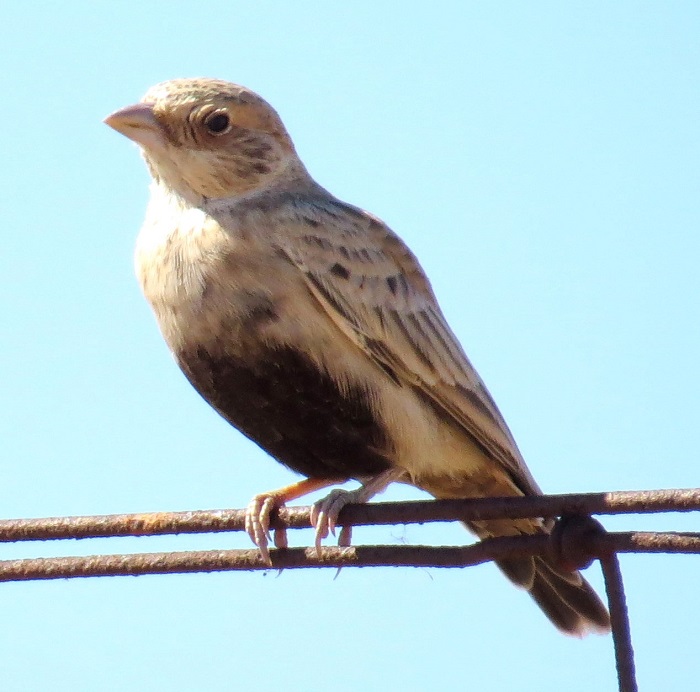
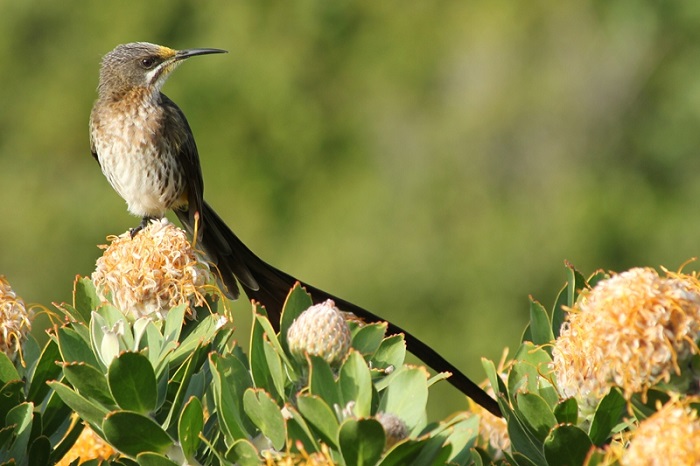
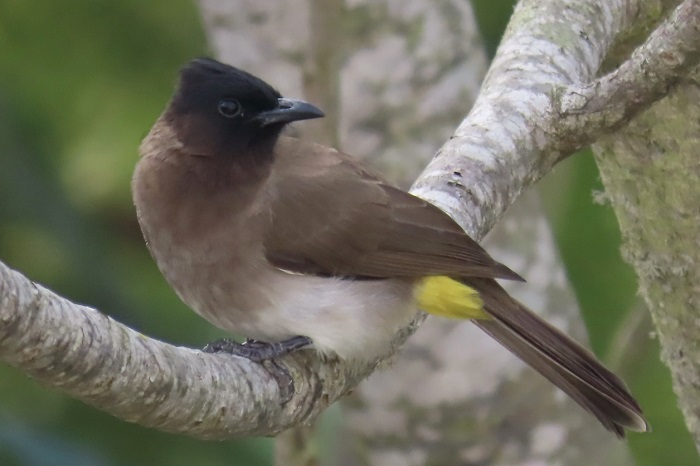
The Cape Clapper Lark is a fairly small, compact lark with rather beautiful yet cryptic plumage and the sexes are alike. Juveniles are less clearly barred than adults with a browner appearance and the feathers on the upperparts have pale margins, giving a scaly appearance.
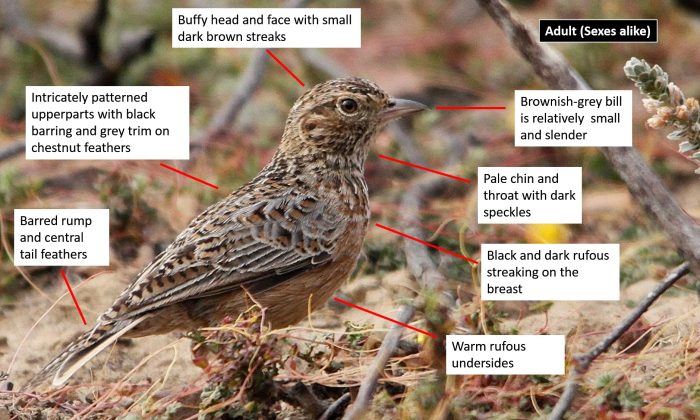
In adults the upperparts (mantle and folded wings) are intricately patterned in chestnut with dark brown to black barring and broad grey trim. The chin and throat are off-white with dark brown speckling. The rest of the underparts are warm buffy-rufous with darker rufous streaking on the lower breast and some blackish streaks on the upper breast. The flight feathers are grey-brown (not rufous) and the rump and central tail feathers are barred.
The face is fairly plain buff with small, dark brown streaks. The bill is brownish-grey, paler at the base and is relatively small and slender.
The Cape Clapper Lark is only likely to be mistaken for the closely related Eastern Clapper Lark Mirafra fasciolata which is larger, with a paler, heavier bill, less conspicuous barring on the upperparts which are also more rufous, and with bright rufous (not grey-brown) flight feathers.
The Cape Clapper lark is a common resident and a southern African endemic.
Its range stretches from the western part of the Northern Cape (possibly also southern Namibia), extending south and east through Namaqualand, the western Great Karoo (around the edges of the winter rainfall zone) and the Western Cape to the vicinity of Gqeberha (Port Elizabeth) and Makhanda (Grahamstown), in the Eastern Cape. The range in the Eastern Cape may overlap slightly with that of the Eastern Clapper Lark but the extent of this is not yet fully understood.
There is no evidence that the distribution of the Cape Clapper Lark has recently changed. This species is not considered threatened.
SABAP2 distribution map for Cape Clapper Lark (Mirafra apiata) – September 2023. Details for map interpretation can be found here.
Habitat
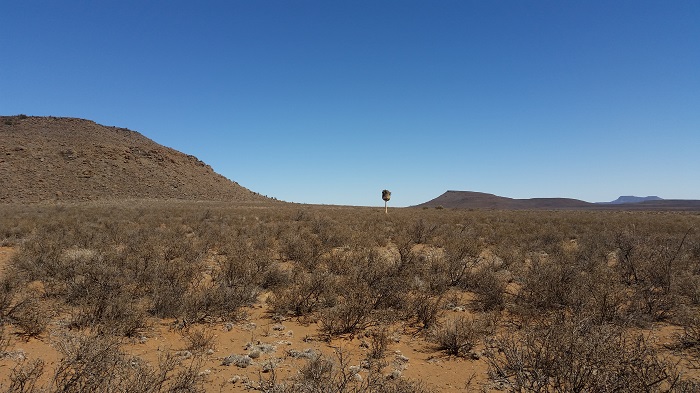
The Cape Clapper Lark prefers fairly tall and dense, scrubby vegetation, including mesic and arid fynbos, mountain fynbos, renosterveld and succulent Karoo. It is also present but uncommon in strandveld vegetation along the coast. This species has adapted to fallow fields, provided there is enough vegetative cover and occasionally also inhabits dense cereal crops that adjoin its natural habitat.
Typical habitat in the Succulent Karoo, seen during the Spring flowering season. Near Vanrhynsdorp, Western Cape Photo by Ryan Tippett
Behaviour
The Cape Clapper Lark is typically found solitarily or in pairs. It is a rather secretive bird and is most often seen during its distinctive display flight, or sometimes when it perches on top of a bush, rock, termite mound or fence post.
Spends much of its time on the ground and is reluctant to flush, preferring to run away from intruders. Once flushed, it usually drops back onto the ground, but occasionally lands on a bush or similar perch.
The Cape Clapper Lark forages on the ground especially around the base of shrubs or grass tufts. Primarily feeds on insects and the seeds of grasses and shrubs. They are also known to consume the occasional small fruit or berry when available.
The Cape Clapper Lark is a monogamous, solitary nester and is likely to be territorial, at least during the breeding season. Males become conspicuous at the onset of breeding, owing to their highly distinctive display flight. Displaying males take off from the ground or from a perch in a steep ascent while clapping the wings together below the body. The rate of clapping increases during this ascent and reaches an astonishing 25 beats per second before he whistles and then floats back down to the ground.
Very little is known about the breeding behaviour of the Cape Clapper Lark. The nest is a cup of grass, lined with fine plant material and sometimes bits of wool. The nest is built into a hollow in the ground at the base of a grass tuft tuft and is partly domed over from the back with grass.
Eggs are laid between August and November with a peak during September and October. The eggs are off-white or slightly green-grey with dense brown to purple blotches and spots. Two to three eggs are laid per clutch. Unfortunately further details regarding the incubation and nestling period are unrecorded.
Further Resources
Species text adapted from the first Southern African Bird Atlas Project (SABAP1), 1997.
The use of photographs by Gerald Wingate, Keir Lynch, Rick Nuttall, Stuart Shearer, Tino Herselman and Zenobia van Dyk is acknowledged.
Virtual Museum (BirdPix > Search VM > By Scientific or Common Name).
Other common names: Kaapse klappertjie (Afrikaans); Alouette bateleuse (French); Kap-Grasklapperlerche (German); Klapperleeuwerik (Dutch); Cotovia-batedora (Portuguese).
A list of bird species in this format is available here.
Recommended citation format: Tippett RM 2023. Cape Clapper Lark (Mirafra apiata) Biodiversity and Development Institute. Available online at https://thebdi.org/2023/09/19/eastern-clapper-lark-mirafra-fasciolata/
Cover image: Eastern Clapper Lark by Gregg Darling – Mountain Zebra National Park, Eastern Cape – BirdPix No. 5436
Identification
The Eastern Clapper Lark is a compact, medium-sized lark. This species has an overall rufous appearance across most of its range, but birds from northern Namibia and northern Botswana are far paler with greyish or sandy brown upperparts and pale sandy-grey underparts. All colour forms have rich rufous flight feathers.
The upperparts are beautifully mottled in shades of black, brown and grey. The underparts are plain with indistinct streaking on the breast. The bill is relatively short and stout.
The sexes are alike in plumage colouration but males are slightly larger than females. Juveniles resemble the adults but have pale tips to the feathers on the crown, back and wings.
This species has a distinctive wing-clapping flight display which can greatly assist with identification.
The Eastern Clapper Lark can be mistaken for a handful of other species. The closely related Cape Clapper Lark (Mirafra apiata) is smaller, with a darker, more slender bill. It is more heavily barred above with predominantly grey-brown (not rufous) flight feathers. The Rufous-naped Lark (Mirafra africana) is appreciably larger, with a more robust build , a longer, heavier bill and an erectile crest. The Flappet Lark (Mirafra rufocinnamomea) can be differentiated by its smaller size, more slender bill, streaked (not faintly barred) tertials and duller rufous wings.
The Eastern Clapper lark is a southern African near-endemic, reaching beyond the region only into south-western Zambia. Its centre of abundance extends from the Eastern Cape, Free State and the central and eastern parts of the Northern Cape, up through North West province into the Kalahari in Botswana. It is less numerous in western Mpumalanga, western KwaZulu-Natal and Gauteng, with scattered records from Namibia. It is a common resident throughout most of its range.
There is no evidence that the distribution of the Eastern Clapper Lark has recently changed. This species is not considered threatened.
SABAP2 distribution map for Eastern Clapper Lark (Mirafra fasciolata) – September 2023. Details for map interpretation can be found here.
Habitat
The Eastern Clapper Lark is mainly a grassland species but also inhabits open, grassy savanna and semi-arid plains provided there is enough grass cover. It prefers dry, and fairly sparse grassland, especially where the grass is tall and there are scattered bushes, termite mounds, boulders and patches of bare ground. It is most abundant in the grassy north-eastern parts of the Nama Karoo biome.
Typical grassy Karoo habitat. Carnarvon district, Northern Cape Photo by Ryan Tippett
Behaviour
The Eastern Clapper Lark is usually encountered solitarily or sometimes in pairs.
Unobtrusive and easily overlooked unless displaying. They are reluctant to flush and prefer to run off quickly when approached. The Eastern Clapper Lark spends most of its time on the ground but can, on occasion, be seen perched on top of a bush, termite mound or fence post.
Forages by walking slowly on flexed legs, with its body close to the ground, pecking items off the floor. Searches at the base of grass tufts and around ants nests and termite mounds. They are known to sometimes follow Aardvarks (Orycteropus afer), investigating their diggings for termites. The diet consists predominantly of insects, including grasshoppers, Northern Harvester Termites (Hodotermes mossambicus), ants and beetles etc. They also consume seeds from various forbs and grasses.
The Eastern Clapper Lark becomes quite conspicuous during the breeding season when the males perform their distinctive flight displays. Males display mostly in the early morning and late afternoon. During display the male rises steeply from the ground or a low perch, clapping the wings together below the body, he then whistles at the top of the ascent before parachuting to the ground. Additionally, males will often cruises with fluttering wings at about 25 m above ground, displaying repeatedly. The rate of wing clapping is constant and does not accelerate as with the Cape Clapper Lark (Mirafra apiata), nor does it clap in bursts as with the Flappet Lark (Mirafra rufocinnamomea).
The Eastern Clapper Lark is a monogamous, solitary nester. Breeding takes place from late September to January, although this varies according to rainfall in drier regions.
The nest is cup-shaped with a partly or completely domed roof with a side entrance. The nest is placed on the ground, often between tufts of grass or stones. Two or three eggs are laid per clutch but details about the incubation period are unknown. The young leave the nest at 11 days old, before they are able to fly.
Species text adapted from the first Southern African Bird Atlas Project (SABAP1), 1997.
The use of photographs by Ansie Dee Reis, Dawie De Swardt, Jorrie Jordaan, Rick Nuttall and Tino Herselman is acknowledged.
Virtual Museum (BirdPix > Search VM > By Scientific or Common Name).
Other common names: Hoëveldklappertjie (Afrikaans); Alouette fasciée (French); Grasklapperlerche (German)
A list of bird species in this format is available here.
Recommended citation format: Tippett RM 2023. Eastern Clapper Lark (Mirafra fasciolata) Biodiversity and Development Institute. Available online at https://thebdi.org/2023/09/19/eastern-clapper-lark-mirafra-fasciolata/
Part 1 described the first five days of the bird ringing course at New Holme. Part 2 describes the last few days and does the overall wrap up. Let’s do the wrap up first. During the course, we handled 367 birds of 35 species. Species in red have links to extensive descriptions with headings: identification, habitat, distribution, behaviour, … The number before the species name is the number handled.
The most striking thing about this list is that rare is common, and common is rare. The six most caught species account for 81% of the total. These six species are 17% of the total number of species. So 17% of the species make up 81% of the total. Rare is common and common is rare. We get back to this theme at the end of the blog!
Of the 367 birds handled, 35 were retraps. Three of the retraps were birds ringed in 2019, and 27 were ringed last year, 2022. The remainder of the retraps were birds ringing during the course, and retrapped on a later day of the course. A retrap rate approaching 10% is impressive. As we continue the ringing effort at New Holme, we will start to be able to use the data for estimating survival rates, at least for the common species.
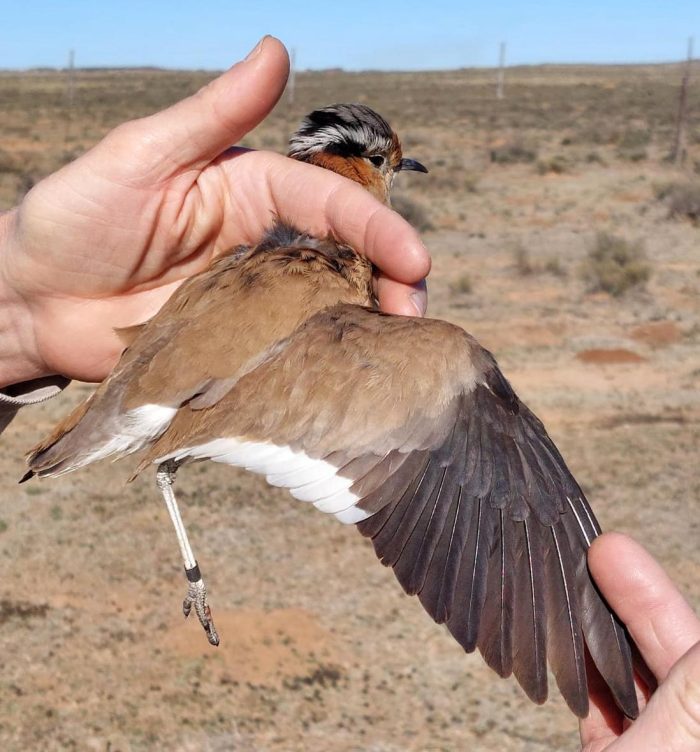
The highlights of our activities on Days 1 to 5 of the course were summarized in Part 1. Species handled included Burchell’s Courser and Pale Chanting Goshawk. It was hard to believe that there would be species that would trump these.
But let’s go back to the Pale Chanting Goshawk first. One of the questions that we get asked most often by people who are watching ringing for the first time is: “Do the birds make it back into the wild?” We ringed the goshawk on Tuesday. On Saturday we took photographs of this bird at two places a couple of kilometres apart on the New Holme farm.
This is the only ringed Pale Chanting Goshawk at New Holme. The diameter of the ring is selected by first measuring the diameter of the leg. The chosen ring size must be able to slide up and down the leg easily, but must also be relatively snug, so that things cannot entangled between the ring and the leg..
We had to wait until after dinner for the birds of the day! We’d put mistnets up along the edge of the dam at dusk.
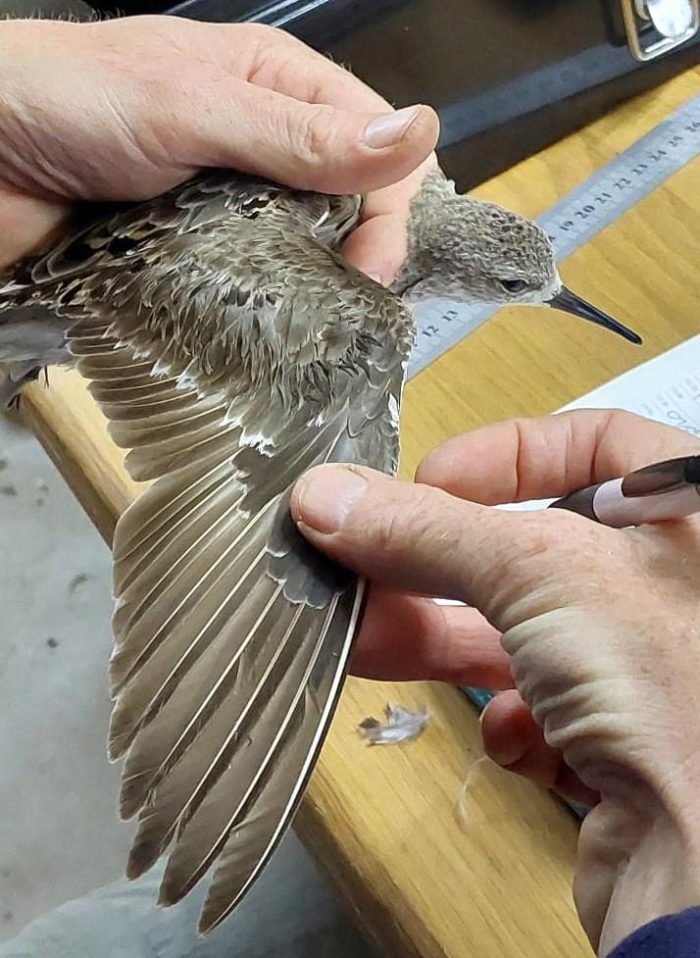
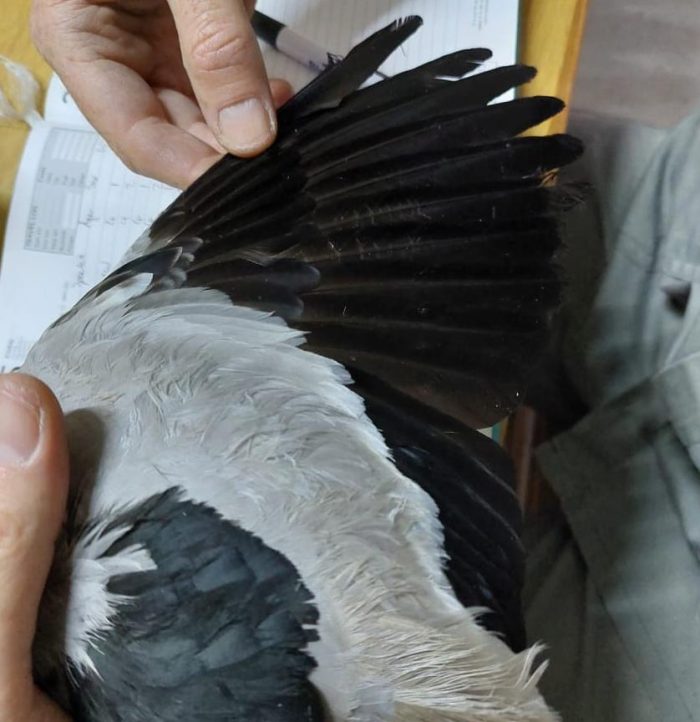
If you look at the upperparts of this Curlew Sandpiper, you can see a few feathers in breeding plumage on the bird’s back – these are the dark chocolate brown feathers, edged with cinnamon and white. The non-breeding plumage is a nondescript grey. The primaries, the main flight feathers, have covered at least 30,000 km, the straight-line distance from South Africa to the breeding grounds on the Siberian tundra, in the Taimyr Peninsula, directly north of India in Asia. They still look in pretty reasonable condition. There ought to be 10 primaries, but if you count them you can see only nine. That is because the 10th one, counting from the outside has been dropped, and is being replaced by a new feather. The secondaries bend a bit towards the bird’s body, and there appears to be a bit of a gap between the primaries and the secondaries. That’s where the growing feather ought to be. The moult of the primaries proceeds slowly from the inside to the outside of the wing, in such a way that there is never such a big gap that the bird can’t fly. The process takes about four months to complete. By early next year, this bird will have a new set of primaries for the northwards journey to Siberia to breed and then back again afterwards..
Besides this Curlew Sandpiper, we handled other long-distance migration waders: Little Stint and a Ruff.
We also caught a Blacksmith Lapwing, a resident wader:
Most birders never get to see the spur at the points of the wings of a Blacksmith Lapwing. This bird’s spur was 11 mm long. That makes it a female. The spurs of the males can be as long as 20 mm. They are as sharp as needles. One of the privileges of being a ringer is seeing these kinds of features from close up!
Day 7 : Friday 8 September
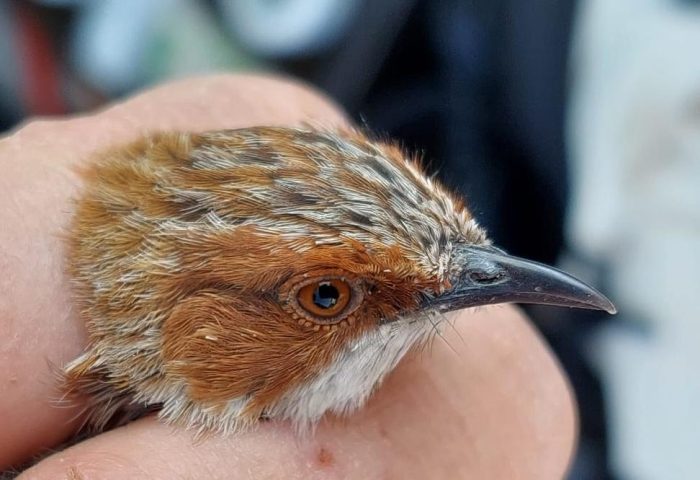
We didn’t have to wait long for the bird of the day. At 09h35 the message arrived: “Just got a Rufous-eared Warbler!”
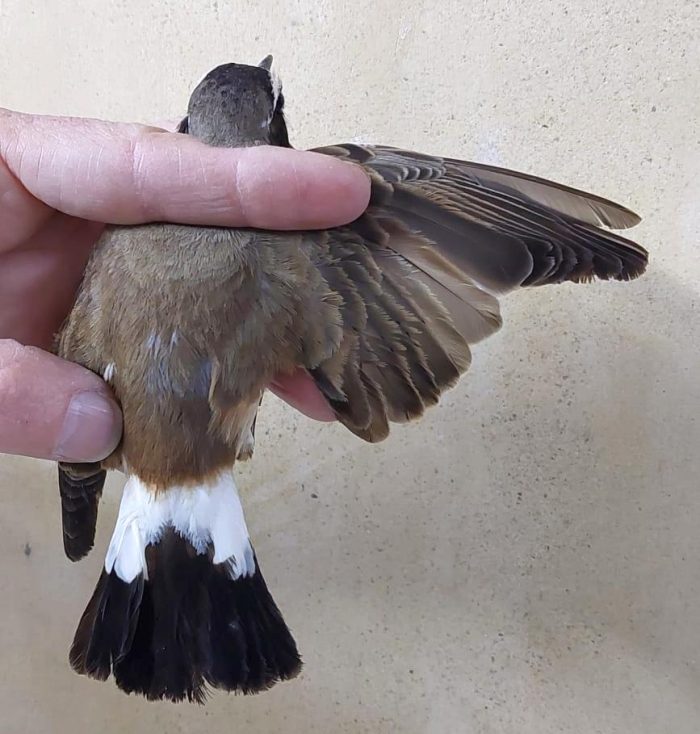
We also had a Capped Wheatear!
Day 8 : Saturday 9 September
On Saturday morning, it was back to the waterhole for a sunrise start:
The previous Sunday had been cool, with no breeze for the first few hours of the day. On Wednesday morning, it was frozen solid. But calm. Saturday morning was much warmer, but much breezier from early in the morning. With mist nets completely out in the open, we couldn’t expect to make a large catch. The objective of the morning was a big increase in the overall sample size of Grey-backed Sparrow-larks. We caught 20, and brought the total for the species to 130 birds. .
It turned out to be lark day!
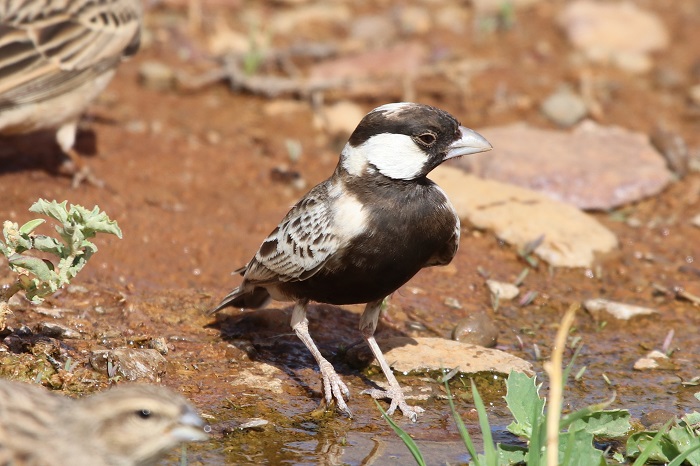
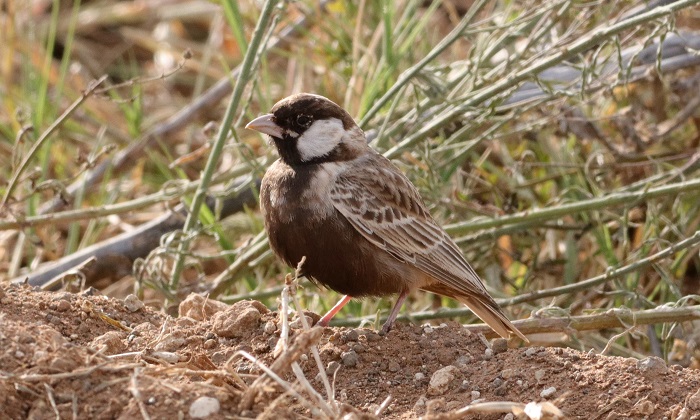
Stark’s Lark!
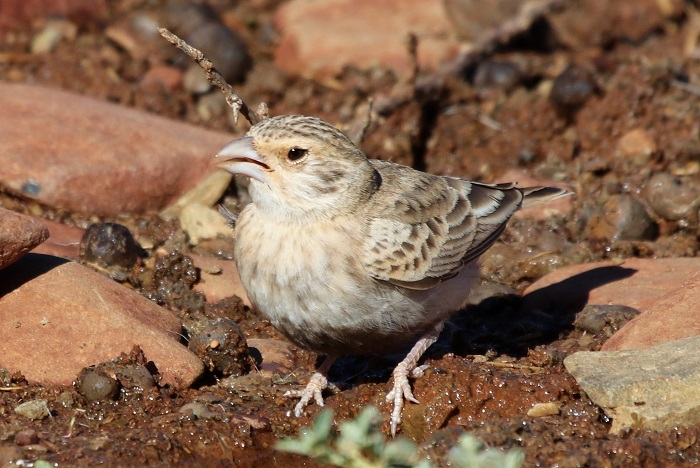
Eastern Clapper Lark!! We caught two Eastern Clapper Larks and one Stark’s Lark.
Rare is common, and common is rare!
The rare species of which we catch only one or two individuals are fascinating. But it is the common species with large sample sizes that, from a science perspective, are the most valuable. These are the species that, ultimately, we can write papers about, that students can write up for their PhDs. Can we do anything with the measurement data on 130 Grey-backed Sparrow-larks, collected on three days (3rd, 6th and 9th September)? Look at Roberts 7 which summarizes all that is known about southern Africa’s birds. Discover that the measurements presented there are based on samples of only 12 females and 14 males. These sample sizes are too small to be considered reliable. So we have processed our 58 females and 72 males into a paper in Biodiversity Observations. The main results are that male Grey-backed Sparrow-larks are about 3% larger than females; sexual dimorphism in plumage is well-known, but dimorphism in size is apparently not.
A bit of a red herring, more or less!
In the process of writing the paper about Grey-backed Sparrow-larks, we had to look at earlier papers that contained relevant data. Here is part of the Methods section of one paper:
To collect our data, we used mistnets to catch birds, we ringed them, measured them and then let them go free to carry on with life. This guy used a rifle and shotgun, and the birds ended up as study skins in a museum! Bear in mind that this fieldwork was done in 1965/66, nearly six decades ago, when mistnets were still in their infancy and the only way to get hold of birds to examine them close up was to shoot them. This diagram summaries the results obtained from shooting 57 Grey-backed Sparrow-larks:
The top and bottom panels we can do far better now, with much larger samples, using mistnets. The information in the second panel cannot be obtained by bird ringers! The quick and dirty way to discover the timing of the breeding season is to shoot birds, to dissect the males and to measure the length of the testes. They are only big in the breeding season; in this particular year, March, April and May. Flight is an energetically expensive activity. Birds save a lot of energy minimizing the size of the testes when they are not needed. Nowadays, the breeding season is found by watching behaviour and working out when the birds we are studying have nests.
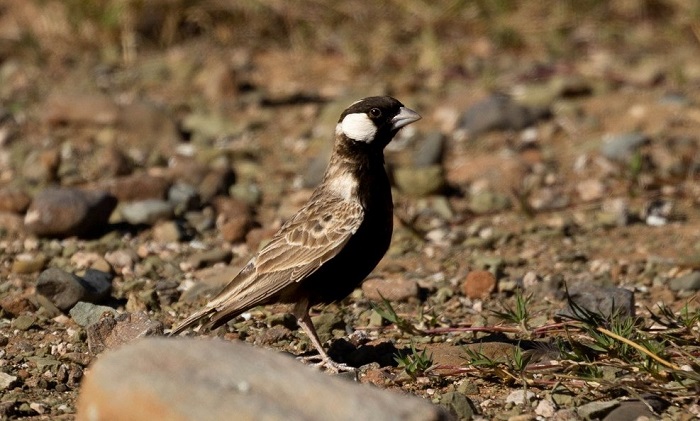
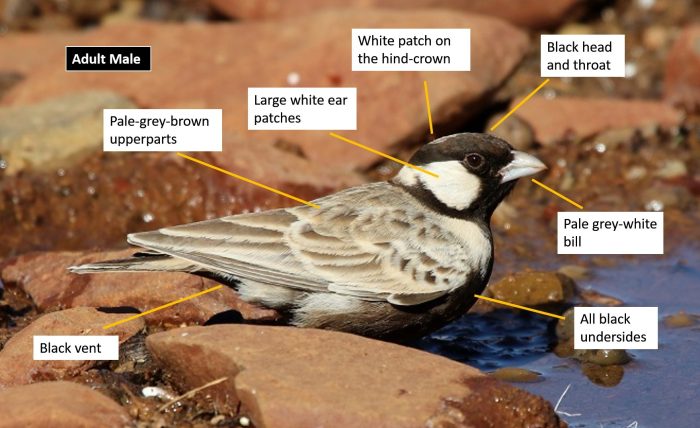
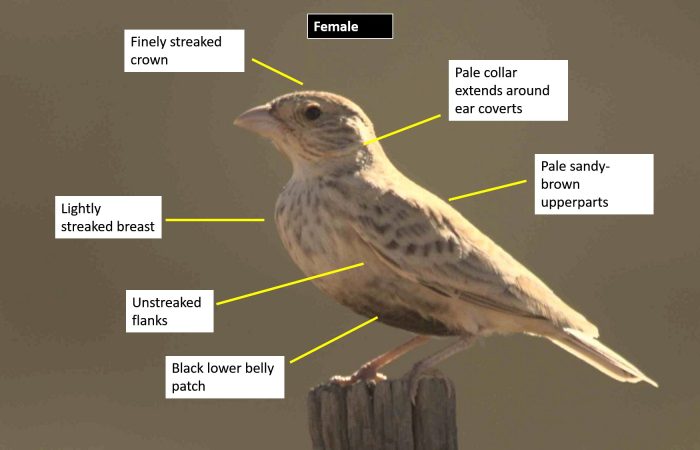
Females are less distinctive than the males but still readily identifiable based on their overall pale grey-brown appearance, un-streaked flanks and black lower belly patch.
Immature birds resemble the females but are variably buff and white spotted above.
Grey-backed Sparrow-lark males are unlikely to be mistaken for another species. Females are similar to those of the Black-eared Sparrow-lark (Eremopterix australis) and the Chestnut-backed Sparrow-lark (Eremopterix verticalis). Females of both the Black-eared and Chestnut-backed Sparrow-larks are darker, particularly on the upperparts, and have reddish brown (not sandy grey) upper wing coverts. They are also more boldly streaked on the breast as opposed to the light streaking on the breast of the female Grey-backed Sparrow-lark.
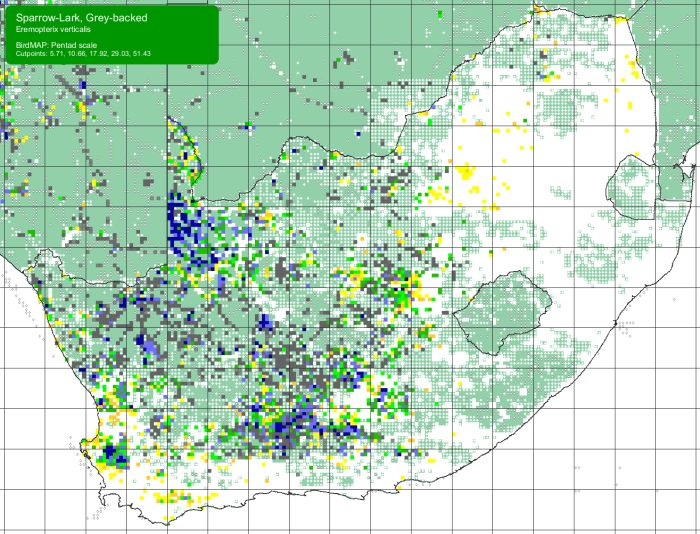
The Grey-backed Sparrow-lark is near-endemicto Southern Africa. It also occurs in south-western Zambia and neighbouring south-eastern Angola and also occurs along the coastal plain of Angola as far north as Luanda. It is distributed across central and western South Africa, and virtually throughout Namibia and Botswana. There are few records from Zimbabwe where the Grey-backed Sparrow-lark is mainly irruptive after good rains.
There is no evidence of changes in the recent past to the distribution of the Grey-backed Sparrow-lark. It remains a common and widespread species and is not threatened.
SABAP2 distribution map for Grey-backed Sparrow-lark (Eremopterix verticalis) – September 2023. Details for map interpretation can be found here.
Habitat
A bird of semi-arid to arid habitats, the Grey-backed Sparrow-lark is present in a range of vegetation types, including Karoo scrub, arid grasslands with scattered shrubs and trees, and sparse Kalahari woodlands. It is frequently attracted to dry pans, burnt grassland, and fallow fields. Prefers flat, sandy or firm gravelly areas and generally avoids rocky and mountainous terrain.
The Grey-backed Sparrow-lark is most numerous in the Karoo and Kalahari vegetation types in the Northern Cape, Botswana and Namibia.
Typical habitat near Vanwyksvlei, Northern Cape Photo by Ryan Tippett
Behaviour
This species is gregarious, even when breeding. It is most often found in small groups but may also occur in flocks numbering in the thousands following good rainfall and grass growth.
The seasonal movements of this species are not well understood, but they appear to be nomadic, moving erratically in response to rainfall and food availability.
Forages in open places among shrubs and stones. Flushes readily in typically erratic flight while uttering a chirping flight call. Spends most of its time on the ground and seldom perches on bushes or fences.
Forages on the ground and feeds mostly on grass seeds, but also eats seeds from certain forbs and shrubs. Insects make up a smaller part of their diet, especially young locust hoppers and the workers and alates of Northern Harvester Termites (Hodotermes mossambicus). Drinks water regularly when available, but some flocks apparently survive without access to water.
The Grey-backed Sparrow-lark breeds opportunistically after rain. It is a monogamous, solitary nester, even though nests may only be a few meters apart.
In display flight, the singing male circles 15-30 m above ground in a series of undulations, often with the legs dangling.
Nest construction is mostly by the female, although the male may help. The nest is a cup composed of fine grass leaves, panicles, feathery awns and rootlets. The nest is placed into an excavated hollow, on a foundation of small stones. The nest rim is normally slightly raised and fringed with more small stones. or soil clods. The nest is usually situated at the base of a shrub or grass tuft and facing south or east for shade.
One to five (normally two or three) eggs are laid per clutch. Clutch size is linked to the amount of rainfall the breeding area has received. The eggs are white and finely speckled with yellowish-brown markings. Incubation begins after all the eggs have been laid or sometimes after the first egg has been laid. Incubation duties are shared with males doing most of the incubation during the day and females at night.
All eggs normally hatch within 24 hours and the nestling period lasts just 7 to 10 days. Parental duties are shared by both sexes. The young are fed exclusively on arthropods, particularly Harvester Termites, caterpillars and grasshoppers. The parents perform broken wing distraction displays when the eggs or young are threatened. When alarmed the male often flies around the nest site in bouncing flight while alarm calling.
The use of photographs by Alan Collett, Gerald Wingate, Tino Herselman and Vaughan Jessnitz is acknowledged.
Virtual Museum (BirdPix > Search VM > By Scientific or Common Name).
Other common names: Grey-backed Finchlark (Alternative English name); Grysruglewerik (Afrikaans); Moinelette à dos gris (French); Nonnenlerche (German); Cotovia-pardal-de-dorso-cinzento (Portuguese); Grijsrug-vinkleeuwerik (Dutch).
List of bird species in this format is available here.
Recommended citation format: Tippett RM 2023. Grey-backed Sparrow-lark Eremopterix verticalis. Biodiversity and Development Institute. Available online at http://thebdi.org/2023/09/11/grey-backed-sparrow-lark-eremopterix-verticalis/
Cover image: Booted Eagle by Gregg Darling – Paarl mountain Reserve, Western Cape – BirdPix No. 6148
Identification
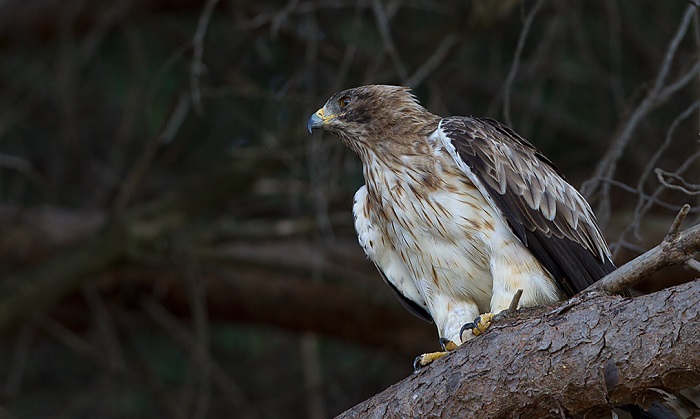
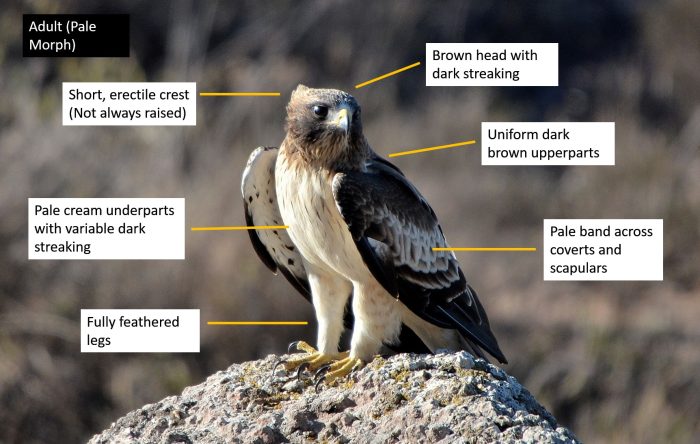
The Booted Eagle has a compact, stocky build and is the smallest brown eagle in southern Africa. The sexes are alike in plumage but they differ in size, females being substantially larger than males. Females weigh up to 975 g and can attain a wingspan of 1.35 m
The Booted Eagle is a variable species and can be found in three colour forms, a pale morph, a dark morph and the rare rufous morph. Pale morph birds make up roughly 80% of all individuals in Southern Africa.
Pale form birds have brown upperparts, including the head, and pale cream coloured underparts, with a variable amount of brown streaking on the chest. Dark morph birds are entirely dark brown with dark streaking below. The rufous morph is intermediate between the dark and pale morphs and has variable, rufous underparts. All colour morphs show a band of buff-tipped feathers on the folded wings.
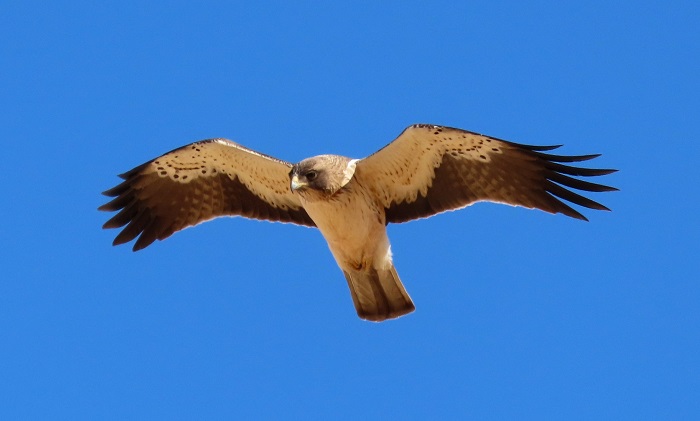
At certain angles in flight, shows pale patches or ‘landing lights’ on the leading edge of the wings, close to the body. This is the most distinguishing feature of this species but is not clear from all angles and is less conspicuous on pale form individuals. Additionally, when seen flying from below, there is a distinctive pale wedge at the bend of the wing.
Juveniles resemble their respective adult morph but have buffy feathers on the upper wing coverts, secondaries and tail feathers.
The Booted Eagle could be mistaken for other similarly sized brown raptors such as Wahlberg’s Eagle Hieraaetus wahlbergi, Lesser Spotted Eagle Clanga pomarina, Black Kite Milvus migrans and juvenile Ayre’s Hawk Eagle Hieraaetus ayresii.
The Black Kite lacks the white ‘landing lights’ and has a shallowly forked (not slightly rounded) tail. Wahlberg’s Eagle has longer, straighter wings and a narrow, rectangular tail, and also lacks the white ‘landing lights’. Juvenile Ayres’s Hawk-Eagle is more compact, with strong barring on the under wings and tail. The Lesser Spotted Eagle is larger with broader wings and a shorter, broader tail. It too lacks the diagnostic ‘landing lights’ of the Booted Eagle.
The Booted Eagle is a very widespread species, occurring across Africa, southern and eastern Europe, parts of western and central Asia and the Indian subcontinent.
It is fairly common but localised throughout Southern Africa and is most numerous in the winter rainfall regions of South Africa.
SABAP2 distribution map for Booted Eagle (Aquila pennatus) – August 2023. Details for map interpretation can be found here.
There are three populations of Booted Eagles in southern Africa. The first comprises birds that breed in the winter rainfall region of the Northern, Western and Eastern Cape. These birds disperse into other parts of southern Africa after breeding. The second population is small and breeds on the Waterberg Plateau in Namibia. The third are non-breeding Palearctic migrants from Eurasia and North Africa. Local breeding birds are indistinguishable from Palearctic birds.
It is possible that the establishment of local breeding populations is a recent phenomenon and the species is perhaps undergoing an increase in numbers and breeding range.
Habitat
Habitat – Gifberg, near Vanrhynsdorp, Western Cape Photo by Ryan Tippett
The Booted Eagle is restricted to breeding on cliffs in mountainous country but hunts in both hilly and flat terrain.
It is most common in the dwarf shrublands of the Karoo and in fynbos. Non-breeding migrants are found in a variety of non-forested habitats, including open woodland, grassland, desert and semi-desert. It avoids forested and densely wooded habitats.
The Booted Eagle is usually encountered solitarily or in pairs. It is inconspicuous when perched and is usually only seen when flying. Soars frequently, especially during the warmest part of the day.
The booted Eagle is fast and agile on the wing and most hunting is done in flight, either after a long, near vertical stoop dive or after a chase in level flight. Sometimes also hunts from a perch
The diet consists mainly of a wide range of bird species up to the size of francolins or guineafowl, but also takes lizards, rodents, and insects such as locusts and termite alates. They will drink water regularly during hot conditions.
In Southern Africa breeding birds nest on cliff faces, often at the base of a tree growing out of the rock face. Birds breed between August and January in South Africa with a peak between September and November. Namibian birds on the Waterberg plateau in winter with a peak in June.
Booted Eagles are monogamous and mate fidelity is high with pairs remaining together for successive seasons. They are territorial but are tolerant of conspecifics breeding nearby.
The nest is a surprisingly small platform of sticks and twigs, lined with fresh green leaves. It is constructed and repaired by both sexes and the nest is frequently re-used over many years.
Two mostly white eggs with feint reddish speckling are laid per clutch. Incubation is performed mostly by the female and the incubation period lasts for around 40 days. Both chicks are often raised but cainism sometimes occurs. The nestling period takes a further 50 to 54 days. During this time the chicks are fed predominantly by the female while the male does most of the hunting. Fledged juveniles remain near the nest for some time and remain dependent on the parents for up to 60 days or so.
This species text is adapted from the first Southern African Bird Atlas Project (SABAP1), 1997.
The use of photographs by Dave Rimmer, Eddie du Plessis, Gerald Wingate, Gregg Darling, Johan and Estelle van Rooyen, John Todd, Jon Blanco, Les Underhill, Pamela Kleiman, Stuart Shearer, Sybrand Venter, Tino Herselman and Zenobia van Dyk is acknowledged.
Virtual Museum (BirdPix > Search VM > By Scientific or Common Name).
Other common names: Dwergarend (Afrikaans); Dwergarend (Dutch); Aigle botté (French); Zwergadler (German); Águia-calçada (Portuguese).
Recommended citation format: Tippett RM 2023. Booted Eagle Aquila pennatus. Biodiversity and Development Institute. Available online at http://thebdi.org/2023/09/07/booted-eagle-aquila-pennatus/
We have done five days of bird ringing at New Holme Lodge, 8 km off the N1 between Hanover and Colesberg in the Northern Cape, and exactly half way between Cape Town and Johannesburg. Three days to go! That will be in Part 2!
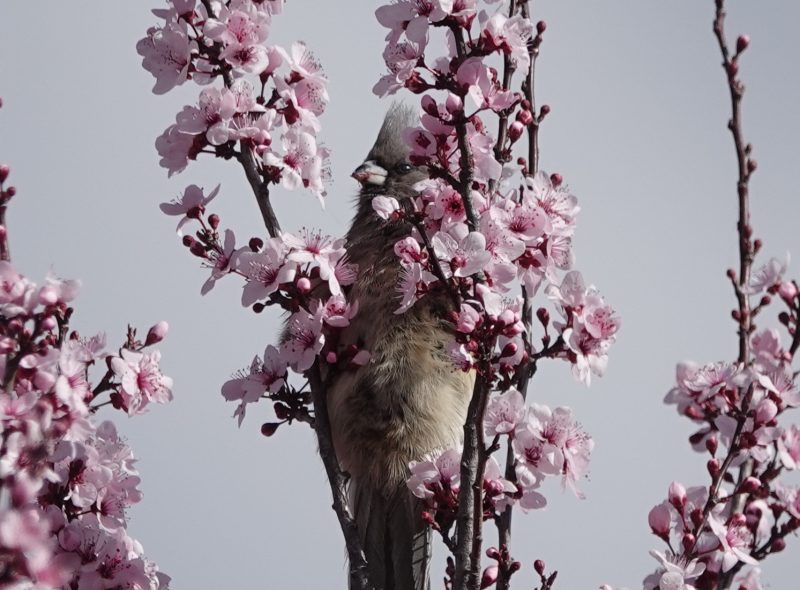
It is clearly spring. The fruit trees around the lodge are in blossom. But spring in the Karoo represents the end of the long dry winter. The countryside looks drought stricken, awaiting the arrival of the summer thunderstorms. But summer rainfall is at risk this year, because of the intensity of the El Niño which appears to be building up this year. This climate systems impacts rainfall over the summer rainfall region of South Africa, including this part of the Karoo. Read this Daily Maverick article.
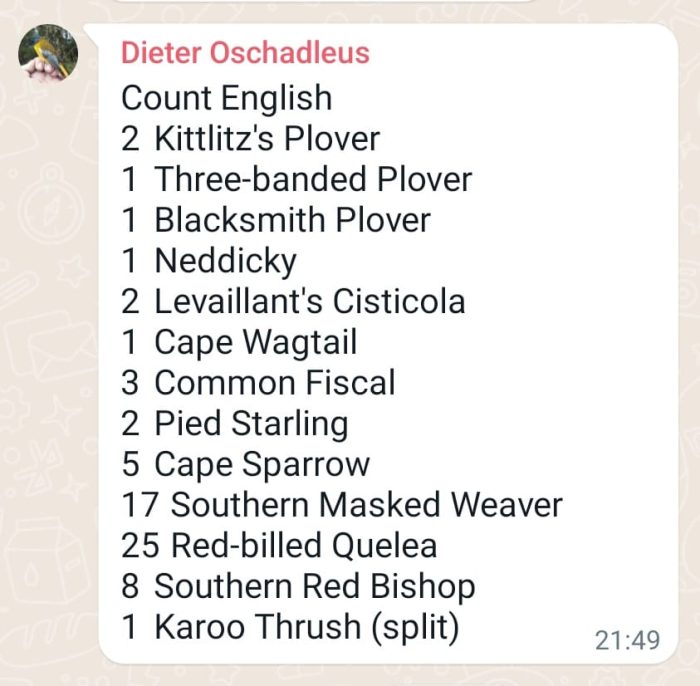
Day 1 : Saturday 2 September. We operated around the Karoo Research Station end of the werf. Dieter summarized the day’s bird ringing results:
Red-billed Queleas and Southern Masked Weavers made up the bulk of the day’s catch of 69 birds of 13 species. There were several retraps, some from the first ringing undertaken here in 2019. The Kittlitz’s Plovers, the Three-banded Plover and the Blacksmith Lapwing were mistnetted at the edge of the New Holme Dam at dusk:
Dieter and Graeme returning with the birds they had mistnetted on the edge of the dam.
The Blacksmith Lapwing was not showing any primary moult. The outermost primary is starting to look a bit frayed at the end, and worn. Birds replace their feathers on an annual basis (mostly). Moult is one of the neglected areas in the study of birds, and something that we focus on strongly in all our ringing events, including the ringing courses.
Day 2 : Sunday 3 September. We headed out to a waterhole on New Holme, some 3 km from the werf.
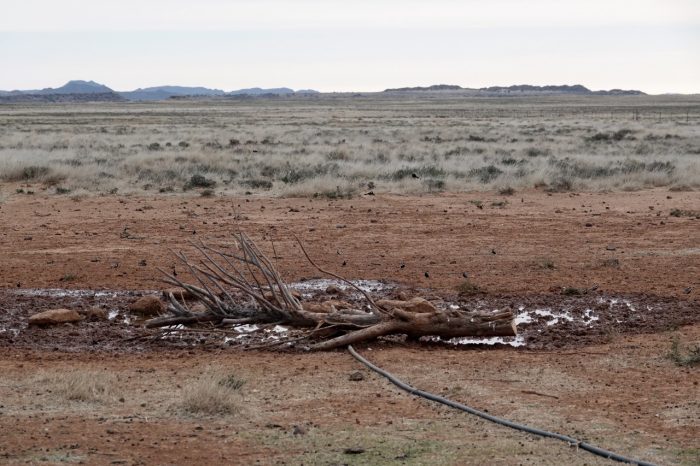
The waterhole is fed by water piped from a nearby wind pump. It does not look particularly impressive. Look closely at at the bare ground just beyond the water. It has a scattering of Grey-backed Sparrow-larks coming to drink:
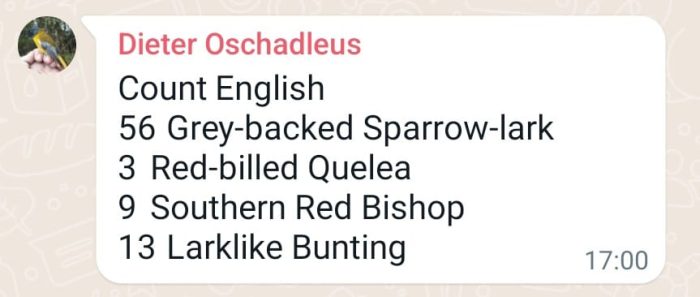
The totals for the morning tell a story of low diversity, with a solid focus on just one species, the Grey-backed Sparrow-larks
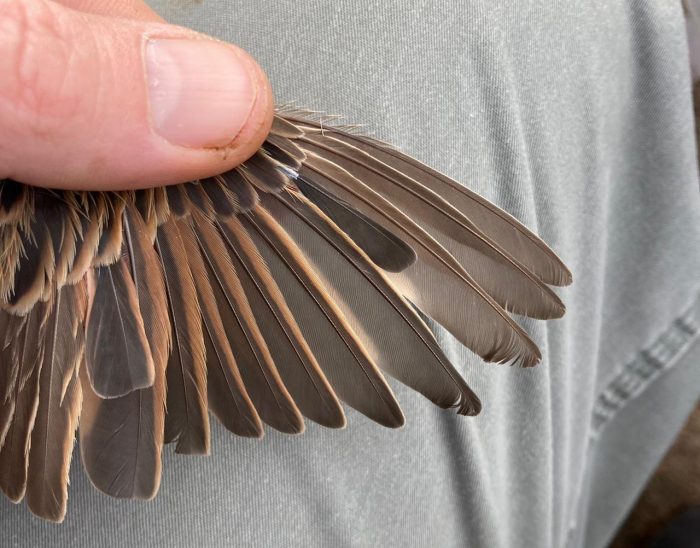
September is the least likely time to find birds of any species in moult in this area. Most species in the summer rainfall area breed once the rains get started, usually October-November. They moult after breeding, in autumn and maybe early winter. Most species avoid moulting in winter, when it is cold and dry, and food resources are minimal. So it was a surprise to find this Lark-like Bunting actively moulting. Working from the outside of the wing, there are three old feathers. They are old because they have faded and the feather tips are worn. Then there is an actively growing primary, about half grown. Working inwards, there are six recently grown primaries, a darker shade of brown, and intact feather tips. Primary moult works from the inside outwards. The next feather to be dropped is the third primary from the end.
Day 3: Monday 4 September We ringed in the gardens on the lodge end of the werf. We caught this Bokmakierie:
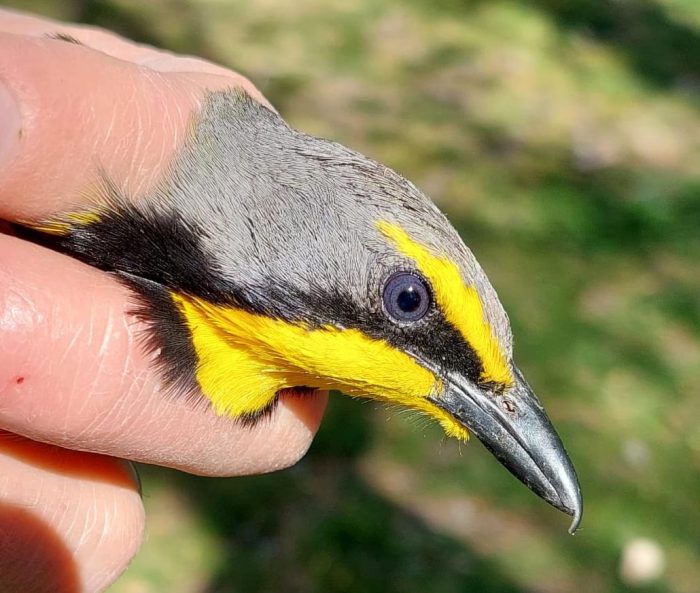
One of the privileges of being a bird ringer is the opportunity to see birds up close. The opportunity to see the detail of the feathers, the colour of the eye, and the complex patterns in it, and the opportunity to grasp the reality that you don’t want to be an insect when that weapon is on the hunt for food!
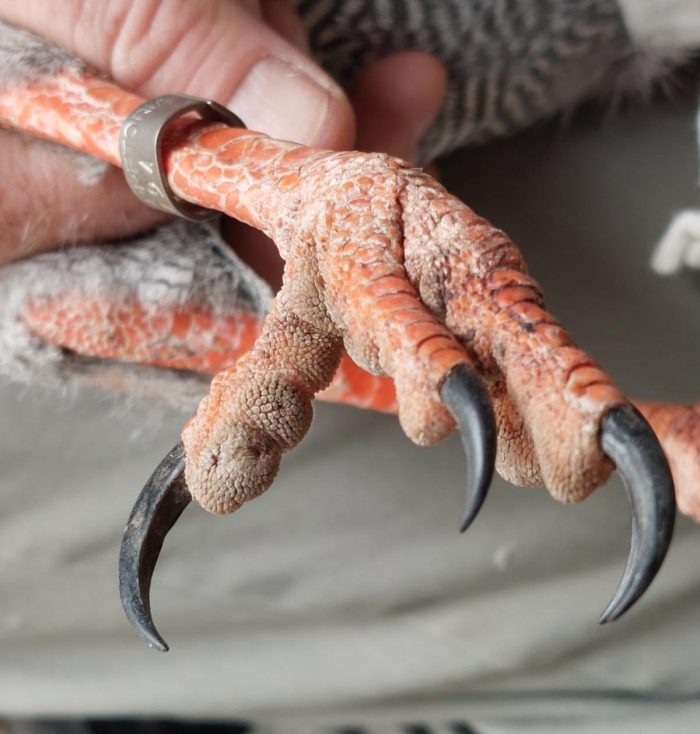
Day 4: Tuesday 5 September We operated back at the Karoo Research Centre end of the werf. Highlight of the day was a Pale Chanting Goshawk:
You don’t want to be the mouse or reptile that encounters those claws!
That is an even scarier weapon than the Bokmakierie’s. And that bill maybe has a shade for the lipstick houses to imitate.
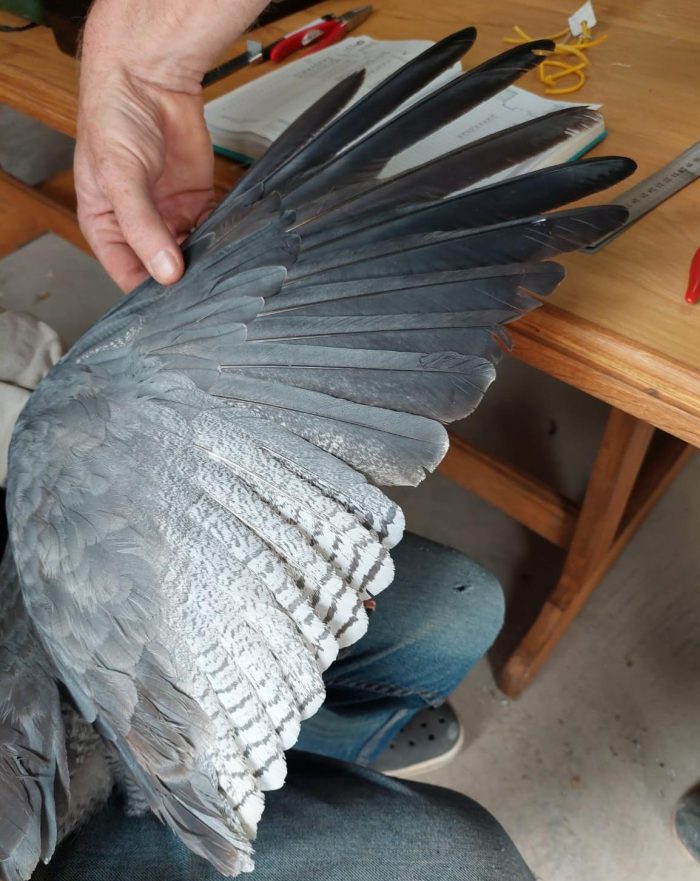
The detailed patterning on the wing is impressive from close up. Those are the secondary feathers of the wing, at the bottom on the photo. The moult of the primaries of large birds (this goshawk weighed 910 g) is quite different to that of small birds. Most birds up to about 250 g moult all their primaries annually, working through the primaries in sequence. For larger birds, it is biologically impossible to replace all their primaries each year. The primaries on the wing of this Pale Chanting Goshawk are a mishmash of old tattered feathers, new feathers and with the fourth primary from the end of the wing growing.
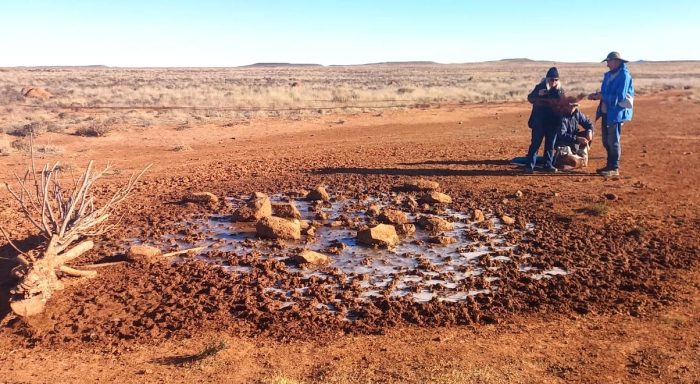
Day 5 Wednesday 6 September. After breakfast we headed back to the distant waterhole. We’d given the Grey-backed Sparrow-larks a three-day break. We knew it was a cold morning, but when we got there, we grasped how cold:
Just as well we had breakfast before heading out! The birds couldn’t come and drink until the ice melted.
Here is the blog about the the second half of the course, Part 2. Links to the descriptions of previous BDI ringing courses and expeditions are summarized in this blog. To join a future ringing event, see Events!
Welcome to the September 2023 edition of the BDInsight. We have plenty of news to share and plenty of exciting events coming up. Read on to find out more…..
Biodiversity Observations
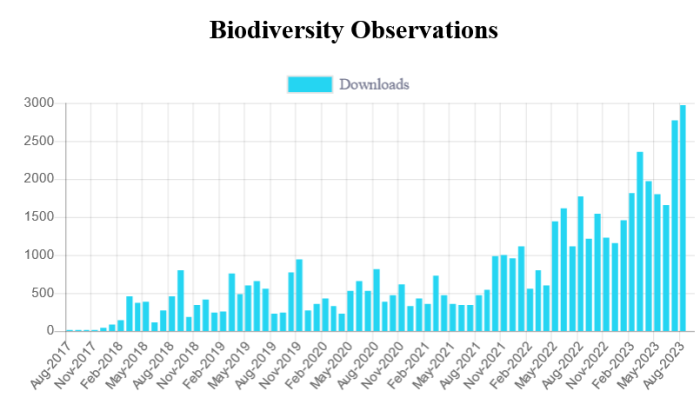
The graph shows that there were 2978 downloads of papers in Biodiversity Observations during August 2023. That is a new record! In 2023, we are working on Volume 13, and there have been 28 papers published this year so far, with a total of 232 pages.
Histogram shows number of papers downloaded each month from Biodiversity Observation during the past six years
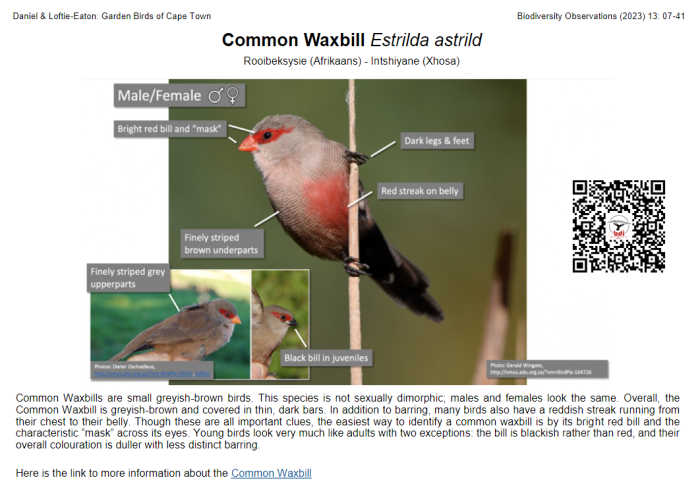
Of the papers published in 2023, the one with the most downloads is A Guide to the Common Garden Birds of Cape Town, South Africa which had been downloaded 1172 times by 31 August. You can find the the paper here: https://journals.uct.ac.za/index.php/BO/article/view/1316. This link does not download the paper itself; it takes you to the page where you click on the PDF to get the paper. The image below is the Common Waxbill page in the garden birds guide.
This is the description for Common Waxbill in the Guide to the Common Garden Birds of Cape Town.If you make yourself a printed version, you can point your cell phone at the QR code on the right, and you get taken directly to the text for the Common Waxbill on the BDI website (see the next article in this BDInsight).
12 out of the 28 papers in Biodiversity Observations so far in 2023 deal with observations on birds in South Africa. This means that the journal is getting increasing support from other taxa and from other countries (and continents). For example there is an excellent paper by Mike Fraser on the reptiles and amphibians of the Cape of Good Hope section of the Table Mountain National Park (here), two papers on ducks in Algeria (here and here), one on a bullfinch on an island in the Caribbean (here), one on a snail in Turkey (here), etc. Here is a list of the 28 papers in 2023 volume to date: https://journals.uct.ac.za/index.php/BO/index
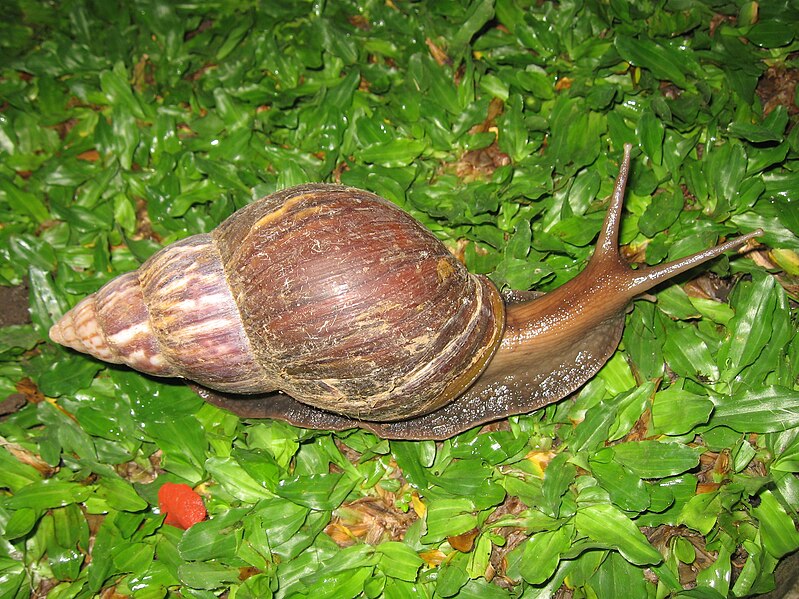
A key measure of the success of a journal is when other authors cite papers in it. One of the most fascinating papers in the 2022 volume last year described the havoc caused by an invasive snail in India. The Giant African Snail Lissachatina fulica is classified as one of 100 worst invasive alien species and has been introduced to more than 50 countries. These are huge snails and they are indigenous to Africa (believe it or not this snail gets kept as a pet). The Biodiversity Observations paper has been cited in a paper about this snail into Italy. The link to the original paper is here; the paper from Italy that cites it is here (and the new paper is in an Open Access journal).
The first paper in the volume 13 of Biodiversity Observations provides a summary of the first 12 volumes! It is available here.
BDI Bird Species Identification Texts
Species identification consists mostly of moving backwards and forwards between an illustration, and text describing the key identification features. We have simplified that, and put the text onto the illustration. The image here is for the Karoo Lark:
This is the identification photo for the Karoo Lark. You don’t need to learn the names of all the different parts of a bird before you can identify birds!
There are now 75 “BDI-style” species texts for birds on our website. Each of the texts starts with an annotated photograph like the one above. The next sections cover Habitat (with photos), Distribution (with bird atlas map), and Behaviour (with words and photos).
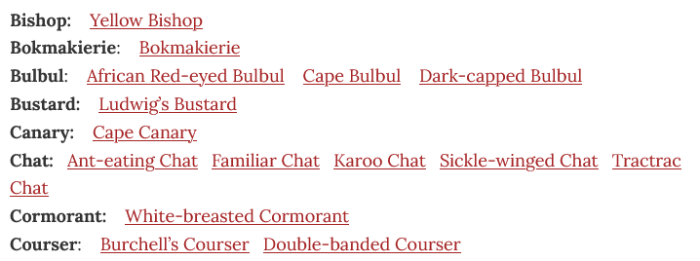
The website links for the 75 species which we have done to date can be found here: http://thebdi.org/bird-species/. Click on the name of any species on this page, and you get the BDI text for it. This is what the website looks like:
This is only an image of the bird list, just to show what it looks like! You need to go to the bird list website itself to be able to click on a species and reach its text.
If you do a google search for any of these 75 species, the BDI text is usually on the first page of the search. Here is what to look out for in a google search for a species.
At the time when the google search was done for Hartlaub’s Gull, the BDI text for the species was in 6th position!
These species texts are available from the Virtual Museum. The Virtual Museum record for a species which has been done, has the word “Text” on the second line. Click on it, and you get the BDI species text. For example, this is a recent record of Cape Sugarbird:
We are not doing the species at random. Our first target group of 32 species consisted of garden birds of Cape Town, and they were used to produce “A Guide to the Common Garden Birds of Cape Town”. As described above, this is the most downloaded paper in Biodiversity Observations so far this year. The species texts currently being produced “BDI-style” are for other similar themes. Watch this space.
With each BDInsight we will list the species with new texts.
Bird Ringing
We have learnt a huge amount about birds through bird ringing. Watch Mark Brown’s outstanding contribution called “Why ring birds?” to Conservation Conversations
There is also a blog on this topic on the BDI website. It is called “The value of bird ringing to conservation and research.” It is recommended reading!
Among other initiatives, the BDI is focusing lots of attention on bird ringing and training bird ringers this past year. The bottom line is that there is still a vast amount to learn about our birds which can most readily be done through bird ringing. There are two quantities that are crucial for understanding species, and for designing management plans for them. One is survival and the other is movement. For both of these, we know very little for almost every South African species.
The way to find out these quantities is to focus ringing effort for a long time on a small number of sites. This is what we plan to do.
The blog on the BDI website contains links to past ringing events and courses, going back to 2019: http://thebdi.org/2023/07/14/bdi-bird-ringing-courses-and-events/ It is a fascinating account of how our thinking has grown and matured over the past five years (and how we have persevered with this vision in spite of all the hassles).
You can find out when the next ringing courses and events are taking place here: http://thebdi.org/upcoming-bdi-events/. You are warmly invited to participate.
Virtual Museum
Up-to-date distribution maps for species are critical for taking conservation decisions about species. Spring is springing, and the butterflies and moths, dragonflies and damselflies, will soon be out and about. Now is the time to dust off your cameras and get out into the field and start refreshing records in the Virtual Museum.
Records made long ago in a grid cell are slowly losing their value as evidence that the species is still present there, and need to be refreshed.
If your access to the Virtual Museum is not working (eg password issues) please contact Megan Loftie-Eaton for help (megan@thebdi.org).
RAVE 2023!
RAVE = RINGING, ATLASING AND VIRTUAL MUSEUMING EXPEDITION
What are the dates, places and costs?
27 November–03 December at Botuin, Vanrhynsdorp
4–10 December at Vondeling Wine Farm, Paardeberg, Wellington
11–15 December at Ouberg Private Nature Reserve, Montagu
16–18 December at Botuin, Vanrhynsdorp
We invite you to attend this citizen science event for as many days as are feasible for you. The cost for food and accommodation (sharing) is R750 per person per day. At Botuin, single accommodation is available at a facility close by. There is one single room at Vondeling. The cost of a single room is R900 per person per day. These dates are confirmed and the accommodation booked, but they can be extended, either by operating at more than one place at the same time, or by starting earlier
What will you gain and what will you give?
As a participant, the most important ingredient towards the success of the RAVE is enthusiasm!
This RAVE is the initial major event for setting up the BioObservatory. Our specific goals during the RAVE focus on ringing, atlasing and the Virtual Museum (VM). Through bird ringing, atlasing, and BirdPixing (for the Virtual Museum), we aim to:
obtain annual survival estimates of key species via recaptures of ringed birds.
build information on local movements of birds by systematically ringing at nearby sites.
strengthen our understanding of moult.
improve our knowledge of annual breeding success and the timing of breeding through a monitoring programme that estimates the percentage of juveniles in the populations at each site.
develop guides that will help ringers and trainee ringers to age and sex birds.
These goals will not be attained through a single expedition, but with each event we are laying the foundations for a BioObservatory. RAVE goals contribute towards the wider goals of the BioObservatory:
We aim to increase the numbers of ringed birds at the three sites (here is a summary of BDI ringing events, with many having been held at the three RAVE sites). We are aiming to increase the size of the existing database. Ultimately, the purpose is to improve the conservation outlook for as many of the species at these sites as possible. We aim to achieve this using the information and understanding gained from bird ringing.
We want to build on the existing bird atlas data for the three sites, with a view to moving in the direction of systematic atlasing, as has been shown to be dramatically effective in monitoring bird population sizes in the Hessequa Region, centred on Stilbaai. For waterbirds, we will supplement the atlasing by undertaking counts of waterbirds at nearby wetlands.
We plan to do as comprehensive surveys as we can for the other taxa represented in the Virtual Museum, but especially butterflies and moths, dragonflies and damselflies, and dung beetles. We will try to make substantive contributions to all sections of the Virtual Museum (digitally curated photographs of various taxa). We need to work out monitoring strategies for these taxa which are appropriate for the three sites.
We would like to engage with local communities. We want to share our enthusiasm for biodiversity with the people who live in the areas close to our sites. We need to brainstorm how to achieve this. It could be through an Open Day, when anyone can join us in ringing or any other activity. Alternatively, we could invite the teachers at a local school or members of the farming community to join us.
Where will we stay?
At Botuin there are three cottages that each sleep two people. There is unlimited accommodation close by. We have all our meals at Botuin. Botuin lies on the southeastern edge of Vanrhynsdorp, 300 km north of Cape Town (three hours’ drive) along the N7 towards Namibia. It is on the edge of Namaqualand.
Ringing at Botuin, Vanrhynsdorp
At Vondeling there are two comfortable cottages in the werf. One sleeps six people in two bedrooms for three people each. The other, which we also use as our main gathering place, sleeps five: two bedrooms each with a double bed, and one with a single bed. A couple of tents and caravans are feasible. Vondeling Wine Farm is 75 km northeast of Cape Town (one hour), on the eastern edge of the Paardeberg.
Vondeling Wine Farm
At Ouberg there is accommodation for 11 people. There is no alternative accommodation in easy striking distance, but a handful of tents and caravans are eminently feasible. Ouberg is 205 km east of Cape Town (2.5 hours), in the mountains on the edge of the Little Karoo. It is 20 km north of Montagu.
Ouberg Private Nature Reserve
Who is in charge?
The expedition will be led by Les Underhill (overall coordination), Dieter Oschadleus (bird ringing), Salome Willemse (administration) and Jean Ramsay (finances). We are supported in multiple areas by other citizen scientists.
How do I apply to join the RAVE?
Send an email to Salome Willemse (ring@thebdi.org), and tell her the dates you would like to attend. We will do our best to accommodate you.
When will the next RAVE take place?
We don’t know. It all depends on the success of this one! But our biggest fear is that we won’t have the capacity to meet the demand.
We hope that you will join us, either now or in the future!
Cover image. Gurney’s Sugarbird by Colin Summergill – Carter’s Hill, KwaZulu-Natal – BirdPix No. 252816
Identification
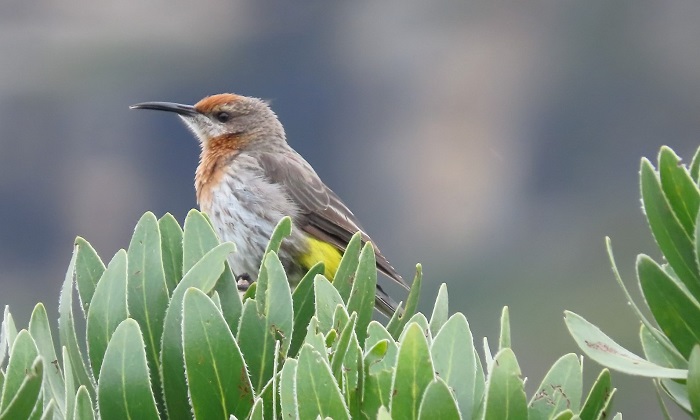
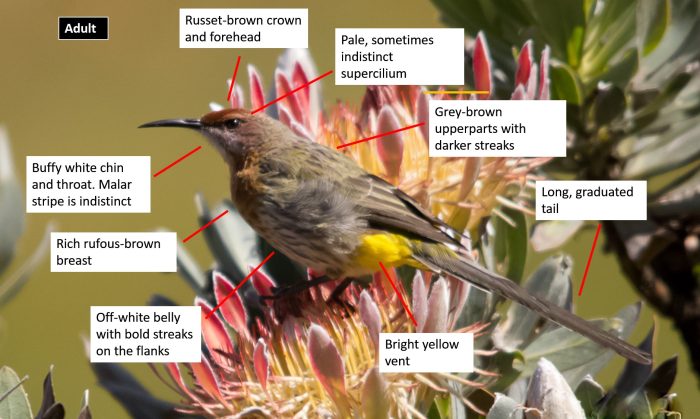
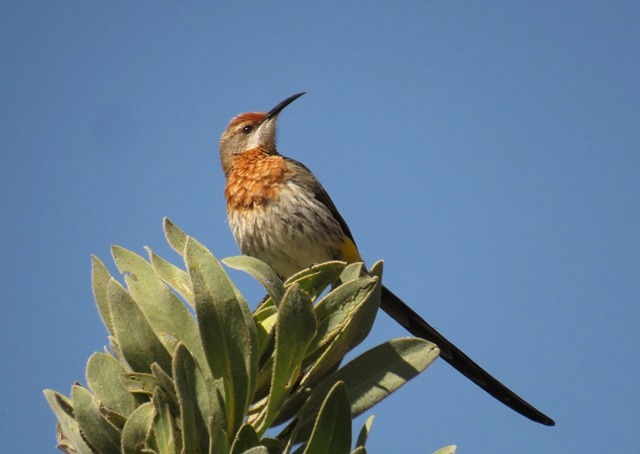
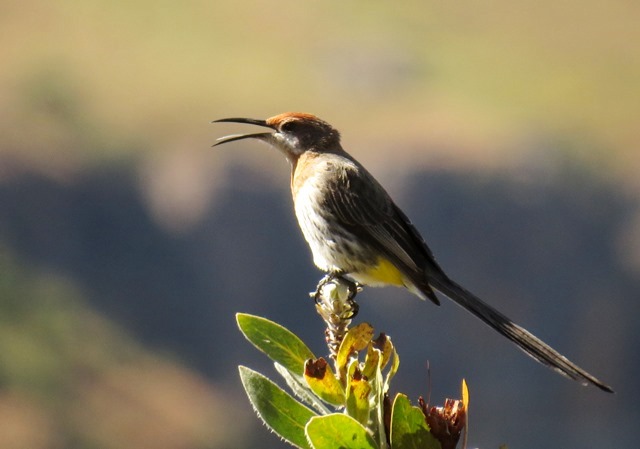
The Gurney’s Sugarbird is an interesting and attractive species, resembling an overgrown sunbird. The sexes are alike in colouration and plumage but males are larger and longer tailed.
The head and face are distinctively marked. The forehead and forecrown are russet-brown and the hind crown, neck, lores and ear coverts are greyish-brown. The chin, throat and supercilium are buffy white, and malar stripes are very indistinct or absent. The upper breast is warm, rufous-brown and the lower breast and belly is white, with long, blackish streaks, especially towards the flanks. The vent is bright yellow and conspicuous. The rump is greenish-yellow and best seen in flight. The dark brown tail is long and graduated with a wedge-shaped tip. The bill is black, long and slightly decurved.
Juveniles resemble females but have a plain brown breast (not warm rufous) and the vent is dull yellow.
The Gurney’s Sugarbird is distinctive and unlikely to be mistaken for any other species, with the exception perhaps of the Cape Sugarbird (Promerops cafer). Gurney’s Sugarbird is smaller, shorter tailed and more richly coloured than its Cape relative. The two species have almost exclusive distributions which overlap marginally in the Eastern Cape.
Gurney’s Sugarbird is uncommon to locally common and is endemic to Southern Africa. Its distribution is closely linked to that of the Silver Protea (Protea roupelliae). The core of its range lies along the eastern Drakensberg escarpment from the Eastern Cape to KwaZulu-Natal, extending into the high mountains of the eastern Free State. Scattered populations occur on the mountains between north-central Limpopo Province and north-western Eswatini (Swaziland), including the Waterberg and Soutpansberg ranges. There is an isolated population in the eastern highlands of Zimbabwe and adjacent Mozambique. Historically, its range overlapped with the Cape Sugarbird in the Amatole Mountains, Eastern Cape.
SABAP2 distribution map for Gurney’s Sugarbird (Promerops gurneyi) – August 2023. Details for map interpretation can be found here.
The Gurney’s Sugarbird is not currently threatened, but its Protea-savanna habitat is at risk from afforestation. Commercial protea farming in KwaZulu-Natal Midlands provides additional habitat, but the damage caused by birds to flowers could lead to control measures being taken.
The Gurney’s Sugarbird inhabits montane grassland and scrub in with Protea, Aloe and Strelitzia spp, including areas adjoining Afromontane forest. Distribution in South Africa largely coincides with that of Silver Protea (Protea roupelliae). Often found in gardens and stands of proteas on flower farms in the KwaZulu-Natal Midlands.
Usually encountered solitarily or in pairs, but sometimes in loose groups at a rich food source. Gurney’s Sugarbird is largely sedentary, but moves locally during the non-breeding season. This is either in response to food availability and the flowering phenology of proteas, or moving to lower altitudes in winter.
Gurney’s Sugarbird feeds mainly on the nectar of Protea species but also from a wide range of tubular-shaped flowers such as Aloes, coral-trees (Erythrina spp), bottlebrushes (Greyia spp), Tree-fuchsia (Halleria lucida), torch lilies (Kniphofia sp), wild daggas (Leonotis spp.) etc. Also takes invertebrates like beetles, bees, ants and spiders and sometimes also consumes pollen.
This species is monogamous and strongly territorial during the breeding season which normally coincides with the peak flowering time of Protea species. The breeding season runs from June to February in KwaZulu-Natal, from November to February in Limpopo and Mpumalanga, and from July to April in Zimbabwe. Males actively chase off rivals and any other nectar-feeding species during this time.
The nest is constructed by the female only with the male staying nearby to protect the territory and nest site. The nest is a loose bowl of twigs, rootlets, grass and bark fibres and is lined with soft grass and the fluffy heads of Protea seeds. The nest is most often situated 1 to 3 m above the ground amongst the branches of Silver Protea (Protea roupelliae) or Common Protea (Protea caffra) trees.
One or two sandy-brown eggs are laid per clutch and incubation begins once the second egg has been laid. The female is responsible for all the incubation duties and the incubation period lasts from 16 to 28 days. The nestlings are fed and cared for by both parents.
Species text adapted from the first Southern African Bird Atlas Project (SABAP1), 1997.
The use of photographs by Alan Manson, Colin Summersgill, Dawie De Swardt, Greg Goosen, Gregg Darling, Ilse Hulme and Pamela Kleiman is acknowledged.
Virtual Museum (BirdPix > Search VM > By Scientific or Common Name).
Other common names: Kaapse suikervoël (Afrikaans); Promérops du Cap (French); Kaapse Suikervogel (Dutch), Kap-Honigfresser (German), Papa-açúcar do Cabo (Portuguese)
Recommended citation format: Tippett RM 2023. Gurney’s Sugarbird Promerops gurneyi. Biodiversity and Development Institute. Available online at http://thebdi.org/2023/08/30/gurneys-sugarbird-promerops-gurneyi/
Cover image by Marna Buys – Kirstenbosch, Western Cape – BirdPix No. 61050 Cape Sugarbird
Identification
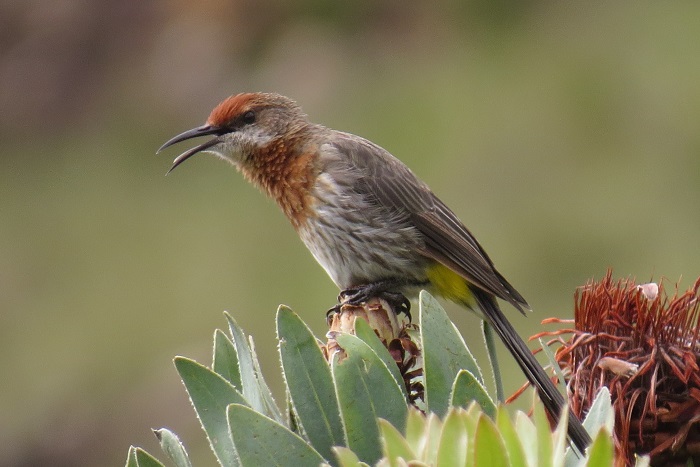
The Cape Sugarbird is a very distinctive species, resembling an overgrown and long-tailed sunbird.
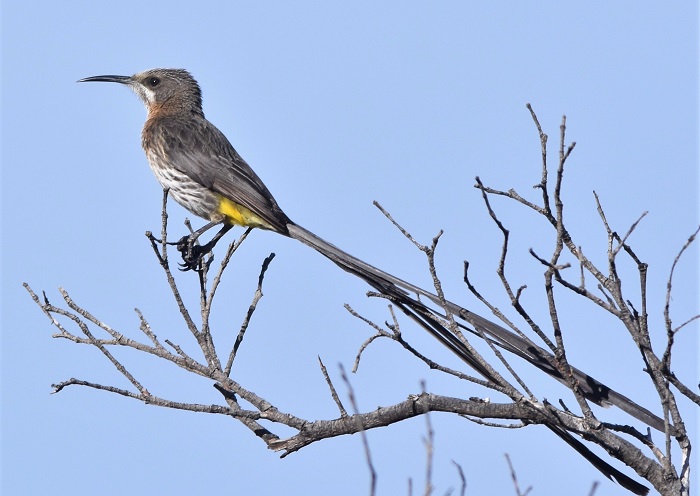
The sexes are alike in plumage colouration but males are larger and have much longer tails. The tail length in adult males varies considerably and can be up to 3 times the length of the body.
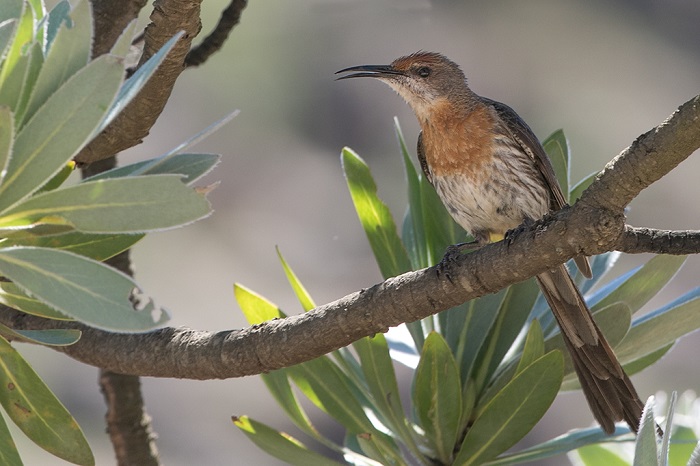
The upperparts are brown with indistinct darker blotches or streaks, especially on the mantle. There is a prominent malar stripe on the lower face with a white stripe above it. The chin and throat are off-white and the upper breast is brown with feint paler mottling. The lower breast and belly are greyish-white with distinct brownish-black streaking. The vent is bright yellow and conspicuous. In flight they show a greenish-yellow rump. The dark brown tail is long (very long in males), graduated and ribbon-like.
Juveniles resemble females in having shorter tails but they are duller with browner underparts and lack the yellow vent of the adults.
The Cape Sugarbird is easily recognisable and not easily mistaken for any other species. The closely related Gurney’s Sugarbird (Promerops gurneyi) is smaller with bolder patterning, richer colouration, and a shorter tail. The ranges of the two species overlap very marginally in the Eastern Cape.
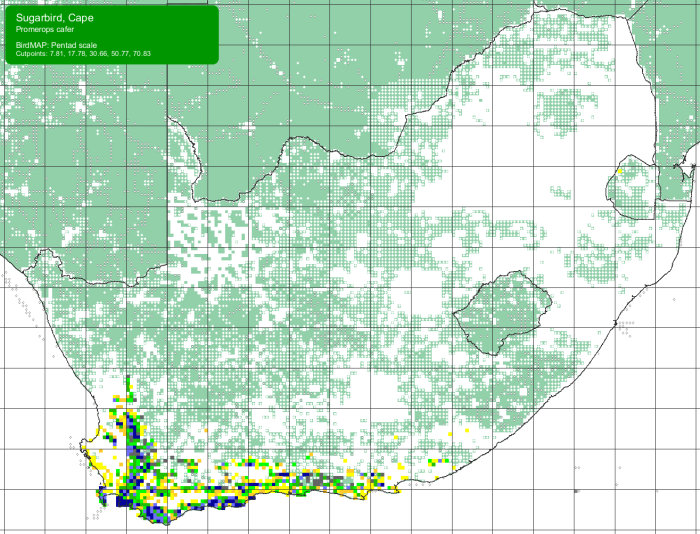
The Cape Sugarbird is a common resident or local-nomad and is endemic to South Africa and the Fynbos Biome. It is restricted to the Western and Eastern Cape provinces. It ranges from near Calvinia and Nieuwoudtville at the north-western edge of its distribution, across to near East London and the Amatola Mountains at the eastern edge of its range.
SABAP2 distribution map for Cape Sugarbird (Promerops cafer) – August 2023. Details for map interpretation can be found here.
Habitat
The Cape Sugarbird is virtually restricted to the Fynbos Biome and is the quintessential fynbos bird.
It is sometimes attracted to suburban gardens or patches of alien vegetation, however, its occurrence in other vegetation types is usually due to that habitat being close to Fynbos, or of transient birds moving from one fynbos patch to another. Generally reluctant to leave fynbos, except in response to fire.
Within its chosen habitat, the Cape Sugarbird occurs almost exclusively in places with an abundance of Proteas (Family Proteaceae), often in hilly or mountainous areas.
The Cape Sugarbird is largely sedentary, but becomes nomadic during the non-breeding season, moving locally in response to food availability. The flight is fast and direct with the tail streaming out behind.
During the breeding season the Cape Sugarbird is most often encountered solitarily or in pairs. However, they may be found in groups of up to 12 at a rich food supply during the non-breeding season.
Forages arboreally in shrubs and bushes, probing Protea flowers and those of other plant species for nectar and insects. Most probing is done while perched but may hover on occasion.
Cape Sugarbirds are strongly dependent on protea nectar and may visit up to 300 flowers per day to meet its energy requirements. It is by far the most important pollinator of many Protea species, even more so than sunbirds. Aside from proteas, sugarbirds will consume nectar from many other plant species including exotic and alien plants.
Note the yellow pollen-stained forehead of this male bird. Cape Sugarbird (Promerops cafer) – Betty’s Bay, Western Cape Photo by Les Underhill
Cape Sugarbirds supplement their diet with a range of insects and other invertebrates. These are captured by probing vegetation or hawking insects in flight. Large insect prey is killed by slapping them against a branch with quick, sideways head movements. Recorded invertebrate prey includes beetles, bees, flies, ants, wasps, aphids, moths, termite alates and spiders.
The nectar diet is supplemented by a range of insects. This female has captured a Cape Honeybee. Cape Sugarbird (Promerops cafer) – Cederberg, Western Cape Photo by David Kennedy
Highly territorial during the breeding season. At this time males become aggressive towards conspecifics as well as sunbirds, actively chasing them away from food sources. Females often assist in territorial defence. Potential predators like Southern Boubou (Laniarius ferrugineus), Bokmakierie (Telophorus zeylonus) and Southern Fiscal (Lanius collaris) are also chased off aggresively.
Males are aggresive towards rivals in the breeding season. These males are engaged in a territorial dispute. Cape Sugarbird (Promerops cafer) – Near Greyton, Western Cape Photo by Stuart Shearer
The Cape Sugarbird is monogamous and prior to egg laying the male becomes very protective towards the female and seldom strays far from her side.
The nest is built entirely by the female and is normally placed around 1m above the ground in dense foliage where the nest is well hidden. The nest is a shallow, loose bowl made from twigs, plant stems, rootlets and grass. The bowl is lined with brown protea fluff and bound in place with fine plant fibres.
1 or 2 eggs are laid per clutch, mainly between March and August (peak March-June). This winter breeding peak is closely linked to the main flowering time of proteas. The eggs are Cream to pale buff or pinkish white, marked with grey, brown, purple-black or glossy black blotches, streaks or spots.
Incubation starts after the second egg has been laid and all incubation is done by the female. The incubation period lasts for around 17 days. During this time the male remains nearby to protect the nest, either by noisily mobbing potential predators or by performing a distraction display to lure threats away from the nest site.
The nestlings are fed and cared for by both parents and are provided with food for around 15 days after fledging. The female chases fully fledged offspring from the territory after 21 days or so.
Cape Sugarbirds are multi-brooded meaning they will attempt to breed more than once in a single breeding season. In fact the female may start a new clutch while still with dependent offspring.
Species text adapted from the first Southern African Bird Atlas Project (SABAP1), 1997.
The use of photographs by David Kennedy, Gerald Wingate, Gregg Darling, Itxaso Quintana, Johan and Estelle van Rooyen, John Todd, Les Underhill, Marna Buys, Philip Nieuwoudt, Stuart Shearer and Tino Herselman is acknowledged.
Virtual Museum (BirdPix > Search VM > By Scientific or Common Name).
Other common names: Kaapse suikervoël (Afrikaans); Promérops du Cap (French); Kaapse Suikervogel (Dutch), Kap-Honigfresser (German), Papa-açúcar do Cabo (Portuguese)
Recommended citation format: Tippett RM 2023. Cape Sugarbird Promerops cafer. Biodiversity and Development Institute. Available online at http://thebdi.org/2023/08/26/cape-sugarbird-promerops-cafer/
Cover image of Common Bulbul by Lia Steen – Shellybeach, KwaZulu-Natal
Identification
The Common or Dark-capped Bulbul is a distinctive and easily recognisable species. The head is black and contrasts with the grey neck and breast. The rest of the upperparts are dusky grey-brown. The underparts are a paler greyish-white and the vent is bright-yellow. The eye is dark brown with a narrow black eye ring.
Common Bulbul (Pycnonotus tricolor) Fairland, Gauteng Photo by Lance Robinson
The sexes are alike and juveniles look similar but with duller plumage.
SABAP2 distribution map for Common (Pycnonotus tricolor) – August 2023. Details for map interpretation can be found here.
The Common Bulbul is a common to locally abundant resident. It is widespread across Africa, avoiding only the arid regions. In Southern Africa it is found in the moister eastern parts from the Eastern Cape, throughout KwaZulu-Natal, Mpumalanga, Gauteng and Limpopo. It is also found throughout southern Mozambique and Zimbabwe and the northern and eastern parts of Botswana and Namibia’s Caprivi Strip.
The Common Bulbul is not a conservation priority because it is common and widespread, and has benefited from its association with humans.
Habitat
Habitat – Ithala Game Reserve, KwaZulu-Natal Photo by Ryan Tippett
The Common Bulbul occupies a wide range of habitats. These include moister woodland and savanna, riverine bush, forest edge and regenerating forest (but not normally the forest interior), dense montane scrub, alien tree plantations, orchards, gardens, and parks. The Common Bulbul flourishes in suburban habitats where it is usually one of the most abundant bird species.
Common Bulbul (Pycnonotus tricolor) Wartburg district, KwaZulu-Natal Photo by Malcolm Robinson
Behaviour
The Common Bulbul is usually encountered in pairs or loose groups particularly at good food sources like fruiting trees. They are highly vocal and conspicuous and become tame around human habitation. The Common Bulbul is a regular and noisy participant in mixed-species mobbing parties and is quick to spot snakes and other predators. Common Bulbuls are known to practise ‘anting’ by crouching among ants with the tail and wings spread. They drink and bathe regularly.
Common Bulbul (Pycnonotus tricolor) Kruger National Park, Mpumalanga Photo by Andre Harmse
The diet consists mostly of fruit, nectar and a range of insects and other invertebrates. Gleans insects and picks fruits from trees and shrubs and occasionally takes fallen food from the ground. Also feeds at bird tables and regularly forages around picnic sites and camping grounds.
Common Bulbuls are monogamous and become strongly territorial during the breeding season, which takes place during Spring and Summer.
The nest is a neat, strong, thin-walled cup of dry grass, rootlets and small twigs, bound on the outer edge with a thin layer of spider web. The interior is lined with fine plant fibres, animal hair, and other similar materials. The nest is built entirely by the female but the male remains close by, often singing from nearby trees or bushes. The nest is placed on a branch, or slung between twigs in a fork, and attached with spider web. It is generally situated in a tree canopy away from the trunk and is usually hidden by vegetation.
Common Bulbul (Pycnonotus tricolor) Chilo Lodge, Zimbabwe Photo by Doug Harebottle
2 to 3 eggs are laid per clutch. The eggs are either brown, pink or white with brown, red or purplish spotting or streaks. Markings vary in size, density and distribution. Incubation begins after clutch completion and lasts for 12 to 15 days. Incubation duties are performed almost exclusively by the female. The Male feeds the female on the nest and generally remains nearby, calling frequently. Later, both adults feed the chicks. The pair maintain contact when foraging, and return together to the nest. The nestling period lasts for 11 to 16 days. Chicks can barely fly when they leave the nest, remaining bunched together in nearby foliage for a few days before starting to follow their parents. Common Bulbuls are probably single-brooded. Broods are frequently parasitised by Jacobin Cuckoos, and occasionally by the African Emerald, Klaas’s, Diderick, and Red-chested Cuckoos.
Common Bulbul (Pycnonotus tricolor) Fairland, Gauteng Photo by Lance Robinson
Further Resources
Species text in the first Southern African Bird Atlas Project (SABAP1), 1997. At this time the scientific name was Pycnonotus barbatus.
The use of photographs by Ansie Dee Reis, Carel van der Merwe, Jon Blanco, Lappies Labuschagne, Sybrand Venter, Tino Herselman and Tony Archer is acknowledged.
Virtual Museum (BirdPix > Search VM > By Scientific or Common Name).
Recommended citation format: Tippett RM 2023. Common Bulbul Pycnonotus tricolor. Biodiversity and Development Institute. Available online at https://thebdi.org/2023/08/23/common-bulbul-pycnonotus-tricolor/
List of bird species in this format is available here.