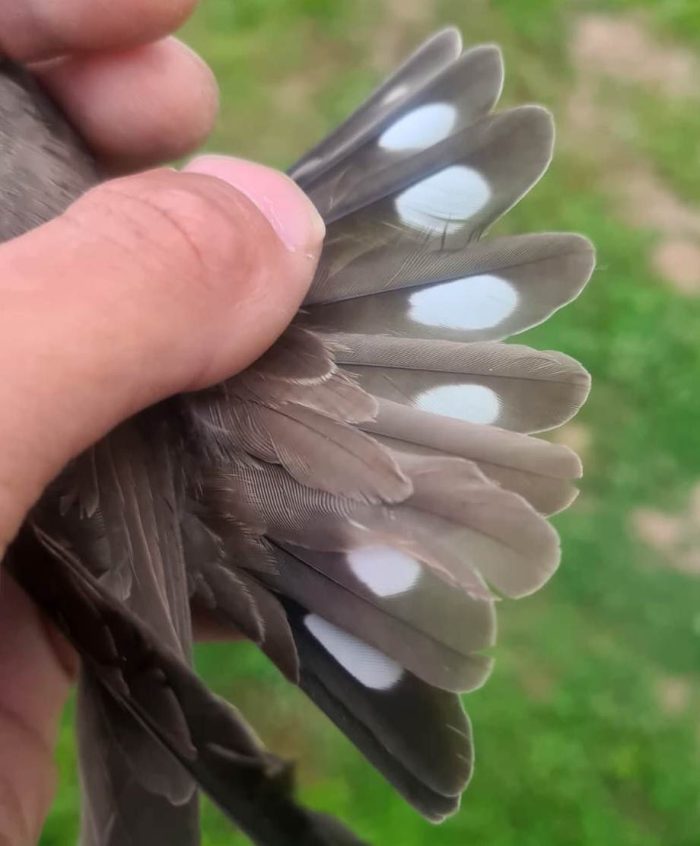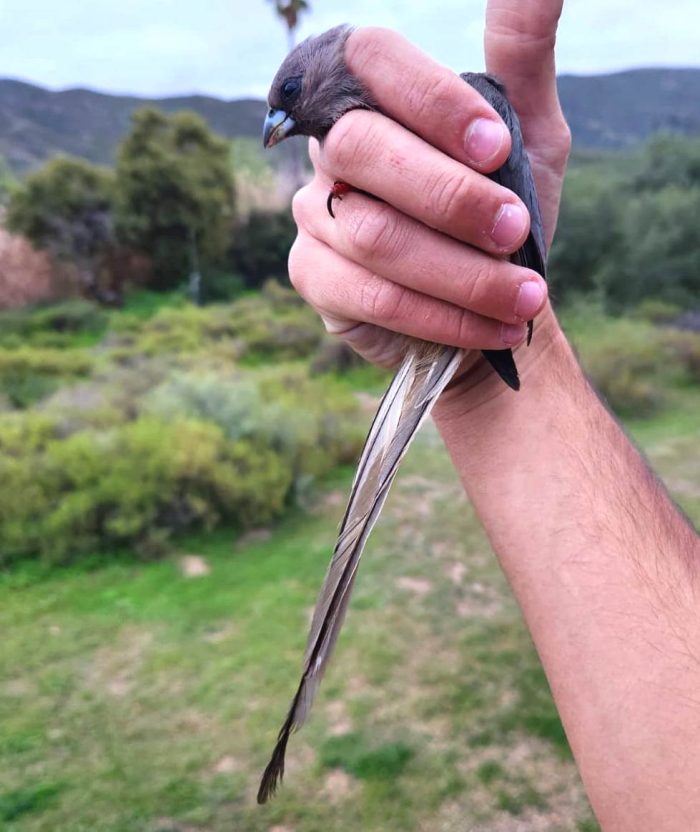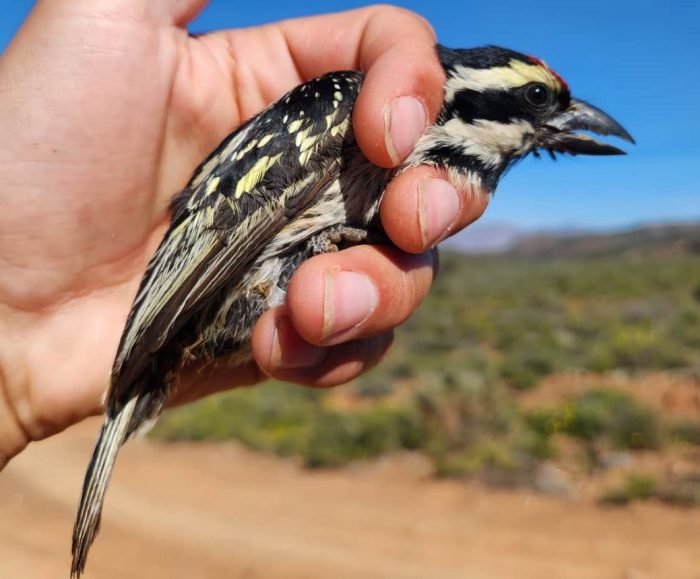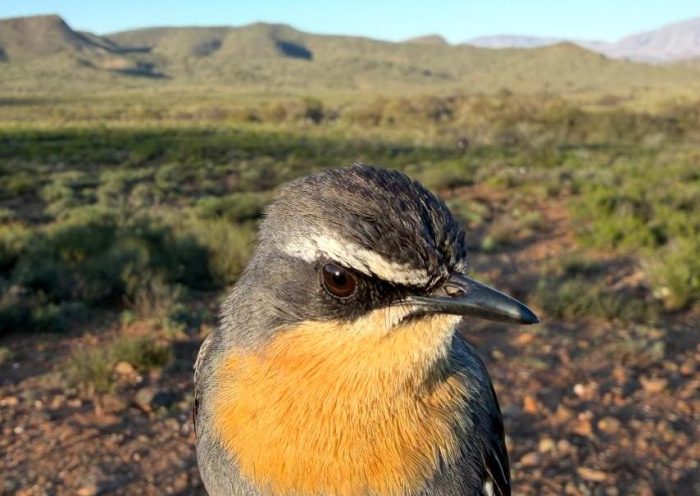
Rosy-faced Lovebird (Agapornis roseicollis)

Cover image of Rosy-faced Lovebird by Roy Earle – Karas, Namibia

Lovebirds are members of the family PSITTACULIDAE (Old World Parrots). The Psittaculiudae is one of four parrot families in the order Psittaciformes. Characteristic features of all parrots include a strong, curved bill, an upright stance, strong legs, and zygodactyl feet. Many parrots are vividly coloured and exhibit little or no sexual dimorphism. They form the most variably sized bird order in terms of length. The most important components of most parrots’ diets are seeds, nuts, fruit, buds, and other plant material. A few species sometimes eat animals and carrion, while the lories and lorikeets are specialised for feeding on floral nectar and soft fruits. Almost all parrots nest in tree hollows and lay white eggs. The Psittaculiudae is made up of 201 species from 41 genera. There are 9 species of Lovebirds and they are restricted to sub-Saharan Africa and Madagascar.

Identification

The Rosy-faced Lovebird is a small, colourful, and noisy parrot with a dumpy, short-tailed appearance.

Rosy-faced Lovebird Agapornis roseicollis
Erongo, Namibia
Photo by Lappies Labuschagne

It is predominantly bright, grass green, although slightly yellower on the undersides. The face, throat, and breast are rose pink, and the forehead and eyebrow are bright pinkish red. The rump is bright cobalt blue. The eyes are dark brown with a white eye-ring. The bill is pale yellowish-horn, and the legs and feet are grey. The sexes are similar, but males have brighter pink colouration on the head and face. Immature birds resemble the adults but are duller, with a greenish forehead and a black base to the upper mandible.

Rosy-faced Lovebird Agapornis roseicollis – Immature
Karas, Namibia
Photo by Johan van Rooyen

The Rosy-faced Lovebird is easily distinguished from Lilian’s Lovebird (Agapornis lilianae) by its pale (not redish) bill, and by its blue (not green) rump and pink face and upper breast. Additionally, the natural ranges of the two do not overlap.
Rosy-faced Lovebird Agapornis roseicollis
Fish River Canyon National Park, Namibia
Photo by Craig Peter

Status and Distribution

The Rosy-faced Lovebird is a locally common resident. Its range extends from just south of the Orange River, near Kenhardt, in the Northern Cape, through Namibia and into Angola. It historically occurred east to Lake Ngami in Botswana, but there have been no recent records from that area. The Rosy-faced Lovebird frequently escapes from captivity, and there is a well-established feral population in Gauteng. This population consists of escaped pets and their descendants, including hybrid mixtures with other lovebird species.

SABAP2 distribution map for Rosy-faced Lovebird Agapornis roseicollis – downloaded in December 2024. Details for map interpretation can be found here.
The Rosy-faced Lovebird is not threatened. Its range in southern Africa has probably increased in recent years with the provision of artificial structures for nest sites and water points in arid regions. However, trapping for the cage bird trade has resulted in substantial decreases in southern Angola.
Rosy-faced Lovebird Agapornis roseicollis
Keimoes, Northern Cape
Photo by Ryan Tippett

Habitat

The Rosy-faced Lovebird inhabits dry woodland, scrubby hillsides, riparian woodlands, and tree-lined watercourses in arid regions. It favours places with rocky outcrops, which are used for breeding. The Rosy-faced Lovebird is highly water-dependent and often congregates around farm dams and reservoirs. It forages in nearby semi-desert shrublands, but is absent from very open habitats. The Rosy-faced Lovebird also visits gardens on farms and in some suburban areas.

Arid woodland habitat.
Between Aus and Keetmanshoop, Namibia
Photo by Les Underhill

Behaviour

The Rosy-faced Lovebird is highly nomadic; its movements are dictated by water and food availability. They are noisy and usually gregarious in flocks of up to 15 birds, but larger flocks gather at water and reliable food sources. The Rosy-faced Lovebird is highly dependent on water and may drink several times per day. The flight is agile, rapid, and direct.

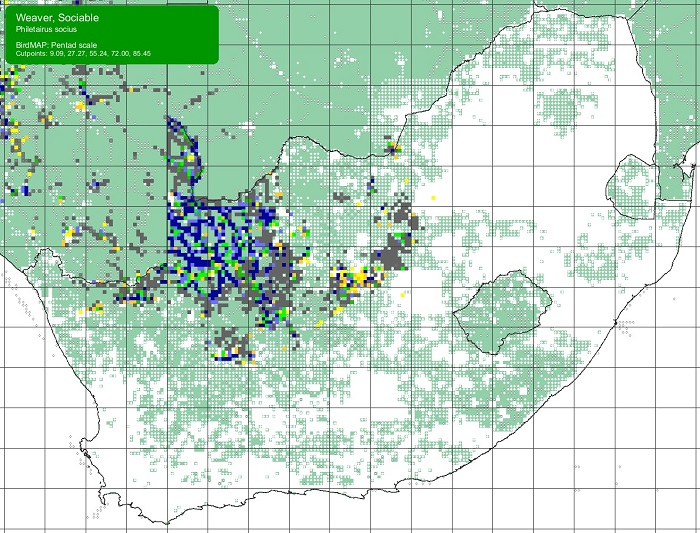
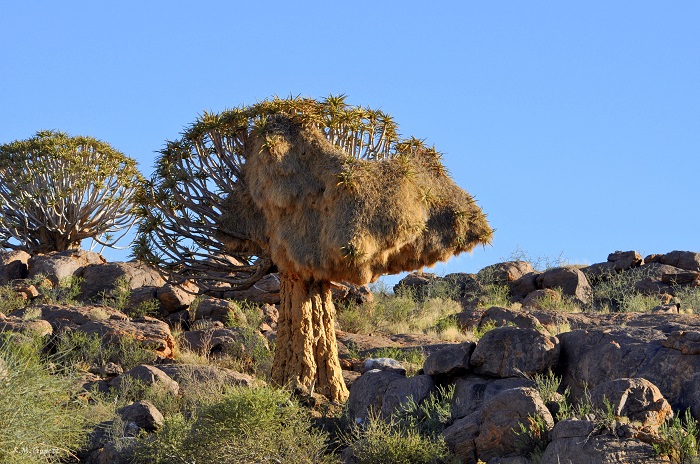
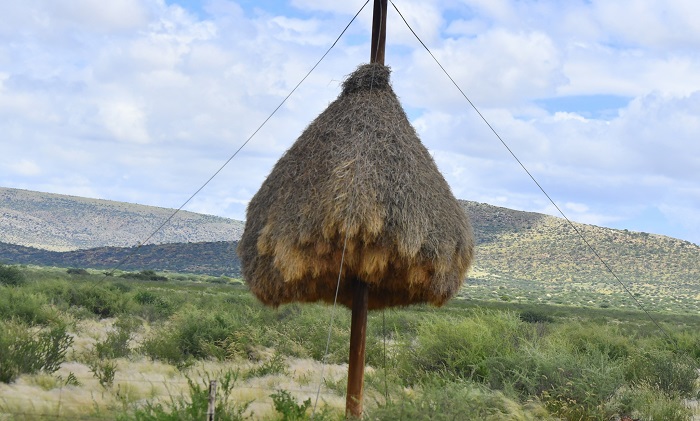
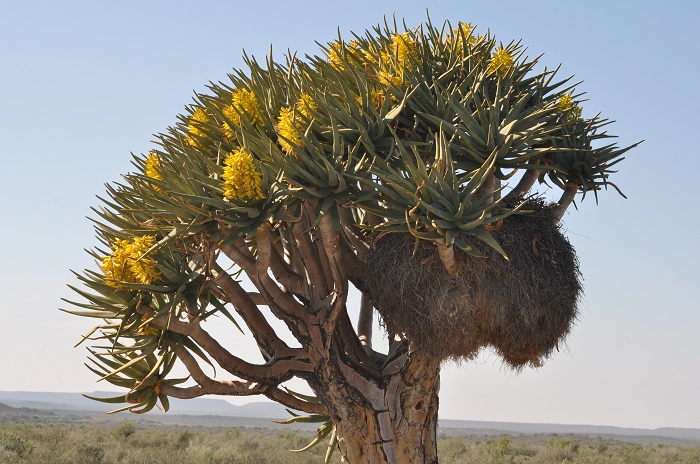
Flocks often roost in the nests of Sociable Weaver (Philetairus socius) and White-browed Sparrow-weaver (Plocepasser mahali). In cool weather, birds huddle in small groups on branches.

Rosy-faced Lovebird Agapornis roseicollis
Karas, Namibia
Photo by Roy Earle

The Rosy-faced Lovebird forages by clambering about in the branches of trees and shrubs and gathers seeds from the ground. The diet consists of various seeds (especially grasses), fruits, berries, flowers, and grain crops such as millet, maize, and sunflower seeds.

Rosy-faced Lovebird Agapornis roseicollis
Luanda, Angola
Photo by Maans Booysen

Rosy-faced Lovebirds are monogamous and form pair bonds, which are maintained for life, while still in immature plumage. They have the extraordinary ability to breed when only 2 months old.

Rosy-faced Lovebirds are colonial nesters and breed mainly from February to April. Nests are most often placed in a hole in a rock face, or building, or in a chamber within a Sociable Weaver nest. They have also been recorded nesting under the eaves of houses and in nest boxes. The nest is a deep cup of bark strips, leaves, or grass. Nesting material is sourced and cut by the female and carried to the nest in her rump feathers. Grass is sometimes removed or stolen from the outside of Sociable Weaver nests to be used in nest construction. No nesting material is added to nests inside Sociable Weaver colonies.

Rosy-faced Lovebird Agapornis roseicollis
Hardap, Namibia
Photo by Cobus Elstadt

4 to 6 dull white eggs are laid per clutch. Eggs are typically laid at 2 day intervals, and incubation begins a day or two after the first egg is laid. The incubation period lasts up to 23 days and is done entirely by the female.

Young chicks take around 43 days to fledge. During this time, they are closely brooded by the female, who receives food from the male. The female feeds her young chicks by regurgitation. Older chicks are later fed by both parents. Juvenile birds are dependent on their parents for a few months after fledging.

Rosy-faced Lovebird Agapornis roseicollis
Fochville, Gauteng
Photo by Evert Kleynhans

Further Resources

Species text adapted from the first Southern African Bird Atlas Project (SABAP1), 1997.

The use of photographs by Cobus Elstadt, Craig Peter, Evert Kleynhans, Johan van Rooyen, Lappies Labuschagne, Les Underhill, Maans Booysen, Roy Earle, and Ryan Tippett is acknowledged.

Other common names: Rooiwangparkiet (Afrikaans); Inséparable rosegorge (French); Rosenpapagei (German); Perzikkopagapornis (Dutch); Inseparável-de-faces-rosadas (Portuguese)

Recommended citation format: Tippett RM. 2026. Rosy-faced Lovebird Agapornis roseicollis. Biodiversity and Development Institute. Available online at https://thebdi.org/2026/03/06/rosy-faced-lovebird-agapornis-roseicollis/

Bird identificationbirding

Rosy-faced Lovebird Agapornis roseicollis
Karas, Namibia
Photo by Roy Earle

Acacia Pied Barbet (Tricholaema leucomelas)

Cover image of Acacia Pied Barbet by Gerald Wingate – Cape Town, Western Cape

The Acacia Pied Barbet belongs to the family LYBIIDAE. Members of the family, which also includes Tinkerbirds, are commonly known as African Barbets. They are small to medium-sized nearpasserine birds known for their heavy, toothed or serrate bills, zygodactyl feet, prominent rictal bristles, and patches of bright colours. They eat mostly fruit and nest in self-excavated holes in trees or banks. They are found throughout sub-Saharan Africa. Lybiidae is composed of 43 species from 10 genera. 10 species occur in southern Africa.

Identification

The Acacia Pied Barbet is a stout species with a bold black-and-white striped head.

Acacia Pied Barbet Tricholaema leucomelas
Cape Town, Western Cape
Photo by Gerald Wingate

The sexes are alike. Adults have an overall black and white (pied) appearance. The forehead is bright red and the crown and nape are black. black. A broad white and yellow supercilium extends well behind the eye and onto the nape. Below this, a thick black eye stripe runs from the base of the bill to the nape. The rest of the upper parts are black with dull yellow-tipped feathers. The rump is yellow and appears as a narrow yellow stripe in flight. The tail dusky-brown with buff-yellow outer tail feathers.

Acacia Pied Barbet Tricholaema leucomelas
Smithfield, Free State
Photo by Lance Robinson

On the underparts, a broad black throat bib extends from the chin to the breast (diagnostic). The remainder of the underparts are white with a dull yellow wash. Some birds have indistinct blackish blotches on the belly and grey-washed flanks.The deep, heavy bill is black and notched on the upper mandible. Rictal bristles are prominent at the base of the bill. The eyes are dark brown and the legs and feet are blackish. Immature birds resemble the adults but the forehead is black (not red).

Acacia Pied Barbet Tricholaema leucomelas
Near Hanover, Northern Cape
Photo by Jon Blanco

The Acacia Pied Barbet is sometimes confused with the much smaller Red-fronted Tinkerbird (Pogoniulus pusillus), and the orange-red foreheaded morph of the Yellow-fronted Tinkerbird (Pogoniulus chrysoconus). However, the tinkerbirds have a streaked crown and nape, white moustachial stripes and they lack the black throat bib.

Status and Distribution

The Acacia Pied Barbet is a common near-endemic to southern Africa, its ranges marginally into southern Angola and south-western Zambia. It is is the most widespread barbet in the region and is found virtually throughout South Africa.

SABAP2 distribution map for Acacia Pied Barbet Tricholaema leucomelas – downloaded in December 2024. Details for map interpretation can be found here.

The Acacia Pied Barbet is not threatened. It has undergone a dramatic and well-documented range expansion, mainly due to the spread of alien trees and the proliferation of artificial water points. This spread into previously unsuitable habitats occurred during the 20th century. The availability of suitable trees for nesting apparently limited its distribution in the past. Other possibly important factors include the abundant supply of food from fruiting alien trees, iand icreases in the density of suitable indigenous nest trees due to bush encroachment.

Habitat

Typical arid woodland habitat.
Mokala National Park, Northern Cape
Photo by Karis Daniel

The Acacia Pied Barbet is a characteristic savanna species. It is tolerant of varied ecological conditions but favours semi-arid savanna, particularly Vachellia/Senegalia (formerly Acacia) or mixed woodlands. In more open habitats, the Acacia Pied Barbet is found along wooded drainage lines. It also frequents gardens, parks, and orchards. The Acacia Pied Barbet’s occurrence in apparently unsuitable open or treeless habitats is attributed to both invasive alien and encroaching indigenous trees that provide nesting sites.

Subtropical savanna Habitat.
Mkhuze Game Reserve, KwaZulu-Natal
Photo by Colin Summersgill

Behaviour

The Acacia Pied Barbet is a sedentary resident with some local movements depending on food and water availability, especially in drier areas. It is mostly encountered singly or in pairs and readily frequents gardens in agricultural and suburban areas. The Acacia Pied Barbet roosts in its own nest holes or in a variety of other species’ nests, including those of Greater Striped Swallow, South African Cliff-Swallow, Sociable and Cape Weavers, Southern Masked Weaver, and Brown-throated Martin. The flight is fast and somewhat dipping.

The Acacia Pied Barbet Tricholaema leucomelas is a frequent visitor to gardens.
Karas, Namibia
Photo by Roy Earle

The larger Black-collared Barbet (Lybius torquatus) may exclude the Acacia Pied Barbet from some areas in the wetter regions of the region where greater competition for nest holes may occur. The Abundance of the Acacia Pied Barbet appears lower where it overlaps with the Black-collared Barbet.

Acacia Pied Barbet Tricholaema leucomelas
Near Willowmore, Eastern Cape
Photo by Cobus Elstadt

The Acacia Pied Barbet feeds mainly on fruit, and is especially fond of mistletoes (Loranthaceae, Viscaceae) and figs (Ficus spp). It disperses sticky mistletoe seeds by regurgitation onto branches. They also consume the fruits of shepherds-trees (Boscia spp), karees (Searsia spp), guarris (Euclea spp), Honeythorns (Lyceum spp.), and Wild Date Palm Phoenix reclinata, etc. In gardens and orchards, they eat apples, grapes, peaches, etc. Acacia Pied Barbets also eat insects and drink nectar from aloes. They have also been observed eating certain flowers, petals, and seed pods.

Acacia Pied Barbet Tricholaema leucomelas
Hoedspruit, Limpopo
Photo by Derek Solomon

The Acacia Pied Barbet is a monogamous, solitary nester. Nesting territories are formed which they actively defend. Breeding is recorded in spring and summer from August to April. In the winter rainfall region, breeding peaks between September and October. In the summer rainfall parts of its range, breeding peaks from October to December.

Acacia Pied Barbet Tricholaema leucomelas
Kuruman River, Northern Cape
Photo by Kyle Finn

The nest is a self-excavated hole in a soft or dead branch of a tree, typically 1 to 3m above the ground. The entrance is roughly circular, up to 38mm in diameter. The nest may be reused again in the same season, but rarely in the following season. 2 to 4 plain white eggs are laid per clutch, although 3 is the norm. They are laid in wood chips at the bottom of the nest chamber. The incubation period lasts up to 18 days and is performed by both sexes. The nestling period takes up to 35 days, during which the nestlings are fed by both parents. The Acacia Pied Barbet is double-brooded.

Despite vigorous defence of the nest, the Acacia Pied Barbet is a brood host of the Lesser Honeyguide (Indicator minor), and less frequently, the Greater Honeyguide (Indicator indicator). The range expansion of the Lesser Honeyguide into the Western Cape province closely followed that of the Acacia Pied Barbet.

Acacia Pied Barbet Tricholaema leucomelas
Cape Town, Western Cape
Photo by Gerald Wingate

Further Resources

Species text adapted from the first Southern African Bird Atlas Project (SABAP1), 1997.

The use of photographs by Cobus Elstadt, Colin Summersgill, Derek Solomon, Gerald Wingate, Jon Blanco, Karis Daniel, Kyle Finn, Lance Robinson, Roy Earle, and Ryan Tippett is acknowledged.

Other common names: Pied Barbet (Alt. English); Bonthoutkapper (Afrikaans); Barbican pie (French); Rotstirn-Bartvogel (German); Kaapse Baardvogel (Dutch); Barbaças-das-acácias (Portuguese)

Recommended citation format: Tippett RM. 2026. Acacia Pied Barbet Tricholaema leucomelas. Biodiversity and Development Institute. Available online at https://thebdi.org/2026/03/04/acacia-pied-barbet-tricholaema-leucomelas/

Bird identificationbirding

Acacia Pied Barbet Tricholaema leucomelas
Erongo, Namibia
Photo by Cobus Elstadt

Yellow Canary (Crithagra flaviventris)

Cover image of Yellow Canary by Lance Robinson – Near Frankfort, Free State

Canaries belong to the Family FRINGILLIDAE (True Finches). Other members of Fringillidae include the Siskins, Seedeaters, Redpolls, Serins, Grosbeaks, and Euphonias, as well as the morphologically divergent Hawaiian Honeycreepers. Birds in this family are small to medium-sized passerines. They generally have stout conical bills adapted for eating seeds and nuts, and often have colourful plumage. They occupy a great range of habitats where they are usually resident and do not migrate. They have a worldwide native distribution except for Australia and the polar regions. The family Fringillidae contains around 236 species from 50 genera.

Identification

In the Yellow Canary, the sexes differ in plumage colouration.

Yellow Canary Crithagra flaviventris
Heidelberg district, Western Cape
Photo by Johan van Rooyen

Adult males are olive green above with fine brown streaking. Birds from the central to northern parts of its range tend to be brighter and yellower above. The undersides are rich yellow in the north and yellow with a greenish wash in the south. The forehead, supercilium, and cheeks are rich yellow. An olive-green band runs through the eye and widens over the ear coverts and onto the sides of the neck and nape. A narrow olive-green malar stripe extends below the yellow cheek and connects with the olive-green sides of the neck. The bill is horn-coloured and the eyes are brown. The legs and feet are pinkish brown.

Yellow Canary Crithagra flaviventris
Near Carnarvon, Northern Cape
Photo by Sybrand Venter

Females are drab in comparison. They are dull olive-grey above, heavily streaked with dusky brown. The lores, ear coverts, and malar stripe are greyish olive, contrasting with a buffy-white supercilium and lower cheeks. The rump and upper tail coverts are yellowish-green. The underparts are buffy white, heavily marked with dusky brown and buffier on the belly, with fewer markings.

Juveniles are similar to adult females but are more heavily streaked above and below.

Yellow Canary Crithagra flaviventris – Female
Carnarvon district, Northern Cape
Photo by Sybrand Venter

Status and Distribution

SABAP2 distribution map for Yellow Canary Crithagra flaviventris – December 2024.
Details for map interpretation can be found here.

The Yellow Canary is a common near-endemic to southern Africa. Its range extends beyond the region only into south-western Angola. The Yellow Canary is widespread in the south-western, central, and north-western parts of the subregion.

There is no evidence of any recent change in the distribution of the Yellow Canary. The species is not considered threatened. The population sometimes irrupts east of its usual range during drought years.

Yellow Canary Crithagra flaviventris
Khomas, Namibia
Photo by Norman Barrett

Habitat

The Yellow Canary is a species of relatively dry and open environments. It inhabits a relatively wide variety of habitats. These include arid and semi-arid Karoo shrublands, arid savanna, alpine shrublands, dry grasslands, dry fynbos, renosterveld, and strandveld, as well as dune vegetation. It also occurs along weedy road verges and in gardens. In the Karoo, the Yellow Canary favours small drainage lines with taller shrubs and rocky hillsides with scattered bushes. In the south-western Cape, it is most abundant in strandveld, renosterveld, and dune fynbos, and avoids mountain fynbos.

A rocky hillside with scattered bushes in the Karoo
Carnarvon district, Northern Cape
Photo by Ryan Tippett

Behaviour

The Yellow Canary is resident in moister parts of its range, and nomadic or possibly a partial migrant in drier regions.

Yellow Canary Crithagra flaviventris
Khomas, Namibia
Photo by Norman Barrett

The Yellow Canary is a conspicuous species. It occurs in pairs when breeding but is found in small to large flocks during the non-breeding season. It frequently forms mixed flocks with Cape Sparrows, White-throated Canaries, Black-headed Canaries, and non-breeding weavers and bishops. The Yellow Canary drinks regularly and often congregates at waterholes, dams, and drinking troughs.

It forages on the ground and at the tops of shrubs. The diet of the Yellow Canary mostly consists of seeds and small fruits, but they will also consume flowers, nectar, and small insects.

Yellow Canary Crithagra flaviventris
Marico River, Limpopo
Photo by Ansie Dee Reis

The Yellow Canary breeds from August to April. Breeding peaks earlier in the winter rainfall region (August), and later between September and October in the north of its range. In arid areas, the Yellow Canary breeds opportunistically after rains at almost any time of the year.

The nest is a shallow cup composed of grass stems, rootlets, dry stalks, etc. The bowl is lined with soft plant down. Nests are most often placed in the fork of a shrub or small tree, usually around 50cm above the ground. It is built entirely by the female in as little as 3 days.

2 to 4 white eggs are laid per clutch. The eggs are sometimes pale blue or green, occasionally with sparse purple-brown spots. The incubation period lasts for 12 to 14 days and is performed only by the female. The nestling period takes up to 19 days and the young are fed by both parents.

Yellow Canary Crithagra flaviventris
Near Lamberts Bay, Western Cape
Photo by Karis Daniel

Further Resources

This species text is adapted from the first Southern African Bird Atlas Project (SABAP1), 1997.

The use of photographs by Ansie Dee Reis, Johan van Rooyen, Karis Daniel, Lance Robinson, Norman Barrett, and Sybrand Venter is acknowledged. Additional photographs by Ryan Tippett.

Other names: Serinus flaviventris (Alt. Scientific); Geelkanarie (Afrikaans); Serin de Sainte-Hélène (French); Geelbuiksijs, Geelbuikkanarie (Dutch); Gelbbauchgirlitz (German); Canário-de-barriga-amarela (Portuguese).

Recommended citation format: Tippett RM. 2026. Yellow Canary Crithagra flaviventris. Biodiversity and Development Institute. Available online at https://thebdi.org/2026/02/26/yellow-canary-crithagra-flaviventris/

List of bird species in this format is available here.

Bird identificationbirding

Yellow Canary Crithagra flaviventris
Near Smithfield, Free State
Photo by Lance Robinson

Lesser Swamp Warbler (Acrocephalus gracilirostris)

Cover image of Lesser Swamp Warbler by Johan Heyns – Marievale Bird Sanctuary, Gauteng

The Lesser Swamp Warbler belongs to the Family ACROCEPHALIDAE (Reed Warblers and allies). The species in this family are small, insectivorous passerine birds. Most are drab olive-brown above and cream to yellow or beige below. They are usually found in reedbeds, but also in open woodland or tall grass. The family is found primarily across Europe, Asia, and Africa, but also ranges far into the Pacific. They are members of a complex group that was formerly included with the Old World warblers but have since been reclassified based on genetic data. The family is made up of 60 species from 7 genera.

Identification

Lesser Swamp Warbler Acrocephalus gracilirostris
Intaka Island, Western Cape
Photo by Mark Stanton

The Lesser Swamp Warbler is fairly large for a reed warbler and has a rather robust build. The upperparts are warm brown with a grey wash on the head and neck. It has a fairly conspicuous white eyebrow. The underparts are whiteish-buff with diagnostic, lightly rufous flanks. The legs are dark brown, unlike the paler brown legs of most Acrocephalus warblers. The sexes are alike, but males are larger than females. Juveniles resemble the adults but have darker underparts and less distinct eyebrows.

Lesser Swamp Warbler Acrocephalus gracilirostris
Port Edward, KwaZulu-Natal
Photo by Lia Steen

The Lesser Swamp Warbler can be mistaken for several other warbler species. It is larger than the African Reed Warbler (Acrocephalus baeticatus) and darker above with a more distinct eyebrow. It can be told from the Little Rush Warbler (Bradypterus baboecala) by the complete lack of streaking on the throat or breast, and by its dark (not pinkish) legs. Additionally, the Lesser Swamp Warbler can be told from all other species by its rich, melodious, and distinctive song.

Status and Distribution

The Lesser Swamp Warbler is a common resident. It is widely distributed in sub-Saharan Africa from southern Sudan and Ethiopia to South Africa, with isolated populations in west-central Africa. It is found almost throughout southern Africa, except the Kalahari Basin and most of the arid and semi-arid parts of Namibia.

SABAP2 distribution map for Lesser Swamp Warbler Acrocephalus gracilirostris – December 2024.
Details for map interpretation can be found here.

The Lesser Swamp Warbler is not threatened. There is no evidence to suggest that the present-day distribution differs from the historical range. The widespread loss of natural wetland habitats has been offset by the construction of dams and sewage ponds, especially in drier areas, which has most likely helped to extend its range. Additionally, the silting up of rivers has provided further suitable habitat by promoting the growth of reeds and other aquatic plants.

Lesser Swamp Warbler Acrocephalus gracilirostris
Near Hanover, Northern Cape
Photo by Ryan Tippett

Habitat

The Lesser Swamp Warbler inhabits reedbeds (Phragmites spp) and bulrushes (Typha capensis) in standing or slow-moving water, including estuaries, rivers, dams, pans, marshes, floodplains, and lakes. It occurs in most biomes, wherever suitable habitat exists.

Typical Habitat
Near Worcester, Western Cape
Photo by Les Underhill

Behaviour

The Lesser Swamp Warbler is encountered singly or in pairs. It is sedentary and territorial year-round. It is highly vocal in summer, but less so during the rest of the year. Nevertheless, the Lesser Swamp Warbler seldom shows itself from thick cover and is frequently overlooked unless calling. It is inquisitive and responds well to spishing, but is not easily seen in its dense reedbed habitat.

Lesser Swamp Warbler Acrocephalus gracilirostris
West Rand, Gauteng
Photo by Mark Stanton

The Lesser Swamp Warbler forages low down in reeds and among other aquatic plants, often just above the water. It moves nimbly up and down vertical stems to glean food items. It may also forage in leaf litter on the ground, and among the foliage of trees adjacent to reedbeds.

The Lesser Swamp Warbler feeds primarily on invertebrates like insects and spiders, and possibly also small frogs.

Lesser Swamp Warbler Acrocephalus gracilirostris
Bellville, Western Cape
Photo by Sharon Stanton

The Lesser Swamp Warbler breeds from September to December in the Western Cape, and slightly later (October to January) in the northern parts of South Africa. Records show that it breeds almost throughout the year in Zimbabwe.

Lesser Swamp Warbler Acrocephalus gracilirostris
Illovo, KwaZulu-Natal
Photo by Georg Jacobs

The nest is a tidy cone-shaped cup built from grass and reed blades. It is lined with fine strips of grass with a few feathers and securely bound to a vertical reed stem. The nest is usually placed 20 to 120cm above the water. 2 to 3 eggs are laid per clutch. The eggs are white to greenish or pale blue-white with heavy black, brown, and grey spots. The incubation period takes up to 14 days and is done by both sexes. Details regarding the nestling period are unrecorded; however, the young are known to be fed by both parents.

Lesser Swamp Warbler Acrocephalus gracilirostris
Intaka Island, Western Cape
Photo by Sharon Stanton

Further Resources

This species text is adapted from the first Southern African Bird Atlas Project (SABAP1), 1997.

The use of photographs by Georg Jacobs, Johan Heyns, Jon Blanco, Les Underhill, Lia Steen, Mark Stanton, and Sharon Stanton is acknowledged. Additional photographs by Ryan Tippett.

Other common names: Cape Reed Warbler (Alt. English); Kaapse rietsanger (Afrikaans); Rousserolle à bec fin (French); Kaapse Rietzanger (Dutch); Kaprohrsänger (German); Rouxinol-pequeno-dos-pântanos (Portuguese).

Recommended citation format: Tippett RM. 2026. Lesser Swamp Warbler Acrocephalus gracilirostris. Biodiversity and Development Institute. Available online at https://thebdi.org/2026/02/23/lesser-swamp-warbler-acrocephalus-gracilirostris/

List of bird species in this format is available here.

Bird identificationbirding

Lesser Swamp Warbler Acrocephalus gracilirostris
Karoo-Gariep Nature Reserve, Northern Cape
Photo by Jon Blanco

Orange-breasted Sunbird (Anthobaphes violacea)

Cover image of Orange-breasted Sunbird by Cobus Elstadt – Cape Peninsula, Western Cape

Sunbirds belong to the Family NECTARINIIDAE. This is a group of small passerine birds  They are small, slender passerines from the Old World, usually with downward-curved bills. Many are brightly coloured, often with iridescent feathers, particularly in the males. A number of species also have elongated tail feathers. Sunbirds are found mainly in the warmer southern regions of the Old World. Species diversity is highest in equatorial regions. The family contains around 151 species from 16 genera.

Identification

The Orange-breasted Sunbird is a distinctive, colourful, and attractive species. It is the only member of its genus. The sexes differ markedly in plumage coloration.

Orange-breasted Sunbird Anthobaphes violacea – Male
Near Somerset West, Western Cape
Photo by Sybrand Venter

Adult males are easy to identify. The head, neck, upper mantle, and upper scapulars are metallic green. The rest of the upper parts are olive green. The brown tail is long and graduated with projecting central rectrices. They have bright yellow pectoral tufts, but these are infrequently visible in the field. There is a narrow violet band on the upper breast, while the remainder of the breast is rich orange, fading to yellow on the belly. The undertail coverts are also orange. The bill, legs and feet are black and the eyes are dark brown.

Orange-breasted Sunbird Anthobaphes violacea – Female
Table Mountain National Park, Western Cape
Photo by Jon Blanco

Adult females are drab in comparison. They are olive green, tinged with grey and brown overall. They sometimes have an orangeish wash on the belly. The tail is dark brown, with yellowish edges to the feathers. Juveniles are similar to adult females before male plumage begins to show.

Orange-breasted Sunbird Anthobaphes violacea – Immature male
Table Mountain National Park, Western Cape
Photo by Itxaso Quintana

Confusion with other species is only likely with females. The female Southern Double-collared Sunbird and Greater Double-collared Sunbird have less yellow breasts. The female Malachite Sunbird is far larger and has a longer bill.

Status and Distribution

The Orange-breasted Sunbird is endemic to South Africa and to the Fynbos Biome. Its distribution extends from Vanrhynsdorp to Gqeberha (Port Elizabeth), but it is absent or scarce away from mountains along the west coast.

SABAP2 distribution map for Orange-breasted Sunbird (Anthobaphes violacea) – December 2024.
Details for map interpretation can be found here.

The Orange-breasted Sunbird is common and is not threatened. There is no evidence of any recent large-scale changes in its distribution. However, the Orange-breasted Sunbird is adversely affected by infestations of alien woody plants, too frequent burning, and, in the coastal lowlands, urban and agricultural development.

Orange-breasted Sunbird Anthobaphes violacea – Male
Mossel Bay, Western Cape
Photo by Joanne Putter

Habitat

The Orange-breasted Sunbird is endemic to the Fynbos Biome. It is restricted to fynbos shrublands and occurs from sea-level to high mountain peaks. The Orange-breasted Sunbird is found wherever plants of the genera Protea, Mimetes, Leucospermum, Erica, and many other plants with tubular flowers are in bloom. The Orange-breasted Sunbird is sometimes also found in gardens adjoining fynbos, but it is generally reluctant to leave fynbos. Nevertheless, the Orange-breasted Sunbird does occasionally venture beyond its traditional habitat and has been recorded in the Karoo, many kilometres from the nearest fynbos.

Typical habitat in mountain fynbos.
Swartberg Pass, Western Cape
Photo by Ryan Tippett

Behaviour

In common with other nectivores, the Orange-breasted Sunbird tracks the flowering of food plants. Its movements are poorly known, however, in large part due to the mountainous and remote nature of its habitat. Observation records indicate that birds move away from lowlands and return to higher altitudes in summer. Orange-breasted Sunbirds are sometimes forced to move into other areas in response to fire, including areas not normally frequented.

Orange-breasted Sunbird Anthobaphes violacea – Male
Kirstenbosch Botanical Gardens, Western Cape
Photo by Sybrand Venter

The Orange-breasted Sunbird is encountered singly or in pairs during the breeding season, but occurs in loose flocks of up to 100 birds at rich food sources in the non-breeding season. Drinks water and bathes frequently, along quiet reaches of streams or in dew that has accumulated on leaves.

Orange-breasted Sunbird Anthobaphes violacea – Male
Kogelberg Biosphere Reserve, Western Cape
Photo by Sharon Stanton

The Orange-breasted Sunbird consumes nectar and invertebrates, although nectar is its preferred diet. The Orange-breasted Sunbird is closely associated with tubular-flowered Erica (Heath) species, with which it appears to have co-evolved. The Orange-breasted Sunbird is the primary pollinator of Ericas. It also feeds on the nectar of a wide range of other plant genera, including Protea, Leucospermum, Leonotis, Mimetes, Watsonia, Lobostemon, Tecoma, and Aloe, etc. They also feed on the nectar of many alien plant species.

Orange-breasted Sunbird Anthobaphes violacea – Male feeding on Erica nectar.
Kirstenbosch Botanical Gardens, Western Cape
Photo by Felicity Ellmore

The Orange-breasted Sunbird is often seen to forage on the ground for arthropods. It also carefully searches for invertebrates among leaves and branches, and frequently hawks insects in flight. Invertebrates eaten include spiders and a variety of insects like flies, wasps, beetles, grasshoppers, ants, termites, and cockroaches.

The Orange-breasted Sunbird is aggressive towards conspecifics and other birds around food sources. It is, however, often displaced from Protea flowers by male Cape Sugarbirds.

Orange-breasted Sunbird Anthobaphes violacea – Male
Table Mountain National Park, Western Cape
Photo by Itxaso Quintana

The Orange-breasted Sunbird breeds from February to November, with a peak between May and August. Differences in the timing of nesting across relatively short distances presumably reflect fine-scale variation in rainfall and/or flowering phenology of food plants.

The nest is a rounded oval with a side-top entrance. It is composed of rootlets, fine, leafy twigs, and grass, all of which are bound together with spider web. The nest is lined with brown protea fluff and other forms of plant down. It is usually situated in a proteaceous shrub, less than 1m above the ground. Nests may occasionally be found up to 10m above the ground in a tree. The nest is built entirely by the female.

Orange-breasted Sunbird Anthobaphes violacea – Female
Table Mountain National Park, Western Cape
Photo by Itxaso Quintana

1 to 2 eggs are laid per clutch. The eggs vary from whitish to grey-green and are blotched and mottled with shades of brown and grey. The incubation period takes 14 or 15 days and is done by the female only. The duration of the nestling period ranges from 15 to 22 days, during which time the young are fed by both parents. Fledglings return to the nest for up to 15 days after their initial departure.

Broods of the Orange-breasted Sunbird are sometimes parasitised by the Klaas’s Cuckoo Chrysococcyx klaas.

Orange-breasted Sunbird Anthobaphes violacea – Male
Near Stilbaai, Western Cape
Photo by Derick Oosthuizen

Further Resources

This species text is adapted from the first Southern African Bird Atlas Project (SABAP1), 1997.

The use of photographs by Cobus Elstadt, Derick Oosthuizen, Felicity Ellmore, Itxaso Quintana, Joanne Putter, Jon Blanco, Rick Nuttall, Sharon Stanton, and Sybrand Venter is acknowledged. Additional photographs by Ryan Tippett.

Other common names: Nectarinia violacea (alt. Scientific Name); Oranjeborssuikerbekkie (Afrikaans); Souimanga orangé (French); Oranjeborst-honingzuiger (Dutch); Goldbrust-Nektarvogel (German); Beija-flor-de-peito-laranja (Portuguese).

Recommended citation format: Tippett RM. 2026. Orange-breasted Sunbird Anthobaphes violacea. Biodiversity and Development Institute. Available online at https://thebdi.org/2026/02/20/orange-breasted-sunbird-anthobaphes-violacea/

List of bird species in this format is available here.

Bird identificationbirding

Orange-breasted Sunbird Anthobaphes violacea – Male
Addo Elephant National Park, Eastern Cape
Photo by Rick Nuttall

Bar-throated Apalis (Apalis thoracica)

Cover image: Bar-throated Apalis by Lia Steen – Port Edward, KwaZulu-Natal

Apalises belong to the Family CISTICOLIDAE. This is a group of small passerine birds found mainly in warmer southern regions of the Old World and contains around 168 species divided into 26 genera. This family is thought to have originated in Africa, which is home to the majority of species, but members of the family can also be found in Europe, tropical Asia, and Australasia. They were formerly included within the Old World warbler family Sylviidae.

Identification

The Bar-throated Apalis is a very small, slender species. It shows considerable plumage variation due to the presence of 13 recognised subspecies in southern Africa.

Bar-throated Apalis Apalis thoracica
Cape St. Francis, Eastern Cape
Photo by Gregg Darling

In adult birds, the upperparts (head, nape, back, and wings) are greyish, often with a tinge of green. The green tinge varies, with northern populations being much greener than birds from the south of their range. The tail is dark grey with white outer tail feathers. The throat is white, bordered below by a black band or collar. The rest of the underparts vary from creamy white to yellow. Birds from the south of their range are whiter below, becoming increasingly yellow further north. The eyes are white, the bill is blackish, and the legs and feet are pinkish. The Bar-throated Apalis is the only apalis in the region with whitish eyes. The sexes are alike.

Juveniles resemble adults, but the breast band is indistinct.

Bar-throated Apalis Apalis thoracica – Juvenile
Albert Falls Nature Reserve, KwaZulu-Natal
Photo by Colin Summersgill

The Bar-throated Apalis could be mistaken for the Rudd’s Apalis (Apalis ruddi), but the latter lacks white in the outer tail and has dark brown (not white) eyes. The Yellow-breasted Apalis (Apalis flavida) has an incomplete or absent breast band and eyes reddish-brown (not white) eyes.

Status and Distribution

SABAP2 distribution map for Bar-throated Apalis (Apalis thoracica) – December 2024.
Details for map interpretation can be found here.

The Bar-throated Apalis is common and occurs over much of Africa south of the equator in many distinct subspecies.

It is found discontinuously from south-east Kenya south through East Africa as far west as central Zambia, to South Africa. In southern Africa, it is found in eastern Botswana, central and eastern Zimbabwe and adjacent Mozambique. In South Africa, it is widespread in the wetter northern, eastern, and southern regions.

Bar-throated Apalis Apalis thoracica
Magoebaskloof, Limpopo
Photo by Marius Meiring

There is no evidence to suggest that the historical distribution of the Bar-throated Apalis has changed. However, the spread of alien trees has allowed their expansion into some previously treeless regions. The Bar-throated Apalis is common throughout much of its range and does not appear to be under any particular threat.

Habitat

Evergreen forest habitat
Ngoye Forest Reserve, KwaZulu-Natal
Photo by Ryan Tippett

The Bar-throated Apalis is adaptable and inhabits a range of wooded habitats. It is equally at home in the interior of evergreen or semi-evergreen forests, forest fringes, a variety of woodlands, as well as drainage lines in Karoo scrub and grassland. The Bar-throated Apalis also inhabits wooded gardens, alien plantations and areas with exotic trees.

Thicket and wooded drainage line habitat
Near Montagu, Western Cape
Photo by Karis Daniel

Behaviour

The Bar-throated Apalis is mostly a sedentary resident. However, some winter movement to lower altitudes is suspected in some areas. It is usually found in pairs, but may also be encountered singly or in small family groups of 4 to 6 birds. Pairs frequently join mixed bird parties.

Bar-throated Apalis Apalis thoracica
Bontebok National Park, Western Cape
Photo by Corrie du Toit

The Bar-throated Apalis forages restlessly in dense vegetation at all heights, favouring lower to middle levels. It often hops from branch to branch, calling frequently. It is not usually shy and is rather inquisitive and fairly tame.

Bar-throated Apalis Apalis thoracica
Cradock district, Eastern Cape
Photo by Zenobia van Dyk

Food is found mostly by gleaning from twigs, leaves, flowers, tree trunks and sometimes from lichen-covered rocks. It will also occasionally forage on the ground and may also hover to snatch insects or hawk small insects in flight. The Bar-throated Apalis consumes a range of small invertebrates and their larvae, including caterpillars, flies, small grasshoppers, beetles, bugs, insect eggs, and spiders. It is also known to eat small quantities of fruit.

Bar-throated Apalis Apalis thoracica
Robberg Nature Reserve, Western Cape
Photo by Richard Johnstone

The Bar-throated Apalis breeds mainly from October to February. Breeding in the south of its range begins earlier in the season than in the north. It is a monogomous, solitary nester, and pairs are territorial.

The nest is a small oval-shaped ball with a side-top entrance. It is loosely constructed out of green moss, fine plant fibres and spider web and variably lined with plant down. The nest is typically hidden in the thick foliage of a shrub, sapling, or creeper. Nests are most often located 1 to 2m above the ground.

2 to 4 eggs are laid per clutch and eggs are laid at daily intervals. They are pale greenish blue or pinkish white, variably marked with reddish-brown and grey spots.

The incubation period takes 14 to 17 days, and incubation duties are shared by both sexes. The newly hatched young are altricial and entirely dependent on their parents for survival. The nestling period lasts for 13 to 18 days. The young are fed by both parents.

The Bar-throated Apalis is often double-brooded. Bar-throated Apalis broods are sometimes parasitised by the Red-chested Cuckoo (Cuculus solitarius) and Klaas’s Cuckoo (Chrysococcyx klaas).

Further Resources

This species text is adapted from the first Southern African Bird Atlas Project (SABAP1), 1997.

The use of photographs by Colin Summersgill, Corrie du Toit, Gregg Darling, Karis Daniel, Lia Steen, Marius Meiring, Richard Johnstone, and Zenobia van Dyk is acknowledged. Additional photographs by Ryan Tippett.

Other common names: Bandkeelkleinjantjie (Afrikaans); uMabhelwane (Zulu); Ugxakhweni (Xhosa); Apalis à collier (French); Halsbandapalis (Dutch); Halsband-Feinsänger (German); Apalis-de-coleira(Portuguese).

Recommended citation format: Tippett RM. 2026. Bar-throated Apalis Apalis thoracica. Biodiversity and Development Institute. Available online at https://thebdi.org/2026/02/12/bar-throated-apalis-apalis-thoracica/

List of bird species in this format is available here.

Bird identificationbirding

Cape Longclaw (Macronyx capensis)

Cover image of Cape Longclaw by Sharon Stanton – Rietvlei Nature Reserve, Western Cape

Longclaws are members of the family MOTACILLIDAE. This group also includes Wagtails and Pipits. They are small passerine birds with medium to long tails and a long hind claw that is especially pronounced in the Longclaws. The family comprises 70 species from 6 genera. 23 species are known from southern Africa.

Identification

The Cape Longclaw is an attractive and easily recognisable species. The sexes differ slightly in their plumage colouration.

Cape Longclaw Macronyx capensis
Near Middelburg, Mpumalanga
Photo by Joanne Putter

In adult males, the forehead to the nape, down to the back and rump are buff-brown with bold, dark brown spots and streaks. The tail is dark olive-brown with white outer tips. The ear coverts are pale brown with some whitish streaking, and the sides of the neck are greyish brown. The supercilium is bright orange. A blackish moustachial stripe leads into a broad black necklace across the upper breast. The throat is bright orange. The remainder of the underparts are deep yellow with buffy flanks. The bill is blackish, the eyes are brown, and the legs and feet are pale brown. As in all longclaws, the claw on the hind toe (Hallux claw) is elongated to push down vegetation, allowing them to easily clamber over grass tussocks.

Cape Longclaw Macronyx capensis – Male showing the long hallux claw.
Dullstroom district, Mpumalanga
Photo by Lance Robinson

Adult females resemble adult males but are duller overall with a thinner, less defined black necklace.

Immature birds are brown above with whitish scalloping. The underparts are buff-coloured, becoming dull orange-yellow with age. The breast band is indistinct.

Cape Longclaw Macronyx capensis – Immature
Near Memel, Free State
Photo by Rick Nuttall

Across most of its range, the Cape Longclaw should not be confused with any other species. However, in north-eastern KwaZulu-Natal and on the Zimbabwe plateau, it could be mistaken for the Rosy-throated Longclaw if not seen clearly.

Cape Longclaw Macronyx capensis. Female on the left and male on the right.
Rondebosch, Cape Town, Western Cape
Photo by Les Underhill

Status and Distribution

The Cape Longclaw is a locally common to common resident, and is endemic to southern Africa. It occurs from the southern parts of the Western Cape, extending eastwards narrowly along the coast before fanning out broadly inland into the Eastern Cape and northwards through KwaZulu-Natal, Lesotho, and the Free State to eSwatini (Swaziland) up to the Limpopo province. An isolated race occurs on the central plateau of Zimbabwe above 1200m, and east to the Eastern Highlands and marginally into adjoining parts of Mozambique.

SABAP2 distribution map for Cape Longclaw Macronyx capensis – downloaded in December 2024.
Details for map interpretation can be found here.

The historical range of the Cape Longclaw has probably changed little over the years; however, overgrazing has reduced habitat availability. Across much of its range, the Cape longclaw is a common breeding resident and is not threatened.

Cape Longclaw Macronyx capensis
Near Riebeek Kasteel, Western Cape
Photo by Rene Navarro

Habitat

The Cape Longclaw inhabits a variety of grassland types, mostly at fairly high elevations, and with minimal tree cover. It prefers moist grasslands with short, dense grass 300-400 mm tall and avoids long, rank grass. It is less common in drier grassland areas. The Cape Longclaw is frequently found near wetlands, especially floodplains and the margins of marshes and dams. It also frequents pastures and burnt grassland, but avoids ploughed fields. The Cape Longclaw is not found in woodlands, though it may occur in grasslands adjacent to wooded areas. In the winter rainfall region, it may also be found in short fynbos, but is more often found in association with wetlands or pastures in that region.

Short, moist grasslands and pastures provide an ideal habitat.
Midmar Nature Reserve, KwaZulu-Natal
Photo by Colin Summersgill

Behaviour

The Cape Longclaw is usually seen singly or in pairs. They may form loose groups of 3 to 5 during the winter non-breeding season, often alongside pipits on burnt ground. It is resident with no evidence to suggest local movements.

It frequently perches on termite mounds, boulders, or fence posts to sun or sing in the early morning. The Cape Longclaw crouches low when alarmed and flies off suddenly with its back to the intruder. Flies with short bursts of stiff wing-beats alternating with glides, typically with the tail fanned.

Cape Longclaw Macronyx capensis
Memel district, Free State
Photo by Rick Nuttall

The Cape Longclaw forages by walking through or over short grass. They peck at or chase insects on the ground or aerially hawk flushed insects. They are also known to scratch open termite tunnels with their feet.

Cape Longclaw Macronyx capensis
Johannesburg, Gauteng
Photo by Roelof van der Breggen

The Cape Longclaw mostly consumes insects and their larvae, including grasshoppers, beetles, caterpillars, and termite alates. They occasionally also eat seeds.

Cape Longclaw Macronyx capensis
Near Klerksdorp, North West
Photo by Tony Archer

The Cape Longclaw breeds from October to March in the summer rainfall region, and from July to November in the winter rainfall region. It is a monogamous, solitary nester, and pairs are territorial. Fighting between pairs may occur, and takes place both on the ground and in the air with wings drooped, and tails fanned in threat posture. In flight display rises to around 10 m, combining fluttering flight with song, before dropping into thick grass. Also sings from a prominent vantage point.

The nest is a neat cup lined with fine rootlets, and is usually well hidden between grass tufts. The nest is built entirely by the female. However, she may be accompanied by the male while collecting nesting material. From 1 to 4 eggs are laid per clutch. The eggs are white to creamy white and heavily spotted with brown and grey. The incubation period lasts for 13 or 14 days, and all incubation is likely done by the female. Newly hatched young are undescribed. The nestling period lasts for 14 days, during which the young are fed by both parents.

Cape Longclaw Macronyx capensis. Female with nesting material.
Rietvlei Nature Reserve, Gauteng
Photo by Neels Jackson

Further Resources

Species text adapted from the first Southern African Bird Atlas Project (SABAP1), 1997.

The use of photographs by Colin Summersgill, Joanne Putter, Johan Heyns, Lance Robinson, Les Underhill, Neels Jackson, Rene Navarro, Rick Nuttall, Roelof van der Breggen, Sharon Stanton, and Tony Archer is acknowledged.

Other common names: Orangethroated Longclaw (Alt. English); Oranjekeelkalkoentjie (Afrikaans); iNqomfi (Zulu); Inqilo (Xhosa); Sentinelle du Cap (French); Kapgroßsporn (German); Kaapse Langklauw Unha-longa-de-garganta-laranja (Portuguese)

Recommended citation format: Tippett RM. 2026. Cape Longclaw Macronyx capensis. Biodiversity and Development Institute. Available online at https://thebdi.org/2026/02/06/cape-longclaw-macronyx-capensis/

Bird identificationbirding

Cape Longclaw Macronyx capensis
Rietvlei Nature Reserve, Gauteng
Photo by Johan Heyns

African Stonechat (Saxicola torquatus)

Cover image of African Stonechat by Gerald Wingate – Cape Town, Western Cape

The African Stonechat belongs to the family MUSCICAPIDAE. This group of songbirds in the order Passeriformes is commonly known as the ‘Old World Flycatchers and Chats’. Members of the group share a number of anatomical features, including the presence of a well-developed 10th primary feather in the wing and adaptations for insect eating. The family comprises around 353 species from 57 genera. Southern African representatives of this family include Flycatchers, Chats, Rock Thrushes, and Wheatears.

Identification

The African Stonechat is a conspicuous and easily recognisable species. The sexes differ in their plumage colouration.

African Stonechat Saxicola torquatus – Male
Cedarberg, Western Cape
Photo by Zenobia van Dyk

The adult male has an entirely black head and throat with conspicuous white patches on each side of the neck. The back is also black, but with variable brownish feather tips. The wings are black with an obvious white wing bar. The rump is white, and the tail is black. The Underparts, including the breast and flanks, are deep chestnut, transitioning to white on the belly and under tail coverts. The bill, legs, and feet are black, and the eyes are dark brown.

African Stonechat Saxicola torquatus – Female
Near Humansdorp, Eastern Cape
Photo by Cobus Elstadt

In adult females, the upperparts, including the head, back and folded wings, are buff with dark brown streaking. The lores and ear coverts are dark brown. The rump is white, and the tail is dark brown. The breast and flanks vary from pale cinnamon to warm buff, paler on the belly and under tail coverts.

Juveniles resemble females, but their upper parts are dark brown with profuse pale buff spotting. The rump is pale rufous-buff, and the tail is dark brown. The throat is greyish, and the rest of the underparts are warm buff with darker mottling on the breast. The eyes are dark brown, and the legs are black.

African Stonechat Saxicola torquatus – Male
Near Riversdale, Western Cape
Photo by Attie van Aarde

The African Stonechat is most likely to be mistaken for the Whinchat (Saxicola rubetra), but the latter has a conspicuous white (male) or buff (female) supercilium and malar stripe. The Whinchat also has a white patch on either side of the tail base. The Whinchat is a rare vagrant to the region.

Status and Distribution

The African Stonechat is generally common to fairly common, but is uncommon in more marginal habitats such as the dwarf shrublands of the Nama Karoo. The African Stone Chat ranges across much of sub-Saharan Africa, but is patchily distributed in West Africa. It is distributed more continuously from north-east Africa down through central Africa to South Africa. It also occurs in Madagascar. In southern Africa, the African Stonechat is widespread in wetter regions and is absent from most of Namibia, the Kalahari Basin, and the southern and northern Karoo. Its occurrence is patchy in southern Mozambique.

SABAP2 distribution map for African Stonechat Saxicola torquatus – downloaded in December 2024.
Details for map interpretation can be found here.

The African Stonechat is not threatened. It is well adapted to situations where irrigation promotes rank growth and has probably expanded its range into farming areas. However, the African Stonechat may be negatively affected by overgrazing.

Habitat

The African Stonechat frequents montane grassland, grassy hillsides, open grassland with scattered scrub and low bushes, fynbos shrublands, the edges of high altitude forest patches, marshy areas, swamp edges and cultivated lands. It is most common in relatively moist, open country, with rank growth and scattered shrubs.

Ideal moist grassland habitat with some rank grass and suitable perching sites.
Midmar Nature Reserve, KwaZulu-Natal
Photo by Colin Summersgill

The African Stonechat is mostly a species of high-altitude grasslands, but in southern Africa it commonly occurs down to sea level. It is found in fynbos but is more common in agricultural areas within that biome. The African Stonechat’s occurrence in the Succulent Karoo and Little Karoo is mostly linked to scattered moist habitats and agriculture. In the Okavango Delta, Botswana, it is restricted to permanent wetlands and moist floodplains.

A male African Stonechat Saxicola torquatus in typical habitat.
Near Secunda, Mpumalanga
Photo by Vaino Prinsloo

Behaviour

The African Stonechat is usually encountered in pairs or family groups. They perch prominently on tall, slender plants, bushes, posts, fence wires or telephone lines. The African Stonechat is often quite tame, but is usually very wary when breeding. It is an active and restless species. The flight is jerky and low, flashing the conspicuous white upper tail coverts and wing patches. The African Stonechat is frequently seen to flick its wings and tail.

African Stonechat Saxicola torquatus – Male
Near Vanrhynsdorp, Western Cape
Photo by Les Underhill

The African Stonechat does much of its hunting from a perch, but sometimes hawks prey in flight. Once prey has been spotted, it drops to the ground from a perch, either returning to the same perch or another nearby. The African Stonechat is also known to forage on rocky shores, hawking prey from perches on rocks or kelp. They may occasionally hover around 2 m above the ground on rapidly beating wings before dropping onto prey.

African Stonechat Saxicola torquatus – Female with insect prey.
Near Sedgefield, Western Cape
Photo by Ryan Tippett

The Diet of the African Stonechat consists primarily of small to medium-sized arthropods. It is known to consume a wide range of insects and their larvae, including flies, termites, grasshoppers, ants, bugs, beetles, moths and butterflies. It also eats woodlice, millipedes, centipedes, spiders, solifuges, snails, small earthworms, small fish, and lizards, seeds and fruit.

African Stonechat Saxicola torquatus – Male with insect prey.
Midmar Nature Reserve, KwaZulu-Natal
Photo by Malcolm Robinson

The African Stonechat is monogamous, although on rare occasions 1 male may breed with 2 females. It is a solitary nester and pairs are territorial, often remaining on their territory throughout the year. During courtship, the male will chase the female, he may also hover above or crouch in front of her with his wings lowered, exposing the white wing patches and rump.

African Stonechat Saxicola torquatus – Male
Bloemfontein, Free State
Photo by Dawie de Swardt

The African Stonechat Breeds mainly in spring and summer, with a peak in October in most areas. It breeds slightly later in higher-lying regions, where severe winter conditions at high altitudes are presumably responsible for a later season.

The nest is a deep cup of dry grass, rootlets and and other plant material. It is lined with hair, wool, thin roots, and occasionally feathers. The nest is built entirely by the female and is placed either on the ground or on a low bank, and is well concealed at the base of a grass tuft or similar plant.

African Stonechat Saxicola torquatus – Female with nesting material.
Near Scottburgh, KwaZulu-Natal
Photo by Mary Ellen Lindsay

2 to 5 eggs are laid per clutch, and the eggs are pinkish to greenish-blue, variably marked with red spots and freckling. The incubation period takes 14 to 15 days to completion, and all incubation is performed by the female. The newly hatched young are altricial and are fed by both parents, but brooded only by the female. The nestling period lasts for up to 16 days. Young birds are dependent on their parents for the first 2 or 3 weeks after leaving the nest. Broods of the African Stonechat are sometimes parasitised by Klaas’s Cuckoo (Chrysococcyx klaas), and the Red-chested Cuckoo (Cuculus solitarius).

African Stonechat Saxicola torquatus – Female with grasshopper prey.
Near Alexandria, Eastern Cape
Photo by Cobus Elstadt

Further Resources

Species text adapted from the first Southern African Bird Atlas Project (SABAP1), 1997.

The use of photographs by Attie van Aarde, Cobus Elstadt, Colin Summersgill, Dawie de Swardt, Gerald Wingate, Les Underhill, Malcolm Robinson, Mary Ellen Lindsay, Vaino Prinsloo, and Zenobia van Dyk is acknowledged. Additional photographs by Ryan Tippett.

Other common names: Stonechat, Common Stonechat (Alt. English); Gewone bontrokkie (Afrikaans); isAncaphela, isAnqawane, isiChegu (Zulu); Ingcaphe, Isangcaphe (Xhosa); Tarier pâtre (French); Schwarzkehlchen (German); Aziatische Roodborsttapuit (Dutch); Cartaxo-comum (Portuguese)

Recommended citation format: Tippett RM. 2026. African Stonechat Saxicola torquatus. Biodiversity and Development Institute. Available online at https://thebdi.org/2026/01/27/african-stonechat-saxicola-torquatus/

Bird identificationbirding

African Stonechat Saxicola torquatus – Male
Tala Game Reserve, KwaZulu-Natal
Photo by Malcolm Robinson

Pied Starling (Lamprotornis bicolor)

Cover image of Pied Starling Starling by Lance Robinson – Near Frankfort, Free State

Starlings belong to the family STURNIDAE. All members of the family, which also includes Mynas, are collectively known as starlings. They are small to medium-sized passerine birds known for their often iridescent plumage, complex vocalisations, and their distinctive, swarming behaviour, known as murmurations. Most have strong bills of medium length that are arched on the culmen. They have moderately long and strong legs with large, strong feet. Wing and tail shape are variable.

Starlings are native to Europe, Asia, and Africa, as well as northern Australia and the islands of the tropical Pacific. Several European and Asian species have been widely introduced around the world. The family contains 125 species from 36 genera.

Identification

Pied Starling Lamprotornis bicolor
Drakensberg, KwaZulu-Natal
Photo by Roelof van der Breggen

The Pied Starling is a large, distinctive and easily recognisable species. Adult birds are predominantly blackish-brown with a slightly greenish, glossy sheen. The undertail and lower belly are white. The uppertail is dark with a greenish gloss. They have striking, white eyes, and the bill is black with a yellow lower mandible and a conspicuous yellow wattle at the gape. The legs and feet are black. The sexes are alike.

Pied Starling Lamprotornis bicolor – Immature
Near Swellendam, Western Cape
Photo by Johan van Rooyen

Immatures are similar to adults but the lower mandible is dark, gradually becoming yellow. The eyes are dark brown and gradually whiten with age. Juvenile plumage is matt black, without any gloss. The bill is black, except for a yellowish-white base to the lower mandible and a white wattle at the gape. The eyes dark brown.

The Pied Starling is unlikely to be mistaken for any other species within its range.

Pied Starling Lamprotornis bicolor
Ukhahlamba Drakensberg Park, KwaZulu-Natal
Photo by Colin Summersgill

Status and Distribution

The Pied Starling is locally common to abundant and is endemic to South Africa, Lesotho, and eSwatini (Swaziland). It occurs in all 9 South African provinces, although only marginally in southern Limpopo province.

It is absent from most of the Limpopo and Mpumalanga provinces, and the eastern lowlands of KwaZulu-Natal and the Eastern Cape. The Pied Starling also avoids the driest parts of the Northern Cape.

SABAP2 distribution map for Pied Starling Lamprotornis bicolor – downloaded in December 2024.
Details for map interpretation can be found here.

The Pied Starling is not threatened and is present in large numbers in many parts of its range, and is common in many protected areas. There has been some loss of habitat from urbanisation, such as on the Cape Peninsula. The loss of natural habitat to agriculture has had little impact as the Pied Starling thrives in farmlands.

Habitat

The Pied Starling is primarily a species of open areas dominated by grassland and semi-arid Karoo scrub. It is regularly found up to 2500 m in the Drakensberg, but occurs down to sea level in the west and south of its range. The Pied Starling is commonly associated with agriculture; often on open ground around farm homesteads, on cultivated lands, and near domestic stock. It also frequents villages, small towns and farmsteads in rural areas, but is absent from larger urban settlements. The Pied Starling is not found in wooded areas, nor in the most arid parts of the interior. Its frequent occurrence in the Fynbos biome is likely due to widespread agriculture in that region. The availability of reedbeds and vertical banks for roosting and nesting is probably a limiting factor on population densities.

Arid grassland and Karoo scrub habitat.
Near Vanwyksvlei, Northern Cape
Photo by Ryan Tippett

Behaviour

The Pied Starling is resident and mostly sedentary, but occasionally forms large nomadic flocks in the dry season.

Pied Starling Lamprotornis bicolor
Welkom, Free State
Photo by Janet du Plooy

Pied Starlings are highly gregarious at all times, usually in flocks of 10 to 20 birds. They roost communally in reeds or trees, often alongside other species, especially Wattled Starlings (Creatophora cinerea). Roosting flocks sometimes number well over 1000 birds. Pied Starlings are noisy when approaching the roost, and large flocks often perform coordinated murmurations at dusk before suddenly diving into the roost site. The loud chorus then continues until nightfall.

Pied Starling Lamprotornis bicolor
Carnarvon district, Northern Cape
Photo by Ryan Tippett

The Pied Starling forages mostly on the ground, walking or running after prey. They feed on insects disturbed by livestock, and regularly perch on sheep and cattle to remove ticks. They frequently flip over dry cowpats to expose insects underneath. They also forage at locust swarms and often form mixed-species foraging flocks with Wattled Starlings. Pied Starlings are also known to search for food in the rocky intertidal zone and feed on amphipods from kelp washed up onto beaches.

Pied Starling Lamprotornis bicolor
Near Hanover, Northern Cape
Photo by Itxaso Quintana

The diet of the Pied Starling comprises a wide range of arthropods, including termites, ants, beetles, grasshoppers, spiders, and ticks, etc. They also feed on plant material like seeds, fruit, and nectar. Around human habitation, Pied Starlings will feed on kitchen scraps, including bread, porridge and fruit.

Pied Starling Lamprotornis bicolor
Near Hanover, Northern Cape
Photo by Jon Blanco

Allofeeding is a common behaviour of the Pied Starling and is thought to establish and maintain bonds within a flock.

Pied Starling Lamprotornis bicolor
Near Hanover, Northern Cape
Photo by Rick Nuttall

The Pied Starling breeds from August to November in the winter rainfall region, from November to March in the Karoo, and throughout the year in the north of its range with a peak from September to November.

Pied Starling Lamprotornis bicolor
Vanrhynsdorp, Western Cape
Photo by Les Underhill

The Pied Starling is monogamous and is either a solitary or, more usually, a colonial nester, with colonies ranging in size from a handful of pairs to thousands of pairs. It is a cooperative breeder with helpers assisting in the feeding of chicks. The nest is a pad of grass, feathers, wool, and other material, built by both sexes. It is usually situated in a tunnel which the pair also excavate themselves. The tunnel is up to 1.5 m long and most often located in a riverbank, erosion donga, quarry, or cutting. They sometimes also nest in holes in buildings, bales of hay, or occasionally in a natural tree hole.

Pied Starling Lamprotornis bicolor
Bloemfontein, Free State
Photo by Dawie de Swardt

2 to 6 eggs are laid per clutch, and larger clutches may involve more than 1 female. The eggs are bright blueish-green and may be plain or with some red spotting. The incubation period lasts from 14 to 16 days. Incubation is performed entirely by the female and begins before the clutch has been completed. The newly hatched young are altricial. They are fed mostly on insects and small amounts of fruit. The nestling period takes 23 to 27 days. Fully fledged young are fed by helpers for at least 1 week after leaving the nest. Pied Starlings are regularly double-brooded. Their broods are frequently parasitised by the Great Spotted Cuckoo (Clamator glandularis), and less often by Greater Honeyguides (Indicator indicator).

Pied Starling Lamprotornis bicolor
Op-Die-Berg, Western Cape
Photo by Karis Daniel

Further Resources

Species text adapted from the first Southern African Bird Atlas Project (SABAP1), 1997.

The use of photographs by Colin Summersgill, Dawie de Swardt, Itxaso Quintana, Janet du Plooy, Johan van Rooyen, Jon Blanco, Karis Daniel, Lance Robinson, Les Underhill, Rick Nuttall, and Roelof van der Breggen is acknowledged.

Other common names: Spreo bicolor (Alt. Scientific Name); African Pied Starling (Alt. English); Witgatspreeu (Afrikaans); iGwayigwayi, iKhwikhwi, iNgwangwa (Zulu); lgiwu-giwu, lgiyo-giyo (Xhosa); Spréo bicolore (French); Zweifarbenstar (German); Tweekleurige Glansspreeuw (Dutch); Estorninho-de-ventre-branco (Portuguese)

Recommended citation format: Tippett RM 2026. Pied Starling Lamprotornis bicolor. Biodiversity and Development Institute. Available online at https://thebdi.org/2026/01/23/pied-starling-lamprotornis-bicolor/

Bird identificationbirding

Pied Starling Lamprotornis bicolor
Golden Gate National Park, Free State
Photo by Roelof van der Breggen

Levaillant’s Cisticola (Cisticola tinniens)

Cover image: Levaillant’s Cisticola by Gerald Wingate – Strandfontein Sewage Works, Western Cape

Cisticolas belong to the Family CISTICOLIDAE. This is a group of small passerine birds found mainly in warmer southern regions of the Old World and contains around 168 species divided into 26 genera. This family is thought to have originated in Africa, which is home to the majority of species, but members of the family can also be found in Europe, tropical Asia, and Australasia. They were formerly included within the Old World warbler family Sylviidae.

Identification

Levaillant’s Cisticola is one of the dark-backed cisticolas, which are more easily identified than other cisticola species.

Levaillant’s Cisticola Cisticola tinniens
Marievale Bird Sanctuary, Gauteng
Photo by Ansie Dee Reis

Breeding adults have a bright rufous crown, with light blackish streaks on the hind-crown, while the face and supercilium are off-white. The upperparts, including the mantle and back, are black and grey with a scaled appearance. The rump is buff-coloured with faint black streaks. The tail is dark brown to red-brown with buff tips. The underparts are buffy-white, sometimes with blackish streaks on the flanks. The bill is black with a pinkish base. The eyes are pale brown, and the legs and feet are pinkish. The sexes are alike.

Levaillant’s Cisticola Cisticola tinniens
Underberg district, KwaZulu-Natal
Photo by Ryan Tippett

Non-breeding adults are similar but carry more prominent streaking on the crown and have buffier upper parts, and darker greyish-buff underparts.

Juveniles resemble non-breeding adults, but are duller and browner overall.

Levaillant’s Cisticola is most easily mistaken for the Rufous-winged Cisticola (Cisticola galactotes), but the latter has a dark grey (not rufous) tail, and dark (not pale) lores. Levaillant’s Cisticola could also be confused with the Grey-backed Cisticola (Cisticola subruficapilla), but that species has a less richly coloured crown and tail, as well as darker and greyer underparts.

Status and Distribution

Levaillant’s Cisticola is a locally common resident but may undertake local movements during the dry season.

Levaillant’s Cisticola Cisticola tinniens
Underberg district, KwaZulu-Natal
Photo by Ryan Tippett

It has a discontinuous range from the west Kenyan highlands south and west to Angola, southern DRC, Zambia, Malawi and South Africa. In southern Africa, it is found mainly in South Africa, where it is widespread and with an isolated population on the Zimbabwe plateau, extending marginally into western Mozambique. In South Africa, it prefers regions with a relatively temperate climate, being replaced by the Rufous-winged Cisticola Cisticola galactotes in the subtropical north and east.

SABAP2 distribution map for Levaillant’s Cisticola (Cisticola tinniens) – December 2024.
Details for map interpretation can be found here.

Levaillant’s Cisticola is not threatened. Its historical distribution is not known to have differed from that of the present. However, the construction of dams has likely created much new habitat in areas where it did not previously occur. The loss of natural wetland habitats has been offset as a result.

Habitat

Levaillant’s Cisticola typically inhabits rank vegetation along streams and rivers, at the edges of reedbeds, and in moist grassland, marshes, and emergent vegetation in water. It is sometimes found in rank vegetation on drier ground, usually when wetlands have dried out. Levaillant’s Cisticola may also occur in irrigated pastures or croplands such as maize and sugarcane fields adjoining wetlands. Levaillant’s Cisticola occurs in wetlands in all the biomes within its distribution, but is most numerous in the Grassland and Fynbos biomes.

Habitat at Wakkerstroom, Mpumalanga
Photo by Ryan Tippett

Behaviour

Levaillant’s Cisticola is usually found in pairs, but may also be encountered singly or in small family groups. This species is highly vocal and therefore conspicuous, and is frequently detected by its call, which can be heard throughout the year. However, Levaillant’s Cisticolas only sing in summer during the breeding season when males make distinctive display flights and call from exposed perches.

Levaillant’s Cisticola Cisticola tinniens
Underberg district, KwaZulu-Natal
Photo by Pamela Kleiman

When disturbed, the Levaillant’s Cisticola perches high up on vegetation to view the intruder. They frequently utter alarm-calls and may fly back and forth in an agitated manner. They forage low down in vegetation and feed on small insects such as termites, grasshoppers, caterpillars, flies, and small beetles.

Levaillant’s Cisticola Cisticola tinniens
Dullstroom district, Mpumalanga
Photo by Joanne Putter

Levaillant’s Cisticola begins breeding in July in the winter rainfall region with peak egg-laying from August to October. Populations further north and east, in the summer rainfall regions breed later between October and April. The nest is an oval ball with a side top entrance, and is usually placed in vegetation over water. It is woven out of dry grass blades, rootlets and spider web, and is lined with fluffy plant down.

2 to 5 eggs are laid per clutch. They vary in colour from white through green to blue and may be plain or with grey-brown spots. The incubation period lasts for 11 to 14 days, but few other details have been recorded. The nestling period takes around 14 days.

Levaillant’s Cisticola Cisticola tinniens
Near Heidelberg, Western Cape
Photo by Johan van Rooyen

Further Resources

This species text is adapted from the first Southern African Bird Atlas Project (SABAP1), 1997.

The use of photographs by Ansie Dee Reis, Dembo Jatta, Gerald Wingate, Joanne Putter, Johan van Rooyen, and Pamela Kleiman is acknowledged. Additional photographs by Ryan Tippett.

Other common names: Vleitinktinkie (Afrikaans); lmvila, Umvila (Xhosa); Cisticole à sonnette (French); Vallei-graszanger (Dutch); Uferzistensänger (German); Fuinha-zunidora (Portuguese).

Recommended citation format: Tippett RM 2026. Levaillant’s Cisticola Cisticola tinniens. Biodiversity and Development Institute. Available online at https://thebdi.org/2026/01/19/levaillants-cisticola-cisticola-tinniens/

List of bird species in this format is available here.

Bird identificationbirding

Levaillant’s Cisticola Cisticola tinniens
Nuwejaars Wetland Special Management Area, Western Cape
Photo by Dembo Jatta

Similar Species