
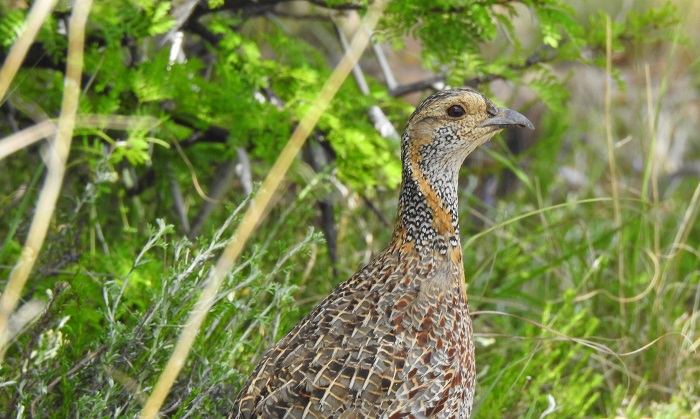
Cover image of Grey-winged Francolin by Kate Webster – Mountain Zebra National Park, Eastern Cape
Francolins belong to the Family: PHASIANIDAE (Pheasants, Grouse, and allies). Other southern African representatives of this family include Spurfowls and Quails. They are generally plump, heavy-bodied gamebirds, with broad, relatively short wings and powerful legs. Many have a spur on each leg, while some, have reduced spurs or none at all. The bill is short and compact. Phasianids inhabit almost all terrestrial habitats, from Arctic and alpine tundra to grasslands, deserts, and savannas, to humid tropical rainforest. Most African species are cryptically patterned but many Asian and Australasian species are among the most spectacularly plumaged of all birds. The Phasianidae comprise 187 species from 54 Genera. 15 species are native to southern Africa.
Identification
The Grey-winged Francolin is a cryptically plumaged species, yet the feathers are beautifully and intricately patterned in black, white, brown and rufous. The sexes are alike in colouration, but males are larger than females.
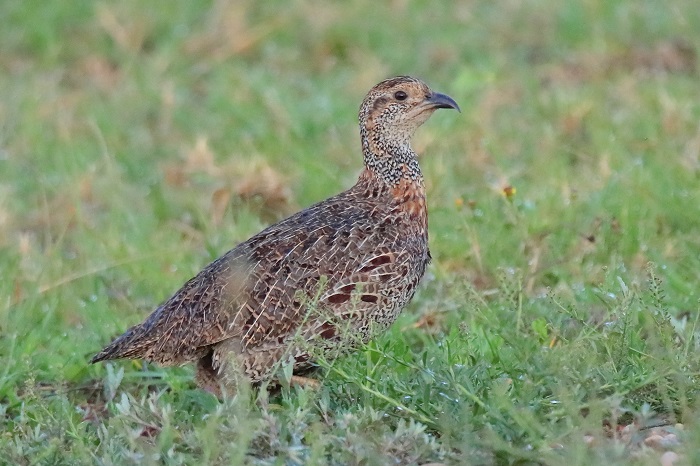
Near Hartenbos, Western Cape
Photo by Johan Heyns
In adults, the upper parts are grey-brown, with white feather shafts and with white or buff transverse barring. The head is warm brownish-buff, with dark speckling. The crown is streaked buff and blackish grey, and the ear coverts are brown. The nape and hind neck are dark grey, spotted white, and the pattern extends to the sides of the lower neck. The lower foreneck is pale cinnamon, and the feathers have distinct rufous patches. The underparts are paler and finely but irregularly barred black and off-white. Rufous primary coverts and primary bases are visible in flight. The bill is grey and heavy at the base, and noticeably decurved. The eyes are dark brown, and the legs and feet are dull greyish yellow. Males are equipped with sharp, robust leg spurs.
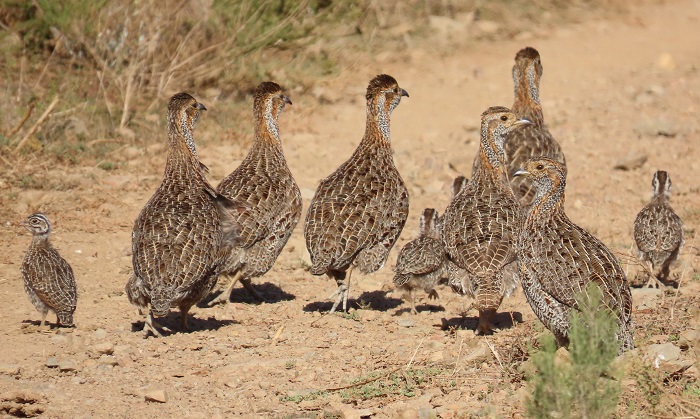
Swellendam district, Western Cape
Photo by Johan van Rooyen
Immature and juvenile birds resemble adults, but carry duller plumage and white throat.
The Grey-winged Francolin is genetically closely allied to the Orange River Francolin (Scleroptila gutturalis), Red-winged Francolin (Scleroptila levaillantii), and Shelley’s Francolin (Scleroptila shelleyi), and it replaces these species in high altitude grasslands. The Grey-winged Francolin differs from other Scleroptila francolins in having more grey than red on the wings (red confined to the outer wing), and a grey-freckled, not white, or buff, throat. It differs from Shelley’s Francolin in having narrow barring on the underparts.
Status and Distribution
The Grey-winged Francolin is locally common. It is endemic to South Africa and Lesotho.
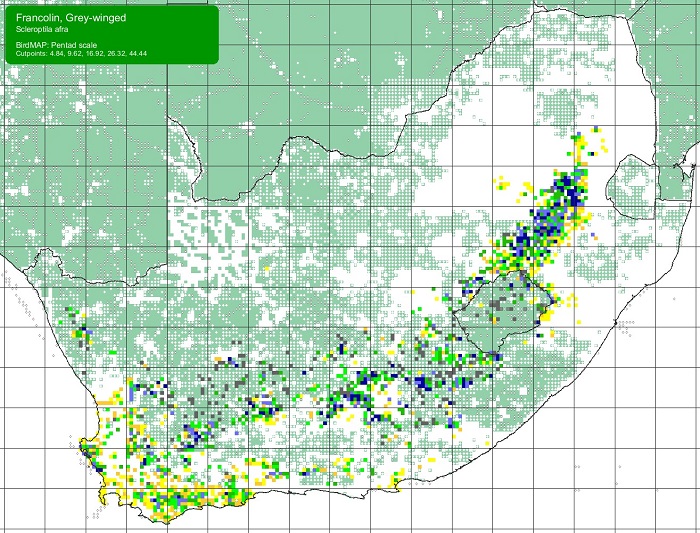
The Grey-winged Francolin ranges from Mpumalanga, through the KwaZulu-Natal Drakensberg, Lesotho, the eastern Free State, and the highlands of the Eastern Cape westwards through the southern half of the Northern Cape to the southern Western Cape. The conspicuous gap in its distribution in the Great Karoo is probably due to sparse vegetation cover in that region. The Grey-winged Francolin is most common in the highland grasslands in the Drakensberg region. It is less numerous in the Northern and Western Cape.
The Grey-winged Francolin is partially sympatric with the Red-winged Francolin (Scleroptila levaillantii), but is generally found at higher altitudes. It occurs alongside the Cape Spurfowl (Pternistes capensis) in the succulent Karoo and fynbos areas of the W Cape.
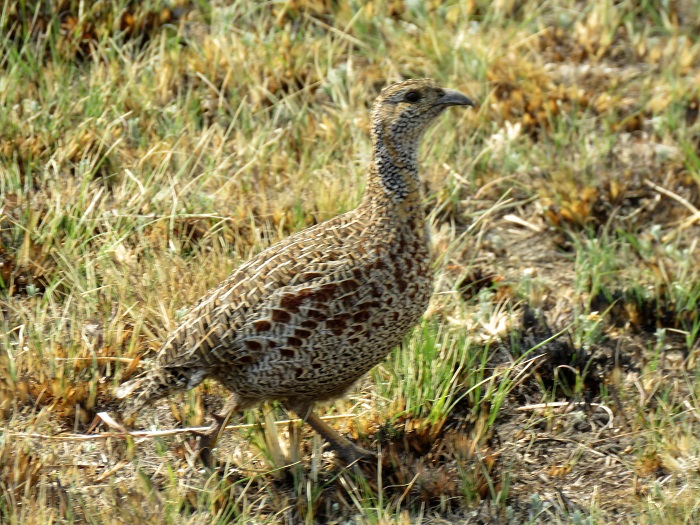
Golden Gate Highlands National Park, Free State
Photo by Terry Terblanche
The Grey-winged Francolin is not threatened. The historical distribution was probably similar to the current distribution. It is known to benefit from habitat modification due to moderate stock farming. Veld burning during early summer has the most detrimental influence on Grey-winged Francolins.
The Grey-winged Francolin is the only southern African francolin sufficiently abundant to sustain commercial wing-shooting. It has been hunted for recreation and commercially in the Eastern Cape for at least the past 120 years. This hunting is known to be both biologically sustainable and economically viable. Additionally, it provides landowners with an incentive to conserve grassland habitats. Hunted populations breed earlier than those that are not hunted, and are more outbred because of increased local movements following hunting.
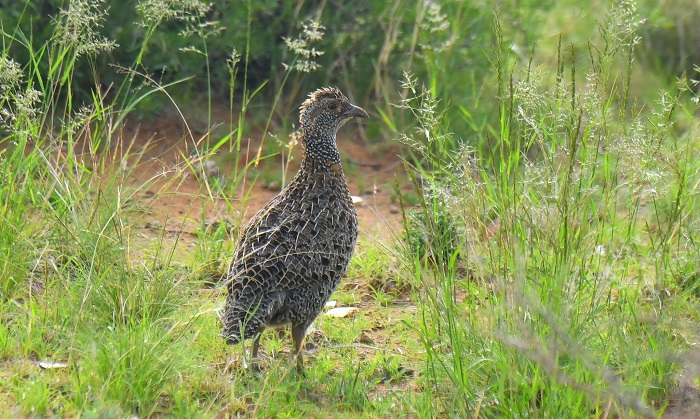
Carnarvon district, Northern Cape
Photo by Ryan Tippett
.
Habitat
The Grey-winged Francolin is typically found in mountainous areas in the Grassland, Nama Karoo, Succulent Karoo, and Fynbos biomes. It prefers ridge tops and shelves to steep slopes and valley bottoms. The Grey-winged Francolin is most numerous in montane grasslands, usually above 1800m. In the Succulent and Nama Karoo, it inhabits hilly and mountainous areas with sufficient grass and scrub cover. In the Fynbos biome, it occurs in grassy places in short fynbos, renosterbos, and strandveld down to sea level.
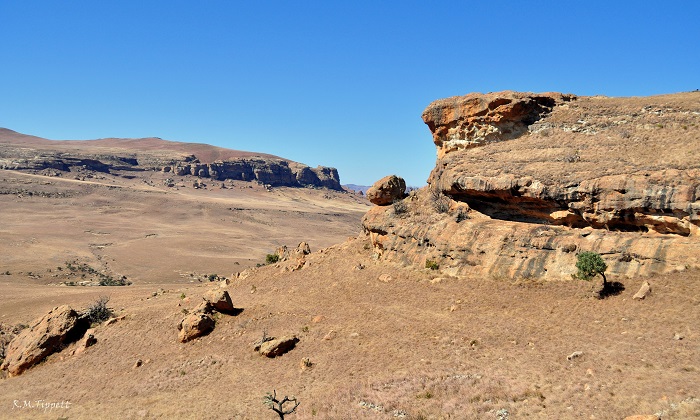
Golden Gate Highlands National Park, Free State
Photo by Ryan Tippett

Carnarvon district, Northern Cape
Photo by Ryan Tippett
Behaviour
The Grey-winged Francolin is resident with no evidence of seasonal movements. Breeding birds remain in the same general locations throughout their lives. However, young birds move between coveys often enough to ensure genetic interchange. Fluctuations in reporting rates reflect variations in conspicuousness linked to the breeding cycle.
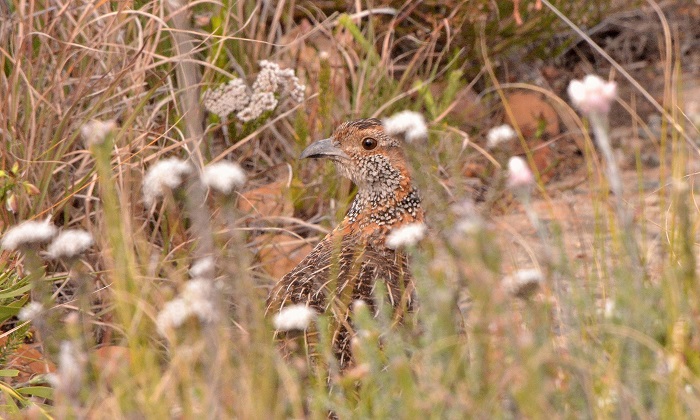
Gamkaberg Nature Reserve, Western Cape
Photo by John Todd
The presence of Grey-winged Francolins is usually revealed by territorial advertisement calls or when flushed. They are otherwise inconspicuous birds. The Grey-winged Francolin often warms up in the early morning on open ground, such as at road verges. Flushed birds fly fast and strongly, typically taking advantage of wind and steep ground to aid escape. Apart from this, they seldom take flight. The Grey-winged Francolin is most likely to run if disturbed (when vegetation is sparse), otherwise sits tight, flushing at the last moment. Birds roost on open ground, huddled together.
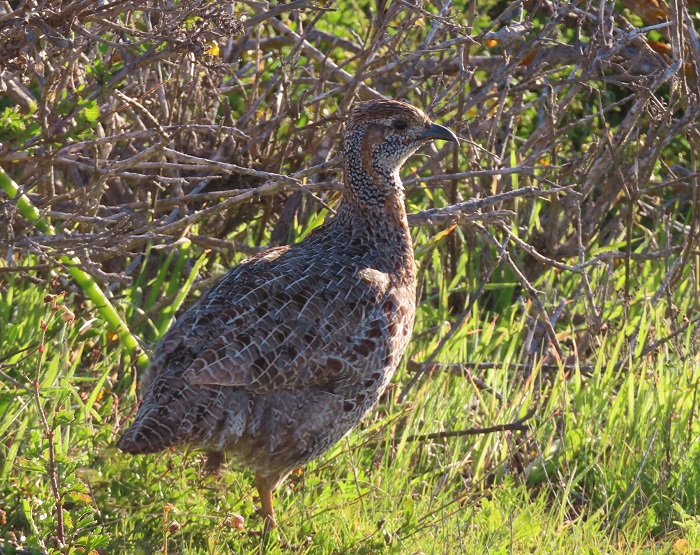
West Coast National Park, Western Cape
Photo by Felicity Ellmore
The diet of the Grey-winged Francolin varies seasonally. It mostly eats underground bulbs and corms of a range of small geophytes that it digs out with its bill. Invertebrates dominate the diet during the summer breeding season.
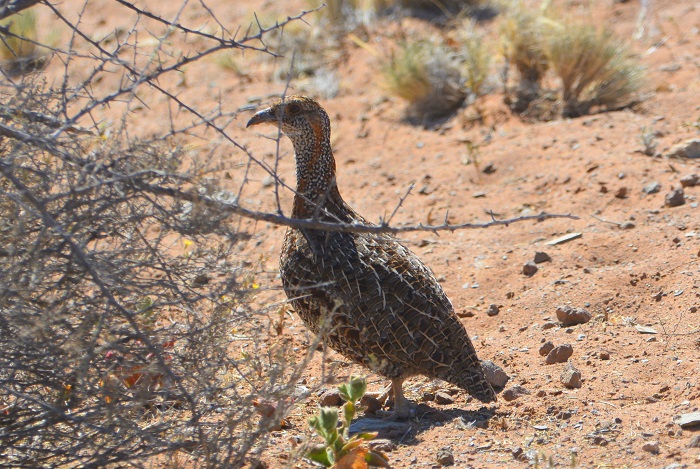
Carnarvon district, Northern Cape
Photo by Ryan Tippett
The Grey-winged Francolin breeds during spring and summer throughout its range, with peak egg-laying between August and November. The breeding season is shorter in the winter rainfall Western Cape. The Grey-winged Francolin is monogamous. Pairs nest solitarily and they are probably territorial.
The nest is a scrape in the ground hidden under a grass tuft. It is lined with grass and occasionally feathers. 4 to 8 eggs are laid per clutch. The eggs are yellowish-brown with some brown and dark grey speckling. Incubation starts after the full clutch has been laid and last for up to 23 days. Incubation is performed soley by the female and she is guarded by the male.
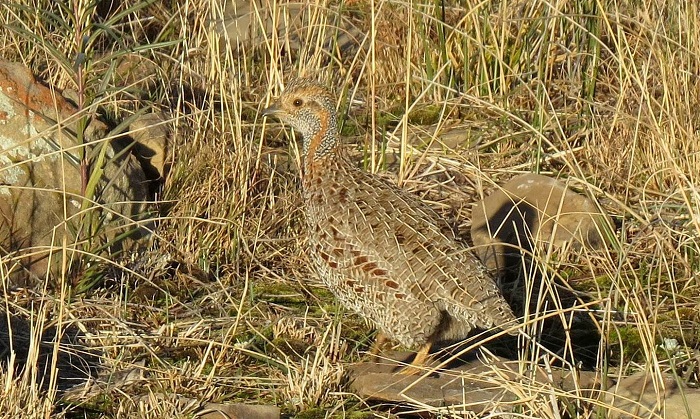
Middelburg district, Eastern Cape
Photo by Tino Herselman
The chicks are precocial, running and feeding almost immediately after hatching. Chicks stay with their parents throughout the breeding season. Breeding failures are mostly due to predation, primarily by small mammalian carnivores, crows and snakes. Other causes of nest failure include fires, human disturbance and trampling by sheep.
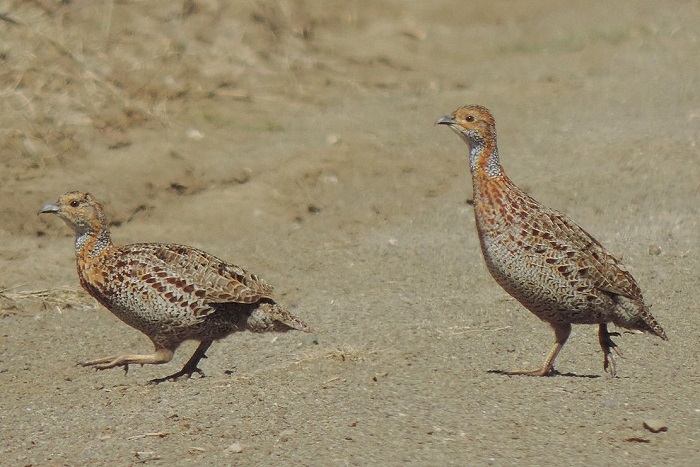
Near Bethal, Mpumalanga
Photo by Vaino Prinsloo
Further Resources
Species text adapted from the first Southern African Bird Atlas Project (SABAP1), 1997.
The use of photographs by Felicity Ellmore, Johan Heyns, Johan van Rooyen, John Todd, Kate Webster, Keir Lynch, Ryan Tippett, Terry Terblanche, Tino Herselman, and Vaino Prinsloo is acknowledged.
Other common names: Greywing Francolin (Alt. English); Bergpatrys (Afrikaans); iNtendele (Zulu); Isakhwatsha (Xhosa); Khoale (South Sotho); Francolin à ailes grises (French); Grauflügelfrankolin (German); Francolim-d’asa-cinzenta (Portuguese); Grijsvleugel-frankolijn (Dutch).
A list of bird species in this format is available here.
Recommended citation format: Tippett RM. 2026. Grey-winged Francolin Scleroptila afra. Biodiversity and Development Institute. Available online at https://thebdi.org/2026/05/11/grey-winged-francolin-scleroptila-afra/
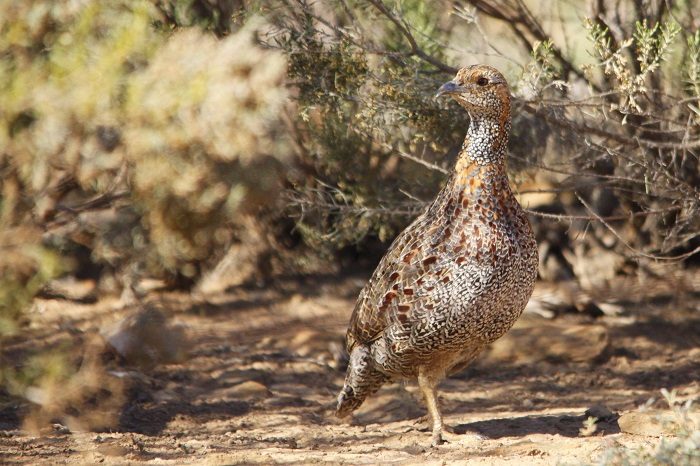
Near Barrydale, Western Cape
Photo by Keir Lynch
