
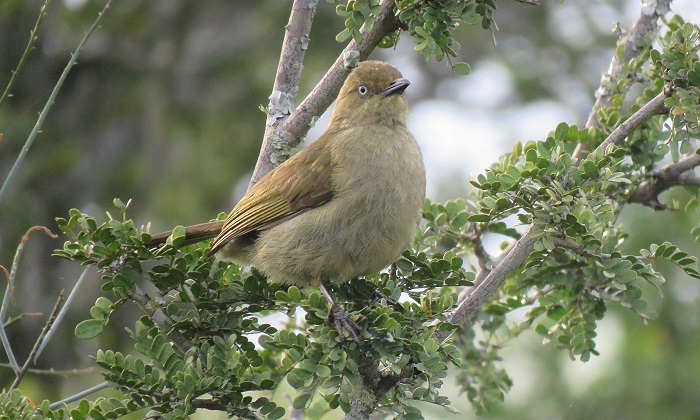
Cover image of Sombre Greenbul by Terry Terblanche – Addo Elephant National Park, Eastern Cape
Greenbuls belong to the Family PYCNONOTIDAE (Greenbuls, Bulbuls, Brownbuls, Leafloves, Bristlebills). They are mid-sized passerines with longish tails and mostly plain-coloured plumage. The family is distributed across most of Africa and the Indian Ocean islands, into the Middle East, through tropical Asia to Indonesia, and as far north as Japan. They occupy a variety of habitats, ranging from dense rainforest to arid savanna. The family comprises 161 species from 28 genera.
Identification
The cheerful Sombre greenbul has dull olive-green upperparts and olive-grey underparts with no other conspicuous features except pale whitish eyes. The Bill is black, and the legs and feet range from brownish to black. The sexes are alike.
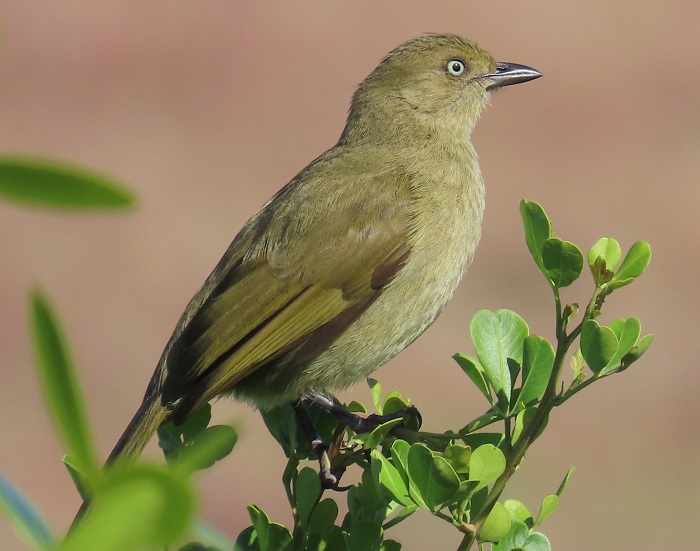
Gamtoos River Mouth, Eastern Cape
Photo by Cobus Elstadt
Juveniles resemble adults, but have a paler bill and an orange gape. They also have brown eyes and an indistinct yellowish eye ring.
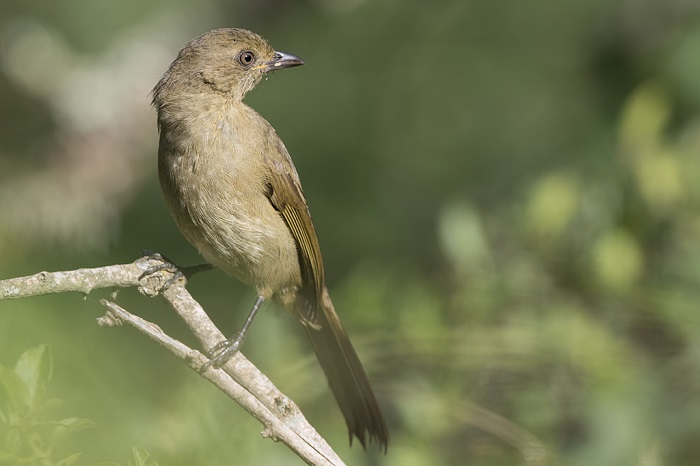
Baviaanskloof, Eastern Cape
Photo by Gregg Darling
The Sombre Greenbul is easily mistaken for other greenbul species. However, the white eye, if seen, is diagnostic. The Stripe-cheeked Greenbul (Arizelocichla milanjensis) has a grey (not olive green) crown and face, and dark (not white to pale yellow) eyes. Yellow-streaked Greenbul (Phyllastrephus flavostriatus) has a grey (not olive green) crown and ear coverts, a whiteish (not olive-grey) throat, and brown (not white to pale yellow) eyes. The Yellow-bellied Greenbul (Chlorocichla flaviventris) has bright yellow (not olive-grey) underparts and red eyes.
Status and Distribution
The Sombre Greenbul is common throughout its range. It ranges from Kenya and southern Somalia south to south-eastern Zambia, southern Malawi and South Africa. In southern Africa, the Sombre Greenbul occurs in eastern Zimbabwe and along the Zambezi River valley to Lake Kariba. It is also found throughout Mozambique, to northern and eastern South Africa, where it extends along the moist escarpment and lowlands south to the Cape Peninsula in the Western Cape.
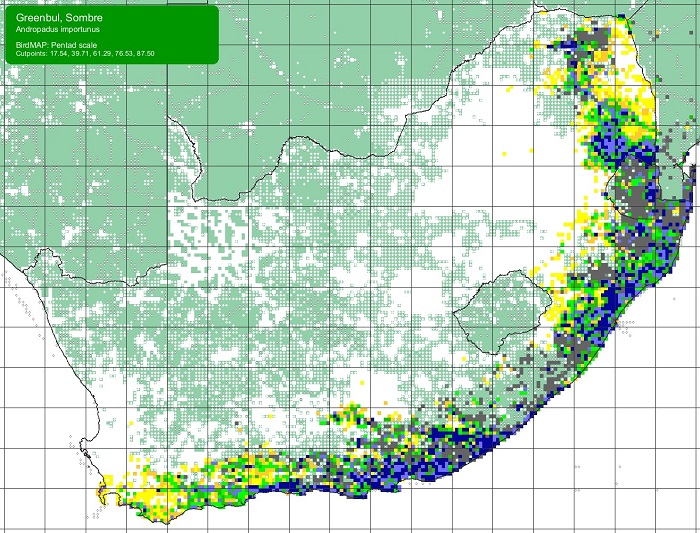
Details for map interpretation can be found here.
The Sombre Greenbul is not threatened. Its range is not known to have undergone change since its discovery in the early 19th century.
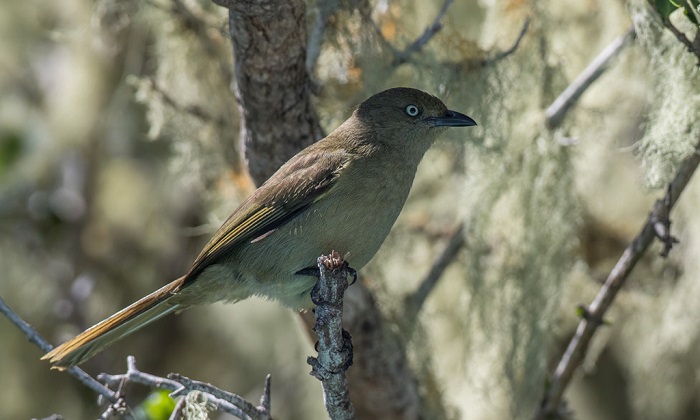
Cape St. Francis, Eastern Cape
Photo by Gregg Darling
Habitat
The Sombre Greenbul inhabits Coastal scrub, coastal and afromontane forest, thickets in densely wooded valleys and various woodland types, including thornveld and dry woodland thickets along drainage lines. The Sombre Greenbul prefers natural vegetation, but is also found in alien thickets and in gardens in well-wooded suburbs. In the fynbos region, it is generally found around forest patches and fringing woody vegetation along rivers.
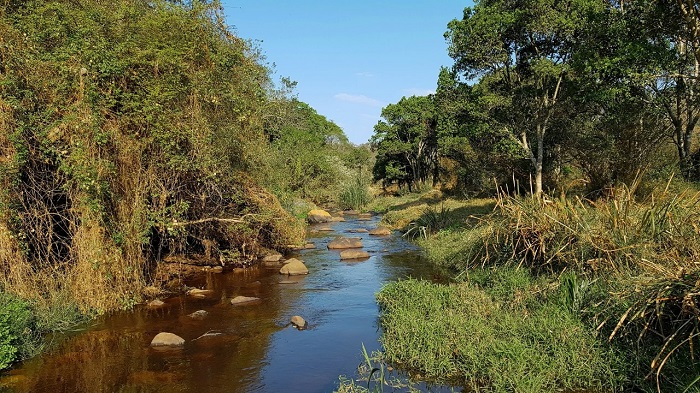
Near Pietermaritzburg, KwaZulu-Natal
Photo by Alex Briggs
Behaviour
The Sombre Greenbul is normally encountered singly or in pairs. Occasional large non-breeding flocks occur at abundant food sources. It is a resident and sedentary species.
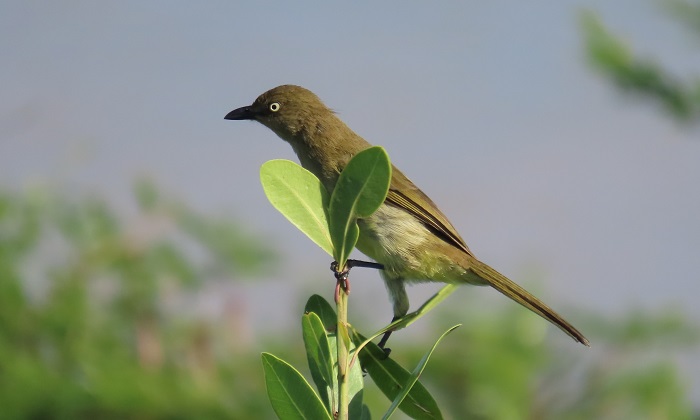
Maputo, Mozambique
Photo by Pieter Cronje
It is shy and inconspicuous and is far more often heard than seen. Its ‘willy’ call is a well-known and characteristic sound wherever it occurs. It is best observed when loudly advertising its territory from the top of a tree or bush. Otherwise, the Sombre Greenbul keeps to dense cover, usually in the canopy. It is an inquisitive bird but dives quickly into cover when alarmed. The flight is rapid and direct, with frequent sharp swerves. It sometimes flies with exaggerated wing-beats, with soft wing clapping.
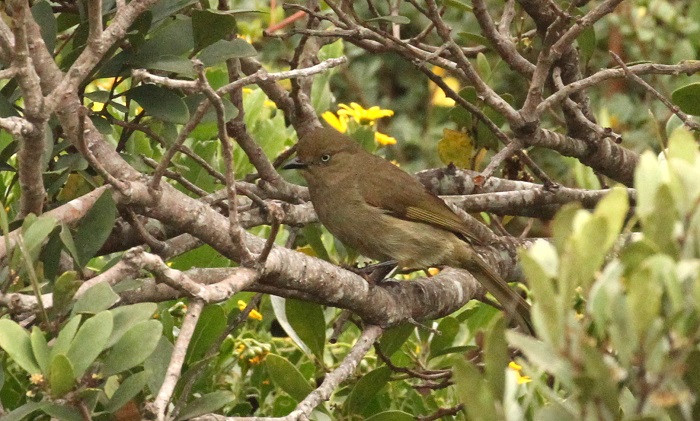
Vleesbaai, Western Cape
Photo by Pieter La Grange
The Sombre Greenbul spends most of its time in forest and thicket canopies, but occasionally feeds in the undergrowth, or on the ground among leaf litter. They sometimes also hawk flying insects, before diving back into cover to eat. The Sombre Greenbul consumes a wide range of wild and cultivated fruits and berries. It also eats insects, small snails, succulent leaves, flowers and unopened buds, and aloe nectar.
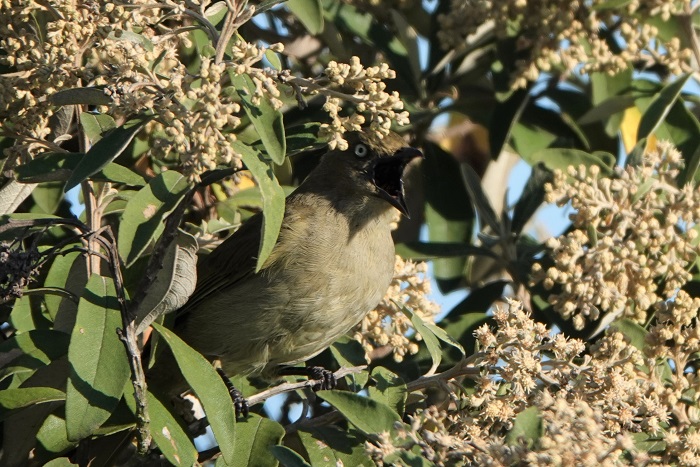
Plettenberg Bay, Western Cape
Photo by Itxaso Quintana
The Sombre Greenbul has a long breeding season in southern Africa, with egg-laying occurring in any month from October to April, but with a clear peak from October to December. It is a monogamous, solitary nester and strongly territorial. The nest is usually a flimsy open cup made from twigs, rootlets, grass, lichen and other plant material, lined with finer plant fibres and sometimes also hair. It is placed up to 4 m above the ground, in the main fork of a slender tree or shrub, or sometimes at the end of a branch and is usually attached to supporting twigs with spider web. The nest is built entirely by the female while the male sings from a nearby tree.
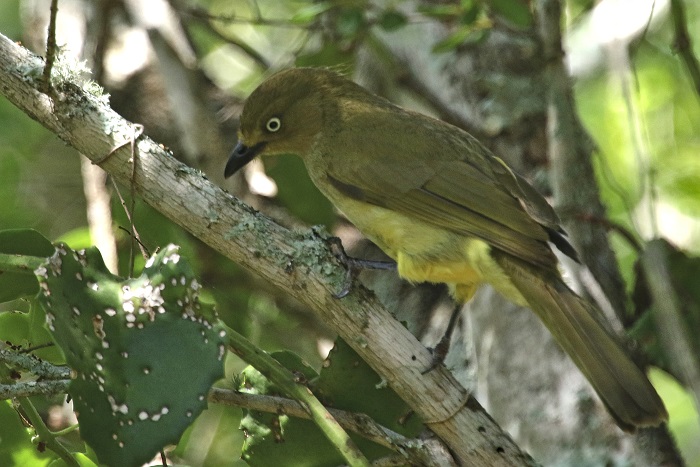
Mkhuze Game Reserve, KwaZulu-Natal
Photo by Lia Steen
1 to 3 eggs are laid per clutch at 1-day intervals. The incubation period lasts for 12 to 13 days, and is performed entirely by the female. The male brings food to her while she is incubating. Interestingly, the adults often perform a broken-wing distraction display when the nest is threatened, dropping directly to the ground and scuttling away like a rat. The nestling period lasts for a further 10 to 14 days, and both adults feed and brood the chicks. Both parents are recorded to eat the nestlings’ faecal sacs. The adults continue to feed the young for up to 3 weeks after the fledglings have left the nest. Broods of the Sombre Greenbul are frequently parasitised by the Jacobin Cuckoo (Clamator jacobinus).
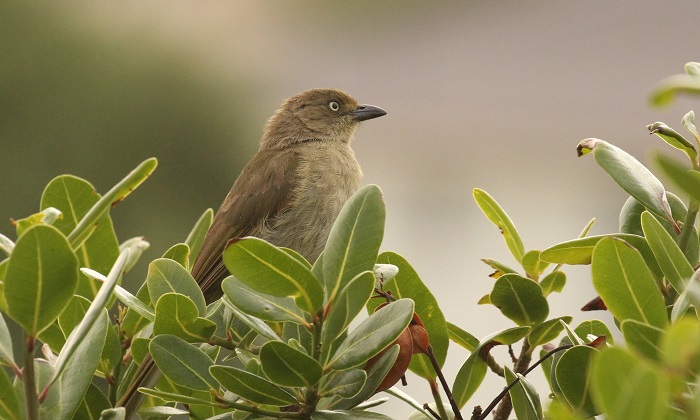
Vleesbaai, Western Cape
Photo by Pieter La Grange
Further Resources
This species text is adapted from the first Southern African Bird Atlas Project (SABAP1), 1997.
The use of photographs by Alex Briggs, Cobus Elstadt, Dieter Oschadleus, Gregg Darling, Itxaso Quintana, Lia Steen, Pieter Cronje, Pieter La Grange, and Terry Terblanche is acknowledged.
Other common names: Sombre Bulbul (Alt. English); Gewone willie (Afrikaans); iWili (Zulu); Inkwili (Xhosa); Bulbul importun (French); Vale Buulbuul (Dutch); Kap-Grünbülbül (German); Tuta-sombria (Portuguese).
Recommended citation format: Tippett RM. 2026. Sombre Greenbul Andropadus importunus. Biodiversity and Development Institute. Available online at https://thebdi.org/2026/06/03/sombre-greenbul-andropadus-importunus/
List of bird species in this format is available here.
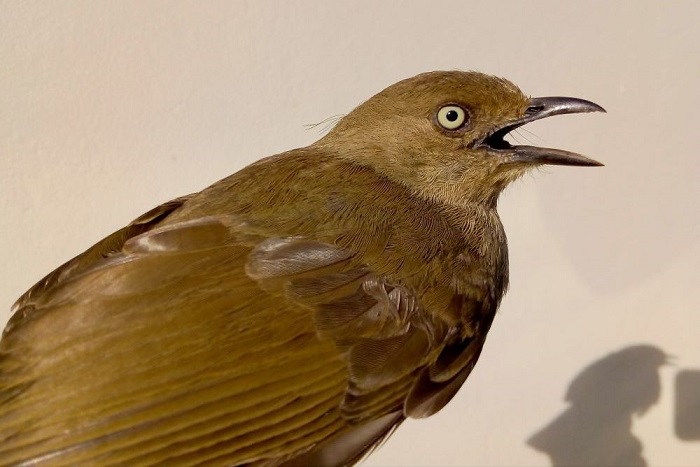
Queen Elizabeth Park Nature Reserve, KwaZulu-Natal
Photo by Dieter Oschadleus
