
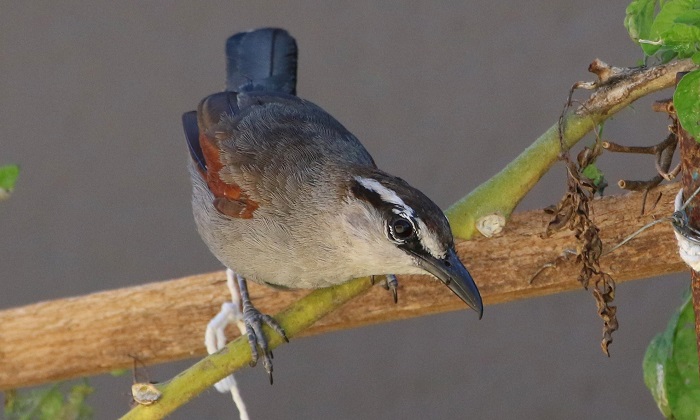
Cover image of Southern Tchagra by Attie van Aarde – Stilbaai, Western Cape
Tchagras belong to the Bushshrike family MALACONOTIDAE. Other members of this group include Boubous, Bushshrikes, Puffbacks, and Gonoleks. They are smallish passerine birds with robust bodies, strong legs and feet, and formidable shrike-like bills. Many are very colourful and most species are rather secretive. The majority occur in woodlands, but also in marshes, scrub and Afromontane or tropical forest. They were formerly classed with the true shrikes in the family Laniidae, but are now considered sufficiently distinctive to be separated from that group. The family is endemic to sub-Saharan Africa but is completely absent from Madagascar. The name Malaconotidae alludes to their fluffy back and rump feathers. The family comprises 50 species from 9 genera.
Identification
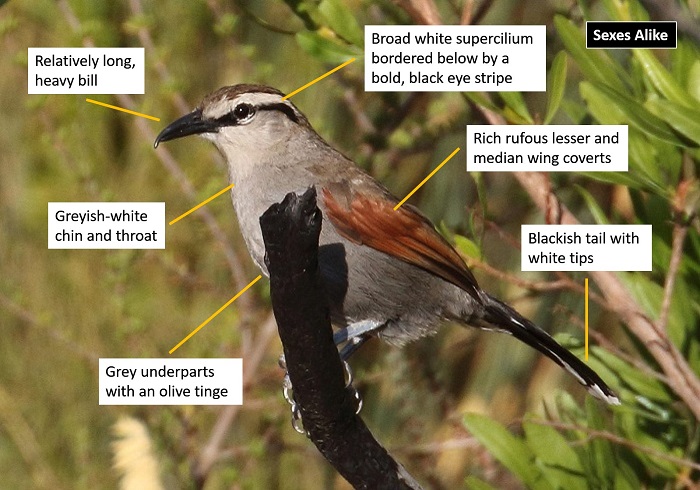
Near Wolsely, Western Cape
Photo by Alan Manson
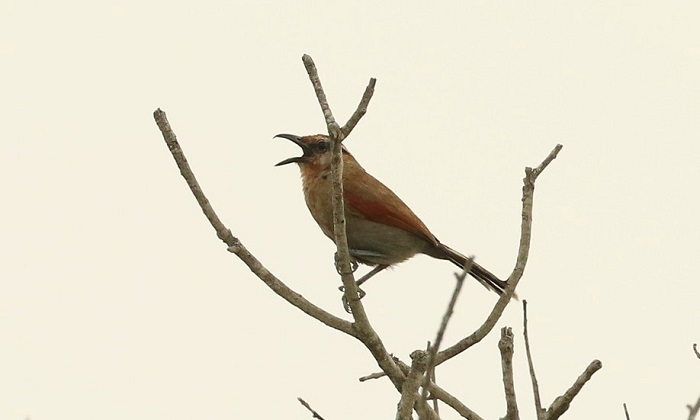
Southern Tchagra sexes are alike. In adults, the crown is rufous-brown with an olive tinge. The supercilium is greyish in front of the eye and white behind. It is broad and long, almost extending onto the nape. The supercilium is bordered below by a bold, black eye stripe. The ear coverts and cheeks are pale greyish-brown, and the sides of the neck are also greyish-brown. The back is rich olive-brown with an olive-grey rump. Lesser and median wing coverts are rich rufous. The tail is blackish with white tips. The central pair of tail feathers are dark greyish-brown, with fine barring. On the underparts, the chin and throat are greyish white, and the rest of the underparts are grey, tinged olive. The bill is black, and the eyes are rich brown. The legs and feet are grey.
Juveniles resemble adults, but their upper parts are more olive tinged. The supercilium is buff-white and the tail tips are buff-coloured (not white).
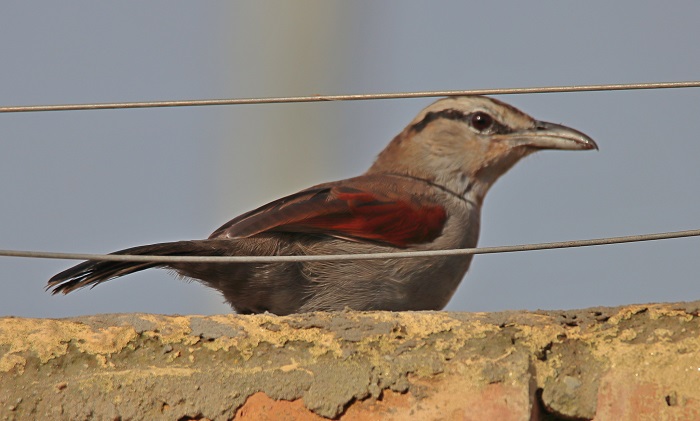
Mossel Bay, Western Cape
Photo by Johan Heyns
The call of the Southern Tchagra is distinctive but could be confused with that of the Brown-crowned Tchagra (Tchagra australis). Visually, the two are also easily mistaken for one another. However, the latter is smaller and has a supercilium bordered above and below by black stripes and with a shorter, weaker bill. The ranges of the two species overlap marginally in KwaZulu-Natal. The Black-crowned Tchagra (Tchagra senegalus) has a black (not brown) crown and white (not grey) underparts.
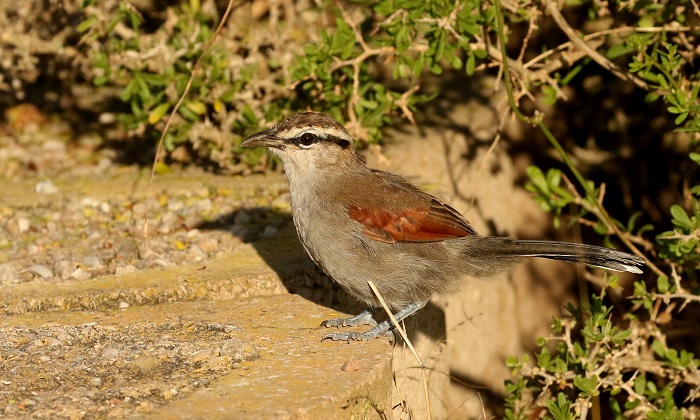
Vleesbaai, Western Cape
Photo by Pieter la Grange
Status and Distribution
The Southern Tchagra is common in the south of its range, but uncommon to rare in the north. It is endemic to South Africa and eSwatini (Swaziland). The Southern Tchagra occurs from the Mpumalanga escarpment south through western Eswatini to KwaZulu-Natal and west along the coastal plain to about Hermanus and Worcester in the Western Cape. It probably also extends marginally in southern Mozambique. It extends along river valleys up to 200 km inland, especially in the Karoo region of the Eastern Cape, although most records are from within 100km of the coast.
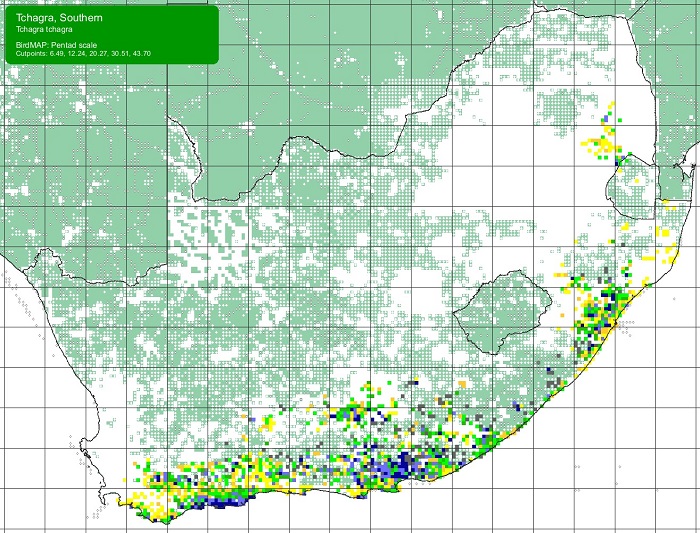
Details for map interpretation can be found here.
The Southern Tchagra is not threatened. There is some evidence of range expansion in the Western Cape since the 1980s. The Southern Tchagra is likely to have benefited from the spread of alien scrub and thickets in some areas.
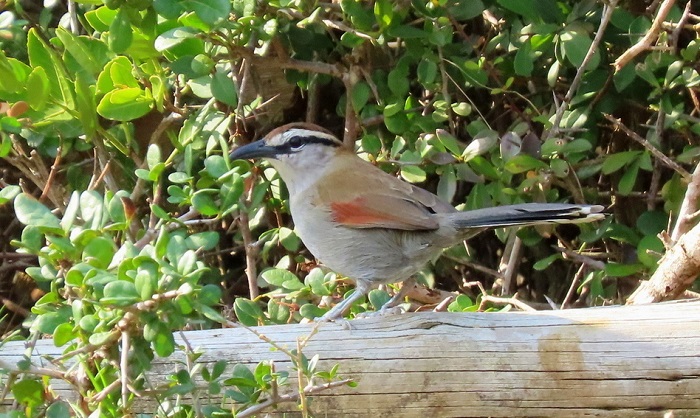
Vergarderingskop Nature Reserve, Western Cape
Photo by Johan van Rooyen
Habitat
The Southern Tchagra favours low, near-impenetrable thickets. It inhabits coastal bush and scrub, the edges and clearings of coastal dune forest, thorny, tangled thickets along rivers, brush piles fringing cultivation, and tangled fynbos. In more arid areas, the Southern Tchagra occurs in dense stands of thorn trees Vachellia karoo along river corridors. At the northern limit of its range, it occurs in bracken and scrub at the ecotone between montane grassland and forest.

Shongweni Dam Nature Reserve, KwaZulu-Natal
Photo by Alex Briggs
Behaviour
The Southern Tchagra is resident and sedentary throughout its range. It is usually encountered singly or in pairs and is a secretive bird of dense cover. It is infrequently seen, even where reputed to be quite common and is far more likely to be heard. They sometimes sing from an exposed perch on top of a bush, but dive for cover at the slightest disturbance. The Southern Tchagra rarely spends time in the open except to fly low to the next thicket. Flights are usually short, with the tail spread and with rapid wing-beats interspersed with glides. It typically creeps into the densest vegetation when disturbed.
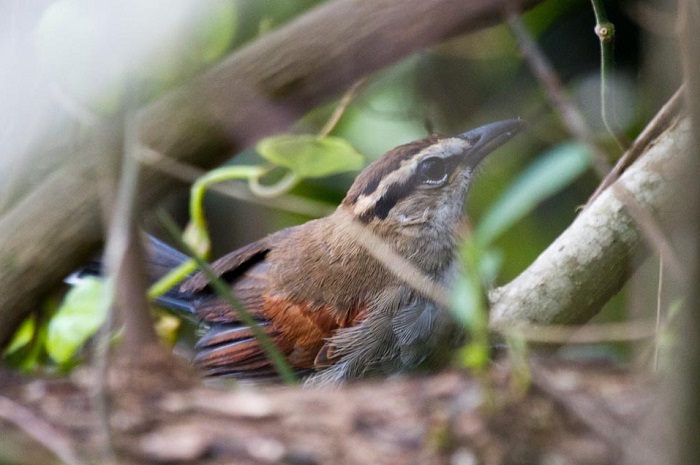
Umhlanga Lagoon Nature Reserve, KwaZulu-Natal
Photo by Roelof van der Breggen
The Southern Tchagra forages close to or on the ground. It hops and runs about, turning over plant material, occasionally foraging in open grass, but never far from cover. It gleans prey from low branches and stems.
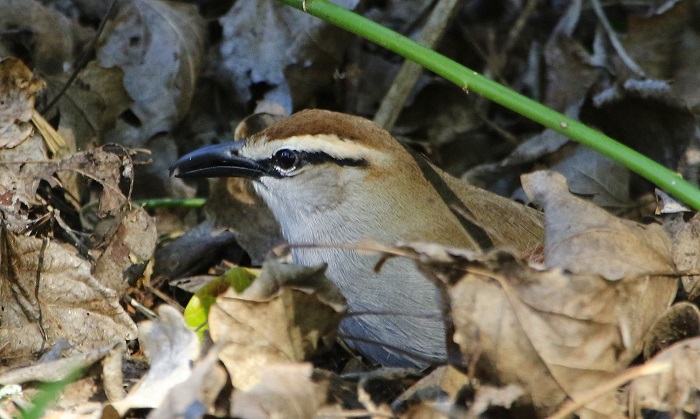
Stilbaai, Western Cape
Photo by Attie van Aarde
The Southern Tchagra eats arthropods and their larvae, including ants, termite alates, grasshoppers, small beetles, crickets, caterpillars, spiders, millipedes, and snails. It also consumes smaller quantities of berries, small fruits, and seeds.
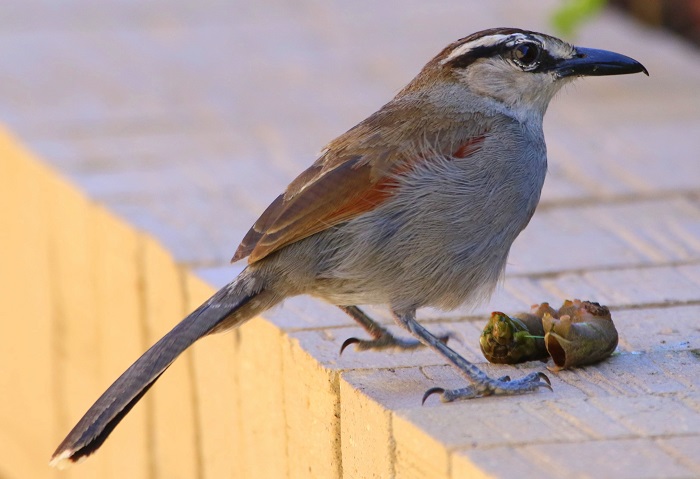
Stilbaai, Western Cape
Photo by Attie van Aarde
The Southern Tchagra is a monogamous, solitary nester and is strongly territorial. Territorial interactions involve excited side-to-side movements, bowing, ‘wing-fripping’, tail-cocking and flicking. It may also enact a flight display over bushes during territorial defence. During courtship, the male postures excitedly, bowing his body with tail fanned and head stretched up.
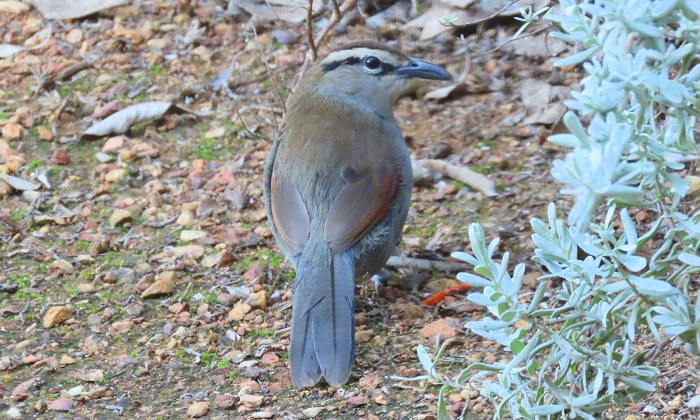
Stilbaai, Western Cape
Photo by Johan van Rooyen
Breeding has been recorded from August to December in the Western Cape and from October to December in KwaZulu-Natal. The nest is a shallow cup of fine plant stems, twigs and rootlets; lined with finer rootlets, sometimes with bits of hair. It is probably built by both sexes. It is usually placed in the fork of a dense shrub, about 1m above the ground. The nest is always well hidden. Old nests are sometimes re-used, with very little refurbishing. Pairs sometimes also build on the old nest of another species.
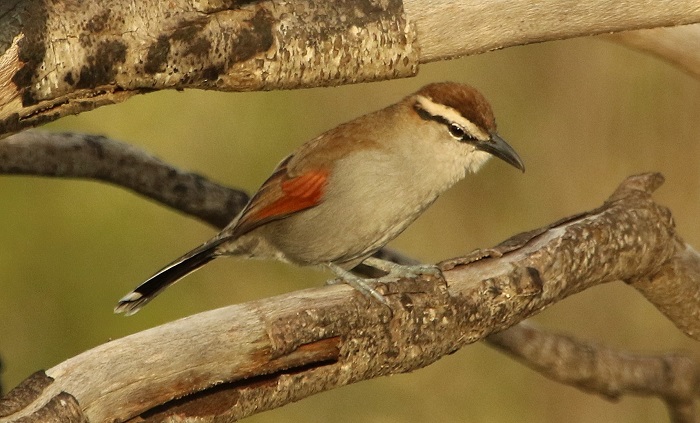
Swellendam district, Western Cape
Photo by Attie van Aarde
Two or three eggs are laid per clutch. They are white purple-grey and red-brown spots and scribbles. The incubation period lasts about 16 days. Newly hatched young are altricial and brooded almost constantly for the first days or so. The nestling period takes a further 13 to 16 days and the young are fed by both parents. Broods of the Southern Tchagra are sometimes parasitised by the Jacobin Cuckoo (Clamator jacobinus).
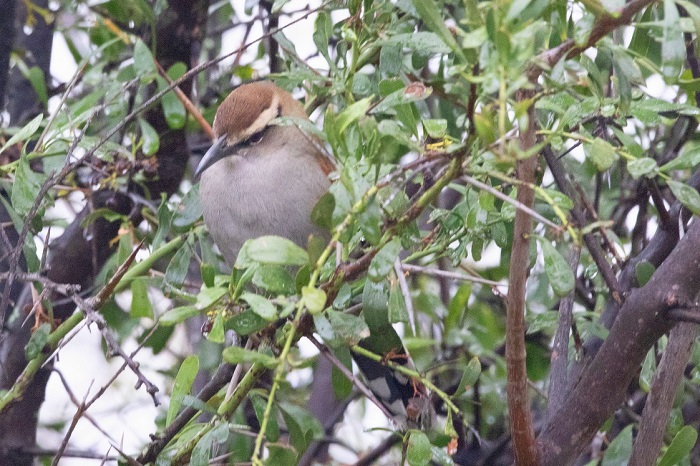
Mountain Zebra National Park, Eastern Cape
Photo by Lance Robinson
Further Resources
Species text in the first Southern African Bird Atlas Project (SABAP1), 1997.
The use of photographs by Alan Manson, Alex Briggs, Attie van Aarde, Johan Heyns, Johan van Rooyen, Lance Robinson, Pieter la Grange, and Roelof van der Breggen is acknowledged.
Other common names: Grysborstjagra (Afrikaans); Umnguphane (Xhosa); Tchagra du Cap (French); Kaapse Tsjagra (Dutch); Kaptschagra (German); Picanço-assobiador-austral (Portuguese).
A list of bird species which have a structured species text like this one is available here.
Recommended citation format: Tippett RM 2025. Southern Tchagra Tchagra tchagra. Biodiversity and Development Institute. Available online at https://thebdi.org/2026/08/05/southern-tchagra-tchagra-tchagra/
Gouritzmond, Western Cape
Photo by Pieter la Grange
