
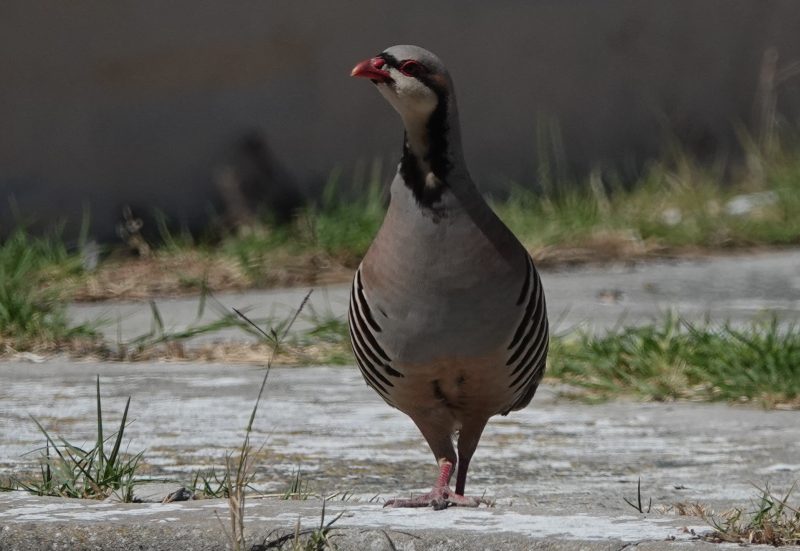
Cover image of Chukar Partridge. Photograph taken on Robben Island.
The Chukar Partridge belongs to the Family Phasianidae (pheasants). There are currently 185 species in the family, in 54 genera. The genus Alectoris, to which the Chukar Partridge belongs, contains seven species. Most of the 185 species in the pheasant family occur in Africa, Asia and Europe, the Old World. The two turkey species are the only members of the family in the New World, in North America. The pheasants are terrestrial birds, and mostly feed on the ground. The chicks are precocial; they are covered with down when they hatch, with open eyes. They leave the nest within hours of hatching, and feed themselves.
Identification
Identification is easy. In southern Africa, you first of all need to be on Robben Island. Secondly, the head pattern and the stripes on the flanks are diagnostic!
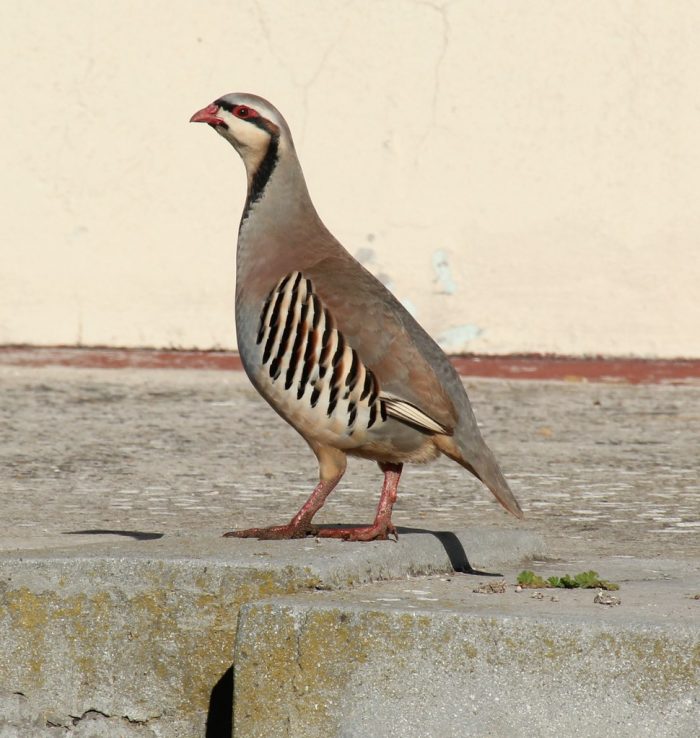
This is not a tricky species to identify!
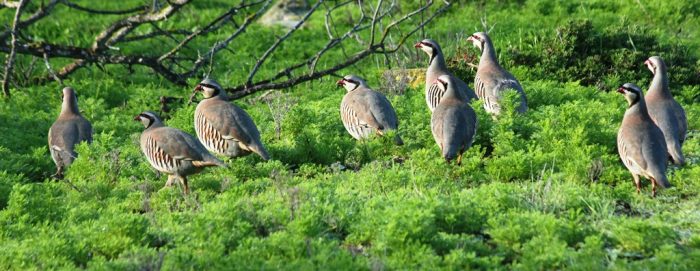
They are often in small groups.
Distribution
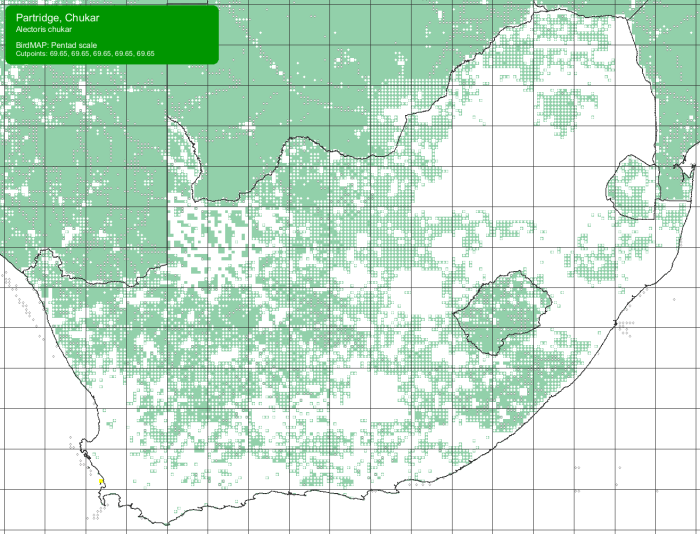
There is only one pentad in which the Chukar Partridge is recorded, and that is pentad 3345_1820, the one that contains Robben Island. You have to look hard at the distribution map above to spot the tiny yellow marker covering the island in Table Bay!
Habitat
Even on Robben Island itself, the distribution is quite limited. They are most frequently seen in and around the village at the southern corner of the island.
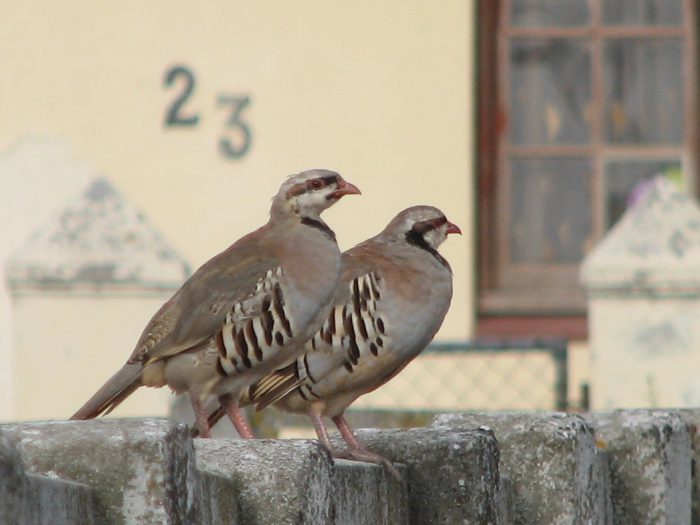
Here are two birds perched on the fence at House 23 on the island.
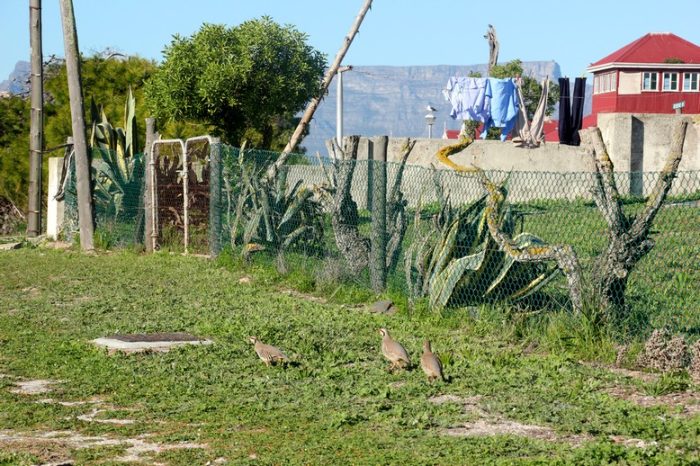
This little group is also in the village.
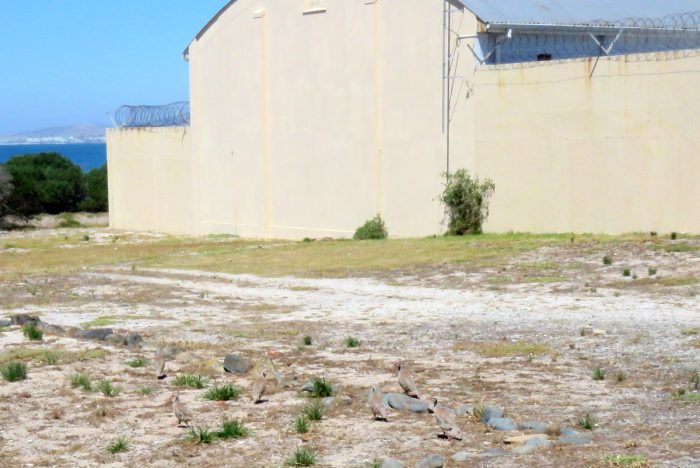
This group is on the edge of the village. The bus that takes visitors on the prison tour passes this open space. It is one of the places where the Chukar Partridge is seen regularly.
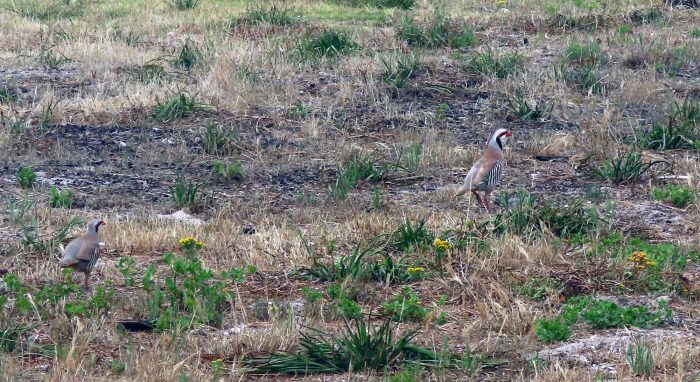
Outside of the village itself, they tend to be restricted to areas where the vegetation is kept short.
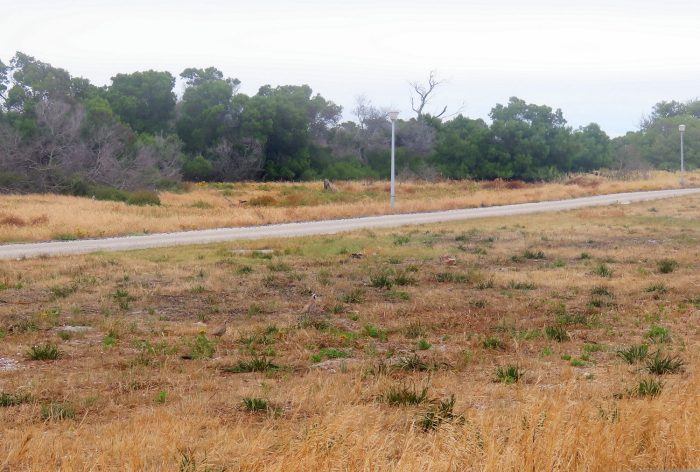
In the short vegetation they can be quite hard to spot. There are two Chukar Partridges in this photograph. Relative to the centre, they are a bit to the left and down.
Breeding
There is a paper in the journal Biodiversity Observations which aims to estimate the timing of breeding of the Chukar Partridge on Robben Island. It suggested that start of the incubation ranged from the beginning of September until the middle of November, with a peak in 21 October; in summary, Chukar Partridges breed on Robben Island in spring. Only one nest has ever been found, so we don’t have a photo of a nest with eggs.
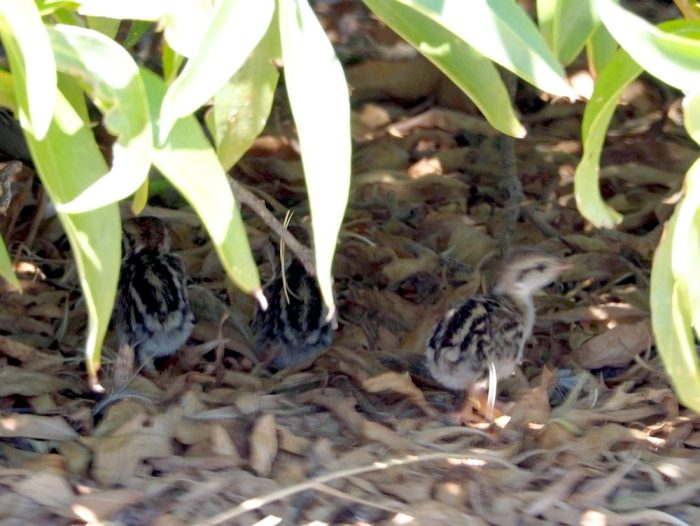
These tiny chicks, hiding under a hedge, were a day or two old. This photo was taken on 4 December 2025. The incubation is about 23 days, so eggs would have been laid in early November.
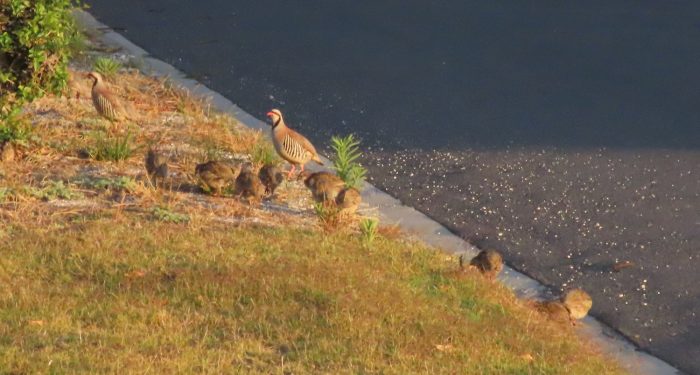
This photo was taken early on the morning of 21 December 2021 on the kerb of the main road through the village on Robben Island. Clutch sizes of Chukar Partridges can be as big as 20 eggs, but eight to 15 is the normal range. In this particular cases, two broods had joined up to produce this large group of young birds.
Background
The Chukar Partridge has a vast range, mainly in Asia in the foothills of mountain ranges, including the Himalayas. The range is the area shaded green on the map below. Its preferred habitat consists of rocky hillsides with low vegetation. It is classified as Least Concern. There is considerable variation in plumage over its range, and there are currently 14 subspecies recognized.
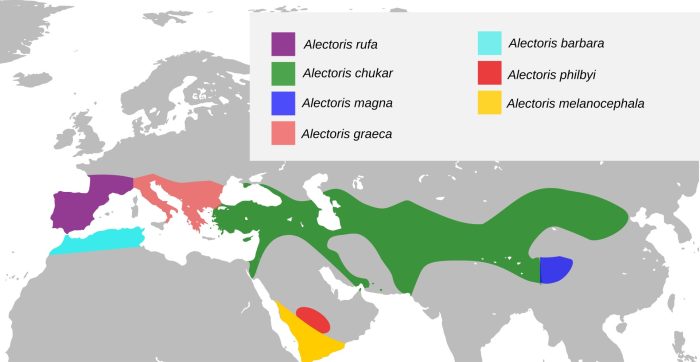
This is the range map for the seven species in the genus Alectoris to which the Chukar Partridge belongs.
It is considered a game bird for sport hunting, so it has been introduced in various countries, not always successfully.
This is how the species reached Robben Island. In 1964, customs staff at the port of Cape Town confiscated a consignment of six Chukar Partridges. We think that they had been bred in an overseas aviary, and were destined for the aviary of a bird collector in Cape Town. For reasons that are lost in time, they were released on Robben Island in April 1964. We have no information on whereabouts in the range their ancestors had been taken, so we do not know the subspecies of the Robben Island birds. The size of the population on the island has fluctuated widely, inversely proportional to the size of the population of Feral Cats Felis catus. In the mid 2020s, the cat population was thought to be down to a handful, with maybe four adults, and the partridges were abundant. There were possibly a few hundred scattered across mainly the southern part of the island.
Further resources
Other common names: Asiatiese Patrys (Afrikaans), Aziatische steenpatrijs (Dutch), Perdrix choukar (French), Chukarhuhn (German), Coturnice orientale (Italian), Perdiz chúcar (Spanish).
Scientific paper: The key paper, with lots of information, including about attempts to introduce Chukar Partridges to other parts of southern Africa, is unfortunately behind a paywall: Vernon CJ, Dean WRJ 2022. The introduction of the Chukar Partridge Alectoris chukar to southern Africa. Ostrich 93: 157–159. You can read the abstract here.
Recommended citation format: Underhill LG 2026. Chukar Partridge Alectoris chukar. Biodiversity and Development Institute. Available online at https://thebdi.org/2026/08/09/chukar-partridge-alectoris-chukar/