

Cover image of Black Harrier by Attie van Aarde – Near Riversdale, Western Cape
The Black Harrier belongs to the family ACCIPITRIDAE (Hawks, Eagles, Vultures, and Kites). The Accipitridae is a family of small to very large birds of prey (Raptors) with strongly hooked bills and variable morphology based on diet. They feed on a range of prey items from insects to medium-sized mammals, with some feeding on carrion and others consuming fruit. The Accipitridae have a global distribution across all the world’s continents (except Antarctica) and many oceanic island groups. Some species are migratory. The family contains 250 species from 74 genera.
Identification
The Black Harrier is a striking and distinctive raptor. The sexes are very similar in plumage coloration; females have a brownish sheen on their contour feathers, while males have more grey in their primaries.

Modder Rivier, Western Cape
Photo by Philna de Villiers
Adult birds are mostly black overall with a white rump and bold black and white banded tails. The rump and tail banding are conspicuous in flight. Some birds have a few white markings on the undersides. The underwing is strongly contrasting black and white; black coverts and white flight feathers with a black trailing edge to the wing. The face is owl-like with piercing yellow eyes. The bill is dark grey, and the cere, legs, and feet are yellow.

Near Koeberg, Western Cape
Photo by Lance Robinson
Immature birds resemble adults, but the black feathering is suffused with brown, and the belly is paler and brownish. The juvenile is dark brown above with buff markings on the wing coverts, cheeks, and eyebrows, and with white mottling on the nape. The underparts are buff-coloured with bold dark brown markings on the chest and flanks. In flight, as in adults, the broad white rump and boldly banded tail are characteristic. Unlike other juvenile harriers, it has yellow eyes.

Near Loxton, Northern Cape
Photo by Ryan Tippett
Adults are unlikely to be confused with any other harriers because of their bold black and white plumage. Very rare melanistic forms of both Montagu’s Harrier (Circus pygargus) and Western Marsh Harrier (Circus aeruginosus) occur but differ from the Black Harrier in having no tail barring or white rump.
Status and Distribution
The Black Harrier is an uncommon southern African endemic. It has the most restricted range of the world’s 13 harrier species, with the core of its range located in the Fynbos Biome of south-western South Africa. In South Africa, it occurs from the Western Cape up through much of the Eastern Cape, Northern Cape, Free State, Lesotho, and the interior of KwaZulu-Natal to Central Mpumalanga, Gauteng, and North West Province. It is widespread but sparse in Namibia, reaching the Hoanib and Uniab River Floodplains in north-western Namibia. The Black Harrier is a vagrant to eSwatini (Swaziland) and Botswana, as far north as Lake Ngami. The Black Harrier’s population is most concentrated in the Western Cape and high-altitude grasslands of the Eastern Cape and Free State. It is far less numerous and is often irruptive into other parts of its range.
The breeding stronghold of the Black Harrier is in the Western Cape, but breeding has been recorded as far north as Port Nolloth in the Northern Cape, and as far east as the KwaZulu-Natal Drakensberg. There is also a small breeding population in north-western Namibia.
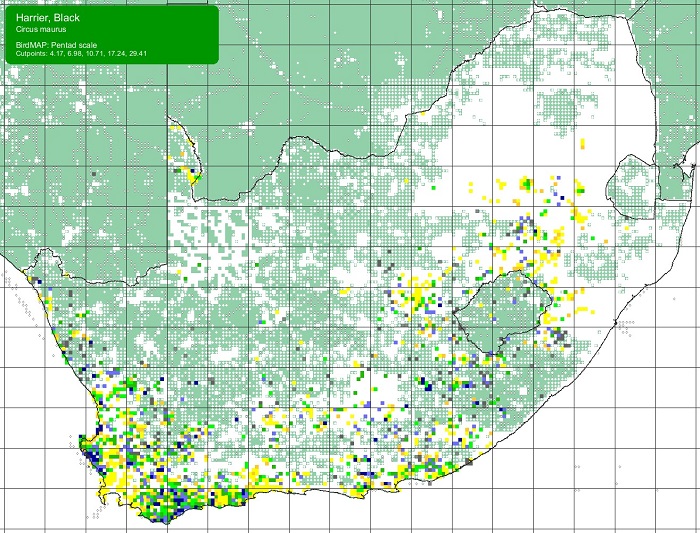
The Black Harrier is listed as Endangered on the Global IUCN Red List. This is due to its restricted range and very small population (fewer than 500 breeding pairs in South Africa). Direct threats include fynbos and grassland fires, habitat loss, and pesticide residues. The Black Harrier is thought to have lost up to 50% of its core breeding habitat in the last century, owing to extensive land transformation by agriculture (particularly in the Overberg), invasive alien vegetation, and urbanisation within the Fynbos Biome.

Near Lamberts Bay, Western Cape
Photo by Zenobia van Dyk
Habitat

West Coast National Park, Western Cape
Photo by Karis Daniel
The Black Harrier inhabits fynbos, grasslands, Karoo scrub, and agricultural fields. In the Western Cape, it is primarily found in fynbos, especially strandveld and mountain fynbos. It is less common in dry restios and renosterveld remnants. The Black Harrier also frequents Karoo scrub in both the summer and winter rainfall regions of the Karoo. Elsewhere, it occurs in dry and moist grasslands, including high-altitude areas of the Eastern Cape and KwaZulu-Natal, sometimes more than 3000 m above sea level. The Black Harrier avoids habitats following fires and typically does not return for several years after.

Carnarvon district, Northern Cape
Photo by Ryan Tippett
Black Harriers are found in the Fynbos, Succulent Karoo, Nama Karoo, and Grassland Biomes. It marginally enters the Savanna Biome in the more open parts of the southern Kalahari.
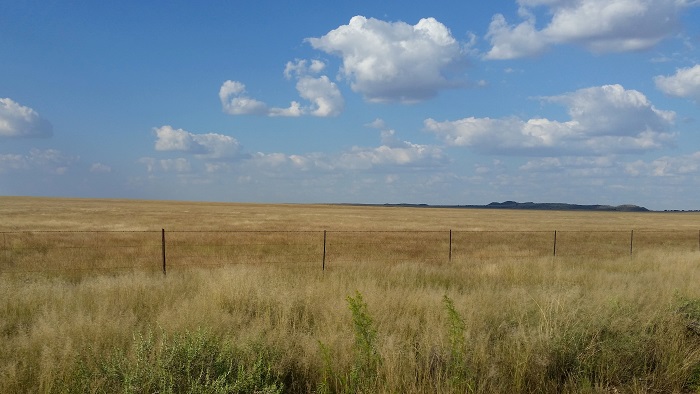
Near Philipolis, Free State
Photo by Ryan Tippett
Behaviour
Black harriers are migratory birds. Most migration is from the winter-rainfall regions of the Western Cape. However, not all of the population migrates, as evidence shows there is little variation in reporting rates between seasons in the core areas of their range. Migration occurs after the breeding season from March to June. It is believed that they migrate to cope with food shortages, although there is great individual variability. Those that do migrate either head north into the semi-desert Karoo scrub of the Northern Cape and Namibia, or eastwards into the grasslands of the Eastern Cape, Free State, Lesotho, and western KwaZulu-Natal. Interestingly, pair members do not travel together, nor do they use the same non-breeding areas.

Near Loxton, Northern Cape
Photo by Ryan Tippett
In some years, the Black Harrier is irruptive into the drier parts of the Grassland biome and the Succulent and Nama Karoo biomes. This is a likely response to food availability, leading to a season of abundance sometimes followed by a complete absence in the following years. This coincides with fluctuating rodent populations in drier regions, which tend to explode after seasons of above-average rainfall. In some years, under ideal conditions, these irruptive birds may remain long enough to breed.

Near Caledon, Western Cape
Photo by Gerald Wingate
The Black Harrier is usually encountered solitarily or sometimes in pairs. They are most often seen in flight but also perch prominently on termite mounds, fence posts, or similar vantage points. They sometimes also sit on open bare ground when elevated perches are unavailable. Black Harriers sometimes soar, but seldom to great heights. They actively seek out shade on hot days and may sleep for short periods while perched on the ground. The Black Harrier drinks and bathes when water is available.

Vanrhynsdorp, Western Cape
Photo by Salome Willemse
Black Harriers hunt in typical buoyant, harrier flight, usually 1 to 3 m above the vegetation. Quartering flight is sometimes interspersed with bouts of hovering. They forage most actively on windy days. On seeing or hearing prey among the vegetation, they check suddenly before dropping onto prey with legs extended. Prey is hit hard and possibly killed on impact. Occasionally hunts from a perch or pursues prey in flight. Prey is mostly eaten on the ground.

Near Heidelberg, Western Cape
Photo by Johan van Rooyen
The Black Harrier is a specialist predator of rodents and birds. They capture a variety of rodent species. Vlei Rats (Otomys spp), Whistling Rats (Paratomys spp.), and Sloggett’s Rat (Myotomys sloggetti) are important prey items in different parts of their range. They also consume a variety of small birds, up to 350g, particularly Common Quail (Coturnix coturnix). The rest of the diet is made up of amphibians, lizards, large insects like grasshoppers and locusts, also eggs, and occasionally carrion.

West Coast National Park, Western Cape
Photo by John Todd
The Black Harrier has been recorded breeding from June to December with an egg-laying peak in September. They are mainly monogamous, although a small percentage of males are polygynous (breeding with 2 females simultaneously). They are generally solitary nesters but are sometimes semi-colonial in the Western Cape, where nests are frequently as close as 50 to 100 m apart.
The nest is a small, untidy structure or pad of dry grasses, stems, and small twigs up to 450 mm in diameter. The nest is placed on or just above ground and is well concealed in rank marsh grasses, or near fynbos bushes or sedges. Nests are either built on the ground in drier terrain or slightly raised on a base of stems, reeds, and weeds in wetter sites. Nests are rebuilt in the same general area over successive years.

Bitter Rivier, Northern Cape
Photo by Johan van Rooyen
1 to 5 (usually 3) blueish-white eggs are laid per clutch. Eggs are laid at 1 to 2 day intervals. Incubation begins once the first egg has been laid and lasts up to 34 days. Incubation is performed entirely by the female, who is fed during this time by the male. The eggs hatch asynchronously, sometimes resulting in large size differences between chicks. The nestling period lasts for a further 36 to 41 days. During the nestling period, the male provides most of the food for the female and young. Fledglings are fed for at least 2 weeks after leaving the nest. The fledglings are aggressively defended by the adults who persistently mob potential predators, especially other raptors. Black Harriers are single-brooded, and research shows that breeding success is relatively high.
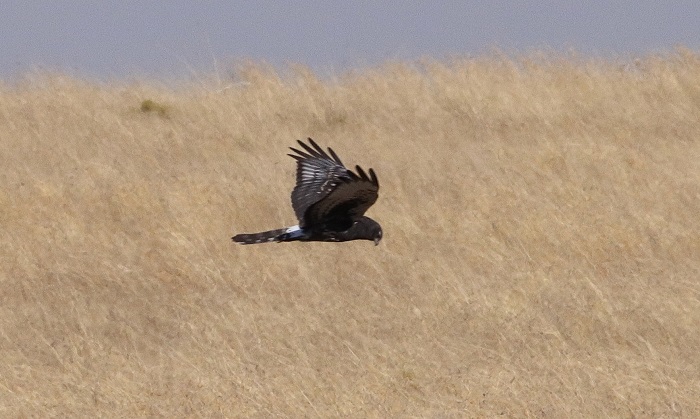
Near Bloemfontein, Free State
Photo by Dawie de Swardt
Further Resources
Species text adapted from the first Southern African Bird Atlas Project (SABAP1), 1997.
The use of photographs by Attie van Aarde, Dawie de Swardt, Gerald Wingate, Johan van Rooyen, John Todd, Karis Daniel, Lance Robinson, Philna de Villiers, Ryan Tippett, Salome Willemse, and Zenobia van Dyk is acknowledged.
Other common names: Witkruisvleivalk (Afrikaans); Busard maure (French); Mohrenweihe (German); Zwarte Kiekendief (Dutch); Tartaranhão-preto (Portuguese)
Recommended citation format: Tippett RM. 2026. Black Harrier Circus maurus. Biodiversity and Development Institute. Available online at https://thebdi.org/2026/04/30/black-harrier-circus-maurus/
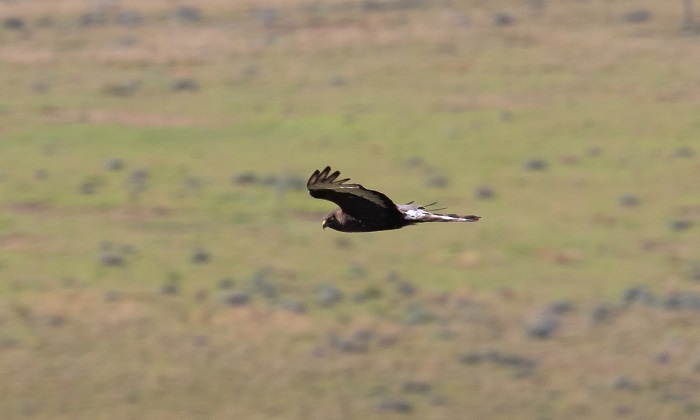
Mavuya, Eastern Cape
Photo by Lance Robinson
