
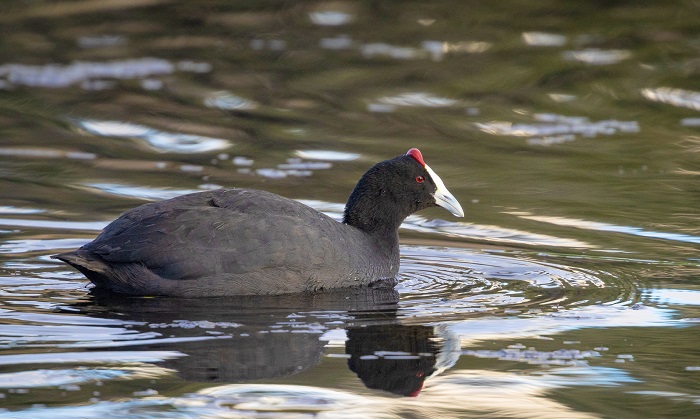
Cover image of Red-knobbed Coot.
Coots belong to the Family RALLIDAE. This family also includes Rails, Crakes, Swamphens, Flufftails, Gallinules, and Moorhens, etc. Their physiology is diverse, but most have laterally compressed bodies, short tails, short rounded wings and well-developed legs and feet. The bill structure is variable. Most birds in this family inhabit wetlands or forest undergrowth and are usually vocal and highly secretive.
Identification
The Red-knobbed Coot is a large and distinctive rallid and quite unlike any other southern African bird
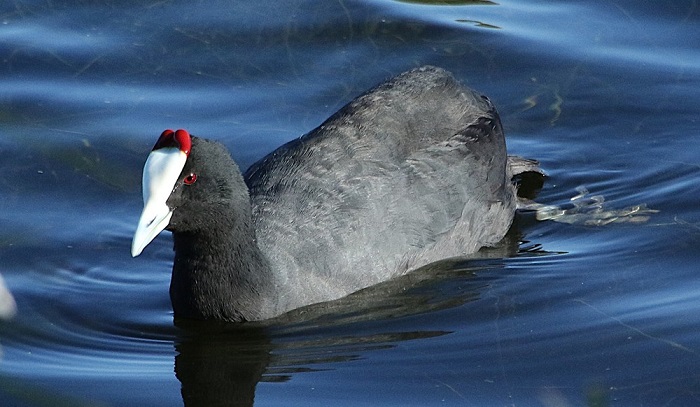
Near Stilbaai, Western Cape
Photo by Attie van Aarde
In adults, the entire body is black to dark slaty grey. The most characteristic feature is the striking, white bill and frontal shield (sometimes with a slight bluish tinge) with 2 red knobs on the head at the top of the shield. These red knobs are large when breeding, otherwise inconspicuous. The eyes are deep red and the legs and feet are greenish grey. The sexes are alike in plumage colouration; however, males are considerably larger than females.
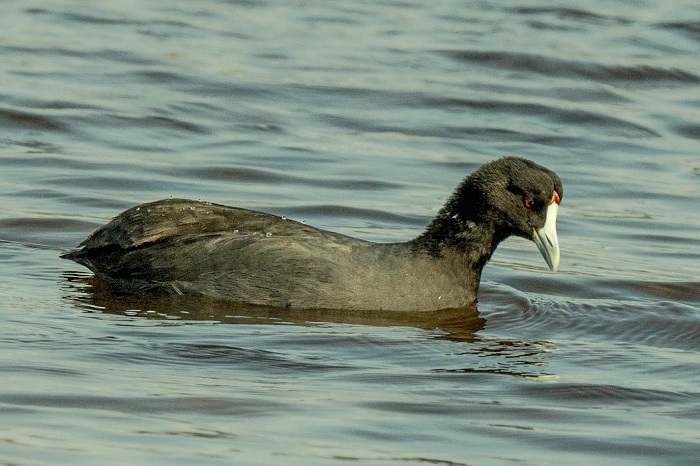
Near Stilbaai, Western Cape
Photo by Jean Hirons
Juveniles are dark grey-brown above, and the sides of the head, neck and flanks are dark olive-brown with off-white mottling. The chin and throat are whitish, and the remainder of the underparts are pale grey. The bill is dull grey, and the eyes are brown. The legs and feet are dark grey.
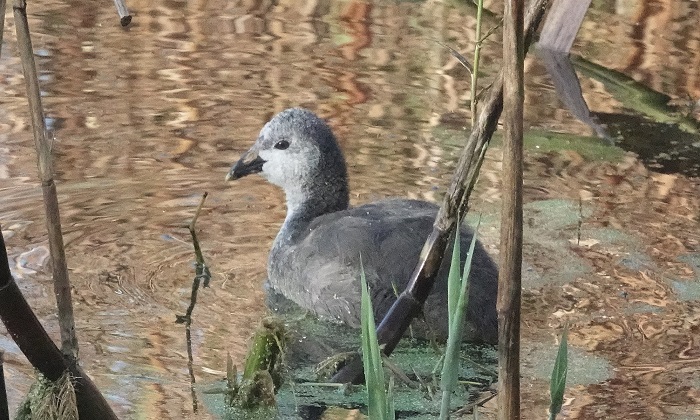
Intaka Island, Western Cape
Photo by Les Underhill
Status and Distribution
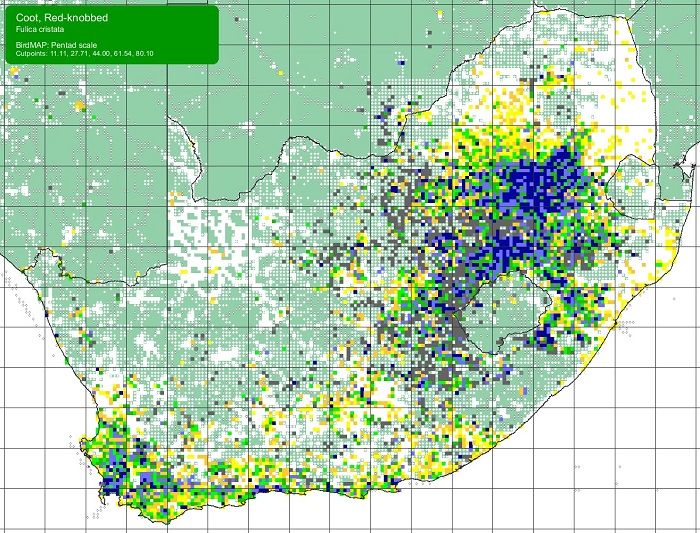
The Red Knobbed Coot has a disjunct distribution with small populations in southern Spain, northern Morocco and Algeria. It has a more continuous range from Ethiopia south through eastern and central Africa to the Cape, and a fragmented range in Madagascar. In southern Africa, it is found throughout the wetter regions and the southern and eastern Karoo. It is scarce in the northern Karoo, and mostly absent from the Kalahari and much of arid Botswana and Namibia. The Red-knobbed Coot is considered locally common to abundant in sub-Saharan Africa.
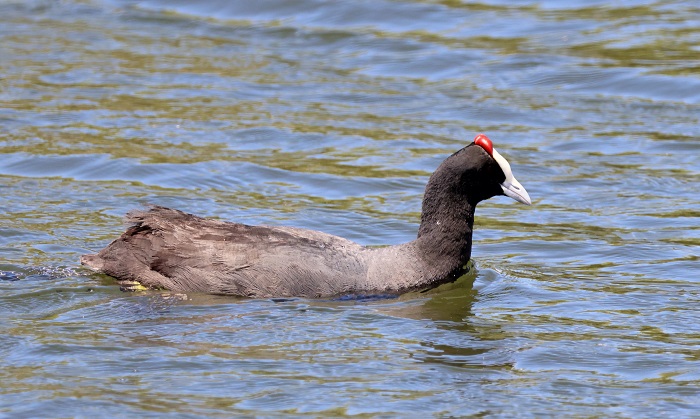
Helderberg Golf Course, Western Cape
Photo by Sharon Stanton
The Red-knobbed Coot is not threatened. In the recent past, its population has expanded considerably in response to increased habitat provided by farm dams and other man-made impoundments. Such changes in distribution and status are especially noticeable in the Western Cape, the Karoo, and in Zimbabwe, where it is now common on artificial impoundments.
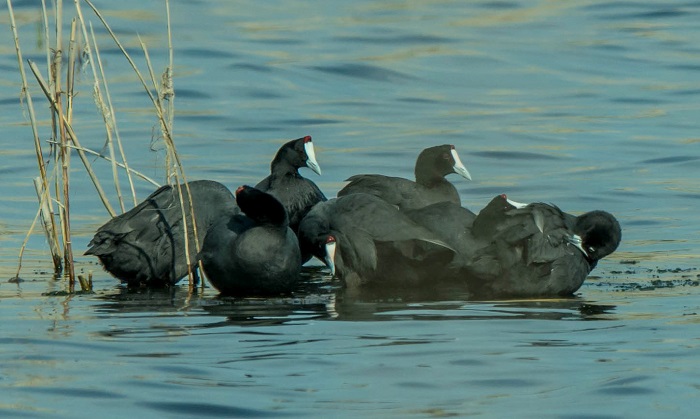
Garden Route National Park, Western Cape
Photo by Jean Hirons
.
Habitat

Wakkerstroom, Mpumalanga
Photo by Ryan Tippett
The Red-knobbed Coot frequents open, small to large freshwater ponds, lakes, dams, marshes, temporary pans, flood plains, sewage ponds, and occasionally rivers and tidal lagoons. It favours wetlands with emergent vegetation and pondweeds, especially when breeding. The Red-knobbed Coot occurs on more open waters when not breeding. It requires submerged aquatic vegetation for food.
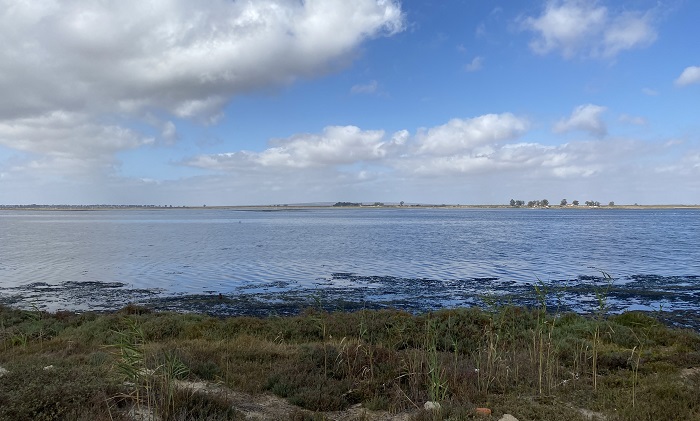
Photo by Karis Daniel
Behaviour
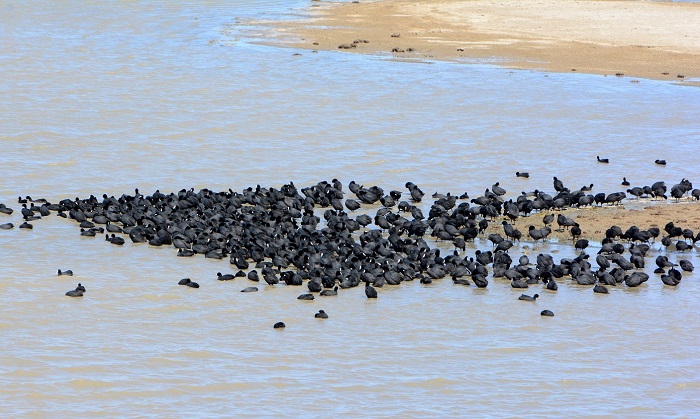
Victoria West Dam, Northern Cape
Photo by Ryan Tippett
Red-knobbed Coots are gregarious, and can be found in pairs in the breeding season or sometimes in flocks of 1000 birds or more when not breeding. Part of the population is resident and sedentary, but most are nomadic, moving in response to rainfall. Permanent waters provide refuges during years of low rainfall. However, numbers fluctuate continually, regardless of rainfall, indicating movement even in dry years.
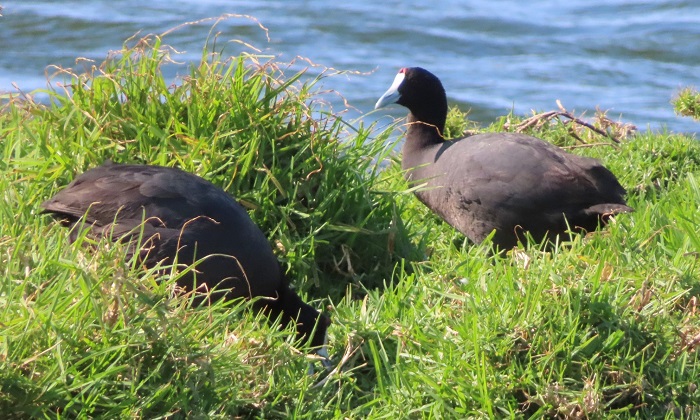
Strandfontein Sewage Works, Western Cape
Photo by Felicity Ellmore
The Red-knobbed Coot spends most of its time swimming and feeding on open water, but also grazes on the shoreline, running back into the water when disturbed. They are pugnacious and aggressive birds. Interactions, fights, and chases between birds take place throughout the year, but mostly during the breeding season. In chases, birds patter across the water, with wings flapping, seldom taking flight, and pitching onto their bellies when abandoning the chase. Flies strongly, with feet projecting beyond tail.
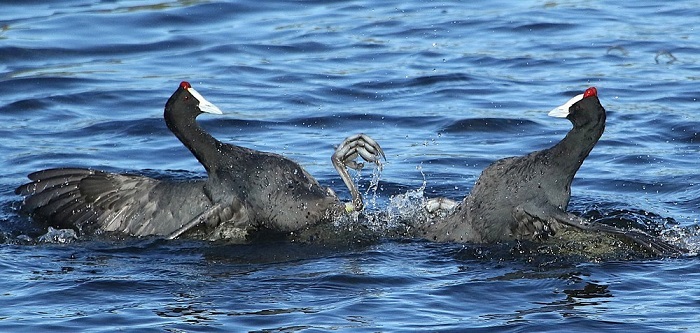
Stilbaai, Western Cape
Photo by Attie van Aarde
They forage either by standing in shallow water or swimming, picking items from the water surface, or by diving. Also walks on the shores of water bodies, grazing short grasses or green cultivated crops. Commonly grazes on short grass lawns around water features in parks and gardens.
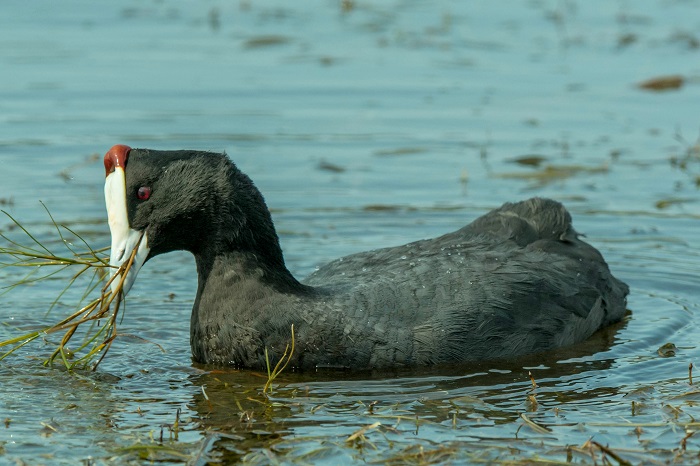
Garden Route National Park, Western Cape
Photo by Jean Hirons
The Red-knobbed Coot is primarily vegetarian, feeding on a wide range of plant material, including algae, aquatic ferns, and the stems, leaves, flowers, fruits and aerial roots of aquatic plants such as Knotweed Persicaria limbata, Torpedo Grass Panicum repens, and Fennel-leaved Pondweed Potamogeton pectinatus, etc. Red-knobbed Coots are opportunistic and also feed on varying amounts of insects, molluscs, and crustaceans as well as human food scraps and occasionally carrion. They have also been recorded eating cow dung.
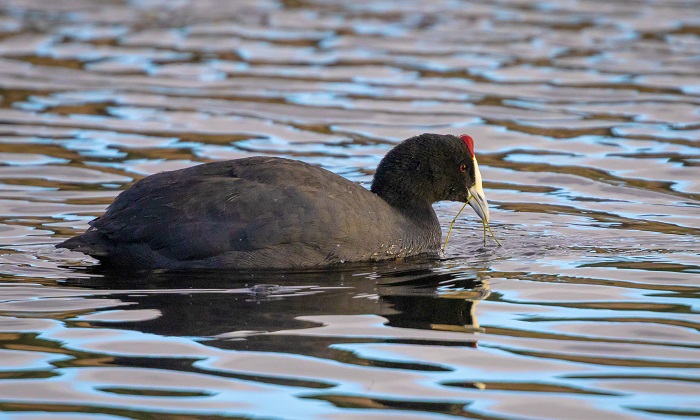
Stanford, Western Cape
Photo by Graeme Hatley
The Red-knobbed Coot breeds throughout the year in South Africa, with 2 peaks from July to September, and again from January to March. It is a monogamous, facultative cooperative breeder. Pairs nest solitarily and are strongly territorial.
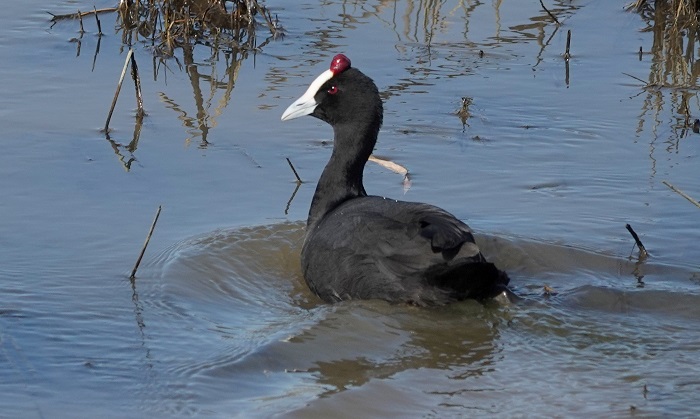
Malmesbury, Western Cape
Photo by Les Underhill
The Nest is a large, floating heap of water plants with a bowl-shaped hollow on top. It is built by both sexes, with juveniles occasionally helping out. The nest is either located in shallow, open water or anchored to vegetation in deeper water and is usually exposed. Additional nesting material is added during incubation. Red-knobbed Coots also build ‘false nests’ and rafts as resting platforms.
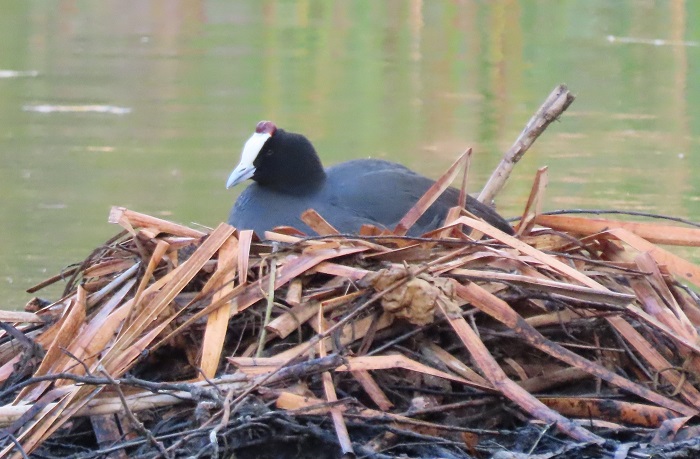
Cedarberg, Western Cape
Photo by Zenobia van Dyk
2-6 eggs are usually laid per clutch. The eggs are buffy-yellow with small purplish-brown dots. The Incubation period lasts for 18 to 25 days. Incubation is performed by both sexes, with frequent changeovers. Newly hatched young are mostly covered in greyish-black down. They are highly precocial and are able to dive soon after hatching. They are fed and cared for by both parents, sometimes with the help of juveniles from an earlier brood.
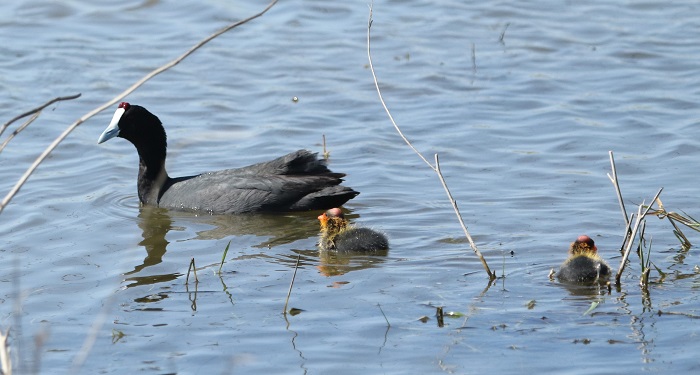
Witsand, Western Cape
Photo by Attie van Aarde
Further Resources
This species text has been adapted from the first Southern African Bird Atlas Project (SABAP1), 1997.
The use of photographs by Attie van Aarde, Felicity Ellmore, Graeme Hatley, Jean Hirons, Karis Daniel, Les Underhill, Ryan Tippett, Sharon Stanton, and Zenobia van Dyk is acknowledged.
Other common names: Bleshoender (Afrikaans); Unomkqayi, Unompemvana (Xhosa); Foulque caronculée, Foulque à crête (French); Kammbleßhuhn (German); Galeirão-de-crista (Portuguese); Knobbelmeerkoet (Dutch).
A list of bird species in this format is available here.
Recommended citation format: Tippett RM. 2026. Red-knobbed Coot Fulica cristata. Biodiversity and Development Institute. Available online at https://thebdi.org/2026/07/30/red-knobbed-coot-fulica-cristata/
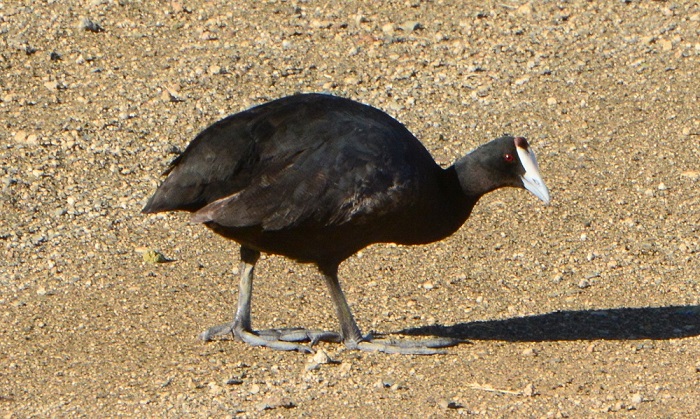
Vosburg district, Northern Cape
Photo by Ryan Tippett
.
