
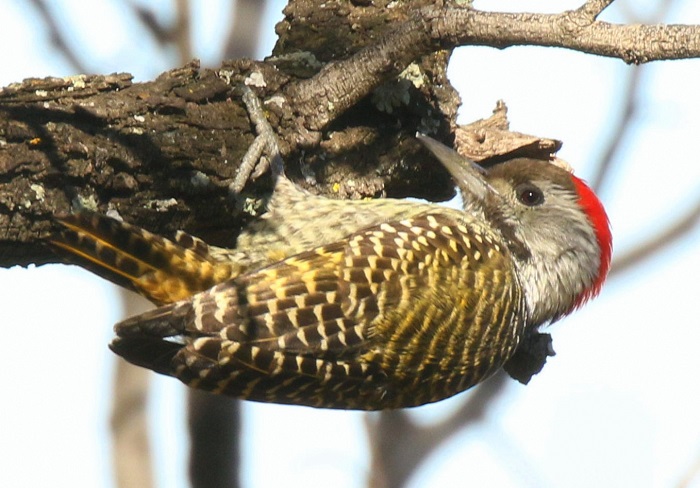
Cover image of Cardinal Woodpecker by Marna Buys – Magaliesberg Natural Area, Gauteng
Woodpeckers belong to the family PICIDAE. Members of this family are chiefly known for the characteristic ‘woodpecking’ behaviour that serves foraging, communication through drumming, and nest excavation. They have straight, strong bills that are reinforced at the base to cushion the brain, a stiff-pointed tail, and most possess zygodactyl toes. The tongue wraps around the rear of the skull and is anchored in one of the eye sockets or nostrils. The colours of many species are based on olive and brown, and some are pied, while others are boldly patterned in black, white, and red. Many have a crest or tufted feathers on their crowns. Woodpeckers have a mostly cosmopolitan distribution, although they are absent from Australasia, Madagascar, and Antarctica. They have diversified into every treed habitat on Earth, and most species live in forested or woodland habitats, although a few species have adapted to largely treeless environments. The family comprises 36 genera and 236 species. 10 species are known from southern Africa.
Identification
The Cardinal Woodpecker is the smallest woodpecker species in southern Africa, reaching a maximum length of 16cm and weighing up to 30 grams. Cardinal Woodpeckers are sexually dimorphic. The sexes differ in their head markings, and males are slightly larger than females, with longer wings and bills.
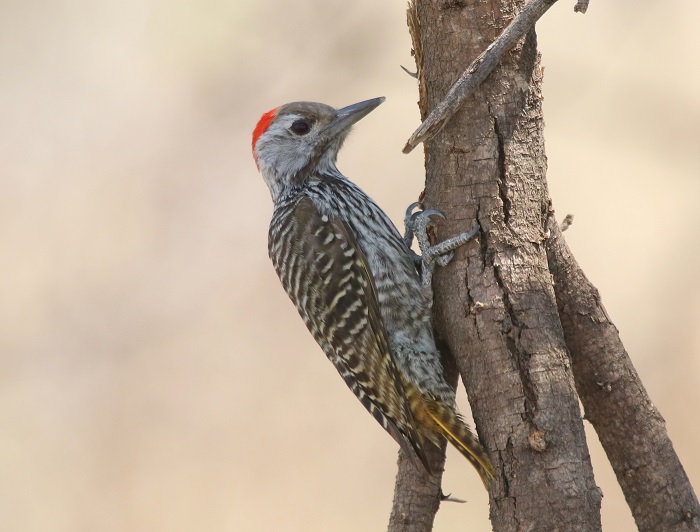
Mokala National Park, Northern Cape
Photo by Sybrand Venter
In adult males, the forehead to mid-crown is brown, and the hind crown and nape are red. A blackish-brown malar stripe extends from the base of the bill to the sides of the neck. The rest of the facial area and throat is white to greyish-white, sparsely and finely streaked dark brown. The upper parts are olive green with alternating bands of blackish brown and white barring. The tail is brown with yellowish barring and golden yellow feather shafts. The underparts are greyish-white with heavy brownish-black streaking. The bill is black and the tongue is long with a barbed tip. The eyes are dark reddish-brown and the legs and feet are greyish black.
Adult females resemble the males, but have a black hind crown and nape. Juveniles are duller and greyer than adults.
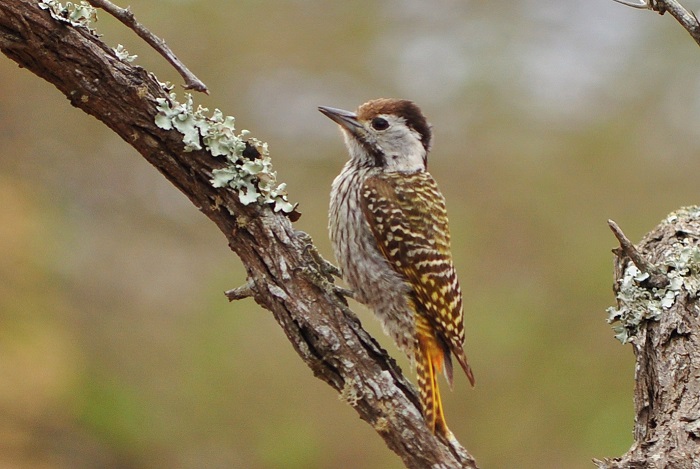
Thanda Private Game Reserve, KwaZulu-Natal
Photo by Ryan Tippett
The Cardinal Woodpecker is sometimes confused with the Golden-tailed Woodpecker (Campethera abingoni), which is the only other woodpecker in the region with streaked underparts. The Cardinal Woodpecker is much smaller and has a conspicuously barred (not spotted) back.
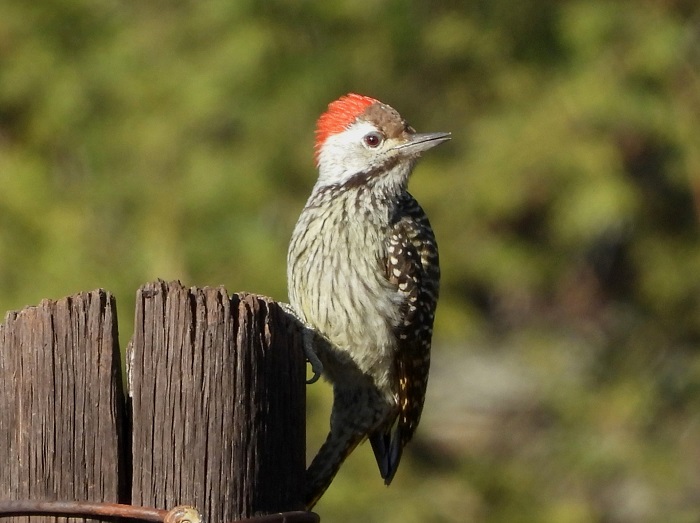
Near Bela-Bela, Limpopo
Photo by Ansie Dee Reis
Status and Distribution
The Cardinal Woodpecker is common throughout its range. It is confined to sub-Saharan Africa, from Gambia and Sudan down to South Africa. It is the most widespread woodpecker of the African savannas. The Cardinal Woodpecker is found throughout most of southern Africa and is only absent from treeless regions.
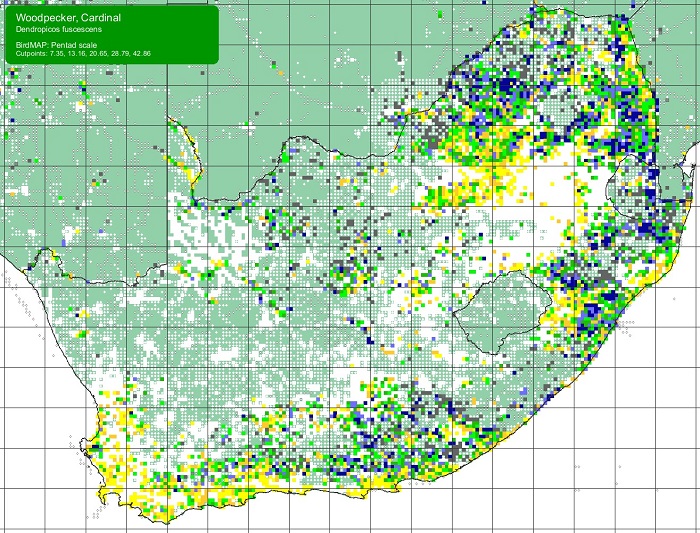
The Cardinal Woodpecker is not threatened. Its range has undoubtedly contracted in areas where woodland has been cleared for agriculture. However, its range has also expanded into areas where alien trees have been planted, where it previously did not occur.
Habitat
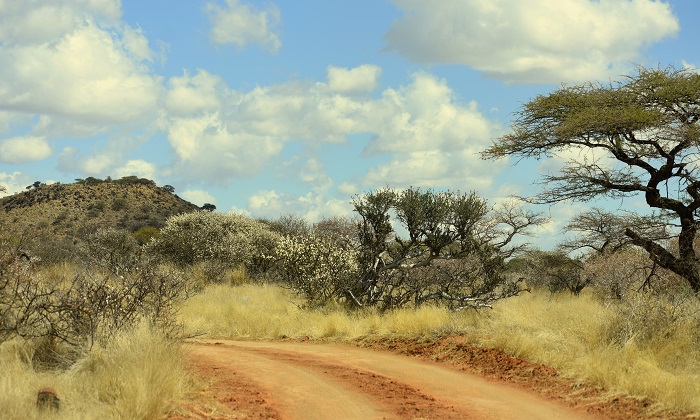
Mokala National Park, Northern Cape
Photo by Karis Daniel
The Cardinal Woodpecker frequents a wide variety of woodland and savanna habitats, from the edges of deserts to the fringes of forests. It inhabits any woodland, including thornveld, broad-leaved woodland and savanna. In desert and semi-desert areas, as well as fynbos and grassland regions, it is restricted to riparian tree galleries or introduced trees around settlements and farmsteads. It regularly enters villages and suburban environments. The Cardinal Woodpecker avoids the interior of evergreen forests, except where fragmented or regenerating. It is also absent from extensive monocultures of planted timber.
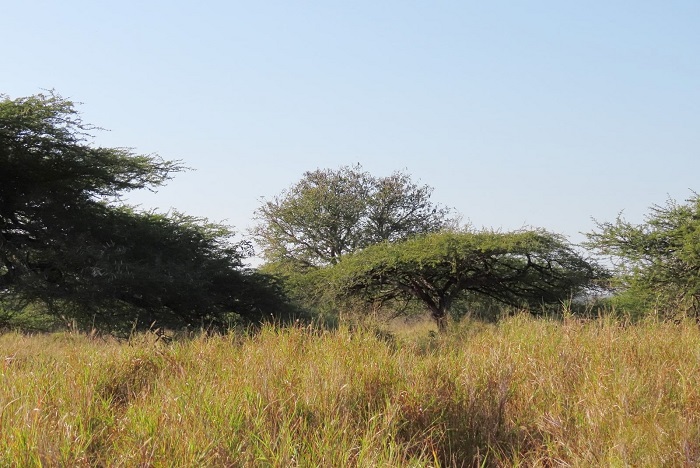
Mkhuze Game Reserve, KwaZulu-Natal
Photo by Colin Summersgill
Behaviour
The Cardinal Woodpecker is resident and sedentary. It is most often found in pairs, less often solitarily, and seldom in family groups except immediately after breeding. Pairs remain together and are territorial year-round. The Cardinal Woodpecker’s presence is usually given away by the tapping sound they make while foraging, or by its distinctive call.
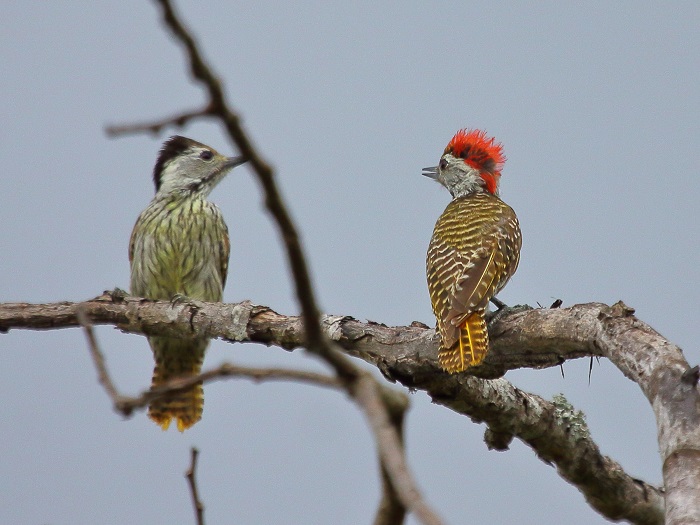
Tembe Elephant Park, KwaZulu-Natal
Photo by Phillip Nieuwoudt
Often forages on thin, mainly dead branches and stems of trees and shrubs that are not used by other woodpeckers. Cardinal Woodpeckers frequently join mixed-species foraging flocks, in which they may occur alongside other woodpeckers. In response to danger, will move out of view behind a branch. In territorial disputes, rivals call frequently, sway heads from side to side, raise crest feathers, flick wings open and closed, and pursue each other. At night, roosts solitarily in a hole in a tree, favouring holes with much larger entrances than nesting holes. Roost sites are reused nightly. Their flight is typically undulating, like most woodpeckers.
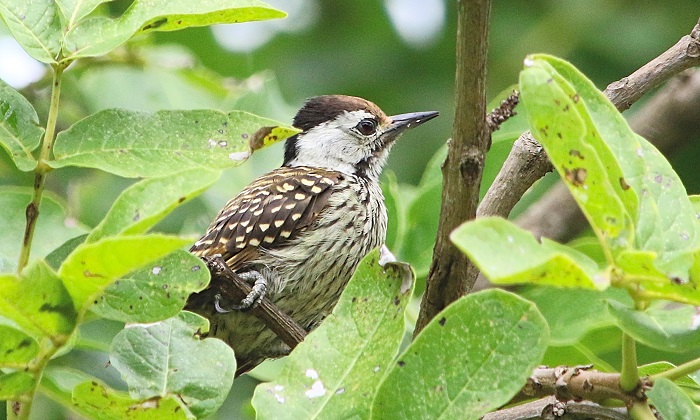
Shelley Beach, KwaZulu-Natal
Photo by Lia Steen
This species is agile and dexterous while foraging, often hanging under branches and turning to peck open a site from different angles. It pecks open cavities and uses its barbed tongue to extract the larvae and pupae of beetles and other insects, including large caterpillars. Some prey, such as ants and spiders, are gleaned from bark and plant stems. It occasionally hawks termite alates and eats occasional small amounts of fruit. They also break into seed pods to feed on wasp larvae.
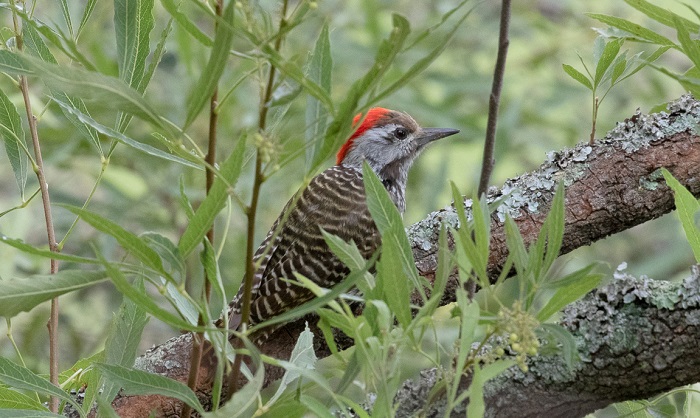
Ukhahlamba Drakensberg Park, KwaZulu-Natal
Photo by Andre Harmse
The Cardinal Woodpecker is a monogamous, solitary nester. The nest is a hole excavated by both sexes, taking 13-21 days to complete. It is usually located on the underside of a dead, sloping stem up to 4 m above the ground. The nest cavity is up to 250 mm deep, with an oval-shaped entrance. Nest holes are seldom reused.
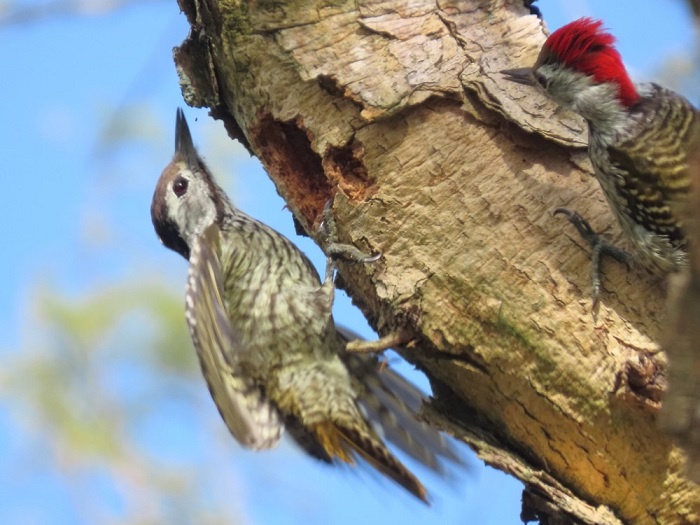
Albert Falls, KwaZulu-Natal
Photo by Colin Summersgill
Eggs are mostly laid from July to December. 1 to 3 glossy white, oval-shaped eggs are laid per clutch on a bed of dry wood chips at 1-day intervals. Incubation starts at clutch completion and lasts up to 13 days. Both sexes share incubation duties. Eggshells and unhatched eggs not removed. Newly hatched young are altricial and are brooded and fed by both parents. The nestling period takes up to 27 days. Juvenile birds disperse within 2 months of fledging. Cardinal Woodpeckers are single-brooded.
Broods are frequently parasitised by honeyguides, including Lesser Honeyguide (Indicator minor), Greater Honeyguide (Indicator indicator), and Scaly-throated Honeyguide (Indicator variegatus).
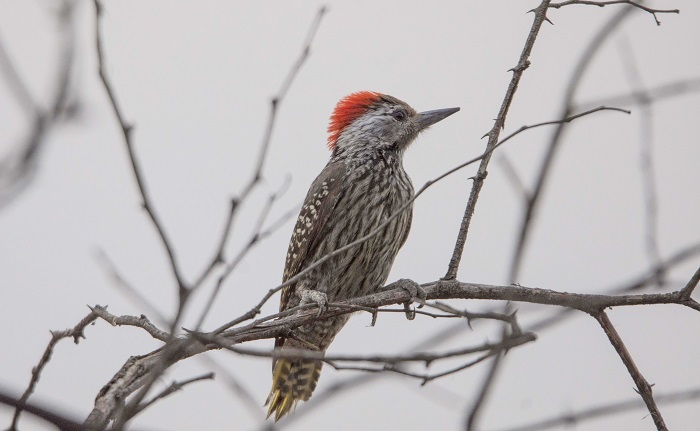
Near Klerksdorp, North West
Photo by Tony Archer
Further Resources
This species text is adapted from the first Southern African Bird Atlas Project (SABAP1), 1997.
The use of photographs by Christopher Willis, Colin Summersgill, Karis Daniel, Ryan Tippett, and Sybrand Venter is acknowledged.
Other common names: Kardinaalspeg (Afrikaans); iNqondaqonda (Zulu); Isinqolamthi (Xhosa); Pic cardinal (French); Kardinalspecht (German); Kardinaalspecht (Dutch); Pica-pau-cardeal (Portuguese).
Recommended citation format: Tippett RM. 2026. Cardinal Woodpecker Dendropicos fuscescens. Biodiversity and Development Institute. Available online at https://thebdi.org/2026/07/17/cardinal-woodpecker-dendropicos-fuscescens/
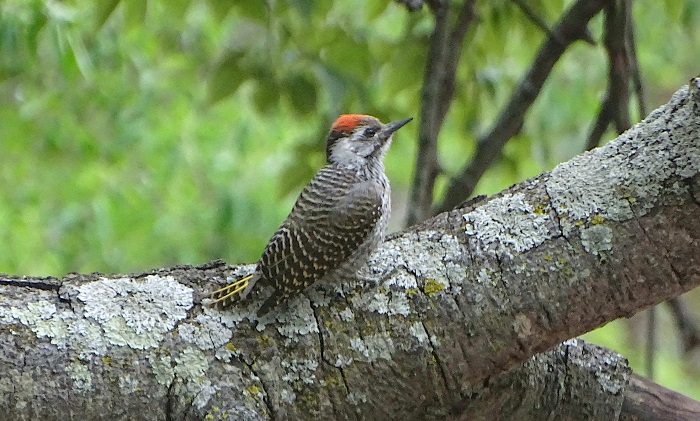
Waterberg, Limpopo
Photo by Cristopher Willis
