
Introduction
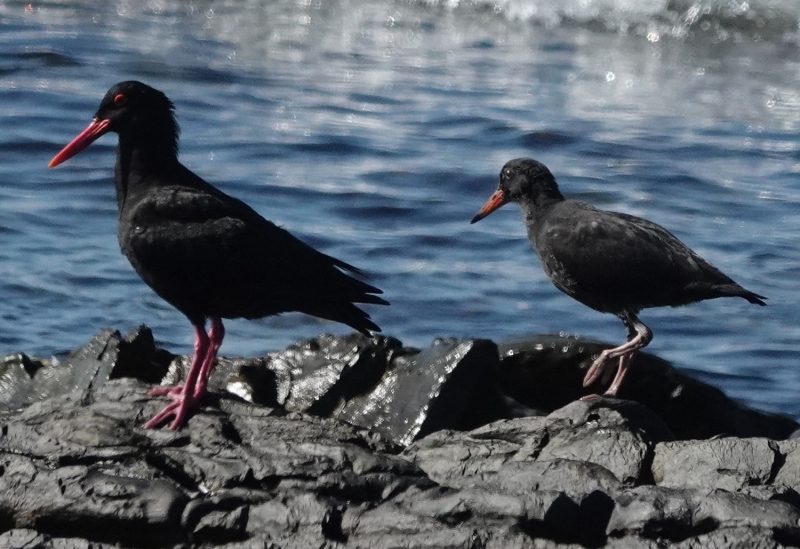
We have been monitoring the breeding of the African Oystercatchers Haematopos moquini on Robben Island since the summer of 2001/02. We have also monitored their abundance. This blog aims to describe the fieldwork we are doing in the summer of 2025/26. Our target interval between trips is six days, but that sometimes gets adjusted by the weather and other commitments. So this blog ought to be updated at roughly six-day intervals. The most recent visit is on top! Our objective for the summer is to find every oystercatcher nest on the island. At the end of the blog is a list of some of the publications that have emerged from this fieldwork. The papers give more background to the science and conservation objectives.
Fieldwork 10 : 16 and 17 January (in progress)
This fieldtrip had been scheduled for the 15th and 16th. But the sea was unsuitable for operation on the 15th, so we went to the island with the first ferry on the 16th, had a long day’s fieldwork, and continued into the morning of the 17th. It now feels like we have caught up!
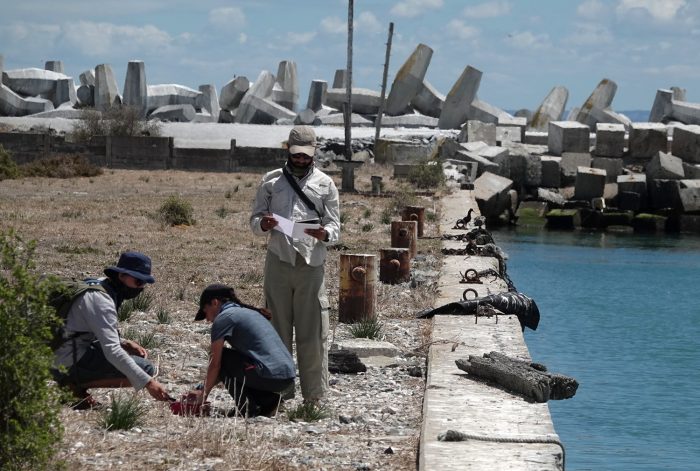
This is our first nest actually in Murray’s Bay Harbour. The nest owner is watching from along the edge of the wharf!
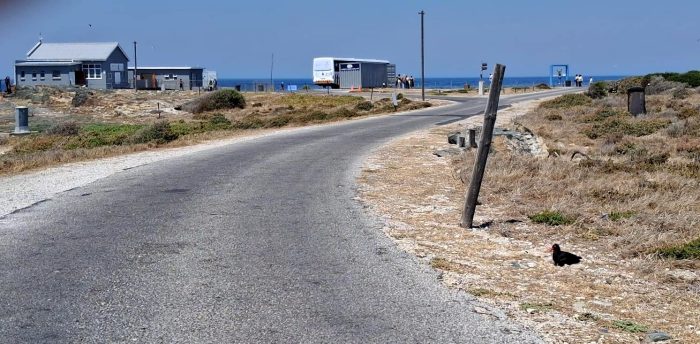
This is probably the first nest that we have found on the inland side of the perimeter road. This is a busy spot with Alpha One in the background. Every tourist bus passes this spot twice. The nest has had two eggs since it was discovered on 5 January. So it is about one-third of the way through the 30-day incubation period.
Fieldwork 9 : 10 January 2026 (in progress)
The two-day trip which had been planned for 3 to 4 January was unable to take place because of high winds and no ferries. As luck would have it, it proved impossible to arrange fieldwork before the next planned dates of 9 and 10 January. And then ferries were cancelled on 9 January, and fieldwork was reduced to a day trip on 10 January.
Fieldwork 8 : 27 December 2025 (in progress)
This was a planned one day trip, due to it being in the holiday season.
Dembo Jatta assisted with almost all of the fieldwork up to this trip, and was the leader of fieldwork in the northern half of the island. This was his last trip before starting a PhD at Wageningen University in the Netherlands; this is the opportunity to thank him for his dedication to the oystercatcher monitoring this season, and to wish him success with the next phase of his studies.
Fieldwork 7 : 21 and 22 December
This is a report on the 7th fieldwork trip of the 2025/26 oystercatcher breeding season. We found six new nests with eggs (five in the southern half, nests S19 to S23; and one in the northern half, N40). This brings the total number of nests found to 63.
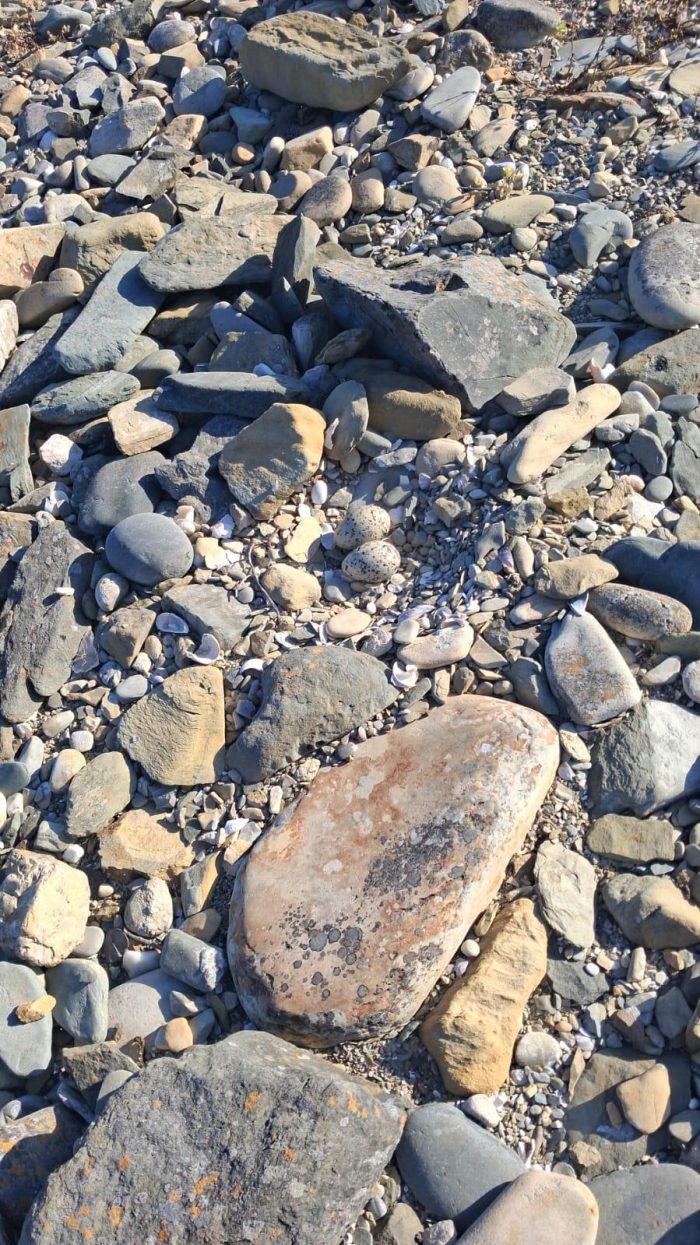
When you see the eggs, they are obvious. Nest S21.
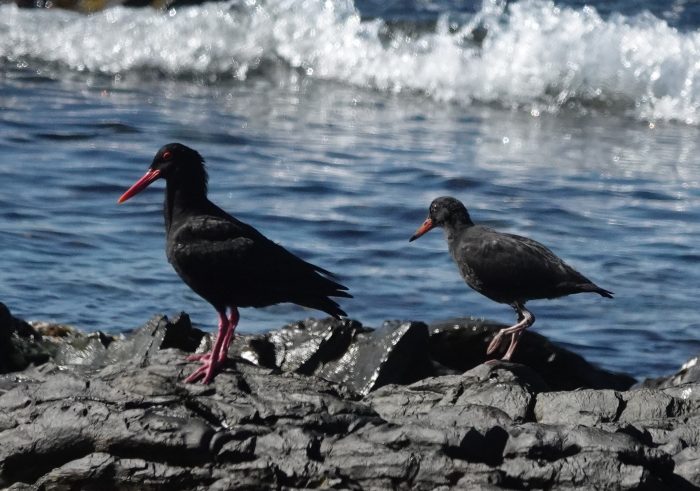
Both of the chicks that were ringed during Fieldwork 5, on 8 and 9 December, are doing fine. The parents no longer bother to hide them, because they can fly. This chick is 42 days old; they fly at about 40 days old. It still has lots of growing to do.
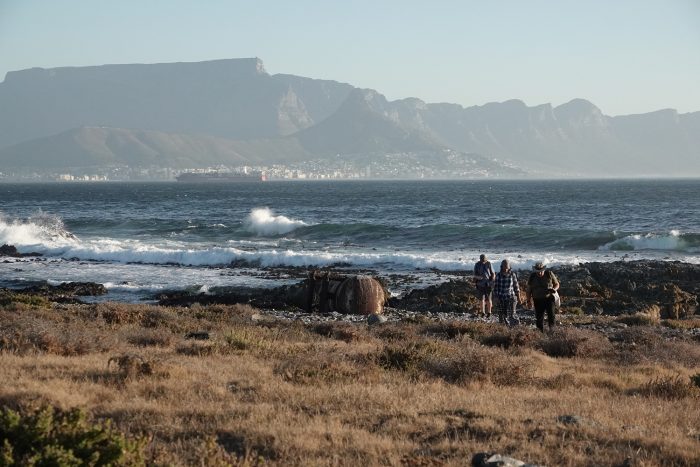
The rusty ship’s boiler on the shore marks the end of the afternoon’s fieldwork on Sunday at 19h00. The team will be back here at 06h30 to continue.
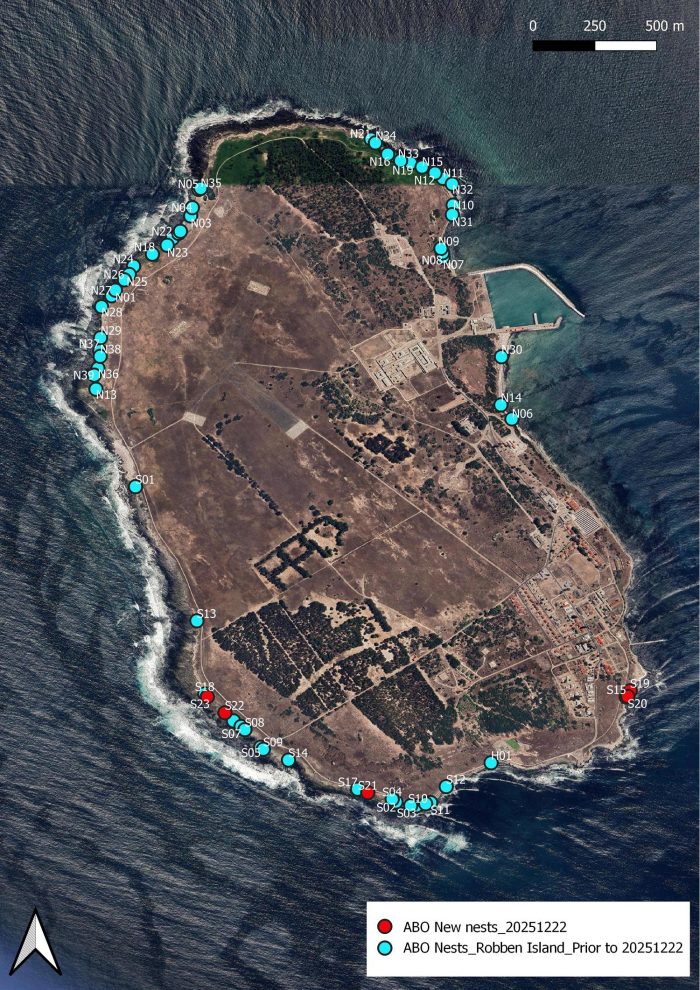
The new nests are in red. The position of nest N40 still needs to be added. It lies between N14 and N30, just south of the harbour.
Bird list
This is the bird species list for Fieldwork 7. Two species, in bold, were recorded for the first time this summer. The list has 38 species.
| Species | Note |
| Cisticola, Zitting | Along the road between the foghorn and the airfield |
| Cormorant, Bank | |
| Cormorant, Cape | |
| Cormorant, Crowned | |
| Cormorant, White-breasted | Only seen at the harbour; maybe three present. |
| Crane, Blue | Over airfield, harassed by Kelp Giull |
| Crow, Pied | |
| Dove, Red-eyed | |
| Dove, Ring-necked | |
| Egret, Cattle | |
| Egret, Little | |
| Fiscal, Southern | |
| Goose, Egyptian | |
| Guineafowl, Helmeted | |
| Gull, Hartlaub’s | |
| Gull, Kelp | |
| Ibis, African Sacred | |
| Ibis, Hadada | |
| Kestrel, Rock | One seen, hunting from tree |
| Night Heron, Black-crowned | One, just after dawn apparently flying from the coast to its daytime roost |
| Oystercatcher, African | We have our first fledglings! |
| Partridge, Chukar | |
| Penguin, African | |
| Pigeon, Speckled | |
| Plover, White-fronted | |
| Sparrow, House | Seen in three places! Harbour, research house, in the village |
| Spurfowl, Cape | |
| Starling, Common | |
| Swallow, Barn | |
| Swallow, White-throated | |
| Swift, Little | |
| Tern, Common | |
| Tern, Greater Crested | |
| Tern, Sandwich | |
| Thick-knee, Spotted | |
| Turnstone, Ruddy | One, south of Bluestone Quarry |
| Weaver, Cape | |
| Whimbrel, Eurasian | |
| Total | 38 species |
We made the second ever record for the Robben Island of Blue Crane. It was circling above the northwestern corner of the island, over the remains of the airfield, which dates back to the Second World War. This northwestern part of the island is part of the scattered Kelp Gull breeding colony, so it is not a surprise that the intruder was mobbed by a Kelp Gull. See the photos below.
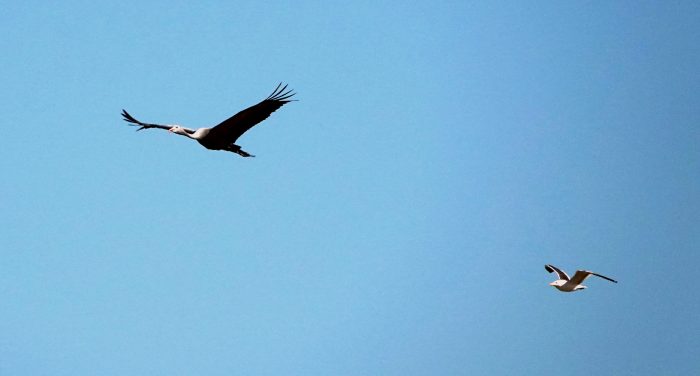
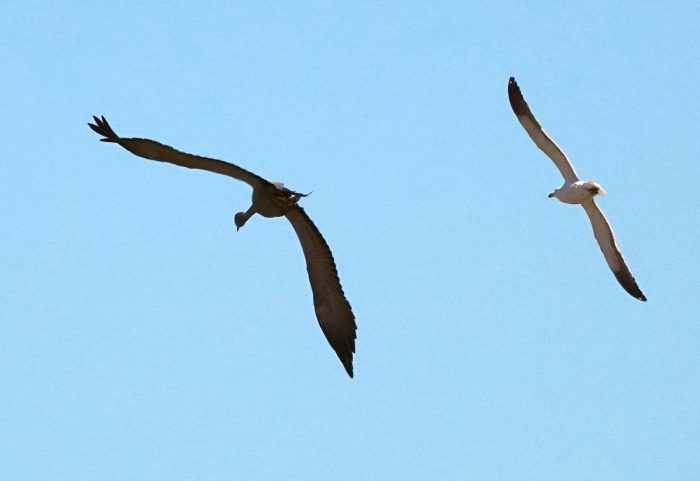
The first record of Blue Crane was made by Phil Whittington, who reported two over the island on 9 November 1998. He was then a PhD student, monitoring the African Penguins that were de-oiled after the Apollo Sea oilspill of 1994. So this is the first record since 2000.
The most recently added species was African Dusky Flycatcher, on 23 May 2024. See the paper First record of African Dusky Flycatcher on Robben Island published in Biodiversity Observations.The total bird list for Robben Island remains on 166, but the list of species recorded since 2000 increases to 136. The most useful paper on Robben Island’s birds is available here. It was published way in back in 2011, so it needs an update!
Fieldwork 6 : 15 and 16 December
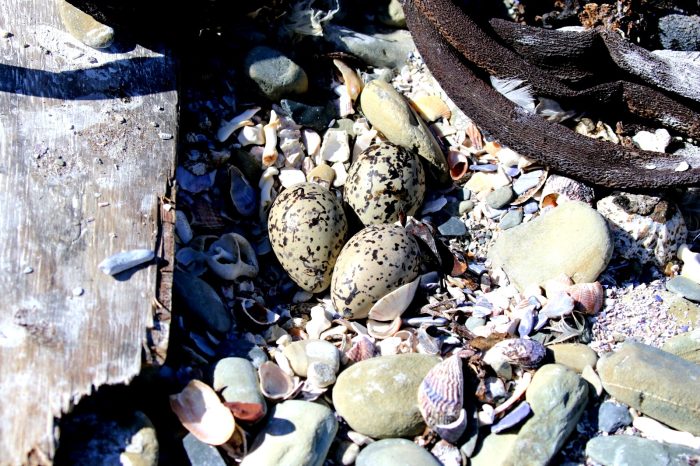
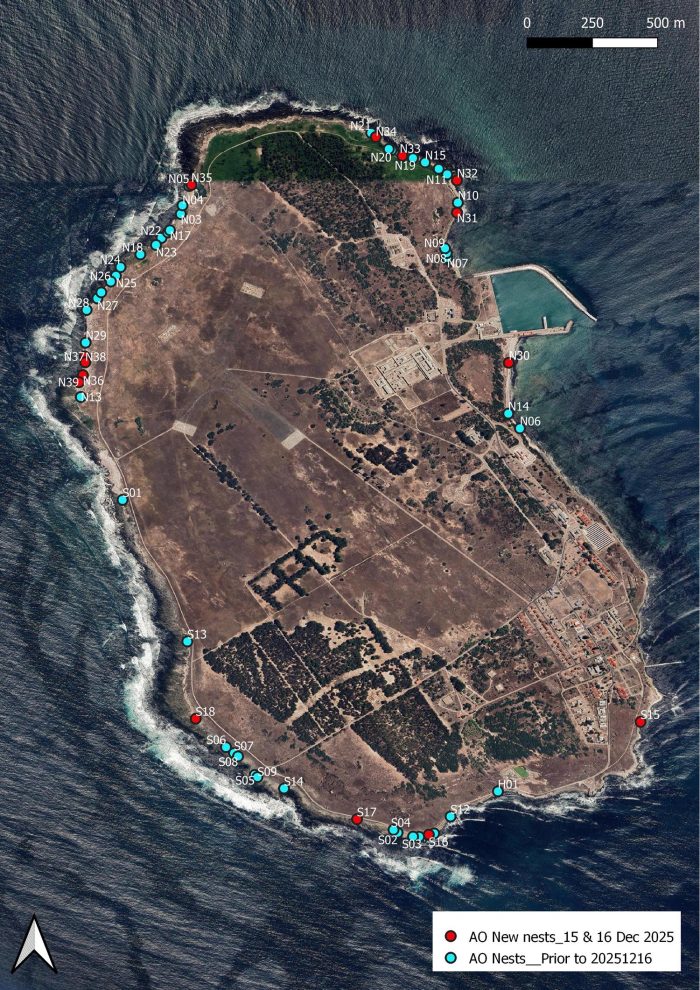
This is a report on the 6th fieldwork trip of the 2025/26 oystercatcher breeding season. We found 14 new nests with eggs (four in the southern half, nests S15 to S18; 10 in the northern half, N30 to N39). This brings the total number of nests found to 57. See the map below. We found our first three-egg clutch of the season. Here it is … nest N37:
37 of the 57 nests found with eggs still have eggs. Probably 10 pairs of the 57 nests have chicks which are alive, judged by the fact that the adults are alarming when we pass through their territories. So the are about 10 pairs which either lost eggs or small chicks. It is still early enough in the breeding season for these pairs to produce a replacement clutch. These are produced on average about 14 days after the loss of eggs or chicks.
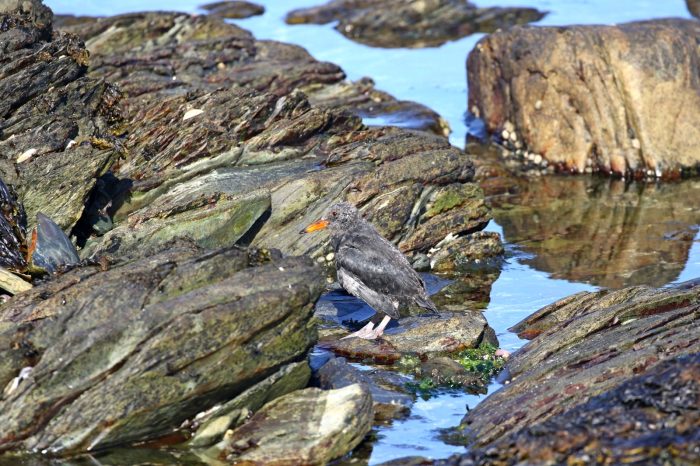
Territories are short sections of the shore, and so nests are close together, so we can’t always be certain which chicks originally belong to which nests. But this chick probably comes from N01; from the records, it probably hatched on about 20 November, so on 15 December it would have been about 25 days old. It was being dive-bombed by Kelp Gulls.
The African Oystercatchers seem to have had a particularly good breeding year so far. Relatively few nests have been lost. Eggs which were laid before the middle of November have hatched by now (incubation period of about 28 days) so there are chicks at all stages of development, from hatchlings onwards. Chicks fly at around 40 days, at about two-thirds of adult weight.
This is the distribution of nests around Robben Island. The newly found nests are in red. Nests fund during Fieldworks 1 to 5 are in blue.
As on previous rounds of fieldwork, we found lots of scrapes. The scrape is placed alongside strands of dry kelp. When the oystercatcher is incubating, it will not be conspicuous! Hopefully many of these scrapes will become red dots on the map, with eggs found in them soon …
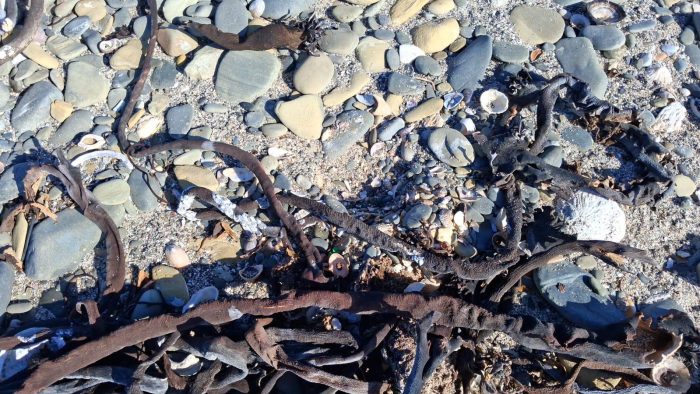
This scrape is on the southern half of the island. There are lots of territories here. Currently, there are only 18 nests in the south, compared with 39 in the north!
Birds
This is our bird list, in alphabetical order. The six species in bold were seen during Fieldwork 6 for the first time this summer.
| Species | Comment |
| African Oystercatcher | We are on 57 nests so far. |
| African Penguin | Several with penguin cellulitis were observed (see photos below) and reported. They have since been collected and admitted to SANCCOB for treatment. |
| African Sacred Ibis | |
| Bank Cormorant | |
| Blacksmith Lapwing | |
| Cape Cormorant | |
| Cape Spurfowl | |
| Caspian Tern | One feeding along shore north of harbour |
| Chukar Partridge | Common, with chicks |
| Common Starling | |
| Crowned Lapwing | The chicks of the pair on the football field are large |
| Egyptian Goose | Isolated birds along the shore, and three in Van Riebeek’s Quarry |
| Eurasian Whimbrel | |
| Fiery-necked Nightjar | One heard along Boundary Road in evening |
| Fiscal Flycatcher | One seem along Boundary Road |
| Greater Crested Tern | Gathering. Pairs starting to do display flights |
| Hadada Ibis | |
| Hartlaub’s Gull | About 30 at harbour |
| Helmeted Guineafowl | |
| House Sparrow | One seen at harbour, one at research house |
| Kelp Gull | Breeding around north end of island, from the harbour to just north of Boundary Road. Lots of chicks of assorted sizes. Fledged young. |
| Little Egret | |
| Little Swift | |
| Pied Crow | At least five on the island |
| Red-eyed Dove | |
| Ring-necked Dove | |
| Rock Kestrel | One on tall tree |
| Ruddy Turnstone | |
| Sandwich Tern | One at harbour |
| Southern Fiscal | |
| Speckled Pigeon | |
| Spotted Thick-knee | |
| Western Cattle Egret | Small numbers |
| White-throated Swallow | |
| White-breasted Cormorant | |
| White-fronted Plover | |
| Yellow-billed Kite | One seen circling over central grassland |
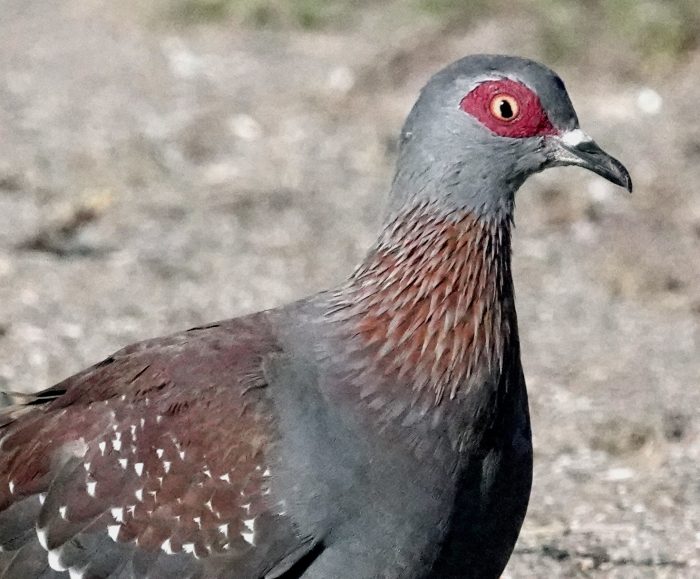
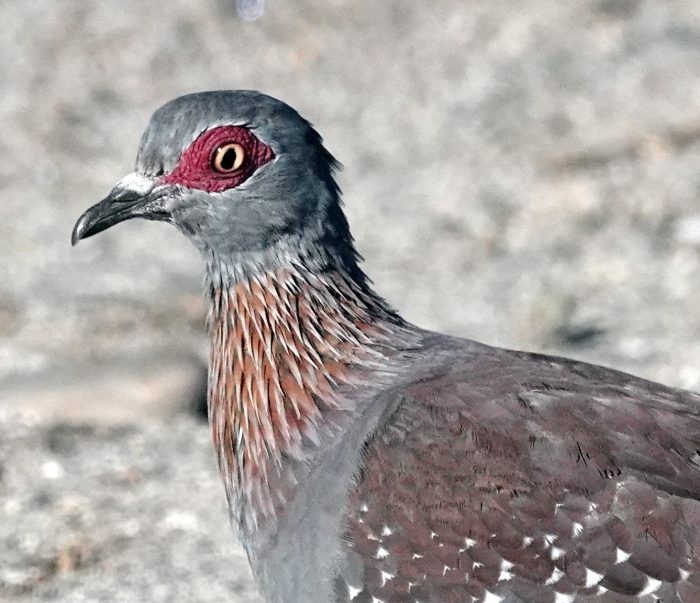
… the right eye and the left eye of the same Speckled Pigeon. Non-circular pupils!
African Penguins have more than enough problems to deal with. Here is a new one. The bird in the centre of the photograph below has a newly occurring condition which has been dubbed cellulitis. Look at the fat legs. The beautiful sleek feathers indicate that it has spent a couple of weeks on the shore doing moult. It is now desperately needing to get back to the ocean to regain condition, but it has accumulated fluid in the legs. The cause of the condition is unknown. We spotted several penguins like this, provided exact coordinates, and they have been admitted to SANCCOB, where the skills exist to treat this condition:
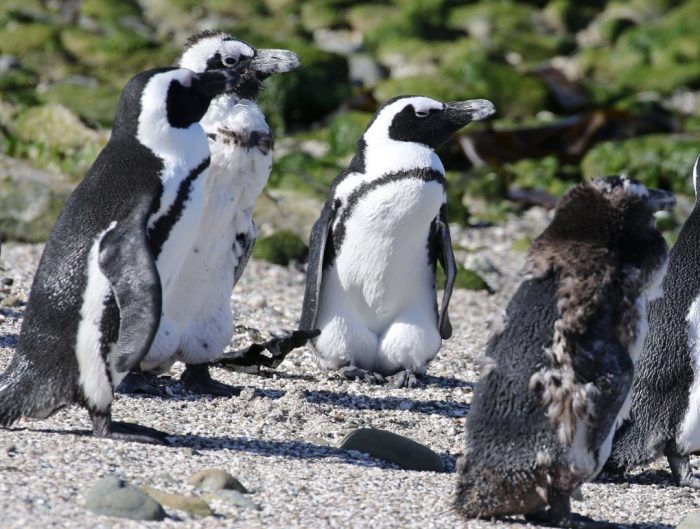
The middle two penguins below are serious cases of penguin cellulitis. The penguin at the back is still moulting.
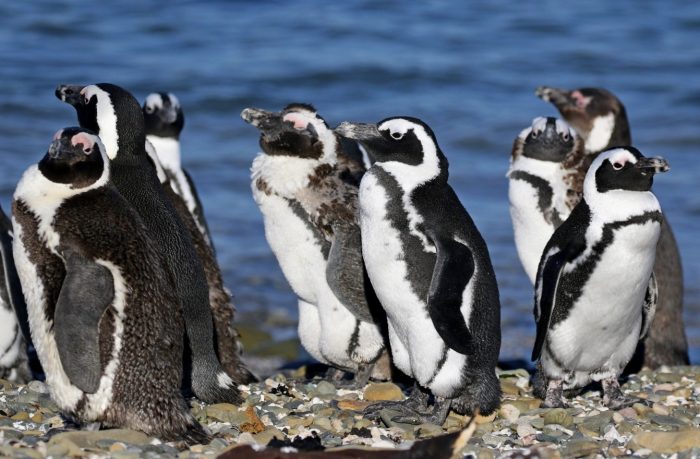
The feather replacement phase of moult takes about 14 days. They come ashore looking like garden gnomes. Even the flippers are full of fat. They are on land for about three weeks living off the fat reserves, sustaining not only themselves, but doing the energetically process of growing a complete new coat of feathers simulataneously. The annual moult is a mega-challenge for penguins. They can’t skip moult, because the old feathers lose their ability to enable the penguin to swim in a bubble of air, and keep the cold out.
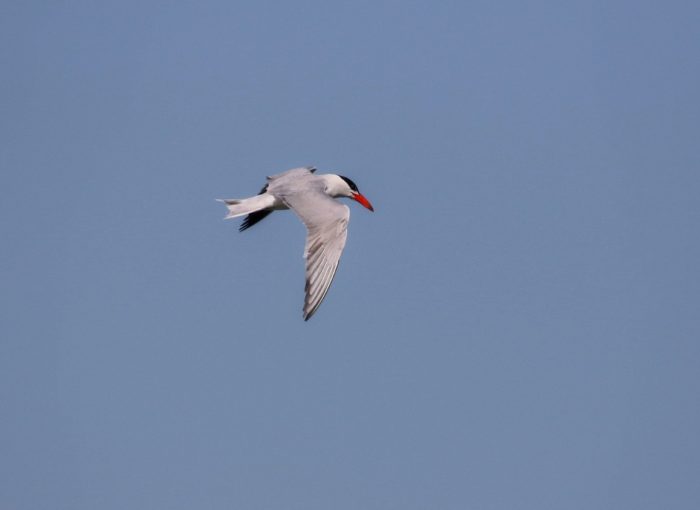
This was our first Caspian Tern of the summer. It was feeding over the shoreline north of the harbour.
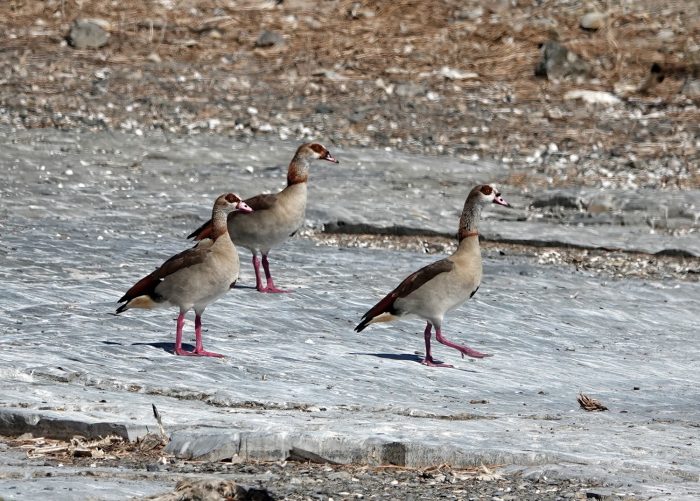
Egyptian Geese in Van Riebeek’s Quarry, south end of the island.
Fieldwork 5 : 8 and 9 December 2025
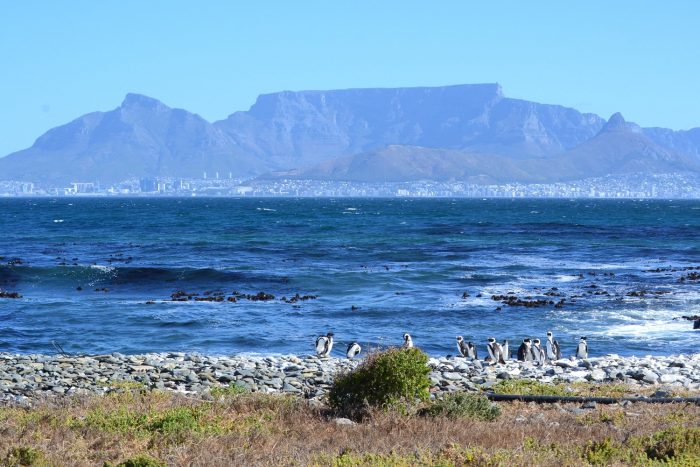
This view is always a reminder of the privilege it is to do research on the Robben Island World Heritage Site. We are grateful to the Robben Island Museum for the opportunity to do fieldwork here, and for the logistics provided.
On this fifth fieldwork trip of the 2025/26 African Oystercatcher breeding season, we found 13 new nests (S14 in the southern half of the island, and N19 to N29 in the northern half). The northern half is racing ahead with twice as many nests as the southern half. The total number of nests found at the egg stage is now 43. None of the clutches so far have had three eggs.
We found one dead ringed oystercatcher: ring K50080. The SAFRING database says that it was ringed on 5 February 2018 as an adult male.
We ringed the two chicks which hatched on 11 November 2025 on Trip 1. See far below! They have grown from …

… this fluffball size, covered in down, to …
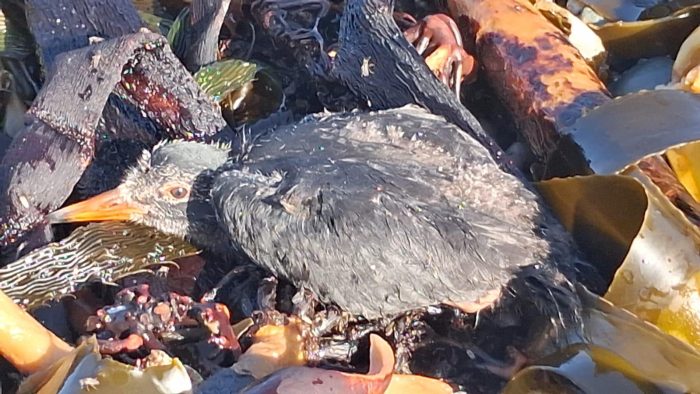
… this almost completely feathered chick is 29 days old. All oystercatcher chicks weigh close to 39 g when they hatch. When we ringed this one, it weighed 421 g and the other chick was 355 g. When there are two chicks, the weights often diverge as they get older. They are capable of flight at around 470 g, which is about two-thirds of adult mass. They are still growing when they start flying!
Chicks are starting to hatch in quite a few of the first-laid nests. For example, here is N17 …
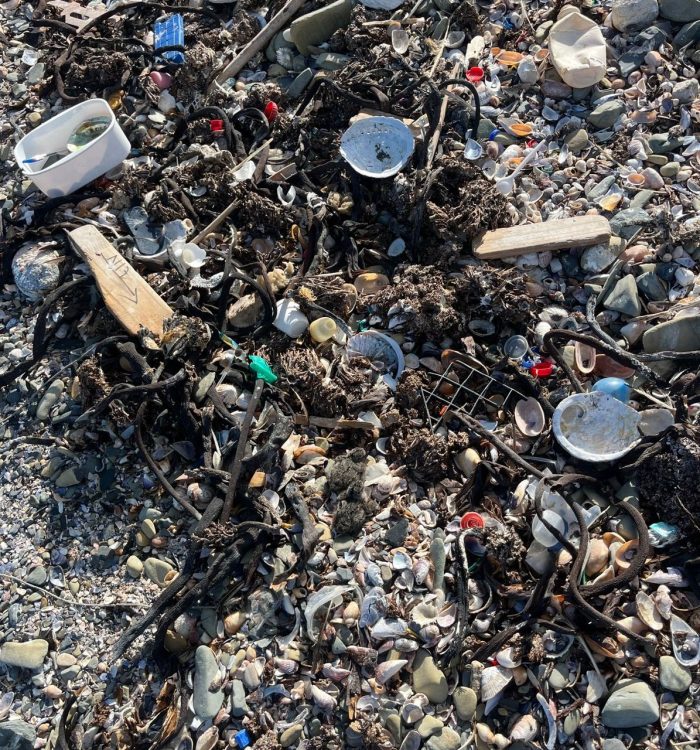
Our egg measurements and the masses when we found nest N17, and our formulae, suggested that incubation for these two eggs in N17 started on 8 November. The average incubation period is 30 days; this takes us to a stab at hatch date of 8 December. These two fluffballs were observed, still in the nest, on 9 December, so our method works well (at least in this case!). The ice cream tub is ours, but the immediate surroundings of this nest contain an alarming amount of little pieces of plastic and other rubbish. The litter does not come from the island; much of it gets dumped into Table Bay by the Black River which is the stormwater drain for much of the City of Cape Town. If you didn’t read this blog as part of Fieldwork 2, read it now: Industrial biodiversity 2 : Black River in Paarden Island : stormwater drain.
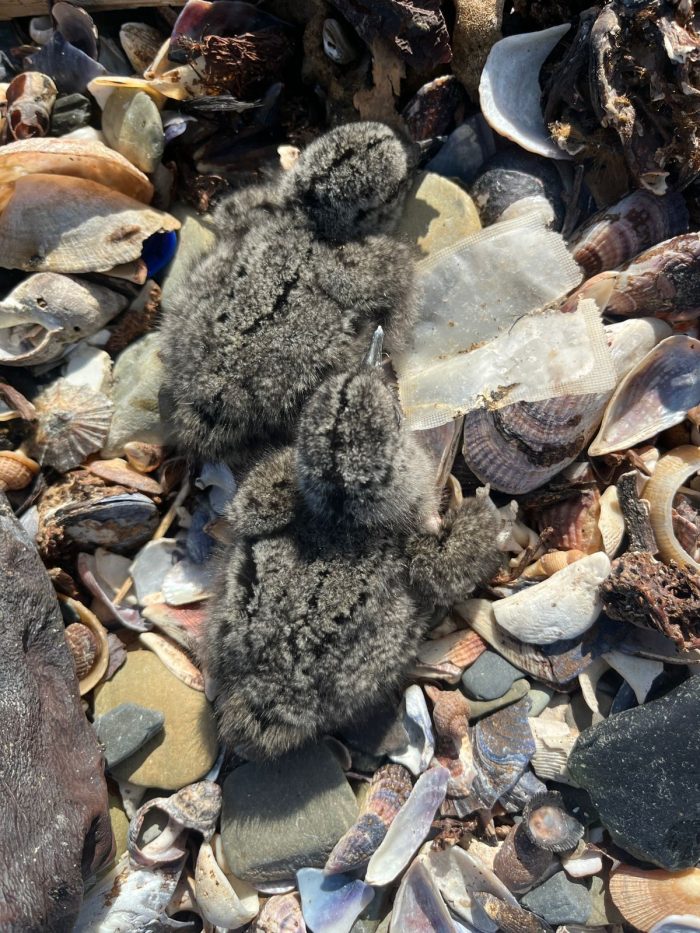
If you failed to spot the N17 fluffballs in the photo above, here is a second opportunity, and a chance for a close up view of a piece of litter.
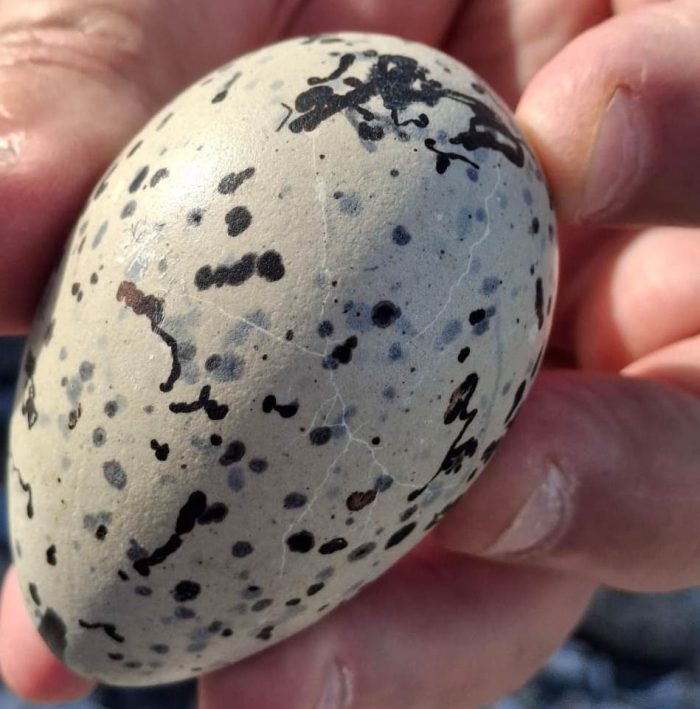
This egg is “starred”. The hatchling will emerge, but the process of getting out of the shell is measured in days, not hours!
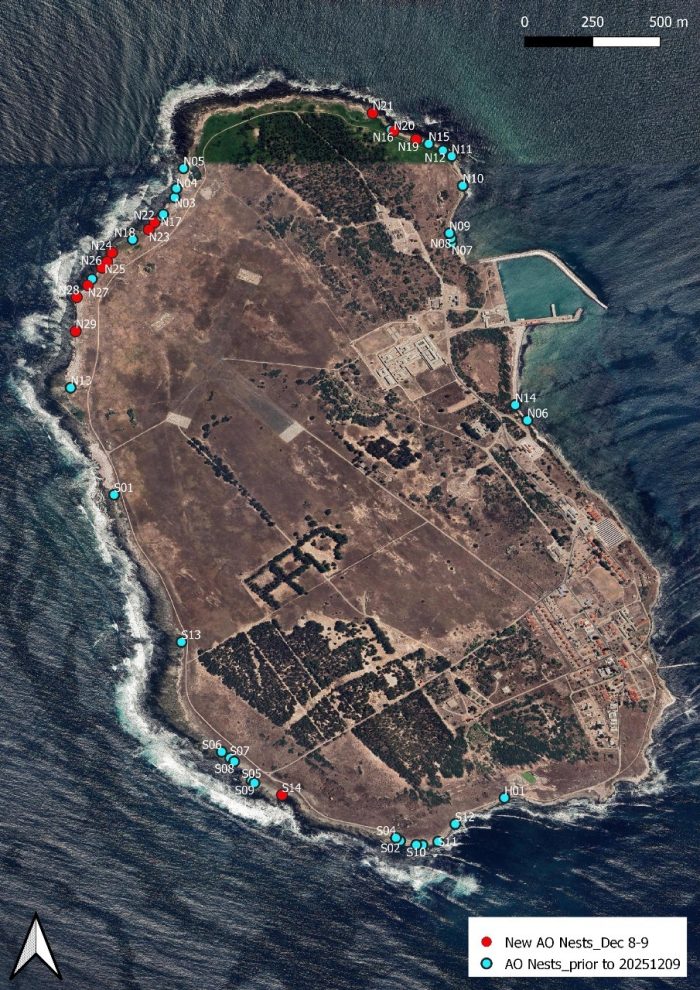
This is the state of play after Fieldwork 5. The nests found this visit are shown in red. They are strikingly clustered. The positions of nests found during the earlier fieldwork sessions are in blue. Diane Smith produced this map.
Bird list
Bird list in alphabetical order. It is our second longest list so far this summer, at 36 species. The longest had 41 species, during Fieldwork 1.
| Species | Comment |
| African Oystercatcher | Breeding deeply underway (see above!) |
| African Penguin | Small numbers moulting |
| African Sacred Ibis | Flying to and from mainland |
| Bank Cormorant | Breeding at short arm |
| Barn Swallow | One seen hawking over shore |
| Blacksmith Lapwing | A pair in the Blue Stone Quarry |
| Black-crowned Night Heron | One on the shore close to the Sea Challenger, late afternoon |
| Black-winged Stilt | 2 at Bluestone Quarry; third record for the island (see below) |
| Cape Batis | One in “woodland” alongside Boundary Road |
| Cape Cormorant | |
| Cape Spurfowl | Groups include young birds |
| Cape Weaver | |
| Chukar Partridge | Groups include young birds |
| Common Starling | |
| Common Tern | One at harbour |
| Crowned Cormorant | |
| Crowned Lapwing | Pair with young on football field |
| Egyptian Goose | A few at the Blue Stone Quarry |
| Eurasian Whimbrel | Several |
| Great Cormorant | One at harbour |
| Greater Crested Tern | Hundreds gathering |
| Hadada Ibis | A few |
| Hartlaub’s Gull | Mostly at the harbour |
| Helmeted Guineafowl | Groups include young birds |
| Kelp Gull | Breeding; both eggs and young |
| Little Egret | A handful, scattered along coast at rockpools |
| Pied Crow | Scattered. Possibly five |
| Red-eyed Dove | |
| Ring-necked Dove | |
| Ruddy Turnstone | Small group |
| Southern Fiscal | Scattered across island; juveniles present |
| Speckled Pigeon | Lots |
| Spotted Thick-knee | Heard at night near research house |
| Western Cattle Egret | Arrive from mainland in evening |
| White-fronted Plover | Second nest found |
| White-throated Swallow | A pair at the harbour |
There were at least two Black-winged Stilt at the Bluestone Quarry. This is the third record for the species on Robben Island. The first was made September and December 2012 (see First observation of Black-winged Stilt Himantopus himantopus on Robben Island), and the second was made between November and December 2017, on checklists for the Second Southern African Bird Atlas Project. Unfortunately, there are no photographs, but hopefully the stilts will stay for a while, as on the previous two occasions, and we will get a photographic record during Fieldwork 6!
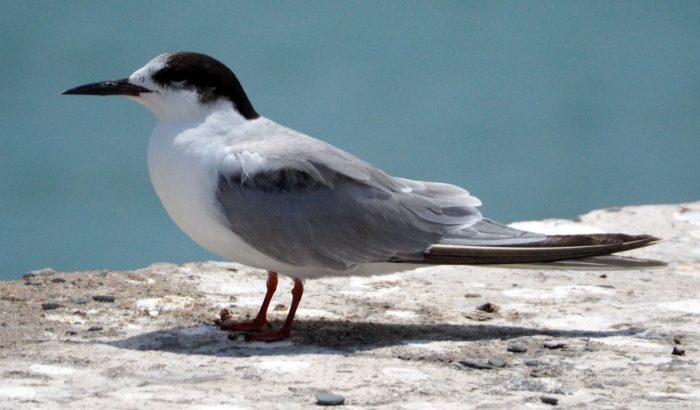
The tips of the outermost primaries of this Common Tern are starting to disintegrate. They will likely have something like 30,000 km on the clock since they were replaced in around February-March this year. A northwards and a southwards migration, and lots of flying while on the breeding grounds. Bird ringing shows that most of the Common Terns that migrate to South Africa breed in the countries around the Baltic Sea: especially Finland and Sweden.
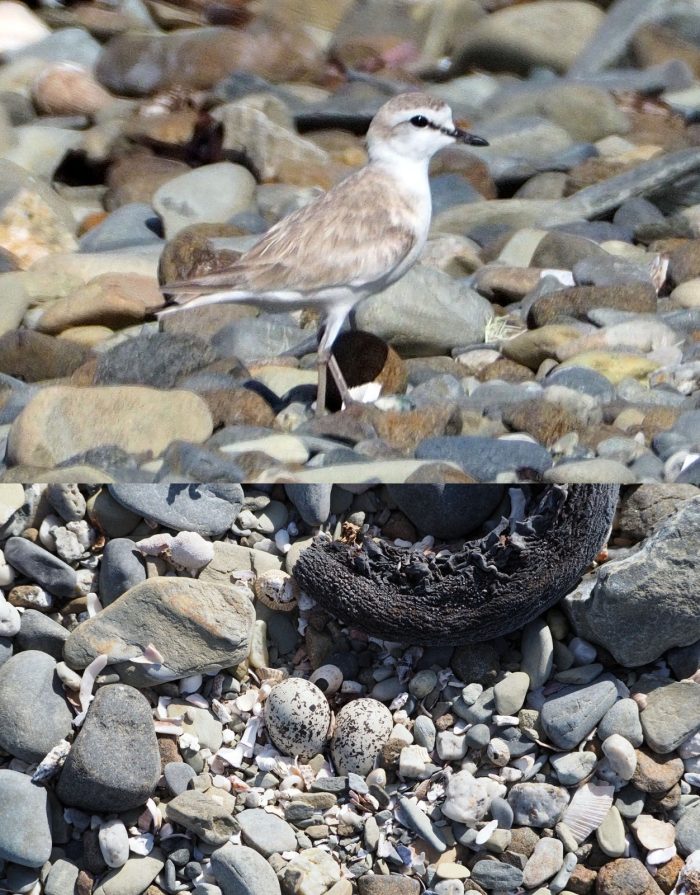
White-fronted Plover.
Mole snake
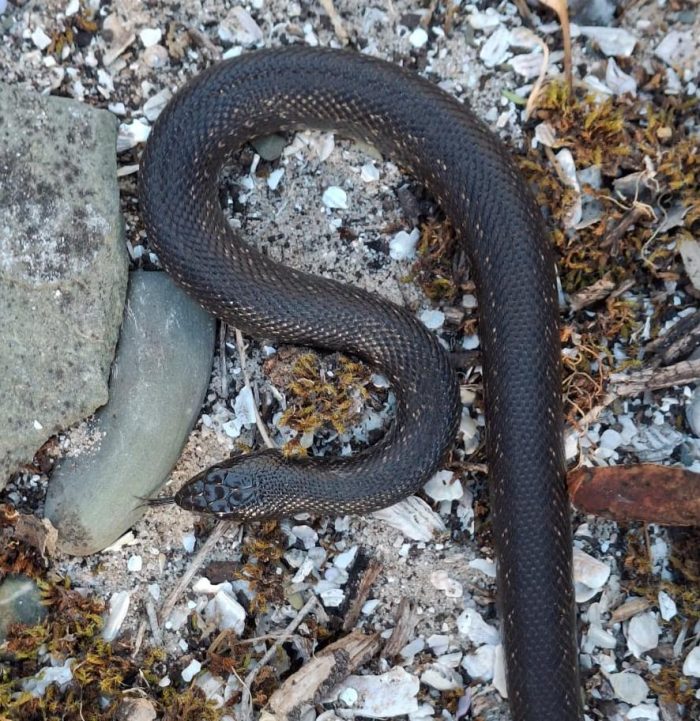
Mole Snake, c. 40 cm, young specimen still showing some white spots. This was the only Mole Snake seen during Fieldwork 5.
Fallow deer
Here is a young fallow deer boldly walking along the main road between the village and the harbour on Robben Island, at 09h00 on a week day morning!
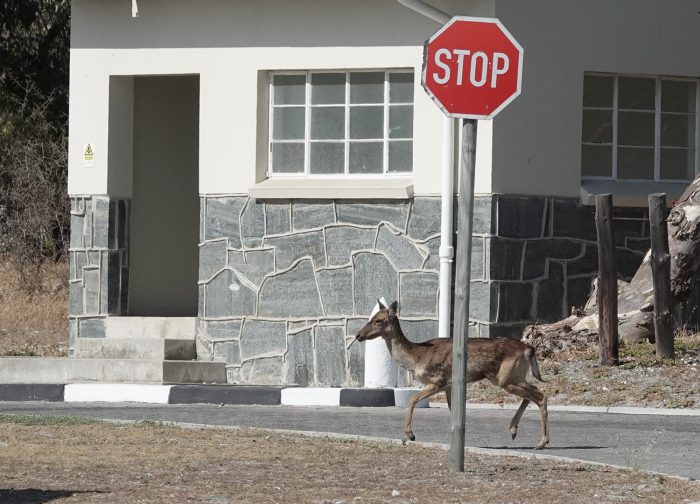
Stop the Fallow Deer. There is a tiny number of adults left. But if left, it’ll grow rapidly again to another large herd. They are destructive to the vegetation, which is recovering amazingly after the ravages of centuries of rabbits.
Plastic
Besides the plastic in and around the nest above, here is a plastic bottle …

Dianne found this water bottle on Robben Island. Internet archaeology revealed that Nongfu Spring is the top supplier of bottled water in China. You are invited to visualize the journey this plastic took from source to shore.
Nightlife
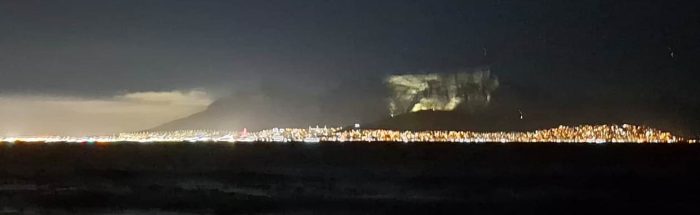
The City of Cape Town, from Robben Island, 8 December 2012. Table Mountain is floodlit.
Fieldwork 4 : 3 and 4 December 2025
We found six new nests (S13 on southern half, and N14 to N18 in the north) . Total nests found with eggs so is now 30. Although there are territories and pairs waiting to breed all around the island, those that have made a start are in clusters!
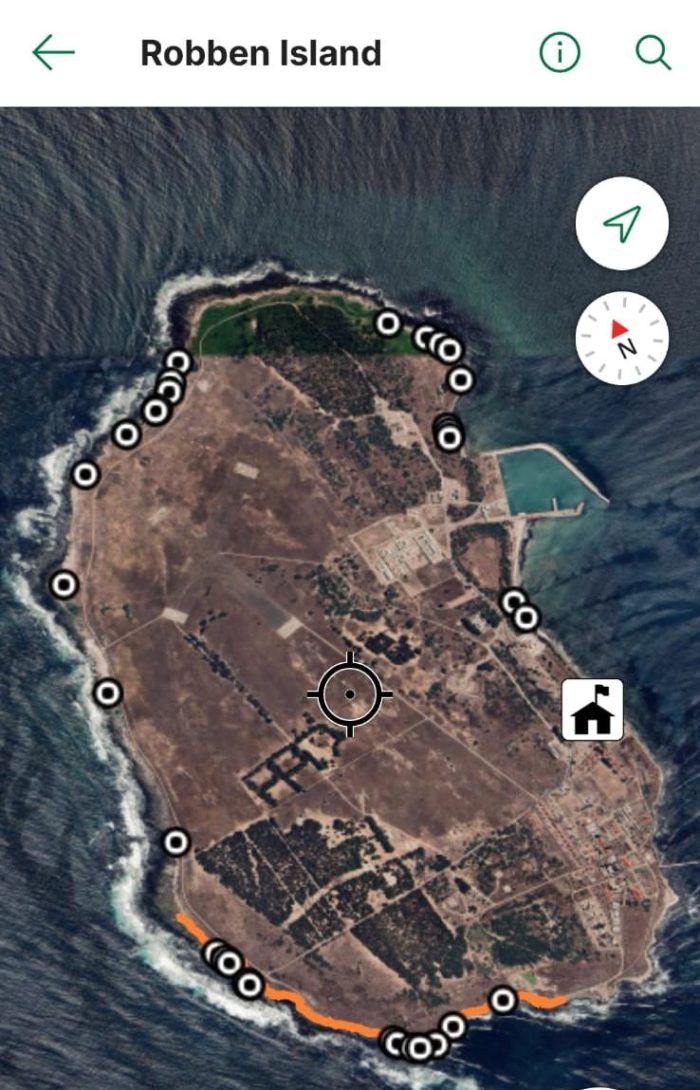
Diane Smith produced this map.
A couple of nests have had one or both eggs predated. The most intriguing incident of all left behind evidence that looked like this …
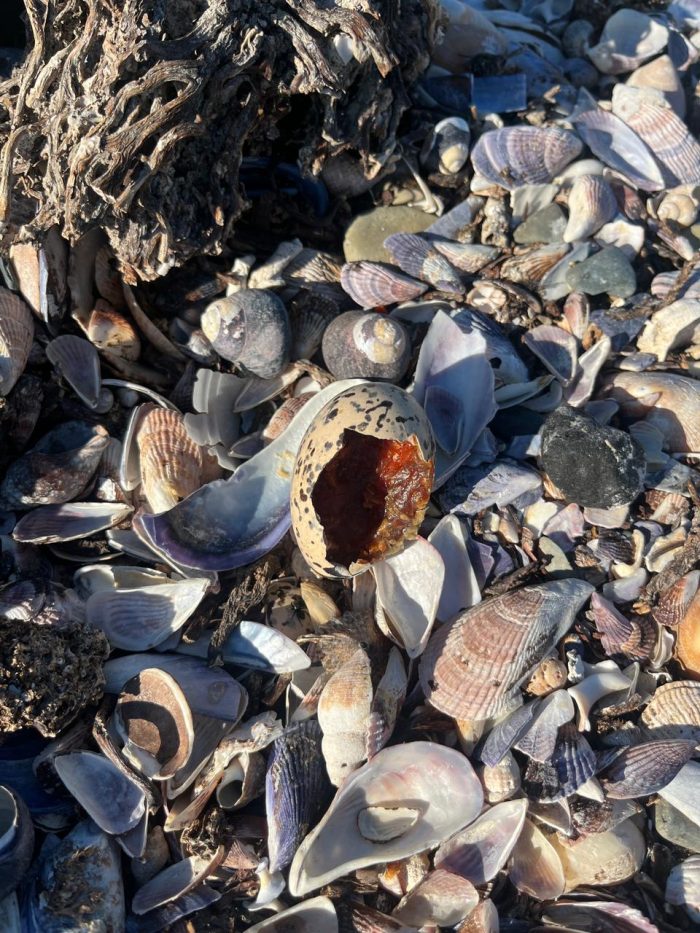
The nest had a single egg on several previous visits. The broken egg is still inside the nest cup. The obvious suspects are Mole Snakes, Kelp Gulls and Feral Cats. But Mole Snakes consume eggs whole; Kelp Gulls carry them away in their beaks; the mammalogists say this is not cat damage, and they suspect a stab by a beak. It turns out that there was another oystercatcher nest 5 m away. Bruno Ens, in The Netherlands, says that he has seen Eurasian Oystercatchers stab the eggs of their neighbours, so vandalism, rather than food, is probably the most likely explanation. The contents of the egg have dried out, rather than have been consumed.
The eggs in several nests have hatched since our last visit …
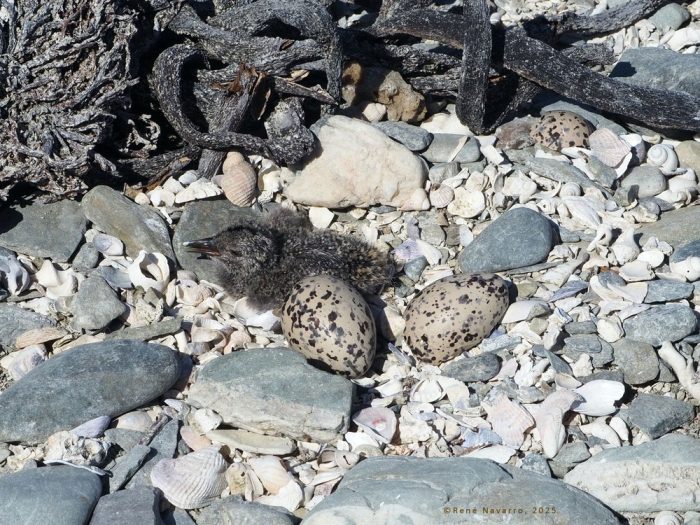
Newly hatched chick, still drying off. The eggshell, in two parts, has not yet been removed. Curated in observation.org
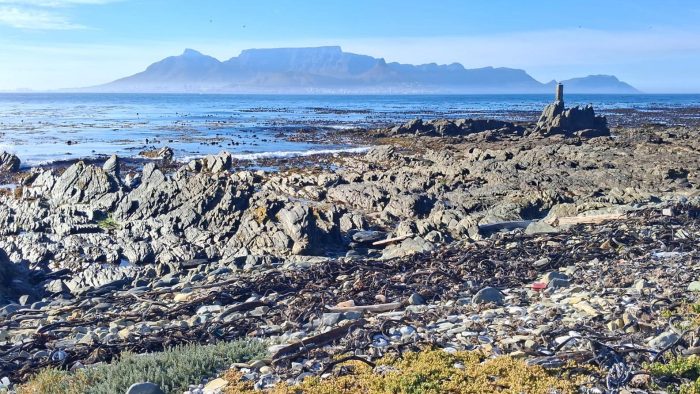
One of the views from the 360 degree office. Spring low tide. The black/dark brown stuff on the shore and in the sea is the kelp Ecklonia maxima, sea bamboo.
Bird list
This is a list of species recorded during this fieldwork trip. They are listed in the order recorded, with a list that started at the research house. Species in red are linked to the structured texts on the BDI website. Species with an asterisk have photos; they are below the table, and in the same order as listed.
| Rank | Species | Comment |
| 1 | Common Starling | Ubiquituous |
| 2 | African Sacred Ibis | Lots arrived at dusk from the mainland; feeding in rock pools along the shore |
| 3 | Kelp Gull | * Breeding along coast from Murray’s Bay Harbour northwards to Boundary Road |
| 4 | Speckled Pigeon | Commonest columbid |
| 5 | Helmeted Guineafowl | Lots of broods with small chicks |
| 6 | African Penguin | Maybe a 100 along coastline |
| 7 | Western Cattle Egret | Tens arrived at dusk from mainland |
| 8 | African Oystercatcher | Breeding |
| 10 | Crowned Cormorant | Breeding |
| 11 | Greater Crested Tern | Flock of several hundred |
| 12 | Eurasian Whimbrel | * Maybe 10 to 20 around island, some first-year |
| 13 | Pied Crow | * At least five |
| 14 | Red-eyed Dove | Second commonest columbid |
| 15 | Cape Spurfowl | Broods with chicks of all sizes |
| 16 | Chukar Partridge | * Broods with chicks |
| 17 | Hadada Ibis | Maybe 10 to 20 on island |
| 18 | Southern Fiscal | At least five |
| 19 | Ring-necked Dove | * Least common columbid |
| 20 | Little Egret | Maybe 10 to 20 around island |
| 21 | White-fronted Plover | Several pairs; one nest with eggs |
| 22 | Egyptian Goose | Less than 10 |
| 23 | Crowned Lapwing | * Pair with two chicks on the prisoners’ football field |
| 24 | Sandwich Tern | * One juvenile found dead |
| 25 | Hartlaub’s Gull | c. 30 at Murray’s Bay Harbour |
| 26 | White-throated Swallow | Murrays’s Bay Harbout |
| 27 | Bank Cormorant | Breeding on short arm breakwater |
| 28 | Water Thick-knee | |
| 29 | Sabine’s Gull | * c. 300 about 2/3rds of way back to The Waterfront |
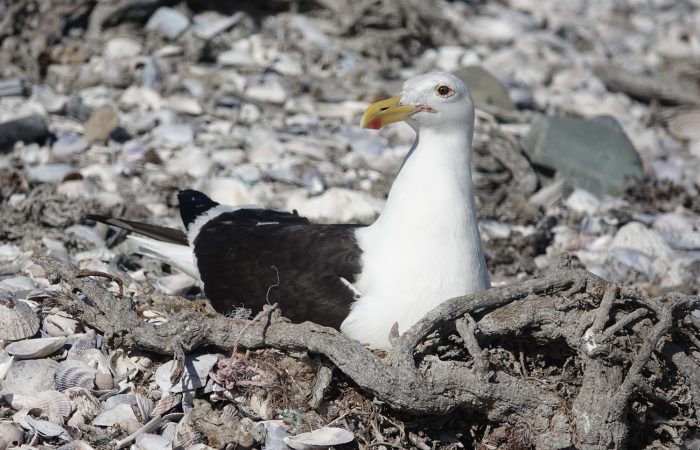
Kelp Gull incubating.
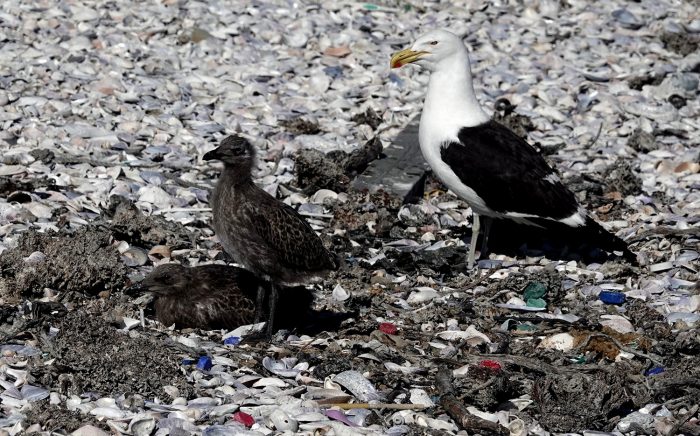
Two feathered Kelp Gull chicks. The chick on the right still has a downy head.
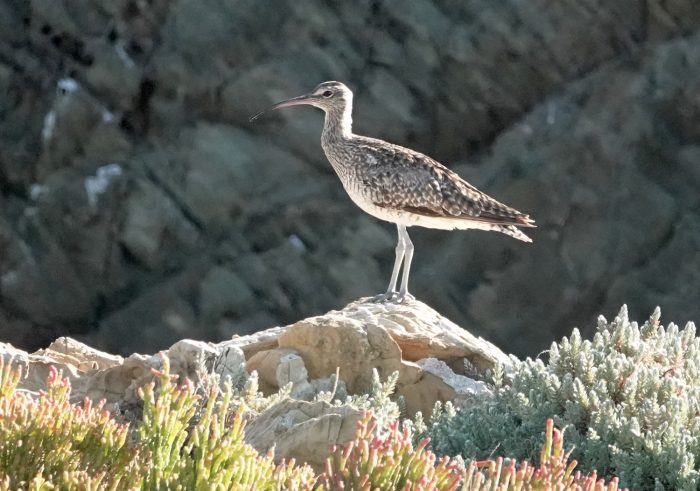
Juvenile Eurasian Whimbrel. The pattern of feathers on the back gives this away. This bird is likely to be about six months old. Likely to have hatched in the taiga in Russia, the huge belt of coniferous forests between the tundra and the steppes.

Pied Crows.
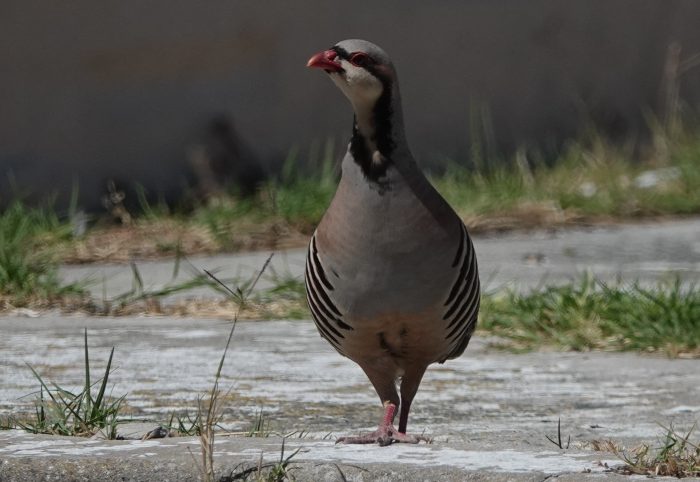
Chukar Partridge, one of the parents of the chicks below.
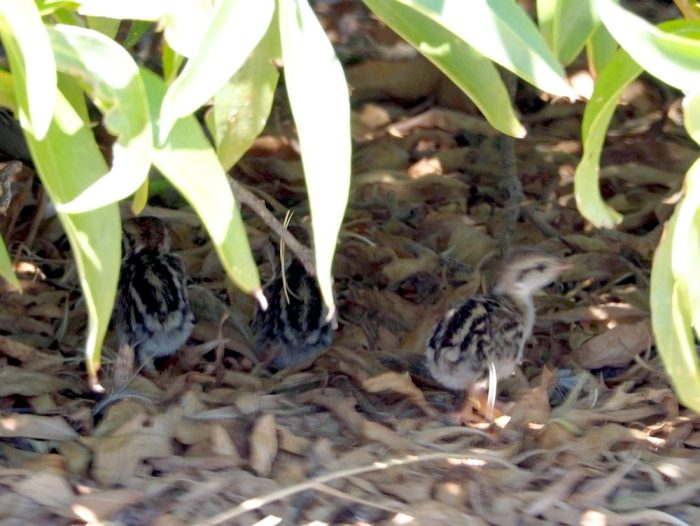
These fluffballs could not be more than a day or two old. But they were FAST. This record is in observation.org as record 3817981025
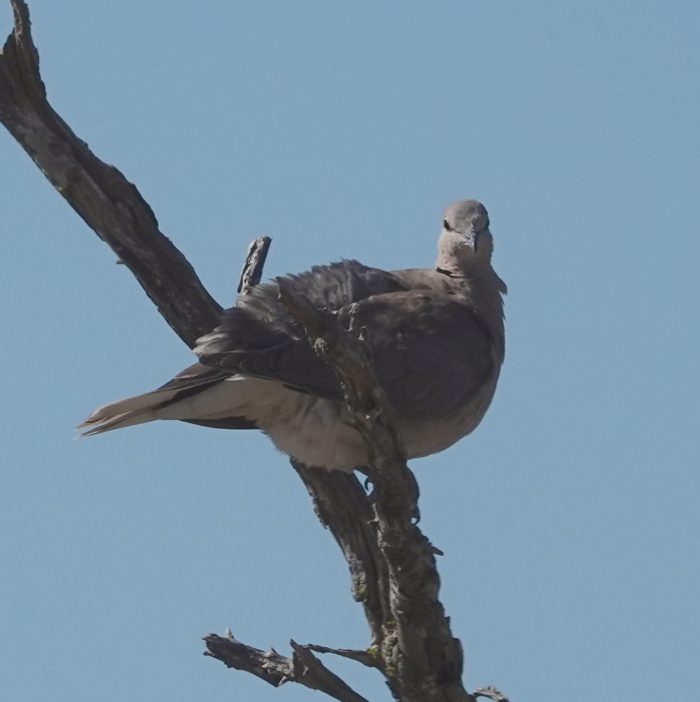
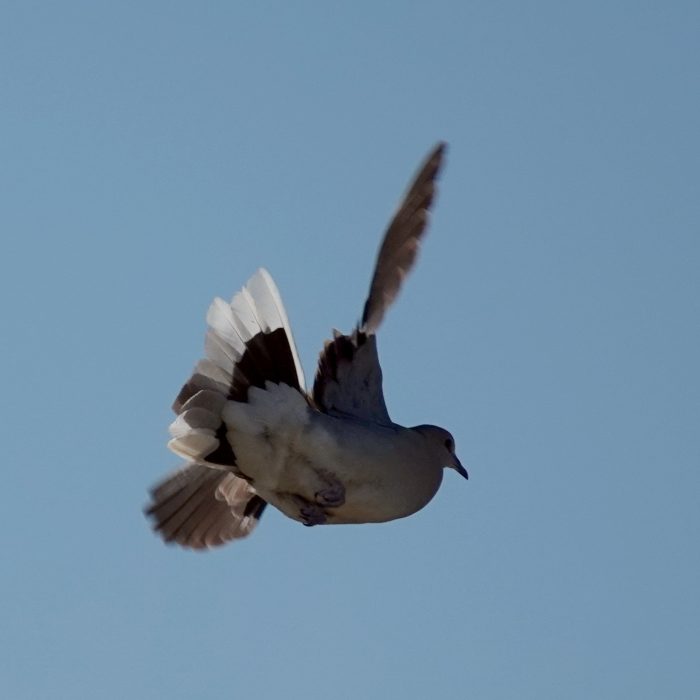
Ring-necked Dove. Confirmed by the white tail in flight.
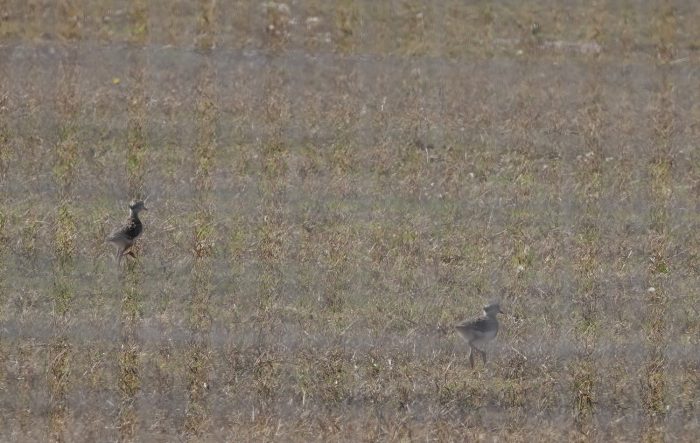
Crowned Lapwing chicks, on the football pitch at the maximum security prison, photographed through the two prison fences!
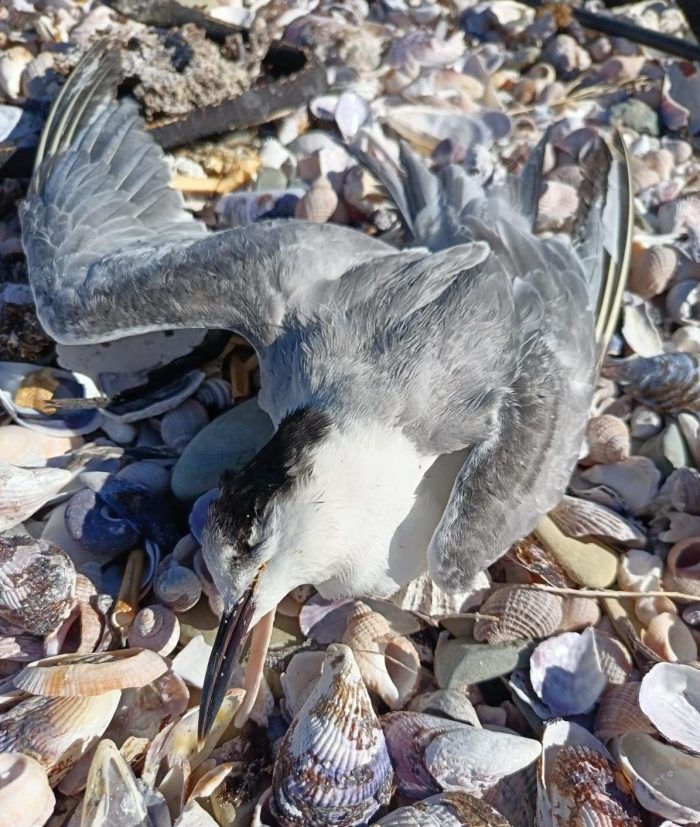
Sandwich Tern. It already had five or six new primaries on its right wing, and the 10th primary has broken tips and is bedraggled through a year’s wear. But the bill tip has very little yellow, and there are darker grey feathers on he wing coverts, so maybe it is a second year bird, i.e. hatched about May-June 2024. Ring recoveries show that most of the Sandwich Terns that migrate to southern Africa breed along the coasts of the North Sea.
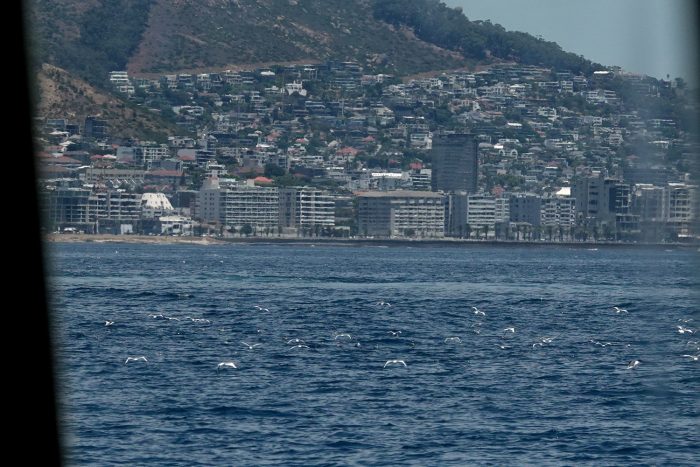
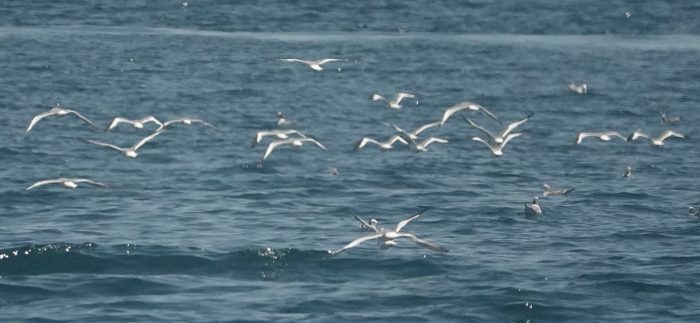
Sabine’s Gulls seem to have become increasingly infrequent in Table Bay in the past two decades. We passed a substantial-sized flock. Geolocator studies show that the Sabine’s Gulls that migrate here breed in eastern Canada. There is a different set of photos in observation.org
Reptiles
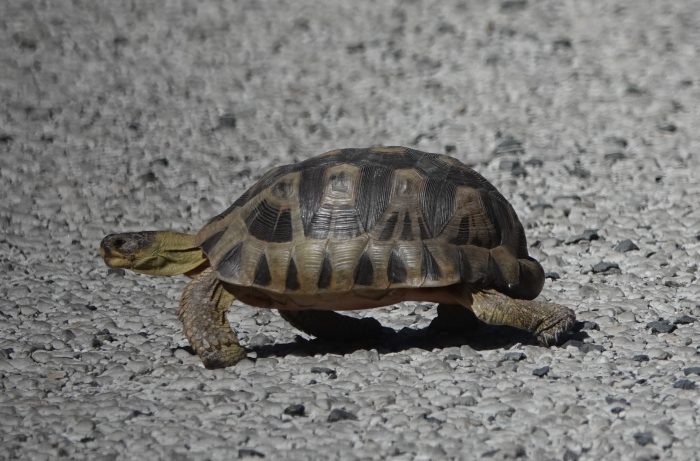
There are lots of Angulate Tortoises on Robben Island. Mostly they are invisible. Then there is a cool breeze, or mist blows in from the ocean, or there is dew on the ground in the early morning, or there has been rain, and vast numbers are on the move. They risk their lives crossing roads. This one moved at speed.
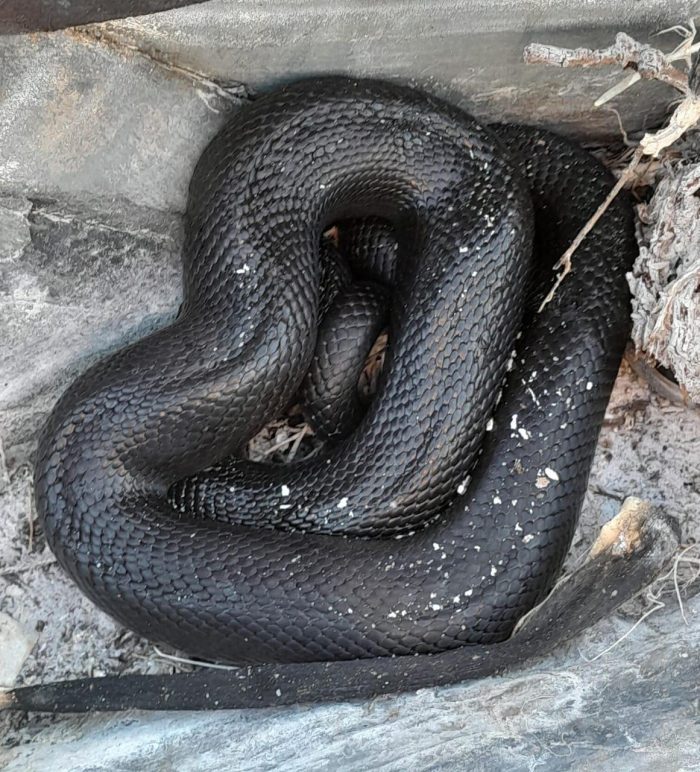
This was the only Mole Snake on this trip. It is in observation.org
Fieldwork 3 : 27 and 28 November 2025
We found 14 new nests (S07 to S12, and N06 to N13), so the total number of nests found with eggs for the breeding season so far is 25. Nest S05, which had one egg on the previous trip, now has two! All nests found with eggs on previous trips still have the same number of eggs (or more!), so there have been no losses due to predation, or any other cause. In addition there is one pair which has two chicks, and a second pair suspected to have at least one chick.

Our study species, the African Oystercatcher. The bird on the left has been ringed.

Diane is measuring and weighing the eggs at nest S08. The process takes a few minutes, and is only done once. We have never had a desertion.

Nest S09, with two eggs, is in the centre of this photograph. There is also an arrow on the flat rock which points to the eggs.

Team 3 at work in the office.

Photogenic species!

The final stage of production of an oystercatcher egg is done in the paintshop. Every egg has a unique pattern.
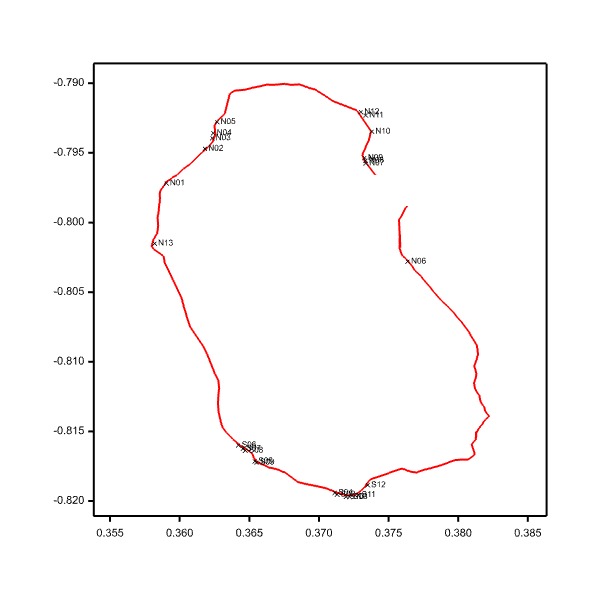
This is the distribution of nests around Robben Island, 28 November 2025! The gap is the harbour. There appears to be strong clustering of nests.
Bird species 27–28 November
This is our list of bird species, in the order in which they were recorded for the bird atlas project (SABAP2, pentad 3345_1820, Robben Island). The first bird seen after we started atlasing was a Chukar Partridge. There are some surprising omissions. We didn’t see a Cape Wagtail, although, between the four of us, we covered the entire coastline. We failed to see sparrows, neither Cape nor House. Pied Crow is missing. We looked for White-throated Swallow as we waited about 20 minutes at Murrays Bay Harbour for the ferry, but didn’t see them. The Bank Cormorant is the final species on the list; there were nests of breeding birds on the short arm breakwater as we left the harbour.
| 1 | Chukar Partridge |
| 2 | Kelp Gull |
| 3 | Hadada Ibis |
| 4 | African Sacred Ibis |
| 5 | Common Starling |
| 6 | Ring-necked Dove |
| 7 | Speckled Pigeon |
| 8 | African Oystercatcher |
| 9 | Cape Weaver |
| 10 | Western Cattle Egret |
| 11 | Crowned Cormorant |
| 12 | Cape Cormorant |
| 13 | Egyptian Goose |
| 14 | Cape Spurfowl |
| 15 | Helmeted Guineafowl |
| 16 | Eurasian Whimbrel |
| 17 | African Penguin |
| 18 | Greater Crested Tern |
| 19 | Little Egret |
| 20 | Spotted Thick-knee |
| 21 | White-fronted Plover |
| 22 | Hartlaub’s Gull |
| 23 | Sandwich Tern |
| 24 | Common Tern |
| 25 | Bank Cormorant |

There were lots of Chukar Partridges.

African Penguin was low down on the list at 17, i.e. the 17th species to be recorded. That is scary low. Most of these are juveniles doing their first moult. They moult into adult plumage, even though it is likely to be several years before they start to breed.

Cape Cormorant with chick. The number of Cape Cormorants breeding this spring seems much smaller than in previous years.

White-fronted Plover.
Other species

This big male Cape Fur Seal was one of three seen on the shore a couple of hundred metres south of the Faure Jetty. It has a nasty open wound on its right flipper.

We found this piece of shed mole snake skin at these coordinates along West Perimeter Road. The snake had clearly used a big piece of chipboard as den.

Cricket.

Sea urchin.

Abalone shell.
A lighter note, but actually dark!

73 lighters found on 2 km of shoreline by three observers! Robben Island sits alongside busy shipping lanes into the port of Cape Town, and also in the dispersal fan of the trash that washes out to sea from 214 square kilometres of the city of Cape Town via the Black River. See Industrial biodiversity 2 : Black River in Paarden Island : stormwater drain.
Fieldwork 2 : 18 and 19 November 2025
This was the second trip of the breeding season. Rene Navarro did the monitoring single-handed. He found nine new nests (S03 to S06 and N01 to N05). The two eggs in N01 are both pipped, so they were laid about a month ago! S01 and S02 (see Fieldwork 1, below) are still going strong.

S03. First nest of the Fieldwork 2 trip. Minimalist approach to nest architecture.

Both eggs in nest N01 were starred. The chicks will gradually turn the fine cracks into a bigger and bigger hole in the eggs, and will hatch within a couple of days.
Fieldwork 1 : 10 and 11 November 2025
We started the African Oystercatcher monitoring on Robben Island on 10 and 11 November 2025. The focus of this phase of the monitoring is on the 2025/26 breeding season.
Theoretically, it is exceptionally early in the breeding season. The African Oystercatchers should be right at the start of their breeding season. To our astonishment we found that one pair were the proud and noisy parents to two recently-hatched fluffballs:

The chick at the bottom of the photo is not yet completely dry, so had hatched in the previous couple of hours. The nest, i.e. the place where the eggs were incubated. is the shallow depression immediately to the left of this fluffball.We knew there were chicks because the parents were going absolutely ballistic. They are totally blasé when there are eggs. But the moment they hatch, there is a radical change in behaviour.


One of parents pretended to be injured. It did an Oscar-winning performance, a distraction display in which the “injured” bird tries to lead you away from its chicks. As in the video below!
The video failed to capture the more determined parts of the display.
One of the parents was ringed:


The ring has six characters. The left photo shows: K50 _ _ _ ; the right photo gives _ _ _ 313. Therefore K50313. It had been ringed, as a breeding adult, on 4 January 2019. Potentially, we can read a more ring numbers by taking lots of photographs. Say, 30. Then you can hope to get an in-focus photo of each digit!
We saw lots and lots of scrapes, some of which will have eggs added over the next weeks and months. We found two nests with eggs: S01 and S02. Both had two eggs. Here are photos of the nests.

S01 is a scrape that has been neatly line with shell fragments.

S01, the “Traffic Beacon Nest”. The big marker is a few metres away from the nest. Close to the nest there are arrows on the rocks to point to the nest. If the nest gets destroyed, by a predator, or worse, a storm (which moves stuff around), we can then work out where the eggs actually were. We need to do this, because the African Oystercatcher takes a minimalist approach to nest architecture.

S01 is a nicely concealed nest, above the spring high tide level.

S02 is a little depression, lined with fragments of shells and little stones, just on the seaside of a small ridge of kelp. The incubating oystercatcher can see over it, but its body is concealed.

The “Box Nest” has a series of markers, starting at the road around the perimeter of the island.They get more subtle closer to the nest.

The final marker is the little piece of white plastic (there is lots of debris washing up on the shore) halfway between the box and the nest, just at the thin line of kelp.

In addition to the Little Egret, find four birds.
Species lists 10–11 November
The bird list has 41 species. Those with links in red have structured species texts on the BDI website.
| African Black Oystercatcher | Many pairs standing close together (i.e. about to breed). Lots of scrapes. Two nests with eggs. One pair with two newly hatched chicks |
| African Penguin | Fair number ashore, especially late afternoon |
| African Sacred Ibis | Small flocks flying between island and mainland |
| Bank Cormorant | 26 new nests at Murrays Bay Harbour, on short arm dolosse |
| Black-crowned Night Heron | |
| Blacksmith Lapwing | |
| Cape Cormorant | Breeding sparsely on long arm breakwater at of Murrays Bay Harbour |
| Cape Spurfowl | |
| Cape Sparrow | |
| Cape Weaver | |
| Cattle Egret | |
| Chukar Partridge | Lots in and about Irish Town |
| Common Starling | |
| Common Tern | Small roost |
| Common Whimbrel | Small numbers on the coast |
| Crowned Cormorant | Breeding |
| Crowned Lapwing | |
| Egyptian Goose | Several pairs. Two pairs had a large gosling, and pair had nine small goslings |
| Greater Crested Tern | Small roost |
| Great White Pelican | One immature on shore near Murrays Bay Harbour; two (an adult and an immature) flew over airfield |
| Hadeda Ibis | Maybe 20 |
| Hartlaub’s Gull | Lots, but none breeding |
| Helmeted Guinea-fowl | |
| Kelp Gull | Many breeding, at all stages from eggs to large chicks. Many nests contain plastic items, including bits of plastic bags of multiple colours |
| Laughing Dove | |
| Little Egret | A few along the coast |
| Little Grebe | One large young in Bluestone Quarry |
| Little Swift | Observed in Irish Town |
| Malachite Sunbird | One male in full breeding plumage near Leper Graveyard |
| Namaqua Dove | Female on grass near MPLC |
| Red-eyed Dove | |
| Ring-necked Dove | |
| Sabine’s Gull | One seen on ferry trip back, nearer to Waterfront than Robben Island |
| Sandwich Tern | Small roost |
| Southern Fiscal | |
| Speckled Pigeon | Commonest columbid. Fledged young |
| Spotted Thick-knee | |
| Spur-winged Goose | Single adult flew over airfield |
| Water Thick-knee | |
| White-breasted Cormorant | |
| White-fronted Plover | |
| White-throated Swallow | Two seen at Murrays Bay Harbour |
Reptiles: Mole Snake (two), Cape Girdled Lizard, Angulate Tortoise
Mammals: Cape Golden Mole (fresh runs), Humpback Whale (three together, including a small calf, just outside Murrays Bay Harbour on 11 November), Steenbok.
Butterfly: Cabbage White
A Sunfish was seen during the trip back to the Waterfront.
Papers
We have done a fair amount of science over the years resulting from this monitoring. Here are some of the Open Access papers.
Braby J, Underhill LG 2007. Was poor breeding productivity of African Black Oystercatchers on Robben Island in 2004/05 caused by Feral Cats, Kelp Gulls, Mole Snakes or the Sumatra tsunami? Wader Study Group Bulletin 113: 66–70.
Calf KM, Underhill LG 2002. Productivity of African Black Oystercatchers Haematopus moquini on Robben Island in the 2001/02 breeding season. Wader Study Group Bulletin 99: 45–49.
Quintana I, Button R, Underhill LG 2021. African Oystercatchers on Robben Island, South Africa: The 2019/2020 breeding season in its two decadal context. Wader Study 128: 209–219.
Underhill LG, Calf KM 2005. How far is an egg through incubation? Wader Study Group Bulletin 106: 39–41.
There are papers to be added. It will take a while to find the online versions.

Acknowledgements
We are grateful to the Robben Island Museum for a vast amount of logistical support for the African Oystercatcher monitoring project. This has been provided over a period of 25 years; we started in the summer of 2001/02. This fieldwork is done with ethical clearance and a research permit.