Find the Ringed Cascader in the FBIS database (Freshwater Biodiversity Information System) here.
Family Libellulidae
Identification
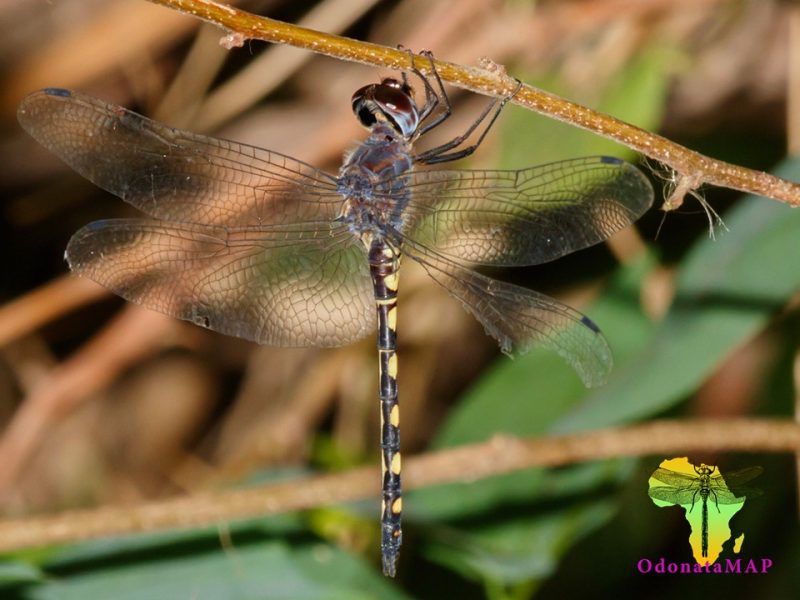
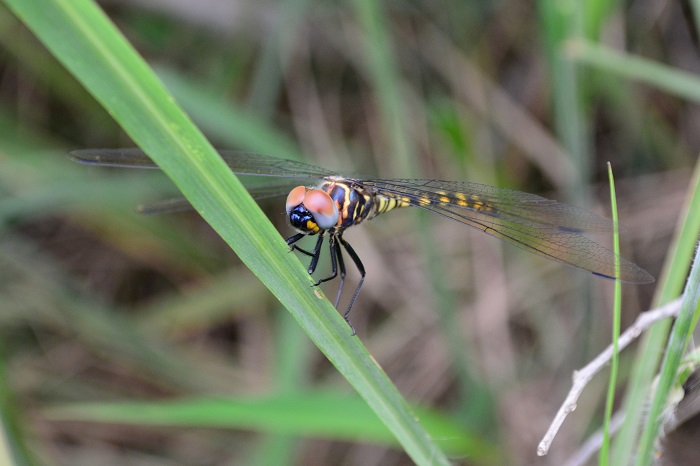
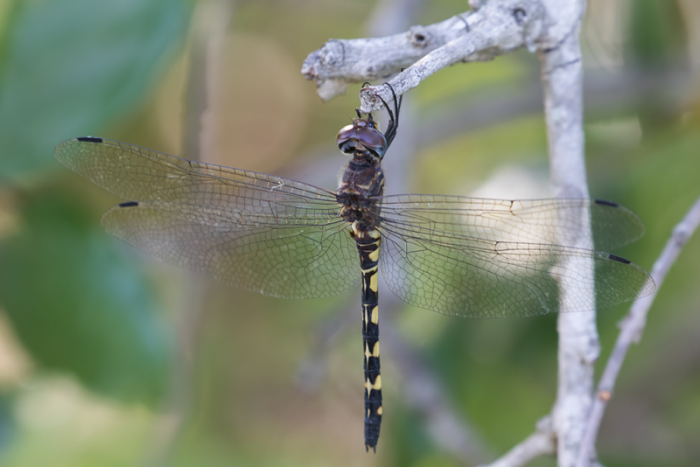
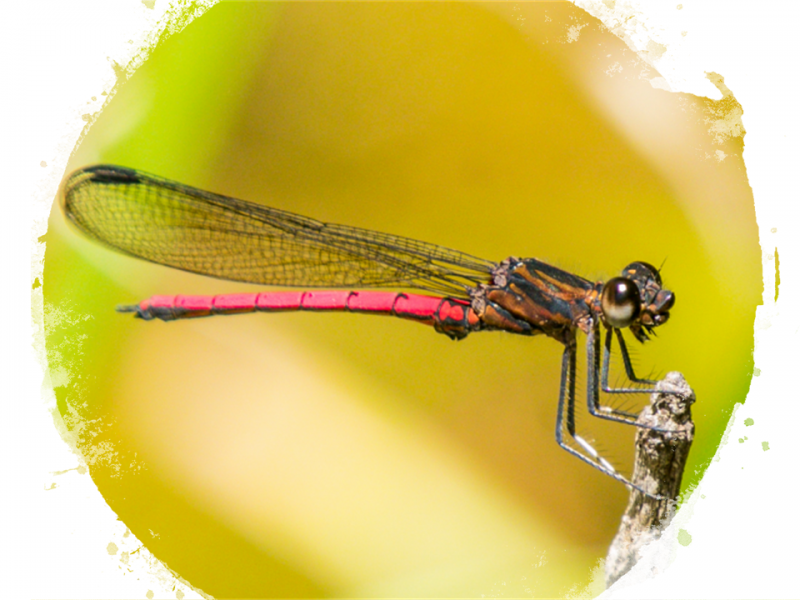
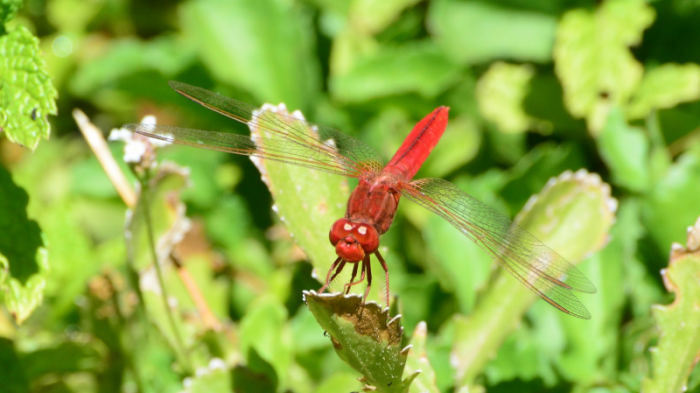
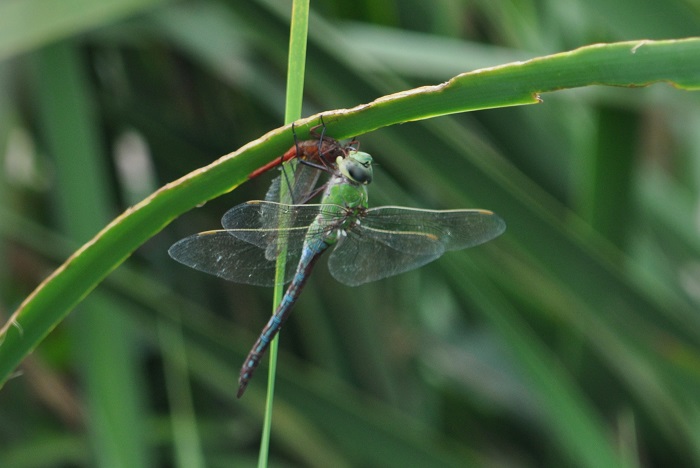
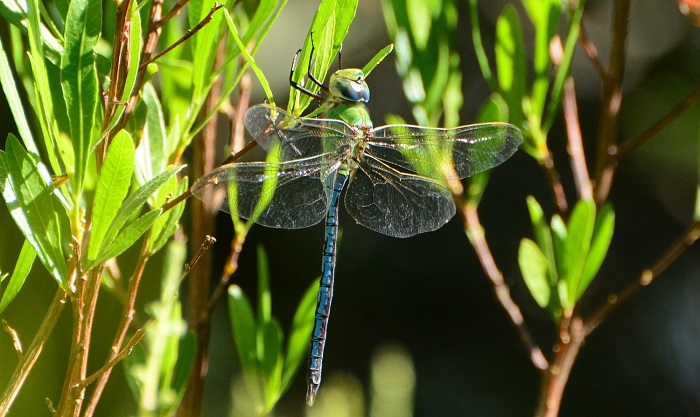
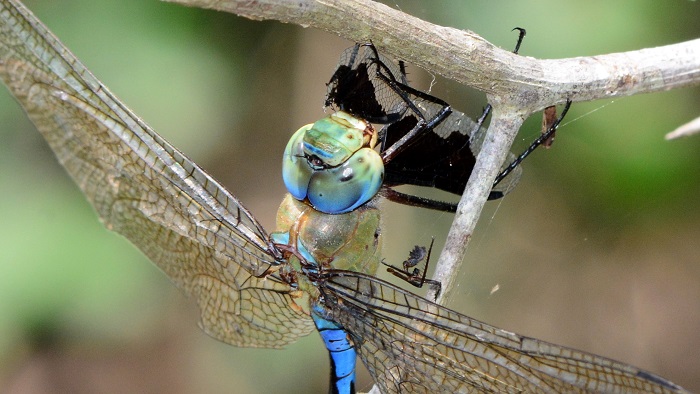
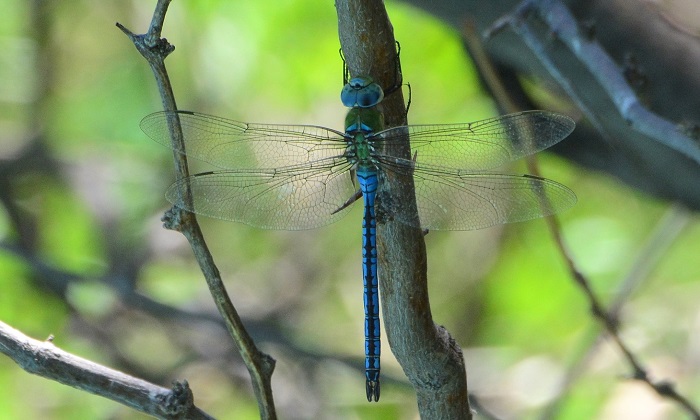
Ringed CascaderZygonyx torridus – Male Tswaing Nature Reserve, Gauteng Photo by Gerhard Diedericks
Large size
Length up to 61mm; Wingspan attains 102mm.
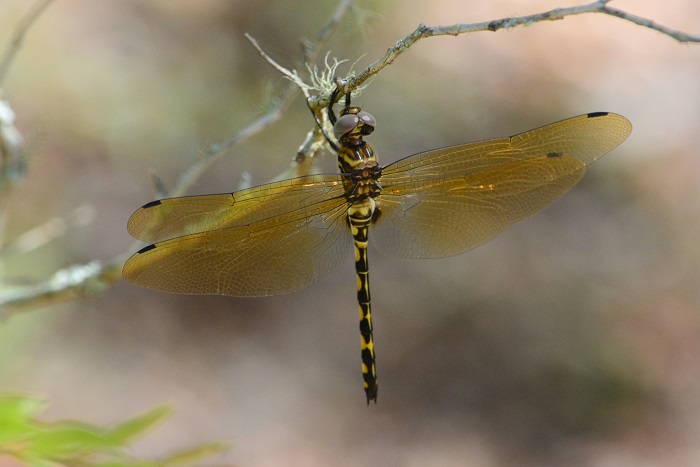
The sexes are alike.
The Ringed Cascader is most similar to Zygonoides fuelleborni, the Southern Riverking. The two have similarly coloured and patterned abdomens. However, Zygonoides fuelleborni has blue rather than black eyes and a bulbous basal segment on the abdomen. The two species also display very different behaviour, making them easy to separate.
The Ringed Cascader could also be mistaken for a female Blue Cascader Zygonyx natalensis but that species shows far less yellow on the abdomen.
Ringed CascaderZygonyx torridus – Female Kosi Bay, iSimangaliso Wetland Park, KwaZulu-Natal Photo by Ryan Tippett
Habitat
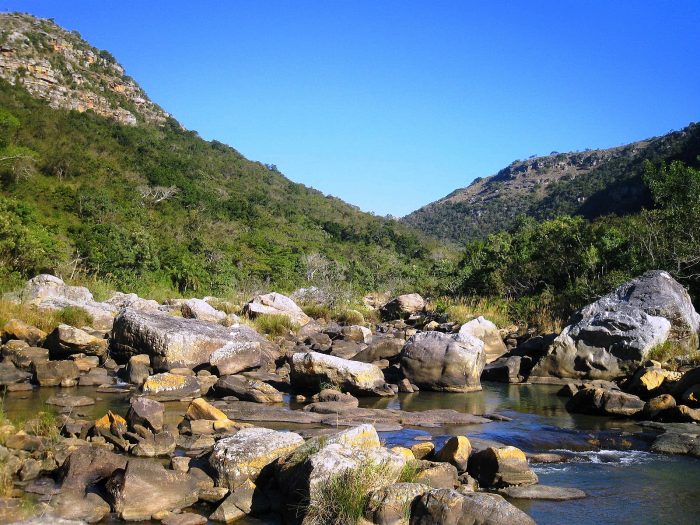
Their preferred habitat is that of rivers and streams in both open and wooded landscapes. The Ringed Cascader favours fast-flowing waters but also hunts over nearby still sections. The Ringed Cascader is most regular along rocky stretches of river, but is not limited by this. Individuals may sometimes be found far from water in the surrounding habitat.
Habitat – Oribi Gorge Nature Reserve, KwaZulu-Natal Photo by Ryan Tippett
Behaviour
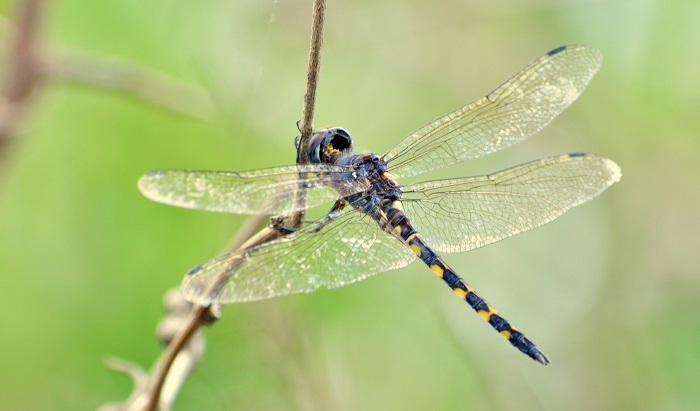
The Ringed Cascader is a strongly aerial species that spends long periods in flight, coursing up and down a chosen route. They are occasionally seen perched, hanging vertically with the wings outstretched. The Ringed Cascader can often be seen hovering over white water and has a great change of speed as it darts off to snatch prey or to chase off a rival. Females and immatures are regularly found away from water in the surrounding woodlands.
The Ringed Cascader is on the wing from September to May.
Ringed CascaderZygonyx torridus – Male Mseleni River, KwaZulu-Natal Photo by Ryan Tippett
Status and Conservation
The Ringed Cascader is locally common. It is listed as of Least Concern in the IUCN Red List of Threatened Species. Zygonyx torridus makes little use of man-made habitats as it is reliant on flowing rivers. It is, however, a fairly hardy species that can inhabit somewhat degraded rivers provided its habitat requirements are met.
Ringed CascaderZygonyx torridus – Male Mkuze Game Reserve, KwaZulu-Natal Photo by Ryan Tippett
Distribution
The Ringed Cascader is a very widespread species. Zygonyx torridus is found throughout most of Sub-Saharan Africa and also occurs in southern Europe, parts of the Middle East and western Asia.
In Africa it is only absent from the arid and semi-arid regions that lack perennial, flowing rivers and streams.
The South African distribution is mostly confined to the North and East where it is widespread.
Ringed CascaderZygonyx torridus – Immature male Amakhosi Game Reserve, KwaZulu-Natal Photo by Ryan Tippett
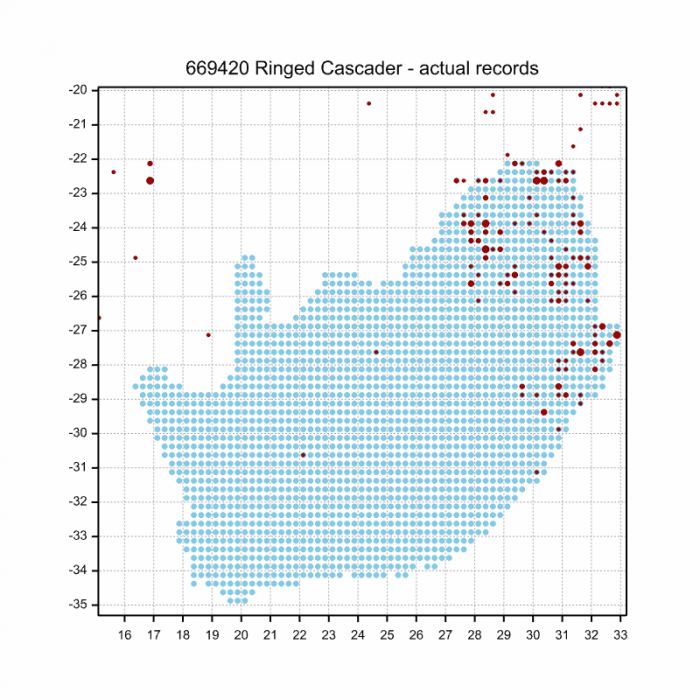
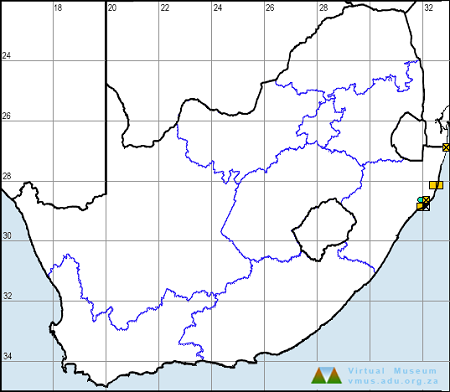
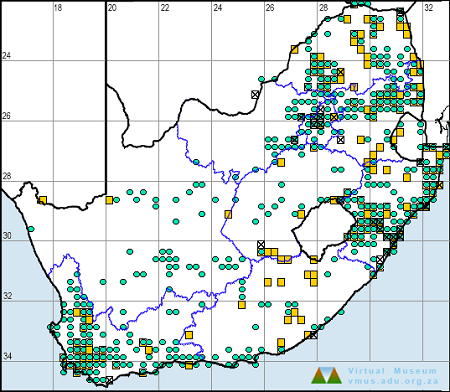
Below is a map showing the distribution of records for Ringed Cascader in the OdonataMAP database as at February 2020.
Below is a map showing the distribution of records for Ringed Cascader in the OdonataMAP database as of December 2024.
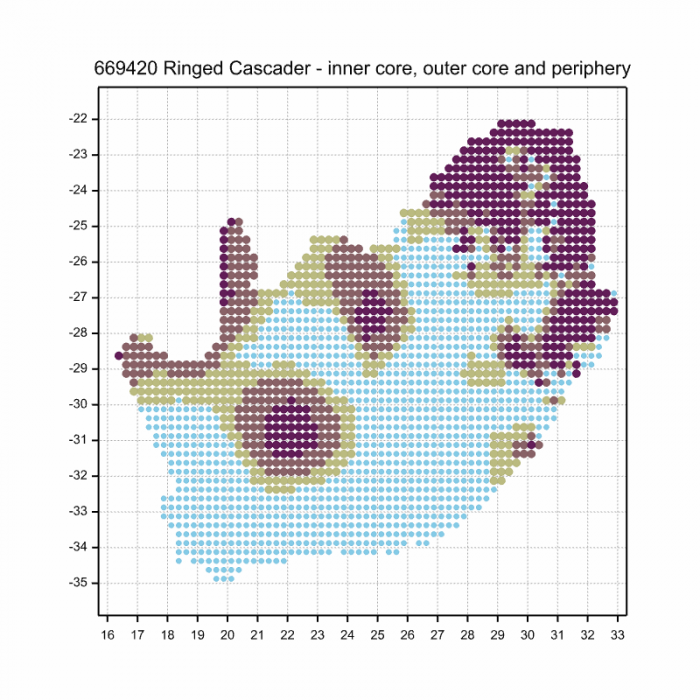
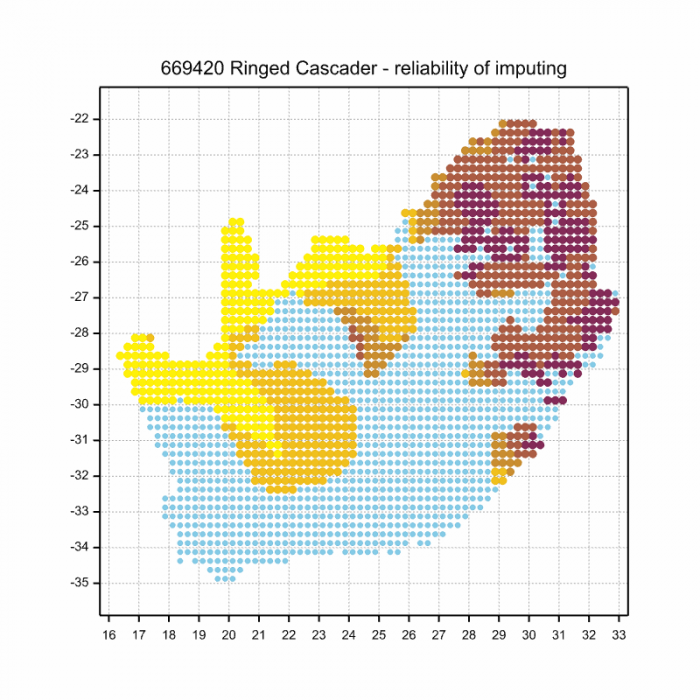
The next map below is an imputed map, produced by an interpolation algorithm, which attempts to generate a full distribution map from the partial information in the map above. This map will be improved by the submission of records to the OdonataMAP section of the Virtual Museum.
Ultimately we will produce a series of maps for all the odonata species in the region. The current algorithm is a new algorithm. The objective is mainly to produce “smoothed” maps that could go into a field guide for odonata. This basic version of the algorithm (as mapped above) does not make use of “explanatory variables” (e.g. altitude, terrain roughness, presence of freshwater — we will be producing maps that take these variables into account soon). Currently, it only makes use of the OdonataMAP records for the species being mapped, as well as all the other records of all other species. The basic maps are “optimistic” and will generally show ranges to be larger than what they probably are.
These maps use the data in the OdonataMAP section of the Virtual Museum, and also the database assembled by the previous JRS funded project, which was led by Professor Michael Samways and Dr KD Dijkstra.
Ringed CascaderZygonyx torridus – Male Photo by Gregg Darling
Further Resources
The use of photographs by Gerhard Diedericks, Gregg Darling, and John Wilkinson is acknowledged. All other photographs by Ryan Tippett.
Ringed CascaderZygonyx torridus (Kirby, 1889)
Other common names: Kringklatertjie (Afrikaans)
Recommended citation format: Loftie-Eaton M; Navarro R; Tippett RM; Underhill L. 2025. Ringed Cascader Zygonyx torridus. Biodiversity and Development Institute. Available online at https://thebdi.org/2020/02/19/ringed-cascader-zygonyx-torridus/
References: Tarboton, M; Tarboton, W. (2019). A Guide to the Dragonflies & Damselflies of South Africa. Struik Nature.
Samways, MJ. (2008). Dragonflies and Damselflies of South Africa. Pensoft
Samways, MJ. (2016). Manual of Freshwater Assessment for South Africa: Dragonfly Biotic Index. Suricata 2. South African National Biodiversity Institute, Pretoria
Martens, A; Suhling, F. (2007). Dragonflies and Damselflies of Namibia. Gamsberg Macmillan.
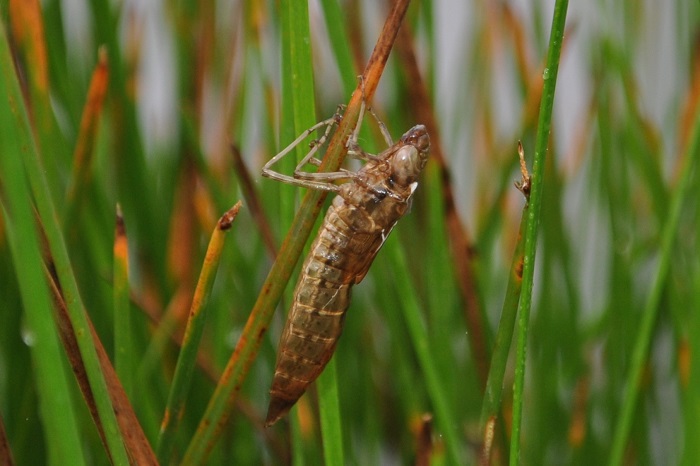
Ringed CascaderZygonyx torridus – Larval shedding Kosi Bay, iSimangaliso Wetland Park, KwaZulu-Natal Photo by Ryan Tippett
Find the Smoky Duskdarter in the FBIS database (Freshwater Biodiversity Information System) here.
Family Libellulidae
Identification
Smoky DuskdarterZyxomma atlanticum – Male Enseleni Nature Reserve, KwaZulu-Natal Photo by Diana Russell Inset images by Kate Braun
Medium sized
Length up tp 47mm; Wingspan attains 72mm.
The Smoky Duskdarter most closely resembles Gynacantha usambarica (Eastern Duskhawker). The Smoky Duskdarter is easily told apart by its far smaller size, different wing venation and by its large green eyes that have three rows of thin brown across the top.
Click here for more details on identification of the Smoky Duskdarter.
Habitat
The Smoky Duskdarter inhabits subtropical or tropical moist lowland forests and shrub-dominated wetlands. In South Africa it occurs mainly in lush swamp forests along the northern KwaZulu-Natal coast.
Typical habitat – Kosi Bay, iSimangaliso Wetland Park, KwaZulu-Natal Photo by Lauren Arnold
Behaviour
The Smoky Duskdarter is Crepuscular, being most active at dusk but is also active during humid, overcast conditions. It hunts by coursing low over tree-covered water bodies.The Smoky Duskdarter rests by day in the deep shade of dense undergrowth. It hangs vertically when perched.
The Smoky Duskdarter is on the wing from December to April.
Status and Conservation
Zyxomma atlanticum is scarce and highly localised in South Africa. It is listed as of Least Concern in the IUCN Red List of Threatened Species.
Distribution
The Smoky Duskdarter is most widespread in the forested regions of West and Central Africa. It also occurrs locally along the south-east African coast in southern Mozambique and far north-eastern South Africa, where it ranges from Kosi Bay down to Richards Bay.
Below is a map showing the distribution of records for Smoky Duskdarter in the OdonataMAP database as at February 2020.
Below is a map showing the distribution of records for Smoky Duskdarter in the OdonataMAP database as of December 2024.
The next map below is an imputed map, produced by an interpolation algorithm, which attempts to generate a full distribution map from the partial information in the map above. This map will be improved by the submission of records to the OdonataMAP section of the Virtual Museum.
Ultimately we will produce a series of maps for all the odonata species in the region. The current algorithm is a new algorithm. The objective is mainly to produce “smoothed” maps that could go into a field guide for odonata. This basic version of the algorithm (as mapped above) does not make use of “explanatory variables” (e.g. altitude, terrain roughness, presence of freshwater — we will be producing maps that take these variables into account soon). Currently, it only makes use of the OdonataMAP records for the species being mapped, as well as all the other records of all other species. The basic maps are “optimistic” and will generally show ranges to be larger than what they probably are.
These maps use the data in the OdonataMAP section of the Virtual Museum, and also the database assembled by the previous JRS funded project, which was led by Professor Michael Samways and Dr KD Dijkstra.
Smoky DuskdarterZyxomma atlanticum Photo by Kate Braun
Further Resources
The use of photographs by Diana Russell, Lauren Arnold, and Richard Johnstone is acknowledged.
Smoky DuskdarterZyxomma atlanticumSelys, 1889
Other Common Names: Donkerskemerwerper (Afrikaans).
Recommended citation format: Loftie-Eaton M; Navarro R; Tippett RM; Underhill L. 2025. Smoky Duskdarter Zyxomma atlanticum. Biodiversity and Development Institute. Available online at https://thebdi.org/2020/02/18/smoky-duskdarter-zyxomma-atlanticum/
References: Tarboton, M; Tarboton, W. (2019). A Guide to the Dragonflies & Damselflies of South Africa. Struik Nature.
Samways, MJ. (2008). Dragonflies and Damselflies of South Africa. Pensoft
Samways, MJ. (2016). Manual of Freshwater Assessment for South Africa: Dragonfly Biotic Index. Suricata 2. South African National Biodiversity Institute, Pretoria
Find the Smoky Spreadwing in the FBIS (Freshwater Biodiversity Information System) here.
Family Lestidae
Identification
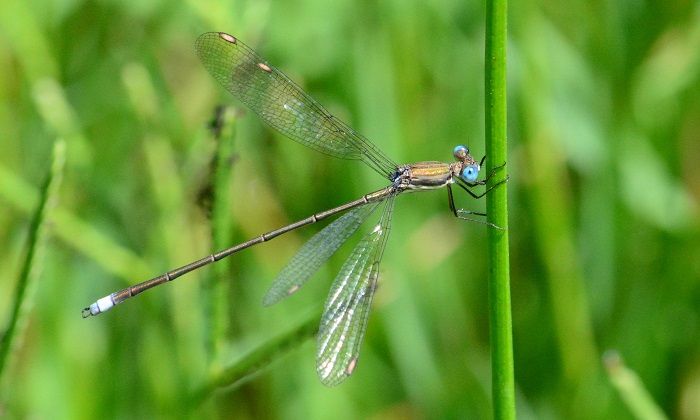
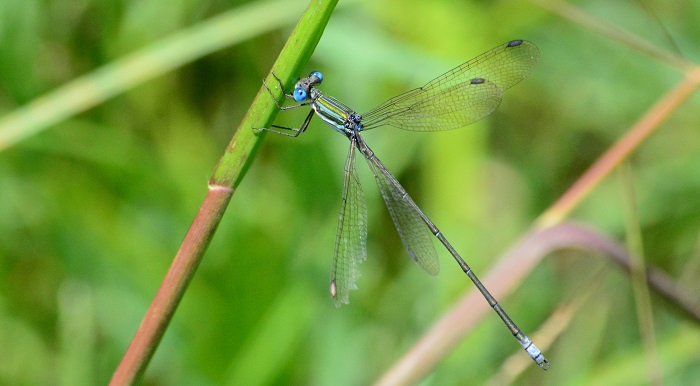
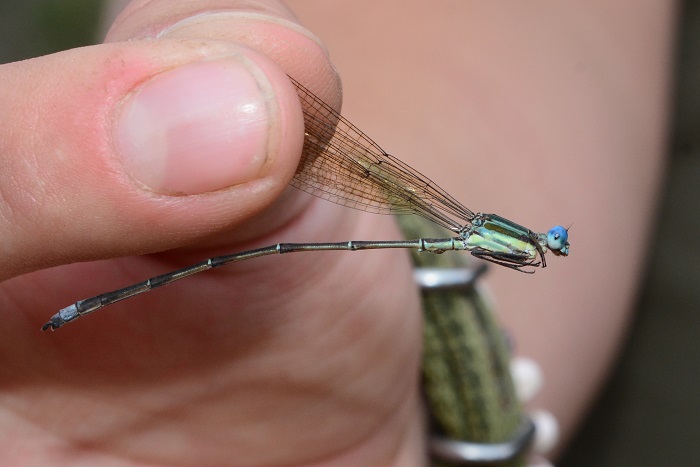
Smoky SpreadwingLestes virgatus – Male False Bay, iSimangaliso Wetland Park, KwaZulu-Natal Photo by Ryan Tippett
Medium sized
Length up to 49mm; Wingspan attains 58mm.
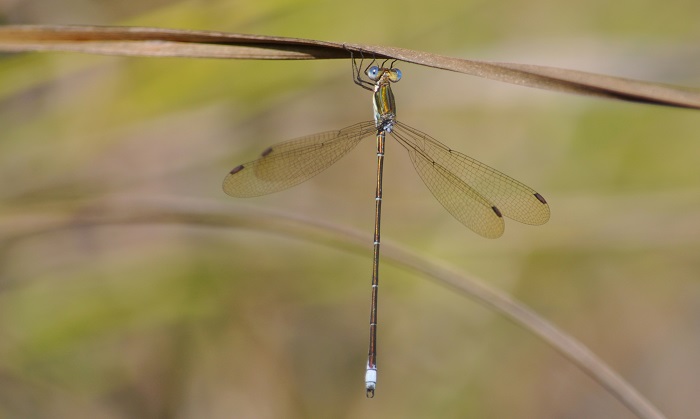
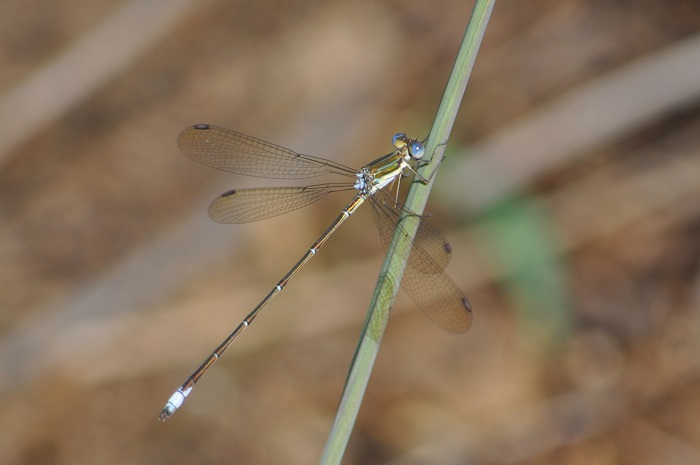
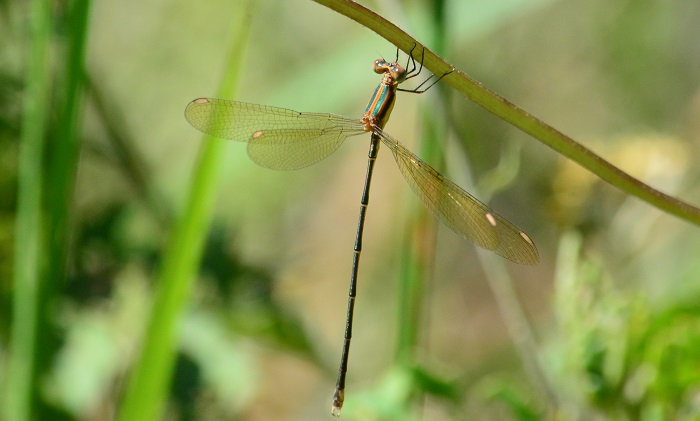
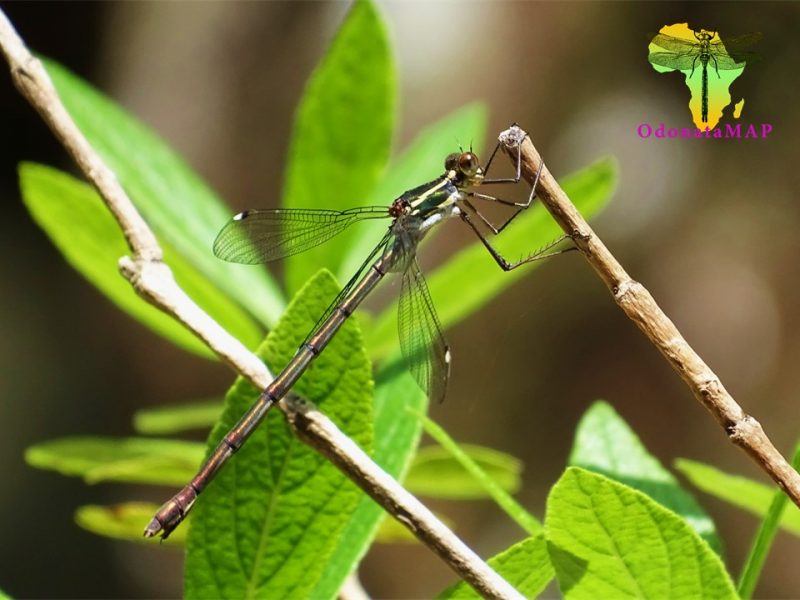
The Smoky Spreadwing most resembles Lestes plagiatus (Highland Spreadwing). The Smoky Spreadwing can be differentiated from other Spreadwings by the bronze-green thorax stripes, swollen pterostigmas with dark outlines, and smoky yellow wings. Older individuals become progressively darker and develop a bronzy colouration.
Females are similar but are duller. They have more robust abdomens than the males, and lack the pruinose terminal segments and the distinctive claspers.
The Smoky Spreadwing could also be confused with a Malachite (Chlorolestes spp.), but can be immediately recognised by its Blue eyes (Malachites have green or brownish eyes), and pale-centered pterostigmas.
Smoky SpreadwingLestes virgatus – Male Near Ixopo, KwaZulu-Natal Photo by Ryan Tippett
Habitat
The Smoky Spreadwing occurs at well-vegetated pans, pools, and marshes with forested or wooded fringes and emergent plant growth. It favours ponds with rich vegetation, particularly tall grasses, and forbs. The Smoky Spreadwing frequents areas of high rainfall above 700mm per year. It is found up to 1600m above sea level.
Habitat – Well vegetated pond with well wooded fringes. Near Hluhluwe, KwaZulu-Natal Photo by Ryan Tippett
Behaviour
The Smoky Spreadwing hangs vertically from a grass or reed stem when at rest. It spends long periods perched and is generally sluggish and unwilling to fly. The females can be found alongside the males.
The Smoky Spreadwing is most active from late September to May, but flies all year at some sites (See Phenology below).
Smoky SpreadwingLestes virgatus – Male Ehlatini Bush Camp, KwaZulu-Natal Photo by Ryan Tippett
Status and Conservation
Lestes virgatus is locally common over most of its range. It is listed as of Least Concern in the IUCN Red List of Threatened Species. The Smoky Spreadwing is moderately sensitive to habitat degradation and commonly occurs at suitable man-made habitats.
Smoky SpreadwingLestes virgatus – Male Near Ixopo, KwaZulu-Natal Photo by Ryan Tippett
Distribution
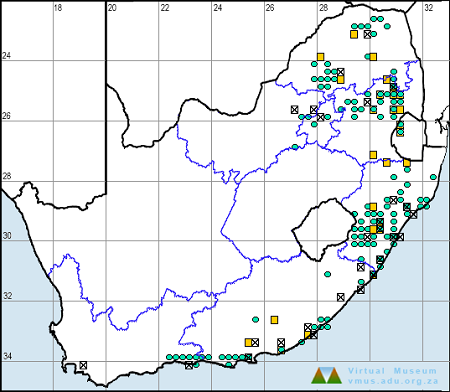
The Smoky Spreadwing is native to much of Southern and Eastern Africa, where it is widespread. It extends from Ethiopia in the north down South Africa. There is also a seemingly isolated population in Nigeria. In South Africa, the Smoky Spreadwing occurs in the northern and eastern parts, as well as along the coast where it is warmer.
Smoky SpreadwingLestes virgatus – Male Ehlatini Bush Camp, KwaZulu-Natal Photo by Ryan Tippett
Below is a map showing the distribution of records for Smoky Spreadwing in the OdonataMAP database as at February 2020.
Below is a map showing the distribution of records for Smoky Spreadwing in the OdonataMAP database as of December 2024.
The next map below is an imputed map, produced by an interpolation algorithm, which attempts to generate a full distribution map from the partial information in the map above. This map will be improved by the submission of records to the OdonataMAP section of the Virtual Museum.
Ultimately we will produce a series of maps for all the odonata species in the region. The current algorithm is a new algorithm. The objective is mainly to produce “smoothed” maps that could go into a field guide for odonata. This basic version of the algorithm (as mapped above) does not make use of “explanatory variables” (e.g. altitude, terrain roughness, presence of freshwater — we will be producing maps that take these variables into account soon). Currently, it only makes use of the OdonataMAP records for the species being mapped, as well as all the other records of all other species. The basic maps are “optimistic” and will generally show ranges to be larger than what they probably are.
These maps use the data in the OdonataMAP section of the Virtual Museum, and also the database assembled by the previous JRS funded project, which was led by Professor Michael Samways and Dr KD Dijkstra.
Smoky SpreadwingLestes virgatus – Male Photo by Jean Hirons
Phenology
Smoky SpreadwingLestes virgatus – Young male Mtunzini, KwaZulu-Natal Photo by Ryan Tippett
Further Resources
The use of photographs by Jean Hirons and Rob Dickinson is acknowledged. All other photographs by Ryan Tippett.
Smoky SpreadwingLestes virgatus(Burmeister, 1839)
Other common names: Rookspanvlerkie (Afrikaans)
Recommended citation format: Loftie-Eaton M; Navarro R; Tippett RM; Underhill L. 2025. Smoky Spreadwing Lestes virgatus. Biodiversity and Development Institute. Available online at https://thebdi.org/2020/02/13/smoky-spreadwing-lestes-virgatus/
References: Tarboton, M; Tarboton, W. (2019). A Guide to the Dragonflies & Damselflies of South Africa. Struik Nature.
Samways, MJ. (2008). Dragonflies and Damselflies of South Africa. Pensoft
Samways, MJ. (2016). Manual of Freshwater Assessment for South Africa: Dragonfly Biotic Index. Suricata 2. South African National Biodiversity Institute, Pretoria
Martens, A; Suhling, F. (2007). Dragonflies and Damselflies of Namibia. Gamsberg Macmillan.
Smoky SpreadwingLestes virgatus – Male Hluhluwe district, KwaZulu-Natal Photo by Ryan Tippett
Find the Drakensberg Malachite in the FBIS database (Freshwater Biodiversity Information System) here.
Family Synlestidae
Identification
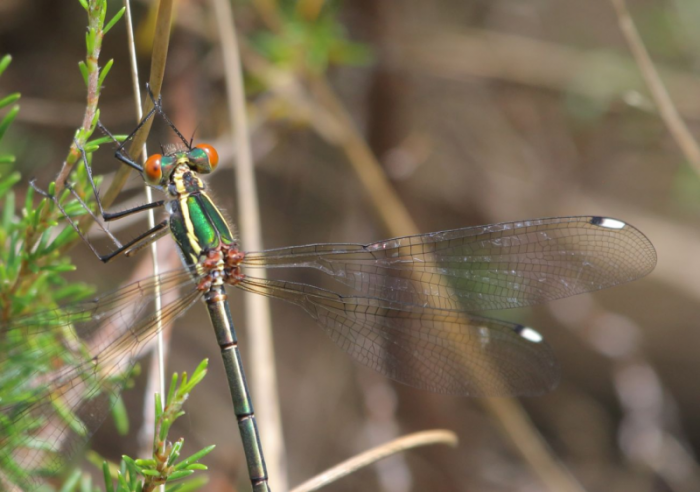
Drakensberg MalachiteChlorolestes draconicus – Male Royal Natal National Park, KwaZulu-Natal Photo by Riëtte Griesel
Large size
Length up to 59mm; Wingspan attains 76mm.
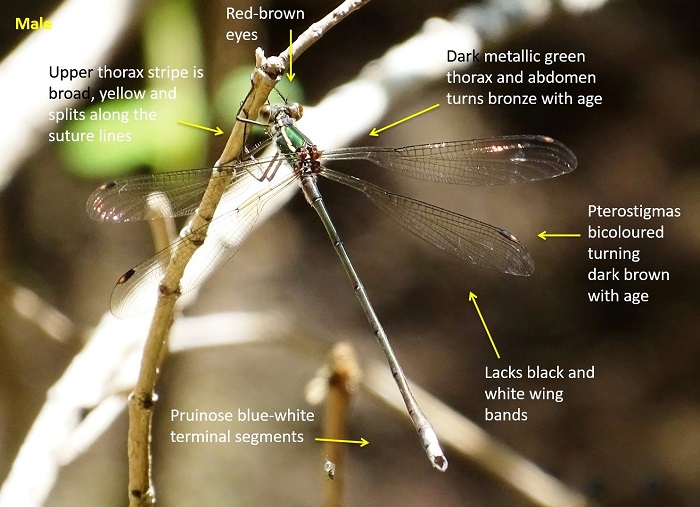
Within its restricted range Chlorolestes draconicus can only be mistaken for Chlorolestes fasciatus (Mountain Malachite). However, the Drakensberg Malachite is larger and there is virtually no size overlap between the two species. The two can be further differentiated by the yellow stripes on the upper thorax. This stripe is narrow in the Mountain Malachite and does not reach the wing bases. The stripes are broad and extend to the wing bases in the Drakensberg Malachite. In addition the Drakensberg Malachite does not have a form with black and white banded wings.
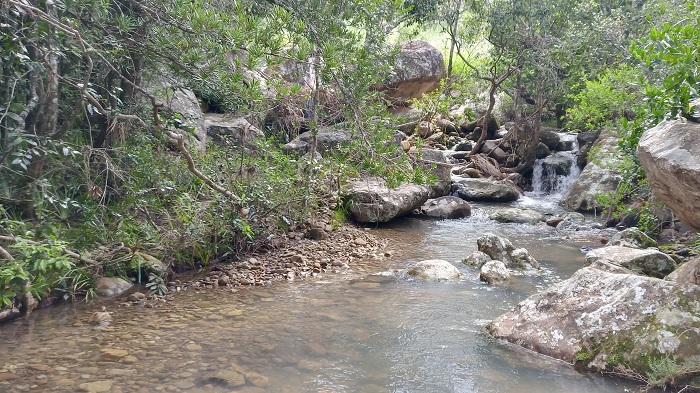
The Drakensberg Malachite frequents rocky streams with pools in high mountainous areas. The streams they inhabit are fringed by boulders, sedges, tall grass, and bushes. The Drakensberg Malachite also occurs along forested streams in protected ravines. The Drakensberg Malachite is only found above 1700m above sea level and is likely to occur to over 3000m.
Habitat at Royal Natal National Park, KwaZulu-Natal Photo by Ryan Tippett
Behaviour
The Drakensberg Malachite is most often seen sitting on vegetation over the water, typically with wings outstretched. Also regularly perches on rocks in the stream. The Drakensberg Malachite spends much of its time perched but occasionally takes flight to capture prey or to find another perch. The Drakensberg Malachite feeds on small flying insects.
The Drakensberg Malachite is on the wing from December to March (See Phenology below).
Status and Conservation
The Drakensberg Malachite is uncommon and localised. Much of its range is protected within the uKhahlamba / Drakensberg Park. As a result the Drakensberg Malachite’s conservation status has been assessed as Least Concern in the IUCN Red List of Threatened Species.
Distribution
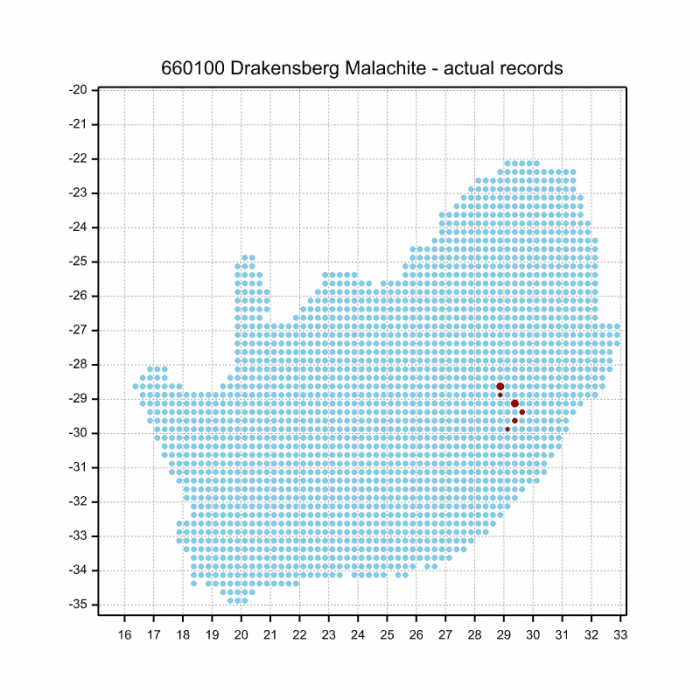
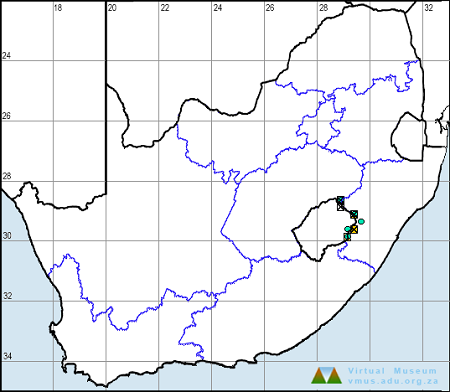
The Drakensberg Malachite is endemic to South Africa and Lesotho. This species has a restricted range in the Drakensberg Mountains.
Below is a map showing the distribution of records for Drakensberg Malachite in the OdonataMAP database as at February 2020.
Below is a map showing the distribution of records for Drakensberg Malachite in the OdonataMAP database as of December 2024.
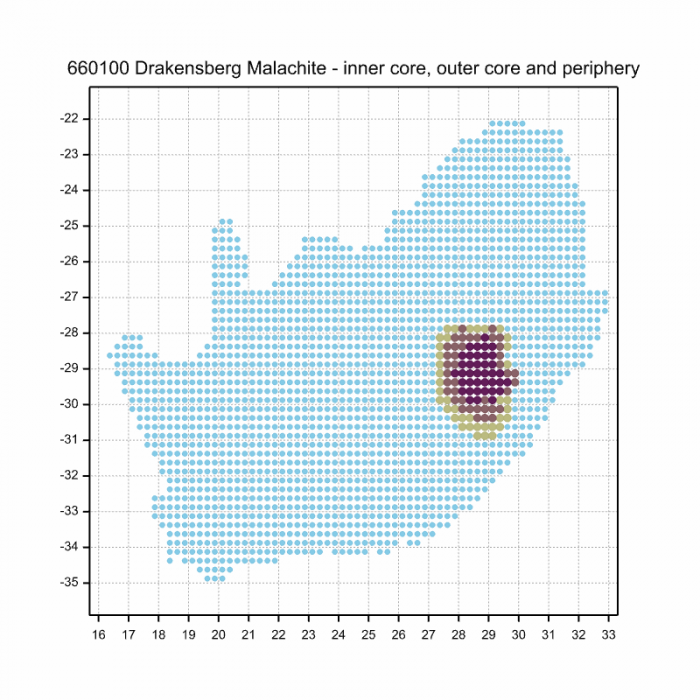
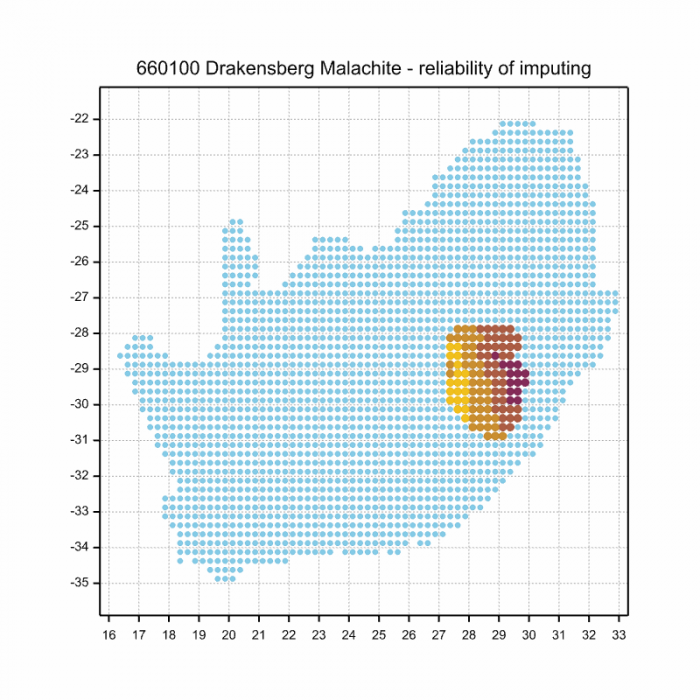
The next map below is an imputed map, produced by an interpolation algorithm, which attempts to generate a full distribution map from the partial information in the map above. This map will be improved by the submission of records to the OdonataMAP section of the Virtual Museum.
Ultimately we will produce a series of maps for all the odonata species in the region. The current algorithm is a new algorithm. The objective is mainly to produce “smoothed” maps that could go into a field guide for odonata. This basic version of the algorithm (as mapped above) does not make use of “explanatory variables” (e.g. altitude, terrain roughness, presence of freshwater — we will be producing maps that take these variables into account soon). Currently, it only makes use of the OdonataMAP records for the species being mapped, as well as all the other records of all other species. The basic maps are “optimistic” and will generally show ranges to be larger than what they probably are.
These maps use the data in the OdonataMAP section of the Virtual Museum, and also the database assembled by the previous JRS funded project, which was led by Professor Michael Samways and Dr KD Dijkstra.
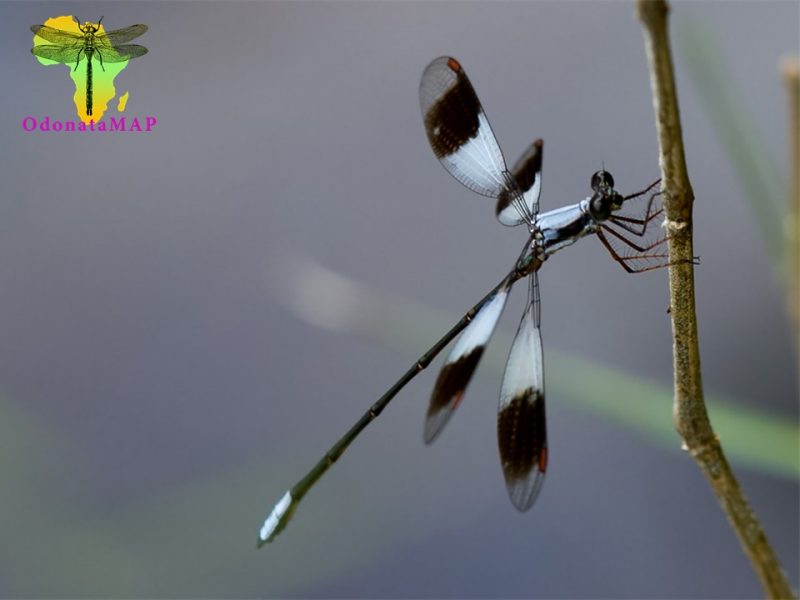
Drakensberg Malachite Chlorolestes draconicus Photo by Alan Manson
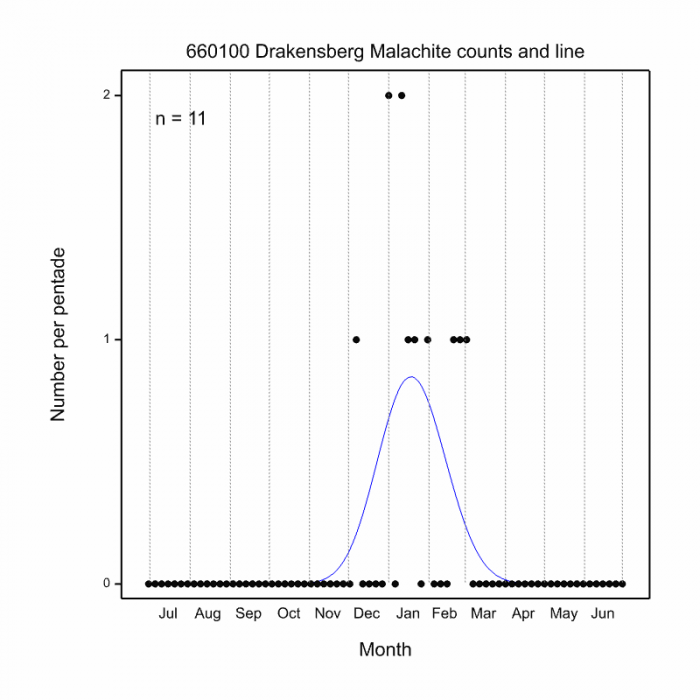
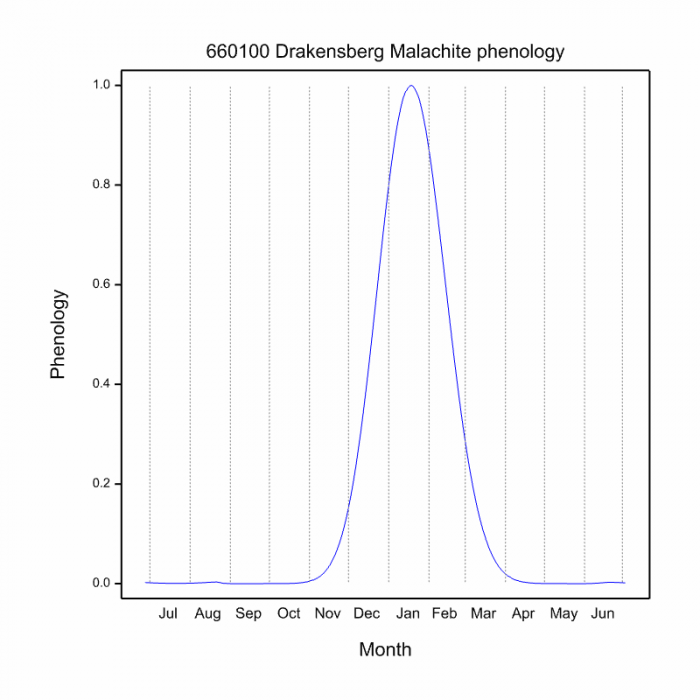
The next two graphs shows how the occurrence of Drakensberg Malachites varies within the year, i.e. the phenology. There are only 11 records in the database for this species, so these results need to be treated cautiosly. The first plot shows the number of records in each pentade, five-day periods, which start on 1 July and end on 30 June the following year. There are two pentades with two records, in December-Janaury. The blue line is generated by a smoother, an algorithm which aims to separate the “signal” from the “noise”, and shows the pattern of seasonality for this species. The second plot shows only the blue line, and it is scaled to lie between zero and one, for easy comparison between species.
Phenology
This phenology plot for the Drakensberg Malachite is tentative (because the sample size is extremely small, only 11 records. It suggests a flight period from December to March. This is a species for which the quality of the phenology plot would be greatly improved by obtaining more OdonataMAP records.
Further Resources
The use of photographs by Alan Manson and Riëtte Griesel is acknowledged.
Other common names: Drakensbergmalagiet (Afrikaans).
Recommended citation format: Loftie-Eaton M; Navarro R; Tippett RM; Underhill L. 2025. Drakensberg Malachite Chlorolestes draconicus. Biodiversity and Development Institute. Available online at https://thebdi.org/2020/02/12/drakensberg-malachite-chlorolestes-draconicus/
References: Tarboton, M; Tarboton, W. (2019). A Guide to the Dragonflies & Damselflies of South Africa. Struik Nature.
Samways, MJ. (2008). Dragonflies and Damselflies of South Africa. Pensoft
Samways, MJ. (2016). Manual of Freshwater Assessment for South Africa: Dragonfly Biotic Index.Suricata 2. South African National Biodiversity Institute, Pretoria
Find the White Malachite in the FBIS database (Freshwater Biodiversity Information System) here.
Family Synlestidae
Identification
White MalachiteChlorolestes umbratus – Male Nature’s Valley, Western Cape Photo by Andre Marais
Medium Sized
Length reaches 47 mm; Wingspan can attain 52 mm
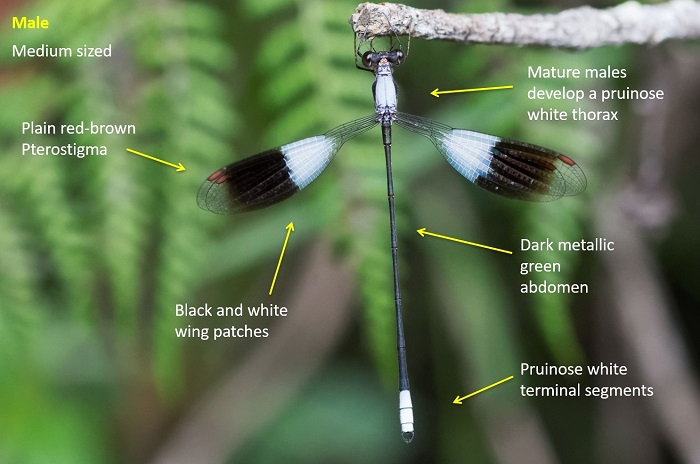
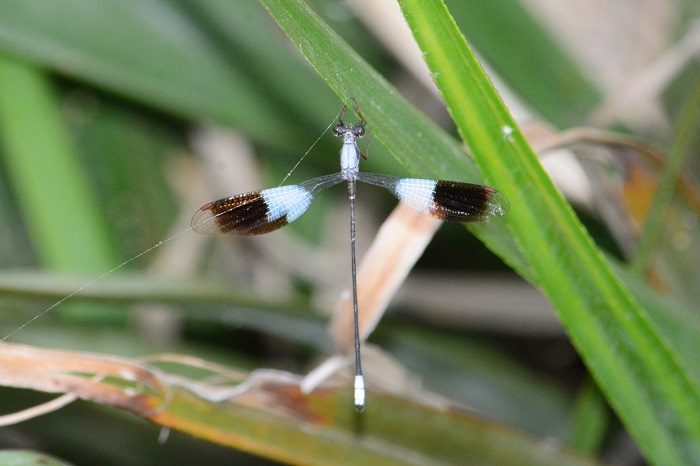
The mature male White Malachite develops a whitish pruinose bloom on the upper thorax. They also possess smoky-black and white wing bands. Non-pruinose males and females have a metallic-green or brown thorax and abdomen. The thorax sides have yellow antehumeral stripes. These individuals are perhaps most similar to Chlorolestes conspicuus, but that species is much larger, and there is no overlap in size.
Both sexes are distinguished from other Chlorolestes by their small size, uniformly coloured pterostigmas and wing venation.
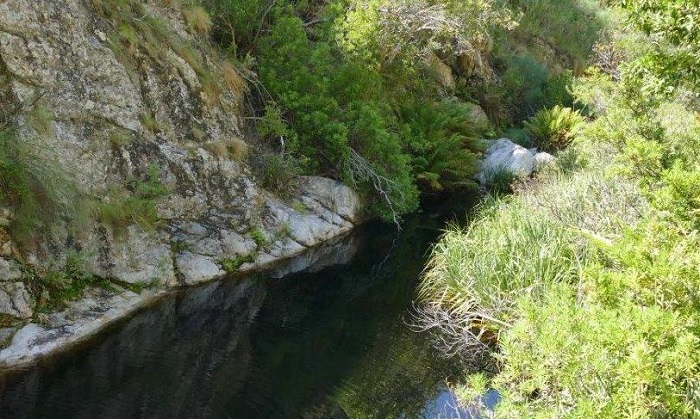
The White Malachite is common along forested streams and rivers. It favours areas of shade and dappled light. It also occurs at well-vegetated streams in fynbos environments. The White Malachite is usually seen perched over pools and calm sections of water.
Habitat – Vogelgat, Western Cape Photo by Sharon Stanton
Behaviour
The White Malachite is an attractive species, mostly seen hanging from plants over the water. Mature males are conspicuous in the dappled forest light. The White Malachite is seldom seen away from water. Females are found in the same vicinity as the males, but are less conspicuous.
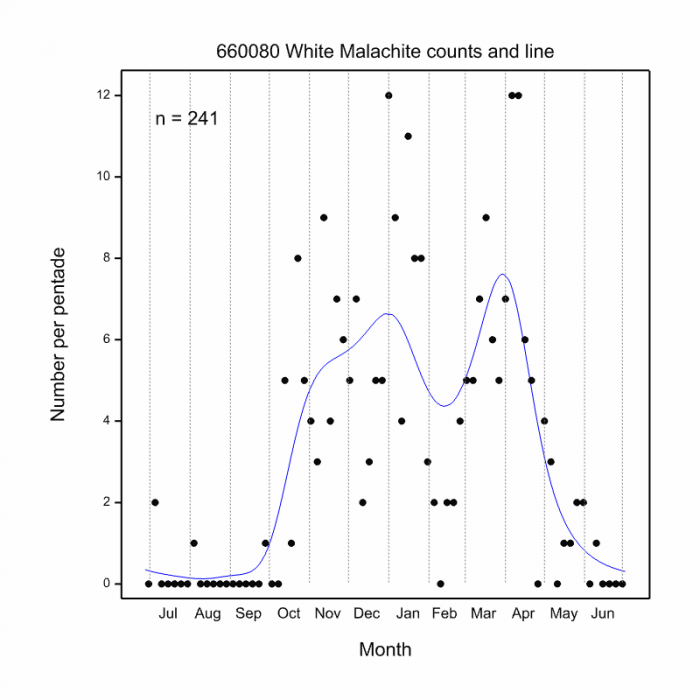
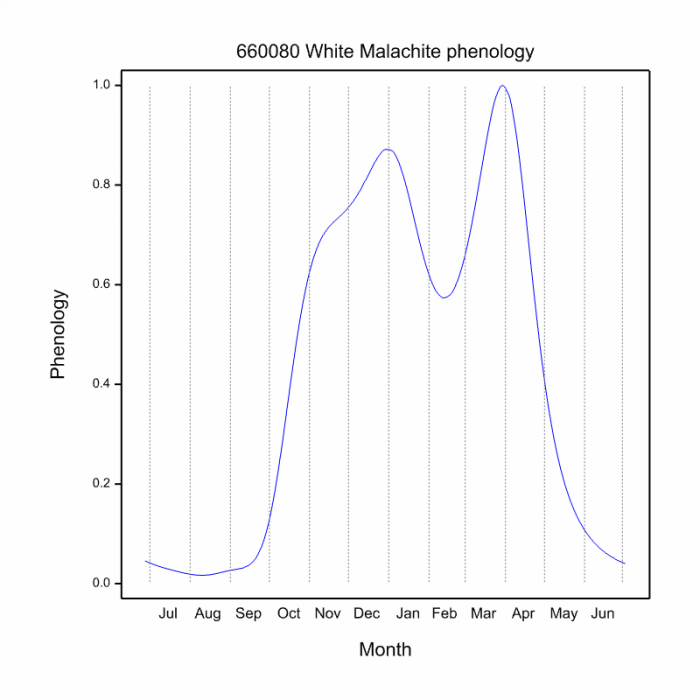
The White Malachite is active from September to May (see Phenology below).
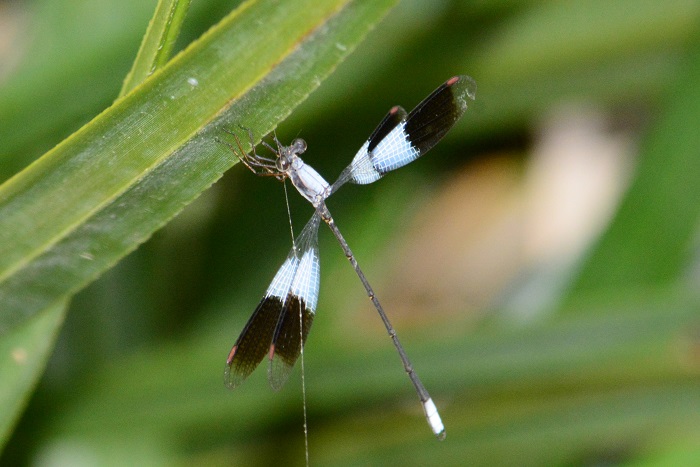
White MalachiteChlorolestes umbratus – Male Grootrivier, Western Cape Photo by Ryan Tippett
Status and Conservation
Chlorolestes umbratus is a fairly common but localised species. Listed as of Least Concern in the IUCN Red List of Threatened Species. It is moderately sensitive to habitat damage.
Distribution
The White Malachite is endemic to the Western and Eastern Cape provinces in South Africa.
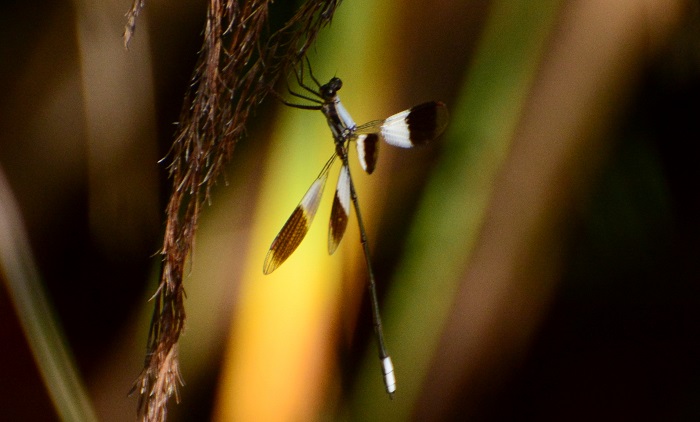
White MalachiteChlorolestes umbratus – Male Marloth Nature Reserve, Western Cape Photo by Ryan Tippett
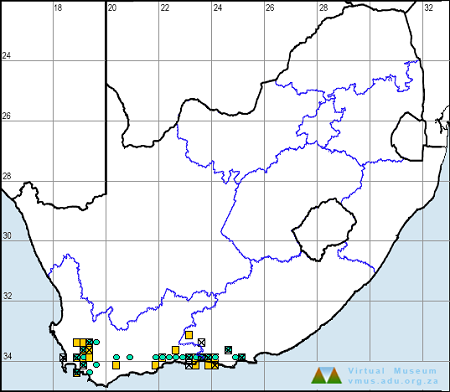
The map below shows the distribution of records for Chlorolestes umbratus in the OdonataMAP database, as at January 2020.
The map below shows the distribution of records for Chlorolestes umbratus in the OdonataMAP database, as of December 2024.
The following map below is an imputed map, produced by an interpolation algorithm, which attempts to generate a full distribution map from the partial information in the map above. This map will be improved by the submission of records to the OdonataMAP section of the Virtual Museum
Ultimately, we will produce a series of maps for all the odonata species in the region. The current algorithm is a new algorithm. The objective is mainly to produce “smoothed” maps that could go into a field guide for odonata. This basic version of the algorithm (as mapped above) does not make use of “explanatory variables” (e.g. altitude, terrain roughness, presence of freshwater — we will be producing maps that take these variables into account soon). Currently, it only makes use of the OdonataMAP records for the species being mapped, as well as all the other records of all other species. The basic maps are “optimistic” and will generally show ranges to be larger than what they probably are.
These maps use the data in the OdonataMAP section of the Virtual Museum, and also the database assembled by the previous JRS funded project, which was led by Professor Michael Samways and Dr KD Dijkstra.
Phenology
White MalachiteChlorolestes umbratus – Male Grootrivier, Western Cape Photo by Ryan Tippett
Further Resources
The use of photographs by Alan Manson and Jean Hirons is acknowledged. Other Photographs by Ryan Tippett.
White MalachiteChlorolestes umbratusHagen in Selys, 1862
Other common names: Bleekmalagiet (Afrikaans).
Recommended citation format: Loftie-Eaton M; Navarro R; Tippett RM; Underhill L. 2025. White Malachite Chlorolestes umbratus. Biodiversity and Development Institute. Available online at https://thebdi.org/2020/02/11/white-malachite-chlorolestes-umbratus/
References: Tarboton, M; Tarboton, W. (2019). A Guide to the Dragonflies & Damselflies of South Africa. Struik Nature.
Samways, MJ. (2008). Dragonflies and Damselflies of South Africa. Pensoft
Samways, MJ. (2016). Manual of Freshwater Assessment for South Africa: Dragonfly Biotic Index.Suricata 2. South African National Biodiversity Institute, Pretoria
OdonataMAP is the Atlas of African Odonata and forms part of the Virtual Museum. OdonataMAP was launched in 2010. The first record was uploaded into the database on 22 September 2010. At its starting point the project described itself as a section of the Virtual Museum which aimed (1) “to map the current distribution of the insect Order Odonata, i.e. dragonflies and damselflies, occurring in Africa” and (2) “to serve as a repository of all existing distribution data for this group.”
OdonataMAP provides an atlas of the up-to-date distributions of the dragonflies and damselflies, which is a critical component of addressing their own conservation priorities, and also the conservation of freshwater ecosystems. The project provides a valuable input to the Red List status of each species. Besides the distribution maps, OdonataMAP aims to make a contribution to understanding the seasonal phenology of these species. Documenting and quantifying changes in seasonality are a critical component of understanding the impacts of climate change on biodiversity
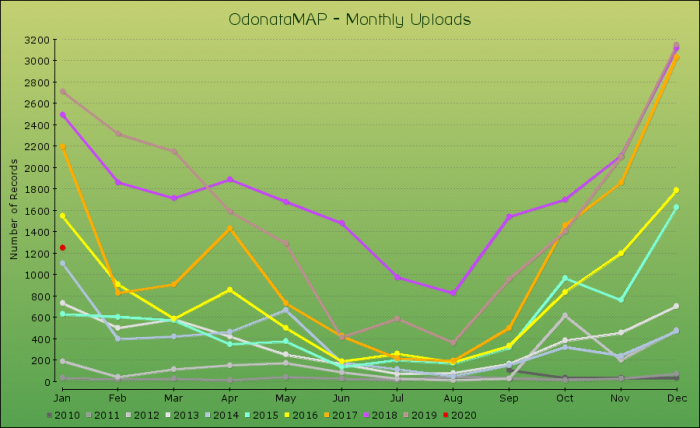
Monthly data uploads to OdonataMAP by year. 2019 is represented by the light purple line
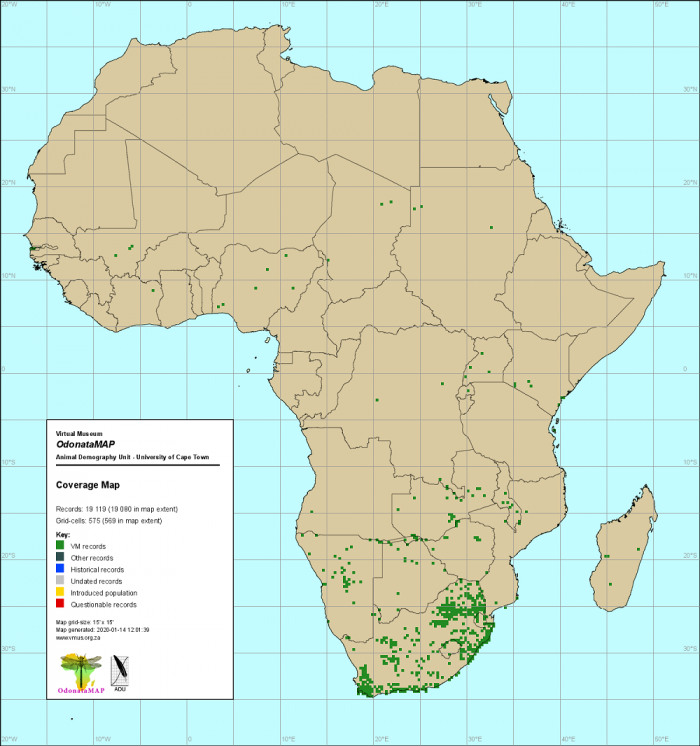
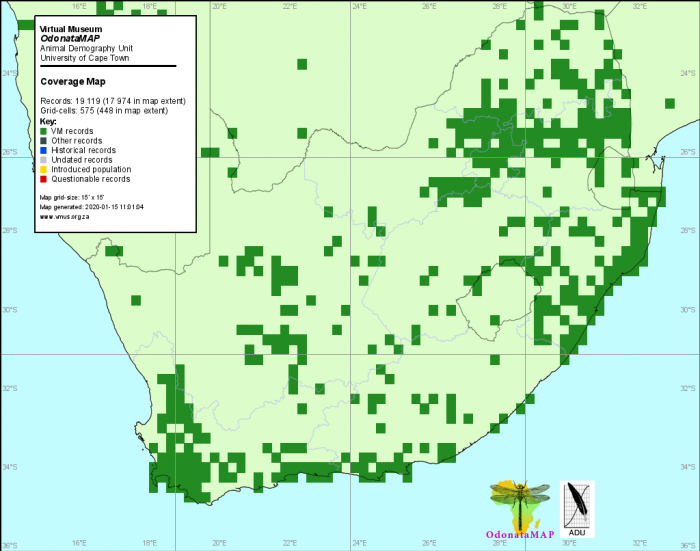
Although filled with challenges, like an ongoing drought throughout most parts of South Africa, 2019 was a good year for OdonataMAP. OdonataMAPpers submitted a total of 19,119 records to the Virtual Museum. And thanks to the amazing members of the OdonataMAP expert panel, 99% of the records have been identified already. Below is a map of Africa, and South Africa, showing the locations (grid cells) of the OdonataMAP data submitted during 2019
OdonataMAP data submissions for Africa for 2019 OdonataMAP data submissions for South Africa, Lesotho and Swaziland for 2019
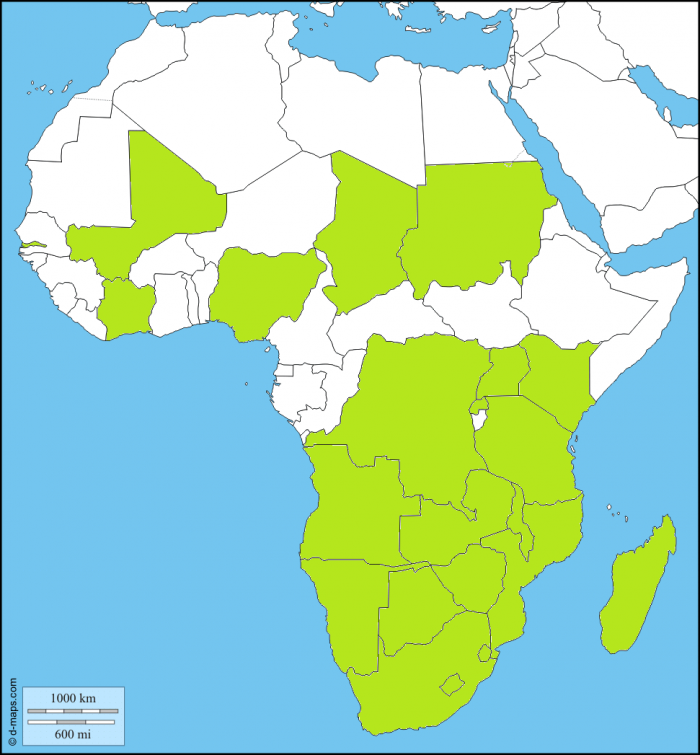
We received records from 26 African countries (Table 1). Apart from South Africa, most of the other records came from Zambia (388), Namibia (369) and Swaziland (278), all three these countries having totals of more than 100 records submitted for the year.
Table 1: OdonataMAP records for 2019 by country
Country
Records
Angola
2
Botswana
78
Cape Verde
4
Chad
66
Congo (DRC)
13
Cote d’Ivoire
3
Eswatini (Swaziland)
6
Gambia
2
Kenya
18
Lesotho
4
Madagascar
7
Malawi
29
Mali
21
Mauritius
35
Mozambique
55
Namibia
369
Nigeria
35
Republic of the Congo
1
Rwanda
3
South Africa
17665
Sudan
2
Swaziland
228
Tanzania
4
Uganda
36
Zambia
392
Zimbabwe
41
Map of Africa with countries for which we received OdonataMAP records highlighted in green
Diana Russell submitted the most records to OdonataMAP for the year, with a great total of 2555 records, followed by Richard Johnstone on 1427 records and Corrie du Toit with 1378 records (Table 2).
Table 2: OdonataMAP Observers with more than 100 records submitted for 2019
Observer
Records
Russell Diana
2555
Johnstone Richard
1427
du Toit Corrie
1378
de Vries Andries Petrus; Joey de Vries
1120
La Grange Pieter
853
Hirons Jean
651
Bensch Gert; Juan-Pierre Antunes
396
Barrett Norman
273
Kleynhans Evert Philippus Jacobus
256
Small Christopher Peter
255
Nuttall Rick
248
Steenkamp Wilna
247
Van Rensburg Maritza
246
Wilkinson John
245
de Vries Andries Petrus; Blyde River OdonataBash
233
Bensch Gert
232
Willis Chris
227
Stanton Sharon
214
Stanton Sharon; Heleen Louw
208
Liebenberg Altha
180
Robinson Lance
177
Cronje Pieter
176
Nieuwoudt Phillip
172
van Dyk Zenobia
164
Hulme Ilse
155
de Vries Andries Petrus; Joey de Vries; Team Swadini Bio-Search
151
Stanton Mark
150
Kleynhans Evert Philippus Jacobus; Cherése Kleynhans
148
Kleynhans DH; Sarieta Kleynhans
147
Tippett Ryan
145
Braun Kate
140
Liptrot Mark
139
Thomson Neil
134
Antunes Juan-pierre Antunes; Gert Bensch
126
Snyman Antoinette
120
Dickinson Robyn
118
Kleynhans Dawie; Sarieta Kleynhans
113
de Vries Andries Petrus; Joey de Vries; Neels Snyman; Antoinette Snyman
106
Darling Desire; Gregg Darling
104
Troskie Eugene Anton; Lerm Rion
102
The two species most often recorded for 2019 were Broad Scarlet Crocothemis erythraea and Red-veined Dropwing Trithemis arteriosa (Table 3).
Find the Conspicuous Malachite in the FBIS database (Freshwater Biodiversity Information System) here.
Family Synlestidae
Identification
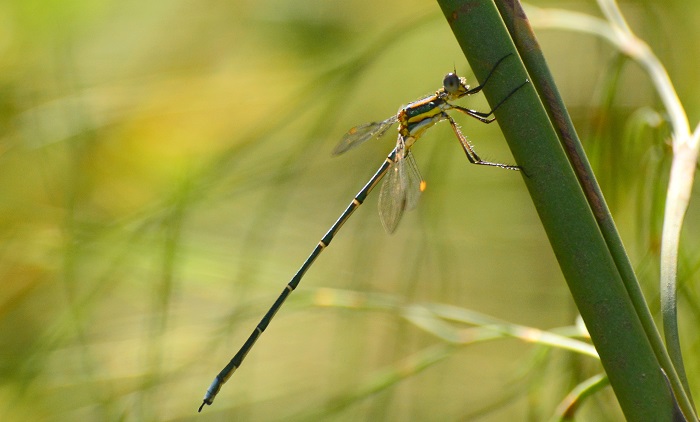
Conspicuous MalachiteChlorolestes conspicuus – Male Kareedouw Mountain, Eastern Cape Photo by Jorrie Jordaan
Large size
Length up to 65mm; Wingspan reaches 73mm.
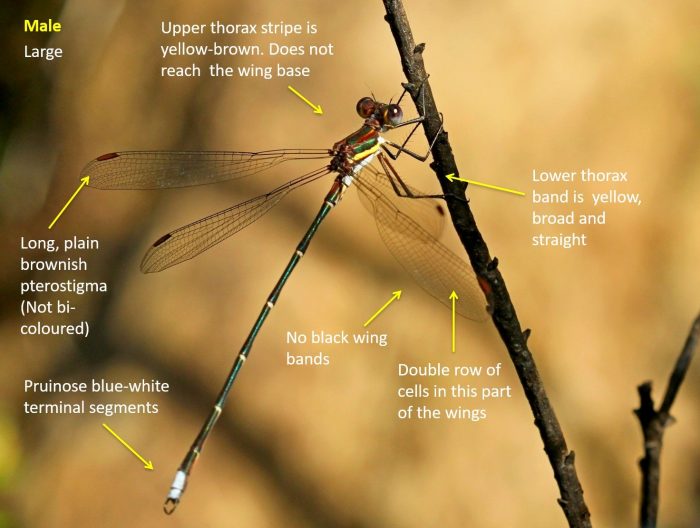
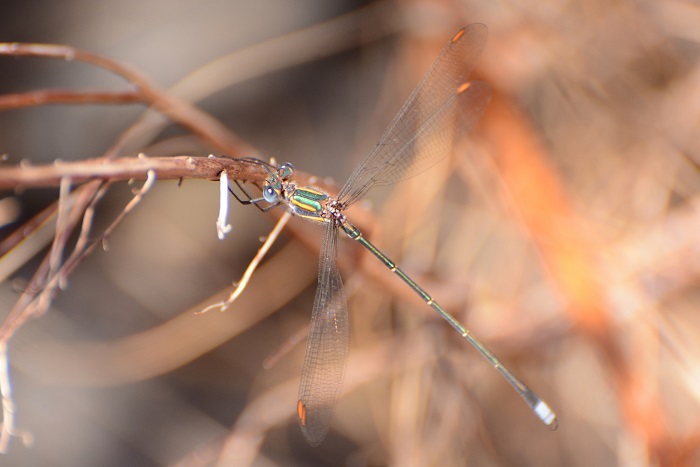
The Conspicuous Malachite is largest species in its genus. It is a fairly dull coloured species but the thorax stripes are relatively broad, bright and noticeable. The thorax and abdomen are metallic-green aging to coppery brown. Males never develop black-banded wings.
The most diagnostic features of the Conspicuous Malachite are the large size, long brownish pterostigmas (not bi-coloured), and the bright yellow lower thorax stripe that is broad and straight.
The Conspicuous Malachite most resembles the un-banded form of Chlorolestes fasciatus (Mountain Malachite) but that species is distinctly smaller, brighter green and has bi-coloured pterostigmas.
The sexes are similar but females are more robustly built.
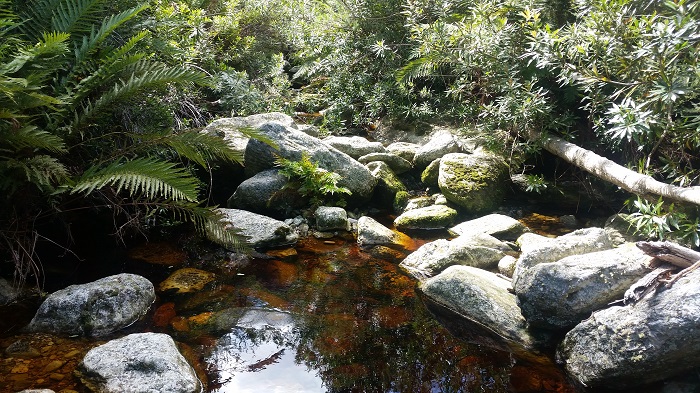
The Conspicuous Malachite is found near rivers and streams in both open and wooded or forested valleys, particularly in mountainous fynbos areas. It favours sites with tall fringing vegetation such as restios, reeds, ferns, bushes and trees. The Conspicuous Malachite also inhabits seeps and small streams with rich vegetation, on steep mountain slopes.
Habitat – Marloth Nature Reserve, Western Cape Photo by Ryan Tippett
Behaviour
Despite its common name it is not a conspicuous species. The Conspicuous Malachite is most often seen hanging from a perch over the water, with its wings outstretched in full sunshine.
The Conspicuous Malachite is most active from December to May (See Phenology below).
Conspicuous MalachiteChlorolestes conspicuus – Male Swartberg Pass, Western Cape Photo by Ryan Tippett
Status and Conservation
The Conspicuous Malachite is locally common. It is listed as of Least Concern in the IUCN Red List of Threatened Species. The Conspicuous Malachite is confined to natural habitats and is not tolerant of habitat degradation.
Distribution
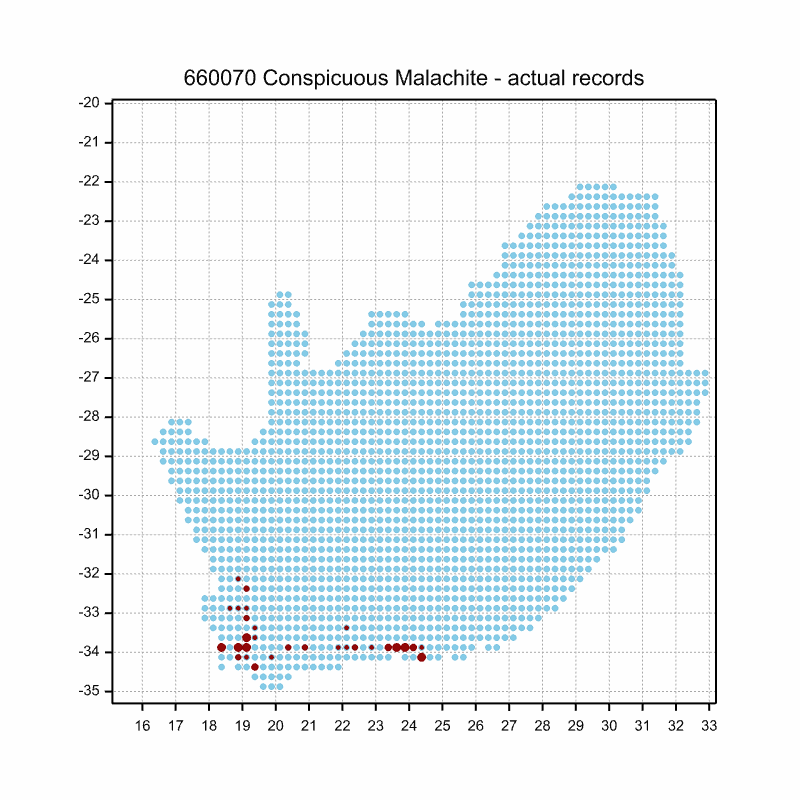
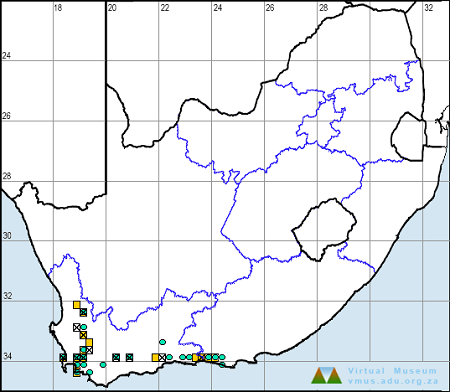
The Conspicuous Malachite is endemic to south-western South Africa and is restricted to the Western and Eastern Cape provinces.
Conspicuous MalachiteChlorolestes conspicuus – Male Bainskloof Pass, Western Cape Photo by Ryan Tippett
The map below shows the distribution of records for Chlorolestes conspicuus in the OdonataMAP database as at January 2020.
The map below shows the distribution of records for Chlorolestes conspicuus in the OdonataMAP database as of December 2024.
The following map below is an imputed map, produced by an interpolation algorithm, which attempts to generate a full distribution map from the partial information in the map above. This map will be improved by the submission of records to the OdonataMAP section of the Virtual Museum
The following map below shows the imputed distribution which has been adjusted for terrain roughness
Conspicuous MalachiteChlorolestes conspicuus – Teneral male Marloth Nature Reserve, Western Cape Photo by Ryan Tippett
Phenology
The next two graphs shows how the occurrence of Conspicuous Malachites varies within the year, i.e. the phenology. There are 82 records in the database for this species, so these results can be treated as moderately reliable. The first plot shows the number of records in each pentade, five-day periods, which start on 1 July and end on 30 June the following year. The maximum number of records in a pentade is nine, in April. The blue line is generated by a smoother, an algorithm which aims to separate the “signal” from the “noise”, and shows the pattern of seasonality for this species. The second plot shows only the blue line, and it is scaled to lie between zero and one, for easy comparison between species.
This phenology plot suggests that the main flight period of the Conspicuous Malachite is in late summer, with a peak at the end of March/beginning of April. There appears to be a steady build-up to this peak of abundance, starting in December. There is a fairly rapid decrease in abundance from late-April. This species is unusual for a winter-rainfall region endemic to have records in every month of the year except one (September). There are single records in May, June, August and October and four in July. A lot more OdonataMAP records for the Conspicuous Malachite are needed to confirm (or disprove) the patterns shown in this plot.
Conspicuous MalachiteChlorolestes conspicuus – Male Swartberg Pass, Western Cape Photo by Ryan Tippett
Further Resources
The use of photographs by Gregg Darling and Jorrie Jordaan is acknowledged. All other Photographs by Ryan Tippett.
Conspicuous MalachiteChlorolestes conspicuusHagen in Selys, 1862
Other common names: Reusemalagiet (Afrikaans).
Recommended citation format: Loftie-Eaton M; Navarro R; Tippett RM; Underhill L. 2025. Conspicuous Malachite Chlorolestes conspicuus. Biodiversity and Development Institute. Available online at https://thebdi.org/2020/02/04/conspicuous-malachite-chlorolestes-conspicuus/
References: Tarboton, M; Tarboton, W. (2019). A Guide to the Dragonflies & Damselflies of South Africa. Struik Nature.
Samways, MJ. (2008). Dragonflies and Damselflies of South Africa. Pensoft
Samways, MJ. (2016). Manual of Freshwater Assessment for South Africa: Dragonfly Biotic Index.Suricata 2. South African National Biodiversity Institute, Pretoria
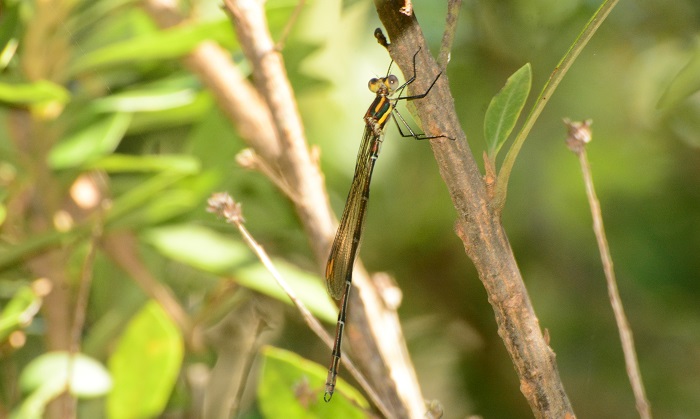
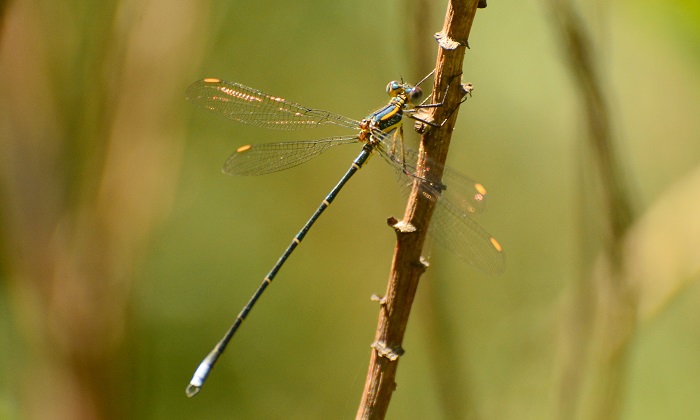
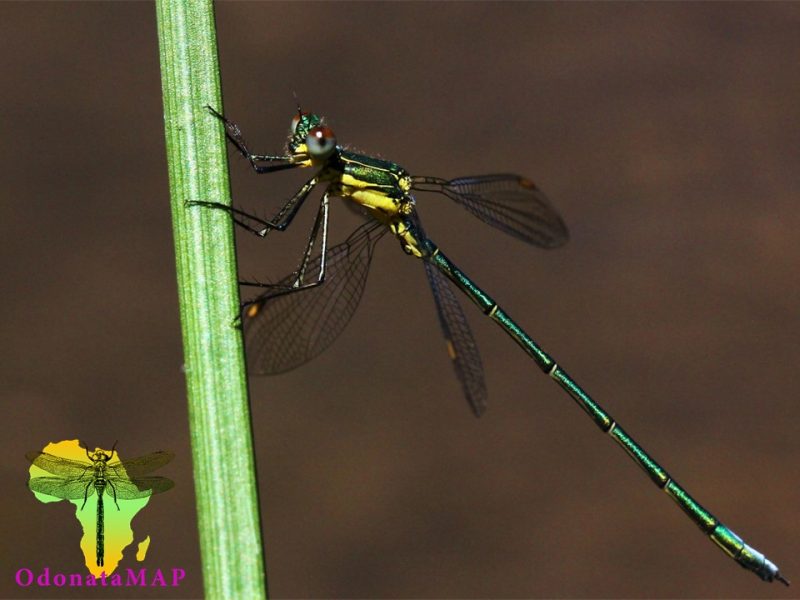
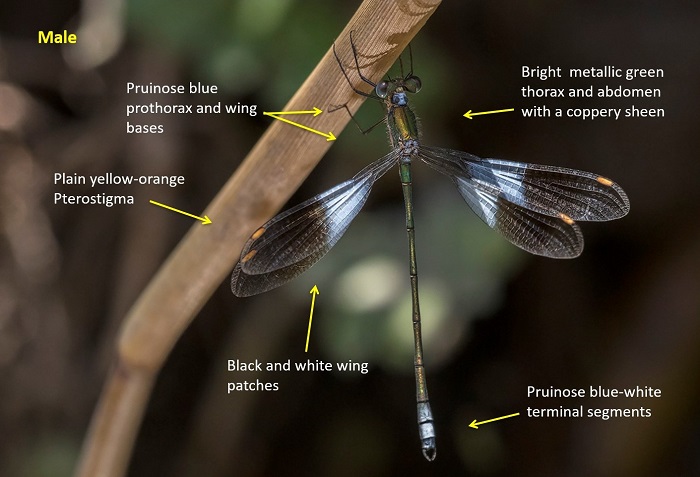
The Amatola Malachite is a distinctive and easily recognised species. Apart from the aforementioned size, chlorolestes apricans can be readily identified by its plain, dark yellowish pterostigmas and pruinose blue prothorax and wing bases. Males occur in two forms. One has black and white-banded wings and the other has plain, un-banded wings. Females resemble un-banded males but are less colourful and more robust with broader abdomens.
The Amatola Malachite frequents streams and rivers in hilly areas. It requires clear, flowing water and a rich growth of reeds, grass, and some scattered bushes.
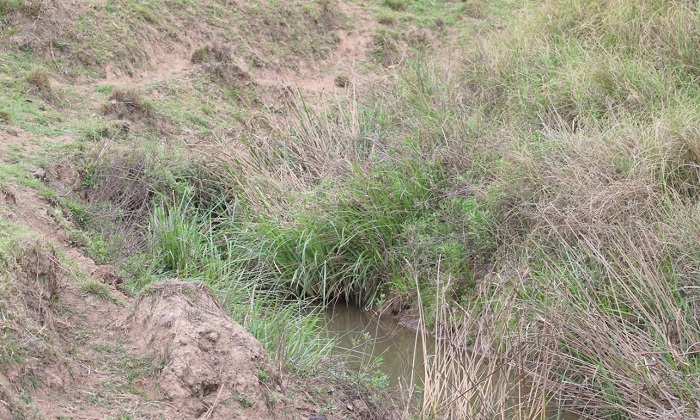
Habitat – Near Stutterheim, Eastern Cape Photo by Corne Rautenbach
Behaviour
The Amatola Malachite is most often observed hanging with wings outstretched, from grass stems in sunny positions over the water. It is fairly confiding and reluctant to fly.
The Amatola Malachite is active from October to April (See Phenology below).
Status and Conservation
Chlorolestes apricans is rare and listed as Endangered on the IUCN Red List of Threatened Species. It only occupies pristine, undamaged habitats and has a very small and restricted distribution. The Amatola Malachite is not tolerant of habitat degradation.
Distribution
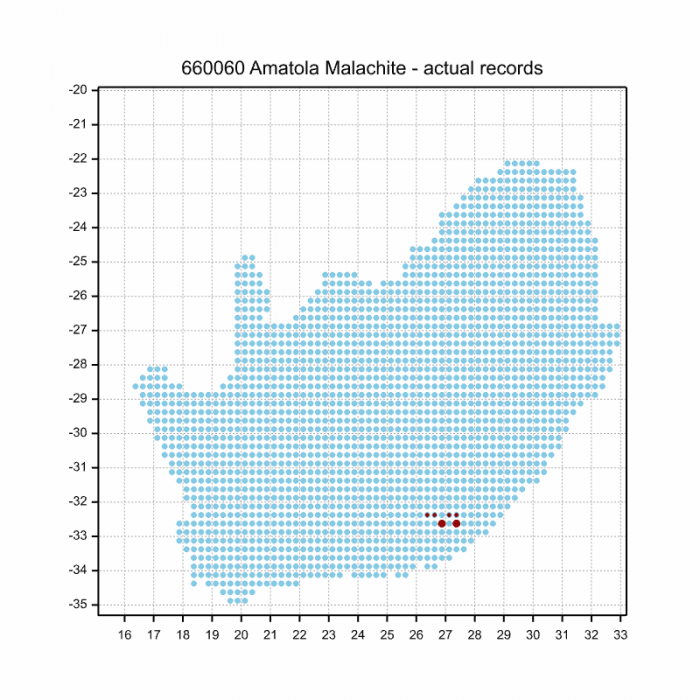
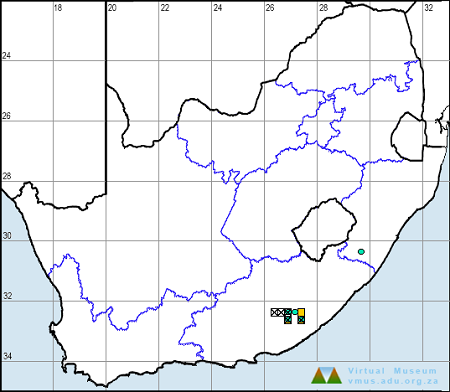
The Amatola Malachite is endemic to South Africa, where it has a restricted range in the Eastern Cape Province. Until recently, the Amatola Malachite was only known from a small area in the Amatola-Winterberg mountains in the Eastern Cape, but has subsequently also been discovered in southern KwaZulu-Natal (See distribution maps below).
The map below shows the distribution of records for Anax imperator in the OdonataMAP database, as at January 2020.
The map below shows the distribution of records for Chlorolestes apricans in the OdonataMAP database, as of December 2024.
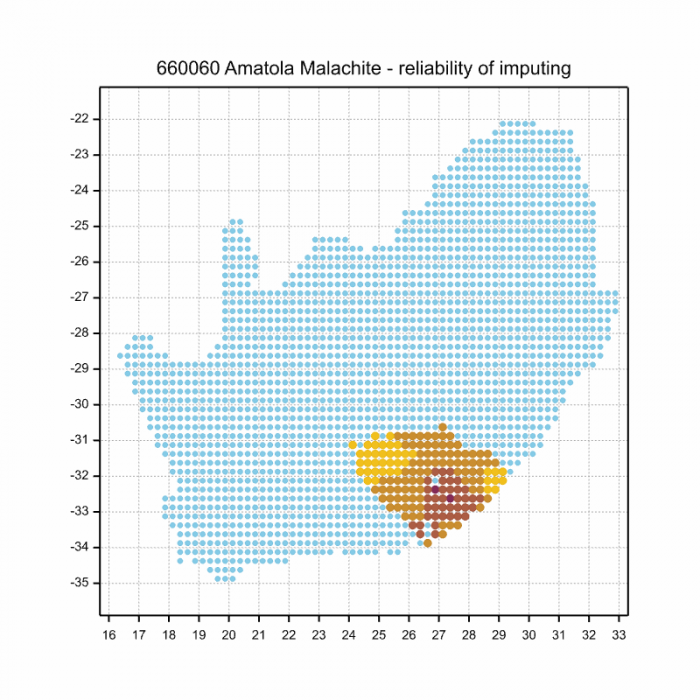
The following map below is an imputed map, produced by an interpolation algorithm, which attempts to generate a full distribution map from the partial information in the map above. This map will be improved by the submission of records to the OdonataMAP section of the Virtual Museum
The next map below is an imputed map, produced by an interpolation algorithm, which attempts to generate a full distribution map from the partial information in the map above. This map will be improved by the submission of records to the OdonataMAP section of the Virtual Museum.
The map below shows the imputed distribution which has been adjusted for terrain roughness
Ultimately, we will produce a series of maps for all the odonata species in the region. The current algorithm is a new algorithm. The objective is mainly to produce “smoothed” maps that could go into a field guide for odonata. This basic version of the algorithm (as mapped above) does not make use of “explanatory variables” (e.g. altitude, terrain roughness, presence of freshwater — we will be producing maps that take these variables into account soon). Currently, it only makes use of the OdonataMAP records for the species being mapped, as well as all the other records of all other species. The basic maps are “optimistic” and will generally show ranges to be larger than what they probably are.
These maps use the data in the OdonataMAP section of the Virtual Museum, and also the database assembled by the previous JRS funded project, which was led by Professor Michael Samways and Dr KD Dijkstra.
Phenology
The next two graphs shows how the occurrence of Amatola Malachites varies within the year, i.e. the phenology. There are only 28 records in the database for this species, so these results need to be treated as tentative. The first plot shows the number of records in each pentade, five-day periods, which start on 1 July and end on 30 June the following year. The maximum number of records in a pentade is four, in early January. The blue line is generated by a smoother, an algorithm which aims to separate the “signal” from the “noise”, and shows the pattern of seasonality for this species. The second plot shows only the blue line, and it is scaled to lie between zero and one, for easy comparison between species.
Tentatively (because the sample size is only 28), this phenology plot shows that the earliest Amatola Malachites in flight can be anticipated in October, and the last ones in April. Most records are anticipated to be from November to March, and the peak of the flight period appears to be in Mid-December. The peak appears to be quite sharp, but this might be a consequence of the small sample size.
To improve the quality of the phenology, please start fieldwork for this species in October, and continue to April, and submit records of Amatola Malachites to OdonataMAP throughout this period. The ideal would be to have a record from each five-day period in which they are seen and photographed.
Further Resources
The use of photographs by Corne Rautenbach, Desire Darling, and Stewart MacLachlan is acknowledged.
Recommended citation format: Loftie-Eaton M; Navarro R; Tippett RM; Underhill L. 2025. Amatola Malachite Chlorolestes apricans. Biodiversity and Development Institute. Available online at https://thebdi.org/2020/02/03/amatola-malachite-chlorolestes-apricans/
References: Tarboton, M; Tarboton, W. (2019). A Guide to the Dragonflies & Damselflies of South Africa. Struik Nature.
Samways, MJ. (2008). Dragonflies and Damselflies of South Africa. Pensoft
Samways, MJ. (2016). Manual of Freshwater Assessment for South Africa: Dragonfly Biotic Index.Suricata 2. South African National Biodiversity Institute, Pretoria
Department of Zoology & Entomology, Rhodes University, Grahamstown, 6140, South Africa
Patrick E Hulley
Department of Zoology & Entomology, Rhodes University, Grahamstown, 6140, South Africa
Abstract
Since 2007 we have carried out surveys of birds at Fort Fordyce, including mist-netting. To date, 175 species have been recorded, including 9 Red Data species, of which one is a breeding resident, and three others may be breeding in the reserve. There are 56 species typical of montane forest; most are present throughout the year. With > 500 birds ringed and 50 recaptures, the oldest records to date are 8 years for an olive thrush and a black-backed puffback.
Introduction
Forest is a rare habitat in South Africa, covering < 1% of the land surface, and it is currently much fragmented. However, there are very few areas which were covered by extensive tracts of natural forest even before human-induced changes to the original vegetation distribution (Rutherford and Westfall 1986). Many small forest remnants, originally under the control of the Department of Forestry, have subsequently been transferred to state conservation departments.
Fort Fordyce (Figure 1) was previously a hilltop forestry station, with extensive plantations of alien pine and eucalypt trees, while indigenous forest persisted on the steeper slopes. In 1987 it became a nature reserve administered by the Cape Provincial Department of Nature Conservation, and removal of alien vegetation began. Most of the plantations have now been felled, but secondary infestations of black wattle (Acacia mearnsii) cover significant areas, although there is also extensive regeneration of natural vegetation. This protected area covers 2155 hectares, and with the Mpofu Game Reserve (7500 hectares) in the adjacent valley, is currently managed by Eastern Cape Parks; these two reserves form part of the Amatola-Katberg Mountain Important Bird Area (BirdLife South Africa 2015).
Figure 1. Location of Fort Fordyce in South Africa
The plateau at Fort Fordyce (altitude 1400 m) has areas of open grassland where grazing mammals have been introduced (black wildebeest Connochaetes gnou, Burchell’s zebra Equus quagga burchellii, red hartebeest Alcelaphus buselaphus caama). Bushbuck (Tragelaphus sylvaticus) and blue duiker (Philantomba monticola) occur naturally in the forested areas; baboon (Papio ursinus) and vervet monkey (Chlorocebus pygerythrus) are present, but no samango monkeys (Cercopithecus albogularis) have been recorded. Caracal (Caracal caracal) is the largest resident predator. Annual rainfall averages 1125 mm (mean over 15 years); summer maximum temperatures range to 42°C while frost occurs regularly in winter, and snow has been recorded in some years.
Based on surveys of the avifauna since 2007 (Craig 2007, 2012) we have posed the following questions:
Does this patch of Afromontane forest preserve a significant component of forest birds, particularly endemic species, and species of conservation concern?
Are these birds resident throughout the year, or is there evidence for seasonal movements?
Methods
Since May 2007, we have visited Fort Fordyce on 47 occasions, mostly single day visits. On each occasion, at least two observers have followed a regular route within the forest and across the grassland area, recording all birds seen and heard. These data have been submitted to the Southern African Bird Atlas Project (SABAP2). We have also set approximately 100 m of mist nets along a track near the reserve office and chalets (Figure 2).
Figure 2. Mist net line at Fort Fordyce (Photo Magi Nams)
The vegetation here is regenerating scrub-forest, with a small patch of pine trees remaining to the east of the net line. All birds captured have been ringed with standard metal rings issued by SAFRING. Apart from our own data, there are 10 surveys by other observers submitted to SABAP2, and three checklists in the Birds in Reserves Project (BIRP). The reserve straddles two pentads (the 5’ x 5’ minute map units used for SABAP2), including the NW corner of pentad 3240_2630 and the NE sector of pentad 3240_2625 (SABAP2, accessed 13 December 2017). However, virtually all data collection has been within the map unit 3240_2625.
Prior to 2007, we visited the reserve on three occasions (September 1988, April 1989, August 1997) during student field trips lasting 3 days each. Birds were mist-netted, and species lists recorded for each visit; these data are discussed separately. Data are also available from the first bird atlas (SABAP1, Harrison et al. 1997), but the mapping unit at that time was a “quarter degree square” (15’ x 15’), which covers a larger area than the reserve and thus incorporated the valley with dry thornveld vegetation. This is evident from the species list, which includes many taxa which have not been recorded subsequently when surveys were restricted to the forest and grassland areas within the reserve.
Results and Discussion
Avifauna
The SABAP1 list for the quarter degree square (map code 3226CB) incorporating Fort Fordyce Reserve has 211 species, but as noted above some of these are clearly birds of the low thornveld areas at the base of the pass which leads up to the plateau. Nevertheless all 86 species noted by AJFKC and PEH in the years 1988-1997 are included in the SABAP1 tally. The current list for the pentad 3240_2625, based on SABAP2, our surveys and mist-netting records, and the few additional BIRP data, is 175 species (Appendix 1); 18 of these species were not recorded during SABAP1. Three species recorded in the forest/grassland habitats in the period 1988-1997 have not been reported in this sector since then: spotted eagle-owl (Bubo africanus), long-billed pipit (Anthus similis) and golden-breasted bunting (Emberiza flaviventris). Of these, only the owl may be present regularly, since with few overnight stays, nocturnal birds are certainly under-reported; the other two species are likely to be occasional vagrants. For comparison, in three KwaZulu-Natal Afromontane forest reserves, Symes et al. (2002) recorded a total of 136 species, with no more than 110 species at any one site. However, these surveys extended over only 2-4 years at their study sites.
Species of conservation concern
Table 1 lists those species recorded at Fort Fordyce, which feature in the most recent “Red Data Book” for southern Africa (Taylor et al. 2015). The frequency with which these species have been recorded (cf. Appendix 1) suggests that most are only occasional visitors to the reserve. The endangered Cape parrot (Poicephalus robustus) has roosted here occasionally, but the large flocks seen feeding on pecan nuts on farms in the valley at certain seasons fly east in the direction of the Hogsback forests each evening (pers. obs.). Only the Knysna woodpecker (Campethera notata) is a confirmed breeding resident; the African crowned eagle (Stephanoaetus coronatus) probably also nests within the protected area, and the lanner falcon (Falco biarmicus) and bush blackcap (Lioptilus nigricapillus) may do so. There are historical records of southern ground hornbill (Bucorvus leadbeateri) from this site, but none within the past 50 years.
Table 1. Conservation status of Red Data species at Fort Fordyce
Common name
Scientific name
Red data status
Status in reserve
Cape parrot
Poicephalus robustus
Endangered
Occasional visitor
blue crane
Anthropoides paradiseus
Near-threatened
Occasional visitor
Knysna woodpecker
Campethera notata
Near-threatened
Breeding resident
striped flufftail
Sarothrura affinis
Vulnerable
Occasional visitor
Verreaux’s eagle
Aquila verreauxi
Vulnerable
Occasional visitor
African crowned eagle
Stephanoaetus coronatus
Vulnerable
Probable breeding resident
secretarybird
Sagittarius serpentarius
Vulnerable
Occasional visitor
lanner falcon
Falco biarmicus
Vulnerable
Possible breeding resident
bush blackcap
Lioptilus nigricapillus
Vulnerable
Possible breeding resident
Forest birds
The forest bird species in Table 2 are based on Skead (1967), who listed 74 species which occur in forest in the Eastern Cape, including riverine forest. However, of the species on his list, some do not extend as far west as the Kei River (e.g. eastern bronze-naped pigeon Columba delegorguei) or are restricted to coastal forests (e.g. red-capped robin-chat Cossypha natalensis), but we have included Barratt’s warbler (Bradypterus barratti) which he described as found “in scrub adjacent to forests” (Skead 1967 p. 81).
Table 2: Eastern Cape forest birds found at Fort Fordyce 2007-2017. E = endemic to southern Africa
Common name
Scientific name
Status in reserve
long-crested eagle
Lophaetus occipitalis
Resident
African crowned eagle
Stephanoaetus coronatus
Resident
forest buzzard
Buteo trizonatus
E Probable resident
rufous-breasted sparrowhawk
Accipiter rufiventris
Visitor
African goshawk
Accipiter tachiro
Resident
African harrier-hawk
Polyboroides typus
Resident
red-necked spurfowl
Pternistis afer
Resident
buff-spotted flufftail
Sarothrura elegans
Visitor
African olive pigeon
Columba arquatrix
Resident
red-eyed dove
Streptopelia semitorquata
Resident
tambourine dove
Turtur tympanistria
Probable resident
lemon dove
Columba larvata
Resident
Cape parrot
Poicephalus robustus
E Visitor
Knysna turaco
Tauraco corythaix
Resident
red-chested cuckoo
Cuculus solitarius
Summer migrant
black cuckoo
Cuculus clamosus
Summer migrant
emerald cuckoo
Chrysococcyx cupreus
Summer migrant
barn owl
Tyto alba
Visitor?
African wood owl
Strix woodfordii
Probable resident
Narina trogon
Apaloderma narina
Resident
green wood-hoopoe
Phoeniculus purpureus
Probable resident
crowned hornbill
Tockus alboterminatus
Resident
red-fronted tinkerbird
Pogoniulus pusillus
Resident
scaly-throated honeyguide
Indicator variegatus
Probable resident
Knysna woodpecker
Campethera notata
E Resident
olive woodpecker
Dendropicos griseocephalus
Resident
grey cuckooshrike
Coracina caesia
Resident
black-headed oriole
Oriolus larvatus
Resident
bush blackcap
Lioptilus nigricapillus
E Possible resident
terrestrial brownbul
Phyllastrephus terrestris
Resident
sombre greenbul
Andropadus importunus
Resident
olive thrush
Turdus olivaceus
Resident
chorister robin-chat
Cossypha dichroa
E Resident
brown scrub-robin
Cercotrichas signata
E Probable resident
white-starred robin
Pogonocichla stellata
Probable resident
bar-throated apalis
Apalis thoracica
Resident
yellow-breasted apalis
Apalis flavida
Resident
green-backed camaroptera
Camaroptera brachyura
Resident
Barratt’s warbler
Bradypterus barratti
E Resident
yellow-throated woodland warbler
Phylloscopus ruficapilla
Resident
African dusky flycatcher
Muscicapa adusta
Resident
Cape batis
Batis capensis
E Resident
blue-mantled crested-flycatcher
Trochocercus cyanomelas
Resident
African paradise-flycatcher
Terpsiphone viridis
Summer migrant
mountain wagtail
Motacilla clara
Probable resident
southern boubou
Laniarius ferrugineus
E Resident
black-backed puffback
Dryoscopus cubla
Resident
olive bush-shrike
Chlorophoneus olivaceus
Resident
orange-breasted bush-shrike
Chlorophoneus sulfureopectus
Visitor
red-winged starling
Onychognathus morio
Resident
southern double-collared sunbird
Cinnyris chalybeus
E Resident
grey sunbird
Cyanomitra veroxii
Resident
collared sunbird
Anthodiaeta collaris
Resident
Cape white-eye
Zosterops virens
E Resident
dark-backed weaver
Ploceus bicolor
Resident
forest canary
Crithagra scotops
E Resident
Based on current distribution data in “Roberts VII” (Hockey et al. 2005), 66 species could occur in montane forests along the Amathole Mountain chain, and of this total, 56 have been recorded at Fort Fordyce to date. This is a significant proportion of the South African forest avifauna. Symes et al. (2002) found no significant seasonal variation in forest-specific or forest-endemic and near-endemic species during their surveys; 27 of their 33 “forest-specific” species were recorded at Fort Fordyce and none of these showed any seasonal pattern in occurrence.
Seasonal occurence
How effective are visits spread over different months in different years at detecting patterns of seasonal occurrence? This can best be assessed by examining the records of known migrants in our database. Whereas the jackal buzzard (Buteo rufofuscus) has been seen in every month of the year, the steppe buzzard (Buteo vulpinus) has been recorded only from October to February. Four cuckoo species (African emerald Chrysococcyx cupreus, black Cuculus clamosus, Klaas’s Chrysococcyx klaas, and red-chested cuckoo Cuculus solitarius) have all been recorded for each of the months October to February; only Klaas’s cuckoo has been recorded at other times (March and April), and this species is known to overwinter in small numbers. The black saw-wing (Psalidoprocne pristoptera) and white-rumped swift (Apus caffer) have both been recorded in every month from September to March, with no records from April to August. A similar pattern is found in the three swallow species (barn Hirundo rustica, greater striped Cecropis cucullata and lesser striped swallows Cecropis abyssinica), with no winter records for any of them. This suggests that our sampling should be adequate to detect presence/absence of most species. What can we deduce about the forest birds as listed in Table 2?
Apart from the cuckoos mentioned above, only one of these forest species, the African paradise flycatcher (Terpsiphone viridis) (Figure 3), is primarily migratory in our area, and the records seem to reflect this with no reports from May to August – whereas the blue-mantled crested-flycatcher (Trochocercus cyanomelas) has been seen in every month of the year. For some species, however, we currently have too few records to draw any conclusions; these are discussed briefly below.
Figure 3. Male African paradise flycatcher (Photo Magi Nams)
There are < 5 records for the rufous-breasted sparrowhawk (Accipiter rufiventris), buff-spotted flufftail (Sarothrura elegans), Cape parrot, barn owl (Tyto alba), African wood owl (Strix woodfordii), tambourine dove (Turtur tympanistria), green wood-hoopoe (Phoeniculus purpureus), scaly-throated honeyguide (Indicator variegatus), bush blackcap (Figure 4), brown scrub-robin (Cercotrichas signata), mountain wagtail (Motacilla clara) and orange-breasted bush-shrike (Telophorus sulfureopectus).
Figure 4. Bush blackcap (Photo Magi Nams)
Of these species, we would speculate that the African wood owl, scaly-throated honeyguide, bush blackcap, brown scrub-robin and mountain wagtail could be rare residents within the reserve; the others are probably occasional visitors, and may be more common in the valleys below. With both summer and winter records for the forest buzzard (Buteo trizonatus), African goshawk (Accipiter tachiro) and African harrier-hawk (Polyboroides typus), they could be rare residents or merely irregular visitors.
For most of the other species, we have at least 15 records, while the southern boubou (Laniarius ferrugineus) and sombre greenbul (Andropadus importunus) have been recorded on every visit. Vernon (1989) discussed forest birds in the East London region, and mentioned six species with regular altitudinal movements between inland forests and the coast: grey cuckooshrike (Coracina caesia), bush blackcap, Cape robin-chat (Cossypha caffra), white-starred robin (Pogonocichla stellata) (Figure 5), Barratt’s warbler and yellow-throated warbler (Setophaga dominica) (Figure 6).
Figure 5. Immature white-starred robin (Photo Magi Nams)
The question of altitudinal movements has been discussed in more detail elsewhere (Craig and Hulley in press); it will be summarised briefly here. There is a winter record of bush blackcaps from Grahamstown (Craig 1986), while Vernon (1989) noted that a high proportion of his observations of grey cuckooshrike, Cape robin-chat, Barratt’s warbler and yellow-throated warbler at the coast were from the months Apr-Sept. Thus it is surprising that at Fort Fordyce all our records of Barratt’s warbler are from this period (Apr-Sept), with no summer records to date. Vernon (1989), however, commented that in some years birds may not leave the montane forest, and for the white-starred robin, studies elsewhere have suggested that only a part of the population undertakes regular altitudinal movements (Oatley 1982, Dowsett 1985). At Fort Fordyce, we have recorded grey cuckooshrike, Cape robin-chat and yellow-throated warbler throughout the year, while for white-starred robin there are records for 10 months (Appendix 1). Chorister robin-chats (Cossypha dichroa) have been recorded in every month; Vernon (1989) categorised this species as resident, although Johnson and Maclean (1994) listed it among altitudinal migrants in KwaZulu-Natal. A chorister robin-chat ringed in July at Fort Fordyce was caught again in July the following year, confirming that some birds do stay through the winter.
Ringing
During visits up to 1997, 65 birds of 21 species were ringed. Since 2007 we have ringed 510 birds of 56 species (Appendix 2), thus capturing 32% of the species recorded, and 59% of the forest specialists (as listed by Symes et al. 2002, Brown 2006). We have recaptured 50 individuals (almost 10% of the ringed birds) from 17 species, with the oldest records an olive thrush (Turdus olivaceus) and a black-backed puffback (Dryoscopus cubla), both eight years after ringing. A green-backed camaroptera (Camaroptera brachyura), yellow-throated warbler, southern double-collared sunbird (Cinnyris chalybeus) and Cape white-eye (Zosterops virens) have been recaptured after more than six years, and a white-starred robin after four years. Few birds have been handled more than twice (Table 3); apart from the white-starred robin, these are all species for which our observations indicate that some birds, if not the same individuals, are present throughout the year (cf. Appendix 1). It is interesting to compare our ringing results with those of other ringers operating in forest sites in South Africa.
Table 3: Ringed birds captured more than twice at Fort Fordyce
Species
Date ringed
Dates recaptured
black-backed puffback
Sept 2007
Apr 2008, Oct 2015
olive thrush
Dec 2014
Oct 2015, Jul, Oct 2017
chorister robin-chat
Feb 2015
Oct, Nov 2015
white-starred robin
Nov 2010
Oct 2011, Sept 2013, Oct 2014
green-backed camaroptera
Oct 2007
Apr, Jun 2008, Apr 2010
green-backed camaroptera
Sept 2009
Nov 2014, Nov 2015
Cape white-eye
Sept 2007
Apr 2010, Nov 2016
Cape white-eye
Apr 2010
Nov 2010, Oct 2011
Cape white-eye
Feb 2012
May 2012, Oct 2014
yellow-throated warbler
Oct 2007
Dec 2007, Dec 2008, Sept 2013
southern double-collared sunbird
Sept 2007
Oct 2011, Feb 2012
southern double-collared sunbird
May 2011
July 2015, July 2017
Also in Afromontane forest, Symes et al. (2002) ringed 403 birds at two inland forest reserves (Hlabeni and Ngele) in KwaZulu-Natal, capturing about 35% of all the species observed there, but > 50% of the forest-specific species. This paper provided no further details on the individual species ringed, nor information on recaptures. In a coastal forest reserve (Umdoni Park) in KwaZulu-Natal, Brown (2006) ringed 466 individual birds of 44 species, which comprised only 23% of the species recorded at this site, but again > 50% of the forest-specific species. Over a five-year period, Brown (2006) recaptured 8.6% of the birds ringed. His most-ringed species by far were bronze mannikin (Lonchura cucullata) and red-backed mannikin (Lonchura nigriceps) (neither of which occur at Fort Fordyce), followed by red-capped robin-chat and olive sunbird (Cynomitra olivacea) (both restricted to coastal forests in the Eastern Cape), brown scrub-robin and green-backed camaroptera.
Williams (2016) described an eleven-year ringing study in an Afromontane forest patch on the Drakensberg escarpment in Mpumalanga. At this site, 384 birds of 43 species were ringed, and 53 individuals of 10 species recaptured. The most frequently ringed species were Cape robin-chat, black-backed puffback, Knysna turaco (Tauraco corythaix), chorister robin-chat, Cape batis (Batis capensis), green-backed camaroptera, blue-mantled crested flycatcher and terrestrial brownbul (Phyllastrephus terrestris) (all > 20 individuals).
All of these species (except the blue-mantled crested flycatcher) have been captured at Fort Fordyce, and all were found to be present throughout the year. However, whereas Williams (2016) captured only 9 sunbirds of five species, at Fort Fordyce the southern double-collared sunbird was one of our most-ringed birds (> 40 individuals). We also caught far more sombre greenbuls than terrestrial brownbuls (see Appendix 2), the reverse of Williams (2016) capture rates; this could be influenced by net positioning at the two sites.
Conclusions
A significant proportion of the regional forest avifauna is found within the Fort Fordyce reserve, and some individuals of all species appear to be present throughout the year. Ringing to date has produced no evidence of movement between this protected area and other localities. While we currently lack good information on breeding status, and breeding success, of these forest species, it is clear that this reserve constitutes a valuable conservation area for forest birds in the Eastern Cape.
Acknowledgements
We are grateful to Eastern Cape Parks for permission to survey and ring birds at Fort Fordyce. The park managers have always been helpful, and interested in our findings. Travel costs have been covered by research grants from Rhodes University and the National Research Foundation. Many birdclub members, students, and other volunteers have assisted with the surveys and ringing, in particular Daniel Danckwerts, Mark Galpin, Mary Hulley, Isabel Micklem, the late John Moore, Lorraine Mullins, Carlota Fernandez Muniz, Gareth Nuttall-Smith, Diane Smith, Kate Webster, and Milena Wolmarans. Special thanks to Magi Nams for the use of her photographs, taken during two ringing sessions in 2015.
References
Brown, M 2006. Annual and seasonal trends in aivifaunal species richness in a coastal lowlands forest reserve in South Africa. Ostrich 77:58-66.
Craig A 1986. Forest birds on Rhodes University campus. Diaz Diary 155:4-5.
Craig A 2007. Bird research at Fort Fordyce. Diaz Diary 35(4):13-15.
Craig A 2012. Bird research at Fort Fordyce. Bee-eater 63(3):51-54.
Craig AJFK and Hulley PE In press. Montane forest birds in winter: do they regularly move to lower altitudes? Observations from the Eastern Cape. Ostrich.
Dowsett RJ 1985. Site-fidelity and survival rates of some montane forest birds in Malawi, south-central Africa. Biotropica 17:145-154.
Harrison JA, Allan DG, Underhill LG, Herremans M, Tree AJ and Parker V (eds) 1997. The atlas of Southern African birds, vol. 1. BirdLife South Africa, Johannesburg.
Hockey PAR, Dean WRJ and Ryan PG (eds) 2005. Roberts birds of southern Africa. 7th edn. The Trustees of the John Voelcker Bird Book Fund, Cape Town.
Johnson DN and Maclean GL 1994. Altitudinal migration in Natal. Ostrich 65:86-94.
Marnewick MD, Retief EF, Theron NT, Wright DR and Anderson TA 2015. Important Bird and Biodiversity Areas of South Africa. Johannesburg: BirdLife South Africa.
Oatley TB 1982. The Starred Robin in Natal. Part 2: Annual cycles and feeding ecology. Ostrich 53:193-205.
Rutherford MC and Westfall RH 1986. Biomes of southern Africa – an objective categorization. Memoirs of the Botanical Survey of South Africa 54:1-98.
Skead CJ 1967. Ecology of birds in the Eastern Cape Province. Ostrich supplement 7:1-103.
Symes CT, Wirminghaus JO and Downs CT 2002. Species richness and seasonality of forest avifauna in three South African Afromontane forests. Ostrich 73:106-113.
Taylor MR, Peacock F and Wanless RM (eds) 2015. The Eskom Red Data book of birds of South Africa, Lesotho and Swaziland. BirdLife South Africa, Johannesburg.
Vernon CJ 1989. Observations on the forest birds around East London. Ostrich supplement 14:75-84.
Williams DM 2016. Bird population trends in a patch of temperate forest on the Drakensberg escarpment, Mpumalanga. Biodiversity Observations 7.6:1-4. http://bo.adu.org.za/content.php?id=199
Appendices
Appendix 1: Observations (sight and sound) of birds at Fort Fordyce; own records and SABAP2 data
Month
Month
Common name
Scientific name
Records
Present
Not recorded
apalis, bar-throated
Apalis thoracica
48
1-12
apalis, yellow-breasted
Apalis flavida
21
1-3,5-12
4
barbet, black-collared
Lybius torquatus
3
batis, Cape
Batis capensis
53
1-12
batis, chinspot
Batis molitor
2
bishop, yellow
Euplectes capensis
21
2,5-10,12
1,3,4,11
blackcap, bush
Lioptilus nigricapillus
2
bokmakierie
Telophorus zeylonus
5
boubou, southern
Laniarius ferrugineus
59
1-12
brownbul, terrestrial
Phyllastrephus terrestris
39
1-12
bulbul, dark-capped
Pycnonotus tricolor
54
1-12
bush-shrike, orange-breasted
Chlorophoneus sulphureopectus
1
bush-shrike, olive
Chlorophoneus olivaceus
32
1-12
buzzard, forest
Buteo trizonatus
6
buzzard, jackal
Buteo rufofuscus
28
1-12
buzzard, steppe
Buteo vulpinus
18
1,2,10-12
3-9
camaroptera, green-backed
Camaroptera brachyura
49
1-12
canary, brimstone
Crithagra sulphuratus
12
2,6,7,9-12
1,3-5,8
canary, Cape
Serinus canicollis
43
1,2,4-12
3
canary, forest
Crithagra scotops
50
1-12
canary, yellow-fronted
Crithagra mozambicus
25
2-12
1
chat, familiar
Cercolmela familiaris
3
cisticola, grey-backed
Cisticola subruficapilla
2
cisticola, lazy
Cisticola aberrans
41
1-12
cisticola, Levaillant’s
Cisticola tinniens
8
cisticola, wailing
Cisticola lais
12
2,4,7,9-12
1,3,5,6,8
cliff-chat, mocking
Thamnolaea cinnamomeiventris
1
cormorant, reed
Phalacrocorax africanus
2
cormorant, white-breasted
Phalacrocorax carbo
1
coucal, Burchell’s
Centropus burchelli
1
crane, blue
Anthropoides paradiseus
3
crested-flycatcher, blue-mantled
Trochocercus cyanomelas
27
1-12
crombec, long-billed
Sylvietta rufescens
1
crow, Cape
Corvus capensis
54
1-12
crow, Pied
Corvus albus
4
cuckoo, African emerald
Chrysococcyx cupreus
11
1,2,10-12
3-9
cuckoo, black
Cuculus clamosus
17
1,2,10-12
3-9
cuckoo, diderick
Chrysococcyx caprius
2
cuckoo, Klaas’s
Chrysococcyx klaas
16
1,3,4,10-12
2,5-9
cuckoo, red-chested
Cuculus solitarius
17
1,2,10-12
3-9
cuckoo-shrike, black
Campephaga flava
2
cuckoo-shrike, grey
Coracina caesia
22
1,2,4-12
3
dove, laughing
Streptopelia senegalensis
2
dove, lemon
Aplopelia larvata
13
1-12
dove, red-eyed
Streptopelia semitorquata
33
1-12
dove, rock
Columba livia
1
dove, tambourine
Turtur tympanistria
4
drongo, fork-tailed
Dicrurus adsimilis
35
1-12
duck, yellow-billed
Anas undulata
2
eagle, African crowned
Stephanoaetus coronatus
19
1,2,4-9,11,12
3,10
eagle, booted
Aquila pennatus
6
eagle, long-crested
Lophaetus occipitalis
19
2-8,10-12
1,9
eagle, Verreaux’s
Aquila verreauxii
2
falcon, lanner
Falco biarmicus
3
falcon, peregrine
Falco peregrinus
1
firefinch, African
Lagonosticta rubricata
15
1-6,8-10,12
7,11
fiscal, common
Lanius collaris
37
2-12
1
flufftail, buff-spotted
Sarothrura elegans
1
flufftail, striped
Sarothrura affinis
3
flycatcher, African dusky
Muscicapa adusta
38
1-4,7-12
5,6
flycatcher, fiscal
Sigelus silens
1
flycatcher, spotted
Muscicapa striata
2
francolin, grey-winged
Scleroptila afra
2
goose, Egyptian
Alopochen aegyptiacus
2
goshawk, African
Accipiter tachiro
8
goshawk, gabar
Melierax gabar
2
goshawk, southern pale chanting
Melierax canorus
1
grassbird, Cape
Sphenoeacus afer
13
2,3,5,8-10,12
1,4,6,7,11
greenbul, sombre
Andropadus importunus
59
1-12
guineafowl, helmeted
Numida meleagris
3
hamerkop
Scopus umbretta
1
harrier, black
Circus maurus
1
harrier-hawk, African
Polyboroides typus
12
1,2,4,8,9,12
3,5-7,10,12
heron, black-headed
Ardea melanocephala
2
heron, grey
Ardea cinerea
1
honeybird, brown-backed
Prodotiscus regulus
1
honeyguide, greater
Indicator indicator
1
honeyguide, lesser
Indicator minor
5
honeyguide, scaly-throated
Indicator variegatus
1
hoopoe, African
Upupa africana
3
hornbill, crowned
Tockus alboterminatus
16
3-11
1,2,12
house-martin, common
Delichon urbicum
2
ibis, African sacred
Threskiornis aethiopicus
1
ibis, hadeda
Bostrychia hagedash
38
1-5,7-12
6
indigobird, dusky
Vidua funerea
2
kestrel, rock
Falco rupicolus
1
kingfisher, brown-hooded
Halcyon albiventris
1
kite, black-shouldered
Elanus caeruleus
6
kite, yellow-billed
Milvus aegyptius
1
lapwing, black-winged
Vanellus melanopterus
1
lapwing, blacksmith
Vanellus armatus
1
lapwing, crowned
Vanellus coronatus
1
longclaw, Cape
Macronyx capensis
8
martin, rock
Hirundo fuligula
12
2,6,9-12
1,3-5,7,8
moorhen, common
Gallinula chloropus
2
mousebird, red-faced
Urocolius indicus
7
mousebird, speckled
Colius striatus
32
1-12
neddicky
Cisticola fulvicapilla
16
1-3,6-12
4,5
nightjar, fiery-necked
Caprimulgus rufigena
1
olive-pigeon, African
Columba arquatrix
32
1-12
oriole, black-headed
Oriolus larvatus
51
1-12
owl, barn
Tyto alba
1
paradise-flycatcher, African
Terpsiphone viridis
13
1,4,9-12
2,3,5-8
parrot, Cape
Poicephalus robustus
1
petronia, yellow-throated
Petronia superciliaris
2
pigeon, speckled
Columba guinea
4
pipit, African
Anthus cinnamomeus
10
pipit, plain-backed
Anthus leucophrys
2
prinia, Karoo
Prinia maculosa
30
1-12
prinia, tawny-flanked
Prinia subflava
5
puffback, black-backed
Dryoscopus cubla
55
1-12
quail, common
Coturnix coturnix
2
raven, white-necked
Corvus albicollis
19
1-5,7-12
6
robin, white-starred
Pogonocichla stellata
21
3-12
1,2
robin-chat, Cape
Cossypha caffra
48
1-12
robin-chat, chorister
Cossypha dichroa
40
1-12
rock-thrush, Cape
Monticola rupestris
1
saw-wing, black
Psalidoprocne holomelaena
18
1-3,9-12
4-8
scrub-robin, brown
Cercotrichas signata
2
scrub-robin, white-browed
Cercotrichas leucophrys
2
secretarybird
Sagittarius serpentarius
4
seedeater, streaky-headed
Crithagra gularis
5
shrike, red-backed
Lanius collurio
3
sparrowhawk, rufous-breasted
Accipiter rufiventris
1
spurfowl, red-necked
Pternistis afer
40
1-12
starling, Cape glossy
Lamprotornis nitens
12
4,7,8,11,12
1-3,5,6,9,10
starling, common
Sturnus vulgaris
2
starling, pied
Lamprotornis bicolor
1
starling, red-winged
Onychognathus morio
55
1-12
stonechat, African
Saxicola torquatus
32
2-12
1
stork, white
Ciconia ciconia
1
sunbird, amethyst
Chalcomitra amethystina
31
1-5,7-12
6
sunbird, collared
Hedydipna collaris
31
1-12
sunbird, greater double-collared
Cinnyris afer
30
1-12
sunbird, grey
Cyanomitra veroxii
17
1,5,7-12
2-4,6
sunbird, malachite
Nectarinia famosa
6
sunbird, southern double-collared
Cinnyris chalybeus
45
1-12
swallow, barn
Hirundo rustica
13
1-3,10-12
4-9
swallow, greater striped
Hirundo cucullata
15
1-4,9,11,12
5-8,10
swallow, lesser striped
Hirundo abyssinica
24
1-3,9-12
4-8
swallow, white-throated
Hirundo albigularis
6
swift, African black
Apus barbatus
13
2,3,7,9-12
1,4-6,8
swift, alpine
Tachymarptis melba
8
swift, horus
Apus horus
1
swift, little
Apus affinis
3
swift, white-rumped
Apus caffer
18
1-3,9-12
4-8
tchagra, southern
Tchagra tchagra
13
2,3,5-12
1,4
thick-knee, spotted
Burhinus capensis
4
thrush, olive
Turdus olivaceus
39
1-12
tinkerbird, red-fronted
Pogoniulus pusillus
32
1-12
tit, southern black
Parus niger
17
1-3,5-11
4,12
trogon, Narina
Apaloderma narina
13
6,7,9-12
1-5,8
turaco, Knysna
Tauraco corythaix
46
1-12
Turtle-dove, Cape
Streptopelia capicola
30
1-12
wagtail, Cape
Motacilla capensis
41
2-12
1
wagtail, mountain
Motacilla clara
2
warbler, Barratt’s
Bradypterus barratti
20
4-10
1-3,11,12
warbler, willow
Phylloscopus trochilus
3
waxbill, common
Estrilda astrild
9
waxbill, swee
Coccopygia melanotis
19
1-4,6,9-12
5,7,8
weaver, Cape
Ploceus capensis
4
weaver, dark-backed
Ploceus bicolor
35
1-12
weaver, spectacled
Ploceus ocularis
1
weaver, thick-billed
Amblyospiza albifrons
2
weaver, village
Ploceus cucullatus
1
white-eye, Cape
Zosterops virens
56
1-12
whydah, pin-tailed
Vidua macroura
3
widowbird, red-collared
Euplectes ardens
1
wood-dove, emerald-spotted
Turtur chalcospilos
7
wood-hoopoe, green
Phoeniculus purpureus
3
wood-owl, African
Strix woodfordii
3
warbler, yellow-throated
Phylloscopus ruficapilla
32
2-12
1
woodpecker, cardinal
Dectropicos fuscescens
1
woodpecker, Knysna
Campethera notata
29
woodpecker, olive
Dendropicos griseocephalus
25
1-10,12
11
Appendix 2: Records of birds ringed at Fort Fordyce
Find the Blue Emperor in the FBIS database (Freshwater Biodiversity Information System) here.
Family Aeshnidae
Identification
Blue EmperorAnax imperator – Male Mabibi, iSimangaliso Wetland Park, KwaZulu-Natal Photo by Ryan Tippett
Very large
Length up to 79mm; Wingspan attains 110mm.
Both sexes of the Blue Emperor are distinctive and unmistakable in Southern Africa. In males, the combination of large size, apple-green thorax, blue eyes, and blue abdomen is diagnostic. Females are similar but have dark brown and pale blueish-green, mottled abdomens and green eyes.
Blue EmperorAnax imperator – Female Near Hluhluwe, KwaZulu-Natal Photo by Ryan Tippett
Habitat
Habitat – Gamka River, near Calitzdorp, Western Cape Photo by Ryan Tippett
The Blue Emperor inhabits a very wide range of habitat types and can be found virtually anywhere in South Africa. Anax imperator is a highly adaptable and successful species and will breed opportunistically at virtually any freshwater habitat, including cement reservoirs. It is most often seen near water and it has a preference for still habitats with plentiful water plants such as dams, ponds, marshes, pans, and slow-moving river stretches. The Blue Emperor is also regularly encountered far from water, even in very arid regions like the Karoo and the Kalahari. The Blue Emperor can quickly colonise seasonal wetlands after rain.
Habitat – Umgeni River, KwaZulu-Natal Photo by Alex Briggs
Behaviour
The Blue Emperor is a powerful and fast flyer and spends most of its time on the wing. At water, males tend to pick a general flight path that they follow back and forth, deviating only to chase down prey or a rival male. Females are most often seen when they visit the water to lay their eggs; otherwise, they are inconspicuous. When at rest, all Anax species hang vertically. The Blue Emperor is frequently active at dusk on humid evenings and regularly joins mixed-species feeding swarms at this time.
Blue EmperorAnax imperator – Male This species is an aggressive predator and often preys on other dragonflies. This one is feeding on a Broad ScarletCrocothemis erythraea. Near Hluhluwe, KwaZulu-Natal Photo by Ryan Tippett
Status and Conservation
The Blue Emperor is a common, adaptable and widespread species. It has a high resistance to habitat degradation and can occur at virtually any water body, man-made or natural, including stagnant and somewhat polluted waters. It is listed as of Least Concern in the IUCN Red List of Threatened Species.
Blue EmperorAnax imperator – Male Near Wellington, Western Cape Photo by Ryan Tippett
Distribution
The Blue Emperor has a vast distribution and is found virtually throughout Africa. It also occurs throughout most of Europe and Central Asia and south into parts of the Arabian peninsula and Southern India. The Blue Emperor is found across South Africa, including the arid regions.
Blue EmperorAnax imperator – Exuvia Lake Naverone, KwaZulu-Natal Photo by Ryan Tippett
The map below shows the distribution of records for Anax imperator in the OdonataMAP database, as at January 2020.
The map below shows the distribution of records for Anax imperator in the OdonataMAP database, as of December 2024.
The map below shows the imputed distribution which has been adjusted for terrain roughness
Blue EmperorAnax imperator – Male Photo by Christian Fry
Phenology
Blue EmperorAnax imperator – Male Feeding on a Lucia WidowPalpopleura lucia. Ehlatini Bush Camp, KwaZulu-Natal Photo by Ryan Tippett
Further Resources
The use of photographs by Christian Fry and Corrie du Toit is acknowledged. All other photographs by Ryan Tippett.
Blue EmperorAnax imperatorLeach, 1815
Other common names: Bloukeiser (Afrikaans)
Recommended citation format: Loftie-Eaton M; Navarro R; Tippett RM; Underhill L. 2025. Blue Emperor Anax imperator. Biodiversity and Development Institute. Available online at https://thebdi.org/2020/01/30/blue-emperor-anax-imperator/
References: Tarboton, M; Tarboton, W. (2019). A Guide to the Dragonflies & Damselflies of South Africa. Struik Nature.
Samways, MJ. (2008). Dragonflies and Damselflies of South Africa. Pensoft
Samways, MJ. (2016). Manual of Freshwater Assessment for South Africa: Dragonfly Biotic Index. Suricata 2. South African National Biodiversity Institute, Pretoria
Martens, A; Suhling, F. (2007). Dragonflies and Damselflies of Namibia. Gamsberg Macmillan.
Blue EmperorAnax imperator – Male Carnarvon district, Northern Cape Photo by Ryan Tippett