
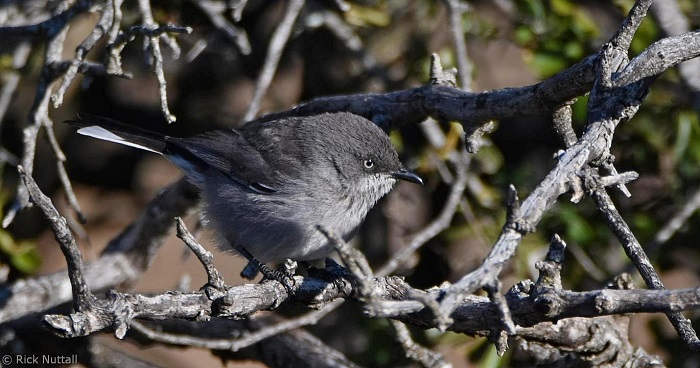
Cover image of Layard’s Warbler by Rick Nuttall – Addo Elephant National Park, Eastern Cape
Layard’s Warbler is a member of the family SYLVIIDAE (Sylvia and Curruca Warblers). These small passerine birds are found throughout Africa, Europe, and much of Asia, as far as north-central China and parts of Siberia. These warblers are usually birds of dense, shrubby habitats, but some also occur in more forested environments. Sylviidae comprises 32 species from 2 genera.
Identification

Carnarvon District, Northern Cape
Photo by Ryan Tippett
In the Layard’s Warbler, the sexes differ slightly in plumage coloration, but this is difficult to see in the field. The adult male is predominantly slate grey in overall appearance. The upper parts are slightly darker than the undersides. The chin, throat, and upper breast are off-white, and the throat carries fine, black streaks. The lower breast is pale grey, palest in the middle, and the flanks are washed darker grey. The Undertail Coverts are white (diagnostic). The tail itself is black, edged, and tipped white. The eye is white (diagnostic in both sexes), and the bill, legs, and feet are black.
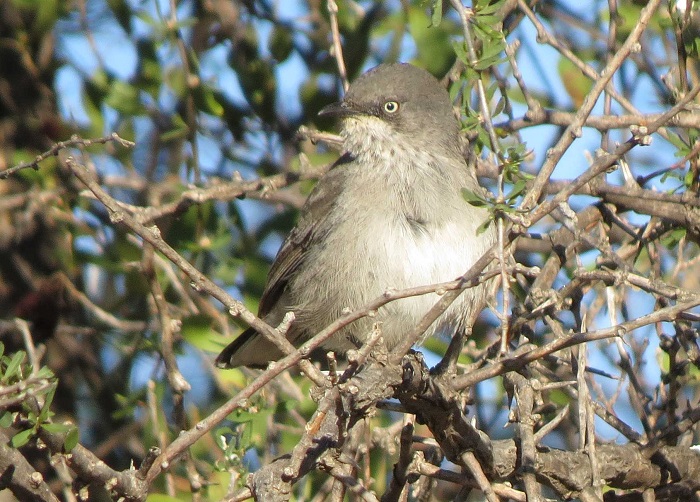
Middelburg district, Eastern Cape
Photo by Tino Herselman
Adult females are usually slightly browner overall than males, and the streaking on the throat and upper breast is less well pronounced. The flanks and undertail coverts are buffy-white. Juveniles resemble the adults, but the chin and throat are greyish, without streaking. The underparts are buffy grey. They also differ in having greyish-yellow (not white) eyes.
Layard’s Warbler is only likely to be mistaken for the closely related Chestnut-vented Tit-Babbler (Sylvia subcaerulea), which is slightly darker and has chestnut (not white) undertail coverts. In more arid areas, the two species frequently co-occur, but differ in their preferred habitat.
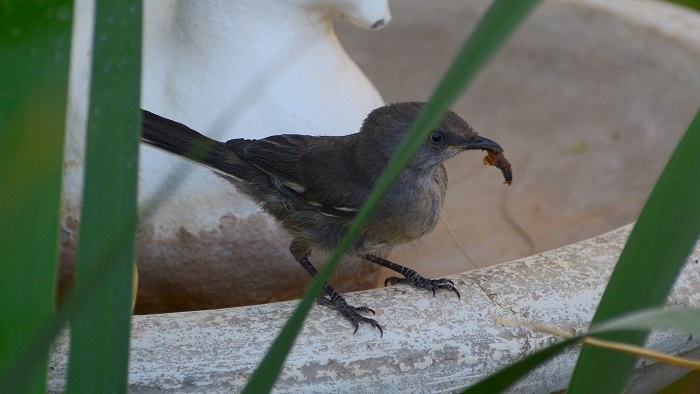
Carnarvon District, Northern Cape
Photo by Ryan Tippett
Status and Distribution
Layard’s Warbler is fairly common to common. It is endemic to southern Africa, from western and southern Namibia south to the Western Cape and west across the Karoo to Free State, Lesotho, and marginally into western KwaZulu-Natal.
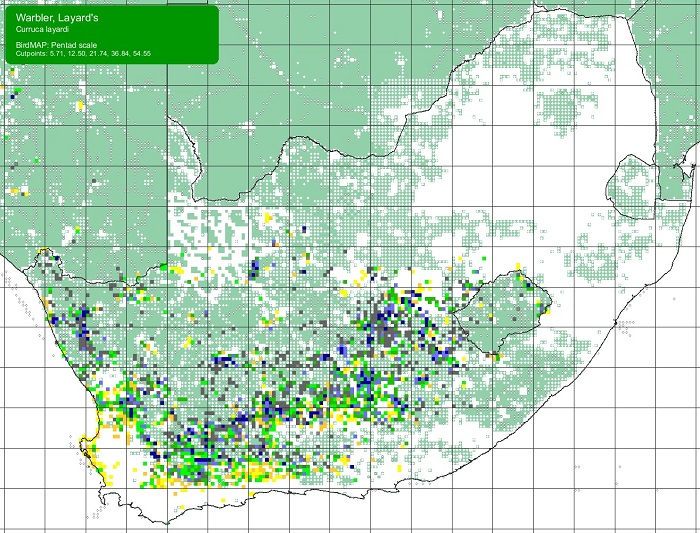
Layard’s Warbler is not threatened. The distribution is not known to have differed from the present. However, it has probably been negatively impacted by coastal development along the west coast of the Western Cape.
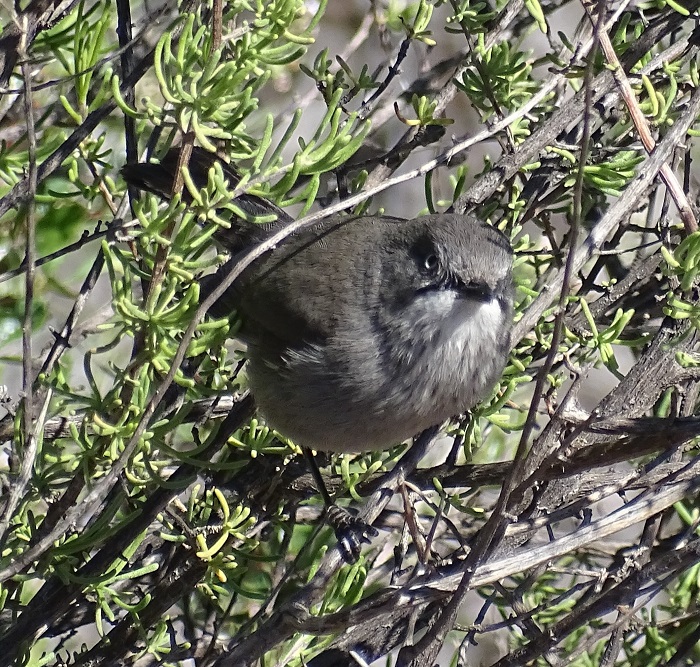
Bushmanskloof, Western Cape
Photo by Zenobia van Dyk
Habitat
Layard’s Warbler typically inhabits short scrub on rocky slopes. It occurs in semi-arid to arid Karroid scrub in both the summer and winter rainfall regions, where it appears to be most numerous. Also occurs in coastal fynbos, Alpine scrub, and taller montane fynbos. Layard’s Warbler is found from sea level along the West Coast to over 2400 m above sea level in the Drakensberg.
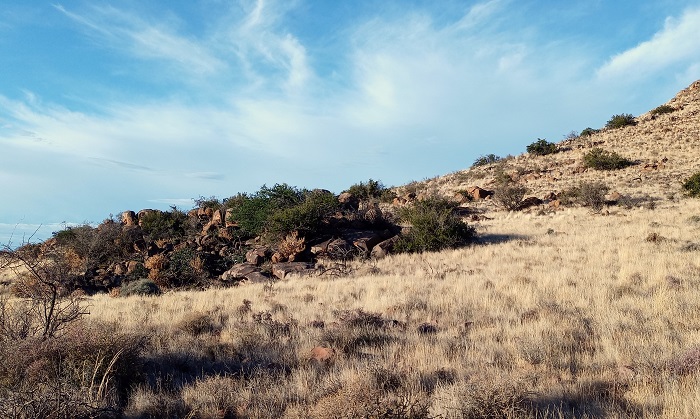
Carnarvon District, Northern Cape
Photo by Ryan Tippett
Behaviour
Layard’s Warbler is mostly resident. In the Karoo, it may move from hillside habitats to lower-lying drainage lines during winter; it also moves to lower altitudes in the Drakensberg during winter.
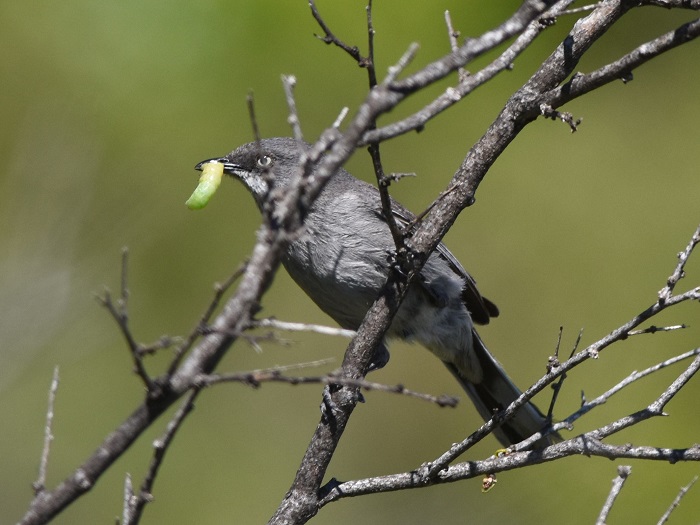
Near Klawer, Western Cape
Photo by Gerald Wingate
Layard’s Warbler is usually encountered singly or in pairs. They are not easily flushed and tend to remain hidden in the undergrowth. They are inquisitive and respond readily to tape playback or spishing. Conspicuous and vocal in the breeding season but easily overlooked when not calling. Sometimes snaps wings in flight from bush to bush and seldom flies in a straight line.
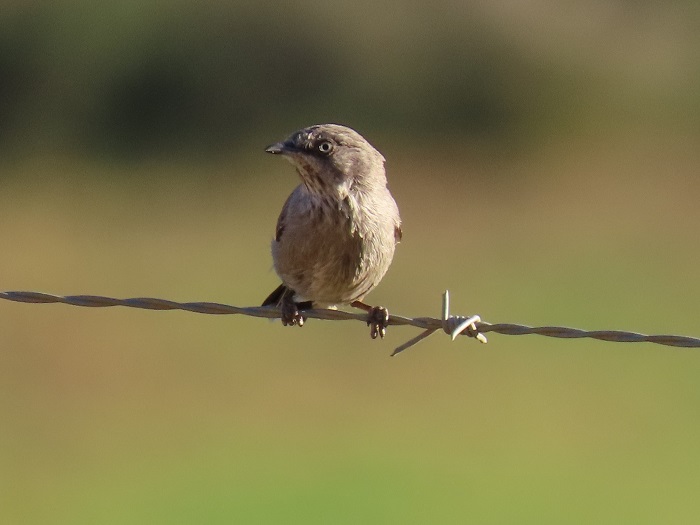
Kasteelberg, Western Cape
Photo by Fiona Hellmann
Layard’s Warbler forages low down in bushes and shrubs, gleaning food from leaves and stems. Eats invertebrates, including grasshoppers, termites, bugs, beetles, caterpillars, and ants. They also consume small fruits and seeds.
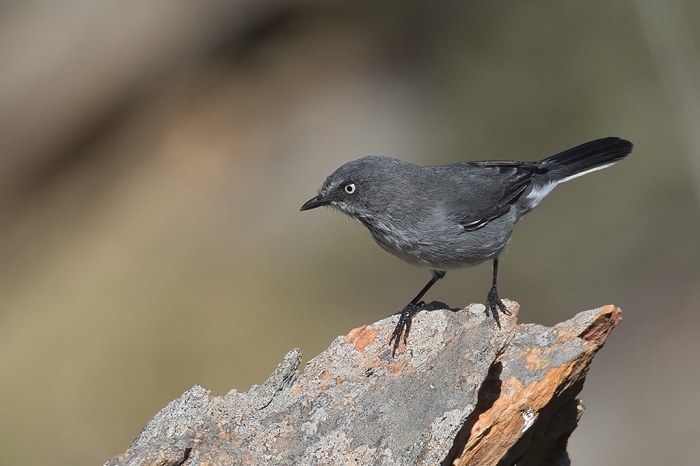
Worcester, Western Cape
Photo by Gregg Darling
Layard’s Warbler is a monogamous, solitary nester. They are probably strongly territorial as breeding pairs are widely spaced. Sings from a perch or makes short display flights in territorial defence.
The nest is a thin-walled cup of grass, silky plant fibres, and spider web placed in a fork of a bush. It is usually found low down and is often fairly exposed. 2 to 3 eggs are laid per clutch. The incubation period is unknown. Adults feeding the young at the nest are very wary and frequently dive behind boulders and into concealing vegetation, usually emerging unseen. The nestling period is not more than 15days.
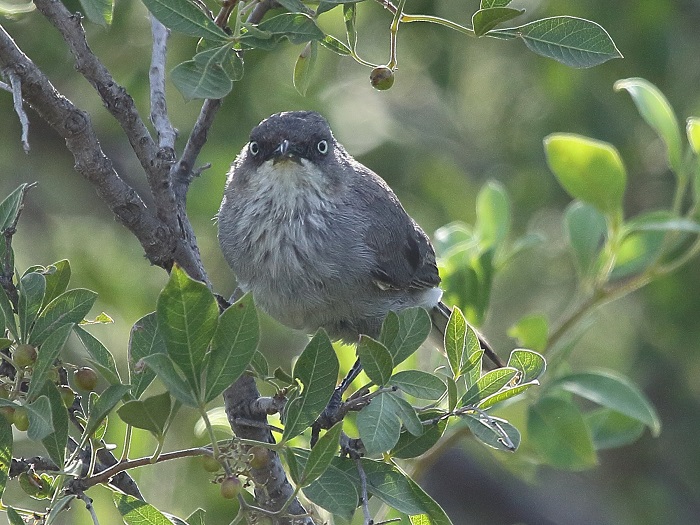
Cypherfontein, Free State
Photo by Phillip Nieuwoudt
Further Resources
Species text adapted from the first Southern African Bird Atlas Project (SABAP1), 1997.
The use of photographs by Dawie de Swardt, Fiona Hellmann, Gerald Wingate, Gregg Darling, Phillip Nieuwoudt, Rick Nuttall, Ryan Tippett, Tino Herselman, and Zenobia van Dyk is acknowledged.
Other common names: Parisoma layardi (Alt. Scientific); Layard’s Titbabbler; Layard’s Tit-Babbler (Alt. English); Grystjeriktik (Afrikaans); Parisome de Layard (French); Layards Meisensänger (German); Layards Meeszanger (Dutch); Felosa-chapim de Layard (Portuguese)
Recommended citation format: Tippett RM. 2026. Layard’s Warbler Sylvia layardii. Biodiversity and Development Institute. Available online at https://thebdi.org/2026/04/14/layards-warbler-sylvia-layardii/

Bloemfontein, Free State
Photo by Dawie de Swardt
