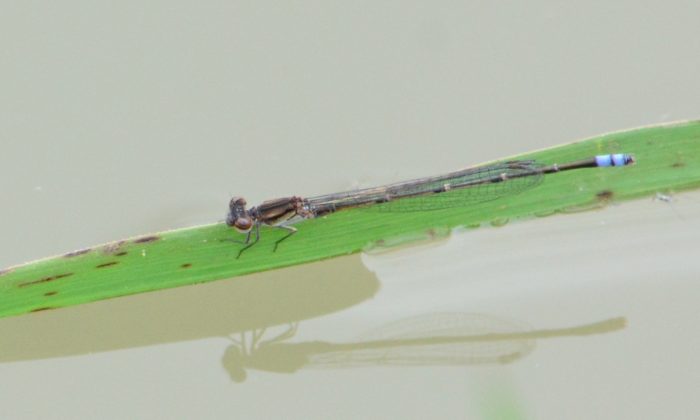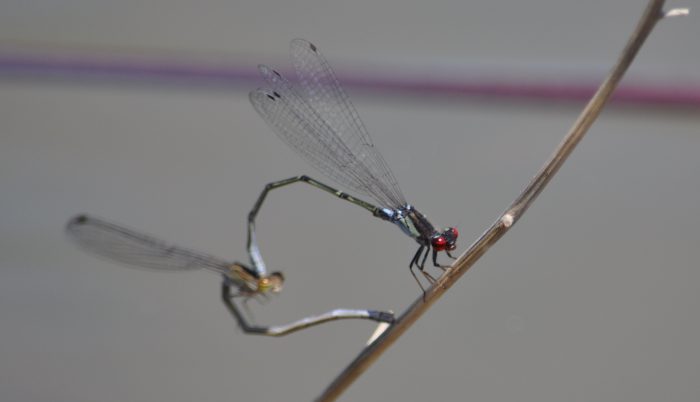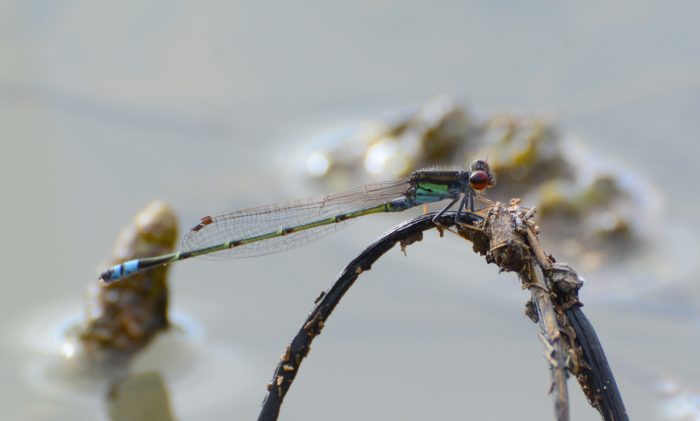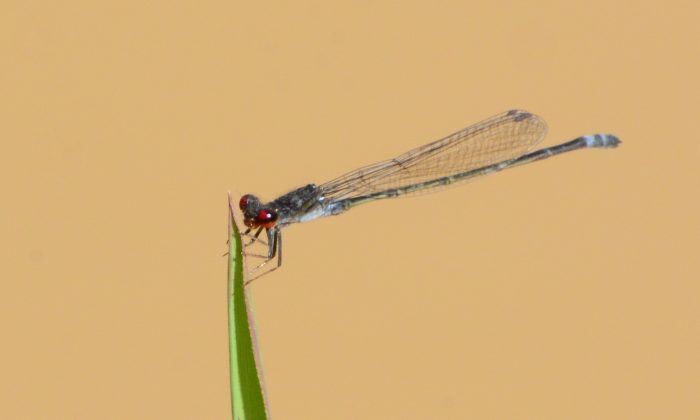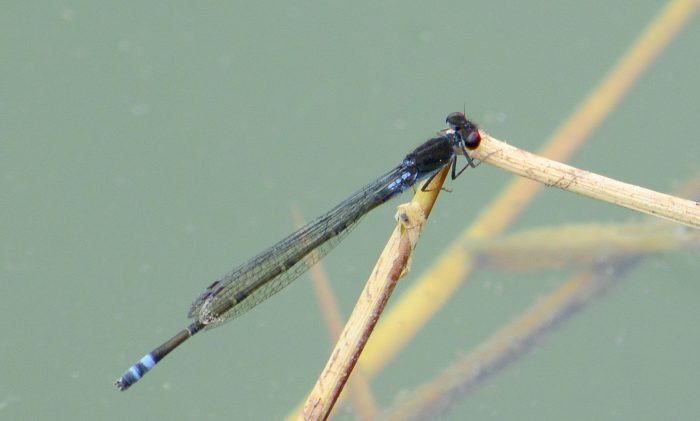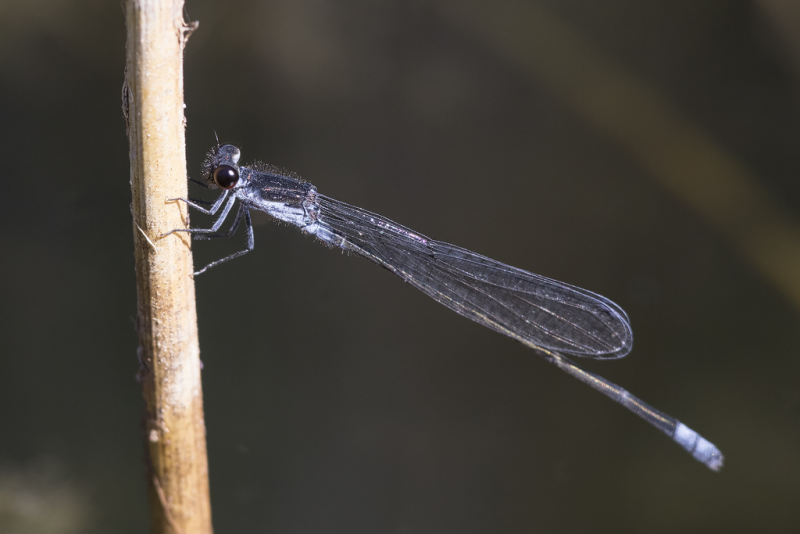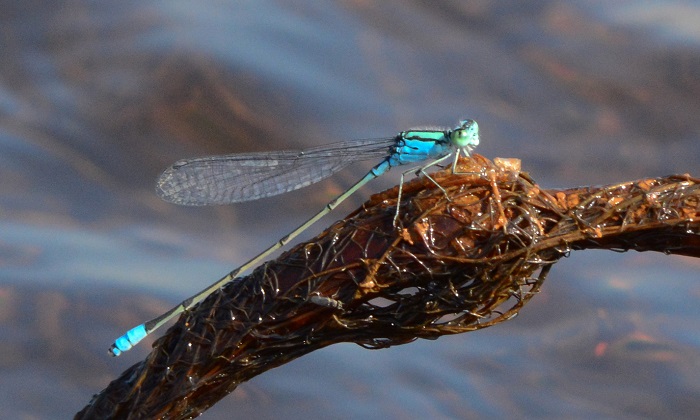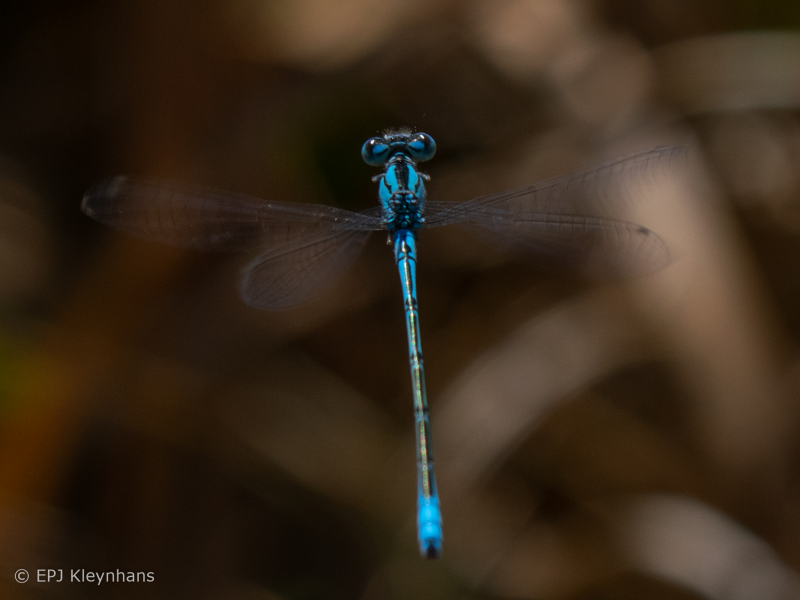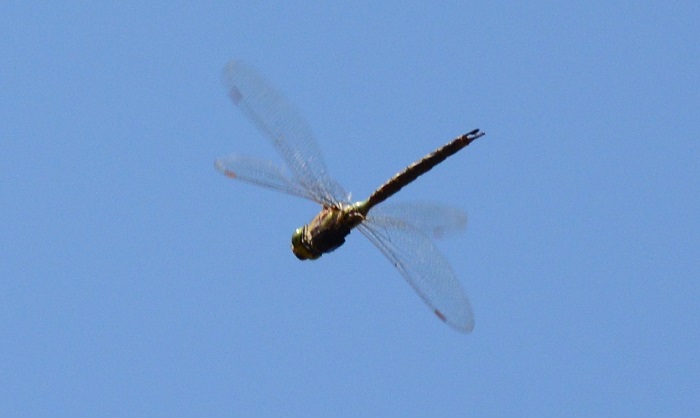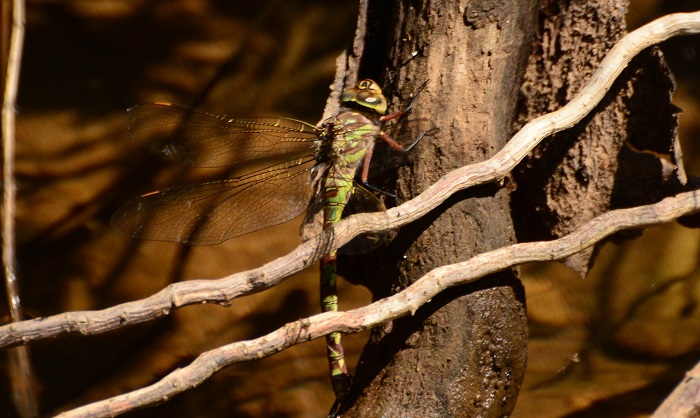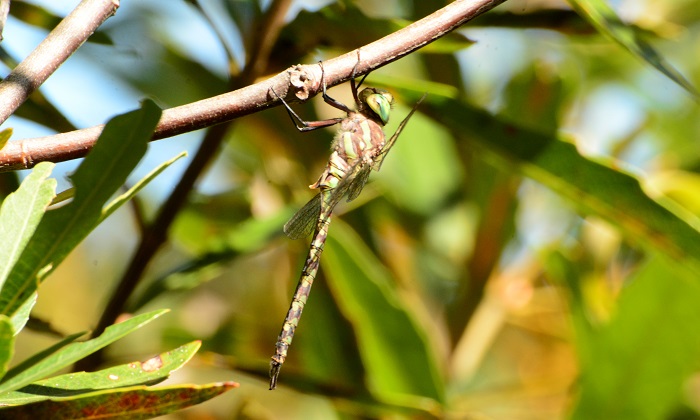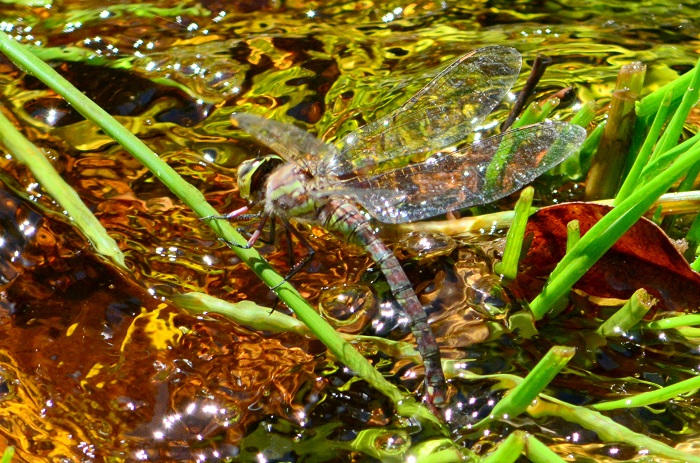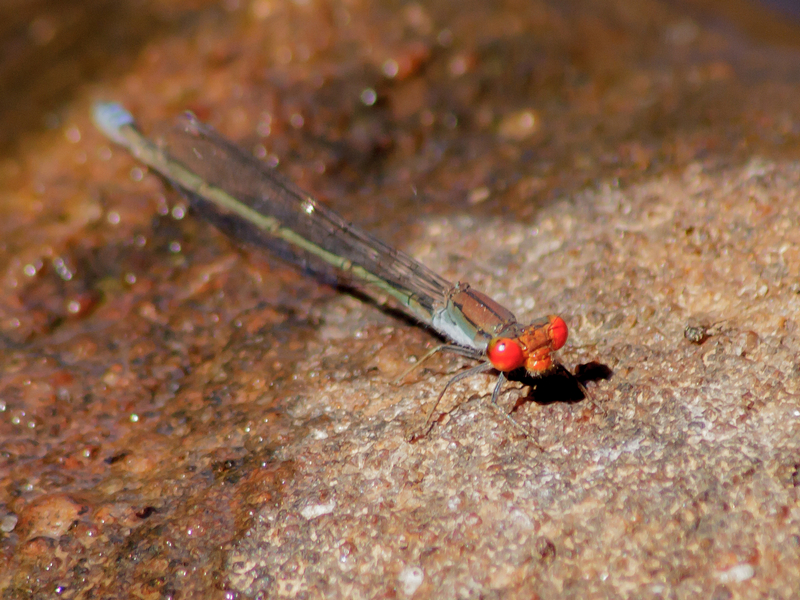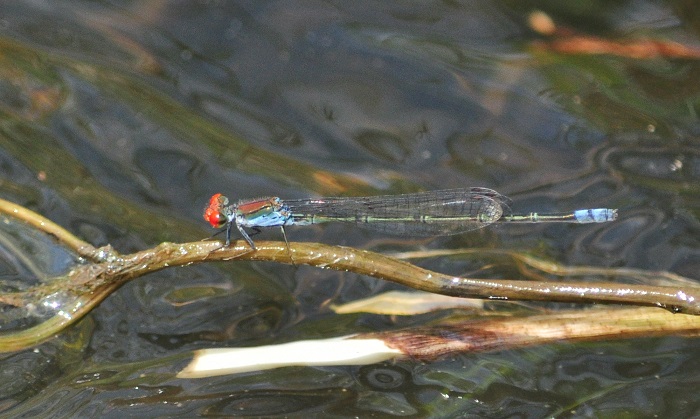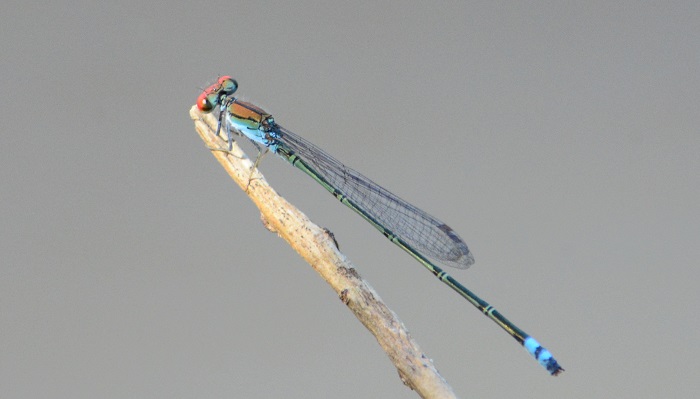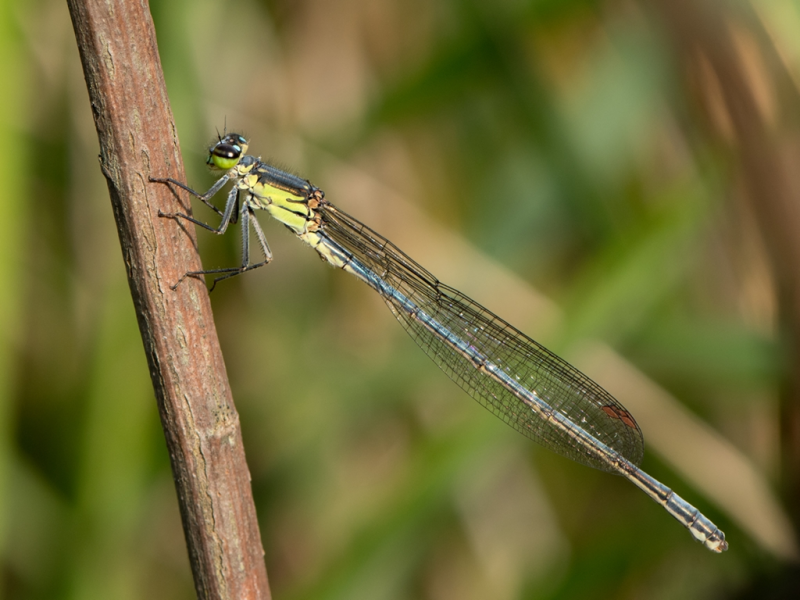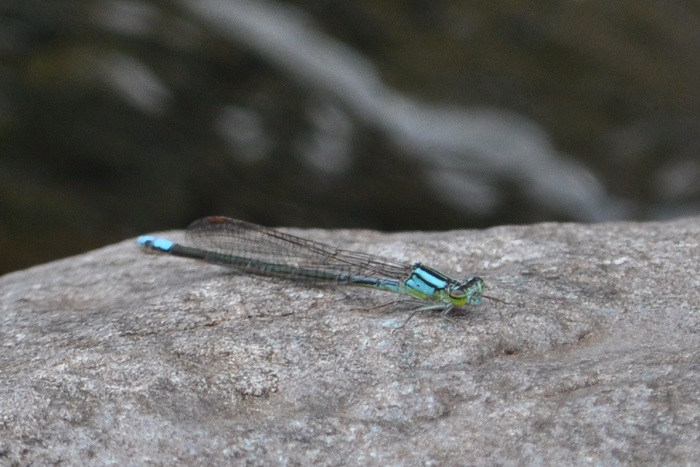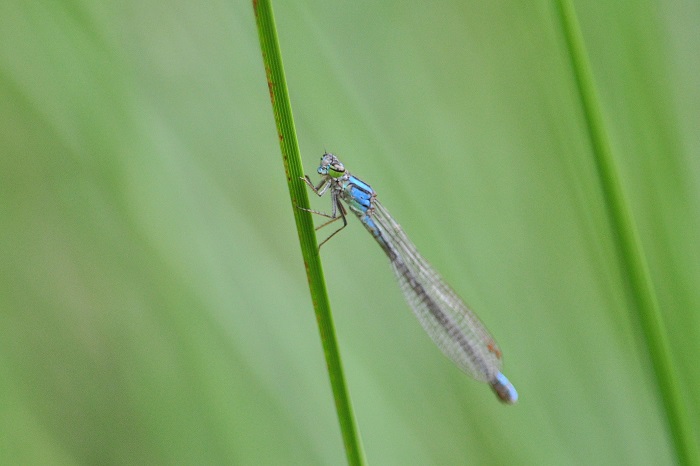
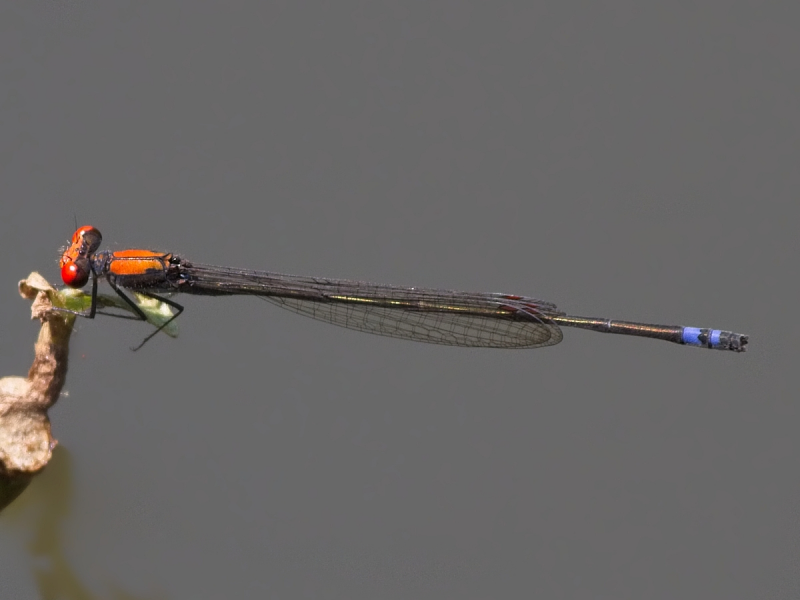
Variable Sprite (Pseudagrion sjoestedti)

Cover photo by John Wilkinson.

Find the Variable Sprite in the FBIS database (Freshwater Biodiversity Information System) here.

Family Coenagrionidae

Identification
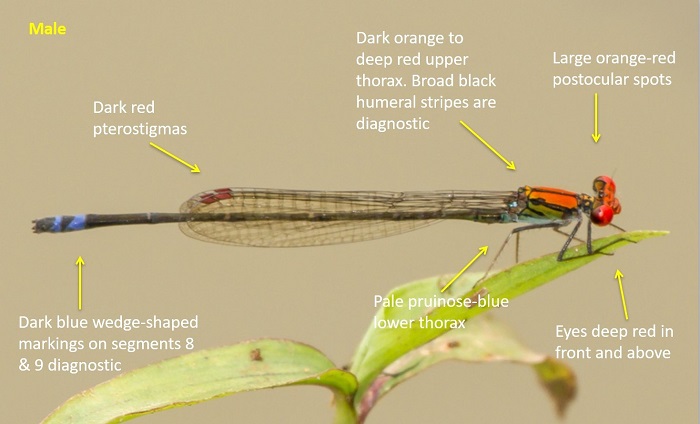
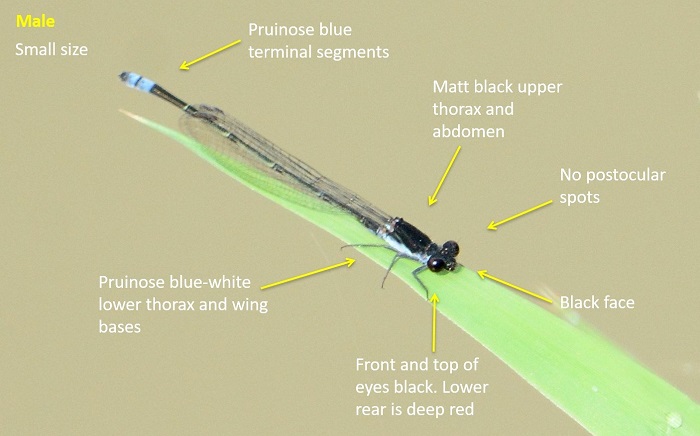
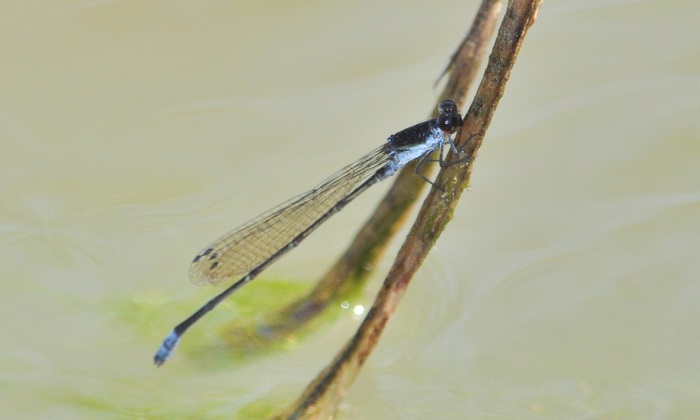
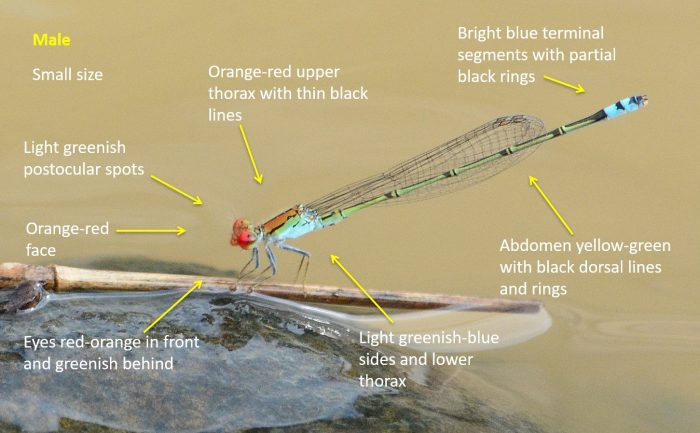
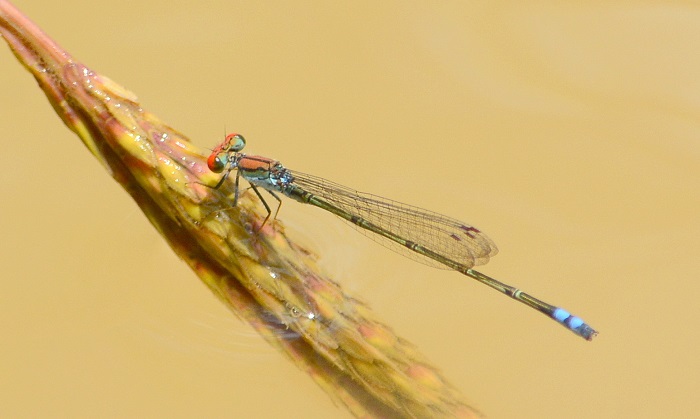
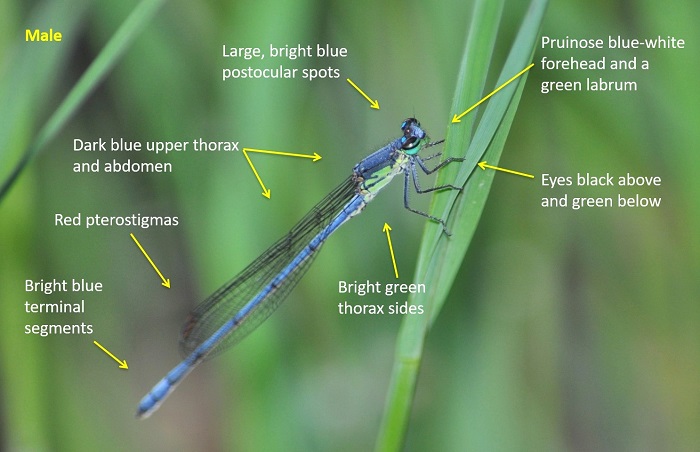
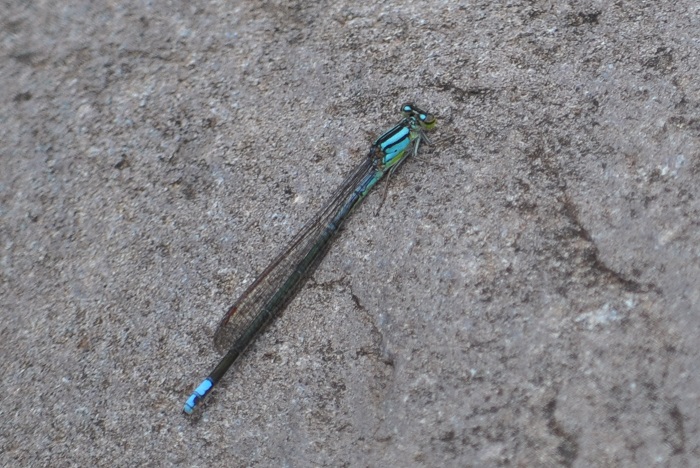
Variable Sprite Pseudagrion sjoestedti – Male
Near Tzaneen, Limpopo
Photo by John Wilkinson

Small size

Length up to 36mm; Wingspan attains 48mm.

The Variable Sprite is one of four predominantly ‘red’ sprite species in the region. The others being Pseudagrion massaicum (Masai Sprite), Pseudagrion acaciae (Acacia Sprite) and Pseudagrion vaalense (Vaal Sprite).

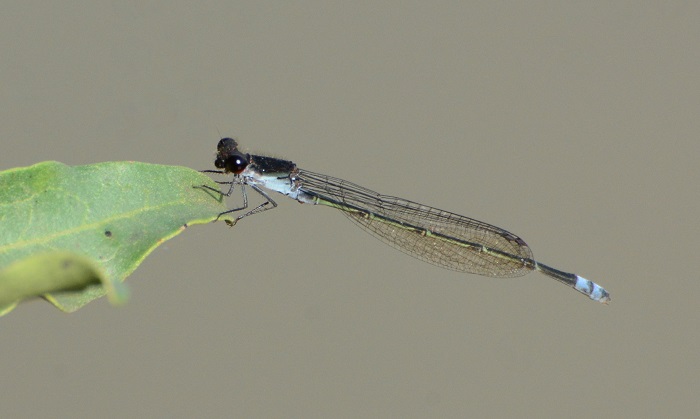
Pseudagrion sjoestedti is best told apart from the others by the morphology of the male claspers. However, the distinctive wedge-shaped blue markings on the terminal segments and the broad humeral stripe are also diagnostic.

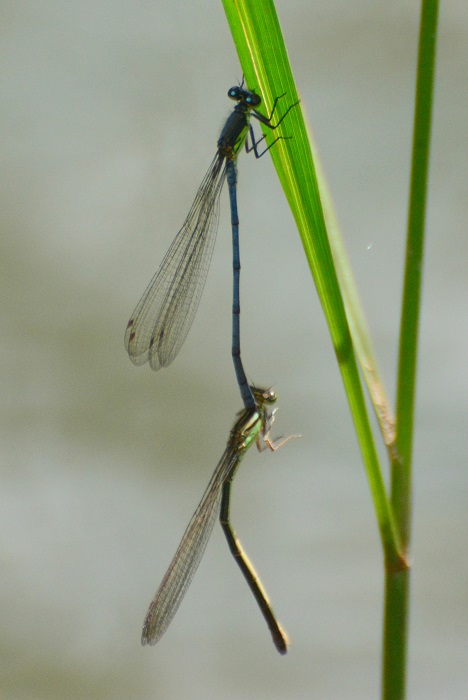
Females are similar to those of other sprite species and are best identified by their association with the males.

Click here for more details on identification.

Habitat

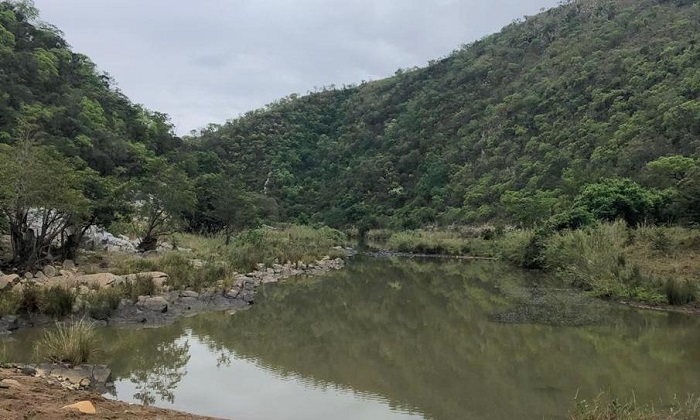
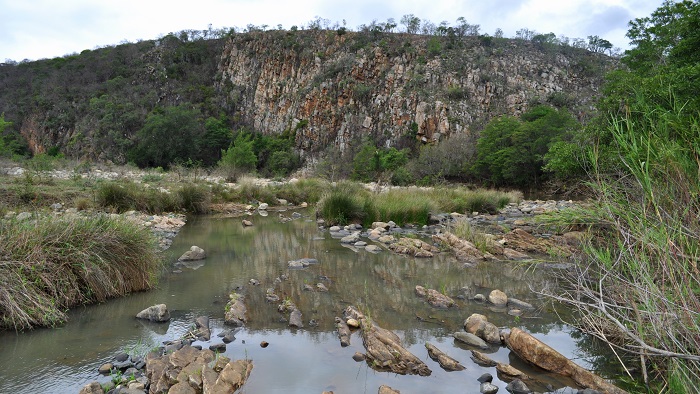
The Variable Sprite is a riverine species, favouring sheltered sites with large overhanging trees, along flowing savanna rivers. It is often found in shaded spots with dappled light.
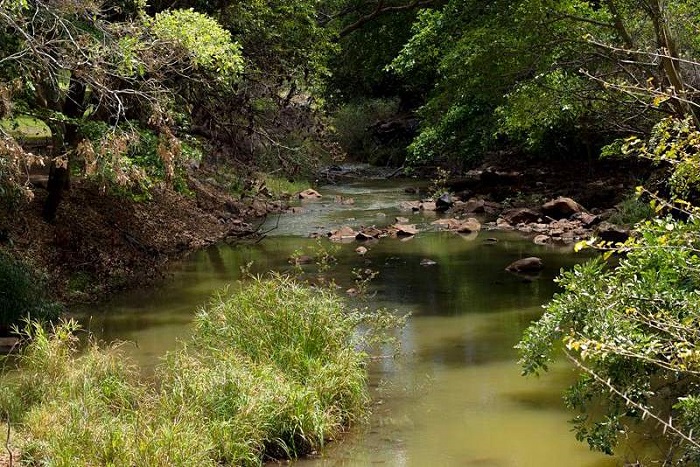
Habitat – Nwanedi Nature Reserve, Limpopo
Photo by John Wilkinson

Behaviour

The Variable Sprite perches on emergent and overhanging reeds near the water.

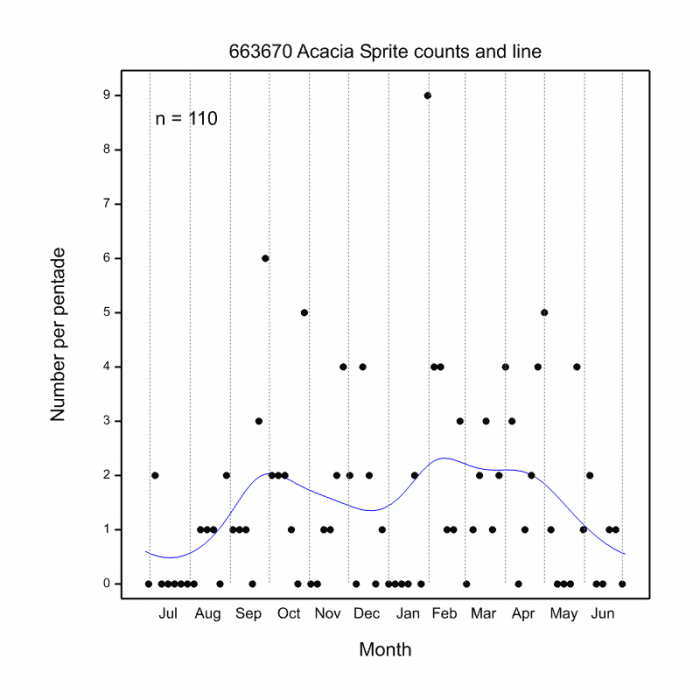
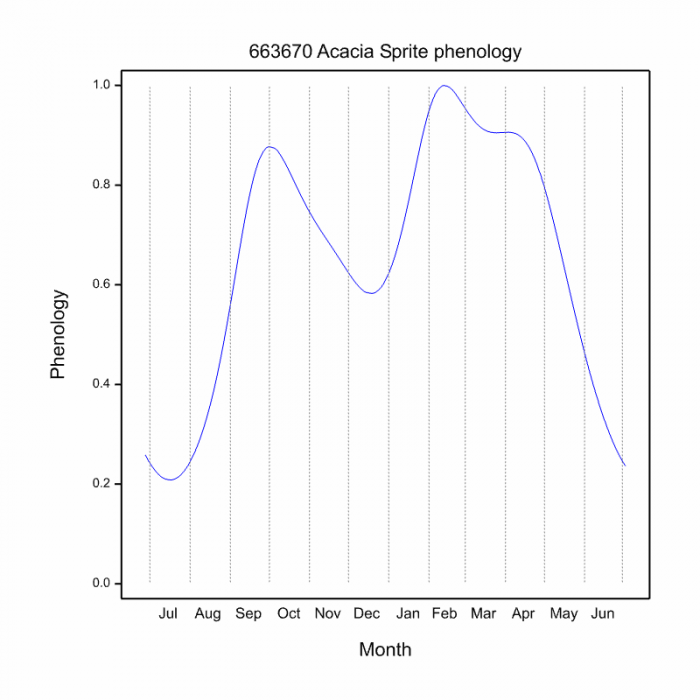
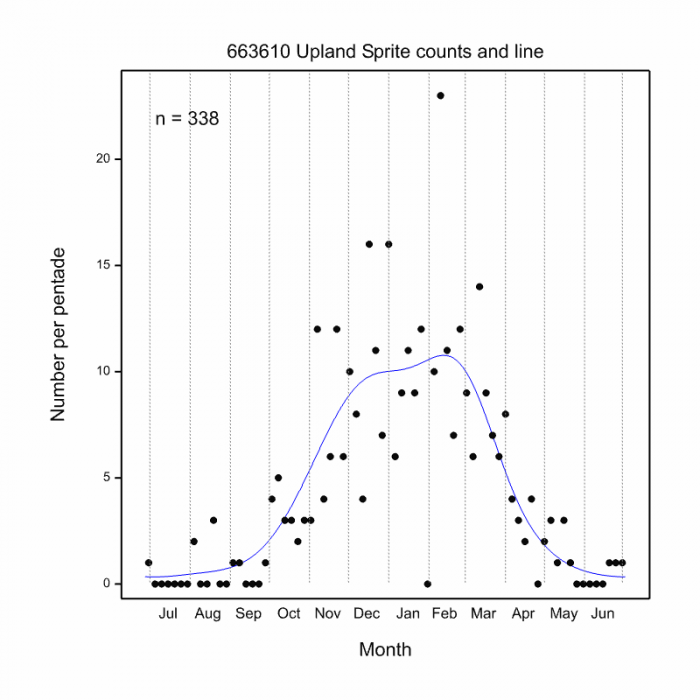
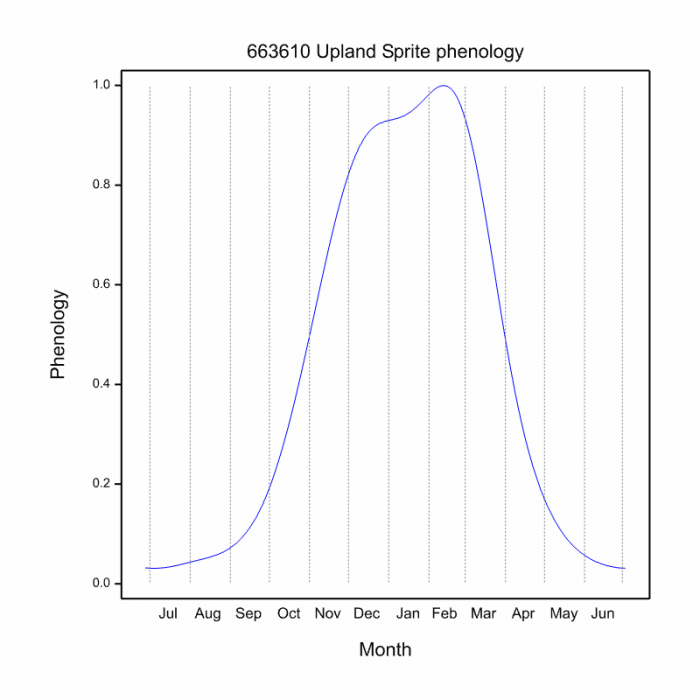
On the wing from September to May (see Phenology below).

Status and Conservation

The Variable Sprite is uncommon and localised in South Africa. It is listed as of Least Concern in the IUCN Red List of Threatened Species.

Distribution

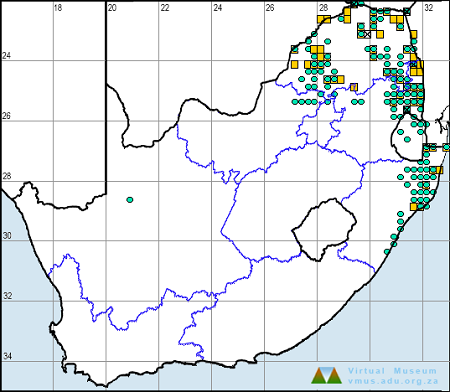
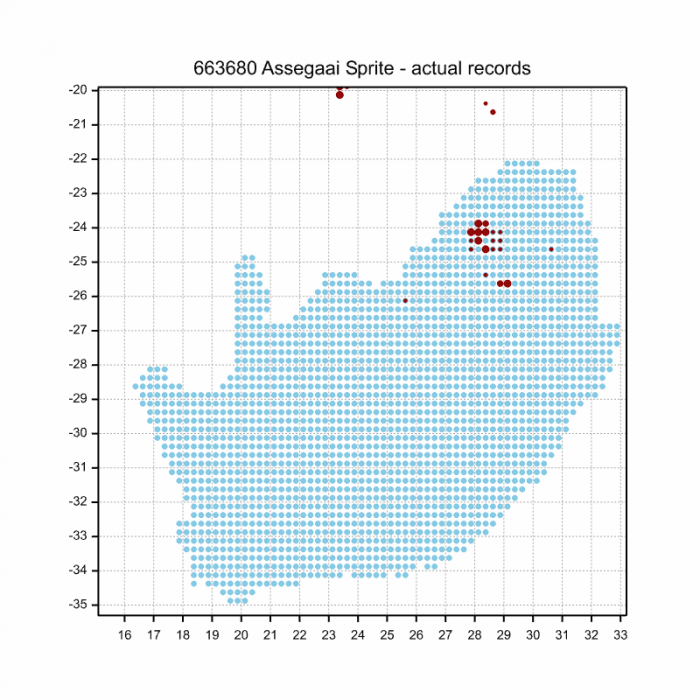
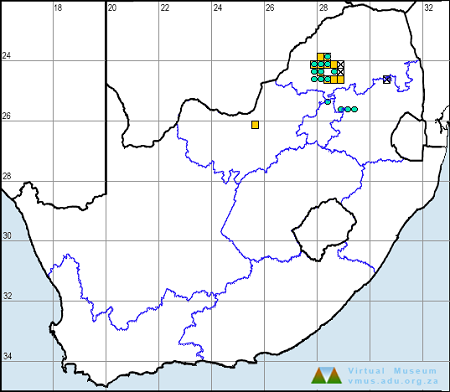
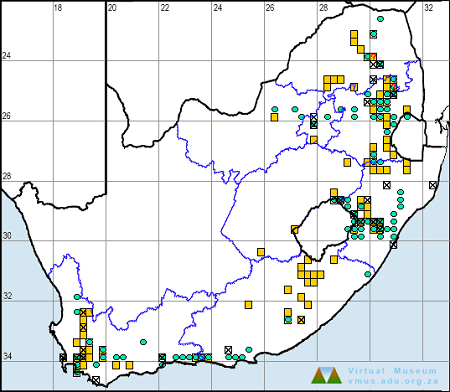
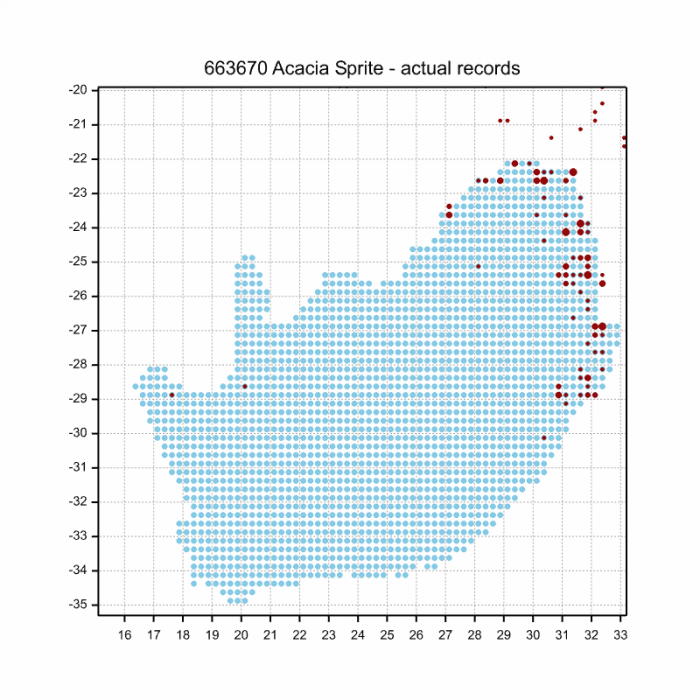
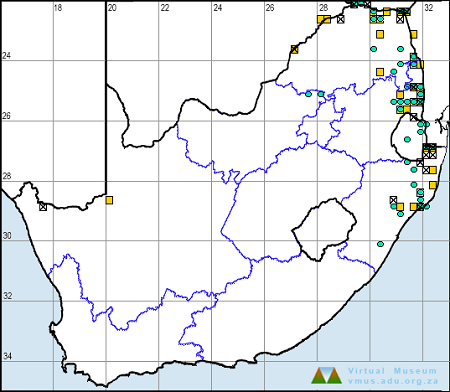
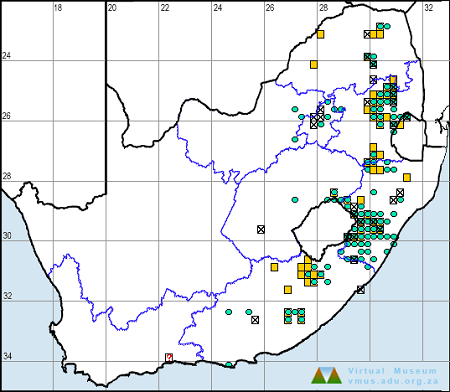
The Variable Sprite is sparsely distributed throughout much of tropical Africa. It is found only in the Northern parts of South Africa, in the Limpopo and Mpumalanga provinces. There are also a couple of new records from northern KwaZulu-Natal (see maps below).

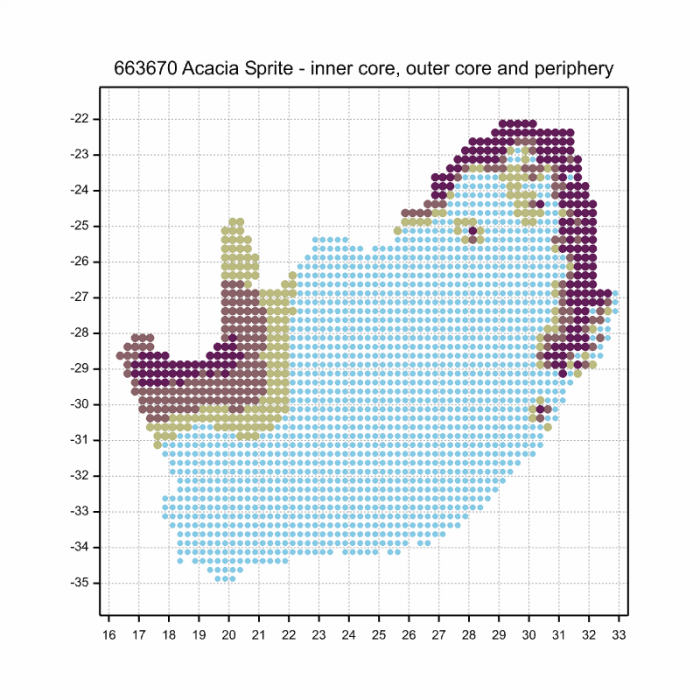
Below is a map showing the distribution of records for Variable Sprite in the OdonataMAP database as at February 2020.

Below is a map showing the distribution of records for Variable Sprite in the OdonataMAP database as of December 2024.
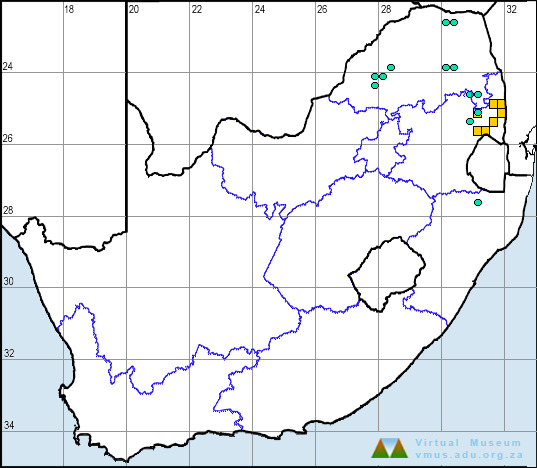
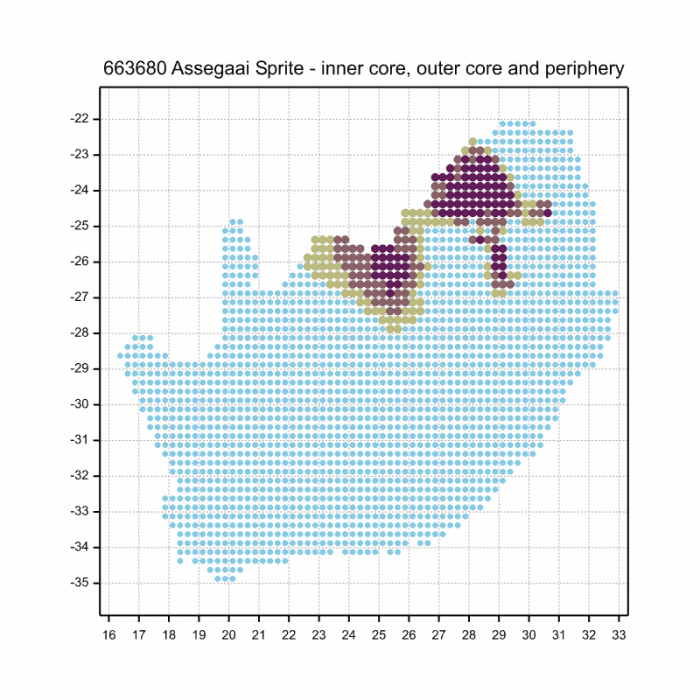
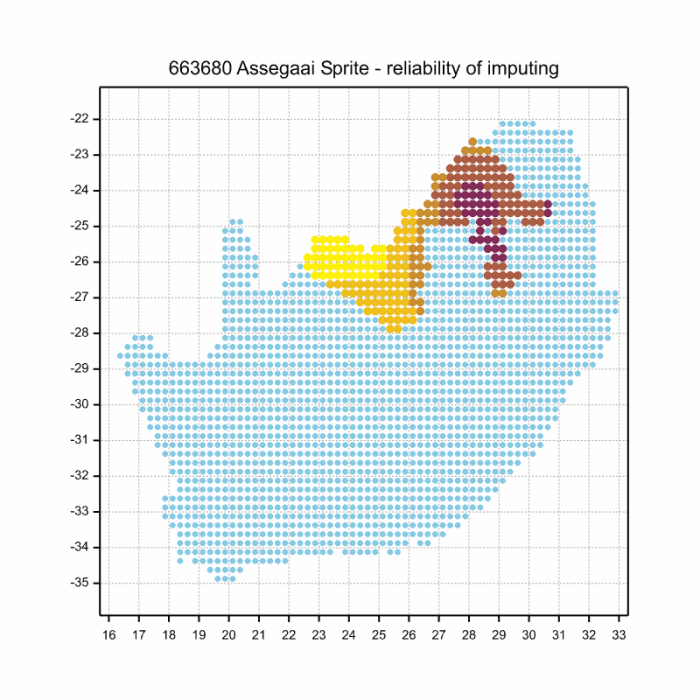
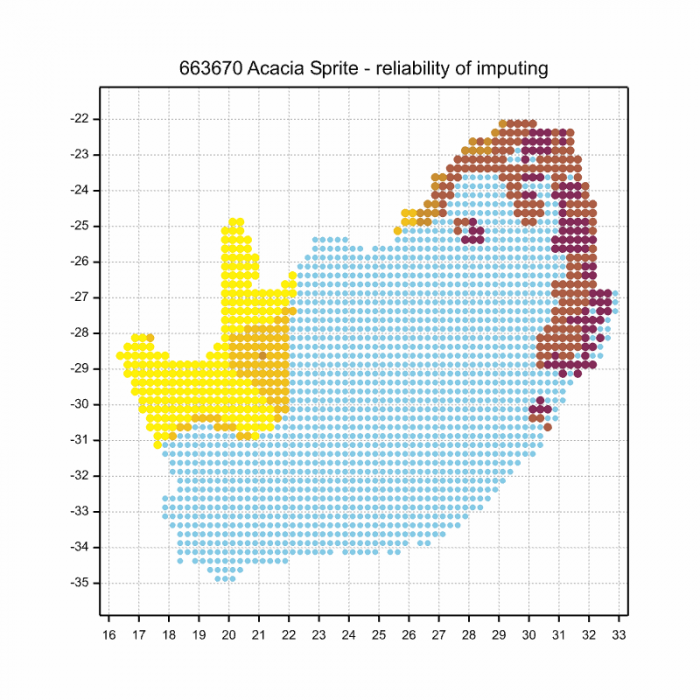
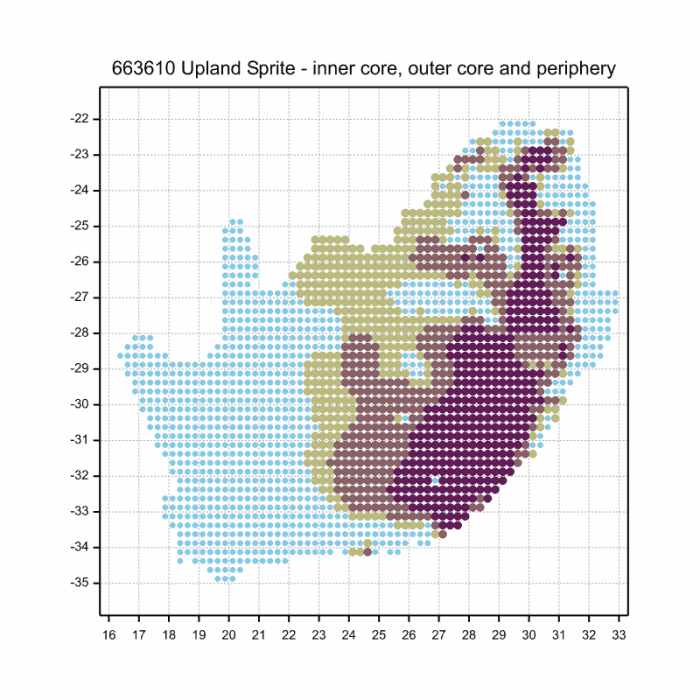
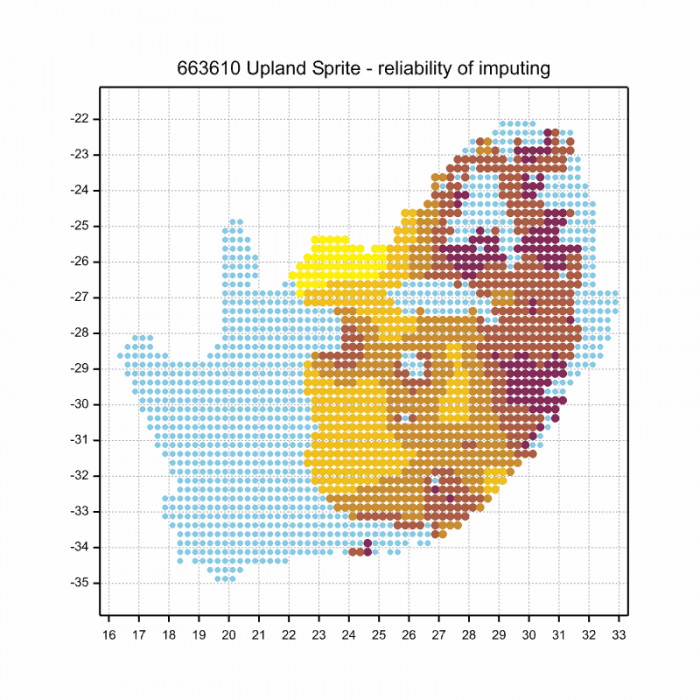
The next map below is an imputed map, produced by an interpolation algorithm, which attempts to generate a full distribution map from the partial information in the map above. This map will be improved by the submission of records to the OdonataMAP section of the Virtual Museum.
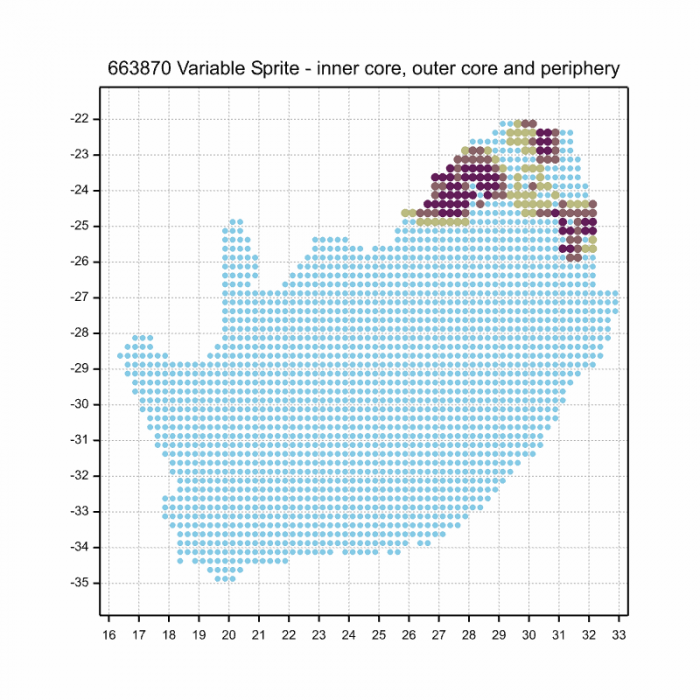
Ultimately, we will produce a series of maps for all the odonata species in the region. The current algorithm is a new algorithm. The objective is mainly to produce “smoothed” maps that could go into a field guide for odonata. This basic version of the algorithm (as mapped above) does not make use of “explanatory variables” (e.g. altitude, terrain roughness, presence of freshwater — we will be producing maps that take these variables into account soon). Currently, it only makes use of the OdonataMAP records for the species being mapped, as well as all the other records of all other species. The basic maps are “optimistic” and will generally show ranges to be larger than what they probably are.

These maps use the data in the OdonataMAP section of the Virtual Museum, and also the database assembled by the previous JRS funded project, which was led by Professor Michael Samways and Dr KD Dijkstra.

Phenology

Further Resources

The use of photographs by John Wilkinson is acknowledged.

Variable Sprite Pseudagrion sjoestedti Förster, 1906

Other common names: Rufous Sprite (Alt. English); Verneukertjiegesie (Afrikaans)

Recommended citation format: Loftie-Eaton M; Navarro R; Tippett RM; Underhill L. 2025. Variable Sprite Pseudagrion sjoestedti. Biodiversity and Development Institute. Available online at https://thebdi.org/2020/05/22/variable-sprite-pseudagrion-sjoestedti/

References: Tarboton, M; Tarboton, W. (2019). A Guide to the Dragonflies & Damselflies of South Africa. Struik Nature.

Samways, MJ. (2008). Dragonflies and Damselflies of South Africa. Pensoft

Samways, MJ. (2016). Manual of Freshwater Assessment for South Africa: Dragonfly Biotic Index. Suricata 2. South African National Biodiversity Institute, Pretoria

Martens, A; Suhling, F. (2007). Dragonflies and Damselflies of Namibia. Gamsberg Macmillan.

Similar Species

Swarthy Sprite (Pseudagrion hamoni)

Cover photo by John Wilkinson.

Find the Swarthy Sprite in the FBIS database (Freshwater Biodiversity Information System) here.

Family Coenagrionidae

Identification

Swarthy Sprite Pseudagrion hamoni – Male
Mkuze River, KwaZulu-Natal
Photo by Ryan Tippett

Small size

Length up to 39mm; Wingspan reaches 50mm.

The Swarthy Sprite shows considerable variation in colouration, depending on age.

Males most closely resemble Pseudagrion commoniae (Black Sprite). Both species may show a uniformly pruinescent black upper thorax, blue sides on the thorax, and blue between the wings. P. hamoni has red and black eyes, with the red being visible on both the top and front of the eyes. The eyes of P. commoniae are black above and in front, only showing a small amount of red on the undersides.

Females are similar to those of many other Pseudagrion species and are best identified by their association with the males.

Click here for more details on identification.

Swarthy Sprite Pseudagrion hamoni – Female
Amakhosi Game Reserve, KwaZulu-Natal
Photo by Ryan Tippett

Habitat

The Swarthy Sprite occupies still or slow-moving sections of rivers, as well as the vegetated fringes of dams, pans, and pools. It is often found on patches of floating aquatic plants. The Swarthy Sprite is mainly a species of the Savanna biome.

Habitat – Mkuze River, KwaZulu-Natal
Photo by Rowan Poortier

Behaviour

Swarthy Sprites perch on vegetation or rocks near the water. Males and females are frequently found side by side. They feed on small aerial insects like mosquitoes and moths.

Most active from October to April but recorded year round at some sites. See Phenology below.

Swarthy Sprite Pseudagrion hamoni – Pair
Mkuze River, KwaZulu-Natal
Photo by Ryan Tippett

Status and Conservation

The Swarthy Sprite is a common resident and is listed as of Least Concern in the IUCN Red List of Threatened Species. It is an adaptable species that can make use of man-made dams and somewhat degraded habitats.

Swarthy Sprite Pseudagrion hamoni – Male
Mkuze River, KwaZulu-Natal
Photo by Ryan Tippett

Distribution

The Swarthy Sprite is widespread across much of Sub-Saharan Africa.

In South Africa, it is restricted to the north-east and is found in KwaZulu-Natal, Mpumalanga, Limpopo, North-West, and Gauteng.

Below is a map showing the distribution of records for Swarthy Sprite in the OdonataMAP database as at February 2020.

Below is a map showing the distribution of records for Swarthy Sprite in the OdonataMAP database as of December 2024.

The next map below is an imputed map, produced by an interpolation algorithm, which attempts to generate a full distribution map from the partial information in the map above. This map will be improved by the submission of records to the OdonataMAP section of the Virtual Museum.
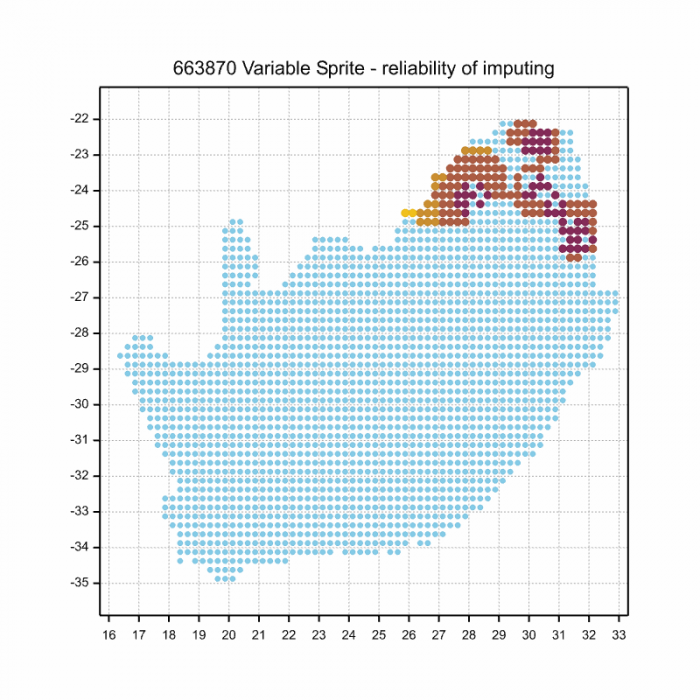
Ultimately, we will produce a series of maps for all the odonata species in the region. The current algorithm is a new algorithm. The objective is mainly to produce “smoothed” maps that could go into a field guide for odonata. This basic version of the algorithm (as mapped above) does not make use of “explanatory variables” (e.g. altitude, terrain roughness, presence of freshwater — we will be producing maps that take these variables into account soon). Currently, it only makes use of the OdonataMAP records for the species being mapped, as well as all the other records of all other species. The basic maps are “optimistic” and will generally show ranges to be larger than what they probably are.

These maps use the data in the OdonataMAP section of the Virtual Museum, and also the database assembled by the previous JRS funded project, which was led by Professor Michael Samways and Dr KD Dijkstra.

Swarthy Sprite Pseudagrion hamoni – Male
Amakhosi Game Reserve, KwaZulu-Natal
Photo by Ryan Tippett

Phenology

Swarthy Sprite Pseudagrion hamoni – Male
Amakhosi Game Reserve, KwaZulu-Natal
Photo by Ryan Tippett

Further Resources

The use of photographs by John Wilkinson and Rowan Poortier is acknowledged.

Swarthy Sprite Pseudagrion hamoni Fraser, 1955

Other common names: Drab Sprite, Hamon’s Sprite (Alt. English); Donkergesie (Afrikaans).

Recommended citation format: Loftie-Eaton M; Navarro R; Tippett RM; Underhill L. 2025. Swarthy Sprite Pseudagrion hamoni. Biodiversity and Development Institute. Available online at https://thebdi.org/2020/05/21/swarthy-sprite-pseudagrion-hamoni/

References: Tarboton, M; Tarboton, W. (2019). A Guide to the Dragonflies & Damselflies of South Africa. Struik Nature.

Samways, MJ. (2008). Dragonflies and Damselflies of South Africa. Pensoft

Samways, MJ. (2016). Manual of Freshwater Assessment for South Africa: Dragonfly Biotic Index. Suricata 2. South African National Biodiversity Institute, Pretoria

Martens, A; Suhling, F. (2007). Dragonflies and Damselflies of Namibia. Gamsberg Macmillan.

Swarthy Sprite Pseudagrion hamoni – Male
Hluhluwe district, KwaZulu-Natal
Photo by Ryan Tippett

Similar Species

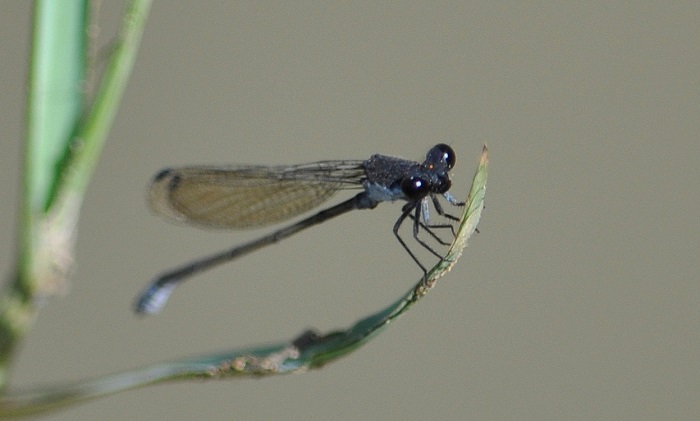
Black Sprite (Pseudagrion commoniae)

Cover photo by Desire Darling.

Find the Black Sprite in the FBIS database (Freshwater Biodiversity Information System) here.

Family Coenagrionidae

Identification

Black Sprite Pseudagrion commoniae – Male
Mkuze River, KwaZulu-Natal
Photo by Ryan Tippett

Small size

Length up to 39mm; Wingspan attains 51mm.

Male Black Sprites are most similar to the dark form Swarthy Sprite (Pseudagrion hamoni). Pseudagrion commoniae can be told by its eyes, which are black above and in front, with dark red below. In Pseudagrion hamoni, the eyes are red in front.

Females are easily confused with those of several other sprite species. They are best identified by their association with the males.

Click here for more details on identification.

Habitat

The Black Sprite inhabits the grass and reed-lined verges of streams and rivers, mainly in hot savanna areas. It prefers slow-moving stretches and pools, often where the water is fairly turbid. It is occasionally also found at dams and ponds. The Black Sprite is largely restricted to the Savanna Biome.

Habitat – Slow moving stretches of savanna rivers.
Mkuze River, KwaZulu-Natal
Photo by Ryan Tiuppett

Behaviour

The Black Sprite perches near the water among reeds and grass and is usually quite reluctant to fly. The Black Sprite feeds on small flying insects.

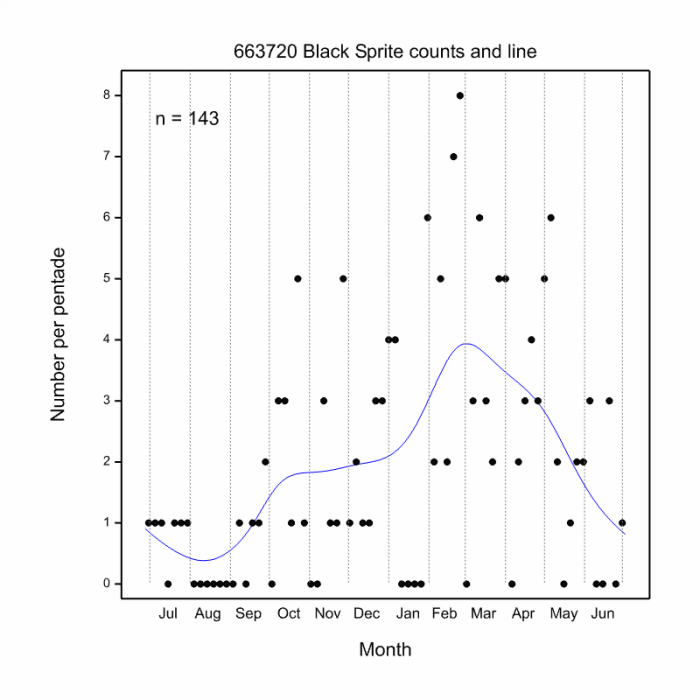
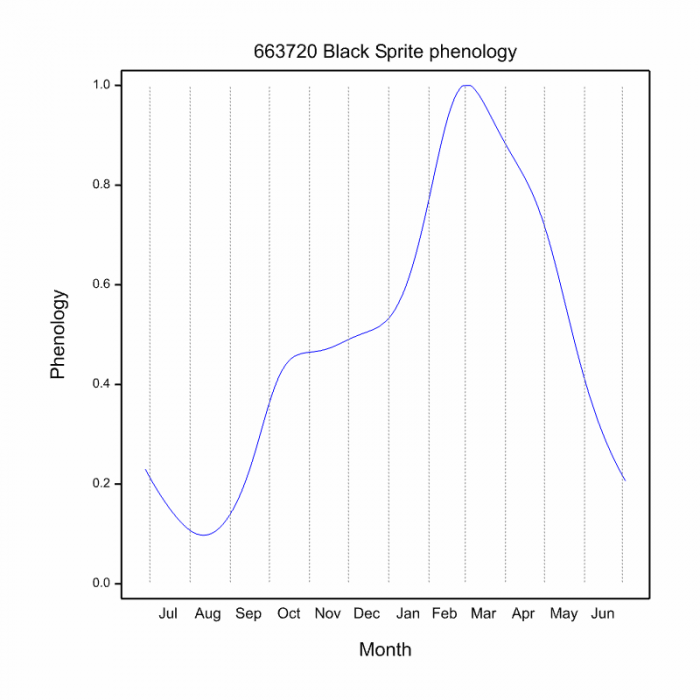
Most active from January to May but recorded year round in warmer areas. See Phenology below.

Black Sprite Pseudagrion commoniae – Male
Amakhosi Game Reserve, KwaZulu-Natal
Photo by Ryan Tippett

Status and Conservation

The Black Sprite is a common species in South Africa. It is listed as of Least Concern in the IUCN Red List of Threatened Species. The Black Sprite often frequents man-made and degraded habitats, especially those with turbid water.

Black Sprite Pseudagrion commoniae – Male
Mkuze River, KwaZulu-Natal
Photo by Ryan Tippett

Distribution

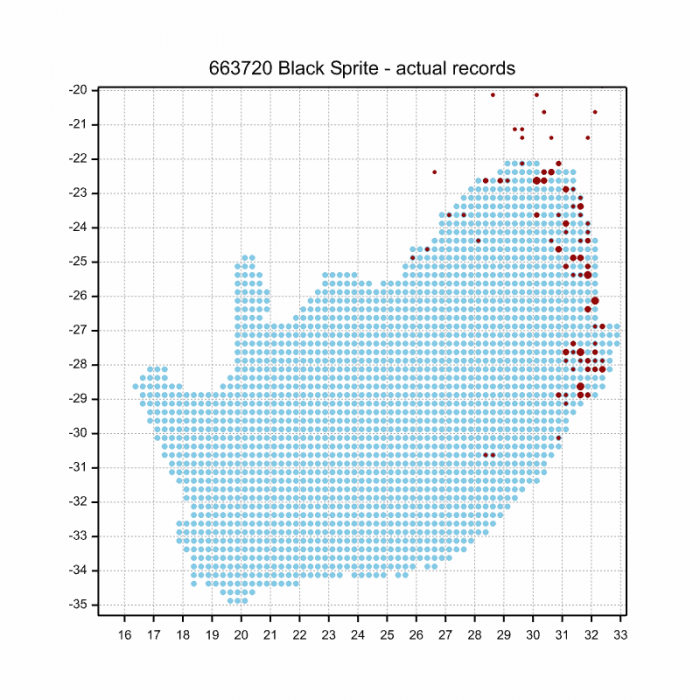
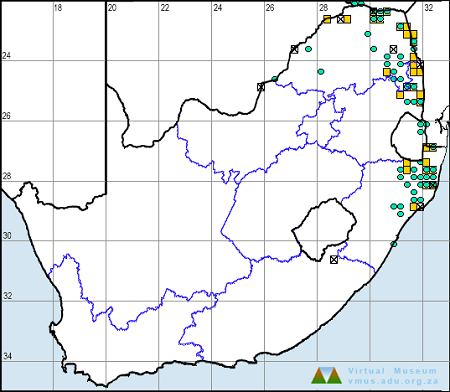
Pseudagrion commoniae is found in Southern and East Africa, ranging from Ethiopia in the North to South Africa. In South Africa it is restricted to the savanna regions of the north-east.

Below is a map showing the distribution of records for Black Sprite in the OdonataMAP database as at February 2020.

Below is a map showing the distribution of records for Black Sprite in the OdonataMAP database as of December 2024.

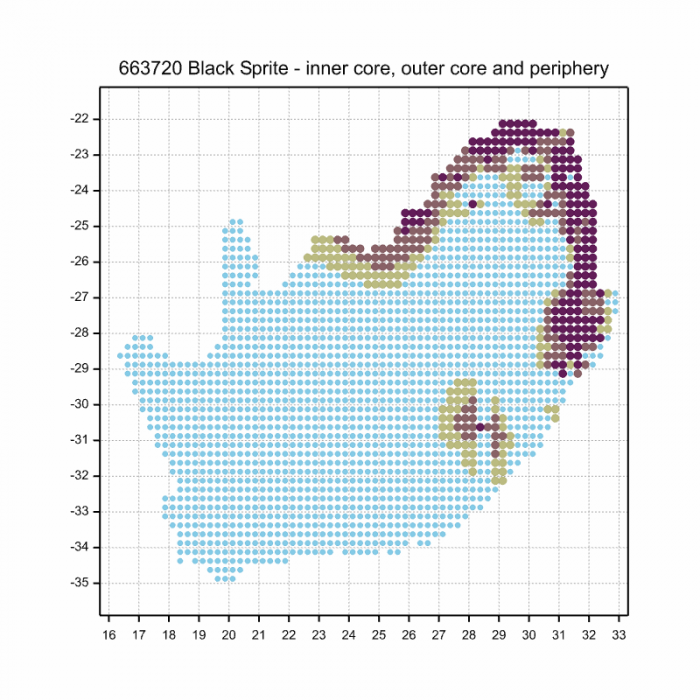
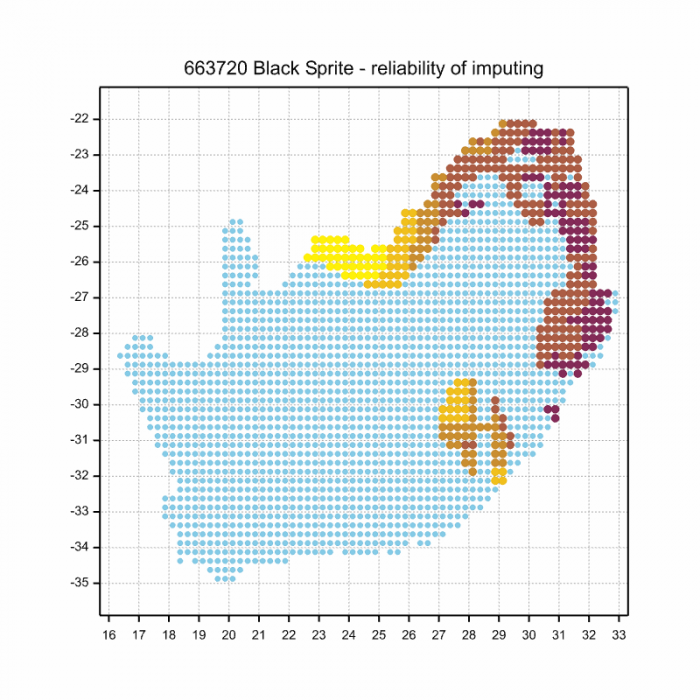
The next map below is an imputed map, produced by an interpolation algorithm, which attempts to generate a full distribution map from the partial information in the map above. This map will be improved by the submission of records to the OdonataMAP section of the Virtual Museum.

Ultimately, we will produce a series of maps for all the odonata species in the region. The current algorithm is a new algorithm. The objective is mainly to produce “smoothed” maps that could go into a field guide for odonata. This basic version of the algorithm (as mapped above) does not make use of “explanatory variables” (e.g. altitude, terrain roughness, presence of freshwater — we will be producing maps that take these variables into account soon). Currently, it only makes use of the OdonataMAP records for the species being mapped, as well as all the other records of all other species. The basic maps are “optimistic” and will generally show ranges to be larger than what they probably are.

These maps use the data in the OdonataMAP section of the Virtual Museum, and also the database assembled by the previous JRS funded project, which was led by Professor Michael Samways and Dr KD Dijkstra.

Phenology

Black Sprite Pseudagrion commoniae – Male
Mkuze River, KwaZulu-Natal
Photo by Ryan Tippett

Further Resources

The use of photographs by John Wilkinson and Rowan Poortier is acknowledged.

Black Sprite Pseudagrion commoniae Pinhey, 1950

Other common names: Swartgesie (Afrikaans).

Recommended citation format: Loftie-Eaton M; Navarro R; Tippett RM; Underhill L. 2025. Black Sprite Pseudagrion commoniae. Biodiversity and Development Institute. Available online at https://thebdi.org/2020/05/21/black-sprite-pseudagrion-commoniae/

References: Tarboton, M; Tarboton, W. (2019). A Guide to the Dragonflies & Damselflies of South Africa. Struik Nature.

Samways, MJ. (2008). Dragonflies and Damselflies of South Africa. Pensoft

Samways, MJ. (2016). Manual of Freshwater Assessment for South Africa: Dragonfly Biotic Index. Suricata 2. South African National Biodiversity Institute, Pretoria

Martens, A; Suhling, F. (2007). Dragonflies and Damselflies of Namibia. Gamsberg Macmillan.

Similar Species

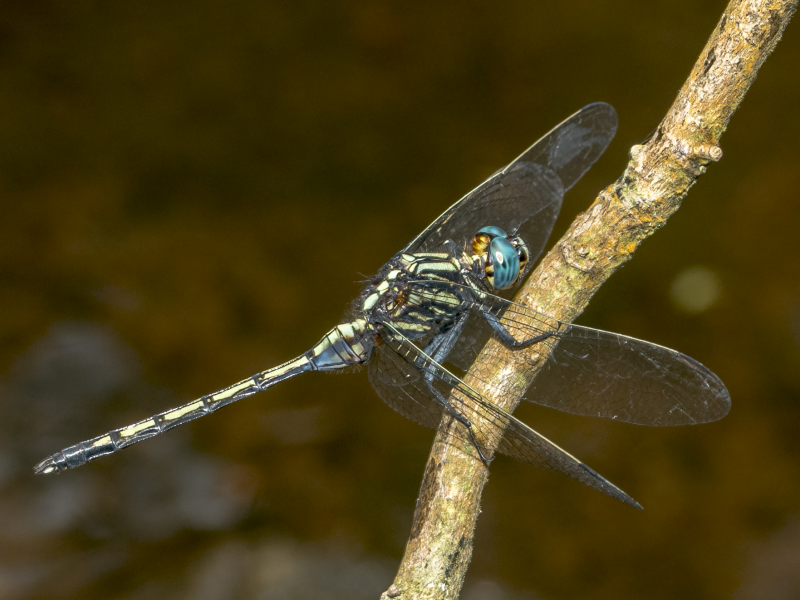
Guinea Skimmer (Orthetrum guineense)

Cover photo by Rob Dickinson.

Find this species in the FBIS database (Freshwater Biodiversity Information System) here.

Family Libellulidae

Identification

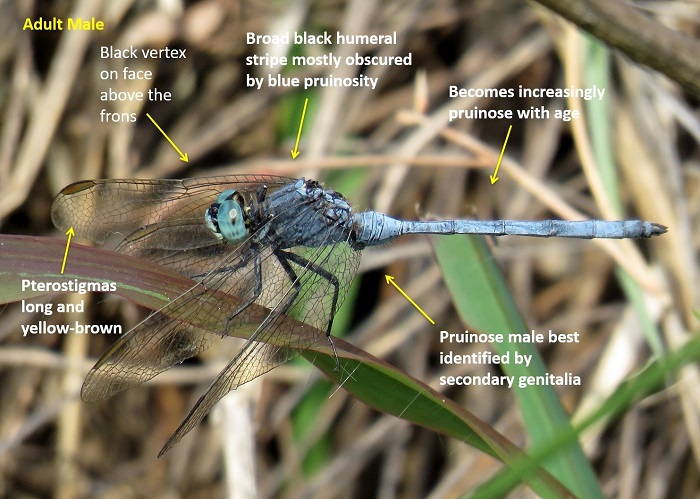
Guinea Skimmer Orthetrum guineense – Mature male
Near Tshipise, Limpopo
Photo by John Wilkinson

Medium Sized

Length up to 44mm; Wingspan attains 71mm.

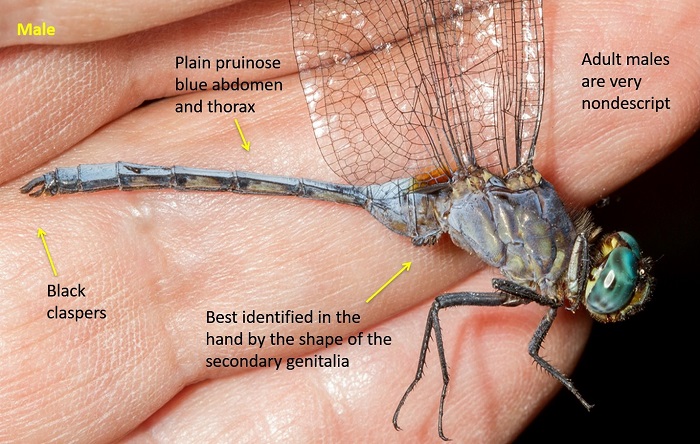
The Guinea Skimmer is most similar to Orthetrum machadoi (Highland Skimmer). The two species were up until recently thought to be conspecific. Mature males of the two can only be definitively identified by the respective shapes of the secondary genitalia.

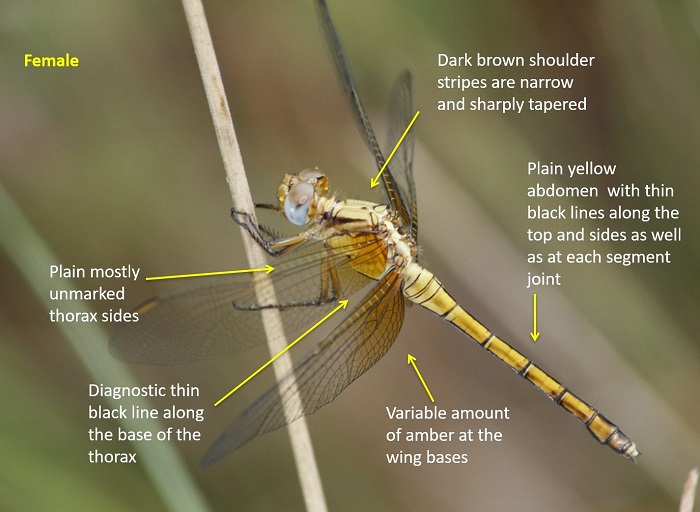
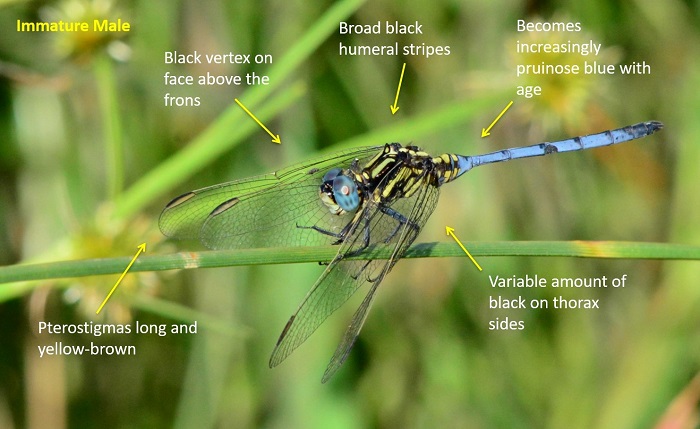
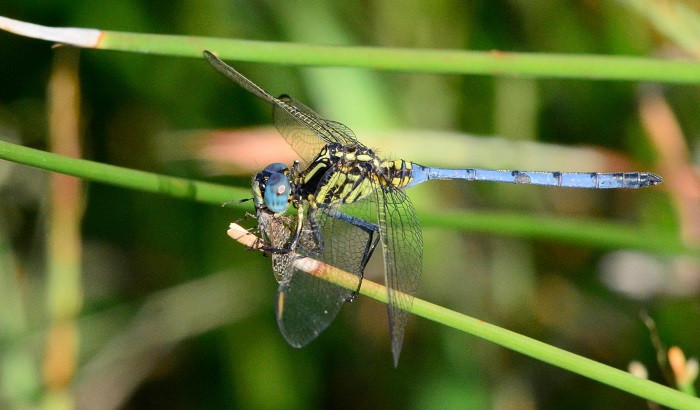
Immature males and females of Orthetrum guineense can be recognised by the mostly unmarked thorax sides, the fine black markings on the abdomen and by the fine black line along the base of the thorax (diagnostic).

Click here for more details on identification.

Guinea Skimmer Orthetrum guineense – Female
Mphaphuli Nature Reserve, Limpopo
Photo by John Wilkinson

Habitat

The Guinea Skimmer inhabits the marshy fringes of flowing streams and rivers. It is usually found in hilly savanna regions above 700m above sea level.

Behaviour

The Guinea Skimmer is usually found close to water. It perches on rocks or overhanging vegetation. The Guinea Skimmer hunts from a perch to which it often returns.

Recorded to be on the wing from September through to June.

Status and Conservation

The Guinea Skimmer is uncommon and localised in South Africa. It is listed as of Least Concern in the IUCN Red List of Threatened Species.

Distribution

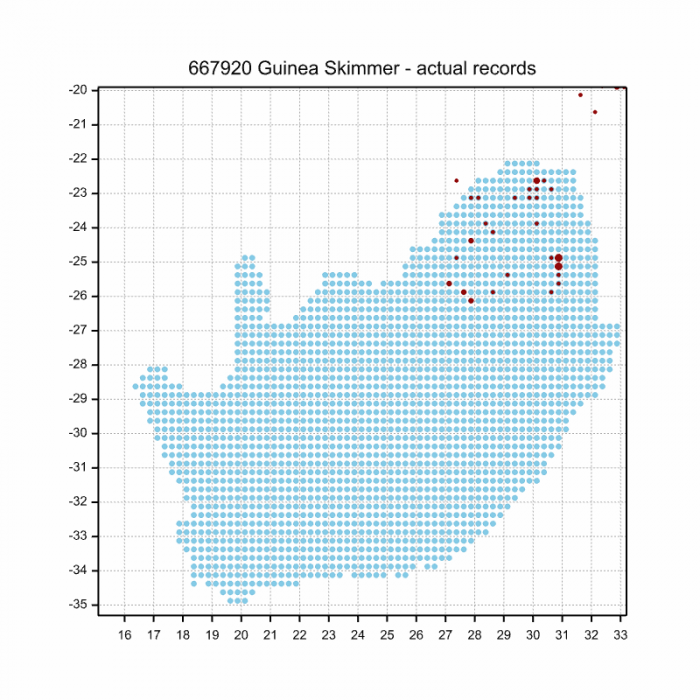
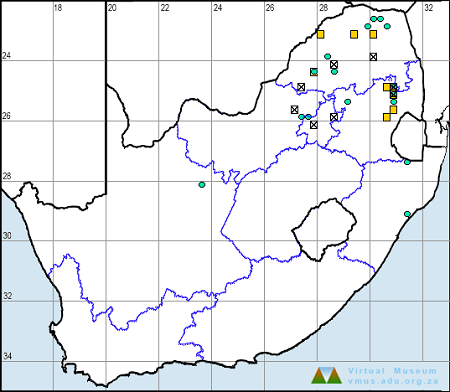
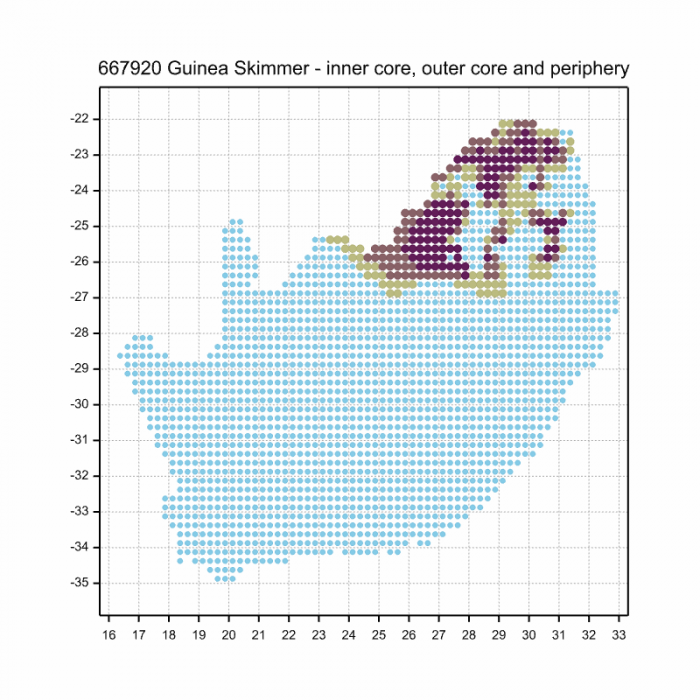
The Guinea Skimmer is patchily distributed over much of Sub-Saharan Africa. It occurs in West and Central Africa, and from East Africa to the north-eastern parts of southern Africa.

Orthetrum guineense is scarce and sparsely distributed in South Africa where it is restricted to the upland savanna regions of the northern provinces.

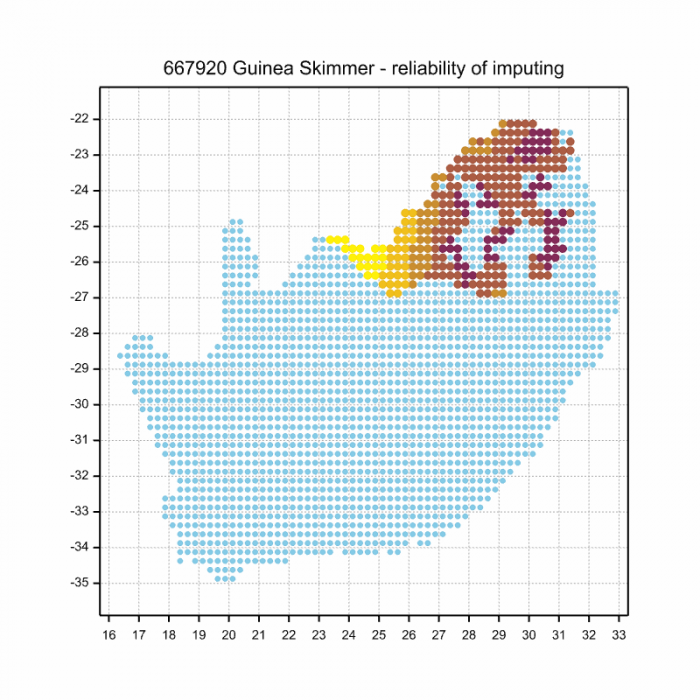
Below is a map showing the distribution of records for Guinea Skimmer in the OdonataMAP database as at February 2020.

Below is a map showing the distribution of records for Guinea Skimmer in the OdonataMAP database as of December 2024.

The next map below is an imputed map, produced by an interpolation algorithm, which attempts to generate a full distribution map from the partial information in the map above. This map will be improved by the submission of records to the OdonataMAP section of the Virtual Museum.

Ultimately, we will produce a series of maps for all the odonata species in the region. The current algorithm is a new algorithm. The objective is mainly to produce “smoothed” maps that could go into a field guide for odonata. This basic version of the algorithm (as mapped above) does not make use of “explanatory variables” (e.g. altitude, terrain roughness, presence of freshwater — we will be producing maps that take these variables into account soon). Currently, it only makes use of the OdonataMAP records for the species being mapped, as well as all the other records of all other species. The basic maps are “optimistic” and will generally show ranges to be larger than what they probably are.

These maps use the data in the OdonataMAP section of the Virtual Museum, and also the database assembled by the previous JRS funded project, which was led by Professor Michael Samways and Dr KD Dijkstra.

Further Resources

The use of photographs by John Wilkinson and Rob Dickinson is acknowledged.

Guinea Skimmer Orthetrum guineense Ris, 1910

Other common names: Guinese Skepper (Afrikaans)

Recommended citation format: Loftie-Eaton M; Navarro R; Tippett RM; Underhill L. 2025. Guinea Skimmer Orthetrum guineense. Biodiversity and Development Institute. Available online at https://thebdi.org/2020/05/21/guinea-skimmer-orthetrum-guineense/

References: Tarboton, M; Tarboton, W. (2019). A Guide to the Dragonflies & Damselflies of South Africa. Struik Nature.

Samways, MJ. (2008). Dragonflies and Damselflies of South Africa. Pensoft

Samways, MJ. (2016). Manual of Freshwater Assessment for South Africa: Dragonfly Biotic Index. Suricata 2. South African National Biodiversity Institute, Pretoria

Martens, A; Suhling, F. (2007). Dragonflies and Damselflies of Namibia. Gamsberg Macmillan.

Similar Species

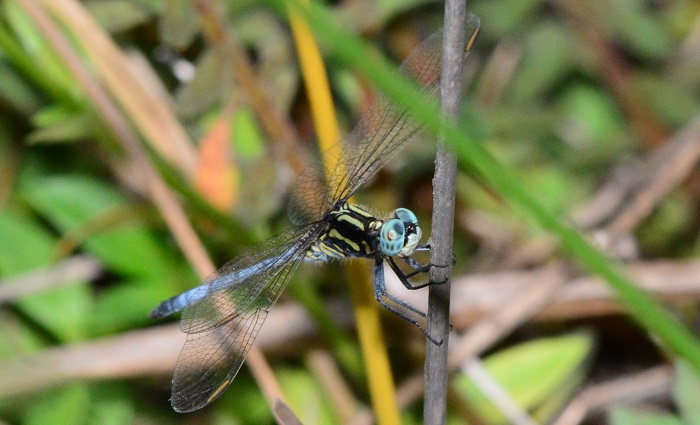
Dark-shouldered Skimmer (Orthetrum hintzi)

Cover photo by Mark Liptrot.

Find the Dark-shouldered Skimmer in the FBIS database (Freshwater Biodiversity Information System) here.

Family Libellulidae

Identification

Dark-shouldered Skimmer Orthetrum hintzi – Adult male
Richards Bay, KwaZulu-Natal
Photo by Diana Russel

Small size

Length up to 43mm; Wingspan reaches 64mm.

The colouration of male Dark-shouldered Skimmers varies with age. Young (teneral) males resemble the females and have brown eyes and thick black/brown edging along the abdomen. Slightly older immature males begin to develop blue pruinosity that begins to obscure the body patterns. The pruinosity first develops on the abdomen before spreading to the thorax. Mature males are entirely pruinose blue and are best identified by the shape of the secondary genitalia.

Fully pruinose males are very similar to Orthetrum abbotti (Little Skimmer) and the two are best identified by the shape of the males secondary genitalia.

Dark-shouldered Skimmer Orthetrum hintzi – Immature male
Near Kosi Bay, KwaZulu-Natal
Photo by Ryan Tippett

Females and immature males are identified by the dark humeral (shoulder) stripes, unmarked thorax sides, and the thick black/brown edging along the abdomen.

Click here for more details on identification of the Dark-shouldered Skimmer.

Dark-shouldered Skimmer Orthetrum hintzi – Female
Bokpoort, Limpopo
Photo by Gregg Darling

Habitat

The Dark-shouldered Skimmer frequents Bogs, seeps, and the marshy fringes of rivers, streams, and pans. It prefers habitats that are rich in grasses. The Dark-shouldered Skimmer is mostly found in savanna regions and is found up to 800m above sea level..

Habitat – Near Kosi Bay, KwaZulu-Natal
Photo by Ryan Tippett

Behaviour

The Dark-shouldered Skimmer perches low to the ground on grass or sedge stems. It seldom sits over open water, preferring boggy ground. The flight is slow and erratic. The Dark-shouldered Skimmer hunts from a perch, often returning to the same grass stem after forays. They are fairly tame and confiding and do not normally fly far once disturbed. Both sexes are found in the same area.

Status and Conservation

The Dark-shouldered Skimmer is locally common and listed as of Least Concern in the IUCN Red List of Threatened Species. It is predominantly found in natural habitats and is not tolerant of habitat degradation.

Distribution

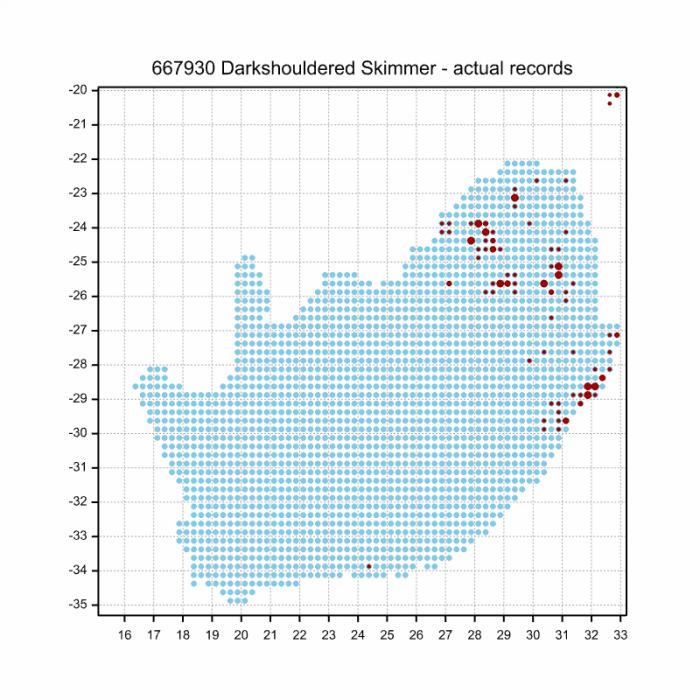
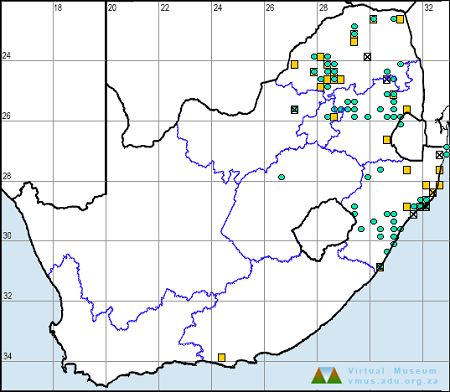
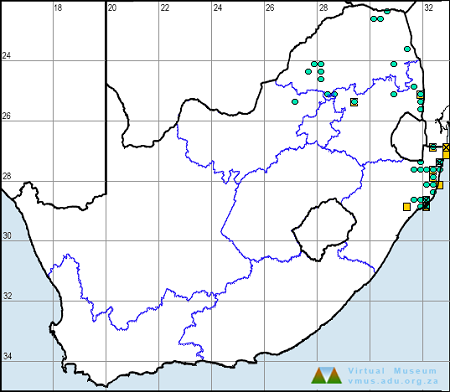
Orthetrum hintzi is widely distributed in sub-Saharan Africa, occurring in West, Central, East and Southern Africa. It is mostly absent from the arid parts of north-east Africa and southern Africa.

Below is a map showing the distribution of records for Dark-shouldered Skimmer in the OdonataMAP database as at February 2020.

Below is a map showing the distribution of records for Dark-shouldered Skimmer in the OdonataMAP database as of December 2024.

The next map below is an imputed map, produced by an interpolation algorithm, which attempts to generate a full distribution map from the partial information in the map above. This map will be improved by the submission of records to the OdonataMAP section of the Virtual Museum.

Ultimately, we will produce a series of maps for all the odonata species in the region. The current algorithm is a new algorithm. The objective is mainly to produce “smoothed” maps that could go into a field guide for odonata. This basic version of the algorithm (as mapped above) does not make use of “explanatory variables” (e.g. altitude, terrain roughness, presence of freshwater — we will be producing maps that take these variables into account soon). Currently, it only makes use of the OdonataMAP records for the species being mapped, as well as all the other records of all other species. The basic maps are “optimistic” and will generally show ranges to be larger than what they probably are.

These maps use the data in the OdonataMAP section of the Virtual Museum, and also the database assembled by the previous JRS funded project, which was led by Professor Michael Samways and Dr KD Dijkstra.

Further Resources

The use of photographs by Diana Russel, Gregg Darling, and Mark Liptrot is acknowledged. All other photographs by Ryan Tippett.

Dark-shouldered Skimmer Orthetrum hintzi Schmidt, 1951

Other common names: Hintz’s Skimmer (Alt. English); Donkerskofskepper (Afrikaans)

Recommended citation format: Loftie-Eaton M; Navarro R; Tippett RM; Underhill L. 2025. Dark-shouldered Skimmer Orthetrum hintzi. Biodiversity and Development Institute. Available online at https://thebdi.org/2020/05/21/dark-shouldered-skimmer-orthetrum-hintzi/

References: Tarboton, M; Tarboton, W. (2019). A Guide to the Dragonflies & Damselflies of South Africa. Struik Nature.

Samways, MJ. (2008). Dragonflies and Damselflies of South Africa. Pensoft

Samways, MJ. (2016). Manual of Freshwater Assessment for South Africa: Dragonfly Biotic Index. Suricata 2. South African National Biodiversity Institute, Pretoria

Martens, A; Suhling, F. (2007). Dragonflies and Damselflies of Namibia. Gamsberg Macmillan.

Similar Species

Catshead Sprite (Pseudagrion coeleste)

Cover photo by Richard Johnstone.

Find the Catshead Sprite in the FBIS database (Freshwater Biodiversity Information System) here.

Family Coenagrionidae

There are two subspecies of the Catshead Sprite in South Africa: Pseudagrion coeleste coeleste and Pseudagrion coeleste umsingaziense.

Identification

Catshead Sprite Pseudagrion coeleste umsingaziense – Male
Phongolo Nature Reserve, KwaZulu-Natal
Photo by Ryan Tippett

Small size

Length up to 38mm; Wingspan reaches 42mm.

The Catshead Sprite is most similar to Pseudagrion assegaii (Assegai Sprite). It can be differentiated from Pseudagrion assegai by being larger and greener. The Assegai Sprite lacks the hints of green on the thorax and eyes of the Catshead Sprite. Most importantly the two species differ in the shape of the black marking on the second abdomen segment. Pseudagrion assegaii shows a spear or assegai-shaped marking, whereas Pseudagrion coeleste has a marking that resembles the head of a cat.

Females are greenish-blue and are fairly easy to identify as they are bluer than the females of other sprites.

Click here for more details on identification.

Catshead Sprite Pseudagrion coeleste coeleste – Female
Linyanti, Botswana
Photo by Ryan Tippett

Habitat

The Catshead Sprite frequents well vegetated still water habitats, such as pans, lakes, floodplains, and dams. It is particularly fond of sites with an abundance of water lilies (Nhymphaea). The Catshead Sprite is less often found along slow-moving river sections.

Habitat – Near Kosi Bay, KwaZulu-Natal
Photo by Ryan Tippett

Behaviour

The Catshead Sprite is found close to the water where it perches on emergent and floating vegetation, especially waterlilies. It flies low over the water when disturbed or chasing a rival..

The Catshead Sprite is recorded throughout the year, but is most active from October to March (see Phenology below)

Catshead Sprite Pseudagrion coeleste umsingaziense – Male
Mkuze Dam, KwaZulu-Natal
Photo by Ryan Tippett

Status and Conservation

The Catshead Sprite is fairly common but localised. Pseudagrion coeleste coeleste is listed as of Least Concern, while Pseudagrion coeleste umsingaziense is listed as Vulnerable in the IUCN Red List of Threatened Species. It is mostly found in undisturbed habitats but will make use of suitable man-made ponds and dams.

Catshead Sprite Pseudagrion coeleste coeleste – Female
Linyanti, Botswana
Photo by Ryan Tippett

Distribution

The Catshead Sprite is native to Central, Southern, and East Africa. It occurs from Angola across to Zambia and on to southern Tanzania and down through Botswana, Zimbabwe, and Mozambique to the north-eastern parts of South Africa.

In South Africa it is found only in Limpopo and Mpumalanga (Pseudagrion coeleste coeleste) and in Northern KwaZulu-Natal (Pseudagrion coeleste umsingaziense).

Below is a map showing the distribution of records for Catshead Sprite in the OdonataMAP database as at February 2020.

Below is a map showing the distribution of records for Catshead Sprite in the OdonataMAP database as of December 2024.

The next map below is an imputed map, produced by an interpolation algorithm, which attempts to generate a full distribution map from the partial information in the map above. This map will be improved by the submission of records to the OdonataMAP section of the Virtual Museum.

Ultimately, we will produce a series of maps for all the odonata species in the region. The current algorithm is a new algorithm. The objective is mainly to produce “smoothed” maps that could go into a field guide for odonata. This basic version of the algorithm (as mapped above) does not make use of “explanatory variables” (e.g. altitude, terrain roughness, presence of freshwater — we will be producing maps that take these variables into account soon). Currently, it only makes use of the OdonataMAP records for the species being mapped, as well as all the other records of all other species. The basic maps are “optimistic” and will generally show ranges to be larger than what they probably are.

These maps use the data in the OdonataMAP section of the Virtual Museum, and also the database assembled by the previous JRS funded project, which was led by Professor Michael Samways and Dr KD Dijkstra.

Catshead Sprite Pseudagrion coeleste umsingaziense – Male
Mpempe Pan, KwaZulu-Natal
Photo by Ryan Tippett

Phenology

Catshead Sprite Pseudagrion coeleste coeleste – Male
Linyanti, Botswana
Photo by Ryan Tippett

Further Resources

The use of photographs by Richard Johnstone is acknowledged. All other photographs by Ryan Tippett.

Catshead Sprite Pseudagrion coeleste Longfield, 1947

Other common names: Broodruggesie (Afrikaans)

Recommended citation format: Loftie-Eaton M; Navarro R; Tippett RM; Underhill L. 2025. Catshead Sprite Pseudagrion coeleste. Biodiversity and Development Institute. Available online at https://thebdi.org/2020/05/21/catshead-sprite-pseudagrion-coeleste/

References: Tarboton, M; Tarboton, W. (2019). A Guide to the Dragonflies & Damselflies of South Africa. Struik Nature.

Samways, MJ. (2008). Dragonflies and Damselflies of South Africa. Pensoft

Samways, MJ. (2016). Manual of Freshwater Assessment for South Africa: Dragonfly Biotic Index. Suricata 2. South African National Biodiversity Institute, Pretoria

Martens, A; Suhling, F. (2007). Dragonflies and Damselflies of Namibia. Gamsberg Macmillan.

Similar Species

Assegai Sprite (Pseudagrion assegaii)

Cover photo by Evert Kleynhans.

Find the Assegai Sprite in the FBIS database (Freshwater Biodiversity Information System) here.

Family Coenagrionidae

Identification

Assegai Sprite Pseudagrion assegaii – Male
Linyanti, Botswana
Photo by Ryan Tippett

Small size

Length up to 34mm; Wingspan reaches 42mm.

The Assegai Sprite is most similar to Pseudagrion coeleste (Catshead Sprite) and Africallagma glaucum (Swamp Bluet).

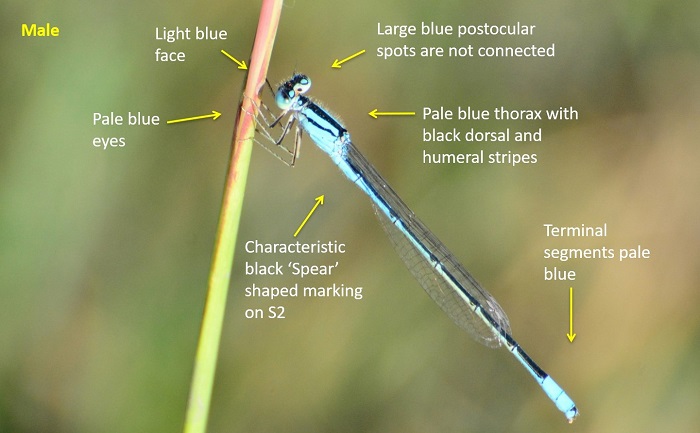
The Assegai Sprite can be differentiated from Pseudagrion coeleste by its smaller and bluer colour. The Assegai Sprite lacks the hints of green on the thorax and eyes of the Catshead Sprite. Most importantly, the two species differ in the shape of the black marking on the second abdominal segment. Pseudagrion assegaii shows a spear or assegai-shaped marking, whereas Pseudagrion coeleste has a marking that resembles the head of a cat.

The Assegai Sprite can be told apart from the Swamp Bluet by being slightly larger and by having large, unconnected postocular spots. They can be further differentiated by the shape of the claspers.

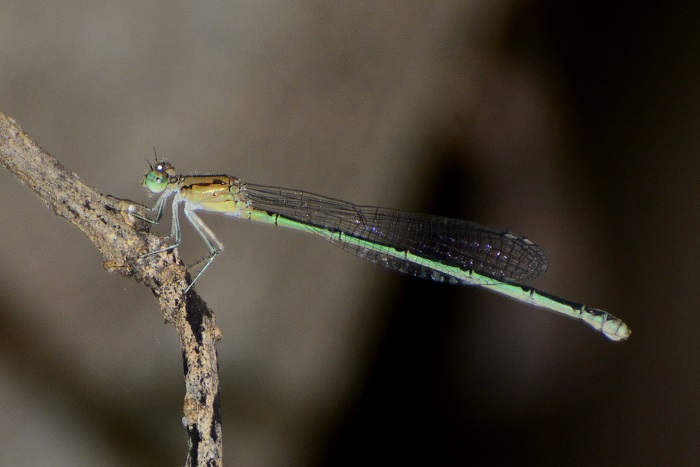
Females are pale greenish and are best told by their association with the males.

Click here for more details on identification.

Assegai Sprite Pseudagrion assegaii – Female
Linyanti, Botswana
Photo by Ryan Tippett

Habitat

The Assegai Sprite inhabits still-water environments with emergent and floating vegetation such as sedges, grass, and water lilies. It favours the fringes of natural habitats, including lakes, pans, and floodplains. The Assegai Sprite will also utilise slow-moving streams and suitable man-made dams or ponds.

Behaviour

Assegai Sprites perch close to the water on emergent plant stems and are particularly fond of resting on waterlily leaves. They fly short distances when disturbed, usually close to the water surface.

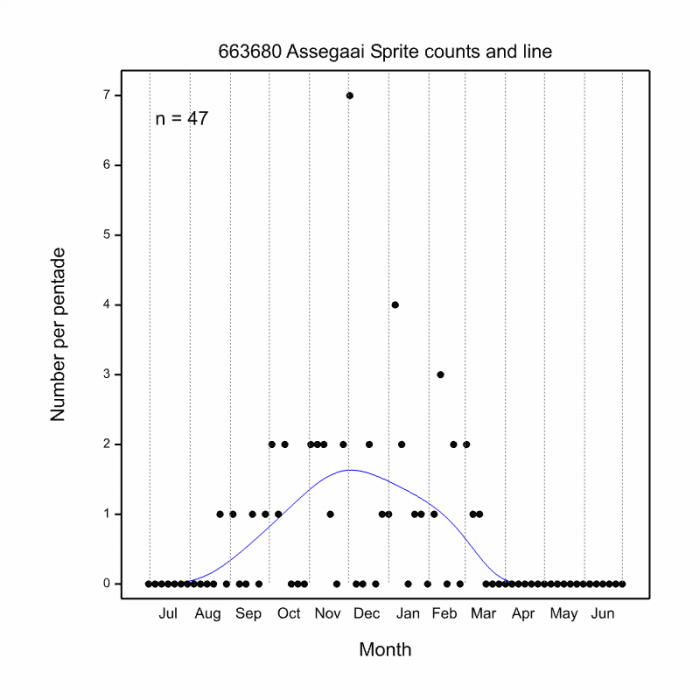
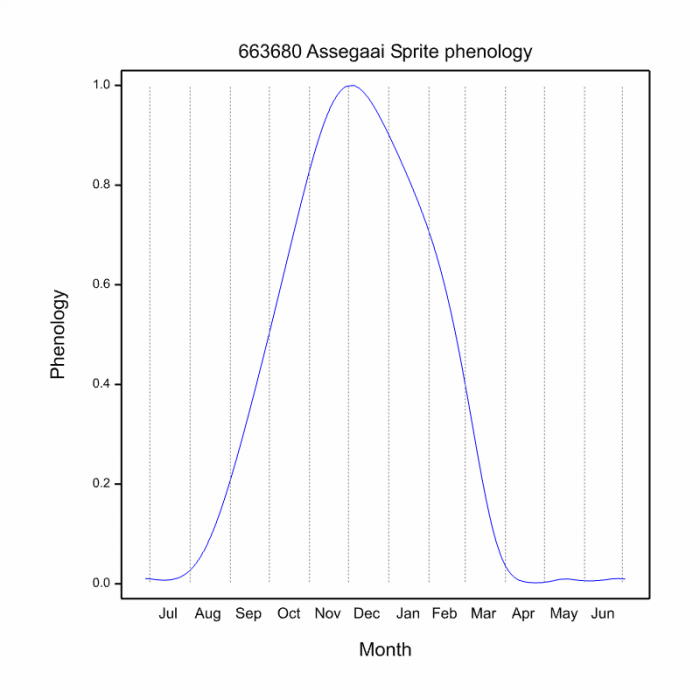
The Assegai Sprite is on the wing from August to March (see Phenology below).

Status and Conservation

The Assegai Sprite is locally common and is listed as of Least Concern in the IUCN Red List of Threatened Species.

Distribution

Pseudagrion assegaii has a very disjunct distribution in Southern and East Africa. It ranges from northern South Africa to Botswana, Zimbabwe, Zambia and Uganda.

In South Africa the Assegai Sprite is recorded from the Limpopo, Gauteng and North-West provices. It is most numerous in the western parts of Limpopo.

Below is a map showing the distribution of records for Assegai Sprite in the OdonataMAP database as at February 2020.

Below is a map showing the distribution of records for Assegai Sprite in the OdonataMAP database as of December 2024.

The next map below is an imputed map, produced by an interpolation algorithm, which attempts to generate a full distribution map from the partial information in the map above. This map will be improved by the submission of records to the OdonataMAP section of the Virtual Museum.

Ultimately, we will produce a series of maps for all the odonata species in the region. The current algorithm is a new algorithm. The objective is mainly to produce “smoothed” maps that could go into a field guide for odonata. This basic version of the algorithm (as mapped above) does not make use of “explanatory variables” (e.g. altitude, terrain roughness, presence of freshwater — we will be producing maps that take these variables into account soon). Currently, it only makes use of the OdonataMAP records for the species being mapped, as well as all the other records of all other species. The basic maps are “optimistic” and will generally show ranges to be larger than what they probably are.

These maps use the data in the OdonataMAP section of the Virtual Museum, and also the database assembled by the previous JRS funded project, which was led by Professor Michael Samways and Dr KD Dijkstra.

Phenology

Further Resources

The use of photographs by Evert Kleynhans is acknowledged. All other photographs by Ryan Tippett.

Assegai Sprite Pseudagrion assegaii Pinhey, 1950

Other common names: Spearhead Sprite (Alt. English); Assegaaigesie (Afrikaans)

Recommended citation format: Loftie-Eaton M; Navarro R; Tippett RM; Underhill L. 2025. Assegai Sprite Pseudagrion assegaii. Biodiversity and Development Institute. Available online at https://thebdi.org/2020/05/21/assegai-sprite-pseudagrion-assegaii/

References: Tarboton, M; Tarboton, W. (2019). A Guide to the Dragonflies & Damselflies of South Africa. Struik Nature.

Samways, MJ. (2008). Dragonflies and Damselflies of South Africa. Pensoft

Samways, MJ. (2016). Manual of Freshwater Assessment for South Africa: Dragonfly Biotic Index. Suricata 2. South African National Biodiversity Institute, Pretoria

Martens, A; Suhling, F. (2007). Dragonflies and Damselflies of Namibia. Gamsberg Macmillan.

Similar Species

Stream Hawker (Pinheyschna subpupillata)

Cover photo by Gert Bensch.

Find the Stream Hawker in the FBIS database (Freshwater Biodiversity Information System) here.

Family Aeschnidae

Identification

Stream Hawker Pinheyschna subpupillata – Male
Lekgalameetse Nature Reserve, Limpopo
Photo by Vaughan Jessnitz

Large size

Length attains 64mm; Wingspan reaches 91mm.

The Stream Hawker is only likely to be mistaken for the females of other Hawker species, as they lack the blue markings of their respective males. These are Zosteraeschna minuscula (Friendly Hawker), Zosteraeschna usambarica (Forest Hawker) and Anaciaeschna triangulifera (Evening Hawker).

Both sexes of the Stream Hawker can be told apart from the above mentioned species by the diagnostic yellow patch with a central black dot on the forehead.

Click here for more details on identification of the Stream Hawker.

Stream Hawker Pinheyschna subpupillata – Female
Lake Naverone, KwaZulu-Natal
Photo by Ryan Tippett

Habitat

The Stream Hawker inhabits streams and rivers. It favours fast-flowing stretches with rocks and fringing vegetation such as grass and bushes. The Stream Hawker is most often found in hilly or mountainous regions. It occurs in both open and more wooded environs. Pinheyschna subpupillata occurs up to 2000m above sea level.

Habitat – Mkhomazi Wilderness area, Drakensberg, KwaZulu-Natal
Photo by Ryan Tippett

Behaviour

The Stream Hawker is an active, aerial species that spends most of its time in flight. It patrols swiftly, back and forth along a chosen stretch of river. The Stream Hawker periodically rests on nearby bushes or by clinging to the sides of boulders. It most often hangs vertically when at rest.

The Stream Hawker is most active from September to April (see Phenology below).

Stream Hawker Pinheyschna subpupillata – Male
Marloth Nature Reserve, Western Cape
Photo by Ryan Tippett

Status and Conservation

The Stream Hawker is fairly common where it occurs. It is listed as of Least Concern in the IUCN Red List of Threatened Species.

Stream Hawker Pinheyschna subpupillata
Dassieshoek Nature Reserve, Western Cape
Photo by Ryan Tippett

Distribution

The Stream Hawker is near-endemic to South Africa, where it is found in mid to high altitude regions from the Western Cape to Limpopo. It is also found in the Eastern Highlands of Zimbabwe and adjacent Mozambique.

Stream Hawker Pinheyschna subpupillata – Female
Dassieshoek Nature Reserve, Western Cape
Photo by Ryan Tippett

Below is a map showing the distribution of records for Stream Hawker in the OdonataMAP database as at February 2020.

Below is a map showing the distribution of records for Stream Hawker in the OdonataMAP database as of December 2024.

The next map below is an imputed map, produced by an interpolation algorithm, which attempts to generate a full distribution map from the partial information in the map above. This map will be improved by the submission of records to the OdonataMAP section of the Virtual Museum.

Ultimately, we will produce a series of maps for all the odonata species in the region. The current algorithm is a new algorithm. The objective is mainly to produce “smoothed” maps that could go into a field guide for odonata. This basic version of the algorithm (as mapped above) does not make use of “explanatory variables” (e.g. altitude, terrain roughness, presence of freshwater — we will be producing maps that take these variables into account soon). Currently, it only makes use of the OdonataMAP records for the species being mapped, as well as all the other records of all other species. The basic maps are “optimistic” and will generally show ranges to be larger than what they probably are.

These maps use the data in the OdonataMAP section of the Virtual Museum, and also the database assembled by the previous JRS funded project, which was led by Professor Michael Samways and Dr KD Dijkstra.

Stream Hawker Pinheyschna subpupillata – Male
Marloth Nature Reserve, Western Cape
Photo by Ryan Tippett

Further Resources

The use of photographs by Gert Bensch and Vaughan Jessnitz is acknowledged. All other photographs by Ryan Tippett.

Stream Hawker Pinheyschna subpupillata (MacLachlan, 1896)

Other common names: Spruitjieventer (Afrikaans)

Recommended citation format: Loftie-Eaton M; Navarro R; Tippett RM; Underhill L. 2025. Stream Hawker Pinheyschna subpupillata. Biodiversity and Development Institute. Available online at https://thebdi.org/2020/05/20/stream-hawker-pinheyschna-subpupillata/

References: Tarboton, M; Tarboton, W. (2019). A Guide to the Dragonflies & Damselflies of South Africa. Struik Nature.

Samways, MJ. (2008). Dragonflies and Damselflies of South Africa. Pensoft

Samways, MJ. (2016). Manual of Freshwater Assessment for South Africa: Dragonfly Biotic Index. Suricata 2. South African National Biodiversity Institute, Pretoria

Stream Hawker Pinheyschna subpupillata – Female
Ruiterbos, Western Cape
Photo by Ryan Tippett

Similar Species

Acacia Sprite (Pseudagrion acaciae)

Cover photo by John Wilkinson.

Find the Acacia Sprite in the FBIS database (Freshwater Biodiversity Information System) here.

Family Coenagrionidae

Identification

Acacia Sprite Pseudagrion acaciae – Male
Mkuze River, KwaZulu-Natal
Photo by Ryan Tippett

Small size

Length up to 38mm; Wingspan attains 48mm.

The Acacia Sprite is one of a handful of ‘Reddish’ sprites found in the region. As with most other sprites, the colouration can be variable, and they tend to darken with age.

Males most resemble those of the Vaal Sprite (Pseudagrion vaalense) and especially younger males of the Cherry-eye Sprite (Pseudagrion sublacteum).

It is similar to Pseudagrion vaalense in that both species have greenish postocular spots, orange-red faces and eyes, and pale blue-green lower thorax sides. In Pseudagrion acaciae the thorax sides tend to be more green than blue and the pruinose blue markings on the end of the abdomen show distinct, incomplete black rings. There is also minimal overlap in the distribution of the two species.

Distribution overlaps widely with that of Pseudagrion sublacteum. In comparison, Pseudagrion sublacteum shows a purplish upper thorax and postocular spots, as well as bluer lower thorax sides and a bright cherry-red face and eyes.

Females are easily confused with those of other Pseudagrion species and are best identified by their association with the males.

Click here for more details on identification.

Acacia Sprite Pseudagrion acaciae – Male
Ndumo Game Reserve, KwaZulu-Natal
Photo by Ryan Tippett

Habitat

The Acacia Sprite frequents flowing rivers in hot, low-altitude savanna areas. It prefers sites with shallow, rocky sections and with sand and varied riverside vegetation, especially grass and woodlands. The Acacia Sprite is most numerous along larger rivers.

Habitat – Mkuze River, KwaZulu-Natal
Photo by Ryan Tippett

Behaviour

Males sit close to the water on a rock, sandbar or suitable reed or grass stem. The flight of the Acacia Sprite is fast and low over the water. They often return to the same perch after each foray to catch food or to chase off a rival. Females are seldom encountered.

The Acacia Sprite has been recorded throughout the year at some sites. It is most active from September to April (see Phenology below).

Acacia Sprite Pseudagrion acaciae – Male
Mkuze River, KwaZulu-Natal
Photo by Ryan Tippett

Status and Conservation

The Acacia Sprite is fairly common but localised. It is listed as of Least Concern in the IUCN Red List of Threatened Species. As a riverine species, it does not make much use of man-made habitats. The Acacia Sprite is restricted to undamaged savanna rivers.

Distribution

The Acacia Sprite ranges from East Africa down to South Africa. The South African distribution is centred upon the larger east-flowing rivers from central KwaZulu-Natal to Limpopo.

Below is a map showing the distribution of records for Acacia Sprite in the OdonataMAP database as at February 2020.

Below is a map showing the distribution of records for Acacia Sprite in the OdonataMAP database as of December 2024.

The next map below is an imputed map, produced by an interpolation algorithm, which attempts to generate a full distribution map from the partial information in the map above. This map will be improved by the submission of records to the OdonataMAP section of the Virtual Museum.

Ultimately, we will produce a series of maps for all the odonata species in the region. The current algorithm is a new algorithm. The objective is mainly to produce “smoothed” maps that could go into a field guide for odonata. This basic version of the algorithm (as mapped above) does not make use of “explanatory variables” (e.g. altitude, terrain roughness, presence of freshwater — we will be producing maps that take these variables into account soon). Currently, it only makes use of the OdonataMAP records for the species being mapped, as well as all the other records of all other species. The basic maps are “optimistic” and will generally show ranges to be larger than what they probably are.

These maps use the data in the OdonataMAP section of the Virtual Museum, and also the database assembled by the previous JRS funded project, which was led by Professor Michael Samways and Dr KD Dijkstra.

Phenology

Acacia Sprite Pseudagrion acaciae – Male
Ndumo Game Reserve, KwaZulu-Natal
Photo by Ryan Tippett

Further Resources

The use of photographs by John Wilkinson is acknowledged. Other photographs by Ryan Tippett.

Acacia Sprite Pseudagrion acaciae Förster, 1906

Other common names: Green-naped Sprite (Alt. English); Akasiagesie (Afrikaans).

Recommended citation format: Loftie-Eaton M; Navarro R; Tippett RM; Underhill L. 2025. Acacia Sprite Pseudagrion acaciae.  Biodiversity and Development Institute. Available online at https://thebdi.org/2020/05/20/acacia-sprite-pseudagrion-acaciae/

References: Tarboton, M; Tarboton, W. (2019). A Guide to the Dragonflies & Damselflies of South Africa. Struik Nature.

Samways, MJ. (2008). Dragonflies and Damselflies of South Africa. Pensoft

Samways, MJ. (2016). Manual of Freshwater Assessment for South Africa: Dragonfly Biotic Index. Suricata 2. South African National Biodiversity Institute, Pretoria

Martens, A; Suhling, F. (2007). Dragonflies and Damselflies of Namibia. Gamsberg Macmillan.

Similar Species

Upland Sprite (Pseudagrion spernatum)

Cover photo by Christian Fry.

Find the Upland Sprite in the FBIS database (Freshwater Biodiversity Information System) here.

Family Coenagrionidae

Identification

Upland Sprite Pseudagrion spernatum – Male
Elands River, KwaZulu-Natal
Photo by Ryan Tippett

Small size

Length up to 44mm; Wingspan reaches 58mm.

Males most resemble Pseudagrion inopinatum (Balinskys Sprite) and Pseudagrion draconis (Mountain Sprite). Easily differentiated from Balinsky’s Sprite as that species has mauve terminal segments as opposed to blue in the Upland Sprite.

Upland Sprite males can be separated from those of Mountain Sprite by having a green, not black labrum and brighter green lower thorax sides. In male Mountain Sprites the lower thorax sides are duller greenish-blue.

Females are distinctive and brightly coloured. They are unlikely to be confused with others within its distribution range.

Click here for more details on identification.

Upland Sprite Pseudagrion spernatum – Female
Elands River, KwaZulu-Natal
Photo by Ryan Tippett

Habitat

The Upland Sprite is a mid-altitude species that inhabits clear, flowing streams and rivers. It prefers sites with vegetated and grassy banks. The Upland Sprite is most often found in hilly or mountainous areas at altitudes between 800m and 2000m above sea level.
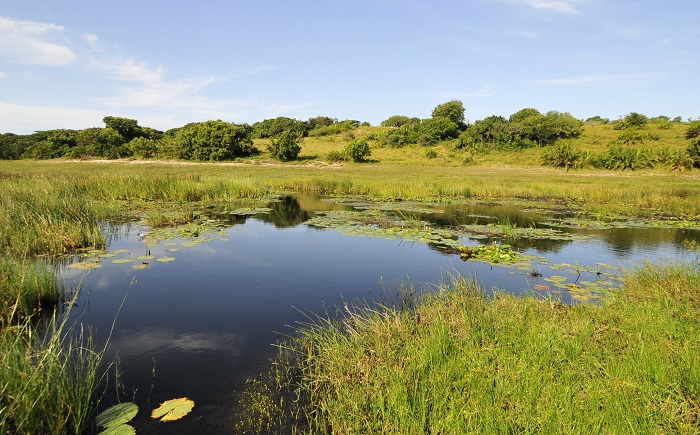
Habitat – Mlambonja River, Drakensberg, KwaZulu-Natal
Photo by Ryan Tippett

Behaviour

The Upland Sprite is usually seen perched on vegetation close to or overhanging the water. It is sometimes also seen on rocks in the water. Interestingly, females are often more conspicuous than males and the two are usually found alongside one another.

The Upland Sprite is most active from October to April (see Phenology below).

Upland Sprite Pseudagrion spernatum – Female
Mlambonja River, Drakensberg, KwaZulu-Natal
Photo by Ryan Tippett

Status and Conservation

The Upland Sprite is locally Common. It is listed as of Least Concern in the IUCN Red List of Threatened Species. This species makes little use of man-made habitats due to its reliance on flowing streams and rivers. The Upland Sprite can occupy slightly degraded rivers, such as those with some alien plants along the banks, provided the water is flowing and clean enough.

Upland Sprite Pseudagrion spernatum – Female
Lake Naverone, KwaZulu-Natal
Photo by Ryan Tippett

Distribution

Pseudagrion spernatum occurs mainly in the upland regions of Eastern and Southern Africa. Ranging in a broad band from Ethiopia in the North down to South Africa.

The South African distribution is centered around the escarpment from the central Eastern Cape up to the Soutpansberg in Limpopo. It is also found in and around Gauteng.

Below is a map showing the distribution of records for Upland Sprite in the OdonataMAP database as at February 2020.

Below is a map showing the distribution of records for Upland Sprite in the OdonataMAP database as of December 2024.

The next map below is an imputed map, produced by an interpolation algorithm, which attempts to generate a full distribution map from the partial information in the map above. This map will be improved by the submission of records to the OdonataMAP section of the Virtual Museum.

Ultimately, we will produce a series of maps for all the odonata species in the region. The current algorithm is a new algorithm. The objective is mainly to produce “smoothed” maps that could go into a field guide for odonata. This basic version of the algorithm (as mapped above) does not make use of “explanatory variables” (e.g. altitude, terrain roughness, presence of freshwater — we will be producing maps that take these variables into account soon). Currently, it only makes use of the OdonataMAP records for the species being mapped, as well as all the other records of all other species. The basic maps are “optimistic” and will generally show ranges to be larger than what they probably are.

These maps use the data in the OdonataMAP section of the Virtual Museum, and also the database assembled by the previous JRS funded project, which was led by Professor Michael Samways and Dr KD Dijkstra.

Phenology

Upland Sprite Pseudagrion spernatum – Female
Mlambonja River, Drakensberg, KwaZulu-Natal
Photo by Ryan Tippett

Further Resources

The use of photographs by Christian Fry is acknowledged. All other photos by Ryan Tippett.

Upland Sprite Pseudagrion spernatum Hagen in Selys, 1881

Other common names: Powder Sprite (Alt. Englisg); Hooglandgesie (Afrikaans).

Recommended citation format: Loftie-Eaton M; Navarro R; Tippett RM; Underhill L. 2025. Upland Sprite Pseudagrion spernatum.  Biodiversity and Development Institute. Available online at https://thebdi.org/2020/05/20/upland-sprite-pseudagrion-spernatum/

References: Tarboton, M; Tarboton, W. (2019). A Guide to the Dragonflies & Damselflies of South Africa. Struik Nature.

Samways, MJ. (2008). Dragonflies and Damselflies of South Africa. Pensoft

Samways, MJ. (2016). Manual of Freshwater Assessment for South Africa: Dragonfly Biotic Index. Suricata 2. South African National Biodiversity Institute, Pretoria

Upland Sprite Pseudagrion spernatum – Mating pair
Royal Natal National Park, KwaZulu-Natal
Photo by Ryan Tippett

Similar Species