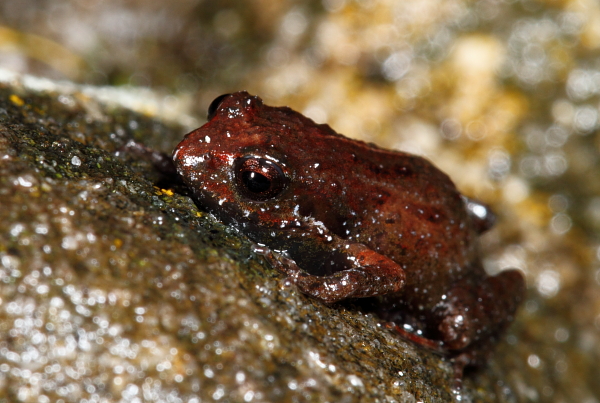
Find the Mountain Caco in the FBIS database (Freshwater Biodiversity Information System) here.
Family Pyxicephalidae
Habitat
The Mountain Caco is restricted to high altitudes above 1200 m where it breeds in ponds, marshes, streams, and flooded grassland.
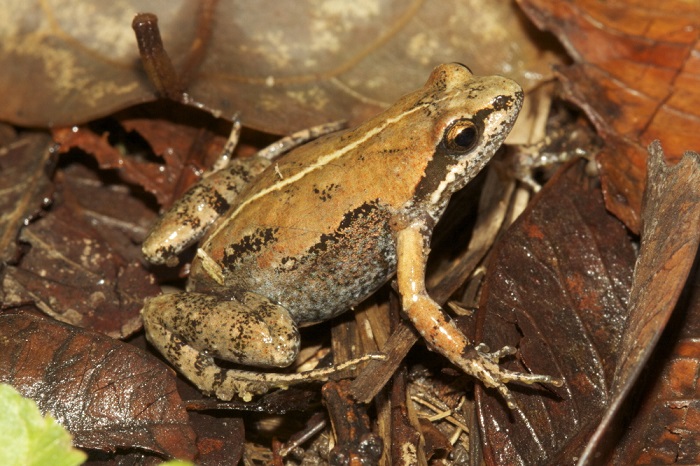
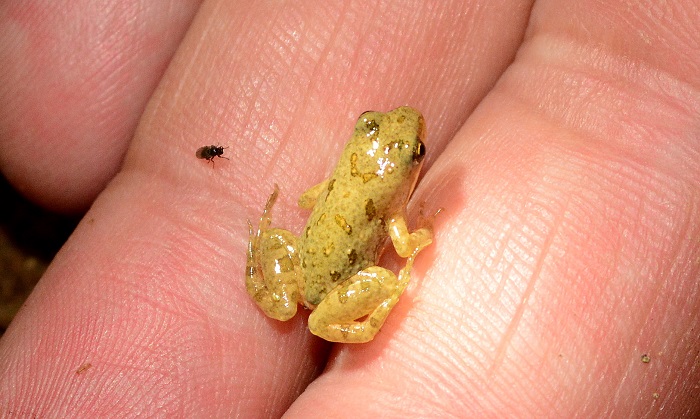
This species vies with C. striatum for the title of the smallest frog in South Africa. Its small size reflects a marked trend in the genus towards size reduction in high-altitude forms.
Behaviour
Very little is known of the life history of the Mountain Caco. Specimens recorded near Graskop, Mpumalanga Province, were calling from beneath grass at the edge of shallow puddles in inundated grassland, while another population was breeding at a seep on a grassy slope. Advertisement and (presumably) agonistic calls were recorded (L.R. Minter pers. comm.).
Status and Conservation
The Mountain Caco has been recorded from the Royal Natal National Park and the Giants Castle and Cathedral Peak nature reserves in KwaZulu-Natal Province, as well as Malolotja Nature Reserve in Swaziland. The species is locally abundant, and is not threatened or in immediate need of conservation action.
Distribution
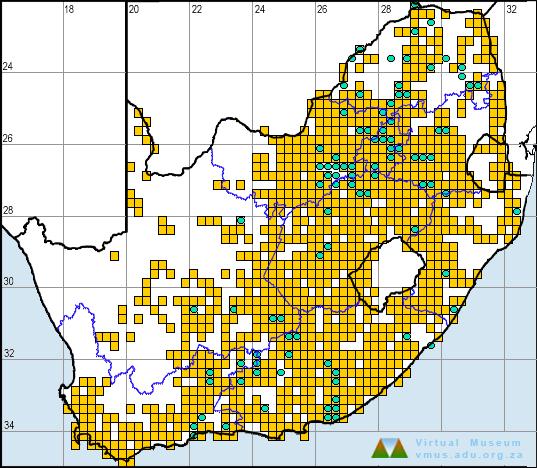
There has been much confusion in the literature surrounding the separation and distribution of C. nanum and C. parvum, because the key in Poynton (1964) provides inadequate characters to separate these species. Poynton (1964) and Lambiris (1989a) listed grid localities where both species are supposedly present, but these were based on some specimens being identified as both nanum and parvum (Bates 1995). Material examined from all of these contested localities was found to be referable to C.parvum (E. Scott in prep.), and no specimens of C. nanum have been obtained from any of these localities.
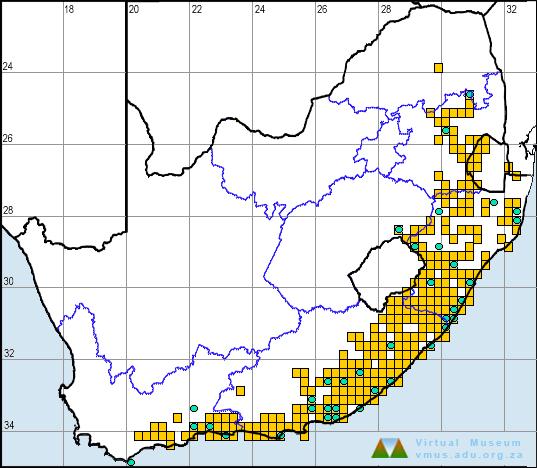
C. parvum occurs in high-altitude habitats above 1200 m along the Drakensberg escarpment. It is known from the northern parts of Eastern Cape Province but appears to have its stronghold in KwaZulu-Natal, with an apparent gap between populations in this province and those farther north, in Swaziland and Mpumalanga Province. The identity of the isolated specimen from near Louis Trichardt (2330AB), mentioned by Poynton (1964), has not been confirmed.
C. parvum has been recorded in sympatry with C.nanum at Malolotja Nature Reserve (2631AA) in Swaziland (R.C. Boycott pers. comm.), and in the Maclear (3128AB) and Mount Frere (3028DD) districts in the Eastern Cape Province (M. Burger pers. comm.).
The advertisement calls of C. nanum and C. parvum are sufficiently different to allow recognition in the field and were used to identify populations during the atlas period. The distribution map for C. parvum presented here is based mainly on aural records. The atlas data are accurate but incomplete.
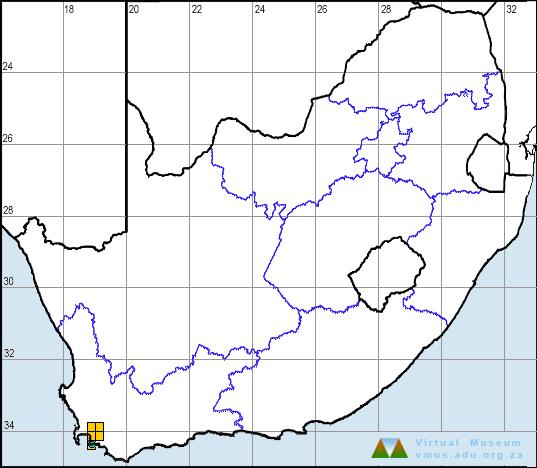
Distribution of Cacosternum parvum. Taken from the FrogMAP database as at February 2022.
Further Resources
The use of photographs by Trevor Hardaker is acknowledged.
Mountain CacoCacosternum parvum Poynton, 1963
Other Common Names: Mountain Dainty Frog (Alternative English Names); Berg Blikslanertjie (Afrikaans)
Recommended citation format: Scott, E; Tippett, RM. (2025). Mountain Caco Cacosternum parvum. Biodiversity and Development Institute, Cape Town. Available online at https://thebdi.org/2022/02/17/mountain-caco-cacosternum-parvum/
This species text has been updated and expanded from the text in the 2004 frog atlas: Scott, E. (2004). Mountain Caco Cacosternum parvum In Minter LR et al 2004.
References:
Minter, LR; Burger, M; Harrison, JA; Braack, HH; Bishop, PJ; Kloepfer, D. (Editors). (2004). Atlas and Red Data Book of the Frogs of South Africa, Lesotho and Swaziland. Smithsonian Institution, Washington, and Avian Demography Unit, Cape Town.
Carruthers, V; du Preez, L. (2017). Frogs of southern Africa: A Complete Guide. Struik Nature, Cape Town.
Channing, A. (2001) Amphibians of Central and Southern Africa. Protea Book House, Pretoria
Find the Bronze Caco in the FBIS database (Freshwater Biodiversity Information System) here.
Family Pyxicephalidae
Identification
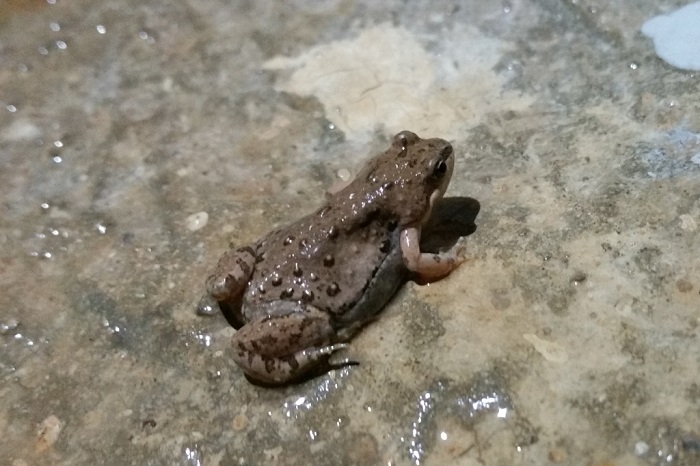
The Bronze Caco is a small frog that reaches a maximum length of 23mm. The skin on the upper parts is granular, and the dorsal colouration varies from grey to brown, typically with a bronzy tinge. A number of dark flecked, low warts are scattered across the back. A pale vertebral line is often also present. On the head, a dark facial mask runs from the snout through the eye to near the base of the forearm. A pale band is present below the face mask, along the upper lip from below the nostril to the base of the forearm. The undersides are smooth with dark mottling, especially on the throat, chest and sides. The central belly region is pale with large grey blotches. The tympanum may be hidden or partially obscured.
Habitat
The Bronze Caco inhabits a wide variety of vegetation types in the Fynbos, Savanna, Grassland, Thicket and Forest biomes, occurring in areas of relatively high rainfall (Van Dijk 1971b). Breeding sites include small ponds, dams, vleis, streams, rain pools alongside roads, and inundated grass and pasture.
Behaviour
During dry periods, Bronze Cacos aestivate below the surface, sometimes emerging in large numbers after heavy rain (Wager 1965).
In KwaZulu-Natal, C. nanum commences breeding slightly earlier in the rainy season than C. boettgeri. Males call mainly from sheltered sites in deeper water. Calling males are distinctly territorial, loudly warning encroaching males by means of a territorial call that differs from their typical advertisement call. On warm, drizzly days or after rain, they may begin calling in the mid-morning, although they usually commence in the late afternoon and continue well into the evening.
Eggs are laid in clusters of 8–25, sometimes up to 50 (Wager 1986). As is typical of the genus as a whole, the eggs are anchored to the substrate. Wager (1986) reported that metamorphosed froglets of C. nanum leave the water 17 days after hatching, which may be the quickest growth to metamorphosis known in any frog (Duellman and Trueb 1986).
The Bronze Caco has been reported to feed on mosquitoes in captivity (Wager 1965), and the species probably plays an important role in the control of small insects in undisturbed habitats. Predators have not been recorded.
Status and Conservation
The Bronze Caco is one of the most common frogs in its range and, in the wet season, it can be heard calling from almost every rut, drainage ditch and small pond. The Bronze Caco is known from many protected areas and is not threatened.
Distribution
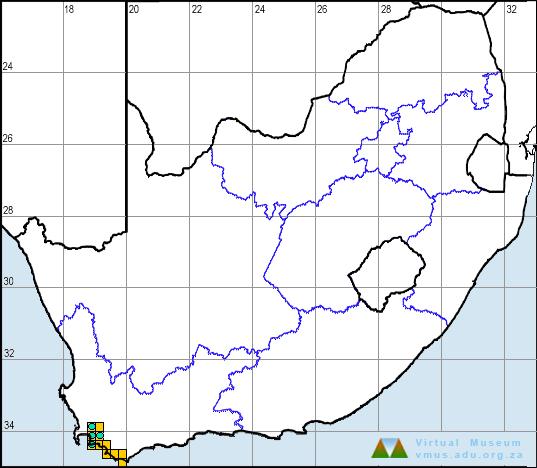
The range of the Bronze Caco extends from Swellendam (3420AB) in the south Western Cape, eastward along a narrow (c.70 km-wide) coastal strip on the relatively moist southern side of the Cape fold mountains to Port Elizabeth (3325DC). From there, its range extends much further inland (c.350 km), reaching the Zuurberg National Park (3325AD), and eastward past the Amatola Mountains and former Transkei, reaching southern KwaZulu-Natal. It is confined to areas below the escarpment, with the KwaZulu-Natal Drakensberg forming a barrier to the northwest.
Atlas records indicate a second, disjunct distribution in northeastern KwaZulu-Natal around the Mkuze, Hluhluwe and Umfolozi reserves and adjacent lowlands, and extending into adjacent areas of Mozambique. Confirmed records exist from the lowlands of southern Swaziland (2731AA, AB).
The Bronze Caco is absent from higher altitudes along the escarpment, where it is replaced by its closest relative, C. parvum (Mountain Caco).
The atlas records for C. nanum are reliable.
Distribution of Cacosternum nanum. Taken from the FrogMAP database as at February 2022.
Further Resources
The use of photographs by Jean-Paul Brouard is acknowledged.
Bronze CacoCacosternum nanumBoulenger, 1887
Other Common Names: Bronze Dainty Frog, Dwarf Dainty Frog (Alternative English Names); Koperblikslanertjie (Afrikaans)
Recommended citation format: Scott, E; Tippett, RM. (2025). Bronze Caco Cacosternum nanum. Biodiversity and Development Institute, Cape Town. Available online at https://thebdi.org/2022/02/17/bronze-caco-cacosternum-nanum/
This species text has been updated and expanded from the text in the 2004 frog atlas: Scott, E. (2004). Bronze Caco Cacosternum nanum. In Minter LR et al 2004.
References:
Minter, LR; Burger, M; Harrison, JA; Braack, HH; Bishop, PJ; Kloepfer, D. (Editors). (2004). Atlas and Red Data Book of the Frogs of South Africa, Lesotho and Swaziland. Smithsonian Institution, Washington, and Avian Demography Unit, Cape Town.
Carruthers, V; du Preez, L. (2017). Frogs of southern Africa: A Complete Guide. Struik Nature, Cape Town.
Channing, A. (2001) Amphibians of Central and Southern Africa. Protea Book House, Pretoria
Find the Namaqua Caco in the FBIS database (Freshwater Biodiversity Information System) here.
Family Pyxicephalidae
Identification
The Namaqua Caco is a small frog that reaches a maximum length of 25mm. It has a narrow head and a broad body.
The upper surface is granular, and the colouration consists of pale brown and beige blotches, and there is a distinct pale triangle on the head. The undersides are pale with large dark markings, and the throat area carries grey mottling. The namaqua Caco is well camouflaged.
Habitat
The Namaqua Caco occurs in the winter-rainfall regions of Namaqualand and the Richtersveld, mainly in Upland Succulent Karoo vegetation. The annual precipitation is low, averaging 150–300 mm (Schulze 1997). There are a few records of this species in Bushmanland, where rainfall occurs mainly during late summer and autumn and the vegetation type is Bushmanland Nama Karoo.
The species is generally associated with rocky granitic outcrops, locally referred to as “Namaqualand klipkoppies”, where it shelters under stones and exfoliating granite or in cracks during the dry season, emerging in wet periods to feed and reproduce. It is highly cryptic with blotches of beige and brown and stippled markings that break up its outline, enabling it to blend with the granite substrate.
Breeding takes place in temporary pools formed in eroded “tanks” in granitic bedrock, rocky streambeds, permanent pools and seeps or springs in granitic inselbergs, but the species has also adapted well to breeding in man-made dams, quarries and borrow-pits.
Behaviour
Breeding is opportunistic and correlated with sparse rainfall events. Calling has been recorded after rains in July, August, September, October, November, March and April. Little is known of the breeding biology of this species, although Channing (2001) recorded the laying of two clutches containing 43 and 69 eggs respectively. Males call from beneath vegetation or from exposed positions at or near the water’s edge. The advertisement call is a repeated, nasal bleat, frequently followed by a clicking territorial call. Calling is antiphonal, producing an almost continuous chorus. Males engage in territorial disputes when other males approach too closely. The only known predators are large toads.
Status and Conservation
The Namaqua Caco is a common frog in Namaqualand and the Richtersveld, and it does not appear to be threatened. It is known to occur in two protected areas: the Richtersveld National Park and the Goegap Nature Reserve. Its presence in the recently proclaimed Namaqualand National Park is unconfirmed.
Small-stock farming is the principal form of land use in the area, and has created a variety of new breeding sites for C. namaquense in the form of small dams and other impoundments. Although the regions in which the Namaqua Caco occurs have low urbanisation and industrial potential owing to their aridity, there is significant mining activity in the region, mostly for copper. The impact of this on C. namaquense is unknown.
A more tangible threat to this species could come from the quarrying of granite. These frogs aestivate in cracks in the rock, thus they are vulnerable to quarrying, as are many other endemic reptiles and invertebrates. Accordingly, any new quarrying activity in this region should be strictly controlled and monitored by conservation authorities, including insistence on the completion of full environmental impact studies before new permits are issued.
Distribution
The Namaqua Caco is found throughout Namaqualand, except for a narrow strip along the coast and most of the low-lying Knersvlakte. The distribution continues inland up to the escarpment. The species is recorded just east of Vanrhynsdorp (3118DB) in the south, and extends northwards beyond the atlas region into southern Namibia as far as the Hunsberg (2716DD). Its distribution extends eastwards into Bushmanland as far as the Ghaamsberg (2919AC). There are also southeasterly inland records from the Calvinia district (3019CD, 3119AB). Since the known distribution of C.namaquense is strongly correlated with the sparse road network in the area, its range is likely to be more extensive. The atlas data are reliable but incomplete.
Distribution of Cacosternum namaquense. Taken from the FrogMAP database as at February 2022.
Further Resources
The use of photographs by Johan Kritzinger is acknowledged.
Namaqua CacoCacosternum namaquenseWerner, 1910
Other Common Names: Namaqua Dainty Frog (Alternative English Name); Namakwa Blikslanertjie (Afrikaans)
Recommended citation format: Scott, E; Tippett, RM. (2025). Namaqua Caco Cacosternum namaquense. Biodiversity and Development Institute, Cape Town. Available online at https://thebdi.org/2022/02/17/namaqua-caco-cacosternum-namaquense/
This species text has been updated and expanded from the text in the 2004 frog atlas: Scott, E. (2004). Namaqua Caco Cacosternum namaquense. In Minter LR et al 2004.
References:
Minter, LR; Burger, M; Harrison, JA; Braack, HH; Bishop, PJ; Kloepfer, D. (Editors). (2004). Atlas and Red Data Book of the Frogs of South Africa, Lesotho and Swaziland. Smithsonian Institution, Washington, and Avian Demography Unit, Cape Town.
Carruthers, V; du Preez, L. (2017). Frogs of southern Africa: A Complete Guide. Struik Nature, Cape Town.
Channing, A. (2001) Amphibians of Central and Southern Africa. Protea Book House, Pretoria
Find the Karoo Caco in the FBIS database (Freshwater Biodiversity Information System) here.
Family Pyxicephalidae
Identification
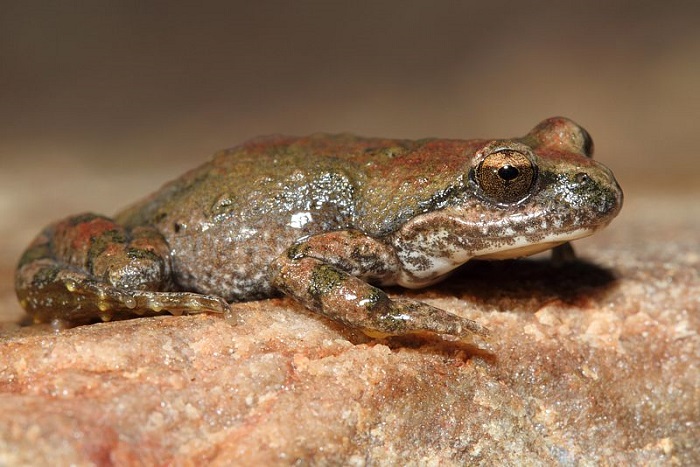
The following description is based on Boycott et al. (2002). The Karoo Caco is dorsoventrally flattened. The maximum snout–vent length recorded for this species is 26.3 mm in males and 30.8 mm in females. The dorsum is usually covered in small glandular warts. The dorsal colouration is uniform olive-brown to khaki-brown, sometimes tinged with red or orange, and the tip of the adpressed fifth toe reaches or extends beyond the second subarticular tubercle of the fourth toe. In breeding males, the gular region is a mustard yellow, whereas in females it is white with small dark patches.
The advertisement call of C. karooicum is a prolonged, coarse rattle, 0.5–1.48 s in duration, containing 22–59 pulses per call. The pulse rate is 42–44 pulses/s, and the emphasized frequency is 2–2.5 kHz (Boycott et al. 2002; H. Braack and A. Channing unpubl. data). The territorial call is a short, loud croak, 0.56–0.76 s in duration, emitted at an emphasized frequency of 2.5–3.2 kHz. This call is produced in separate groups of 6–8 notes and is not interspersed between the advertisement calls as is the case in C. namaquense (Boycott et al. 2002). Both advertisement and territorial calls of C.karooicum are longer in duration than those of C. namaquense.
Habitat
The Karoo Caco occurs in arid areas in which rainfall is unpredictable. The vegetation type present in the Robertson area is Little Succulent Karoo, while the Cederberg and Vanrhynsdorp areas are covered by Lowland Succulent Karoo. These areas are situated at altitudes below 600 m and receive an average annual (winter) rainfall of less than 300 mm (Schulze 1997). The Beaufort West and Fraserburg records occur in Eastern Mixed Nama Karoo, situated at slightly higher altitudes (700–1400 m), and receive more annual precipitation (300–500 mm). These areas lie on an ecotone and receive both winter and, to a lesser extent, summer rain (Low and Rebelo 1996).
The species occurs on shales of the Karoo sequence (Boycott et al. 2002). The frogs’ flattened appearance and habit suggests that this species is lithophilic, aestivating in rock cracks and crevices during long, unfavorable dry periods.
Breeding usually takes place in shallow pools in the rocky beds of small, temporary streams and has also been recorded in a small man-made dam along a stream. The species appears to avoid larger impoundments. Common frogs such as Tomopterna delalandii, Afrana fuscigula, Bufo gariepensis and C. boettgeri breed at a large dam near the type locality, but C. karooicum was not observed breeding there.
Behaviour
The Karoo Caco is an opportunistic breeder, taking advantage of rainfall of sufficient magnitude, regardless of the season in which it occurs. In dry years, little or no breeding may take place. For example, at Vrolijkheid Nature Reserve, no breeding was recorded between major rainfall events, the first in July 1977 and the next in January–February 1981, a period of 3.5 years (Boycott et al. 2002).
Calling usually takes place at night, although on wet, overcast days, males may also call from well-concealed sites. Call sites are sometimes exposed, but more often are located in clumps of vegetation or beneath stones at the water’s edge. Males call while partially submerged, with the head, vocal sac and forelimbs projecting above the water. Calling males maintain a distance of approximately one meter from one another and produce territorial calls when approached by other males (Boycott et al. 2002).
Amplexus occurs in deeper water on the downstream side of rocks or overhanging vegetation, and the eggs are attached to submerged vegetation. At Vrolijkheid Nature Reserve, four clutches of eggs laid in July 1977 numbered 258–323, while nine clutches laid in January and February 1981 numbered 36–156. The time taken to reach metamorphosis under natural conditions was recorded as 28 days (Boycott et al. 2002).
Status and Conservation
Status
The Karoo Caco occurs in the Karoo National Park, the Vrolijkheid Nature Reserve (type locality), and the Boesmanskloof Private Nature Reserve. Together with other frogs in the Western Cape and Northern Cape provinces, it is protected by the Cape Nature Conservation Ordinance 19 of 1974, as amended. The few known populations of C. karooicum do not appear to be facing any immediate or foreseeable threats to their survival. In view of the paucity of information on the distribution and ecology of this species, it is classified Data Deficient (this publication).
Threats
The area occupied by this species has low industrial, mining and urbanization potential. The main form of land use is small-stock farming that presents a low level of threat to this species, apart from general problems associated with land degradation under poor veld management. Some road construction has occurred near the Oukloof population (3221BB), which could potentially reduce the availability of breeding habitat.
Recommended conservation actions
Surveys are required to determine the full extent of the distribution of the Karoo Caco. Research into the ecology and population dynamics of the species is necessary for conservation assessment. Landowners at recorded localities should be made aware of the presence of this frog and the importance of protecting its breeding habitat.
Distribution
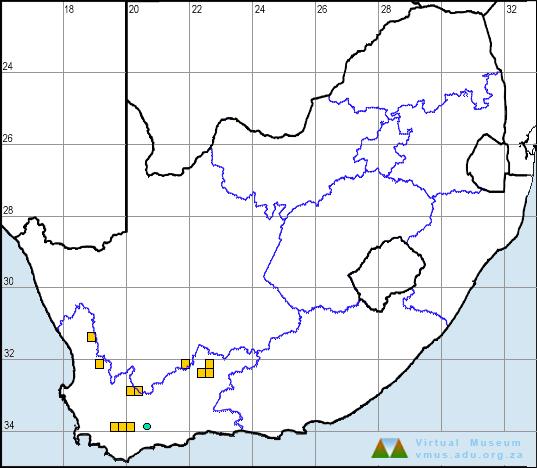
The Karoo Caco is endemic to the arid Karoo regions of the Western and Northern Cape provinces of South Africa. It is known from only a few widely separated localities. The most northerly record is Grootdrif (3118BD) in the Vanrhynsdorp district, which is the only area where the ranges of C. karooicum and C. namaquense are known to overlap. To the east, its distribution extends as far as Beaufort West district (3222BA, BC), bordering on the more mesic summer-rainfall region. Most of the known localities of C.karooicum are near the type locality in the Robertson district of the Little Karoo (3319DD) at the southern limit of its range (Boycott et al. 2002).
Although the Karoo Caco is currently known from only 11 grid cells, it is likely to occur in suitable habitat in the intervening areas. However, this frog appears to have a localized occurrence and specialized habitat preferences, and its distribution is therefore probably also fragmented. The atlas records are reliable, but incomplete.
Distribution of Cacosternum karooicum. Taken from the FrogMAP database as at February 2022.
Further Resources
The use of photographs by Trevor Hardaker is acknowledged.
Karoo CacoCacosternum karooicumBoycott, De Villiers and Scott, 2002
Other Common Names:Karoo Dainty Frog (Alternative English Names); Stofpadda, Karoo Blikslanertjie (Afrikaans)
Recommended citation format: Scott, E; Tippett, RM. (2025). Karoo Caco Cacosternum karooicum. Biodiversity and Development Institute, Cape Town. Available online at https://thebdi.org/2022/02/16/karoo-caco-cacosternum-karooicum/
This species text has been updated and expanded from the text in the 2004 frog atlas: Scott, E. (2004). Karoo Caco Cacosternum karooicum. In Minter LR et al 2004.
References:
Minter, LR; Burger, M; Harrison, JA; Braack, HH; Bishop, PJ; Kloepfer, D. (Editors). (2004). Atlas and Red Data Book of the Frogs of South Africa, Lesotho and Swaziland. Smithsonian Institution, Washington, and Avian Demography Unit, Cape Town.
Carruthers, V; du Preez, L. (2017). Frogs of southern Africa: A Complete Guide. Struik Nature, Cape Town.
Channing, A. (2001) Amphibians of Central and Southern Africa. Protea Book House, Pretoria
Find the Cape Caco in the FBIS database (Freshwater Biodiversity Information System) here.
Family Pyxicephalidae
Identification
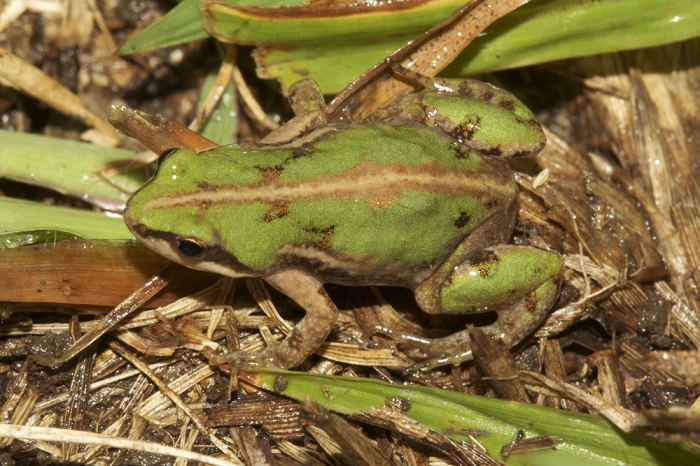
The Cape Caco is the largest member of the genus, attaining a maximum snout-vent length of 39 mm. It has an elongated body with a relatively small head and a horizontal pupil. The fingers and toes lack webbing. The palmar tubercles are poorly developed, the outer metatarsal tubercles are absent, and inner metatarsal tubercles are prominent and flange-like. A pair of large blister-like glands is present on the lower back, at the level of the urostyle, with another pair on the flanks, while numerous smaller glands are often scattered over the rest of the dorsum.
The dorsum varies in colour from grey to cream or light brown, with speckles and flecks of dark brown, orange or green. The ventral surface is creamy white, distinctively marked with large, irregular, olive to black blotches, and males have a dark throat.
The advertisement call is a harsh “creak”, about 0.2 s in duration, uttered repeatedly at a rate of about two per second (Passmore and Carruthers 1995).
Habitat
This species inhabits flat or gently undulating low-lying areas with poorly drained loamy to clay soils. The Cape Caco breeds in shallow, temporary, rain-filled pools and pans that form during the winter months. It also occurs in more sandy habitats but appears to be absent from the deep sands of the Cape Flats and adjoining coastal regions. The natural vegetation, which has been largely destroyed by urban development and agricultural activities, comprises the following vegetation types: West Coast Renosterveld, Central Mountain Renosterveld and, to a lesser extent, Sand Plain Fynbos, Dune Thicket and Mountain Fynbos.
Prior to urban and agricultural development, the area inhabited by the Cape Caco was mostly covered in renosterveld vegetation which is now one of the most threatened and poorly conserved vegetation types in southern Africa. However, this would not appear to be of critical importance for this species, as about 90% of its recorded breeding sites occur in modified habitat, particularly agricultural lands. These are mainly wheat fields, but also include lands cultivated for other crops (e.g. lupins and oats), vineyards, orchards, fallow lands and pastures. Owing to the large-scale destruction of natural vegetation, there are relatively few breeding sites in undisturbed habitat.
Behaviour
The Cape Caco is a winter breeder, with the commencement and duration of the breeding season being determined by the rainfall pattern. Breeding usually begins after the second heavy rain of winter and continues in response to subsequent heavy downpours. C. capense has been found to breed mostly in June–August, but calling activity has been heard as early as 24 April near Hermon (pers. obs.) and breeding has been recorded on 3 September in the Piketberg area (M. Burger and J.A. Harrison; pers. obs.). Males call occasionally during the day but mostly at night. At a prime breeding site under ideal conditions, more than 70 calling males were heard, but breeding aggregations are usually considerably smaller. Calling males are usually scattered and seldom form dense choruses. Males remain partially submerged in the water while calling and duck below the surface at the slightest disturbance.
Spawning was briefly described by Rose (1926). The eggs are laid in jelly clusters with each egg enclosed in a capsule. Egg clusters are attached to submerged vegetation such as grass stalks, and the number of eggs per cluster can vary considerably. In nine clusters (from one breeding group), the eggs numbered 57–400 (Rose 1926), and in 13 clusters found at a Klipheuwel breeding site, the eggs numbered 19–54. The development of the eggs and tadpoles was described by De Villiers (1929). The tadpoles are benthic and the duration of metamorphosis is probably correlated with factors such as temperature and the availability of food and water. In captivity, the tadpoles of eggs laid on 10 June completed metamorphosis from 7 September onwards (Rose 1926). Tailed froglets were found near Paarl on 10 September (pers. obs.).
The Cape Caco aestivates underground during the dry season. Its survival in regularly cultivated lands suggests that the frogs may burrow to depths below the reach of conventional ploughs.
Nothing is known of the diet of this species and no predators have been recorded. C. capense adults appear to secrete a poisonous substance from their skin glands, as it was observed that frogs of other species died when placed in the same vivarium (Rose 1926).
Status and Conservation
Status
The Cape Caco occurs in at least four populations. More than 90% of the area it occupies consists of modified habitat. Furthermore, it is estimated that more than 50% of its natural habitat has been lost over the last 70 years (Harrison et al. 2001), mainly in the southern part of its range.
C. capense occurs in three protected areas, which together represent less than 5% of its historical distribution area: J.N. Briers-Louw Provincial Nature Reserve (near Paarl), Elandsberg Private Nature Reserve (near Hermon) and the adjoining Voëlvlei Provincial Nature Reserve.
This species was previously listed as Rare (McLachlan 1978), and Restricted (Branch 1988), and is currently listed as Vulnerable (Harrison et al. 2001; this publication). This is based on an extent of occurrence <20 000 km2, area of occupancy <2000 km2, severely fragmented habitat, continuing decline in the extent of occurrence, area of occupancy, extent and quality of habitat and the number of locations/subpopulations and mature individuals. The species is legally protected by the Nature Conservation Ordinance 19 of 1974, but is not listed by CITES.
Threats
C. capense is threatened primarily by urban expansion and, to a lesser degree, by changes in the use of agricultural land and invasive vegetation. These have resulted in the loss, degradation and fragmentation of its habitat.
Urban development has resulted in the draining and/or filling of breeding sites. Although most remaining sites are in agricultural lands, intensive agriculture is a threat, and the practice of draining surplus water from cultivated lands prevents or restricts the formation of breeding pools during the wet winter months.
The widespread use of fertilizers, herbicides and pesticides in agricultural lands presents an additional threat, but the exact extent and level of this threat is unknown. The spread of invasive vegetation threatens C. capense habitat in places, particularly where invasive grasses and/or herbs form a thick, impenetrable ground cover.
Climate change due to global warming and reduced rainfall (Midgley et al. 2001) present a potential threat that would lead to a further loss of breeding habitat and the contraction of the distribution range of this species.
Recommended conservation actions
The distribution and conservation status of the Cape Caco is monitored by the Western Cape Nature Conservation Board (De Villiers 1997a) as part of a threatened species monitoring programme. However, the effect of fertilisers, herbicides and pesticides on the species requires further investigation, because most breeding sites are situated on agricultural land. The sites used by frogs for aestivation in summer should be identified, as this may involve habitats other than the breeding habitat.
The future of C. capense depends increasingly on its ability to survive in the agricultural lands that have replaced most of its natural habitat. In this regard, it is important to enlighten farmers about this species and to encourage them to conserve its habitat on their lands and, as far as possible, to leave breeding ponds undisturbed during the winter breeding season.
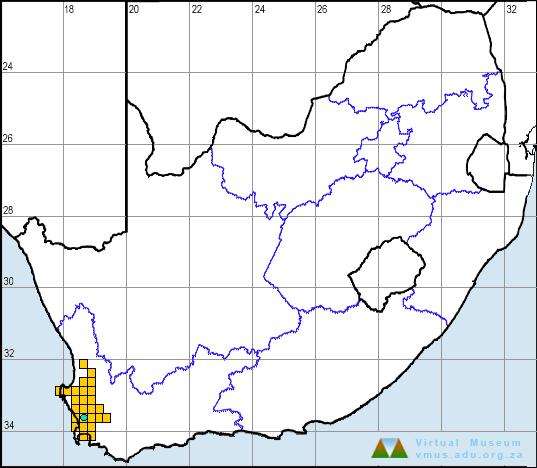
Distribution
The Cape Caco is endemic to the winter-rainfall region of the Western Cape, where it is restricted to altitudes below 280 m in areas that receive an annual rainfall of 300–1000 mm. Most of its distribution range is situated in the lowlands west of the Cape fold mountains, extending from the Cape Flats northward for 200 km to the Graafwater district, including a small population in the Olifants River valley. Another population is present in the Breede River valley about 80 km northeast of the Cape Flats, between Worcester and Tulbagh.
Distribution of Cacosternum capense. Taken from the FrogMAP database as at February 2022.
The description of the species followed its discovery in 1924 at “Rondebosch Golf Links” on the present Rondebosch Common (3318CD; Rose 1926, 1929). During the 50-year period following its discovery, this elusive frog was recorded from only a few additional localities: Stellenbosch (3318DD); Malmesbury (3318BC); Kuils River, Durbanville, Kraaifontein (3318DC); and Faure (3418BA). In 1976, a survey by J.C. Greig and R.C. Boycott of the then Cape Department of Nature and Environmental Conservation, produced a number of new locality records, extending the known range from Somerset West to the Darling, Moorreesburg and Gouda districts, and bringing to light a new population in the Breede River valley. During this survey, the species was recorded from 11 new grid cells, increasing the number to 16 (De Villiers 1988d). During the 1990s, on-going monitoring (De Villiers 1997a) significantly extended the range of the species northwards, to include the areas from Eendekuil to Piketberg to Velddrif (3218CD, DB, DC, DD) and an additional record from the Swartland (3319CA). The frog atlas surveys have added five additional grid cells to the known range. These records include the western limit of its distribution range in the Vredenburg area (3217DD), the present northern limit of its distribution range near Graafwater (3218BA), and a small population in the Olifants River valley (3218BD).
In all, the Cape Caco has been recorded in 26 quarter-degree grid cells. Since 1990, despite an ongoing monitoring programme (De Villiers 1997a), there has been no sign of C. capense in three of the previously recorded grid cells. These include the Worcester (3319CB), Somerset West (3418BB) and Cape Peninsula (3318CD) areas. In fact, the only known C. capense locality on the Cape Peninsula is the site, on the present Rondebosch Common, where this frog was first discovered, and which unfortunately became a rubbish dump (Rose 1950) and was filled in and covered by invasive kikuyu grass (McLachlan 1978).
Further Resources
The use of photographs by Luke Kemp is acknowledged.
Cape CacoCacosternum capenseHewitt, 1925
Other Common Names: Cross-marked Frog, Cape Dainty Frog (Alternative English Names); Kaapse Caco, Kaapse Blikslanertjie (Afrikaans)
Recommended citation format: de Villiers, AL; Tippett, RM. (2025). Cape Caco Cacosternum capense. Biodiversity and Development Institute, Cape Town. Available online at https://thebdi.org/2022/02/16/cape-caco-cacosternum-capense/
This species text has been updated and expanded from the text in the 2004 frog atlas: de Villiers, AL. (2004). Cape Caco Cacosternum capense. In Minter LR et al 2004.
References:
Minter, LR; Burger, M; Harrison, JA; Braack, HH; Bishop, PJ; Kloepfer, D. (Editors). (2004). Atlas and Red Data Book of the Frogs of South Africa, Lesotho and Swaziland. Smithsonian Institution, Washington, and Avian Demography Unit, Cape Town.
Carruthers, V; du Preez, L. (2017). Frogs of southern Africa: A Complete Guide. Struik Nature, Cape Town.
Channing, A. (2001) Amphibians of Central and Southern Africa. Protea Book House, Pretoria
Find the Common Caco in the FBIS database (Freshwater Biodiversity Information System) here.
Family Pyxicephalidae
Identification
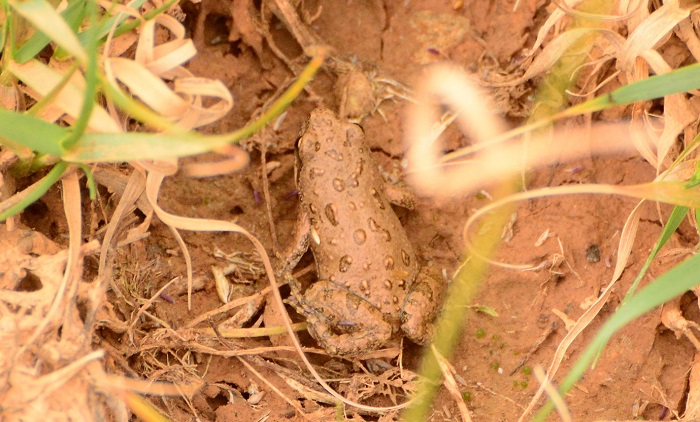
The Common or Boettger’s Caco is a small species that attains 23mm in length. The body is somewhat elongate and widest in the belly region, with a narrow head and a long neck. The dorsal colouration varies from green to light and dark brown or sometimes greyish. Individuals may be spotted, striped or uniform in colour. There is a dark band running from the snout, through the eye, to the base of the forelimbs. Below this there is a pale band along the upper lip from the snout to the base of the forelegs. The undersides are smooth with small grey to black spots. The limbs are relatively long and thin.
Common CacoCacosternum boettgeri Carnarvon district, Northern Cape Photo by Ryan Tippett
Habitat
The Common or Boettger’s Caco inhabits a wide variety of vegetation types in the Nama Karoo, Succulent Karoo, Savanna, Grassland, Fynbos and Thicket biomes. This species is usually absent from forests, although it is sometimes found in forest clearings. Within these biomes, it favours open areas with short vegetation and is especially abundant in grassy areas. The Common Caco can tolerate drier habitats than C. nanum, but also occurs in high-rainfall areas (Van Dijk 1977). In the Nama Karoo and Kalahari, C. boettgeri occurs naturally only in pans or along river courses, but can also be found in artificially created water bodies. The Common Caco breeds in any small, temporary water body, such as pools in flooded grasslands, culverts and other rain-filled depressions.
Habitat – Near Carnarvon, Northern Cape Photo by Ryan Tippett
Behaviour
During the dry season, the Common Caco aestivates in mudbanks, mudcracks, the burrows of other animals, disused termitaria, and under stones.
This species appears to have an extended breeding season. During the rainy season, males usually start calling in the late afternoon and call incessantly after dark, continuing until around midnight. Large choruses are common.
Call bouts are usually initiated by the same individual in the group (Channing 2001). Males normally call from concealed positions under vegetation or other cover, at water level, but have also been observed calling from totally exposed positions. A short territorial call is sometimes uttered by individual males prior to their regular advertisement call. In addition to the advertisement and territorial calls, several other vocalizations are known from the males of C. boettgeri, but their function is not well understood.
Common CacoCacosternum boettgeri Carnarvon district, Northern Cape Photo by Ryan Tippett
Clutches of c.250 eggs are attached to vegetation below the surface of the water (Channing 2001). The tadpoles usually hatch two days later, and metamorphosis is completed within approximately two weeks (Pienaar et al. 1976; Wager 1986).
The Common Caco is known to feed on termites (Passmore and Carruthers 1995) but probably takes any small insect. Like its congeners, it is probably a major predator of mosquitoes (Wager 1986). The Intermediate Egret Egretta intermedia, Spotted Skaapsteker Psammophylax rhombeatus (Channing 2001) and Giant Bullfrog Pyxicephalus adspersus (W.R. Branch pers. comm.) are known to prey on this frog.
Status and Conservation
The Common Caco is known from various nature reserves and protected areas throughout its range and is not threatened. The species is a supreme generalist, adapting well to disturbance. It appears to be unaffected by moderate eutrophication of its water through organic pollution such as bovine (or other) excrement and fertilisers. No conservation actions are necessary for this species.
Common CacoCacosternum boettgeri Karoo-Gariep Nature Reserve, Northern Cape Photo by Ryan Tippett
Distribution
The Common Caco is one of the most widespread and abundant frog species in the atlas region, occurring in most suitable habitats throughout its range at both high and low elevations. The species is absent from Namaqualand, the highlands of Lesotho, the top of the Soutpansberg and along much of the Mpumalanga escarpment.
Distribution of Cacosternum boettgeri. Taken from the FrogMAP database as at February 2022.
The lack of records from south-eastern KwaZulu-Natal, the Buffalo River and the Lower Tugela River basin may reflect a genuine absence of this species (Lambiris 1989a). Conversely, the paucity of records from the arid Northern Cape Province and parts of Eastern Cape Province is probably the result of inadequate sampling effort.
The range of the Common Caco may have increased in the last century due to human activity, particularly where bush and reeds have been cleared and grass has been introduced (Van Dijk 1971b), along with domestic stock.
Outside of the atlas region, C. boettgeri occurs in the savanna regions of Namibia, eastern Botswana, southern Zambia and the Zimbabwe plateau. The disjunct populations that occur in the grasslands of northern Tanzania, southern Kenya and Ethiopia, previously referred to C.boettgeri (Poynton 1964; Poynton and Broadley 1985b), differ in advertisement call and skeletal and genetic characteristics, and apparently represent an undescribed taxon (E. Scott in prep.).
Similarly, the populations in the winter-rainfall Western Cape, recently referred to C. platys (Channing 2001) but previously synonymised with C. boettgeri (Poynton 1964), display different advertisement calls, in addition to a marked mtDNA sequence divergence, compared to their savanna counterparts (E. Scott in prep.). However, the limits of distribution of the Western Cape form are currently unknown, since it is almost impossible to separate preserved museum material on external morphology alone. The atlas distribution map presented here does not distinguish between C. boettgeri and C. platys because over most of the atlas period, their seperate taxonomic status was not recognised. Reliable diagnostic field characters have not been described.
Common CacoCacosternum boettgeri Carnarvon district, Northern Cape Photo by Ryan Tippett
Further Resources
The use of photographs by Jean-Paul Brouard is acknowledged. Other images by Ryan Tippett.
Common CacoCacosternum boettgeri(Boulenger, 1882)
Other Common Names: Boettger’s Caco, Boettger’s Dainty Frog (Alternative English Names); Gewone Blikslanertjie (Afrikaans)
Recommended citation format: Scott, E; Tippett, RM. (2025). Common Caco Cacosternum boettgeri. Biodiversity and Development Institute, Cape Town. Available online at https://thebdi.org/2022/02/15/common-caco-cacosternum-boettgeri/
This species text has been updated and expanded from the text in the 2004 frog atlas: Scott, E. (2004). Common Caco Cacosternum boettgeri. In Minter LR et al 2004.
References:
Minter, LR; Burger, M; Harrison, JA; Braack, HH; Bishop, PJ; Kloepfer, D. (Editors). (2004). Atlas and Red Data Book of the Frogs of South Africa, Lesotho and Swaziland. Smithsonian Institution, Washington, and Avian Demography Unit, Cape Town.
Carruthers, V; du Preez, L. (2017). Frogs of southern Africa: A Complete Guide. Struik Nature, Cape Town.
Channing, A. (2001) Amphibians of Central and Southern Africa. Protea Book House, Pretoria
View the above photo record (by Megan Loftie-Eaton) in FrogMAPhere.
Find De Villiers’ Moss Frog in the FBIS database (Freshwater Biodiversity Information System) here.
Family Pyxicephalidae
DE VILLIER’S MOSS FROG – Arthroleptella villiersi
Hewitt, 1935
Habitat
A. villiersi is found in montane fynbos where the annual rainfall is >750 mm. It inhabits seepages and has been found amongst thick vegetation alongside small streams, even in plantations of exotic trees (A. Turner and A.L. de Villiers pers. comm.).
Behaviour
This species breeds in dense vegetation on wet slopes. Males call from concealed positions under moss or other vegetation, in damp areas (Channing 2001). Calling has been recorded during most months of the year except the driest summer months, while eggs have been found between July and November. A clutch comprises about 11 eggs, laid in a jelly mass 30 mm in diameter, often at the base of a wet, moss covered rock. Other nests have been found lightly concealed beneath overhanging grass on wet slopes and at the sides of road cuttings (Channing 2001). Metamorphosis takes place after 10–14 days.
Status and Conservation
A. villiersi is relatively widespread and often numerous. A large proportion of its habitat falls within protected areas, both statutory and private. The species does not need special conservation action.
Distribution
A. villiersi is endemic to the Western Cape Province where it is found on the slopes of the Hottentots Holland, Kogelberg, and Kleinrivier mountains and eastward to the Bredasdorp Mountains. It occurs from sea level at Rooi Els and Betty’s Bay, to altitudes of 1800 m. This species is sympatric with A. drewesii and A. landdrosia in places, but can be distinguished by differences in its advertisement call (see relevant species accounts) (Channing et al. 1994b). The atlas data are reliable.
Distribution of Arthroleptella villiersi. Taken from the FrogMAP database as at February 2022.
Further Resources
Virtual Museum (FrogMAP > Search VM > By Scientific or Common Name)
More common names: De Villiers’ Chirping Frog (Alternative English Name); De Villiers se Mospaddatjie (Afrikaans).
Recommended citation format for this species text:
Channing A, Tippett RM. De Villiers’ Moss Frog Arthroleptella villiersi. BDI, Cape Town. Available online at http://thebdi.org/2022/02/14/de-villiers-moss-frog-arthroleptella-villiersi/
Recommended citation format:
This species text has been updated and expanded from the text in the 2004 frog atlas. The reference to the text and the book are as follows:
Channing A 2004 Arthroleptella villiersi De Villiers’ Moss Frog. In Minter LR et al 2004.
Minter LR, Burger M, Harrison JA, Braack HH, Bishop PJ, Kloepfer D (eds) 2004. Atlas and Red Data Book of the Frogs of South Africa, Lesotho and Swaziland. Smithsonian Institution, Washington, and Avian Demography Unit, Cape Town.
View the above photo record (by Megan Loftie-Eaton) in FrogMAPhere.
Find the Lightfoot’s Moss Frog in the FBIS database (Freshwater Biodiversity Information System) here.
Family Pyxicephalidae
LIGHTFOOT’S MOSS FROG – Arthroleptella lightfooti
(Boulenger, 1910)
Identification
Adults vary considerably in colouration and markings. Females reach 22 mm in length. The outer metatarsal tubercle is well developed as in Arthroleptella villiersi. The advertisement call is a short chirp consisting of three pulses. The call is 0.1 s long and has an emphasized frequency of 3.1–3.4 kHz (Channing et al. 1994a; Channing 2001). This species does not occur in sympatry with any other Arthroleptella species.
Habitat
This species is restricted to montane fynbos and Afromontane forest in the winter rainfall region, where annual rainfall is >750 mm. It inhabits seepages, both in open fynbos and kloofs, where the vegetation is thick and the substrate is sandy or rocky.
Behaviour
Choruses develop during the daytime and at night, between April and December, coinciding with the rainy season. Males call from concealed sites and are frequently found under moss in the vicinity of egg masses. Clutches of 5–12 eggs are laid on damp soil under vegetation or in more exposed positions, and are often found near waterfalls (Channing 2001). Development is direct and metamorphosis takes place 7–10 days after the eggs are laid.
Status and Conservation
Status
A. lightfooti occurs in the Cape Peninsula National Park and Kirstenbosch Botanical Gardens (Channing 2001; Harrison et al. 2001). Although the limited area of occupancy and extent of occurrence of this species seems to warrant a higher category of threat, its distribution falls almost entirely within the Cape Peninsula National Park and the known sub-populations are not severely fragmented. Major declines are not expected, and the species was therefore classified Near Threatened (Harrison et al. 2001; this publication). While the species is not considered to be under immediate threat, appropriate conservation management practices are necessary to ensure its continued survival.
Threats
Present and potential threats include habitat fragmentation, the alteration of drainage patterns (dam construction), invasive alien vegetation, afforestation and fire (Harrison et al. 2001). These threats are exacerbated by the fact that the area of occupancy is surrounded by a large urban metropolis.
Recommended conservation actions
Habitat and limiting factor management, as well as regular population monitoring, are recommended.
Distribution
A. lightfooti is endemic to the Cape Peninsula. It is known from sea level to 1000 m at the top of Table Mountain. The species appears to be divided into two subpopulations: Table Mountain/Constantiaberg, and the southern Cape Peninsula (Harrison et al. 2001). The atlas data are reliable.
Distribution of Arthroleptella lightfooti. Taken from the FrogMAP database as at February 2022.
Further Resources
Virtual Museum (FrogMAP > Search VM > By Scientific or Common Name)
More common names: Cape Peninsula Moss Frog, Cape Chirping Frog (Alternative English Name); Kaapse Skiereiland mospadda (Afrikaans).
Recommended citation format for this species text:
Channing A, Tippett RM. Lightfoot’s Moss Frog Arthroleptella lightfooti. BDI, Cape Town. Available online at http://thebdi.org/2021/11/11/lightfoots-moss-frog-arthroleptella-lightfooti/
Recommended citation format:
This species text has been updated and expanded from the text in the 2004 frog atlas. The reference to the text and the book are as follows:
Channing A 2004 Arthroleptella lightfooti Lightfoot’s Moss Frog. In Minter LR et al 2004.
Minter LR, Burger M, Harrison JA, Braack HH, Bishop PJ, Kloepfer D (eds) 2004. Atlas and Red Data Book of the Frogs of South Africa, Lesotho and Swaziland. Smithsonian Institution, Washington, and Avian Demography Unit, Cape Town.
View the above photo record (by Faansie Peacock) in FrogMAPhere.
Find the Landroskop Moss Frog in the FBIS database (Freshwater Biodiversity Information System) here.
Family Pyxicephalidae
LANDROSKOP MOSS FROG – Arthroleptella landdrosia
Dawood and Channing, 2000
Identification
Males reach 15 mm in length (Channing 2001). This species may be identified by its advertisement call that consists of a relatively long series of strident clicks, unlike the very short, chirping call of the sympatric A.villiersi (Dawood and Channing 2000; A. Turner and A.L. de Villiers pers. comm.).
Habitat
A. landdrosia inhabits montane fynbos and forest (A.L. de Villiers pers. comm.) along streams and in seepages, including those on steep slopes. It occurs in winter rainfall areas that receive annual rainfall >750 mm.
Behaviour
Breeding takes place between September and February (spring and late summer). Males call from concealed positions in moss and beneath dense vegetation near water along streams. Nothing further is known about the life history and ecology of this species.
Status and Conservation
A. landdrosia is known from Hottentots Holland and Kogelberg nature reserves (Channing 2001; Harrison et al. 2001). Although the limited area of occupancy and extent of occurrence of this species seem to warrant a higher category of threat, major declines are not anticipated because the species occurs in generally rugged and inaccessible terrain, and the known populations are not severely fragmented. The species was therefore classified Near Threatened (Harrison et al. 2001; this publication). While the species is not considered to be under immediate threat, appropriate conservation management practices are required in order to ensure its survival in the long term.
Threats
Present and potential future threats to this species include changes in the quality of its habitat due to drainage, damming and habitat fragmentation caused by invasive alien vegetation, afforestation and frequent fires (Harrison et al. 2001).
Recommended conservation actions
More fieldwork is needed to better understand the distribution, life history and ecology of A. landdrosia. Habitat and limiting factor management, as well as regular population monitoring, are recommended (Harrison et al. 2001).
Distribution
A. landdrosia is endemic to the Hottentots Holland and Kogelberg mountains, reaching the coast near Rooi Els and Betty’s Bay (3418BD). It is found from sea level to 1600 m. The atlas distribution data are reliable.
Distribution of Arthroleptella landdrosia. Taken from the FrogMAP database as at February 2022.
Further Resources
Virtual Museum (FrogMAP > Search VM > By Scientific or Common Name)
More common names: Landdroskop Chirping Frog (Alternative English Name); Landdroskop-mospaddatjie (Afrikaans)
Recommended citation format for this species text:
Channing A, Tippett RM. Landdroskop Moss Frog Arthroleptella landdrosia. BDI, Cape Town. Available online at http://thebdi.org/2022/02/12/landroskop-moss-frog-arthroleptella-landdrosia/
Recommended citation format:
This species text has been updated and expanded from the text in the 2004 frog atlas. The reference to the text and the book are as follows:
Channing A 2004 Arthroleptella landdrosia Landroskop Moss Frog. In Minter LR et al 2004.
Minter LR, Burger M, Harrison JA, Braack HH, Bishop PJ, Kloepfer D (eds) 2004. Atlas and Red Data Book of the Frogs of South Africa, Lesotho and Swaziland. Smithsonian Institution, Washington, and Avian Demography Unit, Cape Town.
View the above photo record (by Trevor Hardaker) in FrogMAPhere.
Find the Drewes’ Moss Frog in the FBIS database (Freshwater Biodiversity Information System) here.
Family Pyxicephalidae
DREWES’ MOSS FROG – Arthroleptella drewesii
Channing, Hendricks and Dawood 1994
Identification
This species barely exceeds 20 mm in length. The outer metatarsal tubercle takes the form of a small ridge in A.drewesii, but is well developed in the sympatric A.villiersi. The advertisement call in A. drewesii has a duration of at least 0.6 s and consists of at least six pulses, with noticeable changes in intensity as the call progresses, whereas in A. villiersi the call is much shorter (0.07–0.11 s), comprising only 4–5 pulses (Channing et al. 1994b; Channing 2001; A. Turner pers. obs.).
Habitat
A. drewesiiinhabits dense vegetation along stream edges and seepages, in montane fynbos. It occurs in a winter rainfall area that receives annual rainfall of 500–750 mm.
Behaviour
Males call from moss-covered slopes, concealed beneath vegetation or stones. Large choruses develop during the rainy season, and calling continues throughout the day and night, from June through September. Nothing further is known about the life history and ecology of this species.
Status and Conservation
Status
A. drewesii is known from the Fernkloof, Maanschynkop, and Vogelgat nature reserves, and adjacent wet areas at altitudes >200 m (Channing 2001; Harrison et al. 2001). The species was previously classified Near Threatened (Harrison et al. 2001), but this has been revised to Data Deficient for this publication, in view of the lack of information on the total extent of the species’ range.
Threats
Present and potential threats include habitat degradation caused by invasive alien vegetation, afforestation, the construction of roads and dams, the alteration of drainage patterns and too frequent fires (Harrison et al. 2001).
Recommended conservation actions
The continued existence of reserves appear to be essential for the long-term survival of A. drewesii, and appropriate conservation management practices are required. Habitat and limiting factor management, as well as regular population monitoring are recommended (Harrison et al. 2001). Surveys are needed to establish the full extent of this species’ range as well as the size of its sub-populations.
Distribution
This species is endemic to the Kleinrivier Mountains, near Hermanus. The known distribution is limited to the quarter-degree grid cell 3419AD, but is probably more extensive. It occurs in sympatry with A. villiersi, although the two species have not been observed calling from the same seepages. The atlas data are reliable, but probably incomplete.
Distribution of Arthroleptella drewesii. Taken from the FrogMAP database as at February 2022.
Further Resources
Virtual Museum (FrogMAP > Search VM > By Scientific or Common Name)
More common names: Drewes’ Chirping Frog, (Alternative English Name); Drewes se Mospaddatjie (Afrikaans)
Recommended citation format for this species text:
Channing A, Tippett RM. Drewes’ Moss Frog Arthroleptella drewesii. BDI, Cape Town. Available online at http://thebdi.org/2022/02/09/drewes-moss-frog-arthroleptella-drewesii/
Recommended citation format:
This species text has been updated and expanded from the text in the 2004 frog atlas. The reference to the text and the book are as follows:
Channing A 2004 Arthroleptella drewesii Drewes’ Moss Frog. In Minter LR et al 2004.
Minter LR, Burger M, Harrison JA, Braack HH, Bishop PJ, Kloepfer D (eds) 2004. Atlas and Red Data Book of the Frogs of South Africa, Lesotho and Swaziland. Smithsonian Institution, Washington, and Avian Demography Unit, Cape Town.