BDInsight – February 2022

We have lots of exciting news to share with you this month, from the plains of the Karoo to the savannas and woodlands of Limpopo Province. And, we have some great news about the online citizen science journal Biodiversity Observations and the biomemory which is the Virtual Museum.

Karoo Research Centre

We launched the Karoo Research Centre at the beginning of February 2022 and are currently developing the fieldwork protocols that will serve as the basis of our research. We aim to create protocols with enough structure to deliver critical insights into changes in Karoo biodiversity, but which also remain straightforward and accessible for implementation by citizen scientists throughout the Karoo.

The Karoo Research Centre is a collaboration between the Khoisan Karoo Conservancy and the Biodiversity and Development Institute (BDI). The Karoo Research Centre is based at New Holme, the main accommodation lodge in the conservancy, located in the Northern Cape Province between Hanover and Colesberg and 8 km off the N1.

By good fortune, we are starting our monitoring at a peak in seasonal wetness in the Karoo. The Khoisan Karoo Conservancy has already received its normal average rainfall, the Seekoei River is flowing strongly, and the New Holme Dam has been overflowing for weeks; this region is enjoying more water than it has in decades.

Once we have obtained sufficient results to establish our credentials, the Karoo Research Centre will receive a formal launch. In the meantime, come and spend a night or two here, and experience the excitement of establishing a new initiative for yourself! We are almost exactly halfway between Gauteng and Cape Town.
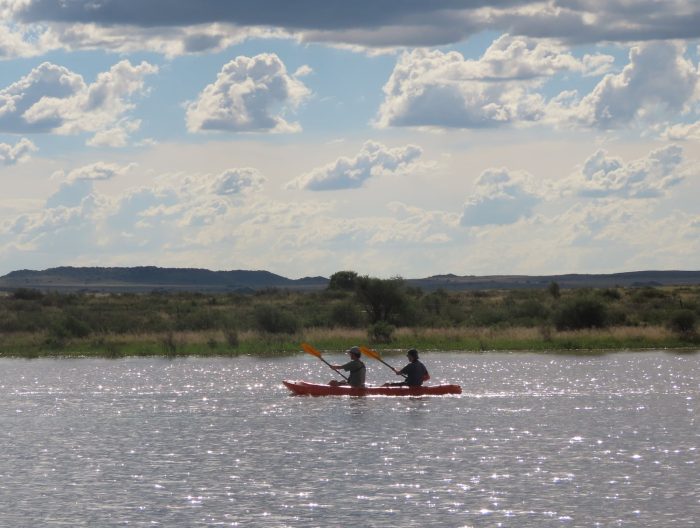
One of the current projects at the Karoo Research Centre is a weekly survey of all the waterbirds on the New Holme Dam. Currently, the dam is completely full, and the perimeter is around 14 km in length. Basque interns Josu Melendez and Jon Blanco take a canoe each along the perimeter, keeping a good distance offshore so they don’t disturb the birds as they move along. It takes a bit over four hours to complete a survey.

There has been fantastic rainfall over the Karoo this summer. Our hypothesis is that the waterbirds are breeding on the myriad of ephemeral wetlands and that when these dry up the adults and their young will come to the New Holme Dam as a dry season refuge through the winter. The first survey produced a total of 479 waterbirds of 18 species, and was dominated by Egyptian Geese (216) and South African Shelduck (109). That is not a lot of birds for that huge area of dam!

To follow updates and news on the Karoo Research Centre, and all our other awesome projects, be sure to follow the BDI on InstagramFacebook and Twitter.

Daily Maverick journalist Angus Begg visited the Khoisan Karoo Conservancy a few weeks ago. Read about his experience here.

BDI Shy Five Tours

The BDI will be hosting Shy Five tours at Khoisan Karoo Conservancy near Hanover in the Northern Cape starting in March 2022. You don’t want to miss out on these awesome biodiversity tours! A great opportunity to meet the Karoo Shy Five: Aardwolf, Aardvark, Black-Footed Cat, Porcupine and Bat-eared Fox. The first tour dates coming up are 20 to 23 March and 8 to 11 April.

If you are interested please contact Megan Loftie-Eaton at megan@thebdi.org or meg.loftie.eaton@gmail.com

A rough itinerary of what you can expect:

Day 1:
• During the afternoon: Arrive at New Holme
• This is home for the next three nights
• Welcome and settle in rooms
• 17h00. Sunset game drive to see hippos and buffalo
• 19h30. Dinner at New Holme lodge
• 20h30. Shy Five night drive in game vehicle, covering about 20 km, and meeting some or all of the Shy Five night mammal species – Aardwolf, Aardvark, Black Footed Cat, Porcupine and Bat-eared Fox.

Day 2:
• 06h00. Coffee and rusks. Bird ringing at the lodge; morning birding drive
• 10h00. Brunch at the lodge
• 11h30. Meet the BDI research team and get to understand the monitoring projects on the go
• 16h30. A game and birding drive, followed by sundowners and the veld braai on a hilltop
• 20h00. Karoo farm pudding at the lodge

Day 3:
• 06h00. Coffee and rusks. Bird ringing at the lodge; morning birding drive
• 10h00. Brunch at the lodge
• 11h30. Option of doing fieldwork for the monitoring projects
• 16h30. Khoi etching trip [10 km drive and a 1 km walk] with snacks
• 19h30. Dinner at the lodge
• 20h30. Shy Five night drive.

Day 4:
• 07h30. Breakfast at the lodge and departure

Virtual Museum

OdonataMAP

Andries de Vries photographed a very special dragonfly in an area where it has not been recorded before! He OdonataMAPped a Crenigomphus hartmanni Clubbed Talontail (Afr: Knoppiekloustert) near Groblersdal. Groblersdal is a farming town situated 32 km north of the Loskop Dam in the Sekhukhune District of Limpopo Province.
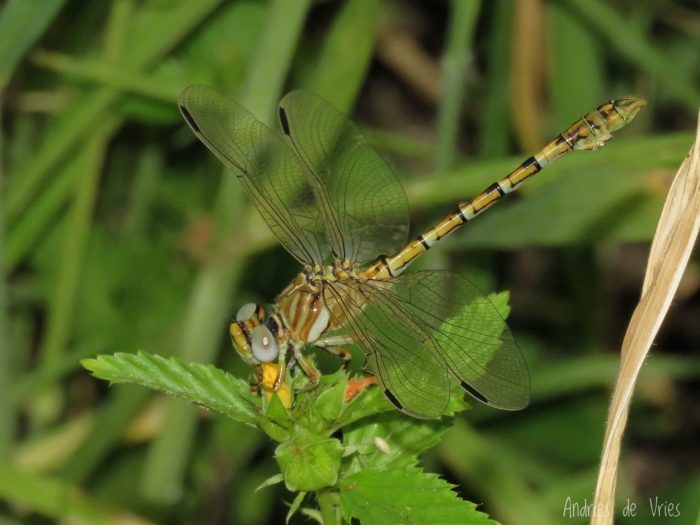
Crenigomphus hartmanni – Clubbed Talontail

Andries says: “The first specimen was a welcome surprise; but after preparing myself a bit better for the long grass around the dam, I returned and photographed another 5 individuals. In total 4 males and 2 females were seen within 200 meters! These will be the first photographic records to be submitted to the Virtual Museum for this Quarter Degree Sector. Another special observation was a connected pair of Mesocnemis singularis – Savanna Riverjack, another first for this locality”

Well done Andries! Thank you for your awesome support and inputs!

Quick uploads for the Virtual Museum

Need a quick way to upload records to the Virtual Museum from your cellphone? We have the solution! Take a look at: https://quickvm.co.za — a mobile friendly version to get your biodiversity records into the VM.
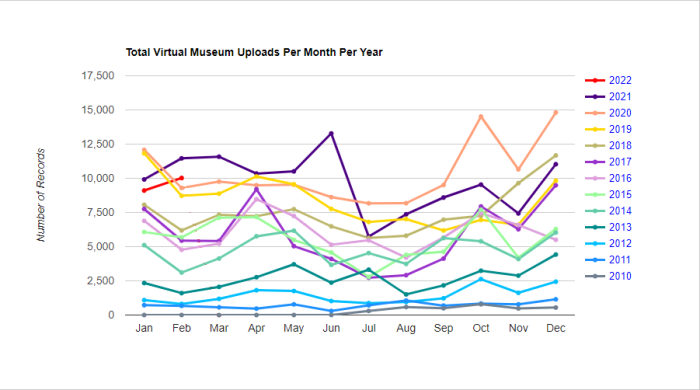
Total number of records submitted to the Virtual Museum per month per year.

For February 2022, the VM received 10,025 records! Thank you BioMAPpers!

Biodiversity Observations

During 2021 the Biodiversity Observations journal went into a little hibernation, some people might even have thought that the journal had closed. But have no fear! The journal is still here! In fact, the first new paper for 2022 has been published, titled: “First nesting records for Black Sparrowhawk Accipiter melanoleucus in the Northern Cape, South Africa” You can access the full paper here.

Biodiversity Observations is the continuation of Ornithological Observations (volumes 1 to 6), it is an e-journal published by the Biodiversity and Development Institute and hosted by the University of Cape Town Libraries.

Biodiversity Observations accepts papers containing information about biodiversity in general. This includes descriptions of distribution, behaviour, breeding, foraging, food, movement, measurements, habitat and colouration/plumage. It will also consider for publication a variety of other interesting or relevant biodiversity material: reports of projects and conferences, annotated checklists for a site or region, specialist bibliographies, book reviews and any other interesting or relevant material. Further details and guidelines to authors are on this website.
Biodiversity Observations aims to create a platform for scientists and citizen scientists to publish a variety of biodiversity related contributions as quickly as possible. The papers will not be peer-reviewed or refereed, but the Editorial Committee will ensure a high standard is maintained. We encourage dialogue and discussion, so papers reflecting on topics already published will be considered. We invite interested parties from all walks of life to submit contributions to be considered for publication. Biodiversity Observations accepts submissions from anywhere in the world.

Tandy’s Sand Frog (Tomopterna tandyi)

View the above photo record (by Zenobia van Dyk) in FrogMAP here.

Find the Tandy’s Sand Frog in the FBIS database (Freshwater Biodiversity Information System) here.

Family Pyxicephalidae

TANDY’S SAND FROG – Tomopterna tandyi

Channing and Bogart, 1996

Habitat

T. tandyi inhabits loose, sandy soils. It occurs along small streams, pans and temporary rain pools, and is commonly associated with farm dams. It thrives in both arid and more mesic areas where annual rainfall is 50–>750 mm. Records are known from the Nama Karoo, Grassland and Savanna biomes.

Breeding habitat – Near Carnarvon, Northern Cape
Photo by Ryan Tippett

Behaviour

Little is known of the reproductive biology of this species. Males call from exposed positions at the edge of newly formed pools, but also from beneath vegetation in flooded areas. Tadpoles vary in colour according to the turbidity of the water in which they are found.

Predators of this species are not recorded

Tomopterna tandyi – Western Cape
Photo by Felicity Grundlingh

Status and Conservation

T. tandyi appears to be a widespread and common species that does not require conservation action. However, additional distribution data based on reliable diagnostic characters, such as advertisement calls, are needed to produce an accurate distribution map for this species.

Distribution

This cryptic, tetraploid species is difficult to distinguish from T. cryptotis (see discussion in T. cryptotis species account). T. tandyi occurs in sympatry with T. delalandii at many localities, for example, Port Alfred (3326DB), and with T. cryptotis at, for example, Colesberg (3025CA).

On the basis of the few existing confirmed records (unpubl. data), T. tandyi appears to be distributed from the semi-arid Karoo region of South Africa northward into East Africa. It has been found from sea level to the inland plateau at >1800 m.

Distribution records, based on advertisement calls, were collected mainly in the southern parts of the atlas region by M. Burger and H.H. Braack. The distribution of this species in the northern and eastern parts of the atlas region is not well known as few verifiable records were collected by observers working in these areas. The distribution data shown on the map are therefore accurate, but incomplete.

Distribution of Tomopterna tandyi. Taken from the FrogMAP database as at February 2022.

Further Resources

Virtual Museum (FrogMAP > Search VM > By Scientific or Common Name)

More common names: Tandy se Sandpadda (Afrikaans)

Recommended citation format for this species text:

Channing A, Tippett RM. Tandy’s Sand Frog Tomopterna tandyi. BDI, Cape Town.
Available online at http://thebdi.org/2022/02/23/tandys-sand-frog-tomopterna-tandyi/

Recommended citation format: 

This species text has been updated and expanded from the text in the
2004 frog atlas. The reference to the text and the book are as follows:

Channing A 2004 Tomopterna tandyi Tandy’s Sand Frog. In Minter LR
et al 2004.

Minter LR, Burger M, Harrison JA, Braack HH, Bishop PJ, Kloepfer D (eds)
2004. Atlas and Red Data Book of  the Frogs of South Africa, Lesotho and
Swaziland. Smithsonian Institution, Washington, and Avian Demography
Unit, Cape Town.

Natal Sand Frog (Tomopterna natalensis)

View the above photo record (by Alicia Culverwell) in FrogMAP here.

Find the Natal Sand Frog in the FBIS database (Freshwater Biodiversity Information System) here.

Family Pyxicephalidae

NATAL SAND FROG – Tomopterna natalensis

(Smith, 1849)

Habitat

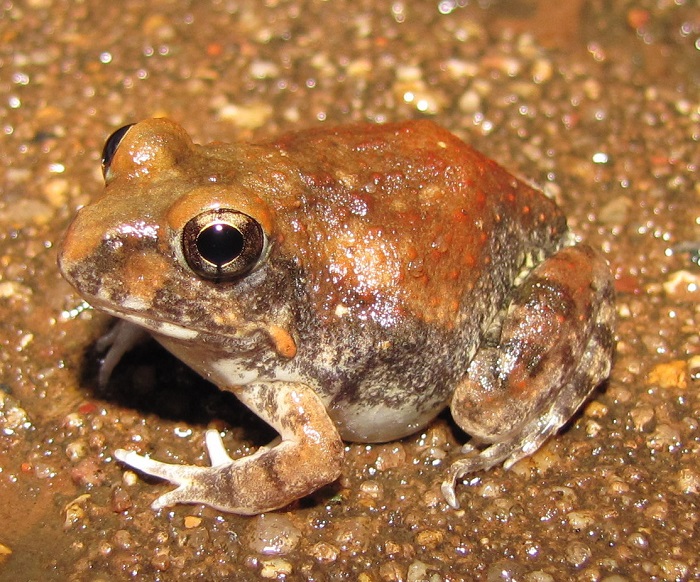
T. natalensis is found in a variety of vegetation types in the Grassland and Savanna biomes. These areas receive annual rainfall of 300–>1000 mm. Breeding takes place in streams, rivers or other places where water flows slowly, but also in standing water.

Behaviour

Breeding begins after the first rains, continuing into midsummer. Males call from exposed positions near the water’s edge, on bare sand, mud or rock. The eggs are usually laid singly or in small groups, in running water. Development is rapid and is completed within 2–3 weeks.

The only recorded predator is the Brown House Snake Lamprophis fuliginosus.

Tomopterna natalensis – Limpopo
Photo by Ryan van Huyssteen

Status and Conservation

Pending the results of future distribution surveys (see remarks under Distribution), this widespread species does not appear to require conservation action.

Distribution

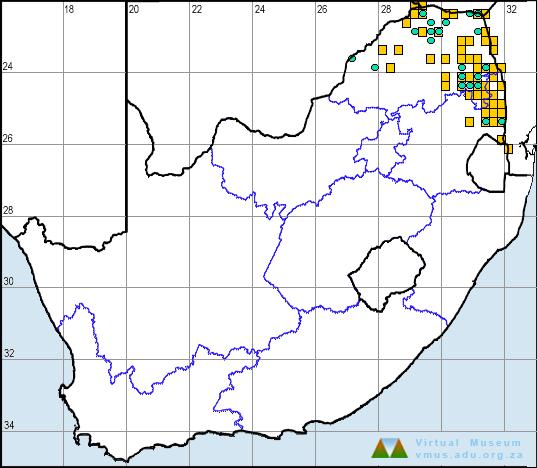
T. natalensis is recorded from Botswana, Zimbabwe and southern Mozambique and its distribution extends into the eastern part of the atlas region, where it occurs from sea level to the high inland plateau at 2000 m. It is largely absent from the upper slopes of the Drakensberg. It is a common species in Limpopo, Mpumalanga, Gauteng and KwaZulu-Natal provinces, as well as in the eastern parts of North West and Eastern Cape provinces and throughout Swaziland. The species is uncommon in the Free State and Lesotho.

The distribution map is reasonably complete and accurate in relation to the present taxonomic status and diagnosis of this species. However, the description of additional cryptic species (unpubl. data) may necessitate a re-examination of the distribution of this species. Distribution records should in future be accompanied by recordings of the advertisement calls.

Distribution of Tomopterna natalensis. Taken from the FrogMAP database as at February 2022.

Further Resources

Virtual Museum (FrogMAP > Search VM > By Scientific or Common Name)

More common names: Natal Pyxie (Alternative English Names); Natalse Sandpadda (Afrikaans)

Recommended citation format for this species text:

Channing A, Tippett RM.  Natal Sand Frog Tomopterna natalensis. BDI, Cape Town.
Available online at http://thebdi.org/2022/02/23/natal-sand-frog-tomopterna-natalensis/

Recommended citation format: 

This species text has been updated and expanded from the text in the
2004 frog atlas. The reference to the text and the book are as follows:

Channing A 2004 Tomopterna natalensis Natal Sand Frog. In Minter LR
et al 2004.

Minter LR, Burger M, Harrison JA, Braack HH, Bishop PJ, Kloepfer D (eds)
2004. Atlas and Red Data Book of  the Frogs of South Africa, Lesotho and
Swaziland. Smithsonian Institution, Washington, and Avian Demography
Unit, Cape Town.

Russet-backed Sand Frog (Tomopterna marmorata)

View the above photo record (by Vaughan Jessnitz) in FrogMAP here.

Find the Russet-backed Sand Frog in the FBIS database (Freshwater Biodiversity Information System) here.

Family Pyxicephalidae

RUSSET-BACKED SAND FROG – Tomopterna marmorata

(Peters, 1854)

Habitat

In the atlas region, T. marmorata inhabits a range of bushveld vegetation types in the Savanna Biome. It seems to prefer sandy soil and occurs in areas where annual rainfall is 500–1000 mm. It breeds in slow-flowing rivers and streams as well as isolated pools, pans or dams with sandy substrates.

Behaviour

T. marmorata adults have been found buried in sandbanks during the dry season. They emerge after the first rains and begin breeding as soon as bodies of standing or running water have formed. Males call from open areas on sandbanks, near the edge of the water. Amplexus is axillary, and the eggs are laid in shallow water (L.R. Minter pers. comm.). The eggs are laid singly, and a clutch size of 150 eggs has been recorded (Channing 2001). No further life history details are known.

Tomopterna marmorata – Mpumalanga
Photo by Robert Tibbitt-Eggleton

Status and Conservation

This is a widespread and common species, but see remarks under Distribution. No conservation action appears to be necessary.

Distribution

North of the atlas region, T. marmorata ranges from Botswana eastward through Zambia, Malawi and Zimbabwe to southern Mozambique. Within the atlas region, the species is fairly widespread in Limpopo Province and eastern Mpumalanga at altitudes <1000 m. An historical record from Ndumo Game Reserve in northern KwaZulu-Natal (Poynton 1964) requires confirmation, as the original specimens have been lost (Lambiris 1989a).

The distribution map is incomplete and the distribution data presented here should be viewed with circumspection. The description of additional cryptic species (unpubl. data) will necessitate a re-examination of the distribution of T. marmorata, using distribution records based on calls.

Distribution of Tomopterna marmorata. Taken from the FrogMAP database as at February 2022.

Further Resources

Virtual Museum (FrogMAP > Search VM > By Scientific or Common Name)

More common names: Marbled Sand Frog, Marmorate Pyxie, Mozambique Dwarf Bullfrog (Alternative English Names); Rooirug-sandpadda (Afrikaans)

Recommended citation format for this species text:

Channing A, Tippett RM. Russet-backed Sand Frog Tomopterna marmorata. BDI, Cape Town.
Available online at http://thebdi.org/2022/02/23/russet-backed-sand-frog-tomopterna-marmorata/

Recommended citation format: 

This species text has been updated and expanded from the text in the
2004 frog atlas. The reference to the text and the book are as follows:

Channing A 2004 Tomopterna marmorata Russet-backed Sand Frog. In Minter LR
et al 2004.

Minter LR, Burger M, Harrison JA, Braack HH, Bishop PJ, Kloepfer D (eds)
2004. Atlas and Red Data Book of  the Frogs of South Africa, Lesotho and
Swaziland. Smithsonian Institution, Washington, and Avian Demography
Unit, Cape Town.

Cape Sand Frog (Tomopterna delalandii)

View the above photo record (by Alison Sharp) in FrogMAP here.

Find the Cape Sand Frog in the FBIS database (Freshwater Biodiversity Information System) here.

Family Pyxicephalidae

CAPE SAND FROG – Tomopterna delalandii

(Tschudi, 1838)

Habitat

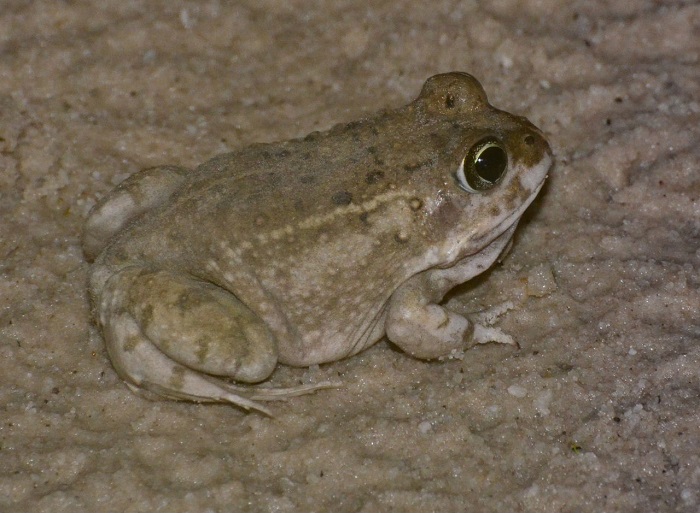
T. delalandii inhabits lowlands and valleys throughout the Fynbos and Succulent Karoo biomes. Annual rainfall in these areas is 60–750 mm. It breeds in pans, vleis and dams, as well as small watercourses in flat, sandy areas.

Behaviour

Males call from exposed positions, often in shallow water. This species breeds in winter in the winter-rainfall region, and in summer throughout the rest of its range (Channing 1988). About 2500 eggs are laid singly or in small masses and have an unpleasant odour. The tadpoles are benthic and reach 44 mm in length. Metamorphosis takes place within 25–35 days.

Tomopterna delalandii – Photo by Andrew & Heather Hodgson

Status and Conservation

This widespread species is abundant and not in need of conservation action.

Distribution

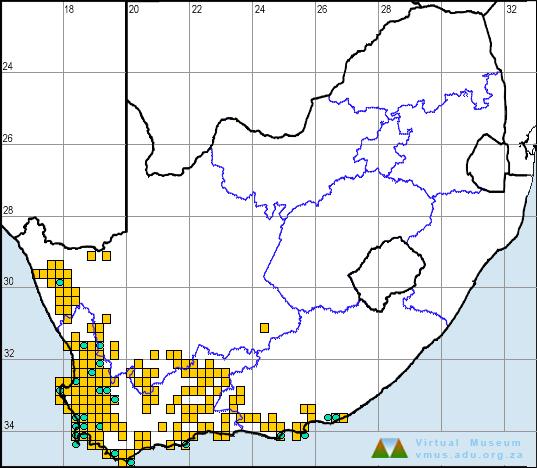
This South African endemic species is distributed from Steinkopf (2917BC) in Northern Cape Province, southward through Namaqualand and eastward across most of Western Cape Province to the low-lying areas of Eastern Cape Province. It is recorded as far east as Port Alfred (3326DB). Some records from the Karoo and interior may be confused with T. tandyi (see the comments under T. cryptotis).

Distribution of Tomopterna delalandii. Taken from the FrogMAP database as at February 2022.

Further Resources

Virtual Museum (FrogMAP > Search VM > By Scientific or Common Name)

More common names: Delalande’s Sand Frog, Striped Pyxie (Alternative English Names); Gestreepte Sandpadda (Afrikaans)

Recommended citation format for this species text:

Channing A, Tippett RM.  Cape Sand Frog Tomopterna delalandii. BDI, Cape Town.
Available online at http://thebdi.org/2022/02/21/cape-sand-frog-tomopterna-delalandii/

Recommended citation format: 

This species text has been updated and expanded from the text in the
2004 frog atlas. The reference to the text and the book are as follows:

Channing A 2004 Tomopterna delalandii Cape Sand Frog. In Minter LR
et al 2004.

Minter LR, Burger M, Harrison JA, Braack HH, Bishop PJ, Kloepfer D (eds)
2004. Atlas and Red Data Book of  the Frogs of South Africa, Lesotho and
Swaziland. Smithsonian Institution, Washington, and Avian Demography
Unit, Cape Town.

Marsh Frog (Poyntonia paludicola)

View the above photo record (by Christopher Whitehouse) in FrogMAP here.

Find the Marsh Frog in the FBIS database (Freshwater Biodiversity Information System) here.

Family Pyxicephalidae

MARSH FROG – Poyntonia paludicola

Channing and Boycott, 1989

Identification

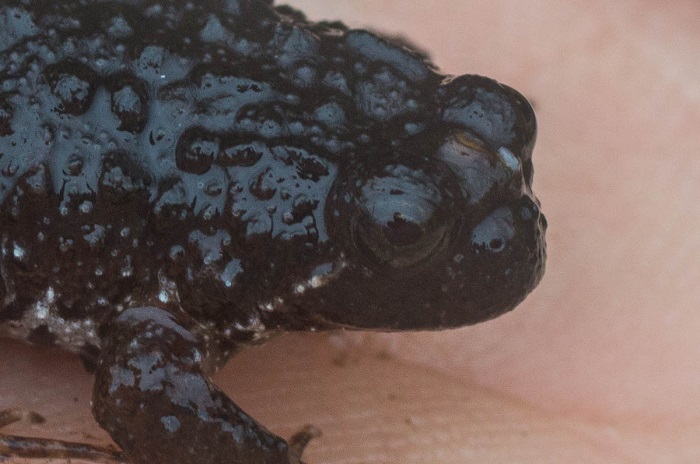
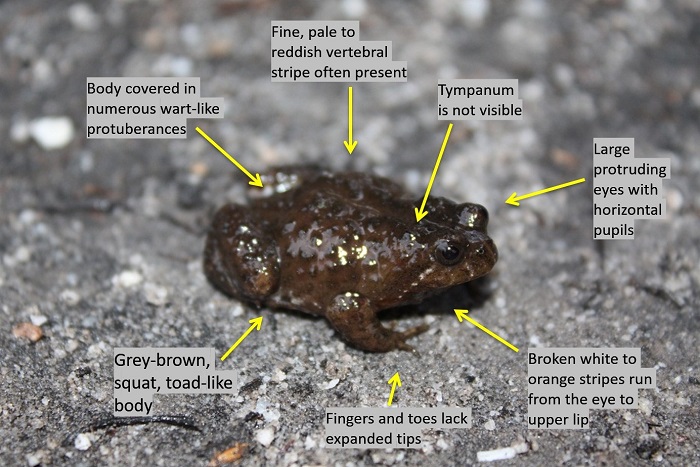
This species may be confused with the moss frogs, Arthroleptella, that are found in the same habitat. However, P. paludicola is larger, females reaching 30 mm in body length, and has a very granular skin. Behind the eye there is a raised glandular area that resembles the parotoid gland in toads, and a glandular ridge runs from the top of the head to the angle of the jaw. The dorsum is grey-brown, often with a pale vertebral stripe. One to three pale stripes run from the lower margin of the eye to the upper lip. The advertisement call is a harsh chirp, unlike the high-pitched calls of Arthroleptella.

Poyntonia paludicola – Kogelberg Nature Reserve, Western Cape
Photo by Felicity Grundlingh

Habitat

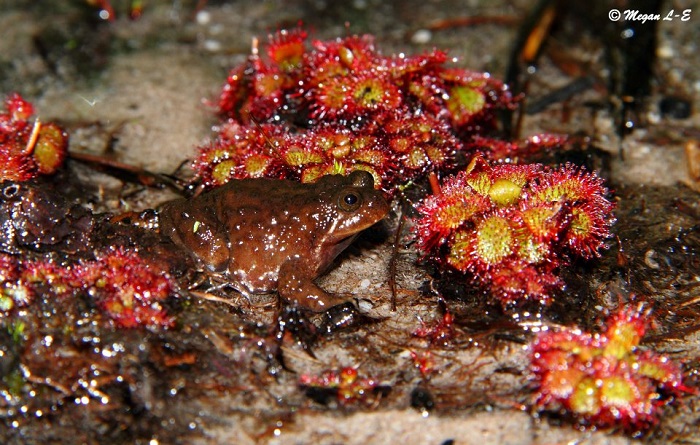
This species inhabits marshy areas, shallow seepage zones and shallow streams along rock outcrops in Mountain Fynbos. The rainfall in these areas exceeds 2000 mm p.a., and falls mainly in winter.

Behaviour

Once sufficient rain has fallen to produce shallow flooded areas, the males start to call. Calling may occur at any time of year in suitable weather conditions, but usually takes place from late summer to late winter. Males call from the edge of shallow water and from beneath vegetation in seepage areas (Channing and Boycott 1989). These frogs are beautifully camouflaged when among the mosses that are typical of their habitat.

The tadpoles have long tails and may grow to 32 mm in length. They hide in soft mud.

No records of predators or prey are available.

Poyntonia paludicola – Kogelberg Nature Reserve, Western Cape
Photo by Megan Loftie-Eaton

Status and Conservation

Status

P. paludicola is assigned to the category Near Threatened (Harrison et al. 2001; this publication). The species has a restricted extent of occurrence (<5000 km2) and area of occupancy (<500 km2). It is estimated that its habitat had decreased in area by <20% over the last 60 years, and that the population size had declined by <20% over the same period (Harrison et al. 2001). These relatively minor changes may be explained by the species’ occurrence in generally rugged and inaccessible mountainous terrain. The conservation status of this species should be revised once more distribution data and information on habitat preferences and life history are available.

All known populations are located within protected areas, including Hottentots Holland, Maanschynkop, Vogelgat, Jonkershoek and Kogelberg nature reserves and the Kogelberg Biosphere Reserve.

Threats

Present and potential threats include habitat modification by too frequent fires, altered drainage, damming, and the loss of fynbos to agriculture, particularly tree plantations. Habitat fragmentation also poses a significant threat.

Recommended conservation actions

Distribution surveys and population and life-history research are needed for this species. Other recommended measures include habitat management, limiting factor management, and monitoring (Harrison et al. 2001).

Distribution

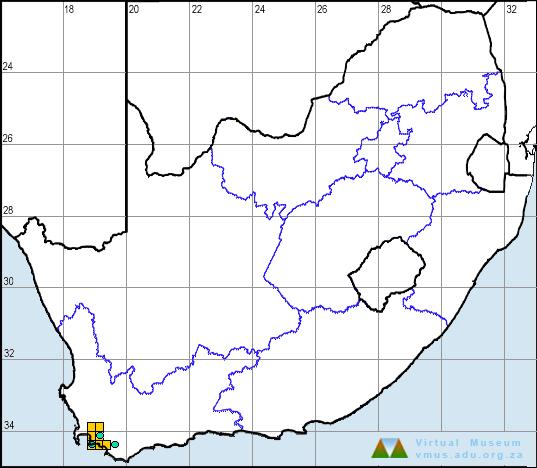
P. paludicola is endemic to the Cape fold mountains of the southwestern Western Cape Province, where it occurs in two subpopulations (sensu the IUCN definition) in the Hottentots Holland/Kogelberg mountain complex and the Klein River Mountains (Channing and Boycott 1989). It is known from all altitudes between 200 and 1800 m wherever suitable habitat is present. Further fieldwork is expected to extend the known range. The atlas data are accurate but incomplete.

Distribution of Poyntonia paludicola. Taken from the FrogMAP database as at February 2022.

Further Resources

Virtual Museum (FrogMAP > Search VM > By Scientific or Common Name)

More common names: Montane Marsh Frog, Kogelberg Reserve Frog (Alternative English Names); Bergmoeraspadda (Afrikaans)

Recommended citation format for this species text:

Channing A, Tippett RM. Marsh Frog Poyntonia paludicola. BDI, Cape Town.
Available online at http://thebdi.org/2022/02/20/marsh-frog-poyntonia-paludicola/

Recommended citation format: 

This species text has been updated and expanded from the text in the
2004 frog atlas. The reference to the text and the book are as follows:

Channing A 2004 Poyntonia paludicola Marsh Frog. In Minter LR
et al 2004.

Minter LR, Burger M, Harrison JA, Braack HH, Bishop PJ, Kloepfer D (eds)
2004. Atlas and Red Data Book of  the Frogs of South Africa, Lesotho and
Swaziland. Smithsonian Institution, Washington, and Avian Demography
Unit, Cape Town.

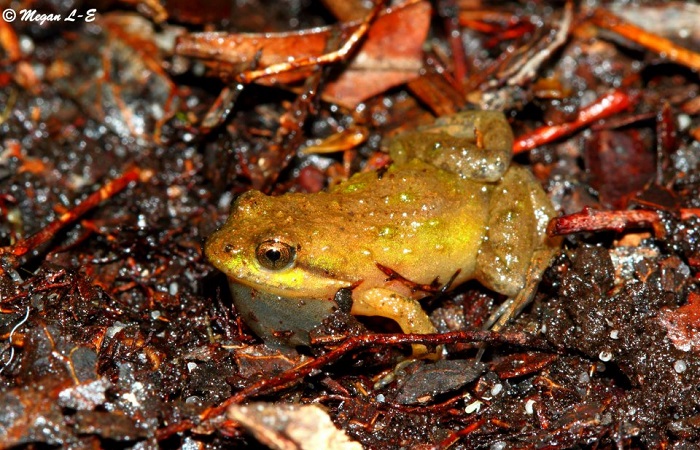
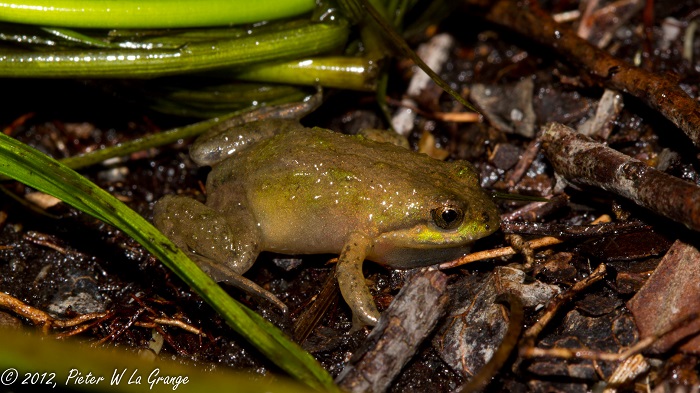
Micro Frog (Microbatrachella capensis)

Cover photo by Megan Loftie-Eaton.

Find the Micro Frog in the FBIS database (Freshwater Biodiversity Information System) here.

Family Pyxicephalidae

Identification

The Micro Frog is one of the smallest amphibians in southern Africa, attaining a length of only c.18 mm. The pupil is horizontally elliptical. The toes are partially webbed, with 2–3 phalanges of the longest toe free of webbing. The dorsum generally has a variable green, brown and/or grey colour, usually interspersed with darker shading and markings. A thin vertebral stripe is often present, sometimes flanked by broader lateral stripes. The ventrum is smooth and off-white or with variable black and white mottling. The throat area of males is plain brown without mottling. The length of the shank is less than half the body length. The call is a series of low-pitched scratches emitted at a rate of about one per second (Passmore and Carruthers 1995).

Although M. capensis belongs to a monotypic genus, it is of similar size and appearance to the sympatric species Cacosternum platysC. platys can be distinguished from M. capensis by its somewhat flatter appearance (with limbs extended more laterally), a lack of webbing between the toes, a predominantly white underside with small, discrete dark spots, and its distinctly different call (Rose 1962; Channing 2001).

Habitat

The Micro Frog has specialised habitat requirements and is sensitive to urban and agricultural threats and invasive plants, and animals. The species is restricted to certain wetlands in low-lying coastal areas of the Fynbos Biome, where fynbos plant communities, typically dominated by restios and/or sedges, occur on neutral to acid sands. The relevant vegetation types are Mountain Fynbos, Sand Plain Fynbos, Mountain Fynbos mixed with Limestone Fynbos in the Gansbaai/Agulhas region, and Mountain Fynbos interspersed with elements of Dune Thicket in parts of the Kleinmond area.

The wetlands comprise ponds, pans, vleis and coastal lakelets filled with darkly stained, humic, generally acidic waters (pH 4.0–7.0). Most of these wetlands are seasonal, and by late summer most breeding sites are dry. Some of the larger wetlands (<25%) at times still retain some water by the end of the dry season, and a few never seem to dry up. The wetland substrates tend to contain a dark humic layer, and the sandy surroundings vary from white to grey to almost black, depending on the humic content.

Although the Micro Frog appears to be intolerant of habitat modification, a few of the breeding sites (c.15%) are situated in previously excavated areas where natural vegetation has recovered sufficiently and water quality meets the necessary requirements (pers. obs.).

Behaviour

The Micro Frog is a winter breeder and commences breeding once the rains have filled its seasonal wetland habitat. Breeding activity has been recorded as early as May (Visser 1979a) and as late as October (pers. obs.), but the prime breeding season is July–September. It is a relatively vocal species and is known to call in high densities. The calls can be heard both day and night, but calling activity is generally more intense at night. At prime breeding sites under ideal conditions, choruses of hundreds of individuals can be heard. Males call from emergent vegetation (e.g., restios) at water level, and from floating vegetation.

The eggs are attached to submerged vegetation in clusters of c.20. Each individual egg is enclosed in a jelly capsule. The tadpoles are benthic and relatively large. Larval development is fairly slow and its duration is believed to depend on factors such as tadpole population density, food and water availability, and temperature. Rose (1929) recorded the emergence of newly metamorphosed froglets in early December. These are only slightly smaller than the adults.

When their wetland habitat starts to dry up, these frogs bury themselves and aestivate through the dry season. Rose (1929) unearthed specimens on the site of a dry seasonal vlei, and about 20 were seen emerging from cracks in damp wetland substrate with the onset of early winter rains (pers. obs.).

Micro Frog Microbatrachella capensis
Near Cape Town, South Africa
Photo by Pieter La Grange

Status and Conservation

Status

The Micro Frog is southern Africa’s most threatened lowland amphibian. More than 80% of its habitat has been lost. Previously listed as Rare (Mclachlan 1978) and Endangered (Branch 1988), the species is now classified as Critically Endangered (Harrison et al. 2001; this publication). The criteria are a severely fragmented area of occupancy <10 km2 (four subpopulations sensu IUCN Criteria), and a projected decline in the extent of occurrence, area of occupancy, quality of habitat, and number of locations, subpopulations and mature individuals. The species is legally protected by the Nature Conservation Ordinance 19 of 1974, but is not listed by CITES.

Despite its Critically Endangered status, the species occurs in relatively high population densities with an estimated 1000 adults occupying an area of 50 × 50 m of prime breeding habitat. At present, <25% of M. capensis breeding habitat is conserved in Kleinmond Coastal and Mountain Nature Reserve (local authority), Groot Hagelkraal Private Nature Reserve (between Gansbaai and Agulhas) and Greater Betty’s Bay Nature Reserve (local authority). Furthermore, the residential area of Betty’s Bay poses a threat to most of the remaining M. capensis habitat in Greater Betty’s Bay Nature Reserve.

Threats

All four subpopulations (sensu IUCN Criteria) and most breeding sites are threatened to a varying degree by human interference. In particular, urban and rural development (including agriculture and associated threats) have caused considerable habitat degradation and loss.

Specific threats include the filling in of habitat; alteration of the water table and drainage patterns that cause either drainage or possible flooding of breeding sites; establishment of sand mines that are a threat to populations in the Kleinmond area (De Villiers 1997b); siltation, pollution and eutrophication of wetland habitat; spread of invasive alien vegetation at a number of localities, especially in the form of Port Jackson Willow Acacia saligna stands; and, potentially, fynbos flower-farming activities.

Invasive alien vegetation not only eliminates fynbos vegetation and reduces the water resources of wetlands, but also results in deterioration in the quality of habitat through changes in water chemistry. Although fire plays an important role in fynbos ecosystems, an increase in the incidence of fire can have a detrimental effect on frog populations.

At some localities (e.g., the Groot Vleie at Betty’s Bay), Bulrushes Typha capensis and reeds Phragmites australis have invaded M. capensis habitat. Reasons for this include eutrophication, the build up of sediment (e.g., through water being channelled into wetlands and the decomposition of excessive plant growth), and a constantly high water table.

Recommended conservation actions

The distribution and conservation status of M. capensis is monitored by the Western Cape Nature Conservation Board (WCNCB; De Villiers 1997a) as part of a threatened species monitoring programme. Breeding sites are monitored annually. A research project is being undertaken to investigate the genetic relationships of the four subpopulations (sensu IUCN Criteria). This will help determine priorities with regard to the conservation and management of these subpopulations.

Management of the Micro Frog’s habitat is an important responsibility and needs to be improved at most breeding sites, especially those on unprotected, privately owned land. The main management activity involves the control of alien vegetation. Structures responsible for the management of populations are as follows: the Cape Flats subpopulation by WCNCB; Betty’s Bay subpopulation by Overstrand Municipality; Kleinmond Coastal and Mountain Nature Reserve by Overstrand Municipality; the remaining breeding sites of the Kleinmond subpopulation, all situated on unprotected private land, by WCNCB with regard to alien vegetation control; and Groot Hagelkraal Private Nature Reserve by Eskom. The remaining breeding sites of the Gansbaai to Agulhas subpopulation are all situated on unprotected private land where there is, as yet, no proper management programme.

At present, <25% of M. capensis habitat is conserved and additional nature reserves are urgently needed. Lack of funding is a major problem in this regard. In general, the Critically Endangered status of M. capensis needs to be publicized to attract public support for conservation of the species.

Sand-mining operations in the vicinity of M. capensis localities must be stopped and the affected habitat rehabilitated (De Villiers 1997b), but legal difficulties and a lack of funding have hampered progress in this regard.

As the distribution of the Micro Frog on the Cape Flats is restricted to <10 ha of wetland habitat on unprotected private property at Kenilworth Race Course, a translocation experiment was undertaken in September 1999. This involved the translocation of c.140 M. capensis tadpoles from the Kenilworth population to a protected blackwater wetland in Rondevlei Nature Reserve, 7 km away. The species has not previously been recorded from this nature reserve, but the nearest historical record, Princess Vlei, is 2 km away. At the time of writing, this experiment did not appear to have been successful but requires further investigation. A captive breeding programme for M. capensis is not recommended.

Finally, it is imperative that wetlands supporting populations of this species should not be stocked with predatory alien fish.

Distribution

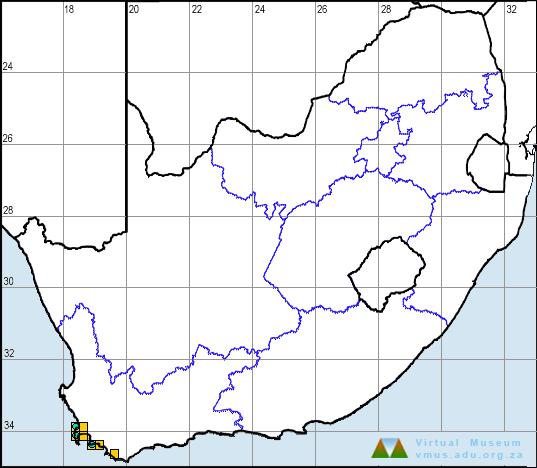
The Micro Frog is endemic to the atlas region and is restricted to the winter-rainfall region of the Western Cape Province. Based on both previous and current records, this spans a distance of c.140 km from the Cape Flats southeastward to the Agulhas region. Distribution records are further limited to low-lying areas of 10–80 m a.s.l. within 10 km of the coast in areas with an annual rainfall of >500 mm.

M. capensis was first discovered on the Cape Flats. The species was described in 1910 and, for a period of 65 years thereafter, the Cape Flats was the species’ only known area of distribution (De Villiers 1988a). Although the discovery and description of the species was based on only one specimen (Boulenger 1910), the frog was later reported to have a wide distribution on the Cape Flats (Rose 1929). All recorded Cape Flats localities fall within an area of <100 km2 on the western half of the Cape Flats (3318CD, DC; 3418AB, BA). These include Crawford, Lansdowne, Kenilworth Race Course, Princess Vlei, Retreat, Ottery and Varkensvlei. No confirmed records were ever obtained from the Cape Peninsula (De Villiers 1988a).

Distribution of Microbatrachella capensis Taken from the FrogMAP database as at February 2022.

The Micro Frog was first reported as being threatened by Rose (1962), who stated that the species had become “something of a rarity” on the Cape Flats as a result of “fencing, building, draining”, and “contaminating”. Following this, no further specimens were found for c.10 years from the mid-1960s on, and it was feared that the species was extinct.

In the period 1975–80, an amphibian survey by the then Cape Department of Nature and Environmental Conservation (carried out by J.C. Greig, R.C. Boycott, A.L. de Villiers) resulted in the discovery of three additional populations: along the coastal forelands to the southeast of the Cape Flats at Betty’s Bay (3418BD) in 1975, Kleinmond (3419AC) in 1976, and midway between Gansbaai and Agulhas (3419DA) in 1980.

During the period 1988–90, a survey was undertaken by the then Cape Chief Directorate Nature and Environmental Conservation (carried out by the author) to examine the distribution, habitat requirements and conservation status of M. capensis. Coincidentally, in August 1988, a botanical survey of the Cape Flats by C.R. McDowell led to the discovery of a healthy M. capensis population in undisturbed wetlands at Kenilworth Race Course (McDowell 1989). This was the first time the species had been seen on the Cape Flats in c.23 years. Furthermore, this appears to be the only remaining Cape Flats population. The frog survey confirmed the presence of this and the other three previously discovered populations to the east, but no additional populations were discovered. In total, 26 breeding sites were recorded, 14 of which were new localities. Since then, despite the destruction and degradation of habitat (e.g. De Villiers 1997b), there has been no significant change in the distribution of M. capensis. Breeding sites are monitored annually (De Villiers 1997a).

In summary, M. capensis has been recorded from a total of seven quarter-degree grid cells, in four subpopulations (sensu IUCN Criteria), namely the Cape Flats (four grid cells), Betty’s Bay, Kleinmond, and Gansbaai/Agulhas subpopulations. At present the species still occurs in four subpopulations, but its total area of occupancy is <10 km2 situated in four grid cells, that is, one grid cell for each subpopulation.

The atlas data are reliable and complete.

Addendum: 20 October 2025

A new subpopulation of Microbatrachella capensis was found in 2021 in the Nuwejaars Wetlands Special Management Area on the Agulhas Plain. This has become the 5th known subpopulation of Microbatrachella capensis and appears to constitute both the most inland and the most easterly known subpopulation. Due to the Nuwejaars Wetland’s size and protected status, this may prove to be a stronghold for this critically endangered frog species.

A link to the Nuwejaars Wetland website and corresponding Micro Frog article can be found here.

Further Resources

The use of photographs by Megan Loftie-Eaton and Pieter La Grange is acknowledged.

Micro Frog Microbatrachella capensis (Boulenger, 1910)

Other Common Names: Mikropadda (Afrikaans)

Recommended citation format: de Villiers, AL; Tippett, RM. (2025). Micro Frog Microbatrachella capensis. Biodiversity and Development Institute, Cape Town. Available online at https://thebdi.org/2022/02/20/micro-frog-microbatrachella-capensis/

This species text has been updated and expanded from the text in the
2004 frog atlas:
 de Villiers, AL. (2004). Micro Frog Microbatrachella capensis. In Minter LR et al 2004.

References: 

Minter, LR; Burger, M; Harrison, JA; Braack, HH; Bishop, PJ; Kloepfer, D. (Editors). (2004). Atlas and Red Data Book of  the Frogs of South Africa, Lesotho and Swaziland. Smithsonian Institution, Washington, and Avian Demography
Unit, Cape Town.

Carruthers, V; du Preez, L. (2017). Frogs of southern Africa: A Complete Guide. Struik Nature, Cape Town.

Channing, A. (2001) Amphibians of Central and Southern Africa. Protea Book House, Pretoria

Similar Species

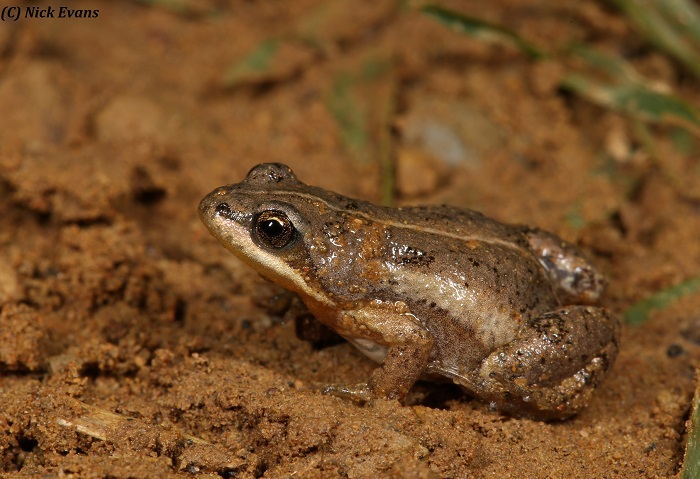
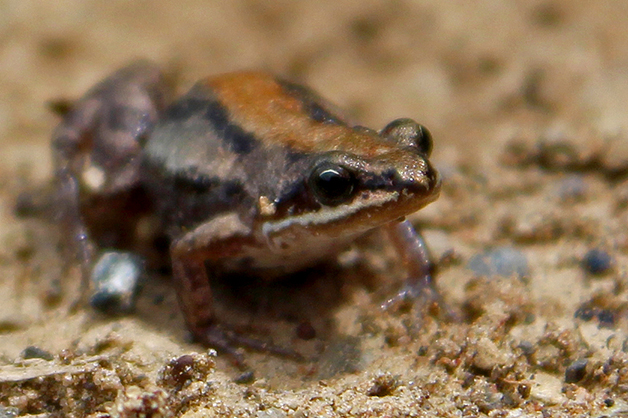
Rhythmic Caco (Cacosternum rhythmum)

Cover photo by Nick Evans.

Find the Rhythmic Caco in the FBIS database (Freshwater Biodiversity Information System) here.

Family Pyxicephalidae

Habitat

The Rhythmic Caco inhabits flooded grassy areas in mid- to high-altitude grassland areas.

Behaviour

The call is distinctive. It consists of a series of pulsed notes ending in a series of chirps. The call is rhythmical, hence the species name.

Rhythmic Caco Cacosternum rhythmum
Near Mooi River, KwaZulu-Natal
Photo by Faansie Peacock

Status and Conservation

Very little is known about the Rhythmic Caco. The conservation status of C. rhythmum is considered Data Deficient.

Distribution

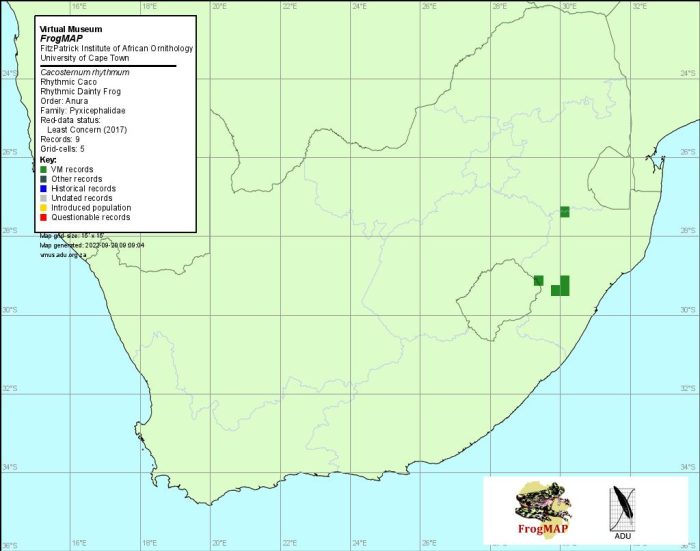
The Rythmic Caco is known only from a handful of locations in the KwaZulu-Natal Midlands and from Wakkerstroom in Mpumalanga. The species is endemic to South Africa.

Distribution of Cacosternum rhythmum. Taken from the FrogMAP database as at February 2022.

Further Resources

The use of photographs by Faansie Peacock and Nick Evans is acknowledged.

Rhythmic Caco Cacosternum rhythmum Channing et al., 2013

Other Common Names: Ritmiese Blikslanertjie (Afrikaans)

Recommended citation format: Tippett, RM. (2025). Rhythmic Caco Cacosternum rhythmum. Biodiversity and Development Institute, Cape Town. Available online at https://thebdi.org/2022/02/20/rhythmic-caco-cacosternum-rhythmum/

References: 

Minter, LR; Burger, M; Harrison, JA; Braack, HH; Bishop, PJ; Kloepfer, D. (Editors). (2004). Atlas and Red Data Book of  the Frogs of South Africa, Lesotho and Swaziland. Smithsonian Institution, Washington, and Avian Demography
Unit, Cape Town.

Carruthers, V; du Preez, L. (2017). Frogs of southern Africa: A Complete Guide. Struik Nature, Cape Town.

Channing, A. (2001) Amphibians of Central and Southern Africa. Protea Book House, Pretoria

Similar Species

Striped Caco (Cacosternum striatum)

Cover photo by Luke Kemp.

Find the Striped Caco in the FBIS database (Freshwater Biodiversity Information System) here.

Family Pyxicephalidae

Identification

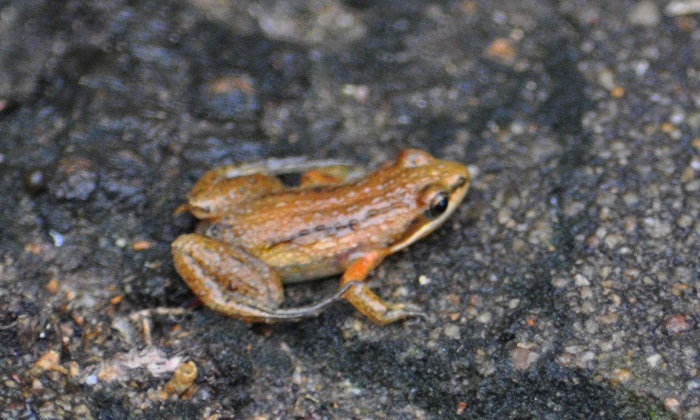
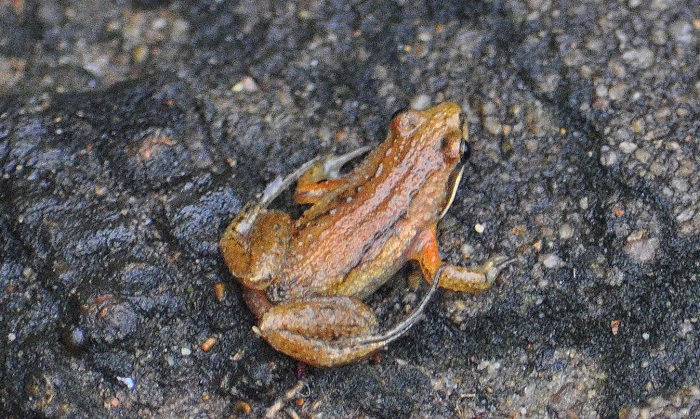
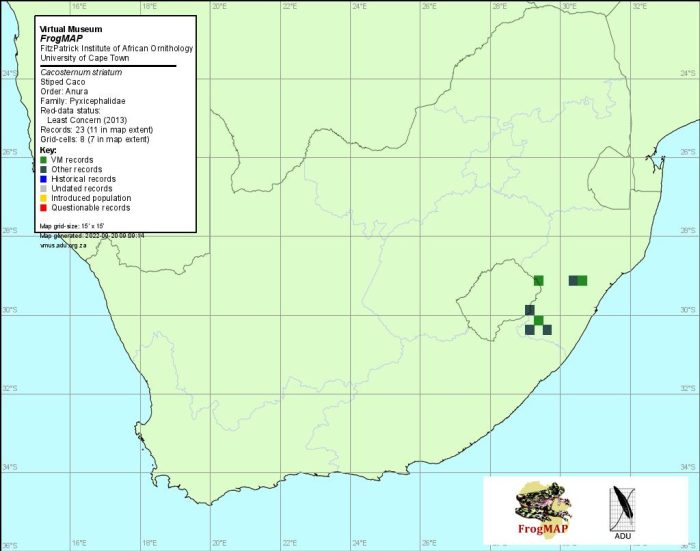
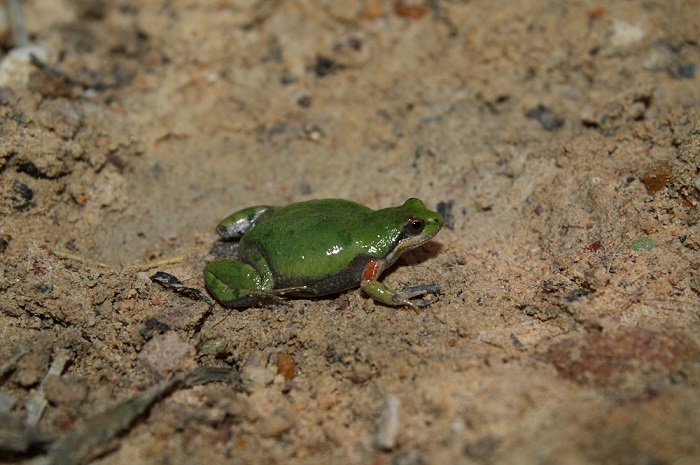
The Striped Caco is a small species that does not exceed 21 mm in snout–vent length. It is readily distinguishable from its congeners by differences in colouration and vocalizations. The dorsum is light brown to orange-brown or even green, with a pair of dark brown dorsolateral stripes that extend from behind the eye to the groin. The flanks and dorsal surfaces of the limbs are somewhat spotted, while the ventrum is generally immaculate white, although sometimes marked with pale grey blotches. C. striatum may be distinguished from C. boettgeri and C. nanum by the presence of a light line that extends from heel to heel along the posterior surfaces of thighs, as well as a series of small, slightly elongated paravertebral glandular ridges, and a longer pair associated with the dorsolateral stripes over the anterior two-thirds of the body (FitzSimons 1947). The carpal tubercles are less prominent than those of C. boettgeri (Lambiris 1989a).

Striped Caco Cacosternum striatum
Eastern Shores, iSimangaliso Wetland Park, KwaZulu-Natal
Photo by Ryan Tippett

The advertisement calls of nine individuals recorded at Sneezewood Flats, Mpur forestry area (3029BC), consist of two components: short chirps and protracted “creaks” (M. Burger pers. comm.). Call bouts usually begin with several “chirps” (e.g., single, then double, then triple) and culminate in a series of creaks repeated up to a dozen times, but probably more in strong choruses. The chirps have a duration of 26–111 ms (mean 61) and an emphasized frequency of 5–5.5 kHz (mean 5.3), and consist of 4–14 pulses, emitted at a pulse rate of 101–187 pulses/s (mean 141). The creaks have a duration of 245–535 ms (mean 362) and an emphasized frequency of 4.6–5.7 kHz (mean 5.3), and consist of 14–24 pulses, emitted at a pulse rate of 27–82 pulses/s (mean 53).

The distribution of museum specimens of C. striatum suggests the presence of separate high- and low-altitude forms. The presence of other frog species, such as Leptopelis xenodactylusAmietia vertebralis, and Strongylopus hymenopus, that are endemic to the same restricted range as the high-altitude form of C. striatum, suggests that some selective forces may have operated (or vicariance events occurred) in this region, resulting in speciation.

The Striped Caco is one of the least studied species in the South African frog fauna. Poynton (1964) noted that the original description of this species did not adequately separate it from the highly variable C. boettgeri and placed it in the synonymy of the latter species. Lambiris (1989a) resurrected C. striatum on the basis of differences in laryngeal and buccopharyngeal morphology and identified diagnostic external morphological characters that separate the species from C. boettgeri. He also noted that the call of striatum differed from that of boettgeri, but was unable to provide a detailed description of the call. A subsequent revision of the genus Cacosternum, using morphological, osteological and genetic data, has confirmed the validity of C. striatum (E. Scott in prep.).

Habitat

The Striped Caco inhabits various vegetation types within the Grassland Biome in the summer-rainfall region. Breeding habitat appears to be in inundated wetlands, or adjacent to slow-flowing sidewaters of highland streams (FitzSimons 1947; Lambiris 1989a). The habitat of C. striatum conforms to that of C. boettgeri, making any ecological distinction difficult to identify. C. striatum has not been collected at the same site as C. boettgeri, although both C. boettgeri and C. striatum have been collected syntopically with C. nanum.

Behaviour

Almost no data is available on the life history of the Striped Caco. Male vocalization has been recorded during December, January and early February (M. Burger, H. Braack and A. Turner pers. comm.). Calling starts during the late afternoon and continues through the night. As is the case in C. boettgeri, the males call from well-concealed sites in dense grass tussocks at or just above the water-level.

Status and Conservation

Status

The Striped Caco was not listed in previous SA National Red Data Books, but was assigned to the category Data Deficient by Harrison et al. (2001), based on a lack of knowledge about the species’ taxonomic status, general biology and distribution.

Striped Caco Cacosternum striatum
Eastern Shores, iSimangaliso Wetland Park, KwaZulu-Natal
Photo by Ryan Tippett

C. striatum has been recorded from a number of protected areas, including Sehlabathebe National Park in Lesotho, SA Natural Heritage Site No.208 at Gilboa Estates (SAPPI) near Mooi River (2930AB), Cobham and Vernon Crookes nature reserves, and the iSimangaliso Wetland Park. Efforts are currently underway to protect the populations at Sneezewood Flats in the Mpur forest area (3029BC), under the management of Singisi Forestry Products. All amphibians are protected by KwaZulu-Natal Nature Conservation Ordinance, No. 15 of 1974, as amended.

Threats

In the grassland habitat occupied by the Striped Caco, afforestation and agriculture (e.g. sugar cane) pose the major threats to fauna and flora, and have resulted in the loss, decrease in quality, and fragmentation of its habitat.

Recommended conservation actions

At the time of writing, high priority is being given to clarification of the taxonomy, distribution and area of occupancy of C. striatum, as well as a detailed study of its life history and ecology. This should allow for the formulation of appropriate recommendations to the relevant conservation authorities in the near future.

Distribution

Low altitude populations of the Striped Caco (50–100 m) include the type locality, a golf course in Durban (2930DD), Charter’s Creek near St Lucia (2832AB), and KwaMbonambi and vicinitiy (2832CA) – all coastal areas with warm tropical climates. Two gravid females that fit the description of C. striatum better than they do any other species of Cacosternum, were collected at a slightly higher elevation (300–450 m) in Vernon Crookes Nature Reserve (3030BC).

The remaining material was collected at much higher altitudes (1500–2200 m) in the KwaZulu-Natal midlands at Cedarville (3029AC), Mpur forestry area east of Franklin (3029BC), Gilboa (2930AB), Impendhle Hills and Boston (2929DB), and in the Drakensberg at Kamberg Nature Reserve (2929BC) and Sehlabathebe National Park, Lesotho (2929CC). A single specimen was collected at an altitude of 1600 m at Matatiele (3028BD).

The data on the map are subject to change pending two studies in progress at the time of writing that are expected to clarify the taxonomic status and distribution of this species (E. Scott, M. Burger unpubl. data).

Distribution of Cacosternum striatum. Taken from the FrogMAP database as at February 2022.

Further Resources

The use of photographs by Luke Kemp is acknowledged. Other images by Ryan Tippett.

Striped Caco Cacosternum striatum FitzSimons, 1947

Other Common Names: Gestreepte Blikslanertjie (Afrikaans)

Recommended citation format: Scott, E; Tippett, RM. (2025). Striped Caco Cacosternum striatum. Biodiversity and Development Institute, Cape Town. Available online at https://thebdi.org/2022/02/20/striped-caco-cacosternum-striatum/

This species text has been updated and expanded from the text in the
2004 frog atlas:
 Scott, E. (2004). Striped Caco Cacosternum striatum. In Minter LR et al 2004.

References: 

Minter, LR; Burger, M; Harrison, JA; Braack, HH; Bishop, PJ; Kloepfer, D. (Editors). (2004). Atlas and Red Data Book of  the Frogs of South Africa, Lesotho and Swaziland. Smithsonian Institution, Washington, and Avian Demography
Unit, Cape Town.

Carruthers, V; du Preez, L. (2017). Frogs of southern Africa: A Complete Guide. Struik Nature, Cape Town.

Channing, A. (2001) Amphibians of Central and Southern Africa. Protea Book House, Pretoria

Similar Species

Flat Caco (Cacosternum platys)

Cover photo by Felicity Grundlingh.

Find the Flat Caco in the FBIS database (Freshwater Biodiversity Information System) here.

Family Pyxicephalidae

Identification

The Flat Caco is a small species that attains a maximum length of 22mm. The head is narrow and the body is broad. The limbs are relatively long and thin. The upperside colouration varies from grey or brown to green, frequently with dark blotches or stripes. A pale vertebral line is sometimes present. A blackish band is present from the eye to the base of the arm, while a paler band sits below this that extends from mid-snout to the arm base. The undersides are smooth and pale with faded-looking greyish-black spots.

The Flat Caco was formerly synonymised with the Common Caco Cacosternum boettgeri (Poynton, 1964), however, the two have different advertisement calls and a marked mtDNA sequence divergence.

Habitat

The Flat Caco is known to inhabit flooded grassland, marshes and seepages.

Behaviour

Very little is known about the life history of the Flat Caco. Its habits are likely to be similar to those of others in the genus.

Status and Conservation

Cacosternum platys is not threatened and is listed as of Least Concern in the IUCN Red List of Threatened Species.

Distribution

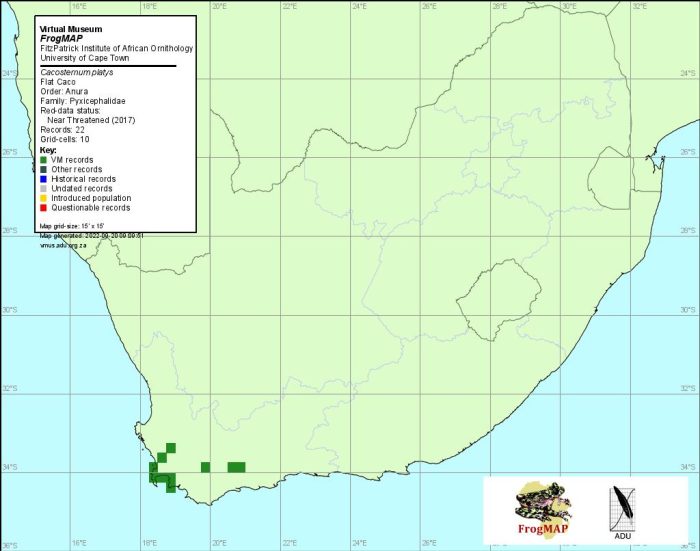
The Flat Caco is endemic to the Western Cape, South Africa.

Distribution of Cacosternum platys. Taken from the FrogMAP database as at February 2022.

Further Resources

The use of photographs by Felicity Grundlingh is acknowledged.

Flat Caco Cacosternum platys Rose, 1950

Other Common Names: Platblikslanertjie (Afrikaans)

Recommended citation format: Tippett, RM. (2025). Flat Caco Cacosternum platys. Biodiversity and Development Institute, Cape Town. Available online at https://thebdi.org/2022/02/18/flat-caco-cacosternum-platys/

References: 

Minter, LR; Burger, M; Harrison, JA; Braack, HH; Bishop, PJ; Kloepfer, D. (Editors). (2004). Atlas and Red Data Book of  the Frogs of South Africa, Lesotho and Swaziland. Smithsonian Institution, Washington, and Avian Demography
Unit, Cape Town.

Carruthers, V; du Preez, L. (2017). Frogs of southern Africa: A Complete Guide. Struik Nature, Cape Town.

Channing, A. (2001) Amphibians of Central and Southern Africa. Protea Book House, Pretoria

Similar Species