
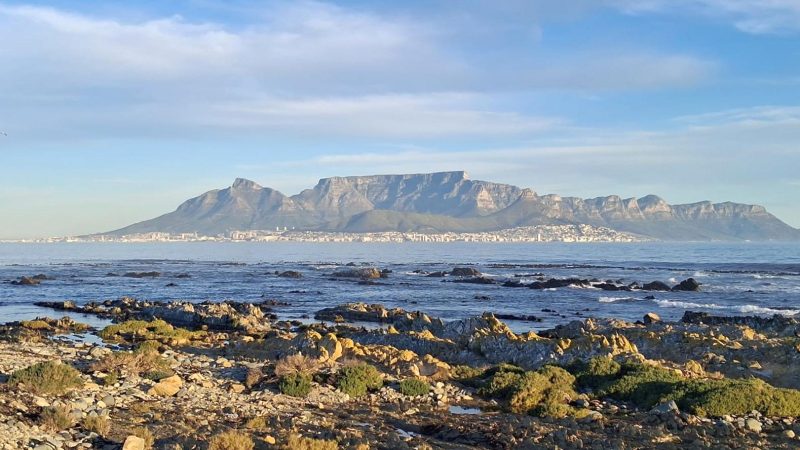
The survey of the African Oystercatchers on Robben Island on Friday 31 July turned out blogworthy, not so much from the perspective of the oystercatchers, but because of other interesting things we observed.
The oystercatcher count was 411 birds, with no juveniles observed. The chicks which fledged after last summer’s breeding season, are no longer with their parents. The oystercatchers are currently in moult, replacing their primary feathers:
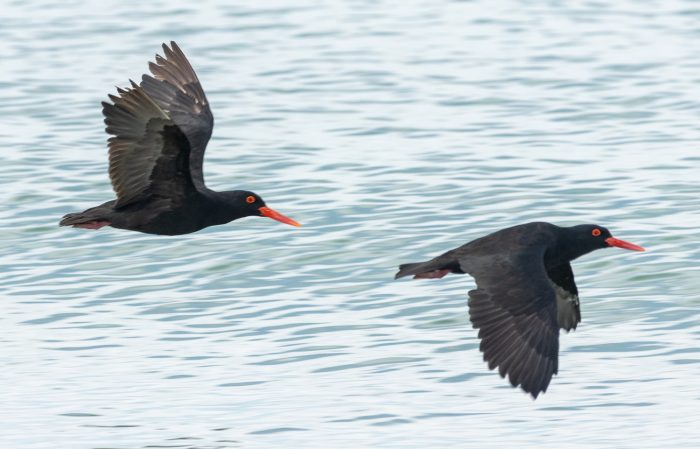
The oystercatcher on the left is about half-way through moult. Looking at both wings, there are four new primary feathers and four old feathers. The old ones are the outer primaries and they are brownish and getting tatty, and most clearly seen on the left wing. The new ones, inner primaries, are blackish, and clearest on the right wing. There are 10 primaries in an oystercatcher; called P1 to P10, numbered from inside to the outside! So there must be two more to find! There is a visible feather that is half way grown (see it on the left wing). It must be P5. So P6 must be in between, P5 (half grown), and P7, the innermost of the old primaries. So it must be P6 that is missing because the moult proceeds from P1 to P10. P6 must recently have been shed,. A bird ringer would write 55553 10000 to summarize the moult of the 10 primary feathers, where 5 means new and 0 means old, and numbers from 1 to 4 indicate the extent of growth of individual feathers.
The bird on the right is nearly finished moult, and inspection of the peculiar shape of the end of the wing suggests that it is P9 and P10 that are growing. A ringer would write 55555 55543.
Taylyn Bate did a study of African Oystercatcher moult as one of the chapters of her MSc, with lots of the data derived from photographs like this one. You can download the whole MSc here. It’s Open Access. Taylyn estimated that African Oystercatchers take 154 days to moult their primaries, and that on average moult starts on 1 April and ends on 2 September. There is a lot of individual variation in the start and end of moult, nicely illustrated in the photograph above. 154 days is a relatively slow and leisurely moult. It more or less fills the non breeding season, finishing just in time for the birds to build some reserves so they are in good condition at the start of the breeding season.
African Sacred Ibises and Kelp Gulls
There are several breeding colonies of African Sacred Ibis dotted around the island. The astonishing thing is that they do almost all of their feeding on the mainland …
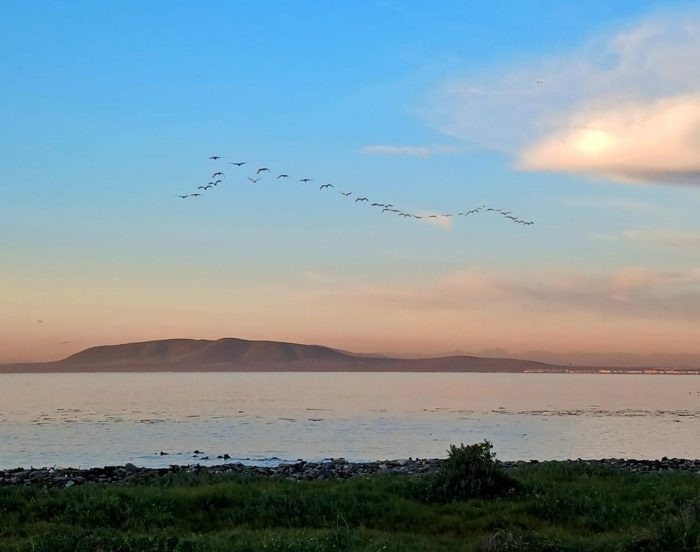
… here is a V-shaped flock of African Sacred Ibises returning from the mainland at sunset. This is the shortest route; the coast at Milnerton is about 7 km away. The ibises presumably feed at wetlands such as Rietvlei, Intaka Island, and the multiple small wetlands that exist as a result of the winter rainfall. The energetics of flying that distance, presumably several times a day in each direction, especially when they have chicks to feed, must be impressive.
Here is one of the ibis colonies, on a section of rocky shore, just above the spring high tide mark …
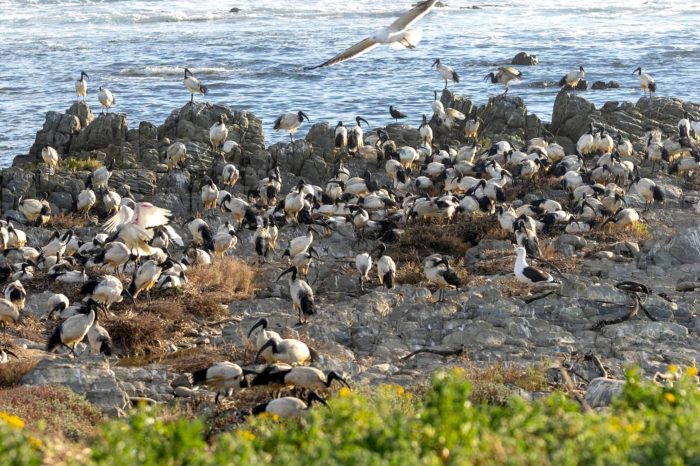
There are Kelp Gulls, patrolling both on the edge of the ibis colony and flying over it. With the slightest lapse of concentration, the gulls sneak in and grab an ibis egg (and some nest material at the same time) …
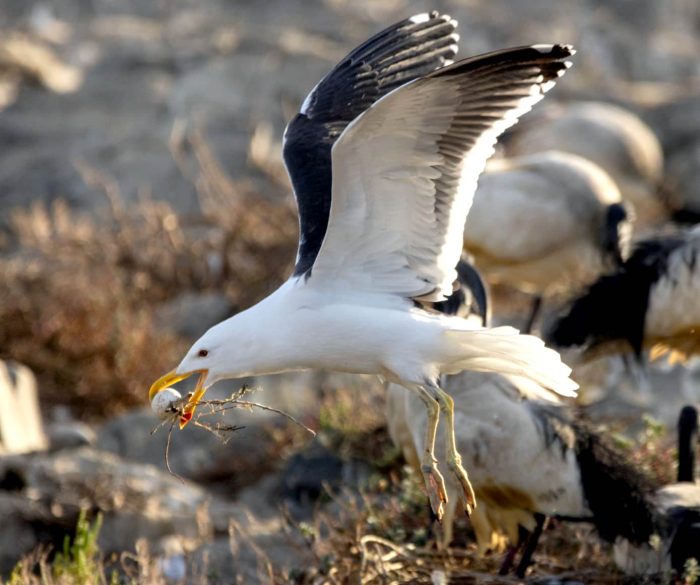
… they fly off with the egg,
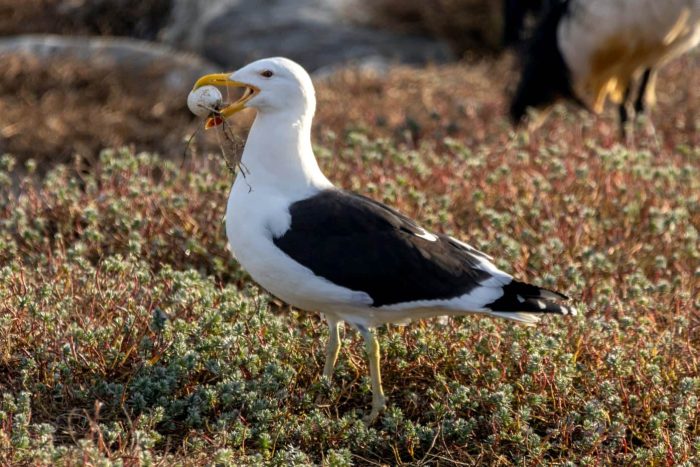
The ibis egg is too big to swallow, so the strategy is to break the egg on a rock, and to slurp up as much of the contents as they can. It’s a bit wasteful!
The Kelp Gulls are not yet breeding on Robben Island, but are gathering in large numbers, and setting up their nesting territories. The Kelp Gull colony on the island is large, covering several kilometres just inshore of the coastline, a few 100 m wide, with nests well spaced out …
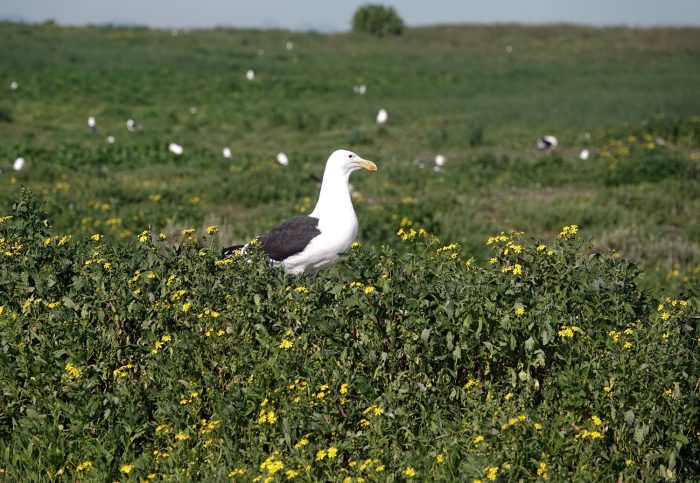
By the time Kelp Gull breeding gets going, the lush green winter vegetation will be drying out, providing lots of nest material. When the oystercatchers start breeding in about November, many of the early gull breeding attempts will be at the large chick stage, but there will still be lots of nests with eggs.
Given the ease with which Kelp Gulls grab ibis eggs, it has long been thought that they are major predators of oystercatcher eggs too. But we have had to rethink that, and maybe it is only the colonial breeders that are a focus for Kelp Gull predation.
Pied Crows
There have been Pied Crows on Robben Island from time to time for many years, and we have been estimating up to 10 crows on some visits. So far, there has never been proof of breeding. However, breeding has been suspected once in the past. On the day of the count, six Pied Crows were observed, and they were all in pairs.
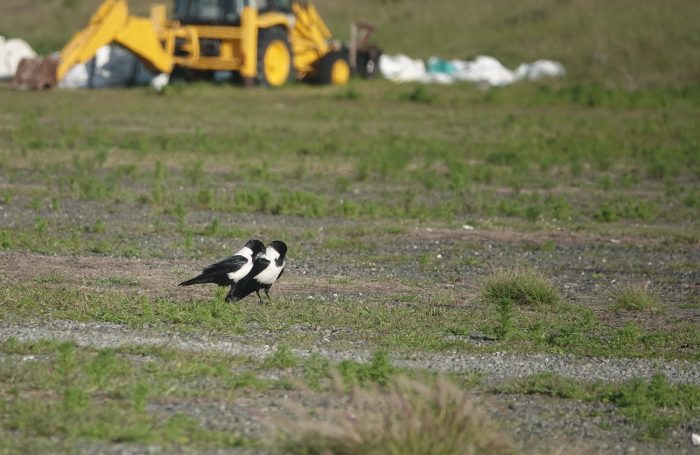
Here is a pair on the old World War 2 airfield, where the helicopter landing area is being upgraded.
Move in close, and you can see that they are …
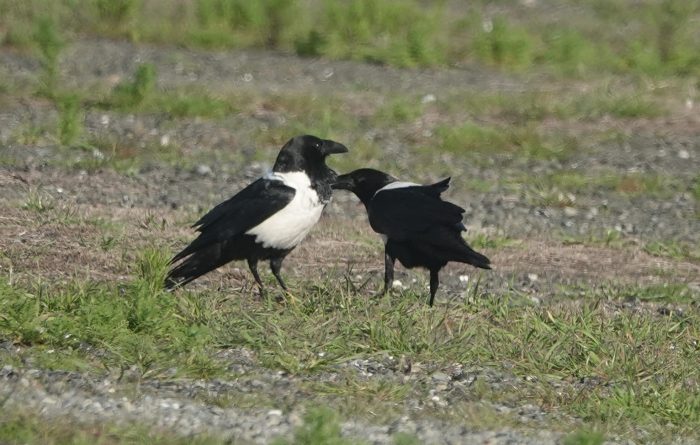
… allopreening. This is part of the behaviour that develops the pair bond. Soon these two birds are likely to be breeding. Robben Island has a large population of Angulate Tortoises. The concern is that one or more of the pairs on Robben Island will discover how to turn tortoises into snacks, in the same way as a few pairs on the mainland have done. See for example this paper in Biodiversity Observations; it is Open Access and available here: How many tortoises do a pair of Pied Crows Corvus albus need to kill to feed their chicks?).
African Penguins
African Penguins have bred on Robben Island since 1984. Initially the colony was located near the northeast corner of the island, and grew to about 20,000 birds. At that stage, the penguin colony was a well defined area, and there were just a handful of arrival/departure coves along the shore. As the colony shrank (it is now less than about 10% of its maximum size), the breeding pairs dispersed across the entire island, and now penguins emerge from the sea at points almost around the entire island, A photo like the one below, African Penguins with Table Mountain in the background, was unthinkable until a few years ago!
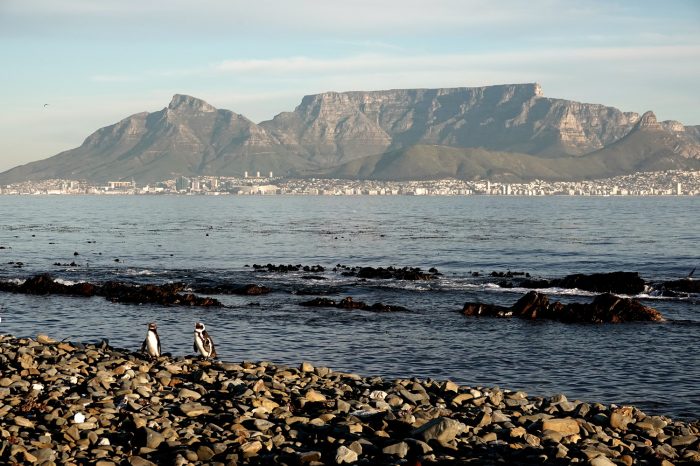
The two penguins are an adult and a juvenile …
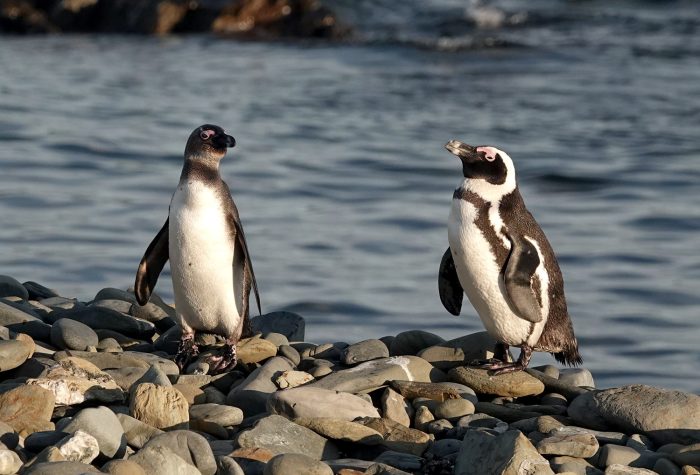
The juvenile plumage is replaced by adult plumage at the first moult, but they mostly don’t start breeding until they are at least three years old.
So even though our purpose was to count oystercatchers, we were privileged to see other things, and make valuable observations.
The Robben Island Museum has supported these oystercatcher surveys over the past 25 years, providing logistics on the island, and transport on the ferries to and from the island.