
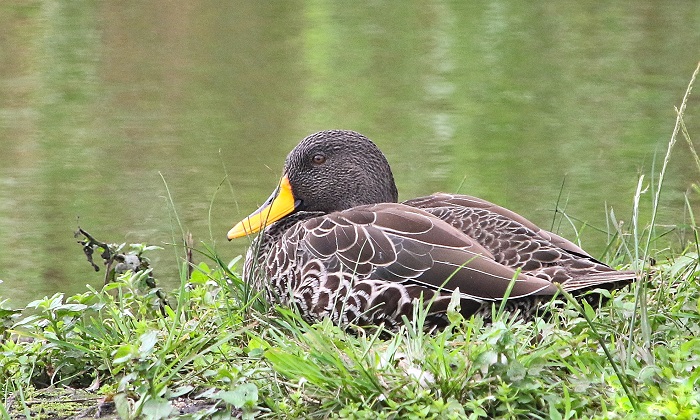
Cover image of Yellow-billed Duck by Lia Steen – Near Port Edward, KwaZulu-Natal
The Yellow-billed Duck belongs to the Family ANATIDAE (Ducks, Geese, Swans, and Waterfowl). The family has a cosmopolitan distribution, occurring on all the world’s continents except Antarctica. These birds are adapted for swimming, floating on the water surface, and sometimes diving. They range from medium to very large and have robust, broad, and elongated bodies. They generally have broad and flattened bills with a curved nail at the tip of the upper mandible and most have lamellae inside their bills for filter feeding. Their necks are moderately to very long, and the wings are short and pointed, supported by strong wing muscles. The short, strong legs are set far back on the body, and the feet are webbed. The family contains around 174 species in 53 genera. 20 species have been recorded from southern Africa.
Identification
The Yellow-billed Duck is a distinctive and familiar species. The sexes are alike in plumage colouration.
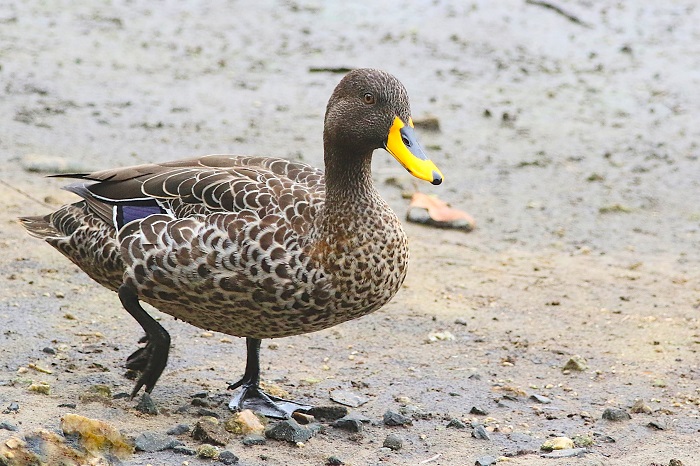
Southbroom, KwaZulu-Natal
Photo by Lia Steen
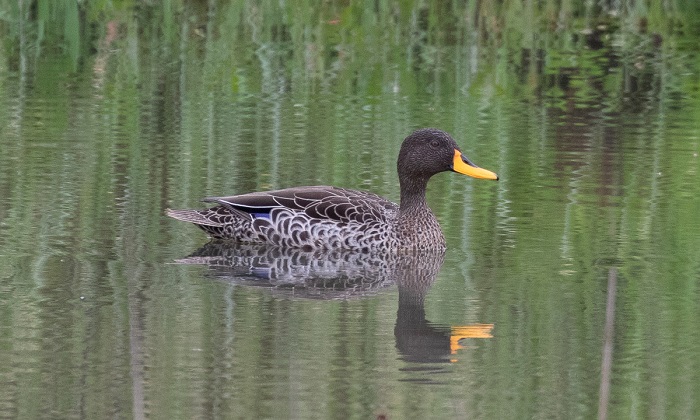
In adults, the head and neck are dusky-brown with buff streaking. The rest of the upper parts are dusky-brown, sometimes with a slight purplish sheen. The feathers are buffy-edged, giving a scaled effect. The upper wing coverts and primaries are greyish olive, and the coverts are scaled pale brown. The greater coverts are edged white, and the secondaries are black with white tips. A bright metallic green median patch forms the speculum. The underparts are pale greyish-brown. Each feather has a dark brown median spot, further adding to the scaled effect. The bill is bright yellow, with variable black markings. The eyes are brown, and the legs and feet are dark greenish-brown.
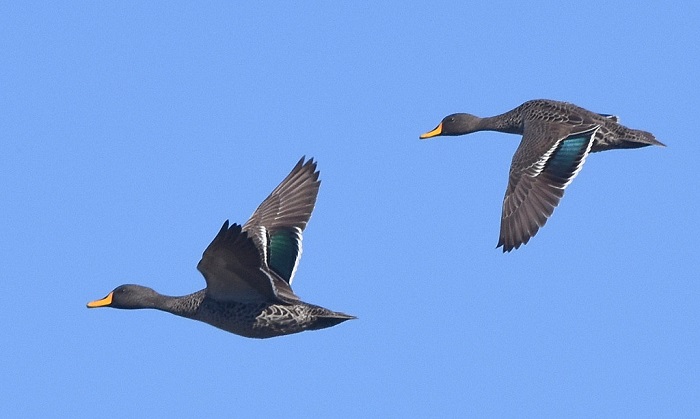
Philadelphia, Western Cape
Photo by Gerald Wingate
Juveniles resemble adults but are less clearly scaled, and the underparts are sometimes tinged rusty.
The Yellow-billed Duck is not easily mistaken for other species. The combination of green speculum and yellow bill is distinctive. It can be mistaken for the African Black Duck (Anas sparsa) if the bill isn’t visible. The Yellow-billed Duck is known to hybridise in the wild with the Red-billed Teal (Anas erythrorhyncha) and the introduced Mallard (Anas platyrhynchos).
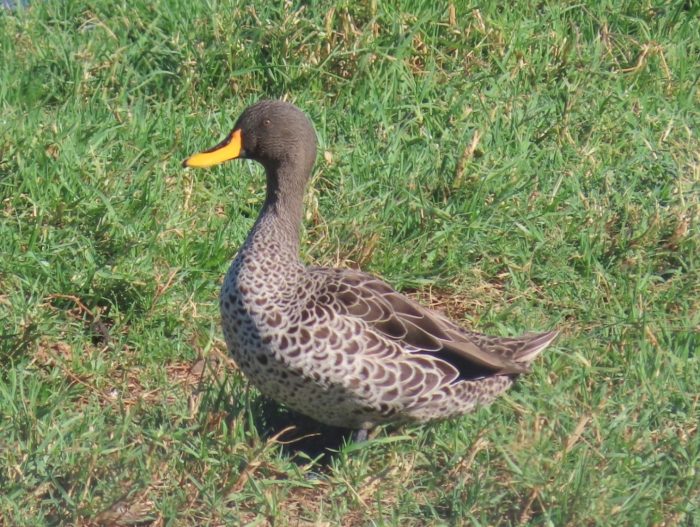
Near Canon Rocks, Eastern Cape
Photo by Cobus Elstadt
Status and Distribution
The Yellow-billed Duck is found from Ethiopia south and west to Angola and South Africa. It occurs throughout southern Africa, but is patchy in Namibia, Botswana, Zimbabwe and southern Mozambique. The Yellow-billed Duck is largely absent from the most arid areas. It is common across its southern African range. It is most abundant on the central plateau of South Africa.
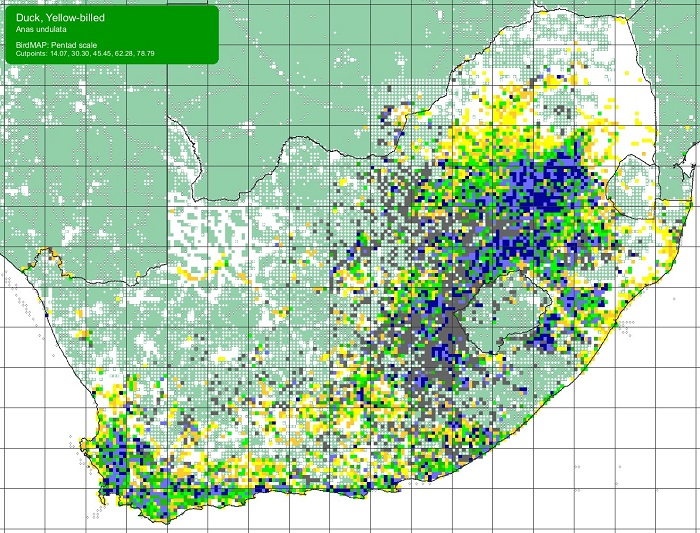
The Yellow-billed Duck is not threatened. Its overall distribution does not seem to have changed much in the past 100 years, except for a possible decrease in numbers in Zimbabwe. Elsewhere, it has probably become more common, benefiting from artificial water bodies, especially in drier areas.
Hybridisation with the Mallard poses a long-term threat to the genetic integrity of the Yellow-billed Duck. Active measures are in place in the Western Cape and KwaZulu-Natal to remove Mallards and hybrids.
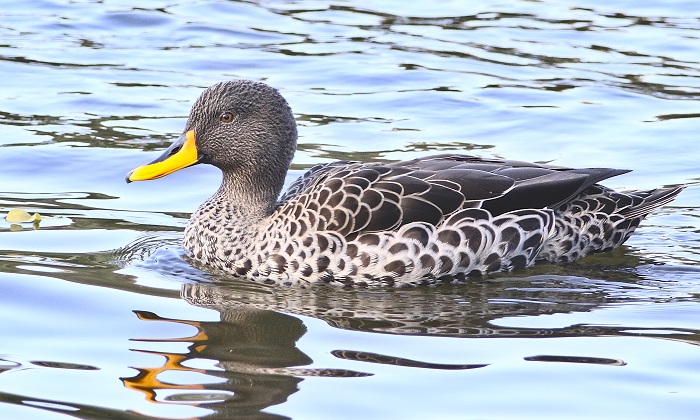
Southbroom, KwaZulu-Natal
Photo by Lia Steen
.
Habitat
The Yellow-billed Duck occurs on almost any kind of inland waterbody, especially farm dams. It is also found in estuaries, sluggish and still waters of rivers and streams, lakes, endorheic pans, swamps, floodplains, marshes and man-made impoundments, including irrigation dams and sewage works. The Yellow-billed Duck avoids saline and highly acidic water bodies, as well as fast-flowing water.
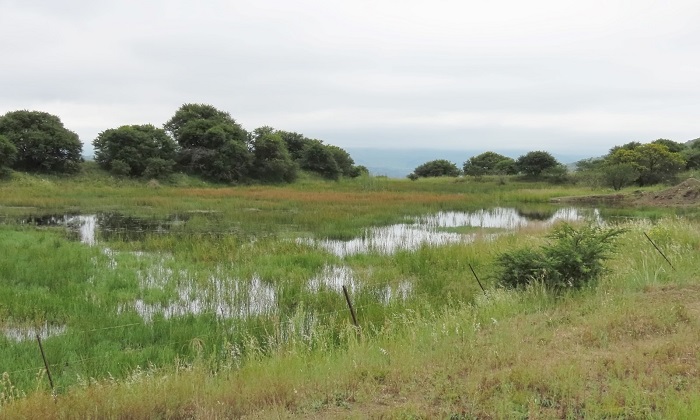
Near Mooi River, KwaZulu-Natal
Photo by Colin Summersgill
Behaviour
The Yellow-billed Duck is mostly nomadic, but some are sedentary at permanent waters, which are used as dry-season refuges. It disperses from permanent waters after sufficient rain has fallen.
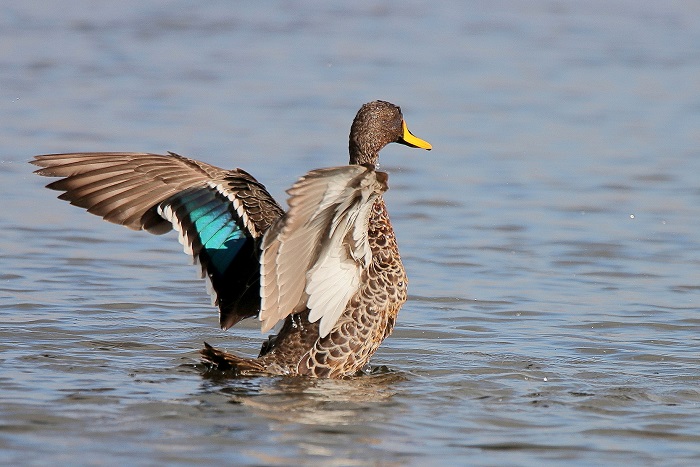
Marievale Bird Sanctuary, Gauteng
Photo by Johan Heyns
The Yellow-billed Duck is mostly found in pairs or small groups, but sometimes many hundreds aggregate at permanent waters or rich food sources. It usually floats near emergent aquatic vegetation, and occasionally on open water. They frequently loaf ashore or in shallow water. Active in evenings and at night, foraging or flying to newly flooded areas.
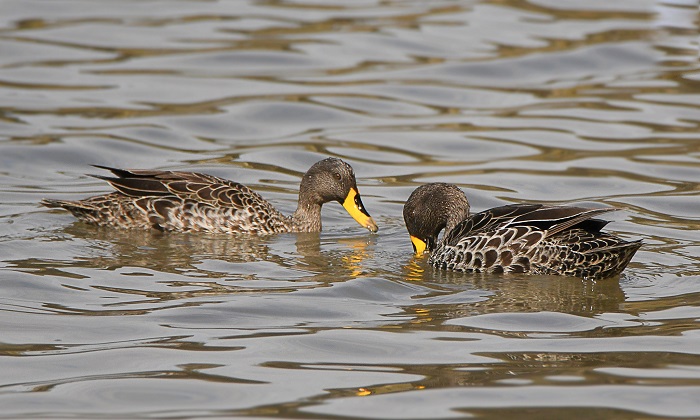
Colchester, Eastern Cape
Photo by Marie Delport
The Yellow-billed Duck forages by swimming and immersing the head and bill to filter sediment. They frequently up-end and sometimes dive. Also grazes the new green growth of aquatic plants. Males and fledged juveniles are largely vegetarian (around 80 % of the diet). Females eat less plant matter than males (around 70 %). Pre-fledging juveniles eat far less plant material (about 30 %).
Pondweeds Potamogeton spp. are favoured, but Oxygen weed Lagorosiphon sp. and sedges are also consumed. The animal component of their diet includes small aquatic insects and their larvae, especially mosquito and midge larvae. They also eat mayflies, water beetles, grasshoppers, and snails.
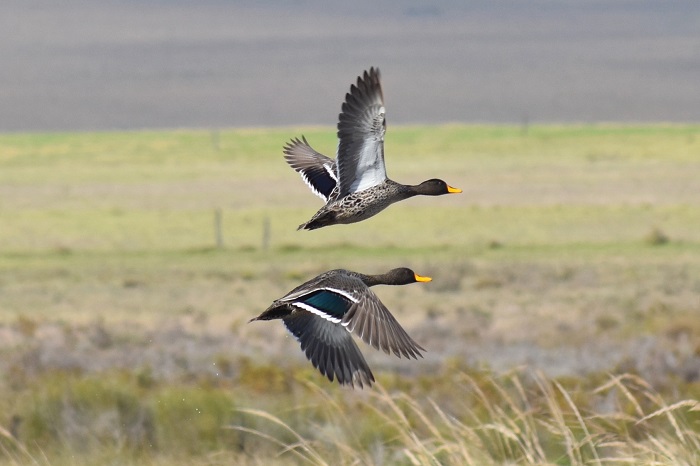
Baardscheerdersbosch, Western Cape
Photo by Karis Daniel
The Yellow-billed Duck is a monogamous, solitary nester, but nests may be less than 10 m apart. The pair bond is short-lived and seldom lasts beyond egg-laying. Courtship behaviour complex and ritualised, performed communally in flocks with increasing frequency towards end of dry season, usually early morning or early evening.
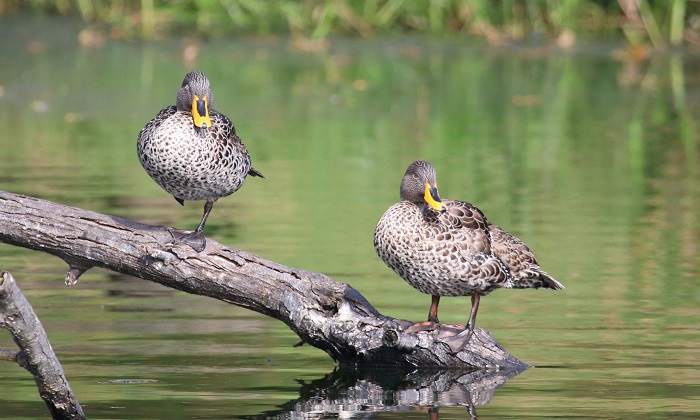
Addo Elephant National Park, Eastern Cape
Photo by Salome Willemse
The nest is a shallow depression in the ground lined with fine grass or waterweeds, and usually lined with down. The nest is typically placed among rushes, reeds, dense grass or sedges, often within a dense patch of vegetation. The nest is often placed under a thorny bush if available, and it is usually hidden from above. Nests are usually located less than 20 m from the water.
In the winter rainfall Western Cape, eggs are laid from June to January, but mainly from June to October. Eggs are laid throughout the year across the rest of its range, with a clear peak from October to May. 2 to 10 eggs are laid per clutch at daily intervals. The eggs are plain, pale creamy yellow or buff. Incubation starts before the clutch is completed, possibly with the first-laid egg. The incubation period lasts for 26 to 29 days. Incubation is performed entirely by the female. She may sometimes leave the nest for short periods, but covers the eggs with down.
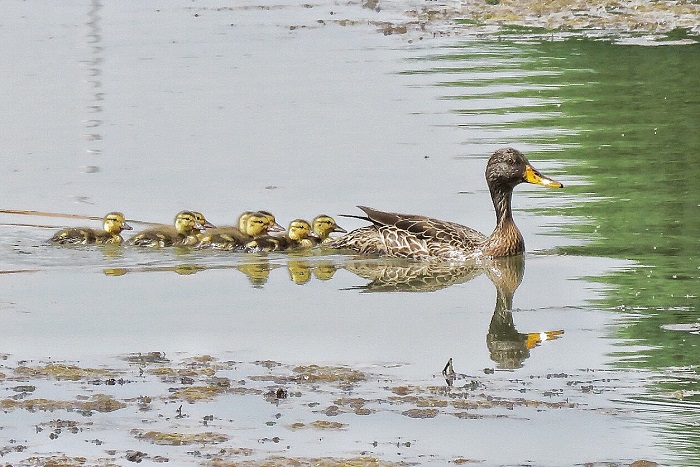
Middleburg, Mpumalanga
Photo by Andries de Vries
Freshly hatched young are precocial and covered in down. The female closely attends the ducklings during their first 3 weeks. They take their first flight at around 68 days, but remain with the female for at least 6 weeks after fledging.
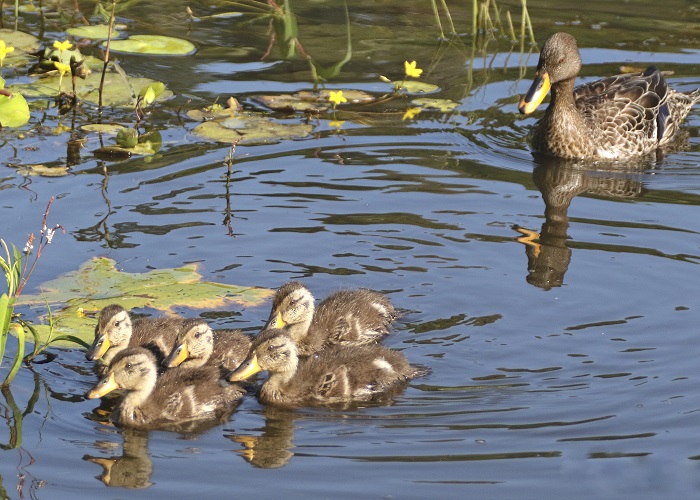
Near Port Edward, KwaZulu-Natal
Photo by Lia Steen
Further Resources
Species text adapted from the first Southern African Bird Atlas Project (SABAP1), 1997.
The use of photographs by Andre Harmse, Andries de Vries, Cobus Elstadt, Colin Summersgill, Gerald Wingate, Johan Heyns, Karis Daniel, Lia Steen, Marie Delport, and Salome Willemse is acknowledged.
Other common names: Geelbekeend (Afrikaans); iDada (Zulu); Idada (Xhosa); Canard à bec jaune (French); Gelbschnabelente (German); Pato-de-bico-amarelo (Portuguese); Geelbekeend (Dutch).
A list of bird species in this format is available here.
Recommended citation format: Tippett RM. 2026. Yellow-billed Duck Anas undulata. Biodiversity and Development Institute. Available online at https://thebdi.org/2026/10/06/yellow-billed-duck-anas-undulata/
Royal Natal National Park, KwaZulu-Natal
Photo by Andre Harmse
