
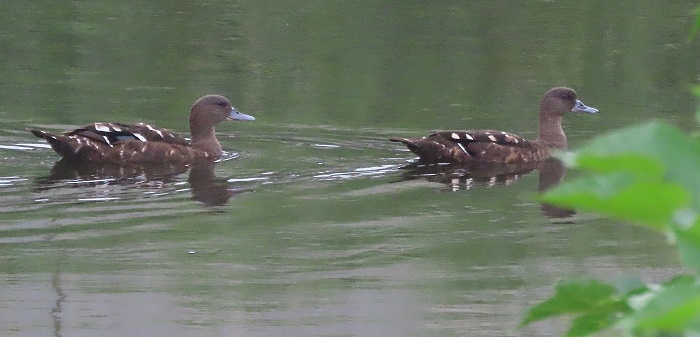
Cover image of African Black Duck by Les Underhill – Swartrivier, Cape Town, Western Cape
The African Black Duck belongs to the Family ANATIDAE (Ducks, Geese, Swans, and Waterfowl). The family has a cosmopolitan distribution, occurring on all the world’s continents except Antarctica. These birds are adapted for swimming, floating on the water surface, and sometimes diving. They range from medium to very large and have robust, broad, and elongated bodies. They generally have broad and flattened bills with a curved nail at the tip of the upper mandible, and most have lamellae inside their bills for filter feeding. Their necks are moderately to very long, and the wings are short and pointed, supported by strong wing muscles. The short, strong legs are set far back on the body, and the feet are webbed. The family contains around 174 species in 53 genera. 20 species have been recorded from southern Africa.
Identification
The African Black Duck is a medium-sized duck with a dark body and distinctive white markings on the back, wings, and tail. The sexes are alike in plumage colouration.
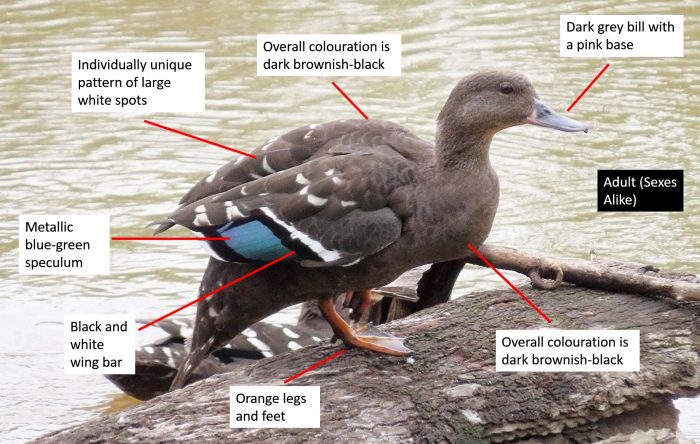
Ungeni River, near Pietermaritzburg, KwaZulu-Natal
Photo by Colin Summersgill
In adults, the upper parts are brownish-black, but the face and neck are paler. The longest scapulars and upper tail coverts are banded white and show as large white spots on the folded wings. The tail is brownish-black with two further rows of white spots. The white markings on the wings and tail form an individually unique pattern.
The underparts are dark olive-brown, apart from the breast which is somewhat paler. The breast and belly feathers are narrowly edged in pale brown. The long flank feathers and undertail coverts show white bands. The wings are brownish black above, with a large carpal spur, which is kept hidden. A white and black wing bar is found on the secondary coverts. The secondaries carry a metallic blue-green speculum. The bill is dark grey with a black culmen ridge and nail, and a pink base. The eyes are brown and the legs and feet are yellowish-orange.
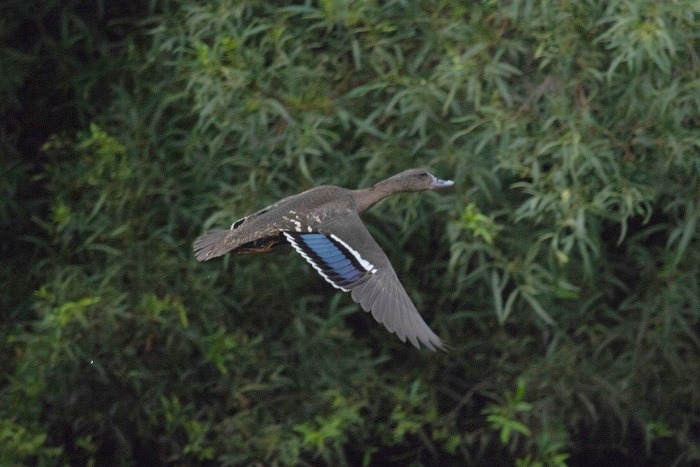
Magaliesberg Natural Area, Gauteng
Photo by Lance Robinson
Juveniles are browner than adults, with bands on the upper parts and a buff-coloured tail. The underparts are white, not blackish-brown. The speculum is duller, and the primary coverts usually have broad white edges.
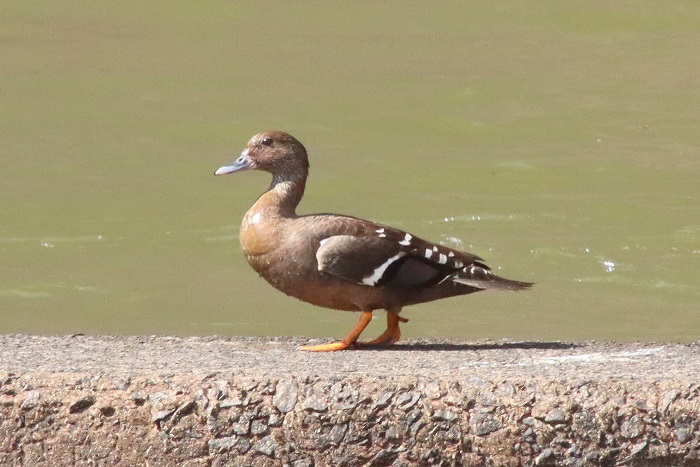
Honnet Nature Reserve, Limpopo
Photo by Marius Meiring
The African Black Duck resembles the Yellow-billed Duck (Anas undulata) in flight or if seen in poor light, especially when the bill is not visible. The African Black Duck is darker, with a whitish (not grey) underwing and a dark (not bright yellow) bill.
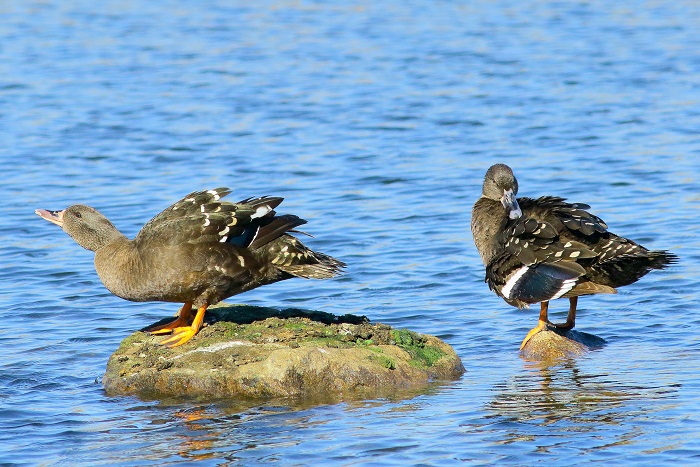
Near Brits, North West
Photo by Andrew Keys
Status and Distribution
The African Black Duck is restricted to sub-Saharan Africa. It occurs from southern Sudan through East Africa and Zambia, south to South Africa, with isolated populations in Guinea, the Cameroon highlands, eastern Nigeria, Gabon and Ethiopia.
In southern Africa, the African Black Duck is found throughout Zimbabwe, southern Mozambique (rare) and most of South Africa. It also occurs in eastern and south-eastern Botswana, southern and central Namibia, and is widespread in Swaziland and Lesotho. In South Africa, it is most common below the escarpment in eastern Limpopo Province, eastern Mpumalanga, KwaZulu-Natal, the Eastern Cape and the Western Cape. It is less common but still widespread over much of the eastern and southern central plateau. The African Black Duck extends into the Karoo along rivers, especially the Orange River and its tributaries. It is fairly common across most of southern Africa.
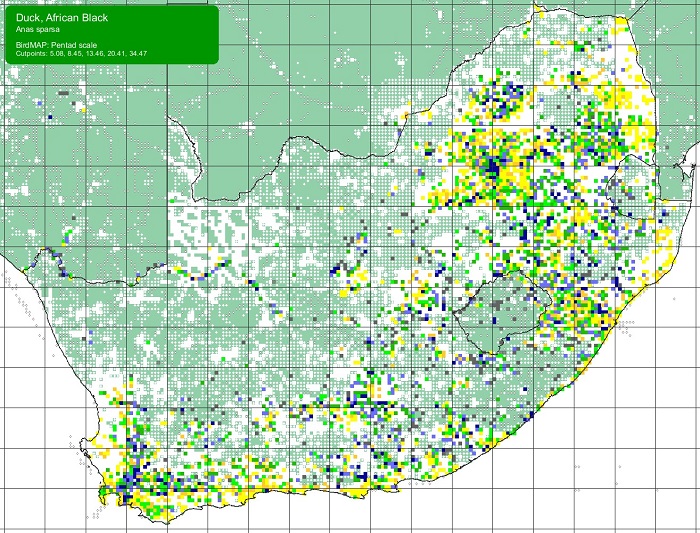
The African Black Duck is not threatened, but as a river specialist, it is vulnerable to habitat loss through river degradation. Dam building, which causes inundation and reduced river flow, is likely to negatively affect populations. Further concerns include siltation, pollution, the clearing of riparian vegetation, and alien biota. Total protection of the African Black Duck has been recommended. Hybridisation with the Mallard (Anas platyrhynchos) is a further potential threat
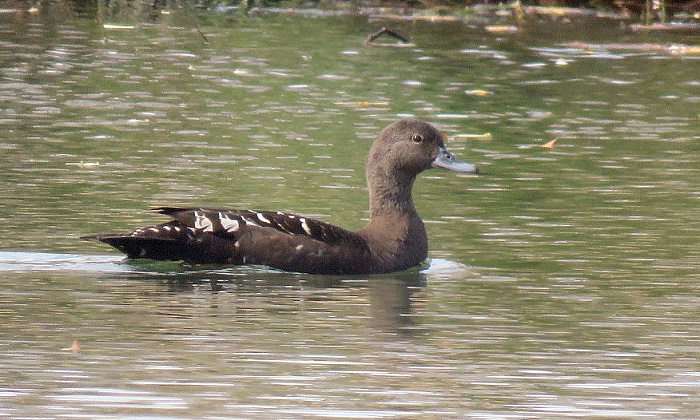
Crown Mines Golf Course, Gauteng
Photo by Kevin Lavery
Habitat
The African Black Duck mainly frequents perennial rivers and streams, from fast-flowing mountain streams to wide, sandy river mouths. It prefers shallow, stony-bottomed streams with wooded banks. It is less often found at dams, sewage ponds or natural wetlands near rivers. However, such wetlands may be used regularly for roosting and social interaction, especially during the dry season. Some pairs include them in their territories, but rarely for breeding purposes. Birds in flightless moult require cover near foraging area, such as over hanging vegetation, lodged branches, or an undercut bank. The African Black Duck is regularly seen along rivers flowing through towns.
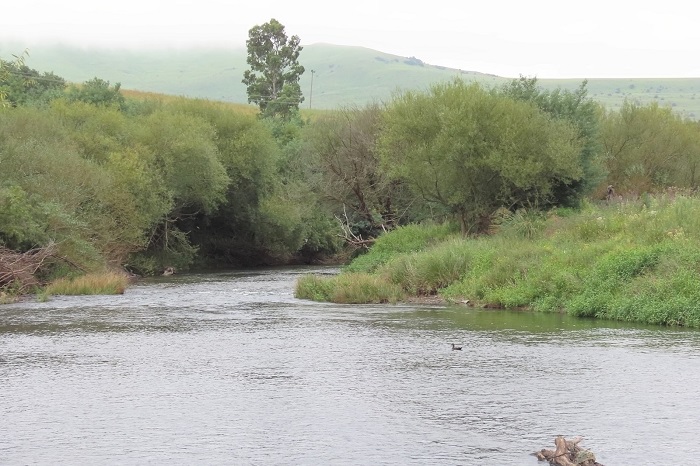
Near Mooi River, KwaZulu-Natal
Photo by Colin Summersgill
Behaviour
The African Black Duck is mostly sedentary and territorial. Extensive movements are probably rare. Birds on ephemeral waters in dry regions must undertake longer movements, mostly along rivers, where they are likely to be harassed by resident pairs. The African Black Duck has been recorded flying overland deep into the Nama Karoo, seemingly far from water.
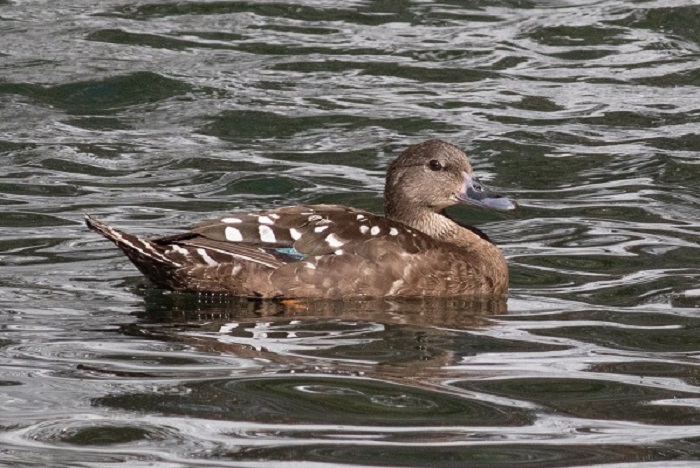
Walter Sisulu Botanical Gardens, Gauteng
Photo by Lance Robinson
The African Black Duck is most often encountered in pairs. They are highly alert as they are vulnerable to predation. African Black Ducks are usually very wary of humans. They are most active around sunrise, and again near sunset. Daylight activity patterns cycle between feeding, bathing, preening, and sleeping. Pairs roost together at night, except when females are incubating. Non-territorial pairs, single adults, and juveniles may gather regularly to roost at large dams. The African Black Duck is aggressive toward conspecifics, and fights occasionally break out, often involving aerial pursuits.
Birds in flightless moult are extremely secretive and less active than non-moulters. Territorial pairs favour certain rocks and banks, usually near a deep bathing pool, for preening and sleeping, and another one for roosting at night. The African Black Duck rarely perches on tree stumps or branches.
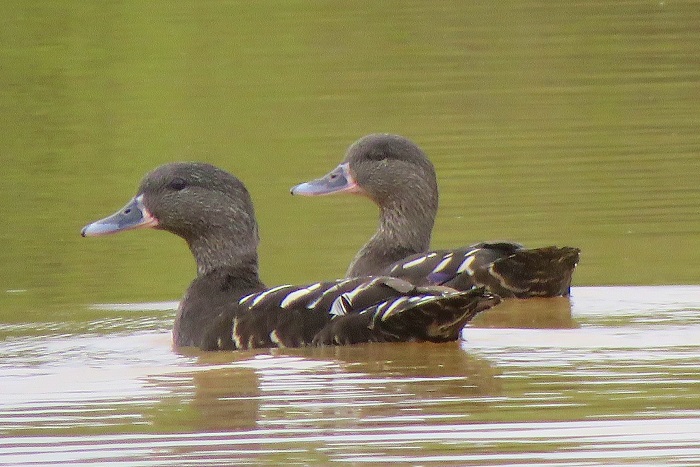
Elands River, North West
Photo by Gerald Gaigher
Territorial pairs visit their entire territory on a daily basis. When under pressure from rivals, pairs will search potential hiding places for intruders. Mates cooperate in expelling intruding adults, but juveniles are usually tolerated. Both male and female call almost constantly during territorial pursuits. If intruders resist expulsion, midair clashes with wing-buffeting result. On water, fighting birds (always of the same sex) stand erect and grasp one another by the hind neck while delivering repeated blows with both wings, using their carpal spurs. Clashes last from a few seconds up to several minutes, and the loser is then vigorously pursued. Such conflicts can cause injury or death and may lead the intruders to claim the territory. The African Black Duck is also aggressive towards Red-billed Teals (Anas erythrorhyncha), Cape Shovelers (Anas smithii) and Cape Teals (Anas capensis).
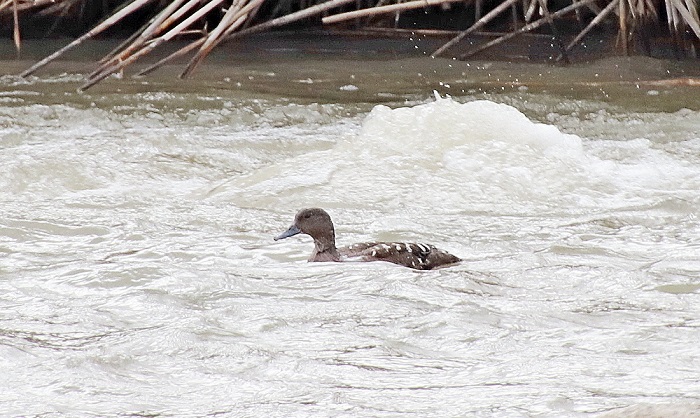
Orange River, near Upington, Northern Cape
Photo by Marius Meiring
The African Black Duck forages mainly along streams and rivers, but also on adjacent water bodies. It feeds primarily by dabbling but also by probing with the bill, submerging the head or neck. Occasionally, it also upends or dives. The African Black Duck searches between rocks, in mud, and among aquatic plants and flooded grasses, even in fast-flowing water.
The diet is little known, but is presumed to consist mainly of benthic invertebrates and vegetable matter. Occasionally strips seeds from aquatic plants or picks fruits from terrestrial plants overhanging water. Also eats fallen fruit and berries, cultivated grain, and fallen acorns. Dives for insect larvae and crustaceans. Other animal food includes chironomid larvae and pupae, molluscs, crabs, fish fry (up to 100 mm), including those of the invasive Rainbow Trout (Oncorhynchus mykiss).
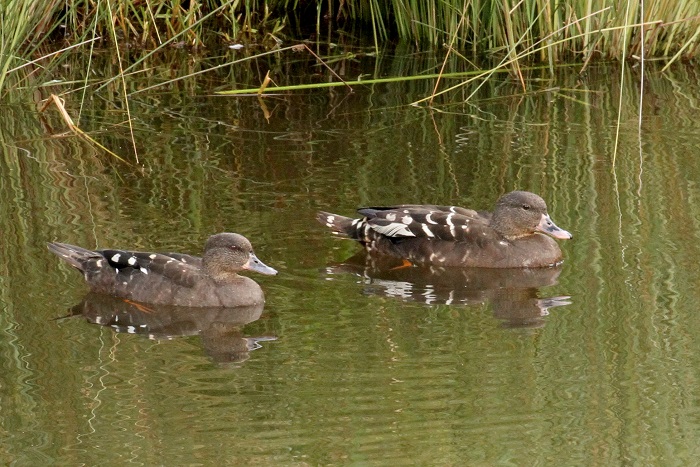
Heidelberg, Gauteng
Photo by Pieter la Grange
In South Africa, the African Black Duck breeds from winter through to early summer. It is monogamous and highly territorial, with each pair occupying several kilometres of river. Unlike most other Anas species, social courtship is virtually absent. Unpaired birds form, test and maintain only part-time liaisons while simultaneously probing weaknesses in the bonds of territory-holding pairs.
The nest is built on the ground in dense grass or other vegetative cover. Usually on a riverbank, or in lodged flood debris, tangled roots, or a hollow stump. Nests are occasionally placed in old, collapsed Hamerkop nests, or on a low cliff ledge. The nest is built entirely by the female. Most nests are located less than 2 m from the water, and rarely up to 20 m from the river. The nest is a deep grass bowl, usually thickly lined with down and contour feathers.
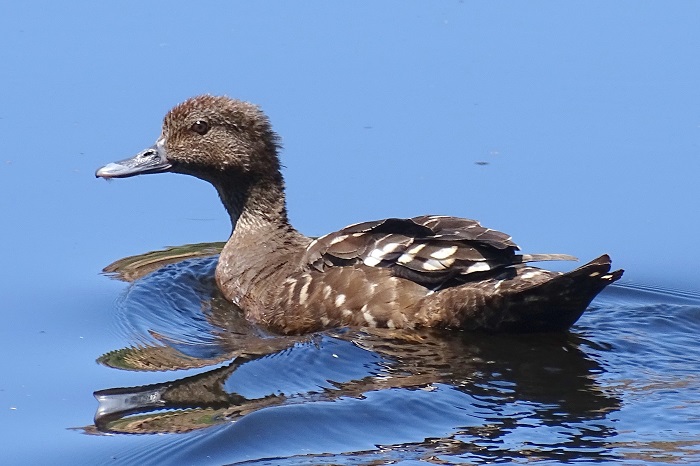
Cedarberg, Western Cape
Photo by Zenobia van Dyk
4 to 11 eggs are laid per clutch. They are usually laid on successive mornings. The eggs are cream to buff-yellow, slightly glossy and oval-shaped. Incubation starts at clutch completion and lasts up to 32 days. The female does all the incubation while the male keeps watch nearby. The female generally leaves the nest twice a day, once in the morning and again in the afternoon. The eggs are covered with down before she leaves the nest. Towards the end of the incubation period, the female rarely leaves the nest, and the eggs may be incubated continuously for the last 3 days.
The newly hatched ducklings are precocial and covered in down. They are fully fledged after around 77 days. Ducklings dive frequently when feeding and also dash across the surface after flying insects. Females with broods are very secretive and keep to cover and use a low-pitched call to maintain contact with their young. Broods probably disperse 1 to 2 months after their first flight. The African Black Duck is single-brooded.
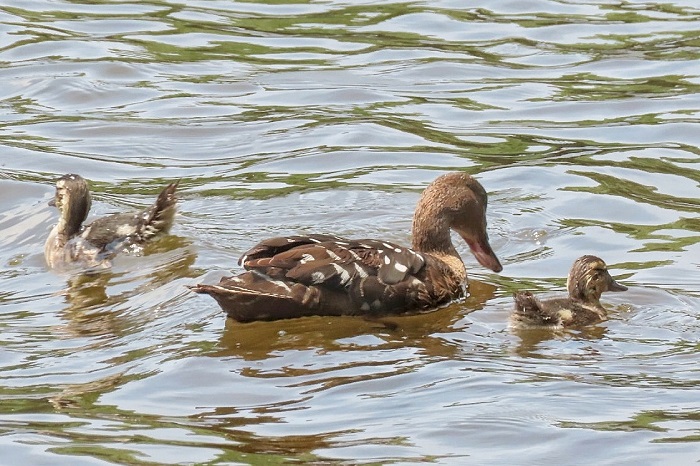
Johannesburg Botanical Gardens, Gauteng
Photo by Andries de Vries
Further Resources
Species text adapted from the first Southern African Bird Atlas Project (SABAP1), 1997.
The use of photographs by Andre Harmse, Andrew Keys, Andries de Vries, Colin Summersgill, Gerald Gaigher, Kevin Lavery, Lance Robinson, Les Underhill, Marius Meiring, Mark Stanton, Pieter la Grange, and Zenobia van Dyk is acknowledged.
Other common names: Swarteend (Afrikaans); iDada (Zulu); Idada (Xhosa); Canard noir, Canard noirâtre (French); Schwarzente (German); Pato-preto-africano (Portuguese); Afrikaanse Zwarte Eend (Dutch).
A list of bird species in this format is available here.
Recommended citation format: Tippett RM. 2026. African Black Duck Anas sparsa. Biodiversity and Development Institute. Available online at https://thebdi.org/2026/10/12/african-black-duck-anas-sparsa/
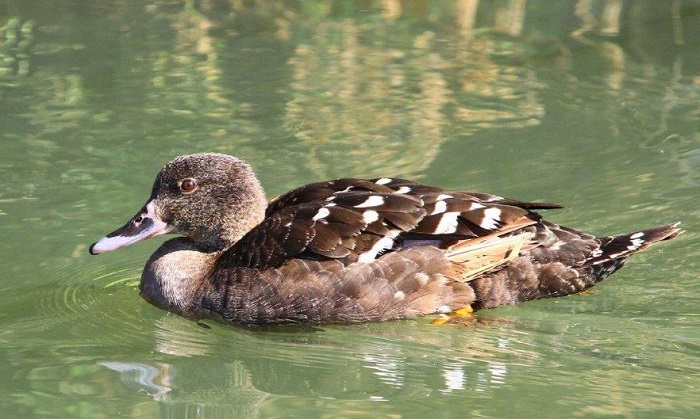
Johannesburg, Gauteng
Photo by Mark Stanton
