
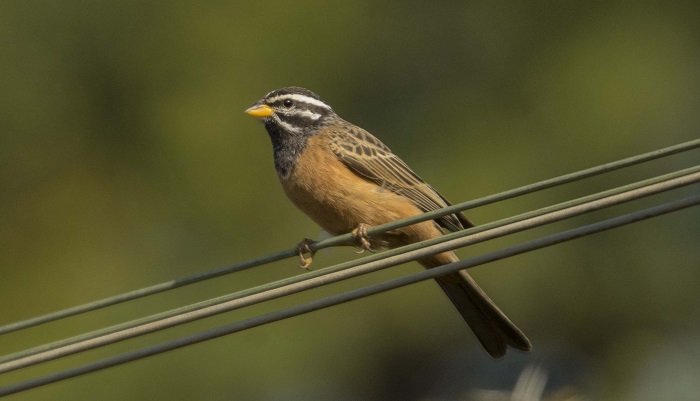
Cover image of Cinnamon-breasted Bunting by Tony Archer – Hartbeesfontein – North West
Buntings belong to the Family: EMBERIZIDAE. The buntings are a group of Old World passerine birds forming the genus Emberiza, which is the only genus in the family. The family contains 44 species. They are seed-eating birds with stubby, conical bills, comparatively long tails, and short legs. The feet are relatively large for scratching on the ground.
Identification
The Cinnamon-breasted Bunting is a
Sexes differ in plumage coloration.
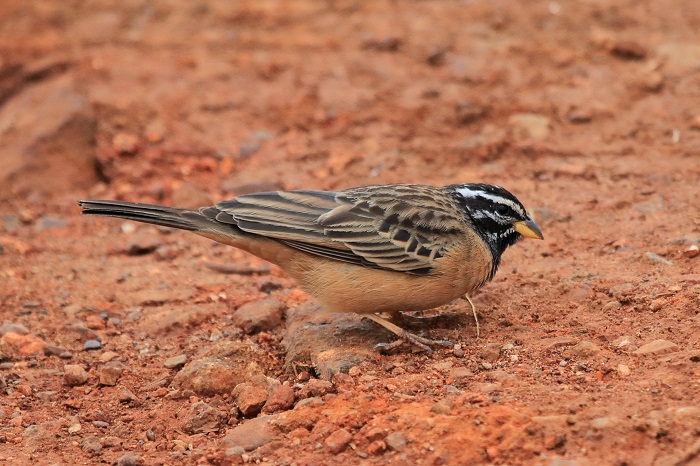
Rietvlei Nature Reserve, Gauteng
Photo by Phillip Nieuwoudt
In Adult males, the head and neck are black with bold white stripes. The mantle, back, rump and upper tail coverts are rich, pinkish cinnamon, flecked with dark brown. The tail is dark brown with pinkish cinnamon edges to the feathers. Primaries and secondaries dark brown, fringed pinkish cinnamon, becoming increasingly cinnamon on inner wing. Coverts dark brown, edged cinnamon. Chin speckled black and white, throat sooty black. Breast, belly, flanks and undertail coverts cinnamon. Upper mandible dark horn, lower mandible yellow. Eyes brown. Legs and feet pinkish brown.
Adult females resemble males, but are generally paler and less reddish above. Crown grey, heavily streaked sooty black. Nape pale pinkish cinnamon, lightly streaked sooty black. Cheeks and throat dark grey, face and head stripes off-white.
Juveniles and immatures as female, but flecked and blotched brown below.
The Cinnamon-breasted Bunting is most likely to be mistaken for the Cape Bunting has dark (not pale) bill, bright rufous wings and grey (not cinnamon) underparts; lacks black-and-white speckling on throat and white (male) or off-white (female) median crown stripe..
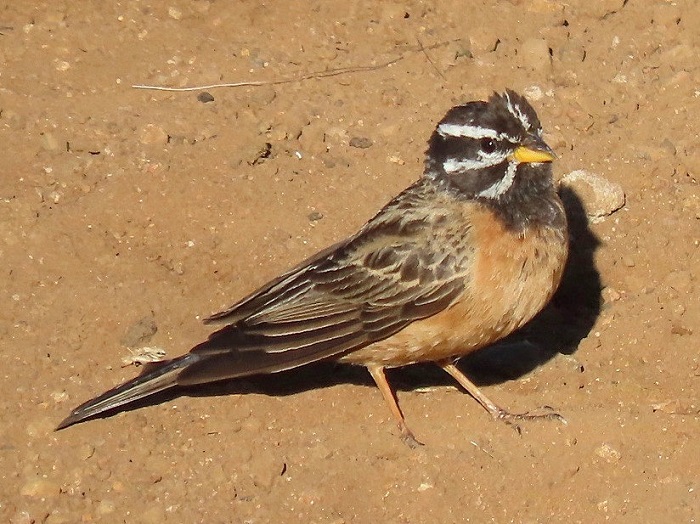
Pilanesberg National Park, North West
Photo by Pieter Cronje
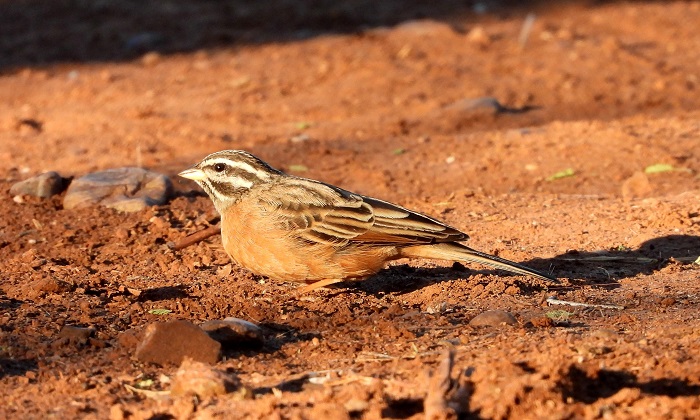
Redhill near Simon’s Town, Western Cape
Photo by John Tinkler
Status and Distribution
Uncommon to locally very common
Sub-Saharan Africa, from Nigeria east to Eritrea and south to S Africa; also in s Arabia and on Socotra Is. In s Africa, widespread in east and north, but absent from most of Namib, Kalahari and Karoo, and coastal regions of KwaZulu-Natal. In s Mozambique, present only in west.
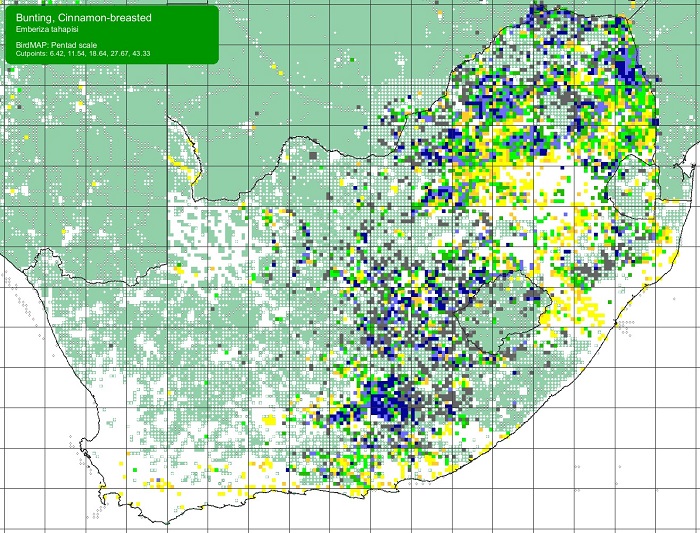
Details for map interpretation can be found here.
Not threatened.
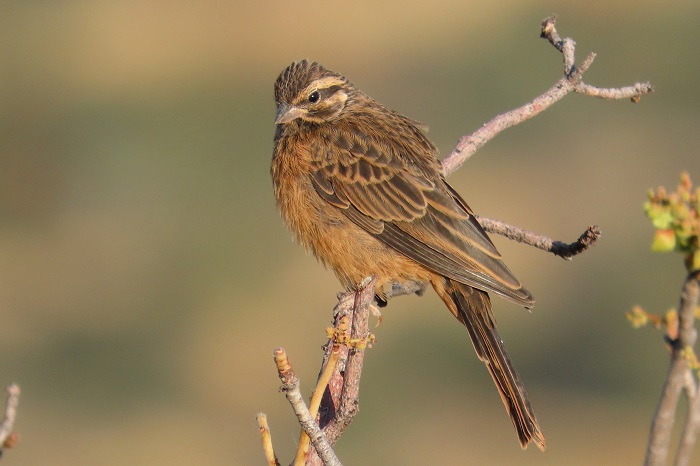
Karoopoort, Western Cape
Photo by Gerald Wingate
Habitat
The Cinnamon-breasted Bunting favours rocky and bare places in wooded or open habitats. It is commonly found on rocky ridges, mountainsides, granite and dolerite outcrops with scattered bushes or trees. Also almost bare rocky and stony patches in woodlands on hills and plains, and eroding stony slopes and gullies, dry watercourses, and abandoned borrow pits and quarries.
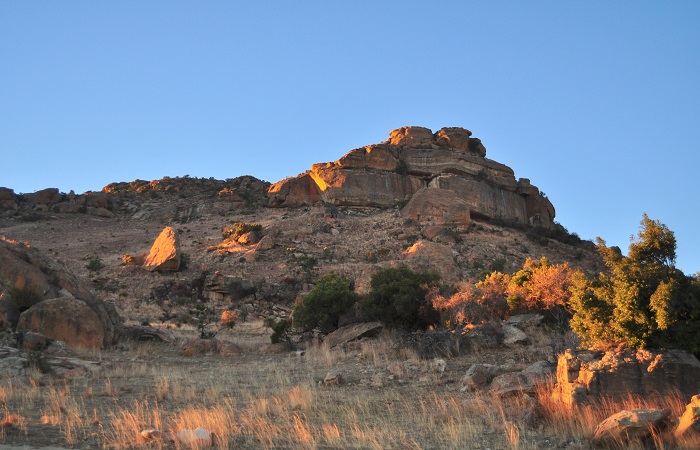
Photo by Ryan Tippett
Behaviour
The Cinnamon-breasted Bunting is resident and a breeding migrant from Nov-Dec to Apr-May. There are no clear patterns to its movements. There is a partial winter migration northward from the eastern parts of its range, with some almost certainly leaving the subregion. In Zimbabwe and northeastern South Africa, numbers increase in December, but concentrations also occur outside the breeding season. The Cinnamon-breasted Bunting is locally nomadic in the dry season. It is an occasional visitor to gardens, mainly in the wet season.
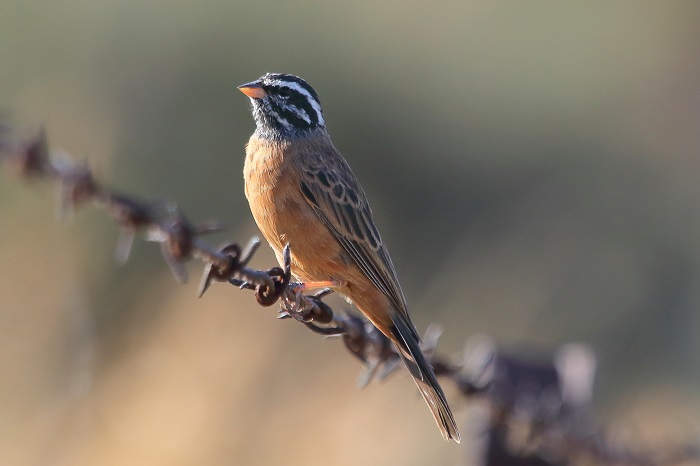
Near Tiffendell, Eastern Cape
Photo by Jorrie Jordaan
The Cinnamon-breasted Bunting is found in pairs or family groups when breeding and mostly singly or in pairs at other times. Occasionally aggregates in small flocks. As with other seed-eating species, it drinks water regularly.
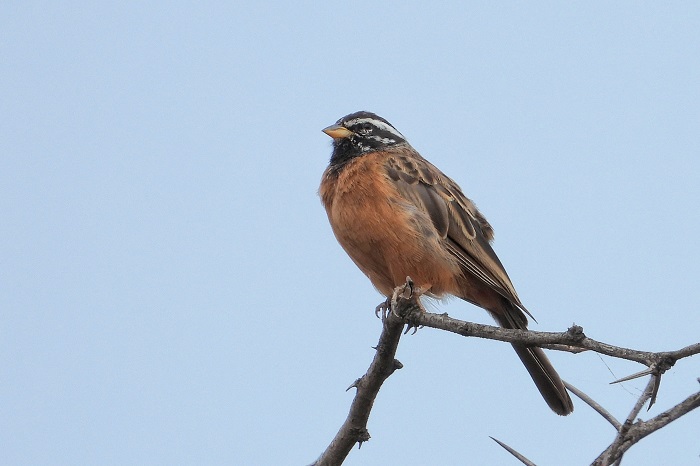
Naudes Nek, Eastern Cape
Photo by Gregg Darling
Forages on ground, in bare or thinly vegetated patches and among rocks, occasionally reaching up to take seeds directly from low-growing grasses. Regularly forages on burnt areas shortly after fire. The Cinnamon-breasted Bunting eats grass seeds, forb seeds, and insects, including small beetles and hawks termite alates.
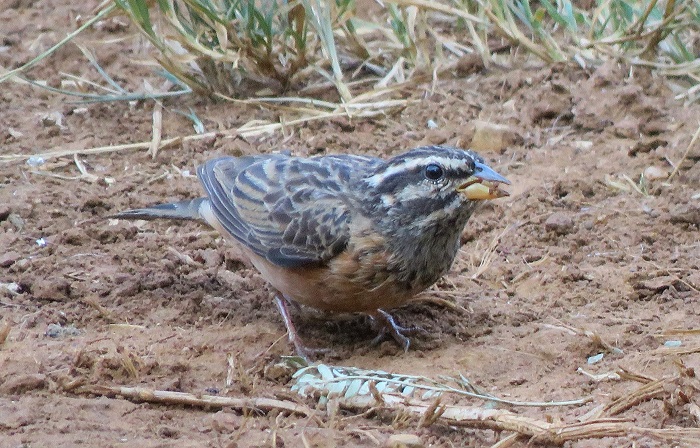
Near Vioolsdrif, Northern Cape
Photo by Johan Van Rooyen
The Cinnamon-breasted Bunting is a monogamous, solitary nester, but nests may be fairly close to one another.
The nest is a shallow cup of grass, fine twigs and rootlets, often on a foundation of coarser twigs. The nest is untidy on the outside, but the cup is neatly lined with rootlets and fine grass. It is built entirely by the female in about 4 days. She is accompanied by the male on collecting trips. The nest is placed in a shallow scrape on the ground at the base of a grass tuft, rock or clod. Usually on a rocky slope, earthen bank, in a crevice in a small rock face, or on open stony ground.
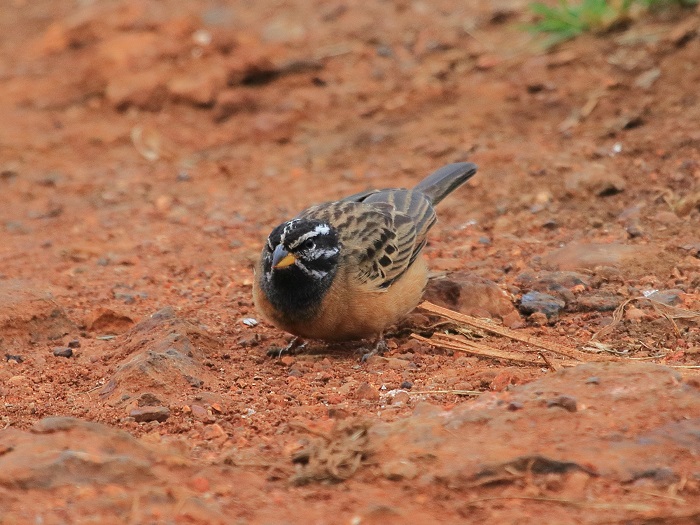
Klein Cedarberg Private Nature Reserve, Western Cape
Photo by Ryan Tippett
The Cinnamon-breasted Bunting breeds from October to June. 2-4. Oval. Pale bluish white or pale green, heavily spotted and blotched with rust, pale and dark brown, grey and slate; markings variable, usually over whole egg, sometimes concentrated at obtuse end.
Incubation period 12-14 d; by both sexes, but mostly by female.
Newly hatched young with skin flesh pink; fine grey down on dorsal feather tracts. Bill blackish, gape orange-yellow, legs white. Nestling period 14-16 d. Nestlings fed by both ads, mainly on seeds, but some insects, incl smalll caterpillars. 41 young hatched from 62 eggs in 19 nests; another 16 nests containing 48 young fledged 15 young.
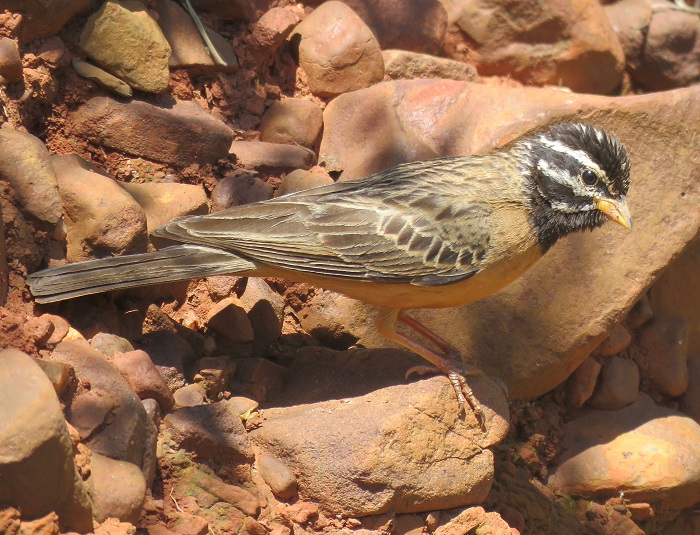
Baviaanskloof Nature Reserve, Eastern Cape
Photo by Jorrie Jordaan
Further Resources
Species text in the first Southern African Bird Atlas Project (SABAP1), 1997.
The use of photographs by Anthony Paton, Dave Rimmer, Desire Darling, Gerald Wingate, Gregg Darling, Johan Van Rooyen, John Tinkler, Jorrie Jordaan and Marna Buys is acknowledged.
Virtual Museum (BirdPix > Search VM > By Scientific or Common Name).
Other common names: Rock Bunting, Cinnamon-breasted Rock Bunting (Alt.English); Klipstreepkoppie (Afrikaans); umDinasibula (Zulu); Bergammer, Siebenstreifenammer (German); Bruant cannelle (French); Berggors, Zevenstrepen-gors (Dutch); Escrevedeira-das-pedras (Portuguese).
List of bird species in this format is available here.
Recommended citation format: Tippett RM 2024. Cinnamon-breasted Bunting Emberiza tahapisi. Biodiversity and Development Institute. Available online at https://thebdi.org/2026/09/26/cinnamon-breasted-bunting-emberiza-tahapisi/
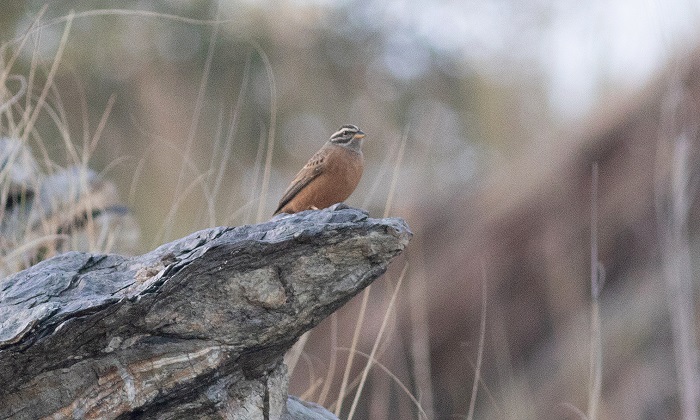
Maanhaarrand, North West
Photo by Anthony Paton
