
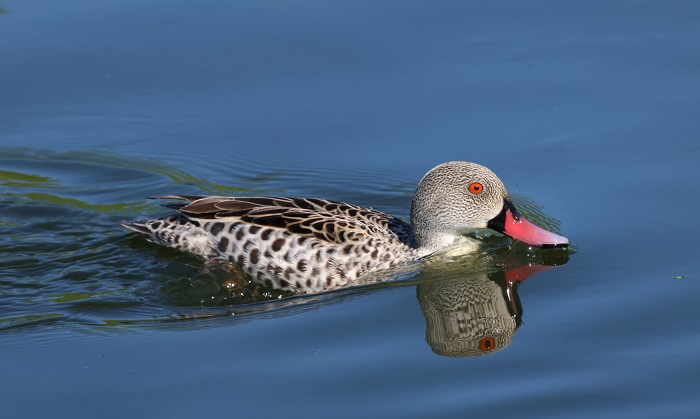
Cover image of Cape Teal by Gerald Wingate – Strandfontein Sewage Works, Western Cape
Teals belong to the Family ANATIDAE (Ducks, Geese, Swans, and Waterfowl). The family has a cosmopolitan distribution, occurring on all the world’s continents except Antarctica. These birds are adapted for swimming, floating on the water surface, and sometimes diving. They range from medium to very large and have robust, broad, and elongated bodies. They generally have broad and flattened bills with a curved nail at the tip of the upper mandible and most have lamellae inside their bills for filter feeding. Their necks are moderately to very long, and the wings are short and pointed, supported by strong wing muscles. The short, strong legs are set far back on the body, and the feet are webbed. The family contains around 174 species in 53 genera. 20 species have been recorded from southern Africa.
Identification
The Cape Teal is a smallish, mostly grey duck with dark spots and blotches. The sexes differ slightly in plumage coloration.
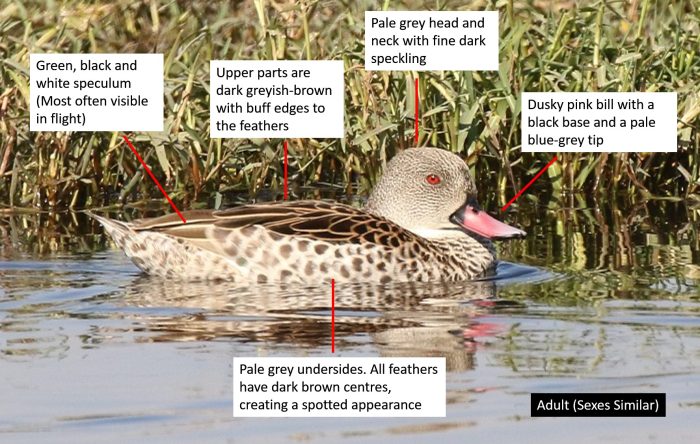
Grootvlei, Gauteng
Photo by Marna Buys
In adult males, the head and neck are pale grey with fine blackish speckling over most of the head and neck. The rest of the upper parts are dark greyish-brown with buff edges to the feathers. The chin and throat are pale grey with little to no speckling. The remaining underparts are pale ash grey and all feathers on the breast have dark brown centres. In flight, the outer secondaries are mostly white, the median secondaries are black-and-white, and the inner secondaries are metallic green, black, and white, together forming the speculum. The tail is greyish-brown with buffy-white edges. The slightly upturned bill is rose pink and brightest during the breeding season. It is blackish at the base and terminates in a pale bluish grey tip. The eyes are orange to red and are vivid red when breeding. The legs and feet are dirty yellow and the tarsal joint and webbing are blackish.
The head of the adult female is slightly darker than the male’s. Females are also whiter below and their breast markings are smaller, and they have duller, less colourful bills.
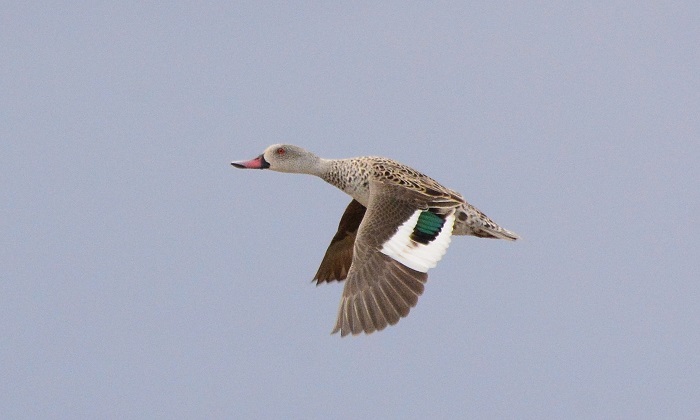
Carnarvon district, Northern Cape
Photo by Ryan Tippett
Juveniles and immatures resemble adults, but are duller brown above. They also have less colourful eyes and bills.
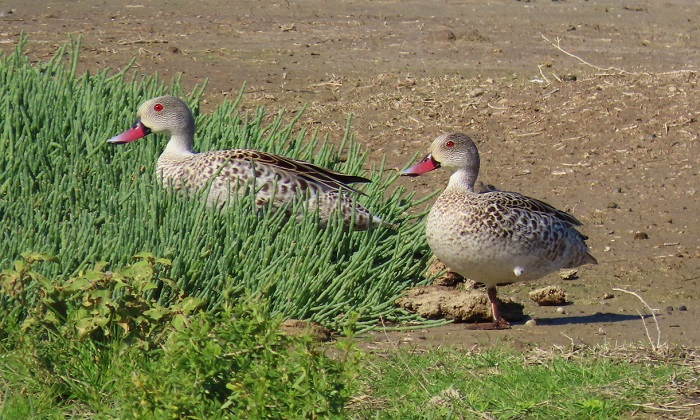
Gouritzmond, Western Cape
Photo by Johan van Rooyen
The Cape Teal is most likely to be mistaken for the Red-billed Teal (Anas erythrorhyncha), but the latter has a black bill saddle and a dark cap and lacks green in the speculum. The Cape Teal has been known to hybridise in the wild with the Red-billed Teal and Yellow-billed Duck (Anas undulata).
Status and Distribution
The Cape Teal is found in sub-Saharan Africa, where it has a wide but disjunct distribution. One population occurs from Sudan and Ethiopia south to Tanzania. The southern population occurs from the southern Angolan coast and southern Zambia to South Africa. The Cape Teal is widespread and fairly common in Namibia. It is common in south-eastern Botswana, and on the Makgadikgadi Pans in years of good rainfall. The Cape Teal is localised and found in small numbers in western and central Zimbabwe. It is an uncommon visitor or rare breeding resident in southern Mozambique, an uncommon visitor to Eswatini (Swaziland), and a rare visitor to western Lesotho. The Cape Teal is widespread in South Africa. It is most common in the western coastal lowlands of the Western Cape and on the western highveld of the inland plateau.
The Cape Teal is uncommon to locally abundant in southern Africa.
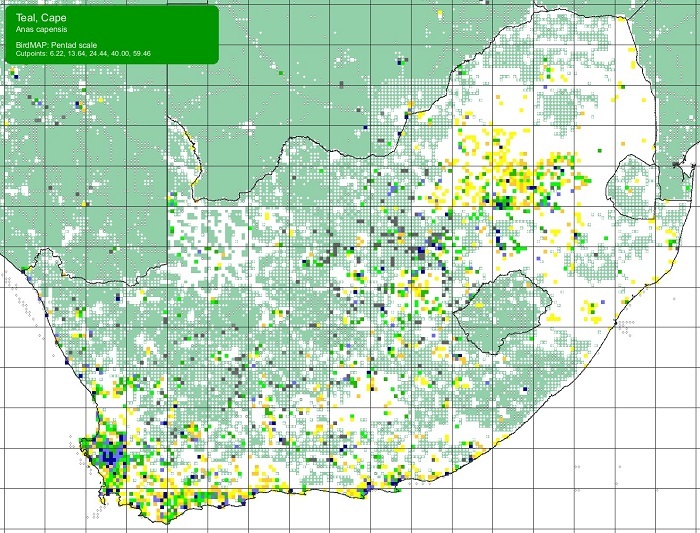
The Cape Teal is not threatened. Its use of sewage ponds and other artificial water bodies resulted in a range expansion in KwaZulu-Natal, Zimbabwe and southern Botswana, and probably elsewhere.
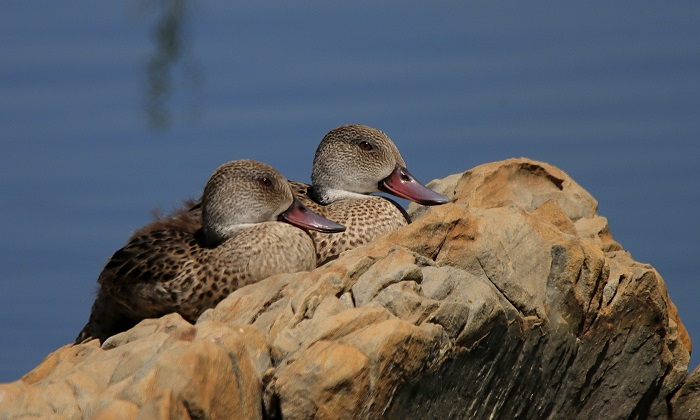
Near Hermanus, Western Cape
Photo by Johan Heyns
.
Habitat
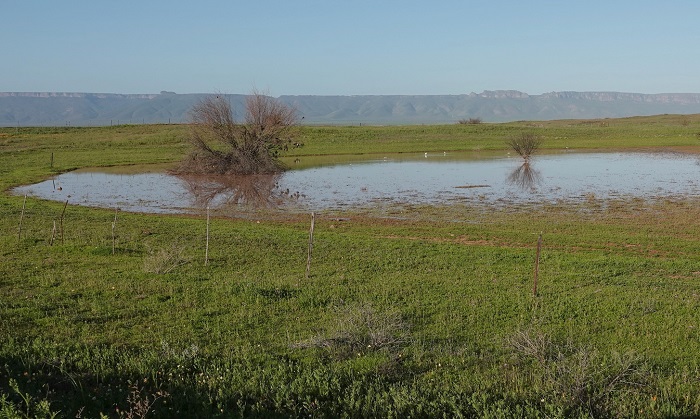
Photo by Les Underhill
The Cape Teal prefers open, saline or brackish wetlands, especially saltpans, estuaries and coastal lagoons. It also occurs at temporary and permanent marshes, ephemeral pans, sewage ponds, and dams, especially those with shallow water. The Cape Teal may move to deep, open waters to moult.
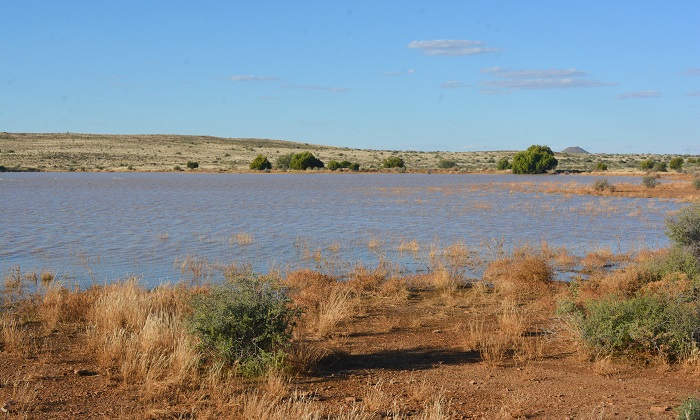
Carnarvon district, Northern Cape
Photo by Ryan Tippett
Behaviour
The Cape Teal is mostly nomadic with some long-distance movements. It is both a resident and partial migrant in the Western Cape, where it congregates on permanent wetlands to moult and disperses to ephemeral ones to breed. Seasonal movements have been recorded in Zimbabwe, where it is usually present in small numbers. There is no evidence for migration or movement outside the region.
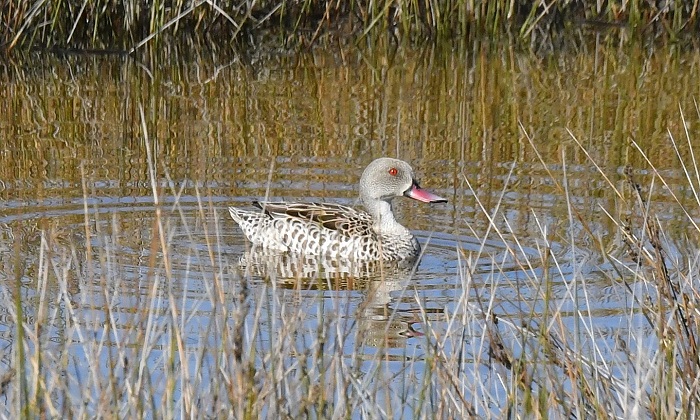
Carnarvon district, Northern Cape
Photo by Ryan Tippett
The Cape Teal is usually found in pairs or small flocks, but may form moulting flocks of several hundred birds. It is generally confiding and spends much time standing in shallows or on the shore when not feeding.
It is aggressive towards conspecifics, even when not breeding and juveniles stay together, away from adults. Moulting birds retreat to deep water when disturbed, swimming flat on the water. The Cape Teal dives if threatened, swimming up to 6 m under water.
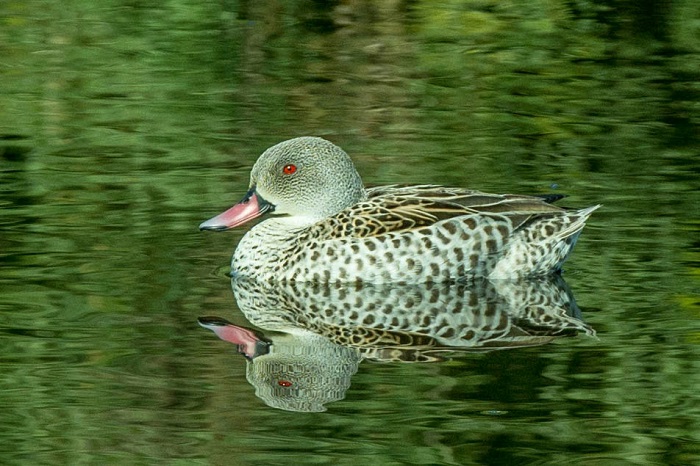
Kleinbrak, Western Cape
Photo by Jean Hirons
The Cape Teal feeds mostly in shallow open waters. It forages throughout the day and sometimes also at night. It forages mostly by filter-feeding on the surface or with its head and neck submerged, less often by up-ending. Occassionally picks invertebrates off submerged vegetation or off the water surface. Sometimes also dabbles while walking or dives in deep water for up to 30 sec. Also grazes on shore, agitating mud in the shallows and filtering the suspension. Cape Teals often feed commensally with Greater Flamingos (Phoenicopterus roseus), Black-necked Grebes (Podiceps nigricollis) and Little Grebes (Tachybaptus ruficollis), filtering water and sediment disturbed by these other species.
The Cape Teal feeds mainly on animal matter, especially small aquatic insects and their larvae. Small crustaceans, tadpoles, snails, and planktonic invertebrates are also consumed. Plant matter makes up a relatively small part of the diet (around 30%) and consists mainly of the leaves, stems, and stolons of Pondweeds.
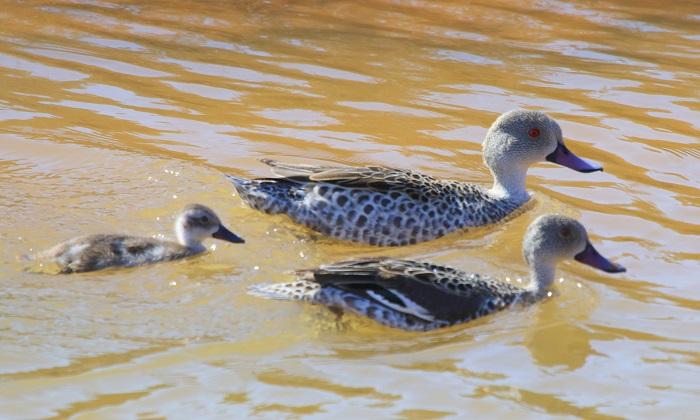
Carnarvon district, Northern Cape
Photo by Sybrand Venter
The Cape Shoveler feeds day or night and usually forages in shallow, open, nutrient-rich waters. They are primarily filter feeders, and most often forage by surface dabbling or with the head and neck submerged. They forage less often by upending or dabbling while walking. Cape Shovelers are also recorded to find food by ‘circle-swimming’ whereby a group of birds swim around in a circle, head to tail, filtering water stirred up by the bird ahead.
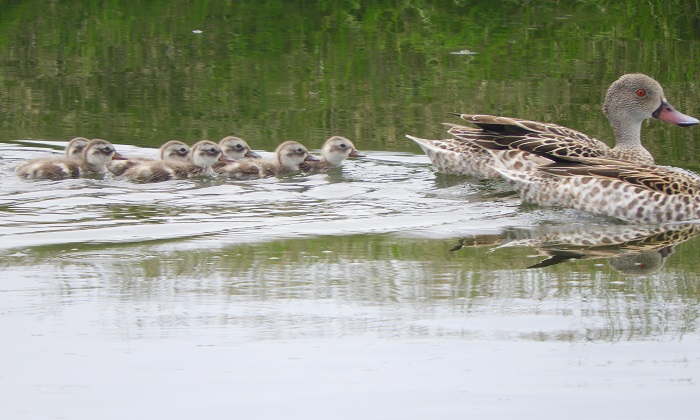
Near Jongensfontein, Western Cape
Photo by Gerald Gaigher
In the summer rainfall parts of its range, the Cape Shoveler breeds throughout the year with a small spring peak from July to September. Breeding in the winter rainfall Western Cape is more seasonal with a marked December peak and only a few breeding records in other months. The Cape Shoveler is a monogamous, solitary nester. Pair bonds are mostly seasonal, but may last for more than 1 season.
The nest is a grass-lined hollow in the ground ringed with down feathers. Nests are typically placed in dense vegetation, usually within 20m of the water. 5 to 12 cream coloured eggs are laid per clutch. Incubation is by the female only and takes 27 to 28 days. The young are precocial and are fully fledged by 8 weeks of age. The young are attended solely by the female.
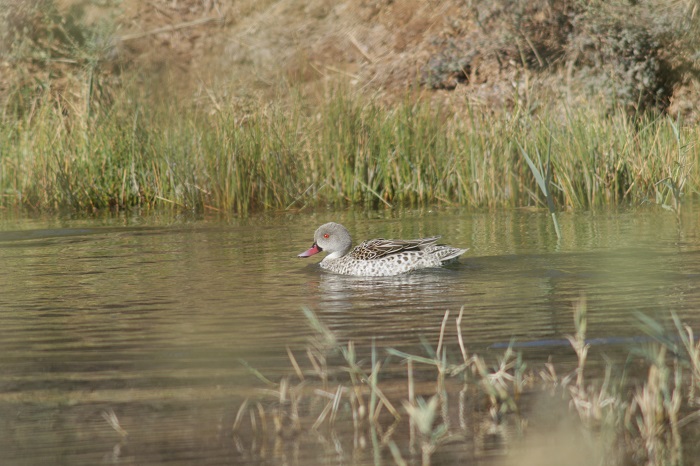
Bokkeveldberge, Northern Cape
Photo by Taylyn Risi
Further Resources
Species text adapted from the first Southern African Bird Atlas Project (SABAP1), 1997.
The use of photographs by Gerald Gaigher, Gerald Wingate, Jean Hirons, Johan Heyns, Johan van Rooyen, Les Underhill, Marna Buys, Ryan Tippett, Sybrand Venter, and Taylyn Risi is acknowledged.
Other common names: Kaapse slopeend (Afrikaans); iDada (Zulu); Canard de Smith (French); Kaplöffelente (German); Pato-trombeteiro do Cabo (Portuguese); Kaapse Slobeend (Dutch).
A list of bird species in this format is available here.
Recommended citation format: Tippett RM. 2026. Cape Teal Anas capensis. Biodiversity and Development Institute. Available online at https://thebdi.org/2026/10/06/cape-teal-anas-capensis/
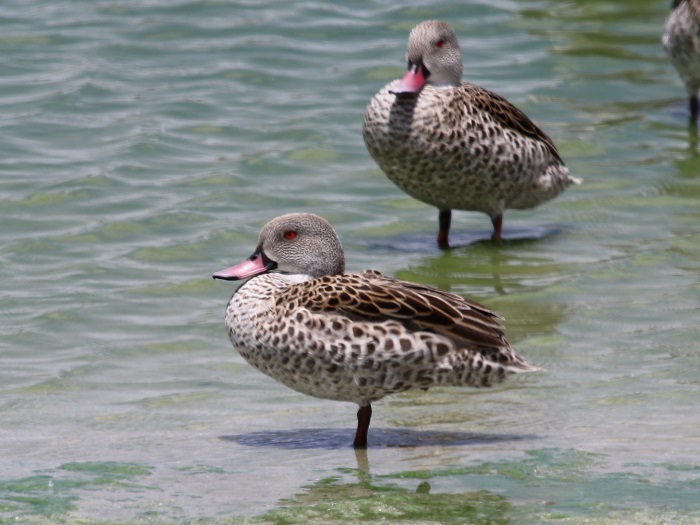
Strandfontein Sewage Works, Western Cape
Photo by Sybrand Venter
