
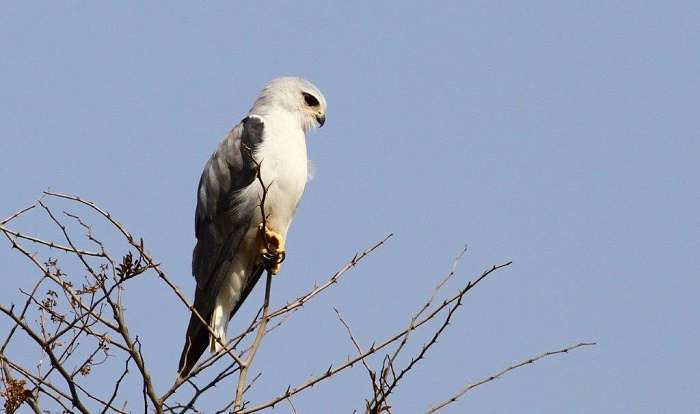
Cover image of Black-winged Kite by Mark Stanton – Pilanesberg National Park, North West
Kites belong to the family ACCIPITRIDAE (Hawks, Eagles, Vultures, and Kites). The Accipitridae is a family of small to very large birds of prey (Raptors) with strongly hooked bills and variable morphology based on diet. They feed on a range of prey items from insects to medium-sized mammals, with some feeding on carrion and others consuming fruit. The Accipitridae have a global distribution across all the world’s continents (except Antarctica) and many oceanic island groups. Some species are migratory. The family contains 250 species from 74 genera.
Identification
The Black-winged Kite is a distinctive smallish grey and white raptor with a black shoulder patch and bright red eyes.
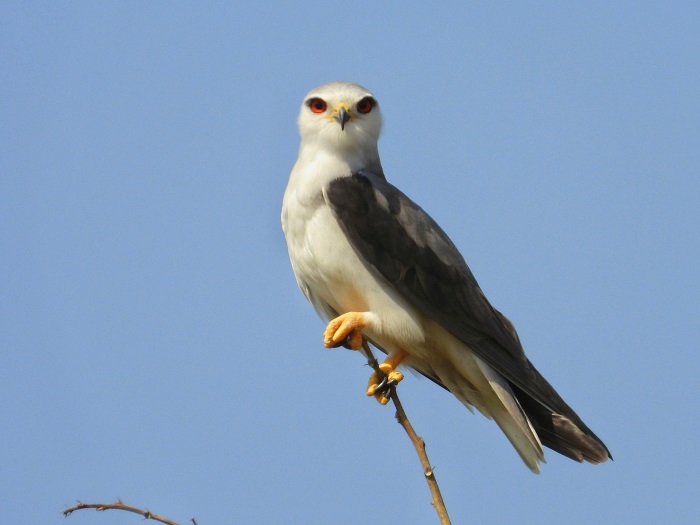
Kruger National Park, Mpumalanga
Photo by Joanne Putter
In adults, the sexes similar in plumage coloration, however, female have less white on the forehead and above the eyes and are slightly darker on the back. Wings project beyond tail at rest; flight gull-like. Ad: Head very pale grey, forehead and supercilium white; remainder of upper parts blue-grey. Tail mostly white, contrasting with grey back; central rectrices grey. Lesser and median wing coverts black, forming black shoulder patch. Flight feathers blue-grey, tipped blackish. Underwing mostly white, with black undersides to outer primaries forming triangular black patch at wing tip. Underparts white, breast washed pale grey. Bill black; cere yellow. Eyes orange to ruby red. Legs and feet yellow.
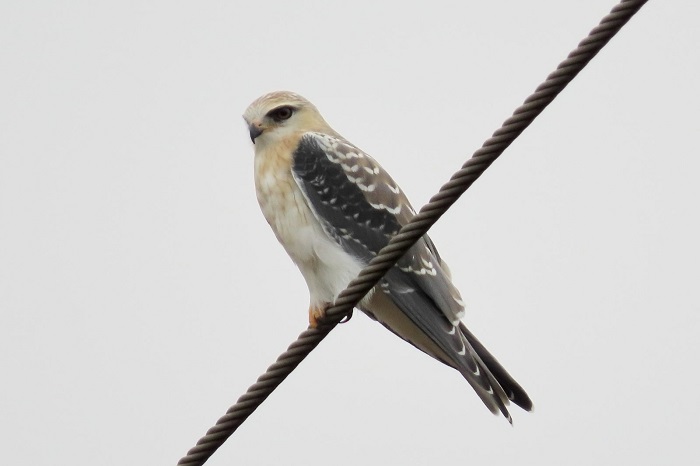
Albert Falls Nature Reserve, KwaZulu-Natal
Photo by Colin Summersgill
Immatures resemble the adultss, but have yellowish-orange eyes; some retain juv remiges, rectrices, greater coverts and alula feathers. Juv: Similar to ad, but breast and neck washed chestnut, nape streaked white. Upper part feathers darker, pale-fringed, appearing scalloped. Flight feathers and coverts dark grey, edged buff; shoulder patch smaller, speckled white. Eyes dark grey-brown, become yellow within 3-4 wk.
At a distance, the smaller Dickinson’s Kestrel has the same pale-headed, grey-backed appearance, but has a more slender, elongated silhouette, with a barred, not plain tail that extends beyond the folded wing tips.
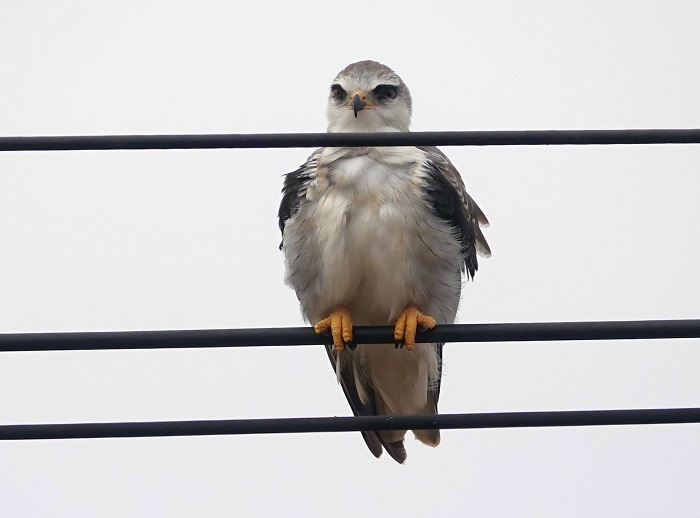
Lamberts Bay, Western Cape
Photo by Les Underhill
Status and Distribution
From south-western Europe and north Africa, south to South Africa. Also from India east to Papua-New Guinea. Widespread in southern Africa, but absent from very arid western areas, some forested areas of the east, and the high Drakensberg plateau.
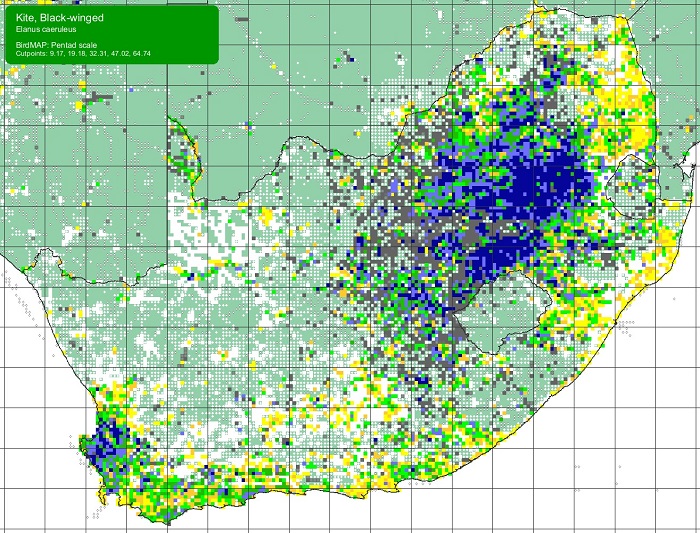
The Black-winged Kite is not threatened. Has benefited from bush clearance for agriculture and from alien trees providing nest sites in otherwise treeless habitats; seemingly unaffected by liberal use of pesticides.
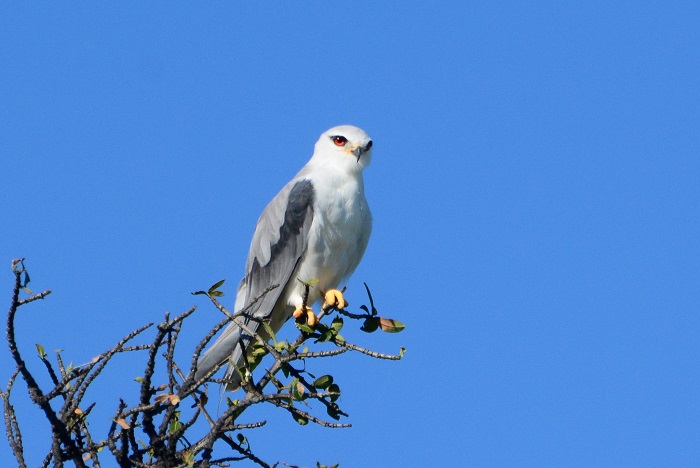
Selinda, Botswana
Photo by Ryan Tippett
Habitat
The Black-winged Kite occurs in most habitats, but is most abundant in grassland and transformed fynbos. Scarce or absent from closed woodland, forest and desert, but present in arid and semi-arid areas where there are irrigated croplands.
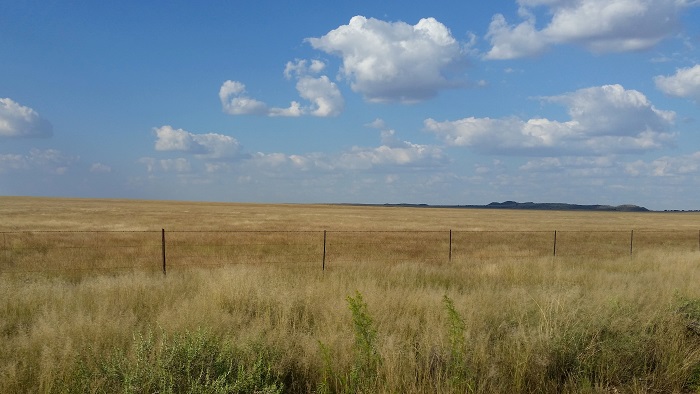
Near Philipolis, Free State
Photo by Ryan Tippett
Behaviour
Large turnover of birds in any one area, but no obvious seasonal movement patterns. Females more nomadic than males. Ringed birds have moved from southern Africa as far as Malawi and Uganda, but most remain within 50-100 km of the ringing site.
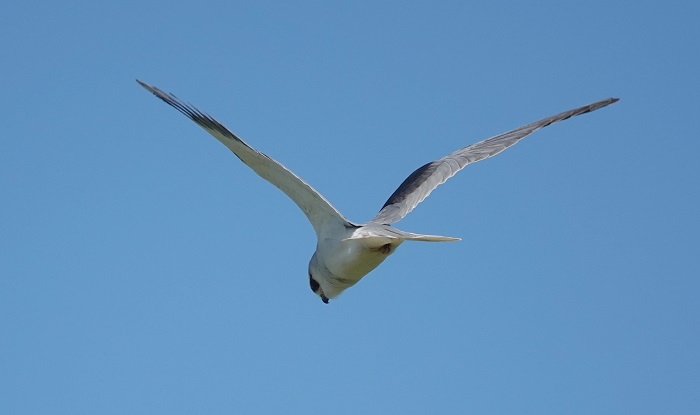
Koringberg, Western Cape
Photo by Les Underhill
Usually seen singly by day, prominently perched on vantage point or in hovering flight. Tail often wagged up and down in apparent threat, directed at conspecifics. At night, sometimes roosts in large groups (up to 300), but usually in smaller groups of 10-20. Roosts usually in reedbeds or adjacent bushes, or in large, solitary trees, dead or alive, incl palms. Individuals may gather at roost from wide area; area of 76 km2 in ne S Africa contained 2 large roosts.
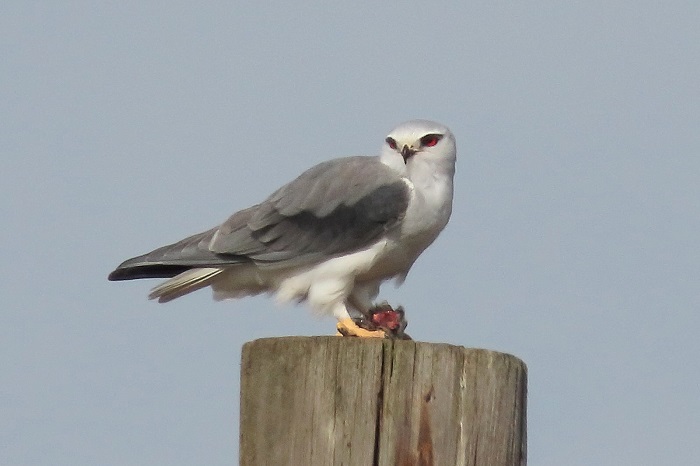
Midmar Nature Reserve, KwaZulu-Natal
Photo by Colin Summersgill
The Black-winged Kite usually hunts for ca 4 hr, up to 9 hr, by day and at dusk. Prey captured by still-hunting (71% of hunting time, successful strike rate 10-20%) from vantage point, or by hovering; latter more successful, but far less energy efficient. Still-hunting more efficient than hovering in terms of prey caught/energy used, but hovering allows exploitation of open habitats lacking perches. When hovering, strike success rate may increase to 20-35%, and larger prey sometimes captured. When prey seen while hovering, bird descends slowly, then raises wings and suddenly drops onto prey. When prey seen from perch, bird descends in short glide, raising wings to pounce. Captured items are taken to perch and eaten. Eats almost exclusively small diurnal mammals (97%), of which rodents 40-90 g make up ca 90%. Birds up to size of Black Crake and doves, and lizards and insects occasionally taken. Food consumed depends on whether the birds are br or not; daily intake varies between 21% and 15% of body weight, respectively.
Nomadic movements allow exploitation of rodent outbreaks.
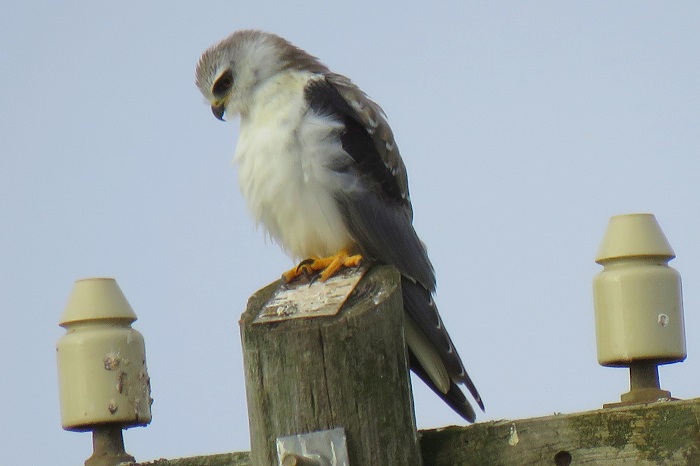
Heidelberg, Western Cape
Photo by Terry Terblanche
Well known. Monogamous, solitary nester; territorial. Mate fidelity difficult to assess, but probably none because of nomadic movements. 1 female may breed with more than 1 male within a season; males apparently selected on basis of territory quality. Displays, accompanied by much calling, consist of aerial circling and ‘butterfly’ flights, with courtship feeding by male. Copulation takes place close to nest, with no obvious preliminary display. Strongly territorial when br; defends territory vocally and aggressively, chasing conspecifics and other, larger raptors. Numbers br in any one locality vary from year to year in areas where there are large fluctuations in prey abundance, but are relatively stable at low densities in marginal habitats.
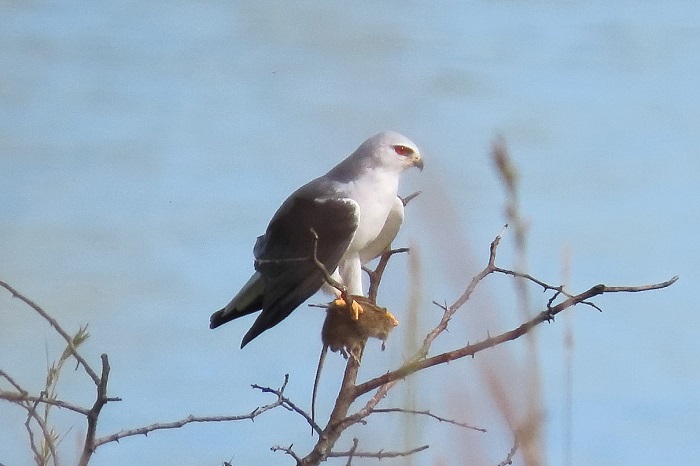
Midmar Nature Reserve, KwaZulu-Natal
Photo by Colin Summersgill
The nest is built by both sexes, sometimes disproportionately more by female. Female may remain on nest while male brings nest material, usually carried in bill. Flimsy, saucer-shaped platform of sticks lined with dry grass and placed as high as possible in tree canopy. Most frequently in thorn trees, but also in alien trees and occasionally on man-made structures including power pylons and utility poles. Old nests are occasionally refurbished, and nest sites are sometimes used repeatedly.
The Black-winged Kite has been recorded to breed throughout the year, but most breeding coincides with the end of the rainy season when rodents are most abundant.
2 to 6 eggs are laid per clutch, and they are laid around 24 hours apart. Elliptical. Buffy, overlaid with dull brown and rusty brown splotches, spots and speckles. Markings very variable, sometimes covering almost entire surface.
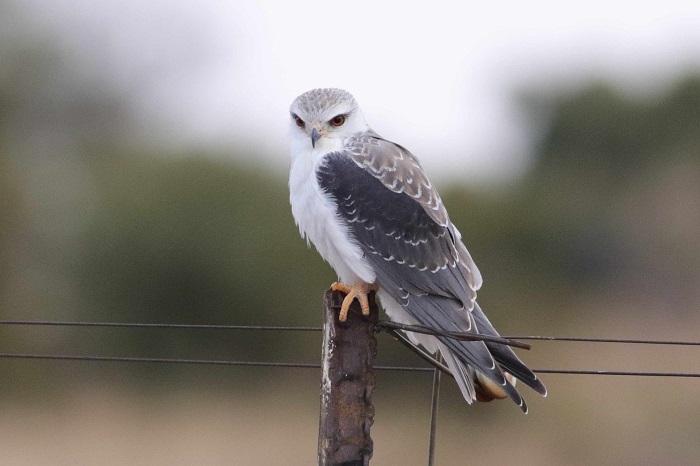
Near Ladybrand, Free State
Photo by Dawie de Swardt
Incubation starts with first-laid egg. Period 30-33 days mainly by female. Male takes short shifts during the day, usually when the female is foraging. Male feeds female on nest, bringing up to 6 items per day.
Newly hatched young covered in pale brownish grey or buff down. By 30 d, perches on branch next to nest, and attempts first flight at around 35 days. Nestlings are brooded by the female, left unattended on nest. All food for nestlings provided by male, who hunts up to 1 500 m from nest; male passes food to female, who then feeds nestlings. Young defecate in nest, and a thick layer of regurgitated pellets also builds up in nest. Female remains within 200 m of nest, forages in vicinity, but seldom feeds young on her own catches. Young stays near nest for around 6 days after first flight, perching in the nest tree and returning to the nest to feed. Thereafter, makes increasingly long flights, but uses a perch near the nest. After this, disperses from nest area, but remains dependent on ads, mostly on male, for up to 82 days. This dependence period is variable and is presumably influenced by prey abundance. Ads may dive at and even strike humans climbing to nests.
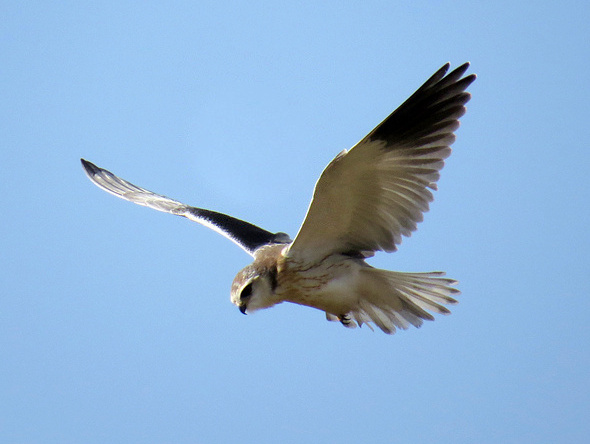
Marievale Bird Sanctuary, Gauteng
Photo by Deon Van der Hoven
Black-winged Kites may breed several times in 1 year and not at all in the following year. Breeding failures are more common during incubation than during the nestling stage. Some mortalities due to nestlings becoming tangled in adjacent thorny branches, or falling prey to Tawny Eagles.
Further Resources
Species text adapted from the first Southern African Bird Atlas Project (SABAP1), 1997.
The use of photographs by Attie van Aarde, Dawie de Swardt, Gerald Wingate, Johan van Rooyen, John Todd, Karis Daniel, Lance Robinson, Philna de Villiers, Ryan Tippett, Salome Willemse, and Zenobia van Dyk is acknowledged.
Other common names: Black-shouldered Kite (Alt. English); Blouvalk (Afrikaans); Umdlampuku, Unongwevana (Xhosa); Élanion blanc (French); Gleitaar (German); Grijze Wouwf (Dutch); Peneireiro-cinzento (Portuguese).
Recommended citation format: Tippett RM. 2026. Black-winged Kite Elanus caeruleus. Biodiversity and Development Institute. Available online at https://thebdi.org/2026/08/01/black-winged-kite-elanus-caeruleus/
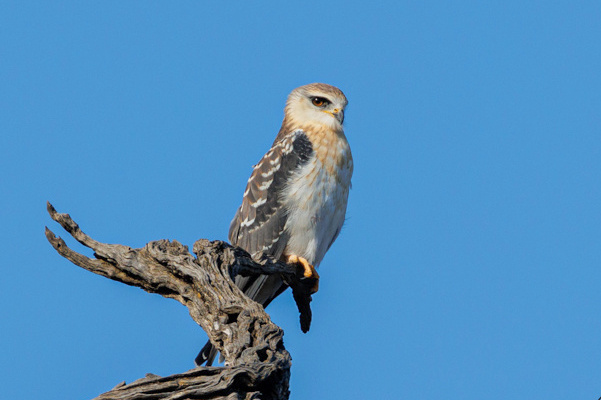
Thabazimbi district, Limpopo
Photo by Roelof van der Breggen
