
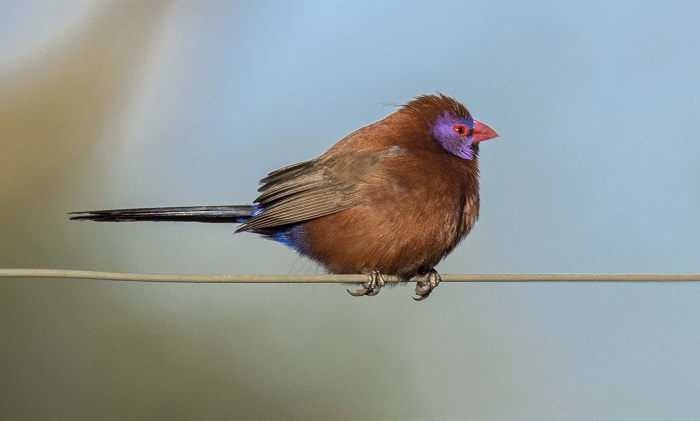
Image of Violet-eared Waxbill by Tony Archer – Near Klerksdorp, North West
Waxbills belong to the Family ESTRILDIDAE. This family also includes the Firefinches, Twinspots, Mannikins, Pytilias, etc. They are small, seed-eating passerines with short conical bills. They are all similar in structure and habits, but vary widely in plumage colours and patterns. Most species are very colourful. They are usually gregarious and often colonial. Their nests are generally a ball of grass with a side entrance and are either placed in a tree or on or close to the ground. The family contains 138 species from 39 genera. They are restricted to the Old World and are found throughout sub-Saharan Africa and Madagascar, as well as southern Asia and Australasia.
Identification
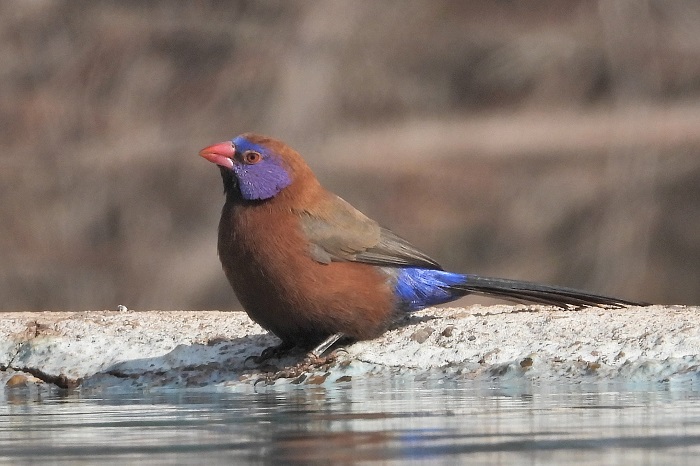
Marico River, Limpopo
Photo by Ansie Dee Reis
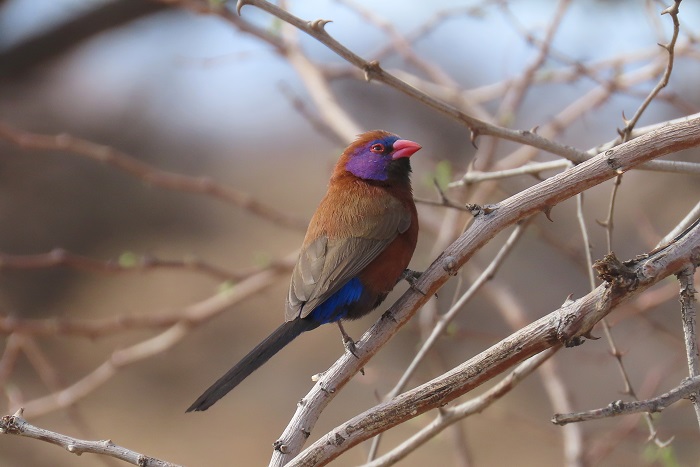
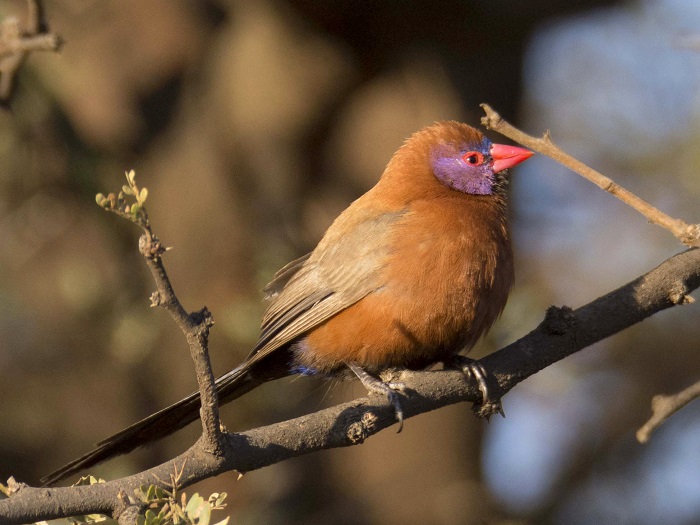
The Violet-eared Waxbill is an unmistakable bird in southern Africa and arguably one of the most beautiful. It is a very colourful seedeater with violet cheeks, a red bill, blue rump and forehead, and rich chestnut body. The sexes are similar, but females are overall paler and duller.
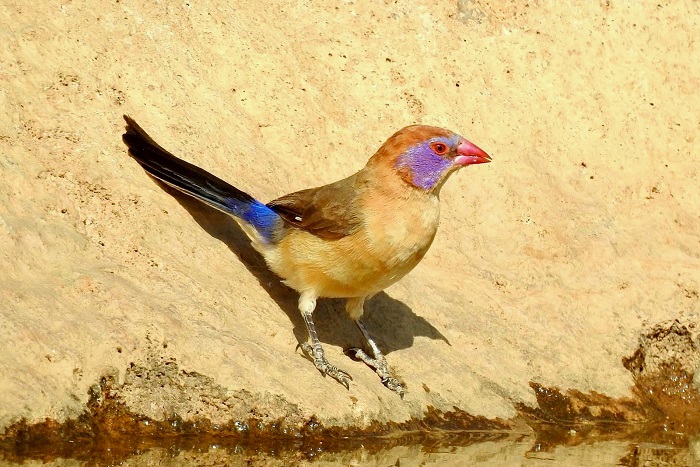
Khomas, Namibia
Photo by Norman Barrett
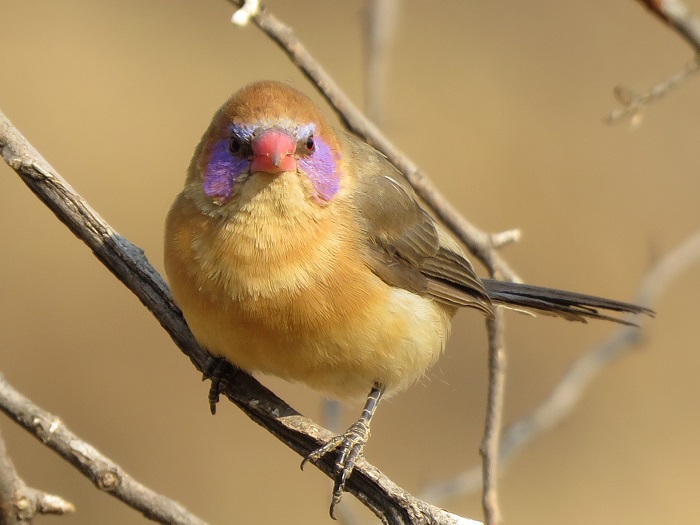
Adult males are overall rich chestnut brown with a paler brown back and folded wings. The cheeks, ear coverts and sides of the face are brilliant violet, and the lores, chin and throat are black. The forehead and rump are deep blue. The tail is black, relatively long and graduated. Bill colouration ranges from pale to bright red, with a purplish sheen. The eyes are reddish or brownish-orange, and the eye ring is bright orange-red. Legs and feet are dark greyish. Adult females are paler straw-brown, with duller blue and violet colouration.
Juveniles are similar to adult females but have black bills and lack bright facial colours.
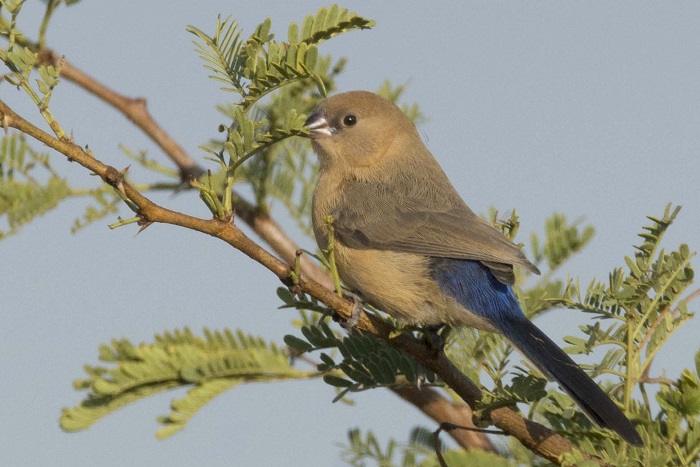
Near Klerksdorp, North West
Photo by Tony Archer
Status and Distribution
The Violet-eared Waxbill is common and near-endemic to southern Africa. It is one of the more arid-tolerant African estrildids, and its distribution is strongly linked to the southern African thornbelt and deep Kalahari sands. Its range encompasses the central Namibian escarpment and northern Namibia east to the Caprivi, Botswana, much of Zimbabwe, the drier parts of southern Mozambique, Limpopo and North West Provinces, the Mpumalanga lowveld, central Free State and the northeastern Northern Cape. Beyond southern Africa, it is found in southern Angola and southern Zambia.
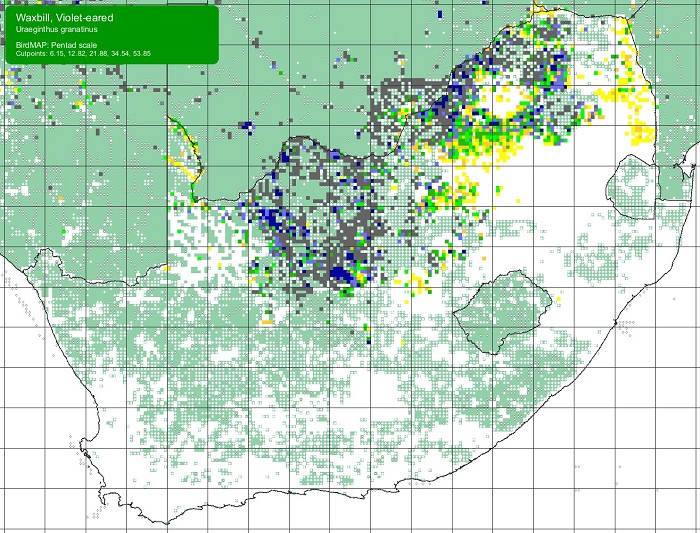
Details for map interpretation can be found here.
The Violet-eared Waxbill is not threatened. However, local populations may be significantly impacted by the cage-bird trade. Fortunately, its often nomadic movement patterns possibly prevent excessive trapping.
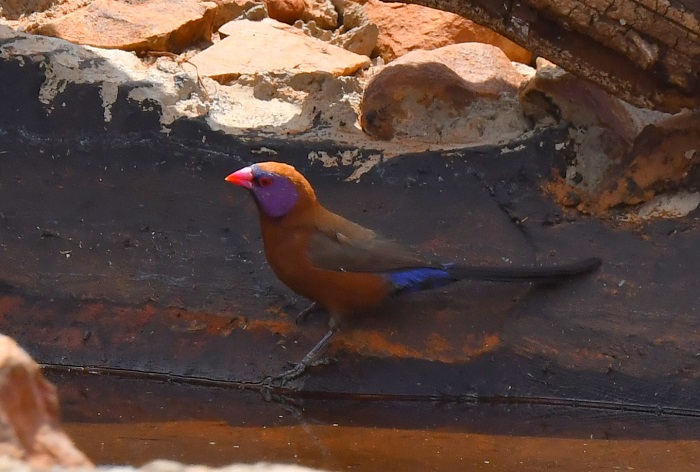
Olienhout Game Reserve, Northern Cape
Photo by Ryan Tippett
Habitat
The Violet-eared Waxbill prefers shrubby areas in open Kalahari and thornveld regions, but extends into open broad-leaved woodland with thickets, particularly on deep Kalahari sands. The Violet-eared Waxbill also inhabits thickets in agriculture-savanna mosaics.
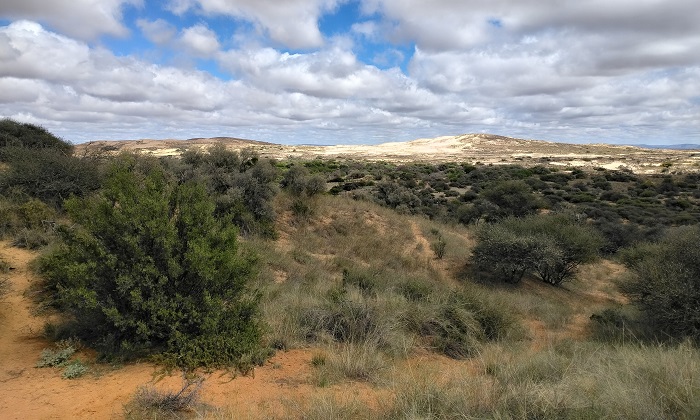
Witsand Nature Reserve, Northern Cape
Photo by Ryan Tippett
Behaviour
The Violet-eared Waxbill is considered to be resident and sedentary, but populations are subject to small-scale nomadic movements, especially in dry years.
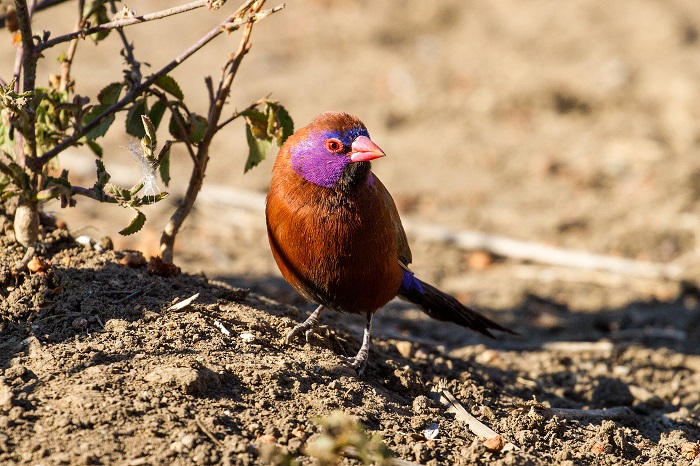
Thabazimbi district, Limpopo
Photo by Roelof van der Breggen
The Violet-eared Waxbill is usually found singly, in pairs, or small family groups. It often associates with the Blue Waxbill (Uraeginthus angolensis) and Black-faced Waxbill (Estrilda erythronotos), especially at water sources. Although it drinks when water is available, the distribution suggests it may be independent of surface water. Drinks mainly in the mid-afternoon in summer and in the morning during winter. The Violet-eared Waxbill drinks least often in summer, as it probably gains enough water from the seeds and insects in its diet.
Spends extended periods in dense foliage where they rest and preen. Violet-eared Waxbills regularly allopreen and are often seen huddled together.
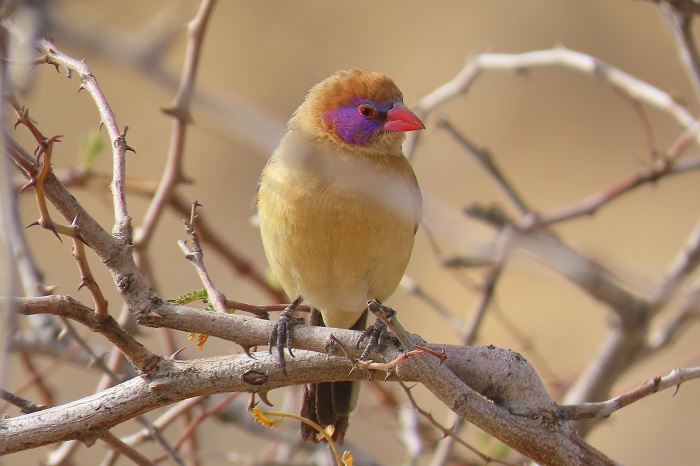
Khomas, Namibia
Photo by Cobus Elstadt
It forages mainly in the morning and late afternoon. The Violet-eared Waxbill generally forages in the shade, especially during the hotter hours of the day. Forages on the ground and on standing grass inflorescences, primarily for seeds, but also takes some insects. Digs seeds from substratum with sweeping movements of the bill. Insects are picked directly, or by breaking open termite workings on trees also gleans prey from leaves. Occasionally, hawks termite alates aerially from the ground.
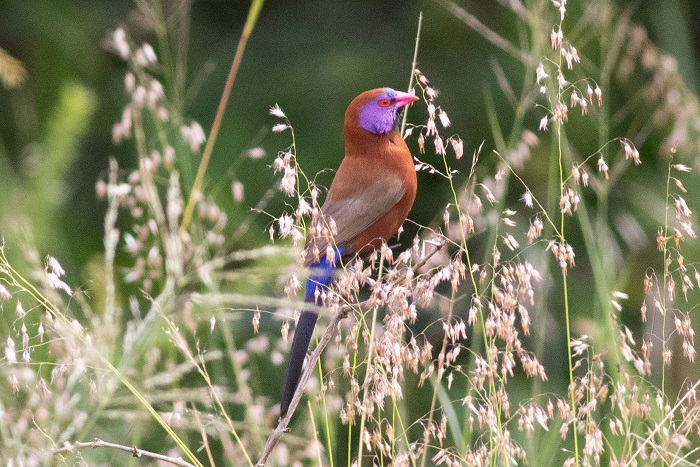
Mabula Game Reserve, Limpopo
Photo by Lance Robinson
The Violet-eared Waxbill eats seeds from a wide variety of grass species. Also eats seeds of forbs and small drupes or berries. In winter, grass seeds dominate the diet, with more insects and occasional berries in summer. Insects consumed include caterpillars, termites, ants, and beetles.
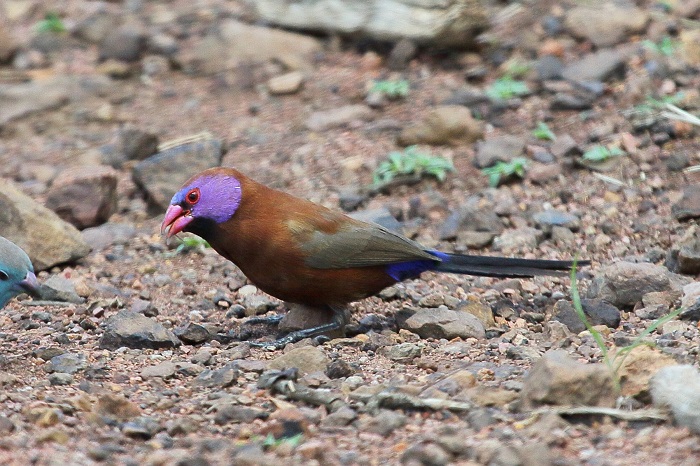
Pilanesberg National Park, North West
Photo by Phillip Nieuwoudt
The Violet-eared Waxbill is monogamous, and pairs maintain lifelong bonds. Pairs nest solitarily and are probably territorial. Pair formation may take place when birds are young and still in immature plumage. The courtship display has not been well documented. The female may collect a grass inflorescence, then perform a ‘Bobbing’ display directed towards the male, while singing or giving contact phrases. Both may angle their tails towards one another with raised crown feathers. A displaying male, may fly close to the female, creating a buzzing sound with his wings.
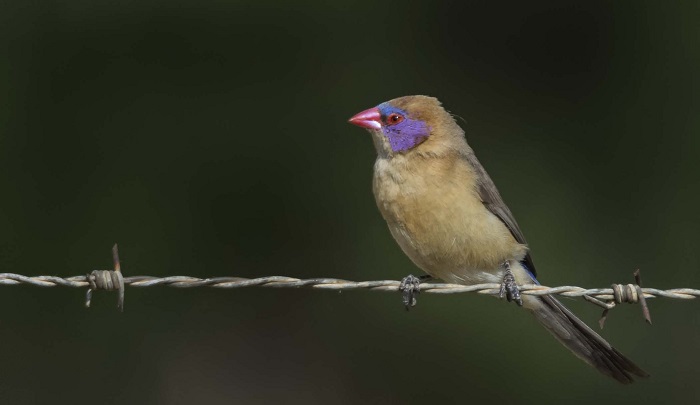
Near Klerksdorp, North West
Photo by Tony Archer
The nest is a thick-walled, oval ball of dry grass with a long vertical axis. It is built by both sexes and is well concealed by foliage. The outer part of the nest mainly comprises dry grass stems, with untidily protruding ends. Finer green grass is used for the inner walls. The entrance is round and usually faces into the vegetation. The nest is lined with feathers, and more are added throughout incubation. The nest is placed up to 3m above the ground in a shrub or tree.
Khomas, Namibia
Photo by Cobus Elstadt
The Violet-eared Waxbill has been recorded breeding in all months except September. Breeding peaks from December to May. Breeding usually takes place after summer rains, when grass inflorescences are available for feeding and nest building. Late breeding is due to delayed summer rains. 2 to 7 white eggs are laid per clutch. Incubation lasts up to 13 days and is done by both sexes. Shifts are shared equally, and the incubating bird leaves the nest immediately once its mate arrives. Newly hatched young are altricial and are brooded and fed by both parents. The nestling period lasts for 16 to 18 days.
Broods of the Violet-eared Waxbill are sometimes parasitised by the Shaft-tailed Whydah (Vidua regia). Around 33% of nests are parasitised with 1 to 5 whydah eggs per nest.
Klerksdorp district, North West
Photo by Tony Archer
Further Resources
This species text is adapted from the first Southern African Bird Atlas Project (SABAP1), 1997.
The use of photographs by Ansie Dee Reis, Anthony Paton, Cobus Elstadt, Gerald Gaigher, Lance Robinson, Norman Barrett, Phillip Nieuwoudt, Roelof van der Breggen, Ryan Tippett, and Tony Archer is acknowledged.
Other names: Koningblousysie (Afrikaans); Cordonbleu grenadin (French); Granaatastrild Common (Dutch); Granatastrild, Blaubäckchen (German); Monsenhor (Portuguese).
Recommended citation format: Tippett RM. 2026. Violet-eared Waxbill Granatina granatina. Biodiversity and Development Institute. Available online at https://thebdi.org/2026/09/23/violet-eared-waxbill-granatina-granatina/
List of bird species in this format is available here.
Near Rustenburg, North West
Photo by Gerald Gaigher
