
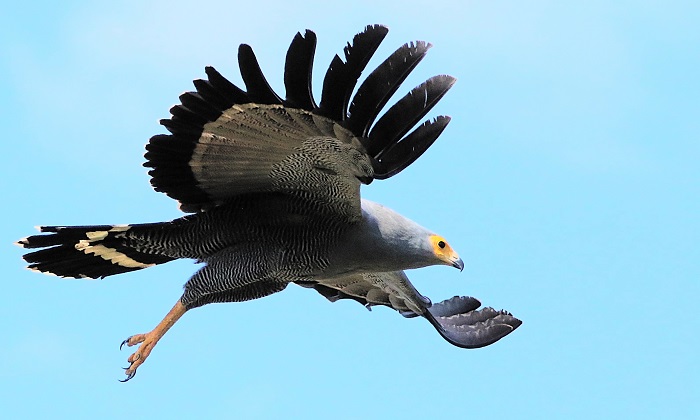
Cover image: African Harrier-Hawk by Lia Steen – Shelly Beach, KwaZulu-Natal
The African Harrier-Hawk belongs to the family ACCIPITRIDAE (Hawks, Eagles, Vultures, and Kites). The Accipitridae is a family of small to very large birds of prey (Raptors) with strongly hooked bills and variable morphology based on diet. They feed on a range of prey items from insects to medium-sized mammals, with some feeding on carrion and others consuming fruit. The Accipitridae have a global distribution across all the world’s continents (except Antarctica) and many oceanic island groups. Some species are migratory. The family contains 250 species from 74 genera.
Identification
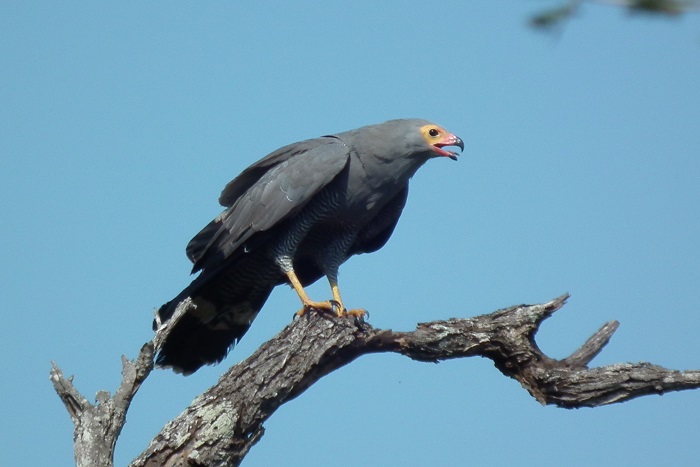
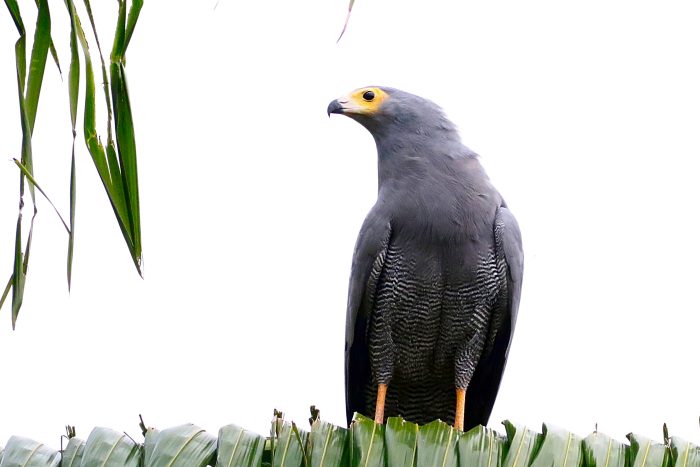
The African Harrier-Hawk is the largest grey hawk in the region. It has a small head with a yellow face and long thin yellow legs.
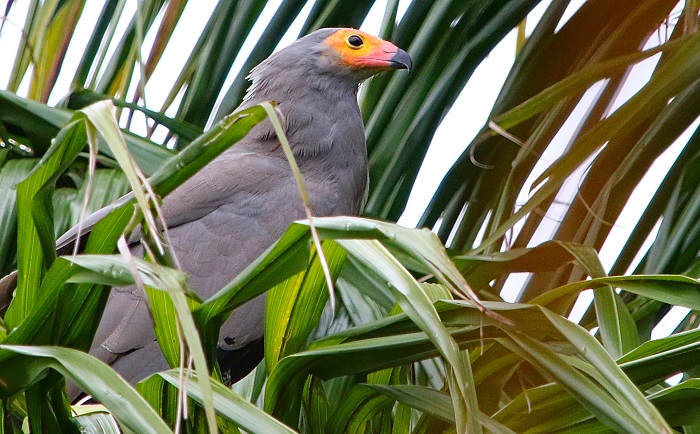
Shelly Beach, KwaZulu-Natal
Photo by Lia Steen
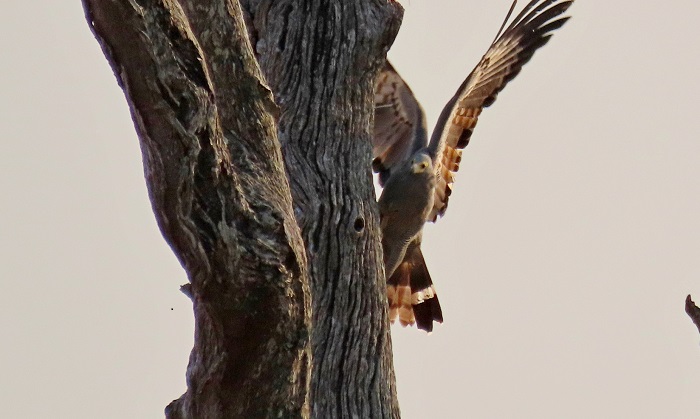
In adults, the combination of a small head, broad wings, and a long tail with a broad white central band is unlike that of any other hawk. The sexes are alike. The bare facial skin is yellow, but can flush red, pink, or greyish yellow depending on mood, especially during the breeding season. The crown can be raised into a crest, and the neck feathers are elongated and can be raised to form a ruff. The upper parts, including the upper wing coverts, are mostly bluish-grey, and the scapulars have sub-apical black spots. The rump and upper tail coverts are barred in black and white. The tail is black, tipped white, with a broad white band across the middle. The throat and upper breast are grey. The rest of the underparts are finely barred dark-grey and white. Females are often more boldly barred below. The bill is black, but the base of the lower mandible and the cere are whitish. The legs and feet are yellow and covered in rough scales. The eyes are dark brownish-black.
In flight, the underwing pattern is distinctive, showing finely barred black and white underwing coverts and broad black margins to the flight feathers.
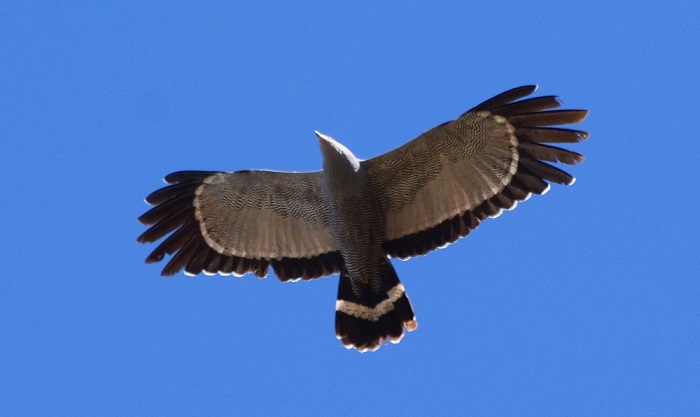
Carnarvon district, Northern Cape
Photo by Ryan Tippett
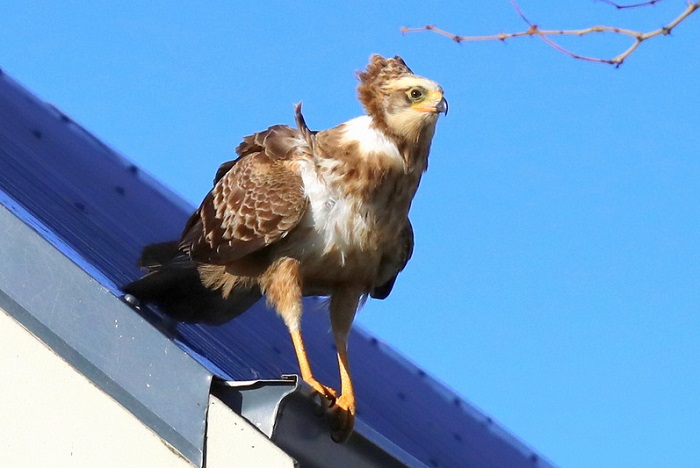
Juvenile plumage colouration varies widely, from fairly plain to dappled or scruffy. The rate of development from juvenile to adult plumage also varies considerably, with increasing amounts of grey in the feathers. The upper parts are various shades of brown and white. The underparts are brown, suffused with buff-brown and white patches. The tail is dark brown, but paler near the base, and broadly barred blackish-brown.
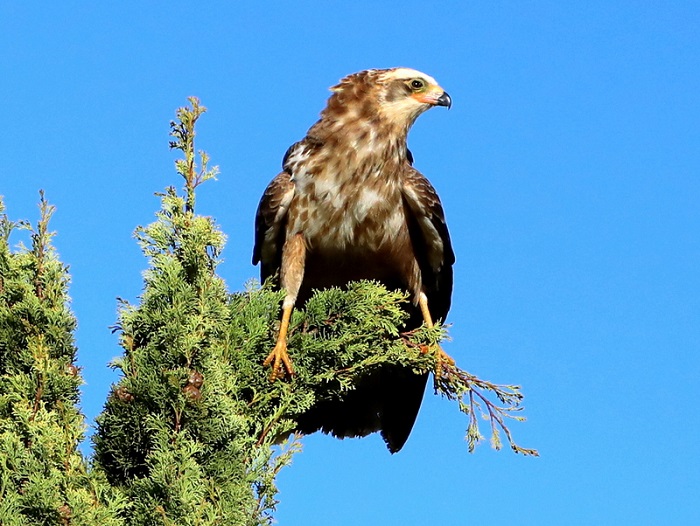
Somerset West, Western Cape
Photo by Corrie du Toit
Adult African Harrier-Hawks are readily identifiable, but perched birds superficially resemble the Pale Chanting Goshawk (Melierax canorus) and Dark Chanting Goshawk (Melierax metabates). The two goshawks lack bare facial skin and the white central tail band.
Status and Distribution
The African Harrier-Hawk is found throughout much of Sub-Saharan Africa, except for the most arid regions. It is widespread in southern Africa, but largely absent from the drier west, including southern Namibia, the central Kalahari, and much of the Karoo. It is strangely absent from the eastern highlands of Zimbabwe and adjacent Mozambique.
The African Harrier-Hawk is fairly common in southern Africa.
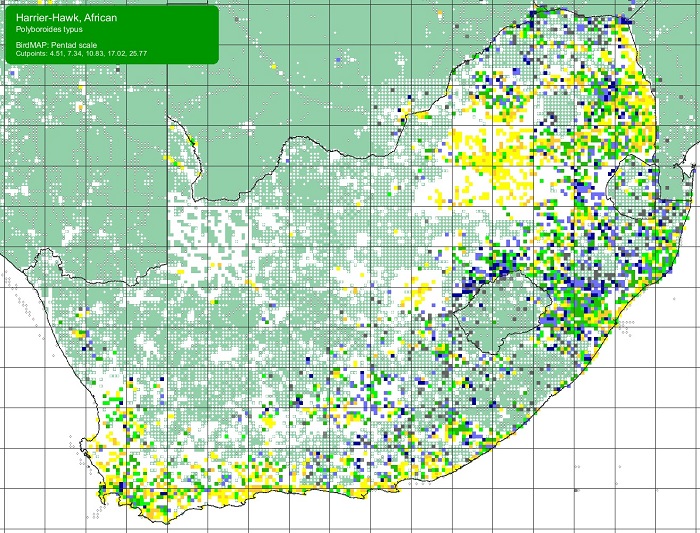
The African Harrier-Hawk is not threatened and it is well-represented in protected areas.
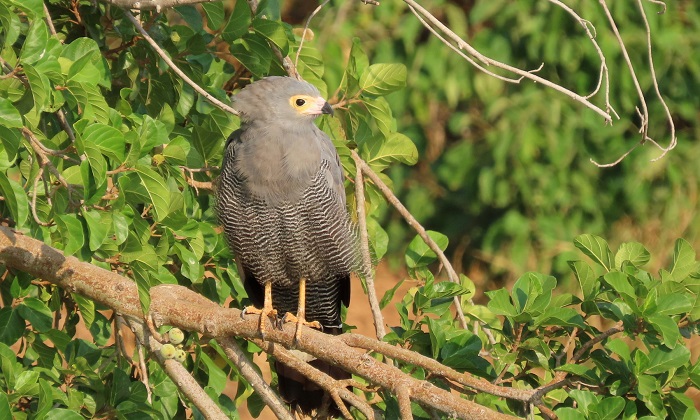
Kruger National Park, Linpopo
Photo by Johan van Rooyen
Habitat
The African Harrier-Hawk inhabits a variety of closed and open woodlands. It also occupies forest edges and canopies but avoids the forest interior. It also frequents Eucalyptus plantations and tall trees in parks and gardens. For hunting, it favours wooded cliffs, ravines and similar rocky habitats with trees, as well as tall trees along drainage lines and those fringing lakes and dams.
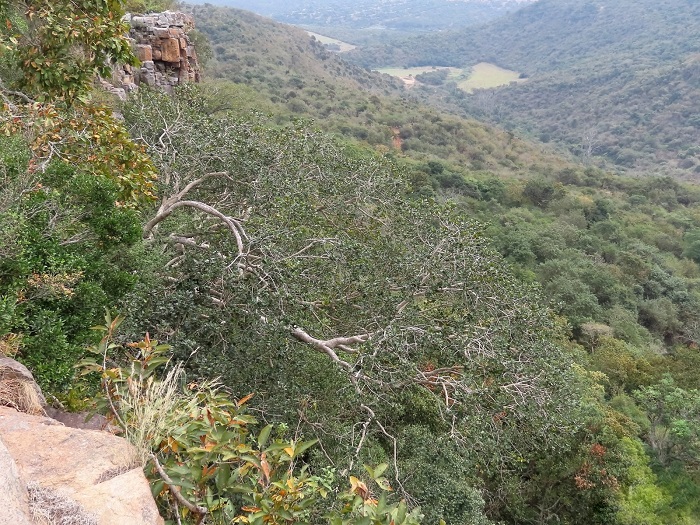
Wartberg district, KwaZulu-Natal
Photo by Colin Summersgill
Behaviour
The African Harrier-Hawk is resident and sedentary in moister regions, but populations may be nomadic in drier habitats such as the southern parts of the Nama Karoo.
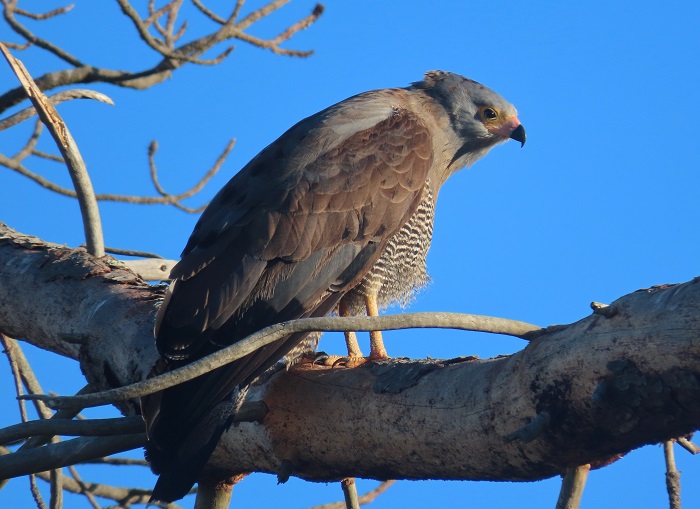
Near Humansdorp, Eastern Cape
Photo by Cobus Elstadt
The African Harrier-Hawk is usually solitary, but is occasionally seen in pairs or family groups. Frequently mobs other raptors and owls. Occasionally seen sunbathing by lying on the ground with wings partially open. The African Harrier-Hawk also drinks and bathes regularly. The flapping flight is characteristically slow, leisurely, and buoyant, with deep wing beats.
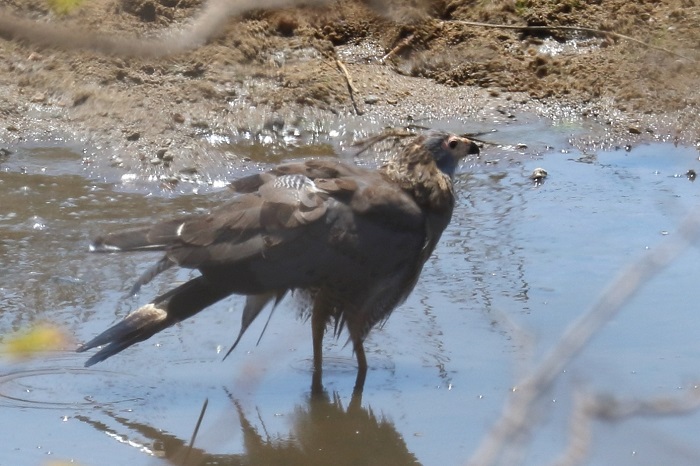
Kruger National Park, Mpumalanga
Photo by Alan Manson
The African Harrier-Hawk is a versatile hunter, but specialises in raiding the nests of small birds and other prey items it finds in holes, cracks, and crevices. It has special morphological adaptations that enable it to do this. These include a noticeably small head and a laterally compressed bill, as well as highly flexible intertarsal joints, which allow the legs to bend in different directions. They can also climb or clamber using their wings and feet. With these adaptations, the African Harrier-Hawk can inspect holes and crevices and extricate prey from awkward positions.
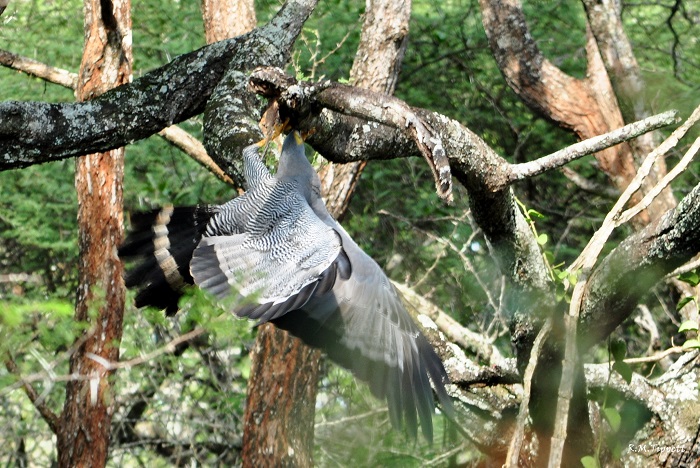
Ndumo Game Reserve, KwaZulu-Natal
Photo by Ryan Tippett
It uses a variety of hunting methods, including low soaring, high soaring, perch hunting and canopy and ground foraging. Low soaring is the most commonly used method. The harrier-hawk flies close to the canopy, aiming to get mobbed by small passerine birds. The African harrier-hawk assesses the level of aggression shown towards it to indicate the presence of nest sites. They have been observed to turn around when the mobbing becomes less aggressive. Once it has found the area where the mobbing birds are most aggressive, it will begin searching for the nest location. Hunting while soaring higher up and perch hunting are mostly used in open areas to find ground-dwelling prey like lizards and arthropods. On the ground, they walk about, looking for the eggs of ground-nesting birds, turning over cowpats and inspecting holes or fallen logs. The African Harrier-Hawk is best known for clambering through tree canopies, up tree trunks and on cliffs or rock faces, hopping from branch to branch or along ledges while searching for prey. It often climbs under overhanging branches or clings to holes on tree trunks, using its flexible legs to reach into cavities while the wings provide stability and balance.
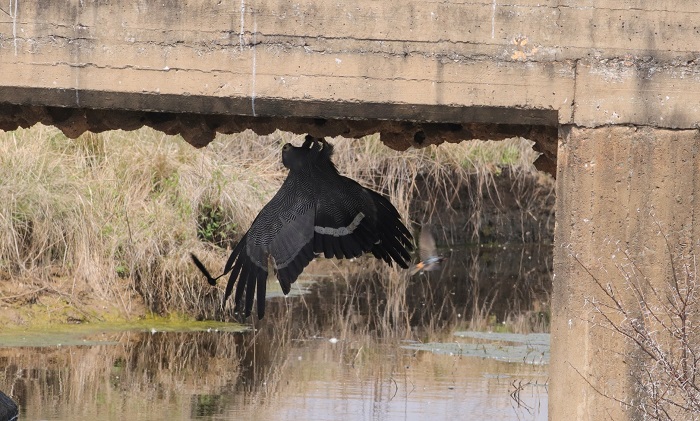
Near Bloemfontein, Free State
Photo by Dawie de Swardt
A hunting bird may pause and listen for the begging calls of nestlings. Searches Hamerkop nests, the skirts of palms and tree aloes, the roofs of houses, and telephone poles in a similar manner. Nests on the ends of thin branches are raided with ease, the bird flapping to keep its balance while reaching into the nest with one foot to extract nestlings. Weaver colonies, heronries, or groups of swallow nests may be visited regularly as they are rich sources of food.
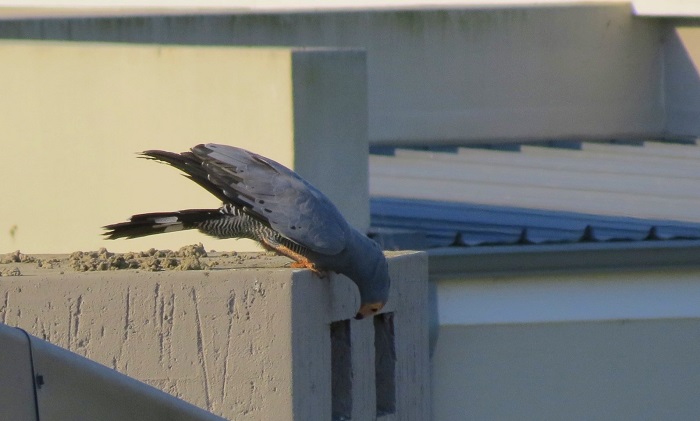
George, Western Cape
Photo by Andre Kok
The African Harrier-Hawk feeds on a wide variety of small animals. They have a particular fondness for the eggs and chicks of many other bird species. Adult birds are seldom taken. Reptiles, especially lizards, mammals up to the size of squirrels, bats, frogs, and insects are also consumed. They occasionally eat carrion, roadkill, and stranded fish.
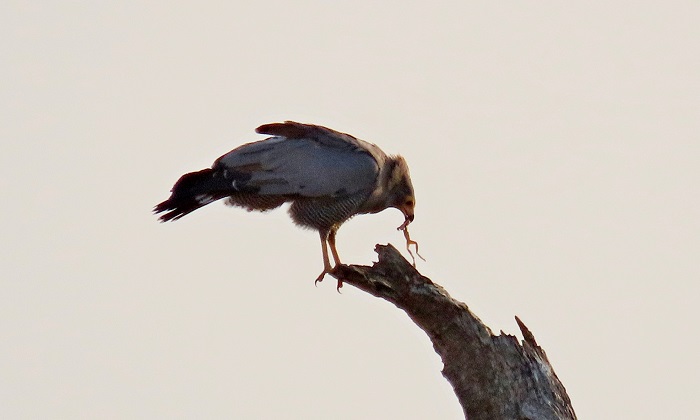
Kruger National Park, Mpumalanga
Photo by Johan van Rooyen
The African Harrier-Hawk breeds from August to December. Most of its breeding activity has been recorded in eastern areas. The reason for the general lack of breeding records from the northwestern regions of southern Africa is not known; either breeding sites are overlooked, or the species may be primarily a non-breeding visitor from the east.
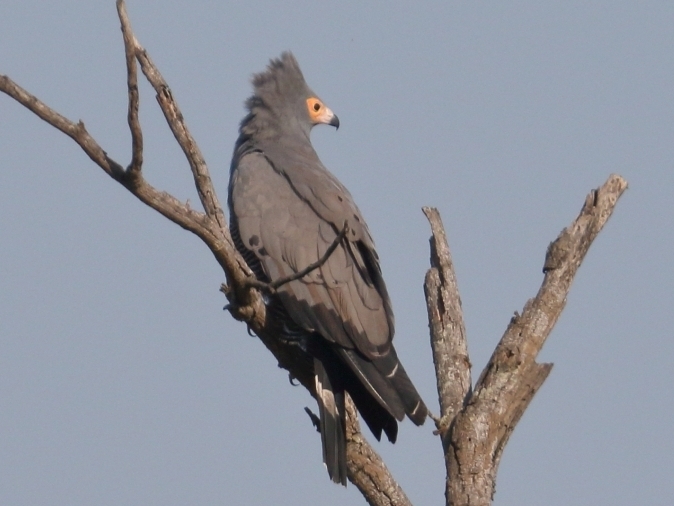
Kruger National Park, Mpumalanga
Photo by Alan Manson
They are usually monogamous. Pairs are highly territorial and maintain their territories year-round. At the onset of the breeding season, one or both members of a pair display by soaring high in the air. Sometimes with exaggerated wing flapping. Occasionally, the male stalls, falls backwards and drops into a dive towards the soaring female, who turns onto her back and extends her legs so they briefly touch talons. The male also courtship-feeds the female, and copulation occurs before or after courtship feeding. At the nest, the male may present the female with a leafy twig after copulation. The faces of both flush red and remain flushed throughout the mating sequence. Copulation continues throughout incubation and into the early nestling period and is thought to be important in reinforcing the pair bond.
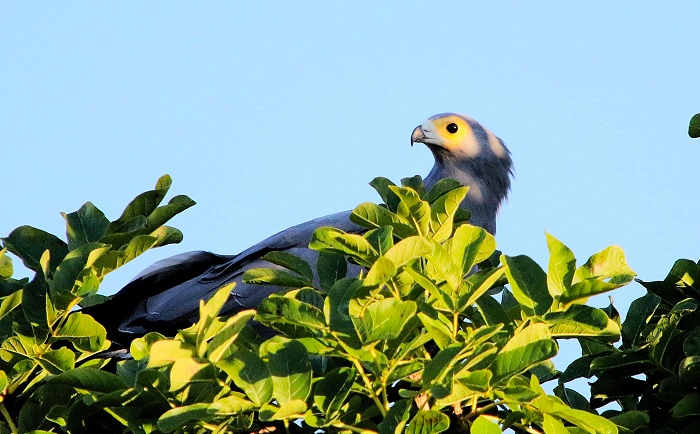
Shelly Beach, KwaZulu-Natal
Photo by Lia Steen
The nest is a platform of sticks with a shallow bowl in the centre and thickly lined with green leaves. The nest is placed in the main fork or upper canopy of a tree. Nests are less often built on cliffs. The same nest may be used for several years, and the pair may add additional material over the years. The African Harrier-Hawk has also been recorded to use the nests of other raptor species.
Kruger National Park, Mpumalanga
Photo by Corrie du Toit
1 to 3 eggs are laid per clutch at 3-day intervals. Incubation begins with the first egg laid and lasts up to 36 days. Both sexes share incubation duties, although the bulk is done by the female. The male mostly incubates for short periods when the female goes off to hunt. The male brings food to the incubating female, especially in the early stages of incubation. Apon the male’s approach, the female calls from a begging posture, and the male often presents the female with a leafy twig at changeover. The newly hatched young are altricial. Chicks are constantly attended by the female and fed by the male. Unusually for a raptor, chicks do not defecate outside the nest. In two-chick broods, the older chick may sometimes kill its younger sibling. Fledglings leave the nest area at around 50 days of age. They remain partially dependent on the parents for at least another 10 days or so.
Kruger National Park, Limpopo
Photo by Johan van Rooyen
Further Resources
Species text from the First Southern African Bird Atlas Project (SABAP1), 1997.
The use of photographs by Alan Manson, Andre Kok, Cobus Elstadt, Colin Summersgill, Corrie du Toit, Dawie de Swardt, Johan van Rooyen, Lia Steen, and Ryan Tippett is acknowledged.
Virtual Museum (BirdPix > Search VM > By Scientific or Common Name).
Other common names: Gymnogene (Alt. English), Kaalwangvalk (Afrikaans); Kleine Kaalkopkiekendief (Dutch); Serpentaire gymnogène, Gymnogène d’Afrique (French); Schlangensperber, Höhlenweihe (German); Secretário-pequeno (Portuguese).
List of species available in this format.
Recommended citation format: Tippett RM 2026. African Harrier-Hawk Polyboroides typus. Biodiversity and Development Institute. Available online at https://thebdi.org/2026/09/13/african-harrier-hawk-polyboroides-typus/
Shelly Beach, KwaZulu-Natal
Photo by Lia Steen
