
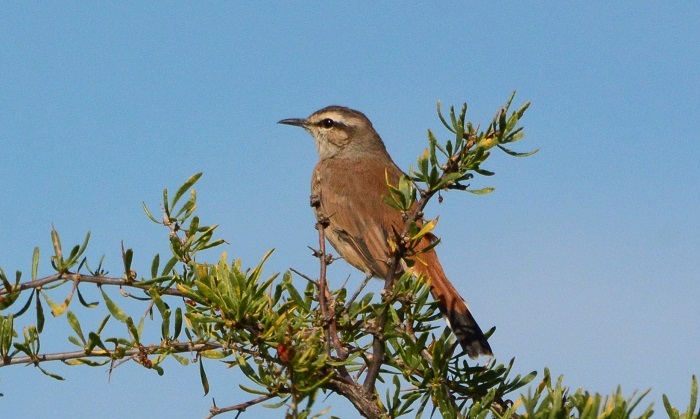
Cover image of Kalahari Scrub Robin by Ryan Tippett – Carnarvon district, Northern Cape
The Kalahari Scrub Robin belongs to the family MUSCICAPIDAE. This group of songbirds in the order Passeriformes is commonly known as the ‘Old World Flycatchers and Chats’. Members of the group share a number of anatomical features, including the presence of a well-developed 10th primary feather in the wing and adaptations for insect eating. The family comprises around 353 species from 57 genera. Southern African representatives include Flycatchers, Chats, Rock Thrushes, and Wheatears.
Identification
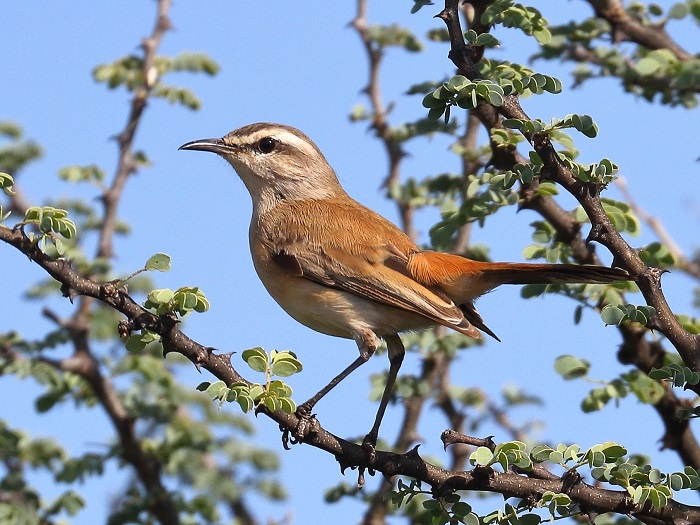
Mokala National Park, Northern Cape
Photo by Alan Manson
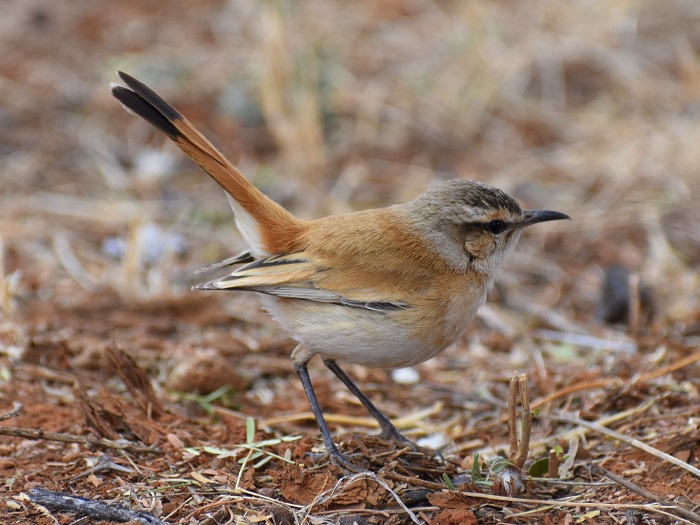
The adult Kalahari Scrub Robin is an overall sandy colour with an orange rump and a white eyebrow. The sexes are alike, although males are slightly larger than females. The head and neck are greyish brown. The conspicuous supercilium is white and broad. A black loral stripe is present below the supercilium and extends through the eye. The ear coverts are sandy brown. The mantle, back and rump are dull russet with a greyish wash. The upper tail coverts are rufous-orange, and the tail is chestnut-orange. The tail, often held erect, has a broad, black sub-terminal bar and white tips. The chin and throat are whitish to pale grey, and the rest of the underparts are pale buff, washed grey. The bill, legs, and feet are black, and the eyes are brown.
Juveniles and immatures resemble the adults, but they have blackish edges to the feathers on the crown, mantle and breast, giving a scaly appearance.
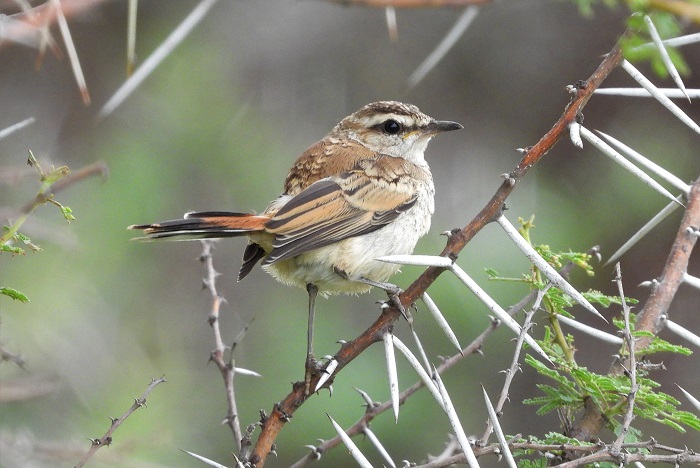
Near Makapanstad, Limpopo
Photo by Ansie Dee Reis
The Kalahari Scrub Robin most resembles the White-browed Scrub Robin (Cercotrichas leucophrys), but the latter has a double white wing bar and streaked underparts. The Karoo Scrub Robin (Cercotrichas coryphoes) is much darker overall and has a dark brownish-grey (not russet) tail and upper tail coverts.
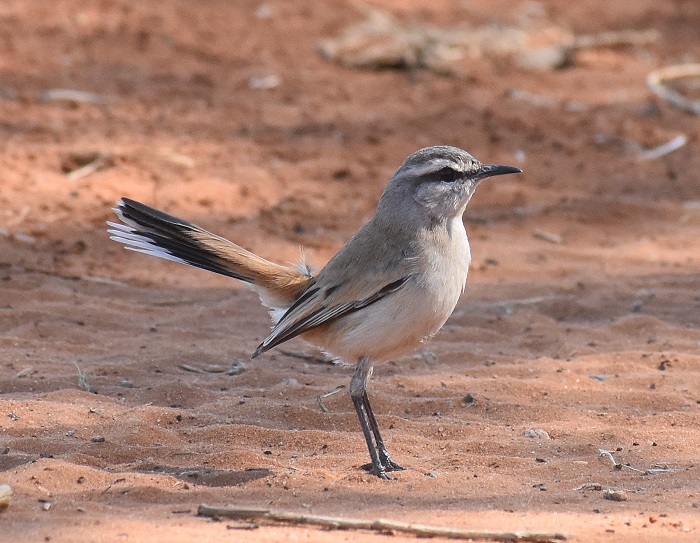
Barkly West, Northern Cape
Photo by Karis Daniel
Status and Distribution
The Kalahari Scrub Robin is fairly common across its range.
The Kalahari Scrub Robin is near-endemic to southern Africa, reaching beyond the sub-region into south-western Angola. In southern Africa, the Kalahari Scrub Robin occurs throughout Namibia (apart from the coastal desert), through Botswana to western Zimbabwe and southwards into western Limpopo Province, North West Province, north-western Free State and most of the Northern Cape.
Not threatened.
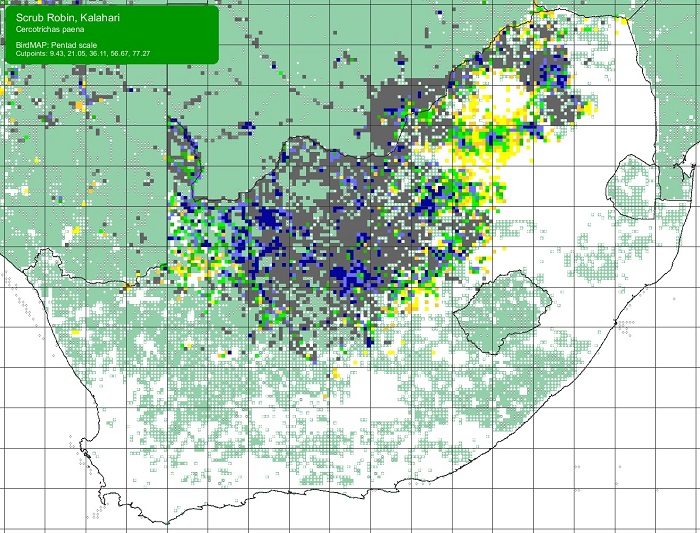
Details for map interpretation can be found here.
Habitat
The Kalahari Scrub Robin inhabits dry, sandy, open savanna with scattered low trees and bushes. Also Black Thorn Vachellia mellifera bushes fringing dry depressions and in scrub and wooded savanna. Patches of bare or almost bare ground are an important habitat requirement, as is the availability of scattered elevated perches. The Kalahari Scrub Robin is regular around animal watering points and cattle dips, where extensive areas of grazed and trampled ground, as well as dung-associated arthropods, provide good foraging opportunities. It also often enters the yards and gardens of rural homesteads.
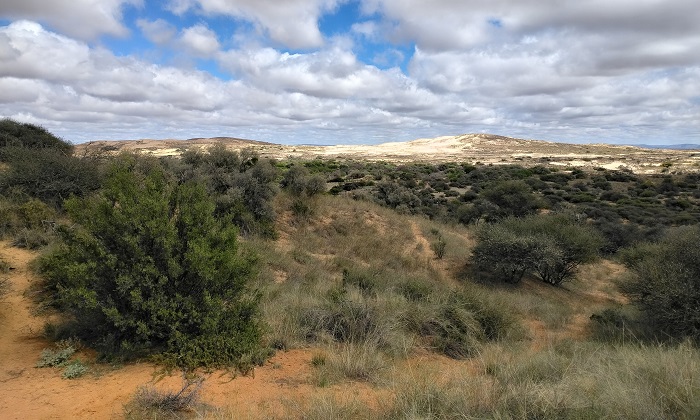
Witsand Nature Reserve, Northern Cape
Photo by Ryan Tippett
Behaviour
The Kalahari Scrub Robin is usually resident but may undertake local seasonal movements during dry periods or when heavy rains lead to dense grass growth.
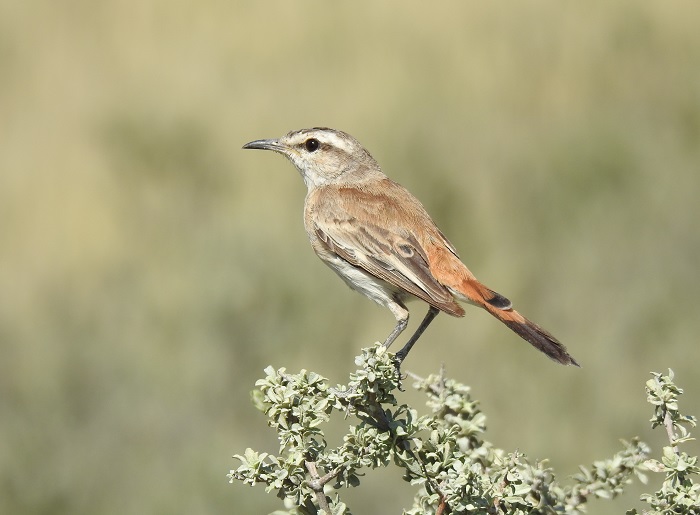
Kgalagadi Transfrontier Park, Northern Cape
Photo by Richard Johnstone
The Kalahari Scrub Robin is found singly or in pairs. It spends much of its time on the ground, where it typically runs and occasionally hops. On landing, it flicks its wings a few times, and raises the tail vertically. When anxious, the tail is often brought forward over the back, almost touching the head. At the same time, the wings may be drooped until the tips almost touch the ground. During the cooler winter months, the Kalahari Scrub Robin sunbathes in the early morning at the top of a bush or tree.
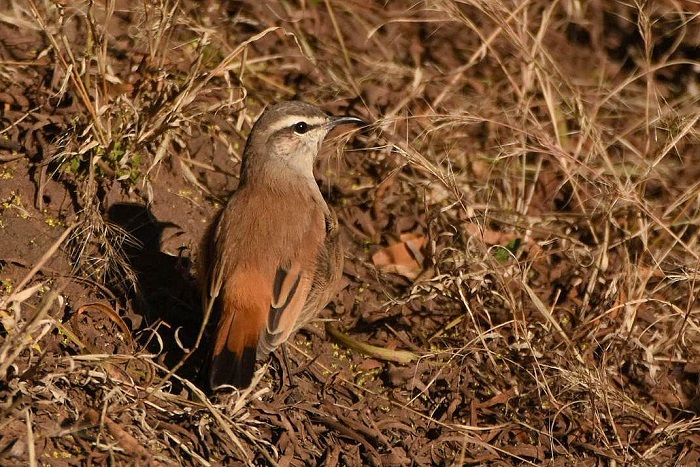
Bloemfontein, Free State
Photo by Rick Nuttall
The Kalahari Scrub Robin forages on the ground, often up to 40 m from the nearest cover. It flicks through leaf and twig debris under shrubs and fallen thorny branches while searching for food. It is an insectivore, with arthropods making up the vast majority of its diet. Harvester termites and ants are an important component of the diet. Other arthropods, including beetles, butterflies, moths, caterpillars, plant bugs, grasshoppers, mantids, and spiders, are also consumed, as are small quantities of drupes or berries.
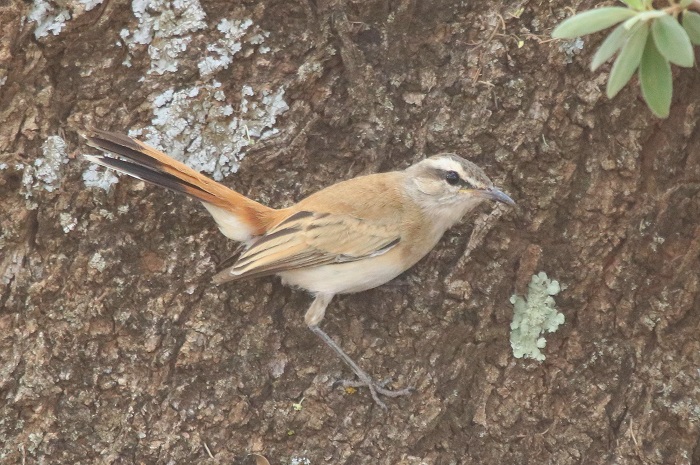
Mokala National Park, Northern Cape
Photo by Sybrand Venter
Monogamous, solitary nester, territorial. Breeding territory advertised by singing male; disputes between rival males involve much singing and posturing with puffed-out breast feathers and vertically cocked tails. Disputes can develop into fights, combatants buffeting each other in shrubs and in vertical flights up to ca 4 m high, before falling to ground. In courtship, male bows and flaps partially extended wings while alternately raising and depressing fully fanned tail.
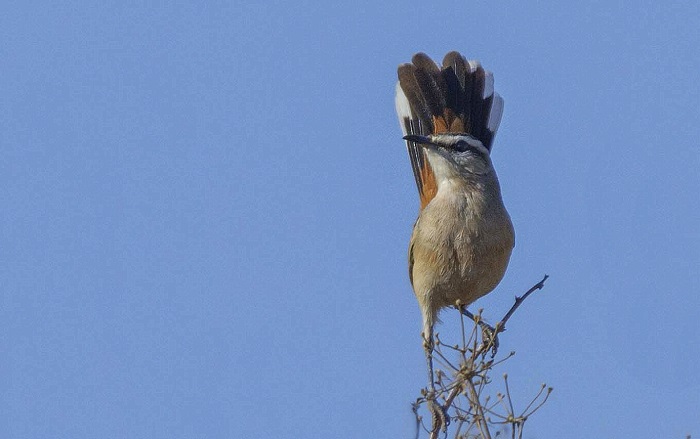
Klerksdorp, North West
Photo by Tony Archer
The nest is an open, often untidy structure of dry grass and leaves and (sometimes) fine twigs; compact cup lined with fine tendrils, rootlets and occasionally animal hair. From ground up to ca 1.5 m above ground; usually in thorny shrub and partially concealed by climbing grass, but many nests not well concealed. Around homesteads, may be placed in artefact such as empty tin. In moister eastern parts of range, Jul-Jan, peak Oct. In drier regions, may breed opportunistically after rainfall at any time of year, although regular seasonal br likely in summer.
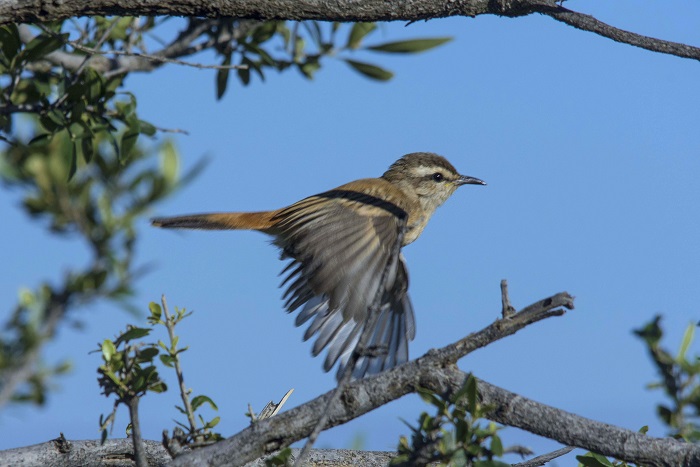
Near Potchefstroom, North West
Photo by Tony Archer
2 to 4 eggs are laid per clutch, laid at daily intervals. Oval to elliptically oval. Usually white to off-white (rarely pale greenish white), speckled and spotted with yellowish brown and russet, with smears of greyish purple; markings usually concentrated over obtuse half, often coalesced into ring or cap. Incubation starts at clutch completion. Period 13 days female only. Newly hatched young are altricial and are naked with no down feathers. Dorsal skin dark greyish black, underparts pale flesh colour; gape yellowish orange. Nestling period 14 d. No distraction displays described. Infrequent host of Diderick Cuckoo.
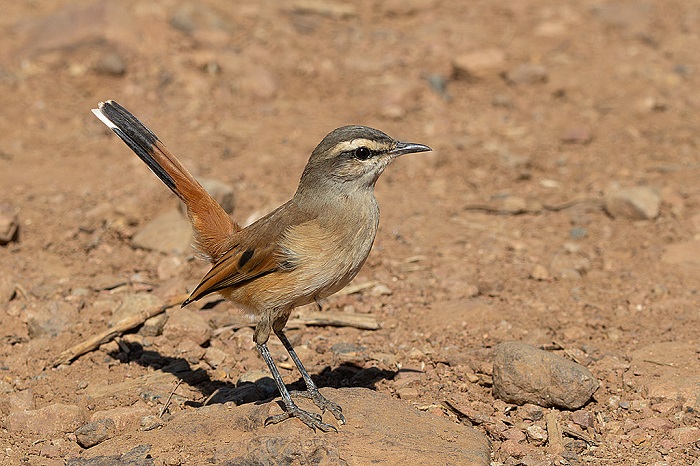
Pilanesberg National Park, North West
Photo by Gregg Darling
Further Resources
This species text is adapted from the first Southern African Bird Atlas Project (SABAP1), 1997.
The use of photographs by Alan Manson, Ansie Dee Reis, Gregg Darling, Karis Daniel, Richard Johnstone, Rick Nuttall, Ryan Tippett, Sybrand Venter, and Tony Archer is acknowledged.
Other common names: Kalahari Robin (Alt. English); Kalahariwipstert (Afrikaans); Phênê (Tswana); Agrobate du Kalahari (French); Kalahari-waaierstaart (Dutch); Kalahariheckensänger (German); Rouxinol-do-mato do Kalahari (Portuguese).
Recommended citation format: Tippett RM 2026. Kalahari Scrub Robin Cercotrichas galactotes. Biodiversity and Development Institute. Available online at https://thebdi.org/2026/09/20/kalahari-scrub-robin-cercotrichas-galactotes/
A list of bird species in this format is available here.
Mokala National Park, Northern Cape
Photo by Karis Daniel
