
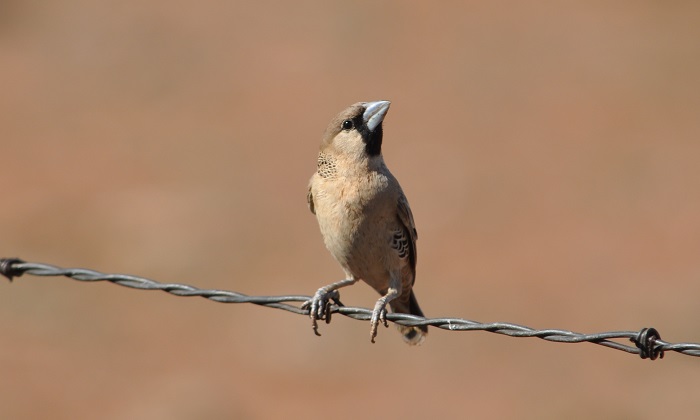
Cover image of Sociable Weaver by Ryan Tippett – Near Kenhardt, Northern Cape
The Sociable Weaver is a member of the Family PLOCEIDAE (Weavers and Allies). Other members of Ploceidae include the Weavers, Bishops, Widowbirds, & Malimbes. Birds in this family are small passerines. These birds have short to medium, conical, pointed bills, adapted for seed-eating. They also have relatively strong legs and feet. Most are gregarious and are known for their intricately woven nests. They are distributed throughout sub-Saharan Africa, Madagascar, the southern edge of the arabian peninsula, and into tropical Asia. The family Ploceidae contains 123 species from 16 genera. Most species are found in Africa.
Identification
The Sociable Weaver is a conspicuous and characteristic bird of arid regions.
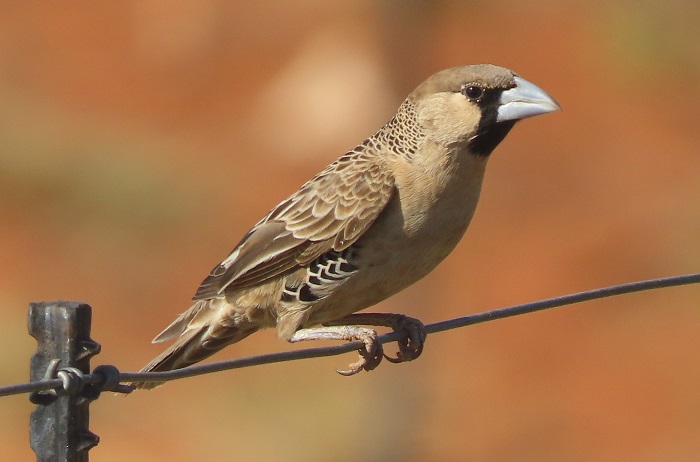
Hopetown district, Northern Cape
Photo by Les Underhill
In adults, the body is mostly dull brown, save for black scalloping on the mantle, back and flanks. The forehead and crown are a slightly darker brown, and the cheeks and sides of the neck are plain buff. The folded wings are dull brown with variable buff edging on the feathers. The lores, the feathers around the base of the bill and the throat patch are black. The bill is dark horn-grey. The eyes are brown and the legs and feet are dark grey.
Sexes differ slightly in plumage colouration. Females closely resemble males but have a smaller black throat patch.
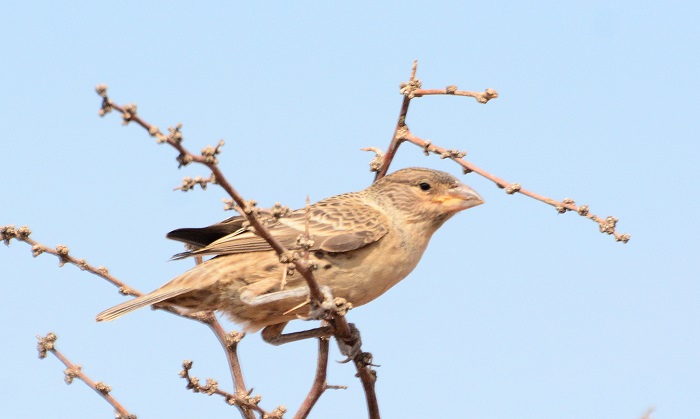
Carnarvon district, Northern Cape
Photo by Ryan Tippett
Juveniles are similar to adult females, but lack the black feathers around the bill and on the throat. They also carry duller scalloping on the flanks.
The Sociable Weaver is not likely to be confused with any other bird species in southern Africa.
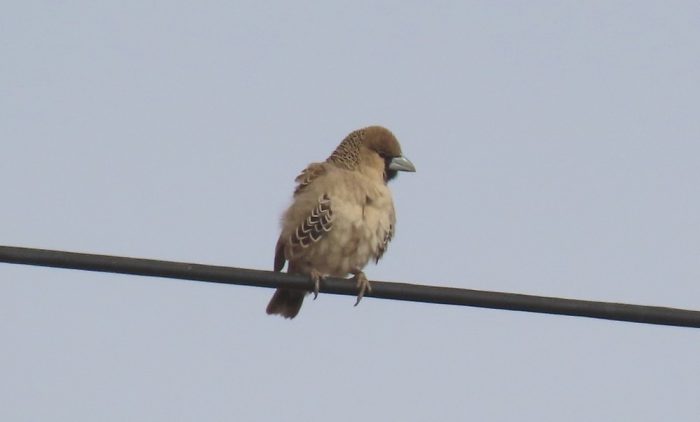
Near Marydale, Northern Cape
Photo by Cobus Elstadt
Status and Distribution
Sociable Weavers are endemic to southern Africa where they are locally common. Their range is centred on the Northern Cape Province and southern Namibia where they are much more abundant than elsewhere.
They range from the Etosha area of northern Namibia south through southwestern Botswana, to the northeastern parts of the Northern Cape, central North West Province and the extreme northern Free State. Sociable Weavers are absent from most of the Namib Desert, the area immediately south of Etosha in Namibia, and from the Ghaap plateau in the Northern Cape.
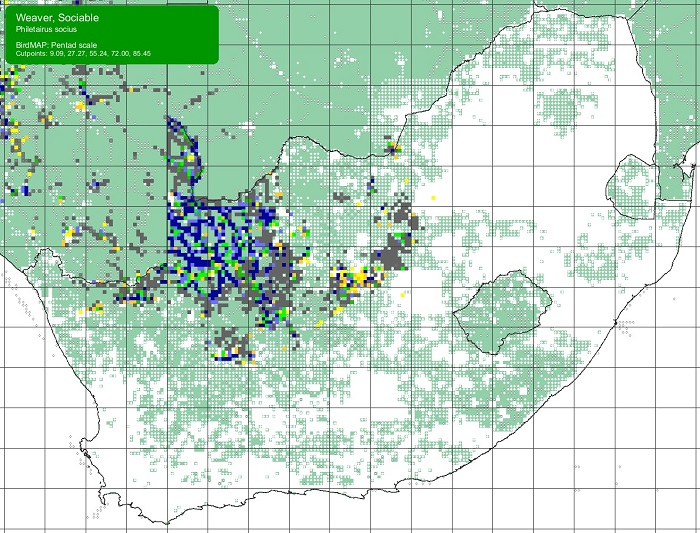
Details for map interpretation can be found here.
The Sociable Weaver is not threatened. Its population has expanded substantially during the 20th century using telephone poles, electricity pylons, and other artificial structures as nest sites. The range could expand further if it were to accept alien trees for nesting. This may be happening in the Karoo, where they sometimes nest in larger Honey Mesquite (Prosopis glandulosa) trees. These trees are now a problematic invader across large swathes of the Northern Cape.
The range of the Sociable Weaver has contracted in parts of North West Province, the Free State, and the Ghaap Plateau in the Northern Cape, where woodland has been cleared for agriculture. In former times, the Sociable Weaver was hunted by the San people.
Habitat
The Sociable Weaver inhabits arid savanna and dry woodland, and is strongly associated with the Southern Kalahari vegetation type. It typically needs open savanna grassland with large trees for nesting. The Sociable Weaver is marginal in grassland, the Namib Desert and Mopane Colophospermum mopane woodland. Its spread into the largely treeless Nama Karoo and parts of the Namib have been permitted by artificial structures providing nesting sites. It is found in regions with a rainfall range of 80 to 600 mm per year.
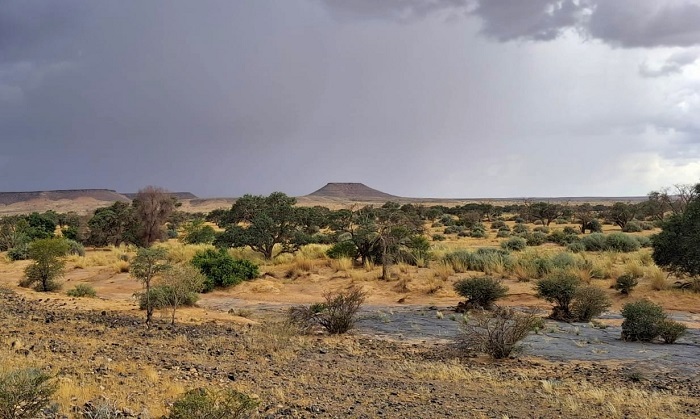
Between Aus and Keetmanshoop, Namibia
Photo by Les Underhill
Behaviour
The Sociable Weaver is highly gregarious at all times in colonies of about 6 to 300 birds. They are resident and sedentary, foraging birds seldom wander more than 1 or 2km from the nest. Each colony is associated with a communally built nest mass. The furthest recorded dispersal of young birds is 32.8 km, and there is very little movement of birds between colonies.
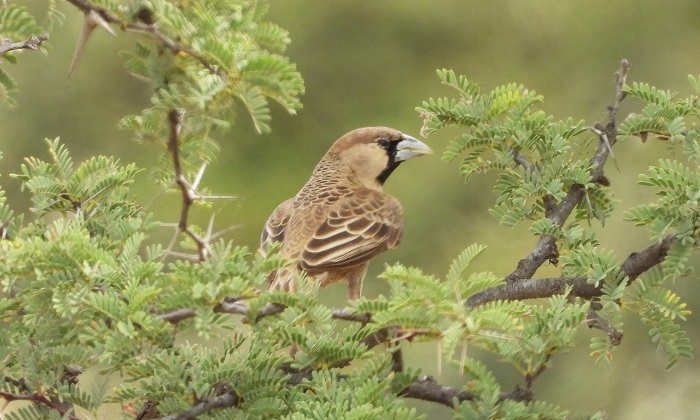
Sandveld Nature Reserve, Free State
Photo by Ansie Dee Reis
They are often highly active at the nest, constantly flying up and down with building material or perching close by, calling almost constantly. They roost in the nest chambers, and 5 or more birds may roost in a single chamber, while other chambers remain empty. They return to the nest before sunset, perching in the canopy, lower branches of the nest tree, or in an adjacent tree. They fly in and out of several chambers before settling in one. Birds do not necessarily roost in the same chamber on consecutive nights unless breeding.
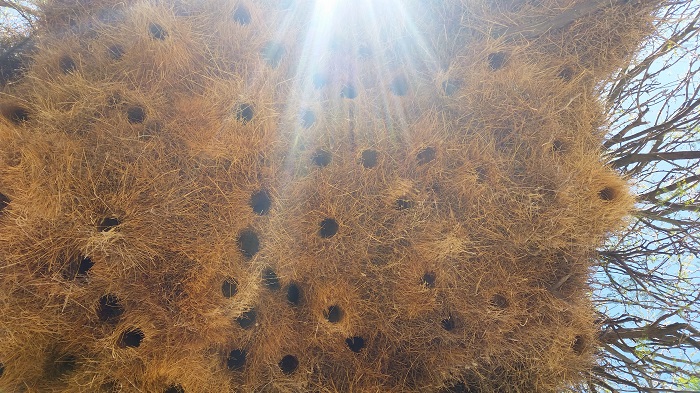
Carnarvon district, Northern Cape
Photo by Ryan Tippett
Sociable Weavers are most well known for their huge nests, which are the World’s largest communal bird nests, and perhaps the most impressive structures built by any bird. The massive nest buffers birds from extreme temperatures. The air temperature within the nest is self-regulating. Day and night, through summer and winter, the nest temperature remains far more constant than the ambient air outside the nest. When it is cold outside, the inside temperature is around 20°C warmer, and the nest temperature increases with the number of occupants. Conversely, on hot summer days, the nest chambers can be as much as 20°C cooler than the air outside the nest.
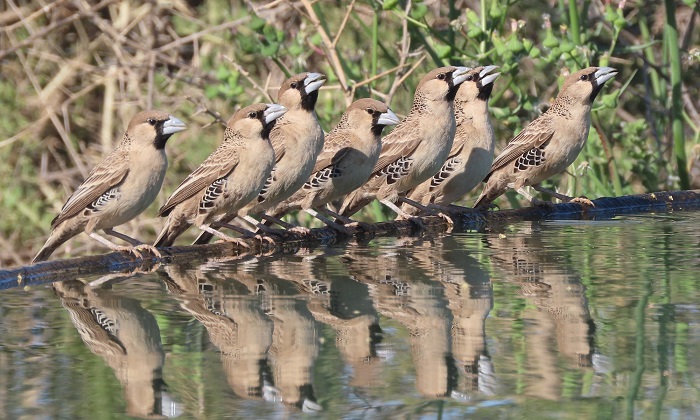
Hopetown district, Northern Cape
Photo by Les Underhill
Sociable Weavers drink regularly, flying up to 3.7 km from the nest to do so. They forage in flocks throughout the day, but mainly during the early morning and late afternoon. Groups forage on the ground, usually less than 2 km from the nest, sometimes joining feeding birds from other colonies. Birds on the ground move by quick hopping.
The diet of the Sociable Weaver is comprised mainly of seeds and arthropods, but they will also eat the soft lower nodes of grasses, as well as flowers and fruit. They mainly eat grass seeds, but legume seeds are also consumed. Arthropods are mostly eaten in summer, with termites forming the bulk, but caterpillars, moths, small grasshoppers, beetles, and ants are also taken.
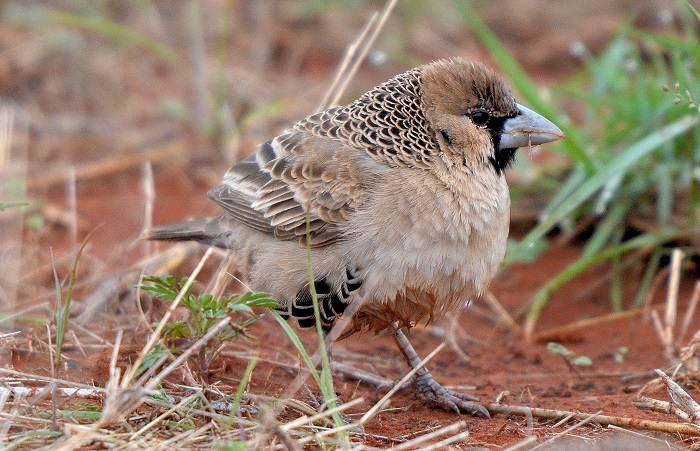
Mokala National Park, Northern Cape
Photo by John Todd
Sociable Weavers breed in any month, and they generally only breed in response to rain, with at least 20 mm of rain required to stimulate breeding. The breeding season may last up to 9 months in wet years with up to 4 broods per season. However, they may not breed at all during drought periods. Sociable Weavers are colonial, cooperative breeders, but are not genetically monogamous.
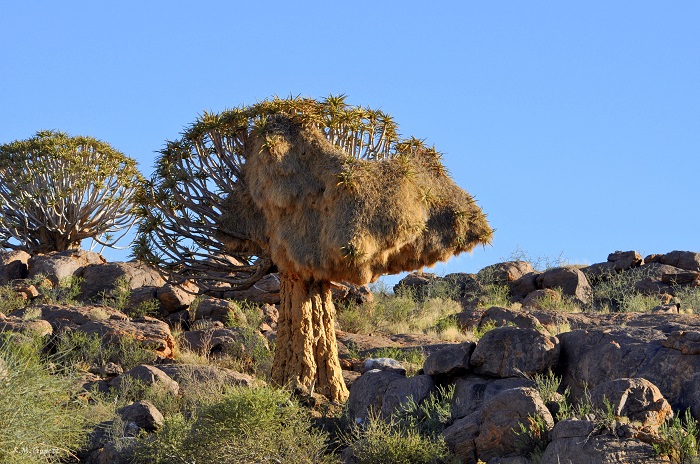
The nest is constructed by both sexes, but males are far more productive builders. The nest is an enormous, communal structure, sometimes measuring more than 7 m across, weighing more than 1 ton and containing over 250 nest chambers. Some larger nests are known to be over 100 years old. The entire structure consists of 2 well-defined parts: a dome-shaped superstructure (roof), usually built of fairly large, thorny twigs, long grasses and stems. It is positioned mostly above the supporting branch. Beneath it is a substructure of dry grasses, within which numerous separate nest chambers are embedded, each connected to the exterior by a vertical tunnel up to 250 mm long and 60-70 mm in diameter. Prior to egg-laying, the nest chamber is lined with soft, dry materials such as grass seed-heads, everlasting (Helichrysum spp.) leaves, and feathers. The Helichrysum leaves are strongly aromatic and are thought to guard against mites and other nest parasites. Nests are placed anywhere from 2 to 16 meters above the ground, and are usually north-facing.
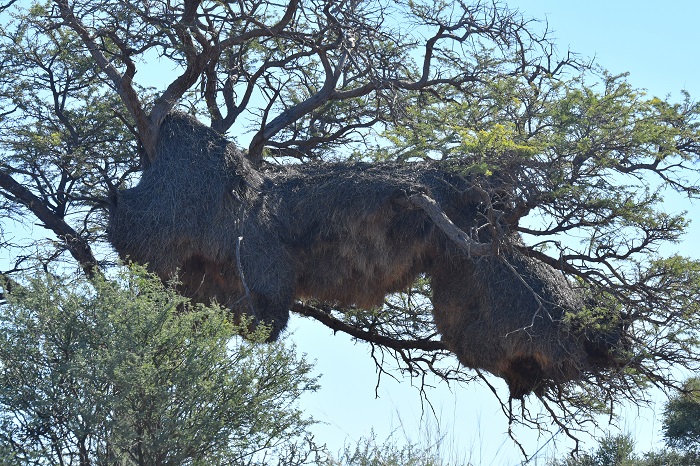
Near Groblershoop, Northern Cape
Photo by Ryan Tippett
The entire structure is maintained year-round. Building material is often collected from fallen portions below the nest, or brought back from foraging trips. Ideal nesting trees have a strong, more or less horizontal support branch with clear access from below. Nests are most often constructed in Camel Thorn Acacia erioloba trees and also in Grey Camel Thorn V. haematoxylon, Umbrella Thorn V. tortillis, Shepherds-tree Boscia albitrunca, Quiver-tree Aloe dichotoma, Karee Rhus lancea, Buffalo-thorn Ziziphus mucronata and Mopane Colophospermum mopane trees. Rarely in alien Eucalyptus spp. and mesquite (Prosopis spp.). Nests are also regularly built on telephone poles and, less often, on electricity and railway pylons, tank stands, wind-pumps, buildings, and natural rock faces.
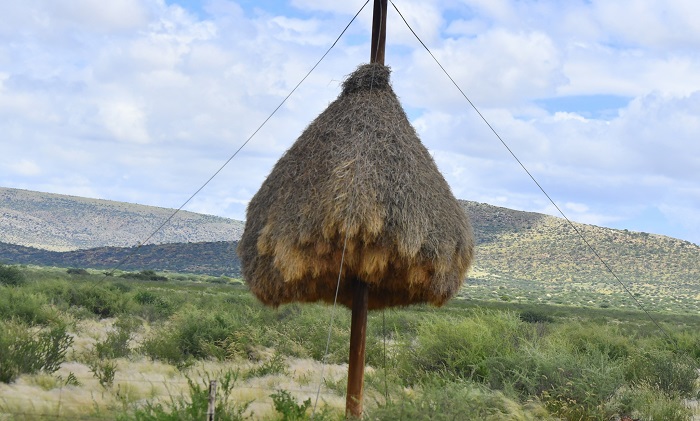
Near Prieska, Northern Cape
Photo by Ryan Tippett
2 to 6 (usually 3 or 4) eggs are laid per clutch at 1-day intervals. Intraspecific brood parasitism (egg dumping) is known to sometimes take place. Incubation usually starts with the first-laid and takes up to 14 days to complete. Incubation is done by both sexes, and sometimes by helpers. Adults and helpers roost in the nest chamber during both incubation and nestling periods, but the helpers often move to an adjacent chamber if too crowded. Hatching is asynchronous, however, the whole brood usually fledges on the same day or at least, within 2 days. The fledging period takes 21 to 24 days and the young are brooded continuously by both parents for their first 2 weeks. They are fed equally by both parents, and by up to 9 helpers of both sexes. Helpers are usually young from previous broods, but sometimes unrelated.
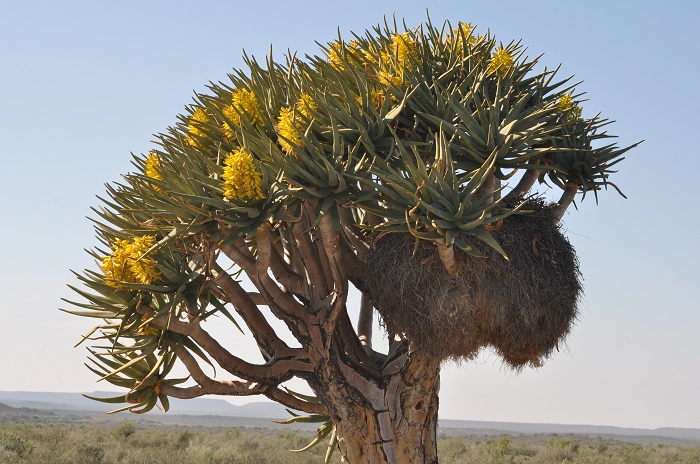
Carnarvon district, Northern Cape
Photo by Ryan Tippett
Sociable Weaver colonies can be heavily impacted by predation. Snakes like the Cape Cobra Naja nivea, Boomslang Dispholidus typus, and Common Egg-eater Dasypeltis scabra can have a significant toll on breeding success. Many nestlings, fledglings, and adults are eaten by raptors, including Gabar Goshawk, Pale Chanting Goshawk, African Harrier- Hawk, Red-necked Falcon, and Pygmy Falcon.
Nest chambers are frequently usurped by mud-nesting wasps, nesting Pygmy Falcons, Red-headed Finches and Rosy-faced Lovebirds, and used as roosts by Ashy Tits, Familiar Chats, Acacia Pied Barbets, and Pearl-spotted Owlets.
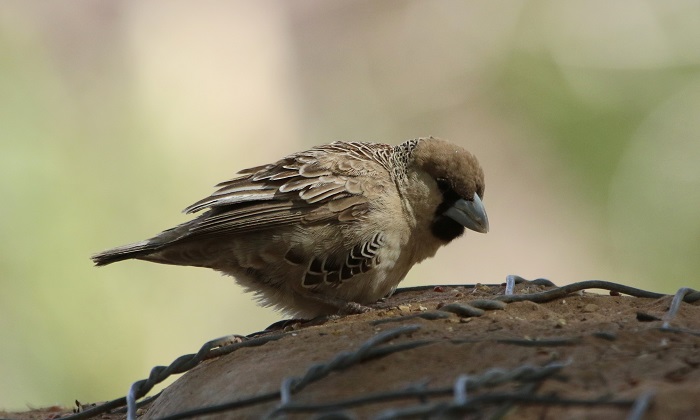
Fish River Canyon National Park, Namibia
Photo by Attie van Aarde
Further Resources
This species text is adapted from the first Southern African Bird Atlas Project (SABAP1), 1997.
The use of photographs by Ansie Dee Reis, Attie van Aarde, Cobus Elstadt, John Todd, Les Underhill, and Ryan Tippett is acknowledged.
Other names: Versamelvoël (Afrikaans); Républicain social (French); Republikeinwever (Dutch); Siedelweber (German); Tecelão-sociável (Portuguese).
Recommended citation format: Tippett RM. 2026. Sociable Weaver Philetairus socius. Biodiversity and Development Institute. Available online at https://thebdi.org/2026/06/19/sociable-weaver-philetairus-socius/
List of bird species in this format is available here.
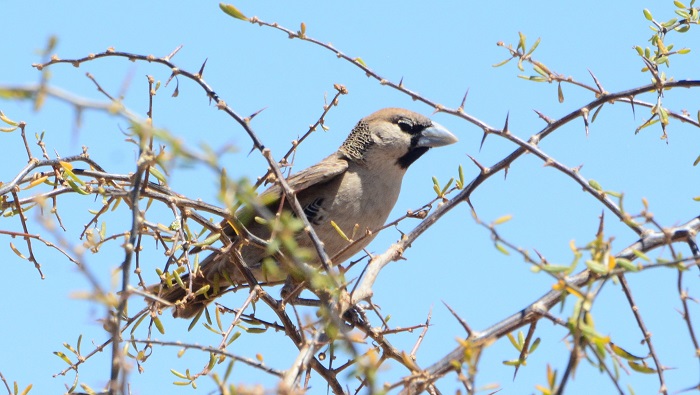
Carnarvon district, Northern Cape
Photo by Ryan Tippett
