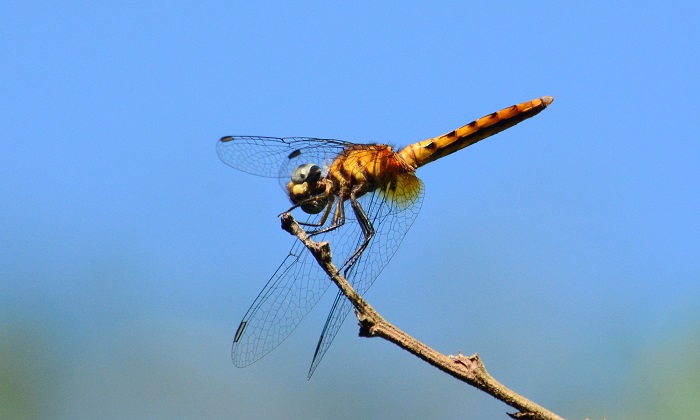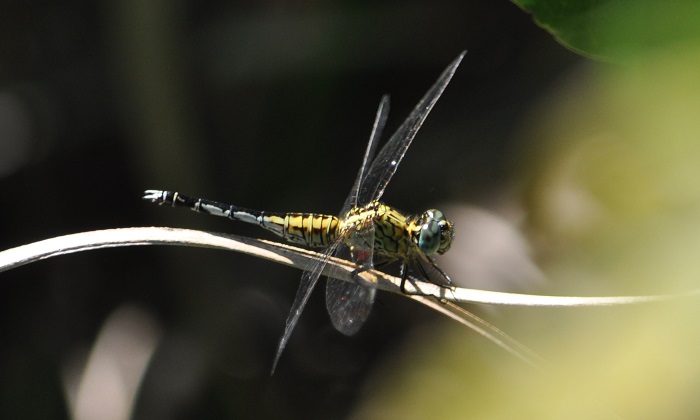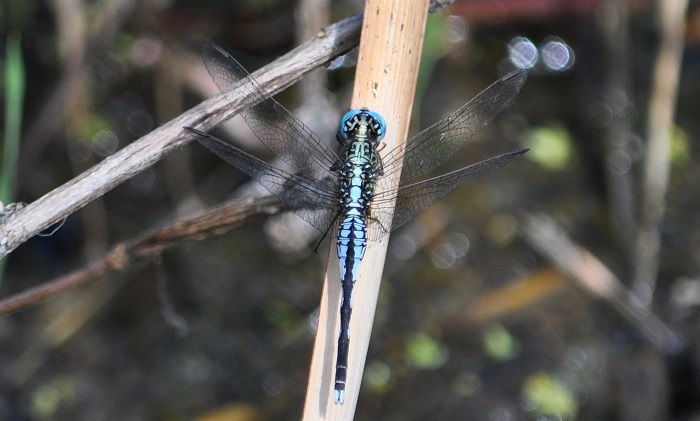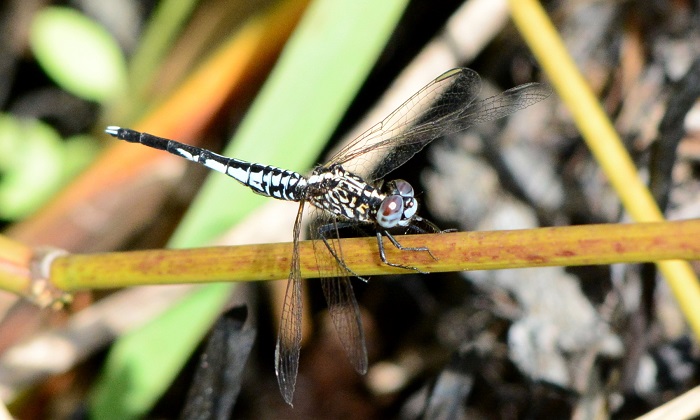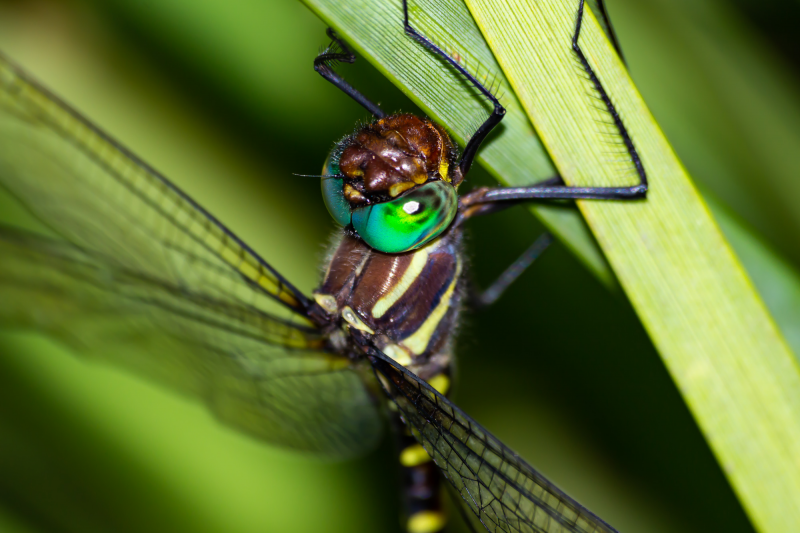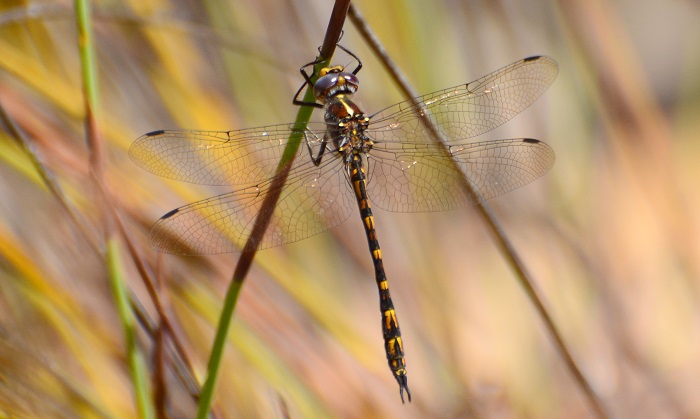
Pygmy Basker (Aethriamanta rezia)

Cover photo by Diana Russell.

Find the Pygmy Basker in the FBIS database (Freshwater Biodiversity Information System) here.

Family Libellulidae

Identification

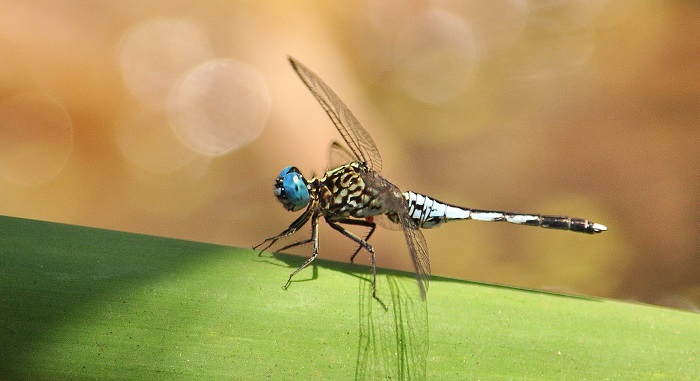
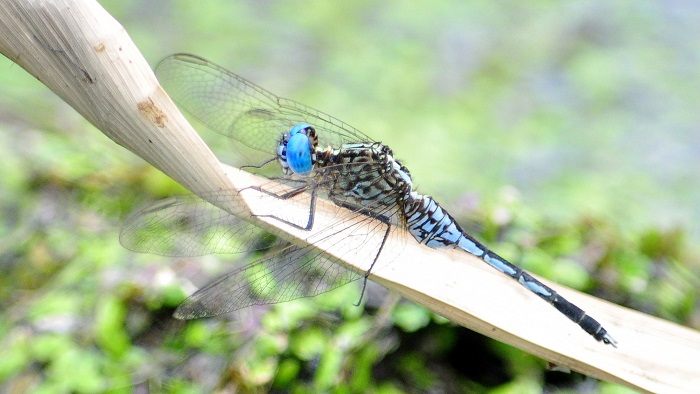
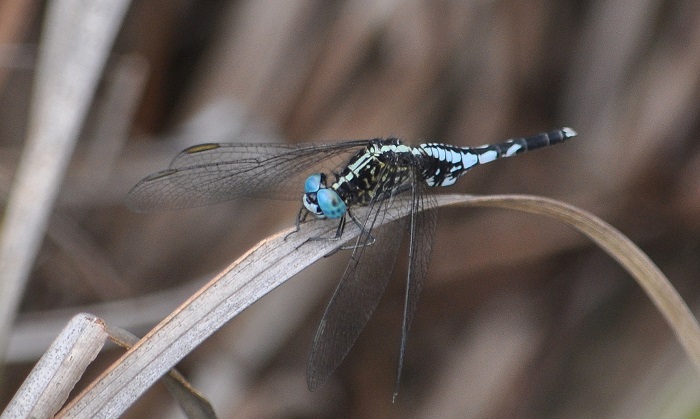
Pygmy Basker Aethriamanta rezia – Male
Okavango Delta, Botswana
Photo by Ryan Tippett

Very small size

Length up to 29mm; Wingspan attains 47mm.

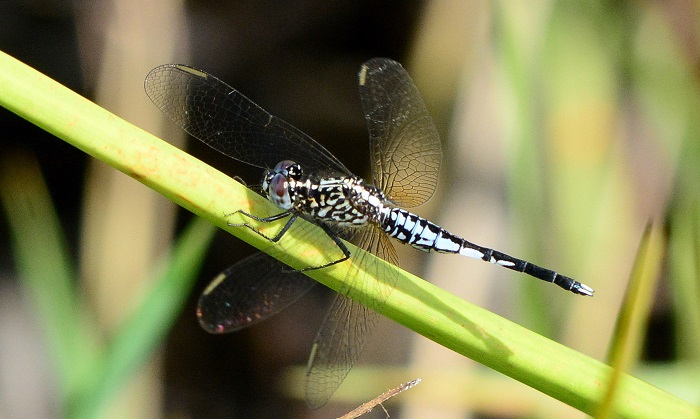
Both sexes of the Pygmy Basker are distinctive and easily recognisable.

Males are most similar to Macrodiplax cora (Coastal Pennant). That species is larger and has differently shaped markings along the top of the abdomen. In addition Macrodiplax cora has far less amber in the hind wings.

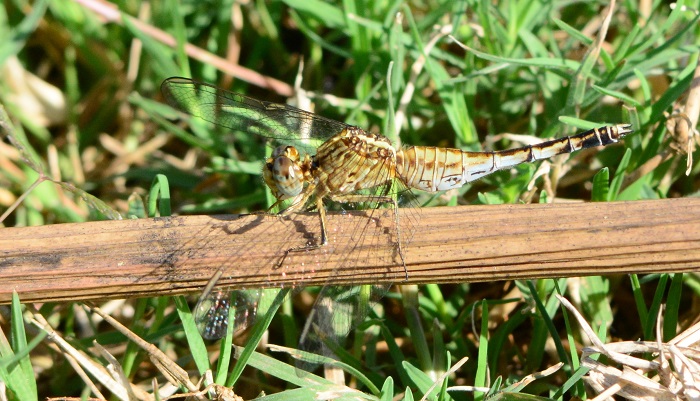
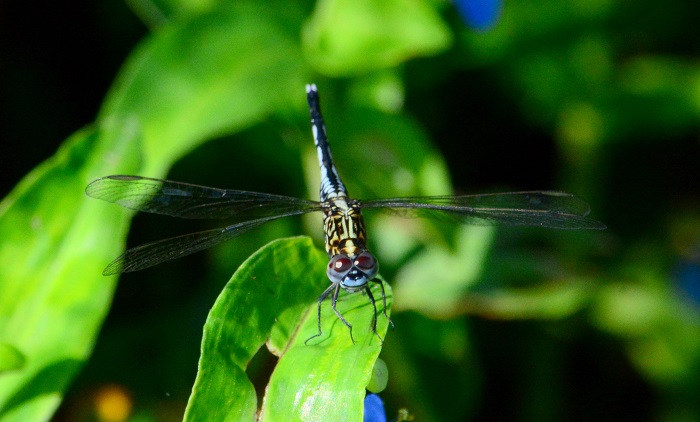
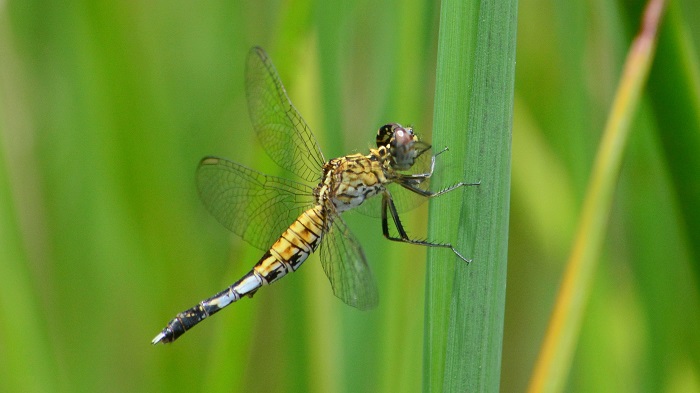
Female Pygmy Baskers share the same patterning as the males but are mustard-yellow to bright yellow in colouration.

Click here for more details on identification of the Pygmy Basker.

Pygmy Basker Aethriamanta rezia – Female
Okavango Delta, Botswana
Photo by Ryan Tippett

Habitat

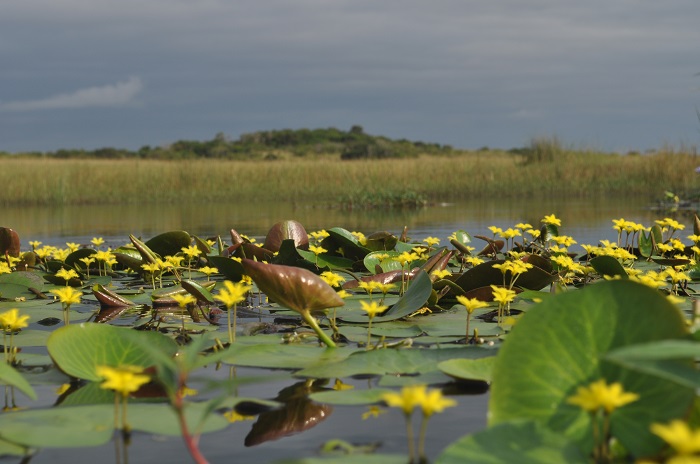
The Pygmy Basker is primarily a coastal species in South Africa. It inhabits sedge and water lily filled ponds and pans on floodplains and in marshes. They are also found at richly vegetated oxbow ponds along meandering rivers and streams. The Pygmy basker favours still or slow-flowing waters. It is found in savanna, coastal grassland and forested environments, provided there is suitable aquatic habitat.

Habitat – Near Kosi Bay, KwaZulu-Natal
Photo by Ryan Tippett

Behaviour

Adult male Pygmy Baskers perch prominently over the water, usually on bare branches or sedge and reed stems. Females and immature males are mostly found away from the water perched on bushes and trees. Pygmy Baskers dart off in short, rapid flights to capture prey, often returning to the same perch. During the heat of the day they can often be seen in the ‘obelisk position’, pointing the abdomens at the sun to reduce the amount of direct sunlight on their bodies.

This species is most active from October to April (see Phenology below).
Pygmy Basker Aethriamanta rezia – Female
Enseleni Nature Reserve, KwaZulu-Natal
Photo by Ryan Tippett

Status and Conservation

Overall, the Pygmy Basker is an uncommon and localised species in South Africa. It is listed as of Least Concern in the IUCN Red List of Threatened Species. It is found mostly in undisturbed habitats and is not very tolerant of habitat degradation.
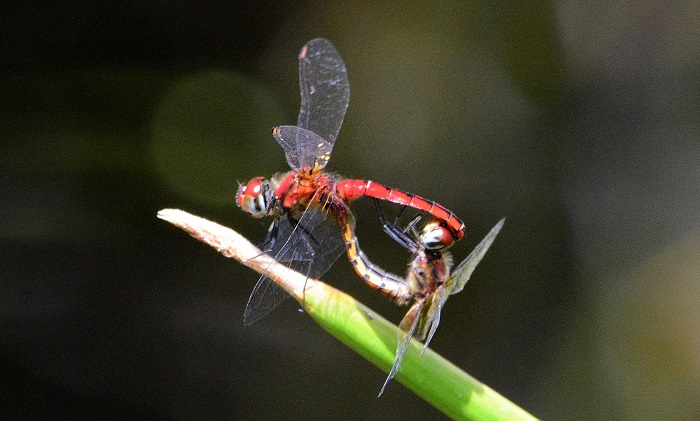
Pygmy Basker Aethriamanta rezia – Male
Kosi Bay, iSimangaliso Wetland Park, KwaZulu-Natal
Photo by Ryan Tippett

Distribution

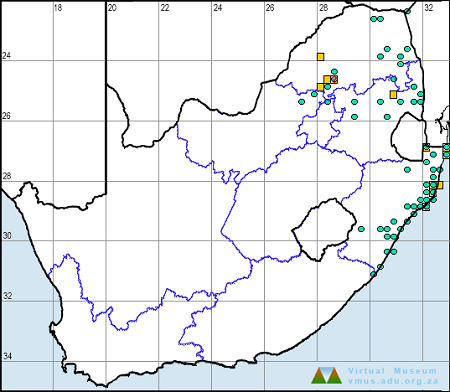
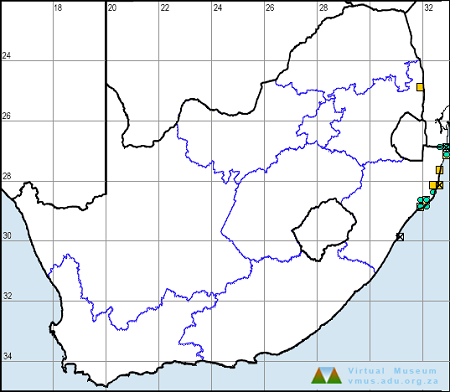
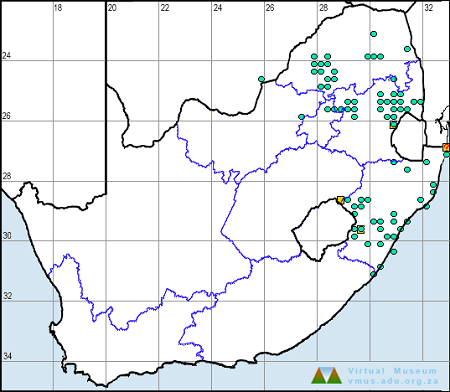
The Pygmy Basker is widespread throughout the wetter parts of sub-Saharan Africa, from Senegal across to Kenya and down to South Africa. It is also found in parts of northern Madagascar. In South Africa it is mostly restricted to the north-eastern coastal plain of KwaZulu-Natal and low-lying parts of Mpumalanga..

Below is a map showing the distribution of records for Pygmy Basker in the OdonataMAP database as at February 2020.
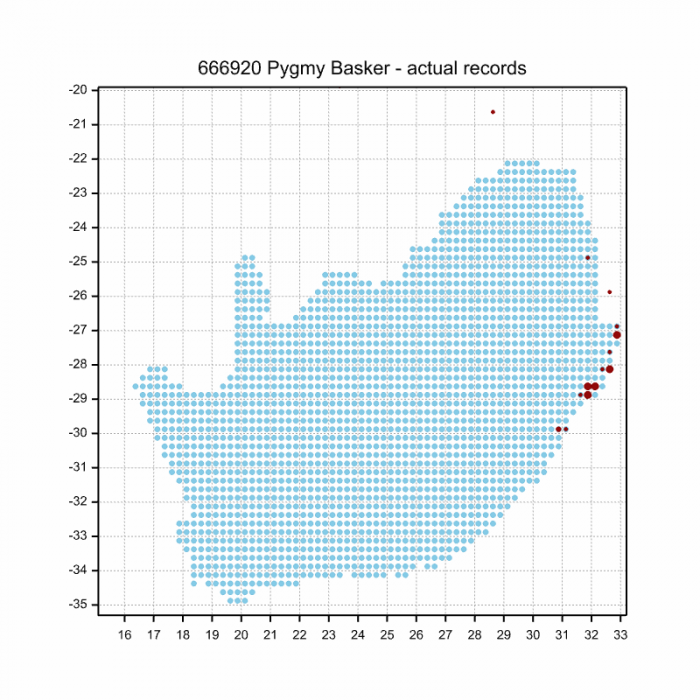
Below is a map showing the distribution of records for Pygmy Basker in the OdonataMAP database as of December 2024.
The next map below is an imputed map, produced by an interpolation algorithm, which attempts to generate a full distribution map from the partial information in the map above. This map will be improved by the submission of records to the OdonataMAP section of the Virtual Museum.

Ultimately, we will produce a series of maps for all the odonata species in the region. The current algorithm is a new algorithm. The objective is mainly to produce “smoothed” maps that could go into a field guide for odonata. This basic version of the algorithm (as mapped above) does not make use of “explanatory variables” (e.g. altitude, terrain roughness, presence of freshwater — we will be producing maps that take these variables into account soon). Currently, it only makes use of the OdonataMAP records for the species being mapped, as well as all the other records of all other species. The basic maps are “optimistic” and will generally show ranges to be larger than what they probably are.

These maps use the data in the OdonataMAP section of the Virtual Museum, and also the database assembled by the previous JRS funded project, which was led by Professor Michael Samways and Dr KD Dijkstra.

Pygmy Basker Aethriamanta rezia – Male
Kosi Bay, iSimangaliso Wetland Park, KwaZulu-Natal
Photo by Ryan Tippett

Phenology

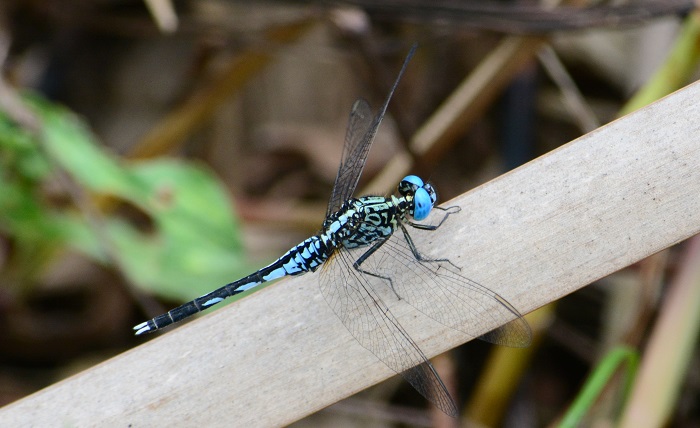
Pygmy Basker Aethriamanta rezia – Immature male
Enseleni Nature Reserve, KwaZulu-Natal
Photo by Ryan Tippett

Further Resources

The use of photographs by Diana Russell is acknowledged. Other photographs by Ryan Tippett.

Pygmy Basker Aethriamanta rezia Kirby, 1889

Other common names: Dwergsonvangertjie (Afrikaans)

Recommended citation format: Loftie-Eaton M; Navarro R; Tippett RM; Underhill L. 2025. Pygmy Basker Aethriamanta rezia. Biodiversity and Development Institute. Available online at https://thebdi.org/2020/06/12/pygmy-basker-aethriamanta-rezia/

References: Tarboton, M; Tarboton, W. (2019). A Guide to the Dragonflies & Damselflies of South Africa. Struik Nature.

Samways, MJ. (2008). Dragonflies and Damselflies of South Africa. Pensoft

Samways, MJ. (2016). Manual of Freshwater Assessment for South Africa: Dragonfly Biotic Index. Suricata 2. South African National Biodiversity Institute, Pretoria

Martens, A; Suhling, F. (2007). Dragonflies and Damselflies of Namibia. Gamsberg Macmillan.

Pygmy Basker Aethriamanta rezia – Male
Okavango Delta, Botswana
Photo by Ryan Tippett

Similar Species

Slender Pintail(Acisoma variegatum)

Cover photo by Desiré Darling.

Find this species in the FBIS database (Freshwater Biodiversity Information System) here.

Family Libellulidae

Identification

Slender Pintail Acisoma variegatum – Male
Near Hluhluwe, KwaZulu-Natal
Photo by Ryan Tippett

Small size

Hind wing25mm.

The Slender Pintail is easily recognised as an Acisoma species by the swollen abdomen base that tapers off sharply from segment 6 down to the tip. It is most similar to the Stout Pintail (Acisoma inflatum). The two species bear a close resemblance to one another and co-occur at many sites.

The most conclusive way to separate the two is in the hand, by examining the male’s secondary genitalia. However, the colouration differences on the S4 ventral corner, along the sides of the abdomen are also helpful. In Acisoma variegatum the ventral corner is mostly white. This same area is edged with black in Acisoma inflatum. Additionally, the S5 lateral carina is partly white in Acisoma variegatum and all-black in Acisoma inflatum. The Slender Pintail also has segments 6 and 7 of equal length, while in the Stout Pintail, segment 6 is shorter than segment 7.

Furthermore, Acisoma variegatum tends to be a little larger and somewhat brighter in colour, with less of the yellowish-brown wash on the thorax.

Click here for more details on identification.

Slender Pintail Acisoma variegatum – Female
Muzi Pan, KwaZulu-Natal
Photo by Ryan Tippett

Habitat

The Slender Pintail inhabits the shallow, standing waters of marshes, pans, floodplains, and slow-moving rivers. It occupies both permanent and seasonal wetlands, preferring sites rich in sedge, grasses, and various types of floating and emergent vegetation.

Typical habitat
Kosi Bay, iSimangaliso Wetland Park, KwaZulu-Natal
Photo by Ryan Tippett

Behaviour

The Slender Pintail typically sits close to the water on floating or emergent plant stems. It hunts from a perch and quickly resettles again. The Slender Pintail has a fast wasp-like flight.

The Slender Pintail is on the wing from mostly from August to May (see Phenology below).

Slender Pintail Acisoma variegatum – Male
Near Hluhluwe, KwaZulu-Natal
Photo by Ryan Tippett

Status and Conservation

The Slender Pintail is locally common in South Africa. It is listed as of Least Concern in the IUCN Red List of Threatened Species. Slender Pintails are most common in natural habitats but will make use of suitable man-made sites such as dams and ponds.

Slender Pintail Acisoma variegatum – Male
Near Hluhluwe, KwaZulu-Natal
Photo by Ryan Tippett

Distribution

The Slender Pintail is widespread in eastern and southern Africa, extending from Ethiopia in the north down to South Africa. Its South African distribution is centred around the hot savanna regions and its range extends along the coastal plain to the Eastern Cape border.

Slender Pintail Acisoma variegatum – Male
Near Hluhluwe, KwaZulu-Natal
Photo by Ryan Tippett

Below is a map showing the distribution of records for Slender Pintail in the OdonataMAP database as at February 2020.

Below is a map showing the distribution of records for Slender Pintail in the OdonataMAP database as of December 2024.

The next map below is an imputed map, produced by an interpolation algorithm, which attempts to generate a full distribution map from the partial information in the map above. This map will be improved by the submission of records to the OdonataMAP section of the Virtual Museum.
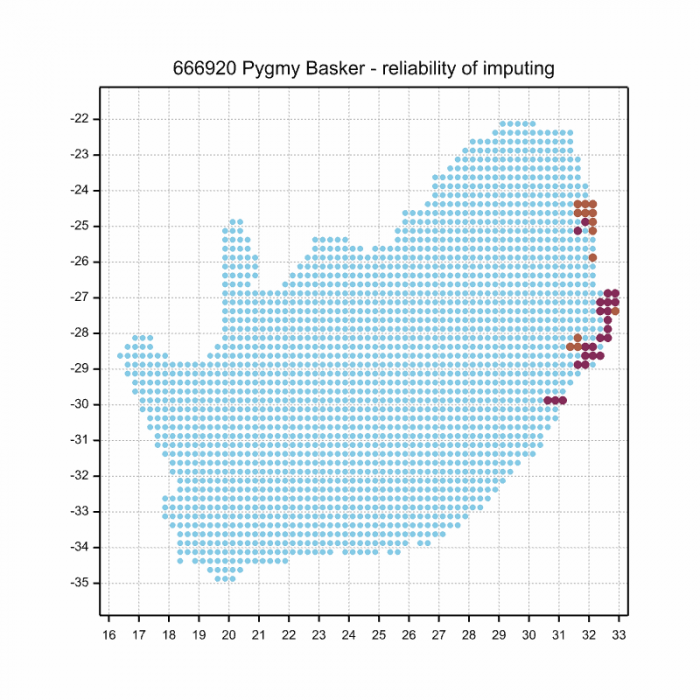
Ultimately, we will produce a series of maps for all the odonata species in the region. The current algorithm is a new algorithm. The objective is mainly to produce “smoothed” maps that could go into a field guide for odonata. This basic version of the algorithm (as mapped above) does not make use of “explanatory variables” (e.g. altitude, terrain roughness, presence of freshwater — we will be producing maps that take these variables into account soon). Currently, it only makes use of the OdonataMAP records for the species being mapped, as well as all the other records of all other species. The basic maps are “optimistic” and will generally show ranges to be larger than what they probably are.

These maps use the data in the OdonataMAP section of the Virtual Museum, and also the database assembled by the previous JRS funded project, which was led by Professor Michael Samways and Dr KD Dijkstra.
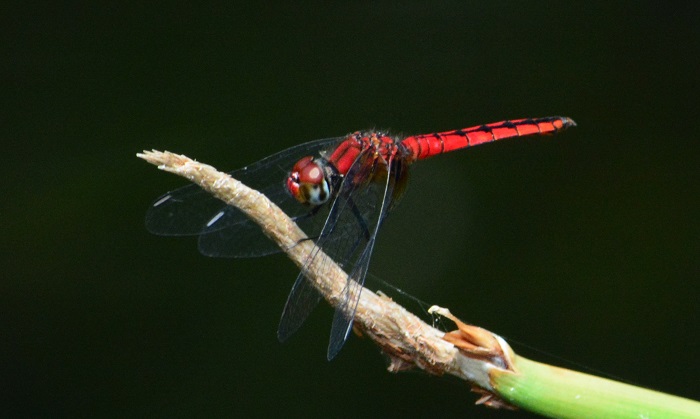
Slender Pintail Acisoma variegatum – Male
Near Hluhluwe, KwaZulu-Natal
Photo by Ryan Tippett

Phenology

Slender Pintail Acisoma variegatum – Female
Kosi Bay, iSimangaliso Wetland Park, KwaZulu-Natal
Photo by Ryan Tippett

Further Resources

The use of photographs by Desiré Darling is acknowledged. All other photos by Ryan Tippett.

Slender Pintail Acisoma variegatum Kirby, 1898

Other common names: Grizzled Pintail (Alt. English); Dunpylstertjie (Afrikaans)

Recommended citation format: Loftie-Eaton M; Navarro R; Tippett RM; Underhill L. 2025. Slender Pintail Acisoma variegatum. Biodiversity and Development Institute. Available online at https://thebdi.org/2020/06/12/slender-pintailacisoma-variegatum/

References: Tarboton, M; Tarboton, W. (2019). A Guide to the Dragonflies & Damselflies of South Africa. Struik Nature.

Samways, MJ. (2008). Dragonflies and Damselflies of South Africa. Pensoft

Samways, MJ. (2016). Manual of Freshwater Assessment for South Africa: Dragonfly Biotic Index. Suricata 2. South African National Biodiversity Institute, Pretoria

Martens, A; Suhling, F. (2007). Dragonflies and Damselflies of Namibia. Gamsberg Macmillan.

Slender Pintail Acisoma variegatum – Male
Near Hluhluwe, KwaZulu-Natal
Photo by Ryan Tippett

Similar Species

Stout Pintail (Acisoma inflatum)

Cover photo by Wayne Johnston.

Find this species in the FBIS database (Freshwater Biodiversity Information System) here.

Family Libellulidae

Identification

Stout Pintail Acisoma inflatum – Male
Okavango Delta, Botswana
Photo by Ryan Tippett

Small size

Hindwing – 22mm.

The Stout Pintail is easily recognised as an Acisoma species by the swollen abdomen base that tapers off sharply from segment 6 down to the tip.

The Stout Pintail is most similar to the Slender Pintail (Acisoma variegatum). The two species bear a close resemblance to one another and co-occur at many sites.

The most conclusive way to separate the two is the colouration difference, on the S4 ventral corner, along the sides of the abdomen. In Acisoma variegatum the ventral corner is mostly white, while it is edged with black in Acisoma inflatum. Additionally, the S5 lateral carina is partly white in Acisoma variegatum and all-black in Acisoma inflatum.

Acisoma variegatum shows segments 6 and 7 of equal length, while in Acisoma inflatum segment 6 is shorter than segment 7.

The Stout Pintail also tends to be slightly smaller and somewhat duller in colour, sometimes showing a yellowish-brown wash on the thorax.

Click here for more details on identification.

Stout Pintail Acisoma inflatum – Female
Lake Naverone, KwaZulu-Natal
Photo by Ryan Tippett

Habitat

Stout Pintails inhabit marshes and floodplains with pools supporting a rich growth of aquatic plants, particularly sedges, reeds, and grasses. The Stout Pintail is sometimes also found along slow-moving sections of rivers. The Stout Pintail is often found where there are floating plants like water lilies amongst the emergent vegetation.

Habitat – Near Kosi Bay, KwaZulu-Natal
Photo by Ryan Tippett

Behaviour

The Stout Pintail sits close to the water on floating or emergent plant stems. It hunts from a perch and quickly resettles again. The flight is fast and wasp-like.

Stout Pintail Acisoma inflatum – Female
Kosi Bay, iSimangaliso Wetland Park, KwaZulu-Natal
Photo by Ryan Tippett

Status and Conservation

The Stout Pintail is locally common in South Africa. It is listed as of Least Concern in the IUCN Red List of Threatened Species. The Stout Pintail is most common in natural habitats but will make use of suitable man-made sites like dams and ponds.

Stout Pintail Acisoma inflatum – Male
Lake Naverone, KwaZulu-Natal
Photo by Ryan Tippett

Distribution

Acisoma inflatum occurs widely across the savanna regions of Sub-Saharan Africa. It also occurs very locally along parts of the Mediterranean coastline of North Africa.

In South Africa, the Stout Pintail is found in the higher rainfall areas of the north and east.

Stout Pintail Acisoma inflatum – Male
Kosi Bay, iSimangaliso Wetland Park, KwaZulu-Natal
Photo by Ryan Tippett

Below is a map showing the distribution of records for Stout Pintail in the OdonataMAP database as at February 2020.

Below is a map showing the distribution of records for Stout Pintail in the OdonataMAP database as of December 2024.

The next map below is an imputed map, produced by an interpolation algorithm, which attempts to generate a full distribution map from the partial information in the map above. This map will be improved by the submission of records to the OdonataMAP section of the Virtual Museum.

Ultimately, we will produce a series of maps for all the odonata species in the region. The current algorithm is a new algorithm. The objective is mainly to produce “smoothed” maps that could go into a field guide for odonata. This basic version of the algorithm (as mapped above) does not make use of “explanatory variables” (e.g. altitude, terrain roughness, presence of freshwater — we will be producing maps that take these variables into account soon). Currently, it only makes use of the OdonataMAP records for the species being mapped, as well as all the other records of all other species. The basic maps are “optimistic” and will generally show ranges to be larger than what they probably are.

These maps use the data in the OdonataMAP section of the Virtual Museum, and also the database assembled by the previous JRS funded project, which was led by Professor Michael Samways and Dr KD Dijkstra.

Stout Pintail Acisoma inflatum – Female
Okavango Delta, Botswana
Photo by Ryan Tippett

Phenology

Stout Pintail Acisoma inflatum – Male
Kosi Bay, iSimangaliso Wetland Park, KwaZulu-Natal
Photo by Ryan Tippett

Further Resources

The use of photographs by Wayne Johnston is acknowledged. All other photos by Ryan Tippett.

Stout Pintail Acisoma inflatum Selys, 1882

Other common names: Grizzled Pintail (Alt. English); Dikpylstertjie (Afrikaans)

Recommended citation format: Loftie-Eaton M; Navarro R; Tippett RM; Underhill L. 2025. Stout Pintail Acisoma inflatum. Biodiversity and Development Institute. Available online at https://thebdi.org/2020/06/09/stout-pintail-acisoma-inflatum/

References: Tarboton, M; Tarboton, W. (2019). A Guide to the Dragonflies & Damselflies of South Africa. Struik Nature.

Samways, MJ. (2008). Dragonflies and Damselflies of South Africa. Pensoft

Samways, MJ. (2016). Manual of Freshwater Assessment for South Africa: Dragonfly Biotic Index. Suricata 2. South African National Biodiversity Institute, Pretoria

Martens, A; Suhling, F. (2007). Dragonflies and Damselflies of Namibia. Gamsberg Macmillan.

Stout Pintail Acisoma inflatum – Male
Lake Naverone, KwaZulu-Natal
Photo by Ryan Tippett

Similar Species

Sable Cruiser (Phyllomacromia monoceros)

Cover photo by Gert Bensch.

Find the Sable Cruiser in the FBIS database (Freshwater Biodiversity Information System) here.

Family Macromiidae

Identification

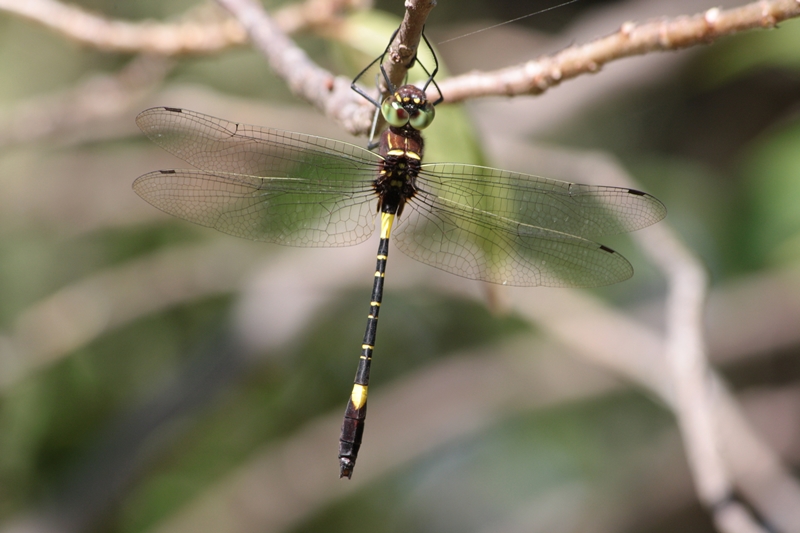
Sable Cruiser Phyllomacromia monoceros – Female
Nwanedi Nature Reserve, Limpopo
Photo by John Wilkinson

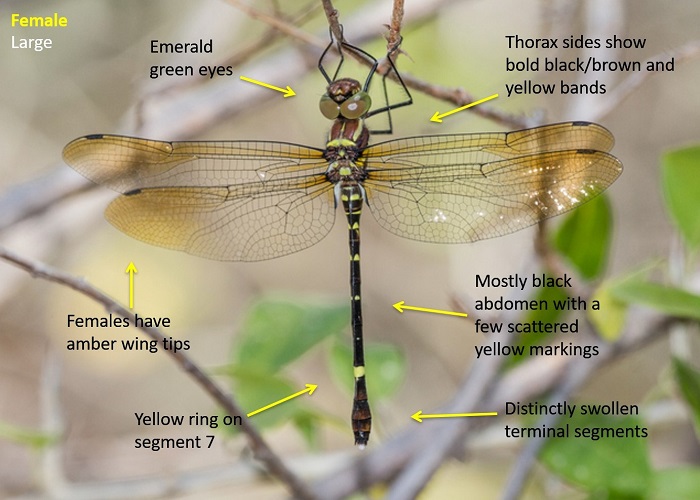
Large size

Length reaches 62mm; Wingspan attains 84mm.

The Sable Cruiser is most similar to the two other Phyllomacromia species in the region, the Darting Cruiser (Phyllomacromia pictus) and the Two-banded Cruiser (Phyllomacromia contumax).

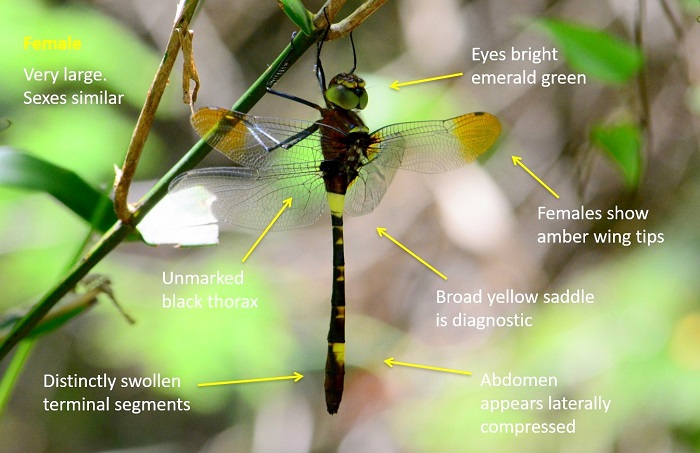
The Sable Cruiser can be identified by its predominantly black abdomen that shows only a few scattered yellow markings. There is a larger yellow ring on segment 7. The sides of the thorax show bold yellow and black bands. This is similar to that of Phyllomacromia pictus, but differs from the plain black thorax of Phyllomacromia contumax.

Males have a diagnostic vertical spine on the tenth abdominal segment.

Click here for more details on identification of the Sable Cruiser.

Habitat

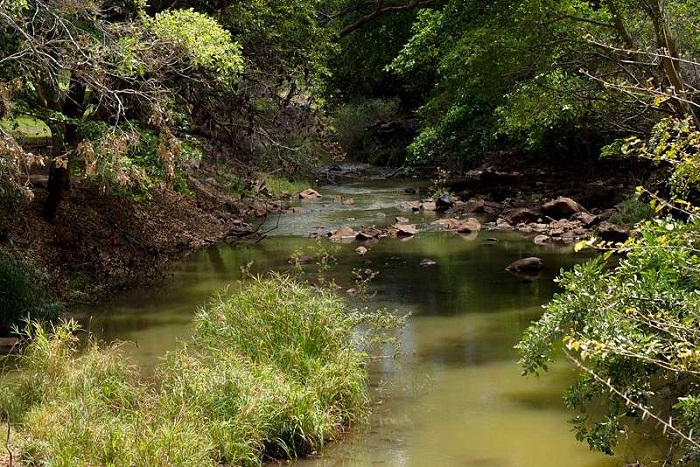
The Sable Cruiser is associated with forested habitats where it frequents rivers and streams. It is often found hunting in nearby clearings or over wetlands at the forest edge.

Habitat at Nwanedi Nature Reserve, Limpopo
Photo by John Wilkinson

Behaviour

The Sable Cruiser is most often encountered in flight. They patrol back and forth along a regular route, and their flight is fast and powerful. The Sable Cruiser hangs from a perch when at rest.

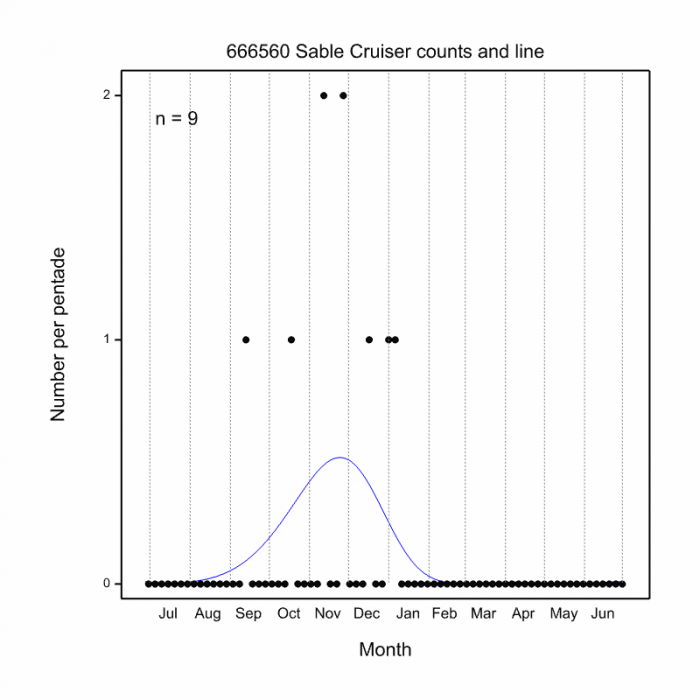
Most active from September to January (see Phenology below).

Status and Conservation

The Sable Cruiser is rare and localised in South Africa. It is listed as Vulnerable in the IUCN Red List of Threatened Species.

Distribution

Phyllomacromia monoceros has a disjunct distribution and occurs in Eastern and Southern Africa. It is found from Kenya in the North down to the Northern Parts of South Africa.

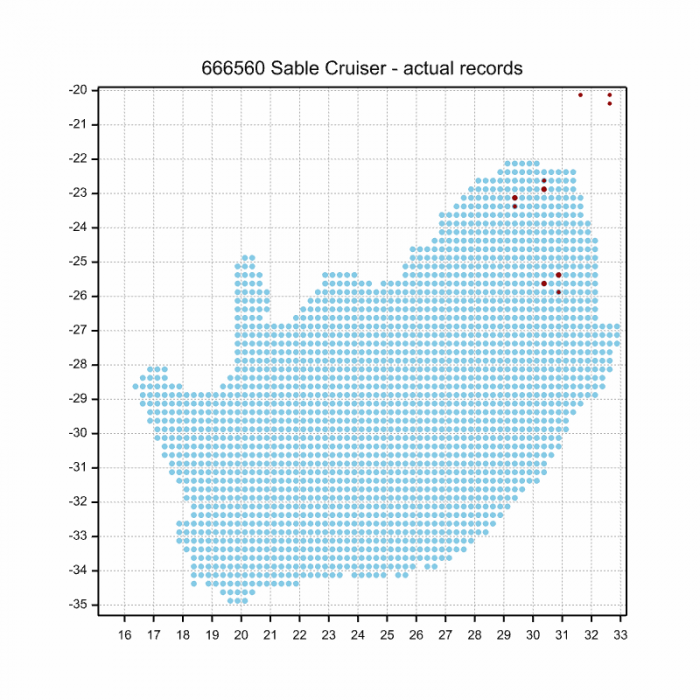
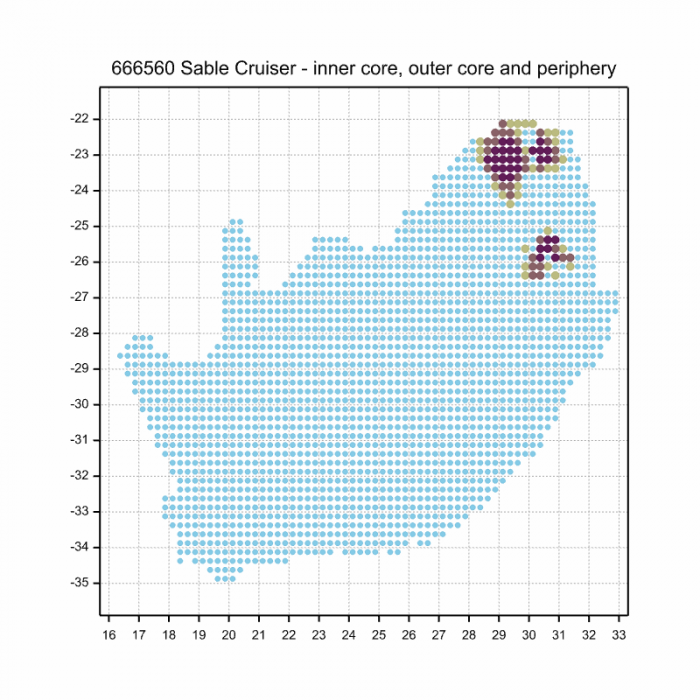
In South Africa the Sable Cruiser has been recorded at several scattered localities along the escarpment in the Limpopo and Mpumalanga provinces.

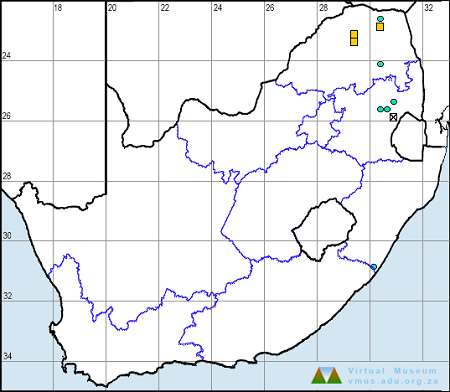
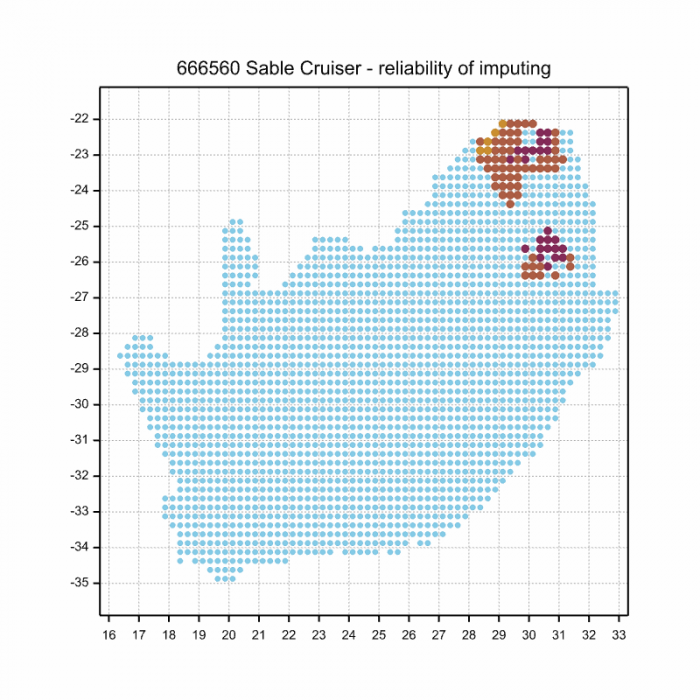
Below is a map showing the distribution of records for Sable Cruiser in the OdonataMAP database as at February 2020.

Below is a map showing the distribution of records for Sable Cruiser in the OdonataMAP database as of December 2024.

The next map below is an imputed map, produced by an interpolation algorithm, which attempts to generate a full distribution map from the partial information in the map above. This map will be improved by the submission of records to the OdonataMAP section of the Virtual Museum.

Ultimately, we will produce a series of maps for all the odonata species in the region. The current algorithm is a new algorithm. The objective is mainly to produce “smoothed” maps that could go into a field guide for odonata. This basic version of the algorithm (as mapped above) does not make use of “explanatory variables” (e.g. altitude, terrain roughness, presence of freshwater — we will be producing maps that take these variables into account soon). Currently, it only makes use of the OdonataMAP records for the species being mapped, as well as all the other records of all other species. The basic maps are “optimistic” and will generally show ranges to be larger than what they probably are.

These maps use the data in the OdonataMAP section of the Virtual Museum, and also the database assembled by the previous JRS funded project, which was led by Professor Michael Samways and Dr KD Dijkstra.

Phenology

Further Resources

The use of photographs by Gert Bensch and John Wilkinson is acknowledged.

Sable Cruiser Phyllomacromia monoceros (Förster, 1906)

Other common names: Unicorn Cruiser (Alt. English), Swartswalker (Afrikaans)

Recommended citation format: Loftie-Eaton M; Navarro R; Tippett RM; Underhill L. 2025. Sable Cruiser Phyllomacromia monoceros. Biodiversity and Development Institute. Available online at https://thebdi.org/2020/06/09/sable-cruiser-phyllomacromia-monoceros/

References: Tarboton, M; Tarboton, W. (2019). A Guide to the Dragonflies & Damselflies of South Africa. Struik Nature.

Samways, MJ. (2008). Dragonflies and Damselflies of South Africa. Pensoft

Samways, MJ. (2016). Manual of Freshwater Assessment for South Africa: Dragonfly Biotic Index. Suricata 2. South African National Biodiversity Institute, Pretoria

Similar Species

Two-banded Cruiser (Phyllomacromia contumax)

Cover photo by Bernardine Altenroxel.

Find the Two-banded Cruiser in the FBIS database (Freshwater Biodiversity Information System) here.

Family Macromiidae

Identification

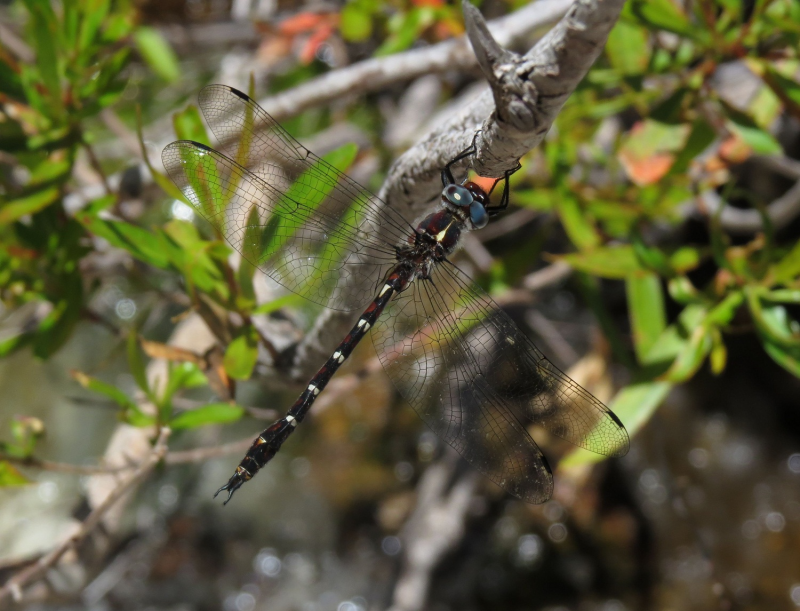
Two-banded Cruiser Phyllomacromia contumax – Male
Limpopo Transfrontier Park, Mozambique
Photo by Gerhardt Diedericks

Very large

Length up to 68mm; Wingspan attains 103mm.

The Two-banded Cruiser is recognisable as a Phyllomacromia species by its large size, striking black and yellow colouration, and bright emerald green eyes.

It is most similar to the Sable Cruiser (Phyllomacromia monoceros) and the Darting Cruiser (Phyllomacromia picta). The Two-banded cruiser can be differentiated by being noticeably larger and by having an unmarked glossy black/brown thorax. The sexes are closely similar, but females have slightly broader abdomens with a less pronounced ‘club’.

Click here for more details on identification of the Two-banded Cruiser.

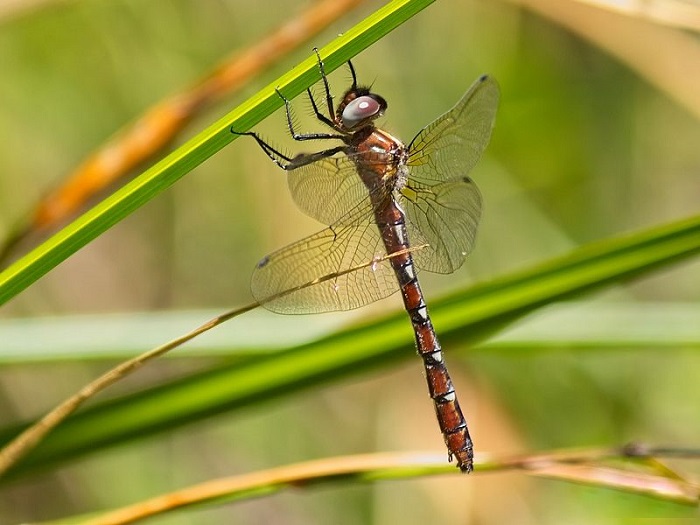
Two-banded Cruiser Phyllomacromia contumax – Female
Enseleni Nature Reserve, KwaZulu-Natal
Photo by Ryan Tippett

Habitat

The Two-banded Cruiser frequents the margins of rivers, lakes, pans, and marshes in savanna and forest regions. It is most numerous in habitats where there is a patchwork of wetland and woodland. The Two-banded Cruiser is often found away from water, hunting in woodland clearings and along roads. This species is most abundant in humid regions.

Habitat – Eastern Shores, iSimangaliso Wetland Park, KwaZulu-Natal
Photo by Ryan Tippett

Behaviour

The Two-banded Cruiser is highly aerial and is most often encountered in flight, but can occasionally be found perched. It hangs vertically from a perch when at rest. Patrols back and forth along a chosen course, along the edge of a wetland, around the treetops, or along a road or clearing.

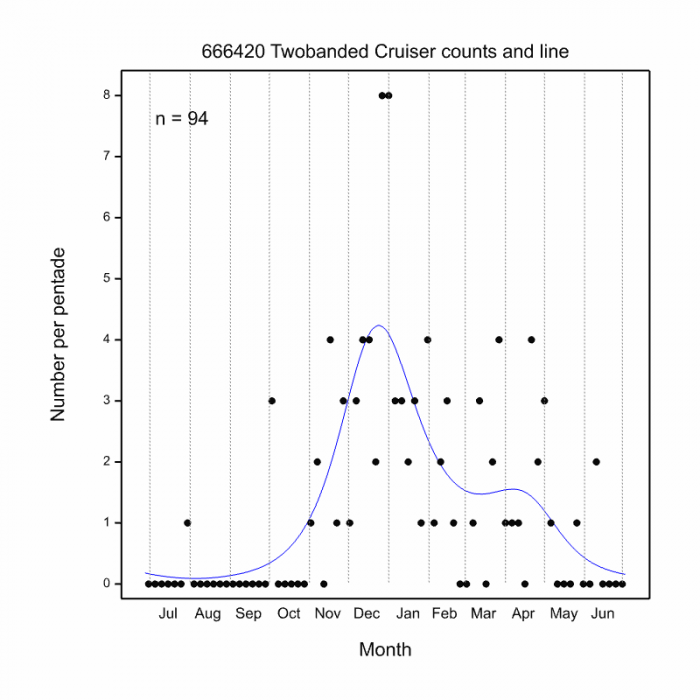
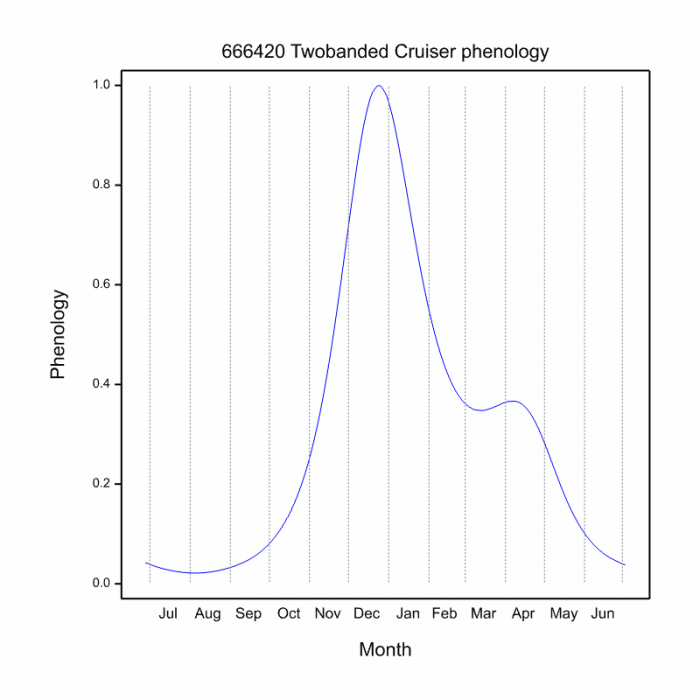
The Two-banded Cruiser is active from October to May, but may fly year-round in warmer areas. See Phenology below.

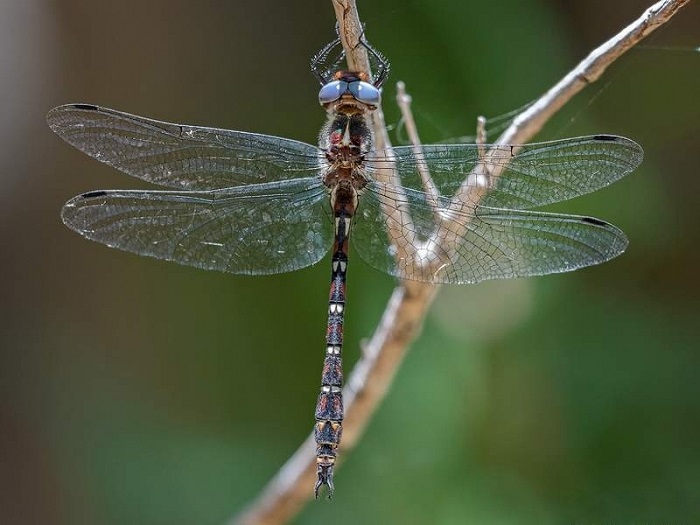
Two-banded Cruiser Phyllomacromia contumax – Male
Mkuze River, KwaZulu-Natal
Photo by Ryan Tippett

Status and Conservation

The Two-banded Cruiser is locally common. It is listed as of Least Concern in the IUCN Red List of Threatened Species. It is a fairly adaptable species and is frequently found around suitable man-made habitats.

Distribution

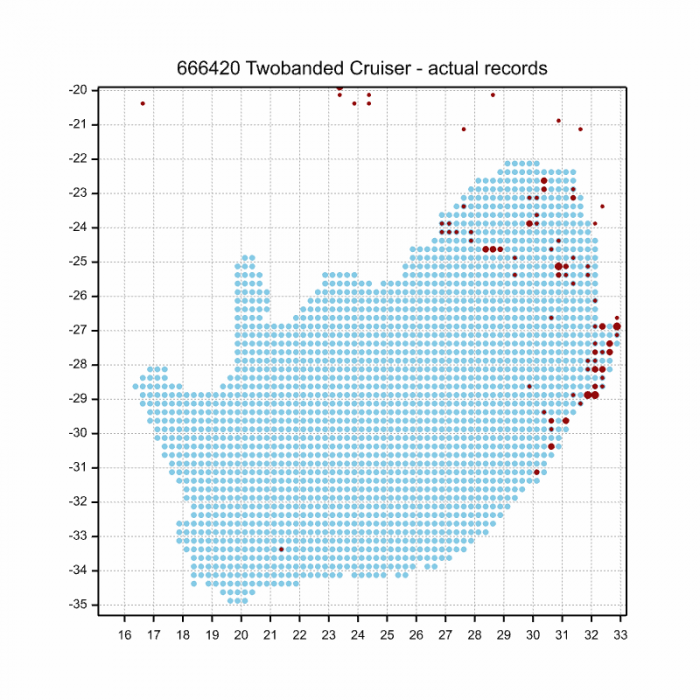
Phyllomacromia contumax is widespread in Sub-Saharan Africa. It is absent only from the arid regions of north-east Africa and the western parts of southern Africa. In South Africa, the Two-banded Cruiser occurs widely in the north and east. It is most abundant in north-eastern KwaZulu-Natal.

Two-banded Cruiser Phyllomacromia contumax – Male
Linyanti, Botswana
Photo by Ryan Tippett

Below is a map showing the distribution of records for Two-banded Cruiser in the OdonataMAP database as at February 2020.

Below is a map showing the distribution of records for Two-banded Cruiser in the OdonataMAP database as of December 2024.

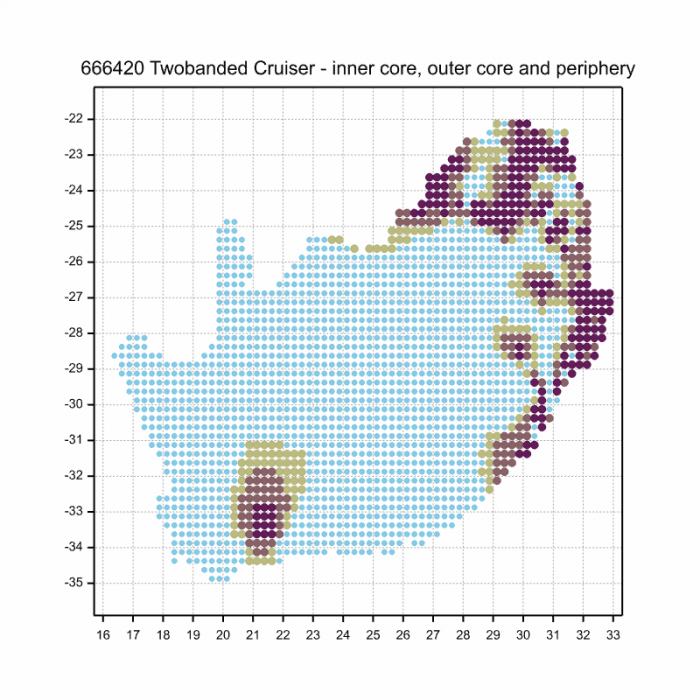
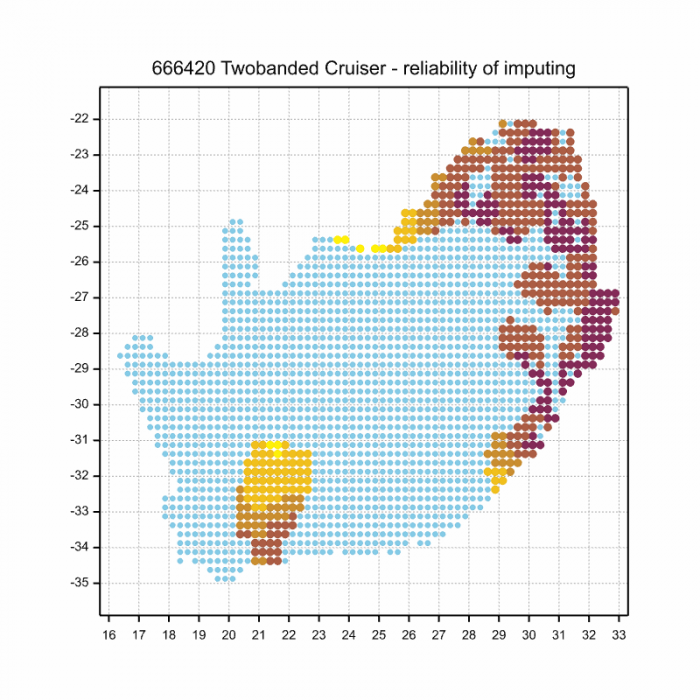
The next map below is an imputed map, produced by an interpolation algorithm, which attempts to generate a full distribution map from the partial information in the map above. This map will be improved by the submission of records to the OdonataMAP section of the Virtual Museum.

Ultimately, we will produce a series of maps for all the odonata species in the region. The current algorithm is a new algorithm. The objective is mainly to produce “smoothed” maps that could go into a field guide for odonata. This basic version of the algorithm (as mapped above) does not make use of “explanatory variables” (e.g. altitude, terrain roughness, presence of freshwater — we will be producing maps that take these variables into account soon). Currently, it only makes use of the OdonataMAP records for the species being mapped, as well as all the other records of all other species. The basic maps are “optimistic” and will generally show ranges to be larger than what they probably are.

These maps use the data in the OdonataMAP section of the Virtual Museum, and also the database assembled by the previous JRS funded project, which was led by Professor Michael Samways and Dr KD Dijkstra.

Two-banded Cruiser Phyllomacromia contumax – Female
Enseleni Nature Reserve, KwaZulu-Natal
Photo by Ryan Tippett

Phenology

Two-banded Cruiser Phyllomacromia contumax – Male
Hluhluwe district, KwaZulu-Natal
Photo by Ryan Tippett

Further Resources

The use of photographs by Bernardine Altenroxel and Gerhardt Diedericks is acknowledged. All other photographs by Ryan Tippett.

Two-banded Cruiser Phyllomacromia contumax Selys, 1879

Other common names: Dubbelbandswalker (Afrikaans)

Recommended citation format: Loftie-Eaton M; Navarro R; Tippett RM; Underhill L. 2025. Two-banded Cruiser Phyllomacromia contumax. Biodiversity and Development Institute. Available online at https://thebdi.org/2020/06/09/two-banded-cruiser-phyllomacromia-contumax/

References: Tarboton, M; Tarboton, W. (2019). A Guide to the Dragonflies & Damselflies of South Africa. Struik Nature.

Samways, MJ. (2008). Dragonflies and Damselflies of South Africa. Pensoft

Samways, MJ. (2016). Manual of Freshwater Assessment for South Africa: Dragonfly Biotic Index. Suricata 2. South African National Biodiversity Institute, Pretoria

Martens, A; Suhling, F. (2007). Dragonflies and Damselflies of Namibia. Gamsberg Macmillan.
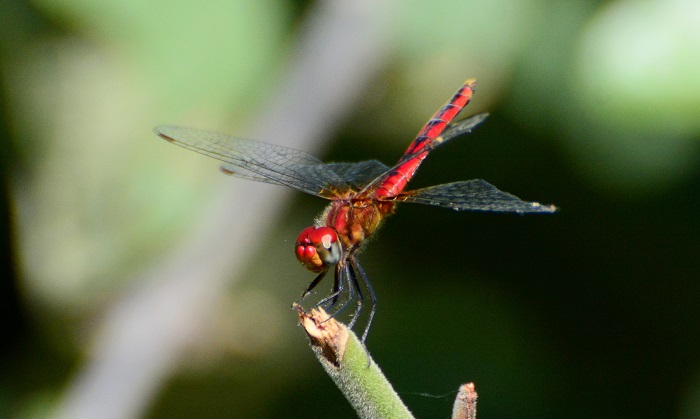
Similar Species

Mahogany Presba (Syncordulia venator)

Cover photo by Felicity Grundlingh.

Find the Mahogany Presba in the FBIS database (Freshwater Biodiversity Information System) here.

Family Synthemistidae

Identification

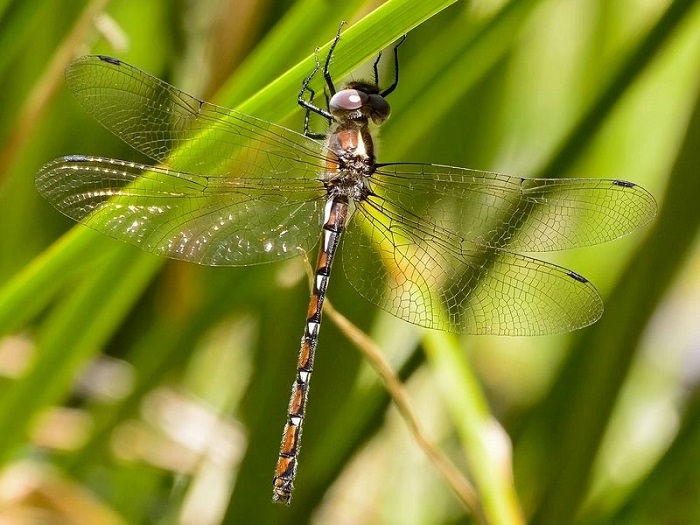
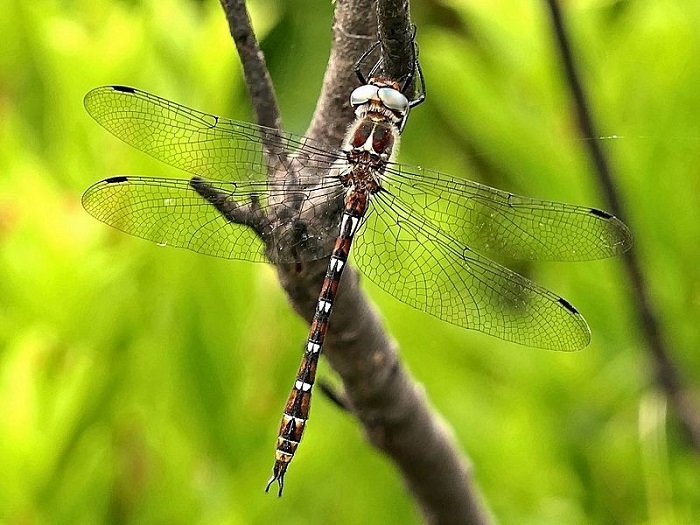
Mahogany Presba Syncordulia venator – Male
Kogelberg Nature Reserve, Western Cape
Photo by Gregg Darling

Medium-large Size

Length up to 50mm; Wingspan reaches 72mm.

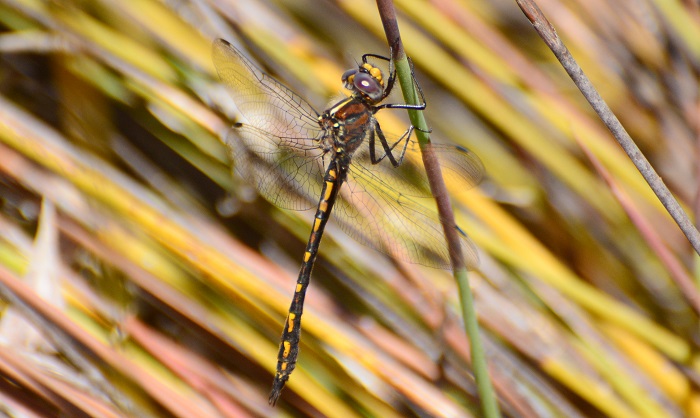
The Mahogany Presba is a very distinctively coloured species. The brown thorax is conspicuously hairy with obscure black lines and markings. The abdomen pattern of cream crescents and triangles, bordered with black, is diagnostic. The sexes closely resemble one another, but females have shorter and broader abdomens. Females also lack the elongated claspers of the male.

It is most likely to be mistaken for the Rustic Presba (Syncordulia serendipator). Both species are predominantly dark-reddish brown, but Syncordulia serendipator is generally darker. The two species also have very differently patterned abdomens.

Click here for more details on identification of the Mahogany Presba.

Mahogany Presba Syncordulia venator – Female
Photo by Hesmarie Els

Habitat

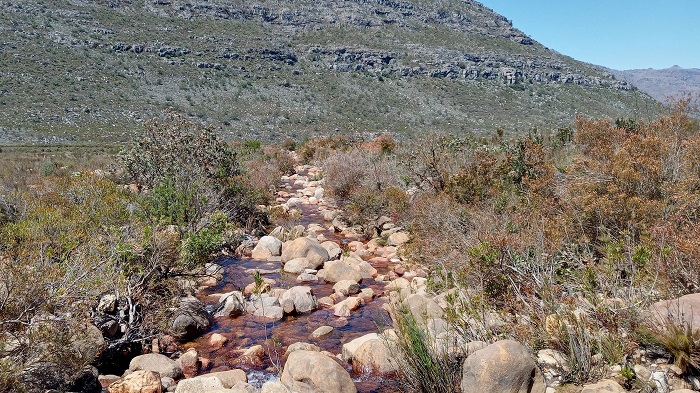
The Mahogany Presba is restricted to fynbos, in rugged, mountainous areas where it frequents rocky streams and rivers with an assortment of boulders and pools. It is partial to areas where there are large bushes fringing the river. The Mahogany Presba also inhabits forested sections of streams surrounded by fynbos vegetation. It occurs between 300 and 1300m above sea level.

Habitat – Mont Rochelle Nature Reserve, Western Cape
Photo by Sharon Stanton

Behaviour

The Mahogany Presba hunts in sustained flight as it courses up and down a chosen route along the stream. It is, however more likely to be encountered some distance from water, hunting over open fynbos vegetation. The flight is fast and direct. The Mahogany Presba hangs vertically from a branch or twig when perched.

It is most active from mid-October to late February. See Phenology below.

Mahogany Presba Syncordulia venator – Male
Photo by Desire Darling

Status and Conservation

The Mahogany Presba is a localised, rare, and little-known dragonfly. It is listed as Vulnerable in the IUCN Red List of Threatened Species. The Mahogany Presba is intolerant towards damage to its fynbos habitat and only occurs in pristine environments.

Mahogany Presba Syncordulia venator – Female
Photo by John Wilkinson

Distribution

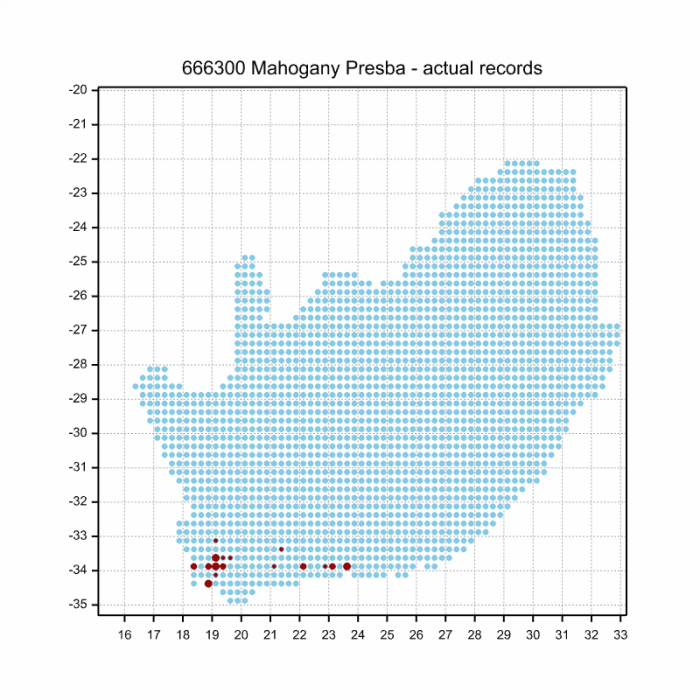
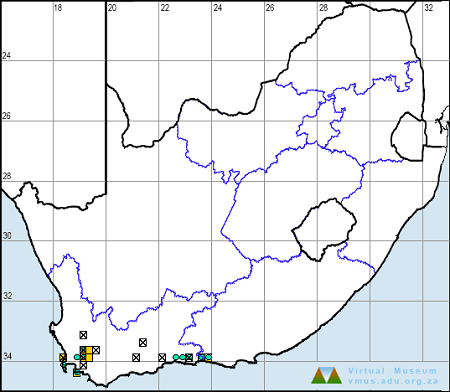
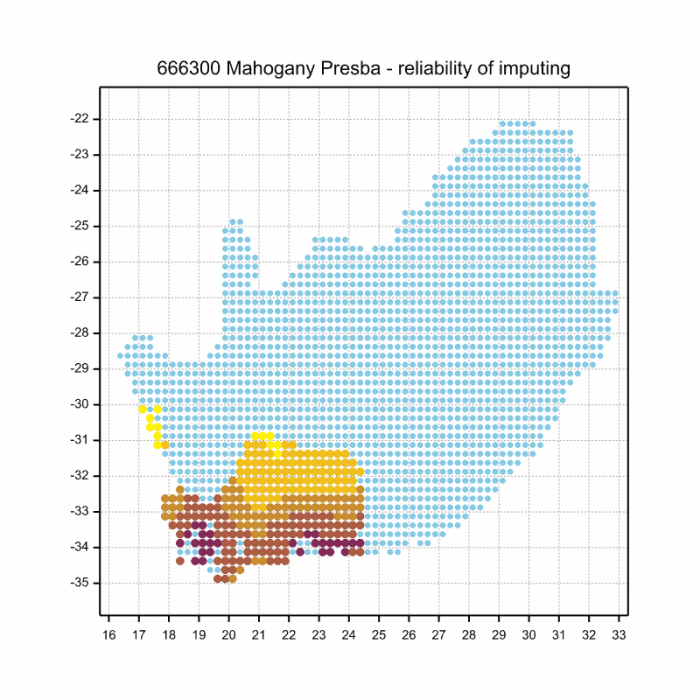
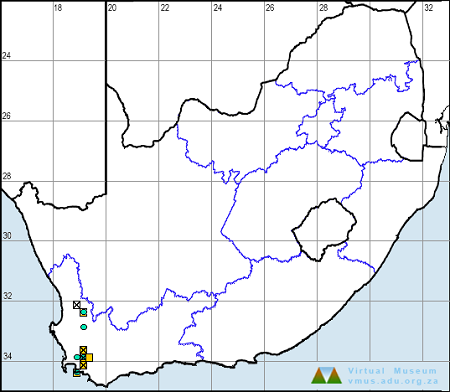
Syncordulia venator is endemic to South Africa, where it is restricted to the mountainous regions of the Western Cape, extending marginally into the Eastern Cape Province.

Below is a map showing the distribution of records for Mahogany Presba in the OdonataMAP database as at February 2020.

Below is a map showing the distribution of records for Mahogany Presba in the OdonataMAP database as of December 2024.

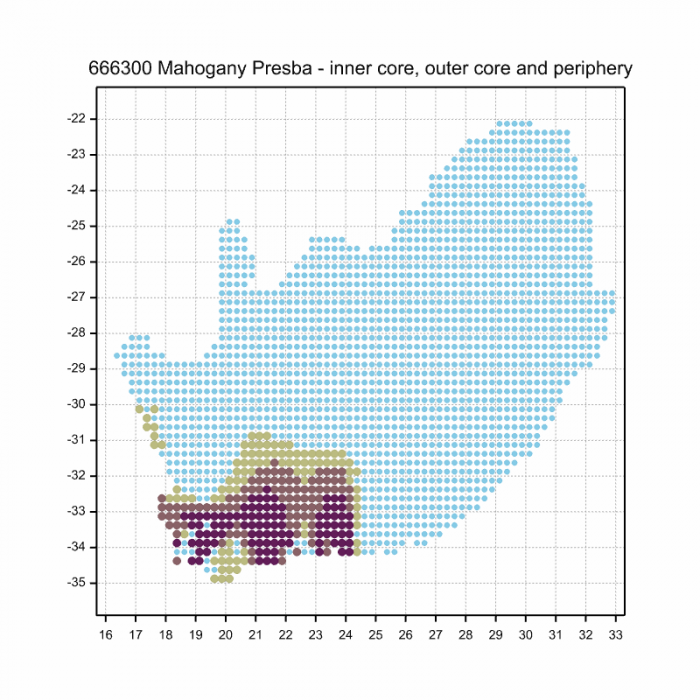
The next map below is an imputed map, produced by an interpolation algorithm, which attempts to generate a full distribution map from the partial information in the map above. This map will be improved by the submission of records to the OdonataMAP section of the Virtual Museum.

Ultimately, we will produce a series of maps for all the odonata species in the region. The current algorithm is a new algorithm. The objective is mainly to produce “smoothed” maps that could go into a field guide for odonata. This basic version of the algorithm (as mapped above) does not make use of “explanatory variables” (e.g. altitude, terrain roughness, presence of freshwater — we will be producing maps that take these variables into account soon). Currently, it only makes use of the OdonataMAP records for the species being mapped, as well as all the other records of all other species. The basic maps are “optimistic” and will generally show ranges to be larger than what they probably are.

These maps use the data in the OdonataMAP section of the Virtual Museum, and also the database assembled by the previous JRS funded project, which was led by Professor Michael Samways and Dr KD Dijkstra.

Phenology

Mahogany Presba Syncordulia venator – Male
Photo by Sharon Stanton

Further Resources

The use of photographs by Desire Darling, Felicity Grundlingh, Gregg Darling, Hesmarie Els, John Wilkinson, and Sharon Stanton is acknowledged.

Mahogany Presba Syncordulia venator Barnard, 1933

Other Common names: Sapeleswalker (Afrikaans)

Recommended citation format: Loftie-Eaton M; Navarro R; Tippett RM; Underhill L. 2025. Mahogany Presba Syncordulia venator. Biodiversity and Development Institute. Available online at https://thebdi.org/2020/06/08/mahogany-presba-syncordulia-venator/

References: Tarboton, M; Tarboton, W. (2019). A Guide to the Dragonflies & Damselflies of South Africa. Struik Nature.

Samways, MJ. (2008). Dragonflies and Damselflies of South Africa. Pensoft

Samways, MJ. (2016). Manual of Freshwater Assessment for South Africa: Dragonfly Biotic Index.Suricata 2. South African National Biodiversity Institute, Pretoria

Similar Species

Rustic Presba (Syncordulia serendipator)

Cover photo by Corrie du Toit.

Find the Rustic Presba in the FBIS database (Freshwater Biodiversity Information System) here.

Family Synthemistidae

Identification

Rustic Presba Syncordulia serendipator – Male
Jonkershoek, Western Cape
Photo by Corrie Du Toit

Medium-large size

Length up to 52mm; Wingspan attains 73mm.

The Rustic Presba can be told apart from other presbas by its overall darker glossy colouration, differently patterned abdomen, and in males by the short, broad claspers. The sexes are similar but females have broader abdomens and a more pronounced amber wash in the wings.

The Rustic Presba most resembles the Yellow Presba (Syncordulia gracilis) and Gilded Presba (Syncordulia legator), however, neither of these species is as dark in colour. They also have differently patterned abdomens and, in males, noticeably more elongated claspers.

Click here for more details on identification of the Rustic Presba.

Habitat

The Rustic Presba frequents rivers and streams, in mountainous fynbos habitats. It requires clear, flowing water with rocks and boulders. The Rustic Presba spends much of its time away from water hunting over the surrounding fynbos.

Habitat – Kogelberg Nature Reserve, Western Cape
Photo by Corné Rautenbach

Behaviour

Much like other Presbas, the Rustic Presba is infrequently found at water. It is most often encountered away from the river, hunting over low fynbos vegetation. The Rustic Presba rests up in dense bushes where it is well camouflaged. It hangs vertically from a branch when perched.

On the wing later in the season than other Syncordulia species. Active from January to late April. See Phenology below.

Status and Conservation

This species is localiseduncommon and endemic to South Africa. It is listed as Vulnerable in the IUCN Red List of Threatened Species. The Rustic Presba is intolerant towards habitat degradation and is only recorded in undamaged habitats.

Distribution

The Rustic Presba is endemic to the South-Western Cape, South Africa. It has a very restricted range and has so far only been recorded at a handful of sites, from Riebeek-Kasteel in the north to Kogelberg Nature Reserve in the South.

Below is a map showing the distribution of records for Rustic Presba in the OdonataMAP database as at February 2020.

Below is a map showing the distribution of records for Rustic Presba in the OdonataMAP database as of December 2024.

The next map below is an imputed map, produced by an interpolation algorithm, which attempts to generate a full distribution map from the partial information in the map above. This map will be improved by the submission of records to the OdonataMAP section of the Virtual Museum.

Ultimately, we will produce a series of maps for all the odonata species in the region. The current algorithm is a new algorithm. The objective is mainly to produce “smoothed” maps that could go into a field guide for odonata. This basic version of the algorithm (as mapped above) does not make use of “explanatory variables” (e.g. altitude, terrain roughness, presence of freshwater — we will be producing maps that take these variables into account soon). Currently, it only makes use of the OdonataMAP records for the species being mapped, as well as all the other records of all other species. The basic maps are “optimistic” and will generally show ranges to be larger than what they probably are.

These maps use the data in the OdonataMAP section of the Virtual Museum, and also the database assembled by the previous JRS funded project, which was led by Professor Michael Samways and Dr KD Dijkstra.

Phenology

Further Resources

The use of photographs by Desire Darling, Felicity Grundlingh, Gregg Darling, Hesmarie Els, John Wilkinson, and Sharon Stanton is acknowledged.

Rustic Presba Syncordulia serendipator Dijkstra, Samways & Simaika, 2007

Other Common names: Rustieke Swalker (Afrikaans)

Recommended citation format: Loftie-Eaton M; Navarro R; Tippett RM; Underhill L. 2025. Rustic Presba Syncordulia serendipator. Biodiversity and Development Institute. Available online at https://thebdi.org/2020/06/08/rustic-presba-syncordulia-serendipator/

References: Tarboton, M; Tarboton, W. (2019). A Guide to the Dragonflies & Damselflies of South Africa. Struik Nature.

Samways, MJ. (2008). Dragonflies and Damselflies of South Africa. Pensoft

Samways, MJ. (2016). Manual of Freshwater Assessment for South Africa: Dragonfly Biotic Index.Suricata 2. South African National Biodiversity Institute, Pretoria

Similar Species

Gilded Presba (Syncordulia legator)

Cover photo by Basil Boer.

Find the Gilded Presba in the FBIS database (Freshwater Biodiversity Information System) here.

Family Synthemistidae

Identification

Gilded Presba Syncordulia legator – Male
Kogelberg Nature Reserve, Western Cape
Photo by Basil Boer

Medium-large size

Length up to 49mm; Wingspan attains 70mm.

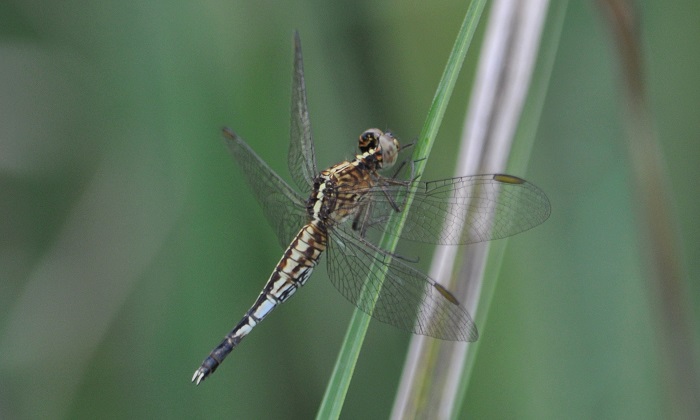
The Gilded Presba is a very distinctively marked species. The chocolate brown thorax is noticeably hairy and carries indistinct black lines and markings with a single pale stripe above. The abdomen pattern is diagnostic, being dark yellow with black bands and streaks. The sexes are alike in terms of colouration but differ in abdomen shape. Males have fairly slender abdomens that broaden towards the tip, and they have distinctly elongate black claspers. Females have broader abdomens and lack the elongate claspers.

Gilded Presba Syncordulia legator – Male
Cedarberg Wilderness Area, Western Cape
Photo by Ryan Tippett

The Gilded Presba is most similar to the Yellow Presba (Syncordulia gracilis), but that species has diagonal yellow bands on the sides of the thorax and a differently patterned abdomen.

Click here for more details on identification of the Gilded Presba.

Habitat

The Gilded Presba is restricted to the fynbos biome. It inhabits flowing, rocky streams and rivers, and surrounding fynbos vegetation. It mostly flies over open and fairly flat terrain in hilly or mountainous areas. The Gilded Presba is confined to pristine, undisturbed habitats up to 800m above sea level.

Typical habitat
Cedarberg Wilderness Area, Western Cape
Photo by Ryan Tippett
Behaviour

The Gilded Presba hunts in sustained flight as it courses up and down a chosen route along the stream. However, the Gilded Presba is just as likely to be encountered some distance from water, hunting aerial insects over open fynbos vegetation. Adults spend relatively little time at the water. The flight is fast and direct. The Gilded Presba hangs vertically from a branch or twig when perched. It often perches fairly close to the ground and is most likely to be seen perched during the hottest part of the day.

The Gilded Presba starts flying earlier in the season than other Presbas. It is on the wing from late September to early December. See Phenology below.

Status and Conservation

The Gilded Presba is a rare and localised South African endemic. It is listed as Vulnerable in the IUCN Red List of Threatened Species. The Gilded Presba is intolerant of habitat degradation and only occurs at pristine, undisturbed sites.

Gilded Presba Syncordulia legator – Male
Cedarberg Wilderness Area, Western Cape
Photo by Ryan Tippett

Distribution

The Gilded Presba is endemic to South Africa, where it is confined to the mountainous regions of the Western Cape. Occurs from the Cedarberg in the North to the Kogelberg Nature Reserve in the South.

Below is a map showing the distribution of records for Gilded Presba in the OdonataMAP database as at February 2020.

Below is a map showing the distribution of records for Gilded Presba in the OdonataMAP database as at December 2024.

The next map below is an imputed map, produced by an interpolation algorithm, which attempts to generate a full distribution map from the partial information in the map above. This map will be improved by the submission of records to the OdonataMAP section of the Virtual Museum.

Ultimately, we will produce a series of maps for all the odonata species in the region. The current algorithm is a new algorithm. The objective is mainly to produce “smoothed” maps that could go into a field guide for odonata. This basic version of the algorithm (as mapped above) does not make use of “explanatory variables” (e.g. altitude, terrain roughness, presence of freshwater — we will be producing maps that take these variables into account soon). Currently, it only makes use of the OdonataMAP records for the species being mapped, as well as all the other records of all other species. The basic maps are “optimistic” and will generally show ranges to be larger than what they probably are.

These maps use the data in the OdonataMAP section of the Virtual Museum, and also the database assembled by the previous JRS funded project, which was led by Professor Michael Samways and Dr KD Dijkstra.

Phenology

Further Resources

The use of photographs by Basil Boer, and Corné Rautenbach is acknowledged.

Gilded Presba Syncordulia legator Dijkstra, Samways & Simaika, 2007

Other Common names: Goudvlekswalker (Afrikaans)

Recommended citation format: Loftie-Eaton M; Navarro R; Tippett RM; Underhill L. 2025. Gilded Presba Syncordulia legator.  Biodiversity and Development Institute. Available online at https://thebdi.org/2020/06/08/gilded-presba-syncordulia-legator/

References: Tarboton, M; Tarboton, W. (2019). A Guide to the Dragonflies & Damselflies of South Africa. Struik Nature.

Samways, MJ. (2008). Dragonflies and Damselflies of South Africa. Pensoft

Samways, MJ. (2016). Manual of Freshwater Assessment for South Africa: Dragonfly Biotic Index.Suricata 2. South African National Biodiversity Institute, Pretoria

Similar Species

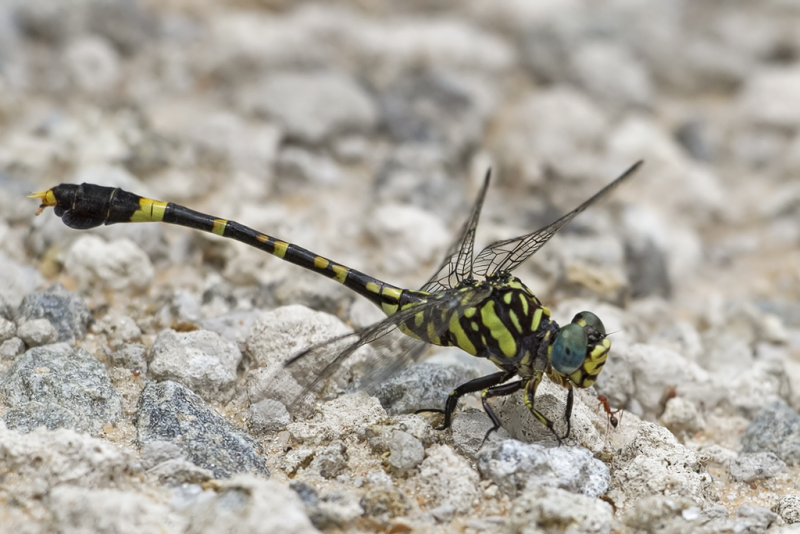
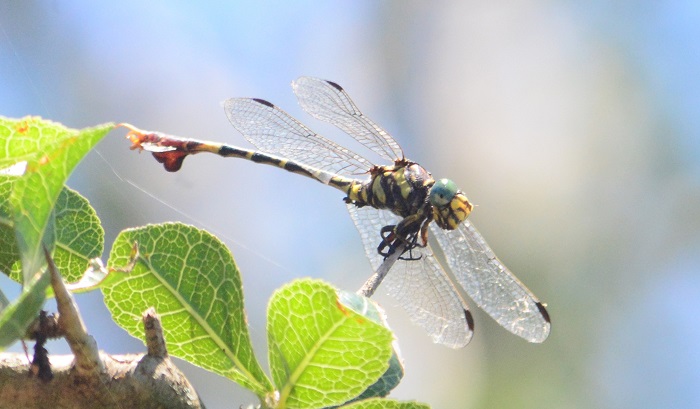
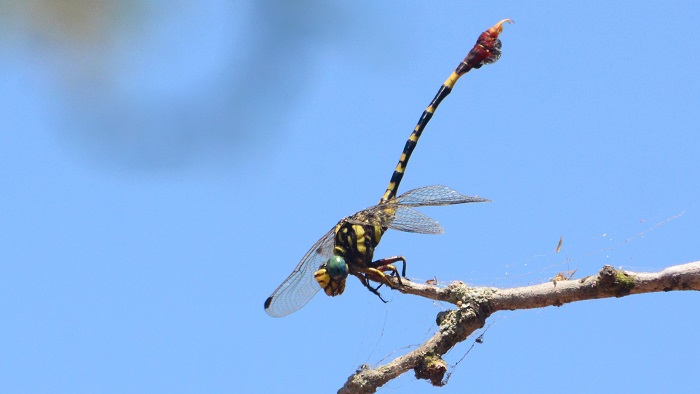
Flapper Hooktail (Paragomphus sabicus)

Cover photo by Desire Darling.

Find the Flapper Hooktail in the FBIS database (Freshwater Biodiversity Information System) here.

Family Gomphidae

Identification

Flapper Hooktail Paragomphus sabicus – Male
Ndumo Game Reserve, KwaZulu-Natal
Photo by Ryan Tippett
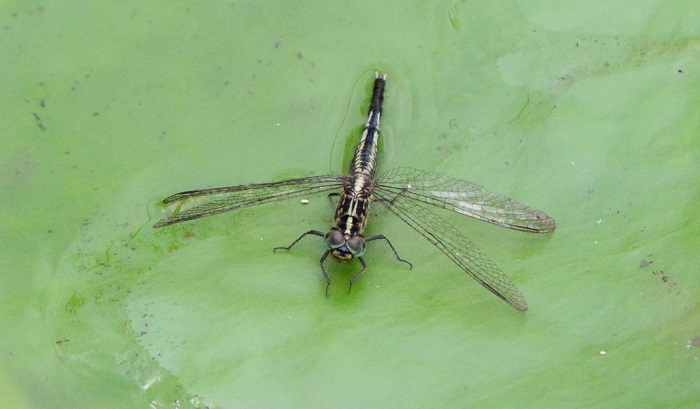
Medium-large size

Length reaches 54mm;

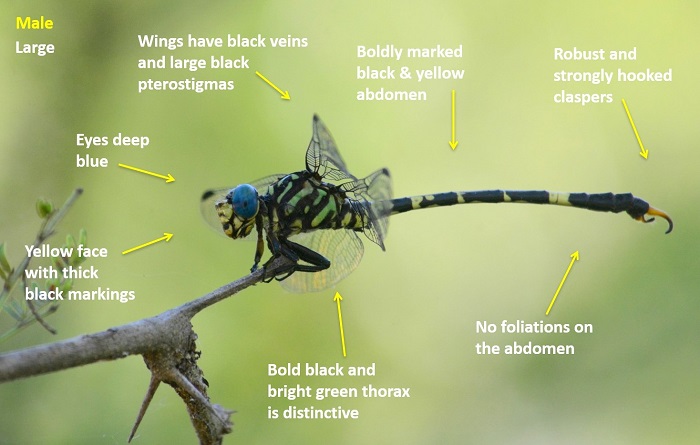
The male Flapper Hooktail Paragomphus sabicus is readily identified by the combination of its greenish-yellow and black colouration, large black-brown foliations, and the elongate, hooked upper claspers. Females are similar to the males but lack the hooked claspers and carry smaller foliations on the abdomen.

The Flapper Hooktail most resembles the Rock Hooktail Paragomphus cognatus, but that species is noticeably smaller and the hooked upper claspers are black-tipped and outwardly splayed. The Rock Hooktail also bears noticeably smaller and paler tail foliations.

Click here for more details on identification of the Flapper Hooktail.

Flapper Hooktail Paragomphus sabicus – Female
Ndumo Game Reserve, KwaZulu-Natal
Photo by Ryan Tippett
Habitat

The Flapper Hooktail is a species of large, flowing savanna rivers with well-wooded banks and usually an abundance of reeds. Individuals are most likely to be found away from the water in the surrounding woodlands above the riverbank.

Habitat – Ndumo Game Reserve, KwaZulu-Natal
Photo by Ryan Tippett
Behaviour

The Flapper Hooktail is seldom seen at the water’s edge. Both sexes of the Flapper Hooktail are most often found perched among trees and bushes above the riverbank. This species hunts from a perch, making swift flights to intercept prey before returning to settle once again. It can be fairly tame and confiding.

The Flapper Hooktail flies mostly from November to March (See Phenology below).

Flapper Hooktail Paragomphus sabicus – Male
Ndumo Game Reserve, KwaZulu-Natal
Photo by Ryan Tippett

Status and Conservation

The Flapper Hooktail is uncommon to rare and localised in South Africa. Overall, it is listed as of Least Concern in the IUCN Red List of Threatened Species. In South Africa, the Flapper Hooktail is only known from undisturbed habitats.

Flapper Hooktail Paragomphus sabicus – Male
Ndumo Game Reserve, KwaZulu-Natal
Photo by Ryan Tippett
Distribution

The Flapper Hooktail is sparsely and erratically distributed across its range, occurring mainly in Southern and East Africa. It ranges from north-eastern South Africa up through parts of Zimbabwe, Northern Botswana, and Namibia to Zambia, Malawi, Tanzania, and Kenya. It has also been recorded once from the Nile River in Sudan.

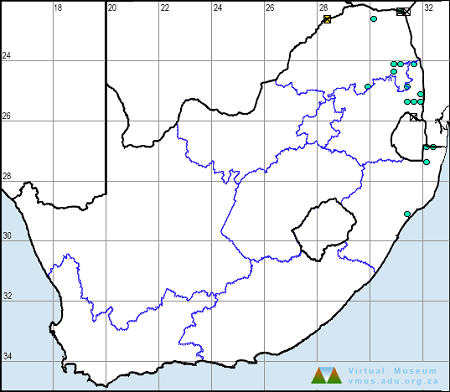
In South Africa, the Flapper Hooktail is restricted to hot, low-lying areas in the Limpopo River valley, the Lowveld, and north-eastern KwaZulu-Natal.

Below is a map showing the distribution of records for Flapper Hooktail in the OdonataMAP database as at February 2020.

Below is a map showing the distribution of records for Flapper Hooktail in the OdonataMAP database as at December 2024.

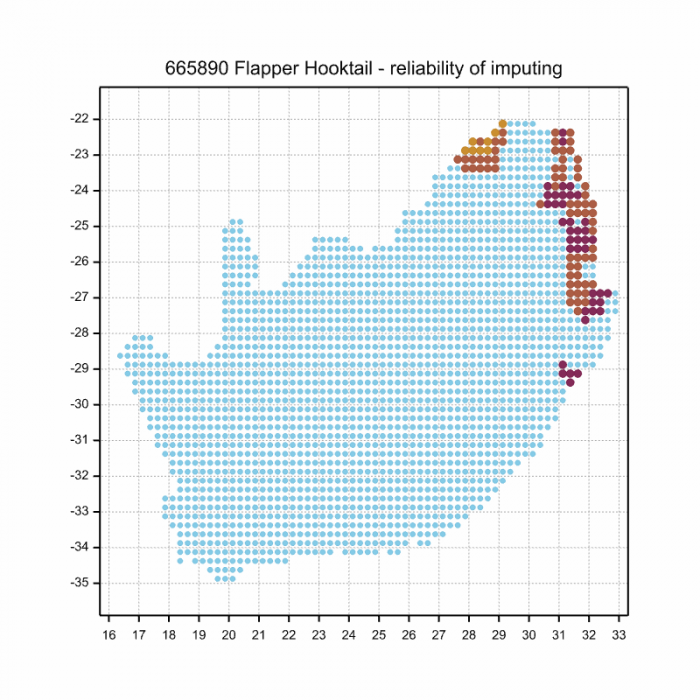
The next map below is an imputed map, produced by an interpolation algorithm, which attempts to generate a full distribution map from the partial information in the map above. This map will be improved by the submission of records to the OdonataMAP section of the Virtual Museum.

Ultimately, we will produce a series of maps for all the odonata species in the region. The current algorithm is a new algorithm. The objective is mainly to produce “smoothed” maps that could go into a field guide for odonata. This basic version of the algorithm (as mapped above) does not make use of “explanatory variables” (e.g. altitude, terrain roughness, presence of freshwater — we will be producing maps that take these variables into account soon). Currently, it only makes use of the OdonataMAP records for the species being mapped, as well as all the other records of all other species. The basic maps are “optimistic” and will generally show ranges to be larger than what they probably are.

These maps use the data in the OdonataMAP section of the Virtual Museum, and also the database assembled by the previous JRS funded project, which was led by Professor Michael Samways and Dr KD Dijkstra.

Phenology

Further Resources

The use of photographs by Desire Darling is acknowledged. All other photographs by Ryan Tippett.

Flapper Hooktail Paragomphus sabicus (Pinhey, 1950)

Other common names: Sabi Hooktail, Clubbed Hooktail (Alt. English); Flaphakiestert (Afrikaans)

Recommended citation format: Loftie-Eaton M; Navarro R; Tippett RM; Underhill L. 2025. Flapper Hooktail Paragomphus sabicus.  Biodiversity and Development Institute. Available online at https://thebdi.org/2020/06/08/flapper-hooktail-paragomphus-sabicus/

References: Tarboton, M; Tarboton, W. (2019). A Guide to the Dragonflies & Damselflies of South Africa. Struik Nature.

Samways, MJ. (2008). Dragonflies and Damselflies of South Africa. Pensoft

Samways, MJ. (2016). Manual of Freshwater Assessment for South Africa: Dragonfly Biotic Index.Suricata 2. South African National Biodiversity Institute, Pretoria

Martens, A; Suhling, F. (2007). Dragonflies and Damselflies of Namibia. Gamsberg Macmillan.

Similar Species

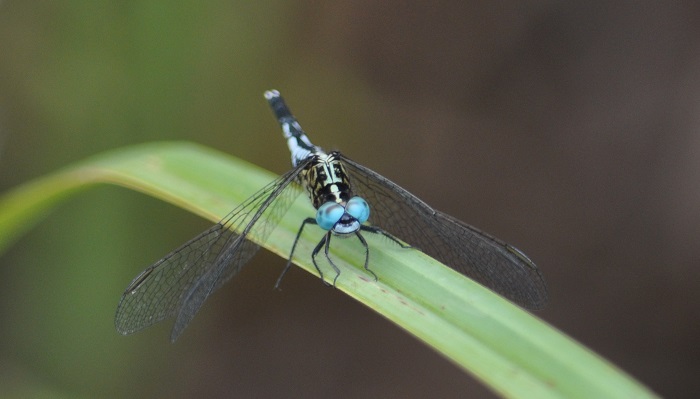
Great Hooktail (Paragomphus magnus)

Cover photo by Wil Leurs.

Find the Great Hooktail in the FBIS database (Freshwater Biodiversity Information System) here.

Family Gomphidae

Identification

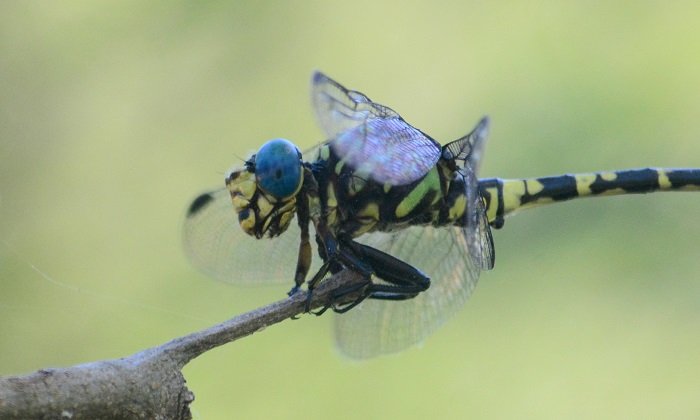
Great Hooktail Paragomphus magnus – Male
Pongola River, KwaZulu-Natal
Photo by Ryan Tippett

Large size

Length up to 58mm.

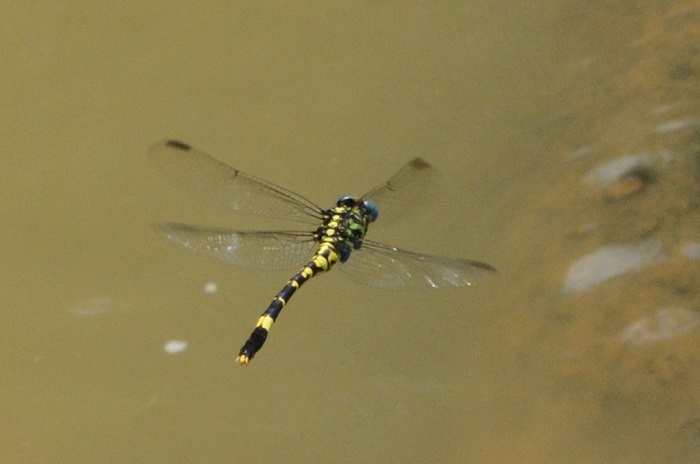
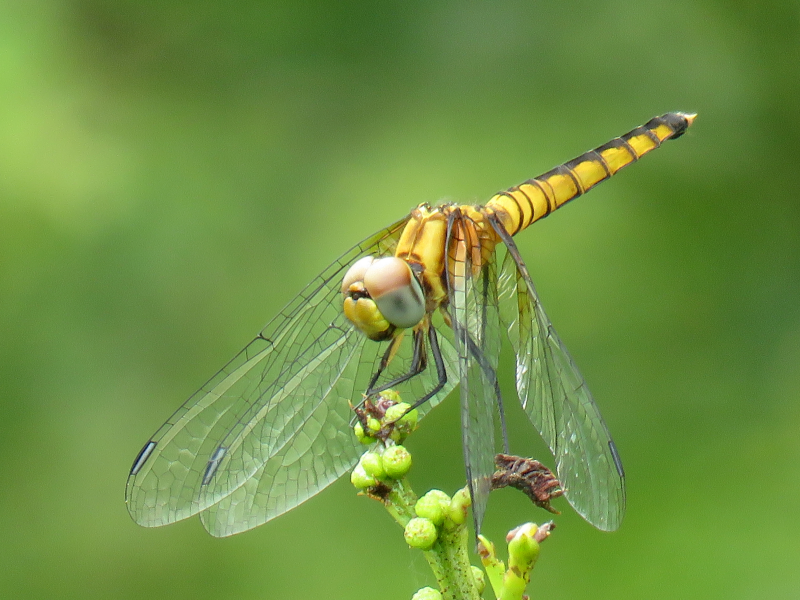
The Great Hooktail is a large and striking species. The combination of its large size, distinctive colouration and lack of foliations on the abdomen render this species unmistakable. Females, however, may be mistaken for those of the Zambezi Siphontail (Neurogompohus zambeziensis), but are more robustly built and with different thorax markings.

The sexes are similar but females lack the strongly hooked claspers of the male. Females are slightly duller, having a yellow-green and black thorax, rather than the bright green and black of the males.

Click here for more details on identification of the Great Hooktail.

Great Hooktail Paragomphus magnus – Female
Mkuze River, KwaZulu-Natal
Photo by Ryan Tippett

Habitat

The Great Hooktail inhabits the savanna rivers of the Lowveld and Northern KwaZulu-Natal. It prefers rocky, flowing rivers with rapids and well-wooded banks lined by trees and reeds.

Habitat – Mkuze River, KwaZulu-Natal
Photo by Ryan Tippett
Behaviour

Not much is known about the Great Hooktail. It mostly perches on trees, both next to the water and in woodland above the riverbank. The Great Hooktail often sits fairly high up. It is also known to sit on the tips of reeds and sometimes on rocks near the water. Females have been observed depositing their eggs at rocky river sections with shallow, fast-flowing water. It hunts from a perch and has a fast, powerful flight.

The Great Hooktail is most active from October to April. See Phenology below.

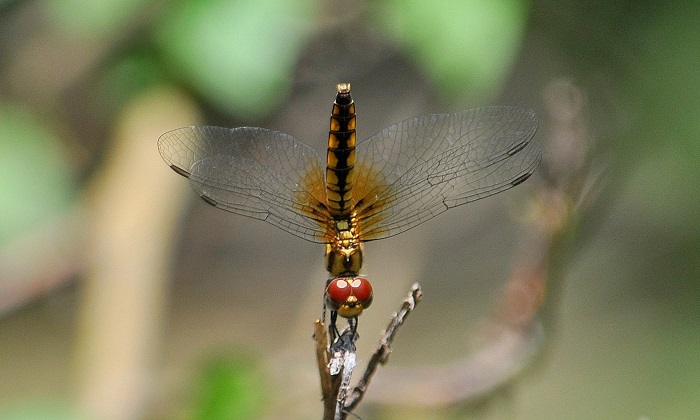
Great Hooktail Paragomphus magnus – Female
Amakhosi Game Reserve, KwaZulu-Natal
Photo by Ryan Tippett

Status and Conservation

Paragomphus magnus is an uncommon and localised species. It was first recorded in South Africa as recently as 2012. It is listed as of Least Concern in the IUCN Red List of Threatened Species.

Distribution

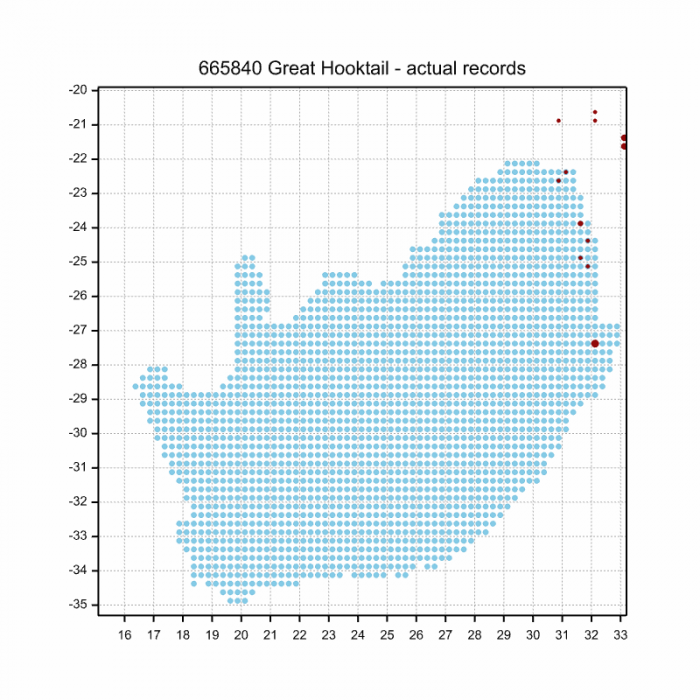
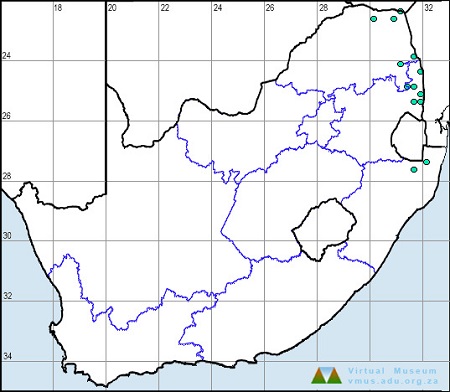
The Great Hooktail is very thinly distributed from northern South Africa, Zimbabwe, and Mozambique up to Malawi, Tanzania, and Kenya. In South Africa, the Great Hooktail has only been recorded from several localities in northeastern KwaZulu-Natal, and the Limpopo and Mpumalanga lowveld.

Below is a map showing the distribution of records for South Africa for the Great Hooktail. Taken from the OdonataMAP database as at February 2020.

Below is a map showing the distribution of records for South Africa for the Great Hooktail. Taken from the OdonataMAP database as of December 2024.

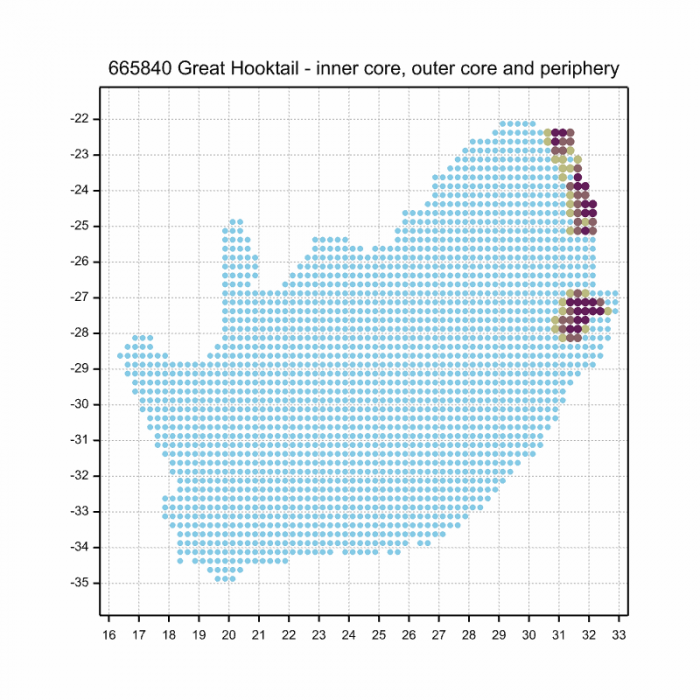
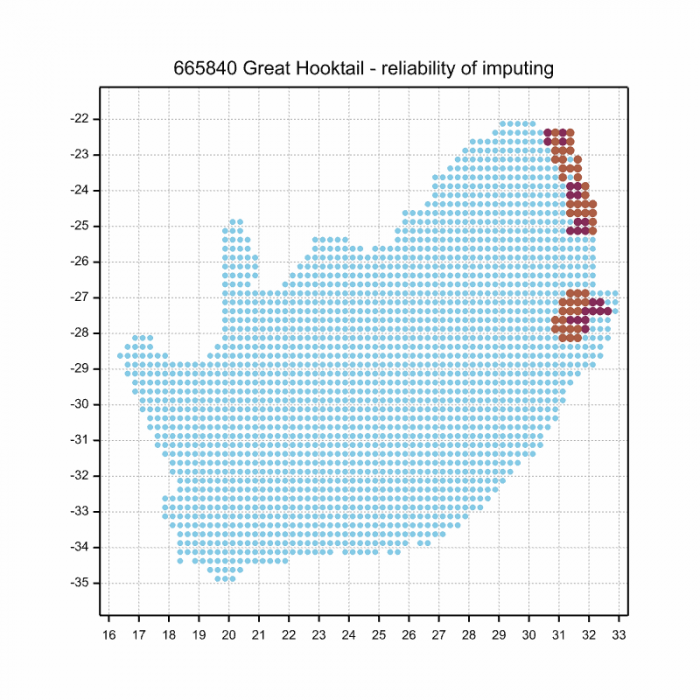
The next map below is an imputed map, produced by an interpolation algorithm, which attempts to generate a full distribution map from the partial information in the map above. This map will be improved by the submission of records to the OdonataMAP section of the Virtual Museum.

Ultimately, we will produce a series of maps for all the odonata species in the region. The current algorithm is a new algorithm. The objective is mainly to produce “smoothed” maps that could go into a field guide for odonata. This basic version of the algorithm (as mapped above) does not make use of “explanatory variables” (e.g. altitude, terrain roughness, presence of freshwater — we will be producing maps that take these variables into account soon). Currently, it only makes use of the OdonataMAP records for the species being mapped, as well as all the other records of all other species. The basic maps are “optimistic” and will generally show ranges to be larger than what they probably are.

These maps use the data in the OdonataMAP section of the Virtual Museum, and also the database assembled by the previous JRS funded project, which was led by Professor Michael Samways and Dr KD Dijkstra.

Great Hooktail Paragomphus magnus – Male
Pongola River, KwaZulu-Natal
Photo by Ryan Tippett

Further Resources

The use of photographs by Wil Leurs is acknowledged. Other photographs by Ryan Tippett.

Great Hooktail Paragomphus magnus Fraser, 1952

Other common names: Groothakiestert (Afrikaans)

Recommended citation format: Loftie-Eaton M; Navarro R; Tippett RM; Underhill L. 2025. Great Hooktail Paragomphus magnus. Biodiversity and Development Institute. Available online at https://thebdi.org/2020/06/08/great-hooktail-paragomphus-magnus/
References: Tarboton, M; Tarboton, W. (2019). A Guide to the Dragonflies & Damselflies of South Africa. Struik Nature.

Samways, MJ. (2008). Dragonflies and Damselflies of South Africa. Pensoft

Samways, MJ. (2016). Manual of Freshwater Assessment for South Africa: Dragonfly Biotic Index. Suricata 2. South African National Biodiversity Institute, Pretoria

Martens, A; Suhling, F. (2007). Dragonflies and Damselflies of Namibia. Gamsberg Macmillan.

Similar Species