BDInsight – July 2020

Life in lockdown has become almost normal. I, for one, have lost count of the number of days we’ve been in lockdown here in South Africa. We adapt to the ebb and flow of this strange new reality and life continues. On the BioMAPping front things have been fantastic! Citizen scientists from across Africa have united under the common cause of being ambassadors for Africa’s biodiversity. The global corona virus pandemic has not dampened the spirits of citizen scientists!

BestJuly for the Virtual Museum

We reached BestJuly in the Virtual Museum by more than 1,300 records. BioMAPpers uploaded 8,160 records to the VM for July 2020, compared to the previous BestJuly of 6,805 records. Well done BioMAPpers! It is awesome to see so much enthusiasm for biodiversity.

We added 20% more records to distribution maps in July 2020 than we did in July last year. We both filled in gaps in maps, and we refreshed old records, providing up-to-date evidence of continued occurrence in grid cells. Well done, Team Virtual Museum. July was also memorable for the initiation of the Citizen Scientist Hours and Virtual BioBashes. Watch this space for details of future events. If you missed them live, you can catch up with them on the BDI YouTube channel.

BDI BioBash for Africa

Keeping distribution maps up to date is the key objective of the Virtual Museum. So in July, we held a BDI BioBash for Africa. We encouraged all our citizen scientists to collect data for the Virtual Museum wherever they are on the African continent, and in whatever places they are able to reach. It’s winter here in the southern bit of Africa, so this is the opportunity for citizen scientists in warmer climates to shine. This is from about the Limpopo Valley northwards! We hosted four Virtual BioBashes during the month, on 10, 19, 28 and 31 July. The Virtual BioBashes were held on Zoom, so all you needed to attend was an internet connection.

We gave as many participants as possible the opportunity to show-and-tell us about their BioMAPping adventures: two or three photos to show us where in Africa they BioBashed, and some photos to show us what they discovered and uploaded to the Virtual Museum.

Zooming BioMAPpers having fun at this evening’s BDI Virtual BioBash. What a treat to see all the wonderful biodiversity across Africa, from Kenya to Cape Town.

We had BioMAPpers from all over Africa joining in: Somalia, Nigeria, Liberia, Kenya, Botswana, Namibia, South Africa, and many other countries. It has been great to connect with so many enthusiastic people across the continent.

You can catch up on all the wonderful July BioBash presentations here: https://www.youtube.com/playlist?list=PLiP0CQKPs5gNOg82dExM_OxvByKzrqYwq

Citizen Scientist Hours

During July we have also been hosting Citizen Scientist Hours on Zoom. It has been great fun and very informative. These “Hours” have been a great opportunity for the citizen scientist community in Africa to come together and learn from each other.

The second BDI Citizen Scientist Hour was held on Sunday evening, 5 July. It was a Zoom event, so people could participate without travelling. The presenters for the evening were:

  • PC Ferreira – Why is it a good idea to submit lots of records to the Virtual Museum AND visit the Karoo Gariep Nature Reserve?
  • Taylyn Risi – Are you able to help me with data collection for my MSc project?
  • John Wilkinson – How did I get passionate about dragonflies and damselflies?
  • Sidney Shema – What has the bird atlas project in Kenya achieved?

Once upon a time PC was just a sheep farmer in the Karoo; now he is working out how to do sheep AND biodiversity. Taylyn is an MSc student at UCT, researching moult in as many of the world’s oystercatcher species as feasible. She also sings the songs she writes. John sends tons of grapefruit, lemons and oranges all over the world from Tshipese in Limpopo. Ten years after his first encounter with a dragonfly he heads the OdonataMAP expert panel. Sidney is based in Nairobi at the Ornithology Section of the National Museums of Kenya. He is the coordinator of the Kenya Bird Map project.

The third BDI Citizen Scientist Hour was held on Wednesday evening, 15 July. The three presenters for the evening were:
  • Clara Cassell – Liberian Bird Atlas Project
  • Rio Button – on the exciting Wildcards.world initiative
  • Steve Woodhall – how an industrial polymers specialist came to write the definitive butterfly guide for South Africa!

If you would like to be part of these events, please email Itxaso Quintana (itxaso@thebdi.org) or me (megan@thebdi.org). We need your name and email address, and we will send you the details of how to attend a day or so beforehand. We plan to do many more Citizen Science Hours and Virtual BioBashes.
BDInsight – June 2020

Another month has flown by, here in South Africa we are still under lockdown, but that has not deterred BioMAPpers from uploading all sorts of wonderful and interesting records to the Virtual Museum. We also held our first two Virtual BioBashes via Zoom and Microsoft Teams and our first BDI Citizen Scientist Hour.

BestJune for the Virtual Museum

We have reached the middle of 2020, and are still building distribution maps. But we need to keep those maps up-to-date, so they remain relevant to conservation planning and priority setting. The RED line (graph below) shows that, for the first three months this year, totals were a bit above last year’s totals. April and May came close. But June has put us ahead again. The number of records for June (8,516) was 10% above June last year (7,734).

The total for the year-so-far is 58,601, just a little bit ahead of the total at the end of June last year (56,852). That’s 3% ahead. Given the circumstances of 2020, a 3% increase is remarkable. Please keep an eye open for the advertizing for BDI Citizen Scientist Hours and Virtual BioBashes! Thanks, Team VM, for your support.

BDI Citizen Scientist Hour

The first BDI Citizen Scientist Hour was held on Tuesday evening, 30 June, from 19:30 to 20:30 South African time. It was Zoom event, and 34 people attended from all across Africa. We had four awesome presentations:

  • Karis Daniel: Why is BirdPix important right now?
  • Magda Remisiewicz: What was it like doing bird ringing in Hel during lockdown?
  • Sam Ivande: Why has participation by citizen scientists in the Nigerian Bird Atlas Project exceeded expectations?
  • Kate Braun: What’s interesting about moths?

Karis is an MSc student at the University of Cape Town. Magda was a postdoc at UCT for three years a decade ago, and is an Associate Professor at the University of Gdansk, Poland, heading up the Bird Migration Research Station. Sam is at the University of Jos in Nigeria, linked onto the A.P Leventis Ornithological Research Institute. Kate leads several biodiversity initiatives in eSwatini (Swaziland).

This was our first “public” Zoom event. We plan to do more Citizen Science Hours, and we are also planning at least one Virtual BioBash for July 2020.

The second BDI Citizen Scientist Hour is planned for Sunday evening, 5 July, 19:30 to 20:30, Central African Time. It is a Zoom event, so you can participate without travelling. There will be an opportunity to ask questions, but we will try hard to stick within the hour:

• PC Ferreira: Why is it a good idea to submit lots of records to the Virtual Museum AND visit the Karoo Gariep Nature Reserve?
• Taylyn Risi: Are you able to help me with data collection for my MSc project?
• John Wilkinson: How did I get passionate about dragonflies and damselflies?
• Sidney Shema: What has the bird atlas project in Kenya achieved?

Once upon a time PC was just a sheep farmer in the Karoo; now he is working out how to do sheep AND biodiversity. Taylyn is an MSc student at UCT, researching moult in as many of the world’s oystercatcher species as feasible. She also sings the songs she writes. John sends tons of grapefruit, lemons and oranges all over the world from Tshipise in Limpopo. Ten years after his first encounter with a dragonfly he heads the OdonataMAP expert panel. Sidney is based in Nairobi at the Ornithology Section of the National Museums of Kenya. He is the coordinator of the Kenya Bird Map project.

Our Zoom licence is for 100 people attending an event. If you would like to be part of this, please email Itxaso Quintana itxaso@thebdi.org. She needs your name and email address. We will send you the details of how to attend a day beforehand. We plan to do more Citizen Science Hours, and we are also doing an African Virtual BioBash this month, July. The video from the First BDI Citizen Scientist Hour will go onto YouTube next week.

The Plight of the African Penguin

It has been 20 years since the “Treasure”, an iron-ore carrier, sank between Dassen Island and Robben Island off the coast of Cape Town. These penguins were ashore on Robben Island the next day (photo below). The bad news is that we can never have an oil spill on this scale again. There are simply not enough African Penguins. From around 2003 onwards, the penguin population in the Western Cape decreased. Plummeted is a better description. The problem seems to be food-related (i.e. it is not about oil). The food problem could be fishery-related or climate-change-related, or most likely a combination of both. And this makes it hard to solve. The conservation of African Penguins in their natural habitat is going to be a tough challenge.

BioMAPping in Lockdown – Derek Solomon shares his experience

Please tell us a bit about yourself, and why do you love biomapping?

I am a wildlife sound recordist, safari guide and enthusiastic amateur wildlife photographer. Biomapping gives another dimension to all of the data I collect, making it available to others whether professional or amateur.

What has your experience been during lockdown and has biomapping helped you in any way to cope with these new challenges we face?

Biomapping during lockdown has helped to focus attention to the smaller creatures and plants. A large Euphorbia cooperi in our garden (photo below) has been flowering for much of lockdown and producing copious amounts of nectar that in turn is attracting a wide variety of insects, spiders and small predators such as lizards. I have been able to photograph and learn about over 50 species of insects, most of which are new to me – a unique opportunity that has provided hours of pleasure and entertainment each day.

Where have you been biomapping during lockdown and what has the experience been like for you?

My biomapping has exclusively been on our home plot in Raptors View Wildlife Estate in Hoedspruit, Limpopo Province. Under level 4 of the lockdown period I, along with several friends, have been keeping busy surveying the birds of the estate. Rather than visually recording species, most of my records have been from sounds picked up by microphones and recorders placed at two points around the house allowing me to include many species of diurnal and nocturnal birds without having to venture outside at inconvenient times. Of course this means many hours in front of a computer analysing the many sounds, both mammal and bird sounds that have been captured. Lockdown days have therefore been very busy.

Recording the sounds of the local wildlife – Raptors View Wildlife Estate

Have you learnt anything new?

Yes, macro photography which has been neglected in the past. New sounds made by birds, mammals and insects.

A spider hunting wasp enjoying some Euphorbia nectar

Anything interesting finds during your lockdown biomapping adventures?

A wide series of vocalisations by two families of Lesser Bushbabies Galago moholi living in different parts of the thatch roof of our house. An anxiety or alarm call by a Common Duiker that came early morning on various occasions and reacted to my presence with my sound equipment. There is no record of this call in the literature as far as I know.

A baby Lesser Bushbaby that fell from its nest….luckily the parents were quick to rescue it

BioMAPping in Lockdown – Rick Nuttall shares his experience

Please tell us a bit about yourself, and why do you love biomapping?

A keen birder since a young age, my passion led me to study ornithology. Following a career in research and management in the museum sector, I now lead birding and nature adventures. I participated in the first Southern African Bird Atlas Project (SABAP), and have since been involved in a number of similar ‘citizen science’ projects, many since their inception.

While scanning the veld along a rural road while atlasing for the SABAP2 project a number of years ago, I noticed numerous butterflies flitting among the roadside flowering plants. This was the catalyst to get me photographing butterflies and moths and submitting these to the Virtual Museum (VM) – providing not only much enjoyment in learning about a new group of animals, but also a rewarding purpose to enjoying and documenting biodiversity! This piqued my interest in the Odonata, and so I began photographing ‘dragons & damsels’, and submitting these to the VM. Very soon I was totally hooked, and now I photograph almost anything that moves, and therein support the various VM biomapping projects. I so enjoy combining these two passions – biodiversity and photography – to contribute to improving our knowledge of our natural world, and to share this passion and knowledge with others! It has also been very rewarding meeting and getting to know the wonderful biomapping community.

What has your experience been during lockdown and has biomapping helped you in any way to cope with these new challenges we face?

Lockdown has provided a wonderful opportunity to spend focused time on biomapping in my garden and surrounds. I was quite frenetic during the initial period of lockdown, hell-bent on photographing almost anything and everything biodiversity-related in the garden. This focused and purposeful activity has continued during lockdown levels 4 and 3, when I have been able to move, and biomap, further afield. What a joy it has been to have this purpose during difficult and uncertain times!

Where have you been biomapping during lockdown and what has the experience been like for you?

My biomapping activities have been limited to our garden and an adjoining small ‘green’ area of natural veld, which during March and April was full of small yellow flowers. These, and the grassland – rank after the excellent late summer rains – provided a treasure trove of butterflies, moths, Odonata and other biodiversity to photograph. Once the lockdown was eased somewhat and we were able to move within a 5 km radius of home, I moved further afield to biomap on the wildlife estate where we live, on the northern outskirts of Bloemfontein.

Again, the sense of purpose provided by biomapping has provided many enjoyable hours out and about, getting to know the local biodiversity far more intimately than I have done previously.

Have you learnt anything new?

It is inevitable that good periods of focused time spent in a particular area will produce all sorts of new things; this has been very true of biomapping during lockdown. One has been forced to spend quality time in the garden, observing and photographing not only those creatures that have always been a primary interest (i.e. birds, Lepidoptera, Odonata), but also all the others, such as spiders, flies, wasps, mantids, etc.

White-bellied Sunbird

Any interesting finds during your lockdown biomapping adventures?

Oh yes – numerous interesting finds! During the initial lockdown period the following:

Birds – An adult Black Stork flying high over our garden; four different sunbird species visiting the flowering wild dagga and Cape honeysuckle plants in the garden – the commonest being White-bellied, then initially a female Malachite, later chased off by an eclipse plumage male that vigourously defended the flowering plants for weeks, until the frost in mid-June burnt away the flowers. A male Amethyst also visited the garden a few times, while the rarest of them all and a new record for my garden – was an eclipse plumage male Dusky Sunbird! An adult Greater Honeyguide was also seen over the course of about a week, visiting what must have been a hive of bees in the roof of the house across the street. Once it was possible to move further away from home, finding Cape Penduline Tits, a pair of Greater Painted Snipe and a way out-of-range Long-crested Eagle was also interesting.

Dusky Sunbird

Butterflies and moths – fortunately there were still a good number of species around during the earlier periods of lockdown, including the regular Painted Lady, Yellow Pansy, African Migrant and Plain Tiger. Irregular visitors that provided wonderful photo opportunities included Citrus Swallowtail, Common Leopard, male and female (the latter of the rare form, alcippoides) Common Diadem, Zebra White, diminutive African Grass Blue, Dotted Blue, Water Bronze and Meadow Blue, Black Pie and the rarer Griqua Pie. Quite a few moths were encountered, including Hummingbird Hawk Moth nectaring in flight, and also a rarely seen mating pair, as well as a stunning, crepuscular Silver-striped Hawk Moth!

Silver-striped Hawk Moth

Odonata – interesting records included female Yellow-veined Widow, Broad Scarlet, Two-striped and Epaulet Skimmers, and a female Friendly Hawker.

Yellow-veined Widow Palpopleura jucunda

Spiders – it was particularly interesting to photograph tiny jumping spiders at close quarters, as well as long-legged spiders among the garden plants.

Mammals – the resident pair of Yellow Mongoose were often seen, while one of our cats brought in a tiny Pygmy Mouse one evening, which I managed to photograph briefly after its release!

Curious little Yellow Mongoose – MammalMAPped

Reptiles – a Striped Grass Snake, juvenile Brown House Snake and a very small Leopard Tortoise (photo below) were among the interesting reptiles encountered during lockdown.

Fungi – a beautiful, pale pinkish purple fungus emerged from some old grass cuttings placed in the garden.

Mantid – although these insects do not have a VM project, it was very interesting to find a stunning little yellow flower mantid (photo below), well camouflaged among small yellow flowers.

BirdPixing since the start of lockdown

Lockdown started in South Africa on 27 March 2020. But the Virtual Museum kept going. During the first five weeks of lockdown, when we were largely confined to our homes, citizen scientists did two things: (1) they worked through their archives of old records, and uploaded them, and (2) they did the best they could to make new records in (and from!) their gardens. Pictures of raptors from gardens were the inspiration for this collage:

Blue Sky Raptors
Blue Sky raptors, a collage of BirdPix records made on 19 April 2020

There were so many records of birds with blue sky in the background that we produced a blog: BirdPixing blues: look up and see birds.

Records for the Virtual Museum in general, and for BirdPix in particular, arrived from many African countries. BirdPix received 4,008 records for South Africa, increasing the size of the South African part of the database from 86,106 to 90,114 records. That’s a 4.7% increase for the period 27 March to 23 June. An impressive achievement, during a difficult period.

Since 27 March 2020, BirdPix has received records for 119 of the 1,974 quarter degree grid cells in South Africa. During the same period last year, 27 March to 23 June 2019, BirdPix got records from 346 quarter degree grid cells. So the restrictions on movement during the lockdown have had a massive impact on the number of grid cells visited. 119 is only 34% of 346! Not surprisingly, the total number of records has also decreased, but not by as much! 4008 is 71% of the 5,661 records submitted during the same period last year.

The quarter-degree grid cell with the most species added was 2427DD Mabula, close to Thabazimbi in Limpopo. Neels and Joanne Putter increased the species list by 65 species, from 20 to 85 species. They added 112 records during the lockdown period, for all of which the photos are new ones. You can see the list of 85 species (which is increasing regularly) by going to this website: http://vmus.adu.org.za/vm_locus_map.php?vm=birdpix&locus=2427DD. The Lesser Honeyguide below is their most recent addition to the grid cell.

Lesser Honeyguide (c) Neels/Joanne Putter BirdPix record 116397
Lesser Honeyguide by Joanne and Neels Putter, 20 June 2020, the newest record in quarter degree grid cell 2427DD. This is one of three photos of this bird submitted in record 116397 in BirdPix. © Neels/Joanne Putter

The grid cell with the most records added was 3421AD Stilbaai, on the coast of the Western Cape, a bit east of Cape Agulhas. Johan van Rooyen motivated the members of the U3A Stilbaai Bird Group to submit records to the Virtual Museum. The photo below shows a Subantarctic Skua at a fishing trawler far offshore of Stilbaai. This was one of 304 records which were submitted during this period.

Subantarctic Skua,Menno Stenvert, Stillbaai. BirdPix record 108631
Menno Stenvert, member of the U3A Stilbaai Bird Group, photographed this Subantarctic Skua on 2 April 2020 from his home in Stilbaai. It is record 108631 in BirdPix.

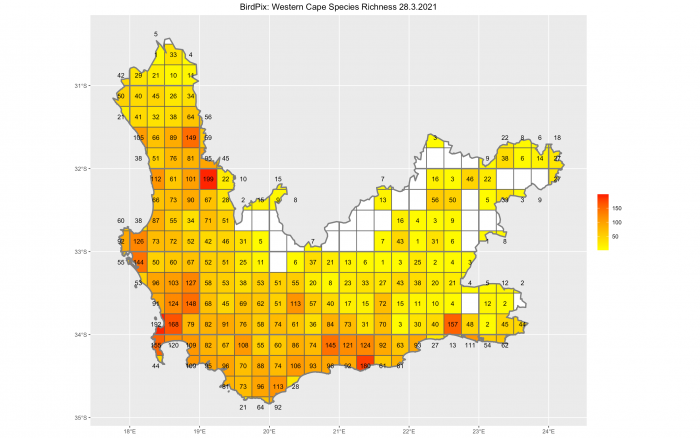
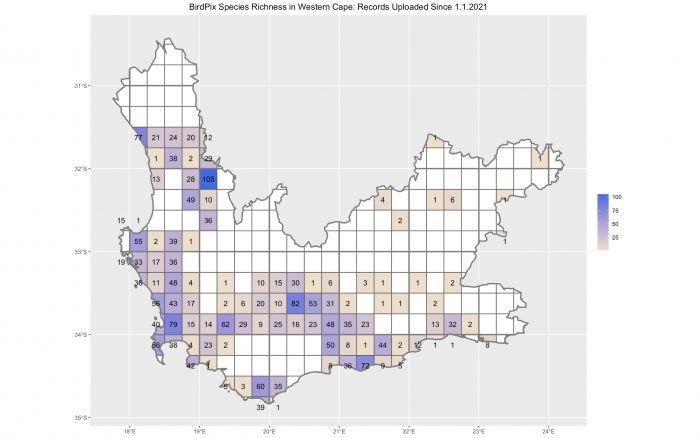
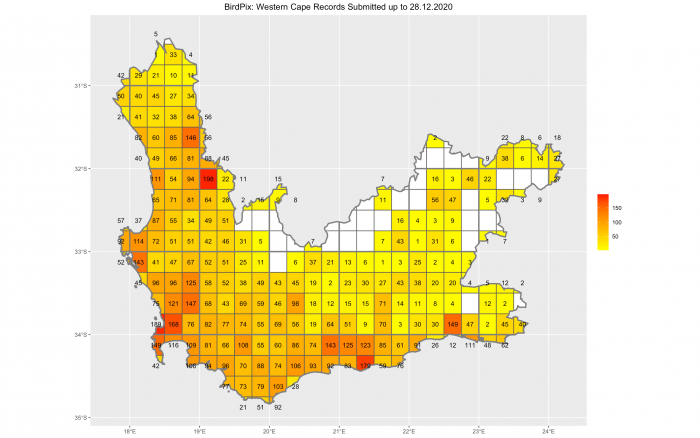
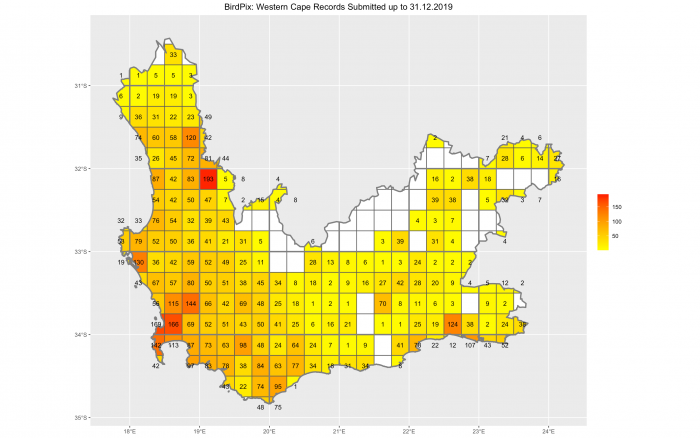
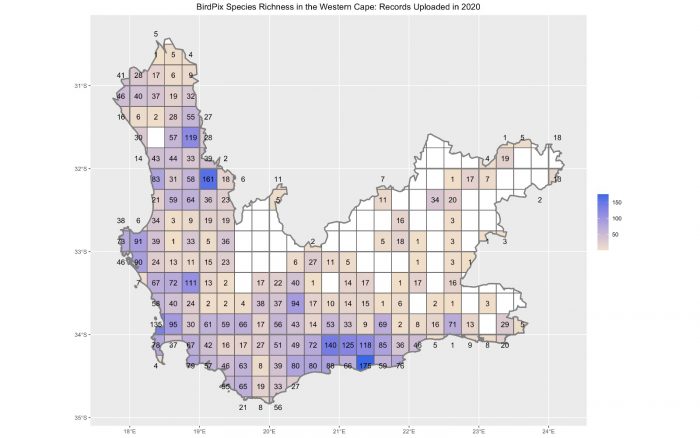
MSc student Karis Daniel produced a BirdPix coverage map for the Western Cape early in the lockdown period:

BirdPix coverage map for the Western Cape 4 April 2020
BirdPix coverage in the Western Cape, on 4 April 2020, early in the lockdown period. The numbers show how many species have been recorded in each quarter degree grid cell.

Karis made a repeat of this map on 22 June:

BirdPix coverage map for the Western Cape, 22 June 2020
BirdPix coverage in the Western Cape, on 22 June 2020, almost three months after the start of the lockdown period. The numbers show how many species have been recorded in each quarter degree grid cell.

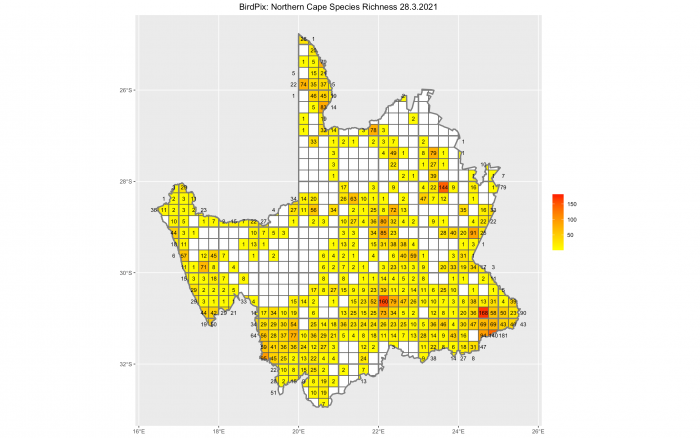
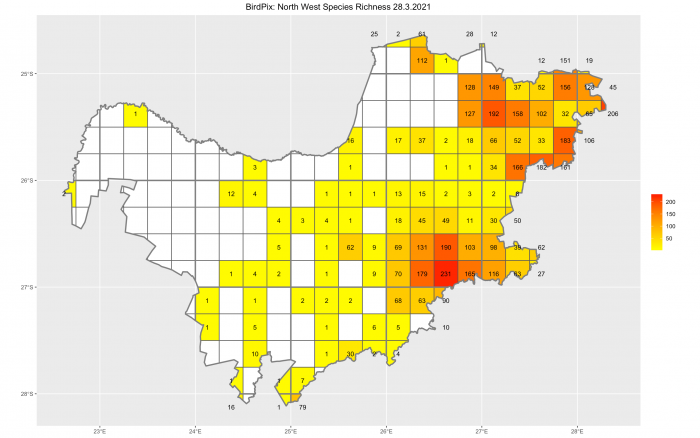
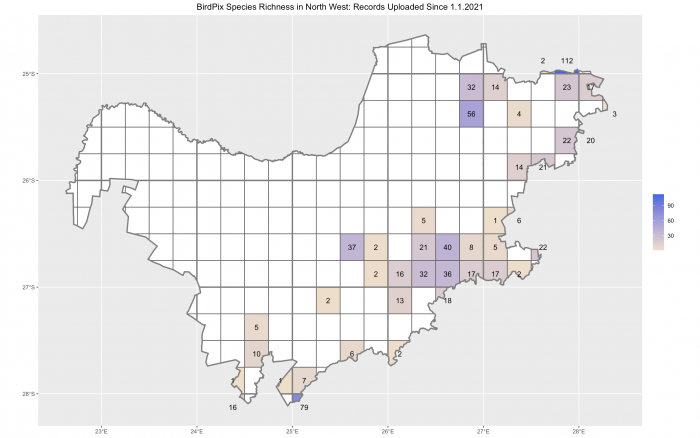
You need to do a bit of work to find the changes, but they are quite substantial. The most significant set of improvements is in the “northern arm” of the Western Cape. This is one of the priority areas in the province for increased coverage.

BirdPix is currently an important project. Karis is using the data to test “species distribution modelling” methods. She is using the BirdPix data, which is very sparse, to generate complete distribution maps, and comparing these maps with the SABAP2 maps. If we can get this right, then we can use the ReptileMAP, OdonataMAP, LepiMAP, etc, data to generate complete distribution maps for those groups. These maps will be at least suitable for use in the next generation of field guides for these species. The size of the BirdPix database is still smaller than for most other groups, so Karis is working at a disadvantage!

So please remember to take lots of bird photos this winter, and upload them to the BirdPix section of the Virtual Museum. This blog explains how to do it.

Epaulet Skimmer (Orthetrum chrysostigma)

Cover photo by Gert Bensch.

Find this species in the FBIS database (Freshwater Biodiversity Information System) here.

Family Libellulidae

Identification

Epaulet Skimmer Orthetrum chrysostigma – Male
Ndumo Game Reserve, KwaZulu-Natal
Photo by Ryan Tippett

Medium sized

Length up to 46mm; Wingspan reaches 69mm.

Both sexes of the Epaulet Skimmer are among the more easily recognised Orthetrum species, due to the single diagonal stripe on the sides of the thorax. Fully pruinose males, however, are hard to identify and are best told by the distinctive shape of the secondary genitalia.

The Epaulet Skimmer is most similar to the closely related Two-striped Skimmer (Orthetrum caffrum), but that species has a darker, browner thorax with two, pale diagonal stripes on the sides.

Click here for more details on identification.

Epaulet Skimmer Orthetrum chrysostigma – Female
False Bay, iSimangaliso Wetland Park, KwaZulu-Natal
Photo by Ryan Tippett

Habitat

The Epaulet Skimmer frequents a wide range of freshwater habitats, including Rivers, streams, lakes, pans, dams, and water-holes. It prefers sites that are fairly open with exposed rocks, sand, or gravel. The Epaulet Skimmer is most numerous along rivers in the savanna regions.

Habitat – Orange River near Keimoes, Northern Cape
Photo by Ryan Tippett

Behaviour

The Epaulet Skimmer often perches on the ground, but also on rocks and exposed stems and twigs. It hunts from a perch with a rapid, darting flight. Frequently returns to the same perch. Both sexes can be found in the same vicinity.

Epaulet Skimmer Orthetrum chrysostigma – Male
Hluhluwe district, KwaZulu-Natal
Photo by Ryan Tippett

Status and Conservation

The Epaulet Skimmer is common and widespread in South Africa. It is listed as of Least Concern in the IUCN Red List of Threatened Species. The Epaulet Skimmer is fairly resistant to habitat damage and is often common at man-made and degraded sites.

Epaulet Skimmer Orthetrum chrysostigma – Female
Ndumo Game Reserve, KwaZulu-Natal
Photo by Ryan Tippett

Distribution

The Epaulet Skimmer is very widespread and occurs virtually throughout Africa, including North Africa. It also occurs in parts of Southern Europe and the Middle East. In South Africa, the Epaulet Skimmer occurs virtually throughout, but is scarce in the dry central regions.

Epaulet Skimmer Orthetrum chrysostigma – Male
Orange River near Prieska, Northern Cape
Photo by Ryan Tippett

Below is a map showing the distribution of records for Epaulet Skimmer in the OdonataMAP database as at February 2020.

Below is a map showing the distribution of records for Epaulet Skimmer in the OdonataMAP database as of December 2024.

The next map below is an imputed map, produced by an interpolation algorithm, which attempts to generate a full distribution map from the partial information in the map above. This map will be improved by the submission of records to the OdonataMAP section of the Virtual Museum.

Ultimately, we will produce a series of maps for all the odonata species in the region. The current algorithm is a new algorithm. The objective is mainly to produce “smoothed” maps that could go into a field guide for odonata. This basic version of the algorithm (as mapped above) does not make use of “explanatory variables” (e.g. altitude, terrain roughness, presence of freshwater — we will be producing maps that take these variables into account soon). Currently, it only makes use of the OdonataMAP records for the species being mapped, as well as all the other records of all other species. The basic maps are “optimistic” and will generally show ranges to be larger than what they probably are.

These maps use the data in the OdonataMAP section of the Virtual Museum, and also the database assembled by the previous JRS funded project, which was led by Professor Michael Samways and Dr KD Dijkstra.

Epaulet Skimmer Orthetrum chrysostigma – Male
Hluhluwe district, KwaZulu-Natal
Photo by Ryan Tippett

Further Resources

The use of photographs by Gert Bensch is acknowledged. All other photographs by Ryan Tippett.

Epaulet Skimmer Orthetrum chrysostigma (Burmeister, 1839)

Other common names: Epouletskepper (Afrikaans)

Recommended citation format: Loftie-Eaton M; Navarro R; Tippett RM; Underhill L. 2025. Epaulet Skimmer Orthetrum chrysostigma. Biodiversity and Development Institute. Available online at https://thebdi.org/2020/06/19/epaulet-skimmer-orthetrum-chrysostigma/

References: Tarboton, M; Tarboton, W. (2019). A Guide to the Dragonflies & Damselflies of South Africa. Struik Nature.

Samways, MJ. (2008). Dragonflies and Damselflies of South Africa. Pensoft

Samways, MJ. (2016). Manual of Freshwater Assessment for South Africa: Dragonfly Biotic Index. Suricata 2. South African National Biodiversity Institute, Pretoria

Martens, A; Suhling, F. (2007). Dragonflies and Damselflies of Namibia. Gamsberg Macmillan.

Epaulet Skimmer Orthetrum chrysostigma – Male
False Bay, iSimangaliso Wetland Park, KwaZulu-Natal
Photo by Ryan Tippett

Similar Species

Cape Skimmer (Orthetrum capicola)

Cover photo by Joe Smereczansky.

Find this species in the FBIS database (Freshwater Biodiversity Information System) here.

Family Libellulidae

The Cape Skimmer is often considered a subspecies of the Julia Skimmer Orthetrum julia falsum. Some authorities treat them as separate species. The differences between them are clear enough that they are treated separately here.

Identification

Cape Skimmer Orthetrum julia capicola – Male
Marloth Nature Reserve, Western Cape
Photo by Ryan Tippett

Medium sized

Length around 57mm; Wingspan around 74mm.

The Cape Skimmer is fairly easy to recognise and it is by far the most common Orthetrum species within its range.

The Cape Skimmer is most similar to Orthetrum julia falsum (Julia Skimmer) and Orthetrum chrysostigma (Epaulet Skimmer). It can be differentiated from Julia Skimmer by having yellowish pterostigmas, black claspers, and a broad grey-white band on the sides of the thorax. The secondary genitalia of O. capicola and O. julia are very similar.

Cape Skimmer Orthetrum julia capicola – Old male
Moordkuil River, Western Cape
Photo by Ryan Tippett

The Cape Skimmer is distinguished from the Epaulet Skimmer Orthetrum chrysostigma by its differently shaped secondary genitalia, and by the thorax stripe, which is irregular and broader at the bottom. The thorax stripe on the Epaulet Skimmer is narrower and of even width.

Cape Skimmer Orthetrum julia capicola – Female
Montagu, Western Cape
Photo by Ryan Tippett

The females are unusual in that they are more recognisable than the males. They have an overall colour ranging from dark pinkish through to red-brown with black lines. They also have two conspicuous white stripes on the sides of the thorax.

Click here for more details on identification.

Habitat

The Cape Skimmer inhabits a wide range of habitats, from rivers and streams to marshes, ponds, and dams. It occupies both still and flowing waters in open or wooded environments. Non-breeding individuals are often found away from water in the surrounding habitats.

Habitat – Kogelberg Nature Reserve, Western Cape
Photo by sharon Stanton

Behaviour

The Cape Skimmer often perches on the ground, but also on rocks and exposed stems and twigs. It hunts from a perch with a rapid, darting flight, frequently returning to the same site. Both sexes can be found in the same vicinity. Non-breeding individuals are regularly found hunting away from water in the surrounding habitats.

The Cape Skimmer flies from October to April.

Cape Skimmer Orthetrum julia capicola – Male
Near Paarl, Western Cape
Photo by Ryan Tippett

Status and Conservation

The Cape Skimmer is very common wherever it occurs. It is listed as of Least Concern in the IUCN Red List of Threatened Species. The Cape Skimmer is highly adaptable and inhabits any suitable habitat, natural or man-made.

Cape Skimmer Orthetrum julia capicola – Male
Cedarberg Wilderness area, Western Cape
Photo by Ryan Tippett

Distribution

Orthetrum julia capicola is endemic to South Africa. It occurs throughout the Western Cape, the southern parts of the Eastern Cape, and marginally into the Northern Cape.

Cape Skimmer Orthetrum julia capicola – Female
Vanrhynsdorp Waterfall, Western Cape
Photo by Ryan Tippett

Below is a map showing the distribution records for the Cape Skimmer in the OdonataMAP database as of February 2020.

Below is a map showing the distribution records for the Cape Skimmer in the OdonataMAP database as of December 2024.

The next map below is an imputed map, produced by an interpolation algorithm, which attempts to generate a full distribution map from the partial information in the map above. This map will be improved by the submission of records to the OdonataMAP section of the Virtual Museum.

Ultimately, we will produce a series of maps for all the odonata species in the region. The current algorithm is a new algorithm. The objective is mainly to produce “smoothed” maps that could go into a field guide for odonata. This basic version of the algorithm (as mapped above) does not make use of “explanatory variables” (e.g. altitude, terrain roughness, presence of freshwater — we will be producing maps that take these variables into account soon). Currently, it only makes use of the OdonataMAP records for the species being mapped, as well as all the other records of all other species. The basic maps are “optimistic” and will generally show ranges to be larger than what they probably are.

These maps use the data in the OdonataMAP section of the Virtual Museum, and also the database assembled by the previous JRS funded project, which was led by Professor Michael Samways and Dr KD Dijkstra.

Cape Skimmer Orthetrum julia capicola – Male
Near Hanover, Northern Cape
Photo by Ryan Tippett

Further Resources

The use of photographs by Joe Smereczansky and Sharon Stanton. Other photographs by Ryan Tippett.

Cape Skimmer Orthetrum julia capicola Calvert, 1893

Other common names: Kaapse Skepper (Afrikaans)

Recommended citation format: Loftie-Eaton M; Navarro R; Tippett RM; Underhill L. 2025. Cape Skimmer Orthetrum julia capicola. Biodiversity and Development Institute. Available online at https://thebdi.org/2020/06/19/cape-skimmer-orthetrum-julia-capicola/

References: Tarboton, M; Tarboton, W. (2019). A Guide to the Dragonflies & Damselflies of South Africa. Struik Nature.

Samways, MJ. (2008). Dragonflies and Damselflies of South Africa. Pensoft

Samways, MJ. (2016). Manual of Freshwater Assessment for South Africa: Dragonfly Biotic Index. Suricata 2. South African National Biodiversity Institute, Pretoria

Cape Skimmer Orthetrum julia capicola – Mating pair
Klein Cedarberg Private Nature Reserve, Western Cape
Photo by Ryan Tippett

Similar Species

Two-striped Skimmer (Orthetrum caffrum)

Cover photo by Katharina Reddig.

Find this species in the FBIS database (Freshwater Biodiversity Information System) here.

Family Libellulidae

Identification

Two-striped Skimmer Orthetrum caffrum – Male
Near Ixopo, KwaZulu-Natal
Photo by Ryan Tippett

Medium sized

Length up to 45mm; Wingspan attains 68mm.

Both sexes of the Two-striped Skimmer are among the more readily identified Orthetrum species, due to the two diagonal stripes on the sides of the thorax.

In fully pruinose males the diagnostic white stripes may become partially or completely obscured. These males are best identified by the shape of the secondary genitalia.

The Two-striped Skimmer is most likely to be confused with the Epaulet Skimmer (Orthetrum chrysostigma), but that species has only one pale, diagonal stripe on the thorax sides.

Click here for more details on identification.

Two-striped Skimmer Orthetrum caffrum – Female
Near Ixopo, KwaZulu-Natal
Photo by Ryan Tippett

Habitat

The Two-striped Skimmer is most common in higher-altitude or mountainous areas, including the arid Karoo. The preferred habitats are open margins of rivers, pans, water-holes, and dams. The Two-striped Skimmer frequents areas with low grassy or bushy growth, and also bare exposed areas and rocks near the water.

Habitat – Swartberg Pass, Western Cape
Photo by Ryan Tippett

Behaviour

The Two-striped Skimmer often perches on the ground or rocks, but also sits on twigs and other similar perches in or near the water. It hunts from a perch and quickly resettles again. The Two-striped Skimmer can often be found away from water along pathways, on lawns, and at other suitable sites. Both sexes are found in the same vicinity.

Two-striped Skimmer Orthetrum caffrum – Male
Carnarvon district, Northern Cape
Photo by Ryan Tippett

Status and Conservation

The Two-striped Skimmer is common and widespread in South Africa. It is listed as of Least Concern in the IUCN Red List of Threatened Species. The Two-striped Skimmer is an adaptable species that readily frequents degraded and man-made habitats.

Two-striped Skimmer Orthetrum caffrum – Male
Swartberg Pass, Western Cape
Photo by Ryan Tippett

Distribution

Orthetrum caffrum is widespread throughout most of southern, central, and eastern Africa. In South Africa, it is only absent from the hot, humid areas of the lowveld and north-eastern KwaZulu-Natal.

Two-striped Skimmer Orthetrum caffrum – Female
Cedarberg, Western Cape
Photo by Ryan Tippett

Below is a map showing the distribution of records for Two-striped Skimmer in the OdonataMAP database as at February 2020.

Below is a map showing the distribution of records for Two-striped Skimmer in the OdonataMAP database as of December 2024.

The next map below is an imputed map, produced by an interpolation algorithm, which attempts to generate a full distribution map from the partial information in the map above. This map will be improved by the submission of records to the OdonataMAP section of the Virtual Museum.

Ultimately, we will produce a series of maps for all the odonata species in the region. The current algorithm is a new algorithm. The objective is mainly to produce “smoothed” maps that could go into a field guide for odonata. This basic version of the algorithm (as mapped above) does not make use of “explanatory variables” (e.g. altitude, terrain roughness, presence of freshwater — we will be producing maps that take these variables into account soon). Currently, it only makes use of the OdonataMAP records for the species being mapped, as well as all the other records of all other species. The basic maps are “optimistic” and will generally show ranges to be larger than what they probably are.

These maps use the data in the OdonataMAP section of the Virtual Museum, and also the database assembled by the previous JRS funded project, which was led by Professor Michael Samways and Dr KD Dijkstra.

Two-striped Skimmer Orthetrum caffrum – Male
Sani Pass, KwaZulu-Natal
Photo by Ryan Tippett

Further Resources

The use of photographs by Katharina Reddig is acknowledged. All other photographs by Ryan Tippett.

Two-striped Skimmer Orthetrum caffrum (Burmeister, 1839)

Other common names: Strepieskepper (Afrikaans)

Recommended citation format: Loftie-Eaton M; Navarro R; Tippett RM; Underhill L. 2025. Two-striped Skimmer Orthetrum caffrum. Biodiversity and Development Institute. Available online at https://thebdi.org/2020/06/19/two-striped-skimmer-orthetrum-caffrum/

References: Tarboton, M; Tarboton, W. (2019). A Guide to the Dragonflies & Damselflies of South Africa. Struik Nature.

Samways, MJ. (2008). Dragonflies and Damselflies of South Africa. Pensoft

Samways, MJ. (2016). Manual of Freshwater Assessment for South Africa: Dragonfly Biotic Index. Suricata 2. South African National Biodiversity Institute, Pretoria

Martens, A; Suhling, F. (2007). Dragonflies and Damselflies of Namibia. Gamsberg Macmillan.

Two-striped Skimmer Orthetrum caffrum – Female
Carnarvon district, Northern Cape
Photo by Ryan Tippett

Similar Species

Little Skimmer (Orthetrum abbotti)

Cover photo by Richard Johnstone.

Find the Little Skimmer in the FBIS database (Freshwater Biodiversity Information System) here.

Family Libellulidae

Identification

Little Skimmer Orthetrum abbotti – Male
Eastern Shores, iSimangaliso Wetland Park – KwaZulu-Natal
Photo by Ryan Tippett

Small size

Length up to 38mm; Wingspan attains 60mm.

The Little Skimmer is the smallest Orthetrum species in the region. In males the combination of small size, long, yellow pterostigmas, and indistinct ‘spectacles’ on the face is often enough for an identification. However, fully pruinose males are similar to those of several other Orthetrum species. They are best identified by the distinct shape of their secondary genitalia. The Little Skimmer most resembles Orthetrum hintzi (Dark-shouldered Skimmer), which is slightly larger.

Females and immature males can be recognised by the long, yellow pterostigmas and plain, mostly unmarked thorax sides.

Click here for more details on identification of the Little Skimmer.

Little Skimmer Orthetrum abbotti – Immature male
Eastern Shores, iSimangaliso Wetland Park – KwaZulu-Natal
Photo by Ryan Tippett

Habitat

The Little Skimmer inhabits boggy ground associated with marshes and seeps. It is also found at marshy pools adjoining streams. The Little Skimmer favours sites that are rich in emergent sedge and grasses. It is mostly found in fairly open grassland habitats. The Little Skimmer occurs from the coast up to 1800m above sea level.

Habitat – Eastern Shores, iSimangaliso Wetland Park.
Photo by Ryan Tippett

Behaviour

The Little Skimmer hunts from a perch and usually returns to the same grass or sedge stem. The flight is fairly slow and weak. It is usually quite confiding and generally reluctant to fly.

The Little Skimmer flies from November to April.

Little Skimmer Orthetrum abbotti – Mating pair.
Eastern Shores, iSimangaliso Wetland Park – KwaZulu-Natal
Photo by Ryan Tippett

Status and Conservation

The Little Skimmer is locally common in South Africa. It is listed as of Least Concern in the IUCN Red List of Threatened Species. It is primarily found in natural habitats.

Little Skimmer Orthetrum abbotti – Immature male
Eastern Shores, iSimangaliso Wetland Park – KwaZulu-Natal
Photo by Ryan Tippett

Distribution

The Little Skimmer is found throughout most of Sub-Saharan Africa. It also occurs in parts of the Middle-East and on Madagascar.

In South Africa it is found mainly in the Eastern and Central areas with localised populations in parts of the Eastern and Western Cape provinces. It is more common inland than along the coast.

Little Skimmer Orthetrum abbotti – Male
Eastern Shores, iSimangaliso Wetland Park – KwaZulu-Natal
Photo by Ryan Tippett

Below is a map showing the distribution of records for Little Skimmer in the OdonataMAP database as at February 2020.

Below is a map showing the distribution of records for Little Skimmer in the OdonataMAP database as of December 2024.

The next map below is an imputed map, produced by an interpolation algorithm, which attempts to generate a full distribution map from the partial information in the map above. This map will be improved by the submission of records to the OdonataMAP section of the Virtual Museum.

Ultimately, we will produce a series of maps for all the odonata species in the region. The current algorithm is a new algorithm. The objective is mainly to produce “smoothed” maps that could go into a field guide for odonata. This basic version of the algorithm (as mapped above) does not make use of “explanatory variables” (e.g. altitude, terrain roughness, presence of freshwater — we will be producing maps that take these variables into account soon). Currently, it only makes use of the OdonataMAP records for the species being mapped, as well as all the other records of all other species. The basic maps are “optimistic” and will generally show ranges to be larger than what they probably are.

These maps use the data in the OdonataMAP section of the Virtual Museum, and also the database assembled by the previous JRS funded project, which was led by Professor Michael Samways and Dr KD Dijkstra.

Little Skimmer Orthetrum abbotti – Immature male
Eastern Shores, iSimangaliso Wetland Park – KwaZulu-Natal
Photo by Ryan Tippett

Further Resources

The use of photographs by Richard Johnstone is acknowledged. All other photographs by Ryan Tippett.

Little Skimmer Orthetrum abbotti Calvert, 1892

Other common names: Kleinskepper (Afrikaans)

Recommended citation format: Loftie-Eaton M; Navarro R; Tippett RM; Underhill L. 2025. Little Skimmer Orthetrum abbotti. Biodiversity and Development Institute. Available online at https://thebdi.org/2020/06/19/little-skimmer-orthetrum-abbotti/

References: Tarboton, M; Tarboton, W. (2019). A Guide to the Dragonflies & Damselflies of South Africa. Struik Nature.

Samways, MJ. (2008). Dragonflies and Damselflies of South Africa. Pensoft

Samways, MJ. (2016). Manual of Freshwater Assessment for South Africa: Dragonfly Biotic Index. Suricata 2. South African National Biodiversity Institute, Pretoria

Martens, A; Suhling, F. (2007). Dragonflies and Damselflies of Namibia. Gamsberg Macmillan.

Little Skimmer Orthetrum abbotti – Mating pair.
Eastern Shores, iSimangaliso Wetland Park – KwaZulu-Natal
Photo by Ryan Tippett

Similar Species

Bottletail (Olpogastra lugubris)

Cover photo by Niall Perrins.

Find the Bottletail in the FBIS database (Freshwater Biodiversity Information System) here.

Family Libellulidae

Identification

Bottletail Olpogastra lugubris – Male
Okavango Delta, Botswana
Photo by Ryan Tippett

Large Size

Length up to 62mm; Wingspan attains 89mm.

The Bottletail is an unmistakable species and it is the only member of its genus. Both sexes are similar in appearance and easily recognised by their long and very thin abdomens. The abdomen base is also noticeably swollen.

The Bottletail is most similar to the Southern Riverking (Zygonoides fuelleborni), but that species has a noticeably broad abdomen that tapers near the waist.

Click here for more details on identification of the Bottletail.

Bottletail Olpogastra lugubris – Young female
Okavango Delta, Botswana
Photo by Ryan Tippett

Habitat

The Bottletail is a riverine species that frequents both seasonal and perennial rivers, mostly in hot savanna areas. It prefers shallow, flowing sections of rivers with a sandy substrate, especially where flanked by tall reeds, papyrus, or trees.

Ideal habitat with shallow, sandy-bottomed sections and an abundance of riverside vegetation.
Ndumo Game Reserve, KwaZulu-Natal
Photo by Ryan Tippett

Behaviour

The Bottletail usually sits fairly low down along the inside of river channels, perching prominently on reed stems and tree branches over the river. Both sexes typically occur in the same areas. The Bottletail hunts from a perch, taking off to hawk flying insects or to chase off rivals in fast, agile flight. In hot weather, they may retreat to shadier perches under the canopy of trees. Non-breeding individuals can often be found a short distance from the river in the surrounding habitat. The Bottletail is on the wing from December to May.

Bottletail Olpogastra lugubris – Male
Pongola River, KwaZulu-Natal
Photo by Ryan Tippett

Status and Conservation

The Bottletail is uncommon and localised in South Africa. It is more common in other regions further north such as the Okavango Delta in Botswana. The Bottletail is listed locally as Near Threatened in the IUCN Red List Of Threatened Species. The global listing for Olpogastra lugubris is of Least Concern.

Bottletail Olpogastra lugubris – Female
Ndumo Game Reserve, KwaZulu-Natal
Photo by Ryan Tippett

Distribution

The Bottletail is widespread throughout most of Sub-Saharan Africa. In South Africa, Olpogastra lugubris is mostly confined to the warmer north-east, with most records coming from Limpopo, Mpumalanga, and KwaZulu-Natal. The Bottletail is also present along the upper Vaal River and may be more widespread along the Vaal and Orange Rivers than current records show.

Below is a map showing the distribution of records for Bottletail in the OdonataMAP database as at February 2020.

Below is a map showing the distribution of records for Bottletail in the OdonataMAP database as of December 2024.

The next map below is an imputed map, produced by an interpolation algorithm, which attempts to generate a full distribution map from the partial information in the map above. This map will be improved by the submission of records to the OdonataMAP section of the Virtual Museum.

Ultimately, we will produce a series of maps for all the odonata species in the region. The current algorithm is a new algorithm. The objective is mainly to produce “smoothed” maps that could go into a field guide for odonata. This basic version of the algorithm (as mapped above) does not make use of “explanatory variables” (e.g. altitude, terrain roughness, presence of freshwater — we will be producing maps that take these variables into account soon). Currently, it only makes use of the OdonataMAP records for the species being mapped, as well as all the other records of all other species. The basic maps are “optimistic” and will generally show ranges to be larger than what they probably are.

These maps use the data in the OdonataMAP section of the Virtual Museum, and also the database assembled by the previous JRS funded project, which was led by Professor Michael Samways and Dr KD Dijkstra.

Bottletail Olpogastra lugubris – Male
Pongola River, KwaZulu-Natal
Photo by Ryan Tippett

Further Resources

The use of photographs by Niall Perrins is acknowledged. All other photographs by Ryan Tippett.

Bottletail Olpogastra lugubris Karsch, 1895

Other common names: Slender Bottletail (Alt. English); Lenige Bottelstert (Afrikaans)

Recommended citation format: Loftie-Eaton M; Navarro R; Tippett RM; Underhill L. 2025. Bottletail Olpogastra lugubris. Biodiversity and Development Institute. Available online at https://thebdi.org/2020/06/19/bottletail-olpogastra-lugubris/

References: Tarboton, M; Tarboton, W. (2019). A Guide to the Dragonflies & Damselflies of South Africa. Struik Nature.

Samways, MJ. (2008). Dragonflies and Damselflies of South Africa. Pensoft

Samways, MJ. (2016). Manual of Freshwater Assessment for South Africa: Dragonfly Biotic Index. Suricata 2. South African National Biodiversity Institute, Pretoria

Martens, A; Suhling, F. (2007). Dragonflies and Damselflies of Namibia. Gamsberg Macmillan.

Bottletail Olpogastra lugubris – Female
Pongola River, KwaZulu-Natal
Photo by Ryan Tippett

Similar Species