Impacts of Rhodes on Biodiversity 3 : Common Starling

This is the third and final blog in this series on the impacts of Rhodes on biodiversity. The first blog talked about the Eastern Grey Squirrel. The second covered four of the five bird species that Cecil John Rhodes introduced so that his residence in Cape Town would have familiar English birds in the garden; of these four only the Common Chaffinch didn’t quickly go extinct. The fifth bird species he introduced was his big success story. Rhodes’s vision of building a railway line northwards from Cape Town through Africa to Cairo failed; but his starling has made a promising start in covering the distance!

Rhodes’s starlings were captured on his behalf by another rogue of the era, Colonel Richard J. Meinertzhagen (1878-1967). He was a soldier; in any squadron of soldiers he would have been regarded as the nastiest. When he wasn’t shooting people he was shooting birds for museum collections. But he couldn’t get enough birds of his own, so he stole skins of birds from museums, and then put his own labels on them, with completely different places and dates. Here’s a link to a paper in the journal Ibis called “Richard Meinertzhagen—a case of fraud examined“. It goes so far as to say: “Given the readiness with which Meinertzhagen falsified data on stolen specimens, one must question the authenticity of data on specimens he collected himself.” That is not what you expect to read in a scientific journal! There are endless stories of the harm this man has done to ornithology. The most horrid is the story of the Forest Owlet Athene blewetti in India. For decades this tiny owl was known to science from only six specimens, collected in India between 1873 and 1883. In 1961 (when he was in his eighties), Meinertzhagen all of a sudden claimed that he had collected a specimen in 1914 (when he would have been 36 years old) from another locality in India. He deposited this specimen in the British Museum. For decades after the 1960s, expeditions visited this part of India which apparently had the most recent sighting of the Foret Owlet. They searched for the owlet, without success, and it was declared extinct. Then Dr Pamela Rasmussen did some forensic ornithology. She discovered that one of the six earlier specimens was missing from the museum collection. It had been stolen by Meinertzhagen and he had put a new label on it, with falsified date and place. His diary demonstrated that he had not been in that part of India on that date! She went in search of the owlet in the area where the other specimens came from; on 25 November 1997, she rediscovered it in a degraded woodland. For a fuller version of this sleazy story, see this article in the Pune Mirror. Anyhow, that is a long detour to describe the kind of company that Cecil John Rhodes associated himself with!

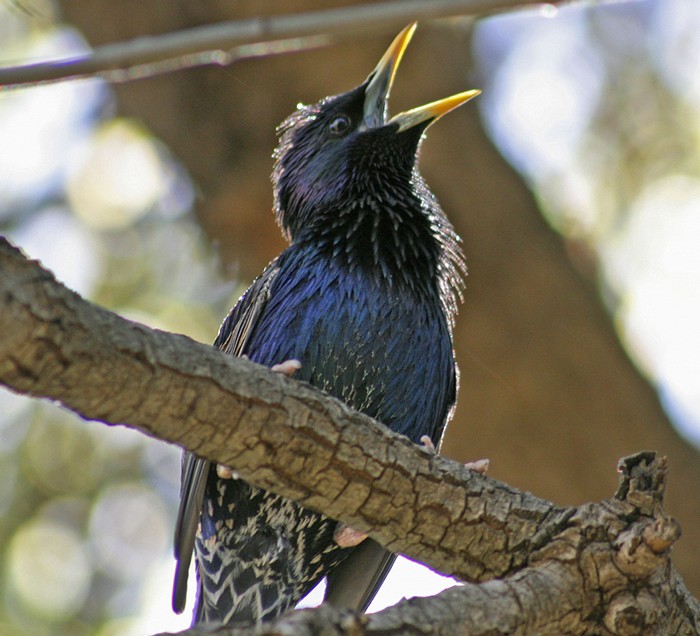
Meinertzhagen supplied Rhodes with 18 Common Starlings. He says (and can we trust him?) that he caught them in Britain in winter, which means that they are likely to have been migrants from continental Europe. There is a massive influx of starlings into Britain in late autumn, especially from northwestern Europe where it gets bitterly cold in winter. Britain is only cold.

The precise year that Rhodes set the starlings free at Groote Schuur is not certain, but it is most likely to have been 1897. They took off, both literally and figuratively. But it was not until 1954 that an attempt was made to put on record how it spread. There is a paper in Ostrich, unfortunately not open access, by Jack Winterbottom and Richard Liversidge, called “The European Starling in the south west Cape” (Ostrich 25: 89-96). Their detective work, to trace its spread, consisted of interviewing lots of people. They neatly summarized their findings in this awesome map:

The spread of the Common Starling in the Western Cape South Africa, one of the impacts of Rhodes on biodiversity
From Winterbottom & Liversidge (1954) The European Starling in the south west Cape. Ostrich 25: 89-96

It was in the suburbs of Cape Town around Groote Schuur within a few years. It colonized Robben Island by 1907. It spread to the far side of the Cape Flats by 1910. The big mountains proved a barrier for a few years, but it got to the far side, to towns like Worcester and Elgin in the 1920s. Along the south coast, the map traces its eastwards spread, taking about three decades to cover the 450 km from Elgin to Plettenberg Bay. It moved northwards along the West Coast more slowly, reaching Clanwillian in 1950. This map effectively shows the distribution of the Common Starling in 1954.

The next snapshot of the distribution of the starling was made by the Southern African Bird Atlas Project (SABAP1), which collected records mainly from the second half of the 1980s. Here is the map:

SABAP1 distribution map for Common Starling
The Atlas of Southern African Birds, Volume 2, page 453

It had expanded far to the east, just into KwaZulu-Natal, and not quite as far to the north, reaching Namibia at the town of Oranjemund. Between the time that fieldwork ended and the atlas was published, it had snuck into Lesotho, and by the early 1990s was getting common in Maseru. The SABAP1 species text for the “European Starling” (as it was then known) is here.

The first bird atlas was followed up the the second bird atlas (SABAP2). This project started in July 2007, and the map below produced in June 2021, so it is a 14-year time exposure!

SABAP2 distribution map for Common Starling in South Africa. This enormous distribution reveals one of the impacts of Rhodes on biodiversity
Distribution of the Common Starling, SABAP2 data, July 2007 to June 2021. The interpretation of this map is described here

Common Starlings have continued their march northeastwards. In the gridcells shaded yellow, they are far less frequently encountered than in those shaded dark blue. But they have clearly established themselves across KwaZulu-Natal, the Free State and Gauteng. There is still a long way to go to reach Cairo.

The Virtual Museum has 501 photographic record of Common Starlings. Below is a collection of thumb-nails of some of them! In the future, say in 50 years time, the photographs which are going to be the most valuable are going to be the ones in which the bird is quite small, and which show the habitat in which it occurred!
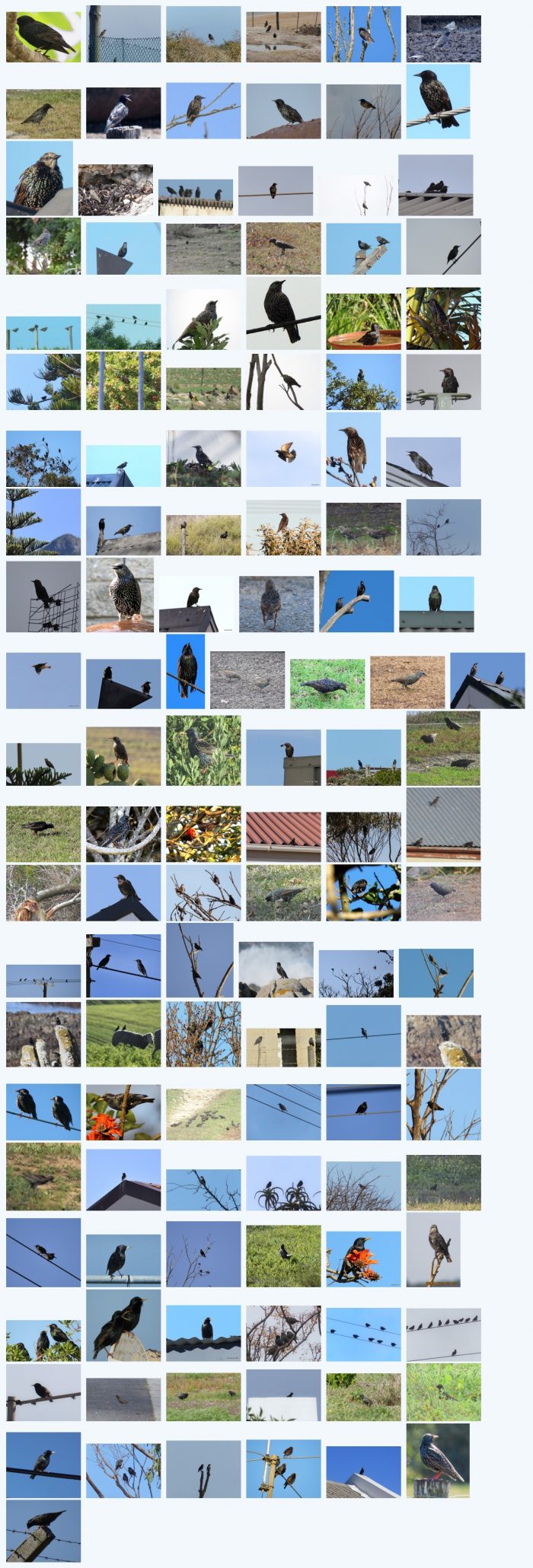
Collage of Common Starling photos from the BirdPix Virtual Museum

You’ll find lots more interesting information about the Common Starling here.

Impacts of Rhodes on biodiversity 1 and 2

The first and second blogs in this series deal with two other species which Rhodes introduced: the Eastern Grey Squirrel, which has not expanded far, and the Common Chaffinch, which has neither gone extinct nor taken off.

Recommended citation format: Underhill LG 2021. Impacts of Rhodes on Biodiversity 3 : Common Starling. Biodiversity and Development Institute. Available online at http://thebdi.org/2021/06/02/impacts-of-rhodes-on-biodiversity-3-common-starling/

BDInsight – May 2021

Winter is around the corner here on the southern tip of Africa, in some areas winter has already arrived with a cold bang! We have some great BDI news to warm you up….

The online guide to the Neuroptera of southern Africa

We have been working on something very exciting over the past little while, the online guide to the Neuroptera (lacewings and antlions) of southern Africa. The insect order Neuroptera, or net-winged insects, includes the lacewings, mantidflies, antlions, and their relatives. The order consists of some 6,000 described species worldwide!

Neuroptera, and within this group especially the family Chrysopidae, are of interest to a large group of entomologists because of their role as predators of pest arthropods (aphids and spidermites) on agricultural plants. 

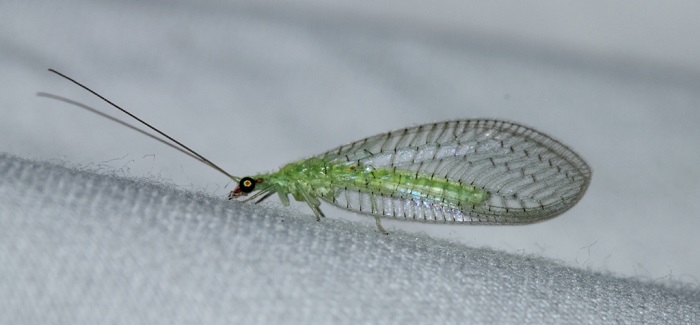
Chrysemosa jeanneli – Family Chrysopidae – LacewingMAP Record by Johan Heyns

Citizen Scientist Hours

We had some incredible talks during the month of May. If you missed out on any of the Citizen Scientist Hours (CSH), don’t despair, you can catch up on our YouTube Channel.

One of the many excellent talks during our CSH events was by Katy Williams. Katy is a researcher and the Conservation Director of the Cape Leopard Trust in South Africa. Katy will talked about the Leopards in the Western Cape of South Africa. Despite extensive habitat loss, direct persecution, and reduction in prey numbers, leopards have managed to persist in the greater Western Cape region, and now fill the role of apex predator in this ecosystem. Watch the talk to learn more about these survivors, the challenges they face, and the Cape Leopard Trust’s work to ensure their future…..

Virtual Museum

10,442 records have already been added to species distribution maps in May. Some of the records report the first occurrence of a species in a grid cell. Many of the records “refresh” old records, providing evidence that the species still persists in the grid cell. Asking which class of records is more important is like asking the question: “Is the left wing of the plane more important than the right wing?” We need both types. We only have one day in May left to push the RED dot (see the graph below) for May up to new and dizzying heights!!

Thank you for your support of the Virtual Museum!

In other news…..

The Cape kelp forests have been named one of the Seven Wonders of the World! Described as a shallow underwater jungle more than twice as wide as the Grand Canyon — and a home to millions of creatures, this wonderland beneath the waves lies approximately 17 km south of Cape Town.

Read more here…

You can also watch the following talk on the amazing biodiversity to be found off the coast of Cape Town. Itxaso gives an awesome presentation on her marine biobash adventure, with records from the coast and under the water….

Myrmeleontidae (Antlions)

This is the description of the Family Myrmeleontidae in the online guide to the Neuroptera (lacewings and antlions) of southern Africa

Myrmeleontidae is the largest lacewing family. There are currently 50 recognised genera and at least 180 described species in South Africa. Additionally there are many species that await description.

Fifty genera are known from South Africa: Annulares; Bankisus; Banyutus; Brachyplectron; Capophanes; Centroclisis; Crambomorphus; Creoleon; Cueta; Cymothales; Distoleon; Exaetoleon; Furgella; Fadrina; Golafrus; Hagenomyia; Jaya; Lachlathetes; Macroleon; Macronemurus; Maula; Myrmeleon; Nadus; Nannoleon; Nemoleon; Nesoleon; Neuroleon; Obus; Palparellus; Palpares; Palparidius; Pamares; Pamexis; Syngenes; Tomatares; Tricholeon.

Identification

Medium to very large sized (Wingspan 26-160 mm)

All have prominent but fairly short antennae. The compound eyes are fairly large and widely spaced.

Adults have two pairs of wings that are roughly equal in size. Their abdomens are long and slender and consist of ten segments.

Adult antlions superficially resemble dragonflies and damselflies. Antlions can be differentiated by having prominent antennae, smaller, widely spaced compound eyes and very intricately veined wings. Antlions also rest with their wings closed down the length of the body.

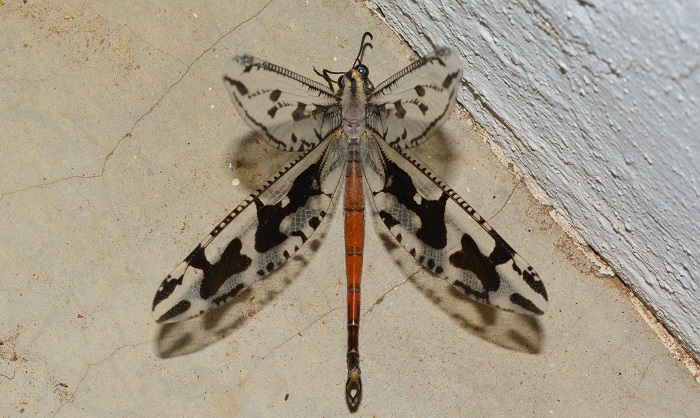
One of the Antlions Palpares immensus
Palpares immensus – This magnificent species is one of the largest in the order. The wingspan can attain 160mm.
Near Carnarvon, Northern Cape
Photo by Ryan Tippett
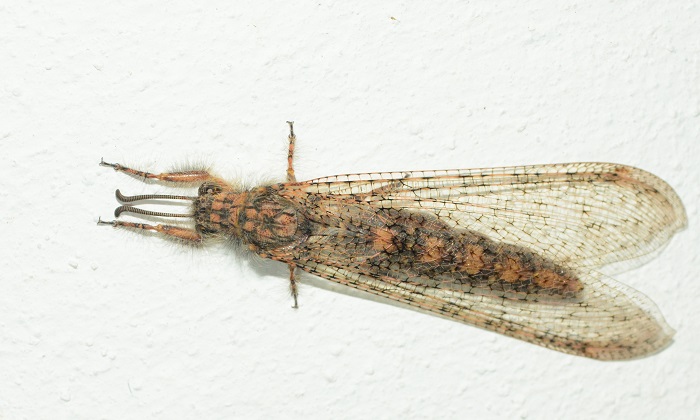
Centroclisis maligna in typical resting position of antlions
Centroclisis maligna in typical antlion resting position, with wings folded along the length of the body.
Near Carnarvon, Northern Cape
Photo by Ryan Tippett

Food & Feeding

Adults and larvae are predatory and feed on other insects.

Adults mostly capture smaller flying insects in flight using their bristly legs. Prey is then taken to a perch before being consumed.

The larvae are all ambush hunters. They conceal themselves below the sand surface and grab unsuspecting prey that passes close by. The larvae of some genera are pit-fall trap builders (see Larvae below).

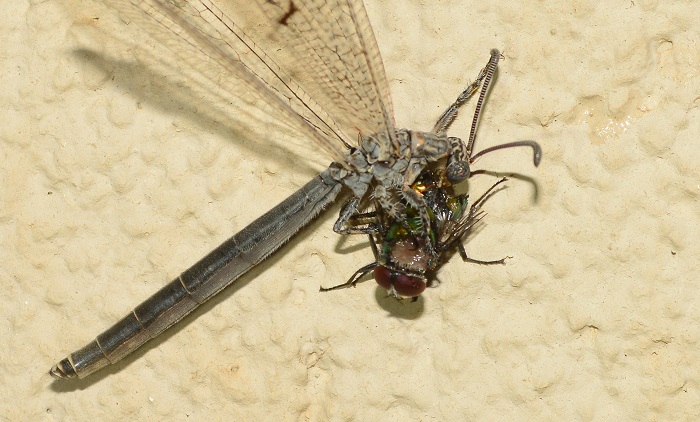
antlion feeding
Creoleon mortifer feeding on a Blowfly (Calliphoridae)
Near Carnarvon, Northern Cape
Photo by Ryan Tippett

Behaviour

Most adults are nocturnal and are readily attracted to lights. Adults are well camouflaged among vegetation during the day.

Larvae

Most species have free-living larvae that live in loose sand. A handful of genera demonstrate the famous ‘pit-building’ technique where the larvae capture their prey in conical pits dug into the sand.

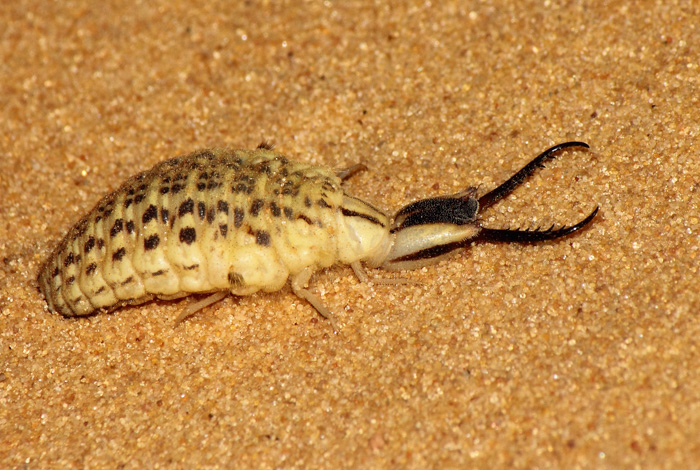
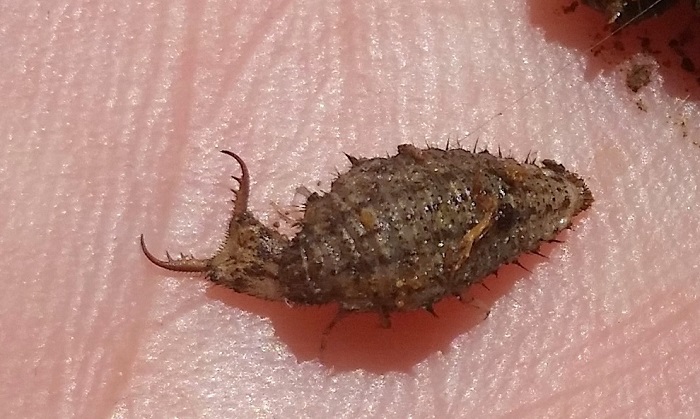
This is the larvae Glafrus oneili, typical of the antlions
Golafrus oneili – Photo by Vaughan Jessnitz
Antlion larvae
Neuroleon sp. – Near Carnarvon, Northern Cape
Photo by Ryan Tippett
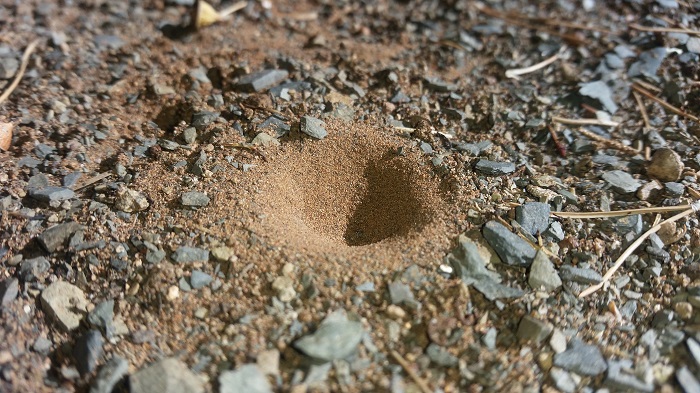
pit, possibly made by a species of Cueta or Myrmeleon
Typical antlion pit, possibly made by a species of Cueta or Myrmeleon.
Near Carnarvon, Northern Cape
Photo by Ryan Tippett

Distribution

Antlions occur throughout South Africa and in all terrestrial habitats.

Mantispidae (Mantidflies)

This is the description of the Family Mantispidae in the online guide to the Neuroptera (lacewings and antlions) of southern Africa

The record for the above photo (by Ryan Tippett) can be found in LacewingMAP here.

•There are seven genera and at least 35 species in the region

•Most are found in the wetter eastern parts of South Africa

•Small to large sized (Wingspan 12-60 mm)

•Adults have raptorial forelimbs for capturing prey

•Adults are predatory and feed on other insects

•The larvae are parasitic & develop in the nests of spiders where they feed on the spiders eggs or on the young spiders

Nemopteridae (Thread-winged Lacewings, etc)

This is the description of the Family Nemopteridae in the online guide to the Neuroptera (lacewings and antlions) of southern Africa

The above photo by Handre Basson is of Palmipenna aeoleoptera (Rock Spoonwing). This is a rare species and is confined to Namaqualand. This record can be found in the LacewingMAP database here.

15 genera are found the region: Concroce; Laurhervasia; Thysanocroce; Tjederia; Barbibucca; Derhynchia; Halterina; Knersvlaktia; Nemeura; Nemia; Nemopistha; Nemopterella; Palmipenna; Semirhynchia; Sicyoptera

At least 60 species occur in South Africa.

Identification

Small to large (Wingspan 25-100mm)

Adults have elongate beak-like mouthparts for feeding on pollen and nectar

The forewings are clear and iridescent in most species. A handful of species have brown or black pigmented forewings, often with white tips.

The hindwings are variously modified. Often elongate with streamer, thread, ribbon, flag, spoon or paddle-like tips. Hindwings are usually coloured in white, brown or black.

Nemopterella sp. showing the beautiful iridescent fore-wings and the modified ‘streamer’ hind wings.
Near Carnarvon, Northern Cape
Photo by Ryan Tippett
Nemia karooa – Note the beak-like mouthparts for feeding on pollen and nectar.
Near Carnarvon, Northern Cape
Photo by Ryan Tippett

Behaviour

Adults of most species fly during spring or early summer. A few such as Laurhervasia setacea emerge predominantly during late summer.

Some species are diurnal, whilst the majority are nocturnal and may appear at lights in large numbers.

Habitat

Largely confined to arid and semi-arid environments, with low scrub vegetation. Often in open, rocky or sandy areas.

Larvae

All species have predatory larvae that actively chase down their prey.

The larvae of the thread-wing types have an elongated prothorax, giving them a distinctive long-necked appearance. In some the larvae are squat and rounded with short, curved and very strong jaws. However, the larvae of many in the family are poorly known.

The larvae live in fine, dry sand, often under rock overhangs or in caves.

Tjederia namaquensis – The long-necked appearance is due to the elongate prothorax.
Cederberg, Western Cape
Photo by Handre Basson

Distribution

The majority of the worlds species occur in the arid regions of the Western Cape, Northern Cape and Namibia. A few species occur in the drier parts of the North-West, Gauteng and Limpopo provinces and also Botswana.

A number of species have very restricted distributions.

An undescribed species of Palmipenna. Near Luderitz, Namibia
Photo by Jessica Kemper

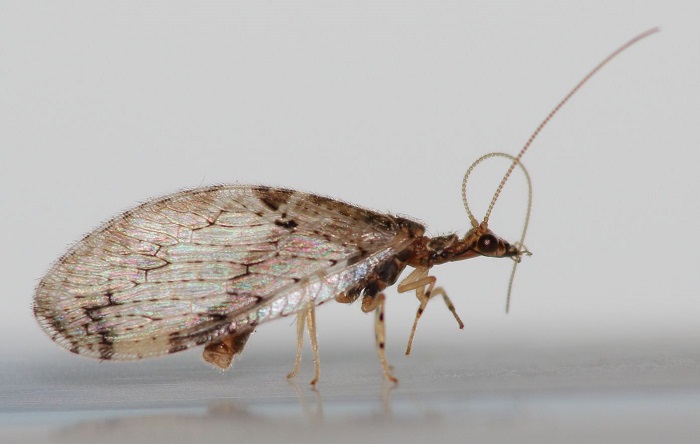
Hemerobiidae (Brown Lacewings)

This is the description of the Family Memerobiidae in the online guide to the Neuroptera (lacewings and antlions) of southern Africa

•7 genera and 22 known species in the region

•Mostly small (Wingspan up to 14 mm)

•Most are brown with variable darker markings

•Found throughout South Africa but are easily overlooked

•Adults are pollinators and can be found on flowering plants

•Larvae live on plants. They are important predators of mites, Aphids, Scale insects and other pests

•Common in gardens and orchards

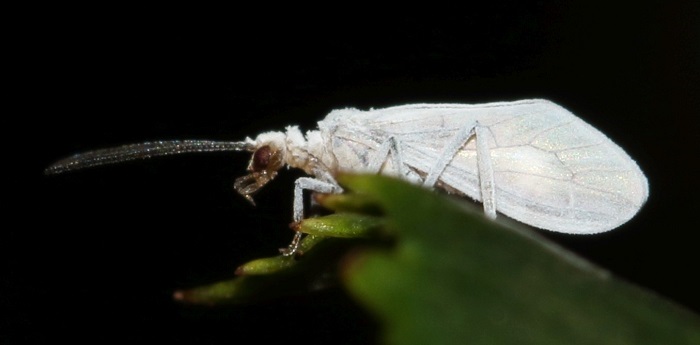
Coniopterygidae (Dusty-winged Lacewings)

This is the description of the Family Coniopterygidae in the online guide to the Neuroptera (lacewings and antlions) of southern Africa

•Comprising 7 genera and 14 species in the region

•All are very small (Wingspan 4-8 mm)

•Easily recognisable. Entire bodies covered in white powdery substance

•Widespread but mostly overlooked

•Adults are pollinators and are found on flowering plants

Larvae live on leaves and are important predators of mites, Aphids, Scale insects and other pests

•Common in gardens and orchards

Ascalaphidae (Owlflies)

This is the description of the Family Ascalaphidae in the online guide to the Neuroptera (lacewings and antlions) of southern Africa

Eight genera are known from South Africa: Tmesibasis; Proctarrelabis; Nephoneura; Eremoides; Allocormodes; Proctolyra; Neomelambrotus; Melambrotus

At least 50 species have been recorded in the region.

Identification

Medium sized (Wingspan 44-80 mm)

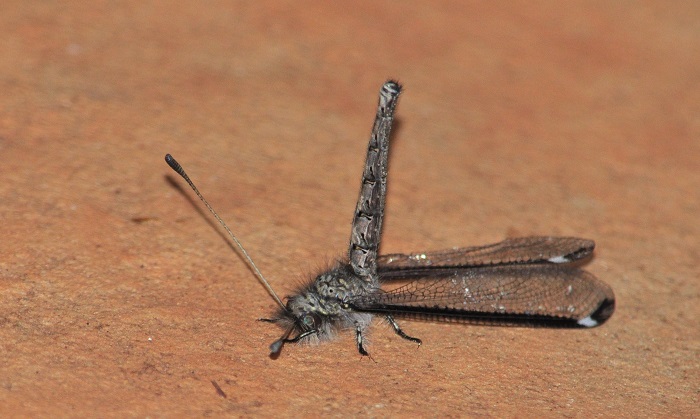
Adult Owlflies are unmistakable. Most have very long, clubbed antennae. Their bodies are generally quite hairy and they have two pairs of roughly equal sized wings. The eyes are well developed and larger than in other Neuropterans.

The resting posture, in the majority of species, is characteristic. The abdomen is held at an angle away from the thorax and wings.

The genus Tmesibasis is different in that they lack obvious clubs on the antennae. They also rest with their wings open and the abdomen is not held up at an angle. They have swollen, wasp-like abdomens and beautifully patterned, narrow-based wings.

Proctareablis sp. in typical posture. The long, clubbed antennae, hairy body and large eyes are clear to see.
Near Carnarvon, Northern Cape
Photo by Ryan Tippett
Tmesibasis laceratus – Limpopo
photo by Luke Verburgt

Behaviour

Most species are crepuscular (active at dawn and dusk).

The flight is swift, direct and powerful.

Adults are predatory and capture other insects on the wing. They hunt from a perch, detecting prey with their keen eyesight.

Food & Feeding

Adults are predators of smaller flying insects such as moths and flies. The larvae are voracious and feed on a range of walking or crawling insects.

Larvae

The larvae resemble those of antlions but are dorsoventrally flattened and have fringed projections on the sides of the body. They have huge jaws that can be opened up 180 degrees.

They are free-living and occur on tree bark or among leaf litter. They are very cryptic and have projections and bristles along their sides that collect debris to aid in camouflage.

Proctareablis sp. – Near Hluhluwe, KwaZulu-Natal
Photo by Ryan Tippett

Distribution

Owlflies are widespread but seldom encountered in large numbers.