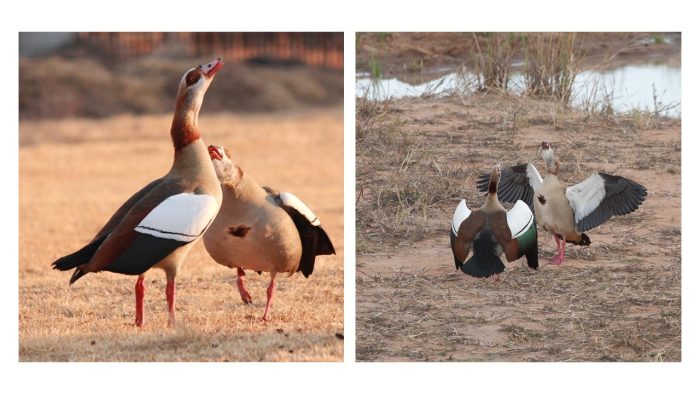
The Egyptian Goose is not actually a goose, but a shelduck. It has many characteristics of a duck, but also some external traits of a goose. Egyptian Geese are easy to identify and can be found across a wide variety of habitats, including grass lawns, urban parks, artificial dams and school grounds.
It is a large brown to tan-coloured bird, easily distinguished from other geese and ducks by its large size, its reddish-brown eye patches and the reddish-brown patch in the middle of its tan-coloured chest (hence its Afrikaans name “kolgans”, meaning dot goose). Males and females look similar but the male is larger. The easiest way to distinguish between the two is on the basis of their call: males tend to mostly hiss, while the females mainly honk. Take a listen here.
Main photo: Dawie De Swardt – BirdPix Record 151742, Bloemfontein, Free State, 10 January 2021. Top insert: Andre Harmse – BirdPix Record 167929, Phalaborwa, Limpopo Province, 25 April 2021. Bottom insert: Ryan Tippett – BirdPix Record 132805, Carnarvon, Northern Cape Province, 02 October 2020.
Juvenile birds can vary in their colouration while their adult plumage (i.e., feathers) is still developing. They have dull brownish underparts and dark-brown to dull-brown colouration on their faces with no eye-patches.
Main photo: Dane Paijmans – BirdPix Record 31394, Cape Town, Western Cape, 23 October 2016. Inset Photo: Anthony Paton – BirdPix 43710, Bedfordview, Gauteng, 11 December 2014.
Habitat
Egyptian Geese inhabit a wide range of freshwater habitats, including rivers, dams, marshes, lakes, reservoirs, estuaries, offshore islands and sewage works. They prefer bodies of water with open shorelines which are close to agricultural land or grasslands where they can graze for seeds, shoots, and other plant matter. They also feed on algae and aquatic plants, and the occasional worm, locust, or termite.
Top Left: Dave Kennedy, Johannesburg, Gauteng. 16 May 2014. BirdPix 11932. Top Right: Christopher Willis, Betty’s Bay, Western Cape. 5 June 2015. BirdPix 18058. Bottom Right: Karis Daniel, Prince Alfred Hamlet, Western Cape. 22 May 2021. BirdPix 170066. Bottom Left: Karis Daniel, Nuwerus, Western Cape. 22 July 2020. BirdPix 121794.
Distribution
They are widespread in sub-Saharan Africa as well as along the Nile River Valley. Substantial non-native populations have become established in the Netherlands, Belgium, Germany and the UK and appear to be expanding rapidly. Within southern Africa they are the most commonly encountered species of waterfowl and are found virtually everywhere, except in highly arid regions and at very high altitudes.
They prefer open habitats such as grasslands and agricultural fields, which is clearly visible in the SABAP2 distribution map. The dark blue areas (i.e., highest reporting rates) in the Western Cape contain large tracts of agricultural fields (mainly grain crops), and the blue areas in the east are mainly grasslands and agricultural land as well.
SABAP2 Distribution map for Egyptian Goose, downloaded 07 March 2022. Details for map interpolation here.
From bird ringing records, it is evident that Egyptian Geese are capable of widespread movements such as from the Western Cape to Namibia and from the Free State to Mozambique; dispersal distances typically range from 70 km to 800 km.
Behaviour
Egyptian Geese are commonly seen in pairs. They form strong pair bonds, and are often observed greeting their bond mates and performing a little courtship dance. Adults are fiercely protective of their young and will fearlessly attack potential predators.
Greeting behaviour between a male and female. Right: Derek Solomon – BirdPix 9618, Mokopane, Limpopo. 12 May 2013. Left: Caitlyn Nauschutz – BirdPix 13817, Midrand, Gauteng. 13 July 2014.
Egyptian Geese are highly territorial, showing behaviours such as hissing, honking and chasing off rival birds. It can be quite entertaining to watch! Males sometimes get into fights with opposing males, trying to bite them on the neck while also beating them with their wings.
These birds can form large flocks where there is enough grazing available, such as on golf courses, agricultural fields and grasslands, and they are often observed among other waterbirds next to dams, rivers and wetlands.
Flock of Egyptian Geese: Lia Steen, Vaal Dam, Free State Province. 09 September 2018, BirdPix 61383. Egyptian Goose and chicks together with other waterbirds: Altha Liebenberg, Stanger, KwaZulu-Natal. 17 September 2017, BirdPix 40498.
During breeding, the nest is made by the female and consists of a shallow bowl of grass, reeds, leaves and down. The usual nest site is on the ground; the female first scrapes a shallow hollow in the ground before constructing the rest of the nest with plant material and down. However, nests are often also constructed on top of old nests of other species, such as Hamerkop, Sociable Weavers, crows, raptors, herons and cormorants. These may be found on cliff ledges, in and on buildings, and in tree holes.
Egg-laying season is year-round, peaking from May to December. The female lays 5-11 eggs, usually one per day, and on completion of the clutch she incubates them for 28-30 days before they hatch. During this time, the male spends most of his time perched nearby and guarding their territory. Both the male and the female feed and care for the chicks. The young fledge at about 60 to 75 days, remaining under the care of their parents for almost 4 months. The chicks reach maturity when they are 2 years old.
Chick: Joan Young, Rietvlei Dam, Gauteng. 25 February 2012, BirdPix 9285. Adult with chicks: Les Underhill, Rondebosch, Western Cape. 09 January 2014, BirdPix 6194. Nest with eggs: John Fincham, Paarl Bird Sanctuary, Western Cape. 25 June 2016, BirdPix 27968.
Since the 1980s, many migrant birds have arrived increasingly earlier in Europe in the northern hemisphere spring (March-April-May). This has often been attributed to springs in Europe gradually getting warmer. But this is obviously a wrong explanation. Long-distance migrants start their journeys thousands of kilometres from Europe. So they must be using different cues to initiate migration.
Magda Remisiewicz and I have written two papers in an Open Access journal called PeerJ which describes these cues for one long-distance migrant, Willow Warbler Phylloscopus trochilus. The big ideas are Magda’s. I helped with data analysis!
The story starts in Poland. With Professor Przemysław Busse. In 1960, as an undergraduate student in his early 20s, he grasped that, to study migration, you needed to have standardized sites and methods. Operation Baltic soon focused on three sites along the Polish coast of the Baltic Sea. The three sites all have the coast on one side, and waterbodies on the inland side, so migrants are funneled along quite narrow strips of land. The mistnetting is as standardized as possible, right down to the same number of nets used in the same places. Operation Baltic initially focused on autumn migration, between fixed dates every year, and later expanded to include fieldwork between specified dates in spring. Professor Busse’s legacy is one of the best long-term datasets for the study of migration patterns anywhere on the planet. In 1960, when he initiated Operation Baltic, no one had ideas about global climate change. So his database dates back to a pre-climate change era!
Professor Busse and I both attended the European Ornithologists’ Union conference in Romania in August 2019.
The paper discussed in this blog uses data from one of the three ringing stations, called Bukowo; this is the westernmost station and about 200 km from the border between Poland and Germany. Bukowo started operating in spring in 1982, so our paper uses data on the northwards migration of Willow Warblers since that year, and up to 2017. Every year the ringing station starts working on 23 March, and continues operating every day until 15 May. This covers the entire spring migration period for the long-distance migrants. It is usually early in April before the first Willow Warblers pass through. Any Willow Warblers mistnetted after 15 May are more likely to be birds that breed in the area than migrants. This is because the birds which have settled to breed locally keep on getting retrapped.
Panorama of Bukowo. Baltic Sea on the left, Kopań coastal lake on the right. The ringing station is inside the woodland straight ahead. The migrants are channelled along the narrow strip of land between the sea and the lake. Great choice of study site, Professor Busse! Bukowo! This is not a luxury field station. Cooking is done in this tent. Another tent is the ringing centre. Everyone has their own sleeping tent. Cars are parked a kilometre away, and the quad bike is used to shuttle people and supplies along the sandy track. This is autumn, when it is still pretty warm. During the spring migration season, it is chilly, and there is sometimes snow.
Back to the papers! The statistical analysis is quite complex, but the final results are easy to grasp. The first step is to estimate the “average cumulative arrival curve”, averaged across all the years of data. To find where to put the point for 1 May, say, add up all the Willow Wablers caught in all years on all days up to and including 1 May, and divide it by the grand total number of Willow Warblers trapped. This is the plot below. It shows, for example, that by 26 April, over all years, almost exactly 33% of the Willow Warblers have passed through Bukowo (see the lower of the two lines with arrows!).
Next we find the cumulative arrival curve for each year. The blue line in the plot below is for 2012. It shows that, by 26 April 2012, close on 70% of the year’s Willow Warblers had passed through. In other words migration was early in 2012. The area between the red line and the blue line is called the anomaly for 2012. Because the blue line is to the left of the red line, we gave the anomaly a negative sign. When migration is late, the blue line is to the right of the red line, and the anomaly is positive.
In the plot below, the dots represent the anomalies in each year, between 1982 and 2017. The dot for 2012 is the most negative of them all (which is why we used this year to illustrate the concept!).
When you look at the relationship between the annual anomaly and time, it is obvious that most of the anomalies in the early years were positive and in the final years were negative. In English, this means that the passage of migrating Willow Warblers is, on average, getting earlier. The statistical stuff top right says that a decreasing pattern like this is extremely unlikely to occur if the timing of migration is actually staying the same. In the jargon of statistics we talk about a trend of getting significantly earlier through the decades. But year is just a number. Even though the calendar year is correlated with the trend in the anomaly, it cannot be the direct cause of getting earlier.
And even if there is a trend, the annual anomalies do jump around a lot. Maybe there is something more going on. So we investigated whether any of the big climate indices could be used to “explain” the anomalies. In the map below, you can see the crazy things we tried. Working from the bottom to the top, we used the Southern Oscillation Index (SOI), the big climate index that drives El Niño, and influences rainfall throughout southern Africa, and is responsible for both droughts and floods. The Indian Ocean Dipole (IOD) is a poorly known index which influences rainfall in East Africa. Rainfall and temperature in the Sahel (TSAH, PSAH), just south of the Sahara Desert, are likely to be influential, because the Sahel is where a lot of the Willow Warblers from western Europe spend the non-breeding season. The Northern Atlantic Oscillation (NAO) is thought to explain whether or not conditions are good for spring migration. Temperature at Łeba, the closest weather station to Bukowo, were averaged for the migration period to form TLEB. We used the Scandinavian index (SCAND) from the previous summer as an explanatory variable for the anomaly in a given year, thinking that if it showed that conditions had been good/poor during the previous breeding season there would be more/fewer Willow Warblers on migration in the following spring!
In our first paper (it is Open Access Remisiewicz M, Underhill LG. 2020. Climatic variation in Africa and Europe has combined effects on timing of spring migration in a long-distance migrant Willow Warbler Phylloscopus trochilus. PeerJ 8(23):e8770) we developed a model which explained 59% of the variation in the overall annual anomaly. It had seven variables: Northern Atlantic Oscillation (over two three-month periods), Indian Ocean Dipole, Southern Oscillation Index, Sahel Precipitation Anomaly, Scandinavian Index and the local mean temperature at Łeba. The amazing thing is that if we add “year” as an eighth variable, the statistical model selection algorithm says that it doesn’t help to improve the quality of the explanation. This means that the combination of climate variables in our best model explained not only the year-to-year variation in the timing of Willow Warbler migration, but also the long-term trend for earlier migration. 59% might not sound impressive, but in this context it is pretty amazing.
Next step was to try something more ambitious. It was published in February 2022. Here is the link to the paper: Remisiewicz M, Underhill LG. 2022. Climate in Africa sequentially shapes spring passage of Willow Warbler Phylloscopus trochilus across the Baltic coast. PeerJ 10:e12964. There are lots of steps in the statistical story which are given in detail in the paper, but are glossed over here. But the series of plots below, which is one of the figures in the paper, shows how each of the climate variables sequentially impacts the anomaly during the migration period.
So, in each plot, the x-axis is essentially the spring migration season, 1 April to 15 May. The thickness of the band indicates the sequential impact of the climate variable on the anomaly. It is easiest to explain by doing an example. Plot A relates the Southern Oscillation Index, averaged over the period Aug-Oct in the year prior to migration. This variable tells us whether Willow Warblers arriving in southern Africa met good or bad conditions. Plot A is telling us that if the Willow Warblers arrived in southern Africa during environmental conditions, there anomaly is positive in the first half of the migration period. Lots of birds arriving early.
Plot B relates to the Indian Ocean Dipole, also Aug-Oct of the previous year. The graph shows that if the Indian Ocean Dipole has produced good rainfall when the Willow Warblers were arriving the previous year, then more birds pass through Bukowo in the early spring. Plots A and B, taken together, suggest that the Willow Warblers with wintering grounds in southern and eastern Africa occur at Bukowo are mainly in the early part of the migration period, and that they arrive there early after good rainfall in southern and eastern Africa.
Plots C and D relate to western Africa, to the conditions in the Sahel when the Willow Warblers are arriving there, Aug-Oct of the previous year. When conditions in the Sahel are good on arrival, they migrate through Bukowo early half a year later.
Plot E says that when conditions in the Sahel are good later on in the season, specifically if there is good precipitation (PSAH) from Nov-Mar, during the main non-breeding period, Willow Warblers from western Africa tend to be numerous on passage through Bukowo in the second half of the migration period. In other words, conditions remain good, so some birds take advantage of them, and delay migration by a week or two.
Plots F and G relate to the Northern Atlantic Oscillation. What the fairly uniform bars tell us if the conditions for migration in western Africa and southwestern Europe are good, there are more birds on passage throughout the migration season.
Plot H says that local temperatures do not play a role during the earliest part of migration. This implies that it is not local conditions which govern the timing of arrival of the first Willow Warblers at Bukowo. Instead, the start of passage is related to climate conditions in eastern and southern Africa several months earlier. Later in April and in May, if temperatures around Bukowo are high, there are more birds on passage.
And Plot I is particularly fascinating. The Scandinavian Index, from during the previous breeding season, points to conditions being favourable (or unfavourable) for high (or low) productivity. It makes sense that a good breeding season is followed by more birds on passage the following spring migration season.
In a nutshell, those are the main findings of our second Willow Warbler paper.
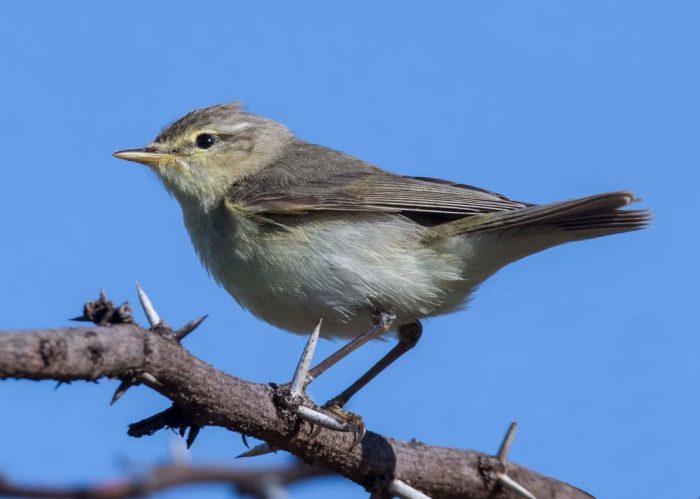
Willow Warbler Phylloscupus trochilus in its non-breeding season habitat. This photo was taken by Tony Archer in November 2017 in Klerksdorp, North-West, South Africa. It is BirdPix record 46564
In these two papers in PeerJ, we used data up to 2017 (even though we had the Willow Warbler data for subsequent years!). We stopped then because 2017 was the final year for which one of the indices we were using was updated. We have found an alternative index, and have now done the analysis using the climate indices up to 2021. Firstly, the Willow Warbler’s trend for gradually earlier passage through Bukowo is continued. Second, and more important, the overall patterns are confirmed. Finally, and dangerously (because it is taking a chance to predict the future), we anticipate that the passage of Willow Warblers at Bukowo will be early this spring. We make this prediction because the current values of the Southern Oscillation Index have generated a wet summer in eastern part of South Africa. Conditions have been good for Willow Warblers and they are likely to migrate early! We will soon find out; the 2022 spring field season at the Operation Baltic ringing station at Bukowo is less than a month away.
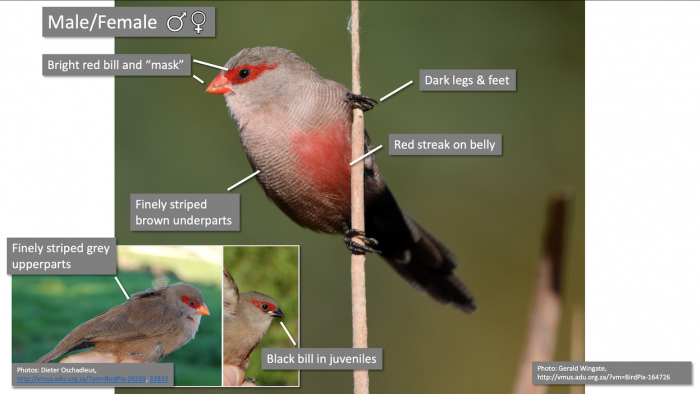
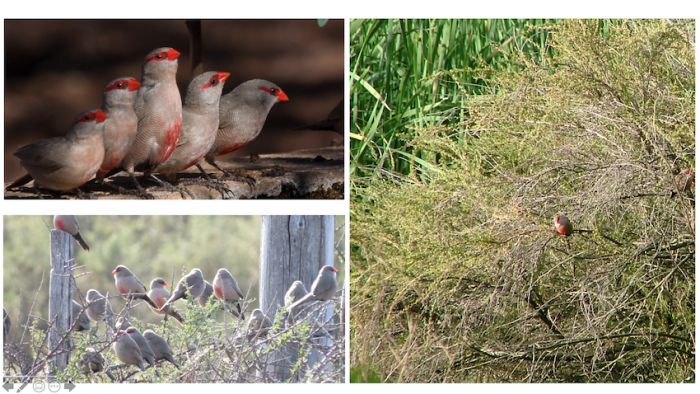
Common Waxbills are small greyish-brown birds. This species is not sexually dimorphic; males females look the same. Overall, the Common Waxbill is greyish-brown and covered in thin, dark bars. In addition to barring, many birds also have a reddish streak running from their chest to their belly. Though these are all important clues, the easiest way to identify a common waxbill is by its bright red bill and the characteristic “mask” across its eyes. Young birds look very much like adults with two exceptions: the bill is blackish rather than red, and their overall colouration is duller with less distinct barring.
Common Waxbill. Gerald Wingate, Durbanville, Western Cape. 8 April 2021. BirdPix 164726 Dieter Oschadleus, Cape Town, Western Cape. 3 September 2016; 3 December 2016. BirdPix 29265; 32832
Common Waxbills do not have the most musical of songs; in fact, you are more likely to hear a contact call used to communicate to one another when foraging in a flock or in flight. You can listen to their song and call here.
Distribution
Except for the very driest parts of the interior, namely the Kalahari and Namib Deserts, these birds are common throughout southern Africa. On this SABAP2 map, see if you can find the Orange River—the Common Waxbill distribution closely follows its path!
SABAP2 distribution map for Common Waxbill, downloaded 28 October 2021. Details for map interpolation here.
Although this map only shows southern Africa, Common Waxbills are not unique to the region and occur in many African countries south of the Sahara desert. The species has also been introduced in countries where it did not originally occur, including Portugal and Spain in Europe, Brazil in South America, Puerto Rico in the Caribbean, and several island nations in the Atlantic, South Pacific, and Indian Oceans.
Habitat
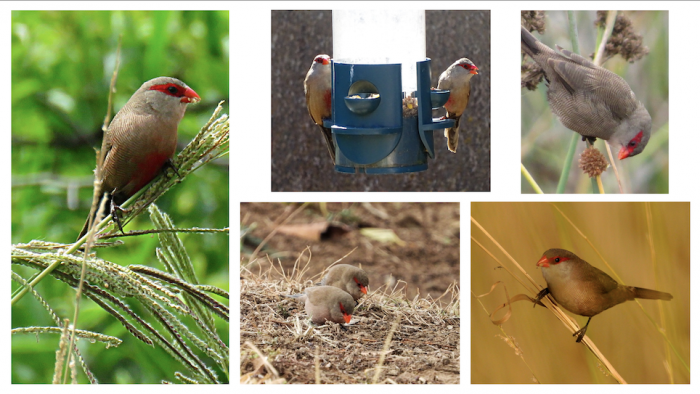
The majority of the Common Waxbill’s diet consists of seeds and flowers from grasses, sedges, and some trees. They will also snack on the occasional insect, but their seed-loving tendencies confine them to a few specific habitat types.
Common Waxbills feeding on seeds. Clockwise from L: David Kennedy, Dullstroom, Mpumalanga. 25 February 2018. BirdPix 50616; Johan & Estelle van Rooyen, Stilbaai, Western Cape. September 4 2015. BirdPix 120426; Cobus Elstadt, Jeffreys Bay, Eastern Cape. 18 February 2018. BirdPix 50581; Rick Nuttall, Howick, KwaZulu-Natal. 9 June 2018. BirdPix 68622; Neels & Joanne Putter, Cathkin Peak, KwaZulu-Natal. 26 October 2020. BirdPix 136150
Waxbills like edges; rushes, reeds, and grasses along the edge of rivers, grasses growing around cultivated land, and thick, tangly vegetation along watercourses. They will also readily visit seed feeders in gardens—keep an ear out for those distinctive contact calls signalling their arrival!
Common Waxbill habitat includes gardens, vegetation next to running water or wetlands, and edges of fields. Top L: Vaughan Jessnitz, Postmasburg, Northern Cape. 17 November 2014. BirdPix 12736; Lower L: Tino Herselman, Middelburg, Eastern Cape. 22 August 2015. BirdPix 77630; R: David Kennedy, Dullstroom, Mpumalanga. 22 November 2015. BirdPix 23136
Behaviour
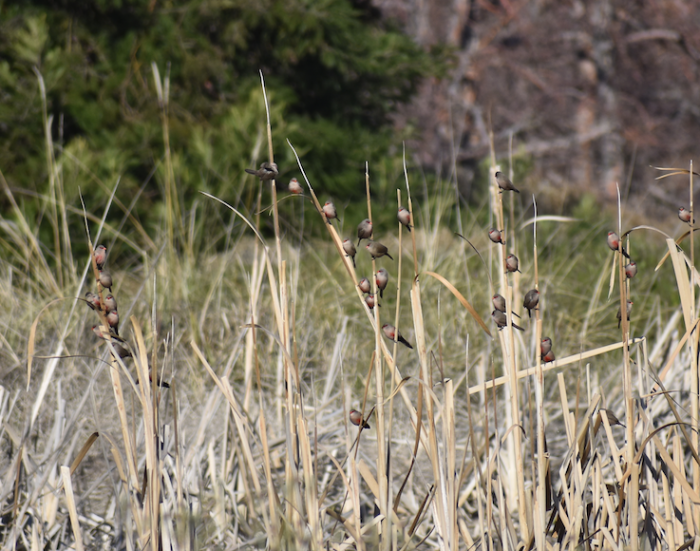
Common Waxbills are gregarious birds. When breeding, they birds may be seen in small family groups or male-female pairs; outside of the breeding season, they often gather in bigger flocks to forage, sometimes with other seed-eating species. At night, Common Waxbills use communal roosts, sites in reeds or bushes where large groups of birds all rest together.
A flock of Common Waxbills. Karis Daniel, Die Dorp Op Die Berg, Western Cape. 24 July 2020. BirdPix 122283
Common Waxbills tend to nest alone as male-female pairs. Males and females work together to build a nest on or just above the ground, with males creating a messy teardrop-shaped hollow from grasses and stems, and females adding soft grasses and feathers for lining. Many pairs will also build a fake nest on top of their real nest, perhaps to confuse potential predators.
In addition to raising their own young, Common Waxbills often take on the role of surrogate parents, whether they like it or not. They are the host species of choice for another common seed-eating bird, the Pin-tailed Whydah, which is a brood parasite. You can read more about this behaviour by visiting the Pin-tailed Whydah page.
Virtual Museum (BirdPix > Search VM > By Scientific or Common Name)
More common names: Rooibeksysie (Afrikaans); Astrild ondulé (French); Wellenastrild (German); Astrilde commune (Italian); Pico de Coral (Spanish)
A list of bird species in this format is available here.
Recommended citation format: Daniel KA 2021. Common Waxbill Estrilda astrild. Biodiversity and Development Institute. Available online at https://thebdi.org/2021/10/28/common-waxbill-estrilda-astrild/
The Cape Canary is a small, brightly-coloured birds. Males and females can be difficult to tell apart; you must look closely! Both sexes have yellow faces, but in males, the yellow runs all the way to the top of the head, forming a cap. In females, the top of the head is grey. There are a few other subtle differences to note: females have more dark streaks on their backs than males, and tend to be a paler yellow underneath.
Female Cape Canary. Gregg & Desire Darling, St Francis Bay, Eastern Cape. 11 September 2015. BirdPix 20281 Inset photo: Male Cape Canary. Kyle Finn, Knysna, Western Cape. 15 July 2014. BirdPix 88030
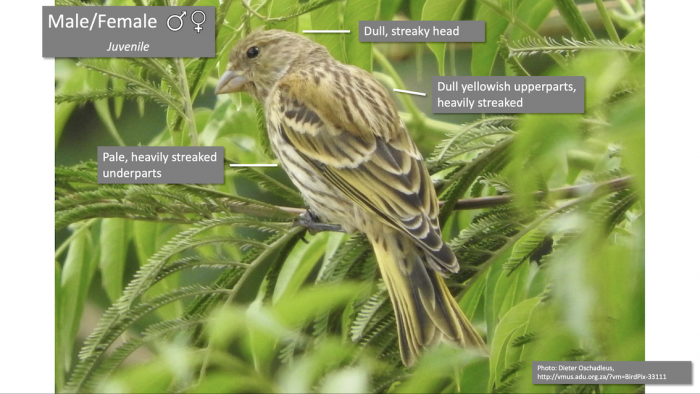
Juvenile Cape Canaries look quite different to adults; they are a dull, pale yellowish colour, and have heavy streaks all over their heads and bodies.
Juvenile Cape Canary. Dieter Oschadleus, Paarl, Western Cape. 21 December 2016. BirdPix 33111 L to R: Cape Canary immature, subadult, adult. Giles Mulholland, Nelspruit, Mpumalanga. Immature: 6 December 2011. BirdPix 134701; Subadult: 13 June 2014. BirdPix 134703; Adult: 22 June 2013. BirdPix 134702
You may have heard the expression “sing like a canary,” and for this species, the words are fitting! Cape Canaries belong to a group of birds called songbirds. Songbirds have specially developed vocal organs which allow them to produce complex songs, and Cape Canaries are no exception. Their ceaseless, cascading song is an iconic part of urban garden soundscapes. You can listen to their song here.
Habitat
Cape Canaries feed primarily on seeds, but will also eat fruits, flowers, and insects. They utilize a variety of habitats ranging from grassland, forest edges, and coastal sand dunes to residential gardens, agricultural fields and urban parks. Thanks to their seed-eating diet, Cape Canaries are often found at bird feeders.
Male Cape Canary feeding on seeds. Gerald Wingate, Bellville, Western Cape. 19 November 2019. BirdPix 97784
Distribution
Because of their reliance on seeds and flowering plants, these birds are largely absent from the dry interior of southern Africa. This SABAP2 distribution map shows the wide belt of land they inhabit.
SABAP2 distribution map for Cape Canary, downloaded 27 October 2021. Details for map interpretation here.
Cape Canaries are endemic; they are only found in southern Africa, and nowhere else in the world! Though their distribution reaches up into parts of Zimbabwe and Mozambique, Cape Canaries do not occur further north.
Behaviour
Cape Canaries are seldom seen (or heard) alone—they are gregarious. When breeding, these birds may be seen in small family groups or male-female pairs; outside of the breeding season, they often congregate in large flocks, sometimes with other seed-eating bird species. They are often seen foraging, searching for seeds in small groups or flocks.
Flock of Cape Canaries. Dave Rimmer, Underberg, KwaZulu-Natal. 10 August 2015. BirdPix 21660
Cape Canaries are sometimes easier to hear than to see—though they may choose conspicuous perches when singing, males will just as often sing from the tops of tall trees.
Cape Canaries usually nest alone, but if there is a lack of suitable places to build nests, several pairs of birds may nest in the same clump of trees. Females do most of the construction work, selecting a branch in a bush or tree and using a mixture of small twigs, leaves, roots, mosses, and even string to make a sturdy cup-shaped nest. The inside is lined with soft seeds, feathers, and hair.
Virtual Museum (BirdPix > Search VM > By Scientific or Common Name)
More common names: Kaapse Kanarie (Afrikaans); Serin du Cap (French); Gelbscheitelgirlitz (German); Canario del Cap (Italian); Serín dorsigrís (Spanish)
Recommended citation format: Daniel KA 2021. Cape Canary Serinus canicollis. Biodiversity and Development Institute. Available online at https://thebdi.org/2021/10/27/cape-canary-serinus-canicollis/
List of bird species in this format is available here.
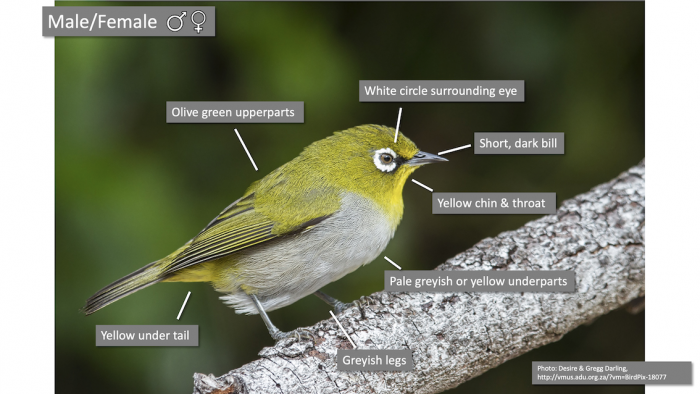
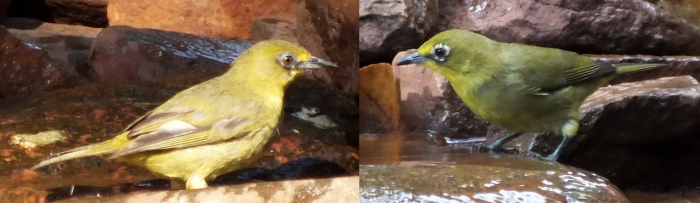
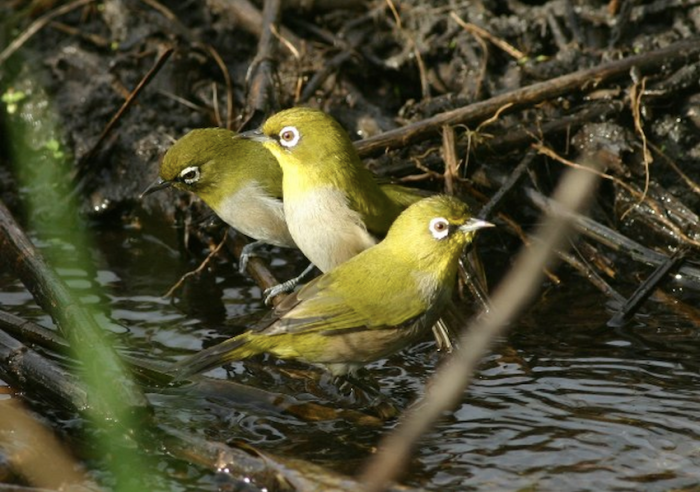
The Cape White-eye is a very small, fast-moving bird. Males and females look alike but show geographic variation. This means that one species can look different in different parts of its range. The Cape White-eyes you are likely to see in Cape Town have olive green upperparts, grey or yellowish bellies, and bright yellow patches on their throats and under their tails. They have short, black bills and a characteristic circle of small white feathers around their eyes—this is where the name “white-eye” comes from!
Cape White-eye identification guide: BirdPix 18077 – Desire & Gregg Darling, St Francis Bay, Eastern Cape, 06 June 2015.
Further north, the same species looks quite different. For instance, in Limpopo province, Cape White-eyes tend to be much more yellow overall with less of a contrast between their upperparts and underparts. Young birds anywhere in southern Africa are a duller greyish colour. Have a look at these two photos from Polokwane, Limpopo: both were taken on the same day in the same place, and believe it or not, they are the same species! The duller-coloured bird on the left is young and still growing its adult feathers, whilst the brighter yellow bird on the right is a mature adult.
L photo (young bird): BirdPix 114574 – Lance Robinson, Polokwane, Limpopo, 09 September 2016. Right photo (adult bird): BirdPix 114572
If you are lucky enough to have Cape White-eyes nesting in your garden, you might glimpse a bird without a white eye ring, like the bird on the left, or a partial ring, like the bird on the right. White-eyes only develop their “white eyes” around 5 weeks of age. If you keep an eye out for these transitional stages, you may be able to work out an estimate of a bird’s age.
Giles Mulholland, Nelspruit, Mpumalanga. L photo (immature): 14 February 2012. BirdPix 134789; R photo (subadult): 7 March 2012. BirdPix 134790
Cape White-eyes are very vocal, and you may find that you are already familiar with some of their repertoire. These birds usually maintain constant streams of communication with each other when flying between trees and foraging. Their trilled contact call is a distinct sound; in the early morning, listen out for their long, liquidy song, which sometimes includes mimicry of other species.
Habitat
Cape White-eyes have quite a varied diet and commonly feed on a combination of insects, fruit, and nectar. They forage in small groups, working together to scour a tree or plant for food before moving together to the next spot.
Cape White-eye diet. Clockwise from top L: Phil White, Simunye, eSwatini. 30 January 2020. BirdPix 103486; Gerald Wingate, Cape Town, South Africa. 10 January 2021. BirdPix 152153; Colin Summersgill, Weenen, KwaZulu-Natal. 13 February 2021. BirdPix 157611; Dave Rimmer, Hillcrest, KwaZulu-Natal. 7 August 2015. BirdPix 20685; Keir Lynch, Grabouw, Western Cape. 24 August 2019. BirdPix 89310
Because they consume a variety of food sources, these birds occupy a range of habitat types, including open shrubby land with scattered trees, forests and forested mountain slopes, residential gardens and parks, and scrubby vegetation alongside rivers. White-eyes are unlikely to visit birdseed feeders in gardens, but will happily feed on fruit or mealworms or have a splash in a bird bath.
Cape White-eye habitat. L: Dewald du Plessis, Fourth Reverse, Eastern Cape. 5 December 2009. BirdPix 23874 Top R: Itxaso Quintana, Cape Town, Western Cape. 13 June 2020. BirdPix 115354 Lower R: Karis Daniel, Anysberg, Western Cape. 4 February 2021. BirdPix 155606
Distribution
The Cape White-eye is a southern African endemic; in other words, it does not occur anywhere else in the world outside of southern Africa.
SABAP2 distribution map for Cape White-eye, downloaded 3 November 2021. Details for map interpolation here.
It is common across South Africa, except for the very dry interior regions of the Northern Cape, as well as in eSwatini and Lesotho. Cape White-eyes can also be found in southeastern Botswana and along the southwestern border of Mozambique.
Behaviour
Cape White-eyes are gregarious, spending their time in pairs or small groups rather than alone. These birds usually spend the night huddled together in pairs before joining a large foraging flock very early in the morning. Flocks work through surrounding vegetation in search of food, often starting before dawn. As the day progresses, the large flock breaks off into smaller and smaller sub-groups until only a few birds or pairs remain together and eventually return to a night-time perch.
Small group of Cape White-eyes. Maans Booysen, Stilbaai, Western Cape. 6 April 2010. BirdPix 11676
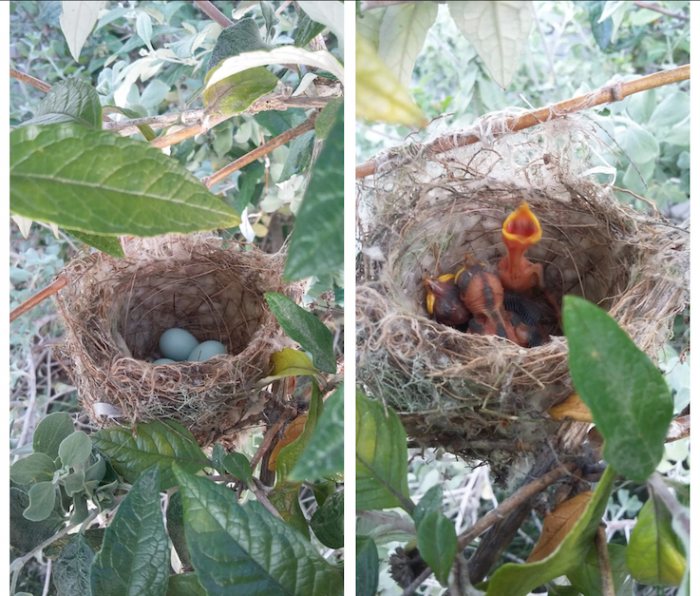
Cape White-eyes are solitary nesters, meaning that each pair of birds builds its nest away from other White-eyes. Males and females share the building responsibility, forming a tiny cup-shaped structure from whatever materials they find in surrounding vegetation.
Cape White-eye nest. Dewald du Plessis. Plettenbergbaai, Western Cape. 29 November 2019. BirdPix 98148
In forests, nests may include lichen and moss; in drier regions, grasses and roots. Nests are lined with soft grass flowers and animal hair, and nests in urban areas occasionally include bits of string or fabric. They are usually constructed between two forked twigs in a shrub or tree, and can be difficult to spot.
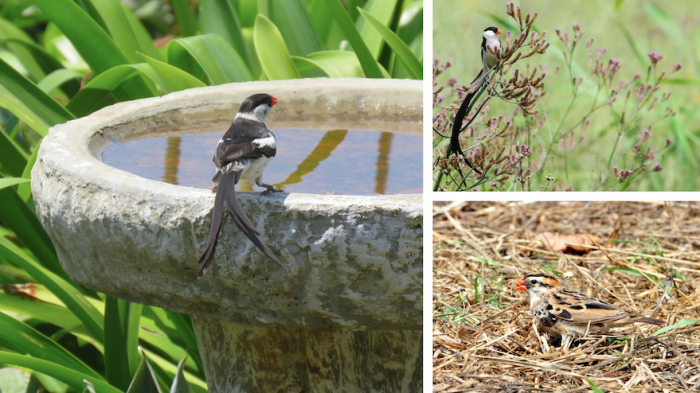
The Pin-tailed Whydah is a small sexually dimorphic species. Males and females differ dramatically when breeding, and appear similar outside of the breeding season. These seasonal “wardrobe changes” are common in many bird species in which one sex (usually the male) performs a display or builds a special structure to attract a mate. Pin-tailed Whydahs fall into the first category; males sing and perform elaborate aerial displays to attract the attention of females.
As environmental conditions become suitable for raising young, males undergo a process called moult, replacing their drab everyday feathers with striking, boldly-coloured breeding plumage. For species like the Pin-tailed Whydah that undergo these seasonal transformations, we can divide identification into a few different categories: breeding male and female, non-breeding male and female, and juvenile.
Let’s start with the breeding male. In full breeding plumage, the male Pin-tailed Whydah is difficult to miss. He is white with a black cap on his head, a bright reddish-orange bill, black legs, and a distinct long, flowing black tail.
Breeding male Pin-tailed Whydah. Derick Oosthuizen, Still Bay, Western Cape. 6 January 2019. BirdPix 116201
By contrast, breeding females make a much less flashy counterpart. A key feature to look for in Whydahs is a striped head. The female Pin-tailed Whydah has a brownish head and face with bold black stripes. She is a pale buff or whitish colour underneath, has black legs, and her back is a mottled mix of brown and black. When breeding, her bill is usually black.
Breeding female Pin-tailed Whydah. Dieter Oschadleus, Cape Town, Western Cape. 12 November 2016. BirdPix 32108
Though it might be hard to imagine, outside of breeding season, males and females look very much alike and can be difficult or impossible to tell apart! Overall, they more closely resemble a breeding female. The head and face are brownish with bold black stripes, the underparts are a pale buff colour, and the back is mottled brown and black. The bill is always red in males, but non-breeding females may have a red or blackish-red bill, making it hard to know for certain which is which.
Non-breeding Pin-tailed Whydah. Lia Steen, Shellybeach, KwaZulu-Natal. 9 October 2020. BirdPix 136987
This becomes a bit easier to untangle when males begin moult; let’s have a look at a male in transitional plumage. This bird is in the process of changing its non-breeding feathers to its bold black-and-white breeding colours. If you see a group of Pin-tailed Whydahs, keep an eye out for males in various stages of transition. You might notice black feathers starting to grow on the back and wings, the beginnings of a black cap on the head, or, often most conspicuously, a half-grown black tail.
Transitional plumage male Pin-tailed Whydah. Johan Heyns, Heidelberg, Gauteng. 16 September 2012. BirdPix 7621
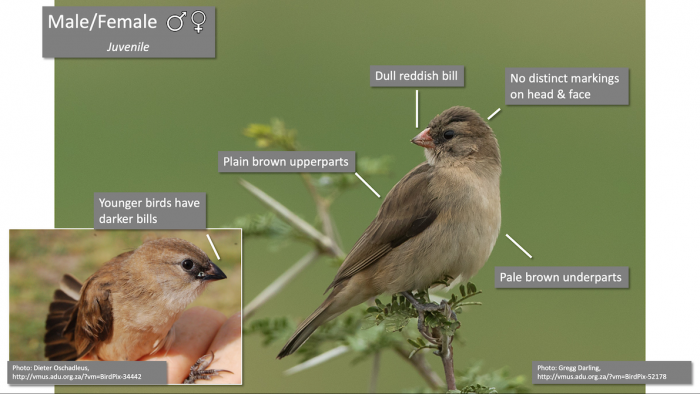
What about birds that are too young to breed? The juvenile Pin-tailed Whydah looks quite different to adult birds; it can be tempting to see a juvenile and think it is a different species! There are no distinct stripes on the head and face, and the entire body is a plain brownish colour. The bill is usually a dull pinkish-red, but very young birds have blackish bills.
Juvenile Pin-tailed Whydah. Gregg Darling, Craddock, Eastern Cape. 13 April 2018. BirdPix 52178 Inset photo: Dieter Oschadleus, Cape Town, Western Cape. 4 February 2017. BirdPix 34442
Pin-tailed Whydahs are noisy and communicative, especially breeding males. Their high-pitched, squeaky song is a common sound in gardens.
Habitat
The Pin-tailed Whydah feeds on grass seeds, often on bare ground. If you watch a Pin-tailed Whydah foraging, you might observe an interesting behaviour; they often use their feet to kick soil away and reveal seeds. This species is at home in a range of habitat types, including savanna, grassland, dense vegetation along running water, wetlands, edges of agricultural fields and residential gardens.
Examples of Pin-tailed Whydah habitat. L: Mary Ellen Lindsay, Scottburgh, KwaZulu-Natal. 24 January 2020. BirdPix 103148; Top R: Mark Stanton, Centurion, Gauteng. 18 December 2019. BirdPix 99446 Lower R: Ryan Matthew Tippett, Mkuze, KwaZulu-Natal. 5 April 2013. BirdPix 12332
In gardens, Whydahs are frequent visitors to bird feeders, and breeding males are notorious for their tendency to aggressively “defend” feeders from other birds. If you have Whydahs feeding in your garden, keep an eye out–territorial interactions between male Whydahs and other species are almost inevitable!
Distribution
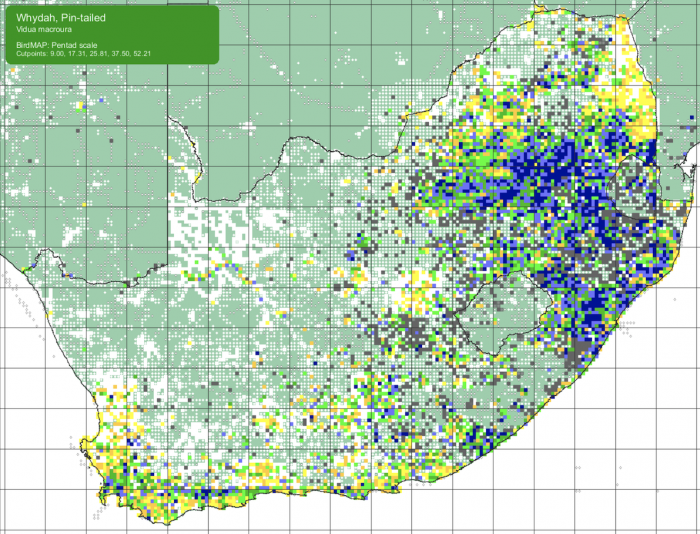
In southern Africa, the Pin-tailed Whydah is common within the Western Cape and along the eastern coast of South Africa, as well as in Zimbabwe and Mozambique and parts of Namibia and Botswana. In years with good rainfall, they may also be found in the typically drier inland regions of Namibia and South Africa.
SABAP2 distribution map for Pin-tailed Whydah, downloaded 29 October 2021. Details for map interpolation here.
Pin-tailed Whydahs are not confined to southern Africa; they are widespread in continental Africa and a common sight in many countries south of the Sahara desert. They are also an introduced species in the United States, Singapore, and Puerto Rico.
Male Pin-tailed Whydah in Sudan. Mohamed Salah, Bahri, Khartoum, Sudan. 3 August 2019. BirdPix 86633
Behaviour
Pin-tailed Whydahs are gregarious birds. When breeding, they tend to form small groups composed of a single breeding male and a mix of several females and non-breeding males. Outside of the breeding season, these groups may be much larger, expanding to include 30 or more individuals.
Breeding males have a knack for making themselves seen through a combination of aggressive behaviour, continuous vocalization, and eye-catching flight displays. You can watch a male singing and displaying in this video, created by Lynette Rudman.
When it comes to raising young, Pin-tailed Whydahs are masters of finding shortcuts! These birds are brood parasites; birds that lay their eggs in the nest of another species. A male Pin-tailed Whydah will aggressively defend a small territory in the breeding season, chasing off other birds and singing from conspicuous perches. Females will visit the territories of males who offer impressive songs and displays, and will often mate with more than one male.
Male Pin-tailed Whydah displaying for female. Lia Steen, Randburg, Gauteng. 7 March 2017. BirdPix 35195
After mating, the female searches for a suitable host nest in which to lay her eggs, and on finding a nest, may remove or even eat one of the host bird’s eggs before laying her own! The host, usually a Common Waxbill, is then left to feed and raise a Pin-tailed Whydah alongside its own young. Common Waxbill and Pin-tailed Whydah hatchlings look remarkably similar, and newly-hatched Whydahs will even mimic the begging behaviours of young Waxbills. Waxbill parents will feed both their own young and the Whydah until the chicks are ready to leave the nest; at this point, the Whydah chick leaves the Waxbills and re-joins a flock of Pin-tailed Whydahs.
This flashy parasite can be seen in action in the BBC documentary series “Attenborough’s Life in Colour.” Check out Series 1, episode 2: Hiding in Colour.
Virtual Museum (BirdPix > Search VM > By Scientific or Common Name)
More common names: Koningrooibekkie (Afrikaans); Veuve dominicaine(French); Dominikanerwitwe (German); Vedova coda a spilli (Italian); Viuda colicinta (Spanish)
List of bird species in this format is available here.
Recommended citation format: Daniel KA 2021. Pin-tailed Whydah Vidua macroura. Biodiversity and Development Institute. Available online at https://thebdi.org/2021/10/29/pin-tailed-whydah-vidua-macroura/
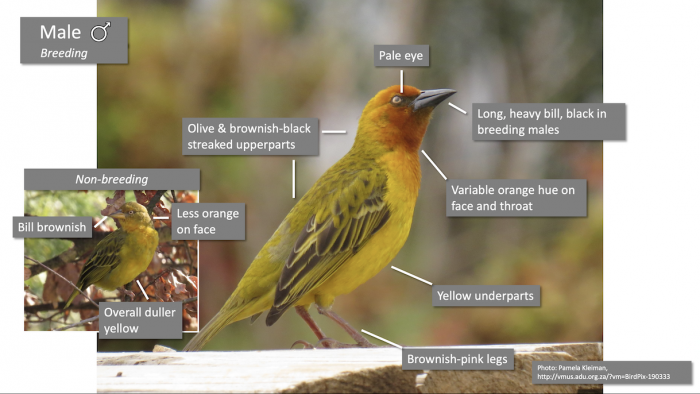
The Cape Weaver is a medium-sized, brightly coloured bird. Males and females look similar but are not quite alike. Males also differ slightly in and out of the breeding season.
Male Cape Weaver. Pamela Kleiman, Underberg, KwaZulu-Natal. 22 October 2021. BirdPix 190333 Inset photo: 7 May 2021. BirdPix 168226
Breeding males have olive green upperparts streaked with dark brown. The eyes are a pale whiteish colour and the long, thick bill is black. The underparts are brilliant yellow, and many males have a patch of deep orange around their face and throats. Outside of the breeding season, adult males keep the pale eyes, but lose the bright colours. Non-breeding males are duller yellow overall, and the dramatic black breeding bill becomes a brownish colour.
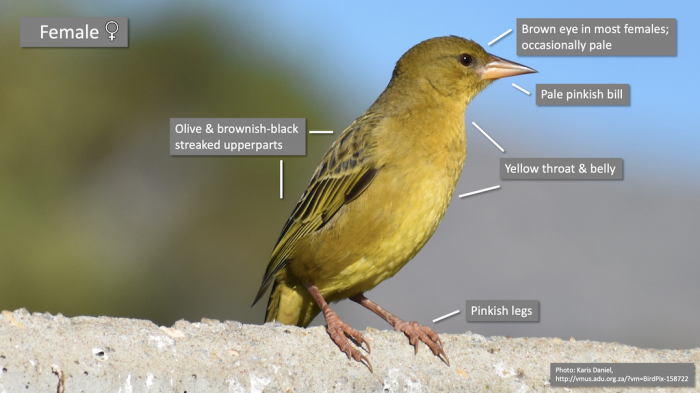
Female Cape Weaver. Karis Daniel, Citrusdal, Western Cape. 2 March 2021. BirdPix 158722
Adult females almost resemble non-breeding males; the upperparts are dull yellowish-green streaked with dark brown, and the underparts are yellow. Females have pinkish-brown bills, and though most have dark brown eyes, around 20% may also have pale eyes! This can make it difficult to tell males and females apart on sight (more here). Juvenile Cape Weavers closely resemble females.
Cape Weavers produce a buzzy, chattery song and a distinct harsh alarm call. Males are particularly vocal around their nests—keep reading to learn more.
Habitat
Cape Weavers have quite a varied diet, and are known to regularly feed on insects, spiders, fruit, nectar, and seeds. They forage in trees and on the ground, and are an important pollinator for many species of aloe.
Cape Weaver diet. L: Itxaso Quintana, Cape Town, Western Cape. 7 April 2020. BirdPix 110096; Top R: Giles Mulholland, Nelspruit, Mpumalanga. 8 July 2012. BirdPix 134656; Lower R: Andries Petrus & Joey de Vries, Nieuwoudtville, Northern Cape. 23 August 2019. BirdPix 93315
So long as some tree cover and permanent water are present, Cape Weavers can be found in a variety of open landscapes, often with shrubby vegetation or near farmland.
Examples of Cape Weaver habitat. Clockwise from top L: Rene Navarro, Riebeek Kasteel, Western Cape. 12 September 2021. BirdPix 184037; Les Underhill, Melkbosstrand, Western Cape. 2 August 2020. BirdPix 123181; Robertson, Western Cape. 23 July 2021. BirdPix 176264; Bitterfontein, Western Cape. 22 July 2020. BirdPix 121140
They are also frequent visitors to garden seed feeders, and will readily utilise bird baths.
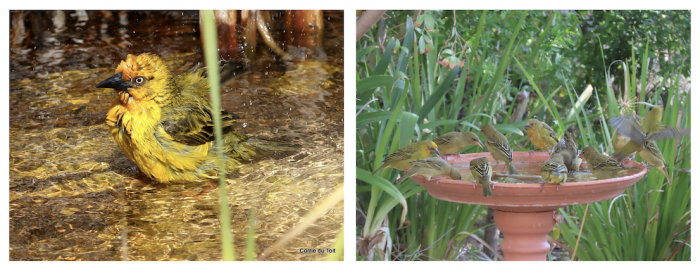
Cape Weavers visiting bird baths. L: Corrie du Toit, Langebaan, Western Cape. 1 September 2020. BirdPix 128245; Fiona Hellman, Riebeek Kasteel, Western Cape. 8 April 2020. BirdPix 108780
Distribution
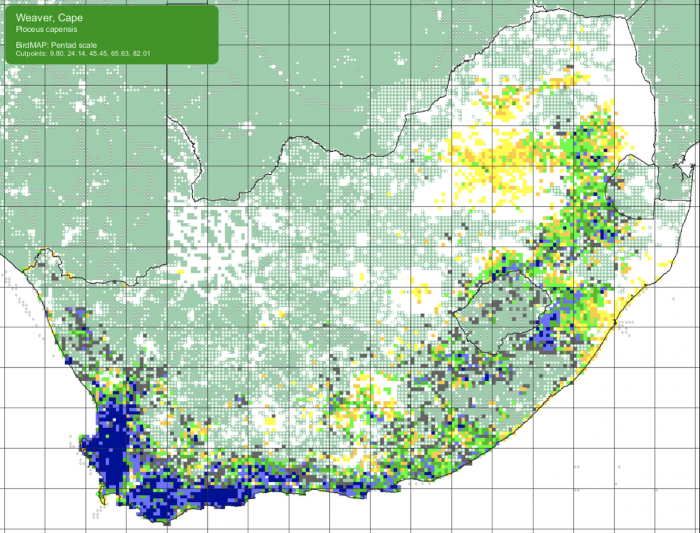
The Cape Weaver is an endemic species; its range is confined to South Africa, eSwatini, and Lesotho. It is common in Lesotho and South Africa, except for the dry interior regions of the Northern Cape, and can also be found in western eSwatini.
SABAP2 distribution map for Cape Weaver, downloaded 8 November 2021. Details for map interpolation here.
Behaviour
Cape Weavers are gregarious, and are often seen in mixed flocks with other species. They typically sleep in large communal roosts in reedbeds, which may also contain other species. The flock leaves the reedbed early in the morning to forage and returns just after sunset.
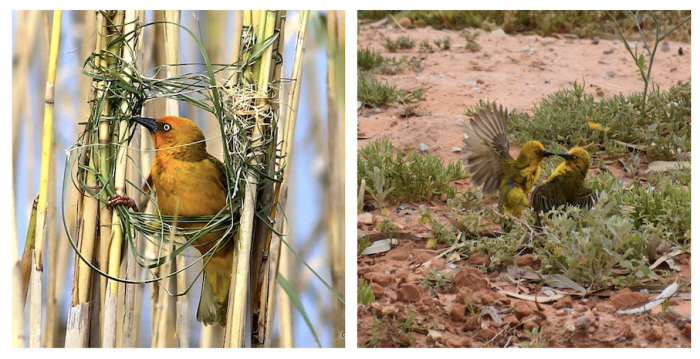
Cape Weavers are typically colonial nesters, meaning that several birds nest close together. Birds in the weaver family have some of the most fascinating nesting strategies and structures of any birds in the world. Males weave their bulky, globular nests from broad grasses, reed blades, and occasionally leaves. Cape Weavers are also polygynous, meaning that one male may have several female mates in a single breeding season. Each male constructs a few nests in his territory, which he fiercely defends.
L: Male Cape Weaver starting a nest. Corrie du Toit, Somerset West, Western Cape. 13 August 2020. BirdPix 125266 R: Male Cape Weavers in a territorial dispute. Karis Daniel, Lambert’s Bay, Western Cape. 20 September 2020. BirdPix 132078
Nests are visited and thoroughly inspected by females. If a female is impressed with the quality of a nest, she will line it with grass and soft feathers. You can watch a male constructing his nest in the video below.
Males will usually break down nests that are not selected by females. Nests are built in a variety of locations, and are commonly seen hanging from tree branches, suspended between reeds, or dangling from man-made structures such as fences or buildings.
Cape Weaver nest sites. L: Dieter Oschadleus, Bellville, Western Cape. 19 May 2021. PHOWN 29998; top R: Johan & Estelle van Rooyen, Vermaaklikheid, Western Cape. 28 September 2020. PHOWN 29469; lower R: Itxaso Quintana, Darling, Western Cape. 13 August 2020. PHOWN 29406
Virtual Museum (BirdPix > Search VM > By Scientific or Common Name)
More common names: Kaapse Wewer (Afrikaans); Tisserin du Cap(French); Kapweber (German); Tessitore del Capo (Italian) Tejedor de El Cabo (Spanish)
List of bird species in this format is available here.
Recommended citation format: Daniel KA 2021. Cape Weaver Ploceus capensis. Biodiversity and Development Institute. Available online at https://thebdi.org/2021/11/8/cape-weaver-ploceus-capensis/
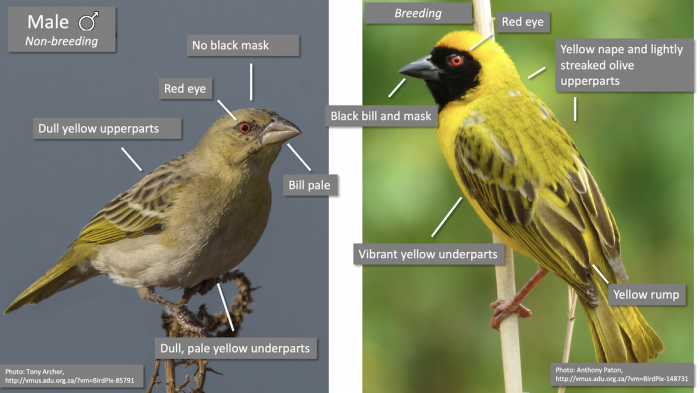
The Southern Masked Weaver is a medium-sized, brightly coloured bird. Males and females look similar outside of the breeding season but are easily distinguishable in breeding plumage.
Southern Masked Weaver male. Non-breeding: Tony Archer, Hartbeesfontein, North West. 27 July 2019. BirdPix 85791 Breeding: Anthony Paton, Northcliff, Gauteng. September 17 2017. BirdPix 148731
Breeding males have olive green upperparts streaked with grey and brown. The eyes are deep red and the bill is black. The underparts are vibrant yellow, and the trademark of a breeding male is its black face mask, running from the forehead all the way down to the throat.
Non-breeding adult males also have reddish eyes, but the red is duller than in breeding males. the bill becomes a pale brownish colour, and the mask disappears. Non-breeding males are also duller yellow overall with paler yellow underparts.
Southern Masked Weaver female. Gert Myburgh, Maun, Botswana. 27 September 2020. BirdPix 132216
Adult females closely resemble non-breeding males; the upperparts are dull yellowish-green streaked with dark brown, and the underparts are pale yellow. During the breeding season, the throat and breast are bright yellow; outside of the breeding season, they are paler in colour. Females have pinkish-brown bills and dark brownish eyes. Juvenile Southern Masked Weavers are almost identical to non-breeding females—it can be difficult to tell them apart!
Southern Masked Weavers produce a buzzy, swirling song, similar to the Cape Weaver.
You can watch a male singing and displaying in this video by Lynette Rudman:
Habitat
Southern Masked Weavers primarily feed on insects and seeds, but will also eat fruits, flowers, and nectar.
David Kennedy, Roodepoort, Gauteng. 22 September 2020. BirdPix 130829
They forage in small groups in grasses, trees and on the ground, and often visit garden seed feeders. Southern Masked Weavers can be found in open, shrubby habitat in dry areas and along rivers, as well as in agricultural land with some tree cover.
Distribution
The Southern Masked Weaver is a near-endemic species; its range is almost entirely confined to southern Africa.
SABAP2 distribution map for Southern Masked Weaver, downloaded 11 November 2021. Details for map interpolation here.
This species is widespread across southern Africa except for a few patches of treeless desert in Namibia, and is less common along the eastern coastlines of South Africa and Mozambique.
Behaviour
Southern Masked Weavers are gregarious and are most often seen in large or small flocks. Outside of the breeding season, these flocks may contain other seed-eating species. They typically sleep in large communal roosts in reedbeds or trees and in the morning, will gather into smaller groups to forage.
Southern Masked Weavers Weavers are colonial nesters, meaning that several birds may nest close together. Birds in the weaver family have some of the most fascinating nesting strategies and structures of any birds in the world.
L: Tony Archer, Klerksdorp North West. 7 November 2020. BirdPix 138177 R: Mark Stanton, Nigel, Gauteng. 30 November 2020. BirdPix 141397
Male Southern Masked Weavers weave their globular nests from broad grasses, palm leaves, or reeds.
Southern Masked Weavers are polygynous, meaning that one male may mate with several females in a single breeding season. Males display outside their nests to attract potential mates. Once the female has selected a nest, she will line it with grass, leaves, and soft feathers. Nests are built in a variety of locations including trees and palms, bushes, reeds, and fences.
L: Les Underhill, Free State. 18 November 2009. PHOWN 1; top R: Dieter Oschadleus, Western Cape. 26 October 2010. PHOWN 226; lower R: Vincent Ward, Northern Cape. 10 October 2015. PHOWN 18443
Virtual Museum (BirdPix > Search VM > By Scientific or Common Name)
More common names: Swartkeelgeelvink (Afrikaans); Tisserin à tête rousse(French); Maskenweber(German); Tessitore velato (Italian) Tejedor enmascarado(Spanish)
List of bird species in this format is available here.
Recommended citation format: Daniel KA 2021. Southern Masked Weaver Ploceus velatus. Biodiversity and Development Institute. Available online at https://thebdi.org/2021/11/11/southern-masked-weaver-ploceus-velatus/
The Red-winged Starling is a large, black bird with striking reddish wing feathers. Males and females look similar but can be told apart: the male has an all-black head, whilst the female’s head is grey.
Red-winged Starling identification. Karis Daniel, Cape Town, Western Cape. 22 November 2020. BirdPix 179611
Both males and females have glossy blueish-black bodies and long tails. Their beaks, legs and feet are also black. When perched, a narrow strip of reddish-orange is just visible on the wing; however this patch of colour becomes much more obvious when the bird is in flight.
Neels Jackson, Glenmore, KwaZulu-Natal. 16 December 2020. BirdPix 152027
This colourful part of the wing contains the primary feathers; the long, strong outer feathers on a bird’s wing. Most species have 9 or 10 primaries. Primaries, together with secondaries, which are the rest of the long feathers between the primaries and the bird’s body, make up the flight feathers. This group of feathers plays an important role in supporting a bird in flight. Beyond keeping them in the air, the Red-winged Starling’s spectacular rust-coloured primaries are a distinctive characteristic, allowing for easy identification when seen swooping overhead.
Red-winged Starlings produce a sweet, clear two-note call and a highly variable whistled song. They also produce an alarmingly raspy scolding sound.
Birds in flight or foraging in a flock often communicate with shortened contact calls, which you can hear in the video below.
Habitat
Red-winged Starlings primarily feed on fruit, insects, arthropods, and nectar, often from aloes or proteas. It’s easy to tell when a starling has been feeding on nectar–its face usually ends up dusted with bright orange pollen (see lower right photo).
Clockwise from top L: Anthony Paton, Northcliff, Gauteng. 1 September 2018. BirdPix 148686; Marius Meiring, Plettenbergbai, Western Cape. 2 February 2021. BirdPix 190019; Zenobia van Dyk, Clanwilliam, Western Cape. 5 June 2020. BirdPix 114600; Dieter Oschadleus, Montagu, Western Cape. 21 October 2020. BirdPix 135428; Gregg & Desire Darling, Port Shepstone, KwaZulu-Natal. 28 June 2014. BirdPix 8800
Red-winged Starlings forage alone, in pairs, or in small groups, either on the ground or in trees. These birds are opportunists; they are excellent at surviving on whatever types of food are available as well as finding new sources of food. Red-winged Starlings typically prefer rocky, mountainous habitat, but their opportunistic tendencies allow them to easily adapt to life along coastlines and in urban environments.
Clockwise from top L: Zenobia van Dyk, Middelburg, Eastern Cape. 3 June 2018. BirdPix 54689; Itxaso Quintana, Cape Town, Western Cape.13 June 2020. BirdPix 115365; Dave Kennedy, Hout Bay, Western Cape. 15 October 2018. BirdPix 83017; Roodepoort, Gauteng. 15 March 2020. BirdPix 109240
Distribution
The Red-winged Starling is found across east Africa, all the way from Ethiopia down to South Africa. Within southern Africa, it is common in Zimbabwe and southeast Botswana, and all of eastern and southern South Africa except for the driest interior parts of the Northern Cape.
SABAP2 distribution map for Red-winged Starling, downloaded 18 November 2021. Details for map interpolation here.
Behaviour
Red-winged Starlings are gregarious and are usually either in pairs or large flocks. These birds are monogamous, meaning that the same male and female stay and breed together for many years. Though well-established pairs will often remain at their favourite nesting site all year, many Red-winged starlings join together in winter to form massive flocks, roosting together on rocky outcrops or in trees. Keep an eye out for these flocks in winter—hundreds of those distinct reddish wings beating at once make for a spectacular sight!
Andrew Keys, Hartebeespoort, North West. 8 May 2020. BirdPix 112036
Much like with their diet, Red-winged Starlings are also opportunists when it comes to nesting. Pairs of Red-winged Starlings roosting as part of a flock may also nest close together; however, some pairs take up residency in a particular spot and nest alone each year.
L: Joan Young, Rustenburg, North West. 2 April 2014. BirdPix 9239; R: Neels Putter, Cathedral Peak, KwaZulu-Natal. 11 November 2020. BirdPix 140314
Both males and females work together to build a large, cup-shaped nest from sticks, grasses, and mud. The nest is often lined with soft grass and animal hairs. The same nest is often reused for many years, and not always by the same pair of birds! Males and females will carefully refurbish and maintain an “old” nest before using it in the breeding season. Nests may be built in a variety of locations, but are most common on rocky ledges or ledges of buildings.
Virtual Museum (BirdPix > Search VM > By Scientific or Common Name)
More common names: Rooivlerkspreeu (Afrikaans); Rufipenne morio(French); Rotschwingenstar(German); Storno alirosse (Italian) Estornino alirrojo (Spanish)
A list of bird species in this format is available here.
Recommended citation format: Daniel KA 2021. Red-winged Starling Onychognathus morio. Biodiversity and Development Institute. Available online at https://thebdi.org/2021/18/11/red-winged-starling-onychognathus-morio/
Roads are the most widespread form of ecological health and integrity loss. Currently, roads are causing severe conservation threats to apex predators globally, and those impacts are expected to increase in the near future if development is not planned properly.
Itxaso Quintana, a Research Associate of the BDI, is one of the lead authors of a newly-published research paper which examined how the network of both current and future planned roads will impact 36 apex predator species across the globe. The paper is published in Scientific Reports, one of the journals in the prestigious stable of journals belonging to Nature.
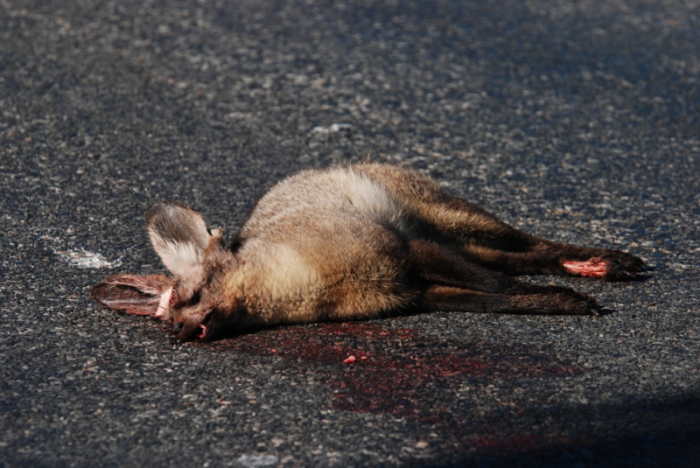
Bat-eared Fox Otocyon megalotis found dead on the on R44 road between Porterville and Piketberg, Western Cape, South Africa – MammalMAP record by A.G. Kilpin
One of the most interesting things about the research is that it was done by a group of just-graduated MSc students from the Erasmus Mundus Joint Masters – International Master’s in Applied Ecology (IMAE). The “joint masters” was funded by the European Commission, and the students moved between the participating universities, in Europe and South America. Almost every member of the class of 25 students represented a different country, with at least one student from every continent! Co-authors of this paper represented South Africa, Colombia, Brazil, Guatemala, Nepal, Spain and France, which gives the paper an international perspective. One of the academics who coordinated this master’s programme, Professor Freddie-Jeanne Richard (Département de Biologie des Organismes et des Populations, Université de Poitiers, Poitiers, France) gave the students the opportunity to form groups to work on reviews of particular topics, and reserved budget so that the publication costs were covered. This is a clever strategy, because it encouraged the group of students, early career scientists, to develop collaborative research skills, and enabled them to publish a substantive paper in a high-ranking journal.
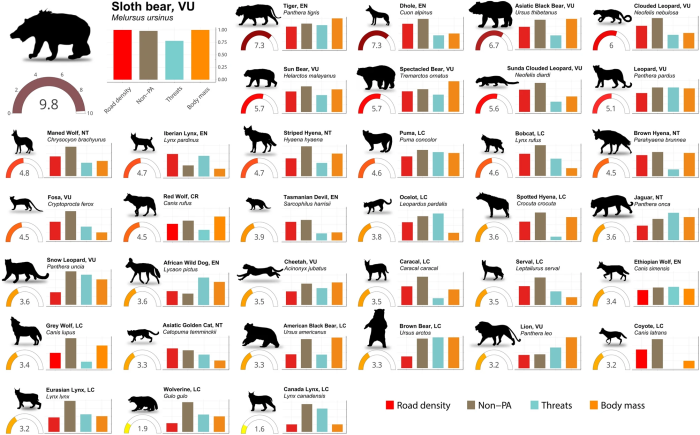
In this paper, the authors assess the impact of existing roads and highlight that currently all 36 apex predator species are exposed to the current road network, suffering from road kills, to increase of poaching and habitat loss due to the increase of accessibility to otherwise remote areas. Asia is a hotspot of high-risk apex predators, hosting 8 of the 10 species most at risk from roads, and with the Sloth Bear, Tiger and Dhole as the most affected.
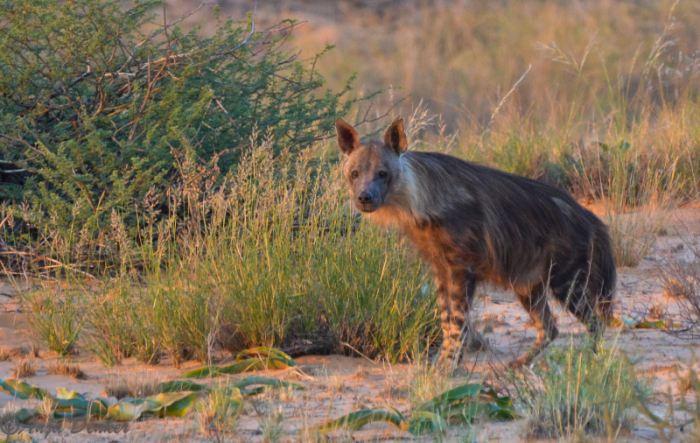
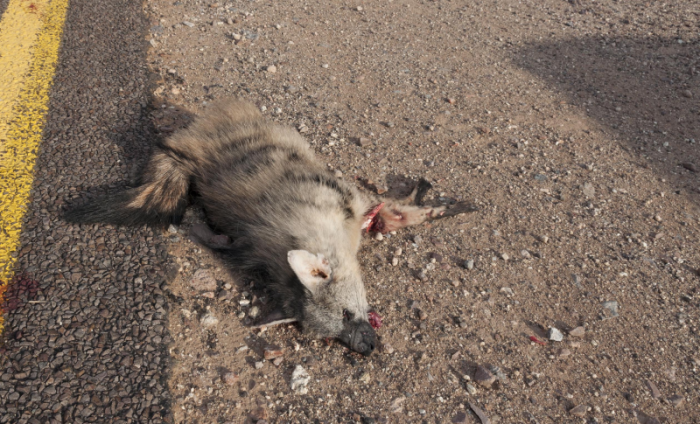
In Africa, the Brown Hyena, a predator endemic to Southern Africa, is the most exposed to roads making it at high risk from roads. Additionally, the authors show that in South Africa, 20 Brown Hyenas have been killed by collision since 2011, and in total, more than 400 apex predators have been killed on the roads in the last two decades.
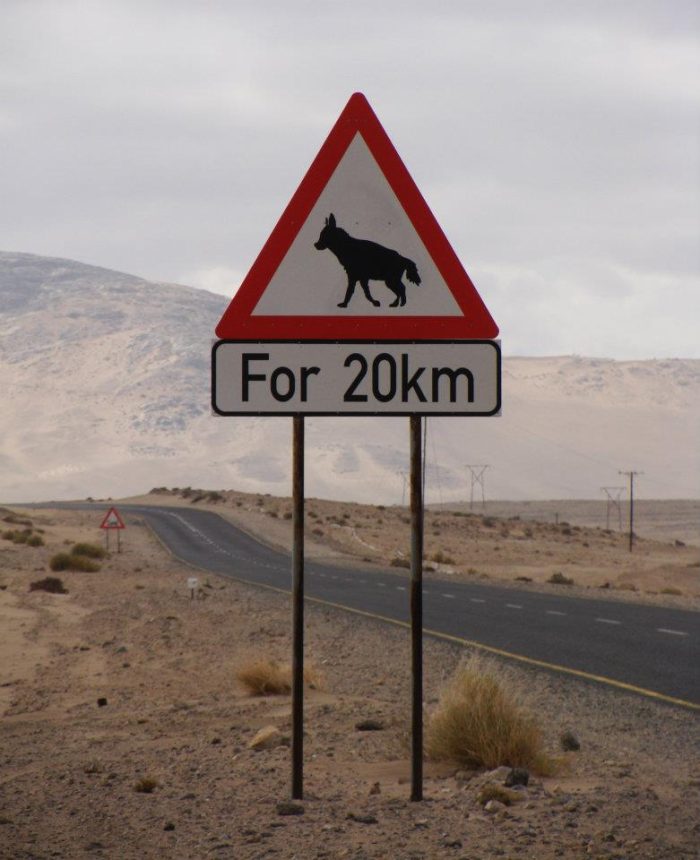
This photo was taken by Yennifer Hernández, from Uruguay. Yennifer helped with the research of the Brown Hyena Research Project in the Namib Desert north and south of Luderitz, Namibia. This “Be careful of Brown Hyenas” sign is on the road from Luderitz towards Keetmanshoop.
The authors also propose a widely applicable method to assess the potential impact of future planned development and applied it in three areas that hold critical ecosystems from apex predators: the Brazilian Amazon, Africa and Nepal. They found that roughly 500 protected areas will be intersected by roads, threatening apex predators’ habitats and ultimately ecosystem functioning.
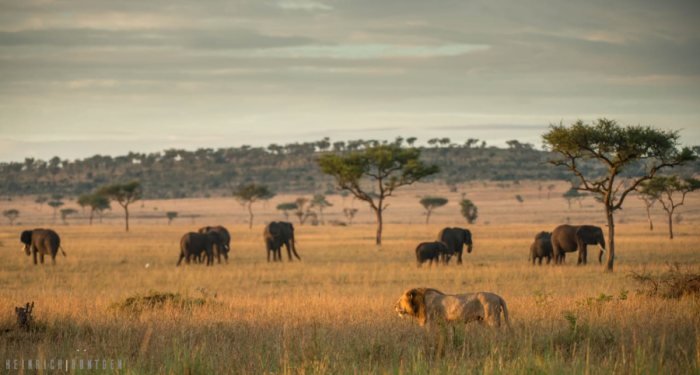
If not planned properly, Scientists warn that roads crossing Tanzania’s Serengeti National Park, in particular, are expected to devastate one of the world’s greatest animal migrations, causing a domino effect on healthy apex predator populations. Finally, the authors emphasize that even if roads can lead to positive social and economic outcomes, this must be strategically planned so that they avoid wilderness and important conservation areas. Future roads should simultaneously adopt mitigation measures such as wildlife crossing areas.
This study started because all authors were aware of conservation issues and realized that roads have already impacted most of the earth’s ecosystems. Apex predators, in particular, are acutely threatened by roads, due to their large spatial ranges, low population densities and reproduction rates. They are at the same time charismatic species and vital to the structure and functioning of ecosystems.
Apex predators risk to roads calculated as the product of exposure to roads (road density within the species range) and vulnerability of species. Gauges indicate the risk value of each species. Bars indicate the standardized road density, the proportion of species distribution area unprotected, standardized number of IUCN listed threats, and standardized value of the categorized average body mass (i.e., very large (> 100 kg), large (25–100 kg), medium (15–25 kg), small (8–15 kg)). The IUCN conservation of each species18 is shown. P. uncia, L. pictus and L. canadensis silhouettes were drawn by Gabriela Palomo-Muñoz, all predator silhouettes were acquired from PhyloPic (http://phylopic.org/).
This blog is illustrated by photos from the MammalMAP section of the Virtual Museum. Records of road kills, regardless of species (and regardless of whether it is a mammal, a reptile, or bird), are really valuable, because they help us understand which species are impacted and where. So if you see a road kill while you are driving, do consider throwing a U-ie, going back and taking a photograph and uploading it to the Virtual Museum. Within the Virtual Museum upload system, there is a box which can be ticked to indicate that the record is a road kill.
The paper is Open Access at this link:
Quintana I, Cifuentes EF, Dunnink JA, Ariza M, Martínez‑Medina D, Fantacini FM, Shrestha BR, Richard F-J. 2002. Severe conservation risks of roads on apex predators. Scientific Reports 12: 2902. https://doi.org/10.1038/s41598-022-05294-9