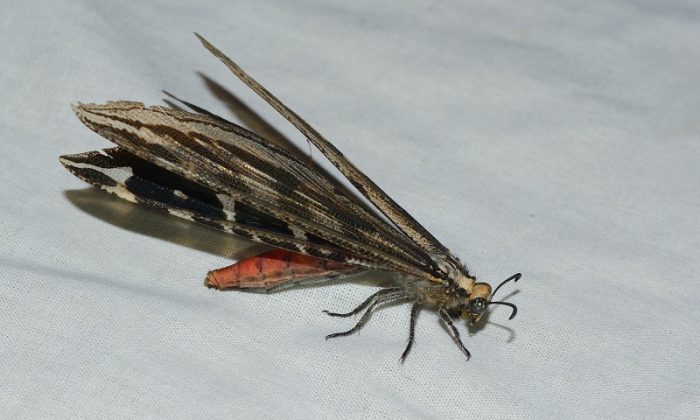
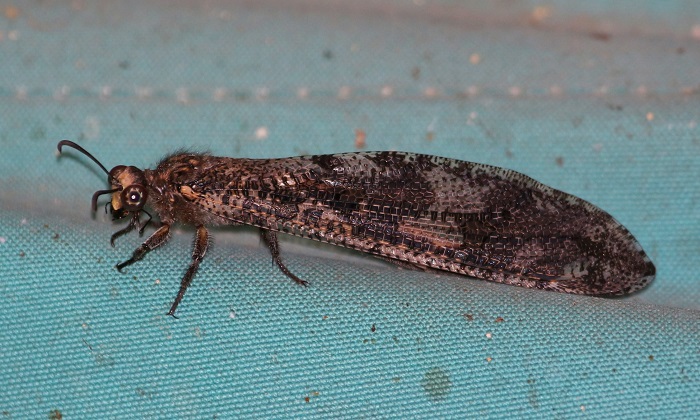
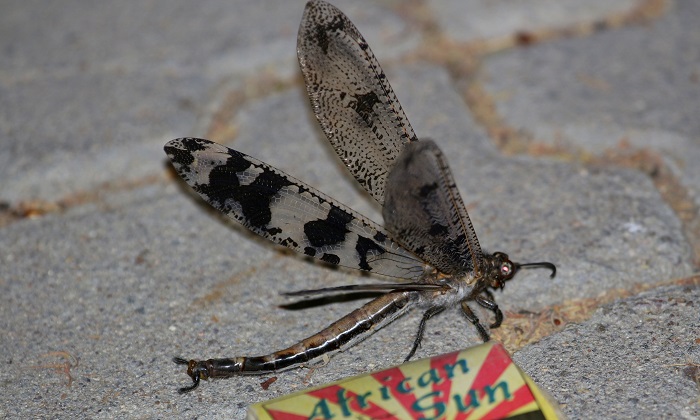
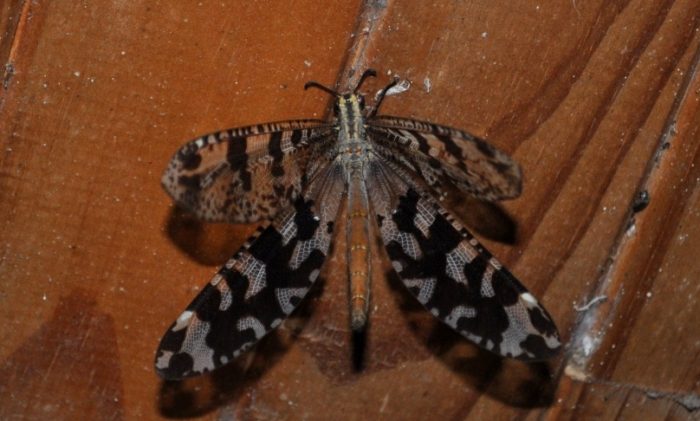
Palparellus nyassanus is known from Limpopo, Gauteng, Mpumalanga and North West provinces. It extends beyond South Africa into Botswana and northwards to Zimbabwe and Malawi. It is an uncommon species.
Distribution of Palparellus nyassanus. Taken from the LacewingMAP database, July 2022.
Virtual Museum (LacewingMAP > Search VM > By Scientific or Common Name)
Acknowledgements:
The use of photographs by Ingmar Van der Brugge, Marita Beneke and Vaughan Jessnitz is acknowledged. This species text has benefited enormously from comments made by Mervyn Mansell on records he has identified in LacewingMAP. We acknowledge his important contribution.
Recommended citation format for this species text:
Tippett RM 2022. Palparellus nyassanus. Biodiversity and Development Institute, Cape Town. Available online at http://thebdi.org/2022/08/30/palparellus-nyassanus/
P. elegantulus inhabits the open, arid shrublands of the Nama Karoo, often on sandy, red soils.
Habitat – Near Carnarvon, Northern Cape Photo by Ryan Tippett
Behaviour
Palparellus pulchellus is sometimes attracted to lights. Adults are nocturnal and often rest in a hanging position among the protective branches of Karoo bushes. They are highly cryptic when at rest and blend specifically with the karroid-type vegetation of the Nama Karoo.
Adults are active during late summer and have been recorded from October to March.
Nothing is known about the larvae of this species.
Palparellus pulchellus is uncommon and not often encountered. This species is confined to South Africa and is a Karoo endemic. It is known mostly from the Northern Cape of South Africa, with one record from the Western Cape.
Distribution of Palparellus pulchellus. Taken from the LacewingMAP database, July 2022.
Virtual Museum (LacewingMAP > Search VM > By Scientific or Common Name)
Acknowledgements:
The use of photographs by Zenobia van Dyk is acknowledged. This species text has benefited enormously from comments made by Mervyn Mansell on records he has identified in LacewingMAP. We acknowledge his important contribution.
Recommended citation format for this species text:
Tippett RM 2022. Palparellus pulchellus. Biodiversity and Development Institute, Cape Town. Available online at http://thebdi.org/2022/08/30/palparellus-pulchellus/
View the above photo record (by Ryan Tippett) in LacewingMAPhere.
Palparellus dubiosus
(Peringuey, 1910)
Identification
Size: Large (Wingspan around 100mm)
It could be confused with Palpares speciosus, but the characteristic thoracic patterns and male terminalia easily distinguish it from P. speciosus and P. caffer.
P. elegantulus inhabits the open, arid shrublands of the Nama Karoo in flat or hilly terrain.
Habitat – Near Carnarvon, Northern Cape Photo by Ryan Tippett
Behaviour
Palparellus dubiosus is regularly attracted to lights. Adults are nocturnal and often rest in a hanging position among the protective branches of Karoo bushes.
Adults are active during late summer and have been recorded from January to April.
Nothing is known about the larvae of this species.
This species is confined to South Africa, Botswana and Namibia. In South Africa, it occurs in the drier western regions of the country. Palparellus dubiosus seems to be common and widespread in the Karoo regions of South Africa.
Distribution of Palparellus dubiosus. Taken from the LacewingMAP database, July 2022.
Virtual Museum (LacewingMAP > Search VM > By Scientific or Common Name)
Acknowledgements:
The use of photographs by Rick Nuttall is acknowledged. This species text has benefited enormously from comments made by Mervyn Mansell on records he has identified in LacewingMAP. We acknowledge his important contribution.
Recommended citation format for this species text:
Tippett RM 2022. Palparellus dubiosus. Biodiversity and Development Institute, Cape Town. Available online at http://thebdi.org/2022/08/30/palparellus-dubiosus/
This species is uncommon and is seldom encountered. C. karrooanus is restricted to the Northern and Western Cape provinces of South Africa. It is also found in southern Namibia and Botswana.
Distribution of Crambomorphus karrooanus. Taken from the LacewingMAP database, July 2022.
Virtual Museum (LacewingMAP > Search VM > By Scientific or Common Name)
Acknowledgements:
The use of photographs by Luke Kemp and Zenobia van Dyk is acknowledged. This species text has benefited enormously from comments made by Mervyn Mansell on records he has identified in LacewingMAP. We acknowledge his important contribution.
Recommended citation format for this species text:
Tippett RM 2022. Crambomorphus karrooanus. Biodiversity and Development Institute, Cape Town. Available online at http://thebdi.org/2022/08/25/crambomorphus-karrooanus/
Palpares cataractae is uncommon in South Africa where it occurrs to the north of the country in the Limpopo province. Ranges further north into Botswana, Malawi, Namibia, Zambia, Mozambique and Zimbabwe.
Distribution of Palpares cataractae. Taken from the LacewingMAP database, July 2022.
Virtual Museum (LacewingMAP > Search VM > By Scientific or Common Name)
Acknowledgements:
The use of photographs by Gert Myburgh, John Wilkinson and Ross Hawkins is acknowledged. This species text has benefited enormously from comments made by Mervyn Mansell on records he has identified in LacewingMAP. We acknowledge his important contribution.
Recommended citation format for this species text:
Tippett RM 2022. Palpares cataractae. Biodiversity and Development Institute, Cape Town. Available online at http://thebdi.org/2022/08/24/palpares-cataractae/
View the above photo record (by Alan Manson) in LacewingMAPhere.
Palpares aemulus
Péringuey, 1911
Identification
Size: Large (Wingspan information unknown)
A striking yellow and black antlion. Palpares aemulus is rather similar to Palpares sobrinus. They can be distinguished from other Palpares by the dense, evenly spaced black speckling on all four wings.
Larvae: The larvae of this species are unknown.
Palpares aemulus– Near Ingwavuma, KwaZulu-Natal Photo by Alan Manson
Habitat
Palpares aemulus is a savanna species. The one LacewingMAP record of this species came from tall grass along the Ngwavuma River floodplain.
Behaviour
P. aemulus is likely to be attracted to light.
Nothing is known about the larvae of this species.
The only LacewingMAP record of this species is from March.
Palpares aemulus– Near Ingwavuma, KwaZulu-Natal Photo by Alan Manson
Status and Distribution
Palpares aemulus is rare and has only been recorded from northern KwaZulu-Natal.
Distribution of Palpares aemulus. Taken from the LacewingMAP database, July 2022.
Virtual Museum (LacewingMAP > Search VM > By Scientific or Common Name)
Acknowledgements:
The use of photographs by Alan Manson is acknowledged. This species text has benefited enormously from comments made by Mervyn Mansell on records he has identified in LacewingMAP. We acknowledge his important contribution.
Recommended citation format for this species text:
Tippett RM 2022. Palpares aemulus. Biodiversity and Development Institute, Cape Town. Available online at http://thebdi.org/2022/08/22/palpares-aemulus/
View the above photo record (by Douglas Cook) in LacewingMAPhere.
Palpares inclemens
(Walker, 1853)
Identification
Size: Very large (Wingspan up to 160mm)
Palpares inclemens is one of the world’s largest antlion species. Closely resembles Palpares lentus, however that species is decidedly smaller.
Larvae: The larvae of this species are very large and coloured in muted shades of red, green and black bands.
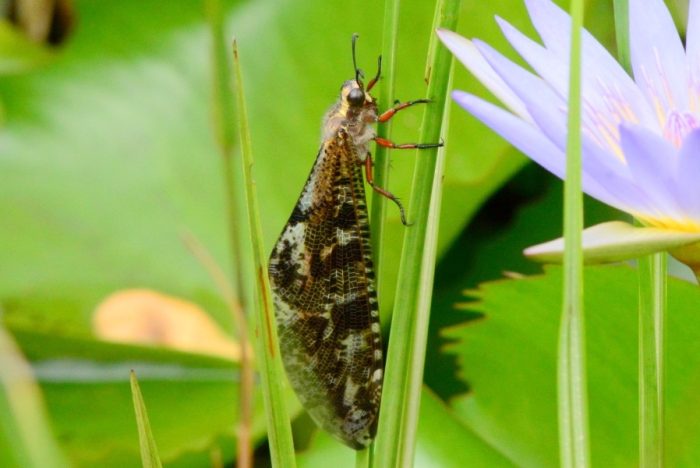
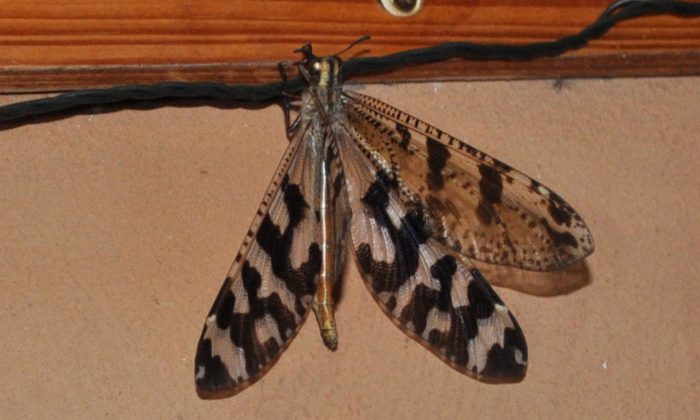
Palpares inclemens – Near Hluhluwe, KwaZulu-Natal Photo by Ryan TippettPalpares inclemens – Ndumo Game Reserve, KwaZulu-Natal Photo by Luke Kemp
Habitat
This species occurs in coastal areas where it inhabits forests and woodlands on sandy soils. Adults are often encountered in rank vegetation in the forest/wetland mosaic of north-eastern KwaZulu-Natal.
Behaviour
P. inclemens is readily attracted to light.
The large red, green and black banded larvae live freely in sand.
They have been recorded from October to April, however most records are from December to April. Adults are most active during the late summer months.
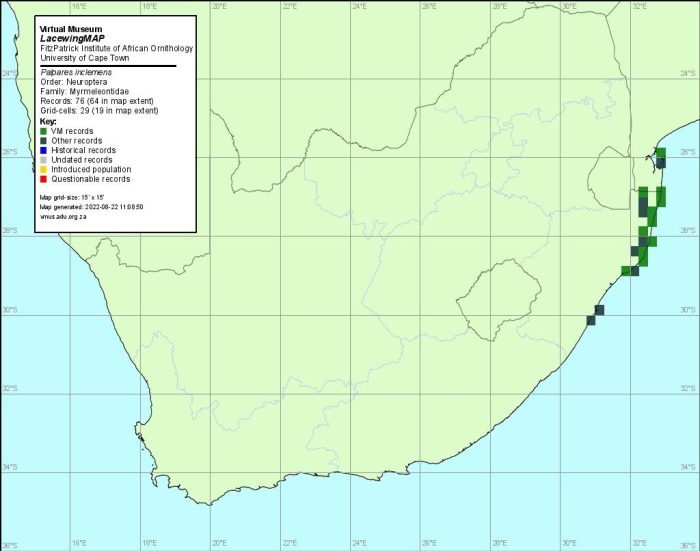
Palpares inclemens is primarily a coastal species, extending down the east coast as far south as Durban. Away from South Africa it ranges northwards to coastal Kenya
Distribution of Palpares inclemens. Taken from the LacewingMAP database, July 2022.
Virtual Museum (LacewingMAP > Search VM > By Scientific or Common Name)
Acknowledgements:
The use of photographs by Douglas Cook, Kate Braun and Luke Kemp is acknowledged. This species text has benefited enormously from comments made by Mervyn Mansell on records he has identified in LacewingMAP. We acknowledge his important contribution.
Recommended citation format for this species text:
Tippett RM 2022. Palpares inclemens. Biodiversity and Development Institute, Cape Town. Available online at http://thebdi.org/2022/08/18/palpares-inclemens/
View the above photo record (by Douglas Cook) in LacewingMAPhere.
Palpares lentus
Navás, 1912
Identification
Size: Large (Wingspan around 100mm)
It strongly resembles Palpares inclemens, (a strictly coastal species), but is smaller.
Larvae: The larvae of this species are unknown.
Palpares lentus– Swebe-Swebe, Limpopo Photo by Joseph HeymansPalpares lentus– Nylsvlei Nature Reserve, Limpopo Photo by Christopher Willis
Habitat
This species inhabits savanna woodlands in the northern parts of South Africa.
Behaviour
P. lentus is readily attracted to light.
Nothing is known about the larvae of this species.
Adults are active early during the early summer months and are on the wing from October to February. Most records come from November. This is in contrast to other Palpares species who mostly emerge during mid to late summer.
Palpares lentus– Makalali Game Reserve, Limpopo Photo by Vaughan Jessnitz
Status and Distribution
Palpares lentus appears to be largely confined to northern and north-western South Africa, with a few records from Botswana and Zimbabwe.
Distribution of Palpares lentus. Taken from the LacewingMAP database, July 2022.
Palpares lentus– Near Vaalwater, Limpopo Photo by Marita Beneke
Further Resources
Virtual Museum (LacewingMAP > Search VM > By Scientific or Common Name)
Acknowledgements:
The use of photographs by Alice Altenroxel, Cornelia Rautenbach, John Wilkinson, Joseph Heymans, Marita Beneke and Vaughan Jessnitz is acknowledged. This species text has benefited enormously from comments made by Mervyn Mansell on records he has identified in LacewingMAP. We acknowledge his important contribution.
Recommended citation format for this species text:
Tippett RM 2022. Palpares lentus. Biodiversity and Development Institute, Cape Town. Available online at http://thebdi.org/2022/08/18/palpares-lentus/
Palpares lentus– Swebe-Swebe, Limpopo Photo by Joseph Heymans
Cover photo – BirdPix 4242 Laughing Dove by Les Underhill.
Identification
The Laughing Dove is a long-tailed, smallish dove, typically 25 cm in length. It is rufous brown on the underside with a lilac pinkish tinged head and neck. The head and underparts are pinkish, shading to buffy white on the lower abdomen. It has a rich rufous coloured neck with black spots. Its upper parts are brownish with a bluish-grey band along the wing and a blue-grey back. Laughing Doves have white outer tail feathers and reddish legs and feet.
Main photo – BirdPix 70022: Mark Stanton, Segou, Mali, 01 April 2018. Photo inset – BirdPix 98276: Lia Steen, Shellybeach, KwaZulu-Natal, 02 November 2019.
Other names for the Laughing Dove include Laughing Turtle Dove, Palm Dove and Senegal Dove while in Asia the name of the Little Brown Dove is often used. You can take a listen to its distinctive call here.
Habitat
It has benefited greatly from habitat disturbance by humans. In southern Africa it is extremely common and widespread, where it can be found in several habitat types including: woodlands, farmlands, suburban parks, alien tree plantations and urban gardens.
Laughing Dove habitats. Left – BirdPix 223568: Lappies Labuschagne, Middelburg, Mpumalanga, South Africa. Top right – BirdPix 221819: Les Underhill, Malmesbury, Western Cape, South Africa. Bottom right – BirdPix: 227672: Johan & Estelle van Rooyen, Northern Cape Province, South Africa.
Distribution
The Laughing Dove is abundant in southern Africa, as it is found everywhere except coastal Mozambique. It has been recorded all across South Africa as can be seen in the Southern African Bird Atlas Project (SABAP2) map below, with blue squares indicating the core of its range in the region.
SABAP2 distribution map for Laughing Dove, downloaded 18 August 2022. Details for map interpretation here.
Behaviour
Laughing Doves are usually seen in pairs or small parties and only rarely in larger groups. Larger groups are formed especially when drinking at waterholes in arid regions. They mainly eat seeds, with fruits, bulbs and nectar making up the rest of their diet. Pairs can often be seen feeding on the ground.
Their flight is quick and direct with regular beats and an occasional sharp flick of the wings characteristic of pigeons and doves in general.
When breeding time comes around, the female normally builds her own nest, while the male collects material. The Laughing Dove lays 1-6, usually 2 eggs, which are incubated by both sexes, for 12-14 days, after which the chicks hatch. The chicks leave the nest at 12-13 days old, before they have even learnt to fly. At 3-4 days after leaving the nest, the chicks are able to fly, after which they become fully independent.
Nests & young. Top left – BirdPix 48837: Dewald du Plessis, Orania, Northern Cape, 20 April 2014. Top right – BirdPix 53560: Ryan Tippett, Maun, Botswana, 02 May 2018. Lower right – BirdPix 33838: Dewald du Plessis, Bloemfontein, Free State, 21 February, 2011. Lower left – BirdPix 31929: Rob Dickinson, Ogbomoso, Nigeria, 10 May 2016.
Enjoying the bird feeder! – BirdPix 101: Lia Steen, Roodepoort, Gauteng, South Africa.
Virtual Museum (BirdPix > Search VM > By Scientific or Common Name).
More common names: Rooiborsduifie (Afrikaans); Icelekwane (Xhosa); uKhonzane (Zulu); Gugurhwana (Tsonga); Tourterelle maillée (French); Palmtortel (Dutch).
Recommended citation format: Daniel KA and Loftie-Eaton M 2022. Laughing Dove Spilopeliasenegalensis. Bird Feeder Project. Biodiversity and Development Institute. Available Online at http://thebdi.org/2022/08/18/laughing-dove-spilopelia-senegalensis/
List of bird species in this format is available here.
The Red-eyed dove is common in many areas of southern Africa, and has adapted well to living with humans.
It is a largish, stocky bird, with adults typically 30 cm in length. Its back, wings and tail are greyish to pale brown in colour. In flight one can observe a dark band with a pale edge on the tail feathers. The head and underparts are greyish pink, shading to pale grey on the face. They have a black collar on the back their neck. The legs and a patch of bare skin around the eye are red. Their call is a loud doo-doo-du-du, which can sound like they are singing “I AM the red-eyed dove”, with an emphasis on the “AM”!
Sexes are similar, but juveniles are duller than adults, and have scalloping on the body feathers.
Main photo: Gareth Yearsley, Morgan Bay, Eastern Cape, 08 October 2020. Inset photo: Les Underhill, Cape Town, Western Cape, 22 October 2016.
Juvenile Red-eyed Dove – Giles Mulholland, Nelspruit, Mpumalanga, 05 October 2012.
The Ring-necked Dove is superficially similar, but shows white in the tail when it flies (rather than the dark grey and light grey bands of this species), and its call is “Tell father, work harder” (rather than “I AM the Red-eyed Dove”).
Habitat
It has adapted very well to the activities of humans, generally preferring woodland habitats, and especially alien tree plantations, with pine trees Pinus sp., Eucalyptus, Rooikrans Acacia cyclops or Port Jackson Acacia saligna.
Habitat types of the Red-eyed Dove. Photo bottom left: Vaughn Jessnitz & Andrew Venter, Gravelotte, Limpopo, 06 November 2021. Top left: Itxaso Quintana, Kleinmond, Western Cape, 26 December 2020. Top right: John & Anne Todd, Heidelberg, Western Cape, 27 October 2020. Bottom right: Ryan Tippett, Keimoes, Northern Cape, 05 December 2019.
Distribution
The Red-eyed Dove occurs across most of sub-Saharan Africa. In southern Africa, it is common in northern Namibia, northern and south-eastern Botswana, Zimbabwe, Mozambique, eSwatini, Lesotho and South Africa. The SABAP2 distribution map below confirms its widespread range across all sorts of habitats within South Africa. It is largely absent from the Northern Cape Province due to the aridness of the area.
SABAP2 distribution map for Red-eyed Dove, downloaded 12 August 2022. Details for map interpretation here.
Behaviour
Red-eyed Doves usually forage on the ground under trees. They eat a wide variety of seeds, as well as flowers, nuts, fruit and the occasional insect. They readily visit gardens.
Red-eyed Dove foraging in a suburban garden – Stellenbosch, Western Cape, 27 December 2011. Photo by Megan Loftie-Eaton.
When breeding time comes around, the female usually makes the nest using material collected by the male. The nest consists of a bowl of twigs lined with grass. It may also use nests of other birds, such as crows, thrushes and egrets. Egg-laying season is year round, usually peaking from September to January. Red-eyed Doves lay 1-2 eggs which are incubated by both parents for 14-17 days.
Red-eyed Doves nesting – Photo left: Lia Steen, Roodepoort, Gauteng, 04 September 2018. Photo right: Malcolm Robinson, Creighton, KwaZulu-Natal, 31 July 2019.
Its flight is quick, with regular wing beats and an occasional sharp flick of the wings, which are characteristic of pigeons and doves in general.
Lift off! – Les Underhill, Wellington, Western Cape, 16 June 2022.
More common names: Grootringduif (Afrikaans); Indlasidudu (Xhosa); iHophe (Zulu); Tourterelle à collier (French); Halbmondtaube (German).
Recommended citation format: Daniel KA and Loftie-Eaton M 2022. Red-eyed Dove Streptopelia semitorquata. Bird Feeder Project. Biodiversity and Development Institute. Available Online at http://thebdi.org/2022/08/18/red-eyed-dove-streptopelia-semitorquata/
List of bird species in this format is available here.