Nannoleon michaelseni

View the above photo record (by Alan Manson) in LacewingMAP here.

Nannoleon michaelseni

Esben-Petersen, 1928

Identification

Size: Small (Wingspan around 35mm)

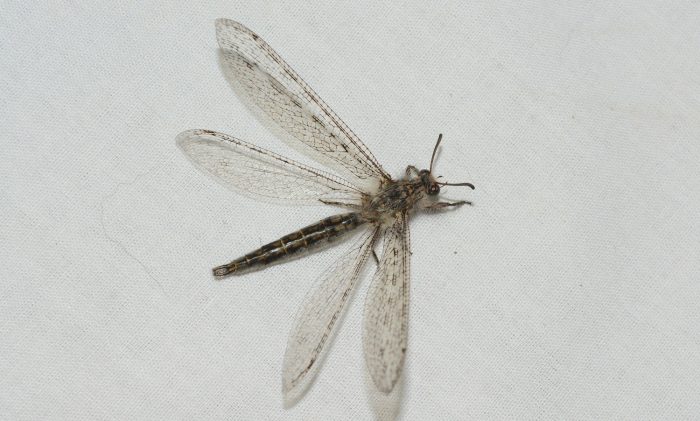
It is characterized by the broad clear wings and their distinctive, long clavate antennae.

Larvae: Nothing is known about the larvae of this species.

Nannoleon michaelseni – Near Carnarvon, Northern Cape
Photo by Ryan Tippett
Nannoleon michaelseni – Near Carnarvon, Northern Cape
Photo by Ryan Tippett

Habitat

Nannoleon michaelseni inhabits the open, arid shrublands of the Nama Karoo in flat or hilly terrain. It is also known from dry savanna woodlands of Mpumalanga and Limpopo.

Habitat – Near Carnarvon, Northern Cape
Photo by Ryan Tippett

Behaviour

Adults are nocturnal and they are regularly attracted to lights. Nothing else is known about the biology of this species.

Adults are active during late summer and have been recorded from December to April,

Nannoleon michaelseni Bushmanskloof, Western Cape
Photo by Zenobia van Dyk

Status and Distribution

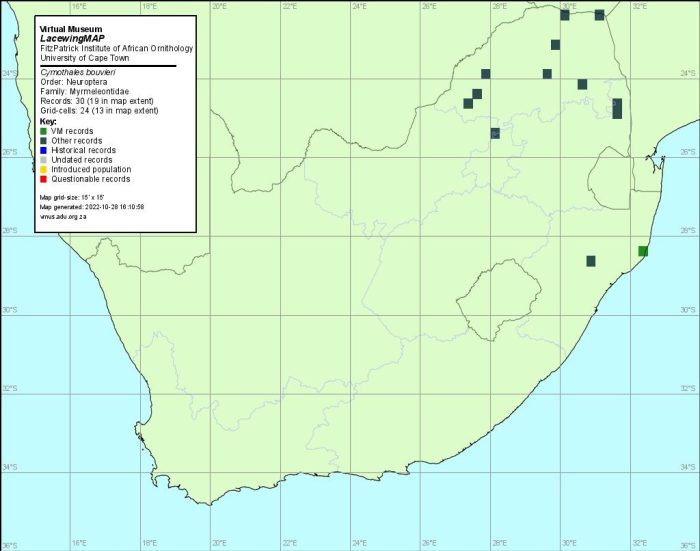
This species is widespread in South Africa and Namibia, and is fairly common in the drier western parts of the sub-region.

Distribution of Nannoleon michaelseni. Taken from the LacewingMAP database, July 2022.

Taxonomy

Order: Neuroptera Family: Myrmeleontidae Subfamily: Dendroleontinae Tribe: Dendroleontini Genus: Nannoleon Species: michaelseni

Nannoleon michaelseni – Near Carnarvon, Northern Cape
Photo by Ryan Tippett

Further Resources

Virtual Museum (LacewingMAP > Search VM > By Scientific or Common Name)

Acknowledgements:

The use of photographs by Alan Manson and Zenobia van Dyk is acknowledged. This species text has benefited enormously from comments made by Mervyn Mansell on records he has identified in LacewingMAP. We acknowledge his important contribution.

Recommended citation format for this species text:

Tippett RM 2022. Nannoleon michaelseni. Biodiversity and Development Institute, Cape Town.
Available online at http://thebdi.org/2022/08/08/nannoleon-michaelseni/

Nannoleon michaelseni – Near Carnarvon, Northern Cape
Photo by Ryan Tippett

Palparidius capicola

View the above photo record (by Ryan Tippett) in LacewingMAP here.

Palparidius capicola

Peringuey, 1910

Identification

Size: Medium-large (Wingspan around 90mm)

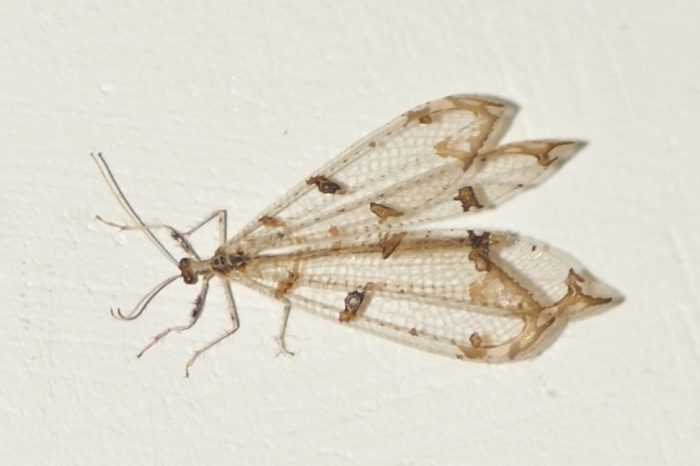
Palparidius capicola is readily identified by the diagnostic horseshoe-shaped markings in the forewings. The males are easily recognised due to their elongated ectoprocts (claspers).

Larvae: Not much is known about the larvae of this species.

Palparidius capicola – Near Carnarvon, Northern Cape
Photo by Ryan Tippett
Palparidius capicola maleNear Carnarvon, Northern Cape
Photo by Ryan Tippett
Palparidius capicola FemaleNear Carnarvon, Northern Cape
Photo by Ryan Tippett

Habitat

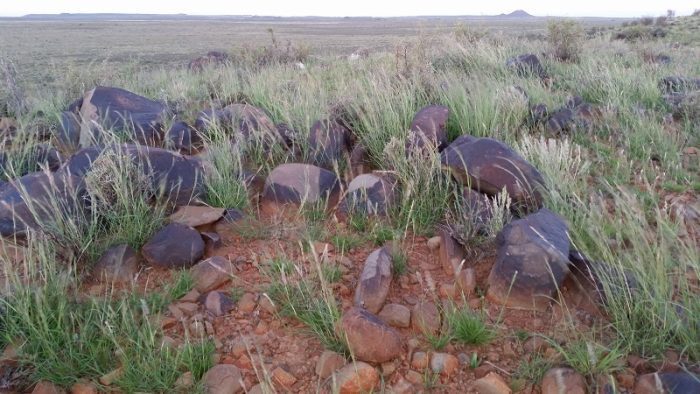
Palparidius capicola inhabits the open, arid shrublands of the Nama Karoo in flat or hilly terrain.

Habitat – Near Carnarvon, Northern Cape
Photo by Ryan Tippett

Behaviour

Like most antlions Palparidius capicola is nocturnal. Adults often rest in a hanging position among the protective branches of larger bushes. They are regularly attracted to lights. Not much is known of its biology. The larvae are thought to live in deep soil.

Adults are active during the summer months. Most numerous from January to April but records exist from September to April.

Palparidius capicola Wildheim Kalahari Lodge, Namibia
Photo by Neil Thomson

Status and Distribution

Fairly common and widespread in the drier western parts of South Africa. It is also known from Namibia and Botswana.

Distribution of Palparidius capicola. Taken from the LacewingMAP database, July 2022.

Taxonomy

Order: Neuroptera Family: Myrmeleontidae Subfamily: Palparinae Tribe: Palparini Genus: Palparidius Species: capicola

Palparidius capicola Near Carnarvon, Northern Cape
Photo by Ryan Tippett

Further Resources

Virtual Museum (LacewingMAP > Search VM > By Scientific or Common Name)

Acknowledgements:

The use of photographs by Neil Thomson is acknowledged. This species text has benefited enormously from comments made by Mervyn Mansell on records he has identified in LacewingMAP. We acknowledge his important contribution.

Recommended citation format for this species text:

Tippett RM 2022. Palparidius capicola. Biodiversity and Development Institute, Cape Town.
Available online at http://thebdi.org/2022/08/03/palparidius-capicola/

Palparidius capicola – Near Carnarvon, Northern Cape
Photo by Ryan Tippett

Myrmeleon obscurus

View the above photo record (by Garth Aiston) in LacewingMAP here.

Myrmeleon obscurus

(Rambur, 1842)

Identification

Size: Small (Wingspan around 44mm)

Myrmeleon obscurus has a distinctive abdomen pattern and plain, unmarked wings.

Myrmeleon obscurusBushmanskloof, Western Cape
Photo by Zenobia van Dyk
Myrmeleon obscurus – Richards Bay, KwaZulu-Natal
Photo by Richard Johnstone

Larvae: The larvae are small with relatively slender heads.

Myrmeleon obscurus – Near Komatipoort, Mpumalanga
Photo by Alan Manson

Habitat

M. obscurus inhabits a very wide range of habitat types and has been recorded from all terrestrial biomes in South Africa.

Behaviour

Adults are most active during the summer months from October to April, but have been recorded throughout the year in the warmer parts of South Africa.

Frequently attracted to lights.

Members of the genus Myrmeleon are considered to be the most primitive antlions.

Myrmeleon obscurus – Mating pair – Near Carnarvon, Northern Cape
Photo by Ryan Tippett

The larvae walk backwards and are pit-builders. Their pits are the most frequently encountered of all Myrmeleon species and occur in a variety of situations – even city pavements where there are sand pockets.

Myrmeleon obscurus – Boknesstrand, Eastern Cape
Photo by Zenobia van Dyk

Status and Distribution

Myrmeleon obscurus is common and very widespread. It occurs over most of southern and eastern Africa. It is also found on the islands of Mauritius and Madagascar in the Indian Ocean.

Distribution of Myrmeleon obscurus. Taken from the LacewingMAP database, July 2022.

Taxonomy

Order: Neuroptera Family: Myrmeleontidae Subfamily: Myrmeleontinae Tribe: Myrmeleontini (Pit-trapping Antlions) Genus: Myrmeleon Species: obscurus

Myrmeleon obscurus – Bushmanskloof, Western Cape
Photo by Zenobia van Dyk

Further Resources

Virtual Museum (LacewingMAP > Search VM > By Scientific or Common Name)

Acknowledgements:

The use of photographs by Alan Manson, Garth Aiston, Richard Johnstone and Zenobia van Dyk is acknowledged. This species text has benefited enormously from comments made by Mervyn Mansell on records he has identified in LacewingMAP. We acknowledge his important contribution.

Recommended citation format for this species text:

Tippett RM 2022. Myrmeleon obscurus. Biodiversity and Development Institute, Cape Town.
Available online at http://thebdi.org/2022/08/03/myrmeleon-obscurus/

Myrmeleon obscurus – Bushmanskloof, Western Cape
Photo by Zenobia van Dyk

Palpares caffer

View the above photo record (by Stephen Ball) in LacewingMAP here.

Palpares caffer

(Burmeister, 1839)

Identification

Size: Large (Wingspan up to 112mm)

P. caffer is an overall yellow with dense black markings. The thorax is yellow and black and partially covered in thick grey setae. The abdomen is dark yellow with variable, broad black lines along the sides.

The fore wings show conspicuous yellow veining with black spotting. There are two distinctive lead-grey blotches near the middle of each fore wing. The hind wings are whiteish with three evenly spaced black patches and scattered smaller black spots.

Superficially resembles Palpares speciosus. That species differs in showing four irregularly spaced black patches on the hindwing.

Larvae: The larvae are large and black.

Palpares caffer – Near Impendle, KwaZulu-Natal
Photo by Christeen Grant
Palpares caffer – Near Vaalwater, Limpopo
Photo by Walter Neser

Habitat

P. caffer inhabits grasslands at low to high altitudes. It is also widespread in open savanna with stands of taller grasses.

Habitat – Ithala Game Reserve, KwaZulu-Natal
Photo by Ryan Tippett

Behaviour

Adults are often found at rest in long grass. They flush and fly off easily but will quickly settle again. Palpares caffer is often attracted to lights.

Adults are active during the summer months and are on the wing from October to April.

The larvae live freely in soil among grass tussocks. They are voracious predators feeding mainly on other arthropods. The larvae are seldom encountered.

Palpares caffer – Cumberland Nature Reserve, KwaZulu-Natal
Photo by Geoff Prosser

Status and Distribution

Palpares caffer is a common species. It occurs fairly widely in South Africa from the Eastern Cape (Grahamstown area) northwards. It seems to be confined to southern Africa, not extending beyond Zimbabwe. It is replaced in the south by its sister-species, Palpares speciosus.

Distribution of Palpares caffer. Taken from the LacewingMAP database, July 2022.

Taxonomy

Order: Neuroptera Family: Myrmeleontidae Subfamily: Palparinae Tribe: Palparini Genus: Palpares Species: caffer

Palpares caffer – Modimolle, Limpopo
Photo by Marita Beneke

Further Resources

Virtual Museum (LacewingMAP > Search VM > By Scientific or Common Name)

Acknowledgements:

The use of photographs by Christeen Grant, Geoff Prosser, Len de Beer, Marita Beneke, Stephen Ball and Walter Neser is acknowledged. This species text has benefited enormously from comments made by Mervyn Mansell on records he has identified in LacewingMAP. We acknowledge his important contribution.

Recommended citation format for this species text:

Tippett RM 2022. Palpares caffer. Biodiversity and Development Institute, Cape Town.
Available online at http://thebdi.org/2022/07/28/palpares-caffer/

Palpares caffer – Near Mbazwane, KwaZulu-Natal
Photo by Len de Beer

Southern Fiscal (Lanius collaris)

Cover photo: Southern Fiscal BirdPix 8316 – Desire Darling

Identification

The Southern Fiscal can be identified by its distinct black and white colouration and its strongly hook-shaped bill. It has a black bill, face, and legs. It has a characteristic white “V” on its back and a relatively long black tail with white outer feathers. Adult male and female Southern Fiscals are quite similar apart from the rufous/chestnut patch of feathers the female has on her sides. The Fiscal Flycatcher has a similar black and white pattern, but it has a thinner and pointed bill.

Identification of adult Southern Fiscals, male and female
Photo right: BirdPix 80962 – Neels Jackson, Pretoria, Gauteng, 06 June 2019. Photo left: BirdPix 5920 – Gregg Darling, St Francis Bay, Eastern Cape, 13 August 2013. Inset photo: BirdPix 3424 – Vaughan Jessnitz, St Lucia, KwaZulu-Natal, 20 May 2012.

The north-western subspecies of the Southern Fiscal has a distinct white eyebrow as shown in the photos below.

Identification of the northern subspecies of the Southern Fiscale
Photo left: BirdPix 172075 – Deon Van der Hoven, Pretoria, Gauteng, 19 June 2021. Photo right: BirdPix 4322 – John & Stephen Tinkler, Upington, Northern Cape, 24 April 2013.

Their call is a jumbled mix of shrike-like swizzling sounds including some imitations. Also a harsh “Dzzzttt-dzzzt-dzzzt” alarm call.

Juveniles have pale brown upperparts and creamy underparts with thin dark barring.

Identification of juvenile Southern Fiscals
Juvenile Southern Fiscals. Photo left: BirdPix 15387 – Gregg & Desire Darling, Usakos, Namibia, 31 December 2014. Photo right: BirdPix 98413 – Pamela Kleiman, Underberg, KwaZulu-Natal, 09 November 2019.

Habitat

It occupies a wide variety of habitats but generally prefers open habitats with scattered trees, such as savanna, open woodland, shrubland and grassland. It is also very common in human-altered habitats like gardens, parks, farmland, and roadsides. They love places with good perches from where they can scan for potential prey.

This is the kind of habitat that Southern Fiscals occur in
Top left: BirdPix 48865 – Dewald du Plessis, Mokala National Park Northern Cape, 04 May 2014. Top right: BirdPix 24820 – Martyn Drabik-Hamshare, Pietermaritzburg, KwaZulu-Natal, 28 February 2016. Bottom left: BirdPix 209722 – Jon Blanco, New Holme Lodge, Northern Cape, 27 February 2022. Bottom right: BirdPix 2479 – Fanie Rautenbach, Table View, Cape Town, Western Cape, 19 May 2013.

Distribution

Widespread across sub-Saharan Africa, but absent from much of the Democratic Republic of Congo, Somalia and Ethiopia. In southern Africa it occurs almost everywhere in South Africa, extending into much of Namibia, Zimbabwe and southern Botswana. The Southern African Bird Atlas Project (SABAP2) data on the Southern Fiscal are displayed in the map below. The blue and green squares (i.e., pentads) are the core of its range in South Africa, Lesotho and eSwatini. These are the pentads where their reporting rate is highest.

SABAP2 distribution map for Southern Fiscal
SABAP2 distribution map for Southern Fiscal, downloaded 01 June 2022. Details for map interpretation can be found here.

Behaviour

The Southern Fiscal is usually solitary and hunts insects and small rodents from an exposed perch and can often be seen at the tops of shrubs or small trees. They have a habit of impaling their prey on thorn tree thorns or fences so as to store the prey items for later consumption. This is why they are also known as Jackie Hangman or the Butcher Bird.

Southern Fiscal and prey items
Southern Fiscals with various prey items. Photo left: BirdPix 52574 – Anthony Archer, Hartbeesfontein, North West Province, 27 April 2018. Photo right: BirdPix 130461 – Karis Daniel, Worcester, Western Cape, 12 September 2020.

Further resources

Species text from the first Southern African Bird Atlas Project (SABAP1), 1997.

Virtual Museum (BirdPix > Search VM > By Scientific or Common Name).

More common names: Fiskaallaksman (Afrikaans); Inxanxadi (Xhosa); iLunga (Zulu); Pie-grièche Fiscale (French); Fiskalwürger (German); Gekraagde Klauwier (Dutch).

List of bird species in this format is available here.

Recommended citation format: Loftie-Eaton M, Daniel KA 2022. Southern Fiscal Lanius collaris. Bird Feeder Project. Biodiversity and Development Institute. Available Online at http://thebdi.org/2022/06/01/southern-fiscal-lanius-collaris/

Banyutus lethalis

View the above photo record (by Gary Brown) in LacewingMAP here.

Banyutus lethalis 

(Walker, 1853)

Identification

Size: Small to medium sized (Wingspan around 58mm)

Banyutus lethalis is mimicked by the gregarious African antlion, Hagenomyia tristis and the two bear a close resemblance. B. lethalis has longer antennae and clear wings with prominent black veining and a bicoloured pterostigma. H. tristis has shorter antennae, slightly irridescent wings with inconspicuous black veins and has smaller white pterostigmas.

Banyutus lethalis – Mtubatuba, KwaZulu-Natal
Photo by Toy Bodbijl
Banyutus lethalis – Sango, Zimbabwe
Photo by
Ian Riddell

Larvae: The larvae have dark, blackish colouration.

Habitat

Banyutus lethalis inhabits savanna woodland and forest regions. Adults are often found among tall grass in the dappled light beneath trees.

Habitat – Ndumo Game Reserve, KwaZulu-Natal
Photo by Ryan Tippett

Behaviour

The adults are nocturnal and spend the day resting among tall grass. They are frequently attracted to light. Banyutus lethalis is gregarious and often flies in mixed swarms with Hagenomyia tristis, which it closely resembles – in a mimicry complex.

The black larvae live freely in fine, shallow sand and often prey on other antlion larvae.

In South Africa adults are on the wing from September to May, although it is most commonly recorded from November to March.

Banyutus lethalis is often gregarious – Hectorspruit, Mpumalanga
Photo by Gert Bensch

Status and Distribution

B. lethalis is common and has a very wide distribution in eastern South Africa, extending northwards into Mozambique, Kenya, Tanzania, Malawi, Zambia, Zimbabwe, DRC.

Distribution of Banyutus lethalis. Taken from the LacewingMAP database, July 2022.

Taxonomy:

Order: Neuroptera Family: Myrmeleontidae Subfamily: Myrmeleontinae Tribe: Nemoleontini Genus: Banyutus Species: lethalis

Banyutus lethalis – Near Thabazimbi, North-West Province.
Photo by Andre Harmse

Further Resources

Virtual Museum (LacewingMAP > Search VM > By Scientific or Common Name)

Acknowledgements:

The use of photographs by Andre Harmse, Chris Meyer, Gert Bensch, Gary Brown, Ian Riddell and Toy Bodbijl is acknowledged. This species text has benefited enormously from comments made by Mervyn Mansell on records he has identified in LacewingMAP. We acknowledge his important contribution.

Recommended citation format for this species text:

Tippett RM 2022. Banyutus lethalis. Biodiversity and Development Institute, Cape Town.
Available online at http://thebdi.org/2022/07/28/banyutus-lethalis/

Banyutus lethalis – Ndola, Zambia
Photo by Chris Meyer

Pamexis karoo

View the above photo record (by Cornelia Rautenbach) in LacewingMAP here.

Pamexis karoo – Butterfly Antlion

Mansell, 1992

Identification

Size: Medium (Wingspan up to 60mm)

P. karoo has an overall yellow and black colouration. Forewings are bright yellow, richly adorned with black spots. The hindwings are creamy white to pale yellow with distinctive, broad black patterning. The abdomen is black with pale yellow sides and fine yellow lines above.

Larvae: Unknown.

Pamexis karoo – Dasklip Pass, Western Cape
Photo by Fanie Rautenbach
Pamexis karoo – Sutherland, Northern Cape
Photo by Christopher Willis

Habitat

Inhabits dry fynbos, succulent karoo and the southern Nama Karoo in areas with sparse, low vegetation.

Habitat – Montague. Western Cape
Photo by Ryan Tippett

Behaviour

Adults emerge between October and February.

Pamexis karoo – Ladismith, Western Cape
Photo by Cornelia Rautenbach

Often found on sparse, open patches of ground between vegetation. Flies rapidly when disturbed and usually resettles on a low shrub. They are highly cryptic when resting amongst fynbos, karoo vegetation or on lichen covered rocks. Unlike most antlions Pamexis karoo is not attracted to lights.

Nothing is known about the larvae of this species.

Pamexis karoo – Matroosberg, Western Cape
Photo by Fanie Rautenbach

Status and Distribution

Pamexis karoo is uncommon but is the most widespread species in its genus. Its range extends from the Cedarberg Mountains eastwards to the Grahamstown area, and possibly comprises a species complex. Pamexis karoo has been recorded from the Western, Eastern and Northern Cape provinces.

Distribution of Pamexis karoo. Taken from the LacewingMAP database, July 2022.

Taxonomy

Order: Neuroptera Family: Myrmeleontidae Subfamily: Palparinae Tribe: Palparini Genus: Pamexis Species: karoo

Pamexis karoo – Near Calitzdorp, Western Cape
Photo by Fanie Rautenbach

Further Resources

Virtual Museum (LacewingMAP > Search VM > By Scientific or Common Name)

Acknowledgements:

The use of photographs by Christopher Willis, Cornelia Rautenbach and Fanie Rautenbach is acknowledged. This species text has benefited enormously from comments made by Mervyn Mansell on records he has identified in LacewingMAP. We acknowledge his important contribution.

Recommended citation format for this species text:

Tippett RM 2022. Pamexis karoo. Biodiversity and Development Institute, Cape Town.
Available online at http://thebdi.org/2022/07/27/pamexis-karoo/

Palpares immensus

View the above photo record (by Niall Perrins) in LacewingMAP here.

Palpares immensus

McLachlan, 1867

Identification

Size: Very Large (Wingspan up to 160mm)

Palpares immensus – Near Carnarvon, Northern Cape
Photo by Ryan Tippett
Palpares immensus – Near Carnarvon, Northern Cape
Photo by Ryan Tippett

Palpares immensus is one of the world’s largest antlion species. It has long wings with characteristic black patterning. It has a generally pale appearance with its wings folded at rest. The abdomen is rufous-brown, often with black terminal markings.

Larvae: The larvae are very large and have distinctive reddish, beige and black colouration.

Palpares immensus – Naukluft, Namibia
Photo by Alex Dreyer

Habitat

P. immensus inhabits the open, arid shrublands of the Nama Karoo in flat or hilly terrain.

Habitat – Near Carnarvon, Northern Cape
Photo by Ryan Tippett

Behaviour

Adults are nocturnal and often rest in a hanging position among the protective branches of larger bushes. They are regularly attracted to lights.

Adults are active during late summer and have been recorded from January to May.

Palpares immensus – Naukluft, Namibia
Photo by Alex Dreyer

The larvae live freely in sand and are ambush hunters. They are voracious predators and feed mainly on other arthropods, but have been known to attack geckos and, in one case a small adder. They are unable to feed on these reptiles and usually die as a result of not being able to extract their jaws from the vertebrate prey.

Palpares immensus – Erongo, Namibia
Photo by Katharina Reddig

Status and Distribution

Fairly common and widespread in the drier western areas of South Africa, being concentrated in the Northern and Western Cape Provinces. It extends into Namibia, Botswana and up into southern Angola.

Distribution of Palpares immensus. Taken from the LacewingMAP database, July 2022.

Taxonomy

Order: Neuroptera Family: Myrmeleontidae Subfamily: Palparinae Tribe: Palparini Genus: Palpares Species: immensus

Palpares immensus – Near Carnarvon, Northern Cape
Photo by Ryan Tippett

Further Resources

Virtual Museum (LacewingMAP > Search VM > By Scientific or Common Name)

Acknowledgements:

The use of photographs by Alex Dreyer, Katharina Reddig and Niall Perrins is acknowledged. This species text has benefited enormously from comments made by Mervyn Mansell on records he has identified in LacewingMAP. We acknowledge his important contribution.

Recommended citation format for this species text:

Tippett RM 2022. Palpares immensus. Biodiversity and Development Institute, Cape Town.
Available online at http://thebdi.org/2022/07/26/palpares-immensus/

Golafrus oneili

View the above photo record (by Ryan Tippett) in LacewingMAP here.

Golafrus oneili – Kalahari Phantom Antlion

Péringuey, 1911

Identification

Size: Very Large (Wingspan 120mm)

Golafrus oneili is one of southern Africa’s most magnificent antlions. The adults have long, narrow wings. The posterior margin of each wing is incised, forming a raised ridge when folded at rest. The wings provide effective camouflage when inactive during the day. G. oneili has extremely long legs relative to other Palparinae.

Golafrus oneili – Near Carnarvon, Northern Cape
Photo by Ryan Tippett
Golafrus oneili – Near Carnarvon, Northern Cape
Photo by Ryan Tippett

Larvae: The larvae are large and imposing with striking white and black colouration.

Golafrus oneili – Venetia Nature Reserve, Limpopo
Photo by Vaughan Jessnitz

Habitat

A sand specialist frequenting open karoo vegetation and dry savanna, usually on red kalahari sands. Most numerous in Bushmanland and the Kalahari where it inhabits red sand dunes with scattered bushes and tall grasses.

Habitat – Near Vanwyksvlei, Northern Cape
Photo by Ryan Tippett

Behaviour

Adults are nocturnal and spend the day resting among tall grass. They are frequently attracted to light.

Adults are on the wing from December to April

Golafrus oneili – Near Keimoes, Northern Cape
Photo by Cornelia Rautenbach

The very large larvae are voracious predators, which inhabit deep sand. They come to the surface at night to lie in wait for prey and leave characteristic tracks in the sand where they surface. They ambush their prey and do not construct pit-fall traps. The white body is thought to be an adaptation to reflect heat in the arid, hot environments in which they live.

Golafrus oneili – Near Sekoma, Botswana
Photo by Mark Stanton
Golafrus oneili – Kuruman River Reserve, Northern Cape
Photo by Kyle Finn

Status and Distribution

This species is seldom encountered and is generally scarce but may be fairly common in suitable habitat.

Golafrus oneili has been recorded from South Africa, Botswana and Namibia. It South Africa it occurrs mostly in the Northern Cape with some records from the Western Cape, Limpopo and North-West province.

Distribution of Golafrus oneili. Taken from the LacewingMAP database, July 2022.

Taxonomy:

Order: Neuroptera Family: Myrmeleontidae Subfamily: Palparinae Tribe: Palparini Genus: Golafrus Species: oneili

Further Resources

Virtual Museum (LacewingMAP > Search VM > By Scientific or Common Name)

Acknowledgements:

The use of photographs by Vaughan Jessnitz, Kyle Finn, Mark Stanton and Cornelia Rautenbach is acknowledged. This species text has benefited enormously from comments made by Mervyn Mansell on records he has identified in LacewingMAP. We acknowledge his important contribution.

Recommended citation format for this species text:

Tippett RM 2022. Golafrus oneili. Biodiversity and Development Institute, Cape Town.
Available online at http://thebdi.org/2022/07/25/golafrus-oneili-kalahari-phantom-antlion/

Golafrus oneili – Near Carnarvon, Northern Cape
Photo by Ryan Tippett

Southern Double-collared Sunbird (Cinnyris chalebeus)

Cover photo: BirdPix 4828 – Michael Brooks.

Identification

The Southern Double-collared Sunbird Cinnyris chalebeus is a small sunbird in the family Nectariniidae. The male and female look different from one another. The male has a pale grey belly and relatively narrow red breast band. The female is overall grey-brown. The only similar species it overlaps with in geographic range is the Greater Double-collared Sunbird Cinnyris afer. It differs from the Southern Double-collared Sunbird by being about 20% larger, with a longer, heavier bill, a much broader red breast band in the male, and a slower song.

Main photo: BirdPix 4828 – Michael Brooks, Cape Town, Western Cape, 30 September 2013. Left inset: BirdPix 34605 – Dieter Oschadleus, Cape Town, Western Cape, 11 February 2017. Right inset: BirdPix 118561 – Johan & Estelle van Rooyen, Vermaaklikheid, Western Cape, 02 May 2016.
Left: BirdPix 103512 – Karis Daniel, Citrusdal, Western Cape, 26 January 2020. Top right: BirdPix 64119 – Zenobia van Dyk, Reneen, Northern Cape, 9 November 2018. Bottom right: BirdPix 68560 – Willem Van Zyl, Cape Town, Western Cape, 6 January 2019.

The female might not be as flashy in her colouration, but still just as elegant. She has brown upperparts and yellowish-grey underparts. Juveniles resemble the females. It can be tricky to tell the difference between female Southern Double-collared Sunbirds and other female sunbird species. In general, Southern Double-collared Sunbird females are greyer below than female Orange-breasted Sunbirds, and darker below than female Dusky Sunbirds.

Female Southern Double-collared Sunbird: BirdPix 26644 – Gregg & Desire Darling, Clarkson, Eastern Cape, 15 May 2016.

This beautiful little sunbird gives a characteristic short two-note “cher-cher” call and a rapid high-pitched song of up-and-down notes. Take a listen in the video below:

Habitat

It prefers fynbos, Karoo shrubland, as well as woodland, Afromontane forests, gardens, and even Eucalyptus plantations.

Male Southern Double-collared Sunbird in its natural habitat enjoying some nectar: BirdPix 218221 – Josu Meléndez, Simon’s Town, Western Cape, 29 April 2022.

Distribution

Southern Double-collared Sunbirds are endemic to southern Africa, occurring from the far south of Namibia to South Africa. The core of their distribution is centred around the Western Cape extending east and north to KwaZulu-Natal, Mpumalanga and Limpopo Province.

SABAP2 distribution map for Southern Double-collared Sunbird, downloaded on 02 May 2022. Details on how to interpret the map can be found here.

Behaviour

The Southern Double-collared Sunbird is usually seen singly or in small groups. Its flight is fast and direct on its short wings. It feeds mainly on nectar from flowers, but also eats fruit, and, especially when feeding young, insects and spiders.

Male and female having a sip of nectar from a bottle-feeder: BirdPix 155231 – Gerald Wingate, Bellville, Western Cape, 04 February 2021.

The nest is built solely by the female in about 25-30 days. The nest has an an oval-shaped structure with a side entrance, built of grass, strands of old man’s beard Galium tomentosum, rootlets, and twigs. All of this is then strongly secured with spider web. There are exceptions though, as some nests (especially in forests) can be constructed entirely out of old-man’s-beard Usnea barbata.

Female Southern Double-collared Sunbird building a nest: BirdPix 191442 – Marius Meiring, Kirstenbosch Botanical Garden, Cape Town, 18 October 2021.

Egg-laying season is almost year-round, peaking from July to September. Southern Double-collared Sunbirds lay 1-3 eggs, which are incubated solely by the female for about 13-16 days. The chicks are fed by both adults, and they leave the nest after about 15-19 days. The parents feed the chicks until they are about 42-46 days old, at which point the young become fully independent.

Further Resources

Species Text from the first Southern African Bird Atlas Project (SABAP1), 1997

Virtual Museum (BirdPix > Search VM > By Scientific or Common Name)

Other common names: Klein-rooibandsuikerbekkie (Afrikaans); Ingcungcu (Xhosa); iNcuncu (Zulu); Souimanga Chalybée (French); Halsband-nektarvogel (German).

List of bird species in this format is available here.

Recommended citation format: Loftie-Eaton M and Daniel K 2022. Southern Double-collared Sunbird Cinnyris chalebeus. Bird Feeder Project. Biodiversity and Development Institute. Available Online at http://thebdi.org/2022/04/11/southern-double-collared-sunbird-cinnyris-chalebeus/