View the above photo record (by Ryan Tippett) in LacewingMAPhere.
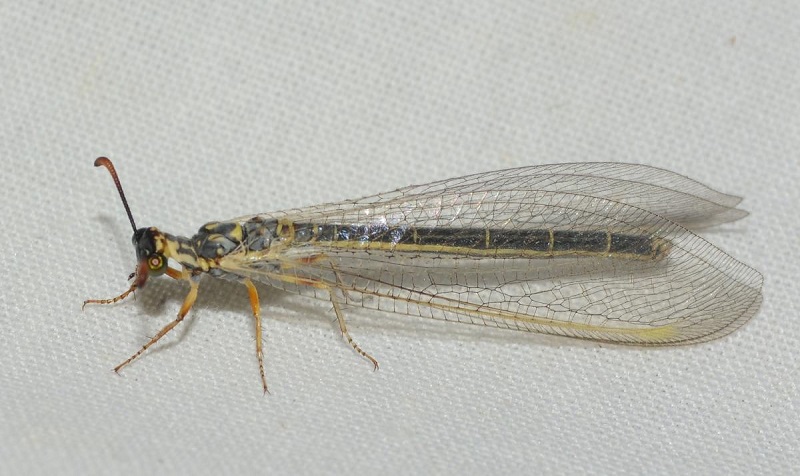
Myrmeleon doralice
Banks, 1911
Identification
Size: Small (Wingspan around 44mm)
Myrmeleon doralice is an attractive yellow, grey and black antlion. The wings are clear and slightly iridescent.
Larvae: The larvae are small and pinkish with relatively slender heads.
Myrmeleon doralice – Near Carnarvon, Northern Cape Photo by Ryan TippettMyrmeleon doralice – Near Carnarvon, Northern Cape Photo by Ryan TippettTypical Myrmeleon larvae – Boknesstrand, Eastern Cape Photo by Zenobia van Dyk
Habitat
M. doralice can be found in a wide variety of habitat types but favours dry savannas and arid Karoo shrublands.
Behaviour
Adults are active during the summer months from November to May.
This species is readily attracted to lights.
Members of the genus Myrmeleon are considered to be the most primitive antlions.
The larvae walk backwards and are typical pit-builders. The pits are frequently located out in the open.
Typical Myrmeleon pit-fall traps – Near Graaf-Reinet, Eastern Cape Photo by Dewald du Plessis
Status and Distribution
Myrmeleon doralice is Common and widespread throughout southern Africa, particularly in the drier regions. Beyond South Africa it is known to occur in Botswana, Namibia, Zimbabwe, Zambia and Kenya.
Distribution of Myrmeleon doralice. Taken from the LacewingMAP database, November 2022.
Virtual Museum (LacewingMAP > Search VM > By Scientific or Common Name)
Acknowledgements:
The use of photographs by Dewald du Plessis, J. du Plooy and Zenobia van Dyk is acknowledged. This species text has benefited enormously from comments made by Mervyn Mansell on records he has identified in LacewingMAP. We acknowledge his important contribution.
Recommended citation format for this species text:
Tippett RM 2022. Myrmeleon doralice. Biodiversity and Development Institute, Cape Town. Available online at http://thebdi.org/2022/11/10/myrmeleon-doralice/
The Swee Waxbill is 9–10 cm long with a grey head and breast, pale yellow-grey belly, olive back and wings, red lower back and rump, and a black tail. The upper mandible of its bill is black and the lower red. The male has a black face, but the female’s face is grey. Juveniles are much duller than the female and have an all-black bill.
The Swee Waxbill is endemic to southern Africa, occurring from Limpopo Province in South Africa south through Swaziland and south-western Mozambique and all along the coastal region of South Africa to the Western Cape Province. Its distribution in South Africa is displayed in the SABAP2 map below.
SABAP2 distribution map for Swee Waxbill, downloaded on 07 November 2022. Details for map interpretation can be found here
Habitat
It generally prefers edges of montane and coastal forest, wooded valleys in fynbos, bushy hillsides, grassy clearings in woodland, alien tree plantations, and gardens. They are often found in groups while foraging for food.
Swee Waxbills at the bird feeder – BirdPix 176837 – Robyn Kadis, Franschhoek, Western Cape, 28 July 2021.
Feeding on grass seeds – Harold Porter Botanical Garden – BirdPix 213713 – Gerald Wingate, Betty’s Bay, Western Cape, 12 March 2022.
Behaviour
It mainly eats seeds which it usually eats directly off of grasses. They supplement their diet with insects caught on the ground and in vegetation.
Foraging on the lawn – BirdPix 125308 – Andrew Kruger, Underberg, KwaZulu-Natal, 02 July 2016.
Egg-laying season is from October to April. Both sexes build the nest, consisting of an oval-shaped structure with a side-top entrance. They use dry grass to build the nest and then line it with soft grass inflorescences, feathers, and other plant material. The nest is typically placed in a tree, bush, garden pergola, or Aloe.
The chicks are fed by both parents, leaving the nest after about 19-22 days, becoming fully independent about 15-19 days later.
Swee Waxbill nest in an Aloe – University of Cape Town campus – BirdPix 31043 – Dieter Oschadleus, Cape Town, Western Cape, 06 October 2016.
Further Resources
Species text from the first Southern African Bird Atlas Project (SABAP1), 1997.
Virtual Museum (BirdPix > Search VM > By Scientific or Common Name).
More common names: Suidelike Swie (Afrikaans); Xidzingirhi (Tsonga); ubuSukuswane (Zulu); Astrild à joues noires (French); Gelbbauchastrild (German); Groenrugastrild (Dutch).
A list of bird species in this format is available here.
View the above photo record (by Ryan Tippett) in LacewingMAPhere.
Myrmeleon alcestris
Banks, 1911
Identification
Size: Small (Wingspan around 44mm)
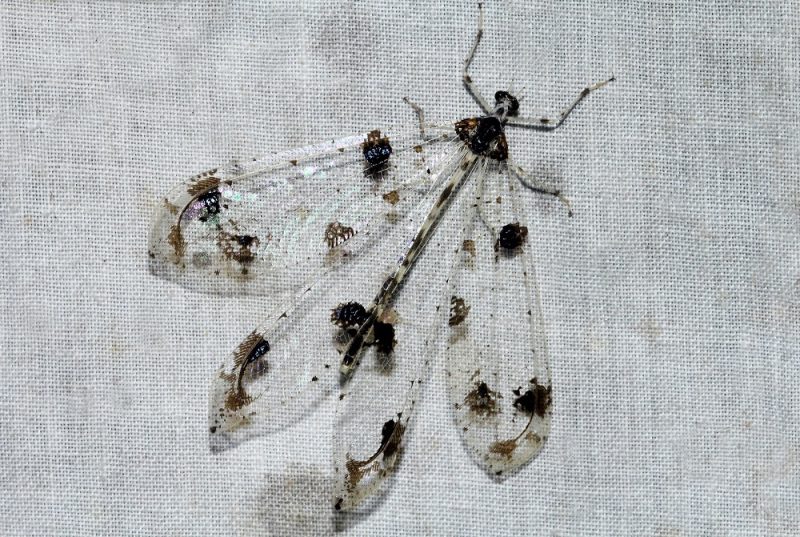
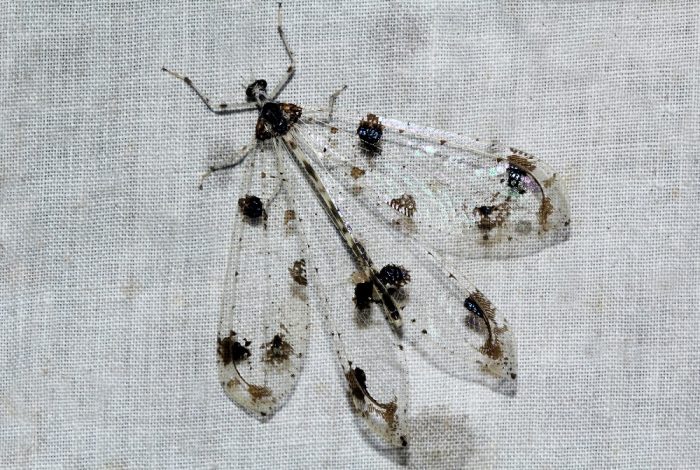
Myrmeleon alcestris is a very characteristic Myrmeleon owing to the black markings in the wings. The dark patches are especially conspicuous when the wings are folded at rest. This species also has a fairly distinctive abdomen pattern especially when seen from above.
Larvae: The larvae are small with relatively slender heads.
Myrmeleon alcestris – Near Carnarvon, Northern Cape Photo by Ryan TippettMyrmeleon alcestris – Near Carnarvon, Northern Cape Photo by Ryan TippettMyrmeleon alcestris – Near Carnarvon, Northern Cape Photo by Ryan TippettTypical Myrmeleon larvae – Boknesstrand, Eastern Cape Photo by Zenobia van Dyk
Habitat
M. obscurus ocurrs in a wide variety of habitat types and has been recorded from most terrestrial biomes in South Africa.
Behaviour
Adults are most active during the summer months from October to April, but have been recorded throughout the year in the warmer parts of South Africa.
Frequently attracted to lights.
Members of the genus Myrmeleon are considered to be the most primitive antlions.
The larvae walk backwards and are typical pit-builders. The pits are frequently located out in the open.
Typical Myrmeleon pit-fall traps – Near Graaf-Reinet, Eastern Cape Photo by Dewald du Plessis
Status and Distribution
Myrmeleon alcestris is common across its range. It is widespread in South Africa and is present in all provinces. The species extends into Mozambique, Namibia, Botswana and Zimbabwe.
Distribution of Myrmeleon alcestris. Taken from the LacewingMAP database, November 2022.
Virtual Museum (LacewingMAP > Search VM > By Scientific or Common Name)
Acknowledgements:
The use of photographs by Aletta Liebenberg, Dewald du Plessis and Zenobia van Dyk is acknowledged. This species text has benefited enormously from comments made by Mervyn Mansell on records he has identified in LacewingMAP. We acknowledge his important contribution.
Recommended citation format for this species text:
Tippett RM 2022. Myrmeleon alcestris. Biodiversity and Development Institute, Cape Town. Available online at http://thebdi.org/2022/11/09/myrmeleon-alcestris/
View the above photo record (by Gary Brown) in LacewingMAPhere.
Macroleon quinquemaculatus
(Hagen, 1853)
Identification
Size: Medium sized (Wingspan around 60mm)
These antlions have mostly brown coloured bodies and show conspicuous dark bands across the abdomen. The wings are clear with diagnostic white pterostigmas.
Larvae: The larvae are pale coloured and resemble those of other pit-building species.
Macroleon quinquemaculatus inhabits savanna woodland and forest regions. Adults are can be found among tall grass in the dappled light beneath trees.
Habitat – Ndumo Game Reserve, KwaZulu-Natal Photo by Ryan Tippett
Behaviour
The adults are nocturnal and spend the day resting among tall grass or other vegetation and may often be found on the underside of branches. Macroleon quinquemaculatus is frequently attracted to light.
It is the largest pit building species in the Afrotropics and the pits are always in very well sheltered situations, especially under buildings. Adults sometimes form aggregations, aligning themselves along branches.
In South Africa adults are on the wing from October to April.
This species is common and quite widespread in South Africa. Ranges from the Western Cape northwards through KwaZulu-Natal and up to Limpopo. It is absent from the drier western areas. Macroleon quinquemaculatus extends far into Africa, across all countries as far north as Liberia and Ethiopia. It is also found on Madagascar.
Distribution of Macroleon quinquemaculatus. Taken from the LacewingMAP database, October 2022.
Virtual Museum (LacewingMAP > Search VM > By Scientific or Common Name)
Acknowledgements:
The use of photographs by Gary Brown and Peter Vos is acknowledged. This species text has benefited enormously from comments made by Mervyn Mansell on records he has identified in LacewingMAP. We acknowledge his important contribution.
Recommended citation format for this species text:
Tippett RM 2022. Macroleon quinquemaculatus. Biodiversity and Development Institute, Cape Town. Available online at http://thebdi.org/2022/11/08/macroleon-quinquemaculatus/
As its name suggests the Grey-headed Sparrow has a grey head and face with pale grey underparts. Its wings are reddish-brown and darker brown towards the wing tips. It has a distinctive white spot on its shoulders and a white patch under its tail. Males and females are alike. When breeding their bills turn black.
Main photo – BirdPix 29710 – Gregg & Desire Darling, Oyster Bay, Eastern Cape, 18 September 2016. Inset photo – BirdPix 82313 – Anthony Archer, Klerskdorp, North West Province, 22 June 2019.
Distribution
The Southern Grey-headed Sparrow occurs from western and southern Angola through Zambia to southern Africa, where it is fairly common across much of the region, excluding the arid west of Namibia and the arid parts of South Africa. In South Africa it is most common towards the eastern half of the country.
SABAP2 distribution map for Southern Grey-headed Sparrow, downloaded 07 November 2022. Details for map interpretation can be found here.
Habitat
It generally prefers savanna woodland, especially with Acacia trees. It also occupies dry broad-leaved woodland, plantation edges, cultivated land and gardens.
BirdPix 234590 – Johan and Estelle van Rooyen, Namutoni Camp, Etosha National Park, Namibia, 17 June 2022.
Behaviour
Southern Grey-headed Sparrows eat seeds, fruit, nectar and insects, doing most of their foraging on the ground. They are often in flocks with other granivorous (seed-eating) birds.
At the bird feeder – BirdPix 230695 – Pamela Kleinman, Underberg, KwaZulu-Natal, 08 July 2022.
Breeding season is from September to June, peaking from about December to April. The nest is built by both sexes. It consists of a simple pad of grass, leaf petioles, weed stems, hair, and feathers. The nest is typically placed in a tree cavity, or in a hole in a wall, a hollow fence post, nest box, under the eaves of a building, or in an old swallow or swift nest.
The chicks are brooded and fed by both adults on a diet of insects. The chicks leave the nest after about 16-19 days. The fledglings remain dependent on their parents for about 14-21 days more, but they still roost in the nest for a further 13-20 days.
Adult with chick – BirdPix 238874 – Lia Steen, Shellybeach, KwaZulu-Natal, 26 October 2022.
Further Resources
Species text from the first Southern African Bird Atlas Project (SABAP1), 1997.
Virtual Museum (BirdPix > Search VM > By Scientific or Common Name).
More common names: Gryskopmossie (Afrikaans); Serobele (South Sotho); Moineau sud-africain (French); Graukopfsperling (German).
View the above photo record (by Erlo Brown) in LacewingMAPhere.
Crambomorphus sinuatus
(Olivier, 1811)
Identification
Size: Very Large (Wingspan up to 122mm)
Crambomorphus sinuatus is a magnificent antlion species. The head and thorax are grey and rather hairy while the abdomen is brick-red in colouration.
The forewings are mostly grey with a complex mix of black and white markings. The hindwings are black with a characteristic arrangement of white spots and blotches. The trailing edge of the wings are sinuous and end in a hooked tip.
Larvae: The larvae are very large and plain black-grey in colour.
Virtual Museum (LacewingMAP > Search VM > By Scientific or Common Name)
Acknowledgements:
The use of photographs by Alex Dreyer, Katharina Reddig and Niall Perrins is acknowledged. This species text has benefited enormously from comments made by Mervyn Mansell on records he has identified in LacewingMAP. We acknowledge his important contribution.
Recommended citation format for this species text:
Tippett RM 2022. Crambomorphus sinuatus. Biodiversity and Development Institute, Cape Town. Available online at http://thebdi.org/2022/11/08/crambomorphus-sinuatus/
Cover image: Pied Crow by Trevor Hardaker – BirdPix 16860
Identification
The Pied Crow is an unmistakable, vocal and conspicuous species, unlikely to be overlooked or misidentified. Pied Crows get their name due to their pied plumage. Pied means having two or more colours, and in this case, it is black and white.
As its name suggests, its glossy black head and neck are interrupted by a large area of white feathering from the shoulders down to the lower breast. Their eyes are dark brown and their legs, feet and bill are black. The bill is long and slightly hooked. Both sexes are similar and have no differences in their plumage.
Main photo – BirdPix 79602 – Karis Daniel, Hanover, Northern Cape, 25 May 2019. Inset photo – BirdPix 91000 – Alexander Wirth, Camps Bay, Western Cape, 14 July 2019.
Distribution
It occurs across most of sub-Saharan Africa, but is absent from, or rare, in the central and western forests. It has become prolific, its numbers and range are expanding especially in the Karoo region of South Africa as can be seen in the SABAP2 distribution map below.
SABAP2 distribution map for Pied Crow, downloaded 07 November 2022. Details for map interpretation can be found here.
The contrast between being abundant in the wheat-growing area north of Cape Town (the Swartland) and scarce on the wheat-growing area east of Cape Town (the Overberg) is striking. This contrast is thought to be diet-related, but has not been explained. In fact the overall pattern of the distribution remains a puzzle. If you compare this distribution map with that of the Cape Crow, there are areas where either one of the two species predominates, areas where they both occur, and areas where neither occurs.
Habitat
Pied Crows prefer open savanna woodland, bushy shrubland, and grassland with scattered trees. It is becoming more and more common in farmland, urban, and suburban areas. They are highly adaptive and don’t mind foraging in villages, towns, and cities and often visit rubbish dumps and bins.
A pair of Pied Crows in Karoo shrubland habitat – BirdPix 91392 – Les Underhill, De Doorns, Western Cape, 07 September 2019.
Behaviour
The Pied Crow is an omnivorous bird. It mainly feeds on plant material such as fruit and seeds, but also readily eats reptiles (such as tortoises), small mammals, fish, insects and other birds.
Pied Crows are usually seen in pairs or small groups, but they can congregate in large numbers at communal roosts or at good food sources, e.g. refuse dumps and large mammal carcasses.
Pied Crows and a Lappet-faced Vulture feeding on a carcass – BirdPix 13715 – John Fincham, Opuwo, Namibia, 23 September 2013.
During breeding, both the female and the male construct the nest, which is a large bowl made of twigs, sometimes including bits of wire. The nest is then lined with fur, dry dung, rags or sheep wool. It is usually placed in the vertical fork of a tall tree, such as a pine, Eucalyptus, cypress or palm. It also commonly places it on the top of a telephone pole, especially in more open areas, such as the Karoo.
Pied Crow at its nest on a telephone pole – BirdPix 26220 – Les Underhill, Lamberts Bay, Western Cape, 28 April 2016.
Further Resources
Species text from the First Southern African Bird Atlas Project (SABAP1), 1997.
Paper, published 2025: Range expansion of Pied Crows Corvus albus and consequences for biodiversity in southwestern Africa. Open Access.
More common names: Witborskraai (Afrikaans); Igwangwa (Xhosa); iGwababa (Zulu); Corbeau Pie (French); Schildrabe (German); Schildraaf (Dutch).
Recommended citation format: Loftie-Eaton M and Daniel KA 2022. Pied Crow Corvus albus. Bird Feeder Project. Biodiversity and Development Institute. Available Online at http://thebdi.org/2022/11/08/pied-crow-corvus-albus/
List of bird species in this format is available here.
View the above photo record (by Bart Wursten) in LacewingMAPhere.
Cymothales exilis
Mansell, 1987
Identification
Size: Small-Medium sized (Wingspan around 56mm)
Delicate and beautiful antlions with very long, slender legs. The wings are iridescent with intricate black/brown markings. The hind wings end in elegant pointed tips.
Larvae: The larvae of Cymothales exilis are unknown.
Cymothales exilis inhabits hot, humid woodlands in the tropics and subtropics.
Behaviour
Like others in the genus Cymothales exilis likely rests among grass or other vegetation where it is well camouflaged. Adults are readily attracted to lights and are recorded from October to May.
The life history of the larval stage is unknown, but other species of Cymothales live in detritus in tree holes or on rock ledges. This species probably does the same.
Status and Distribution
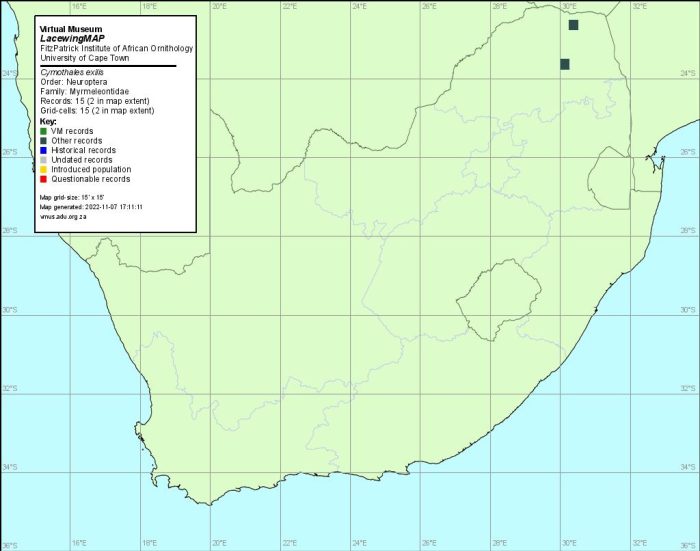
Cymothales exilis is fairly widespread in southern, central and eastern Africa, but is very rare. It is known from South Africa, Mozambique, Zimbabwe, Tanzania, Kenya and Malawi.
Distribution of Cymothales exilis. Taken from the LacewingMAP database, October 2022.
Virtual Museum (LacewingMAP > Search VM > By Scientific or Common Name)
Acknowledgements:
The use of photographs by Bart Wursten is acknowledged. This species text has benefited enormously from comments made by Mervyn Mansell on records he has identified in LacewingMAP. We acknowledge his important contribution.
Recommended citation format for this species text:
Tippett RM 2022. Cymothales exilis. Biodiversity and Development Institute, Cape Town. Available online at http://thebdi.org/2022/11/07/cymothales-exilis/
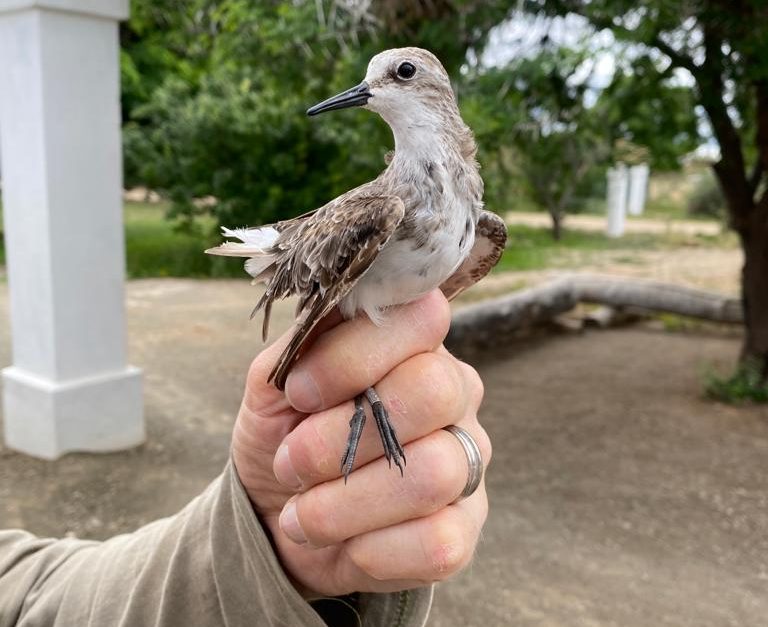
The second BDI bird ringing course at New Holme Lodge, in the KhoiSan Karoo Conservancy, has been completed. (Here is the blog about the first course!) Eight attendees had an exciting week of ringing new species, enjoying birding, going on a night drive, and tasting excellent meals! Some special birds seen included Osprey, Jacobin Cuckoo and Melodious Lark. (Cover photo: Little Stint)
Cape Sparrow treasure at the end of the rainbow
The total number of birds caught was nearly 500 birds of an amazing 30 species. The top species caught was the Southern Red Bishop (162), followed by Cape Sparrow (119), and Southern Masked-Weaver (98). The weavers were actively breeding, with most females having brood patches. The bishops were preparing to breed, with lots of activity.
On our way to New Holme, we visited Rietaar farm where we were able to ring some Barn Owl chicks (5 of 9 nestlings were large enough for ringing). At New Holme we also ringed 3 Hoopoe chicks from a tree hole cavity – at least 2 more chicks could not be reached. A family of Common Fiscals, including 4 juveniles, was caught in the mistnets.
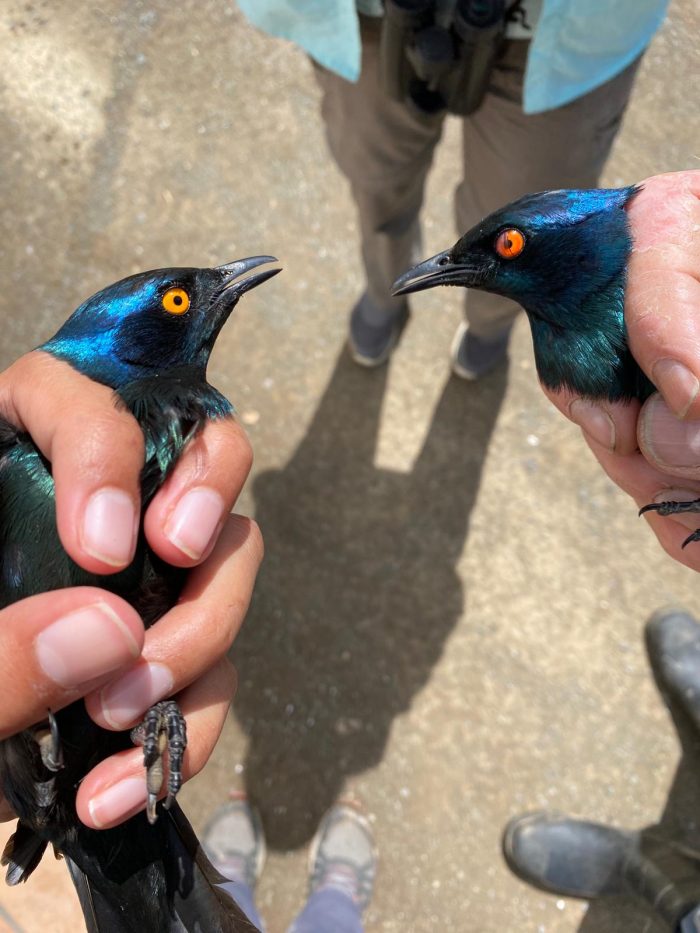
Wattled Starlings were seen in the fields, but not near the homestead where most ringing was done. But we did catch some Pied Starlings and the resident pair of Cape Glossy Starlings.
A pair of Cape Glossy Starlings
A day of ringing in the karoo veld did not produce many birds because of high winds. We also experienced some unseasonal thunder showers with lots of rain on one or two afternoons, but still had exceptional numbers of birds when it wasn’t raining.
We visited neighbouring farm, Mielefontein, where we caught a good number of birds. The potential is great, with many interesting species seen, including 3 Painted Snipe.
To join a ringing course, see dates and contact person here.
African Hoopoe in hand!
Table of ringing totals, KhoiSan Karoo Conservancy, 30 October to 6 November 2022
Cover image. Speckled Pigeon by Gregg Darling – BirdPix 46904
Identification
This is a large pigeon at 41 cm in length. Its back and wings are reddish-brown, the latter heavily speckled with white spots. The rest of the upperparts and underparts are blue-grey, and the head is grey with prominent red patches around the eye. The neck is brownish, streaked with white, and the legs are red. Sexes are similar, but juveniles are browner than adults and lack the red eye patches. The call is a loud doo-doo-doo.
Main photo: BirdPix 117234 – Lance Robinson, Marievale Bird Sanctuary, Gauteng, 17 September 2016. Photo inset: BirdPix 61337 – Lia Steen, Greylingstad district, Mpumalanga, 02 September 2018.
Distribution
The Speckled Pigeon is common throughout most of South Africa, except for the lowveld (eastern and northern South Africa) and the coast of KwaZulu-Natal Province.
SABAP2 distribution map for Speckled Pigeon, downloaded on 07 November 2022. Details for map interpretation can be found here
Habitat
The Speckled Pigeon is common across southern Africa, especially in South Africa. It usually prefers rocky, mountainous areas with cliffs and gorges, but it can also be found near buildings and in gardens.
Speckled Pigeon on a rocky ledge – BirdPix 215730 – Jon Blanco, Camdeboo National Park, Eastern Cape, 08 April 2022.
Speckled Pigeons on the roof of a house – BirdPix 213802 – Johan and Estelle van Rooyen, Riversdale, Western Cape, 11 March 2022.
Behaviour
It feeds mostly on seeds, rarely eating small fruits and flowers. It typically forages on the ground, usually on farmland, lawns or roads. They can gather in large numbers, especially agricultural fields, where grain or groundnuts are available.
The Speckled Pigeon builds its own nest, with the male collecting material and giving it to the female, who then puts it into the nest. This consists of a collection of twigs, grass, herbs and sometimes wire and nails. The nest is usually built on cliff ledges, in caves, gullies, or often in buildings.
Speckled Pigeon nests – Photo left: BirdPix 21036 – Dieter Oschadleus, Robben Island, Western Cape, 03 October 2015. Photo right: BirdPix 11544 – Graham Bull, Langebaan, Western Cape, 25 October 2014.
Breeding takes place year round. The female lays 1-3 eggs which both parents incubate in shifts for about 15 days. The chicks are brooded for the first six days of their lives, after which brooding ceases. The nestling period is highly variable depending on the environment, ranging from 21-37 days.
Further Resources
Species text from the first Southern African Bird Atlas Project (SABAP1), 1997.
Virtual Museum (BirdPix > Search VM > By Scientific or Common Name).
More common names: Kransduif (Afrikaans); Ivukuthu (Xhosa); iVukuthu (Zulu); Gespikkelde Duif (Dutch); Guineataube (German).
A list of bird species in this format is available here.