
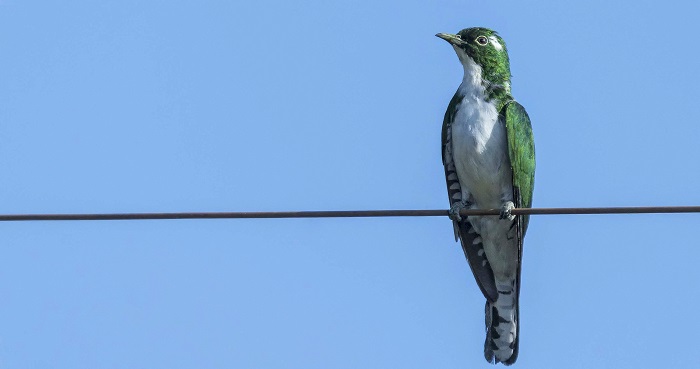
Cover image: Klaas’s Cuckoo by Tony Archer – Near Klerksdorp, North West
Cuckoos belong to the Family CUCULIDAE. This family includes Cuckoos, Coucals, Malkohas, Anis, Roadrunners, Couas, etc. It is a diverse group that contains both parasitic and nonparasitic species. They vary in size from small to large, with strong, sometimes deep and stout bills that are arched on the culmen. Their tails are mostly relatively long and heavy, and their wing may be long and pointed or short and rounded. Many species have crests, and the plumage is variable but is often spotted and barred. They have zygodactyl feet, and most species are arboreal, although a few are terrestrial. The Cuculidae have a worldwide distribution, although most are found in the tropics and subtropics. The family comprises 36 genera and 156 species. 20 species are known from southern Africa.
Identification
Klaas’s Cuckoo is an attractive, small cuckoo. They are sexually dimorphic, differing markedly in plumage colouration.
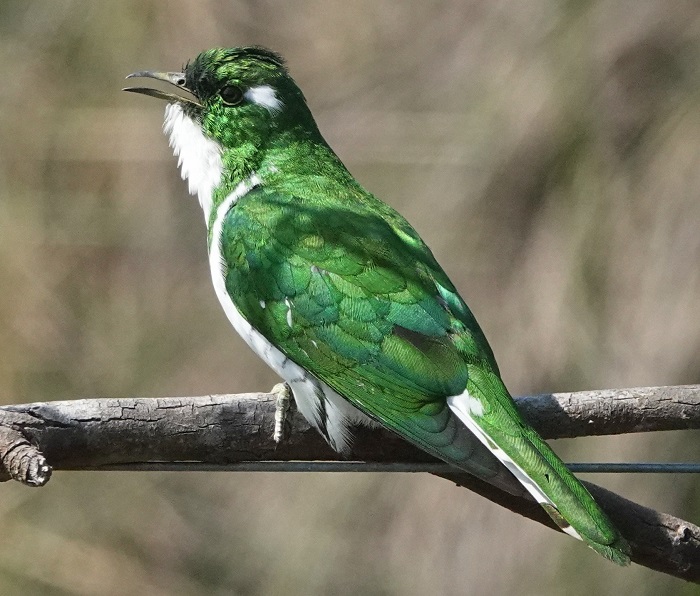
Nuwejaars Wetland Special Management Area, Western Cape
Photo by Les Underhill
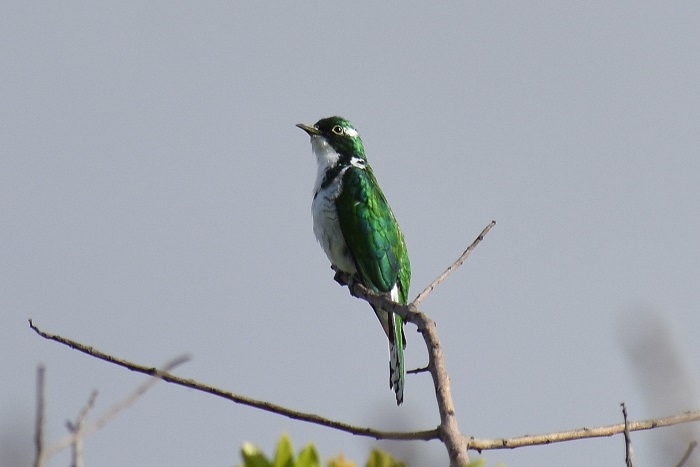
Adult males are uniformly bright, metallic green above, aside from a conspicuous white ear patch. The upper tail is glossy green with a bronzy sheen. The outer tail feathers are white. The undersides are pristine white with a metallic green half-collar from in front of the wings to the sides of the breast. The flanks are narrowly green-barred, and the leggings are white, with green streaks. The bill is greenish-black to black. The eyes are dark brown and the eye ring is green. The legs and feet are greenish-black.
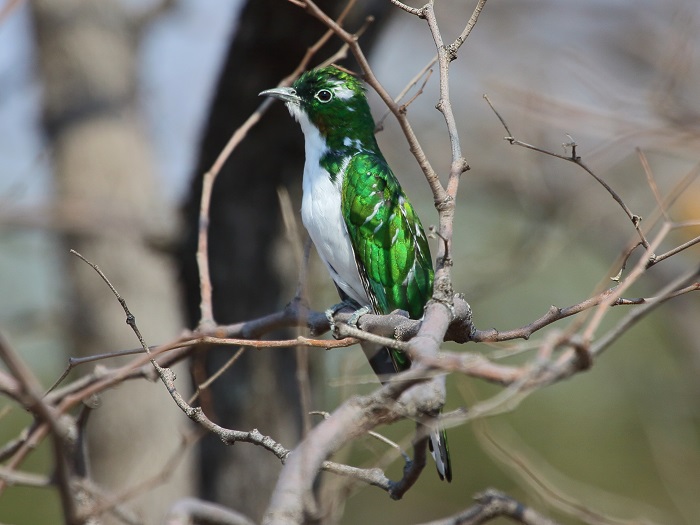
Mapungubwe National Park, Limpopo
Photo by Phillip Nieuwoudt
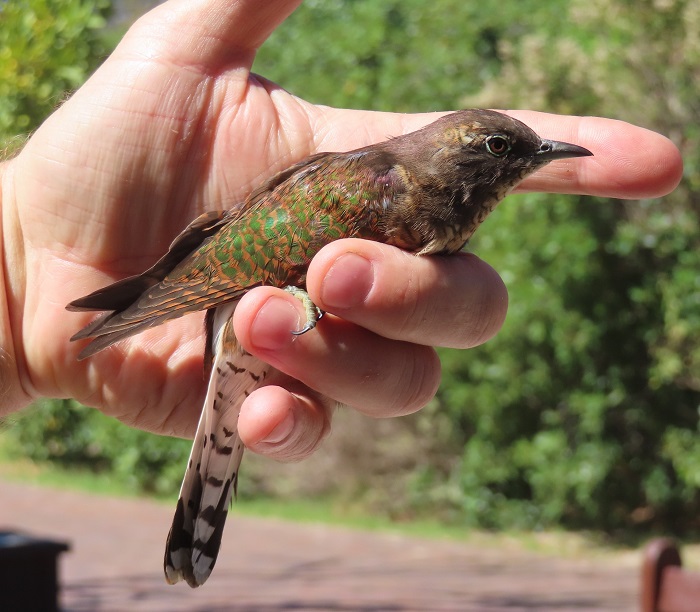
Adult females have a greyish-brown head, the colour extending down the sides of the neck and to the upper breast and with a small white patch behind the eye. The upper back is also greyish brown, while the lower back is barred green and brown. The rump is brown with a copper sheen. The tail is white at the base. The central two pairs of rectrices are coppery brown. The rest of the tail feathers are white, each with a large coppery subterminal spot and 1 or 2 incomplete black bars. The folded wings are barred green and brown. The underparts are white with fine brown barring on the breast and flanks. The thighs are also barred in dull metallic green and buff. The bill is greenish with a black tip. The eyes are brownish-grey with a pale green eye ring. The legs and feet are greenish.
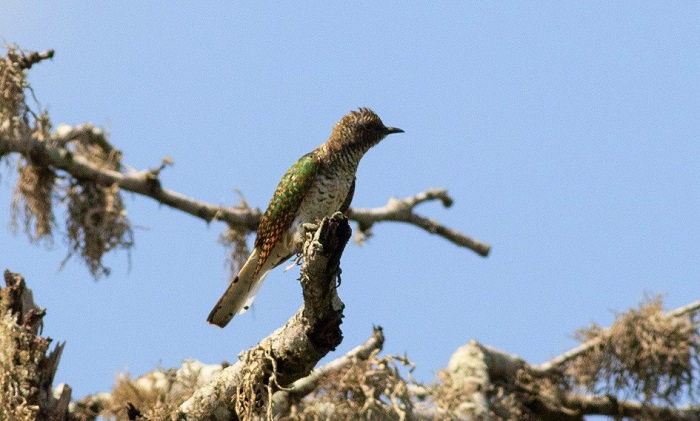
False Bay, iSimangaliso Wetland Park, KwaZulu-Natal
Photo by Lance Robinson
The sexes are alike in juveniles. The head and back are iridescent green with buff-brown barring and an indistinct white streak behind the eye. The tail has bronze-brown central rectrices with buff barring near the base and edges. The outer rectrices are white with black bars near the tip. The folded wings are metallic green with buff barring. Underparts are white and heavily barred bronze-green from the chin to the undertail coverts. The bill is black, and the eyes are rich brown.
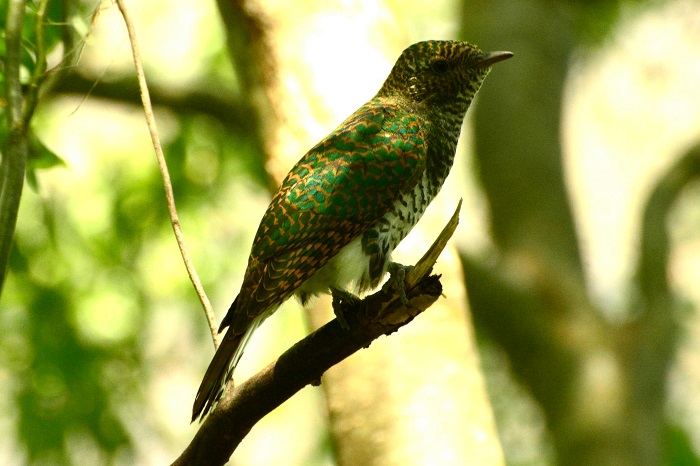
Stellenbosch, Western Cape
Photo by Heather Hodgson
Adult males can be mistaken for the male Diederik Cuckoo (Chrysococcy caprius). However, in the Klaas’s Cuckoo, the small white patch behind the eye and the green half-collar that extends onto the sides of the breast are diagnostic. Females of the two are similar to one another but are easily told apart by bill colour (red in Diederik Cuckoo and greenish-black in Klaas’s Cuckoo).
Female and juvenile Klaas’s Cuckoo are easily confused with the female and juvenile African Emerald Cuckoo (Chrysococcyx cupreus). The latter, however, lacks the white patch behind the eye and has a green-and-white (not brown-and-white) barred throat.
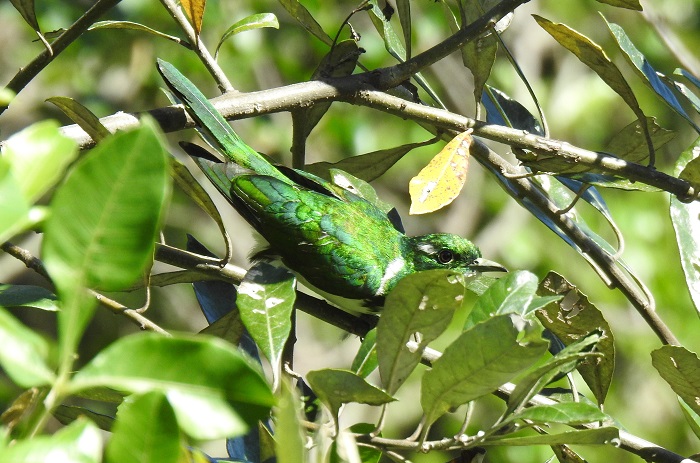
Richards Bay, KwaZulu-Natal
Photo by Richard Johnstone
Status and Distribution
Klaas’s Cuckoo is found on the southern Arabian Peninsula, and widely in sub-Saharan Africa from Senegal east to Sudan and Ethiopia, south to South Africa. In southern Africa, it occurs sparsely in central and northern Namibia, northern, eastern and south-eastern Botswana, Zimbabwe, Mozambique, and northern, eastern and southern South Africa. Klaas’s Cuckoo is largely absent from the arid regions of southern Africa.
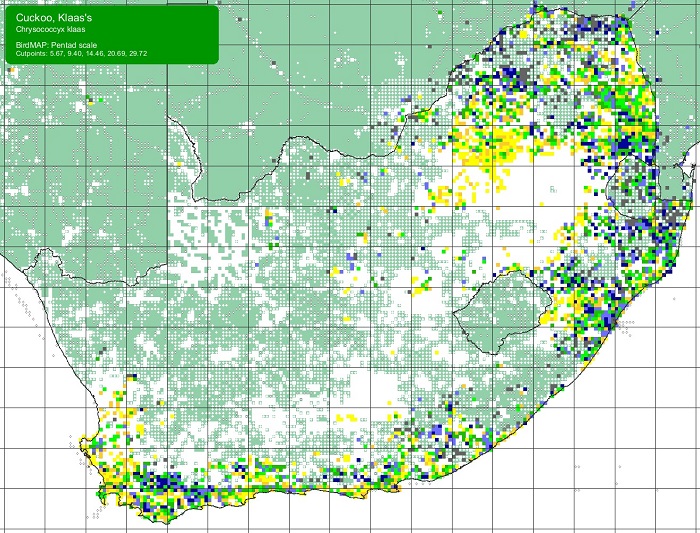
Klaas’s Cuckoo is fairly common in southern Africa. It is not threatened and is well represented in protected areas. Its range in north-central South Africa appears to have expanded westward since the 1980s.
Habitat
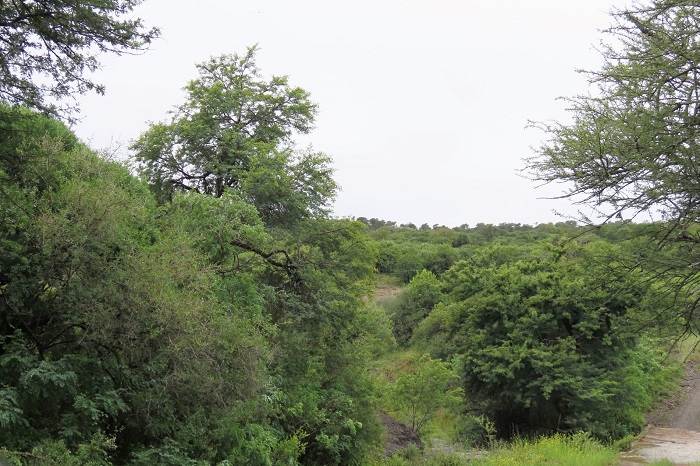
Photo by Colin Summersgill.
Klaas’s Cuckoo inhabits forests, forest edges, and open or dense woodland, including thornveld, miombo (Brachystegia), and Mopane Colophospermum mopane woodlands. In otherwise unsuitable habitats, Klaas’s Cuckoo has adapted to parks, gardens, and alien trees around farmsteads. Reporting rates confirm its preference for forests, forest edge, and moist woodlands.
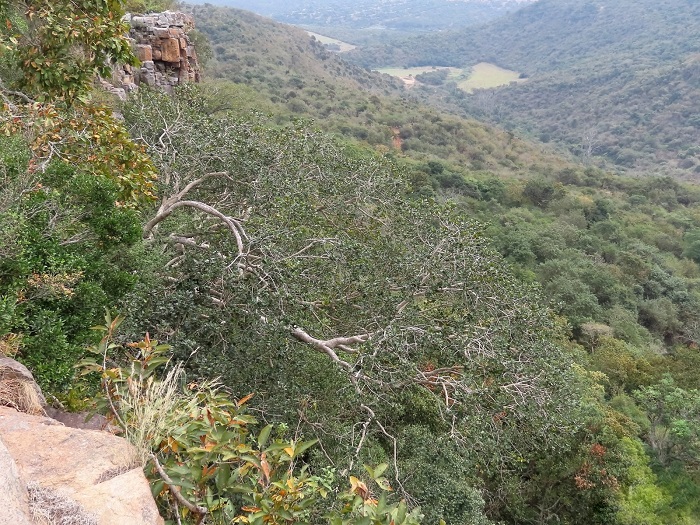
Wartberg district, KwaZulu-Natal
Photo by Colin Summersgill
Behaviour
Klaas’s Cuckoo is an intra-African breeding migrant across most of its southern African range, arriving as early as August and departing in February. It is however, a resident in lowland areas.
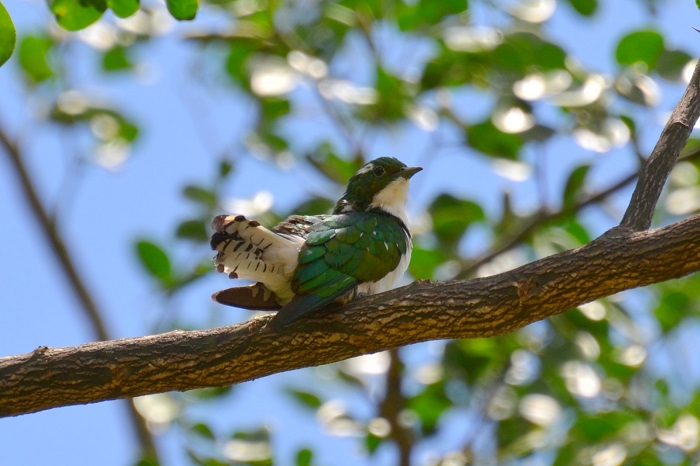
Mkhuze Game Reserve, KwaZulu-Natal
Photo by Sharon Stanton
Generally solitary and usually heard more often than seen. The Klaas’s Cuckoo’s distinctive song is delivered from a perch, either within foliage or from an exposed branch.
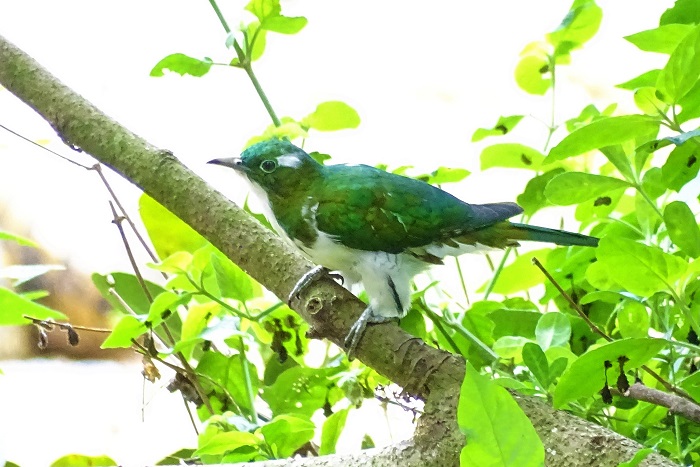
St. Lucia, KwaZulu-Natal
Photo by Wiekus moolman
Klaas’s Cuckoo forages among foliage, gleaning invertebrates from leaves and occasionally hawking aerial prey. The diet consists mainly of butterflies and caterpillars, including large hairy ones, which are swallowed hairs and all. Large caterpillars are beaten against a branch before swallowing. A variety of other insects are also consumed, including bugs, beetles, moths, small grasshoppers, termites, and occasional seeds and fruit.
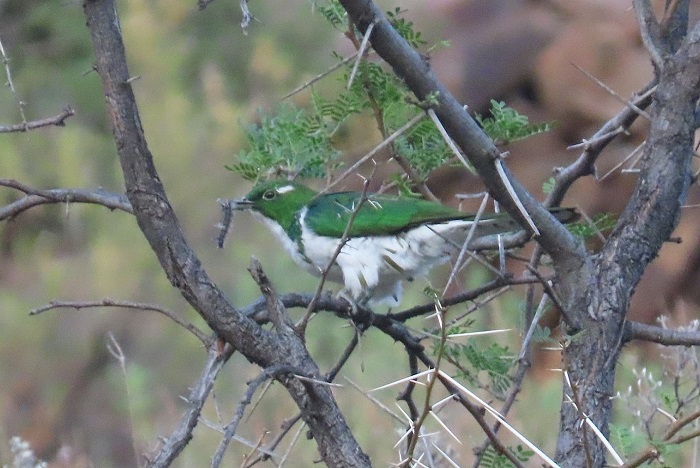
Near Willowmore, Eastern Cape
Photo by Cobus Elstadt
The Klaas’s Cuckoo is territorial. Territory size varies by habitat, and territories tend to be larger in drier areas. Males are believed to be promiscuous. Klaas’s Cuckoo is a brood parasite but is not host-specific and is known to parasitise at least 18 species in southern Africa. Batises, small warblers, and sunbirds are the primary hosts, including Cape Batis, Chinspot Batis and Pririt Batis, African Dusky Flycatcher, Bar-throated Apalis, Yellow-bellied Eremomela, Long-billed Crombec. Also Grey, Amethyst, Scarlet-chested, Malachite, Collared, Greater Double-collared, White-bellied, Dusky and Marico Sunbirds.
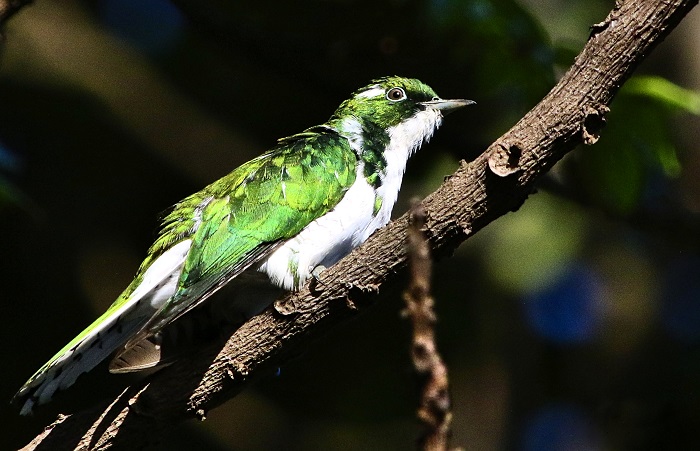
Shelly Beach, KwaZulu-Natal
Photo by Lia Steen
The egg-laying behaviour is not well known. Eggs are laid from September to April, with a peak from October to December. Females usually lay 1 egg per nest and will also remove 1 egg from the host clutch. A female lays an average of 24 eggs per season. The eggs are oval and white to pale greenish-blue with rufous-brown spots, speckles, or blotches. The eggs of each female vary considerably in colour and markings, and each individual lays a consistent egg type throughout her lifetime. Each female is thought to specialise in parasitising a particular host species in which her eggs best match those of the host. However, the accuracy of the egg matching varies. In some cases, the accuracy of the match is remarkable, and the difference is undetectable to the human eye. In many instances, the colour is the same, but the size is not and sometimes neither the size nor colour matches.
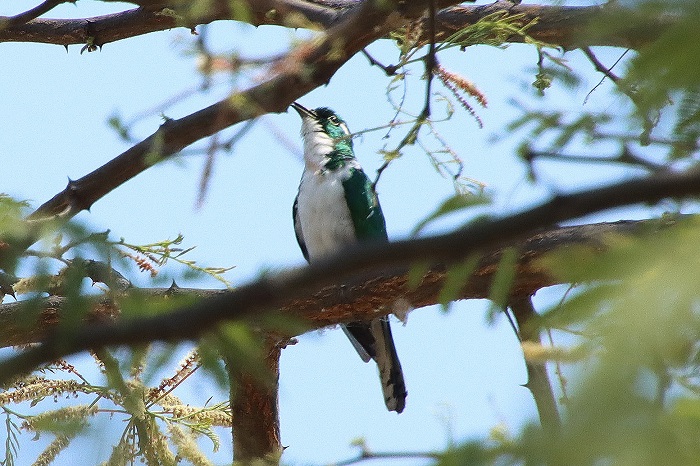
Matshavhawe, Limpopo
Photo by Marius Meiring
The incubation period is 11 to 12 days and typically shorter than that of the host’s eggs. Therefore, the cuckoo egg usually hatches before those of the host. A newly hatched cuckoo chick is altricial, naked, and blind. Despite its feeble appearance, the cuckoo chick wastes little time in evicting the other eggs or nestlings from the nest. Their eyes first open at around 6 days. If handled, the cuckoo chick can excrete a nauseating black and brown fluid from the cloaca. The nestling period takes up to 21 days. When the young cuckoo first leaves the nest, it is very tame and a poor flier, but after 7 to 10 days it flies well. The young cuckoo remains with the host adults for up to 25 days after fledging.
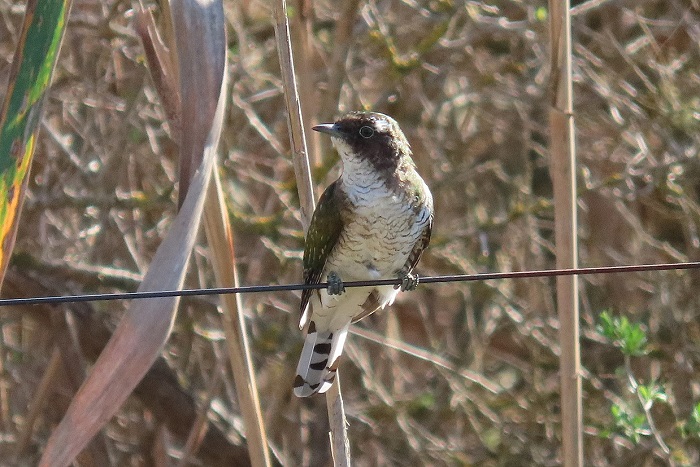
Stilbaai, Western Cape
Photo by Johan van Rooyen
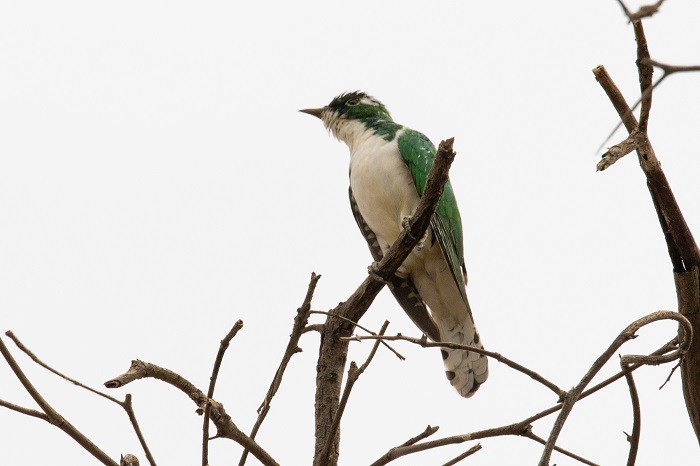
Mabula Game Reserve, Limpopo
Photo by Lance Robinson
Rondevlei, Western Cape
Photo by Karis Daniel
Further Resources
Here is the species text the First Southern African Bird Atlas Project (SABAP1), 1997.
The use of photographs by Colin Summersgill, Dave Rimmer, Desire Darling, Gregg Darling, Joanne Putter, Johan Heyns, Kate Braun, Lia Steen, Rick Nuttall, Roelof van der Breggen, Ryan Tippett, and Tony Archer is acknowledged.
Virtual Museum (BirdPix > Search VM > By Scientific or Common Name).
Other common names: Meitjie (Afrikaans); Klaaskoekoek (Dutch); Coucou de Klaas (French); Klaaskuckuck (German); Cuco-bronzeado-menor (Portuguese).
List of species available in this format.
Recommended citation format: Tippett RM 2026. Klaas’s Cuckoo Chrysococcyx klaas. Biodiversity and Development Institute. Available online at https://thebdi.org/2026/08/27/klaass-cuckoo-chrysococcyx-klaas/
Rondevlei, Western Cape
Photo by Felicity Ellmore
