
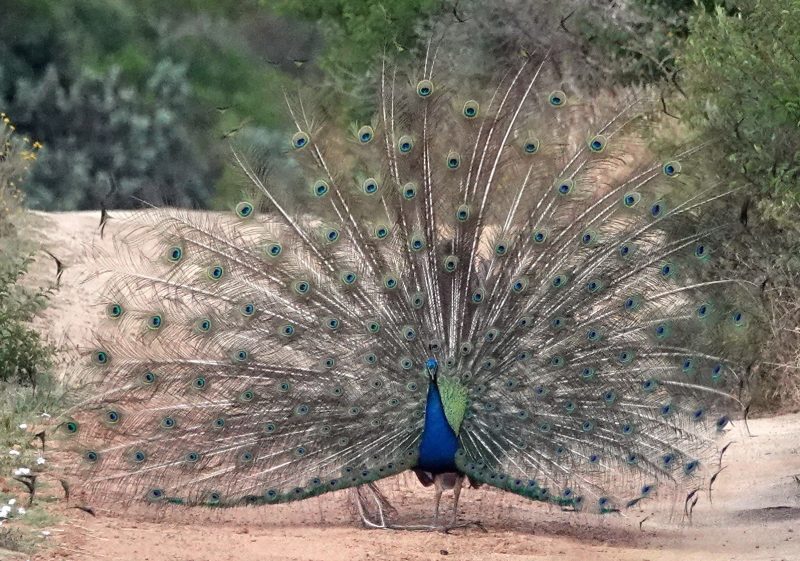
Cover image of Indian Peafowl. Photograph taken 9 December 2023, at Vondeling Wine Farm, northwest of Wellington, Western Cape, South Africa.
The Indian Peafowl belongs to the Family Phasianidae (pheasants). There are currently 185 species in the family, in 54 genera. The genus Pavo contains two species, both are native to southern Asia: the Indian Peafowl, discussed here, and the Green Peafowl Pavo muticus, an Endangered species mostly in Thailand, Vietnam, Indonesia. There is also a peafowl in Africa, in the Democratic Republic of Congo, but it is a different genus: Congo Peafowl Afropavo congensis. Almost all of the 185 species in the pheasant family occur in the Old World: Africa, Asia and Europe. The two turkey species are the only members of the family in the New World, in North America. The pheasants are terrestrial birds, and mostly feed on the ground. The chicks are prococial; they are covered with down when they hatch, with open eyes. They leave the nest within hours of hatching, and feed themselves.
Identification
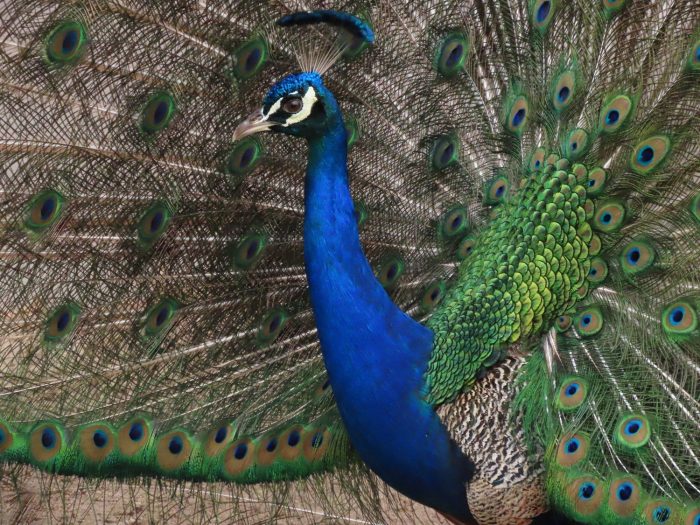
A male Indian Peafowl is instantly recognizable.
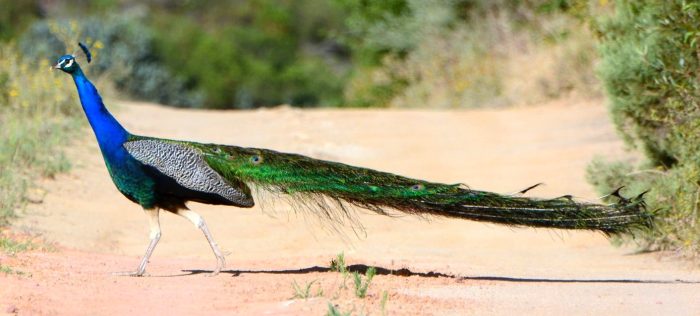
From the bill to the tip of the tail, this male is the width of this farm track.
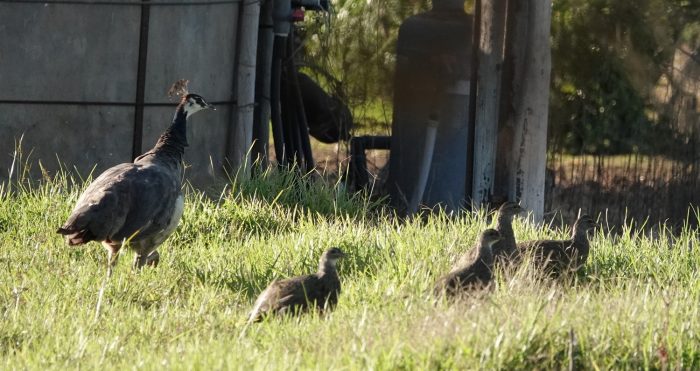
Female Indian Peafowl, walking with a covey of Cape Spurfowl. Besides the crown feathers, she is a large bird. The neck of the female has a greenish-blue sheen; apart from that the colours are dull browns and creams.
Distribution
SABAP2 atlasers have recorded Indian Peafowl at many scattered locations across South Africa …
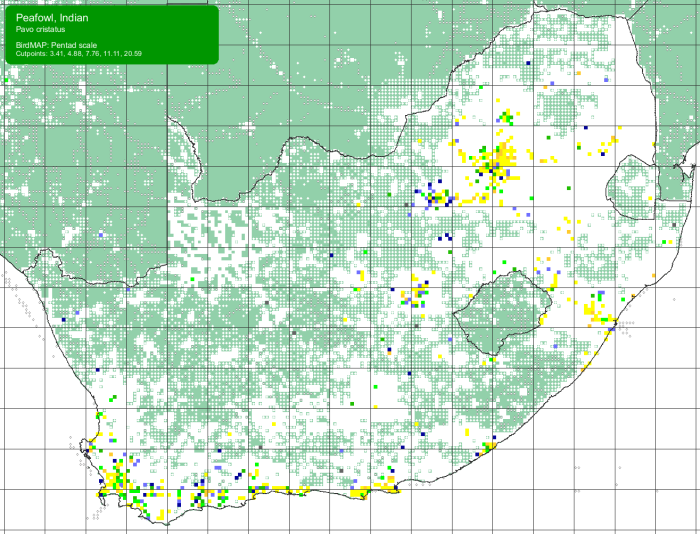
SABAP2 distribution map for Indian Peafowl, downloaded December 2024. Details of the interpretation for this form of the SABAP2 distribution maps are here.
Traditionally, the only genuinely self-sustaining population of Indian Peafowl was the one on Robben Island, but there are now multiple such populations across southern Africa. Some of them have been written up as papers in Biodiversity Observations:
Some of the pentads in which SABAP2 observers have recorded Indian Peafowl will likely be populations which are domestic, but many of these populations are likely becoming feral.
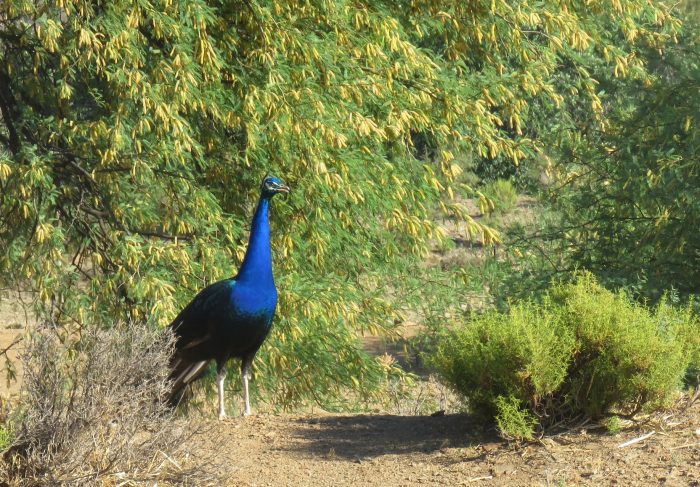
For example, in November 2018, we did a Biobash to the Hantam, the region northeast of Calvinia in the Northern Cape. This male Indian Peacock was found roaming around the werf of a farm there. The Hantam had once been a major producer of wool, the farmers were wealthy, and many of the farmhouses were mansions. The region had been drought-stricken for years; see the blog! This farm, along with many others in the area, had been completely abandoned. No one there! The once-ornamental peafowl had become totally feral. This is the process that drives the scattered distribution on the SABP2 distribution map above.
Habitat
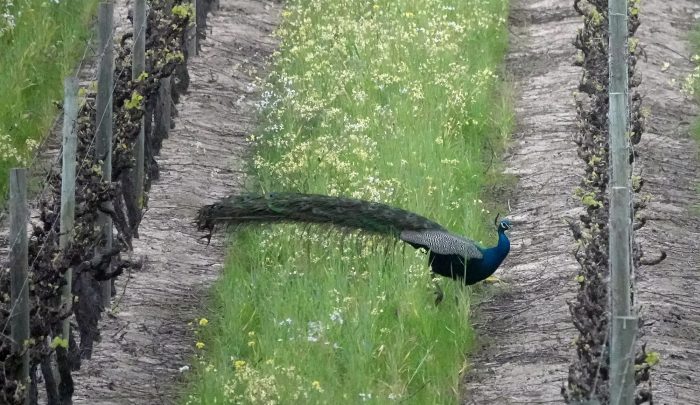
These peafowl did not eat grapes in the vineyard of this wine farm where they were present throughout the year; if they did they would not be tolerated!
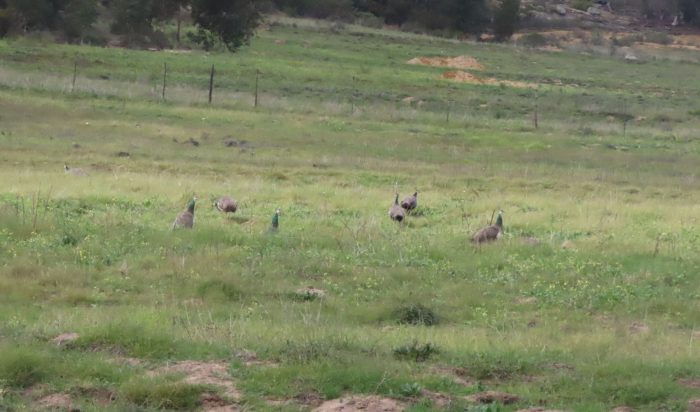
This covey of peafowl, both males and females, are feeding in rough pasture.
Behaviour
Although the spend the day on the ground, they fly up into trees, sometimes in a loose roost, for the night.
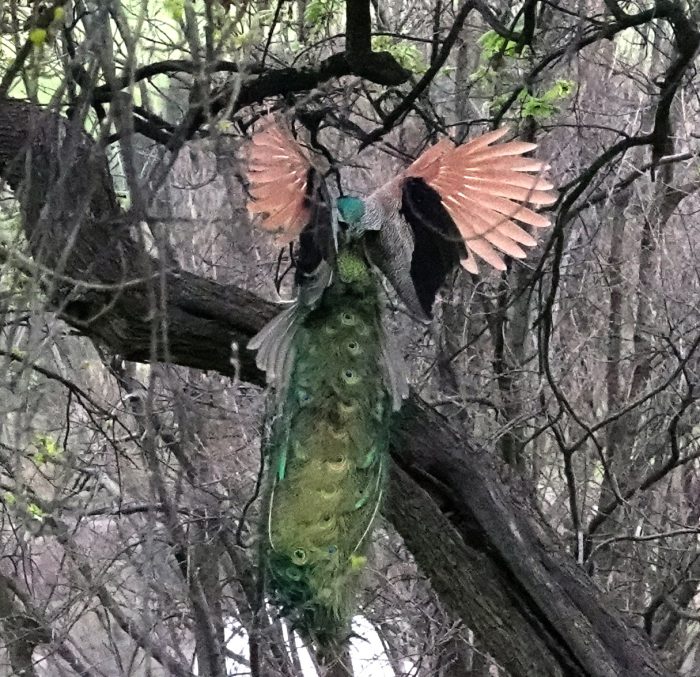
Male, flying up into a tree in the early evening and landing on a branch.
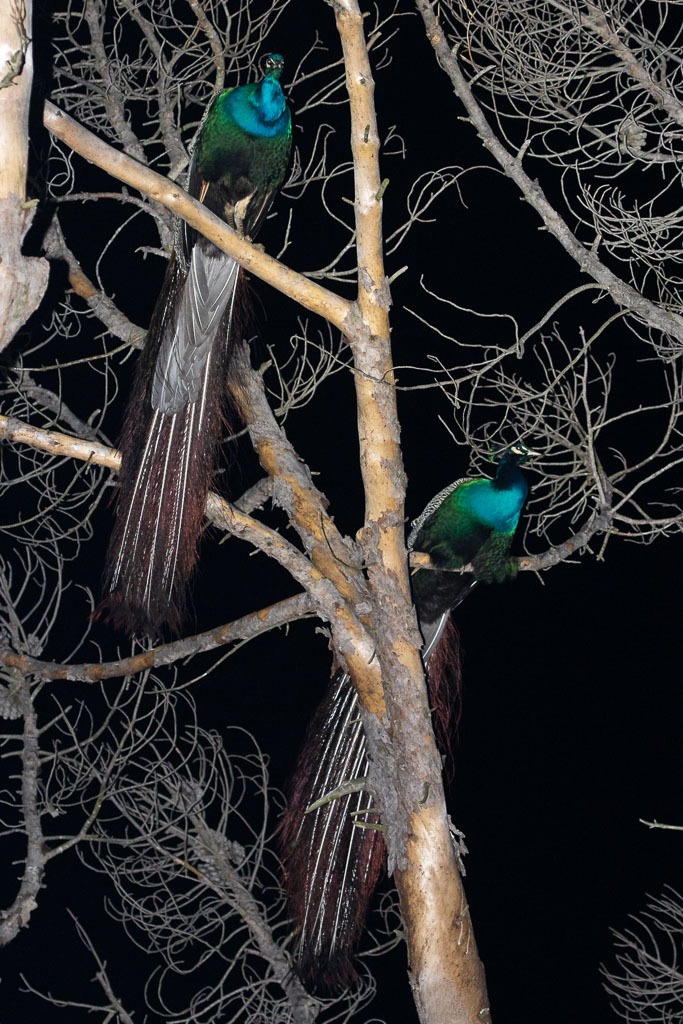
Male Indian Peafowls roosting in a pine tree at Vondeling Wine Farm.
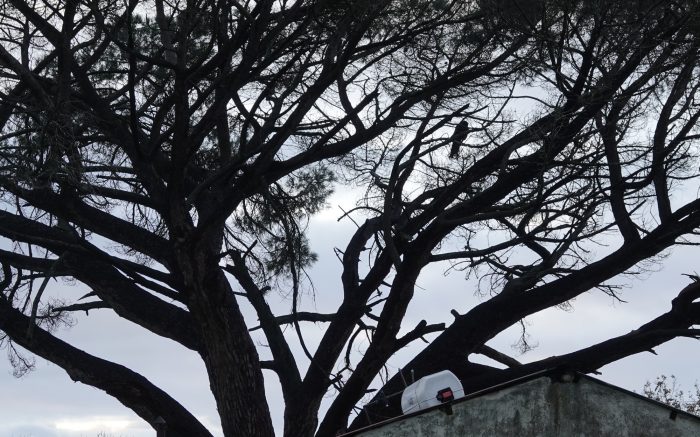
Morning has arrived and this peafowl has not yet flown down from his overnight perch.
The males use their tails in elaborate displays to attract females.
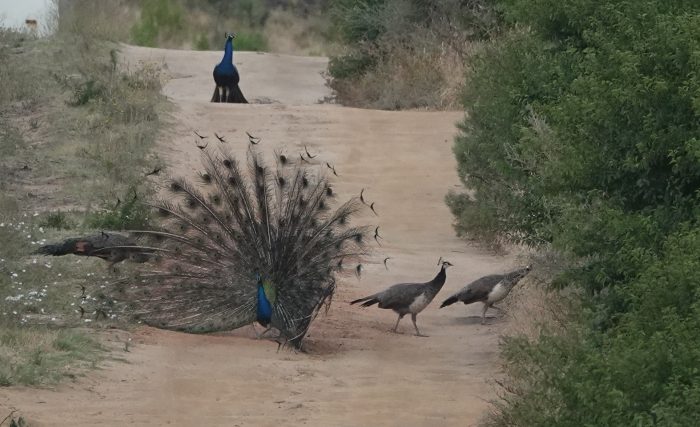
… not impressed!
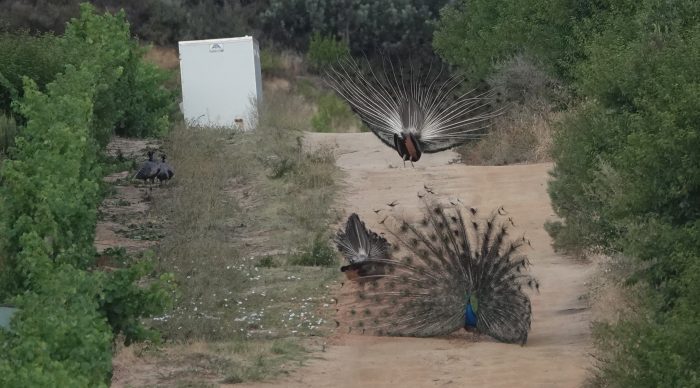
Even with three males displaying, the females were not impressed.
Breeding
So, from time to time, the females do choose a male and lay eggs. Beyond fertilization, the males have no further role to play. Not only would it be awkward to try to incubate eggs with a clumsy tail that drags along the ground behind them, the bright colours would draw the attention of predators to the nest. The dull brownish colours of the female enable her to remain camouflaged on the nest.
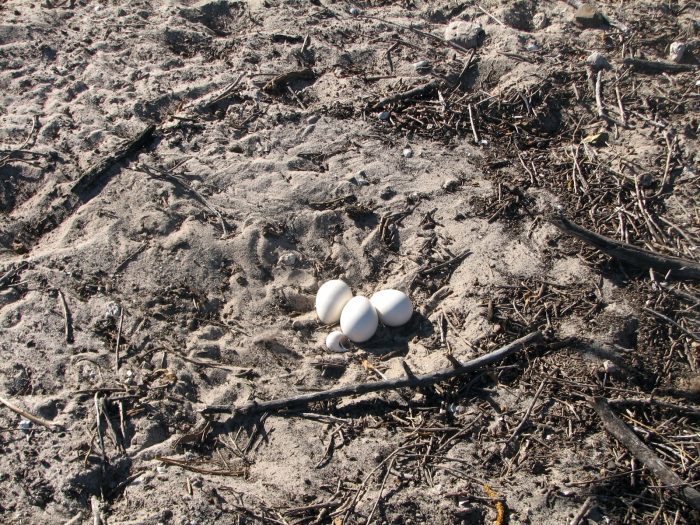
This was the only Indian Peafowl nest we ever found on Robben Island.
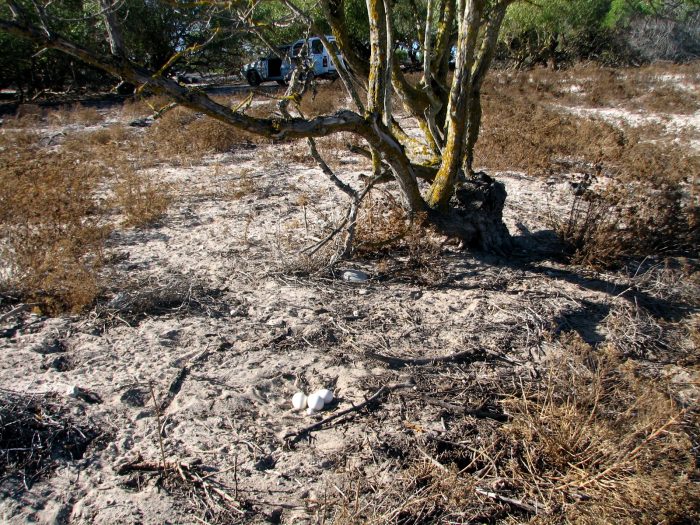
The nest was very much out in the open.
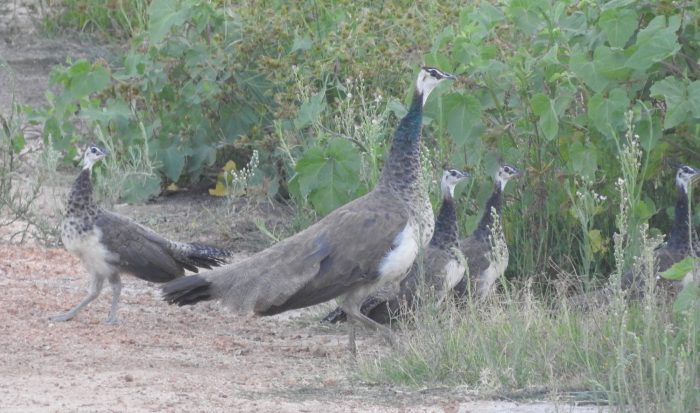
Here is a female, with the bluish neck, with her chicks, more than half-grown.
Background
The Indian Peafowl is the national bird of India. This map shows its natural range. In some parts of India its status gives it protection; in other parts it has become rare.
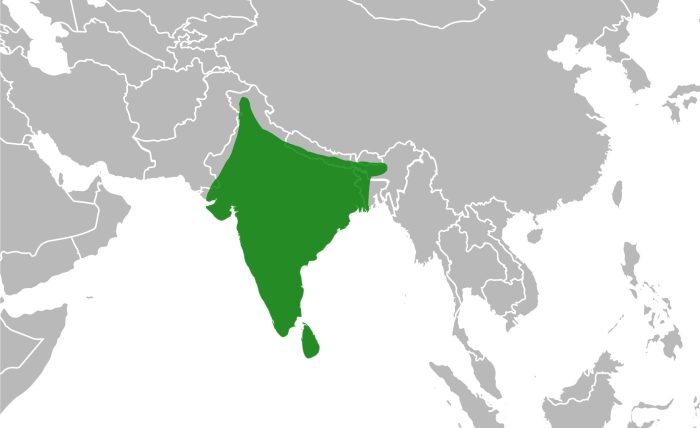
The Indian Peafowl has been introduced all over the world. The primary objective was to use them as living ornaments in the gardens of the wealthy, an icon of luxury. But some escaped and became feral. There are suburbs in many parts of the world where the peafowl is the catalyst for human-human conflict. There are people who love them (they are beautiful) and there are people who hate them (they are raucous, including through the night, and their droppings are large, smelly and slippery).
So the posse of feral Indian Peafowl in N1 City during the pandemic in 2020 has disappeared. In the photographs below, they are walking in among the long queue of motorists in the “drive-through” Covid testing station in December 2020.
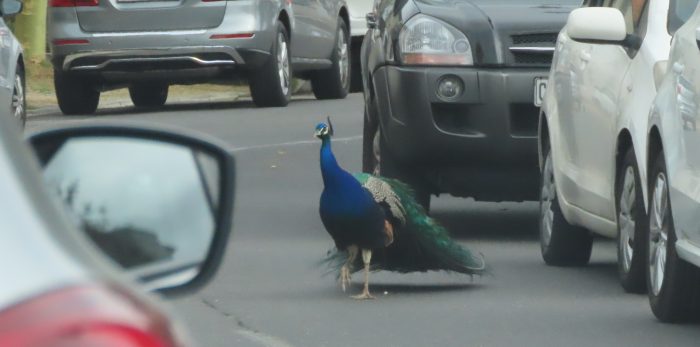
Occasionally they did an impromptu display as entertainment. The queue was several hours long.
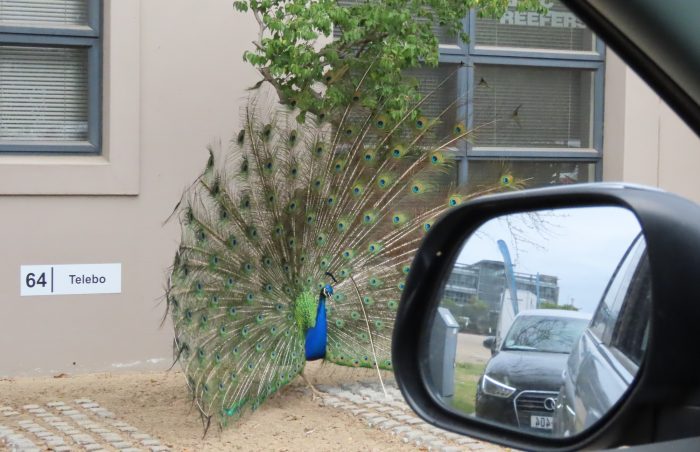
These peafowl likely became a source of human conflict, and somehow or other, they have disappeared.
Further resources
Other common names: Bloupou Patrys (Afrikaans), Blauwe pauw (Dutch), Paon bleu (French), Chukarhuhn (German), Pavone (Italian), Pavo real común (Spanish),.Påfågel (Swedish), Riikinkukko (Finnish), Paw indyjski (Polish)
Scientific papers:
Structured species test: A list of all the species with structured species texts like this one is available here
Recommended citation format: Underhill LG 2026. Indian Peafowl Pavo cristatus. Biodiversity and Development Institute. Available online at https://thebdi.org/2026/08/10/indian-peafowl-pavo-cristatus/