The BDI visits Roam Private Game Reserve

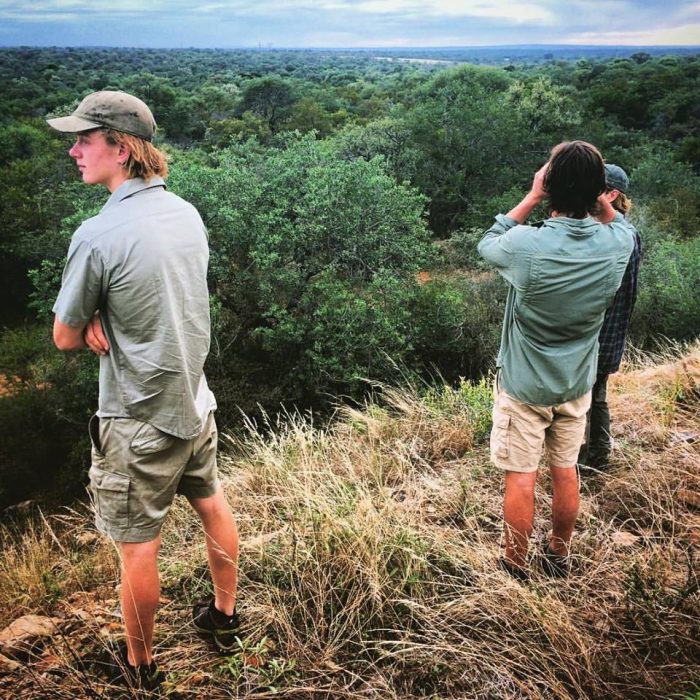
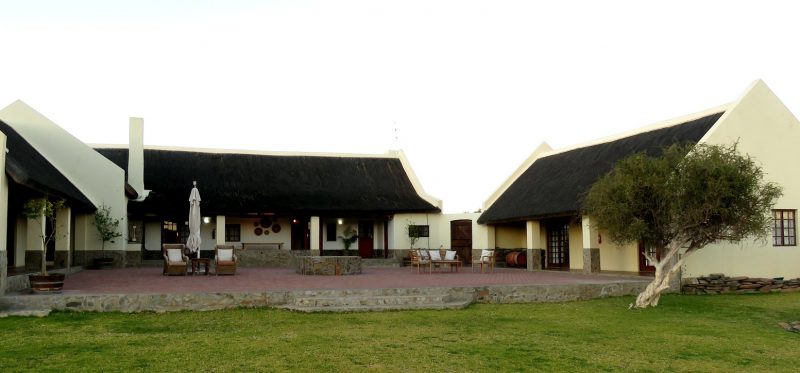
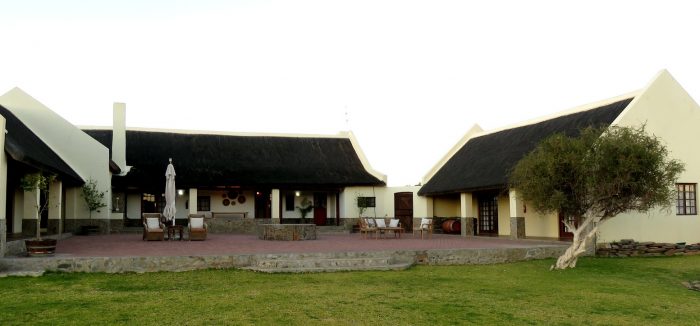
Five years ago, the Post family bought a 5000 ha property in the Karoo which had been used for hunting, turned it into a biodiversity conservation area, and renamed it Roam Private Game Reserve. The old hunters’ accommodation has been transformed into a Luxury Safari Lodge that resonates with the hospitality and peacefulness of the Karoo.
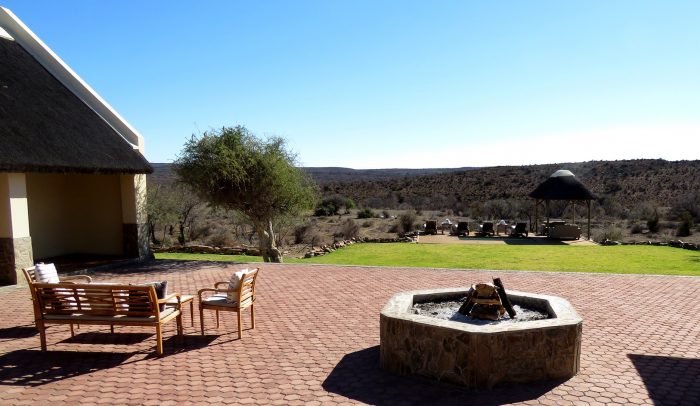
To satisfy the demands of hunters, what had originally been a sheep farm had been overstocked with large target animals. Veld degradation had been the result. This is steadily being repaired. Species that do not belong in the Karoo have gradually been removed. The overall population of large mammals has been reduced to levels that are sustainable.

The quarter degree grid cell into which Roam Private Game Reserve falls is 3222CD, south of the N1 between Laingsburg and Beaufort West, and west of the N12 on its way south to Meiringspoort, and north of the Groot Swartberg range of mountains that forms the southern boundary of the Great Karoo. It is a particularly inaccessible grid cell for citizen scientists. There is bird atlas data for only three of the nine pentads in the grid cell. Prior to our visit, there was only a handful of records in the Virtual Museum.
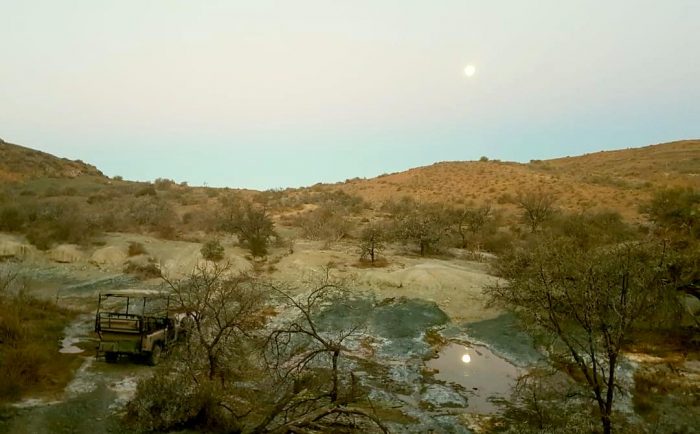
For most people, the caricature of the Karoo is a flat landscape dotted with “koppies” (i.e. hills). This is a rugged part of the Karoo, with deep tree-lined valleys giving rise to natural springs, that continue to flow even in the current deep drought. This is water that has probably not seen the light of day for centuries. It comes from geological formations far underground. This critical source of water is likely to be most at risk from fracking.
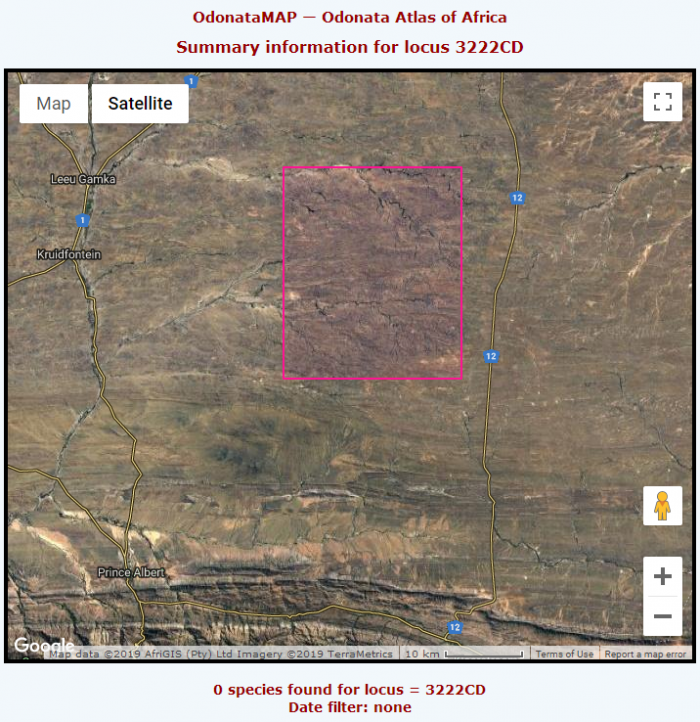
Roam Private Game Reserve would be a fabulous place to search for dragonflies and damselflies in the warm months of the year. OdonataMAP contains no records at all for this grid cell. Nor does either LacewingMAP or ScorpionMAP, and the Karoo is a known hotspot for these groups of species.
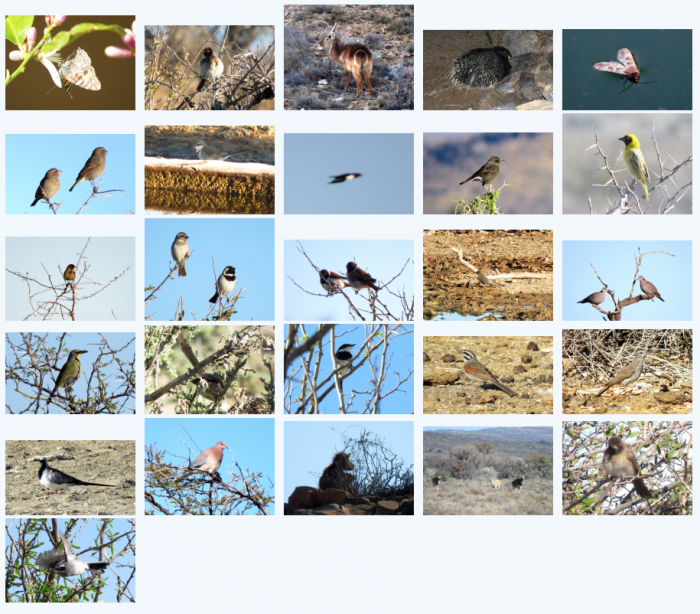
This collage shows the 26 records we added to the Virtual Museum during our short visit to Roam. Being deep in winter, these were mostly for BirdPix. However, these are the first records in the Virtual Museum for this gridcell for BirdPix, so they are especially valuable.
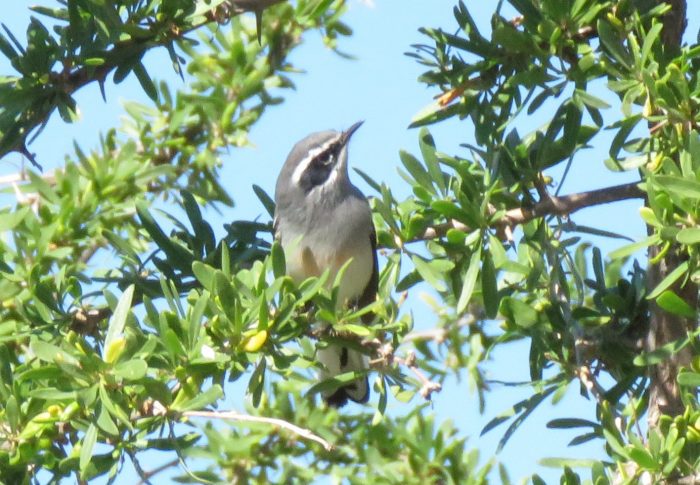
Fairy Flycatcher Stenostira scita

The managers on the reserve are Abigail and Donovan de Swardt. Soon after we arrived, Donovan loaded us onto the game-viewing vehicle and showed us some of the highlights. He had a stake-out where he regularly finds Fairy Flycatchers, but with us it didn’t deliver. Instead, the Fairy Flycatcher appeared the next morning in one of the shrubs at the lodge. This is probably the highlight record of the visit. Here is the record in the Virtual Museum: http://vmus.adu.org.za/?vm=BirdPix-88594.
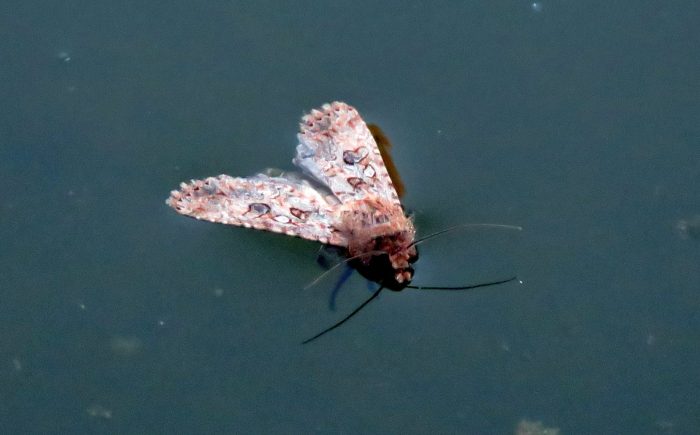
This is the first record of a moth from the grid cell and is now in LepiMAP (http://vmus.adu.org.za/?vm=LepiMAP-691619). It has been identified by Quartus Grobler as belonging to the genus Agrotis. Some of the members of this genus are one of crop agriculture’s most notorious pests, the cutworms.
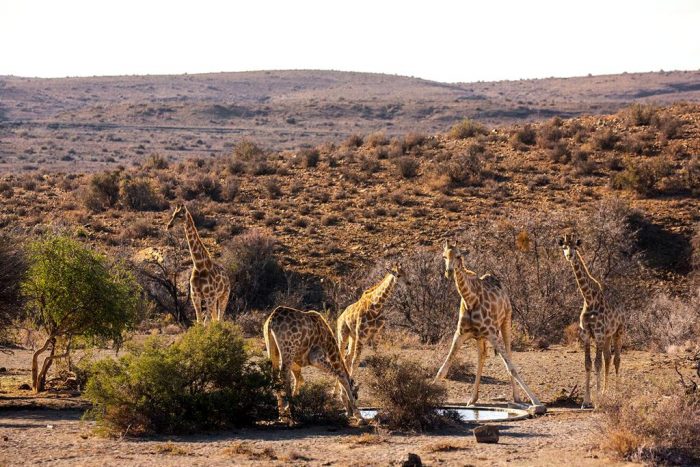
There are 12 giraffes, with three having been born in the nature reserve era. They mostly spend their time in the riverine trees along the drainage lines, but regularly visit the waterhole at the lodge. This photo was taken by Abigail de Swardt.
We are grateful to Denis Post for enabling us to visit Roam Private Game Reserve, and Abigail and Donovan de Swardt for their hospitality and enthusiasm.

With enthusiasm, the BDI is hoping that the Roam Private Game Reserve will become an outstanding site for student research projects. It has massive potential. Watch this space.

BDInsight – August 2019

August has flown by! And soon the migrant birds will arrive back in South Africa. We look forward to welcoming them back in the southern hemisphere. August has also been a busy month for the BDI, including adventures to the Karoo and Europe, preparing for the “return of the dragons”, and testing out PanGoPod Alpha in the field.

Upcoming Event

21 September 2019: The Return of The Dragons — OdonataMAP data drive for the upcoming dragonfly and damselfly season

OdonataMAP is a Virtual Museum project aiming to: (1) map the current distributions of the Odonata (dragonflies and damselflies) occurring in Africa; and (2) to serve as a repository of all existing distribution data for this group of important insects. To participate in OdonataMAP all you need to do is register as an observer through the Virtual Museum website. Close-up photographs of dragonflies or damselflies, along with date and locality information, including geographic coordinates are submitted to the VM in the data upload section. The Virtual Museum allows you to upload a maximum of three photos per record (one species = one record). Please take the GPS coordinates as accurately as possible; alternatively you can also find your position on the Google Map available in the upload page, but this may be difficult if you photographed your dragonfly/damselfly in an area with no good landmarks.

Student Research Projects

A major expansion of the BDI website was undertaken in August. The information about the Research Projects for students is now live. Please go and have a look at http://thebdi.org/research-training/students-research-themes/

Our main research project themes are ecology, environmental sociology, ecological economics, and historical ecology. These themes overlap to a large degree, and our research projects often involve cross-disciplinary research involving several themes.

Although applications from anyone, anywhere in the world, will be considered, we anticipate most of our students will be from universities in Europe. Many universities encourage their students to undertake a project abroad, and the academic year in which this opportunity is permitted varies a lot. The duration of the project also varies, between weeks and months. The role of the BDI is to provide accommodation and supervision. We are geared up to undertake the formal contractual obligations needed by the sending university.

Exciting News from the Karoo

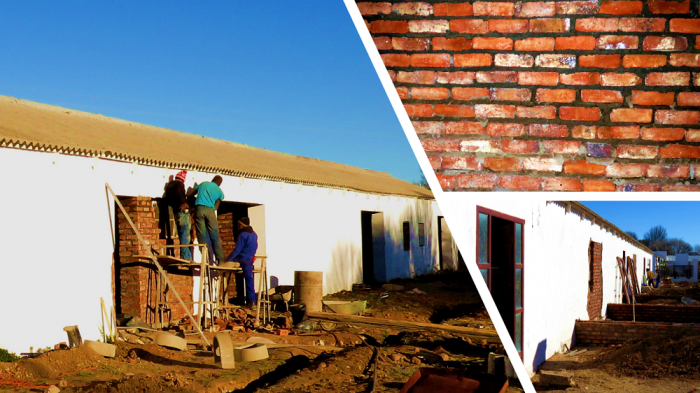
A critical ingredient for the BDI’s goal of enabling students to undertake projects in Africa is the provision of comfortable accommodation. So, in partnership with the Karoo Gariep Nature Reserve, we are transforming an old building at the New Holme Guest Farm into an awesome living area. We are creating five double-rooms, a kitchen area and a study area. We aim to turn this into a high quality research centre.

Construction underway at New Holme Guest Farm

Over the busy summer period, these rooms will be used by the New Holme Guest Farm for travelers on their way between Gauteng and Cape Town. During the tourism off-season, the accommodation will be used by the BDI. There is a large array of fascinating student research projects on the Karoo Gariep Nature Reserve. Renovations are proceeding at speed, and the accommodation will be available at New Holme Guest Farm in the upcoming December-January period (2019/20).

From Across The Pond

Europe-Africa-Asia

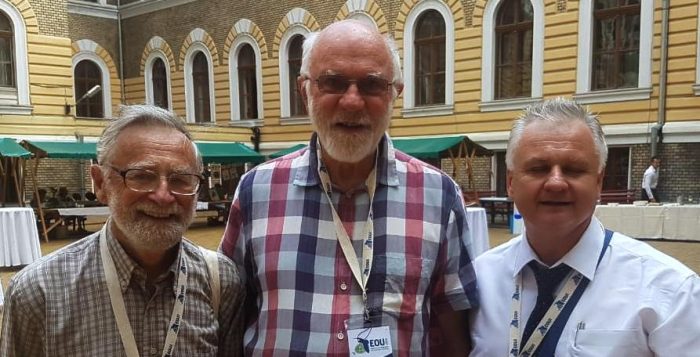
This photo was taken at the European Ornithologists’ Union’s 12th Conference held at the Babes-Bolyai University in Romania during August. On the left, Professor Przemyslaw Busse represents Europe, Les Underhill represents Africa and, on the right, Professor Sergej Soloviev represents Asia! Professor Busse, University of Gdansk, started “Operation Baltic” in the early 1960s. Somehow, he got it right to get permission to start a bird ringing programme at sites along the coast of the Baltic Sea. This was a military zone in the era of communist rule of Poland. Here is a PowerPoint presentation made by Professor Busse for the 55th anniversary of Operation Baltic

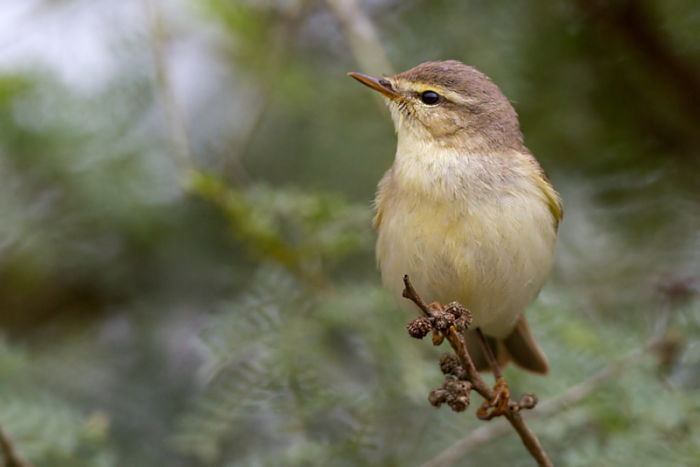
Two things make Operation Baltic special: (1) the birds mistnetted here are on migration to northwestern Europe; (2) the methods have been tightly standardized from the start. So Operation Baltic has generated one of the best datasets on the planet to measure changes in the timing of migration in recent decades. Professor Magda Remisiewicz is now leader of Operation Baltic, incorporated into the Bird Migration Research Station at the University of Gdansk. Magda and Les presented a paper at the EOU conference on how the timing of the migration of Willow Warblers along the Baltic Sea coast has changed in the past four decades. Professor Busse has made a huge contribution to ornithology.

Willow Warbler Phylloscopus trochilusphoto by Gregg Darling

In a long story covering decades with many twists and turns, Professor Soloviev has kept biology alive at the Dostoevsky Omsk State University, Omsk, Russia. There is no biology department at this university; he is an ornithologist in the Department of Chemistry! Omsk is a largely industrial city, more than 2000 km east of Moscow, east of the Urals, and far into Asia. The Trans-Siberian Railway passes through Omsk. Professor Soloviev has set up a field research station here. From a South African perspective, what makes Professor Soloviev’s research on birds so interesting and important is that his research station is the only one in this huge area in which most of the migrant warblers breed.

Sergej and Les are co-authors on a new research paper, with Magda as lead author. The paper is about the primary moult in the Common Whitethroat. The whitethroats that breed in Poland and migrate to West Africa produce new wing feathers before they migrate. Those that breed around Omsk, and migrate to South Africa, do the opposite. They migrate first, and then moult in South Africa. Moult, along with breeding and migration, are the energetically challenging components of the annual cycle of whitethroats. The paper develops our understanding of the varying strategies that this species adopts in different parts of its range to get through the year.

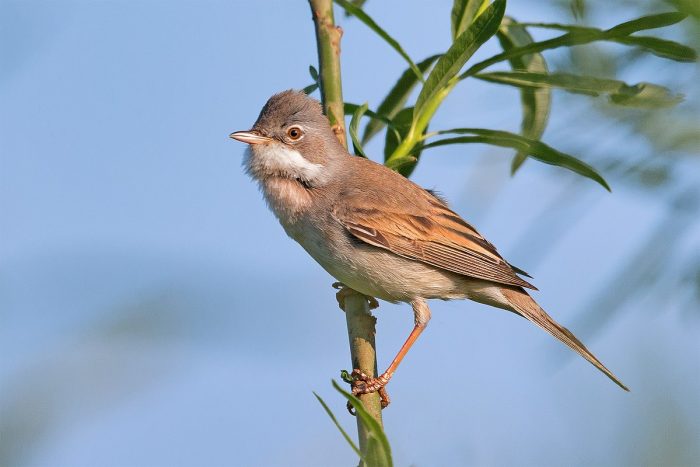
Common Whitethroat Sylvia communisphoto by Andreas Trepte

Here is the full reference to the paper:

Remisiewicz M, Bernitz Z, Bernitz H, Burman MS, Raijmakers JMH, Raijmakers JH, Underhill LG, Rostkowska A, Barshep Y, Soloviov SA, Siwek I in press. Contrasting strategies for wing moult and pre-migratory fuelling in medium- and long-distance migrant populations of Common Whitethroat Sylvia communis. Ibis. You can read the abstract here

PanGoPod Alpha

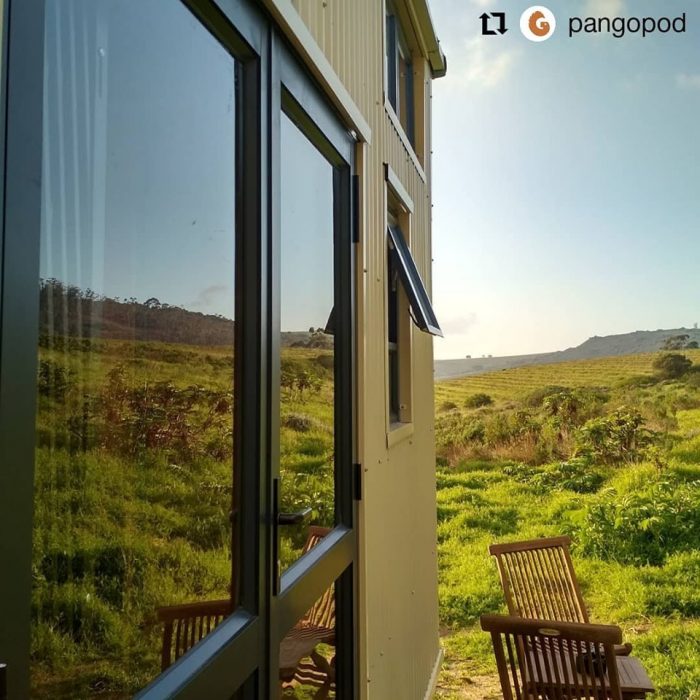
PanGoPod Alpha has housed its first students in the field at the wonderful Fynbos Estate and it has been a great success. PanGoPods are off-grid eco-friendly mobile homes. They are bigger than a caravan but smaller than a Park Home. This sort of housing is common in the USA, Canada, Australia, and New Zealand, where they are called Tiny Homes.

Want to find out how you can get your hands on your very own PanGoPod? All you need to do is contact us at director@thebdi.org. We’ll start the process of engaging with you about what you need and want from a PanGoPod.

Seychelles bird longevities

Seychelles Magpie Robin

During August 2019 bird ringing training courses were held on Aride and on Cousin Islands in the Seychelles. Some interesting longevity records were obtained.

Madagascar Turtle Dove

A Madagascar Turtle Dove was recaptured on Cousin Island on 19 August 2019. This individual had been ringed in the same area 7 years 11 months previously. This dove has a subspecies in Madagascar and one in the Seychelles, but these two subspecies interbreed in the Seychelles. No longevity records appear to have been published for any forms of this turtle dove, making this the oldest known record for the species.

Madagascar Turtle Dove


Seychelles Fody

A Seychelles Fody was recaptured on Aride Island on 15 August 2019. It had been ringed as a juvenile on the same island nearly 14 years previously (ring FA41377)! While the oldest fody is 16 years, this is the oldest fody recorded on Aride.

Seychelles Fody
Seychelles Fody with pale bill


Seychelles Magpie Robin

A Seychelles Magpie Robin (4A51905) was recaptured about 9 years after it fledged. Currently the oldest Seychelles Magpie Robin in the SAFRING database is 12 years 3 months (ring 4A38425). However, there are many outstanding magpie-robin records, so there could be an even older bird.

Seychelles Magpie Robin
Seychelles Magpie Robin on bird table


Would you like to ring birds in the Seychelles? Book a trip with African Ringing Expeditions!

Swaziland Superwoman!…BDI interviews conservation scientist Kate Braun

I was employed as Ecologist/Research Officer by the Swaziland National Trust Commission (now Eswatini National Trust Commission), the parastatal organisation responsible for the conservation of Eswatini’s cultural and natural resources, from 1986 to 1995. My responsibilities were the research programmes and activities for guiding management of the ENTC’s nature reserves, and to provide information for conservation of the country’s biodiversity. Part of the work that I did was to begin compiling information on the flora and fauna found within the ENTC reserves.

Kate Braun in her natural habitat – Mlawula Nature Reserve

In terms of biodiversity field work, my initial focus was on the grasses, as little information was available at that stage, and this extended to general plant collection, usually focusing on groups of plants which had not been well investigated. At this stage, very little information was digitized, and, in collaboration with the Pretoria Herbarium, I put together the Flora Database for Eswatini, and in the early to mid ’90s created the ENTC website, which made this information available to the public.

After 1995, I continued to work for ENTC on a part time basis as a consultant, maintaining the website, and taking photos for them for publicity purposes. This overlapped with my interest in photography, and when digital cameras became available, I focused on taking photos of the flora for the database/website, rather than collecting specimens.

One of the biggest problems I encountered when trying to compile biodiversity information was the difficulty in finding resources to try and identify plants and animals. Hard copy publications were available, but a small organisation like the ENTC was in no position to budget for the purchase of a broad selection of books and journals. At that stage, online resources were very limited.

In the process of taking photos of the flora, I started getting photos of butterflies and other invertebrates as well. With regard to butterflies and moths, Neville Duke and Chuck Saunders did a lot of collecting in the country, but the only information I had available was hand written lists of species recorded from Malolotja and Mlawula Nature Reserves, which gave me a starting point of 222 species of butterflies recorded in Eswatini.

In 2008, I discovered the UCT-ADU Virtual Museum as a means of getting photos identified, and over then next few years, I was able to get photos of a number of species of butterflies. The Virtual Museum provided the resources for me to be able to compile an updated illustrated checklist of the butterflies including about 280 species: Eswatini Butterflies Checklist, August 2013

Kate’s first butterfly photo – a Gaudy Commodore Precis octavia sesamus – Malolotja Nature Reserve

As the Virtual Museum grew, I expanded my focus, including other groups of fauna where the expertise was available for identifications. From around 2011, my focus included the dragonflies and damselflies. Initial information on species possibly occurring in Swaziland was available from Dragonflies and Damselflies of South Africa by Michael J. Samways, and I found a southern African checklist online, published by the Department of Entomology & Arachnology of the Durban Natural Science Museum. Combining this with the photo records I was able to obtain, and by using the resources of the Virtual Museum, I was able to put together a provisional checklist of Eswatini’s Odonata in 2012. This has been upgraded and additional information included, and as at 2018, includes 82 species: Eswatini Odonata Checklist, 2018

In 2016, one of my contracts was the biodiversity information component of the SNPAS project (Strengthening National Protected Areas Systems Project). My task was to compile a data set of all available existing records of flora and fauna recorded in Eswatini. I have been working on making this information available via the ENTC website, and am developing the Biodiversity Explorer component of the website to make this information more accessible to non-scientists.

In early 2017, I started focusing on getting photos of the moths, and this has coincided with more and more information being available online to assist with identifications, as well as updates of the taxonomy of various groups of moths. Prior to this, existing available information included a list of about 800 species of moths. Since then, I have been able to obtain some of the record information for previous collections, in particular, those collected by Neville Duke in the 1980’s/90’s, but as most of his collection, housed in the Ditsong Museum, has not yet been digitized, there is still a huge amount of information not yet easily available.

Over the last couple of years, in collaboration with various people, I have been able to put together a provisional checklist, which currently includes over 1300 species. Much work is still needed on this, and many photos still require identifications, so it is expected that the checklist will have many additions — Eswatini Provisional Moths Checklist — Special thanks go to Quartus Grobler for all the time and effort he has put into helping with identification of moth photos.

In collaboration with Mervyn Mansell, I am also currently working on a similar illustrated checklist for the Neuroptera, and this should be available soon. I am currently working with the ENTC on an upgrade of the website, and once we have the new format in place, I will be upgrading and updating the biodiversity information available on the website. So much of what I have been able to put together has been dependent on collaboration with organisations and individuals, both scientists and “citizen scientists”. In spite of all the photos I’ve already taken, I am still getting records of new species for Eswatini, an indication of how much work is still to be done.

A beautiful lacewing from Eswatini – Italochrysa zulu

What are you still hoping to achieve? This might be in terms of species, coverage, targets …

In Eswatini, most of the vertebrate species of fauna found in the country have been documented, but this doesn’t apply to many groups of invertebrates. There will still be many years of work to document this diversity, and I hope to continue to collaborate with organisations such as the Animal Demography Unit to continue to further our knowledge of Eswatini’s fauna and flora, and to make this information available and accessible.

What do you see as the role which citizen science plays in biodiversity conservation? What is the link?

I believe that citizen science is an invaluable approach for documenting biodiversity.  Current technology allows for more and more people to be directly involved, making it possible to obtain a huge amount of information on species presence and distributions, far more than could be obtained by scientists without this help. Citizen science also raises awareness of the richness of our biodiversity, and can only help in the long term conservation of our flora and fauna.

Plains Zebra Equus quaggaMammalMAPped by Kate in Malolotja Nature Reserve

Chicks of the Wetlands – White-Winged Flufftails

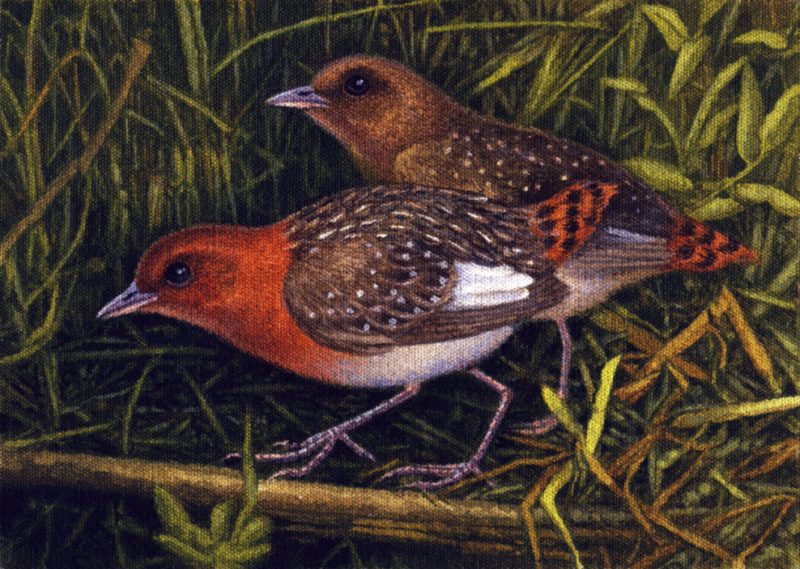
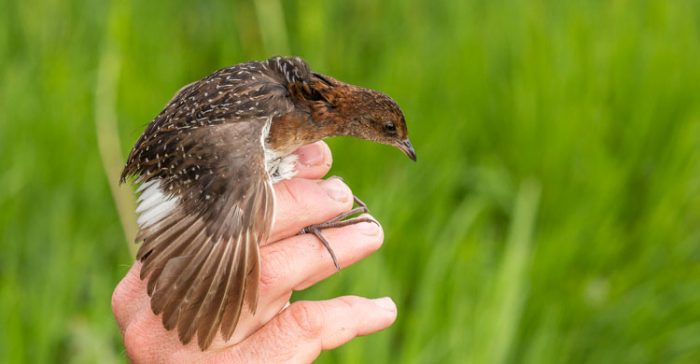
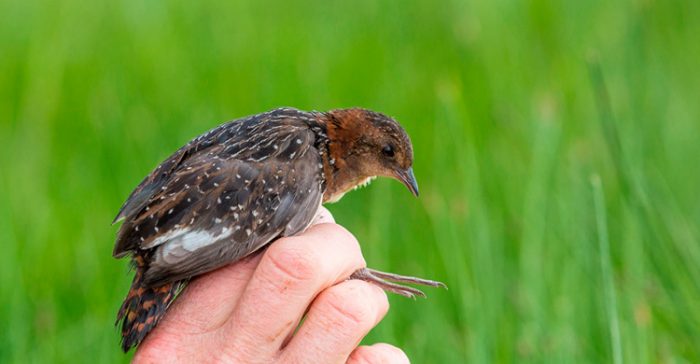
What you see here is something very few people have ever seen in the wild.  I haven’t seen any myself, yet.  All I’ve seen is a sad little stuffed specimen in the Ditsong National Museum of Natural History. These are White-winged Flufftails Sarothrura ayresi. They are one of the rarest and most threatened birds in South Africa, and Africa. The species is only known to breed in Ethiopia and South Africa, and it was only confirmed as breeding in South Africa in the past year or so, using camera traps which recorded a female with three chicks!  Everywhere that they occur, they face severe threats – the destruction, alteration and degradation of their wetland habitats. It is estimated that as few as 250 individuals of this species may exist in the entire world!

So what are flufftails, exactly?  Their English common names refer to the rather fluffy feathers of their short tails. In Afrikaans they are known as ‘vleikuikens’ or ‘chicks of the marshes/wetlands’. The White-winged Flufftail is the smallest species, measuring up to 15 cm in total length, and weighing just about 30 g. Flufftails only occur in Africa and Madagascar. They are elusive birds, frequenting dense vegetation such as wetlands, rank grasses and forest edges. All the flufftails look quite similar, with dark feathers on their dumpy bodies, and often brighter reddish-brown feathers on their heads, breasts and/or tails. Most of them also have light spotting or streaking.  Females are typically duller in colour than males. Their diet consists of leaves and seeds of marsh plants as well as small aquatic invertebrate critters, tiny fish and tadpoles. They were once considered members of the Rallidae Family (rails, crakes, coots, etc.), because of their similarity to crakes, but today they are grouped into their own genetically distinct family, the Sarothruridae. Flufftails are often only recorded and identified by their calls. Most species have far-carrying, hooting, almost ghost-like calls, that sound very “deep”, especially coming from such small birds. Only recently have the calls of White-winged Flufftails been recorded, including both clicking sounds as well as a low-frequency call.

White-winged Flufftail (Sarothrura ayresi) – photo by Sergey Dereliev

The White-winged Flufftail has been observed only a handful of times. When approached, these birds will typically creep into dense vegetation and then sit tight. Flufftails in general can be recognized when flushed by their tiny size, dark colour and rather weak flight. That helps you say that what you flushed was a flufftail, but not which flufftail species it was, since they all look rather similar and a short glimpse of a bird flying away from you before diving into dense cover hardly allows you a detailed inspection. But in the case of the White-winged Flufftail, if you flush it, you know for sure what it is, because it is the only flufftail species that has the white secondary flight feathers, showing up as a clearly visible white panel in its wings as it flies.

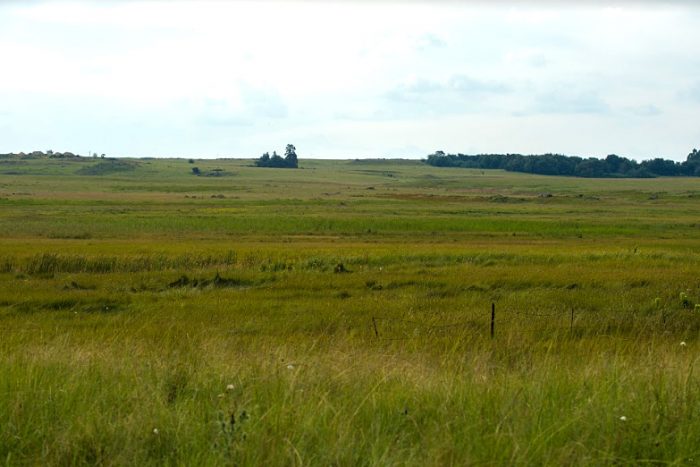
Even so, White-winged Flufftails are very hard to ever see. The principal breeding site of White-winged Flufftails is Berga in Ethiopia, a patch of wetland that is flooded during the rainy season, making excellent living conditions for the flufftails: rather short but dense cover of grasses and sedges, and shallow waters. Unfortunately, this wetland region is only a few square km in extent and is still being encroached by ever-growing numbers of cattle and people. Public awareness campaigns are in effect.  A few more wetlands in Ethiopia may sustain small breeding populations, but this hasn’t been confirmed.  In South Africa, the main region where White-winged Flufftails occur, is one of high-altitude perennial marshes and seepages near the headwaters of rivers, near Dullstroom, Middelpunt, and Wakkerstroom. Even here there is only about 3.9 square km of suitable habitat in total. This means that globally, there is only 10 square km of suitable habitat where these flufftails live and breed!

Middelpunt Wetland – photo by Morné Fourie

The white wing patches of these flufftails seem to be an important visual feature, used in a flapping display between a breeding male and female. It’s strange that these flufftails have been found in South Africa and Ethiopia, but nowhere in between (apart from a tiny number of records for Zimbabwe, which is next door to South Africa). Still, the Ethiopian birds look just like the ones in South Africa. Are they the same species? Are they different subspecies forming isolated populations? Or are they in fact just one population – with the birds from Ethiopia migrating to South Africa and back? For a while it was thought that they were migrants, since the species was known to breed in Ethiopia but not in South Africa.  But now that the birds are known to breed in South Africa, it may be that the two populations are indeed distinct and resident. But genetic analysis shows that the Ethiopian and South African birds are indeed very much alike, certainly the same species, and perhaps still connected by some kind of migration. It is likely that the species used to be much more abundant and widespread, but has dwindled to the point where all the linking populations between South Africa and Ethiopia have now disappeared, leaving those two widely separated populations. It would be interesting if migration can be proved, since flufftails hardly seem to be strong fliers, and the distance between their haunts in South Africa and Ethiopia is over 4000 km.

So where does that leave our little flufftails? At present, they are extremely endangered; even if their remaining habitat can be totally protected and safeguarded, it would be difficult to increase the flufftail population, since there are so few individuals left. A small population is always vulnerable. Not enough individuals means not much genetic variation, leaving them susceptible to diseases. One solution would be to reclaim certain regions, converting farmland, tree or sugarcane plantations back to their original marshland state.  This would be a rather big project, but not impossible. A few additional few square kilometres might do wonders for White-winged Flufftails!

Another idea that is being considered, is captive breeding of White-winged Flufftails. The only problem is, we don’t know much about how flufftails breed at all! A solution to this conundrum might be to breed and raise the much more common Red-breasted Flufftails in captivity to study and document the specific needs of flufftails. This is a risky proposition but it might work. Whatever the case, White-winged Flufftails are charming and mysterious little birds that need our protection.

White-winged Flufftail – photo by Sergey Dereliev

Biodiversity Superhero… BDI interviews citizen scientist Owolabi Bibitayo Ayobami

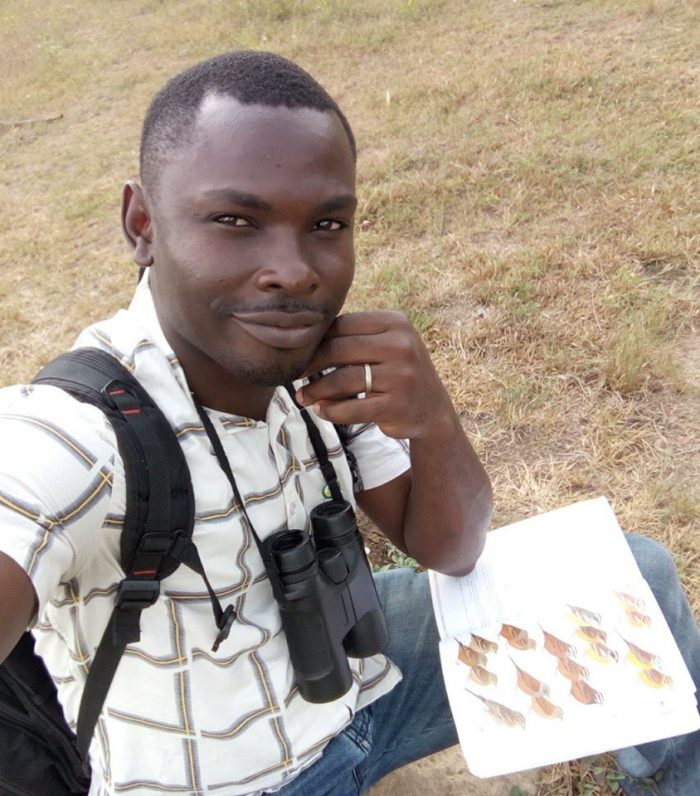
Owolabi Bibitayo Ayobami is a lecturer at the Department of Wildlife and Ecotourism Management at Osun State University in Osogbo, Nigeria. He is also busy with his PhD, focusing on vulture conservation in the southwestern state of Nigeria, through the Federal University of Technology Akure. Owolabi is passionate about wildlife conservation, especially that of birds.

Owolabi writes, “I was born into a family with an agricultural background, both my parents have a passion for agriculture. My mom was my Agricultural Science teacher during my secondary school days. I was only introduced to ornithology in 2013, but since then I have been an advocate for bird conservation! I absolutely love birds. Without birds, our chances of survival as humans are slim, we all need to do our part to keep the environment healthy for birds, ourselves as well as all other creatures that we share the planet with. Birds are important environmental indicators, they help us to quantify how healthy and balanced our environment are.”

How did you become a citizen scientist? What was the catalyst that got you going?

Like I mentioned earlier, in 2013 I was privileged to attend a seminar during my master’s degree programme and I found myself fascinated by the presentation on birds. That day my heart was so captured for biodiversity conservation. I went to meet the presenter (Dr Okosodo) and told him I want to work on birds for my Masters project. He gave me my first pair of binoculars and introduced me to the amazing world of citizen science. I did not know much about biodiversity prior to that seminar, I was quite ignorant of the beautiful flora and fauna that nature has bestowed on us.

I then took it upon myself to sensitize people to nature, through write-ups, social media posts, photos and any other mediums I could find in order to spread the gospel of nature conservation.

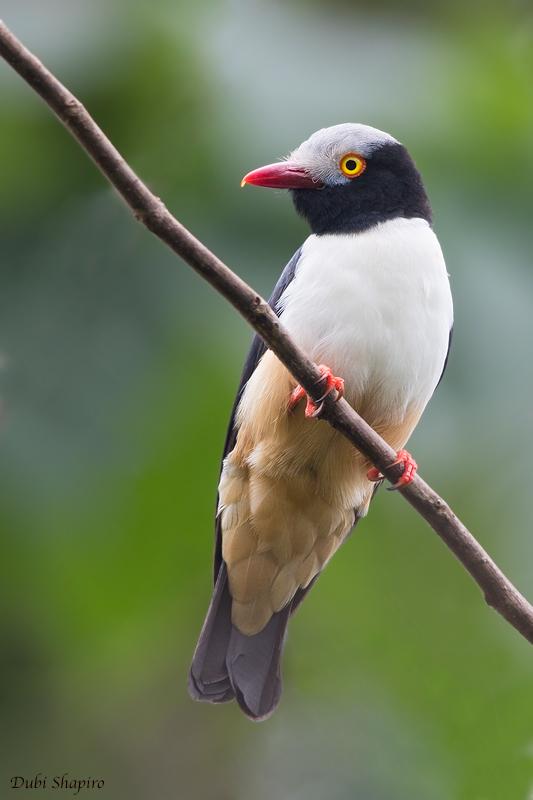
Red-billed Helmetshrike Prionops caniceps – photo by Dubi Shapiro

The catalysts that got me going happened in phases; first, the the feedback I received from people through emails and other means, of their eagerness to learn and know more about the environment and birds inspired me to go the extra mile as a citizen scientist. There is an indescribable joy when your efforts, to make life more meaningful and worthwhile, are noticed and appreciated. A friend once asked me, “I know butterflies to be colourful, but birds are either black or white. But the birds you have shown me are so diverse in colouration, do you paint them?” 🙂 I am glad that I can open people’s eyes to the wonderful world of birds. Another source of motivation for me, comes from senior colleagues in conservation who are at the forefront in helping to protect wildlife. They encourage me to keep up my own efforts.

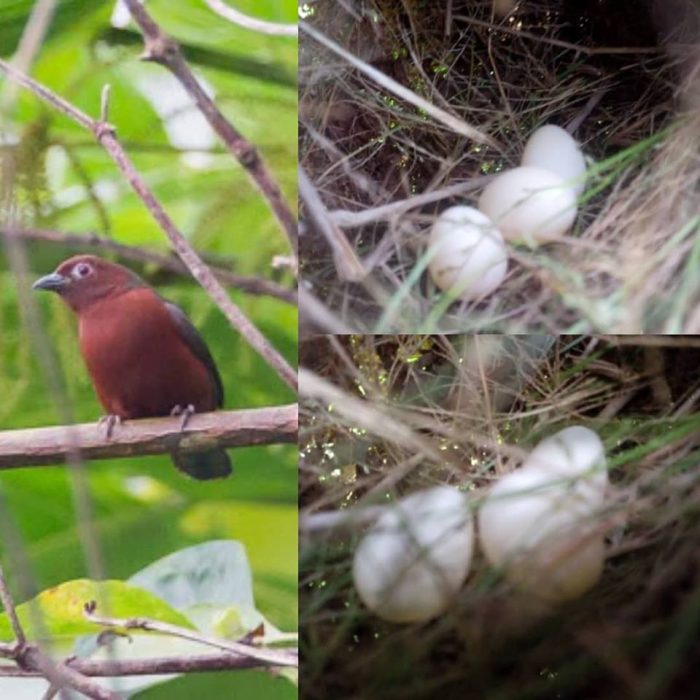
Chestnut-breasted Nigrita Nigrita bicolor – photo by Owolabi

What has been the highlight for you?

There are too many highlights to mention!! Not a single day has gone by when I am out in the field with my camera and binoculars that I don’t discover something new and exciting. Each new discovery is wonderful to me. The more I discover, the more I want to know and the more I want to learn.

How has being a citizen scientist changed your view of the world?

Being a citizen scientist has helped me change my view of the world in various ways. I now feel that together we can make a difference to help the natural environment, if we choose to minimize the impact of various human activities. Collecting data and contributing to knowledge through the Nigerian Bird Atlas Project and the Virtual Museum really changed my views about the world in terms of species ranges, distributions and biodiversity conservation.

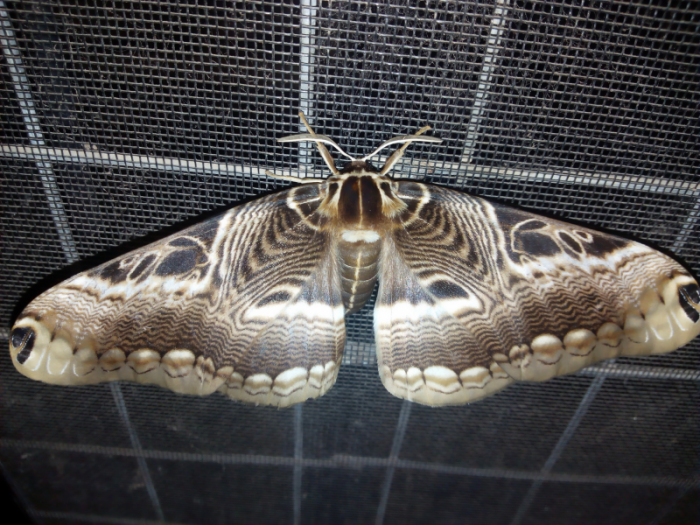
Dactyloceras bramarbas — LepiMAPed in Osogbo, Nigeria by Owolabi

What does the term “citizen scientist” mean to you?

Citizen scientists are a a group of people, either professionals or non-professionals, taking part in crowd-sourcing, data analysis, and data collection. The idea is like that of division of labour, distributing work or to break down huge tasks into understandable and manageable components that anyone can perform. Participation of non-professionals in science is increasing, and citizen science has a central part in this. It is a contribution by the public to research, actively undertaking and requiring thoughtful action. It is absolutely fantastic!

What are you still hoping to achieve? This might be in terms of species, coverage, targets …

Thank you for this question. It reminds me that there is still so much that I want to do! There are two things I hope to achieve. I want to publish a book on the birds of southwestern Nigeria, and a book on bats of southwestern Nigeria. I know this might be a huge task, but I know it is achievable. Embedded in these goals are so many other awesome things like new species to discover, distribution range maps to update, and more grid cells to cover for the Nigerian Bird Atlas. I also want to upload all my discoveries to the Virtual Museum, which will help to contribute to a rich database on Nigerian biodiversity.

What resources have been the most helpful? (And how can they be made better?)

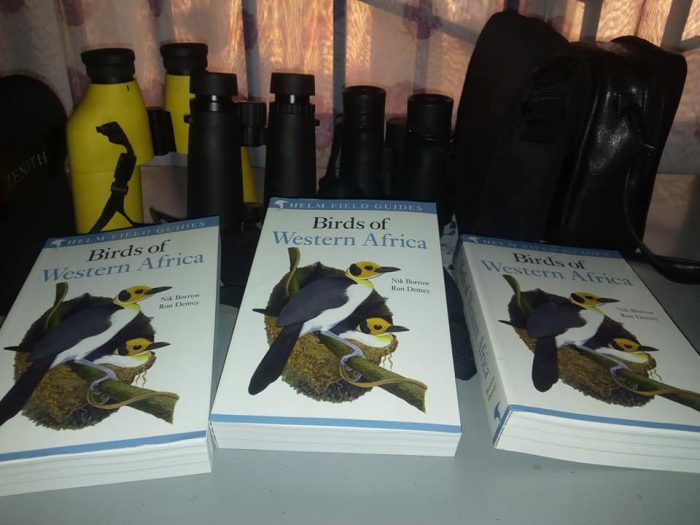
The Virtual Museum has been the most helpful tool for me. But I think it would help and to give the website a bit of a ‘face lift’ to make it more attractive and user-friendly. The equipment and bird books provided by APLORI for the Nigerian Bird Atlas Project has been a great help. More donations of binoculars and books by the public or private organizations would be fantastic! It helps us to get more people into bird atlasing.

How do you react to the statement that “Being a citizen scientist is good for my health, both physical and mental!”?

The statement is 100% correct. I can’t imagine myself spending a whole day just sitting around discussing football, I will grow sick and tired of it. I love football of course, I am not against playing or watching it. Don’t get me wrong. You may even find it ironic that I am part of the staff football team at Osun State University. But what I am saying is that I have found a better way to keep the body and soul alive. Time spent in nature is always a healing experience. Walking about in nature is the best. It sets one’s mind at rest and gives one hope for the future. The splendour of nature’s majesty is indescribable and it works wonders! 🙂

What do you see as the role which citizen science plays in biodiversity conservation? What is the link?

Citizen science plays a key role in biodiversity conservation. It helps to spread the gospel of nature conservation and education. People around me now watch out for birds and other wildlife. They send me coordinates and photos of the critters they find. They all want to know what more they can do to help and contribute. Citizen science shows us that biodiversity conservation is a joint responsibility irrespective of your profession, gender, age, tribe, religion or political affiliations. Together we can achieve so much more! 🙂

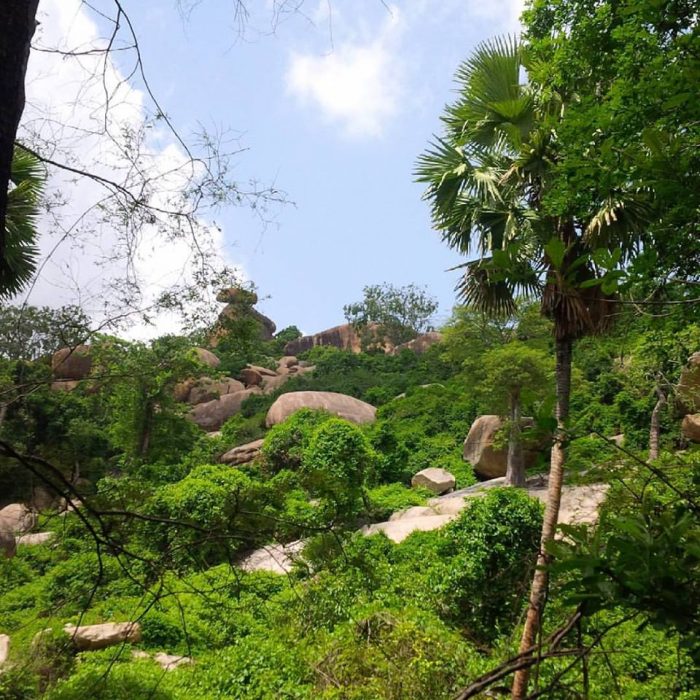
Old Oyo National Park, Nigeria – Photo by Owolabi

Always on the move… BDI interviews citizen scientist Joan Young

“I have spent nearly 40 years living and working in the bush, loving every minute of every day. When I started with macro photography, I discovered a whole new world! Everything from insects to flowers …… so many wonderful shapes and colours that are often not that obvious to the naked eye. Some of the tiniest critters are often the most beautiful.”

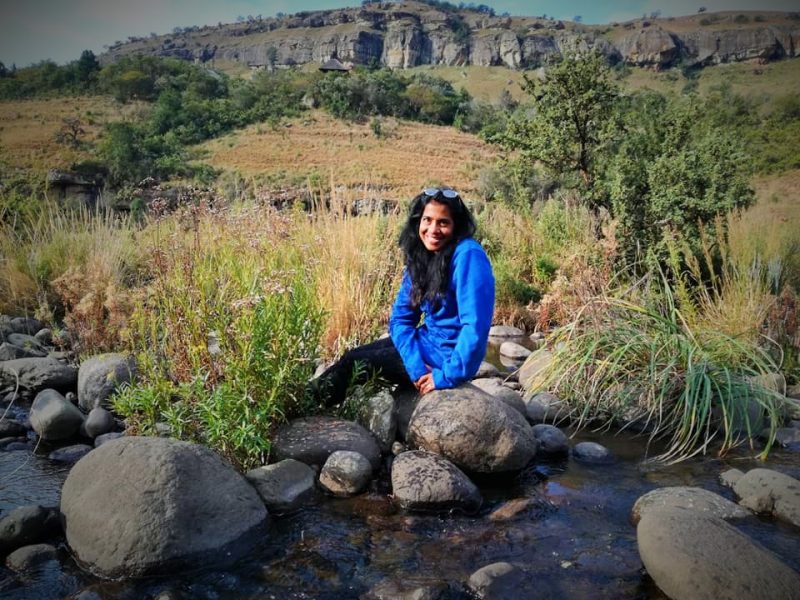
Joan out in the field doing what she does best!

How did you become a citizen scientist? What was the catalyst that got you going?

Very early on in my career I discovered that, sadly, many people were obvious to the amazing world of fauna and flora. So I made it my mission to share all the fascinating things I found in nature with others. At the time, there were very few field guide books available, and those that were around were expensive. On top of that, the distribution maps in the books were often inaccurate as I was discovering species far outside their represented ranges. I started a website to help people identify critters, because I was receiving so many emails from people asking me “what is this?”. A few years down the line a friend told me about the Virtual Museum and its biodiversity mapping projects, naturally I jumped at the chance to contribute my photographs.

What has been the highlight for you?

There is just too many highlights to mention, as each discovery of something new is so exciting to me. Hardly a week goes by that I don’t come across something wonderful. The more I find, the more I want to find and the more I want to learn!

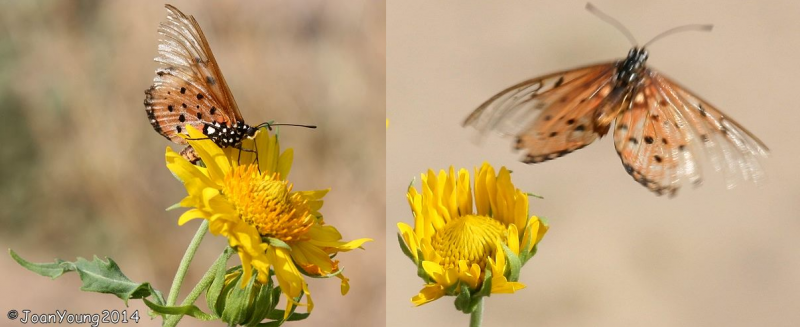
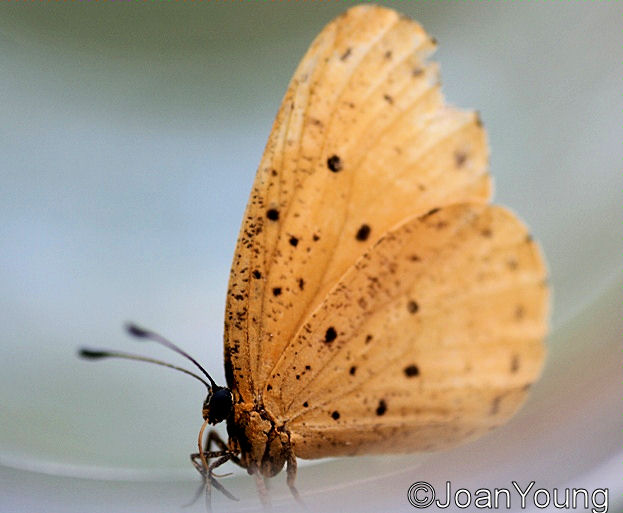
Pentila tropicalis tropicalis — Spotted Pentila or Spikkel-geelvlerkie — LepiMAPped in KwaZulu-Natal

How has being a citizen scientist changed your view of the world?

I never considered myself to be a citizen scientist, only an educator, someone who wanted to discover as much as possible about fauna and flora and to share that knowledge with others so that they could love and respect nature too. I think the whole idea of using enthusiasts like myself is fantastic, it’s great to know that we can help scientists collect valuable data on species distributions. We desperately need up to date maps, especially with current rates of human encroachment on the natural environment.

What does the term “citizen scientist” mean to you?

I had been asked to contribute my data and photographs to various other projects before I learnt about the Virtual Museum. I feel the Virtual Museum has given me the chance to really be useful and make a difference. Citizen science has given my life more purpose.

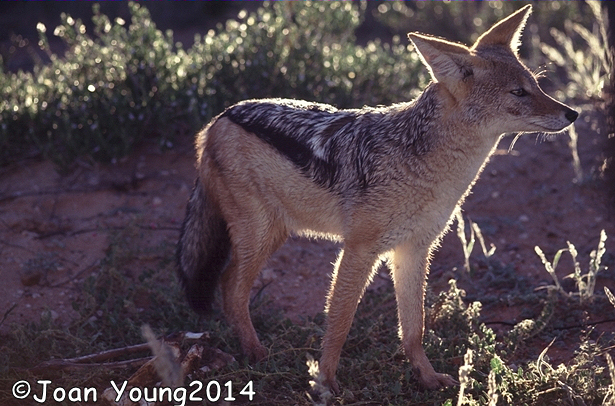
Canis mesomelas — Black-backed Jackal — MammalMAPped near Upington in the Northern Cape

What are you still hoping to achieve? This might be in terms of species, coverage, targets …

I will go on photographing and learning something new every day about fauna and flora, until the day I die or my eyes get too poor to take photographs! It is such a pity that I never had formal training, as I would love to go out into the field and help on science projects at a higher level, but often one needs a formal scientific background in order to be considered for such work. Citizen science has given me the opportunity to make a difference where I can.

What resources have been the most helpful? (And how can they be made better?)

Books on certain fauna like moths and mushrooms have been very hard to come by, but luckily through the years I have met and worked with wonderful scientists and I am so grateful for their patience and help. Photographs are not always sufficient for identifying a critter to species level. There are many species that I have been trying to identify for year, but I still do not have names for them. I would love to contribute as much data as I can. I am concerned that the undocumented species could end up on the extinction list without us even knowing!

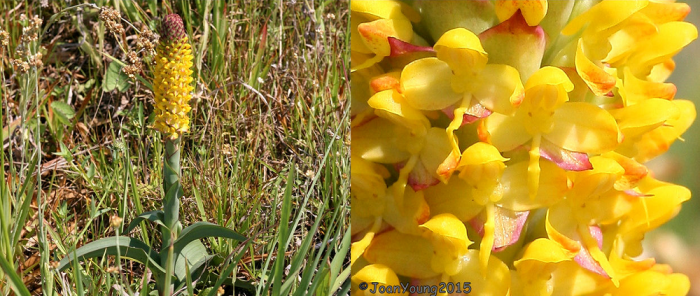
Disa woodiiOrchidMAPped near Ramsgate in KwaZulu-Natal

How do you react to the statement that “Being a citizen scientist is good for my health, both physical and mental!”?

I can’t see myself retiring and sitting at home watching TV all day! Getting out into nature has helped me to stay healthy and mentally alert. I love spending time outdoors, walking or hiking and keeping a sharp lookout for anything of interest. I would have aged at least ten years by now without my photography and the Virtual Museum projects.

What do you see as the role which citizen science plays in biodiversity conservation? What is the link?

Citizen scientists often have more opportunities than professionals to get out and about and find species. Citizen scientists help to fill a huge gap in data collection that would otherwise cost thousands of Rands, and take up big chunks of time and effort if left to one researcher or institution. Many hands make light work as they say. The whole idea of using the public to contribute to science is one of the best ideas I have ever come across! 🙂


The Bald and the Beautiful

Today I want to share one of my paintings that celebrates the beauty of the Southern Bald Ibis, Geronticus calvus. This species is near and dear to me. As a child, I sometimes saw them on the sport fields of my high school; and I still see them today, from time to time, while out on birding excursions. They are striking birds with their bright red bald heads and iridescent plumage. Their calls are melodious and mournful, a far-carrying ‘kew-kou-kloup’. 

This species shares its genus with the Endangered Northern Bald Ibis, Geronticus eremita, which occurs from Morocco to the Middle East. There are also plans afoot to reintroduce it to Europe. The Northern Bald Ibis can be distinguished from the Southern Bald Ibis by the narrow plumes on its head. The Southern Bald Ibis is listed as Vulnerable and is endemic to South Africa, Lesotho and Swaziland. It is estimated that there are only 4,600 breeding birds of this species in the South African region. Its continued existence depends on the conservation of its preferred habitat, which is short, fairly moist grasslands in mountainous and highland areas. Grasslands are some of the most threatened habitats on Earth, much of which has been lost to agricultural expansion. Grasslands are also impacted by overgrazing from domestic animals as well as bush encroachment. Bald ibises are able to make use of some human-created ‘grasslands’, like sports fields and some agricultural fields. In areas with cattle, they will turn over and probe cow pats with their long, curved bills to hunt for beetles and grubs. 

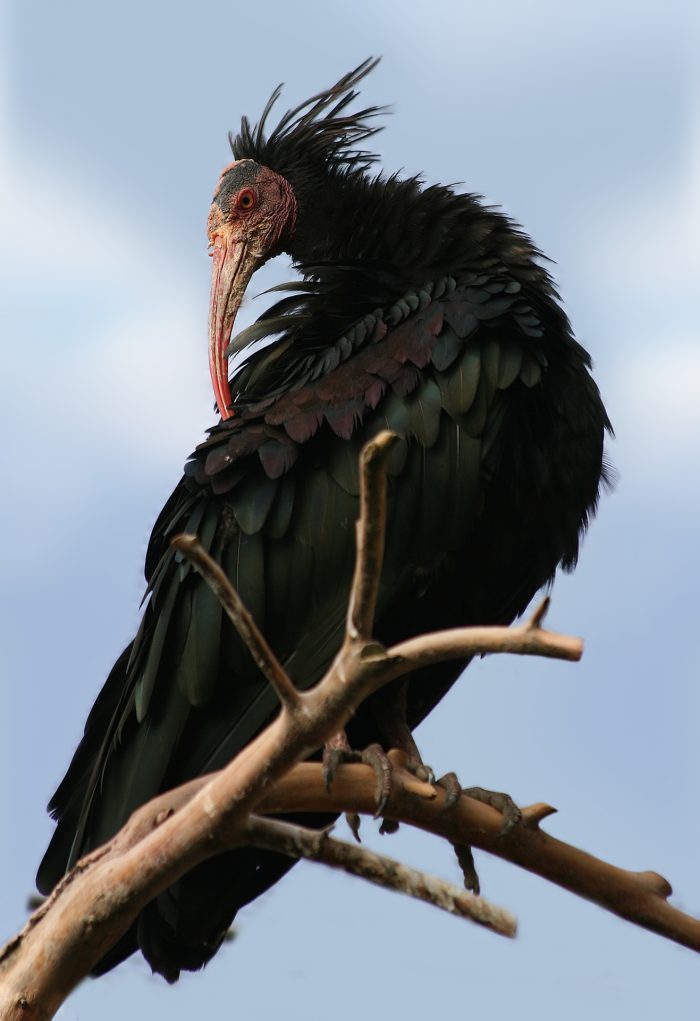
Northern Bald Ibis or Hermit Ibis – Geronticus eremita – photo by Richard Bartz

Bald ibises are also restricted by the availability of breeding sites. They are cliff-nesters and breed in the open areas of mountain faces, as well as river gorges and sometimes around waterfalls. One of the greatest causes in the decline of this species is human disturbance at their breeding sites and the degradation of their habitat. Most of their breeding sites occur on privately owned land, whereas only a small minority of breeding pairs are located on nature reserves or state forest land, which are the only areas where they are guaranteed protection.

Southern Bald Ibis – Kalkoen Ibis – Geronticus calvus – photo by Willem Kruger

An alarming sight at some of their nesting sites below the cliffs are piles of shiny, plastic buttons. They probably confuse these with beetles, ingesting them and eliminating them intact. It is not known whether this has a negative impact on them, but it might, and yet another reason why we should be concerned about the large amounts of near-indestructible human-made plastic objects accumulating in all environments around the globe.

The Comrades Butterfly… BDI interviews citizen scientist Luelle Watts

Luelle Watts is an amazing woman and LepiMAPper extraordinaire. She has snapped and mapped 1632 LepiMAP records to date, all while training for South Africa’s infamous Comrades Marathon.

Luelle writes: “I grew up on a farm and my siblings were all much older than me. So I was very much a loner, finding my comfort and solace in Nature. I was a recluse and an introvert, shying away from people from a tender age. Later in life, my late husband and I lived on various small holdings, which made me bond with animals and the natural environment even more. I have a great passion for gardening, fishing and the outdoors. My love for running has taken me up and down the road to the Comrades Ultra Marathon 16 times and I hope to achieve my 20th Comrades finish soon.   

How did you become a citizen scientist? What was the catalyst that got you going?

I really enjoy insect photography, so I used my first DSLR camera to take ‘pretty’ pictures. Gradually butterflies became my most favoured subjects. I started posting them on the Bugs and Butterflies Facebook group to get help with identifications. And it was here that I met so many knowledgeable people! Steve Woodhall, butterfly expert and author of the Field Guide to Butterflies of South Africa, encouraged me to start contributing to the Virtual Museum.

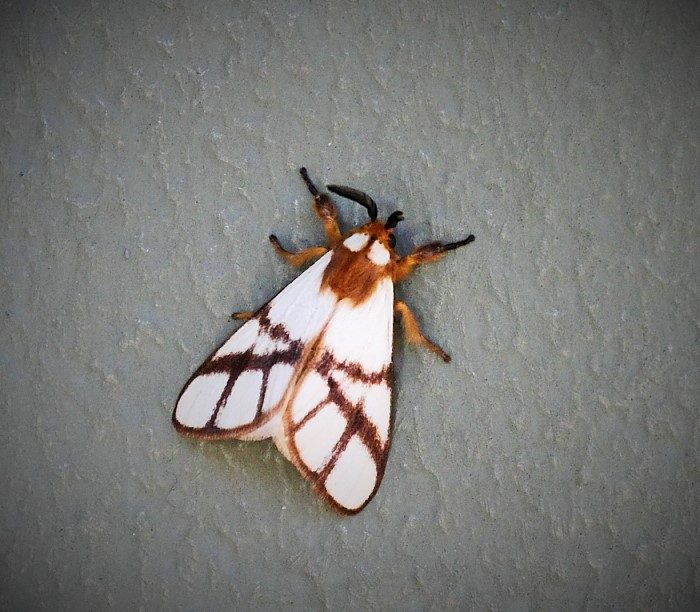
Anaphe panda – Banded Bagnest/Processionary moth – LepiMAP

What has been the highlight for you? 

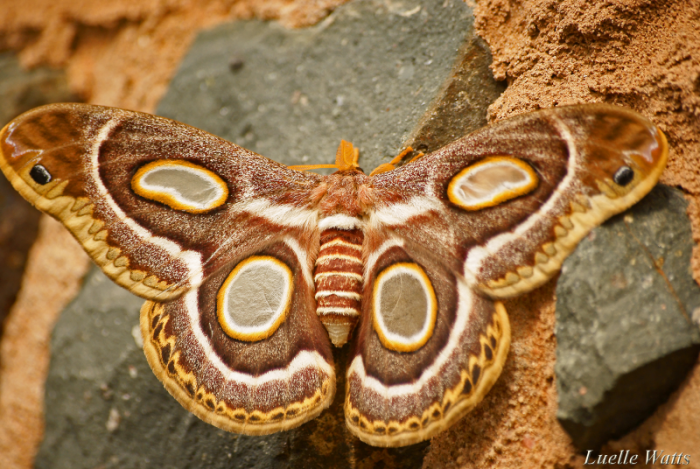
The highlight for me has been all the knowledge I’ve gained on butterflies and moths from other enthusiasts and experts. I have also learnt a lot through rearing several butterfly and moth caterpillars. Steve Woodhall has been a great mentor, he has always been encouraging and helpful. Successfully rearing processionary moths Anaphe panda was very exciting for me, especially since they took six months to emerge! Rearing a White-ringed Atlas Moth Epiphora mythimnia was amazing too.

Epiphora mythimnia – White-ringed Atlas Moth – LepiMAP

How do you react to the statement that “Being a citizen scientist is good for my health, both physical and mental!”?

Oh I agree wholeheartedly that being a citizen scientist is definitely good for both my physical and mental health. Chasing after butterflies can be both exasperating and rewarding, especially when you manage to get that perfect photo after walking for miles! Citizen science is also mentally stimulating. I am always keen to learn something new everyday. I think it is important that one never stops learning.

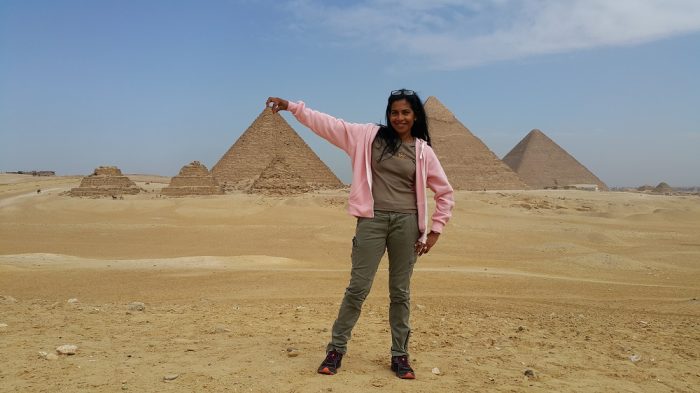
Luelle on a recent trip to the amazing Pyramids of Giza

Spreading the Seeds of Light

On Saturday, 20 July 2019, I was lucky enough to join the Saturday Girls for their Career Guidance Day at the New Dawn Centre in Acornhoek, Mpumalanga. I was asked to talk about my work and personal journey as an Environmental Scientist. I felt really honoured to be invited to this special day. It was a new experience for me to talk about my career and how I ended up becoming an “Eco-Warrior”.

In many parts of Africa, and the rest of the world, gender inequality is still a sad reality. The main aim of the Saturday Girls’ Classes is to help high school girls achieve success within the local school system and prepare effectively for tertiary education, or whichever path they choose to take after school. Thabi Mosenohi, the Seeds of Light Education Support Program Manager, writes: “we want our young girls to think outside the box when it comes to choosing a career path. In the villages of Acornhoek, we find there is limited information regarding career paths and we want to expose the girls to a wide variety of possibilities. We also want them to realize that women are making things happen out there!”

Some of the posters in the classroom – messages of inspiration and encouragement

The Saturday Girls Educational Support Program gives teenage girls a voice, allowing them a safe space in which to speak out and advocate for their needs. The girls also learn important leadership and problem-solving skills through the program. Like many other teenagers in South Africa, the teenagers of Acornhoek struggle with reading and mathematical literacy due to a lack of educational support. Rural schools often have minimal resources, large classes and not enough qualified teachers.

In these areas, girls often get left behind because the few opportunities that do exist are usually given to boys. Seeds of Light offers classes on Saturday mornings to local high school girls. The aim is to empower girls to make the most of the schooling they have. Seeds of Light offers some tuition in Mathematics and English, but their main aim is to encourage leadership, critical thinking and problem solving. Economies thrive and the financial resilience of families and their communities are strengthened when girls and women are empowered and given equal opportunities. Evidence like this forms the basis for organizations like the International Monetary Fund’s (IMF) commitment to investing in programs and policies that prioritize girls and women.

The first slide of the talk I presented at the Saturday Girls Career Guidance Day
Some of the slides from my presentation

For me, it was so special to talk to these bright girls. They give me great hope for the future of our South African rainbow nation. It was also an opportunity for me to reflect on my journey as an Environmental Scientist. I realized, once again, how lucky I’ve been with the opportunities that have come my way. Yes, it still required hard work, sacrifice, blood, sweat and tears from my side, but nothing in life that is worth having ever comes easy. I am truly grateful for the people in my life that helped and encouraged me along the way (my family, friends, teachers, professors, and many more). I had a more privileged upbringing than most girls in South Africa, but I hope that in my small way I can give back and encourage other girls to reach for the stars, go after their dreams, and care for nature along the way too (no matter what career path they end up following).

Some photos from the day

The Saturday Girls program has helped many girls to approach life with a can-do attitude rather than dwelling on their circumstances. There were lots of other awesome women who spoke at the career day too. It was great fun to meet them and learn about their fields of work!

Career Day Programme

Seeds of Light, South Africa, began in 2000 as the humanitarian arm of CoreLight, a U.S. non-profit organization, when the founders (Leslie Temple-Thurston, Victoria More, Brad Laughlin, and Judy Miller) learned about the plight of over 1.5 million AIDS orphans in South Africa. Seeds of Light vowed to do something to make a difference. They committed not just to help the orphans but also to uplift the larger area of Acornhoek, Mpumalanga, one of South Africa’s designated poverty nodes, where 1 in 3 people is HIV+, and where there is 70% unemployment, and little access to running water.

It was a privilege to meet the Saturday Girls and I hope to join in on more Seeds of Light initiatives and activities soon! I would like to end off my blog with this beautiful quote from Seeds of Light Founder Leslie Temple-Thurston: “Children who are [encouraged to be creative] learn that they are not empty inside—that they always have inner resources to draw on and that they can create something out of nothing. They become adults who find creative solutions to life’s many challenges and therefore adopt a positive attitude. They find their value within and gain a sense of confidence and self-worth: essential qualities for developing a fulfilling life, and perhaps most importantly, a sustainable future for their community.”