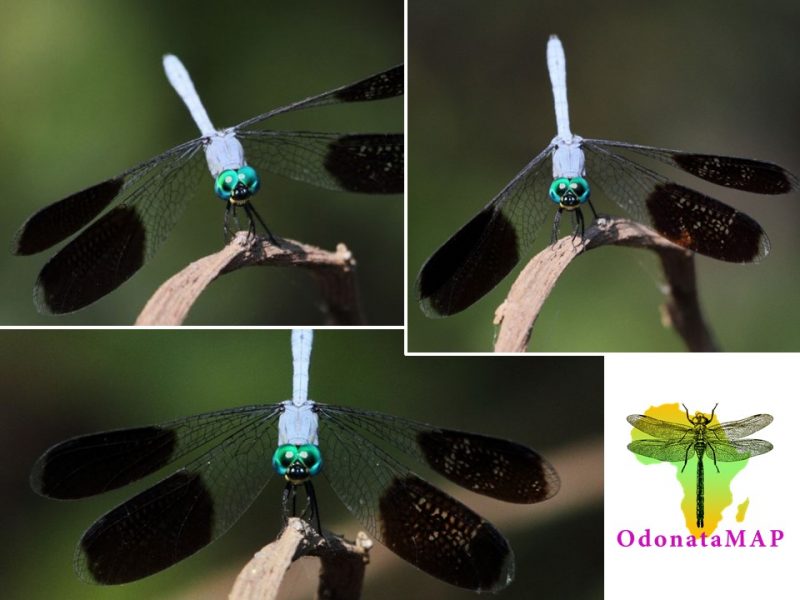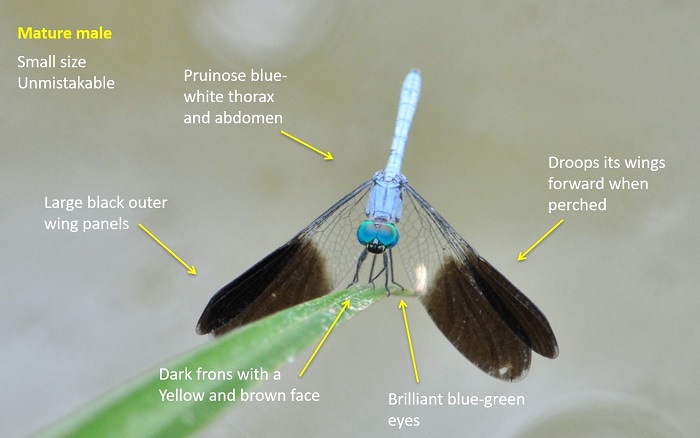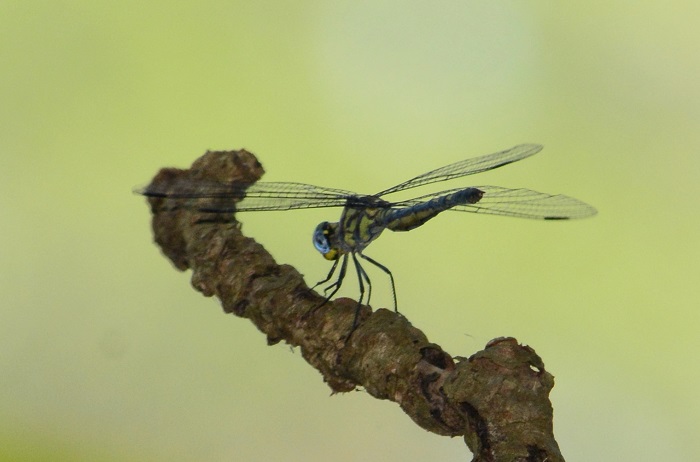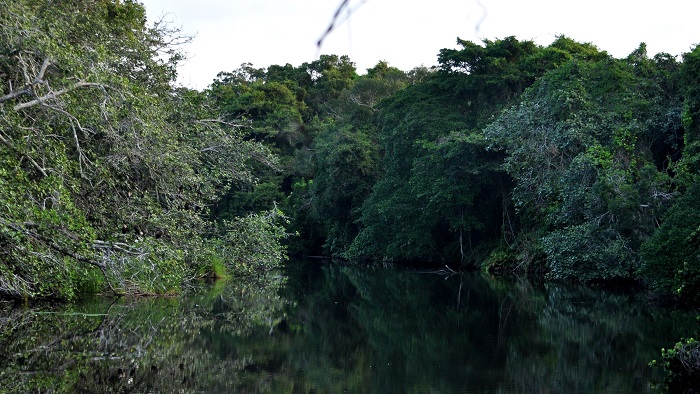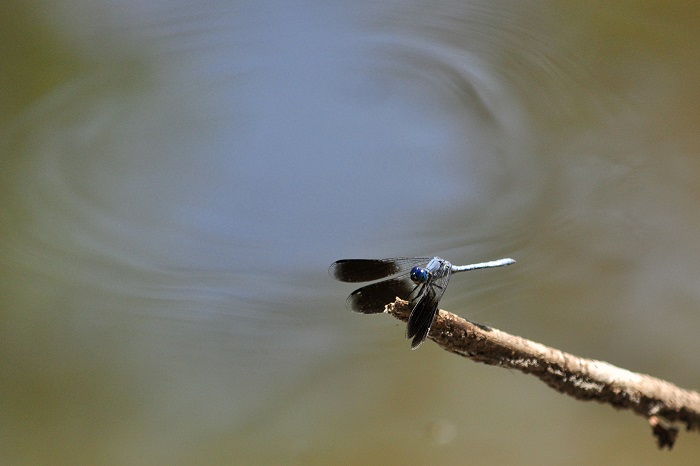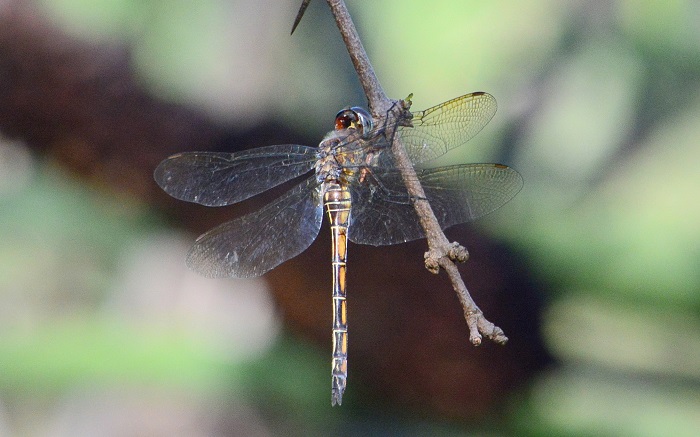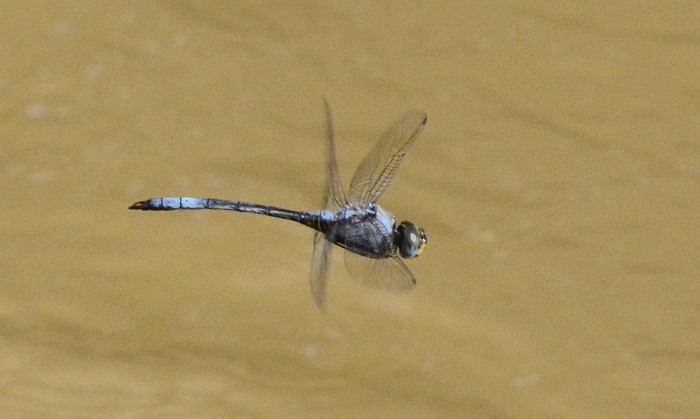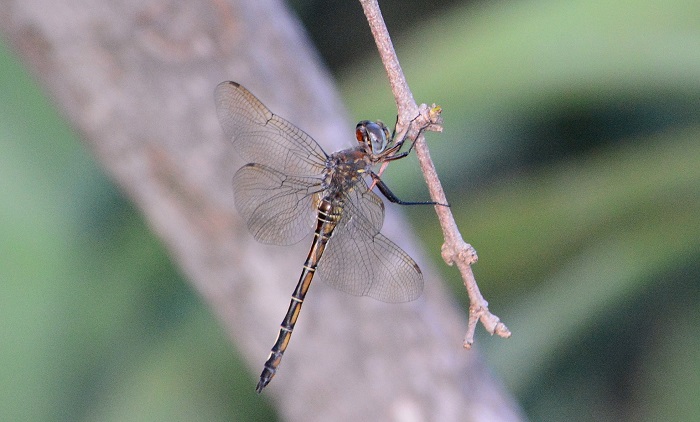
Cryptic Spreadwing (Lestes dissimulans)

Cover photo by Marita Beneke.

Find the Cryptic Spreadwing in the FBIS database (Freshwater Biodiversity Information System) here.

Family Lestidae

Identification

Cryptic Spreadwing Lestes dissimulans
Mabusa Nature Reserve, Mpumalanga
Photo by Niall Perrins

Small size

Length up to 42mm; Wingspan reaches 50mm

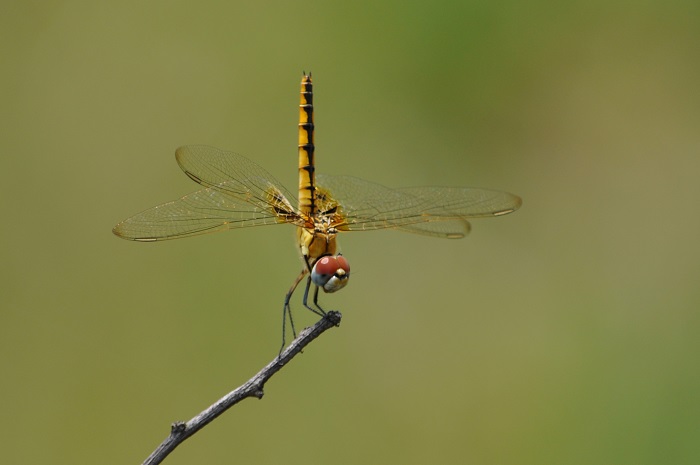
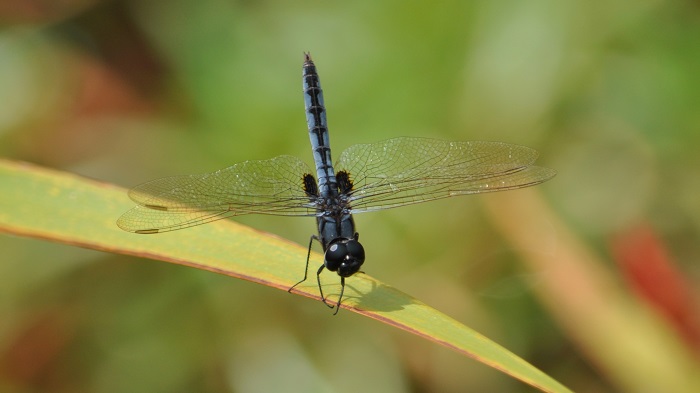
The Cryptic Spreadwing is similar to Lestes tridens (Spotted Spreadwing), but differs in the structure of the claspers and the amount of pruinose blue on segments 9 and 10 on the abdomen. Lestes dissimulans also has plain or indistinct markings on the top of the thorax. Lestes tridens shows a bolder and more distinctive marking on the upper thorax.

Females of the two are very similar and best separated by their association with the males.

Click here for more details on identification.

Habitat

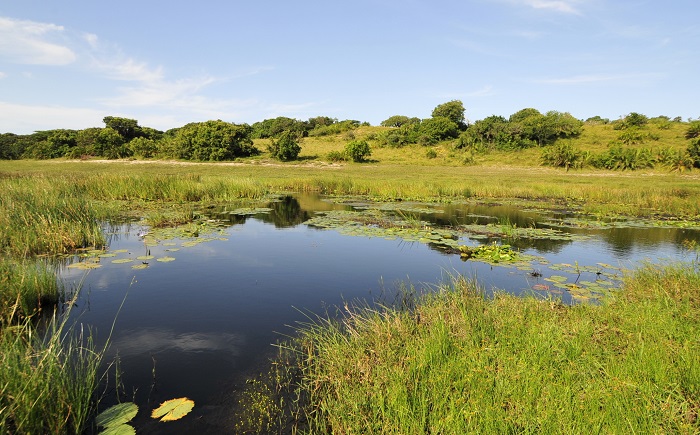
The Cryptic Spreadwing frequents both perennial and seasonal still-water habitats. It prefers shallow areas of pans, dams, and ponds with tall emergent or flooded grass. The Cryptic Spreadwing inhabits hot savanna regions.

Behaviour

The Cryptic Spreadwing is a fairly inactive species that spends long periods hanging vertically from emergent grass stems. The females are frequently seen alongside the males. Cryptic Spreadwings are well camouflaged and easily overlooked. Their blue-grey colouration and slender bodies blend perfectly with the grass and glare from the water.

The Cryptic Spreadwing is most active from October to March (See Phenology below).

Status and Conservation

Lestes dissimulans is an uncommon and highly localised species in South Africa. It is listed locally as Vulnerable in the IUCN Red List of Threatened Species. The species is listed as of Least Concern for Africa in general due to its relatively wide distribution. The Cryptic Spreadwing is not very tolerant of habitat degradation and is mostly found in pristine habitats.

Distribution

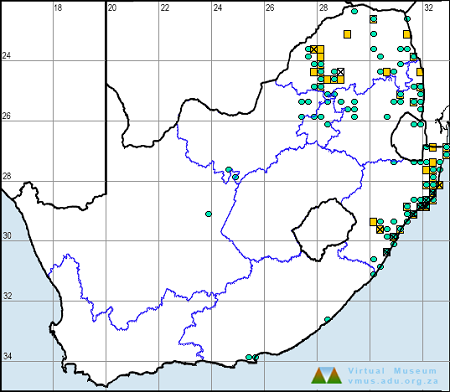
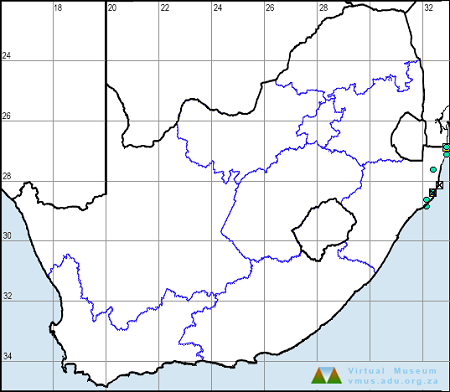
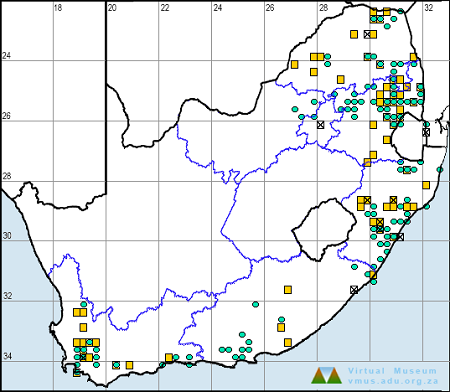
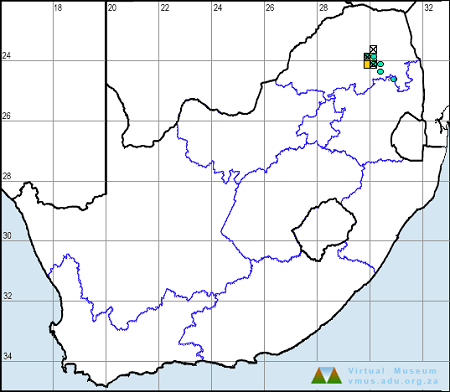
Lestes dissimulans occurs from the far North of KwaZulu-Natal to Limpopo in South Africa, and then widely across southern, eastern, central, and western Africa.

Below is a map showing the distribution of records for Cryptic Spreadwing in the OdonataMAP database as at February 2020.

Below is a map showing the distribution of records for Cryptic Spreadwing in the OdonataMAP database as of December 2024.

The next map below is an imputed map, produced by an interpolation algorithm, which attempts to generate a full distribution map from the partial information in the map above. This map will be improved by the submission of records to the OdonataMAP section of the Virtual Museum.

Ultimately, we will produce a series of maps for all the odonata species in the region. The current algorithm is a new algorithm. The objective is mainly to produce “smoothed” maps that could go into a field guide for odonata. This basic version of the algorithm (as mapped above) does not make use of “explanatory variables” (e.g. altitude, terrain roughness, presence of freshwater — we will be producing maps that take these variables into account soon). Currently, it only makes use of the OdonataMAP records for the species being mapped, as well as all the other records of all other species. The basic maps are “optimistic” and will generally show ranges to be larger than what they probably are.

These maps use the data in the OdonataMAP section of the Virtual Museum, and also the database assembled by the previous JRS funded project, which was led by Professor Michael Samways and Dr KD Dijkstra.

Phenology

Further Resources

The use of photographs by Marita Beneke and Niall Perrins is acknowledged.

Cryptic Spreadwing Lestes dissimulans Fraser, 1955

Other common names: Kriptiese Spanvlerkie (Afrikaans)

Recommended citation format: Loftie-Eaton M; Navarro R; Tippett RM; Underhill L. 2025. Cryptic Spreadwing Lestes dissimulans. Biodiversity and Development Institute. Available online at https://thebdi.org/2020/02/27/cryptic-spreadwing-lestes-dissimulans/

References: Tarboton, M; Tarboton, W. (2019). A Guide to the Dragonflies & Damselflies of South Africa. Struik Nature.

Samways, MJ. (2008). Dragonflies and Damselflies of South Africa. Pensoft

Samways, MJ. (2016). Manual of Freshwater Assessment for South Africa: Dragonfly Biotic Index. Suricata 2. South African National Biodiversity Institute, Pretoria

Martens, A; Suhling, F. (2007). Dragonflies and Damselflies of Namibia. Gamsberg Macmillan.

Similar Species

Elegant Malachite (Chlorolestes elegans)

Cover photo by Desire Darling.

Find the Elegant Malachite in the FBIS database (Freshwater Biodiversity Information System) here.

Family Synlestidae

Identification

Elegant Malachite Chlorolestes elegans – Male
Limpopo, South Africa
Photo by Gerhardt Diedericks

Large size

Length up to 63mm; Wingspan attains 76mm.

In South Africa, due to its habitat and restricted distribution, the Elegant Malachite should only be confused with Chlorolestes tessellatus (Forest Malachite) and Chlorolestes fasciatus (Mountain Malachite). The Elegant Malachite is the larger of the three species, with very little size overlap. Chlorolestes elegans has a yellow lower thorax stripe that curves noticeably upwards towards the wing bases (diagnostic). Chlorolestes tessellatus shows a less obviously curved stripe that grades to brown nearer the wing bases. Both species have forms with banded and unbanded wings. The best method for identification remains the males unique clasper morphology.

Click here for more details on identification.

Habitat

The Elegant Malachite is found in Malawi, Mozambique, South Africa, and Zimbabwe, where its natural habitats are rivers and streams in tropical and subtropical moist montane forests. It favours clear, rocky streams in densely vegetated, shady areas with pools and running water. The Elegant Malachite is only recorded above 1200m above sea level in South Africa.

Behaviour

The Elegant Malachite perches in dappled light with its wings outstretched, where it is well camouflaged.

It is on the wing from November to May (See Phenology below).

Status and Conservation

The Elegant Malachite is uncommon and highly localised. It is listed as Near Threatened in the IUCN Red List of Threatened Species. It is vulnerable to habitat loss.

Distribution

The Elegant Malachite ranges from the Limpopo province in South Africa, up along the Eastern Highlands of Zimbabwe and adjacent Mozambique to southern Malawi and Parts of northern Mozambique. It has a localised and disjunct distribution.

In South Africa, the Elegant Malachite is restricted to the northern escarpment forests between Wolkberg and the Soutpansberg in Limpopo.

Below is a map showing the distribution of records for Elegant Malachite in the OdonataMAP database as at February 2020.

Below is a map showing the distribution of records for Elegant Malachite in the OdonataMAP database as of December 2024.

The next map below is an imputed map, produced by an interpolation algorithm, which attempts to generate a full distribution map from the partial information in the map above. This map will be improved by the submission of records to the OdonataMAP section of the Virtual Museum.

Ultimately, we will produce a series of maps for all the odonata species in the region. The current algorithm is a new algorithm. The objective is mainly to produce “smoothed” maps that could go into a field guide for odonata. This basic version of the algorithm (as mapped above) does not make use of “explanatory variables” (e.g. altitude, terrain roughness, presence of freshwater — we will be producing maps that take these variables into account soon). Currently, it only makes use of the OdonataMAP records for the species being mapped, as well as all the other records of all other species. The basic maps are “optimistic” and will generally show ranges to be larger than what they probably are.

These maps use the data in the OdonataMAP section of the Virtual Museum, and also the database assembled by the previous JRS funded project, which was led by Professor Michael Samways and Dr KD Dijkstra.

Phenology

The next two graphs shows how the occurrence of Elegant Malachites varies within the year, i.e. the phenology. There are only 17 records in the database for this species, so these results need to be treated with caution. The first plot shows the number of records in each pentade, five-day periods, which start on 1 July and end on 30 June the following year. The maximum number of records in a pentade is three, in a pentade in May. The blue line is generated by a smoother, an algorithm which aims to separate the “signal” from the “noise”, and shows the pattern of seasonality for this species. The second plot shows only the blue line, and it is scaled to lie between zero and one, for easy comparison between species.

Tentatively (because the sample size is only 17), this phenology plot shows that the flight period of the Elegant Malachite is from November to May. The bimodality (i.e. having two peaks) is almost certainly an artefact caused by the tiny size of the sample. Lots more records of Elegant Malachites are needed in OdonataMAP to improve the phenology plot.

Further Resources

The use of photographs by Desire Darling and Gerhard Diedericks is acknowledged.

Elegant Malachite Chlorolestes elegans Pinhey, 1950

Other common names: Elegante Malagiet (Afrikaans).

Recommended citation format: Loftie-Eaton M; Navarro R; Tippett RM; Underhill L. 2025. Elegant Malachite Chlorolestes elegans. Biodiversity and Development Institute. Available online at https://thebdi.org/2020/02/27/elegant-malachite-chlorolestes-elegans/

References: Tarboton, M; Tarboton, W. (2019). A Guide to the Dragonflies & Damselflies of South Africa. Struik Nature.

Samways, MJ. (2008). Dragonflies and Damselflies of South Africa. Pensoft

Samways, MJ. (2016). Manual of Freshwater Assessment for South Africa: Dragonfly Biotic Index.Suricata 2. South African National Biodiversity Institute, Pretoria

Similar Species

Black-splashed Elf (Tetrathemis polleni)

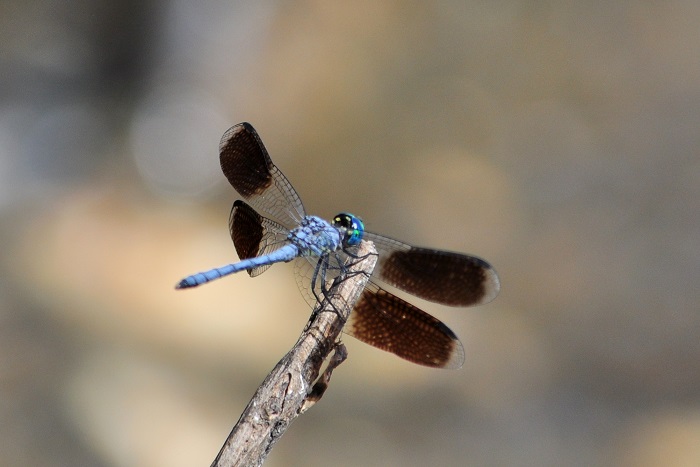
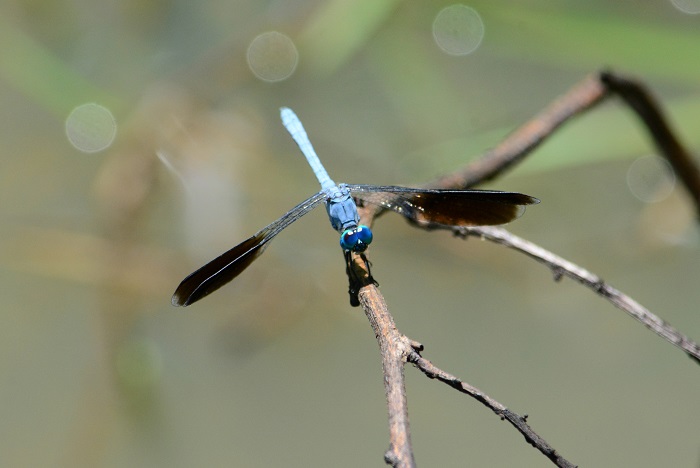
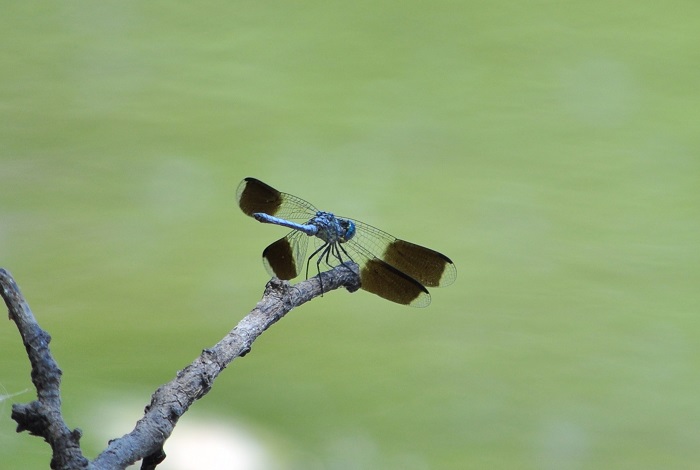
Cover photos by Alan Manson.

Find this species in the FBIS database (Freshwater Biodiversity Information System) here.

Family Libellulidae

Identification

Black-splashed Elf Tetrathemis polleni – Banded Male
Ndumo Game Reserve, KwaZulu-Natal
Photo by Ryan Tippett

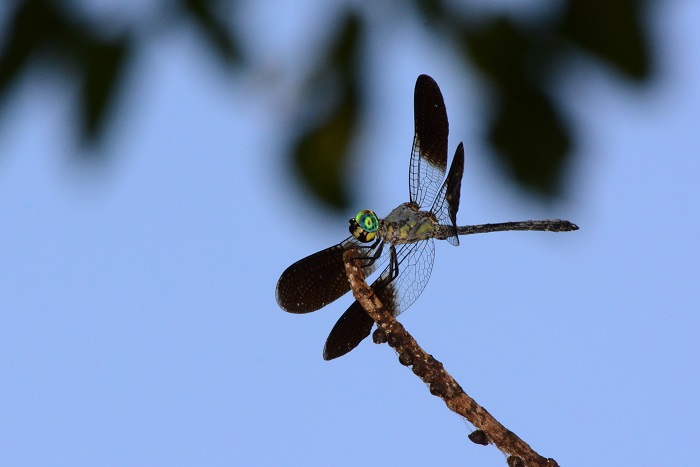
Small size. Length up to 35mm; Wingspan attains 63mm.

The Banded male Black-splashed Elf is striking and distinctive. Unbanded males can be mistaken for skimmers (Orthetrum spp.) or the Inspector (Chalcostephia flavifrons)but can be separated on wing venation and behaviour.

Females are quite similar to those of Notiothemis jonesi (Eastern Forestwatcher). They are best identified by wing venation. Black-splashed Elf females have a four-sided discoidal cell in the forewings, while the fore wings of Notiothemis jonesi have a triangular discoidal cell.

Click here for more details on identification.

Black-splashed Elf Tetrathemis polleni – Female
Enseleni Nature Reserve, KwaZulu-Natal
Photo by Ryan Tippett

Habitat

The Black-splashed Elf is a shade-loving species of calm, forested rivers, streams, and pools where trees overhang the water. They inhabit coastal, swamp, and riverine forests, and are sometimes also found in dense woodland along streams. The Black-splashed Elf is found mostly in warmer regions.

Habitat – Mkhuze Game Reserve, KwaZulu-Natal
Photo by Ryan Tippett
Habitat – Kosi Bay, KwaZulu-Natal
Photo by Ryan Tippett

Behaviour

Male Black-splashed Elfs perch conspicuously on bare, overhanging branches and twigs, usually 1 to 3m above the water. Females are not seen as often and frequently sit higher up and slightly further away from the water. The flight is fast, and the males’ black wing splashes give a fluttering effect. They don’t fly for long and quickly return to their perch. The Black-splashed Elf characteristically sits with the wings drooped forward and the abdomen held up at an angle.

Black-splashed Elf Tetrathemis polleni – Banded Male
Kuleni Game Park, KwaZulu-Natal
Photo by Ryan Tippett

Status and Conservation

Tetrathemis polleni is a common but localised species. It is listed as of Least Concern in the IUCN Red List of Threatened Species. The Black-splashed Elf is most numerous in undisturbed habitats but can occur at suitable man-made ponds and impoundments. It is moderately sensitive to habitat degradation. This species tolerates some turbid or stagnant water and abandons sites extensively lined with alien trees. The Black-splashed Elf is sensitive to the deforestation of overhanging indigenous trees, resulting in a loss of shady habitat.

Black-splashed Elf Tetrathemis polleni – Banded Male
Enseleni Nature Reserve, KwaZulu-Natal
Photo by Ryan Tippett

Distribution

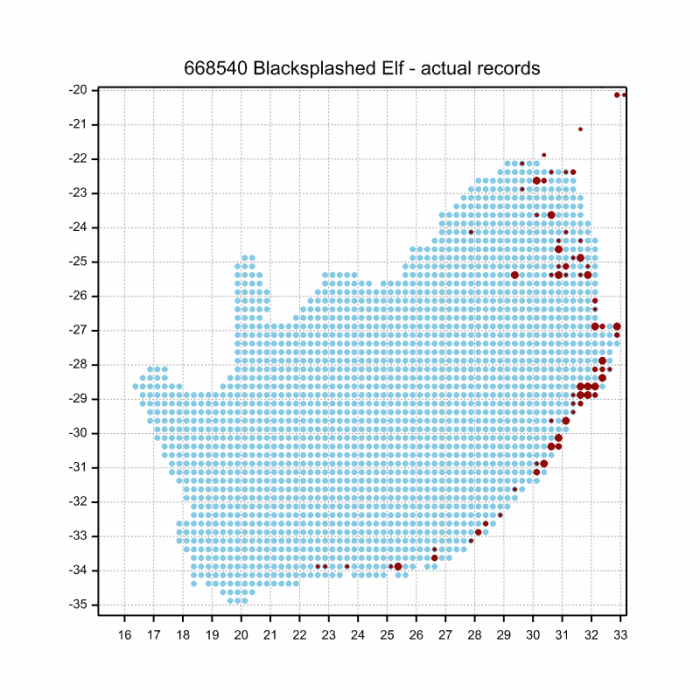
The Black-splashed Elf is most widespread in the Eastern parts of Africa, from South Africa to Uganda, Somalia, and Ethiopia. There is also a population in West Africa ranging from Nigeria to Guinea.

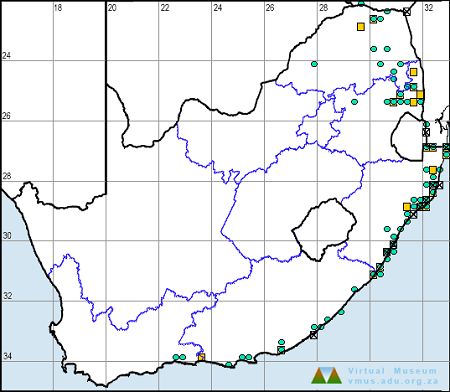
In South Africa, the Black-splashed Elf is found in the north and east, extending down the east coast as far as George, Western Cape.

Black-splashed Elf Tetrathemis polleni – Banded Male
Kuleni Game Park, KwaZulu-Natal
Photo by Ryan Tippett

Below is a map showing the distribution of records for Black-splashed Elf in the OdonataMAP database as at February 2020.

Below is a map showing the distribution of records for Black-splashed Elf in the OdonataMAP database as of December 2025.

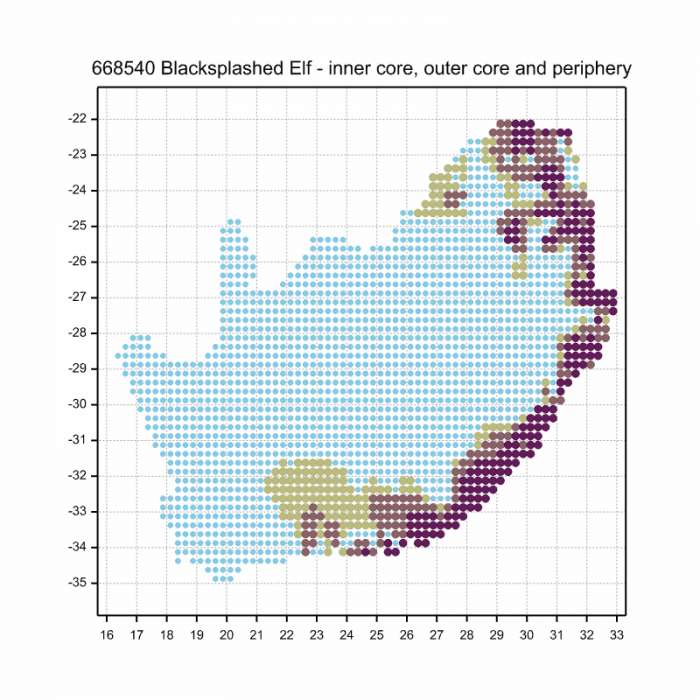
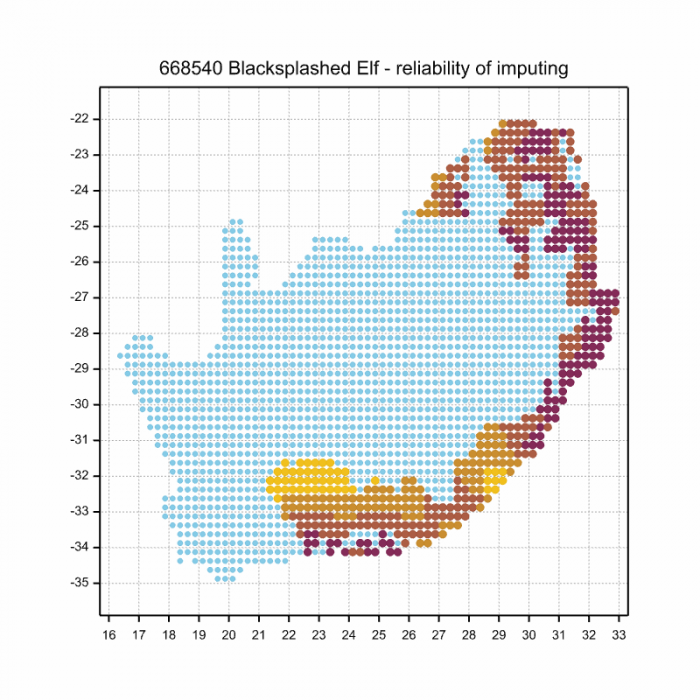
The next map below is an imputed map, produced by an interpolation algorithm, which attempts to generate a full distribution map from the partial information in the map above. This map will be improved by the submission of records to the OdonataMAP section of the Virtual Museum.

Ultimately, we will produce a series of maps for all the odonata species in the region. The current algorithm is a new algorithm. The objective is mainly to produce “smoothed” maps that could go into a field guide for odonata. This basic version of the algorithm (as mapped above) does not make use of “explanatory variables” (e.g. altitude, terrain roughness, presence of freshwater — we will be producing maps that take these variables into account soon). Currently, it only makes use of the OdonataMAP records for the species being mapped, as well as all the other records of all other species. The basic maps are “optimistic” and will generally show ranges to be larger than what they probably are.

These maps use the data in the OdonataMAP section of the Virtual Museum, and also the database assembled by the previous JRS funded project, which was led by Professor Michael Samways and Dr KD Dijkstra.

Black-splashed Elf Tetrathemis polleni – Banded Male
False Bay, iSimangaliso Wetland Park, KwaZulu-Natal
Photo by Ryan Tippett

Further Resources

The use of photographs by Alan Manson is acknowledged.

Black-splashed Elf Tetrathemis polleni (Selys, 1869)

Other common names: Swartspikkeldwergie (Afrikaans)

Recommended citation format: Loftie-Eaton M; Navarro R; Tippett RM; Underhill L. 2025. Black-splashed Elf Tetrathemis polleni. Biodiversity and Development Institute. Available online at https://thebdi.org/2020/02/26/black-splashed-elf-tetrathemis-polleni/

References: Tarboton, M; Tarboton, W. (2019). A Guide to the Dragonflies & Damselflies of South Africa. Struik Nature.

Samways, MJ. (2008). Dragonflies and Damselflies of South Africa. Pensoft

Samways, MJ. (2016). Manual of Freshwater Assessment for South Africa: Dragonfly Biotic Index. Suricata 2. South African National Biodiversity Institute, Pretoria

Black-splashed Elf Tetrathemis polleni – Banded Male
Ndumo Game Reserve, KwaZulu-Natal
Photo by Ryan Tippett

Similar Species

Jaunty Dropwing (Trithemis stictica)

Cover photo by Gerhard Diedericks.

Find this species in the FBIS database (Freshwater Biodiversity Information System) here.

Family Libellulidae

Identification

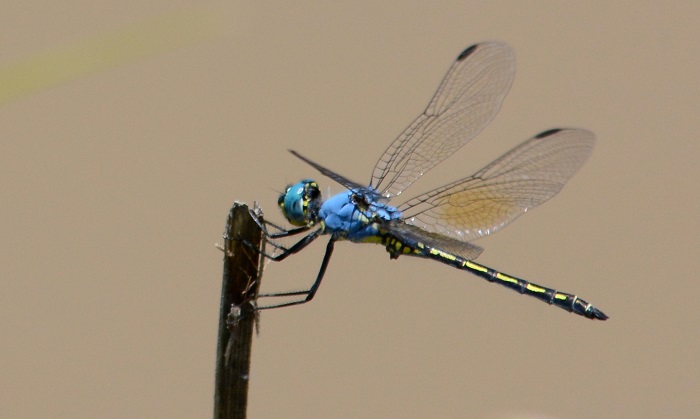
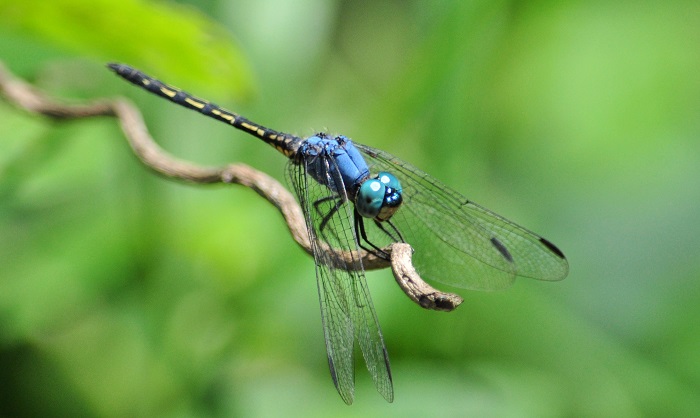
Jaunty Dropwing Trithemis stictica – Male
Wilge River, Free State
Photo by Ryan Tippett

Small size

Length up to 38mm; Wingspan reaches 66mm.

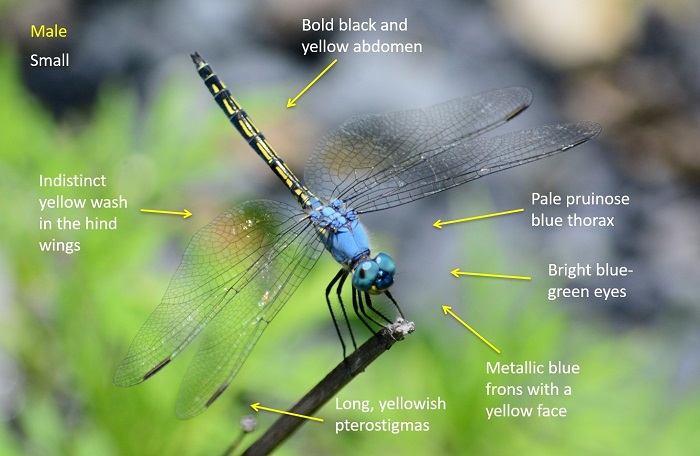
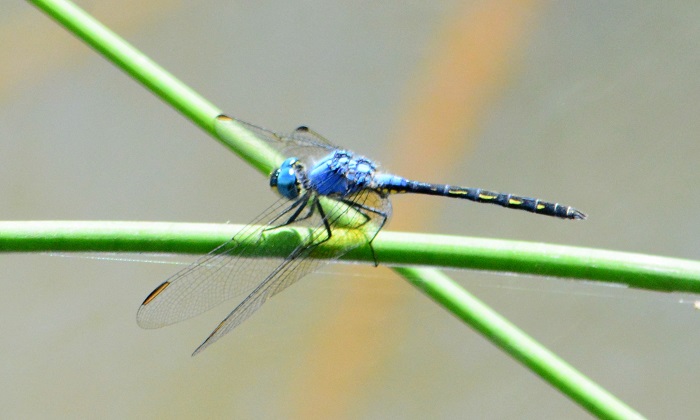
Male Jaunty Dropwings are distinctive and unmistakable within South Africa. The combination of pale blue thorax, Greenish-blue eyes, and striking yellow and black abdomen is diagnostic. There are other very similar species further north in Africa, notably the Marsh Dropwing Trithemis palustris.

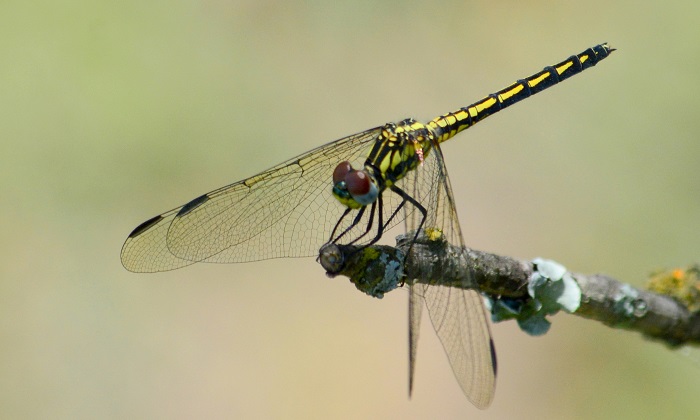
Jaunty Dropwing Trithemis stictica – Female
Near Oyster Bay, Eastern Cape
Photo by Desire Darling

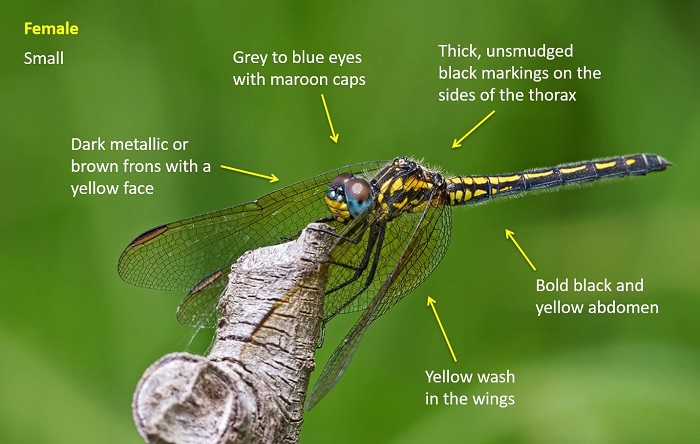
Females can be easily confused with those of other dropwing species, especially the Navy Dropwing (Trithemis furva). Elegant Dropwing females can be told by the thick, un-smudged black markings on the sides of the thorax and the bold black and yellow abdomen pattern.

Click here for more details on identification.

Habitat

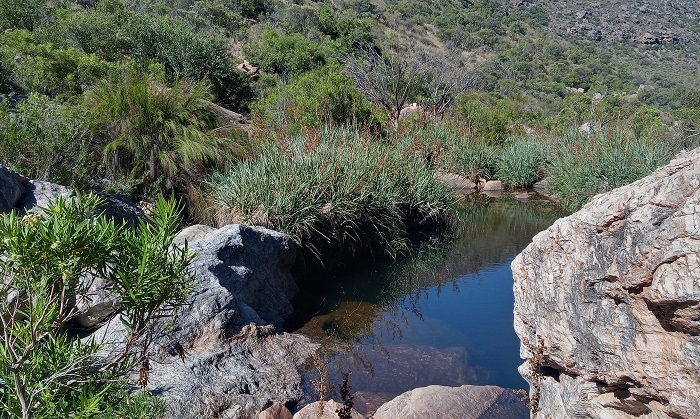
Typical marsh habitat
Near Kosi Bay, KwaZulu-Natal
Photo by Ryan Tippett

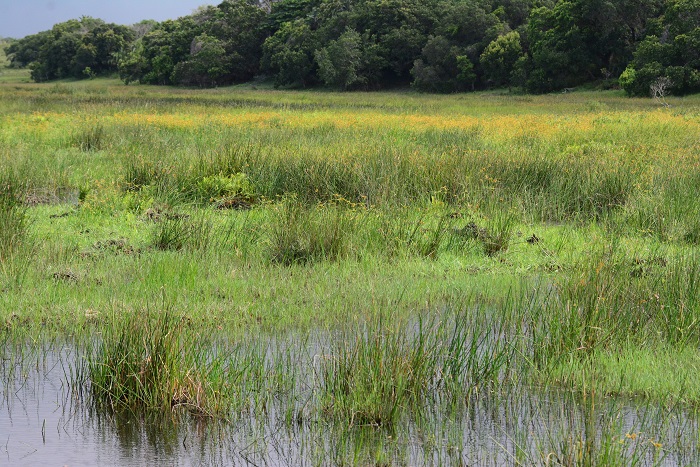
The Jaunty Dropwing frequents the vegetated margins of still water environments, such as marshes, pans, dams, and the quiet pools and backwaters of rivers and streams. It is seldom found at running water. Jaunty Dropwings prefer areas rich in vegetation, like sedges, reeds, and emergent grass.

The Jaunty Dropwing is often found at vegetated pools along slow-moving rivers.
Gifberg, Western Cape
Photo by Ryan Tippett

Behaviour

The Jaunty Dropwing likes to sit in exposed, sunny positions. During the heat of the day, they can often be seen in the ‘obelisk’ position, pointing their abdomens at the sun to reduce the amount of direct sunlight on their bodies. Jaunty Dropwings are perch hunters and spend as much time perched as they do darting off to intercept prey, or to chase off a rival.

Jaunty Dropwing Trithemis stictica – Male
Wilge River, Free State
Photo by Ryan Tippett

Status and Conservation

Trithemis stictica is a common and widespread species. It is listed as of Least Concern in the IUCN Red List of Threatened Species. The Jaunty Dropwing is reasonably tolerant of habitat degradation and is commonly found at suitable man-made water bodies.

Jaunty Dropwing Trithemis stictica – Female
Wilge River, Free State
Photo by Ryan Tippett

Distribution

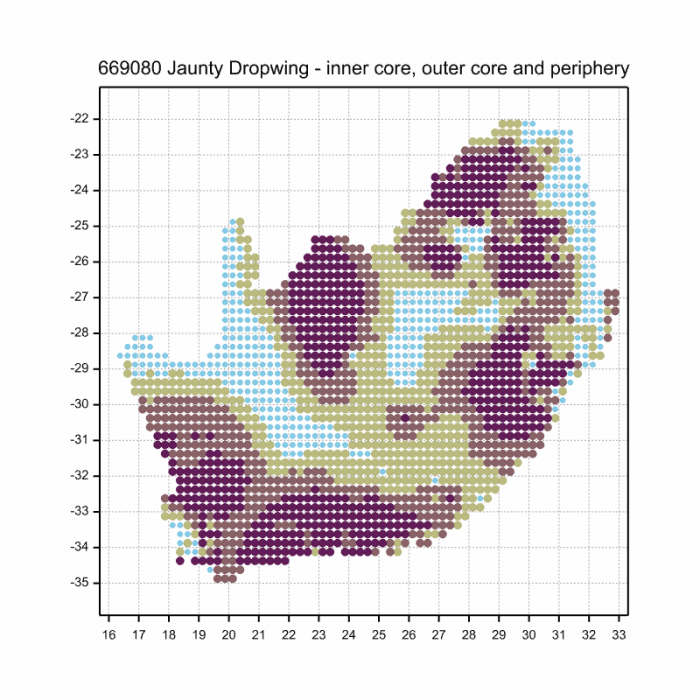
The Jaunty Dropwing has a wide distribution throughout most of sub-Saharan Africa and is also found on Madagascar. It is widespread in South Africa but avoids the arid and semi-arid central and western parts of the country.

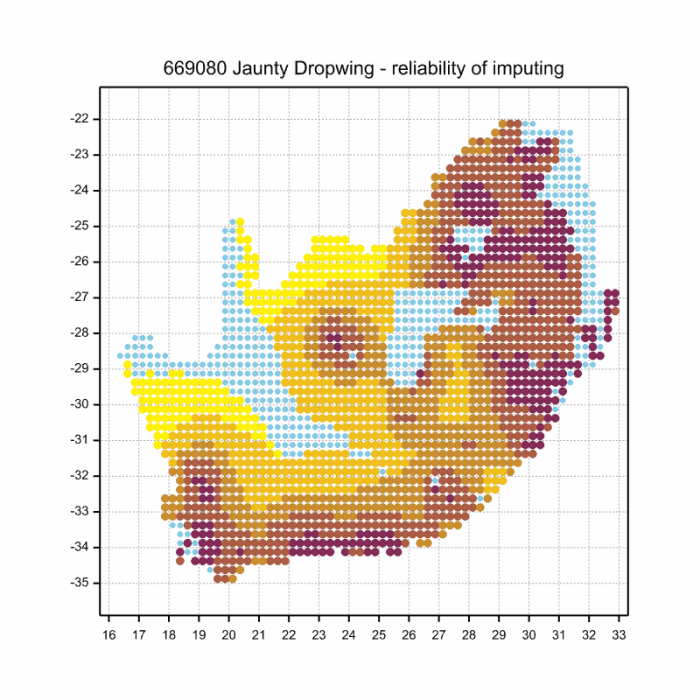
Below is a map showing the distribution of records for Jaunty Dropwing in the OdonataMAP database as at February 2020.

Below is a map showing the distribution of records for Jaunty Dropwing in the OdonataMAP database as at December 2024.

The next map below is an imputed map, produced by an interpolation algorithm, which attempts to generate a full distribution map from the partial information in the map above. This map will be improved by the submission of records to the OdonataMAP section of the Virtual Museum.

Ultimately, we will produce a series of maps for all the odonata species in the region. The current algorithm is a new algorithm. The objective is mainly to produce “smoothed” maps that could go into a field guide for odonata. This basic version of the algorithm (as mapped above) does not make use of “explanatory variables” (e.g. altitude, terrain roughness, presence of freshwater — we will be producing maps that take these variables into account soon). Currently, it only makes use of the OdonataMAP records for the species being mapped, as well as all the other records of all other species. The basic maps are “optimistic” and will generally show ranges to be larger than what they probably are.

These maps use the data in the OdonataMAP section of the Virtual Museum, and also the database assembled by the previous JRS funded project, which was led by Professor Michael Samways and Dr KD Dijkstra.

Jaunty Dropwing Trithemis stictica – Male
Sodwana Bay, iSimangaliso Wetland Park, KwaZulu-Natal
Photo by Ryan Tippett

Further Resources

The use of photographs by Desire Darling and Gerhard Diedericks is acknowledged.

Jaunty Dropwing Trithemis stictica (Burmeister, 1839)

Other common names: Vrolike Valvlerkie (Afrikaans)

Recommended citation format: Loftie-Eaton M; Navarro R; Tippett RM; Underhill L. 2025. Jaunty Dropwing Trithemis stictica. Biodiversity and Development Institute. Available online at https://thebdi.org/2020/02/26/jaunty-dropwing-trithemis-stictica/

References: Tarboton, M; Tarboton, W. (2019). A Guide to the Dragonflies & Damselflies of South Africa. Struik Nature.

Samways, MJ. (2008). Dragonflies and Damselflies of South Africa. Pensoft

Samways, MJ. (2016). Manual of Freshwater Assessment for South Africa: Dragonfly Biotic Index. Suricata 2. South African National Biodiversity Institute, Pretoria

Martens, A; Suhling, F. (2007). Dragonflies and Damselflies of Namibia. Gamsberg Macmillan.

Jaunty Dropwing Trithemis stictica – Male
Seweweekspoort, Western Cape
Photo by Ryan Tippett

Similar Species

Orange-winged Dropwing (Trithemis kirbyi)

Cover photo by Riëtte Griesel.

Find this species in the FBIS database (Freshwater Biodiversity Information System) here.

Family Libellulidae

Identification

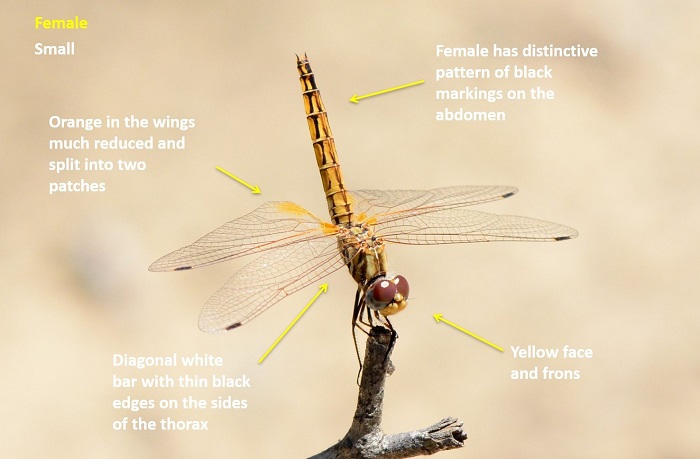
Orange-winged Dropwing Trithemis kirbyi – Male
Near Carnarvon, Northern Cape
Photo by Ryan Tippett

Small

Length up to 37mm; Wingspan up to 63mm

Both sexes of the Orange-winged Dropwing are readily identifiable. Males could be mistaken for the Red Groundling (Brachythemis lacustris), but are bright-orange-red (not deep red), and have slender abdomens with a tapered waist. The Orange-winged Dropwing also has a more elongate build, all black pterostigmas (not black and white), and unmarked red eyes.

Females are similar to other Trithemis species but can be separated on their distinctive abdomen pattern.

Click here for more details on identification.

Orange-winged Dropwing Trithemis kirbyi – Female
Near Hluhluwe, KwaZulu-Natal
Photo by Ryan Tippett

Habitat

The Orange-winged Dropwing inhabits a wide range of natural and man-made water bodies, including rivers, streams, lakes, pans, dams, concrete reservoirs, swimming pools and drinking troughs. They prefer rocky habitats and areas with bare ground adjacent to the water. Bare concrete, gravel and bricks surrounding artificial water bodies provide ideal habitat. They can be found at both still and running water, and also make use of temporary and somewhat brackish water. Trithemis kirbyi can be particularly common at water points in dry arid regions.

Typical habitat near Vanrhynsdorp, Western Cape
Photo by Ryan Tippett

Behaviour

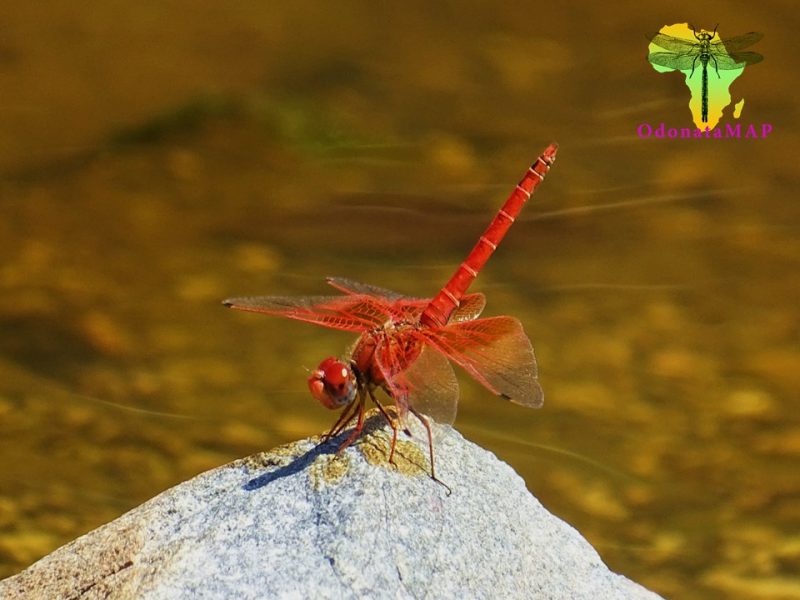
The Orange-winged Dropwing is a conspicuous species that sits in the open on rocks or bare ground and sometimes on branches or reeds. Females are often found near the males but are far less conspicuous. Males can be very active as they restlessly chase each other or intercept prey. The flight is rapid but not sustained and they quickly return to a perch. During hot conditions, Orange-winged Dropwings are often seen perched with their abdomens held vertically upwards (see image below). This is a form of thermoregulatory behaviour to minimise exposure to sunlight and thus prevent overheating. This is known as ‘obelisk posture’ or ‘sky-pointing’.

Orange-winged Dropwing Trithemis kirbyi – Male
Near Upington, Northern Cape
Photo by Ryan Tippett

Status and Conservation

Trithemis kirbyi is an abundant and widespread species. It is listed as of Least Concern in the IUCN Red List of Threatened Species. Orange-winged Dropwings are highly adaptable and resitant to habitat change. They have made great use of man-made impoundments and have doubtless benefited from this. This species is often more prevalent at degraded habitats than in pristine areas.

Orange-winged Dropwing Trithemis kirbyi – Female
Carnarvon district, Northern Cape
Photo by Ryan Tippett

Distribution

The Orange-winged Dropwing has a wide distribution. It is found virtually throughout Africa and in parts of the Middle East and southern Europe (Spain). It extends eastwards to India and Sri Lanka and also occurs on many islands in the Indian Ocean. The Orange-winged Dropwing occurs throughout southern Africa, including arid regions.

Below is a map showing the distribution of records for Orange-winged Dropwing in the OdonataMAP database as at February 2020.

Below is a map showing the distribution of records for Orange-winged Dropwing in the OdonataMAP database as of December 2024.

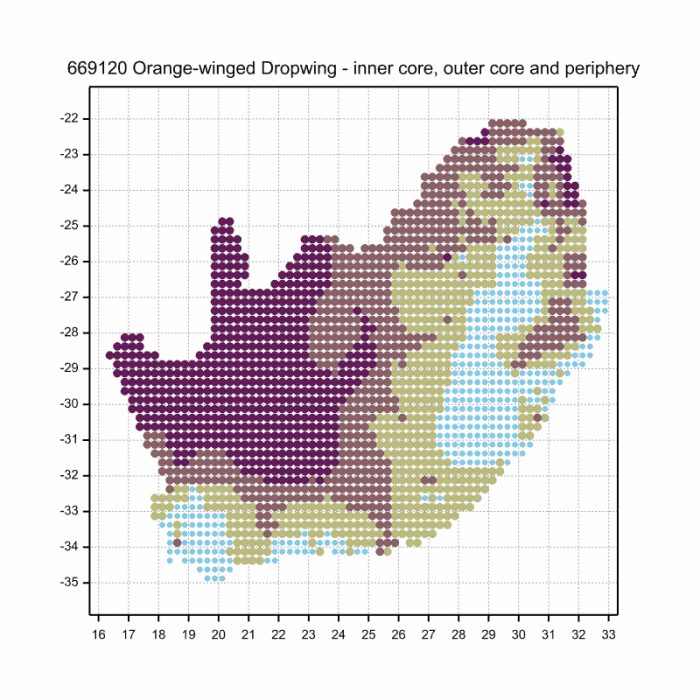
The next map below is an imputed map, produced by an interpolation algorithm, which attempts to generate a full distribution map from the partial information in the map above. This map will be improved by the submission of records to the OdonataMAP section of the Virtual Museum.

Ultimately, we will produce a series of maps for all the odonata species in the region. The current algorithm is a new algorithm. The objective is mainly to produce “smoothed” maps that could go into a field guide for odonata. This basic version of the algorithm (as mapped above) does not make use of “explanatory variables” (e.g. altitude, terrain roughness, presence of freshwater — we will be producing maps that take these variables into account soon). Currently, it only makes use of the OdonataMAP records for the species being mapped, as well as all the other records of all other species. The basic maps are “optimistic” and will generally show ranges to be larger than what they probably are.

These maps use the data in the OdonataMAP section of the Virtual Museum, and also the database assembled by the previous JRS funded project, which was led by Professor Michael Samways and Dr KD Dijkstra.

Orange-winged Dropwing Trithemis kirbyi – Male
Mkuze River, KwaZulu-Natal
Photo by Ryan Tippett

Further Resources

The use of photographs by Riëtte Griesel is acknowledged. All other photographs by Ryan Tippett.

Orange-winged Dropwing Trithemis kirbyi (Gerstäcker, 1891)

Other common names: Kirby’s Dropwing, Scarlet Rock Glider (Alt. English); Oranjevlerk-valvlerkie (Afrikaans)

Recommended citation format: Loftie-Eaton M; Navarro R; Tippett RM; Underhill L. 2025. Orange-winged Dropwing Trithemis kirbyi. Biodiversity and Development Institute. Available online at https://thebdi.org/2020/02/26/orange-winged-dropwing-trithemis-kirbyi/

References: Tarboton, M; Tarboton, W. (2019). A Guide to the Dragonflies & Damselflies of South Africa. Struik Nature.

Samways, MJ. (2008). Dragonflies and Damselflies of South Africa. Pensoft

Samways, MJ. (2016). Manual of Freshwater Assessment for South Africa: Dragonfly Biotic Index. Suricata 2. South African National Biodiversity Institute, Pretoria

Martens, A; Suhling, F. (2007). Dragonflies and Damselflies of Namibia. Gamsberg Macmillan.

Orange-winged Dropwing Trithemis kirbyi – Male
Near Vosburg, Northern Cape
Photo by Ryan Tippett

Similar Species

Savanna Riverjack (Mesocnemis singularis)

Cover photo by Gregg Darling.

Find the Savanna Riverjack in the FBIS database (Freshwater Biodiversity Information System) here.

Family Platycnemididae

Identification

Savanna Riverjack Mesocnemis singularis – Male
Mkuze River, KwaZulu-Natal
Photo by Ryan Tippett

Medium sized

Length up to 44mm; Wingspan attains 62mm.

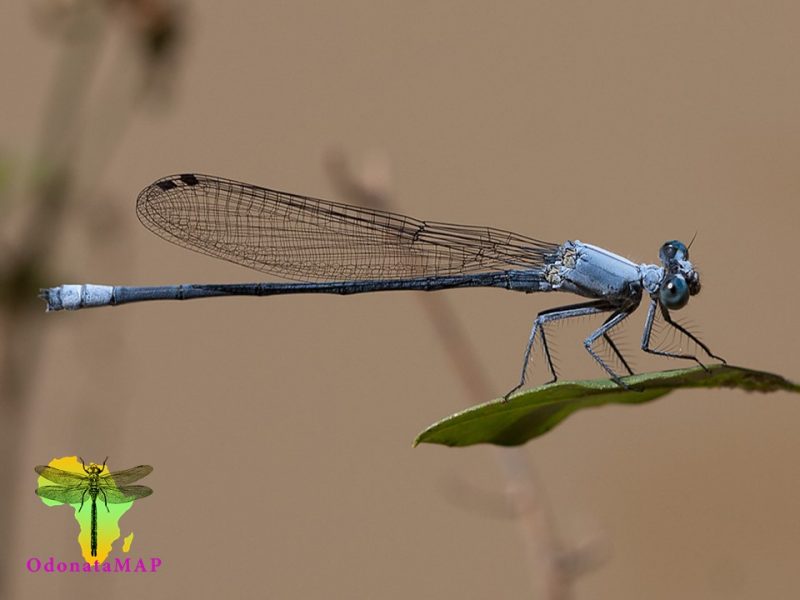
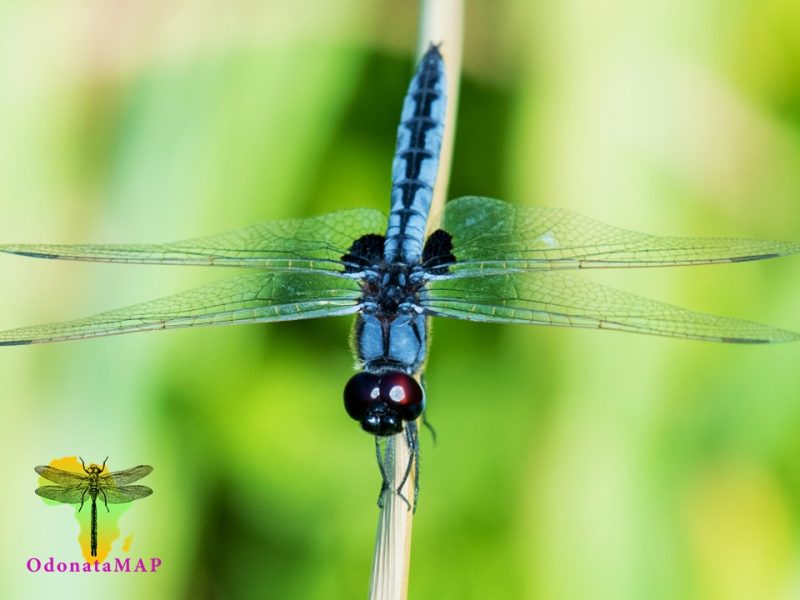
The Savanna Riverjack is robust for a damselfly, with a distinctive shape and posture. Males are easily recognised as there are no similar looking species in Southern Africa. Adult males are covered in pale blue-white pruinosity and are rather eyecatching.

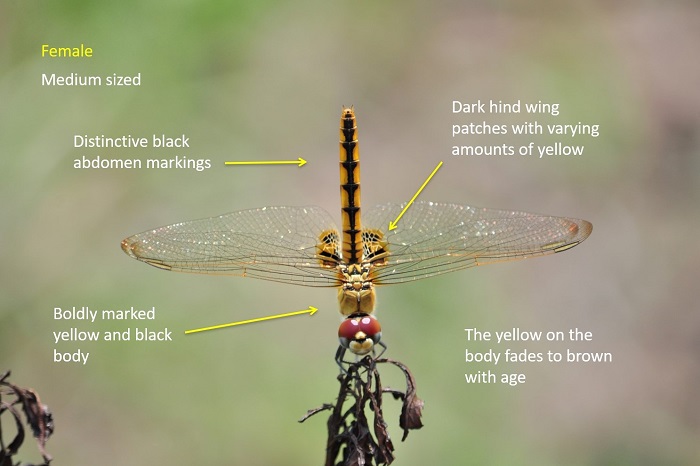
Females resemble those of Metacnemis valida (Blue Riverjack). The two are similar in size and shape and both are predominantly brown with darker markings. Metacnemis valida females have a prominent white diagonal band on the sides of the thorax. This is absent in Mesocnemis singularis. Additionally the two species are not known to co-occur.

Click here for more details on identification.

Savanna Riverjack Mesocnemis singularis – Female
Mkuze River, KwaZulu-Natal
Photo by Ryan Tippett

Habitat

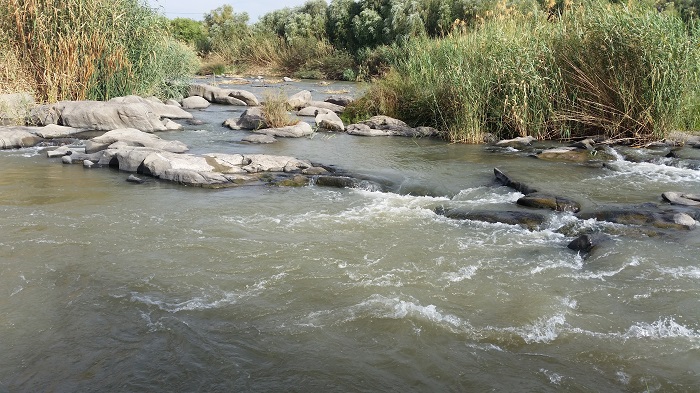
The natural habitat of the Savanna Riverjack includes open, rocky rivers and streams in savanna, scrub, or forest areas. The Savanna Riverjack is sometimes also found along the rocky shores of lakes. Mesocnemis singularis prefers fast-flowing water, including broken and white water with nearby vegetation to perch on.

Habitat – Orange River, Near Keimoes, Northern Cape

Behaviour

The Savanna Riverjack perches conspicuously near the water on rocks and overhanging or emergent twigs and stems. They often perch close to white water and both sexes are frequently found together.

Savanna Riverjack Mesocnemis singularis – Male
Orange River, near Upington, Northern Cape
Photo by Ryan Tippett

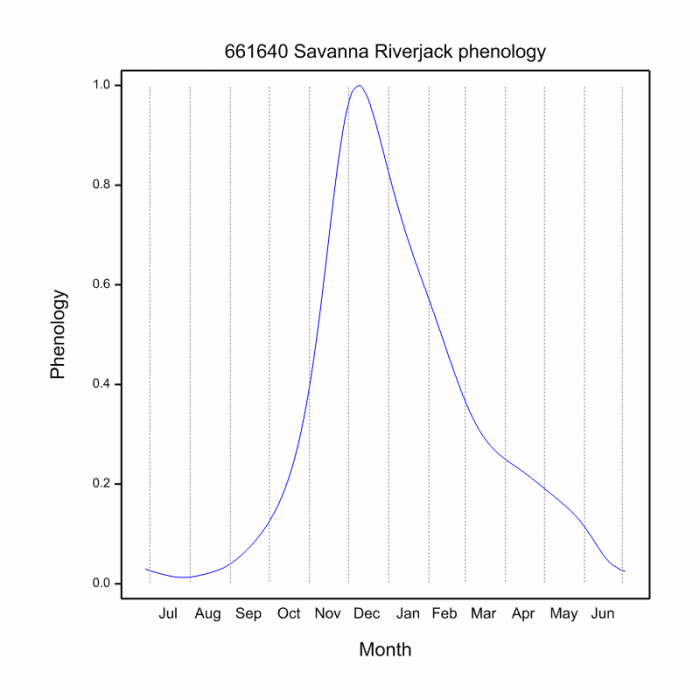
It is most active from October to May, but is likely to fly all year round at some warmer sites (See Phenology below).

Status and Conservation

The Savanna Riverjack is a common species. It is listed as of Least Concern in the IUCN Red List of Threatened Species. The Savanna Riverjack is a fairly hardy species but is most numerous at healthy, undisturbed rivers.

Savanna Riverjack Mesocnemis singularis
Amakhosi Game Reserve, KwaZulu-Natal
Photo by Ryan Tippett

Distribution

The Savanna Riverjack is widespread in sub-Saharan Africa, including west, central, eastern, and southern Africa. In South Africa, the Savanna Riverjack is found mainly in the north and east, in Limpopo, Gauteng, Mpumalanga, and KwaZulu-Natal. It is also found along the length of the Vaal and Orange Rivers, and some of their larger tributaries.

Below is a map showing the distribution of records for Savanna Riverjack in the OdonataMAP database as at February 2020.

Below is a map showing the distribution of records for Savanna Riverjack in the OdonataMAP database as of December 2024.

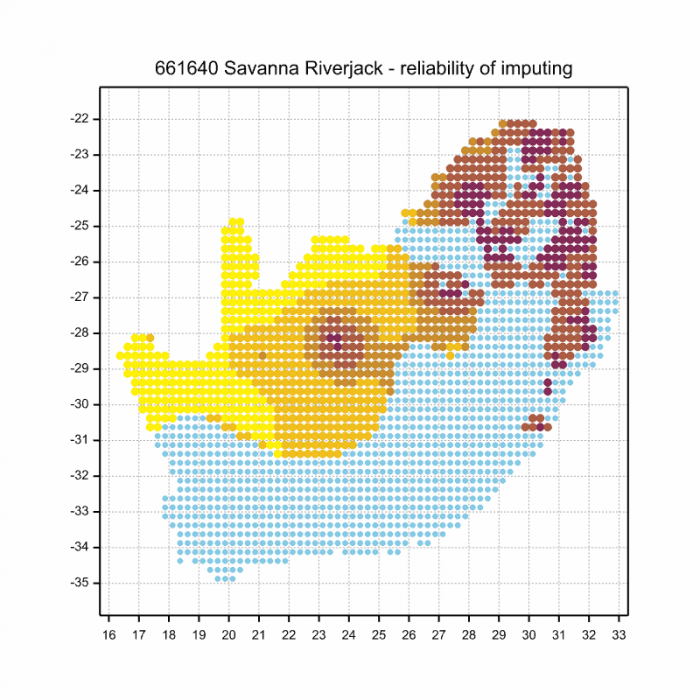
The next map below is an imputed map, produced by an interpolation algorithm, which attempts to generate a full distribution map from the partial information in the map above. This map will be improved by the submission of records to the OdonataMAP section of the Virtual Museum.

Ultimately, we will produce a series of maps for all the odonata species in the region. The current algorithm is a new algorithm. The objective is mainly to produce “smoothed” maps that could go into a field guide for odonata. This basic version of the algorithm (as mapped above) does not make use of “explanatory variables” (e.g. altitude, terrain roughness, presence of freshwater — we will be producing maps that take these variables into account soon). Currently, it only makes use of the OdonataMAP records for the species being mapped, as well as all the other records of all other species. The basic maps are “optimistic” and will generally show ranges to be larger than what they probably are.

These maps use the data in the OdonataMAP section of the Virtual Museum, and also the database assembled by the previous JRS funded project, which was led by Professor Michael Samways and Dr KD Dijkstra.

Phenology

Savanna Riverjack Mesocnemis singularis – Male
Mkuze River, KwaZulu-Natal
Photo by Ryan Tippett

Further Resources

The use of photographs by Alan Manson is acknowledged. All other photographs by Ryan Tippett.

Savanna Riverjack Mesocnemis singularis Karsch, 1891

Other common names: Riverjack; Common Riverjack (Alternative English Name); Vlakterivierjuffer (Afrikaans)

Recommended citation format: Loftie-Eaton M; Navarro R; Tippett RM; Underhill L. 2025. Savanna Riverjack Mesocnemis singularis. Biodiversity and Development Institute. Available online at https://thebdi.org/2020/02/25/savanna-riverjack-mesocnemis-singularis/

References: Tarboton, M; Tarboton, W. (2019). A Guide to the Dragonflies & Damselflies of South Africa. Struik Nature.

Samways, MJ. (2008). Dragonflies and Damselflies of South Africa. Pensoft

Samways, MJ. (2016). Manual of Freshwater Assessment for South Africa: Dragonfly Biotic Index. Suricata 2. South African National Biodiversity Institute, Pretoria

Martens, A; Suhling, F. (2007). Dragonflies and Damselflies of Namibia. Gamsberg Macmillan.

Savanna Riverjack Mesocnemis singularis – Male
Orange River, near Prieska, Northern Cape
Photo by Ryan Tippett

Similar Species

Blue Basker (Urothemis edwardsii)

Cover photo by Christian Fry.

Find the Blue Basker in the FBIS database (Freshwater Biodiversity Information System) here.

Family Libellulidae

Identification

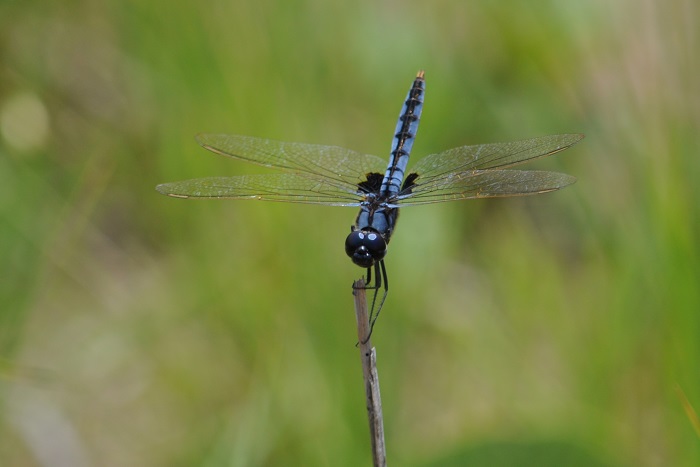
Blue Basker Urothemis edwardsii – Male
Enseleni Nature Reserve, KwaZulu-Natal
Photo by Ryan Tippett

Medium sized

Length up to 44mm; Wingspan reaches 80mm

Male Blue Baskers are readily identified and unlike any other species in the region. The combination of the matt, dark blue body and black hind wing panels is diagnostic.

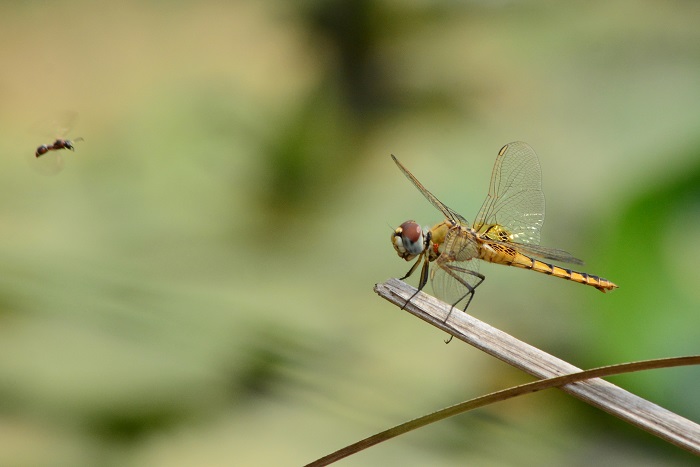
Females are overall yellowish with brown accents. They show bold black patterning down the length of the upper abdomen and dark brownish panels at the hind wing bases.

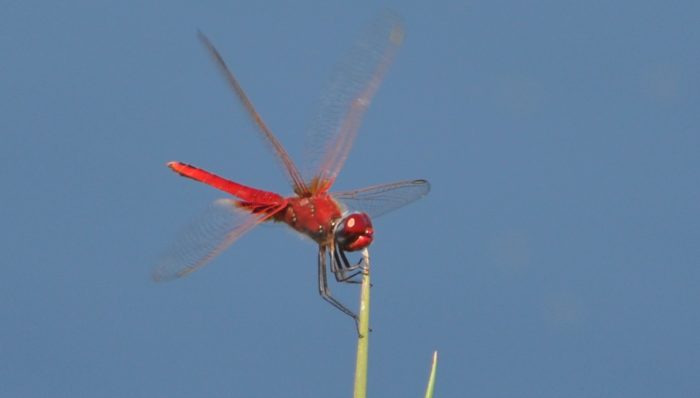
Females resemble those of Urothemis assignata (Red Basker). In that species the body colouration is more rufous than yellowish. The two species can be further differentiated by the patterning on the upper surface of the abdomen and by their slightly different hind wing markings.

Click here for more details on identification of the Blue Basker.

Blue Basker Urothemis edwardsii – Female
Enseleni Nature Reserve, KwaZulu-Natal
Photo by Ryan Tippett

Habitat

The Blue Basker inhabits freshwater lakes, pans, dams, marshes, and slow flowing sections of rivers. It prefers still-water habitats with abundant plant growth like reeds and sedges. Non-breeding individuals can often be found in open grassy areas away from water.

Typical habitat – Near Kosi Bay, KwaZulu-Natal
Photo by Ryan Tippett

Behaviour

Blue Baskers are perch hunters and spend as much time perched as they do darting off to intercept prey, or to chase off a rival. They like to sit in open, sunny positions. During the heat of the day they can often be seen in the obelisk position, pointing the abdomens at the sun to reduce the amount of direct sunlight on their bodies (see image below). Males and females both occur in the same areas.

The Blue Basker is on the wing from November to April.

Blue Basker Urothemis edwardsii – Female
Enseleni Nature Reserve, KwaZulu-Natal
Photo by Ryan Tippett

Status and Conservation

Urothemis edwardsii is a common species in South Africa. It is listed as of Least Concern in the IUCN Red List of Threatened Species. The Blue Basker is fairly resistant to habitat degradation and commonly occupies man-made habitats, provided there is enough vegetation to meet its habitat requirements.

Blue Basker Urothemis edwardsii – Male
Near Hluhluwe, KwaZulu-Natal
Photo by Ryan Tippett

Distribution

The Blue Basker is widespread and occurs virtually throughout Africa south of the Sahara, including parts of Madagascar and Mayotte in the Comoros archipelago. Isolated or relict populations are also found in Algeria and Oman. In South Africa, the Blue Basker is found mainly in the warmer and wetter north and east of the country.

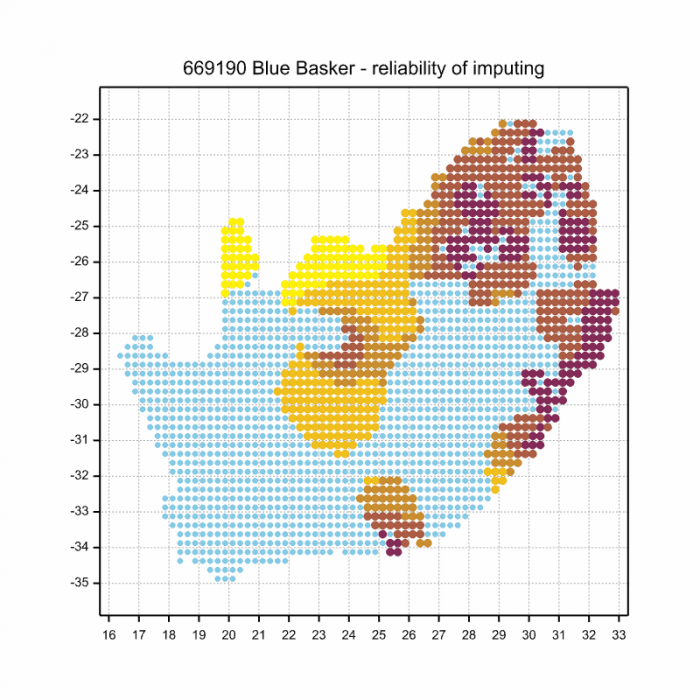
Below is a map showing the distribution of records for Blue Basker in the OdonataMAP database as at February 2020.

Below is a map showing the distribution of records for Blue Basker in the OdonataMAP database as of December 2024.

The next map below is an imputed map, produced by an interpolation algorithm, which attempts to generate a full distribution map from the partial information in the map above. This map will be improved by the submission of records to the OdonataMAP section of the Virtual Museum.

Blue Basker Urothemis edwardsii – Female
Ehlatini Bush Camp, KwaZulu-Natal
Photo by Ryan Tippett

Further Resources

The use of photographs by Christian Fry is acknowledged. All other photographs by Ryan Tippett.

Blue Basker Urothemis edwardsii (Selys, 1849)

Other common names: Blousonvangertjie (Afrikaans)

Recommended citation format: Loftie-Eaton M; Navarro R; Tippett RM; Underhill L. 2025. Blue Basker Urothemis edwardsii. Biodiversity and Development Institute. Available online at https://thebdi.org/2020/02/25/blue-basker-urothemis-edwardsii/

References: Tarboton, M; Tarboton, W. (2019). A Guide to the Dragonflies & Damselflies of South Africa. Struik Nature.

Samways, MJ. (2008). Dragonflies and Damselflies of South Africa. Pensoft

Samways, MJ. (2016). Manual of Freshwater Assessment for South Africa: Dragonfly Biotic Index. Suricata 2. South African National Biodiversity Institute, Pretoria

Martens, A; Suhling, F. (2007). Dragonflies and Damselflies of Namibia. Gamsberg Macmillan.

Blue Basker Urothemis edwardsii – Male
Enseleni Nature Reserve, KwaZulu-Natal
Photo by Ryan Tippett

Similar Species

St Lucia Basker (Urothemis luciana)

Cover photo by Diana Russell.

Find the St. Lucia Basker in the FBIS database (Freshwater Biodiversity Information System) here.

Family Libellulidae

Identification

St. Lucia Basker Urothemis luciana – Male
Richards Bay, KwaZulu-Natal
Photo by Richard Johnstone

Medium-large size and robust

Length attains 46mm; Wingspan reaches 84mm.

The St. Lucia Basker is a deep red species with extensive dark amber panels at the base of the wings.

It is easily confused with the Red Basker (Urothemis assignata), but is larger and has extensive amber patches at the base of the forewings. These are much reduced or absent in Urothemis assignata. Both sexes of Urothemis luciana have 8 or 9 Ax veins in the forewing. (Urothemis assignata has 7 Ax veins in the forewing).

Click here for more details on identification of the St. Lucia Basker.

Habitat

The St. Lucia Basker inhabits the subtropical wetlands of coastal north-eastern KwaZulu-Natal. It is found in the vicinity of both perennial and seasonal marshes, swamps and pans. This species favours wetland/forest mosaic where trees, bushes and grassland are found in close proximity to wetlands.

Habitat – Cape Vidal, iSimangaliso Wetland Park, KwaZulu-Natal
Photo by Ryan Tippett

Behaviour

The St. Lucia Basker is far more aerial than other Urothemis species and spends less time perched at the waters edge. It is most often seen on and around trees and bushes, with an abundance of long grass and water nearby. The St. Lucia Basker perches conspicuously on top of trees, bushes and reeds etc. The flight is fast and powerful. It’s movements and life history are not yet fully understood.

St. Lucia Basker Urothemis lucianaa
Kosi Bay, iSimangaliso Wetland Park, KwaZulu-Natal
Photo by Ryan Tippett

Status and Conservation

Urothemis luciana is an uncommon to rare species with an erratic occurence. This species is not present at the same sites every year and appears to vanish during prolonged dry years, only to re-appear again after good rains. The St. Lucia Basker is listed as Near Threatened in the IUCN Red List of Threatened Species. A significant portion of its South African range is protected within the iSimangaliso Wetland Park. The St. Lucia Basker is not known to occur at artificial habitats and is sensitive to habitat degredation.

Distribution

The St. Lucia Basker is endemic to north-eastern KwaZulu-Natal and southern Mozambique. It occurs as far South as Richards Bay.

Below is a map showing the distribution of records for St Lucia Basker in the OdonataMAP database as at February 2020.

Below is a map showing the distribution of records for St Lucia Basker in the OdonataMAP database as of December 2024.

The next map below is an imputed map, produced by an interpolation algorithm, which attempts to generate a full distribution map from the partial information in the map above. This map will be improved by the submission of records to the OdonataMAP section of the Virtual Museum.

Further Resources

The use of photographs by Diana Russell and Richard Johnstone is acknowledged. All other photographs by Ryan Tippett.

St. Lucia Basker Urothemis luciana Balinsky, 1961

Other common names: St. Lucia-sonvangertjie (Afrikaans)

Recommended citation format: Loftie-Eaton M; Navarro R; Tippett RM; Underhill L. 2025. St. Lucia Basker Urothemis luciana. Biodiversity and Development Institute. Available online at https://thebdi.org/2020/02/25/st-lucia-basker-urothemis-luciana/

References: Tarboton, M; Tarboton, W. (2019). A Guide to the Dragonflies & Damselflies of South Africa. Struik Nature.

Samways, MJ. (2008). Dragonflies and Damselflies of South Africa. Pensoft

Samways, MJ. (2016). Manual of Freshwater Assessment for South Africa: Dragonfly Biotic Index. Suricata 2. South African National Biodiversity Institute, Pretoria

Similar Species

Southern Riverking (Zygonoides fuelleborni)

Cover Photo by Gary Brown.

Find the Ringed Cascader in the FBIS database (Freshwater Biodiversity Information System) here.

Family Libellulidae

Identification

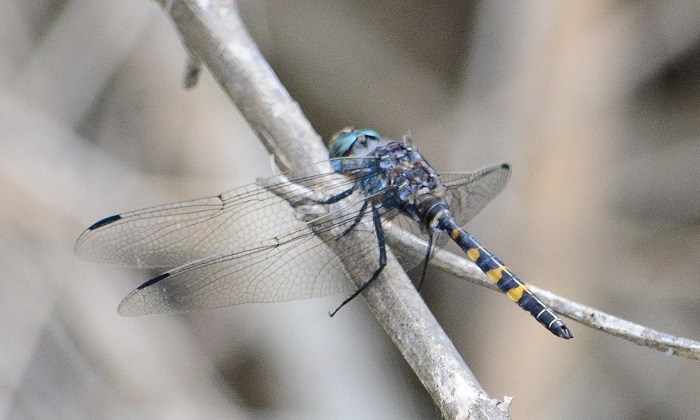
Southern River King Zygonoides fuelleborni – Male
Mkuze River, KwaZulu-Natal
Photo by Ryan Tippett

Medium-large to large size.

Length attains 56mm. The wingspan can reach 90mm.

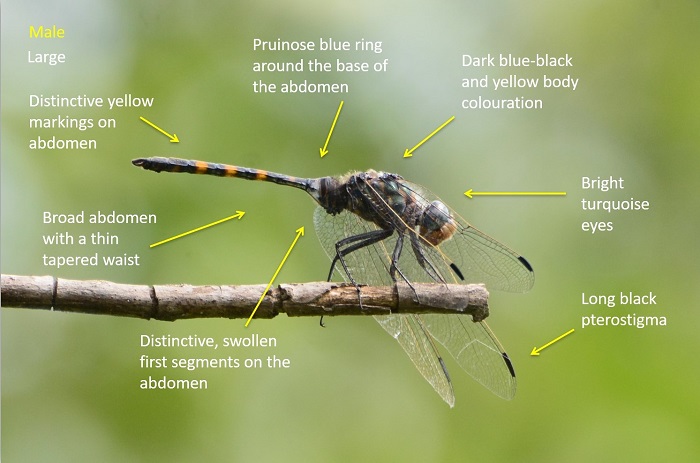
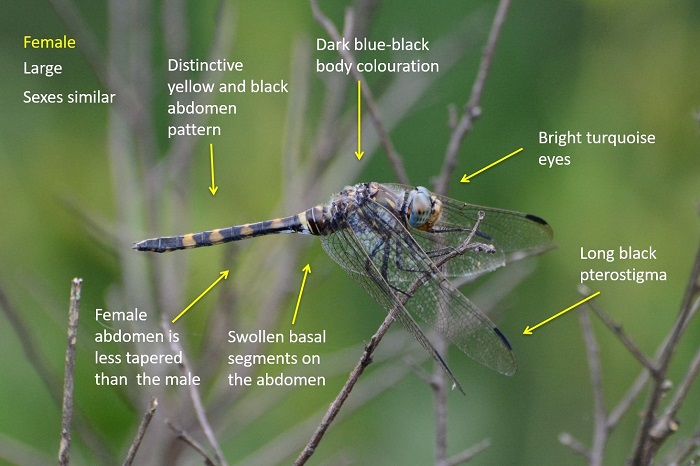
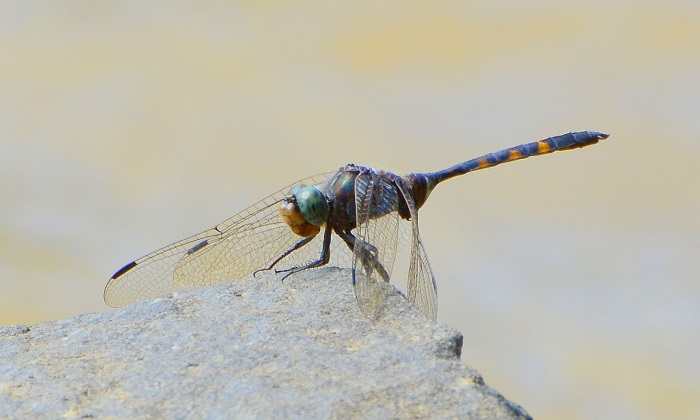
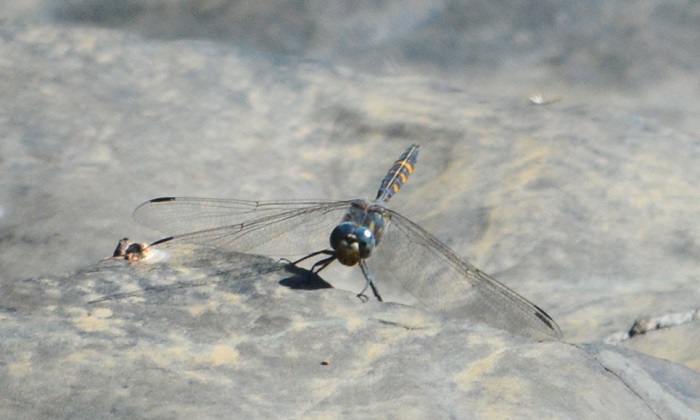
Both sexes are similar in appearance. The most distinguishing feature of Southern Riverking is the swollen basal segments on the abdomen. This is most noticeable in the male.

Most likely to be mistaken for Olpogastra lugubris (Bottletail) or Zygonyx torridus (Ringed Cascader). The Southern Riverking and the Bottletail show similar patterning but are easily separated by their very different abdomen shapes. Zygonoides fuelleborni has a broad abdomen and a noticeably tapered waist. Olpogastra lugubris has a diagnostic, thin, and elongate abdomen. The abdomen of the Ringed Cascader is also broad but lacks the tapered waist. Zygonoides fuelleborni can be further separated from Zygonyx torridus by its bright blue-green eyes as opposed to the black-brown eyes of the latter.

Click here for more details on identification of the Southern Riverking.

Southern Riverking Zygonoides fuelleborni – Female
Mkuze River, KwaZulu-Natal
Photo by Ryan Tippett

Habitat

The preferred habitat of the Southern Riverking is large, strong-flowing savanna rivers with wooded or reed-lined banks. The Southern Riverking especially likes faster-flowing sections of rivers with white water, such as rapids and falls. It requires exposed rocks or overhanging trees for perching on.

Habitat – Mkuze River, KwaZulu-Natal
Photo by Ryan Tippett

Behaviour

The Southern Riverking is a busy and active species with a swift, powerful flight. It perches regularly between flights, but seldom for very long. It often perches on overhanging reeds, trees or bushes and frequently sits on rocks close to the water. The Southern Riverking frequently joins mixed-species hunting swarms at dusk. Zygonoides fuelleborni is on the wing from November to May.

Southern River King Zygonoides fuelleborni – Male
Amakhosi Game Reserve, KwaZulu-Natal
Photo by Ryan Tippett

Status and Conservation

The Southern Riverking is uncommon in South Africa. It is localised and thinly distributed in South Africa. It occurs primarily in undisturbed habitats, although it is often found near weirs and dams on rivers that create rapid-like conditions. It is listed as of Least Concern in the IUCN Red List of Threatened Species.

Southern River King Zygonoides fuelleborni – Male
Mkuze River, KwaZulu-Natal
Photo by Ryan Tippett

Distribution

Zygonoides fuelleborni is found in Eastern and Southern Africa, from Kenya down to central KwaZulu-Natal in South Africa.

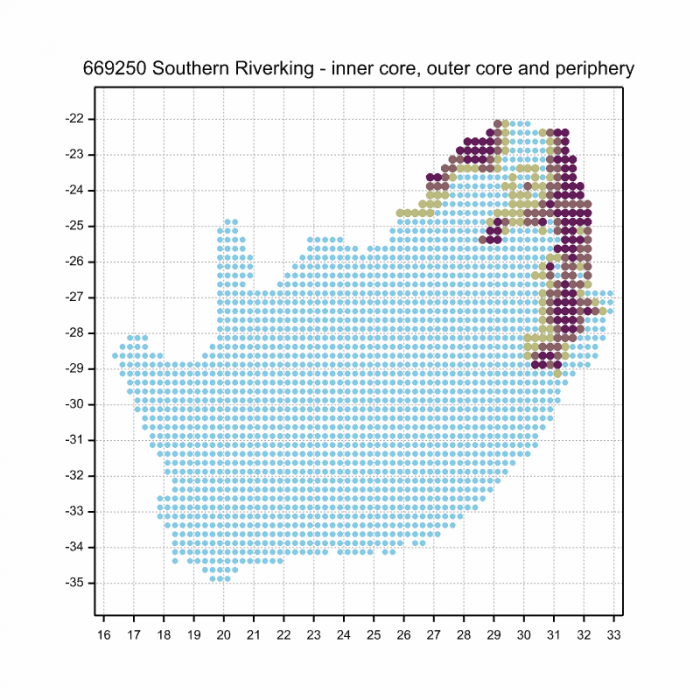
Below is a map showing the distribution of records in South Africa for the Southern Riverking. Taken from the OdonataMAP database as at February 2020.

Below is a map showing the distribution of records in South Africa for the Southern Riverking. Taken from the OdonataMAP database as of December 2024.

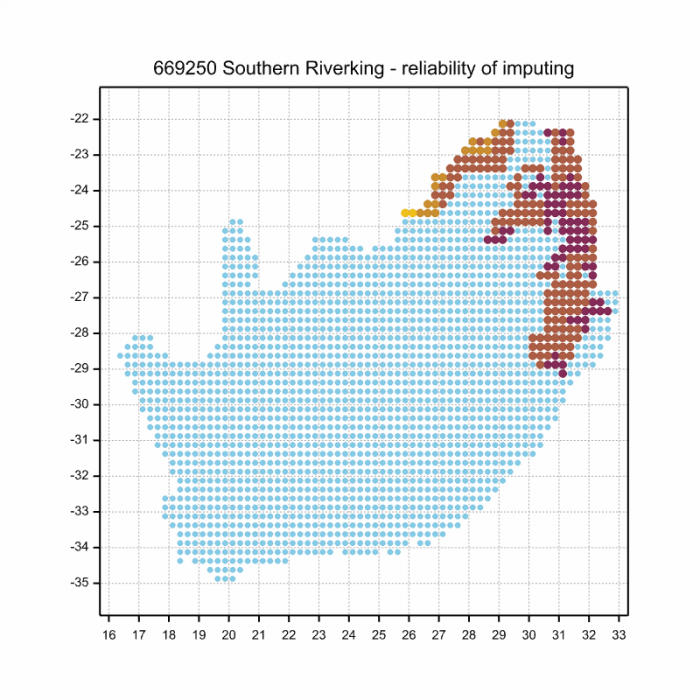
The next map below is an imputed map, produced by an interpolation algorithm, which attempts to generate a full distribution map from the partial information in the map above. This map will be improved by the submission of records to the OdonataMAP section of the Virtual Museum.

Ultimately we will produce a series of maps for all the odonata species in the region. The current algorithm is a new algorithm. The objective is mainly to produce “smoothed” maps that could go into a field guide for odonata. This basic version of the algorithm (as mapped above) does not make use of “explanatory variables” (e.g. altitude, terrain roughness, presence of freshwater — we will be producing maps that take these variables into account soon). Currently, it only makes use of the OdonataMAP records for the species being mapped, as well as all the other records of all other species. The basic maps are “optimistic” and will generally show ranges to be larger than what they probably are.

These maps use the data in the OdonataMAP section of the Virtual Museum, and also the database assembled by the previous JRS funded project, which was led by Professor Michael Samways and Dr KD Dijkstra.

Southern River King Zygonoides fuelleborni – Male
Mkuze River, KwaZulu-Natal
Photo by Ryan Tippett

Further Resources

The use of photographs by Niall Perrins is acknowledged. All other photographs by Ryan Tippett.

Southern River King Zygonoides fuelleborni (Grünberg, 1902)

Other common names: Robust Riverking ; Fuelleborn’s Spectacular (Alt. English); Krasse Bottelstert (Afrikaans)

Recommended citation format: Loftie-Eaton M; Navarro R; Tippett RM; Underhill L. 2025. Southern River King Zygonoides fuelleborni. Biodiversity and Development Institute. Available online at https://thebdi.org/2020/02/21/southern-riverking-zygonoides-fuelleborni/

References: Tarboton, M; Tarboton, W. (2019). A Guide to the Dragonflies & Damselflies of South Africa. Struik Nature.

Samways, MJ. (2008). Dragonflies and Damselflies of South Africa. Pensoft

Samways, MJ. (2016). Manual of Freshwater Assessment for South Africa: Dragonfly Biotic Index. Suricata 2. South African National Biodiversity Institute, Pretoria

Martens, A; Suhling, F. (2007). Dragonflies and Damselflies of Namibia. Gamsberg Macmillan.

Southern River King Zygonoides fuelleborni – Male
Amakhosi Game Reserve, KwaZulu-Natal
Photo by Ryan Tippett

Similar Species

Blue Cascader (Zygonyx natalensis)

Cover photo by Jean Hirons.

Find the Blue Cascader in the FBIS database (Freshwater Biodiversity Information System) here.

Family Libellulidae

Identification

Blue Cascader Zygonyx natalensis – Male
Mkuze River, KwaZulu-Natal
Photo by Ryan Tippett

Large size

Length up to 54mm; Wingspan reaches 86mm.

The Blue Cascader is most likely to be mistaken for one of the blue skimmers (Orthetrum spp.), which it resembles in general size, shape, and colour. Zygonyx natalensis can be easily differentiated by the distinct gap in pruinosity along its abdomen and by its metallic blue frons. In addition, the Blue Cascader demonstrates very different behaviour to all of the skimmers.

Females most resemble both sexes of Zygonyx torridus (Ringed Cascader). They differ mostly in the size and shape of the yellow markings along the abdomen. Female Blue Cascaders show smaller, thinner yellow markings.

Click here for more details on identification.

Blue Cascader Zygonyx natalensis – Female
Shayamoya Game Lodge, KwaZulu-Natal
Photo by Ryan Tippett

Habitat

The Blue Cascader inhabits rocky, fast-flowing streams and rivers. It is particularly fond of river stretches with ‘white water’ where there are rapids, cascades, and waterfalls. Females can sometimes be found some distance away from water in a variety of vegetation types. The Blue Cascader occupies rivers in the savanna, grassland, and fynbos regions.

Habitat – Kogelberg Nature Reserve, Western Cape
Photo by Sharon Stanton

Behaviour

Blue Cascader males are frequently seen patrolling a stretch of water or hovering low down over rapids and waterfalls. They regularly return to hover at a favourite site after inspecting a length of river. The Blue Cascader can sometimes be found away from water, hunting over surrounding habitats. The flight is swift and powerful. The Blue Cascader hunts on the wing and is not often seen perched. Females are seldom seen and spend most of their time away from water.

Blue Cascader Zygonyx natalensis – Male
Mkuze River, KwaZulu-Natal
Photo by Ryan Tippett

Status and Conservation

The Blue Cascader is locally common in South Africa. It is listed as of Least Concern in the IUCN Red List of Threatened Species. This species makes little use of man-made habitats other than artificial weirs that may simulate natural rapids and waterfalls. The Blue Cascader is reliant on healthy, flowing river systems.

Distribution

The Blue Cascader can be found over much of Sub-Saharan Africa, but is mostly recorded from Eastern and Southern Africa, ranging from Ethiopia to the Western Cape in South Africa.

Zygonyx natalensis is widespread in the northern and eastern parts of South Africa, where it is most numerous. Its range continues south to the Eastern and Western Cape, where it is more localised.

Blue Cascader Zygonyx natalensis – Female
Shayamoya Game Lodge, KwaZulu-Natal
Photo by Ryan Tippett

Below is a map showing the distribution of records for Blue Cascader in the OdonataMAP database as at February 2020.

Below is a map showing the distribution of records for Blue Cascader in the OdonataMAP database as of December 2024.

The next map below is an imputed map, produced by an interpolation algorithm, which attempts to generate a full distribution map from the partial information in the map above. This map will be improved by the submission of records to the OdonataMAP section of the Virtual Museum.

Ultimately we will produce a series of maps for all the odonata species in the region. The current algorithm is a new algorithm. The objective is mainly to produce “smoothed” maps that could go into a field guide for odonata. This basic version of the algorithm (as mapped above) does not make use of “explanatory variables” (e.g. altitude, terrain roughness, presence of freshwater — we will be producing maps that take these variables into account soon). Currently, it only makes use of the OdonataMAP records for the species being mapped, as well as all the other records of all other species. The basic maps are “optimistic” and will generally show ranges to be larger than what they probably are.

These maps use the data in the OdonataMAP section of the Virtual Museum, and also the database assembled by the previous JRS funded project, which was led by Professor Michael Samways and Dr KD Dijkstra.

Blue Cascader Zygonyx natalensis – Male
Mkuze River, KwaZulu-Natal
Photo by Marita Beneke

Further Resources

The use of photographs by Jean Hirons and Marita Beneke is acknowledged. All other photographs by Ryan Tippett.

Blue Cascader Zygonyx natalensis (Martin, 1900)

Other common names: Blouklatertjie (Afrikaans)

Recommended citation format: Loftie-Eaton M; Navarro R; Tippett RM; Underhill L. 2025. Blue Cascader Zygonyx natalensis. Biodiversity and Development Institute. Available online at https://thebdi.org/2020/02/20/blue-cascader-zygonyx-natalensis/

References: Tarboton, M; Tarboton, W. (2019). A Guide to the Dragonflies & Damselflies of South Africa. Struik Nature.

Samways, MJ. (2008). Dragonflies and Damselflies of South Africa. Pensoft

Samways, MJ. (2016). Manual of Freshwater Assessment for South Africa: Dragonfly Biotic Index. Suricata 2. South African National Biodiversity Institute, Pretoria

Martens, A; Suhling, F. (2007). Dragonflies and Damselflies of Namibia. Gamsberg Macmillan.
Similar Species