Find the Sickle Spreadwing in the FBIS database (Freshwater Biodiversity Information System) here.
Family Lestidae
Identification
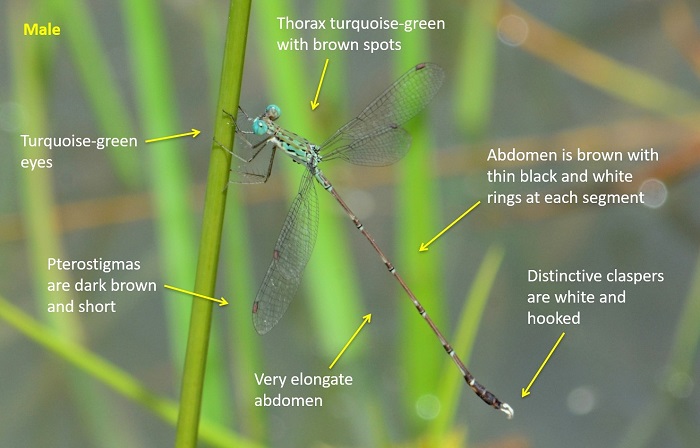
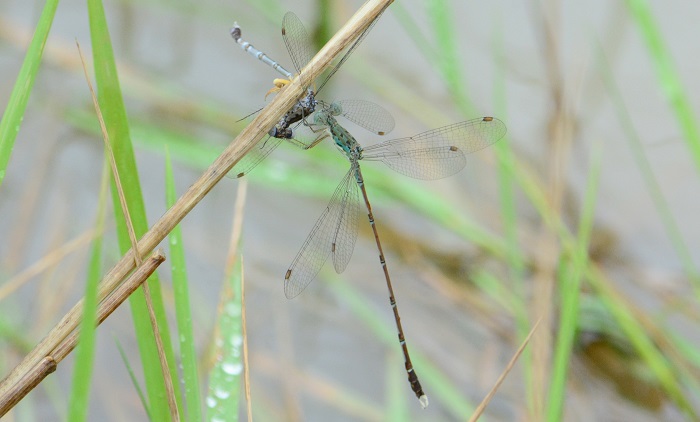
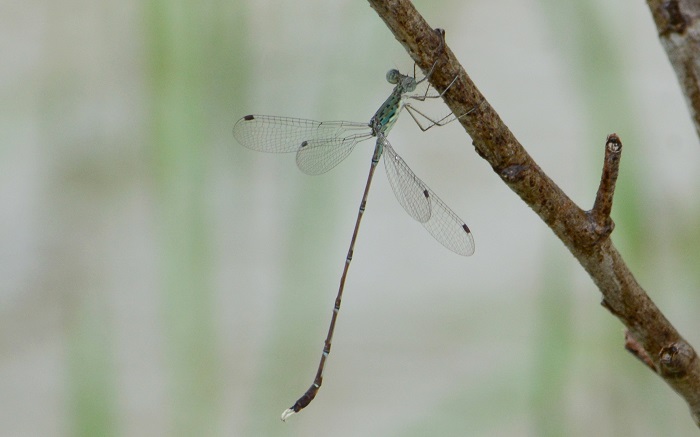
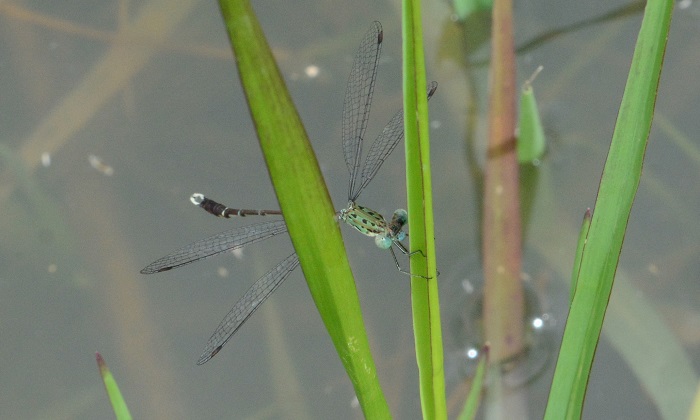
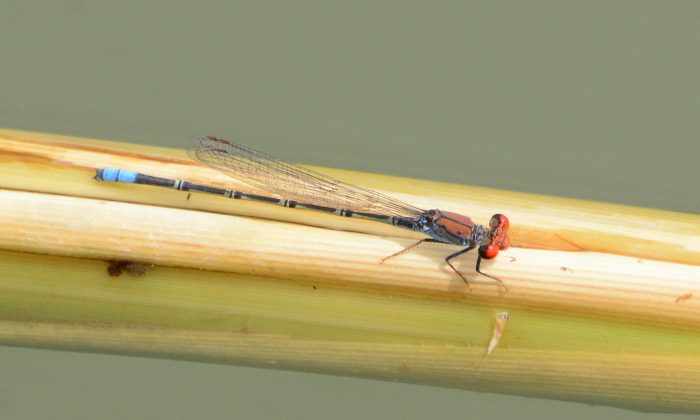
Sickle SpreadwingLestes uncifer – Male Near Hluhluwe, KwaZulu-Natal Photo by Ryan Tippett
Medium-large size
Length up to 48mm; Wingspan reaches 51mm.
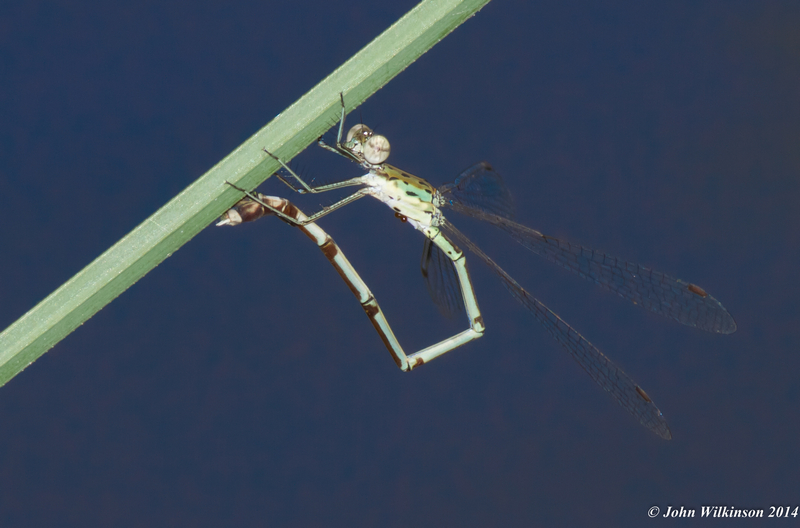
The Sickle Spreadwing is easily recognised and unlike any other spreadwing in the region. Its large size and green, turquoise and brown colouration is distinctive. In males the obviously hooked, white claspers are diagnostic.
Females are similar to males but are duller and lack the distinctive white, hooked claspers.
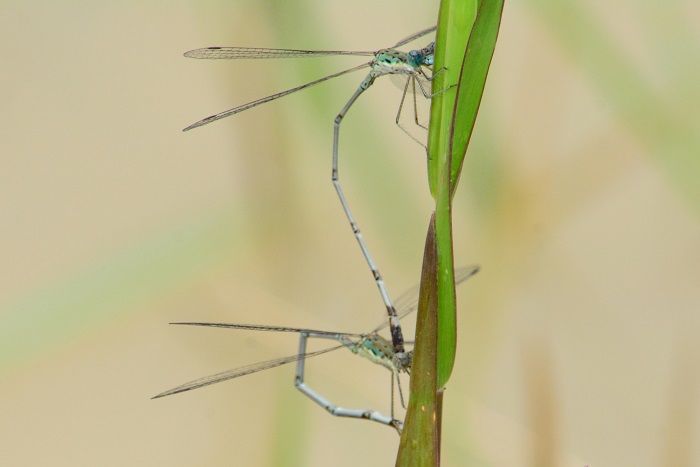
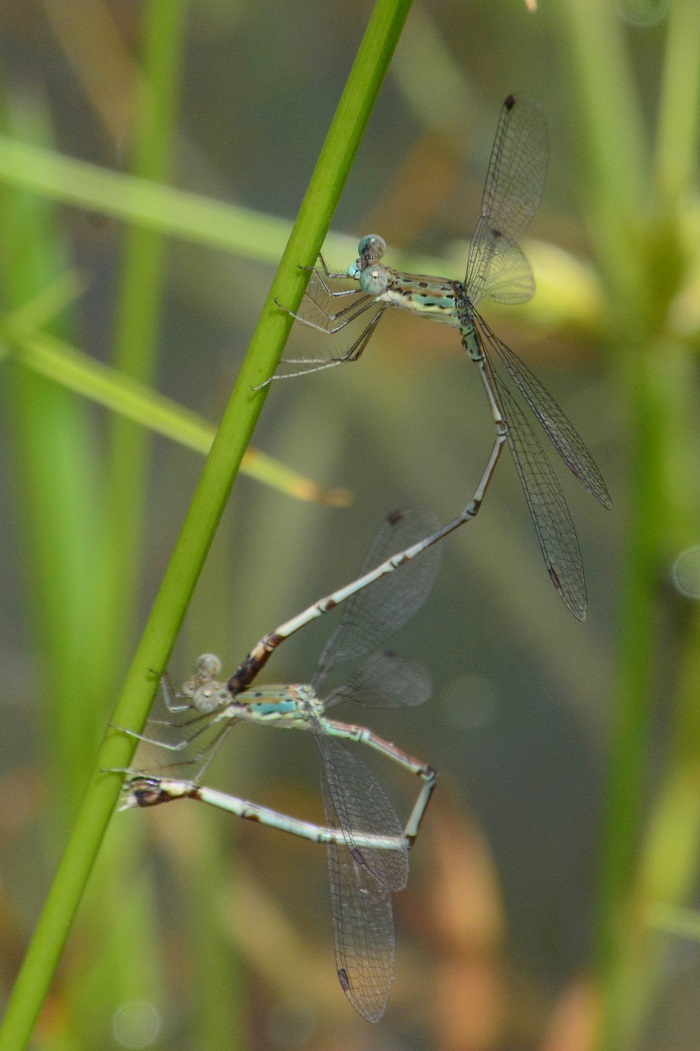
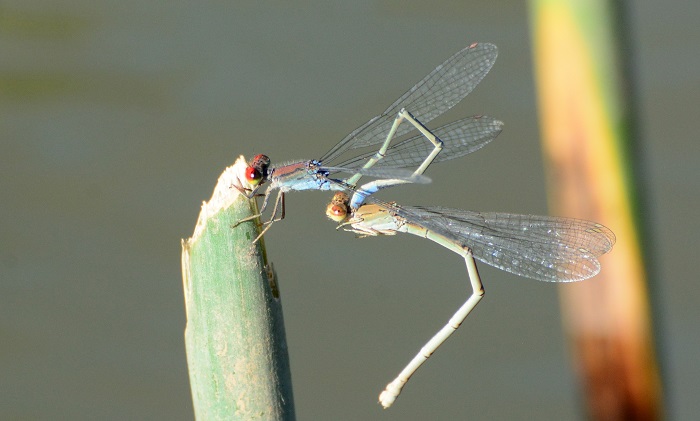
Sickle SpreadwingLestes uncifer – Pair Near Hluhluwe, KwaZulu-Natal Photo by Ryan Tippett
Habitat
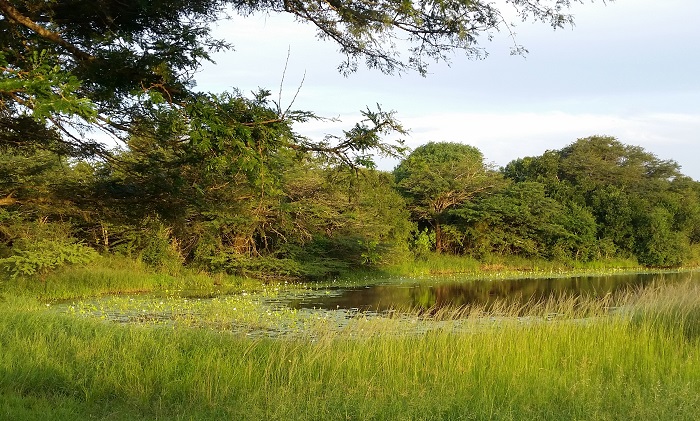
The Sickle Spreadwing inhabits ponds, pools, and marshes. It prefers habitats with tall grass and sedges surrounded by dense bush. Lestes uncifer is restricted to low altitudes, mostly in humid, and well-wooded, or forested areas.
Habitat – Near Hluhluwe, KwaZulu-Natal Photo by Ryan Tippett
Behaviour
The Sickle Spreadwing spends long periods hanging vertically from tall emergent plant stems. It is well camouflaged and is a shy and weary species that retreats into thick vegetation when disturbed. Females occur in the same vicinity as the males. The Sickle Spreadwing takes relatively large prey, including other damselfly species.
Sickle SpreadwingLestes uncifer – Feeding on a Spotted Spreadwing Lestes tridens. Near Hluhluwe, KwaZulu-Natal Photo by Ryan Tippett
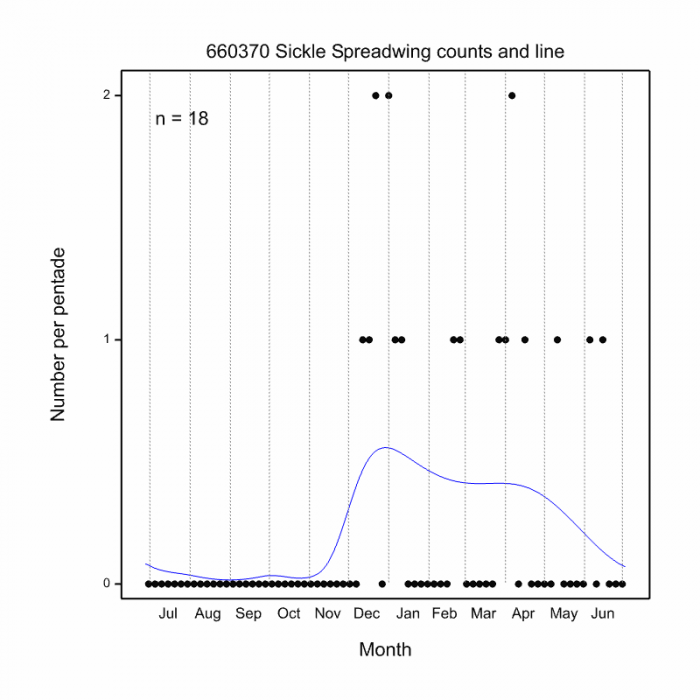
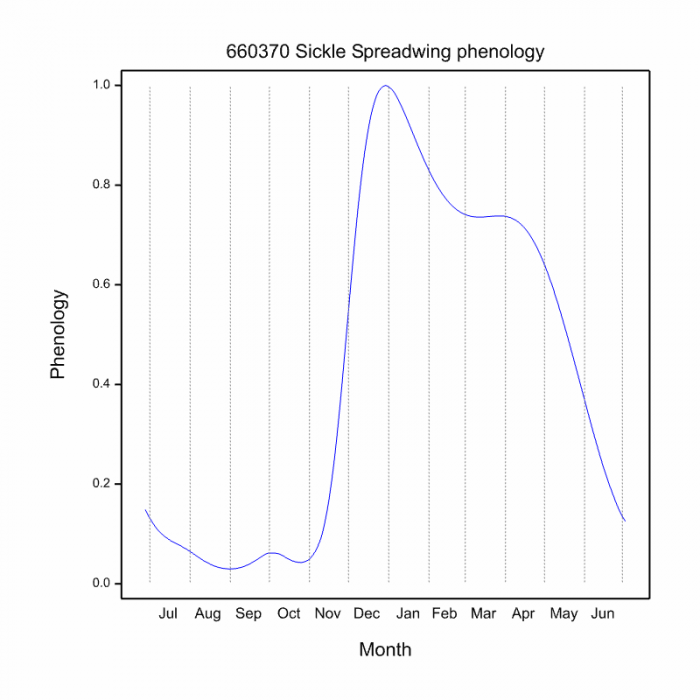
The Sickle Spreadwing is most active from late November to June, possibly all year at some sites. See Phenology below.
Status and Conservation
The Sickle Spreadwing is an uncommon and highly localised species. In South Africa, it is listed as Vulnerable in the IUCN Red List of Threatened Species. This is due to its scarcity and marginal occurrence in the country. The Sickle Spreadwing has a wider distribution in tropical Africa and is considered of Least Concern over the rest of its range. The Sickle Spreadwing is fairly sensitive to habitat degradation and is mostly found in undisturbed places. In some areas it will make use of small man-made ponds and dams, provided they offer good quality habitat.
Sickle SpreadwingLestes uncifer – Male Near Hluhluwe, KwaZulu-Natal Photo by Ryan Tippett
Distribution
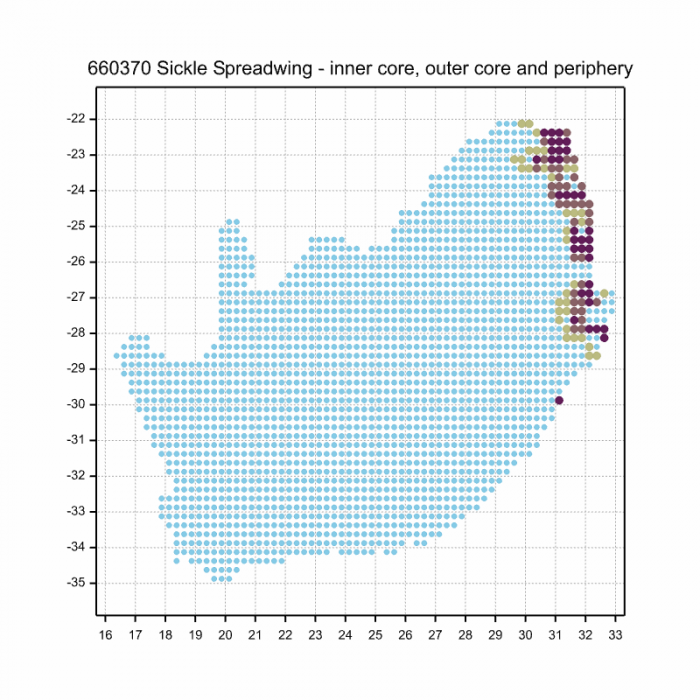
The Sickle Spreadwing is native to much of the southern and eastern parts of Africa, where it is widespread. It ranges from South Africa northwards to Kenya and Uganda. In South Africa, the Sickle Spreadwing is found in the lowveld regions of Limpopo and Mpumalanga, and the sub-tropical north-eastern parts of KwaZulu-Natal.
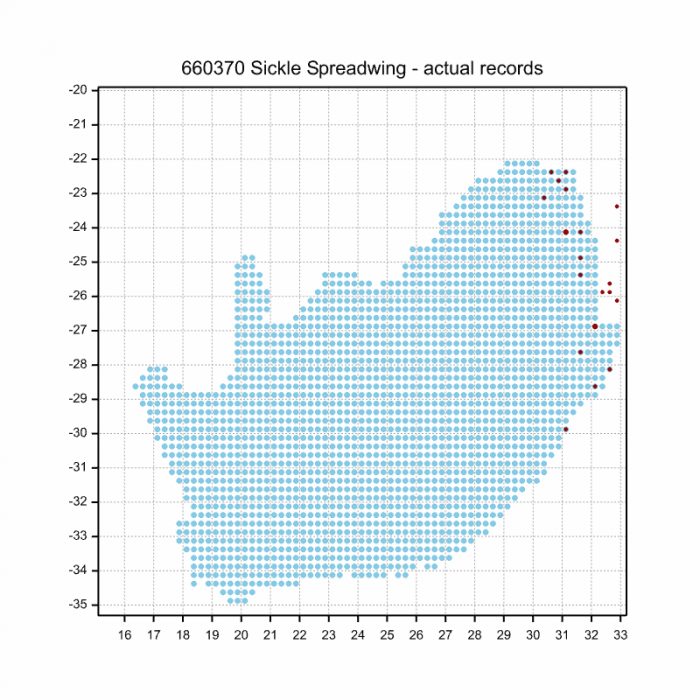
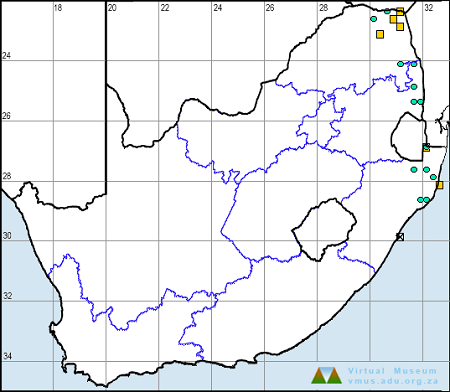
Below is a map showing the distribution of records for Sickle Spreadwing in the OdonataMAP database as at February 2020.
Below is a map showing the distribution of records for Sickle Spreadwing in the OdonataMAP database as of December 2024.
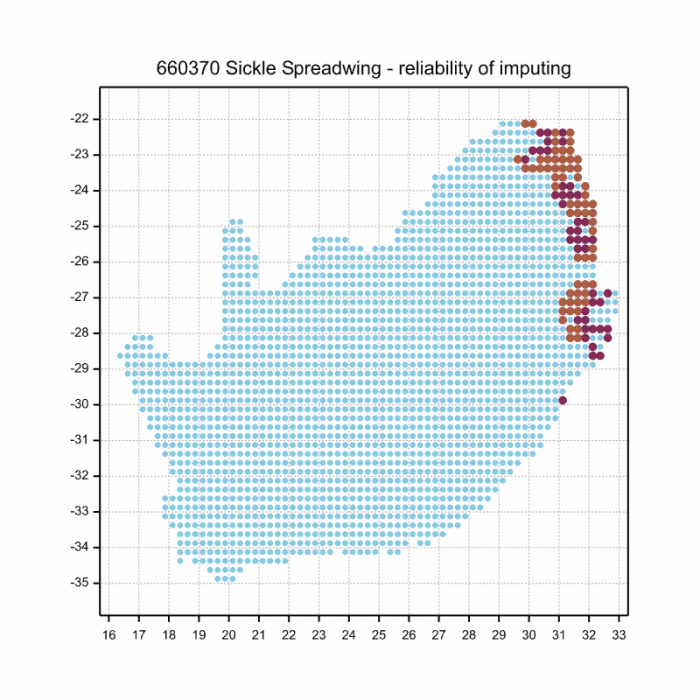
The next map below is an imputed map, produced by an interpolation algorithm, which attempts to generate a full distribution map from the partial information in the map above. This map will be improved by the submission of records to the OdonataMAP section of the Virtual Museum.
Ultimately, we will produce a series of maps for all the odonata species in the region. The current algorithm is a new algorithm. The objective is mainly to produce “smoothed” maps that could go into a field guide for odonata. This basic version of the algorithm (as mapped above) does not make use of “explanatory variables” (e.g. altitude, terrain roughness, presence of freshwater — we will be producing maps that take these variables into account soon). Currently, it only makes use of the OdonataMAP records for the species being mapped, as well as all the other records of all other species. The basic maps are “optimistic” and will generally show ranges to be larger than what they probably are.
These maps use the data in the OdonataMAP section of the Virtual Museum, and also the database assembled by the previous JRS funded project, which was led by Professor Michael Samways and Dr KD Dijkstra.
Phenology
Sickle SpreadwingLestes uncifer – Male Near Hluhluwe, KwaZulu-Natal Photo by Ryan Tippett
Further Resources
The use of photographs by John Wilkinson is acknowledged. All other photographs by Ryan Tippett.
Sickle SpreadwingLestes unciferKarsch, 1899
Other common names: Sekelspanvlerkie (Afrikaans)
Recommended citation format: Loftie-Eaton M; Navarro R; Tippett RM; Underhill L. 2025. Sickle Spreadwing Lestes uncifer. Biodiversity and Development Institute. Available online at https://thebdi.org/2020/04/20/sickle-spreadwing-lestes-uncifer/
References: Tarboton, M; Tarboton, W. (2019). A Guide to the Dragonflies & Damselflies of South Africa. Struik Nature.
Samways, MJ. (2008). Dragonflies and Damselflies of South Africa. Pensoft
Samways, MJ. (2016). Manual of Freshwater Assessment for South Africa: Dragonfly Biotic Index. Suricata 2. South African National Biodiversity Institute, Pretoria
Sickle SpreadwingLestes uncifer – Pair Near Hluhluwe, KwaZulu-Natal Photo by Ryan Tippett
Find the Peak Bluet in the FBIS database (Freshwater Biodiversity Information System) here.
Family Coenagrionidae
Identification
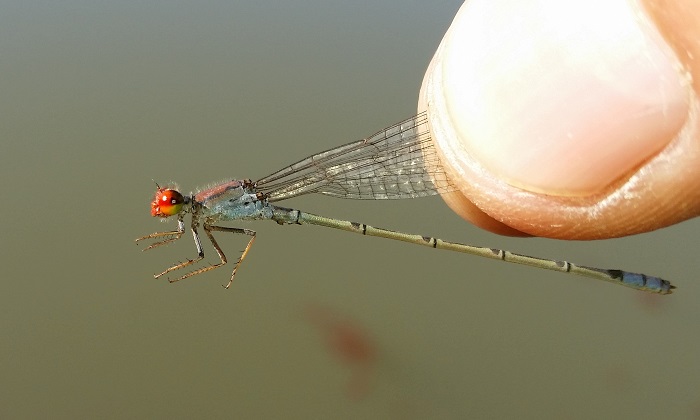
Peak BluetAfricallagma sinuatum – Male Monk’s Cowl, KwaZulu-Natal Photo by Evert Kleynhans
Small size
Length up to 36mm; Wingspan attains 37mm.
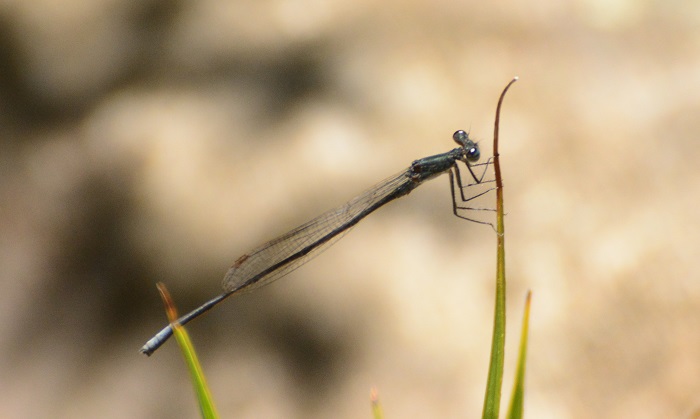
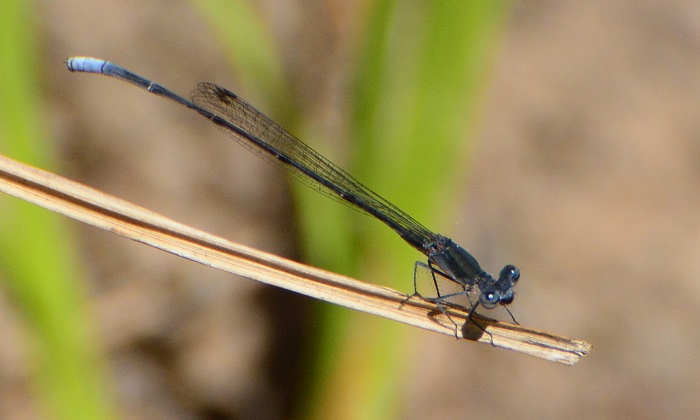
The Peak Bluet is a small blue, green, and black damselfly. It is the most elongated Bluet in the region. The very long slender abdomen and distinctive clasper shape should rule out any confusion with other species.
The Peak Bluet is most similar to the Slender Bluet (Africallagma fractum). The Peak Bluet is more elongate and has a greenish hue on the upper thorax. It also has distinctively shaped claspers.
The Peak Bluet is a species of the grassland biome. It occurs in open, mountainous regions with high rainfall where it inhabits the grassy fringes of seeps and streams. The Peak Bluet is mostly found between 1000 to 2000m above sea level.
Behaviour
The Peak Bluet usually perches on grass stems over the water, it may occasionally also be seen seen sitting on rocks in the stream.
The Peak Bluet is on the wing from September to March.
Status and Conservation
The Peak Bluet is uncommon and localised in South Africa. It is listed as of Least Concern in the IUCN Red List of Threatened Species.
Distribution
Africallagma sinuatum has a disjunct distribution in south-east Africa and has been recorded in the Democratic Republic of the Congo, Ethiopia, Malawi, South Africa, Tanzania, Zambia, and Zimbabwe. In South Africa, the Peak Bluet has only been recorded from several widely scattered locations in Mpumalanga, KwaZulu-Natal, and the Eastern Cape.
Below is a map showing the distribution of records for Peak Bluet in the OdonataMAP database as of February 2020.
Below is a map showing the distribution of records for Peak Bluet in the OdonataMAP database as of December 2024.
The next map below is an imputed map, produced by an interpolation algorithm, which attempts to generate a full distribution map from the partial information in the map above. This map will be improved by the submission of records to the OdonataMAP section of the Virtual Museum.
Ultimately, we will produce a series of maps for all the odonata species in the region. The current algorithm is a new algorithm. The objective is mainly to produce “smoothed” maps that could go into a field guide for odonata. This basic version of the algorithm (as mapped above) does not make use of “explanatory variables” (e.g. altitude, terrain roughness, presence of freshwater — we will be producing maps that take these variables into account soon). Currently, it only makes use of the OdonataMAP records for the species being mapped, as well as all the other records of all other species. The basic maps are “optimistic” and will generally show ranges to be larger than what they probably are. These maps use the data in the OdonataMAP section of the Virtual Museum, and also the database assembled by the previous JRS funded project, which was led by Professor Michael Samways and Dr KD Dijkstra.
Further Resources
The use of photographs by Evert Kleynhans and Lappies Labuschagne is acknowledged.
Peak BluetAfricallagma sinuatum(Ris, 1921)
Other Common names: Spitsbloutjie (Afrikaans).
Recommended citation format: Loftie-Eaton M; Navarro R; Tippett RM; Underhill L. 2025. Peak Bluet Africallagma sinuatum. Biodiversity and Development Institute. Available online at https://thebdi.org/2020/04/17/peak-bluet-africallagma-sinuatum/
References: Tarboton, M; Tarboton, W. (2019). A Guide to the Dragonflies & Damselflies of South Africa. Struik Nature.
Samways, MJ. (2008). Dragonflies and Damselflies of South Africa. Pensoft
Samways, MJ. (2016). Manual of Freshwater Assessment for South Africa: Dragonfly Biotic Index.Suricata 2. South African National Biodiversity Institute, Pretoria
Find the Sooty Threadtail in the FBIS database (Freshwater Biodiversity Information System) here.
Family Platycnemididae
Identification
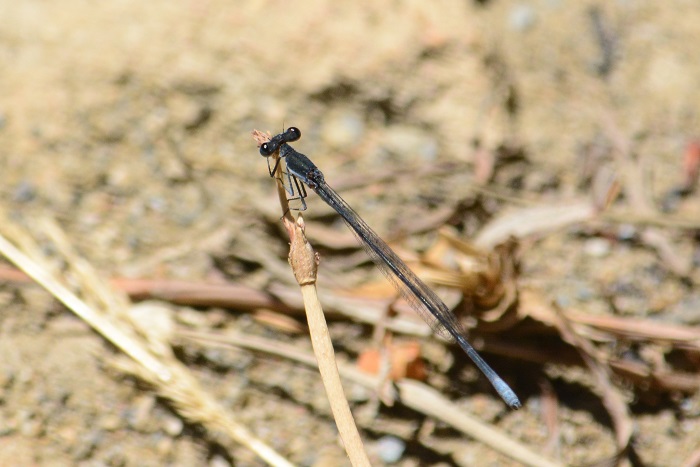
Sooty ThreadtailElattoneura frenulata – Male Seweweekspoort, Western Cape Photo by Ryan Tippett
Small size
Length up to 35mm; Wingspan attains 46mm
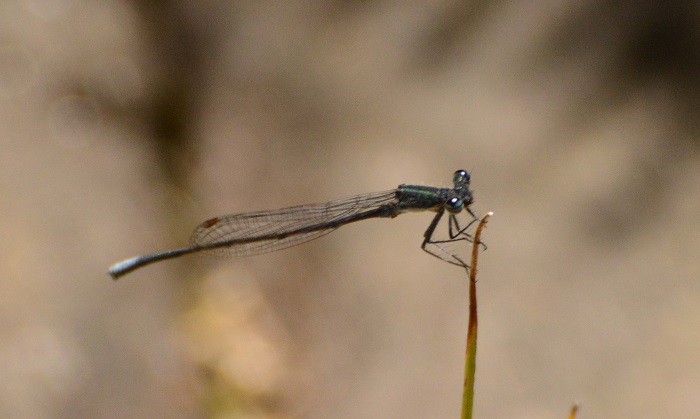
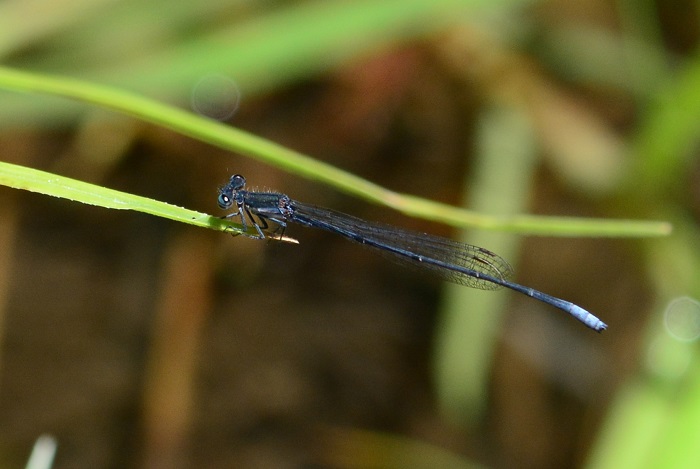
Male Sooty Threadtails are easily identified by their elongate build and dark colouration. Females are very similar to those of Elattoneura glauca (Common Threadtail), but are generally darker. Best told by their association with the males.
The Sooty Threadtail inhabits mountainous areas. It frequents well-vegetated, flowing streams and rivers, ideally with pools and slow-moving sections. It is often found among tall grass and other rank vegetation along the riverbank.
Habitat – Bainskloof, Western Cape Photo by Sharon Stanton
Behaviour
The Sooty Threadtail perches low down on grass stems and other stream side vegetation. It frequently sits on rocks or bare ground close to the water. Females are usually found in the same vicinity as the males. The Sooty Threadtail is generally sluggish and reluctant to fly. It does not fly far once disturbed and quickly resettles on a perch.
Most active from October to March (See Phenology below).
Sooty ThreadtailElattoneura frenulata – Male Tradouw’s Pass, Western Cape Photo by Ryan Tippett
Status and Conservation
Although it has a restricted distribution, the Sooty Threadtail is locally common. It is listed as of Least Concern in the IUCN Red List of Threatened Species. The Sooty Threadtail is moderately sensitive to habitat damage. It requires clean, clear water, but it does occur in habitats with some alien vegetation. The Sooty Threadtail will also readily make use of suitable, small, man-made impoundments along streams and rivers.
Sooty ThreadtailElattoneura frenulata – Male Vanrhynsdorp Waterfall, Western Cape Photo by Ryan Tippett
Distribution
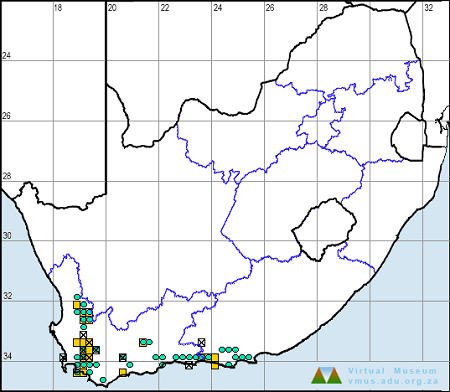
The Sooty Threadtail is endemic to South Africa. It is widespread in the mountainous regions of the Western Cape, extending marginally into the Eastern Cape province.
Below is a map showing the distribution of records for Sooty Threadtail in the OdonataMAP database as at February 2020.
Below is a map showing the distribution of records for Sooty Threadtail in the OdonataMAP database as of December 2024.
The next map below is an imputed map, produced by an interpolation algorithm, which attempts to generate a full distribution map from the partial information in the map above. This map will be improved by the submission of records to the OdonataMAP section of the Virtual Museum.
Ultimately, we will produce a series of maps for all the odonata species in the region. The current algorithm is a new algorithm. The objective is mainly to produce “smoothed” maps that could go into a field guide for odonata. This basic version of the algorithm (as mapped above) does not make use of “explanatory variables” (e.g. altitude, terrain roughness, presence of freshwater — we will be producing maps that take these variables into account soon). Currently, it only makes use of the OdonataMAP records for the species being mapped, as well as all the other records of all other species. The basic maps are “optimistic” and will generally show ranges to be larger than what they probably are. These maps use the data in the OdonataMAP section of the Virtual Museum, and also the database assembled by the previous JRS funded project, which was led by Professor Michael Samways and Dr KD Dijkstra.
Sooty ThreadtailElattoneura frenulata – Male Seweweekspoort, Western Cape Photo by Ryan Tippett
Phenology
Sooty ThreadtailElattoneura frenulata – Male Tradouw’s Pass, Western Cape Photo by Ryan Tippett
Further Resources
The use of photographs by Corrie du Toit and Sharon Stanton is acknowledged. All other photographs by Ryan Tippett.
Other common names: Roetswartdraadstertjie (Afrikaans)
Recommended citation format: Loftie-Eaton M; Navarro R; Tippett RM; Underhill L. 2025. Sooty Threadtail Elattoneura frenulata. Biodiversity and Development Institute. Available online at https://thebdi.org/2020/04/17/sooty-threadtail-elattoneura-frenulata/
References: Tarboton, M; Tarboton, W. (2019). A Guide to the Dragonflies & Damselflies of South Africa. Struik Nature.
Samways, MJ. (2008). Dragonflies and Damselflies of South Africa. Pensoft
Samways, MJ. (2016). Manual of Freshwater Assessment for South Africa: Dragonfly Biotic Index. Suricata 2. South African National Biodiversity Institute, Pretoria
Sooty ThreadtailElattoneura frenulata – Male Seweweekspoort, Western Cape Photo by Ryan Tippett
Definition. The lowdown : the most important facts and information about something (Cambridge Dictionary). This blog summarizes the key results out of LepiMAP for the butterflies of KwaZulu-Natal and the Eastern Cape.
LepiMAP is the atlas of the Lepidoptera, both butterflies and moths, in Africa. It is one of the sections of the Virtual Museum. The first major output out of this database was the Conservation Assessment of Butterflies of South Africa, Lesotho and Swaziland. The development of this atlas is reviewed here. The butterfly atlas not only collected new distributional data using the Virtual Museum and dedicated field surveys, it also assembled the data for 300,000 records of specimens in museums and private collections. Some of the specimens were collected in the 19th century. The total number of records for this atlas was 337,000. This substantial database was the platform on which the LepiMAP initiative grew. The total size of the LepiMAP database on 15 April 2020 was 546,767 records, both butterflies and moths, throughout Africa.
This review is focuses on a small geographic component of the data, and only on the butterflies. This is the first of three blogs on the state of play in LepiMAP in South Africa. This one deals with KwaZulu-Natal and the Eastern Cape. The second with Western Cape, Northern Cape and the Free State, and the third with the remaining northern provinces of South Africa: North West, Limpopo, Mpumalanga and Gauteng.
LepiMAP is now using the updated taxonomy and the English common names in the second edition of Steve Woodhall’s Field Guide to the Butterflies of South Africa. The revision was published by Penguin Random House in March this year. It features the 671 species of butterflies which have been recorded in South Africa, Lesotho and Eswatini. The common names of the butterflies have been changed as part of an initiative to give butterflies more descriptive names (e.g. the area they fly in or the habitat that they prefer). The coppers (Aloeides) are now knowns as russets. The bars (Cigaritis) are now called silverlines.
KwaZulu-Natal
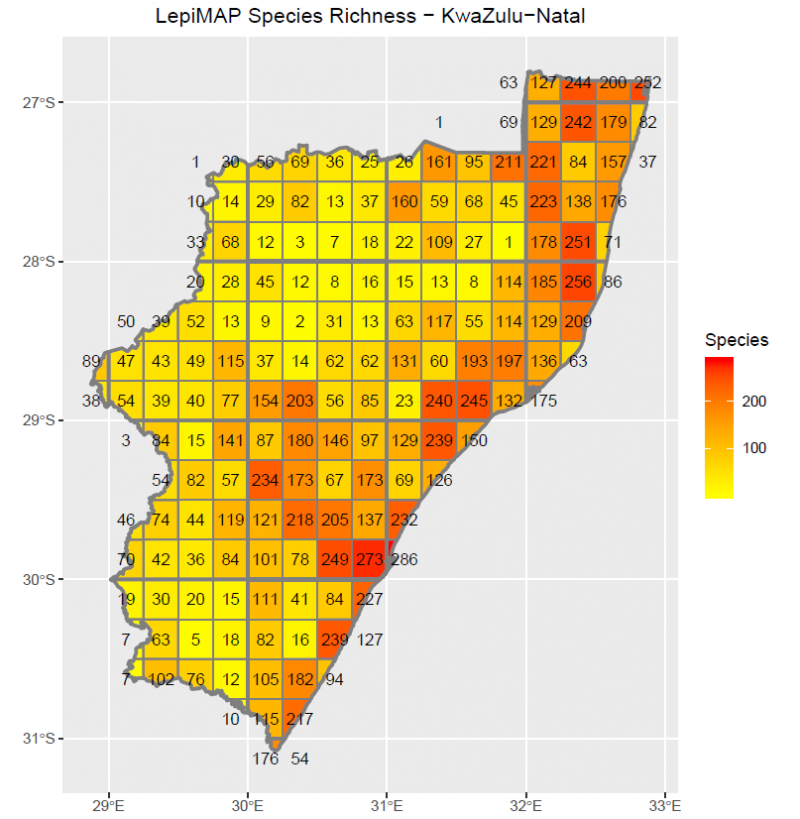
Butterfly species richness in the quarter degree grid cells of KwaZulu-Natal, from the LepiMAP database. This analysis uses the entire database, including museum and specimen records.
What is special about LepiMAP in KwaZulu-Natal is that every quarter degree grid cell has records of butterflies. That’s not quite right. There’s a grid cell with only one record and one species. It is grid cell 2731DD Ngxongwane. This record is of a Red-line SapphireIolaus sidus made by BW Plowes in January 1986. That’s 34 years ago! After the lockdown, someone needs to make a special effort to go to visit quarter-degree grid cell 2731DD Ngxongwane! It is not a long distance from the N2 as it heads northwestwards south of Eswatini.
The grid cell which seems to have the most species is 2931CC Durban East. An uncritical look at the database says that 286 species of butterfly have been recorded here. The oldest record in the database for this grid cell was made on 17 February 1854 by CGC Dickson. It’s an African Snout Libythea labdaca laius. Inside the database, in the part not open to public viewing, it says it this record was made at “Durban Morningside Burman Bush”, a locality that still persists to this day. This place description would have been linked to the actual specimen, so it is a genuine record of a species in this grid cell. The database has a total of 55 records for this species in this grid cell, made through the decades; the most recent was made by Jenny Norman on 22 March 2004, 16 years ago. African Snout needs to be refreshed.
This Durban East grid cell has an alleged total of 14,093 records of butterflies! The problem here is that there are a huge number of early museum specimens that are simply labelled “Durban” and have had their coordinates directed into this grid cell. The number of records for this grid cell since 1980 is 2,570. It would be a massively time consuming exercise to go through all the early records, and to try to work out which of the old records really came from this grid cell, and which came from somewhere in the general vicinity of “Durban”. Fortunately, this is serious problem only for this grid cell! 286 species here, even historically since 1854, is a bit of a stretch, even though it includes the bluff, the largely destroyed wetlands of Durban Bay and Durban North. See the map here.
Pride of place for the grid cell with the most butterfly records goes to 3030BC Scottburgh. It has 16,559 records; of these, 14,614 are photographic LepiMAP records uploaded via the Virtual Museum website. The photographic records stretch back to 2008, and have been contributed by citizen scientists such as Mary Lindsay, Christopher Small, Mark Liptrot, Luelle Watts, Trish Strachan, Christopher Willis and Garth Aiston. There must be a fantastic opportunity here to look at subtle changes in species composition through the past decade.
One-year butterfly species richness in the quarter degree grid cells of KwaZulu-Natal, from the LepiMAP database. This map is based on LepiMAP records from 12 April 2019 to 12 April 2020
This map is quite alarmingly empty! Steve Woodhall admonishes LepiMAPpers: “For me, the take home message from this map is that we KZNers have become creatures of habit, going to our favourite spots month in month out!” The two grid cells towards the south with 159 and 138 species are 2930DD Durban West and 3030BC Scottsburgh, respectively. These have resident LepiMAPpers, and their long-term regular contributions are going to be amazing to search for trends. Two grid farther north have more than 100 species in the past year. Steve says: “2931AB Tugela (105 species) is high because of the popularity of Harold Johnson Nature Reserve, and in 2831CD Eshowe the popular spots are Dlinza and Mandawe. We need to move out.”
Months of the most recent visits to the quarter degree grid cells of KwaZulu-Natal, according to the LepiMAP database. The year of the visit is colour-coded according to the bar on the right, and the month of the last butterfly record submitted to LepiMAP is shown in the grid cell. Grid cells shaded beige have not had a butterfly record submitted since prior to the year 2000.
Many grid cells are dark blue or light blue, so that they have had records since 1 January 2019, especially along the coast on along the N3 axis towards the interior. But an inspection of the previous figure shows that, in many grid cells, just a handful of records have been made! There are two grid cells which are beige, so they have not had a single record this millennium!
Eastern Cape
Butterfly species richness in the quarter degree grid cells of the Eastern Cape, from the LepiMAP database. This analysis uses the entire database, including museum and specimen records.
In the Eastern Cape, the grid cells having the largest species richness for butterflies are mainly along the coast and the coastal plain. The grid cell with the largest number of species, according to the database, is 3129DA Port St Johns. There are 5,315 records of butterflies allegedly from this grid cell, and 227 species. But 3,453 of these are prior to 1980. It is likely that this grid cell has the same problem is the Durban East grid cell mentioned above. The 1,862 records since 1980 represent 182 species, and it remains the most species rich grid cell in the Eastern Cape. Many museum specimens collected over a large area would have been labelled “Port St Johns”, which was once the largest town in the region.
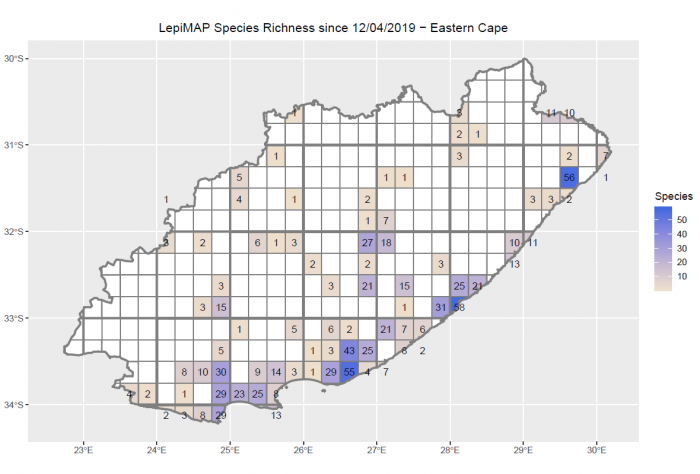
One-year butterfly species richness in the quarter degree grid cells of the Eastern Cape, from the LepiMAP database. This map is based on LepiMAP records from 12 April 2019 to 12 April 2020
Most records of butterflies submitted to LepiMAP from the Eastern Cape during the past year have been from coastal grid cells. It would be amazing to get a lot more records from all over the Eastern Cape!
Months of the most recent visits to the quarter degree grid cells of the Eastern Cape, according to the LepiMAP database. The year of the visit is colour-coded according to the bar on the right, and the month of the last butterfly record submitted to LepiMAP is shown in the grid cell. Grid cells shaded beige have not had a butterfly record submitted since prior to the year 2000.
There is a large number of grid cells shaded beige, and without a month. These have not been visited this millennium! There is lot of opportunity to make a major contribution to LepiMAP in all these grid cells.
Fanie Rautenbach does almost all the identifications of butterflies for LepiMAP. We asked him for his ideas on all these maps, for both provinces. He said: “I think these maps are very informative. The more you look at them the more information you see. However, they do highlight a major problem we have with LepiMAP. The project is doing well in a small number of sectors and doing not so well in the majority of sectors. I am especially surprised by the number of sectors in the Eastern Cape that have no records in the last 20 years. We really need to come up with ideas (1) to recruit more citizen scientists in the rural areas and (2) to encourage current citizen scientists to travel more.” If you are able to help, please do. The need is great.
Find the Vaal Sprite in the FBIS database (Freshwater Biodiversity Information System) here.
Family Coenagrionidae
Identification
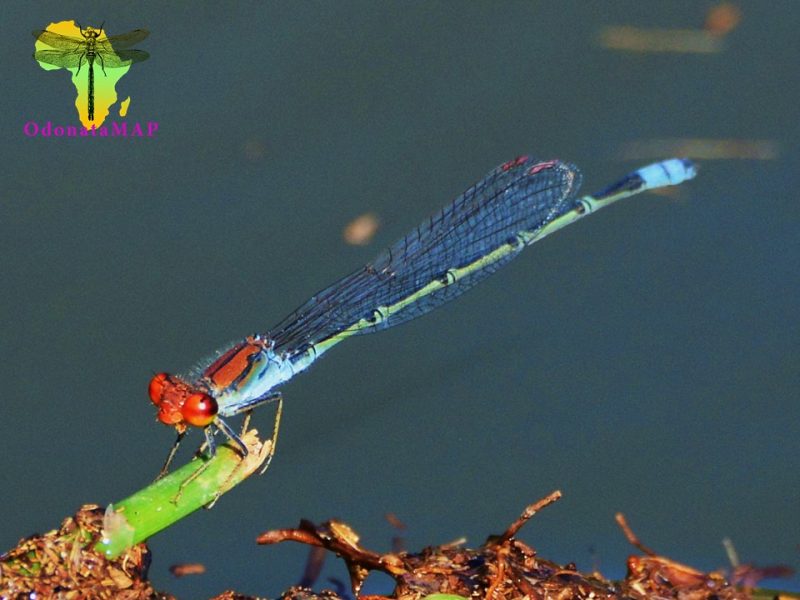
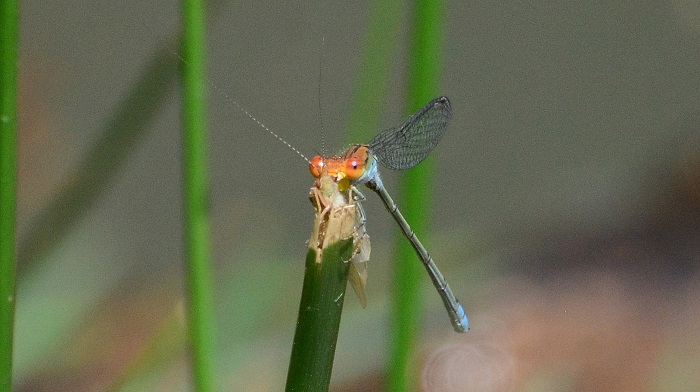
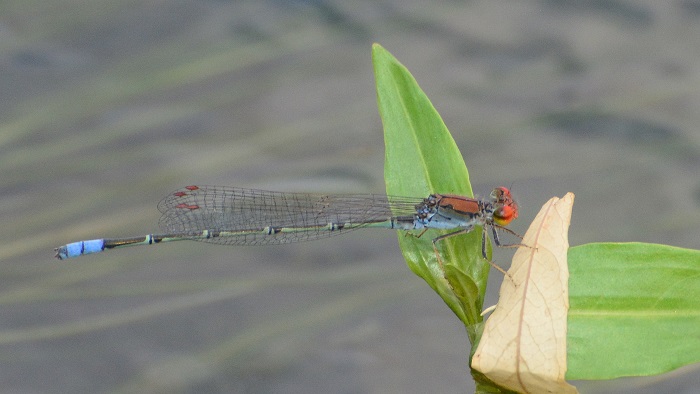
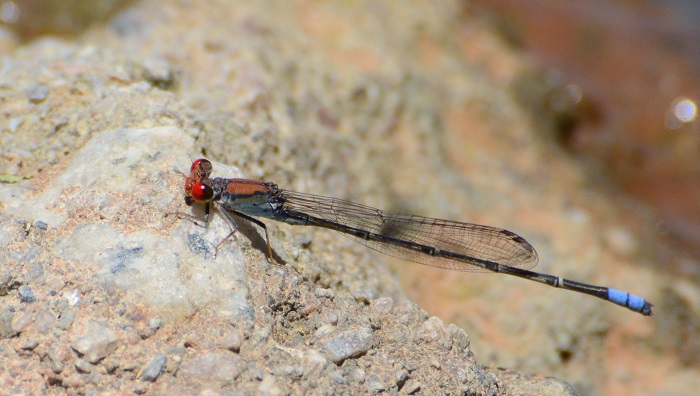
Vaal SpritePseudagrion vaalense – Mature Male Near Prieska, Northern Cape Photo by Ryan Tippett
Small size but is the largest of the ‘Red’ sprites in South Africa.
Length up to 39mm; Wingspan attains 49mm
Like many other Pseudagrion species the male Vaal Sprite’s colouration is variable and changes gradually with age. The postocular spots in particular, range from greenish when young, through greenish-orange, to orange-brown in aged individuals. The sides of the thorax are greenish-blue in young individuals. The light blue pruinosity starts low down and eventually extends up to the antehumeral stripe with maturity.
Vaal SpritePseudagrion vaalense – Young Male Upington, Northern Cape Photo by Ryan Tippett
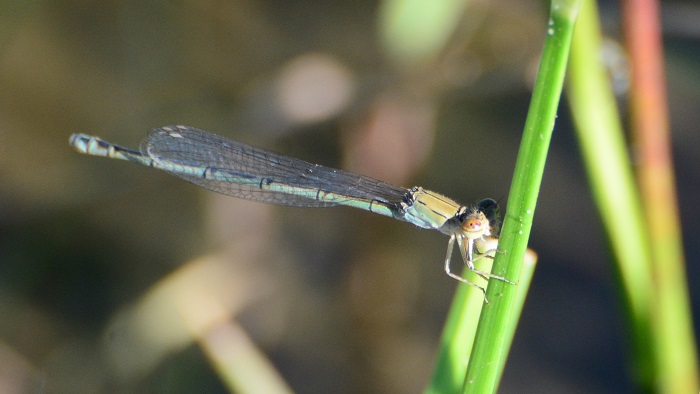
Females are khaki brown, often with a thin pale blue dusting on the sides of the thorax and abdomen. They are best identified by their association with the males.
The Vaal Sprite is one of four mostly red sprites found in South Africa. The others are the Acacia Sprite, Masai Sprite, and the Variable Sprite
Vaal SpritePseudagrion vaalense – Female Near Prieska, Northern Cape Photo by Ryan Tippett
Habitat
The Vaal Sprite inhabits strong flowing rivers in open landscapes. The preferred habitat is fast flowing water with abundant rocks and some emergent and bank side vegetation like reeds and grasses. It appears to somewhat avoid large stretches of broken or white water. In areas where they are numerous, the Vaal Sprite will also occupy slow-moving parts of the river as well as quiet backwaters. Pseudagrion vaalense mostly frequents undisturbed habitats and generally avoids dams and degraded stretches of rivers.
Ideal habitat – Orange River near Keimoes, Northern Cape Photo by Ryan Tippett
Behaviour
The Vaal Sprite is seldom found away from rivers. They perch prominently at sunny locations on rocks and vegetation, typically low down, close to the water. It is weary and alert, often flying to midstream rocks and reeds when disturbed. The Vaal Sprite frequently hovers over eddies and swirls where the current is strong. The flight is rapid and usually low over the water. Females are frequently found in the same vicinity as the males.
The Vaal Sprite is active from OctobertoMay (see Phenology below)
Vaal SpritePseudagrion vaalense Near Prieska, Northern Cape Photo by Ryan Tippett
Status and Conservation
The Vaal Sprite is locally common at suitable sites within its restricted distribution. It is listed as of Least Concern in the IUCN Red List of Threatened Species. The Vaal Sprite is moderately sensitive to habitat degradation and occurs mostly in undisturbed places. The species has not adapted to man-made habitats.
Vaal SpritePseudagrion vaalense Near Keimoes, Northern Cape Photo by Ryan Tippett
Distribution
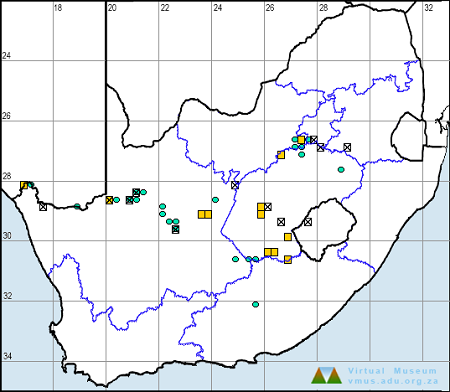
The Vaal Sprite is endemic to South Africa and southern Namibia. It is restricted to the Orange/Vaal River system and its major tributaries. The Vaal Sprite has been recorded from the Free State, North West, Northern Cape, and Eastern Cape Provinces.
Vaal SpritePseudagrion vaalense Near Keimoes, Northern Cape Photo by Ryan Tippett
Below is a map showing the distribution of records for Vaal Sprite in the OdonataMAP database as at February 2020.
Below is a map showing the distribution of records for Vaal Sprite in the OdonataMAP database as of December 2024.
The next map below is an imputed map, produced by an interpolation algorithm, which attempts to generate a full distribution map from the partial information in the map above. This map will be improved by the submission of records to the OdonataMAP section of the Virtual Museum.
Ultimately, we will produce a series of maps for all the odonata species in the region. The current algorithm is a new algorithm. The objective is mainly to produce “smoothed” maps that could go into a field guide for odonata. This basic version of the algorithm (as mapped above) does not make use of “explanatory variables” (e.g. altitude, terrain roughness, presence of freshwater — we will be producing maps that take these variables into account soon). Currently, it only makes use of the OdonataMAP records for the species being mapped, as well as all the other records of all other species. The basic maps are “optimistic” and will generally show ranges to be larger than what they probably are.
These maps use the data in the OdonataMAP section of the Virtual Museum, and also the database assembled by the previous JRS funded project, which was led by Professor Michael Samways and Dr KD Dijkstra.
Vaal SpritePseudagrion vaalense Near Keimoes, Northern Cape Photo by Ryan Tippett
Phenology
Vaal SpritePseudagrion vaalense – Pair Near Prieska, Northern Cape Photo by Ryan Tippett
Further Resources
All photographs by Ryan Tippett.
Vaal SpritePseudagrion vaalenseChutter, 1962
Other common names: Vaalriviergesie (Afrikaans)
Recommended citation format: Loftie-Eaton M; Navarro R; Tippett RM; Underhill L. 2025. Vaal SpritePseudagrion vaalense. Biodiversity and Development Institute. Available online at https://thebdi.org/2020/04/13/vaal-sprite-pseudagrion-vaalense/
References: Tarboton, M; Tarboton, W. (2019). A Guide to the Dragonflies & Damselflies of South Africa. Struik Nature.
Samways, MJ. (2008). Dragonflies and Damselflies of South Africa. Pensoft
Samways, MJ. (2016). Manual of Freshwater Assessment for South Africa: Dragonfly Biotic Index. Suricata 2. South African National Biodiversity Institute, Pretoria
Martens, A; Suhling, F. (2007). Dragonflies and Damselflies of Namibia. Gamsberg Macmillan.
Vaal SpritePseudagrion vaalense – Female Near Prieska, Northern Cape Photo by Ryan Tippett
It’s clear that the world on the far side of the lockdown is going to be different. It also seems that birding will change. Birders will look up more! And see the blue sky birds.
It is striking how many of the recent submissions to BirdPix are variations of this theme:
Kelp Gull over Rondebosch on the 7th of Lockdown, otherwise known as 2 April 2020. Submitted to BirdPix by Itxaso Quintana (BirdPix 108342)
This is the bluest photo in the whole of BirdPix. And there have been dozens more blue sky birds since the start of the lockdown in South Africa on Friday 27 March. The theme of this blog is something like “the birds and the blues”.
When you run out of garden birds, or if you don’t have a garden, lockdown birding needs a new strategy. And judging by the photos submitted in the past two weeks, BirdPixers are looking up more and more.
Salome Willemse, based at Botuin Olives in Vanrhynsdorp, has submitted about half a dozen blue sky birds to BirdPix. She says: “I have realised that we have far more birds if you pay attention to the sky as well. I have recorded 64 species from my garden. Maybe 20 or so flew over.” This is the first African Black Swift she has seen in her pentad, which she atlases regularly.
African Black Swift over Botuin Olives on the outskirts of Vanryhnsdorp, Western Cape. 11 Lockdown = 6 April 2020. Submitted to BirdPix by Salome Willemse (BirdPix 108575)
This is also the first BirdPix record of African Black Swift in quarter degree grid cell3118DB and becomes its 132nd species. It’s not surprising that it took 336 BirdPix records for the grid cell to record this species, because the normal range of African Black Swift fades out at about the Olifants River, about 50 km to the south.
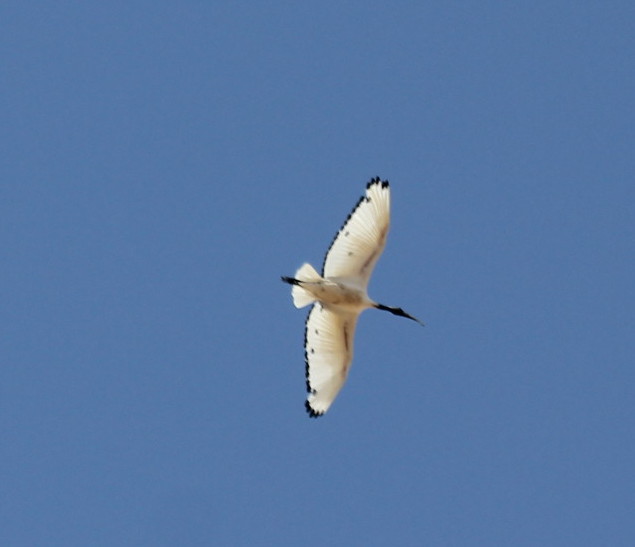
African Sacred Ibis over Botuin Olives on the outskirts of Vanryhnsdorp, Western Cape. 11 Lockdown = 6 April 2020. Submitted to BirdPix by Salome Willemse (BirdPix 108576)
Another of Salome’s blue sky birds is this African Sacred Ibis. Besides being a beautiful photo showing the translucence of the wings, what is fascinating about this photo is that the ibis is doing primary moult. The five outermost primaries look a bit duller than the inner ones, and the sixth one from the outside is not quite fully grown. The black tip of the feather is the first to be produced, and finally ends up in position on the trailing edge of the wing. Rather little is known about the moult of the African Sacred Ibis. So this record makes a contribution to ornithology.
Mark Stanton, in Randberg, says: “The garden certainly has its limits! …” So he looked up and found …
African Palm-Swift over Randburg, Gauteng. 12 Lockdown = 7 April 2020. Submitted to BirdPix by Mark Stanton (BirdPix 108653)
… African Palm-Swift. “This was a lifer for me in my garden! I just never bothered to try and get images of them before, I always assumed they were White-rumped Swifts which are common around here. This was in among the 100 images I took.” This is the second record of African Palm-Swift in grid cell 2627BB; the previous record was made in April 2017, so it was overdue for “refreshment“. This grid cell has 1,874 BirdPix records for 166 species.
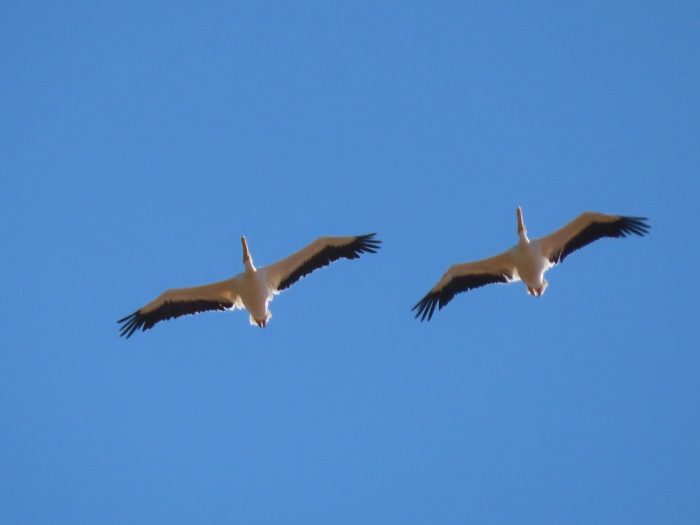
Great White Pelicans over Riebeek Kasteel, Western Cape. 13 Lockdown = 8 April 2020. Submitted to BirdPix by Fiona Hellmann (BirdPix 108783)
One of Fiona Hellmann’s blue sky birds submitted to BirdPix was these two Great White Pelicans flying over her home in Riebeek Kasteel. Most pelicans in the Western Cape are based on Dassen Island. Every day the birds radiate out from the island and many feed at the farm dams in the Swartland, so they are fairly common in the area. Even so, this is the first BirdPix record for this grid cell (3318BD). Fiona says: “I’m not spending more time looking at the sky – just more time sitting on the stoep and watching everything fly past. My strategy is to listen out for the Pied Crows and White-necked Ravens. Most often when I hear them they are mobbing or harassing a bird of prey.” Her stoep view is below.
The view from Fiona Hellmann’s stoep over the Riebeek Mountains, Western Cape
But if you live in the suburbs, the view of the blue is interrupted by street furniture. Aesthetically, this might be a negative, but it provides a practical positive. Perches.
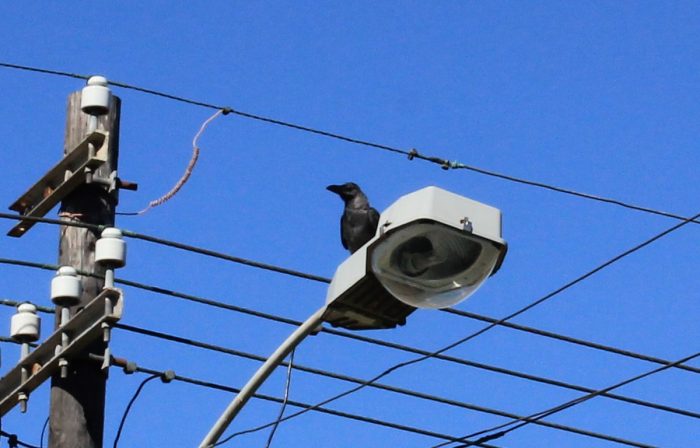
House Crow in Rondebosch East, Western Cape. 8 Lockdown = 3 April 2020. Submitted to BirdPix by Fanie Rautenbach (BirdPix 108510)
So you thought the House Crows had been eliminated from the Western Cape? They are still around. This blue sky bird was recorded by Fanie Rautenbach. Fanie plays a pivotal role in LepiMAP, and most of the records he submits to the Virtual Museum are butterflies, and he has also made some impressive contributions to other sections of the Virtual Museum. He does the identifications of almost all the butterflies, and does them amazingly fast. We owe him a special vote of thanks. He says: “At the moment, I have no other choice but to look skywards. Not much going on here in terms of butterflies here in my non-existent garden. Sometimes the House Crows wake me up with their persistent caws.”
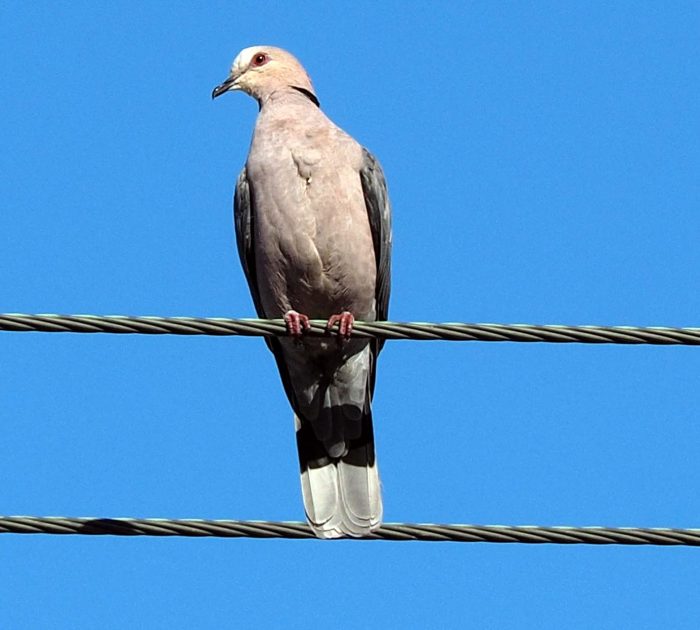
Red-eyed Dove in Plumstead, Western Cape. 8 Lockdown = 3 April 2020. Submitted to BirdPix by Rene Navarro (BirdPix 108391)
Even Rene Navarro, the information systems specialist responsible for the original design of the Virtual Museum, for its development and for keeping it running, is staring up into the sky from time to time in his garden in Plumstead , camera at the ready. The scalloped edges of the breast feathers of this Red-eyed Dove indicate that it is a juvenile. The complex texture of the electricity cables is as interesting as the bird!
Jackal Buzzard in St Francis Bay, Eastern Cape. 8 Lockdown = 3 April 2020. Submitted to BirdPix by Desire and Gregg Darling (BirdPix 108552)
Perhaps not unsurprisingly, a fair proportion of the blue sky birds are of raptors. Desire and Gregg Darling submitted this awesome Jackal Buzzard from St Francis Bay in the Eastern Cape. This is the 19th record of Jackal Buzzard from grid cell 3424BB; the previous record was in July 2019, so it was due for “refreshment“. Other blue sky raptors are Verreaux’s Eagle from the northern Cederberg, African Harrier-Hawk from Randburg and African Fish-Eagle from Riebeek Kasteel.
The most frequently recorded blue sky bird was the ubiquitous Pied Crow. If you ignore the crows, the fascinating thing about this collage is the variety of shades of blue sky.
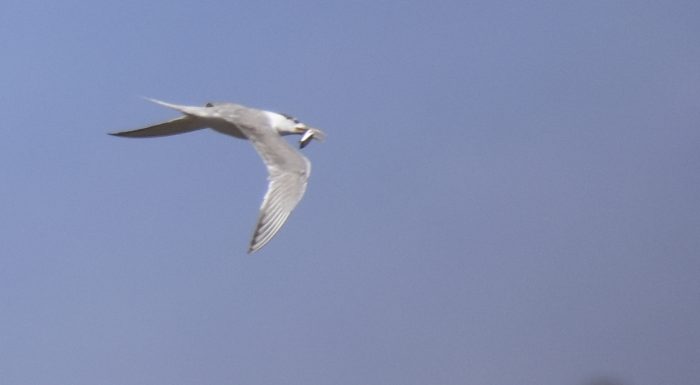
Swift Tern over Rondebosch, Western Cape. 9 Lockdown = 4 April 2020. Submitted to BirdPix by Karis Daniel (BirdPix 108475)
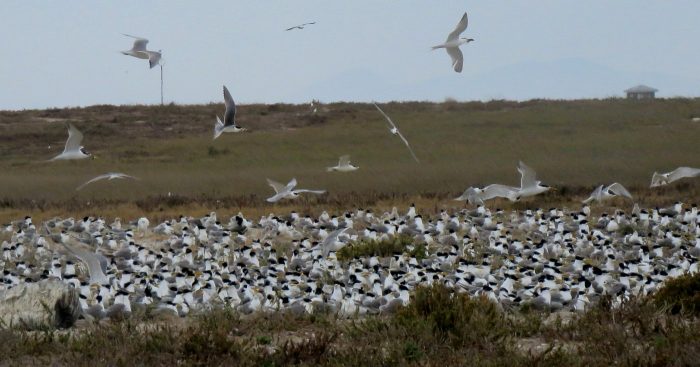
Karis Daniel photographed this Swift Tern flying north over suburban Rondebosch. It was one of many carrying a fish. The tide goes out a long way from Rondebosch! What’s going on? Currently Swift Terns are breeding on Robben Island. So the ultimate destination of each fish is a chick on the island. The terns must be catching the fish in False Bay, and taking the short cut across the peninsula between False Bay and Table Bay. The distance between the breeding colony and False Bay is about 45 km. So these birds are flying 90 km to fetch one fish for their chick.
This is a small part of the Swift Tern breeding colony on Robben Island on 8 March 2020. Submitted to BirdPix by Les Underhill (BirdPix 106285)
By good luck, BirdPix has a record of the 2020 Swift Tern breeding colony on Robben Island. The photo was taken on 8 March. At that stage, the terns were tightly on their nests, incubating eggs. On 4 April, when Karis took the photo with the fish, the eggs would have hatched, and parents would have to cope with hungry chicks. The nearest suitable fish must have been in False Bay. At least the birds didn’t take the long sea-route around Cape Point to get there.
Subantarctic Skua, offshore of Stilbaai, Western Cape. 7 Lockdown = 2 April 2020. Submitted to BirdPix by Menno and Krysia Stenvert (BirdPix 108631)
The blue is not only sky, it can also be sea. Of the 16 records of Subantarctic Skua in the BirdPix database, this is probably the only one taken from land. The remainder are at sea, often 20 or more kilometres from the shore. Menno Stenvert estimates that this Subantarctic Skua was about 1.5 km offshore of his home at Stilbaai.
What a lot of blue photographs. I hope you will go outside with your camera and patiently search the sky for birds. Please upload them to the Virtual Museum. The method for doing the submissions is described here.
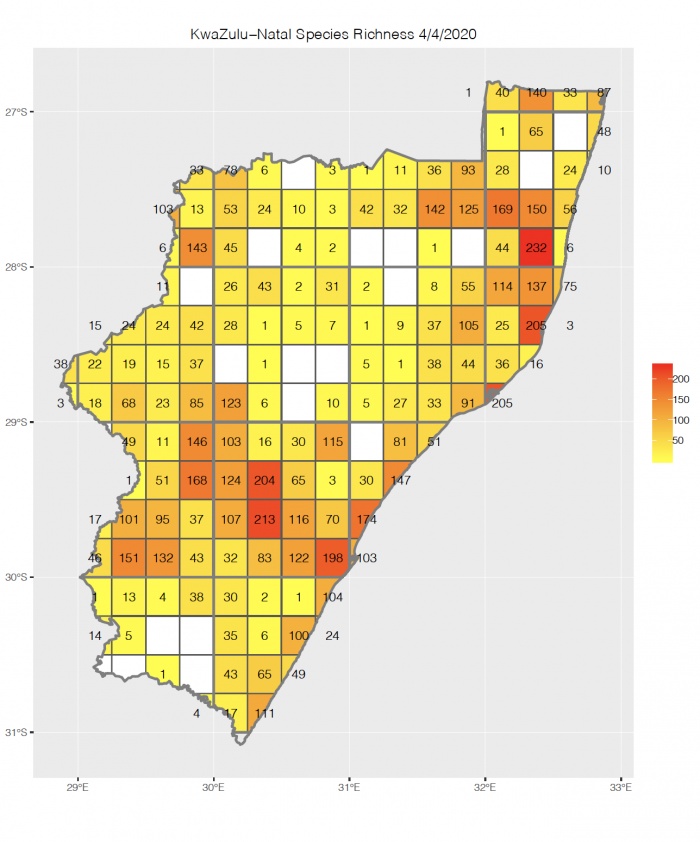
This map shows the number of bird species recorded per quarter degree grid cell in BirdPix in KwaZulu-Natal. The darker the shade, the more species. See the bar on the right.
Species richness in coastal KwaZulu-Natal, and through the Midlands to the foothills of the Drakensberg, is generally impressive. Five grid cells have more than 200 species. These set the standard that we should be aiming at! Another 28 grid cells have between 100 and 200 species. In the northeast, quarter degree grid cell 2729DD Newcastle, with 143 species stands head and shoulders above its neighbours. This was the initiative of citizen scientist Dave Rimmer while he was based there.
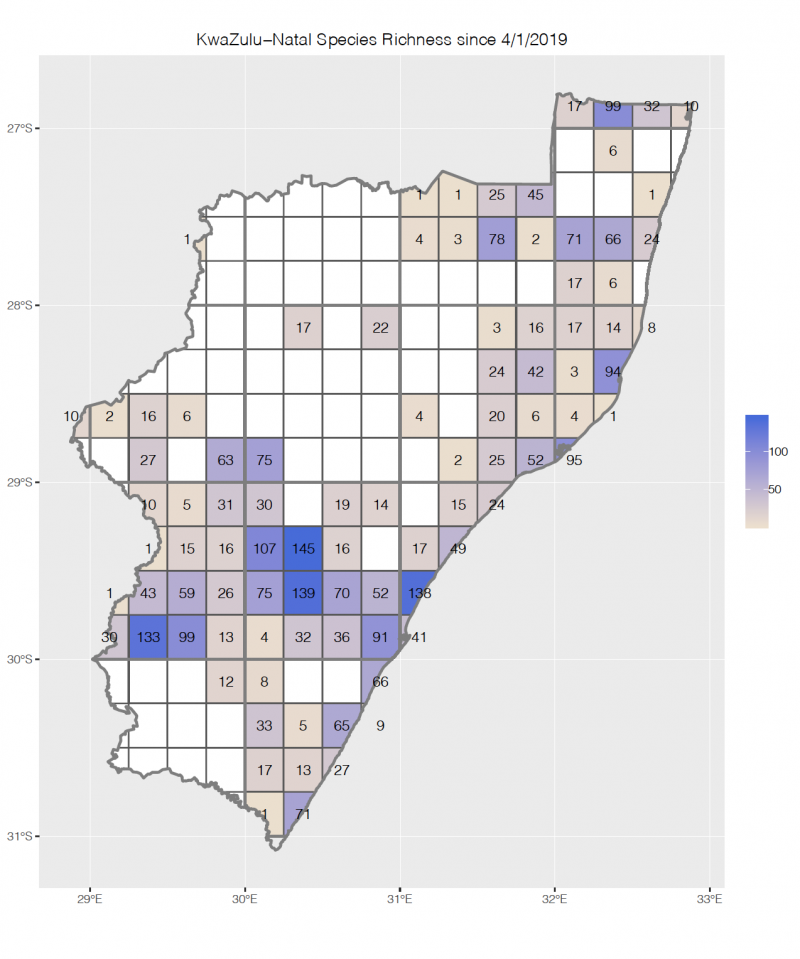
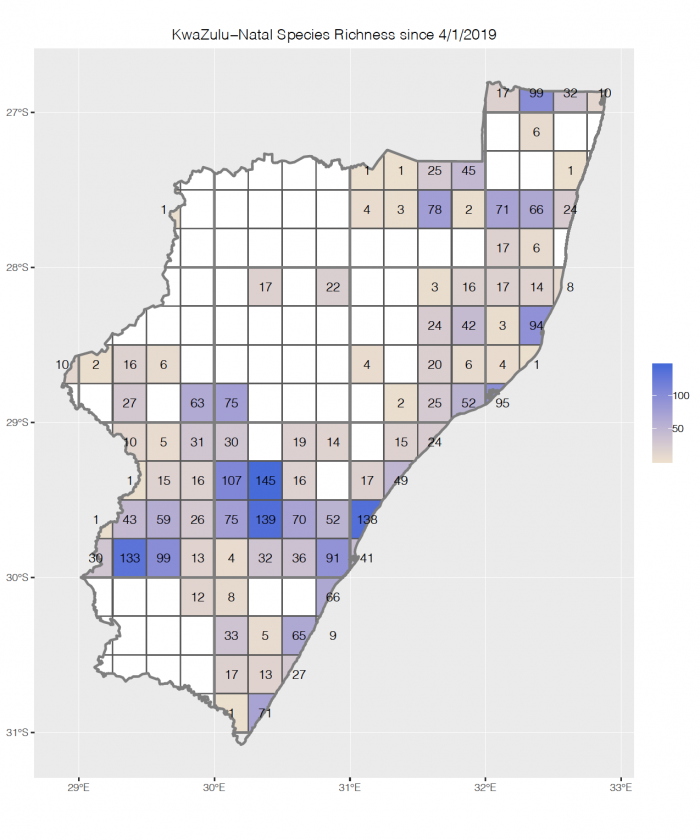
This map shows the number of bird species recorded per quarter degree grid cell in BirdPix in KwaZulu-Natal in the past year, since 1 April 2019. The darker the shade of blue, the more species. See the bar on the right. The colour coding is chosen to be different from the previous map, so there is no confusion between them.
Five grid cells have received records for 100 or more species in the past year, and there are another 17 with 50 to 99. This is great because it helps keep the database up-to-date. In the northwest, only two grid cells have received records in the past 12 months.
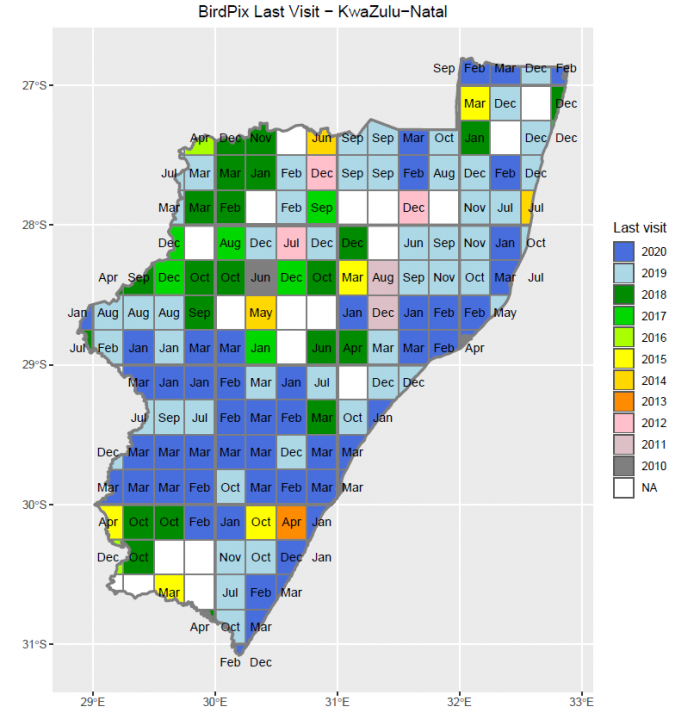
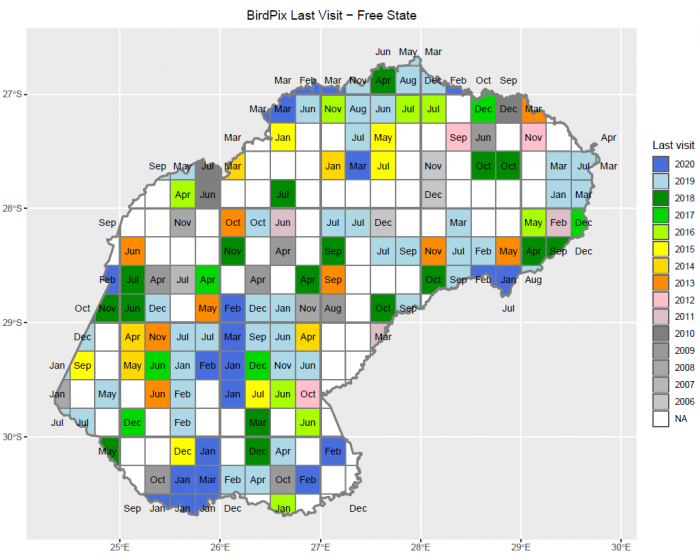
This map shows the date on which each quarter degree grid cell was last visited and had a record uploaded to BirdPix in KwaZulu-Natal. You determine the year from the colour bar on the right, and the month is given inside the grid cell. Blank cells have not got any BirdPix records yet.
The dominant colour on this map is blue. There is lots of dark blue. These quarter degree grid cells have all had 2020 records, in January, February or March! All the light blue grid cells have records from last year, 2019. There is a patch dominated by the shades of green in the northwest, where the last records date from 2018 and earlier years. This should be a focus of attention!
The first blog in this series dealt with BirdPix in the three “Cape” provinces. It also had an introduction that won’t be repeated here. All that needs to be said is that BirdPix is really important, and we are wanting to grow the database rapidly. The third blog focuses on KwaZulu-Natal.
This second blog covers BirdPix progress up to 4 April 2020 in the five northern provinces of South Africa: Limpopo, Mpumalanga, Gauteng, North West and Free State. There are three maps for each province, with Mpumalanga and Gauteng plotted together. So that means there is a total of 12 maps. The maps were prepared by Karis Daniels and Itxaso Quintana. Rene Navarro wrote the amazing query that extracts the data. The blog is first published with just the maps, and a paragraph of text for each will be added later!
Limpopo
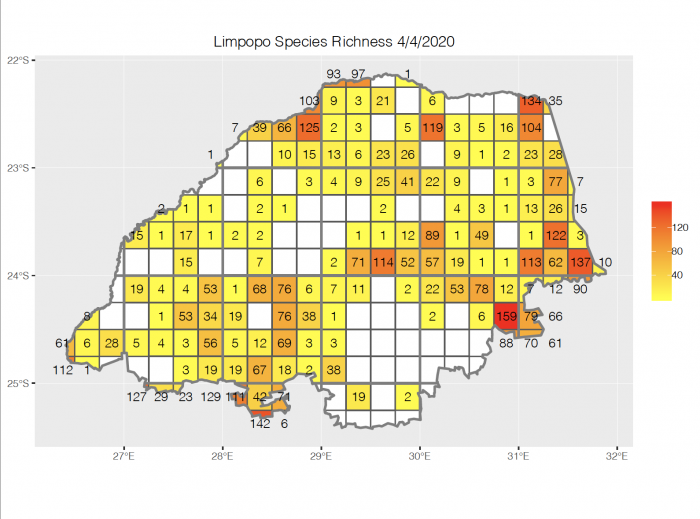
This map shows the number of bird species recorded per quarter degree grid cell in BirdPix in Limpopo. The darker the shade, the more species. See the bar on the right.
The top BirdPix grid cell in Limpopo is 2430BD Hoedspruit, with (currently) 428 records and 159 species. 15 grid cells have more than 100 species. There are lots of grid cells with no records, or just a handful of records! Lots of opportunities here to strengthen the BirdPix database.
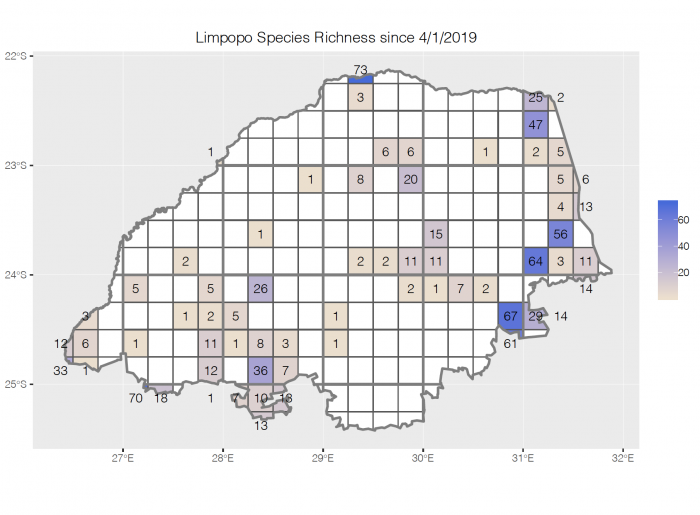
This map shows the number of bird species recorded per quarter degree grid cell in BirdPix in Limpopo in the past year, since 1 April 2019. The darker the shade of blue, the more species. See the bar on the right. The colour coding is chosen to be different from the previous map, so there is no confusion between them.
A lot of the submissions to BirdPix since April 2019 have been from the Kruger National Park, along the eastern edge of Limpopo. But pride of place goes to grid cell 2229AB, which includes the key parts of the Mapungubwe National Park. Overall, this grid cell has 133 records of 97 species, of which this map shows that 73 have been recorded since April 2019.
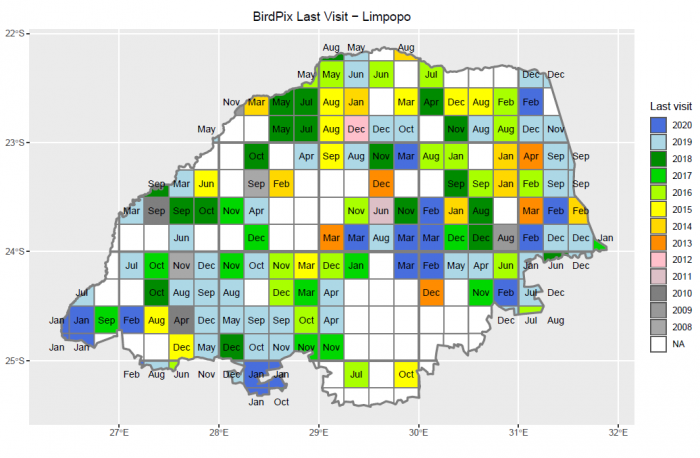
This map shows the date on which each quarter degree grid cell was last visited and had a record uploaded to BirdPix in Limpopo. You determine the year from the colour bar on the right, and the month is given inside the grid cell. Blank cells have not got any BirdPix records yet.
Please try to make more grid cells in this map dark blue, with 2020 visits. If you are locked down in a grid cell in Limpopo, you can make a valuable contribution to BirdPix from wherever you are.
Mpumalanga and Gauteng
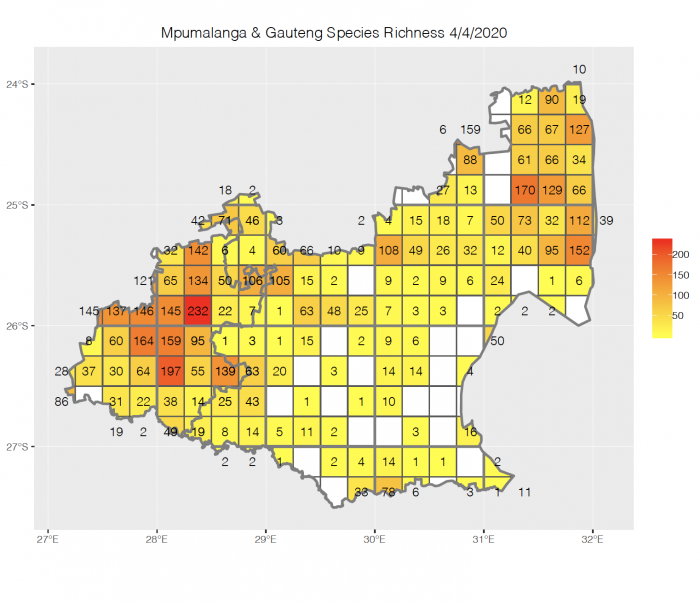
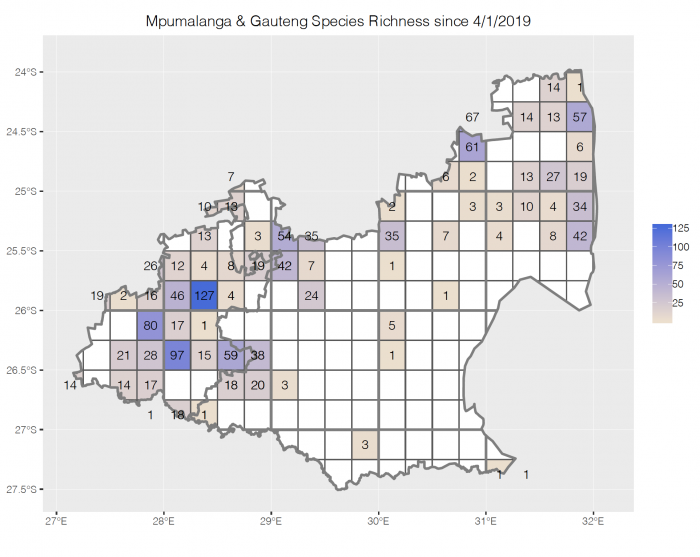
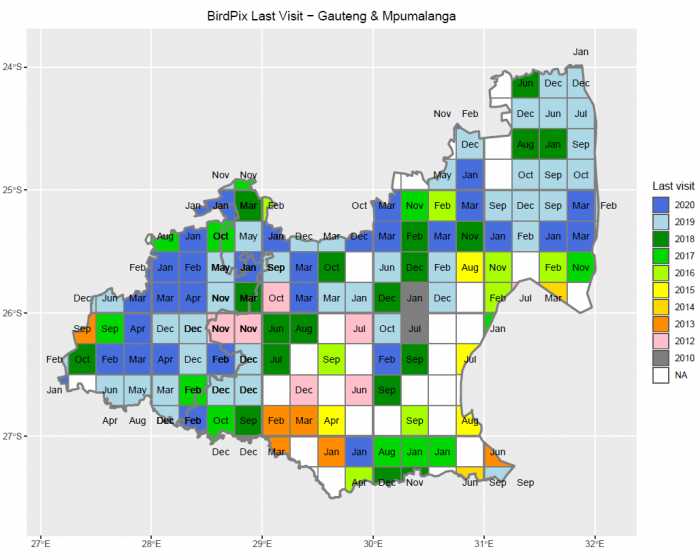
These maps for these two provinces are combined. Gauteng is at the western end of each map.
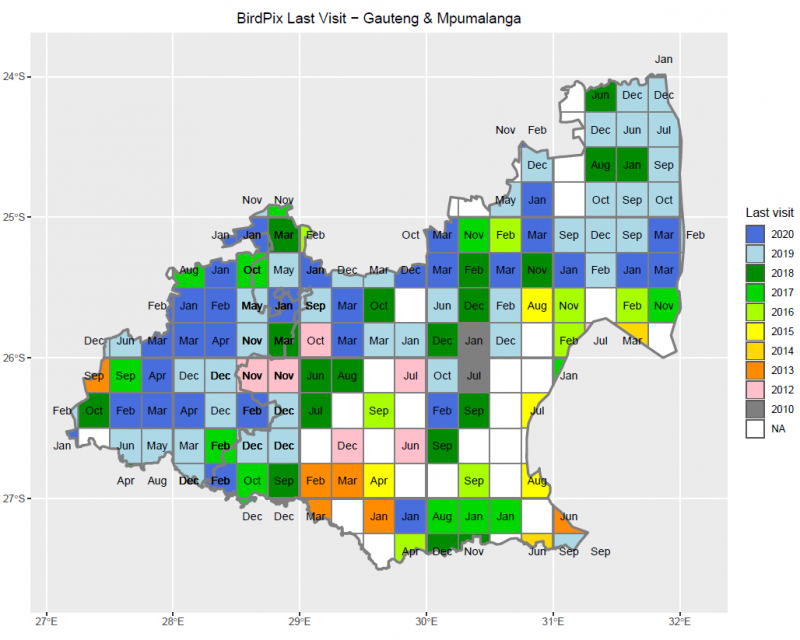
This map shows the number of bird species recorded per quarter degree grid cell in BirdPix in Mpumalanga and Gauteng. The darker the shade, the more species. See the bar on the right.This map shows the number of bird species recorded per quarter degree grid cell in BirdPix in Mpumalanga and Gauteng in the past year, since 1 April 2019. The darker the shade of blue, the more species. See the bar on the right. The colour coding is chosen to be different from the previous map, so there is no confusion between them.This map shows the date on which each quarter degree grid cell was last visited and had a record uploaded to BirdPix in Mpumalanga and Gauteng. You determine the year from the colour bar on the right, and the month is given inside the grid cell. Blank cells have not got any BirdPix records yet.
We’ll write a paragraph for each map as soon as we can.
North West
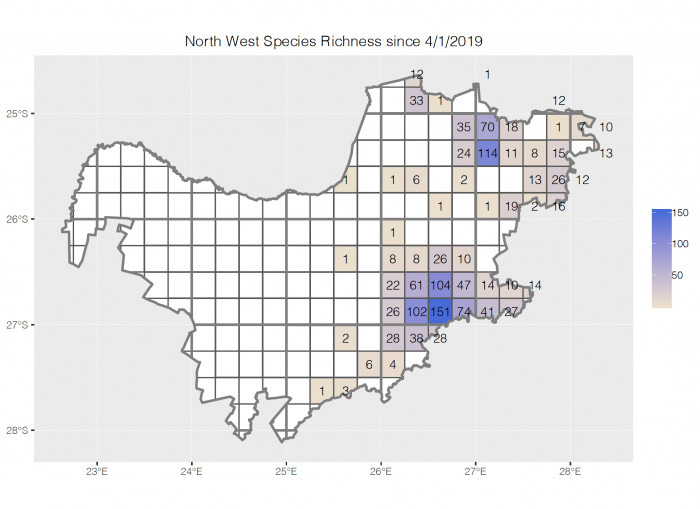
This map shows the number of bird species recorded per quarter degree grid cell in BirdPix in North West. The darker the shade, the more species. See the bar on the right.
Coverage of the western half of North West is pretty dismal! This is common to every citizen science project. The reason is that is not an easy area to access. If anyone has photos of birds from here in their personal archives, please upload them to BirdPix. Coverage in the eastern half is more promising. The bar is set by grid cell 2626DC Klerksdorp, where citizen scientist extraordinary Tony Archer, is very active. This grid cell has 1104 records, which cover 220 species.
This map shows the number of bird species recorded per quarter degree grid cell in BirdPix in North West in the past year, since 1 April 2019. The darker the shade of blue, the more species. See the bar on the right. The colour coding is chosen to be different from the previous map, so there is no confusion between them.
No species have been recorded in the western half of North West since April 2019. Of the 220 species ever recorded in Tony Archer’s grid cell at Klerksdorp, 151 have been recorded in the past year. Tony has kept refreshing species here.
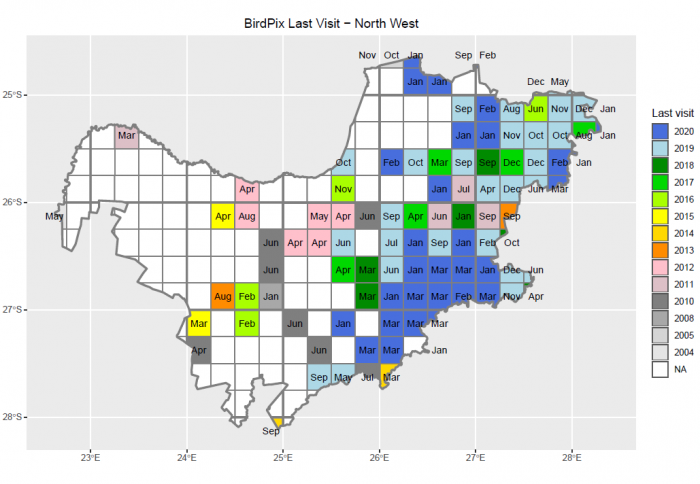
This map shows the date on which each quarter degree grid cell was last visited and had a record uploaded to BirdPix in North West. You determine the year from the colour bar on the right, and the month is given inside the grid cell. Blank cells have not got any BirdPix records yet.
Many quarter degree grid cells in the eastern half of North West are either dark blue or light blue. That’s encouraging, please keep up the good work.
Free State
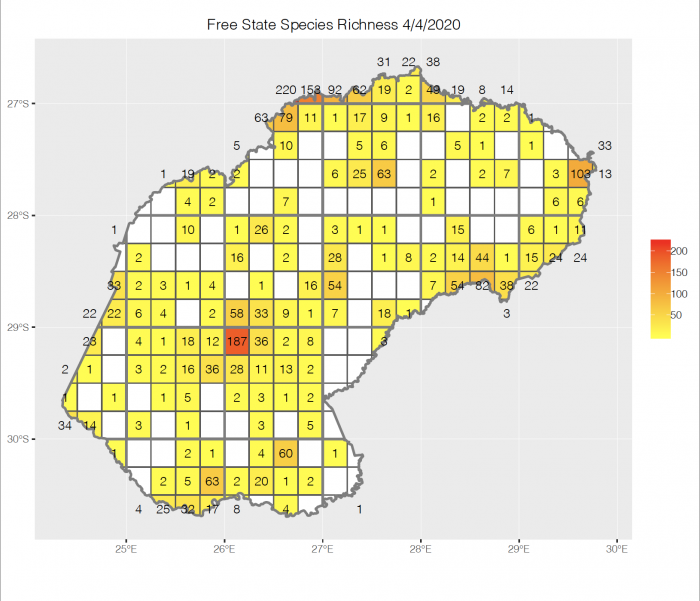
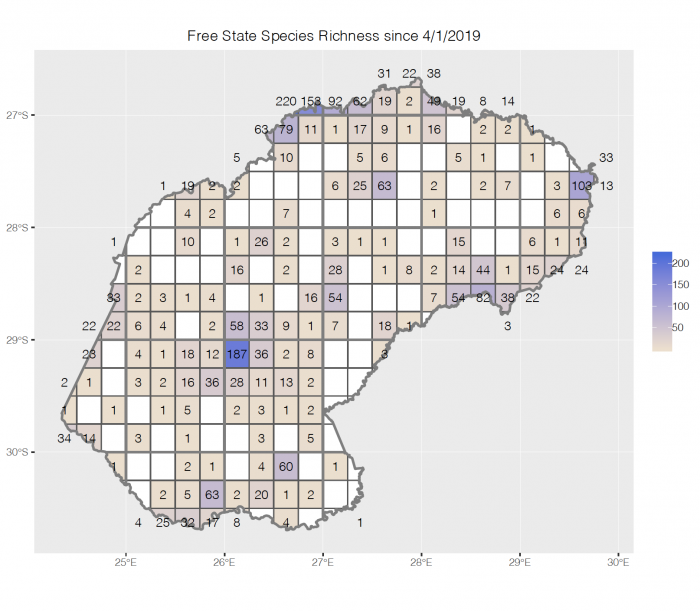
This map shows the number of bird species recorded per quarter degree grid cell in BirdPix in the Free State. The darker the shade, the more species. See the bar on the right.This map shows the number of bird species recorded per quarter degree grid cell in BirdPix in the Free State in the past year, since 1 April 2019. The darker the shade of blue, the more species. See the bar on the right. The colour coding is chosen to be different from the previous map, so there is no confusion between them.This map shows the date on which each quarter degree grid cell was last visited and had a record uploaded to BirdPix in the Free State. You determine the year from the colour bar on the right, and the month is given inside the grid cell. Blank cells have not got any BirdPix records yet.
This is the first of a series of blogs on BirdPix. This one covers the Western, Eastern and Northern Cape provinces of South Africa. For each province, it answers three questions: (1) How well is BirdPix doing overall? (2) How well has BirdPix done in the past year, since 1 April 2019? (3) When was each quarter degree grid cell last visited? We’ll tackle the remaining six provinces for BirdPix as separate blogs (KwaZulu-Natal and the five northern provinces) and then move on to other sections of the Virtual Museum.
Why is BirdPix so important? Right now, MSc student Karis Daniel is using the BirdPix maps to “model” the full distributions of species. All bird species, even the most common, have quite scruffy datasets. This is true to a greater or lesser extent for every species in the Virtual Museum. None of the maps is “complete”, there are lots of “false negatives”, places where the species MUST occur (because it is in most of the surrounding grid cells, which have similar habitat). We discussed “false negatives” here. In contrast, the distribution maps for the bird atlas, SABAP2, are virtually complete for many species. The bird atlas does not yet have full coverage, but there are lots of species for which the entire range is covered. The idea for Karis’s project is to use the statistical methods called “species distribution models” to generate complete maps out of the BirdPix data, and to find the method which comes closest to generating the “truth”, as defined by the bird atlas. If she can find a method that works for the BirdPix data, then we can apply it to the LepiMAP data, to the ReptileMAP data, to the FrogMAP data, to the ScorpionMAP data. All these projects have generated incomplete datasets, with lots of false negatives. The distributions are not complete.
What’s needed now for BirdPix is to get the database more comparable in size to that of, say, LepiMAP or OdonataMAP. There are three maps for each province. The first shows overall coverage, measured as species richness, the number of species recorded in the BirdPix database per quarter degree grid cell. The second map shows the total number of species recorded in the past year, from 1 April 2019 to 6 April 2020. This gives insight into how up to date the records are. The third map tells us when each grid cell was last visited. Let’s go.
Western Cape
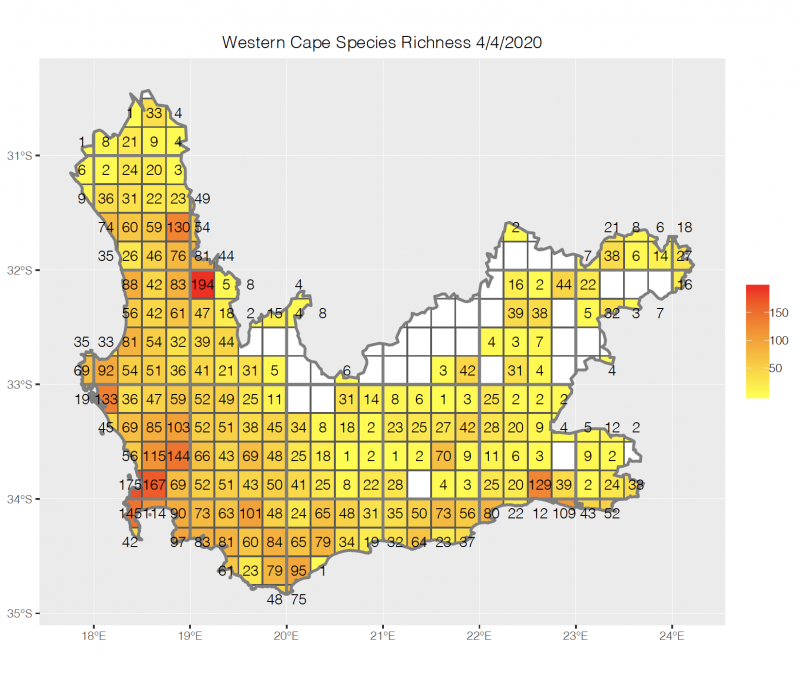
This map shows the number of bird species recorded per quarter degree grid cell in BirdPix in the Western Cape. The darker the shade, the more species. See the bar on the right.
The grid cell in the Western Cape with the most species is 3219AA Clanwilliam. 194 species have been photographed here. The citizen scientist responsible for setting this bar so high is Zenobia van Dyk. If Zenobia can find 194 species in pretty difficult habitat mostly in the Cederberg Mountains, then the rest of us ought to be doing a lot better everywhere else. Even the Cape Town grid cell 3318CD, with the advantages of (a) habitat for seabirds, shorebirds and wetland birds, and (b) lots of observers, only has 175 species. [If you have difficulty going between the codes for the grid cells and the map, you need to study the blog on quarter degree grid cells carefully!]
This map shows the number of bird species recorded per quarter degree grid cell in BirdPix in the Western Cape in the past year, since 1 April 2019. The darker the shade of blue, the more species. See the bar on the right. The colour coding is chosen to be different from the previous map, so there is no confusion between them.
This map shows the number of species recorded in each grid cell in the past year, since the beginning of April 2019. Many of the records were “refreshments” of old records. These are incredibly important, because they confirm the continued presence of a species in a grid cell. A very large number of the records made in this period were the first records in BirdPix for the species. This map is pretty impressive. And so is the next one …
This map shows the date on which each quarter degree grid cell was last visited and had a record uploaded to BirdPix in the Western Cape. You determine the year from the colour bar on the right, and the month is given inside the grid cell. Blank cells have not got any BirdPix records yet.
All grid cells shaded dark blue have had at least one record submitted to BirdPix in 2020. And we are three months into the year. Those which are light blue have their most recent record from 2019. It is amazing that most grid cells with data have records from the past 15 months. The shades of greens and yellow (last visited 2013-2018), the pink grid cell (3320DA Kareevlakte, last visit in June 2012), and of course the blank grid cells are priorities for visits. But the overall impression for the Western Cape is how blue it is! Well done, BirdPixers.
Eastern Cape
We follow the same pattern as for the Western Cape.
This map shows the number of bird species recorded per quarter degree grid cell in BirdPix in the Eastern Cape. The darker the shade, the more species. See the bar on the right.
Grid cell 3125CA, just south of Middelburg, has 202 BirdPix species. Tino Herselman is the citizen scientist responsible for the excellent coverage of this and the surrounding quarter degree grid cells. 3424BB has 175 species, the photographic handiwork of Desire and Gregg Darling; this grid cell contains Cape St Francis and the estuary of the Kromrivier. BirdPix needs some more champions in the Eastern Cape.
This map shows the number of bird species recorded per quarter degree grid cell in BirdPix in the Eastern Cape in the past year, since 1 April 2019. The darker the shade of blue, the more species. See the bar on the right. The colour coding is chosen to be different from the previous map, so there is no confusion between them.
Grid cell 3324AD, which had 127 species in the previous map, has none in this map! Pam Kleiman, who was the BirdPixer here, has moved to grid cell 2929DA in the foothills of the Drakensberg in KwaZulu-Natal, where she continues to make an awesome contribution to BirdPix. We need someone in Steytlerville to take over Pam’s role, and keep the records for the grid cell refreshed and up-to-date.
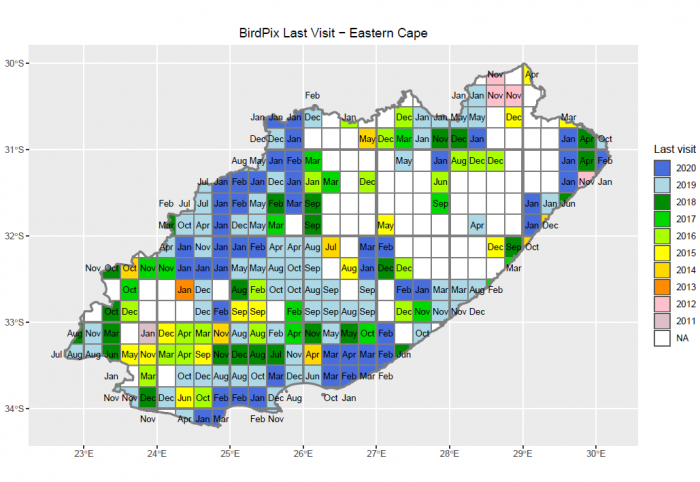
This map shows the date on which each quarter degree grid cell was last visited and had a record uploaded to BirdPix in the Eastern Cape. You determine the year from the colour bar on the right, and the month is given inside the grid cell. Blank cells have not got any BirdPix records yet.
Please help keep this map blue, and preferably dark blue, by uploading your bird photos to the BirdPix section of the Virtual Museum. There is quite a lot of green and yellow at the western end of the Eastern Cape, and this is fixable. The eastern end of the Eastern Cape remains a big challenge for BirdPix, as it does for many citizen science projects.
Northern Cape
The Northern Cape is thinly populated. It is mostly arid, apart from narrow strips of riparian vegetation along the banks of the Orange and Vaal Rivers. Along sections of these rivers, there are also extensive irrigation schemes, which are green oases in semi-desert. For the past bunch of years, severe drought has impacted the province, heightening the contrast between the vast expanse of dryland and the tiny area of irrigated land. This is not an easy province to do citizen science in, and the temptation is to focus on the “green”. In arid grid cells, species richness is generally small, and especially so in the drought. Let’s have a peek and see how BirdPix has fared.
This map shows the number of bird species recorded per quarter degree grid cell in BirdPix in the Northern Cape. The darker the shade, the more species. See the bar on the right.
All things considered, coverage of the Northern Cape is not bad. There are some huge gaps, like the broad band of white running northeast from the northern corner of the Western Cape. Coverage in the southeast is good. This is where the Northern Cape touches Tino Herselman’s initiative in the Eastern Cape (see above). In this area is grid cell 3125AC, with 169 species, but it only has a sliver in the Northern Cape. So the grid cell entirely inside the Northern Cape with the most species is also in this area. 3024DC has 149 species. This grid cell contains the Karoo Gariep Nature Reserve, where the BDI Citizen Science Conference was held in February this year.
Two more prominent grid cells in the Northern Cape have resident citizen scientists. Altha Liebenberg is based in Danielskuil, in the northeast. 2823BA has 128 species. Ryan Tippett is on the farm Louievale north of Carnarvon, centre-south. 3022CA has 118 species. This demonstrates the incredible value of having dedicated citizen scientists based in grid cells. We desperately need more Althas and more Ryans!
We really do need the Virtual Museumers of Kimberley to focus their cameras on birds, and improve the BirdPix coverage. The city of Kimberley is split across four quarter degree grid cells: 2824DA has 16 species; 2824DB has 33; 2824DC has 22; and 2824DD also has 22. The initial target for each of these grid cells should be 100 species!
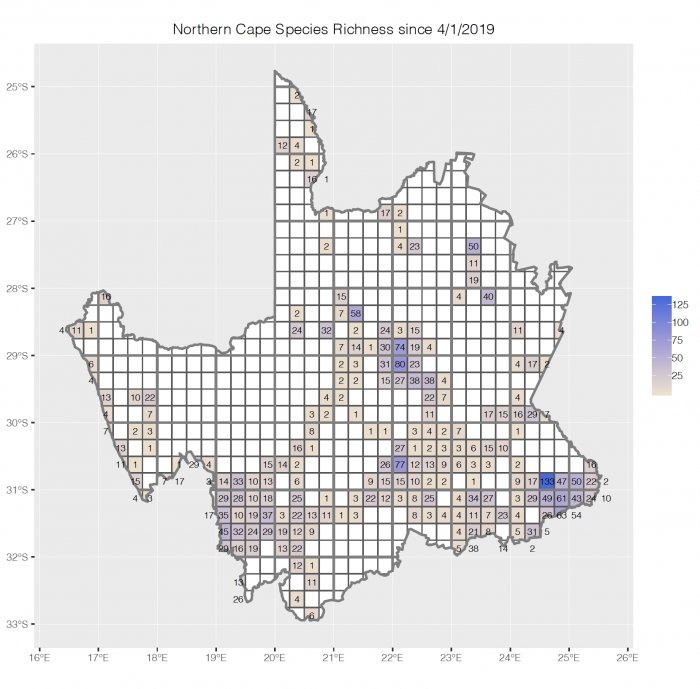
This map shows the number of bird species recorded per quarter degree grid cell in BirdPix in the Northern Cape in the past year, since 1 April 2019. The darker the shade of blue, the more species. See the bar on the right. The colour coding is chosen to be different from the previous map, so there is no confusion between them.
The visits by the BDI teams to the Karoo Gariep Nature Reserve in the past year (see here and here) generated 133 species in grid cell 3024DC. Two BioBashes have been held in the Northern Cape. The Calvinia BioBash in June 2019 is responsible for most of the records in the big rectangle in the southwest, and the Boegoeberg BioBash last October created the rectangle just east of centre. The Boegoeberg Dam lies in grid cell 2922AA with 80 species recorded in the past year; the total for the grid cell is 86 species, so there are only six species that have not been “refreshed”. The “caterpillar” of grid cells running northeastward from Calvinia towards Upington was created en route to the Boegoeberg BioBash, illustrating the value of the “road trip”.
This map shows the date on which each quarter degree grid cell was last visited and had a record uploaded to BirdPix in the Northern Cape. You determine the year from the colour bar on the right, and the month is given inside the grid cell. Blank cells have not got any BirdPix records yet.
It is impressive how much data collection for BirdPix has been done in 2019 and 2020. This map is mostly blue. Every record from the Northern Cape is precious, and this is true not only for BirdPix but for all the other citizen science projects.
The biggest barrier to interpreting these maps is getting to grips with finding your way around the six-character codes for the quarter degree grid cells. The clown who designed this complicated system should have been allowed to design one more thing only: his tombstone.
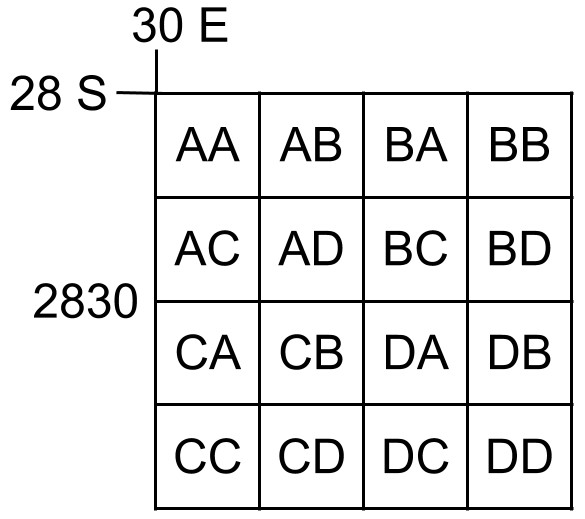
The first four characters are numbers, and tell us what degree cell we are in. Like reading a book, we start in the top-left corner, the northwest corner of the degree cell. The first pair of numbers are the degrees south and the second pair are degrees east. The degree cell below is 2830. The final two characters tell us the layout of the quarter degree grid cells within the degree square, as illustrated here.
To find the code for a grid cell in the maps above, first step is to establish the degree cell. The degree lines are drawn thick. So it is mostly easy to navigate the degree cells. Go to the top left hand corner. Follow the line to the left edge of the map, and find the degrees south. From the top left corner of the degree cell, follow the line to the bottom edge of the map, and find the degrees east. That gives you the degree square. Within the degree square, the diagram above shows you the two-letter code for the quarter degree grid cell you want.
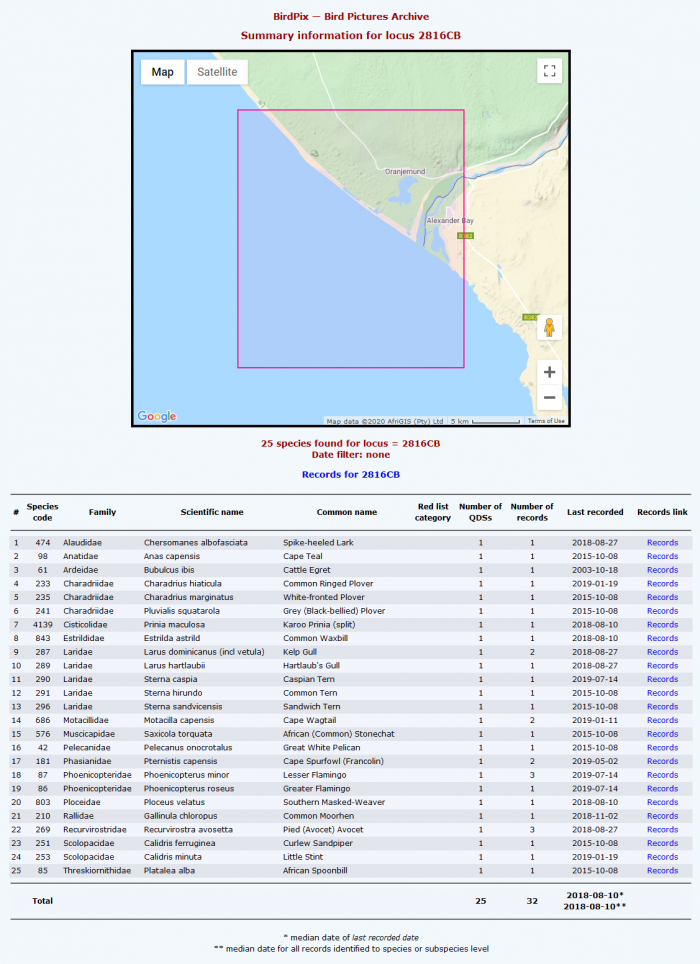
The web address for getting the list of species for a grid cell has this pattern: http://vmus.adu.org.za/vm_locus_map.php?vm=birdpix&locus=2824DD. You can change the “locus” (=the place) to the code for any other quarter degree grid cell. And if you want the reptiles rather than the birds, change vm=birdpix to vm=reptilemap. Suppose you want the birds from the quarter degree grid cell at the mouth of the Orange River, in the extreme west of the Northern Cape. On the map, go to the top-left corner of the degree cell. It is at 28S and 16E. So the grid cell is 2816. It is in the third row from the top, and the second row from the left. From the diagram above, this is position CB. So the code is 2816CB. So let’s try http://vmus.adu.org.za/vm_locus_map.php?vm=birdpix&locus=2816CB. That’s right, and here is the map and the list of 25 species which have been recorded here!
Karis Daniel and Itxaso Quintana made the maps. Rene Navarro wrote the underlying query that enables these maps to be produced. Malcolm Robertson, Colin Summersgill, Lisl van Deventer and Garth Aiston do the major share of confirming identifications for BirdPix. Thank you.
These are trying times for all of us. It can be hard to stay focused, it can be hard to stay positive, but there are ways we can make the lockdown more bearable, and even fun! Connecting with nature is important, perhaps now more than ever. Nature is all around us if we take the time to notice (and right now all we have is time!). Connecting with nature has been proven to help us relax, reduce anxiety, and lift our spirits. Nature is good for us because we are part of nature.
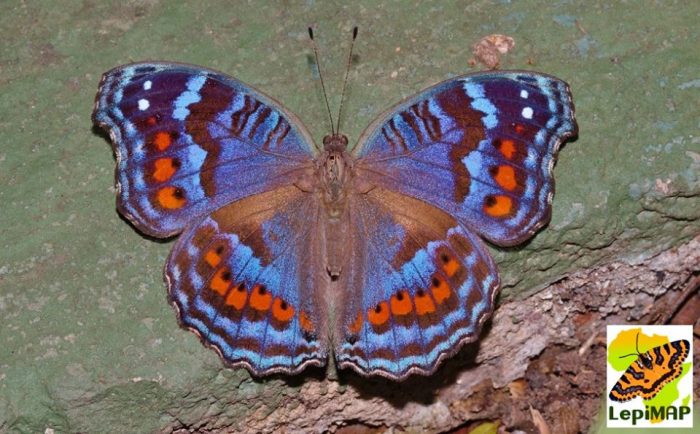
Jewels of nature – have you seen this gorgeous butterfly in your garden? Now is the perfect time to discover the gems in and around your house. This beauty is known as a Gaudy Commodore or Rooi-en-blou-blaarvlerk. LepiMAP record by I.C. Riddell
If you have a garden, use the lockdown to explore your garden properly. Take your camera (cellphone, “mik-en-druk”, or DSLR, whatever suits your fancy) and see what you can find. Butterflies, dragonflies, damselflies, frogs, reptiles, moths, these are but a few of the critters that you might find in your green patch. Keep a species list, take photographs, and whip out all those field guides you’ve been meaning to give a proper read. Try to identify all your garden critters. And, of course, don’t forget to upload your photos to the different sections of the Virtual Museum (where the members of the expert panels will be happy to identify your finds for you).
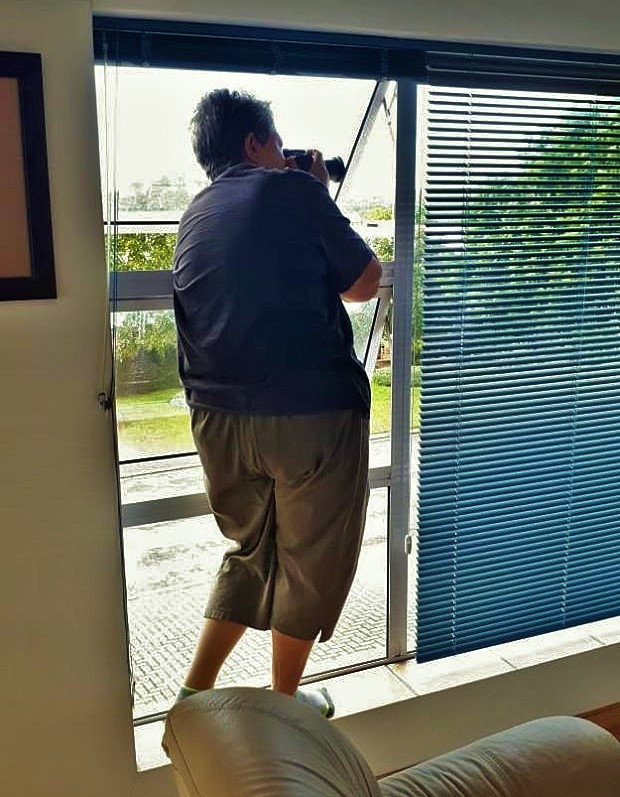
Okay, so you don’t have a garden? No problem! Step out onto your balcony, or open the window, get some sunshine onto your face and take a deep breath. Grab your binoculars and LOOK! Make a bird list, make a tree list, or sketch the sunrise/sunset. Take photos of any birds that you might see and upload those to the Virtual Museum.
Virtual Museuming in lockdown. Estelle van Rooyen photographs the birds she can see from a window in her home in Stilbaai, Western Cape Province. We tend to go far afield when we search for biodiversity, but where we live tends to be neglected. This is the opportunity to rectify this!
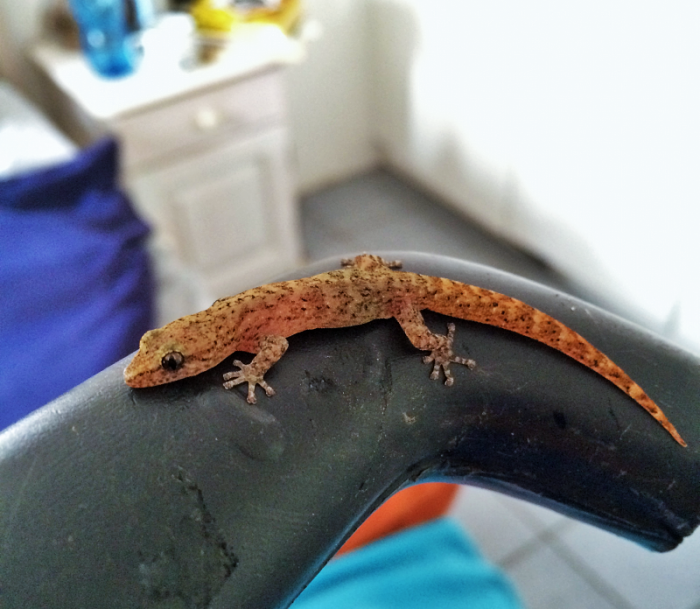
If you don’t have a garden, you can still biomap! Take a wander inside your home, go on a safari in your living room, kitchen, bedroom. Take a closer look, make a game out of it and see who can snap and map the most species inside the house. What do you see? Perhaps you will find one of these, a Marbled Leaf-toed Gecko Afrogecko porphyreus (photo below). These awesome geckos are like your own personal pest control unit, keeping your home free of insects. Remember to upload your photos to ReptileMAP at http://vmus.adu.org.za/
Biomapping can help us all to stay sane and connect with nature. Thank you to all the citizen scientists who have taken on the challenge to biomap at home. You are awesome! Let us know what you find by uploading your discoveries to the Virtual Museum and by sharing your photos on social media. Stay safe, stay curious and stay calm.