Fanie Rautenbach’s Great LepiMAP Challenge 2020/21

Fanie Rautenbach has worked his way through the LepiMAP records for South Africa, Lesotho and Swaziland, has identified data gaps, and is challenging us to fill them. Fanie is the member of LepSoc Africa who takes the main responsibility for doing the identifications of butterflies in LepiMAP.
This blog does two things. Firstly, it lists all the species of butterfly for which we don’t have a photographic record in LepiMAP. Secondly, it lists the species for which there are photographic records in LepiMAP, but for which the most recent record was made more than five years ago, i.e. in 2014 or earlier. The Great LepiMAP Challenge for the summer of 2020/21 is to “refresh” the records for these species.

The LepiMAP database contains 477,000 records of butterflies, getting on for half a million. This is one of the largest databases of its kind in the world. For the butterfly atlas of South Africa, Lesotho and eSwatini (the SABCA project), we computerized every specimen record we could find. This included museums and private collections. This database goes back to the 19th century, although most of the records used for the butterfly atlas were made after the Second World War, in the second half of the 20th century, and from 2000 to 2010.

This blog consists of a series of four tables. Each table covers a time period. The first three tables are the 112 species that are not in LepiMAP as photographic records. The fourth table selects the 56 species that have not been “refreshed”, even once, since 2014. The column headers are mostly self-explanatory; the numbers in the column QDGC give the number of quarter degree grid cells in which the species has been recorded; the column records gives the total number of records for the species in the database. The two-letter codes are abbreviations for the provinces of South Africa, eS is eSwatini (Swaziland) and Les is Lesotho. The crosses show which of these political regions the species has been recorded in. Locality gives the general area where the species has been recorded. The numbers in the first column are in date order.

So Fanie’s first challenge to all LepiMAPpers is to get photographic records for these 168 species, and to upload them into the Virtual Museum. In the tables he has indicated the political regions they occur in, and there is a general description of the locality.

Fanie’s second challenge is to find the species in areas where they have not been recorded previously. (Many species have “traditional” sites where they get recorded, and for some species it is believed that they occur only on a single hilltop.) And then people have unexpectedly bumped into them at other sites, often at a considerable distance. Steve Woodhall’s talk at a BDI Citizen Scientist Hour called “Looking for butterflies” will help you learn how to go about doing butterfly fieldwork. And his book: “Fieldguide to Butterflies of South Africa” (reviewed here) gives the flight period for each species, so you know when to look. You can order a copy of this field guide by sending an email to Steve Woodhall.

We asked Steve to comment on this challenge: “This challenge is vital, as it carries on the great work done by LepSoc Africa and citizen scientists during the original SABCA project. Our understanding of our butterflies’ biogeography was increased immensely by SABCA, but LepiMAP record collecting for the project ended in July 2010, leading up to the publication of the Red List and Atlas in 2013. Environmental change has accelerated in the past 10 years, and we need to rise to this challenge to fill in the new gaps that Fanie has identified.”

This first table lists the 18 species for which there is not a single record in the LepiMAP database this century. The most recent record was made two decades ago. Amazingly, 12 of these 19 species are regarded as “Least Concern”. But this is due to the reality that many of them have wide ranges farther north in Africa. But it would be nice to know that the species persists at the edge of its range, in the southern end of Africa. (Because of the constraints of this format, you need to scroll out to the right to see the far ends of the tables – sorry! You can also download the tables as an Excel spreadsheet, or as a PDF)

  Family Scientific name Common name Status QDGC Rec-ords Last observed Li Mp Ga NW KZN FS NC WC EC eS Les Locality
1 LYCAENIDAE Deloneura immaculata Bashee river buff Extinct 1 2 29/12/1863                 X     Bashee River near Gwetyibeni (Fort Bowker)
2 NYMPHALIDAE Tirumala petiverana Dappled monarch, blue monarch Least Concern 2 2 26/06/1976 X                     Malta forest (Lekgalameetse NR)
3 NYMPHALIDAE Ypthima antennata antennata Clubbed ringlet Least Concern 4 21 03/02/1979 X                     Buffelsberg near Munnik (NE of Polokwane)
4 NYMPHALIDAE Stygionympha dicksoni Dickson’s hillside brown Critically Endangered 3 32 31/08/1985               X       Tygerberg, Kapokberg (Darling)
5 LYCAENIDAE Aloeides mbuluensis Mbulu’s copper Least Concern 3 30 20/11/1990         X       X     Mbulu (Transkei) Lotheni
6 NYMPHALIDAE Pseudonympha southeyi southeyi Southey’s brown Least Concern 7 53 10/11/1991                 X     Joubert’s Pass (Lady Grey), Ben MacDhui
7 HESPERIIDAE Andronymus caesar philander White dart Least Concern 4 6 16/05/1993 X X     X             Kosi Bay, Pafuri (Kruger park) Swadini resort
8 NYMPHALIDAE Charaxes druceanus solitarius Silver-barred charaxes Least Concern 1 4 19/07/1993 X                     Blouberg
9 LYCAENIDAE Thestor calviniae Dickson’s skolly Least Concern 1 46 11/11/1993             X         mear Calvinia, Hantamsberg
10 NYMPHALIDAE Coenyropsis natalii poetulodes Natal brown Data Deficient 3 27 06/03/1994 X                     Chuniespoort, Tubex (Wolkberg)
11 NYMPHALIDAE Charaxes xiphares staudei Forest-king charaxes Least Concern 1 16 14/03/1994 X                     Blouberg
12 NYMPHALIDAE Dira swanepoeli isolata Swanepoel’s widow Least Concern 1 23 12/02/1996 X                     Blouberg
13 LYCAENIDAE Thestor protumnus terblanchei Terblanche’s skolly Vulnerable 2 8 15/02/1996           X           Korannaberg
14 LYCAENIDAE Trimenia malagrida malagrida Scarce mountain copper Critically Endangered 1 120 26/02/1996               X       Lion’s Head, Twelve Apostles
15 NYMPHALIDAE Neptis serena serena Serene sailer Least Concern 5 6 10/09/1996 X                     Near Mpaphuli Cycad Reserve
16 LYCAENIDAE Chrysoritis lyncurium Tsomo river opal Vulnerable 4 84 18/12/1997                 X     Mbulu Forest, Tsomo River
17 NYMPHALIDAE Sevenia rosa Rosa’s tree nymph Least Concern 5 17 19/01/1998         X             Ngoye Forest Reserve
18 LYCAENIDAE Trimenia wykehami Wykeham’s silver-spotted copper Least Concern 8 176 11/12/1999             X X       Verlatenkloof Pass (Sutherland), Nuweveld mountains (Beaufort West)

The next table contains the 19 butterfly species that were last recorded between 2000 and 2007.

  Family Scientific name Common name Status QDGC Rec-ords Last observed Li Mp Ga NW KZN FS NC WC EC eS Les Locality
19 LYCAENIDAE Aloeides carolynnae aurata Carolynn’s copper Near Threatened 5 77 21/02/2000               X       De Hoop Nature Reserve, Still Bay
20 LYCAENIDAE Chrysoritis thysbe mithras Common opal Data Deficient 2 48 01/09/2000               X       Brenton-on-sea, Struisbaai
21 LYCAENIDAE Chrysoritis oreas Drakensberg daisy copper Near Threatened 10 197 16/10/2000         X             Bulwer Mountain, Lotheni, Bushman’s Neck”
22 LYCAENIDAE Thestor petra tempe Tempe skolly Least Concern 5 73 29/12/2000               X       Elandsberg, Seweweekspoort
23 NYMPHALIDAE Pseudonympha southeyi kamiesbergensis Southey’s brown Least Concern 5 26 03/10/2001             X         Grootvlei pass (Kamieskroon)
24 HESPERIIDAE Kedestes sarahae Sarah’s ranger Least Concern 1 13 14/10/2001               X       Cedarberg Mountains (Welbedacht)
25 LYCAENIDAE Aloeides monticola Cedarberg copper Least Concern 1 43 21/10/2001               X       Cedarberg Mountains
26 LYCAENIDAE Chrysoritis blencathrae Waaihoek opal Least Concern 2 72 21/01/2002               X       Waaihoek Mountains (Worcester)
27 LYCAENIDAE Zintha hintza krooni Hintza pierrot Least Concern 4 4 16/12/2002             X         Witsand
28 LYCAENIDAE Trimenia wallengrenii wallengrenii Wallengren’s silver-spotted copper Critically Endangered 1 21 17/11/2003               X       Kapokberg near Darling
29 NYMPHALIDAE Torynesis orangica Orange widow Least Concern 4 282 15/02/2004           X           Golden gate, Clarens
30 LYCAENIDAE Virachola dinomenes dinomenes Orange playboy Least Concern 17 240 18/06/2004         X             Hluhluwe False Bay Park
31 LYCAENIDAE Aloeides stevensoni Stevenson’s copper Endangered 2 64 06/11/2004 X                     Haenertsburg
32 LYCAENIDAE Chrysoritis adonis adonis Adonis opal Least Concern 2 186 14/11/2005               X       Gydo Mountain (Ceres)
33 NYMPHALIDAE Neita lotenia Loteni brown Least Concern 7 103 07/01/2006         X           X Bushman’s Neck, Lotheni
34 NYMPHALIDAE Torynesis pringlei Pringle’s widow Least Concern 4 42 28/01/2007                     X Rafoletsane, Sehonghong Valley
35 NYMPHALIDAE Cassionympha camdeboo Camdeboo brown Least Concern 3 35 14/11/2007                 X     Aberdeen
36 LYCAENIDAE Lepidochrysops jefferyi Jeffery’s blue Endangered 2 160 17/11/2007   X                   Barberton
37 LYCAENIDAE Lepidochrysops swanepoeli Swanepoel’s blue Endangered 2 140 17/11/2007   X                   Barberton
38 LYCAENIDAE Thestor barbatus Bearded skolly Data Deficient 1 13 15/12/2007               X       Spitskoppie (Herold)

This big table contains the 74 butterfly species which were last recorded between 2008 and 2011, and which are not in LepiMAP as photographic records.

  Family Scientific name Common name Status QDGC Rec-ords Last observed Li Mp Ga NW KZN FS NC WC EC eS Les Locality
39 LYCAENIDAE Lepidochrysops loewensteini Loewenstein’s blue Least Concern 5 56 13/01/2008                 X   X Sehonghong river valley Dulcies neck
40 LYCAENIDAE Orachrysops nasutus remus Nosy blue Least Concern 16 84 13/01/2008         X       X   X Ongeluksnek Sehonghong river valley
41 LYCAENIDAE Aloeides pringlei Pringle’s copper Least Concern 2 77 15/02/2008                 X     Groot Winterberg (Between Adelaide and Tarkastad)
42 LYCAENIDAE Anthene minima minima Little hairtail Least Concern 25 81 14/03/2008 X X     X         X   Mhlosinga Mkuse
43 NYMPHALIDAE Charaxes marieps Marieps charaxes Least Concern 1 121 29/03/2008 X X                   Mariepskop
44 LYCAENIDAE Lepidochrysops penningtoni Pennington’s blue Data Deficient 4 23 03/09/2008             X         Wolfhok
45 HESPERIIDAE Spialia agylla bamptoni Grassveld sandman Least Concern 4 43 21/09/2008             X         Hondeklip bay
46 PIERIDAE Colotis celimene pholoe Lilac tip Least Concern 3 6 27/09/2008             X         Tswalu Nature Reserve
47 LYCAENIDAE Chrysoritis turneri wykehami Wykeham’s opal Least Concern 3 78 18/10/2008             X         Hantamsberg Sutherland
48 LYCAENIDAE Chrysoritis nigricans rubescens Dark opal Least Concern 1 26 05/11/2008               X       Gamka nature reserve
49 LYCAENIDAE Chrysoritis azurius Azure opal Least Concern 11 200 21/11/2008             X         Sutherland Roggeveld escarpment
50 NYMPHALIDAE Serradinga bowkeri bella Bowker’s widow Least Concern 6 10 02/12/2008                 X     Compass berg Swaershoek Pass (Cradock)
51 LYCAENIDAE Thestor overbergensis Overberg skolly Least Concern 3 15 08/12/2008               X       De Hoop nature reserve Cape Agulhas
52 LYCAENIDAE Chloroselas mazoensis Purple gem Least Concern 17 145 21/12/2008 X X     X         X   Watervalsrivierpas (Lydenburg) Tembe Elephant park
53 NYMPHALIDAE Neita durbani D’Urban’s brown Least Concern 13 114 05/01/2009                 X     Bedford Pearston
54 LYCAENIDAE Chrysoritis thysbe schloszae Moorreesburg Common opal Critically Endangered 1 52 01/03/2009               X       Koringberg (Moorreesburg)
55 PAPILIONIDAE Papilio ophidicephalus zuluensis Emperor swallowtail Least Concern 5 110 10/03/2009         X             Nkandla Forest
56 NYMPHALIDAE Stygionympha geraldi Gerald’s hillside brown Least Concern 11 80 17/04/2009             X         Port Nolloth, Hondeklipbaai
57 LYCAENIDAE Capys penningtoni Pennington’s protea Endangered 6 330 26/09/2009         X             Bulwer mountain
58 NYMPHALIDAE Tarsocera cassus outeniqua Spring widow Least Concern 17 87 10/10/2009               X       Calitzdorp Anysberg
59 LYCAENIDAE Chrysoritis beaufortia charlesi Beaufort opal Least Concern 3 132 18/10/2009             X         Sutherland
60 LYCAENIDAE Chrysoritis violescens Violescent opal Least Concern 7 239 18/10/2009             X         Sutherland
61 LYCAENIDAE Lepidochrysops jamesi jamesi James’s blue Least Concern 6 111 18/10/2009             X         Sutherland
62 LYCAENIDAE Phasis pringlei Pringle’s arrowhead Least Concern 4 78 18/10/2009             X         Sutherland
63 LYCAENIDAE Aloeides caledoni Caledon copper Least Concern 8 27 22/10/2009               X X     Lootsberg pass Shaw’s pass
64 LYCAENIDAE Aloeides merces Wakkerstroom copper Least Concern 7 49 08/11/2009   X     X             Dirkiesdorp Mhlonganvula
65 NYMPHALIDAE Dingana alaedeus Wakkerstroom widow Near Threatened 4 74 08/11/2009   X                   Kastrolnek (Wakkerstroom)
66 LYCAENIDAE Aloeides pallida liversidgei Giant copper Least Concern 3 29 11/11/2009                 X     Baviaanskloof
67 LYCAENIDAE Chrysoritis zeuxo cottrelli Cottrell’s daisy copper Least Concern 10 76 11/11/2009               X       Gamka Nature Reserve, Millwood NR
68 LYCAENIDAE Lepidochrysops quickelbergei Quickelberge’s blue Least Concern 4 73 21/11/2009               X       Gydo Mountain (Ceres)
69 LYCAENIDAE Thestor camdeboo Camdeboo skolly Least Concern 4 48 17/12/2009                 X     Cambedoo Mountains (Aberdeen)
70 LYCAENIDAE Thestor compassbergae Compassberg skolly Least Concern 3 112 18/12/2009                 X     Compassberg (Graaf-Reinett)
71 NYMPHALIDAE Neita neita Neita brown Least Concern 18 211 27/12/2009   X     X             Watervalsrivierpas
72 LYCAENIDAE Chrysoritis daphne Daphne’s opal Least Concern 1 100 29/12/2009               X       Kammanasie mountains (Uniondale)
73 LYCAENIDAE Chrysoritis pyramus balli Ball’s opal Least Concern 3 110 29/12/2009               X       Kammanasie mountains (Uniondale)
74 LYCAENIDAE Orachrysops brinkmani Brinkman’s blue Least Concern 1 76 29/12/2009               X       Kammanasie Mountains (Uniondale)
75 NYMPHALIDAE Serradinga kammanassiensis Kammanassie widow Least Concern 2 75 29/12/2009               X       Kammanasie Mountains (Uniondale)
76 NYMPHALIDAE Pseudonympha penningtoni Pennington’s brown Least Concern 26 232 31/12/2009         X       X   X Ben McDhui, Mount-Aux-Sources, Moteng
77 NYMPHALIDAE Neptis kiriakoffi Kiriakoff’s sailer Least Concern 5 8 25/02/2010 X X     X             Mangusi, Mpaphuli Cycad Reserve, Kowyns Pas
78 NYMPHALIDAE Charaxes karkloof trimeni Karkloof charaxes Least Concern 6 44 07/03/2010               X       Gouna Forest, Hoogekraal Pass
79 LYCAENIDAE Trimenia malagrida paarlensis Scarce mountain copper Critically Endangered 1 140 13/03/2010               X       Paarl Mountain, Paardeberg
80 NYMPHALIDAE Cyrestis camillus sublineata African porcelain Least Concern 5 19 20/03/2010 X                     Pafuri
83 PIERIDAE Dixeia leucophanes Spotless black-veined white   2 6 03/09/2010 X                     Mabelikwe
84 NYMPHALIDAE Tarsocera imitator Deceptive widow Least Concern 28 147 04/09/2010             X X       Springbok Wolfhok
85 LYCAENIDAE Lepidochrysops jamesi claassensi James’s blue Least Concern 2 34 05/09/2010             X         Hantambsberg
86 LYCAENIDAE Lepidochrysops badhami Badham’s blue Least Concern 10 173 02/10/2010             X         Springbok Caroulsberg
87 LYCAENIDAE Thestor dryburghi Dryburg’s skolly Least Concern 8 135 02/10/2010             X         Arkoop (N7 north of Kammieskroon) Springbok
88 LYCAENIDAE Lepidochrysops bacchus Wineland blue Least Concern 23 158 03/10/2010               X X     Malmesbury, Coega (PE)
89 LYCAENIDAE Chrysoritis uranus schoemani Uranus opal Least Concern 6 41 09/10/2010               X       Gifberg
90 LYCAENIDAE Orachrysops regalis Royal blue Least Concern 6 48 09/10/2010 X                     Wolkberg
91 LYCAENIDAE Thestor rooibergensis Rooiberg skolly Least Concern 2 65 16/10/2010               X       Top of Rooiberg (Calitzdorp)
92 HESPERIIDAE Spialia secessus Wolkberg sandman Least Concern 10 97 06/11/2010 X X               X   Munnik, Sheba Mine
93 LYCAENIDAE Thestor pictus Langeberg skolly Least Concern 4 71 10/11/2010               X       Garcia’s Pass
94 LYCAENIDAE Aloeides pallida jonathani Giant copper Least Concern 1 93 19/11/2010               X       Kammanassie Mountains
95 LYCAENIDAE Anthene millari Millar’s hairtail Least Concern 47 220 19/11/2010 X X X X X         X   Various locations
96 LYCAENIDAE Lepidochrysops balli Ball’s blue Least Concern 2 98 19/11/2010               X       Kammanassie Mountains
97 LYCAENIDAE Deloneura millari millari Millar’s buff   21 218 21/11/2010         X       X     Makatini Flats, Emanguzi Forest
98 LYCAENIDAE Chrysoritis adonis aridimontis Adonis opal Least Concern 1 67 08/12/2010               X       Elandsberg
99 LYCAENIDAE Lepidochrysops littoralis Coastal blue Near Threatened 14 129 12/12/2010               X       Witsand Stillbay, Mosselbay
100 LYCAENIDAE Lepidochrysops victori Victor’s blue Vulnerable 2 53 20/12/2010                 X     Huntley Glen, Long hill (Queenstown)
101 LYCAENIDAE Chrysoritis penningtoni Pennington’s opal Vulnerable 6 161 21/12/2010                 X     Hogsback Mount Kubusi (Stutterheim)
102 LYCAENIDAE Orachrysops nasutus nasutus Nosy blue Least Concern 17 101 21/12/2010                 X     Lundean’s Neck (Barkley East), Gaika’s Kop
103 LYCAENIDAE Aloeides dentatis maseruna Roodepoort copper Least Concern 24 145 22/12/2010           X           Heilbron
104 LYCAENIDAE Aloeides trimeni southeyae Trimen’s copper Endangered 5 64 22/12/2010               X       Albertinia
105 LYCAENIDAE Aslauga australis Southern purple Near Threatened 10 12 22/12/2010                 X     Tsomo, Cintsa Bay
106 LYCAENIDAE Lepidochrysops oosthuizeni Oosthuizen’s blue Least Concern 17 106 23/12/2010           X     X   X Clarens Joubert’s Pass, Lundean’s Neck, Sterkspruit
107 LYCAENIDAE Lepidochrysops southeyae Southey’s blue Least Concern 15 125 23/12/2010           X     X     Sterkspruit, Tarkastad
108 LYCAENIDAE Lepidochrysops rossouwi Rossouw’s blue Least Concern 3 90 08/01/2011   X                   Stoffberg
109 LYCAENIDAE Lepidochrysops outeniqua Outeniqua blue Least Concern 5 79 19/01/2011               X X     Tsitsikama National Park, Avontuur
110 LYCAENIDAE Lepidochrysops vansoni Van Son’s blue Least Concern 12 67 12/02/2011 X X                   Loding, Kopje, Great Saltpan
111 LYCAENIDAE Trimenia malagrida maryae Scarce mountain copper Least Concern 2 110 22/02/2011               X       Near Vermaaklikheid
118 LYCAENIDAE Lepidochrysops hypopolia Morant’s blue Extinct 1 1 26/10/2011       X X             Blue bank (Ladysmith), Potchefstroom
119 LYCAENIDAE Chrysoritis felthami dukei Feltham’s opal Least Concern 28 127 29/10/2011             X X       Worcester/Robertson area, Sutherland
120 NYMPHALIDAE Dingana clara Clara’s widow Endangered 4 68 30/10/2011 X                     Wolkberg

The table below the map & photo contains 56 species for which there are photographic records in LepiMAP, but the most recent record is five or more years old, and needs to be refreshed. The map and photo below are representative of this group of species. There are 56 records in the LepiMAP database going back to 1915. They come from 25 scattered quarter degree grid cells. But this species has eluded LepiMAPpers since Vaughan Jessnitz took this photo near Hoedspruit in 2011!
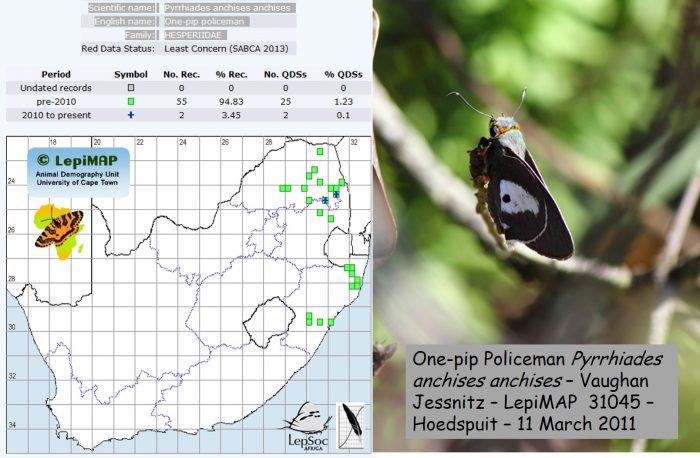
The map shows 55 of the 56 records for One-pip Policeman in the LepiMAP data (there is one record flagged as unreliable and it is not shown!). The green squares show the quarter degree grid cells for the species up to 31 December 2009. The two blue crosses mark the two most recent records, made in February 2010 (LepiMAP 11454) and in March 2011, featured above (LepiMAP 31045). This species MUST surely occur in many of the “in-between” grid cells in the distribution map. Maybe it occurs in eSwatini!

For a species to qualify for the table below, it needs to have a photographic record in LepiMAP. The cut-off date for being eligible is that the most recent record in LepiMAP must have been before 31 December 2014.

  Family Scientific name Common name Status QDGC Rec-ords Last observed Li Mp Ga NW KZN FS NC WC EC eS Les Locality
112 HESPERIIDAE Pyrrhiades anchises anchises One-pip policeman Least Concern 25 56 11/03/2011 X X     X             Imfolozi Nature Reserve, Linwood forest, Klaserie private NR
113 NYMPHALIDAE Ypthima condamini condamini Condamin’s ringlet Least Concern 2 2 15/03/2011 X                     Wolkberg farm at Letaba drift
114 NYMPHALIDAE Precis antilope Darker commodore Least Concern 40 72 22/04/2011 X X X             X   Nylsvley Nature Reserve, Mlawula Nature Reserve
115 LYCAENIDAE Lepidochrysops wykehami Wykeham’s blue Least Concern 7 149 19/09/2011             X         Kamieskroon, Wolfhok
116 NYMPHALIDAE Pseudonympha trimenii nieuwveldensis Trimen’s brown Least Concern 5 68 19/09/2011               X       Molteno pass (Nuweveld mountains)
117 LYCAENIDAE Aloeides kaplani Kaplan’s copper Least Concern 13 91 20/09/2011             X X       Sutherland, Karoo National Park (Beaufort West)
121 NYMPHALIDAE Serradinga clarki ocra Clark’s widow Least Concern 2 43 04/11/2011   X                   Long Tom pass
122 LYCAENIDAE Aloeides barbarae Barbara’s copper Endangered 2 45 11/11/2011   X                   Barberton
123 LYCAENIDAE Iolaus lulua White spotted sapphire Least Concern 5 50 07/12/2011         X             Ndumu game reserve
124 NYMPHALIDAE Pseudonympha paragaika Golden Gate brown Vulnerable 5 148 02/01/2012           X           Golden gate
125 LYCAENIDAE Lepidochrysops lerothodi Lesotho blue Least Concern 16 202 21/01/2012                 X   X Mokhotlong, Blue mountain pass, Lundean’s Nek
126 NYMPHALIDAE Charaxes xiphares xiphares Forest-king charaxes Least Concern 12 98 19/03/2012               X X     Tsitsikama National Park, Saarsveld, Karatara
127 NYMPHALIDAE Charaxes xiphares bavenda Forest-king charaxes Least Concern 10 118 29/03/2012 X                     Hangklip forest, Entabeni forest
128 LYCAENIDAE Durbania limbata Natal rocksitter Least Concern 23 426 21/04/2012         X X           Balgowan, Mooirivier, Harrismith
129 LYCAENIDAE Chrysoritis beaufortia stepheni Stephen’s opal Least Concern 5 351 06/10/2012             X         Hantamsberg, Wolfhok
130 LYCAENIDAE Chrysoritis phosphor borealis Scarce scarlet Least Concern 10 75 06/10/2012   X     X             Panorama gorge, Mhlopeni Nature Reserve
131 LYCAENIDAE Aloeides simplex Dune copper Least Concern 19 139 01/11/2012             X         Witsand, Kuruman
132 NYMPHALIDAE Charaxes pondoensis Pondo charaxes Least Concern 13 159 04/01/2013         X       X     Port St. Johns, Umtamvuma reserve
133 LYCAENIDAE Alaena margaritacea Wolkberg zulu Critically Endangered 2 259 05/01/2013 X                     Wolkberg
134 LYCAENIDAE Lepidochrysops braueri Brauer’s blue Least Concern 21 153 08/01/2013               X X     Prince Alfred’s pass, Buffelsnek, Baviaanskloof
135 NYMPHALIDAE Stygionympha vansoni Van Son’s hillside brown Least Concern 17 158 24/04/2013             X         Springbok, Kamieskroon, Carolusberg
136 LYCAENIDAE Anthene talboti Talbot’s hairtail Least Concern 73 169 14/06/2013 X X X X X   X X X X   Various locations
137 LYCAENIDAE Chrysoritis lyndseyae Lyndsey’s Opal Vulnerable 1 1 25/09/2013             X         Hondeklipbaai (Wallekraal road)
138 LYCAENIDAE Orachrysops mijburghi Mijburgh’s blue Endangered 5 72 27/10/2013     X     X           Heilbron, Suikerbosrand
139 LYCAENIDAE Thestor vansoni Van Son’s skolly Least Concern 3 114 02/11/2013               X       Gydo mountain (Ceres)
140 HESPERIIDAE Platylesches dolomitica Hilltop hopper Least Concern 10 19 16/11/2013     X X               Utopia nature reserve, Hillshaven
141 LYCAENIDAE Aloeides molomo krooni Molomo copper Least Concern 13 93 18/11/2013             X         Kuruman, Witsand
142 LYCAENIDAE Trimenia wallengrenii gonnemoi Wallengren’s silver-spotted copper Vulnerable 3 32 18/11/2013               X       Piketberg
143 LYCAENIDAE Erikssonia edgei Erikson’s copper Critically Endangered 2 61 14/12/2013 X                     Bateleur nature reserve
144 LYCAENIDAE Orachrysops montanus Golden Gate blue Least Concern 3 45 18/12/2013           X           Golden gate
145 LYCAENIDAE Aloeides bamptoni Bampton’s copper Least Concern 27 172 09/01/2014             X         Springbok, Witsand, Steinkopf
146 PAPILIONIDAE Papilio ophidicephalus ayresi Emperor swallowtail Least Concern 15 138 31/01/2014   X     X         X   Mariepskop, Nongoma Ngome Forest
147 HESPERIIDAE Spialia depauperata australis Wandering sandman Least Concern 48 211 01/02/2014 X X X X X             Utopia nature reserve, Tswaing Nature Reserve
148 HESPERIIDAE Platylesches tina Small hopper Least Concern 6 13 15/02/2014 X                     Lekgalameetse Nature Reserve
149 LYCAENIDAE Chrysoritis aureus Heidelberg opal Endangered 5 215 08/03/2014   X X                 Alice Glockner Reserve
150 NYMPHALIDAE Neita extensa Savanna brown Least Concern 35 193 08/03/2014 X X                   Perdekop (Jan Trichardt pass), Verloren vallei (Dullstroom)
151 LYCAENIDAE Thestor dicksoni warreni Dickson’s skolly Data Deficient 2 45 05/04/2014               X       Graafwater
152 NYMPHALIDAE Cymothoe alcimeda marieps Battling glider Least Concern 17 143 12/04/2014   X                   Mariepskop
153 NYMPHALIDAE Torynesis mintha piquetbergensis Mintha widow Least Concern 4 123 07/05/2014               X       Hill NE of Moorreesburg
154 PIERIDAE Colotis celimene amina Lilac tip Least Concern 32 191 29/05/2014 X X X X X             Various locations
155 HESPERIIDAE Teniorhinus harona Arrowhead orange   2 2 14/06/2014 X                     Mphapuli Cycad Reserve
156 LYCAENIDAE Chrysoritis dicksoni Dickson’s Strandveld copper Critically Endangered 1 49 09/09/2014               X       Witsand
157 LYCAENIDAE Chrysoritis zonarius coetzeri Coetzer’s daisy copper Least Concern 7 96 12/09/2014             X X       Nieuwoudtville, Clanwilliam
158 NYMPHALIDAE Telchinia induna salmontana Induna acraea Endangered 7 62 13/09/2014 X                     Lajuma mountain retreat, Matshavhawe
159 LYCAENIDAE Lepidochrysops mcgregori McGregor’s blue Least Concern 4 128 19/09/2014             X         Hantam national botanical garden
160 LYCAENIDAE Chrysoritis thysbe psyche Common opal Least Concern 6 189 20/09/2014               X       Bitterfontein, Lambert’s bay
161 NYMPHALIDAE Stygionympha scotina coetzeri Eastern hillside brown Least Concern 6 11 25/09/2014 X X                   Lekgalameetse Nature Reserve
162 PIERIDAE Colotis doubledayi Desert veined tip Least Concern 6 173 25/09/2014                 X     Vioolsdrift
163 LYCAENIDAE Trimenia argyroplaga cardouwae Large silver-spotted copper Least Concern 4 34 21/11/2014               X       Dasklip pass (Porterville)
164 NYMPHALIDAE Pseudonympha swanepoeli Swanepoel’s brown Data Deficient 4 43 26/11/2014 X X                   Verlorenvallei, Houtbosberg
165 LYCAENIDAE Lepidochrysops gydoae Gydo blue Least Concern 1 87 05/12/2014               X       Gydo mountain (Ceres)
166 LYCAENIDAE Thestor petra petra Rock skolly Least Concern 4 245 05/12/2014               X       Gydo mountain (Ceres), Matroosberg
167 LYCAENIDAE Chrysoritis turneri amatola Turner’s opal Least Concern 12 97 14/12/2014                 X   X Gaika’s kop (Hogsback), Lootsberg pass, Mount Kubusie, Groot Winterberg
168 LYCAENIDAE Lepidochrysops procera Potchefstroom blue Least Concern 21 181 20/12/2014   X X X X             Badplaas, Welverdiend (Gauteng), Hillshaven (Gauteng)

These 56 species have eluded LepiMAPpers since the beginning of 2015. Let us (a) refresh them, and (b) find new localities where they occur. Ten of the species are in threat categories. Two are “Data Deficient” (we don’t have enough information to classify them into a threat category). The rest are “Least Concern” (we have no worries about the persistence into the future). The way to confirm this “Least Concern” status is to get a better understanding of their distributions, and to maintain a steady stream of records, so we are certain that they are still present.

Although this blog focuses on the southern end of Africa, LepiMAP covers the whole continent, and the offshore islands. Within a few years, it would be fantastic to have sufficient data to do a blog like this for other countries and regions of Africa.

Footnote

 The Seventh BDI Citizen Scientist Hour, on 9 September 2020, was devoted to butterflies and LepiMAP. Fanie did a presentation on the Great LepiMAP Challenge. You can watch it here:

There were two other presentations on butterflies during this Citizen Scientist Hour. Oskar Brattström’s title was Butterflies – Africa’s most exciting animals and you can watch it here:

And the third presenter was Steve Woodhall, talking about Looking for butterflies. Here it is:

The BDI Citizen Scientist Hours are Zoom events. The presentations are recorded, and are uploaded to the BDI’s YouTube channel, which is here. To find out when the next Citizen Scientist Hour will take place, go to the Facebook page of BDI Citizen Science, and search under “events”.
BDInsight – August 2020

Another month has flown by! We are heading into Spring here in the southern Hemisphere, although today feels more like Winter. It is rather chilly all over South Africa this week. It even snowed on Table Mountain!! But things are starting to heat up on the biodiversity front….

BestAugust for the Virtual Museum

The Virtual Museum had another record breaking month, with BioMAPpers uploading 8,173 records to the VM for the month.

The Virtual Museum is helping us build distribution maps, and keeping them up-to-date by refreshing old records as they get long-in-the-tooth. Ideally, it would be nice to refresh all records on an annual basis; in an era of rapid change, the fact that a species was recorded in a place a decade ago is not really good evidence that it STILL occurs there. We need to refresh records frequently (and this is especially true in the urban and suburban areas which appear to have lots of data).

West African Citizen Scientist Hour

On 27 August, we held the 6th Citizen Scientist Hour, with a focus on West Africa.
There was an awesome line up of talks for the evening:

Talatu is a Lecturer and Research Fellow at A.P. Leventis Ornithological Research Institute (APLORI) in Jos, Nigeria (https://www.aplori.org/). APLORI is the only field station dedicated to ornithological research and conservation training in West Africa. The Institute contributes directly to the knowledge infrastructure, especially in West African countries, while also providing a unique base from which to set up long-term ecological research projects.

Sam is also a Research Associate at APLORI and plays a big role in the success of the Nigerian Bird Atlas Project.

Ringim has a big passion for citizen science and nature conservation. He has been a major help starting a culture of citizen science in Nigeria and contributes to the Virtual Museum and Nigerian Bird Atlas Project on a regular basis.

You can catch up on all our previous Citizen Scientist Hours and BioBashes on our YouTube Channel.

Bringing hippos back to the Karoo

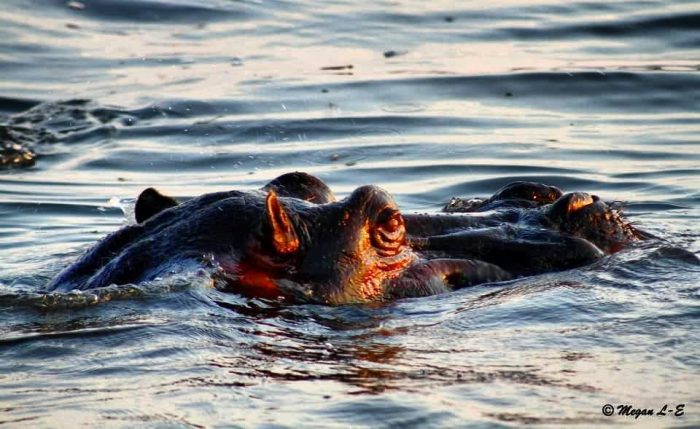
In the heart of the Karoo something wonderful is happening. Nature has been given a chance to come back to an area which used to be home to wild herds of springbok and wildebeest and even hippos and rhinos. Former farmland has been set aside and formally proclaimed as a nature reserve, the Karoo Gariep Nature Reserve.

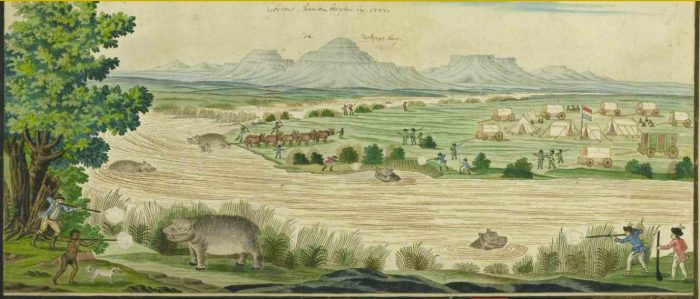
On 23 September 1775, colonial explorers Robert Jacob Gordon and Baron Joachim Ammena van Plettenberg from Netherlands shot and killed as many as 26 hippo in one day on the Seekoei River (meaning Hippo River) that runs through the semi desert Karoo region of the Northern Cape of South Africa. A 1777 painting by RJ Gordon portrays one such hunting party in full flagrant sway. French explorer François le Vaillant writes at the end of the 18th century about how he fashioned a plate from the foot of a hapless hippo. 

230 years later, PC Ferreira, a passionate sheep farmer and the heart behind the KhoiSan Karoo Conservancy, realized the immense loss to the environment and conservation, suffered generations ago, when the last Seekoei River hippos were shot and killed in the late 1700’s. These were the last remaining hippos in the Karoo and the Northern Cape. PC decided to take action and initiated a hippo reintroduction project in 2000. It would eventually take 6 years for this project to bear fruit, but in 2006 a small breeding group of hippos were released on the then recently established Karoo Gariep Conservancy (est. 2005). Now known as KhoiSan Karoo Conservancy, which includes the formally proclaimed Karoo Gariep Nature Reserve (est 2015) and Hanover Aardvark Nature Reserve. 

For his contribution to conservation PC was awarded the SANParks Kudu Award in 2008. Over the next 14 years five hippos were born from the original group, but sadly the old bull killed all of them. The old bull died in 2017 and in 2019 we lost the cow. Only one strong and healthy, but very lonely, young bull remains and he is in desperate need of a family. We are raising funds to introduce three hippo cows and reestablish a healthy hippo family in the Seekoei River in the Karoo Gariep Nature Reserve. This hippo family will be the only hippo family in the Northern Cape. In time our goal is to establish a viable wild hippo population all along the Seekoei River, which is 300 km in length and can accommodate at least 80 hippos. Our goal is to restore the Seekoei River valley to its pristine, wild and natural state so that wildlife and humans can thrive together and prosper. Please help us by donating to this amazing cause: https://www.givengain.com/cc/the-return-of-the-karoo-hippo/

Impacts of Rhodes on Biodiversity 2 : Common Chaffinch

21 records of Common Chaffinch in BirdPix

The first blog in this series talked a bit about Cecil John Rhodes and his beliefs, which can can be summarized in this quote: “Remember that you are an Englishman, and have consequently won first prize in the lottery of life.” The first blog in the series actually focused on Eastern Grey Squirrels, introduced by Rhodes to his estate in Cape Town about 1900.

This blog focuses on four of the five bird species which Rhodes introduced around 1900. Three of the four went extinct fairly fast. After 120 years, the fourth is hanging on.

We can dismiss the first three species in a couple of paragraphs: Rook Corvus frugilegus, Song Thrush Turdus philomelos and Common Blackbird Turdus merula. The Atlas of the Birds of the Southwestern Cape says that Rhodes’s consignment of about 200 Rooks lasted only two years:

Rooks were also introduced to Cape Town by Cecil John Rhodes
The species account for the Rook in the Atlas of the Birds of the Southwestern Cape, published by the Cape Bird Club in 1989

So one sentence was enough to deal with the Rook. The Song Thrush was “still holding its own in the gardens of Newlands” in 1937, but within 10 years it was extinct. So it lasted about four decades. The Song Thrush has also been introduced to New Zealand, where it are common, and to Australia, where it occurs mainly in Victoria and New South Wales. There were a few Common Blackbirds in and around Cape Town until about 1930, so they lasted about three decades. The Common Blackbird was also introduced to New Zealand, where it became one of the most widespread bird species, and to Australia, where the Atlas of Living Australia has more than 352,000 records of the species, mainly from Tasmania, Victoria, New South Wales and South Australia. It is a puzzle that Song Thrushes and Common Blackbirds did not become established here in the same way as they succeeded in similar climates in Australia.

Song Thrush still in Cape Town about 1937
From the Presidential Address of Dr R Bigalke, entitled “The naturalisation of animals, with species reference to South Africa“, and published in the South African Journal of Science in 1937

The fourth of the four bird species considered in this blog is the Common Chaffinch Fringilla coelebs. 120 years after it was introduced it has neither gone extinct, nor has it taken off. In his 1937 Presidential Address, Dr Bigalke also wrote:

The Common Chaffinch has reached Wynberg and Camps Bay

So, in about 40 years, the Chaffinch had spread about 5 km to the south, to Wynberg, and presumably around the northern end of Table Mountain, via the City Bowl to Camps Bay, a distance of about 10 km via Kloof Nek. 50 years later, in the Atlas of the Birds of the Southwestern Cape, published 1989, with fieldwork 1981 to 1985, the species account for the Chaffinch reads like this:

Common Chaffinch introduced to Cape Peninsula. One of the impacts of Rhodes on biodiversity
… A female was seen at Klaasjagersberg in the Cape of Good Hope Nature Reserve.

So, between the 1930s and the 1980s, the range did not change a great deal. It was still unable to break out of the Cape Peninsula! Subsequently, with the removal of alien trees from the Table Mountain National Park, the range of the Chaffinch has possibly contracted.

At the moment, August 2020, there are 21 records of Common Chaffinch in BirdPix. Here they are:

Collage of Chaffinch photos in the BirdPix Virtual Museum. One of the impacts of Rhodes on biodiversity
Thumbnails of the 21 records of Common Chaffinch in BirdPix

If you plot these 21 BirdPix reecords onto a map of the Cape Peninsula, this is what you get:

Chaffinch distribuntion in the Cape Peninsula

Working our way from north to south along the eastern edge of mountain chain of the Cape Peninsula, the first BirdPix record was in the parking area at Rhodes Memorial, close to the University of Cape Town. A few kilometres to the south, there is a cluster of seven records in the Kirstenbosch National Botanical Gardens. Then there are scattered records southwards via Constantia to the Tokai Forest, where the Table Mountain National Park has its headquarters. There are four records farther away from the mountain in the suburbs. From north to south: the eastern edge of Rondebosch and Access Park, Kenilworth (these two records are immediately west of the M5 highway), then one in Bergvliet and one in Kirstenhof. Access Park is a “retail precinct”, but hosts a good scattering of pine trees, which are a Chaffinch magnet.

On the western side of the Cape Peninsula mountain chain, Bigalke mentioned Camps Bay and the atlas mentioned Hout Bay. BirdPix has a single record for this side of the Cape Peninsula, from Noordhoek, a few kilometres farther south than the earlier records.

This detailed map of distribution records provides the start of a baseline against which change can be measured. But with only 21 records, it is likely to be incomplete.

Are there still Chaffinches in Camps Bay, or Hout Bay? Are there any in the City Bowl, where there are lots of pine trees? What about Pinelands, a suburb where the stone pines were preserved when the houses were built? If you know of other places in and around Cape Town where Chaffinches occur, please try to get a photo. (This is not an easy task; patience needed.) Please upload your records to the BirdPix section of the Virtual Museum. Old records are also welcome.

Male Chaffinch at Groot Constantia. One of the impacts of Rhodes on biodiversity
This male chaffinch was photographed at Groot Constantia on 28 September 2019. There is a second photograph in the BirdPix database of a female on the same day at the same place. See http://vmus.adu.org.za/?vm=BirdPix-93977

Breeding records!

Off on a different track, it seems that the last record of breeding Chaffinches was made in September 1987. That’s 33 years ago, so it is worth reproducing it in full. The nest was found by David Allan, and he wrote an excellent record of the breeding event. His report is published in Promerops, the newsletter of the Cape Bird Club:

Article about Common Chaffinch nest
Promerops number 182, page 14, published in February 1988

Chaffinches elsewhere

Common Chaffinches occur as an indigenous species in Europe and eastwards far into Asia. In western Europe they breed from Spain and Portugal in the south to Norway in the north. A few breed in Morocco and Algeria in north Africa, so it can be claimed as an African species. As the distribution extends eastwards into Asia, the latitudinal range gets narrower. The indigenous range is characterized by trees: areas with deciduous forest, coniferous forest, or mixed forest of both deciduous and coniferous trees.

Rhodes was not alone in wanting to make the countries they had moved to, with their strange and unfamiliar biodiversity, look and feel and sound like “home”. The earliest “bird clubs” were known as “acclimatization societies“, and their objective was to bring consignments of birds from the “home country” and release them in the “new country”. The most successful acclimatization societies were in New Zealand. The list of British bird species they introduced to New Zealand is impressive. The Chaffinch is one. Several hundred were released in Auckland between 1864 and 1869, and there were similar-sized releases in towns and cities in both the North and South Islands. Chaffinches “acclimatized” slowly in New Zealand (see here), but within five decades they had overrun the country, and even expanded into the natural forests. In contrast, the acclimatization societies of Australia and North America had total failures with the Chaffinch.

Three things can happen …

The Common Chaffinch in the Cape Peninsula is a rare example of an introduction that has neither taken off nor gone extinct. Three things can happen. 1). They can bumble along indefinitely, in the way that they have done for the past 120 years. 2). They can follow the Rook, the Song Thrush and the Common Blackbird and go extinct. 3). They can all of a sudden discover the elusive secret of success, and suddenly become an invasive species. Number 3 happened in New Zealand, and Number 2 in Australia and North America. We have no idea! But what we, as citizen scientists, can do is to monitor the population carefully.

Impacts of Rhodes on biodiversity 1 and 3

The first and third blogs in this series deal with two other species which Rhodes introduced: the Eastern Grey Squirrel, which has not expanded far, and the Common Starling. The starling is Rhode’s big “success” story. If his vision of building a railway line northwards from Cape Town through Africa to Cairo failed, his starling has made a modest start in covering the distance!

Acknowledgements

Itxaso Quintana produced the map. Thanks to everyone who submitted records of Chaffinches to BirdPix.

Recommended citation format: Underhill LG 2021. Impacts of Rhodes on Biodiversity 2 : Common Chaffinch. Biodiversity and Development Institute. Available online at http://thebdi.org/2020/08/31/impacts-of-rhodes-on-biodiversity-2-common-chaffinch/

Horned Talontail (Crenigomphus cornutus)

Cover photo by Bertie Brink.

Find the Horned Talontail in the FBIS database (Freshwater Biodiversity Information System) here.

Family Gomphidae

Identification

Medium Sized

Length attains 49mm; Wingspan up to 68mm.

The Horned Talontail is very similar to Crenigomphus hartmanni (Clubbed Talontail). The main difference is that Crenigomphus cornutus lacks the small foliations on abdomen segments 8 and 9. Additionally, in Crenigomphus cornutus segments 9 and ten are of similar length, whereas in Crenigomphus hartmanni segment 10 is roughly twice as long as segment 9.

Horned Talontail Crenigomphus cornutus – Female
Kabompo River, Zambia
Photo by Bertie Brink

Habitat

The Horned Talontail inhabits large rivers in savanna regions. It favours sites with lotic (fast-flowing) water and abundant grass and low bushes.

Behaviour

The Horned Talontail is most often seen foraging in rank grass near rivers. Crenigomphus cornutus hunts from a perch, usually a tall grass or reed stem, but sometimes also from bushes.

Status and Conservation

The Horned Talontail is listed as Vulnerable in the IUCN Red List of Threatened Species. This species is data deficient in South Africa.

Distribution

The Horned Talontail is erratically distributed in South-Central Africa. It has been recorded from Southern DRC, Northern Zambia, and Angola. It has also been recorded from the Zambezi region of Southern Zambia, Namibia’s Caprivi Strip, far north-eastern Botswana and north-western Zimbabwe.

In South Africa Crenigomphus cornutus has only been recorded once, from Malelane in the Kruger National Park.

There are no maps for this species at present.

Further Resources

The use of photographs by Bertie Brink is acknowledged.

Horned Talontail Crenigomphus cornutus Pinhey, 1956

Other Common Names: Puntige Kloustert (Afrikaans).

Recommended citation format: Loftie-Eaton M; Navarro R; Tippett RM; Underhill L. 2025. Horned Talontail Crenigomphus cornutus. Biodiversity and Development Institute. Available online at https://thebdi.org/2020/08/24/horned-talontail-crenigomphus-cornutus/

References: Tarboton, M; Tarboton, W. (2019). A Guide to the Dragonflies & Damselflies of South Africa. Struik Nature.

Samways, MJ. (2008). Dragonflies and Damselflies of South Africa. Pensoft

Samways, MJ. (2016). Manual of Freshwater Assessment for South Africa: Dragonfly Biotic Index. Suricata 2. South African National Biodiversity Institute, Pretoria

Martens, A; Suhling, F. (2007). Dragonflies and Damselflies of Namibia. Gamsberg Macmillan.

Similar Species

Eastern Scissortail (Microgomphus nyassicus)

Cover photo by John Wilkinson.

Find the Eastern Scissortail in the FBIS database (Freshwater Biodiversity Information System) here.

Family Gomphidae

Identification

Eastern Scissortail Microgomphus nyassicus – Male
Swadini, Blyde River, Mpumalanga
Photo by Antoinette Snyman
Inset image by Andries DeVries

Medium sized

Length reaches 43mm.

The Eastern Scissortail is the smallest gomphid species in Southern Africa. It is best recognised by its small size and distinctive claspers. Microgomphus nyassicus has the typical yellowish-green and black colouration of many gomphid species. It also has unusual, thick black, looped markings on the upper thorax.

Within the sub-region, the Eastern Scissortail is most similar to the Spined Fairytail (Lestinogomphus angustus). Both species are close in terms of size and colouration, but the Spined Fairytail has a far more slender abdomen and the two have very different clasper structures.

Click here for more details on identification of the Eastern Scissortail.

Eastern Scissortail Microgomphus nyassicus – Female
Swadini, Blyde River, Mpumalanga
Photo by Antoinette Snyman

Habitat

The Eastern Scissortail is recorded from rocky rivers and streams in well-wooded or forested environments. It favours flowing water with large rocks and nearby cover in the form of shady vegetation and reeds.

Habitat – Blyde River, Mpumalanga
Photo by Andries DeVries

Behaviour

The Eastern Scissortail is highly elusive and easily overlooked. Interestingly larvae, exuvia, and adult females are found more often than adult males. The males appear to spend much of their time in the shade of bushes and trees some meters from the river. They are seemingly active for only a short period during the hottest time of the day, when they sit on sunny boulders and reeds close to the water. Females are found among trees and bushes not too far from the river. Despite its elusiveness, the Eastern Scissortail is fairly tame and confiding.

Eastern Scissortail Microgomphus nyassicus – Female
Swadini, Blyde River, Mpumalanga
Photo by Antoinette Snyman

Status and Conservation

Very little is known about the Eastern Scissortail. The paucity of records from throughout its range suggests Microgomphus nyassicus is rare, but more data is needed. It is currently listed as of Least Concern in the IUCN Red List of Threatened Species.

An exuvia, believed to belong to this species was found at Oribi Gorge, KwaZulu-Natal in 1988. Another was found near the Komati River, Mpumalanga in 2018.

The first record of an adult in South Africa, was by Antoinette Snyman on the Blyde River, Mpumalanga in May 2019. See the identification image above.

Eastern Scissortail Microgomphus nyassicus – Female
Swadini, Blyde River, Mpumalanga
Photo by Andries de Vries

Distribution

The Eastern Scissortail is erratically distributed in South-East Africa. It has been recorded from Southern DRC, Northern Zambia, and Malawi as well as the border region between Zimbabwe and Mozambique and a few scattered locations in South Africa.

In South Africa, it has been recorded from the Mpumalanga and KwaZulu-Natal provinces.

There are no maps for this species at present.

Eastern Scissortail Microgomphus nyassicus – Female
Swadini, Blyde River, Mpumalanga
Photo by John Wilkinson

Further Resources

The use of photographs by Andries de Vries, Antoinette Snyman, and John Wilkinson is acknowledged.

Eastern Scissortail Microgomphus nyassicus (Grünberg, 1902)

Other common names: Oostelike Knipstertjie (Afrikaans)

Recommended citation format: Loftie-Eaton M; Navarro R; Tippett RM; Underhill L. 2025. Eastern Scissortail Microgomphus nyassicus. Biodiversity and Development Institute. Available online at https://thebdi.org/2020/08/24/eastern-scissortail-microgomphus-nyassicus/

References: Tarboton, M; Tarboton, W. (2019). A Guide to the Dragonflies & Damselflies of South Africa. Struik Nature.

Samways, MJ. (2008). Dragonflies and Damselflies of South Africa. Pensoft

Samways, MJ. (2016). Manual of Freshwater Assessment for South Africa: Dragonfly Biotic Index.Suricata 2. South African National Biodiversity Institute, Pretoria

Similar Species

Silke’s Fairytail (Lestinogomphus silkeae)

Find Silke’s Fairytail in the FBIS database (Freshwater Biodiversity Information System) here.

Family Gomphidae

Identification

Medium sized, but one of the smallest members of its family.

Silke’s Fairytail was only recently described in 2012. It has the typical colouration of many gomphid species. It is best recognised by its small size, and very distinctive downward pointing abdomen.

The Silke’s Fairytail most resembles the Spined Fairytail (Lestinogomphus angustus). The two are very similar in terms of colouration, and the only distinct difference is the shape of the male appendages. Silke’s Fairytail is also similar in size and colouration to Microgomphus nyassicus (Eastern Scissortail), but Lestinogomphus silkeae has a far more slender build and the two have very different clasper structures.

Habitat

The Silke’s Fairytail inhabits the well-wooded banks of perennial streams and rivers in both savanna and forested regions. It is usually found in areas with shade or dappled light.

Behaviour

Little is known about the habits of Silke’s Fairytail but it is probably very similar to that of the Spined Fairytail. It is believed to emerge later in the season than the Spined Fairytail. Silke’s Fairytail is unobtrusive and spends much time sitting on a shady perch over or near the water.

Status and Conservation

The status of Silke’s Fairytail is presently undetermined in South Africa. More data is required.

Distribution

Lestinogomphus silkeae has so far only been recorded from the Okavango panhandle, Botswana, and from near Victoria Falls, Zimbabwe. A record from the Sabie River in South Africa is also thought to be of this species.

Further Resources

Silke’s Fairytail Lestinogomphus silkeae Kipping, 2012

Recommended citation format: Loftie-Eaton M; Navarro R; Tippett RM; Underhill L. 2025. Silke’s Fairytail Lestinogomphus silkeae. Biodiversity and Development Institute. Available online at https://thebdi.org/2020/08/24/silkes-fairytail-lestinogomphus-silkeae/

References: Tarboton, M; Tarboton, W. (2019). A Guide to the Dragonflies & Damselflies of South Africa. Struik Nature.

Samways, MJ. (2008). Dragonflies and Damselflies of South Africa. Pensoft

Samways, MJ. (2016). Manual of Freshwater Assessment for South Africa: Dragonfly Biotic Index. Suricata 2. South African National Biodiversity Institute, Pretoria

Martens, A; Suhling, F. (2007). Dragonflies and Damselflies of Namibia. Gamsberg Macmillan.

Similar Species

Fork-tailed Bluet (Proischnura subfurcata)

Cover photo by N. Hart.

Family Coenagrionidae

Identification

Fork-tailed Bluet Proischnura subfurcata – Male
Makungwa River, Rwanda
Photo by Desire Darling

Very small size

Length up to 30mm; Wingspan attains 38mm.

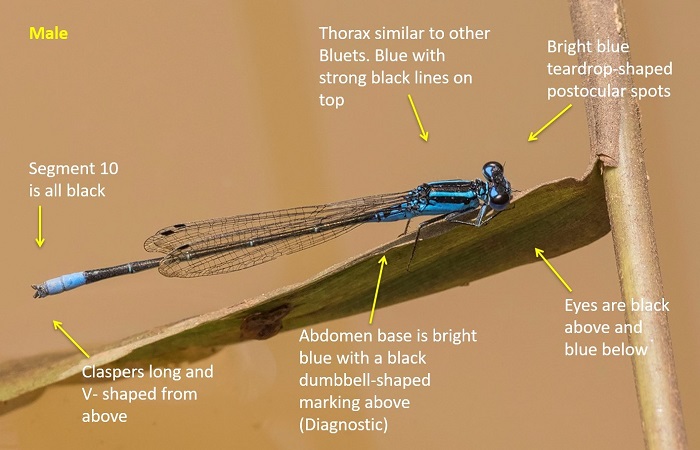
The overall colouration of the Fork-tailed Bluet, as with many other bluets, is bright blue and black. It is most similar to the Sailing Bluet (Azuragrion nigridorsum). The Fork-tailed Bluet can be readily differentiated from the sailing Bluet by its highly distinctive claspers, teardrop-shaped postocular spots and the blue abdomen base with a black dumbell-shaped marking above.

Click here for more details on identification.

Habitat

The Fork-tailed Bluet frequents the grassy fringes of pools and ponds. It is most often found in mountainous, forested areas.

Behaviour

The Fork-tailed Bluet typically perches low down amongst grass or reed stems in damp areas.

Status and Conservation

The current status of Proischnura subfurcata in South Africa is uncertain. It is only known from a few dubious old records (Pre. 1951), from KwaZulu-Natal and the Western Cape. Overall it is listed as of Least Concern in the IUCN Red List of Threatened Species.

Distribution

There is currently no map available for this species. More data is required.

The Fork-tailed Bluet is mainly an East African species that ranges from Ethiopia in the North down to Zimbabwe and Neighbouring Mozambique in the South. Its presence in South Africa requires confirmation.

Further Resources

The use of photographs by Desire Darling and N. Hart is acknowledged.

Fork-tailed Bluet Proischnura subfurcata (Selys, 1876)

Other Common names: Mikstertbloutjie (Afrikaans).

Recommended citation format: Loftie-Eaton M; Navarro R; Tippett RM; Underhill L. 2025. Fork-tailed Bluet Proischnura subfurcata. Biodiversity and Development Institute. Available online at https://thebdi.org/2020/08/24/fork-tailed-bluet-proischnura-subfurcata/

References: Tarboton, M; Tarboton, W. (2019). A Guide to the Dragonflies & Damselflies of South Africa. Struik Nature.

Samways, MJ. (2008). Dragonflies and Damselflies of South Africa. Pensoft

Samways, MJ. (2016). Manual of Freshwater Assessment for South Africa: Dragonfly Biotic Index.Suricata 2. South African National Biodiversity Institute, Pretoria

Similar Species

Ruby Jewel (Chlorocypha consueta)

Cover photo by Nick Hart.

Family Chlorocyphidae

Identification

Ruby Jewel Chlorocypha consueta – Male
Mulanje, Malawi
Photo by Gary Brown

Small size

Length up to 31mm; Wingspan attains 56mm.

Males are unmistakable within the sub-region.

The Ruby Jewel can be told apart from the Platycypha caligata (Dancing Jewel) and Platycypha fitzsimonsi (Boulder Jewel) by having a vivid, all-red abdomen and thin dark coloured legs. The Platycypha jewels have vivid blue on the upper surface of the abdomen and broad, flattened lower legs that are white on the inner surface and red on the outside.

Female Ruby Jewels are very similar to those of the Platycypha jewels, and are best identified by their association with the males.

Click here for more details on identification.

Habitat

The Ruby Jewel inhabits forested streams and rivers with clean, clear, flowing water and dappled light.

Behaviour

This species sits close to the water on rocks, tree roots, or on overhanging vegetation. The Ruby Jewel is usually reluctant to fly.

The Ruby Jewel is on the wing from November to May

Status and Conservation

The continued presence of this species in South Africa is uncertain and it may well be regionally extinct. In the IUCN Red List of Threatened Species, the Ruby Jewel is listed as Critically Endangered for South Africa, but of Least Concern overall.

Distribution

There is currently no distribution map for this species. More data is required.

There are three old records for Ruby Jewel from northern and central KwaZulu-Natal. Subsequent searches have not lead to the rediscovery of the species in the country. It is doubtful weather this species is resident in South Africa.

The Ruby Jewel has a disjunct distribution in South-East Africa. Occurs in southern DRC, northern Zambia, Malawi, Tanzania and the Eastern Highlands of Zimbabwe and neighbouring Mozambique.

Further Resources

The use of photographs by Gary Brown and Nick Hart is acknowledged.

Ruby Jewel Chlorocypha consueta (Karsch, 1899)

Other common names: Rooijuweeltjie (Afrikaans).

Recommended citation format: Loftie-Eaton M; Navarro R; Tippett RM; Underhill L. 2025. Ruby Jewel Chlorocypha consueta. Biodiversity and Development Institute. Available online at https://thebdi.org/2020/08/24/ruby-jewel-chlorocypha-consueta/

References: Tarboton, M; Tarboton, W. (2019). A Guide to the Dragonflies & Damselflies of South Africa. Struik Nature.

Samways, MJ. (2008). Dragonflies and Damselflies of South Africa. Pensoft

Samways, MJ. (2016). Manual of Freshwater Assessment for South Africa: Dragonfly Biotic Index.Suricata 2. South African National Biodiversity Institute, Pretoria

Impacts of Rhodes on Biodiversity 1 : Eastern Grey Squirrel

Cecil John Rhodes was a dominating person in the politics of southern Africa for a few decades at the end of the nineteenth century. “One of Rhodes’ guiding principles throughout his life, that underpinned almost all of his actions, was his firm belief that the Englishman was the greatest human specimen in the world and that his rule would be a benefit to all. Rhodes was the ultimate imperialist, he believed, above all else, in the glory of the British Empire and the superiority of the Englishman and British Rule“. Given this passion for all things English, it is impossible to understand why he thought it a great idea to introduce the Eastern Grey Squirrel Sciurus carolinensis to the grounds of his estate in Cape Town.

When Rhodes arrived in Africa in 1870 aged 17, the Eastern Grey Squirrel had not yet been introduced to England. The first introduction to England was in 1876, and there were lots of introductions after that. Within about 20 years, they expanded in their new range to include England and Wales and southern Scotland. They took to their new home like a duck takes to water, or in this case like a squirrel takes to trees. Eastern Grey Squirrels were introduced to England from the eastern USA. In spite of their total un-Englishness, Rhodes apparently decided that it would be nice to have American squirrels jumping around in the oak trees in the gardens of his Groote Schuur estate.

Eastern Grey Squirrel, one of the impacts of Rhodes on biodiversity
At the time of writing this blog, this was the 78th and most recent Eastern Grey Squirrel uploaded into MammalMAP as a photographic record. The photograph was taken by Heather and Andrew Hodgson on 27 July 2020 at the Groot Constantia Wine Estate. It is record 32972 in MammalMAP, and you can look at it here: http://vmus.adu.org.za/?vm=MammalMAP-32972

We don’t know exactly in which year Rhodes got his consignment of squirrels from England, but it was about 1900, so in 2020 we can “celebrate” the 220th anniversary of their introduction. They did as well here as they done in England. By 1918, they were put on the official “vermin list” of the Cape Province, and you got paid a bounty for every one you could prove you had shot. Between 1918 and 1922, the government paid out bounties for 11,188 dead squirrel specimens. Rhodes’s squirrels quickly proved an expensive “nice to have”.

During the 1940s, D.H.S. Davis worked in the “Plague Research Laboratory” of the government’s Department of Health in Johannesburg. He made visits to Cape Town, probably in a citizen scientist capacity, and made it his business to uncover the history of the squirrel in Cape Town. He interviewed both “forestry officials and private persons” who were members of the Cape Natural History Society (and therefore also citizen scientists). He wrote a paper, submitted it to the Proceedings of the Zoological Society of London and it was published in this journal in 1950 (“Notes on the status of the American Grey Squirrel (Sciurus carolinensis Gmelin) in the south-western Cape (South Africa)” – unfortunately, the paper is not “open access”). The paper is a goldmine of carefully researched information. Nothing comparable has been published subsequently! This map, of the area of Greater Cape Town, was published in that paper.

Sketch map from 1950 showing the distribution of the Eastern Grey Squirrel. This is one of the impacts of Rhodes on biodiversity

The numbers on the map are important. Groote Schuur, where the squirrels were released is number 1. They reached the nearby suburbs (2–4) in the next few years. Tokai (5) was reached in 1908. They had expanded in the grey area of the Cape Peninsula (1–11) by 1919. Squirrels were recorded at 12 and 13 on the Cape Flats in 1932 and 1930, respectively. But they were already in the Stellenbosch and Paarl districts (14–20, 22, 23) by 1920, and reached Franschhoek (21) in 1942. They had crossed the mountains to reach the Elgin district (24–27) by 1933. The easternmost records were made in the Lebanon State Forest (28), a pine plantation, in 1948. Davis’s view was that the squirrels had not been introduced to these new locations; they dispersed naturally. The dotted area on the map were Davis’s best guess at the limits of the distribution of the Eastern Grey Squirrel when he submitted his paper in 1949.

Amazingly, the distribution remains much like this in the 21st century. Here are three maps that show the exact positions of the photographic records of Eastern Grey Squirrels in MammalMAP. These maps use the coordinates supplied by the observers. The second map zooms in on the first, and the third on the second.

This map shows the same area as Davis’s but with a bit more to the north. The distribution of records is much the same, except that there is a record from Ceres, in the northeast. But there are no records from the Elgin valley in the south. Action Point for Team Virtual Museum: Do any of the other towns in this region have squirrel populations: Villiersdorp, Caledon, Hermanus, Malmesbury, Riviersonderend, Greyton, Swellendam, Worcester, Robertson, …?

Next we zoom in on the Cape Peninsula. Action point for Team Virtual Museum: Are there squirrels south of these records: Kirstenhof, Muizenberg, Fish Hoek, Simonstown, etc? Where is the southernmost squirrel on the Cape Peninsula? Davis’s sketch map above suggests a southern limit at Fish Hoek.

And finally we zoom in to the suburbs of Cape Town which have hosted squirrels since within a decade of their introduction. Action point for Team Virtual Museum: When the exact locations are shown at this scale, the map looks pretty sparse. Please help fill in the gaps. If you see a squirrel, please try and get a photograph, and upload it to the MammalMAP section of the Virtual Museum. Please try to get the coordinates as accurate as possible!

Many of the squirrel records in MammalMAP are from the Company’s Gardens (and see here too!), at the mountain end of Adderley Street, the heart of the city’s central business district. There are lots of them! The “famous squirrels” are given as reason number of two (of six reasons) why tourists should visit the Company’s Gardens. When I was a boy, in the 1950s, my dad took me to the Gardens, and we would buy a small packet of peanuts and feed the squirrels. Tourists still do this! Action point for Team Virtual Museum: Where else in the “City Bowl” are there squirrels? Are there squirrels in the suburbs between the Gardens and Table Mountain: Tamboerskloof, Oranjezicht, … ? Are there squirrels at the look-out point on Signal Hill (there are lots of stone pines for them there, see below)?

Davis’s map showed squirrels all the way round Table Mountain, including places like Sea Point, Clifton and Camps Bay. But we don’t have any MammalMAP records for these northwestern suburbs. Action point for Team Virtual Museum: Are there squirrels in the coastal suburbs between the Waterfront and the Cape Town Stadium and Bakoven?

Eastern Grey Squirrel, one of the impacts of Rhodes on biodiversity

In his 1950 paper, Davis stated that the “chief limiting factor to the spread of grey squirrels is the absence of tall seed-bearing trees.” Oaks and pines (and especially the Stone Pine Pinus pinea) provide ideal food and habitat, but a wide variety of other trees are used. Indigenous trees don’t produce food for squirrels, so they have not expanded their range into fynbos habitats. Biodiversity Explorer says: “Their distribution is patchy and discontinuous being closely associated with oak trees and pine plantations.” Action point for Team Virtual Museum: Let’s get so many records for the Eastern Grey Squirrel that we can see precisely the discontinuous patches where it occurs!

Here are thumbnails of some of the MammalMAP records of Eastern Grey Squirrels to date. Some of the photos are amazing; in some the squirrel is just a blur. That is fine, so long as we can identify that it is an Eastern Grey Squirrel. There are 78 records in total.

Collage of Eastern Grey Squirrels, from the MammalMAP section of the Virtual Museum. This is one of the impacts of Rhodes on biodiversity.

The Eastern Grey Squirrel is listed by the IUCN as one of the World’s 100 Worst Invasive Alien Species. But there is no chance of eliminating this rodent from the Western Cape. This very idea would cause an outrage! Their amazing bushy tails and endearing habits are more effective advertisements for their image than could be achieved by any public relations agency!

Impacts of Rhodes on biodiversity 2 and 3

The second and third blogs in this series deal with two other species which Rhodes introduced: the Common Chaffinch, which has neither gone extinct nor taken off, and the Common Starling, which is taking the slow route to Cairo!

Acknowledgements

Itxaso Quintana produced the maps. This is the first time we have ever produced maps of this kind from the data of the Virtual Museum. Thanks to all the MammalMAPpers who have submitted records of squirrels.

Recommended citation format: Underhill LG 2021. Impacts of Rhodes on Biodiversity 1 : Eastern Grey Squirrel. Biodiversity and Development Institute. Available online at http://thebdi.org/2020/08/22/impacts-of-rhodes-on-biodiversity-1-eastern-grey-squirrel/

Plants need protecting too

South Africa has an amazing diversity of plants and animals.  Many people know and cherish the most visible and charismatic wildlife, such as rhinos, elephants, lions and giraffes. A growing number of people are enjoying South Africa’s beautiful birds, and people are starting to appreciate the reptiles, frogs, and even some of the insects such as butterflies and dragonflies. Few people, however, are quite aware of what might be South Africa’s greatest living treasure; its plant diversity.  South Africa boasts about 25,000 described species of flowering plants, and the Cape Floristic Region, supporting about 9,000 species, is considered one of the world’s six floral kingdoms. South Africa is also the country with the greatest diversity of succulents in the world! It truly is a treasure that warrants effort to protect.

South Africa’s botanical richness is definitely a national treasure, and the diversity of plants are vital to the diversity of animals – all animals depend directly or indirectly on plants.  Plants provide food, medicine (even animals use plants for their medicinal values), shelter and building materials to so many other living things – humans included.  Species that go extinct are irreplaceable. Every species that vanishes will have knock-on effects on other species, to their detriment, and also to the detriment of the habitat in which it occurred.

Erica regia – Elim heath, Elimsheide – Agulhas Plain, Overberg, South Africa – Photo by Bionerds.co.za

The conservation of plants is in many ways different from the conservation of mammals, birds or other animals. The big difference between plants and (most) animals, is that plants cannot move as individuals. On the up side, this makes them easier to work with.  It is not necessary to find a way to capture or restrain a plant; you can just walk up to it (if it is in an accessible place).  You can take photos, you can take a small piece as a sample or a specimen. You can collect seeds if there are any.  There are challenges too, however, if you are in an area where a plant species is known to grow, finding it may be no easy task.  Many plants occur very sparsely, meaning you have to hike for many hours before you’ll find even one, even in its prime range. It can be very hard to spot small plants amidst dense grass or scrub. Some plants are ‘invisible’ for much of the year, with their main parts subterranean (underground), sending out shoots only during the growing season.  Some plants can only be positively identified when in flower, and their flowering periods may be brief; it is easy to miss them unless you go out into their habitat to search for them pretty much every single day.  And some plants grow in difficult-to-access places: on cliffs or steep mountain slopes, in impenetrable, thorny thickets, like some epiphytes high up in the forest canopy.

Vachellia erioloba – Camel Thorn tree – Tswalu Kalahari Game Reserve

One of the challenges with some plant species is that they have very small distribution ranges – in some cases, only on a single hill, or a small patch of ground with unique geological and environmental features. It is not always possible to figure out which particular ‘spot’ might host such a uniquely restricted plant species; therefore, seeing as there are many places in South Africa that haven’t been properly explored by botanists, there might be many such ‘range-restricted’ plants still awaiting discovery.  Many plants might have already been driven to extinction because the spots where they grew, have been turned into towns, farms, plantations, mines, or submerged by the building of dams. 

Some plants are sensitive to disturbance. Overgrazing of an area might lead to a decline in grass cover and an increase in dense growth of shrubs, trees, and weedy herbs. Bush encroachment can also happen when regular fires are excluded from an area. Bush encroachment leads to changes in ecological attributes, such as the amount of sunlight reaching the ground level. I have observed this in colonies of highly habitat-specific plants, such as a species of Euphorbia and a population of Lithops: what was initially open grassland, with lots of ‘room’ for these light-loving plants to grow, gets turned into bushland and the plants are ‘shaded out’ and disappear.

Dichrostachys cinerea subsp. africana – Sicklebush – Polokwane Game Reserve, South Africa – Photo by Megan Loftie-Eaton

Human activities have caused major changes to the factors that determine the nature of the vegetation across most of South Africa. Migratory wild mammals have been replaced with fenced-in domestic livestock. Fire regimens are determined largely by human whims, in some places being too frequent relative to the needs of the local flora, and in other places the fire cycle has been suppressed.  

The introduction of invasive alien plant species is also a contentious issue. Some examples of alien invasives include: Hakea and Australian Acacia-species in the fynbos biome, Opuntia prickly-pear cacti in the grassland, savanna and succulent thicket biomes, Lantana camara along rivers, the Kariba weed Salvinia molesta on large bodies of water, and Solanum mauritianum, Bugweed, in forest regions. These plants, once introduced to a region, propagate themselves and easily spread without any further help from humans.  Because they come from different ecosystems in distant places, they typically don’t have any natural predators here. They can reproduce and multiply at a massive rate. They invade natural areas in large numbers, displacing the native plants that used to grow there. These invaders can be very difficult to eradicate; some can be countered by the introduction of their natural pests (bio-control), but others are more resistant and need labor-intensive physical removal methods.

Lantana camara – Cherry Pie – highly invasive alien plant species in South Africa

Plants are able to ‘move’ by means of seed dispersal. They can distribute their seeds over small or large distances, depending on the durability of the seeds and the way they are adapted to dispersal.  Under normal conditions, environments have always been changing, cycling from forest to grassland and sometimes even to desert and then back again. Plants could cope with this, moving to moister places if their own became too dry, to warmer regions if their own became too cold, and vice versa. The difference is that this was a slow process. Most natural changes in climate and factors influencing a particular habitat take place slowly – or at least, took place slowly in the past. The ice ages came and went over thousands of years. Plants, with the distribution mechanisms of their seeds, were able to move around, to get to the places where they were capable of growing and flourishing.  Some did indeed go extinct, as a result of these fluctuations, when they got hemmed in, in places from which they could not easily disperse. But they were replaced by new species that were able to adapt and change to the new conditions. Again, this is because the changes took place fairly slowly, giving them time to adapt and evolve.

Tankwa Karoo, Northern Cape, South Africa

The challenge we face now is that human-created changes to habitats and the environment are happening much faster than the historic natural changes – too fast for many or most plants to cope with. Even where changes are slow, our activities are making it difficult for plants to ‘move’ the way they used to. Natural habitats have become fragmented – they remain as ‘islands’ in a sea of cities, towns and other human settlements, mines, factories and farms. If living conditions in one  such ‘island’ become unfavourable for a certain species, it can’t easily disperse to a new place, because of all the fragmentation. Relocation is often not possible, because the plant’s seeds are adapted for short- or medium-distance rather than long-distance dispersal, leaving a species vulnerable to extinction.

Human-caused climate change is a big threat. Apart from rising sea levels, the major challenge is that the world’s climatic zones will change. Some places will get warmer, some places a lot warmer. Most plant species are specifically adapted to certain temperature ranges. Too cold, or too hot, and it is no longer possible for them to flourish.  Consider a plant that only grows on cool mountain slopes (bearing in mind that, the higher the altitude, the colder the local climate). If the climate gets warmer, the plant can adapt by spreading to higher slopes where it is cool enough, but once the plant has reached the mountain’s peak, there’s nowhere higher and cooler to move to. 

Gibbaeum heathii – Baby Bottoms, Baba Boudjies – Sanbona Wildlife Reserve, Western Cape, South Africa – photo by Bionerds.co.za

Hotter climates may favour insect pests and fungal or other diseases, which can ravage plants on a large scale. We know little about this, how to predict it, or how to counter such a problem. 

The increased levels of carbon dioxide in the atmosphere, that is the main cause of global warming, also favours the growth of woody plants over grass, and may lead to grasslands converting into forest or shrublands. Many specialized grassland plant (and animal) species might face extinction.

A large change in atmospheric temperatures may seriously alter ocean currents and the circulation of the air across the planet. We cannot predict the full consequences, but certainly, big changes will happen. Imagine a desert region becoming a lot wetter. Under natural conditions, where plants are free to spread, new species will colonize the desert, but with restricted dispersal because of human-made barriers, it may be hard for suitable plants to establish themselves. As it gets wetter, the desert-adapted plants decrease – these plants cannot tolerate wet conditions – and with few or no new plants moving in, the desert could actually become more barren, with heavy rains washing away the soil. 

Kruger National Park in the dry season

Plant cover and plant roots protect the soil surface of the planet. Plants play a role in moderating the climate. The rainforest plants of the Amazon basin, for example, is partly responsible for the moist climate it needs to flourish. Trees release moisture over the canopy that in turn aids the formation of clouds that bring more rain. If you take away the forest – suddenly the local climate becomes drier and more extreme.

South Africa, as a result of global climate change, may end up a lot hotter and perhaps also a lot drier than it is right now.  Plant cover and species diversity is likely to be adversely affected.

In the face of these severe challenges, we might become despondent – but humans are capable of doing incredible things, we just need to put in the work. With plants, this means leg-work.  It is vital that we catalogue our plant diversity.  At the moment we are just scratching the surface; vast parts of our country are still unexplored. We need volunteers, people to go to places and record the plants that are there. We need to know which ones are where, and which ones are rare. Finding a rare species out in the wild is a thrill; plant-seeking excursions are like treasure hunts. We need the knowledge to inform our conservation efforts.  Many threatened plant species could recover and thrive with just a little bit of help from people. Growing plants is generally much easier than breeding mammals or birds. We can help species to relocate; we can boost denuded populations.  So let’s spread the word and get working!

Adenium multiflorum