Southern Pygmy Toad (Poyntonophrynus vertebralis)

View the above photo record (by Ryan Tippett) in FrogMAP here.

Find the Southern Pygmy Toad in the FBIS database (Freshwater Biodiversity Information System) here.

Family Bufonidae

SOUTHERN PYGMY TOADPoyntonophrynus vertebralis

A. Smith, 1848

Identification

Adult:

Size: Females up to 36mm long. Males are distinctly smaller.

A small squat species with an overall light brown or grey colouration. The skin is leathery and consistently granular or warty. The upper sides are fairly plain or may show irregular dark patterning. A thin vertebral line may sometimes be present.

A pale scapular patch is often present between the shoulders and is variable in size.

The tympanum (ear drum) is inconspicuous and partly concealed by glandular warts. The parotoid glands on the neck are indistinct and somewhat flattened.

Poyntonophrynus vertebralis – Near Carnarvon, Northern Cape
Photo by Ryan Tippett

The undersides are noticeably pale with variable, bold black markings. The skin is leathery and quite granular, especially near the hind legs. The skin on the throat is fairly smooth and may be white or yellowish.

Poyntonophrynus vertebralis – Underside
Doornhoek, Eastern Cape
Photo by Zenobia Van Dyk

Tadpole:

Size: Up to 20mm

Tadpoles of Poyntonophrynus vertebralis have deep, oval-shaped bodies. Their tails are moderately developed and not as deep as the body. Additionally, the tail is slightly longer than the body and the upper and lower fins are of roughly equal length. The mouth is small and located ventrally near the front of the head. The eyes are situated to the sides on the upper front part of the head.

The overall colouration is dark with many fine golden speckles or spots.

Habitat

Poyntonophrynus vertebralis inhabits primarily the Nama Karoo Biome but is also found in parts of the Savanna and Grassland biomes. The species is largely restricted to summer-rainfall areas, but has been recorded in some parts of the Nama Karoo that are transitional between summer and winter rainfall.

It occurs on a variety of substrates, from brackish soils to gravels, in open sandy and grassy areas and in Karoo scrub. It takes refuge under rocks and logs, in mud cracks, deep leaf litter, and occasionally in the abandoned mounds of Trinervitermes termites, sometimes far from open water (De Waal 1980; H. Braack pers. comm.).

Breeding habitat in the Karoo includes temporary shallow pans, pools or depressions containing rain-water, and occasionally culverts and rocky pools in seasonal water courses (new atlas data). In the Free State, tadpoles have been found in roadside pools, small dams, quarries and rock pools along rivers (new atlas data).

Breeding habitat – Rain filled pool in the Nama Karoo
Near Carnarvon, Northern Cape
Photo by Ryan Tippett

Behaviour

Breeding choruses of P. vertebralis develop from October to March. It is an explosive breeder, congregating in large numbers at temporary pools after heavy spring or summer rains (H. Braack pers. comm.). Visser (1979b) recorded thousands of specimens crossing the national road at Victoria West after rain. The call carries a great distance and a chorus produces a deafening sound (Du Preez 1996).

Poyntonophrynus vertebralis – Near Victoria West, Northern Cape
Photo by Malcolm Hepplewhite

Males usually call from concealed sites near the water’s edge, but they will call from exposed positions when there is insufficient cover. In large breeding aggregations, males clasp other individuals indiscriminately, regardless of gender. Satellite behaviour, in which silent males intercept and clasp females that are approaching calling males, was observed at both Beaufort West and Middelburg (H. Braack pers. comm.).

Wager (1965, 1986) collected eggs at the beginning of March; this suggests that breeding occurs after mid-summer rains. The eggs measured <1 mm in diameter and were laid in double strands 2.5 mm thick. They were entangled amongst stones and grass 2–4 cm beneath the surface. Although Wager’s aquarium tadpoles completed metamorphosis after about one month, Power (1927a) recorded a developmental period of only 16 days. When feeding, Wager’s tadpoles showed a preference for the stems of aquatic plants rather than algae, whereas Power (1927b) observed tadpoles feeding on algae and mud at the bottom of a natural pool.

Adult frogs prey on termites, ants, aphids, fly and beetle larvae, adult beetles, and mites (Bates and Irish 2002). During large-scale emergences of P. vertebralis in the breeding season, many are killed by road traffic, and Suricates Suricata suricatta and Black Crows Corvus capensis have been observed feeding on the remains. Captive Suricates and Polecats Ictonyx striatus have also been observed feeding on these toads (H. Braack pers. comm.).

Poyntonophrynus vertebralis – Near Kimberley, Northern Cape
Photo by Luke Kemp

Status and Conservation

The Southern Pygmy Toad is not threatened. It is listed as of Least Concern in the IUCN Red List of Threatened Species.

In the Free State, P. vertebralis occurs in Soetdoring, Krugersdift Dam, and Koppies Dam nature reserves (Bates 1997). It has also been collected at Oviston Nature Reserve and Mountain Zebra National Park in Eastern Cape Province. The species enjoys varying degrees of protection under provincial conservation legislation. It may have been negatively impacted by crop agriculture in Grassland-Biome portions of its range, whereas it is probably not threatened in karoid areas where land is used primarily for grazing. However, the Karoo is renowned for periodic outbreaks of the Brown Locust Locustana pardalina, and over-zealous use of insecticides could affect local frog populations. Monitoring of populations of P. vertebralis in protected areas is recommended. Additional information on the breeding biology of this endemic species is needed.

Poyntonophrynus vertebralis – Doornhoek, Eastern Cape
Photo by Zenobia van Dyk

Distribution

Poyntonophrynus vertebralis is endemic to the atlas region, although recent records from North West Province suggest that it may also occur in southern Botswana. Its distribution follows that of the Nama Karoo Biome in the Northern, Eastern and Western Cape provinces and the southern Free State, but it also occurs in grassland and savanna at Kimberley, north of Christiana, and in the Free State. It occurs as far east as Maseru (2927BC) and near Masite (2927CB) in western Lesotho. Recent atlas records have extended the known western limits of the species as far as the Brandvlei district (3020AD) of Northern Cape Province.

Further north, the species has been recorded in two apparently isolated populations, namely, the Koppies area (2727BA) of the northern Free State (Bates 1995), and on the border between Limpopo and North West provinces (recent atlas data) where it appears to occur in sympatry with P. fenoulheti. The confirmed presence of P. vertebralis, based on advertisement calls (atlas data), supports Jacobsen’s (1989) identification of specimens from grid cells 2428AC and 2528CA. The latter identifications were previously considered dubious because these areas were far north of the known range (Jacobsen 1989).

With regard to the apparently disjunct distribution of P. vertebralis in the Free State, Bates (1995) reported the existence of two museum specimens from “Adonasfontein, Winburg”, a locality that cannot be traced. If the latter locality is in the vicinity of Winburg (2827CA), it will bridge the large gap between southern and northern populations in the Free State.

The taxonomy of the “vertebralis group” (Poynton 1964; Poynton and Broadley 1988) requires revision to determine the exact ranges of the various species. An attempt should be made to identify morphological differences between P. vertebralis and P. fenoulheti in areas of sympatry, to assist in the identification of specimens from these areas.

The atlas data is accurate but incomplete.

Distribution of Poyntonophrynus vertebralis. Taken from the FrogMAP database, April 2022.

Further Resources

Virtual Museum (FrogMAP > Search VM > By Scientific or Common Name)

More common names: Suidelike dwergskurwepadda (Afrikaans)

Recommended citation format for this species text:

Bates MF, Tippett RM.  Southern Pygmy Toad Poyntonophrynus vertebralis. BDI, Cape Town.
Available online at http://thebdi.org/2021/09/19/southern-pygmy-toad-poyntonophrynus-vertebralis/

Recommended citation format: 

This species text has been updated and expanded from the text in the
2004 frog atlas. The reference to the text and the book are as follows:

Bates MF 2004 Poyntonophrynus vertebralis Southern Pygmy Toad. In Minter LR
et al 2004.

Minter LR, Burger M, Harrison JA, Braack HH, Bishop PJ, Kloepfer D (eds)
2004. Atlas and Red Data Book of  the Frogs of South Africa, Lesotho and
Swaziland. Smithsonian Institution, Washington, and Avian Demography
Unit, Cape Town.
Eastern Ghost Frog (Heleophryne orientalis)

Cover photo by A. Coetzer.

Find the Eastern Ghost Frog in the FBIS database (Freshwater Biodiversity Information System) here.

Family Heleophrynidae

Identification

Adult:

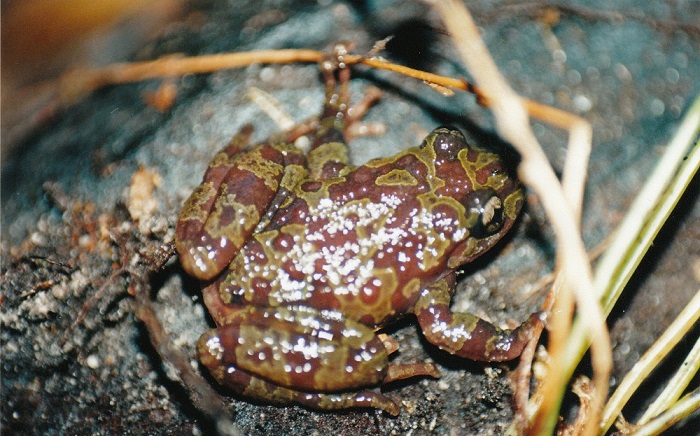
Size: Males attain 35mm; Females up to 46mm long.

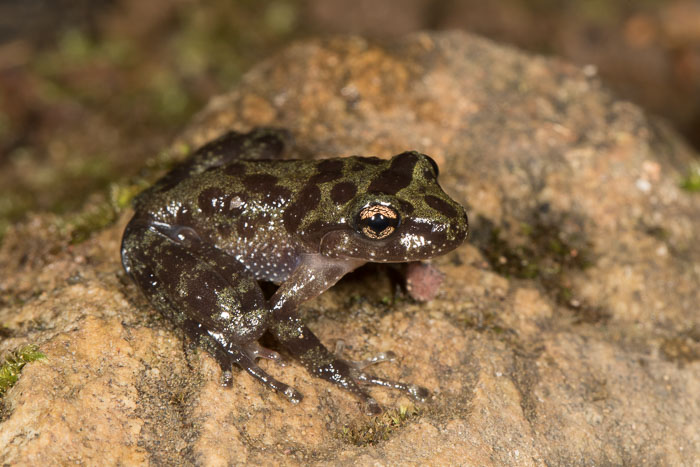
Eastern Ghost Frog Heleophryne orientalis
Grootvadersbosch Nature Reserve, Western Cape
Photo by Trevor Hardaker

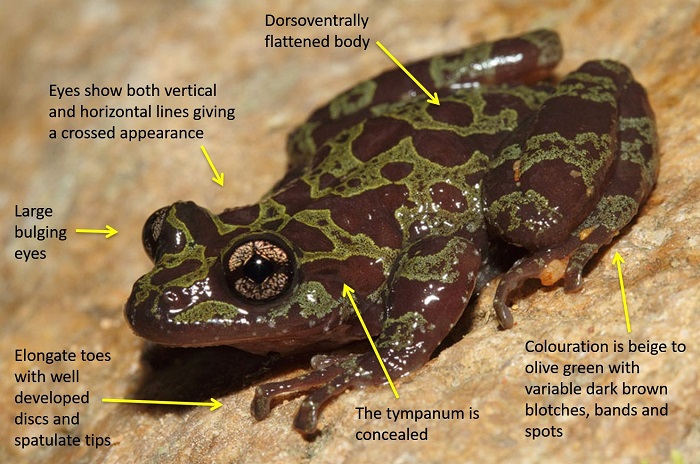
The body of Heleophryne orientalis is flattened, enabling them to shelter under rocks and in narrow crevices. They possess large, bulging eyes that feature a broad horizontal line and a smaller vertical line (The pupil is vertical). This gives the eye a crossed appearance. The tympanum (ear drum) is not visible.

The colouration and patterning is somewhat variable. The base colour ranges from beige to olive green with darker brown blotches, spots and bands. A band between the eyes is usually present. The undersides are white.

Adults develop asperities (small, rough protrusions) on the skin at several places, including the fingers, arms and chest.

They have fairly long arms and legs. The fingers and toes are also elongate and have spatulate tips and large discs to enhance grip on slippery surfaces. The feet are well webbed allowing Heleophryne orientalis to be strong swimmers.

Males are smaller than females. Breeding males develop swollen forearms, loose skin on the back and spines on the chest and inner fingers.

Tadpole:

Size: Up to 60mm.

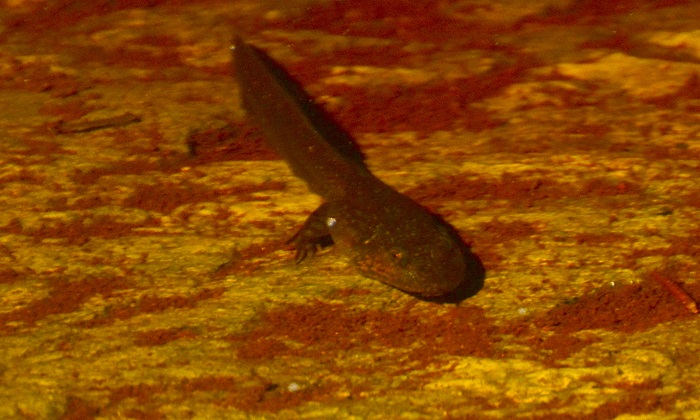
Tadpoles of Heleophryne orientalis are broad, flattened and very streamlined. They are equipped with powerful tails and large sucker mouths. These are adaptations to prevent them from being swept away in fast-flowing torrents. The oversized sucker-like mouths also enable them to leave the water and climb vertical rock surfaces.

The overall colouration is yellow-brown with variable mottling. The tail is slightly longer than the body and the upper and lower fins are of roughly equal length.

Habitat

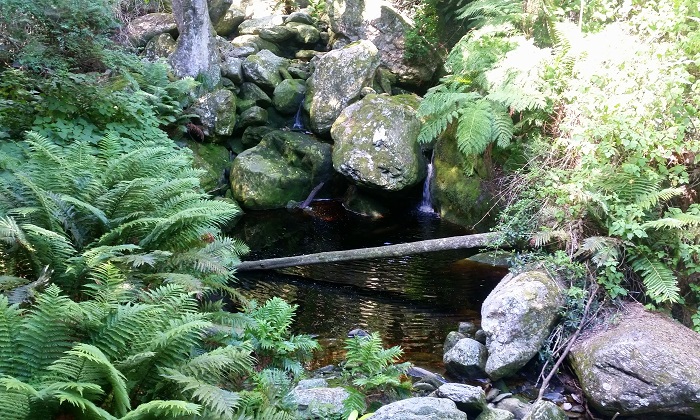
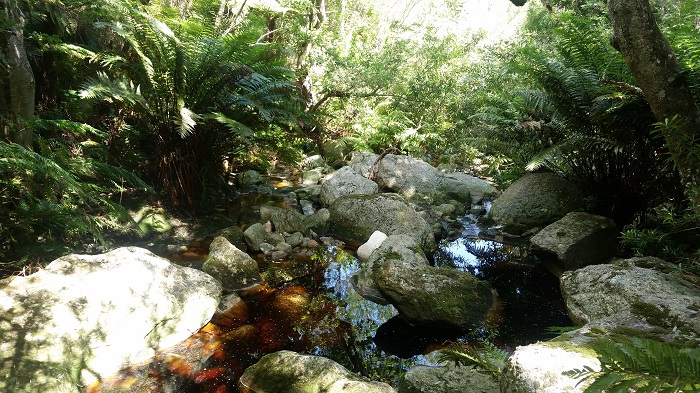
The Eastern Ghost Frog is confined to patches of Afromontane Forest surrounded by moist Mountain Fynbos (Moll et al. 1984). The average rainfall at these sites ranges from 600 – 3000mm per annum (Boycott 1982). Here Heleophryne orientalis inhabits perennial mountain streams in forested ravines and gorges. They prefer streams with cold, clear water that is often tea-coloured due to tannins from decaying vegetation. These streams often slow to a trickle in the dry season but can become swift-flowing torrents on the wet season.

Habitat – Marloth Nature Reserve, Western Cape
Photo by Ryan Tippett

The Eastern Ghost Frog is often found near waterfalls and cascades, on wet rock faces, in rock cracks and in caves. The tadpoles may be found beneath submerged and partly submerged rocks in swift- and slow-flowing streams and in rocky pools.

Habitat – Marloth Nature Reserve, Western Cape
Photo by Ryan Tippett

Behaviour

Heleophryne orientalis breeds in early summer when river and stream flow is reduced. This is from mid-October to mid-December with the peak during November.

Eastern Ghost Frog Heleophryne orientalis
Grootvadersbosch Nature Reserve, Western Cape
Photo by Felicity Grundlingh

Calling takes place during the day and night. Males call from various sites inside or adjoining the water, such as from under rocks and from caves and crevices. They may additionally advertise themselves from exposed positions such as lichen-covered boulders near waterfalls and cascades.

Unlike most of the other Heleophryne species, the males of H. orientalis appear to form breeding aggregations, at least during peak periods. Several individuals may be found calling within close proximity to one another.

Egg laying in H. orientalis happens largely outside of the water, yet always in moist environments. Often the only available moisture is a thin layer of water seeping over the substrate on which the eggs are laid. This differs from the egg-laying habits of the other Heleophryne species which lay their eggs while completely submerged in water. Between 114–191 eggs, are laid in clutches in damp moss-covered places between boulders, or under small rocks in the streambed.

Tadpoles feed on algae growing on submerged surfaces in streams and pools. They find shelter under loose pebbles and boulders when disturbed. Their colouration closely matches that of the water and the substrate on which they feed.

Eastern Ghost Frog Heleophryne orientalis – Tadpole
Marloth Nature Reserve, Western Cape
Photo by Ryan Tippett

Status and Conservation

Heleophryne orientalis is not threatened. It is listed as of Least Concern in the IUCN Red List of Threatened Species.

H. orientalis occurs abundantly in forested ravines and gorges on the southern slopes of the eastern Langeberg Mountains and is under no threat. The species occurs in several private and public protected areas such as the Grootvadersbosch and Marloth Nature Reserves.

Distribution

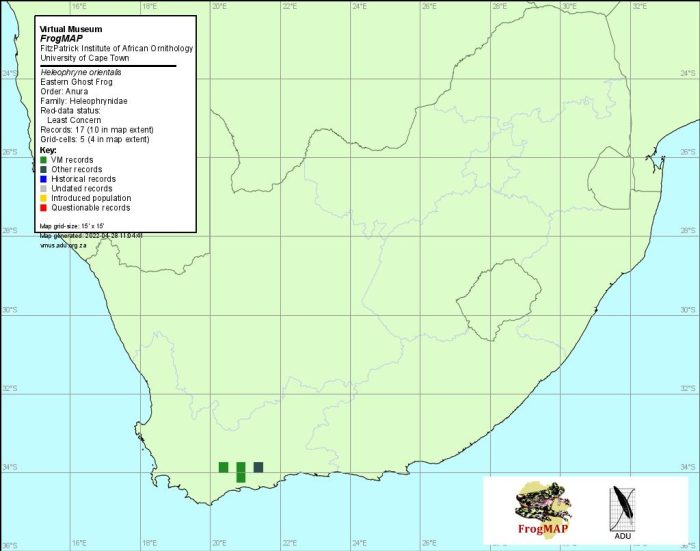
Heleophryne orientalis is endemic to the Western Cape Province of South Africa. It occurs along the eastern Langeberg Mountains, from near Montagu in the west to the Gouritz River in the east. The Eastern Ghost Frog has been recorded at altitudes ranging from 215-500 m/asl.

Distribution of Heleophryne orientalis. Taken from the FrogMAP database, April 2022.

The atlas records are reliable but incomplete. Heleophryne records allocated to H. orientalis (as presently defined) were based on the range of H. purcelli orientalis as recognized by Poynton (1964) and Boycott (1982). What remains to be determined are the eastern limits of the range of H. purcelli and the western limits of the range of H. orientalis. It is unlikely that the distributions of the two species overlap.

Further Resources

The use of photographs by A. Coetzer, Felicity Grundlingh, and Trevor Hardaker is acknowledged. Other images by Ryan Tippett.

Eastern Ghost Frog Heleophryne orientalis (FitzSimons, 1946)

Other Common Names: Oostelike Spookpadda (Afrikaans).

Recommended citation format: Boycott, RC; Tippett, RM. (2025). Eastern Ghost Frog Heleophryne orientalis. Biodiversity and Development Institute, Cape Town. Available online at https://thebdi.org/2021/08/05/eastern-ghost-frog-heleophryne-orientalis/

This species text has been updated and expanded from the text in the
2004 frog atlas:
 Boycott, RC. (2004). Eastern Ghost Frog Heleophryne orientalis. In Minter LR
et al 2004.

References: 

Minter, LR; Burger, M; Harrison, JA; Braack, HH; Bishop, PJ; Kloepfer, D. (Editors). (2004). Atlas and Red Data Book of  the Frogs of South Africa, Lesotho and Swaziland. Smithsonian Institution, Washington, and Avian Demography
Unit, Cape Town.
Carruthers, V; du Preez, L. (2017). Frogs of southern Africa: A Complete Guide. Struik Nature, Cape Town.

Channing, A. (2001) Amphibians of Central and Southern Africa. Protea Book House, Pretoria

Claus, B; Claus, R. (2002). Common Amphibians and Reptiles of Botswana. Gamsberg Macmillan, Windhoek.

Similar Species

BDInsight – July 2021

During the most recent BDI Citizen Scientist Hour, Les Underhill gave a talk on the current status of OdonataMAP, the Atlas of African Dragonflies and Damselflies. The talk focuses on the progress of the project in Africa and, more specifically, within South Africa. The talk reports on the progress of the “Online atlas of dragonflies and damselflies of southern Africa”. We make suggestions on optimizing our Odonata fieldwork next summer and Les also talks about how together with the Freshwater Research Centre (http://frcsa.org.za/), OdonataMAP data are being used to influence conservation policy to help protect dragonflies and damselflies. You can view the talk here: 

New maps  for the “Online atlas” will be produced soon. If you have records not yet submitted to OdonataMAP please submit them via the Virtual Museum at http://vmus.adu.org.za/. It is a quick and easy process and you can rest assured that your records will make a difference for Odonata conservation! We make regular updates to the FBIS system of the Freshwater Research Centre.

The full set of  videos of the presentations at the Citizen Scientist Hours (125 of them!) can be found on our YouTube Channel. If you would like to be sent the emails containing the Zoom links, send an email to Itxaso Quintana (itxaso@thebdi.org), and she will add you to the mailing list so you can stay up to date with all the upcoming BDI events!

The Virtual Museum

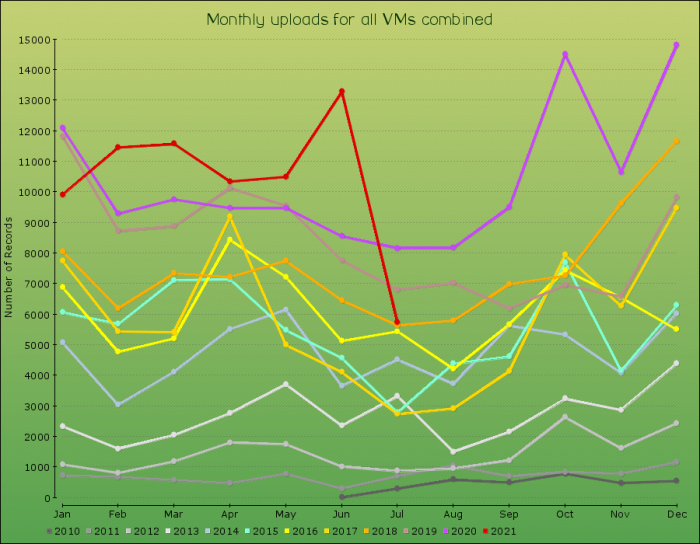
This is a story of three winters. Virtual Museum submissions always drop in winter, when there are hardly any butterflies and dragonflies, etc, about. Then, there is also the winter of the third wave of Covid, and the weariness and uncertainty that comes with that. And the third winter is political insecurity, and the fears and worries it brings. In the light of the these three winters, it is a remarkably good achievement that July 2021 was the third best July for the Virtual Museum!

We need to wait until September before the weather in the southern end of Africa warms up enough for the smaller creatures to start putting in a reappearance. So, August is a good month to upload backlogs of records to the Virtual Museum. On an annual basis, the total to the end of July 2021 is 3% upon the total to July last year.

Somehow, being involved with citizen science projects such as the Virtual Museum will help us through the stresses of our times. We cannot give way to despair. Biodiversity needs us.

Biodiversity enthusiast! ….The BDI interviews citizen scientist Lucky Okpanachi Atabo

Please tell us a bit about yourself, your background and what you do:

My name is Lucky Okpanachi Atabo. I am a young Nigerian and an active volunteer and advocate for various contemporary societal issues like biodiversity and environmental conservation. I am an undergraduate in Biological Sciences and currently in my final year.

How did you become a citizen scientist? What was the catalyst that got you going?

The term ‘citizen science’ was very much alien to me up until, when as an intern, I was privileged to listen to a scholar present the details of his research on what he titled “Citizen Science and Urban Ecology“. It was right there in that lecture room that I was able to see and comprehend how much good can be achieved from the work that citizen scientists do especially in species conservation. The passion for citizen science was ignited in me from that moment and this was precisely in the year 2019 while I was interning at A.P Leventis Ornithological Research Institute, Jos, Plateau State.

Common Themis Forester – Euphaedra themis – Photo by Lucky Okpanachi Atabo

What has been the highlight for you? 

Being out in the field putting in my effort to achieve the objectives of citizen science has helped to shape how I view and respond to environmental issues. Within this short time, I have come to see that real changes can be made practically and consistently. I began to use my photos and storytelling to drive a message into the minds of people closest to me and then spiralling up to larger audiences. This way, I’ve been able to spread the message of conservation and it gives me so much joy to see a change in the attitude of people towards these issues. Realizing that the people around me are becoming positively conscious of their decisions thrills me intensely.

How has being a citizen scientist changed your view of the world?

Being a citizen scientist has taught me that every decision I make as a person will impact on the world one way or another. Being a citizen scientist has also shown me that with a bit of effort from everyone, we can achieve great changes.

Common Citril – Ceriagrion glabrum

What does the term “citizen scientist” mean to you?

Citizen science to me simply means everyone is needed. No matter who you are (Writer, photographer, physician, journalist, etc.) or where you are, you are important and your hands are needed on deck.

What are you still hoping to achieve? This might be in terms of species, coverage, targets …

Recently, I started the ‘new species everyday’ challenge for myself. Knowing that I have a limited time to spend here on campus, I try to record as many new species as I can within my grid cell. So, I make sure to take a walk around and within the university’s small biological garden to catch any new species flying or walking around. So far I’ve been able to build a good species list including some very interesting sightings. Anywhere else I visit even on very short durations, I try to atlas as many species as I can.

I’m also hoping to help inspire more people with similar passions to join in the work that is needed to cover more ground in Nigeria and Africa as a whole.

Laughing Dove – Streptopelia senegalensis

How do you react to the statement that “Being a citizen scientist is good for my health, both physical and mental!”?

Personally, I consider citizen science as the healthiest way to have fun. My happiest moments are times spent outside either watching birds or photographing these very cute and adorable species. This has improved me a lot physically and mentally. I always say that being out in natural places makes me feel reborn. I really wish more people will plug into this as a means to stay fit and sharp.

What do you see as the role which citizen science plays in biodiversity conservation? What is the link?

You can only go on to protect a species when you’re sure that it is there. I regard citizen scientists as the torch bearers of conservation; we light up the tunnel so everyone can see, and by everyone, I mean the ordinary people as well as powerful stakeholders like government bodies or NGO’s.

Common Dotted Border – Mylothris chloris chloris

What are the challenges you encounter as a citizen scientist?

Being out mostly in wild and isolated places exposes one to certain risks. I always try to use my sixth sense whenever I am out in the field or I make sure I have a good knowledge of any area I plan to visit. This has limited me in terms of data coverage but for now safety is key

The photos that I take are usually taken with my mobile phone and it is pretty challenging and disappointing, especially when there’s an interesting species either moving too fast or at a distance too far for cell phone photography. Hopefully, I’ll save up enough money to buy a good camera and continue to snap it and map it! 🙂

Aegocera rectilinea
Tigertail – Ictinogomphus ferox

Garden Ecology: Colonisation and Succession

Garden Ecology: Colonisation & Succession

Good afternoon, naturalists! Time for an update on Operation Feed the Birds, and a few new insights into garden ecology. 

Let’s begin with the birds. 

Since my first blog post, the two bird feeders have been kept busy, entertaining visitors around the clock. One of my neighbours has a very active feeder, and I suspected that the birds from his garden would locate this hot new local food source quickly. And yet, their speed still surprised me! Within exactly 1 hour and 5 minutes (yes, I did spend an entire day by the window with my binoculars), a male and female Cape Sparrow were furtively darting to and from the tree feeder. The first few birds were extremely wary; if a hinge creaked, or a dog barked, or if I so much as breathed, they were off like a flash. 

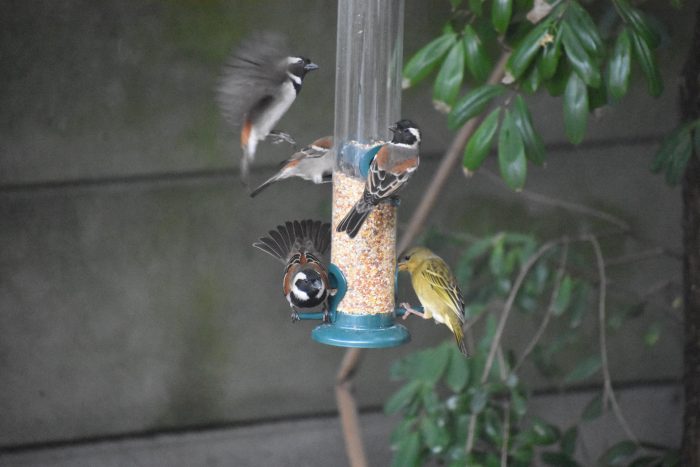
Cape Sparrows and a Cape Weaver vying for a spot at the feeder.

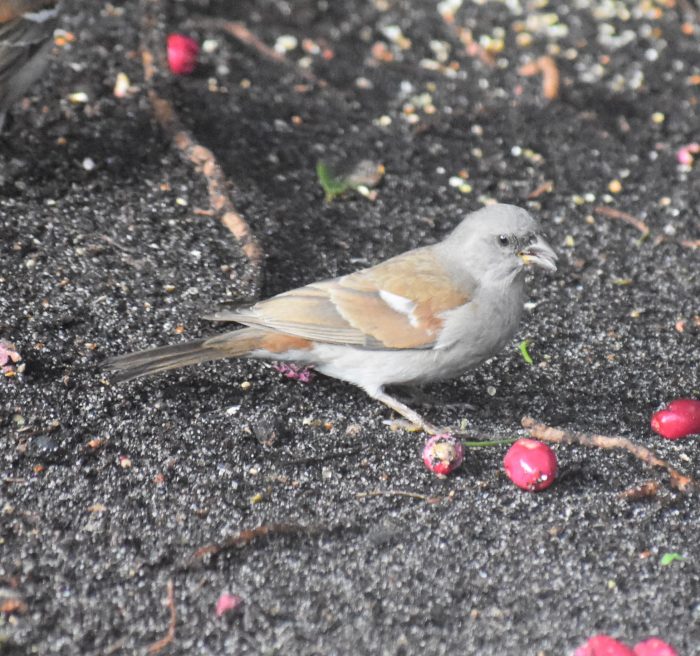
As the day wore on, though, the birds began to grow accustomed to the noises and sights of the garden, and by the end of the first week they barely flinched if I opened the door. My species list for the cottage slowly continued to climb—I began seeing birds at my feeder not previously observed in the garden. Southern Masked Weaver, Pin-tailed Whydah, and (miraculously) a single Southern Grey-headed Sparrow began to make regular appearances. (I have dubbed the sparrow “Jack.” He hangs around now, always on his own). 

Jack, the Southern Grey-headed Sparrow.

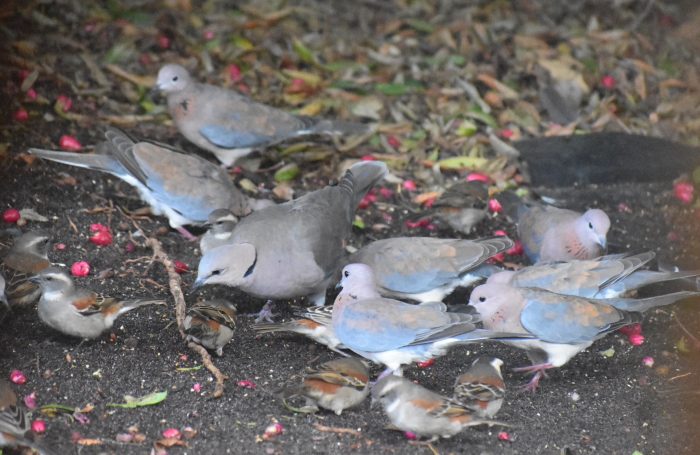
Needless to say, since those first few days, the feeders have become a veritable hive of activity. Laughing Doves and Red-eyed Doves, chests puffed out, strut importantly below the feeders, collecting seeds and filling the air with their burbling coos. A hot-headed Ring-necked Dove chases off Laughing Doves that come too close, and even the Cape Robin-Chat now makes regular appearances, perhaps sensing safety in the presence of so many birds.

Doves and sparrows feeding on seeds spilled from the feeders

Broadly, the sheltered feeder receives more visitors in a 10-minute period and experiences a faster overall decline in seed level than the open feeder.” 

Clearly, in terms of use, the feeders are a success. At least twice a day (and more often if I can), I sit by the window with a timer, a notebook, and a pencil, and record the birds arriving at each feeder in a 10-minute block. At the end of the day, I measure the level of seed in each feeder. Already, patterns are emerging! Broadly, the sheltered feeder receives more visitors in a 10-minute period and experiences a faster overall decline in seed level than the open feeder. 

Garden Ecology Colonisation and Succession

Though the pattern of use for the tree-sheltered feeder versus the open feeder is intriguing (and we will explore it further in a future blog), my thoughts over the past few weeks have been equally preoccupied with the garden itself. And that brings us to our next set of ecological concepts in this blog series: colonisation and succession

What do these words (which sound like they belong in political history) have to do with birds in a garden? 

To answer that question, we first need to understand how a garden ecosystem forms. 

Let’s start with an example. 

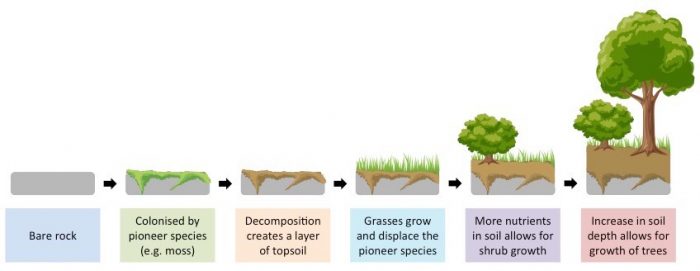
Imagine that you are on a volcanic island. A volcano erupts, lava flows over the land and into the ocean, and as it cools, new, bare rock is formed. It has never had any plant life on it; it has never been inhabited by any species—it is new, untouched, and barren. As rain falls, and the wind blows, and the sun continues to shine, life slowly begins to arrive.

Pioneer species…are organisms with seeds or spores that can travel long distances by wind or water.”

These are pioneer species; organisms with seeds or spores than can travel long distances by wind or water. Things like algae, fungi, and lichen, which spread across the bare rock, slowly breaking it down. And as these species spread, some die off, and wind and water deposit more and more living material. Microorganisms continue to break down these layers of “stuff,” over time forming the rich, organic matter that makes up soil. 

Primary succession. Rock is colonised by pioneer species, which create soil for the growth of grasses and larger plants, ultimately creating a climax community.

Once soil is present, new species are able to move in. Grass, which takes in its nutrients from soil, spreads over the land, and displaces the pioneer species. As the grass grows, it continues adding material and nutrients back into the soil, making it deeper and richer, and paving the way for bigger plants, like shrubs.

Primary succession…describes the succession of species and events that build on one another to create an established, living community”

This pattern of moving in, enriching the soil, and making space for something new continues, eventually allowing massive organisms like trees to take root. And we have only considered the plants—imagine what else comes along with this growth! Insects, birds, reptiles, mammals, and more, all thriving on what once was empty rock.  

This process of moving from bare rock to a flourishing ecosystem is called primary succession. It describes the succession of species and events that build on one another to create an established, living community (in ecology, this is called a climax community). 

Now, imagine that a fire sweeps through our climax community, burning through all of the vegetation. You might think we are back to square one! But in reality, we have an advantage: the soil stays behind. And after the fire, it is thicker and richer than ever before.

Secondary succession…tells us which species colonise a landscape after a major natural disturbance, and the order in which those species arrive.”

Because of this, fast-growing plants are able to colonise the soil much more quickly than the first time around, and a climax community once again takes shape. This process, called secondary succession, is the one that is of interest to us. It tells us which species colonise a landscape after a major natural disturbance (in our example, fire), and the order in which those species arrive. 

Secondary succession. Climax community is disturbed, rich soil remains and nourishes new plant growth, climax community is re-established.

Now that we understand the concepts of colonisation and succession, we are ready to take our ecological knowledge into the garden.

Most gardens are disturbed ecosystems, transformed by a series of human interventions.”

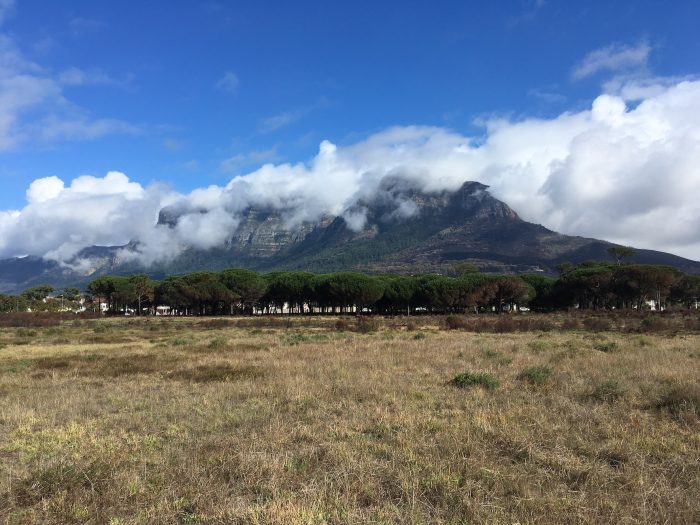
Though it may come as a surprise, my typical suburban garden is actually a disturbed ecosystem. The disturbance was not a fire, like in the previous example, but rather a series of human interventions. 300 years ago, this little patch of earth in the suburbs was not part of a “suburb” at all! Rather than fence lines and homes, this region was characterized by vast expanses of sandy soil, sparsely covered with native shrubs and trees. It sat in the heart of a biome called the Cape Flats Sand Fynbos. 

The Rondebosch Common, one of just a few dedicated areas of Cape Flats Sand Fynbos conservation.
The Rondebosch Common is one of just a few conservation areas for Cape Flats Sand Fynbos. Photo: Karis Daniel

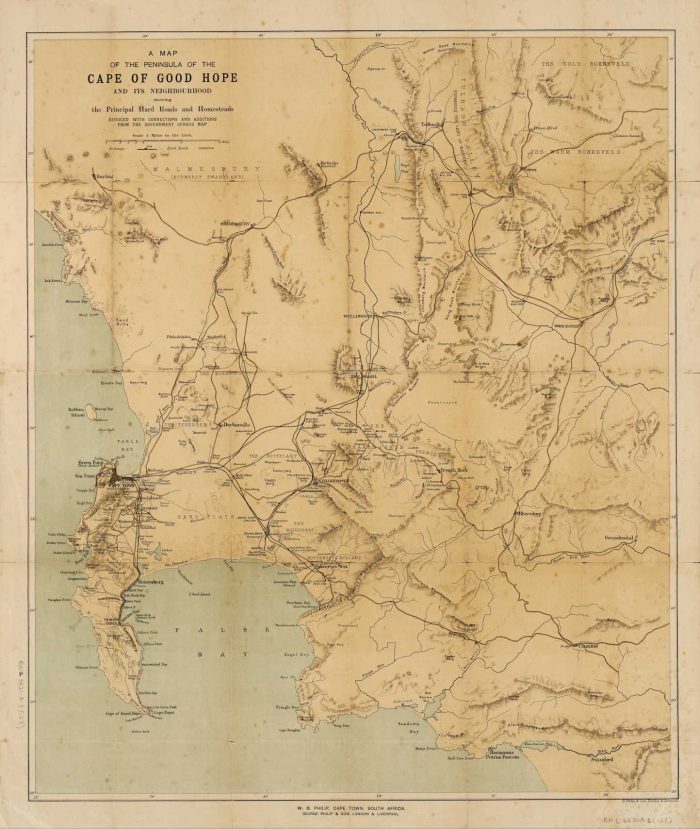
The growing human population within the city of Cape Town took its toll on the land. Heavy ox wagons struggled to travel across the deep sand, and in the early 1800s, authorities introduced alien plant species from Australia in an attempt to stabilize the soil. Though the sand was effectively stabilized, it came at a heavy cost: the original Cape flats sand fynbos ecosystem was overrun with non-native species, and was pushed to the brink of extinction. 

Garden Ecology Colonisation and Succession
A map of the Cape Peninsula from 1893, showing the vast “sand flats” expanse east of the city. High resolution image available here, from the University of Cape Town Libraries Digital Collections.

In Pinelands, where I stay, thousands of non-native pine trees were also introduced in the late 1800s to control the shifting sands. Over the next 100 years, the area subsequently served as a brick-making business, a camp for the British army, a set of hostels for bubonic plague patients, and, eventually, a suburb of Cape Town. 

Who will colonise the land once fynbos is present?”

It isn’t hard to see how human influence has “disturbed” the area—in fact, disturbance seems a mild term for the radical change inflicted on the landscape! My little garden is not a true case of secondary succession; though it is primarily sandy soil, there is some plant growth. But as we slowly clear the alien trees and plants and begin to introduce native vegetation, it will be fascinating to see what non-plant species come back.

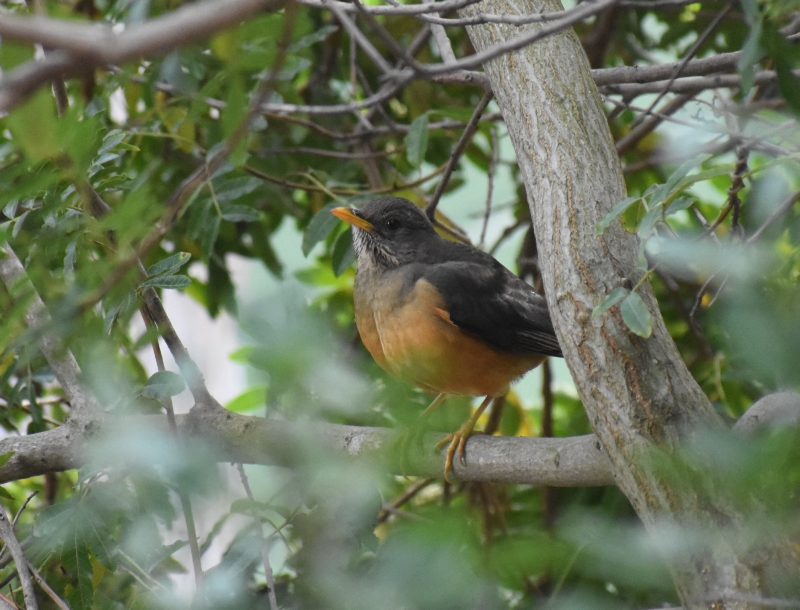
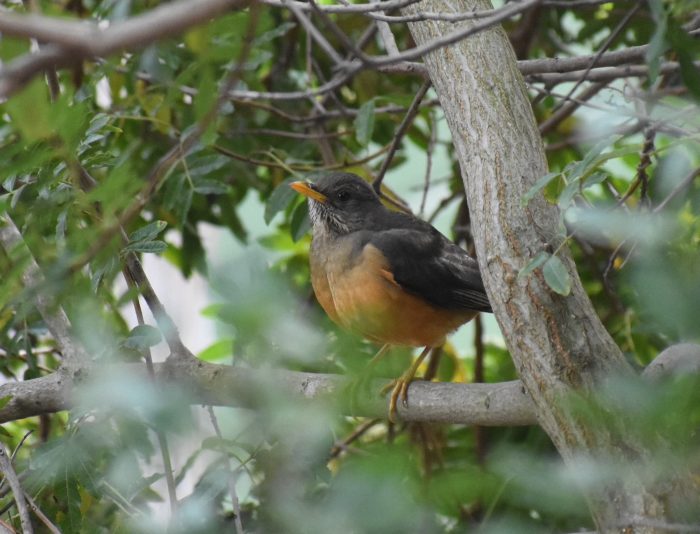
An Olive Thrush perched in a non-native Australian Brush-cherry tree (Syzygium paniculatum) in my garden.

Who will colonise the land once fynbos is present? Will new birds arrive? New insects? Which will come first, and pave the way for others? Where will they come from, and what seeds will they carry with them? The questions are expansive and inviting, and for me, learning their answers is one of the most exciting prospects of “re-wilding” a garden. 

For those of you who also enjoy these sorts of questions, here are a few more to consider: 

  • Do you know the “disturbance history” of your garden or city? 
  • How have you witnessed landscapes changing over your lifetime?
  • Where can you see the principles of succession at work? 

If you have a succession story to share, leave a comment on this blog or send us an email—we would love to hear it!

Until next time, happy exploring!

Further reading 

History of Pinelands: The Garden City of Pinelands, South Africa

The Cape Flats Sand Fynbos

Primary & Secondary Succession explained

History of the Cape Flats

Cape Sparrow (Passer melanurus)

Cape Sparrow identification

Identification

The Cape Sparrow is a small, boldly patterned bird which is sexually dimorphic; in other words, males and females look different to one another. The key differences are in their heads: males have black heads with a broad white ‘c’ shape running from the eyes to the throat, and in females, the head is grey, and the white ‘c’ less distinct.

Male Cape Sparrow identification.
Male Cape Sparrow. Desire & Gregg Darling, Addo Elephant NP, Eastern Cape. 23 March 2014. BirdPix 7096.
Female Cape Sparrow identification.
Female Cape Sparrow. Fanie Rautenbach, West Beach, Western Cape. 26 August 2012. BirdPix 416.

Though facial colouration and pattern separate the two, both male and female sparrows have pale grey bellies, dark blackish bills, and a rich chestnut-brown rump and wings.

Male Passer melanurus showing chestnut rump and wings.
Male Cape Sparrow showing off its chestnut-coloured rump and wings. Jorrie Jordaan, Redhouse, Eastern Cape. 8 May 2016. BirdPix 31189

Cape Sparrows are vocal, and as for many birds their repertoire consists of variations on three basic types of sound: song, contact call, and alarm.  

You can listen to each by clicking on the links above.

Habitat

Cape Sparrows eat a wide range of foods, and so are able to inhabit a variety of habitat types. They are common and often abundant in dry savanna, dry, shrubby woodland, agricultural land and orchards, as well as residential gardens and parks. These birds cope well in human environments and are often regular visitors to garden birdseed feeders. Within the Western Cape, Cape Sparrows also sometimes forage in the intertidal zone along coastlines.

Examples of Cape Sparrow habitat.
Examples of Cape Sparrow habitat. Top L & R: urban/agricultural; lower L & R: dry, shrubby woodland.

Distribution

The SABAP2 distribution map for Cape Sparrow shows just how widespread these birds are!

Cape Sparrow distribution map.
SABAP2 distribution map for Cape Sparrow, downloaded 15 June 2021. Details for map interpretation here.

Though common across most of southern Africa, they are considered near-endemic to this region. Cape Sparrows occurs sparsely in parts of Botswana and southern Zimbabwe, as well as the southwest of Angola.

Behaviour

Though sparrow behaviour and interactions are fascinating to explore, we will limit our scope to behaviours which are relevant to finding or identifying Cape Sparrows.

They are gregarious, meaning that they are usually in pairs or groups.  

Flock of Passer melanurus
Small flock of Cape Sparrows. Jorrie Jordaan, Redhouse, Eastern Cape. 8 May 2016. BirdPix 31189

They often perch conspicuously on top of things—fence posts, bushes, trees, or rooftops. On the ground, rather than walking, they commonly use a “hopping” gait characteristic of many sparrows.

Cape Sparrow demonstrating "hopping" gait.
Female Cape Sparrow hopping in a garden. Karis Daniel, Alfalfa, Western Cape. 19 August 2020. BirdPix 126929

Cape Sparrows usually nest in colonies, with males and females working together to build messy, globe-shaped nests lined with feathers. Nest colonies are common in bushes and trees (often acacias), and within urban environments, individual nests may be built on infrastructure such as fence posts and gables.

Examples of nests of Passer melanurus.
Two examples of Cape Sparrow nests. L: nest behind a road signpost. Karis Daniel, Montagu, Western Cape. 14 September 2020. BirdPix 130732. R: nest in a residential garden. Dewald du Plessis, Bloemfontein, Free State. 4 August 2007. BirdPix 23794.

Further resources

Species text in the first bird atlas (1997)

Virtual Museum (BirdPix > Search VM > By Scientific or Common Name)

More common names: Gewone Mossie (Afrikaans); Moineau mélanure (French); Kapsperling (German); Passero del Capo (Italian); Gorrión de El Cabo (Spanish)

A list of bird species in this format is available here.

Recommended citation format: Daniel KA 2021. Cape Sparrow Passer melanurus. Biodiversity and Development Institute. Available online at https://thebdi.org/2021/06/17/cape-sparrow-passer-melanurus/

Eurasian Oystercatcher (Haematopus ostralegus)

Eurasian Oystercatcher

The Eurasian Oystercatcher Haematopus ostralegus breeds in Europe and Asia. Most move south for the northern winter. Most remain in soutern Europe, some migrate to northern Africa, and tiny numbers reach the southern end of Africa.

Identification

This is the only black and white oystercatcher that occurs anywhere on the African continent. As its name implies, it breeds in Europe and Asia, and travels to Africa as a migrant.

All photographic credits at end

There are other species of black and white oystercatchers, but they occur in North and South America and in Australia and New Zealand.

This is the call.

Habitat

Whereas African Black Oystercatchers occur on both rocky and sandy shores, Eurasian Oystercatchers prefer soft, sandy or muddy substrates. So they are mostly found at lagoons and large sandy estuaries. This young Eurasian Oystercatcher, at the Gamtoos River Estuary in the Eastern Cape, is in classic habitat for the species.

Distribution

On the Atlantic Ocean coast of southern Africa, they have mostly been recorded at Walvis Bay Lagoon and Sandwich Harbour in Namibia, and at Langebaan Lagoon in South Africa. Along the Indian Ocean coast, there are many suitable estuaries and lagoons from about Plettenberg Bay, eastwards through the Eastern Cape and KwaZulu-Natal in South Africa, and in Mozambique. But they can turn up anywhere along the coast.

SABAP2 distribution map, downloaded 11 June 2021

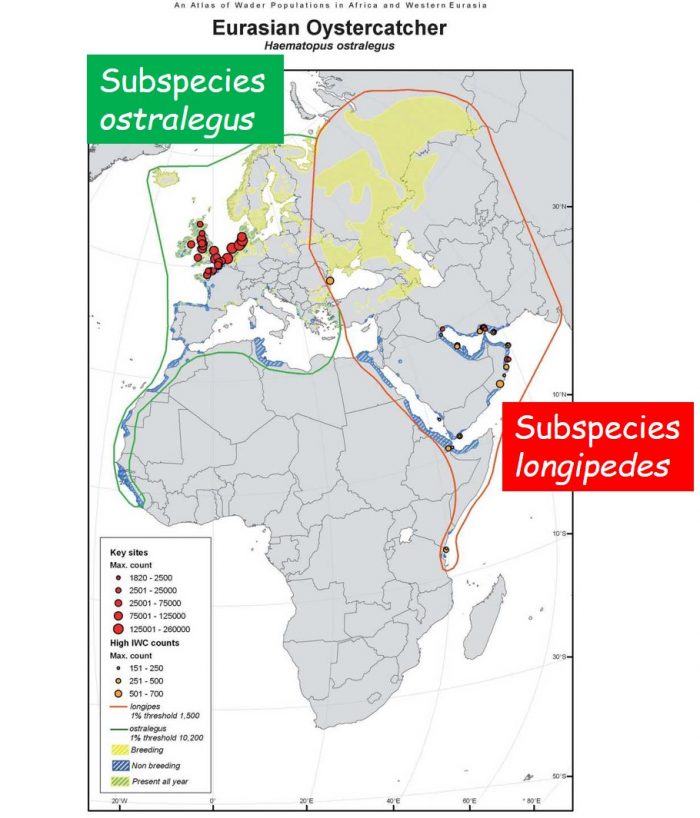
Two subspecies of the Eurasian Oystercatcher have African connections. The normal range of the western subspecies ostralegus is outlined in green in the map below, and that of the eastern subspecies longipedes in red. The difference between the two subspecies are subtle; longipedes has a slightly longer bill than ostralegus. On this map, breeding areas are shaded yellow, and non-breeding areas in blue. Neither subspecies normally reaches southern Africa. The western subspecies ostralesgus occurs along the coastline of northwest Africa. The eastern subspecies longipedes migrates as far south along the eastern coast of Africa to Tanzania. It is thought that the birds reaching southern Africa (including Namibia) are longipedes, arriving along the east coast of Africa. In reality, we don’t really know!

Page 46 in An atlas of wader populations in Africa and western Eurasia, published in 2009 by Wetlands International

Breeding

In broad brush terms there is a huge difference between the two subspecies; during the breeding season ostralegus is (traditionally) on saltwater coastlines of the oceans of western Europe, and longipedes on freshwater margins of lakes and large rivers of the interior of the eastern half of Europe. This is shown on the map below. But, from about the middle of the 20th century, ostralegus started breeding inland in agricultural landscapes, even 100 km from the sea, where they feed on earthworms, rather than on molluscs.

Gallery

The pictures below are selected from the BirdPix section of the Virtual Museum.

This is probably the largest flock of Eurasian Oystercatchers south if the “normal” nonbreeding range shown in the map above. This flock of about 20 birds was at San Sebastian, Vilanculos, Mozambique.

This is the experience you are on the lookout for; a Eurasian Oystercatcher in a flock of African Black Oystercatchers. Keep looking. This was at Walvis Bay Lagoon.

Further resources: A selection of papers

More common names: Bonttobie (Afrikaans), Huîtrier pie (French), Austernfischer (German), Ostraceiro (Portuguese), Ostrero Euroasiático (Spanish)

List of bird species in this format is available here.

Photographic acknowledgements: Most of the photographs in this identification guide are in the BDI/FitzPatrick Institute Virtual Museum. They are used here with permission of the photographers, who continue to own the copyright on these images. Top image: Alan Collett, BirdPix 143367. Identification image: Dave Rimmer, BirdPix 58147. Habitat image: Gregg Darling, BirdPix 104255. First gallery image: Georg Jacobs BirdPix 99051. Second gallery image: Maans Booysen, BirdPix 102228. Third Gallery image: Les Underhill BirdPix 1415.

Recommended citation format: Underhill LG 2021. Eurasian Oystercatcher Haematopus ostralegus. Biodiversity and Development Institute. Available online at http://thebdi.org/2021/06/14/eurasian-oystercatcher-haematopus-ostralegus/

Little Egret (Egretta garzetta)

The Little Egret Egretta garzetta belongs to a large family of birds called the Ardeidae, the herons, the egrets and the bitterns. The herons are, on average, larger than the egrets, but the two names are used confusingly. The “Little” Egret is not the smallest member of the family!

Identification

The yellow feet are the diagnostic.

Little Egret Egretta garzetta identification
All photographic credits at end

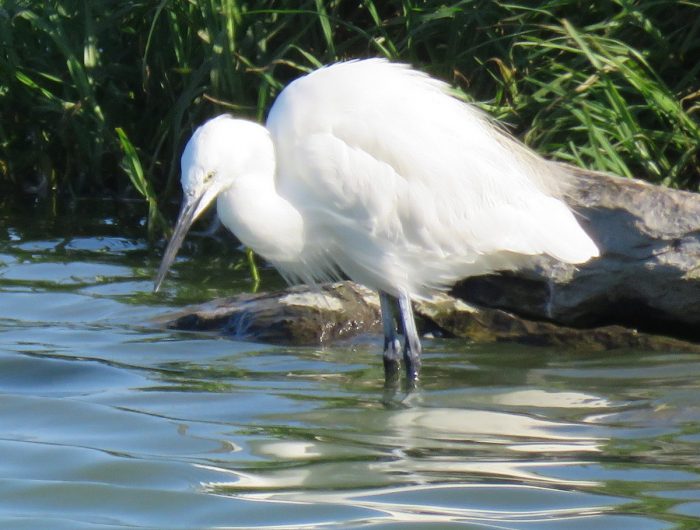
The only problem arises is when the feet are underwater, like this:

Littlr Egret Egret hiding yellow feet

Usually, if you wait a little while and watch, it will start to move. It usually walks with a crazy gait, and lifts its feet out of the water with each step, so you get a quick yellow flash which confirms the identification. With a little experience, then even without seeing the yellow feet, you will get to know that this is a Little Egret, from the relative size and shape of its bill, body and neck.

Young birds look essentially the same as adults, but they don’t have plumes, and the yellow of their feet is a bit muted.

Listen to the call.

Habitat

These photos give a feel for the kinds of places where you can anticipate encountering a Little Egret.

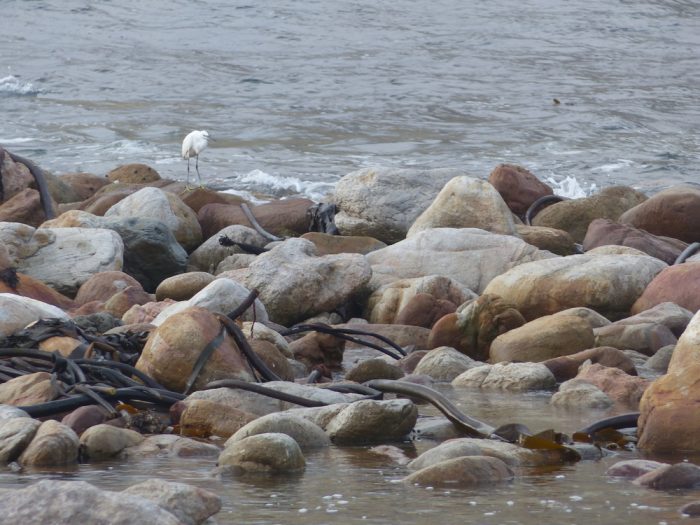
Little Egret Egretta garzetta in kelp
Little Egret Egretta garzetta on a rocky shore
Little Egret iEgretta garzetta in a dambo
Little Egret Egretta garzetta living dangerously at Boegoeberg Dam

Distribution

This is the SABAP2 distribution map for Little Egret. In the interior of southern Africa, this map is essentially tracking the places where there are wetlands with shallow edges. These wetlands can be natural, such as rivers, estuaries, pans (like the ones in the Free State) or artificial, such as sewage works, large reservoirs and small farm dams. Along the open coastline, it prefers sheltered rocky shores with rockpools at low tide.

Distribution map for Little Egret Egretta garzetta
SABAP2 distribution map for Little Egret, download 12/06/2021. Details of map interpretation are here

Little Egrets occur in most of Africa, southern Eurasia and Australia. It is steadily expanding its range northwards in western Europe. They have established a tiny breeding population on the west coast of North America.

Gallery

This is all you need to see to be 100% certain that it is a Little Egret:

Yellow feet, all you need for Little Egret

The yellow feet are the key diagnostic feature. This is not universal truth, if you travel to the Americas or to Australia there are other species of white egret with yellow feet!

Birding is not without humour. This Little Egret is pretending to be a new species, the Extra-long-legged Egret!

Little Egret with long legs

Further resource:

Species text in the first bird atlas (1997).

More common names: Kleinwitreier (Afrikaans), Aigrette garzette (French), Seidenreiher (German), Garça-branca-pequena (Portuguese), Garceta común (Spanish).

Photographic acknowledgements: Most of the photographs in this identification guide are in the BDI/FitzPatrick Institute Virtual Museum. They are used here with permission of the photographers, who continue to own the copyright on these images. Top image: Jorrie Jordaan, BirdPix 34978. First identification image: Les Underhill, BirdPix 2267. Second identification image: Johan and Estelle van Rooyen, BirdPix 115991; First habitat image: Les Underhill, BirdPix 48966. Second habitat image, Itxaso Quintana, BirdPix 116367. Third habitat image, Dave Kennedy BirdPix 11964. Fourth habitat image, Salome Willemse, BirdPix 105973. First gallery image, Les Underhill. Second gallery image: Dawie de Swardt, BirdPix 52412.

List of bird species in this format is available here.

Recommended citation format: Underhill LG 2021. Little Egret Egretta garzetta. Biodiversity and Development Institute. Available online at http://thebdi.org/2021/06/12/little-egret-egretta-garzetta/

Birds on the coastline of the Western Cape

The coastline

The focus here is on learning the really common birds which you can expect to see on the coastline in the Western Cape. These are the species you are most likely to encounter on the beach, or along a section of rocky shore.

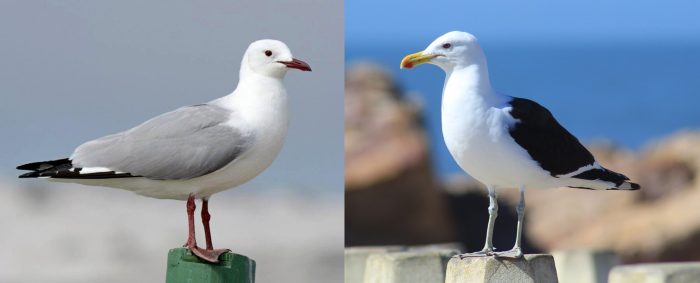
GULLS: Perhaps the birds which first come to mind when you say “seashore” are the gulls. 99.9% of the gulls of the Western Cape are either Hartlaub’s Gulls or Kelp Gulls. Adults are easy to tell apart. Kelp Gulls are much bigger than Hartlaub’s Gulls. When they are sitting, Kelp Gulls have black backs, and Hartlaub’s Gulls have grey backs.

Hartlaub's Gull (left) and Kelp Gull (right). Birds on the coastline of the Western Cape

The Hartlaub’s Gull is on the left, and the Kelp Gull on the right. It would be nice if it were that simple. You need to go the blog posts for each species to discover the complications caused by the age of the bird, i.e. the juvenile plumages. This is true for all the species presented here.

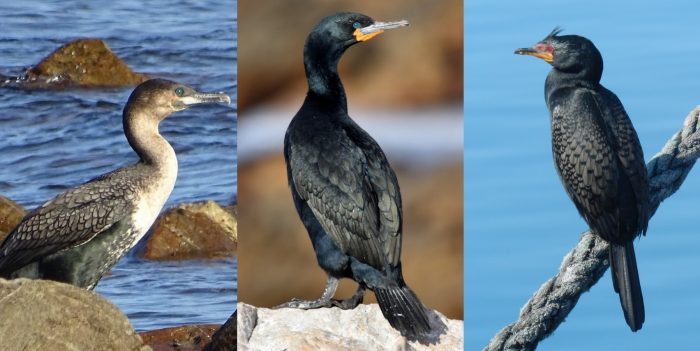
CORMORANTS: Next up are the cormorants (duikers in Afrikaans). There are four species, but one of these (the Bank Cormorant) is so rare that it is classified as Critically Endangered. That leaves three feasible species: White-breasted Cormorant (left), Cape Cormorant (middle) and Crowned Cormorant (right):

left to right : White-breasted Cormorant, Cape Cormorant, Crowned Cormorant. Birds on the coastline of the Western Cape

These three birds are dry, so you can see the intricate patterning of the feathers of their folded wings. When they are wet, they look black. The White-breasted Cormorant on the left is the largest, and has a blue eye. But so does the Cape Cormorant in the middle. The Crowned Cormorant on the right has a red eye. The Cape Cormorant has a notably short tail; the Crowned Cormorant has a long tail. If you see the crest feathers sticking up or you see the red eye, then it can only be Crowned Cormorant. The White-breasted Cormorant has a patch of yellow skin at the base of the bill. The other two species have orange, but in different patterns. These three cormorants are not that simple to distinguish. This is especially true when you add young birds into the mix. You need to look at the full texts for each species.

TERNS: Not every piece of shoreline has terns. Where they occur, they are often in large flocks. The tern species in the Western Cape all have grey wings, the same shade of grey as Hartlaub’s Gull. Essentially the terns look like sporty versions of the gulls. The terns are sleek and aerodynamic compared to the gulls. Most of the terns on the shoreline of the Western Cape belong to one of three species: Swift Tern (yellow bill), Sandwich Tern (black bill tipped yellow) and Common Tern (plain back bill). In reality it is not that simple. When you encounter a flock of terns, it may consist of one, or two or all three of these species. Often the flock of terns might have merged with a flock of gulls.

top left Common Tern, bottom left Sandwich Tern, right Swift Tern. Birds on the coastline of the Western Cape

Except for rare vagrants, the Swift Tern is the only tern in the Western Cape with a yellow bill. The yellow-tipped black bill is globally unique to the Sandwich Tern (although there are a few species with black-tipped yellow bills). The legs and head of the Common Tern can vary between red and black, and all shades in-between. For all the species the head pattern is variable; it is not a useful identification feature. Size is useful. The photo below shows the Common Tern above in context:

Common Terns in foreground, Swift Terns at the back

The Common Tern is much smaller than the Swift Tern. The strange bird on the right is a young Swift Tern. The Sandwich Tern is intermediate in size between Common Tern and Swift Tern. Size is only useful if you are looking at a flock of terns.

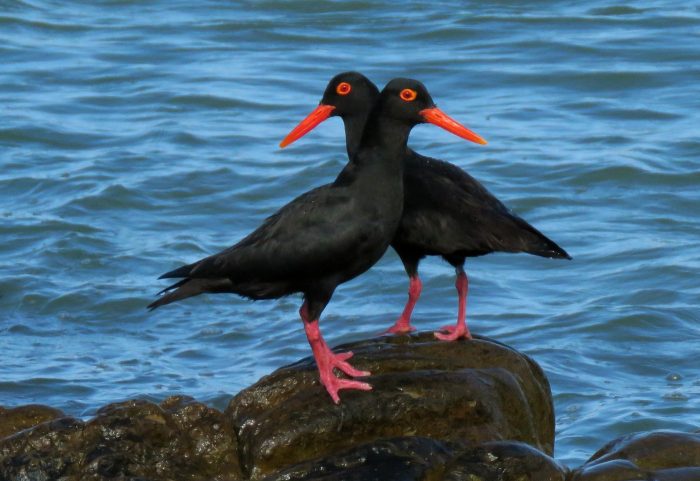
OYSTERCATCHER: A plump black bird with a red dagger for a bill is African Oystercatcher.

African Oystercatcher. Birds on the coastline of the Western Cape

Oystercatchers breed during summer, when they have to share the shore with holiday makers. If you are angling or picnicking on the shore, and a pair of oystercatchers is persistently making a lot of noise, they are trying to communicate with you: “Please move along a 50 m or so; we are not comfortable having you so close to our nest.”

EGRET: A white bird with blackish legs which looks like it walked through spilt paint and got yellow feet is Little Egret. They are most conspicuous on the shore at low tide, when they feed in the rock pools.

Little Egret

There are other species in this family, the egrets and the herons, which are quite often on the coastline; Little Egret is the one that is most frequently encountered. Grey Heron comes second. Apart from the cormorants, these are the only birds on the shore that you would really consider taking a photograph of in portrait, rather than landscape, mode. They are all much taller than they are wide!

DUCKS & GEESE: One “duck-type” bird has added the coastline to its set of preferred habitats: Egyptian Goose:

Egyptian . Birds on the coastline of the Western Cape

If this blog had been written two decades ago, the Egyptian Goose would not have featured. Traditionally, they are birds of freshwater. Somehow, they discovered that the green sea lettuce (scientific name Ulva) was edible. (In the photo above for the Little Egret, the bird is hiding its right foot in sea lettuce.)

IBISES: There are two ibises on the shore. The noisy Hadeda Ibis (brown) and the silent African Sacred Ibis (white with black head).

African Sacred Ibis on left, Hadeda on right

Ibises have a uniquely distinctive shape. African Sacred Ibis on left; Hadeda Ibis on right

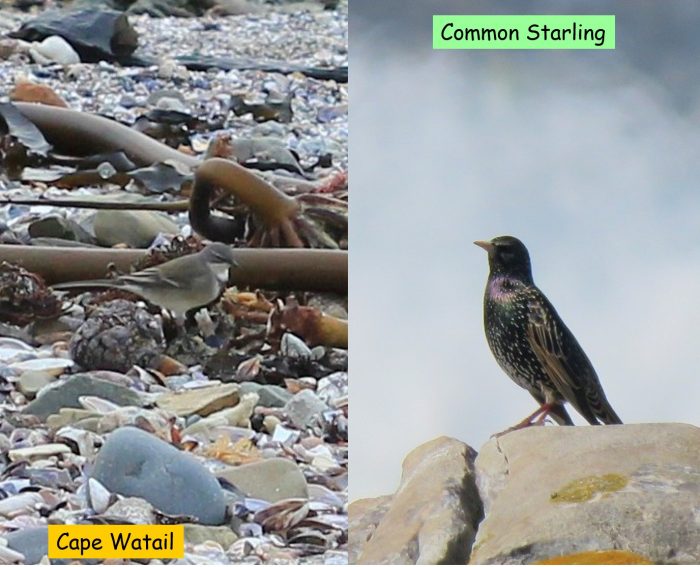
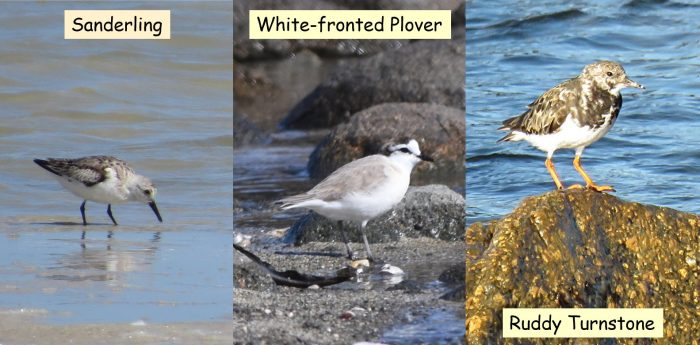
SMALL BIRDS – WAGTAIL, STARLING, WADERS : As soon as you get into the vegetation behind the coastline, whether it is natural, alien or gardens, there are a lot of bird species which you can encounter. But there are only five small species that you are likely to encounter on the beach or in the rock pools of the inter-tidal zone: Cape Wagtail (grey and white with black bib), Common Starling (black), White-fronted Plover (mostly white and cream), Ruddy Turnstone (black, white and brown) and Sanderling (white and grey).

Cape Wagtails (left) and Common Starlings (right) are two landbirds that feed in the intertidal zone right down to the edge of the sea:

Cape Wagtail on left, Common Starling on right. Birds on the coastline of the Western Cape

Sanderlings (left) are mostly found on sheltered sandy beaches, feeding at the edge of the waves, running at speed to keep pace with the waves. White-fronted Plovers (centre) occur on both sandy and rocky shores, feeding from the edge of the sea to the back of the beach. Ruddy Turnstones (right) are mostly on rocky shores, or feeding on piles of kelp washed up on sandy shores.

left to right: Sanderling, White-fronted Plover, Ruddy Turnstone

Sanderlings and Ruddy Turnstones breed in Siberia, and migrate to the Western Cape for the local summer (about September to April). White-fronted Plovers are residents, and breed on the shore just above the high tide level.

Of course, there are lots of other species of birds on the coastline. For example, if you go to the Boulders or Stony Point, you will certainly see African Penguins. If you visit Bird Island at Lambert’s Bay, you will see Cape Gannets in their thousands.

If you manage to take a photograph of any bird listed above, please submit it to the Virtual Museum. You can include your own identification, even if it is a bit tentative. The expert panel will confirm whether you have got it right. If you see a bird which is not listed above, do try to take a photograph and submit it to the Virtual Museum. You can leave the species field blank, and a member of the expert panel will do the identification. Every record is valuable as evidence that a species still occurs at a locality.

Recommended citation format: Underhill LG 2021. Birds on the coastline of the Western Cape. Biodiversity and Development Institute. Available online at http://thebdi.org/2021/06/11/birds-on-the-coastline-of-the-western-cape/

The Virtual Museum

The Virtual Museum (populatrly known as the VM) provides the platform for citizen scientists to contribute to biodiversity research and mapping projects. This innovative concept was originally developed by the Animal Demography Unit at the University of Cape Town (UCT) in 2005. It is now managed by the Biodiversity and Development Institute (an independent non-profit company) and the FitzPatrick Institute of African Ornithology (UCT).

What is the Virtual Museum?

For many people, the word “museum” conjures up images of a place to see stuffed animals on display. But this museum is not like this. Every real museum does not only have displays; there is always a door labelled “Private: Staff Only.” Go through that door, and you get into the scientific part of the museum. If it is a biological museum, it consists of large collections of specimens. Frequently there are large numbers of specimens of the same species from different parts of the range. They are all carefully preserved and labelled with the date and place where they were collected, the name of the collector, and the associated number of the record in a catalogue, which until recently was on paper. This is a real museum below!

Natural history museum paris Michael Bates
This is a real museum; those are real snakes inside the bottles. Specimens carefully preserved in alcohol in bottles, everyone neatly labelled with collector, species and date. (Photo by Mike Bates, taken in the Natural History Museum, Paris)

The Virtual Museum is just like this part of the Real Museum, except that instead of specimens on shelves or in bottles, we have digital photographs in a database. The details of collector, date and place are also in the database. For example, there are 3,488 photographs of Painted Ladies Vanessa cardui in LepiMAP, and here are a handful of them:

Virtual Museum records of Painted Ladies. The real butterflies flew away, and continued with their lives. So this is a “virtual museum” in contrast to a “real museum”. One advantage of the “Virtual Museum” is that the specimens don’t lose their colour with time. The disadvantages are that you cannot handle the specimens, all you have (as Ringo Starr would say) is a photograph. And you can’t take a DNA sample from a photo!

One important use of all these photographs of the Painted Lady is to plot the locations where each record was observed, and to make distribution maps. One standard way of making maps is to put a grid over the region of interest, and to shade the grid cells in which the species has been recorded. In South Africa, Lesotho and Eswatini we often use a coarse grid, with lines at quarter degree intervals, about 27 km apart. When you realise that this coarse system generates 2,000 quarter degree grid cells for these three countries, then 3,488 records is not so impressive. If we go to a one minute grid (about 1.6 km), which would be nice, the three countries have 450,000 grid cells, nearly half a million!

A second use of all these Painted Lady records is to use them to work out the period of the year when the species is flying. This is called the “phenology”. When people talk about climate change, the first thought is that the future will be warmer. Another component of climate change is that the timing of the seasons will change. There is a real interest in seeing how biodiversity adapts to these changes. The statistical methods used to produce phenology plots need mountains of data. 3,488 Painted Ladies is not enough! And if we are going to be able to detect changes in phenology, we need vast numbers of new photos of Painted Ladies, made in 2021, 2022, 2023, …. and for ever. We will never have enough Painted Ladies. It is just as well this museum is “virtual” rather than “real”!

Members of the public are encouraged to submit digital photographs for the various sections of the Virtual Museum. Together with the photograph goes the same information as on the label of the specimen. Species identifications can be done by the observers, and these are confirmed by a panel of experts. If there is no identification, then these are done by the expert panel.

Currently the VM hosts 17 biodiversity projects: BirdPix (bird pictures archive); BOP (odd plumages of birds). PHOWN (photos of weaver nests), and 14 atlases: DungBeetleMAP (dung beetles, Coleoptera: Scarabaeidae). EchinoMAP (African Echinoderms: sea stars, sea urchins and brittle stars), FishMAP (freshwater fish in southern and eastern Africa), FrogMAP (African frogs), LacewingMAP (African Neuroptera and Megaloptera), MushroomMAP (South African mushrooms), OdonataMAP (African Odonata), OrchidMAP (African orchids), LepiMAP (African Lepidoptera), ReptileMAP (African reptiles), ScorpionMAP (African scorpions), SpiderMAP (African spiders), MammalMAP (African mammals), and TreeMAP (South African trees).

The databases in the Virtual Museum are used for multiple purposes. The most common use is to collate all the places where a species has been photographed, and to generate distribution maps for the species. These are available online and serve as conservation and education tools. These maps include Virtual Museum records and sometimes also other distributional records which are contained within the Virtual Museum database.

Virtual Museum records help expand the distribution databases for these taxa; they not only confirm the presence of a species at a particular point in time, but they also provide new distribution records for species and sometimes lead to extensions of the known range of a species. We try hard to “refresh” old records, so the maps are kept up to date.

Although the Virtual Museum database contains the exact localities of records, the only information made publicly available is the quarter-degree grid cell in which the record occurs. These are roughly square, with sides 27 km, about 700 square km. This is the scale at which information is published in atlases. For species that are subjected to poaching (e.g. rhinos, but a substantial list of other species as well), the records in the database appear to disappear as soon as they are identified. This is an unfortunate and important security feature of the Virtual Museum.

Your photos can make a difference for biodiversity conservation and information systems!