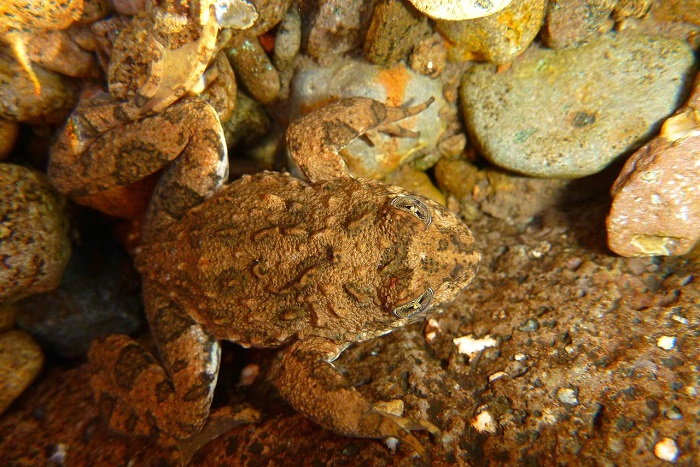
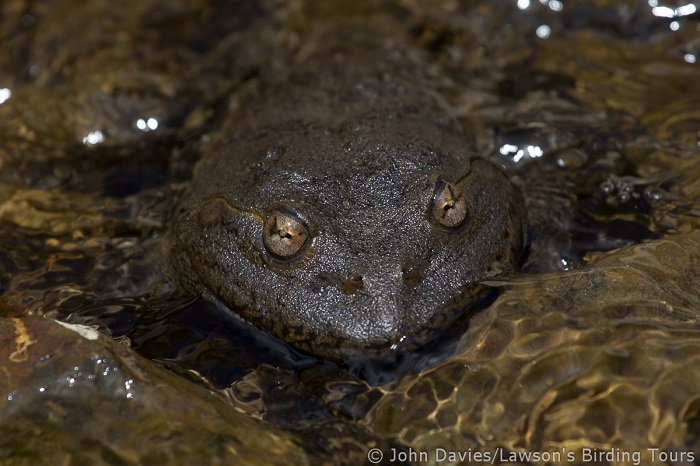
Maluti River Frog (Amietia vertebralis)

View the above photo record (by John Davies) in FrogMAP here.

Find the Maluti River Frog in the FBIS database (Freshwater Biodiversity Information System) here.

Family Pyxicephalidae

MALUTI RIVER FROG – Amietia vertebralis

(Hewitt, 1927)

Habitat

This species inhabits Afro Montane Grassland and Alti Mountain Grassland of the Grassland Biome, usually at altitudes of 1750–3282 m. It has also been recorded at lower elevations of 1646 m in the Mzimkulu River (2929CB) in Drakensberg Gardens (Bush 1952), and 1540 m at Fort Hook (3027DA) in the Witteberg range (Poynton 1964). These frogs occur in cold, clear streams and associated pools with rocky substrates, in mountainous areas, including most major rivers and their tributaries in Lesotho.

Typical habitat – Bokong Nature Reserve, Lesotho
Photo by Michael Cunningham

Behaviour

A. vertebralis is largely aquatic, but may be found on rocks and under stones or amongst vegetation at the water’s edge. Wager (1986) also found adults, up to 75 mm in length, sheltering under stones or water plants in swampy areas on mountain slopes. Adults can apparently remain submerged for a few days at a time (Bush 1952) because they are able to breathe efficiently through their skin, whereas juveniles spend more time foraging at the edge of the water (Lambiris 1988b). Both adults and tadpoles have been observed moving about under ice during winter and are intolerant of high temperatures (Rose 1950; Lambiris 1987, 1989a). Mass mortalities of this species in the Drakensberg (O’Grady 1998) may have been caused by a rise in water temperature in stagnant streams during drought conditions.

Breeding occurs from mid-September to February (Lambiris 1988b). Males usually call while almost completely submerged, with only the head protruding from the water, but occasionally they call from exposed rocks (Channing 1979).

The eggs are attached to submerged vegetation in shallow, gently-flowing streams or associated pools with sandy or stony substrates (Lambiris 1988b, 1989a). Van Dijk (1996) observed eggs in shallow, slow-flowing water in September and late November in central Lesotho. The eggs, c.1.8 mm in diameter, formed a single layer on the substrate and were part of a fairly coherent mass c.30 cm across. Bourquin and Channing (1980) observed egg masses in January, while FitzSimons (1948) collected an egg mass in November that was “attached to vegetable matter in a small backwater, away from the running stream”, and contained larvae “almost ready to emerge”.

Development of tadpoles takes several months or may even exceed a year in the wild (Van Dijk 1996). According to Lambiris (1988b), development in captivity took almost two years.

Tadpoles were found in February in shallow water or along the margins of fast-flowing rivers with rocky substrates (Van Dijk 1996). The tadpole is adapted to life in fast-flowing water in having a wide, flat body, a heavy but narrowly-webbed tail, and a large sucker-like mouth for obtaining a firm grip on smooth rocks. Tadpoles initially prey on infusoria, and later scavenge on detritus (Lambiris 1988b).

Adults prey on invertebrates such as gastropods and crabs, but also consume smaller frogs (Channing 1979). Captive specimens located and devoured small crabs (carapace 30 mm wide) while underwater (Channing 1979), and also ate mice (Rose 1962).
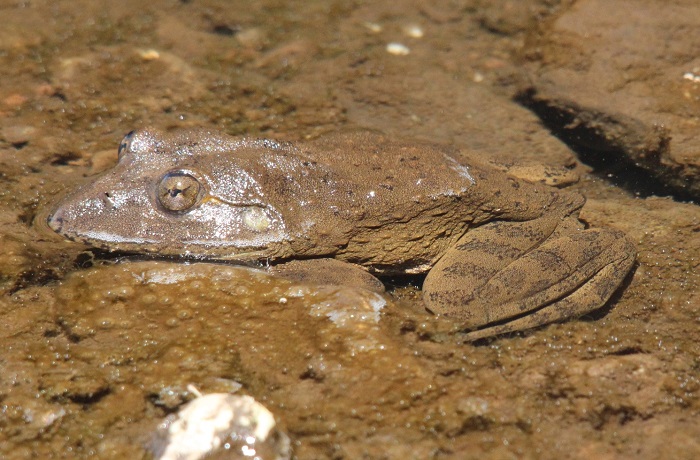
Amietia vertebralis – Lesotho
Photo by Cornelia Rautenbach

Status and Conservation

A. vertebralis was previously classified Restricted (Branch 1988). It was subsequently discovered at a number of additional localities, especially in the highlands of Lesotho (Bates 2002), and it appears to be abundant in many parts of its range (e.g. Lambiris 1988b). The species was assessed for this publication and assigned to the category Least Concern because its extent of occurrence and area of occupancy are in excess of the relevant thresholds and, although there are known localized threats to the species, there is no evidence that these are likely to cause a major long-term decline of the species.

The remoteness of this frog’s habitat will undoubtedly protect it from human impacts in most parts of its range. However, A. vertebralis appears to be threatened in areas affected by the Lesotho Highlands Water Project. The filling of the Katse Dam in Lesotho may have isolated some populations (Van Dijk 1996), while filling of the Mohale Dam will result in separation or extinction of populations in the Jorodane, Senqunyane and Bokong rivers (Mouton 1996). If the Mohale Dam causes large-scale migration of people and their livestock to areas further up the river catchment, increased erosion and water pollution will result. This may pose a problem as the species appears to occur only in pristine habitat. These frogs are not known to move overland, thus re-colonization will be prevented by the dam which will act as a barrier to dispersal (Mouton 1996). Littering of stream banks was also identified as a negative factor by Lambiris (1988b), but G. Kopij observed this species in streams polluted by the washing of laundry (Ambrose 1999).

In 1998, the mass mortality of a species assumed to be Amietia vertebralis was reported by hikers at an upland site in the Drakensberg escarpment (O’Grady 1998). The cause of death was undetermined, but at the time the river had been reduced to a series of isolated stagnant pools owing to an exceptionally dry year. The causative organism of chytridiomycosis has been identified in museum specimens of Ametia vertebralis (Speare 2000; Weldon 2002). Although this does not prove that the chytrid fungus was responsible for the deaths reported in 1998, this seems a plausible explanation as chytridiomycosis epidemics often occur during periods of drought, and affect high-altitude species (Berger et al. 1998; Pounds et al. 1999; Berger et al. 2000).
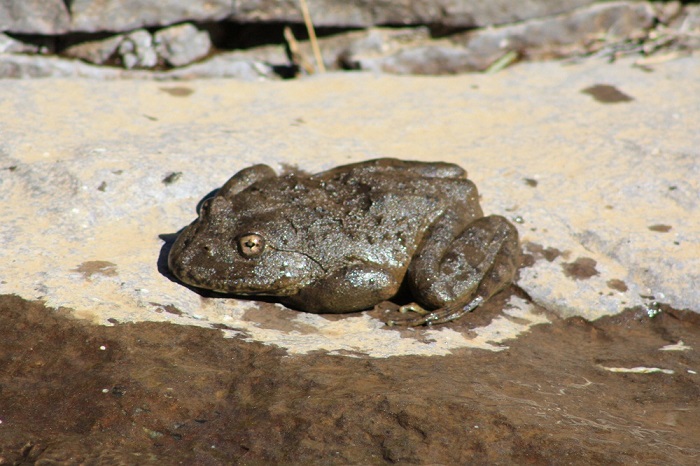
Amietia vertebralis – Photo by Felicity Grundlingh

In an opinion survey of local people in the highlands of central Lesotho, it was found that A. vertebralis is probably not threatened by local use as a source of food or medicine. Less than 1% of respondents reported that frogs (as a group) were eaten, while 12% said that they were used for medicine: for example, the fat is used to treat burns (Mouton 1996).

A. vertebralis is protected in Sehlabathebe National Park in Lesotho, Ukhahlamba Drakensberg Mountain Park (World Heritage Site) and by Cape Provincial nature conservation legislation (Nature Conservation Ordinance No. 19 of 1974).

Distribution

A. vertebralis is found at high altitudes in Lesotho and adjacent mountain ranges in KwaZulu-Natal, Free State and Eastern Cape Province, including the Witteberg range (Bates 2002).

Hewitt’s (1927) original description of Rana (now Amietiavertebralis was based on juvenile frogs. Bush (1952) later distinguished Rana umbraculata from R. vertebralis based on the former’s larger size, relatively wider head and dissimilar sternal apparatus. However, Poynton (1964) presented evidence indicating that R. umbraculata simply represented the adult form of R. vertebralis. Van Dijk (1966) noted morphological differences in tadpole populations that suggested two taxa were represented. He provisionally assigned the tadpoles to R. vertebralis and R. umbraculata. Lambiris (1991) found differences in laryngeal morphology and tadpole mouthparts and also felt that R. vertebralis comprised more than one species.

At the present time only one species of Amietia is recognized, pending further taxonomic research. All atlas distribution data have therefore been referred to A. vertebralis. Bearing in mind the taxonomic uncertainty outlined above, the atlas data may be considered reliable but incomplete.
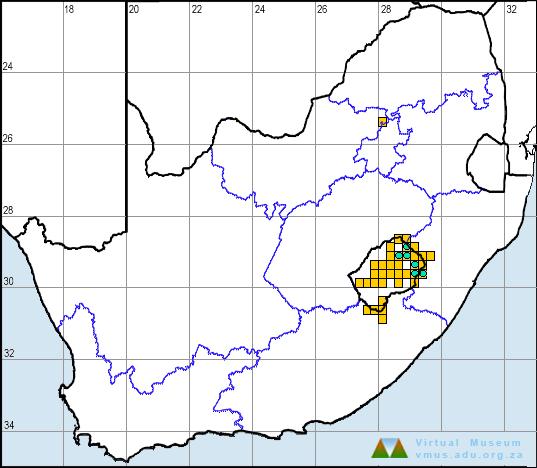
Distribution of Amietia vertebralis. Taken from the FrogMAP database as at March 2022.

Further Resources

Virtual Museum (FrogMAP > Search VM > By Scientific or Common Name)

More common names: Aquatic River Frog, Water Rana, Umbraculate Frog, (Alternative English Names); Grootbekrivierpadda (Afrikaans)

Recommended citation format for this species text:

Bates MF, Tippett RM.  Maluti River Frog Amietia vertebralis. BDI, Cape Town.
Available online at http://thebdi.org/2022/03/28/maluti-river-frog-amietia-vertebralis/

Recommended citation format: 

This species text has been updated and expanded from the text in the
2004 frog atlas. The reference to the text and the book are as follows:

Bates MF 2004 Amietia vertebralis Maluti River Frog. In Minter LR
et al 2004.

Minter LR, Burger M, Harrison JA, Braack HH, Bishop PJ, Kloepfer D (eds)
2004. Atlas and Red Data Book of  the Frogs of South Africa, Lesotho and
Swaziland. Smithsonian Institution, Washington, and Avian Demography
Unit, Cape Town.
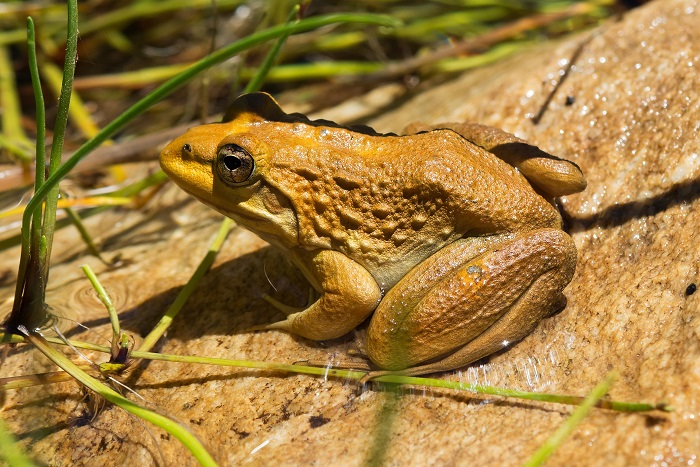
Van Dijk’s River Frog (Amietia vandijki)

View the above photo record (by Andre Marais) in FrogMAP here.

Find Van Dijk’s River Frog in the FBIS database (Freshwater Biodiversity Information System) here.

Family Pyxicephalidae

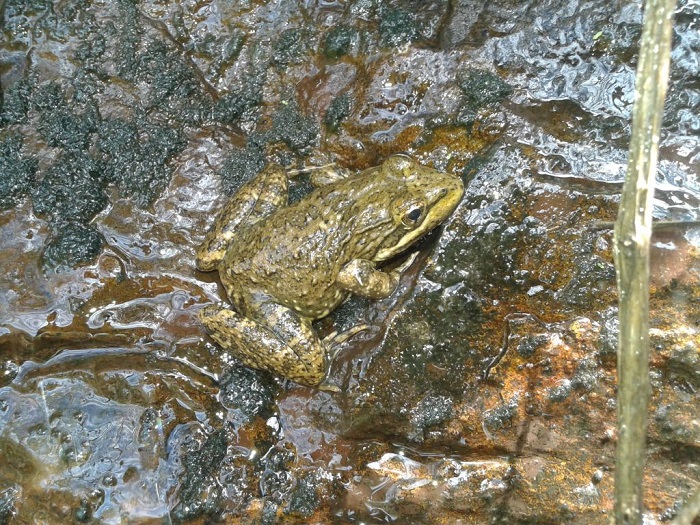
VAN DIJK’S RIVER FROG – Amieta vandijki

(Visser & Channing, 1997)

Identification

This species reaches a body length of 54 mm in males and 56 mm in females. A. vandijki is superficially similar to the sympatric A. fuscigula, and the two species are known to breed in the same pools. This should be borne in mind when identifying specimens from areas in which the species coexist. A. vandijki may be distinguished from A. fuscigula by the presence of a large pale mark in the middle of the back, and a prominent skin fold running from the back of the eye to the arm, obscuring the upper or entire tympanum. In A. vandijki, 2–3 phalanges of the fourth toe are free of webbing, whereas in A. fuscigula only half to one phalanx is free of webbing (Visser and Channing 1997).

The call is biphasic, consisting of a series of 10–15 clicks uttered within 0.8 s, followed by a harsh, pulsed croak about 0.25 s in duration (Channing 2001).

The tadpoles reach about 55 mm in length. They are dark brown or velvety black with deep, dark fins and a paddle-like tail. The tadpoles are easily distinguished from those of A. fuscigula, which have only a small amount of pigment in their tails (Channing 2001).

Habitat

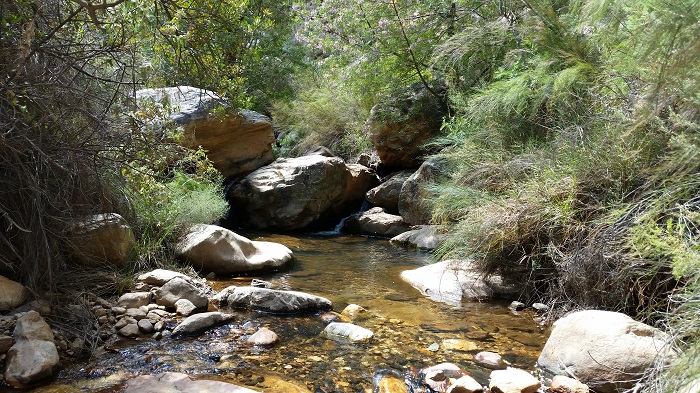
This species inhabits Mountain Fynbos that receives annual rainfall of 300–800 mm, mainly in winter. The frog is associated with rocky streams on steep, well-vegetated slopes and forested gorges (Visser and Channing 1997). Breeding habitat includes pools on the sides of streams, and deeper, slow-flowing water.

Habitat – Seweweekspoort, Western Cape
Photo by Ryan Tippett

Behaviour

This species is active throughout the year. Breeding takes place October–December, after good rain. Little is known of the species’ breeding biology. Predators and food items have not been recorded.

Amieta vandijki – Swartberg, Western Cape
Photo by Paul Bester

Status and Conservation

Status

A. vandijki is classified Data Deficient (Harrison et al. 2001; this publication). It is known to occur in Grootvadersbos Nature Reserve, Boosmansbos Wilderness Area, Swartberg Nature Reserve and Garcia State Forest (Harrison et al. 2001).

Threats

Present and predicted threats include damming of streams, wildfires and loss of habitat to invasive alien plants (Harrison et al. 2001).

Recommended conservation actions

Fieldwork is needed to collect additional distribution data and details of the life history of A. vandijki. The degree of genetic differentiation between the Swartberg and Langeberg subpopulations needs to be established. Habitat should be managed to ameliorate existing and predicted threats (Harrison et al. 2001).

Amietia vandijki – Seweweekspoort, Western Cape
Photo by Ryan Tippett

Distribution

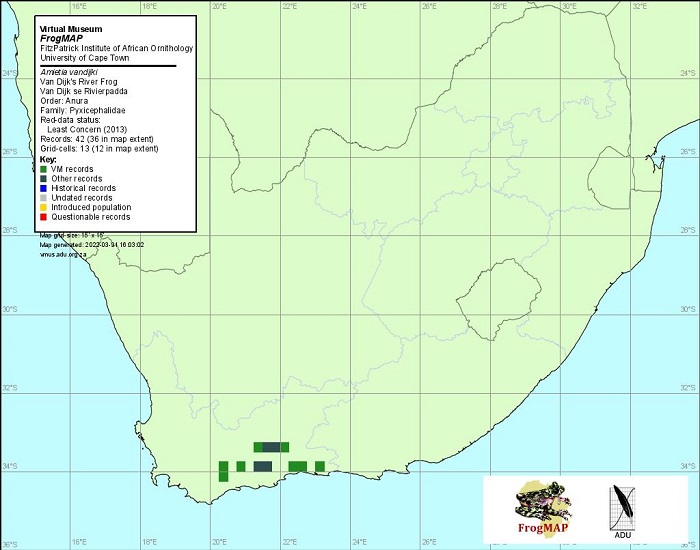
A. vandijki occurs at medium to high altitudes in the Swartberg and Langeberg mountain ranges in the east of the Western Cape Province. Despite the addition of a number of new atlas records, the distribution of this recently described endemic species is not well known. The atlas data are accurate but incomplete.

Distribution of Amieta vandijki. Taken from the FrogMAP database, March 2022.

Further Resources

Virtual Museum (FrogMAP > Search VM > By Scientific or Common Name)

More common names: Van Dijk se rivierpadda (Afrikaans)

Recommended citation format for this species text:

Channing A, Tippett RM.  Van Dijk’s River Frog Amietia vandijki. BDI, Cape Town.
Available online at http://thebdi.org/2022/03/28/van-dijks-river-frog-amietia-vandijki/

Recommended citation format: 

This species text has been updated and expanded from the text in the
2004 frog atlas. The reference to the text and the book are as follows:

Channing A 2004 Amietia vandijki Van Dijk’s River Frog. In Minter LR
et al 2004.

Minter LR, Burger M, Harrison JA, Braack HH, Bishop PJ, Kloepfer D (eds)
2004. Atlas and Red Data Book of  the Frogs of South Africa, Lesotho and
Swaziland. Smithsonian Institution, Washington, and Avian Demography
Unit, Cape Town.
Poynton’s River Frog (Amietia poyntoni)

View the above photo record (by Ralie Claassen) in FrogMAP here.

Find Poynton’s River Frog in the FBIS database (Freshwater Biodiversity Information System) here.

Family Pyxicephalidae

POYNTON’S RIVER FROG – Amietia poyntoni

Channing & Baptista, 2013

Habitat

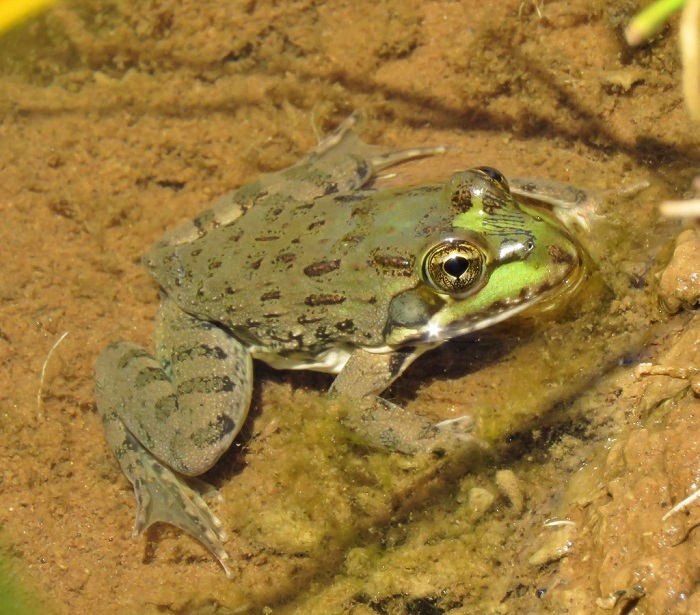
A. poyntoni is predominantly found in the Grassland and Nama Karoo biomes. Its natural habitat includes streams and rivers in open areas. Readily colonises artificial water bodies such as farm dams, fishponds and wells.

Behaviour

Poynton’s River Frog is active both day and night. It is active and vocal throughout much of the year. Sits in concealed positions at the waters edge. Jumps into water at the slightest disturbance where it hides at the bottom in soft sediment.

Amietia poyntoni – Karoo National Park, Western Cape
Photo by N. Spangenberg

Status and Conservation

Amietia poyntoni is currently considered Near Threatened.

Distribution

This species is near-endemic to South Africa. It occurs widely in the interior and central plateau, from Limpopo and Mpumalanga to the Western Cape. Also occurs in southern and central Namibia.

Distribution of Amieta poyntoni. Taken from the FrogMAP database as at March 2022.

Further Resources

Virtual Museum (FrogMAP > Search VM > By Scientific or Common Name)

More common names: Poynton se rivierpadda (Afrikaans)

Recommended citation format for this species text:

Tippett RM.  Poynton’s River Frog Amietia poyntoni. BDI, Cape Town.
Available online at http://thebdi.org/2022/03/28/poyntons-river-frog-amietia-poyntoni/

Phofung River Frog (Amietia hymenopus)

View the above photo record (by Michael Cunningham) in FrogMAP here.

Find the Phofung River Frog in the FBIS database (Freshwater Biodiversity Information System) here.

Family Pyxicephalidae

PHOFUNG RIVER FROG – Amietia hymenopus

(Boulenger, 1920)

Habitat

A. hymenopus inhabits Alti Mountain Grassland vegetation, in topography characterized by steep slopes and fast-flowing streams. Annual precipitation is 500–750 mm and occurs as summer thunderstorms and winter snowfalls. Adults forage in grassland on the plateaux and on gentle slopes. When breeding, they may be found in seepage areas, along the rocky banks of gently flowing streams, or near the edges of pools.

Typical habitat – Bokong Nature Reserve, Lesotho
Photo by Michael Cunningham

Behaviour

Breeding occurs after the first spring rains in September, through to January. Unlike other members of this genus, A. hymenopus lays its eggs in the water. Clutches of 200–500 eggs are attached to rock in flowing water or deposited in shallow, stagnant pools at the sides of streams. Eggs may also be laid in many smaller batches of 7–15 (Channing 1979). The development of the tadpoles has not been documented.

Status and Conservation

A. hymenopus occupies uplands that are generally free of impacts that would affect it negatively. The species occurs in the uKhahlamba-Drakensberg Park. It is not believed to be threatened, and no special conservation action is recommended. However, the number of atlas records for this species is very limited and it is recommended that additional surveys be conducted to determine the true extent of the species’ range and the size of its populations. The presence of chitrid fungus infections in Ametia vertebralis (see species account), a species that inhabits the same uplands, indicates that Amietia hymenopus should also be monitored for this pathogen. Little is known of the life history of A. hymenopus and this also handicaps conservation assessment.

Amietia hymenopus – Bokong Nature Reserve, Lesotho
Photo by Dieter Kassier

Distribution

A. hymenopus is endemic to the high slopes of the Drakensberg and Lesotho highlands. The southernmost record from Barkley East (3027DC) appears isolated, but this is probably due to inadequate sampling. The species occurs at altitudes of 1800–>3000 m.

Very few records were collected during the atlas period. The atlas data are reliable but incomplete.

Further Resources

Virtual Museum (FrogMAP > Search VM > By Scientific or Common Name)

More common names: Phofung-rivierpadda (Afrikaans)

Recommended citation format for this species text:

Tippett RM. Phofung River Frog Amietia hymenopus. BDI, Cape Town.
Available online at http://thebdi.org/2022/03/27/phofung-river-frog-amietia-hymenopus/

Recommended citation format: 

This species text has been updated and expanded from the text in the
2004 frog atlas. The reference to the text and the book are as follows:

Bates MF 2004 Amietia hymenopus Phofung River Frog. In Minter LR
et al 2004.

Minter LR, Burger M, Harrison JA, Braack HH, Bishop PJ, Kloepfer D (eds)
2004. Atlas and Red Data Book of  the Frogs of South Africa, Lesotho and
Swaziland. Smithsonian Institution, Washington, and Avian Demography
Unit, Cape Town.

Cape River Frog (Amietia fuscigula)

View the above photo record (by Alan Manson) in FrogMAP here.

Find the Cape River Frog in the FBIS database (Freshwater Biodiversity Information System) here.

Family Pyxicephalidae

CAPE RIVER FROG – Amieta fuscigula

(Duméril and Bibron, 1841)

Habitat

A. fuscigula inhabits grassland, fynbos and karoo scrub in flat and mountainous regions. The species tolerates some habitat disturbance and is frequently associated with human habitation. Readily colonises farm dams, ditches and ponds.

Breeding takes place in shallow water along the edges of pools, dams, streams and slow-flowing rivers. These frogs breed in both standing water in both flat and steeply sloped areas. The same habitat is used throughout the year.

Behaviour

The adults spend the day floating among vegetation or basking on rocks above the water. Larger individuals may be found on banks or in vegetation above the water, leaping to the safety of the nearest pool when disturbed. This species has long hind legs and a fair amount of webbing between the toes, and is well adapted to jumping and swimming.

Amietia fuscigula – Oyster Bay, Eastern Cape
Photo by Gregg Darling

Males typically call from floating vegetation or from shallow water at the edge. Clutches of 400–500 eggs are laid in shallow, standing water. Tadpoles may grow to 165 mm in length.

These frogs consume large numbers of flying and crawling insects. In turn, they constitute an important prey item for otters, large birds and snakes.

Status and Conservation

This common species is found in most rivers, ponds, farm dams and other wetlands within its range. It is found in many protected areas. A. fuscigula is not generally threatened. The species is listed as of Least Concern in the IUCN Red List of Threatened Species.

Amietia fuscigula – Groot Wintershoek Mountains, Western Cape
Photo by Andrew & Heather Hodgson

Distribution

A. fuscigula is largely restricted to the Western Cape, where it is common and widespread. Extends marginally into the southern parts of the Eastern Cape.

The distribution data are comprehensive, but care needs to be taken in areas where this species may be confused with A. delalandii, A. poyntoni or A. vandijki. These species share a number of colour patterns, and smaller individuals of A. fuscigula may be confused with larger individuals of other Amietia species.

There is currently no map available for this species.

Further Resources

Virtual Museum (FrogMAP > Search VM > By Scientific or Common Name)

More common names: Kaapse rivierpadda (Afrikaans)

Recommended citation format for this species text:

Tippett RM.  Cape River Frog Amietia fuscigula. BDI, Cape Town.
Available online at http://thebdi.org/2022/03/27/cape-river-frog-amietia-fuscigula/

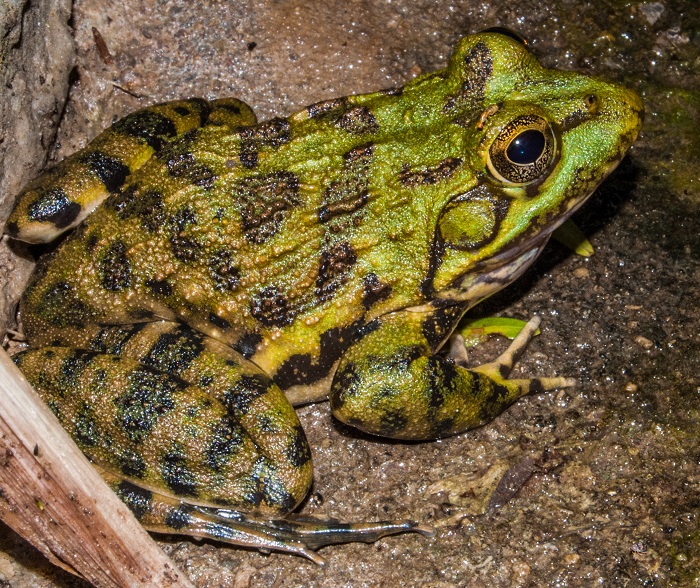
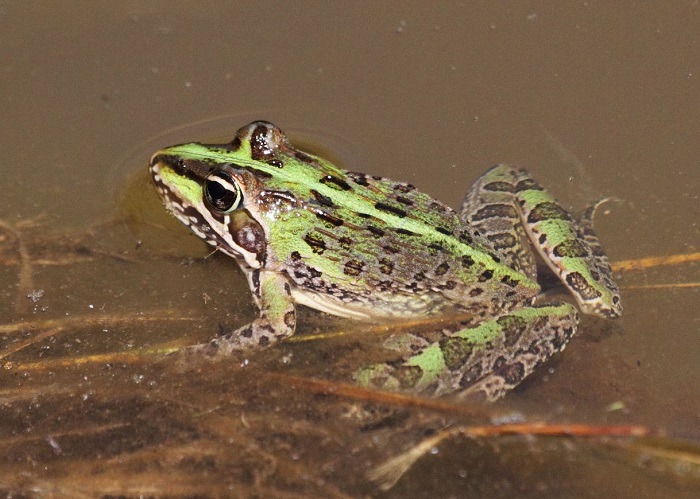
Delalande’s River Frog (Amietia delalandii)

View the above photo record (by Alan Manson) in FrogMAP here.

Find Delalande’s River Frog in the FBIS database (Freshwater Biodiversity Information System) here.

Family Pyxicephalidae

DELALANDE’S RIVER FROG – Amieta delalandii

(Duméril and Bibron, 1841)

Habitat

A. delalandii inhabits the Grassland and Savanna biomes, and forest fringe. Annual rainfall in these areas is 500–900 mm. The species tolerates some habitat disturbance and is frequently associated with human habitation, taking up residence in ditches and ponds, often where reeds and water lilies are present.

Breeding takes place in shallow water along the edges of pools, dams, streams and slow-flowing rivers. These frogs breed in both standing water in flat areas and running water traversing slopes of more than 14 degrees (Channing 1979). The same habitat is used throughout the year

Behaviour

The adults spend the day floating amongst vegetation or basking on rocks above the water. Larger individuals may be found on banks or in vegetation above the water, leaping to the safety of the nearest pool when disturbed. This species has long hind legs and a fair amount of webbing between the toes, and is well adapted to jumping and swimming.

A. delalandii is active throughout the year and breeding has been recorded in all months of the year (Channing 1979). Males typically call from floating vegetation or from shallow water at the edge. Clutches of 400–500 eggs are laid in shallow, standing water. Tadpoles may grow to 80 mm in length (Wager 1986).

Amieta delalandii – Near Howick, KwaZulu-Natal
Photo by Faansie Peacock

Being a common species that is active all year round, these frogs consume large numbers of flying and crawling insects. In turn, they constitute an important prey item for otters (Rowe-Rowe 1977a, b), large birds and snakes.

Status and Conservation

This widespread species is found in all rivers, ponds, farm dams and other wetlands within its range. It is found in many protected areas. Localized threats include acid pollution from old gold-mine dumps. A. delalandii is not generally threatened

Amieta delalandii – Near Babanango, KwaZulu-Natal
Photo by Gerhardt Diedericks

Distribution

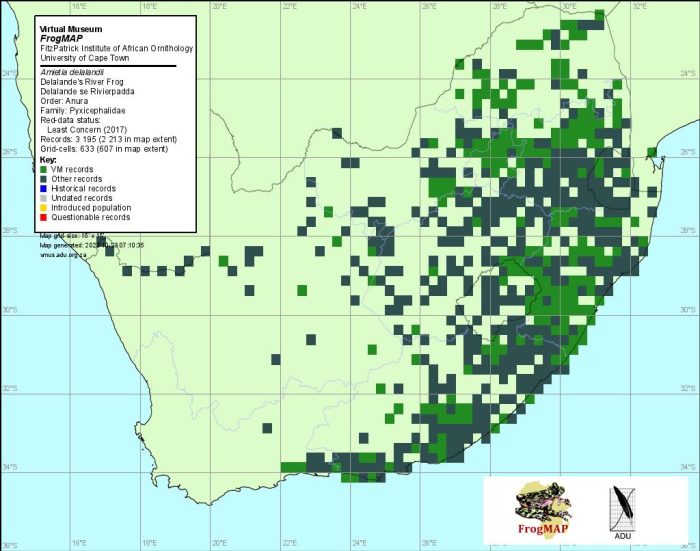
This widespread species is distributed from Ethiopia, south through East Africa to southern Africa, and westward to Angola (Poynton 1964). It occurs mainly in the eastern half of the atlas region, from just within the eastern border of Western Cape Province, northward at all altitudes up to 2000 m. A. delalandii has been recorded from the Vaal and Gariep (Orange) river drainages westward to the coast.

The distribution data are comprehensive, but care needs to be taken in areas where this species may be confused with A. fuscigula or A. poyntoni. These two species share a number of colour patterns, and smaller individuals of A. fuscigula may be confused with larger individuals of A. delalandii.

Distribution of Amieta delalandii. Taken from the FrogMAP database. October 2022.

Further Resources

Virtual Museum (FrogMAP > Search VM > By Scientific or Common Name)

Acknowledgements:

The use of photographs by Alan Manson, Faansie Peacock and Gerhardt Diedericks is acknowledged.

More common names: Common River Frog, Angola River Frog, Common Rana (Alternative English Names); Gewone Rivierpadda (Afrikaans)

Recommended citation format for this species text:

Channing A, Tippett RM.  Delalande’s River Frog Amieta delalandii. BDI, Cape Town.
Available online at http://thebdi.org/2022/03/26/common-river-frog-amietia-delalandii/

Recommended citation format: 

This species text has been updated and expanded from the text in the
2004 frog atlas. The reference to the text and the book are as follows:

Channing 2004 Amieta delalandii Delalande’s River Frog. In Minter LR
et al 2004.Minter LR, Burger M, Harrison JA, Braack HH, Bishop PJ, Kloepfer D (eds)
2004. Atlas and Red Data Book of  the Frogs of South Africa, Lesotho and
Swaziland. Smithsonian Institution, Washington, and Avian Demography
Unit, Cape Town.
Delicate Leaf-folding Frog (Afrixalus delicatus)

View the above photo record (by Michael Adams ) in FrogMAP here.

Find the Delicate Leaf-folding Frog in the FBIS database (Freshwater Biodiversity Information System) here.

Family Hyperoliidae

DELICATE LEAF-FOLDING FROG – Afrixalus delicatus

Pickersgill, 1984

Habitat

A. delicatus inhabits Coastal Bushveld-Grassland: a mosaic of forest patches, evergreen thicket and secondary woody vegetation set in a grassy matrix, that extends along the KwaZulu-Natal coast from sea level to an altitude of 300 m. The annual rainfall exceeds 1000 mm and there is an abundance of surface water that collects in a variety of natural wetlands and artificial impoundments. When breeding, this species seems to show a preference for relatively permanent bodies of water such as ponds, vleis and marshes, particularly those with emergent vegetation that includes Polygonum pulchrum and Ludwigia stolonifera used during oviposition. (Telford 1982; Backwell 1991).

Behaviour

A favourite retreat in winter is the leaf axils of Strelitzia and bananas; little else is known about the behavioural ecology of A. delicatus during the non-breeding season.

Afrixalus delicatus – Near Hluhluwe, KwaZulu-Natal
Photo by Felicity Grundlingh

Breeding takes place September–February in South Africa. Males congregate on emergent vegetation at their breeding sites in the evening and call until about 00:30, although calling activity is more subdued after midnight or once most of the males have paired. In South Africa, calling males within a chorus form groups of about eight individuals with a density of 2–3.2 males/m2 (Backwell and Passmore 1991), and about 25% of males are satellites (Backwell 1991). In Kenya, choruses consist of many hundreds of males with aggregation densities of 15–>40/m2 (M.P. pers. obs.).

The eggs are white, enveloped in vertically folded leaves of grasses and herbs, up to 15 cm above the water. The mean clutch size is 93 (Wager 1965; Telford 1982; Pickersgill 1984; Backwell and Passmore 1991).

During the day, both sexes retire to leaf axils of vegetation in or near standing water, although some individuals may be found in exposed positions on the shaded sides of Cyperus or Typha leaves (M.P. pers. obs.). A. delicatus is believed to feed largely on mosquitoes (Wager 1965) and other small insects. The predators of this species are unknown.

Afrixalus delicatus – pair during amplexus
Near Hluhluwe, KwaZulu-Natal
Photo by Nick Evans

Status and Conservation

A. delicatus occurs in a number of reserves, particularly in northern KwaZulu-Natal, such as those at Kosi Bay, St Lucia, Dukuduku and Mtunzini. However, further south its survival is threatened by sugar farming that has resulted in extensive habitat loss, draining of wetlands, and burning. Urban sprawl places additional pressure on breeding populations. In urban areas, A. delicatus survives as isolated populations largely associated with well-vegetated water hazards on golf courses and stagnant seepages at the fringes of farmland.

Afrixalus delicatus – Richards Bay, KwaZu;u-Natal
Photo by Cornelia Rautenbach

Distribution

A. delicatus is distributed along the coastal plain of Mozambique (Pickersgill 1984; Poynton and Broadley 1987), and is also known to occur in southern Malawi, ranging northward along the East African coast to southern Somalia (M.P. unpubl. data). In the atlas region, ubiquitous populations of A. delicatus occur along the coastal belt of northern KwaZulu-Natal, reaching Mount Edgecombe (2931CA) in the south.This species is syntopic with A. s. spinifrons at many localities where the ranges of these two species overlap (M.P. pers. obs.).

A. delicatus is also similar, morphologically, to A. aureus, and is sympatric with that species over part of its range. However, the latter seems to prefer drier habitat and does not usually utilize the same breeding sites (Pickersgill 1984; M.P. pers. obs.). Also, the advertisement call of A. aureus lacks a “zip” component and cannot be confused with A. delicatus.

The accurate identification of A. delicatus and A. s. spinifrons requires careful morphological examination and recording of the advertisement call. However, most of the atlas data were obtained from identified museum material or from field workers familiar with these species, and may therefore be regarded as reasonably accurate and complete

Distribution of Afrixalus delicatus. Taken from the FrogMAP database, April 2022.

Further Resources

Virtual Museum (FrogMAP > Search VM > By Scientific or Common Name)

More common names: Delicate Spiny Reed Frog (Alternative English Name), Delikate Blaarvouendepadda (Afrikaans)

Recommended citation format for this species text:

Pickersgill M, Bishop PJ, Tippett RM.  Delicate Leaf-folding Frog Afrixalus delicatus. BDI, Cape Town. Available online at http://thebdi.org/2022/03/24/delicate-leaf-folding-frog-afrixalus-delicatus/

Recommended citation format: 

This species text has been updated and expanded from the text in the
2004 frog atlas. The reference to the text and the book are as follows:

Pickersgill M, Bishop PJ 2004 Afrixalus delicatus Delicate Leaf-folding Frog. In Minter LR
et al 2004.

Minter LR, Burger M, Harrison JA, Braack HH, Bishop PJ, Kloepfer D (eds)
2004. Atlas and Red Data Book of  the Frogs of South Africa, Lesotho and
Swaziland. Smithsonian Institution, Washington, and Avian Demography
Unit, Cape Town.
Hadada Ibis (Bostrychia hagedash)

Cover photo: Hadada Ibis – BirdPix 101445 – Neels Jackson

Identification

The Hadada Ibis gets its name from its loud three to four note call uttered in flight, especially in the mornings and evenings when they fly out or return to their roost trees. The calls of Hadada Ibises are considered a sign of approaching rains in parts of Lesotho.

It is a large, grey-to-partly brown bird. Males and females are alike in plumage. It has a narrow, white, roughly horizontal stripe across its cheeks. This is sometimes called the “moustache” though it does not reach the mouth corners. The feathers on its wings have an iridescent green and purple sheen and it has a long, curved greyish-black bill with a patch of red, only prominent during breeding season, on the top part of its bill.

Identification guide to Hadada Ibis Bostrychia hagedash
Main photo: BirdPix 149281 – Anthony Paton, Bedfordview, Gauteng, 20 August 2016. Flying Hadada: BirdPix 44590 – Gregg & Desire Darling, Jeffreys Bay, Eastern Cape, 30 September 2017.

Habitat

The Hadada Ibis generally prefers open grassland with well-wooded valleys and patches of dense woodland (to use as nesting sites). It also occurs in forest clearings, wetlands with short grass, vleis, irrigated croplands, sports fields, pastures, and lawns in urban areas.

The distribution range of the Hadada has increased in southern Africa by nearly two and a half times in the 20th century due to the introduction of trees in habitats that were once treeless and the expansion of urban areas (and therefore gardens and parks). Irrigation projects may also have helped in their expansion as they appear to need moist and soft soils in which to probe for food.

Habitat for Hadada ibis
Probing for food on a grass lawn: BirdPix 105543 – Les Underhill, Cape Town, Western Cape, 09 February 2020.
Habitat for Bostrychia hagedash
Hadada habitats. Left: BirdPix 5338 – Darling Desire, Oyster Bay, Eastern Cape, 09 November 2013. Top right: BirdPix 11918 – Dave Kennedy, Krugersdorp, Gauteng, 14 December 2010. Bottom right: BirdPix 13121 – John Fincham, Katimo Molilo, Namibia, 02 August 2014.

Distribution

Hadadas occur across Africa south of the Sahel. In southern Africa, they are common northern Botswana, the Caprivi Strip (Namibia), northern and southern Zimbabwe, Mozambique and much of South Africa, excluding parts of the arid Karoo. 

In South Africa the core of their range is in Gauteng, KwaZulu-Natal, the Eastern Cape and Western Cape, mainly in the areas with moist grassland habitats and easily accessible water sources. The map below displays the distribution data from the second Southern African Bird Atlas Project (SABAP2).

SABAP2 distribution map for Hadada Ibis Bostrychia hagedash
SABAP2 distribution map for Hadada Ibis, downloaded on 23 March 2022. Details on how to interpret the map can be found here.

The Hadada Ibis has increased in abundance across most of the western half of South Africa in recent decades. There is a paper in the journal Biodiversity Observations which demonstrates the changes between the first and second bird atlas projects, SABAP1 and SABAP2.

Behaviour

Hadada Ibises roost in groups in trees. They fly out in the mornings with loud calls and return in the evenings with regularity. They are monogamous, solitary nesters, and probably form a life-long pair bond.

They feed on insects, millipedes, earthworms, and other invertebrates, using their long scimitar-like bill to probe soft soil. Hadadas readily feed on snails and can clear garden beds around residential homes. A gardener’s best friend! They are particularly welcomed on golf greens because they are great at extracting moth and beetle larvae that feed on the roots of the grass and other vegetation.

Foraging habitat for Hadada Ibis
Foraging in a wetland: BirdPix 189067 – Pieter Cronje, Lake Naivasha, Kenya, 16 October 2021. Probing for food on a grass lawn: BirdPix 105543 – Les Underhill, Cape Town, Western Cape, 09 February 2020.
A Hadada’s nest consists of a platform of sticks with a central bowl lined with grass, lichen, weeds, leaves and other plant debris. It is typically placed in the fork of a horizontal tree branch, or occasionally on other suitable structures such cliffs, dam walls, or even telephone poles.

It lays 1-5 eggs, which are incubated by both parents for about 25-28 days. The chicks are fed by both parents and they leave the nest at about 33-40 days old, becoming fully independent at roughly 60 days old.

Nest of Bostrychia hagedash
Hadada Ibis on its nest: BirdPix 28794 – Dieter Oschadleus, Cape Town, Western Cape, 06 August 2016. 

Further Resources

Species Text from the first Southern African Bird Atlas Project (SABAP1), 1997

Virtual Museum (BirdPix > Search VM > By Scientific or Common Name)

Paper on change of range between SABAP1 and SABAP2

Other common names: Hadeda (Afrikaans); Ing’ang’ane (Xhosa); iNkankane (Zulu); Ibis hagedash (French); Hagedasch-Ibis (German).

A list of bird species in this format is available here.

Recommended citation format: Loftie-Eaton M and Daniel K 2022. Hadada Ibis Bostrychia hagedash. Bird Feeder Project. Biodiversity and Development Institute. Available Online at http://thebdi.org/2022/03/24/hadada-ibis-bostrychia-hagedash/

Bronze Mannikin (Spermestes cucullata)

Cover photo of Bronze Mannikin: BirdPix 90010 – Dave Rimmer

Identification

The Bronze Mannikin or Bronze Munia Spermestes cucullata is a small passerine (i.e. perching) bird. Male and female Bronze Mannikins look alike. They have grey bills and blackish heads with white underparts and brown barring on their sides. They can also be identified by the metallic green patch of feathers on their shoulders.

Immature birds are a more plain buffy brown, with dark grey-brown upperparts and a black bill.

Identification Bronze Mannikin
Main photo: BirdPix  137820 – Craig Peter, Grahamstown, Eastern Cape, 29 October 2020. Inset photo bottom left: BirdPix 105697 – Lia Steen, Port Edward, KwaZulu-Natal, 25 February 2020. Inset photo top left: BirdPix 20526 – Dave Rimmer, Durban, KwaZulu-Natal, 26 August 2015.

Bronze Mannikins have a chirpy, high pitched call. Take a listen here.

Habitat

It generally prefers grassy habitats with a few scattered bushes and trees, like at the edges of thickets or evergreen forests. They are also found in savanna habitats, suburban gardens, and along the border between natural vegetation and cultivated land. Bronze Mannikins are dependant on water so if you have a bird bath in your garden they are likely to visit!

Spermestes cucullata
Photo left: BirdPix 13076 – Werner Van Goethem, Austin Roberts Bird Sanctuary, Gauteng, 23 February 2014. Top right: BirdPix 6412 – AP Labuschagne, Polokwane, Limpopo, 11 May 2009. Bottom right: BirdPix 46753 – Norman Barrett, Leopards Hill, Lusaka Province, Zambia, 17 November 2012.  
Bronze Mannikins at a bird bath
Bronze Mannikins at a bird bath – BirdPix 60059 – Ryan Tippett, Pennington, KwaZulu-Natal, 03 August 2018.

Distribution

They occur across much of sub-Saharan Africa, from Senegal to Ethiopia and south to southern Africa. Here they are very common in Mozambique, Zimbabwe, watini and eastern South Africa, while rather scarce in northern and south-eastern Botswana and the Caprivi Strip of Namibia due to the more arid conditions in those areas.

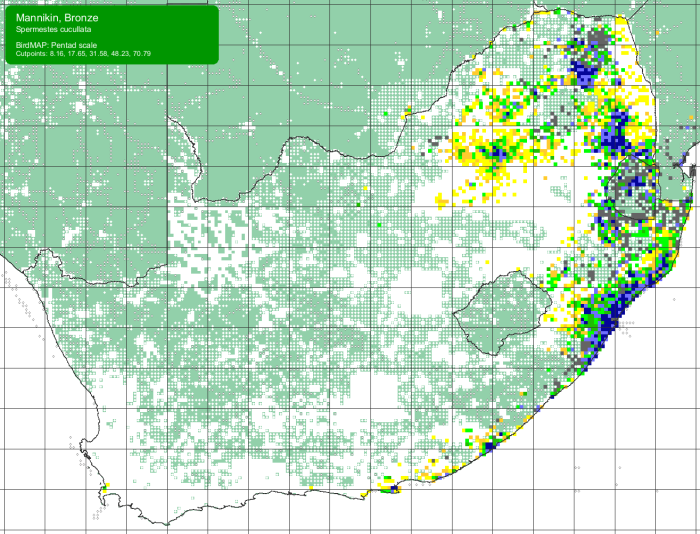
In South Africa the core of their range is in the east from KwaZulu-Natal to Limpopo Province, according to distribution data from the Second Southern African Bird Atlas Project (SABAP2). There are records of Bronze Mannikins in and around Cape Town, where they were introduced in 2015. The release reportedly took place in Rondebosch, a suburb in the “southern suburbs” of Cape Town; by 2023 the introduced range had extended a few suburbs to the north and to the south, from about Observatory to Wynberg, and is steadily expanding.

SABAP2 distribution map Bronze Mannikin
SABAP2 distribution map for Bronze Mannikin, downloaded on 22 March 2022. Details on how to interpret the map can be found here.

Behaviour

Bronze Mannikins are conspicuous and gregarious birds, often found in small flocks. They mainly eat grass seeds and the occasional insect. They do most of their foraging on the ground, often taking advantage of bird feeders in gardens. Before going to roost at nightfall, they usually visit a water source. They sometimes associate with other birds like waxbills or other mannikin species, and they may also use their vacated nests.

Spermestes cucullata
Flocks of Bronze Mannikins. Bottom left: BirdPix 29278 – Lia Steen, Shellybeach, KwaZulu-Natal, 15 August 2016. Top right: BirdPix 31248 – Lia Steen, Whiteriver, Mpumalanga, 01 January 2016.

During the breeding season (August to May) the male gathers the nesting material which the female uses to build the nest. The nest is an untidy ball-shaped structure which is usually made of green grass inflorescences but sometimes contains pine needles and wild Asparagus stems. Bronze Mannikins typically build their nests in a bush, tree, or man-made structure, like a post or beam of a building.

They lay 2-8 eggs, which are incubated by both the male and female for about 12-16 days. Both parents feed the chicks on a diet of mainly seeds The chicks leave the nest after about 15-21 days and become fully independent roughly 4 weeks later.

Bronze Mannikin
Parents feeding their young. Left: BirdPix 51966 – Ilse Hulme, Weenen Game Reserve, KwaZulu-Natal, 02 April 2018. Right: BirdPix 197150 – Lia Steen, Shellybeach, KwaZulu-Natal, 22 November 2021.
Spermestes cucullata
Bird feeder party! BirdPix 18924 – Dave Kennedy, Margate, KwaZulu-Natal, 10 July 2015.

Further Resources

Species Text from the first Southern African Bird Atlas Project (SABAP1), 1997

Virtual Museum (BirdPix > Search VM > By Scientific or Common Name)

Other common names: Gewone Fret (Afrikaans); Ingxenge (Xhosa); Zadzasaga (Shona); Capucin Nonnette (French); Kleinelsterchen (German).

A list of bird species in this format is available here.

Recommended citation format: Loftie-Eaton M and Daniel K 2022. Bronze Mannikin Spermestes cucullata. Bird Feeder Project. Biodiversity and Development Institute. Available online at http://thebdi.org/2022/03/23/bronze-mannikin-spermestes-cucullata

Common Starling (Sturnus vulgaris)

Identification

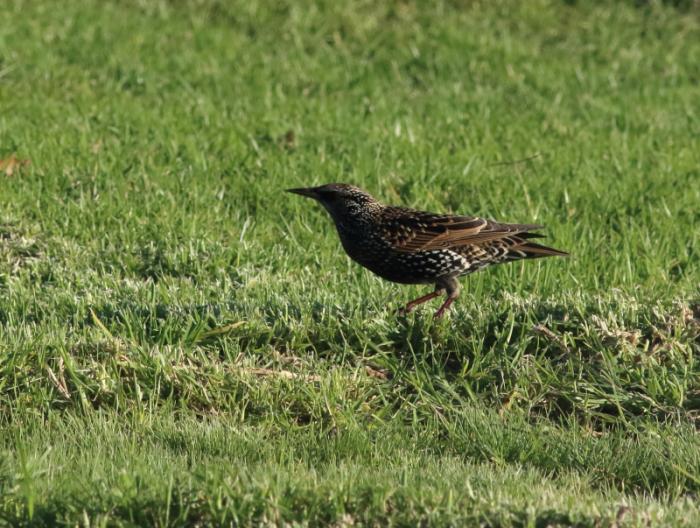
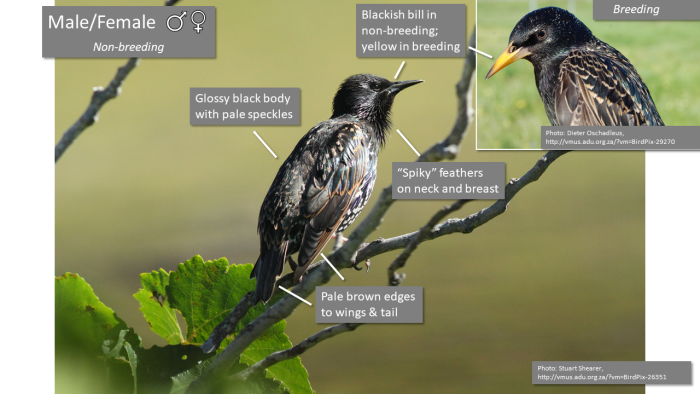
The Common (or European) Starling Sturnus vulgaris can be identified by its short tail, pointed head, triangular-shaped wings, and pale speckles on its wings and body. Common Starlings look black in colour, when seen at a distance, but at closer range they are glossy with a sheen of purple and green (this is known as iridescence). Adult birds have blackish bills when not breeding and yellow bills when breeding.

In the air, their flight is often fast and direct. On the ground they move about confidently, often at a run. They have quite a range of vocalizations.

Identification of adult Common Starling
Main photo: BirdPix 26351 – Stuart Shearer, Greyton, Western Cape, 05 February 2013. Inset photo: BirdPix 29270 – Dieter Oschadleus, Cape Town, Western Cape, 03 September 2016.

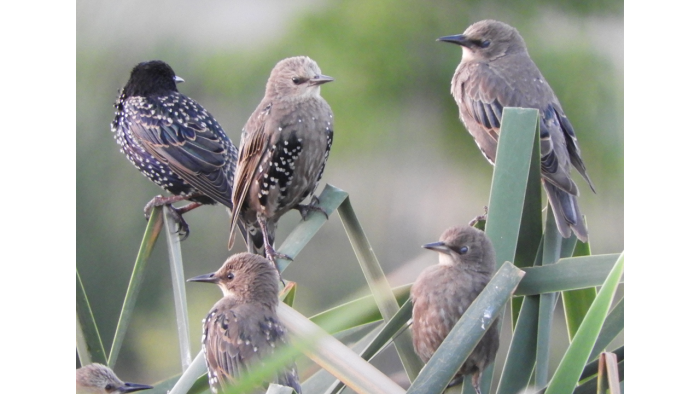
Juvenile birds are grey-brown in colour with speckling only appearing at about one year of age.

ID of juvenile Common Starling
Main photo: BirdPIx 7111 – Doug Harebottle, Cape Town, Western Cape, 23 March 2014. Inset photo: BirdPix 34230 – Dieter Oschadleus, Cape Town, Western Cape, 08 January 2017.

Habitat

In South Africa, they are mainly found in and around cities and towns. Their favoured habitats are grass lawns and sports fields where they often look for food, mainly invertebrates, by probing into the ground with their sharp bills.

Habitat for Sturnus vulgaris
Common Starling foraging on a lawn: BirdPix 54668 – C Meyer, Stellenbosch, Western Cape, 03 June 2018.

Distribution

Common Starlings are native to Eurasia, north Africa, and Japan, but were introduced to Australia, New Zealand, North America, Argentina, and South Africa. They are considered a serious agricultural pest, in some of these regions, but not so much in South Africa. They were introduced to Cape Town in 1897 by Cecil John Rhodes. The story of their range expansion is here.

They mainly occur in the southern half of South Africa, especially along the coastline, and they are by far most commonly found in urban and agricultural areas. Common Starlings are always closely associated with humans. They do well in urban areas.

Distribution map for Sturnis vulgaris from SABAP2
SABAP2 distribution map for Common Starling, downloaded 18 March 2022. Details for map interpretation can be found here.

There are recent observations of Common Starlings potentially increasing their range in Namibia too. You can read about it in Biodiversity Observations.

Behaviour

Common Starlings are gregarious and noisy birds. They are often found in pairs or small groups. Flock size is highly variable but they can form massive, noisy flocks (known as murmurations), especially near their roosting sites.

Noisy starlings
Noisy birds! Left photo: BirdPix 123222 – Gerald Gaigher, Jongensfontein, Western Cape, 01 August 2020. Right photo: BirdPix 5369 – Dawie De Swardt, Barkley East, Eastern Cape, 13 November 2013.
A flock of Common Starlings
Gregarious birds. BirdPix 155118 – Gerald Gaigher, Paarl, Western Cape, 05 February 2021

They mainly eat insects and other invertebrates which they supplement with fruit, seeds and nectar. Common Starlings do most of their foraging on the ground, plucking up food items or probing the soil for underground prey. 

They build an untidy nest in a natural or artificial cavity, during breeding season (September to December). They lay about four or five glossy, pale blue eggs, which take two weeks to hatch. The young remain in the nest for another three weeks before fledging.

Nest of Sturnus vulgaris
Common Starling eggs in a nest. Photo by Mike Richey

Further Resources

Species text from the first Southern African Bird Atlas Project (SABAP1), 1997.

Virtual Museum (BirdPix > Search VM > By Scientific or Common Name).

The story of its introduction to South Africa: Impacts of Rhodes on Biodiversity 3 : Common Starling

More common names: Europese Spreeu (Afrikaans); Étourneau Sansonnet (French); Star (German); Spreeuw (Dutch).

A list of bird species in this format is available here.

Recommended citation format: Loftie-Eaton M and Daniel KA 2022. Common Starling Sturnus vulgaris. Bird Feeder Project. Biodiversity and Development Institute. Available online at http://thebdi.org/2022/03/22/common-starling-sturnus-vulgaris/