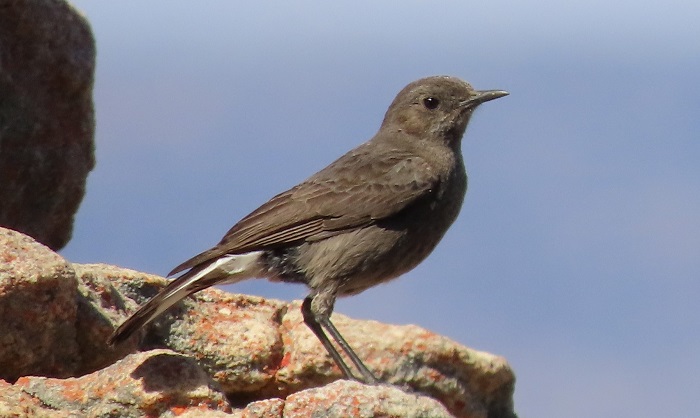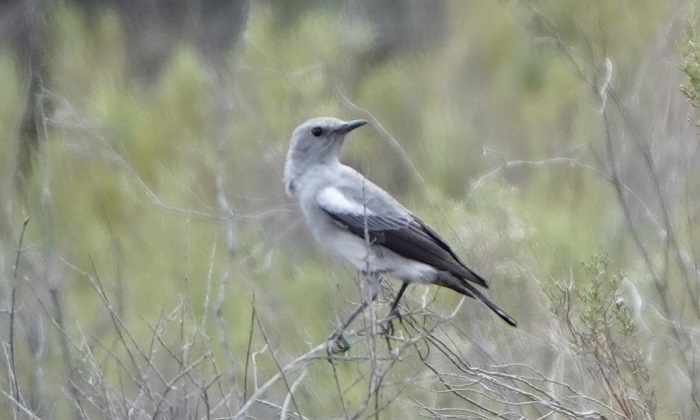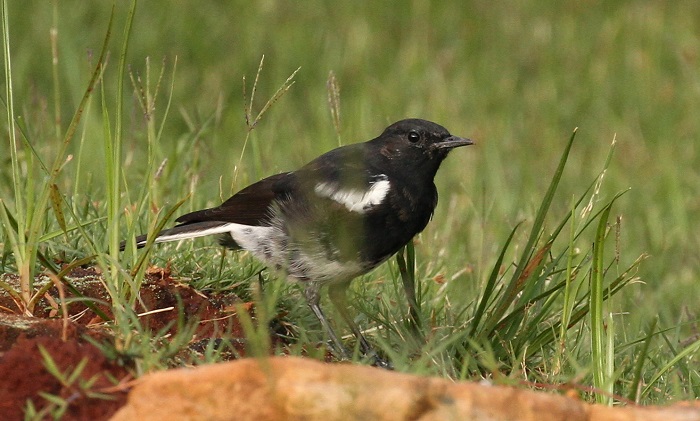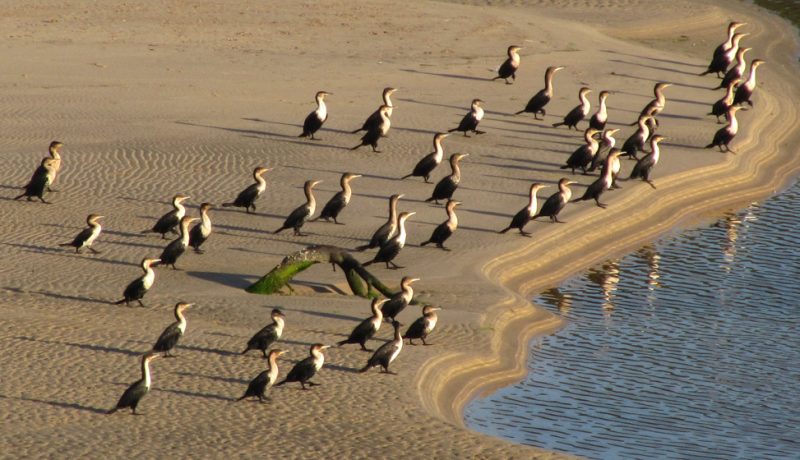
Capped Wheatear (Oenanthe pileata)

Cover image of Capped Wheatear by Sybrand Venter – Near Carnarvon, Northern Cape – BirdPix No. 219360

Identification

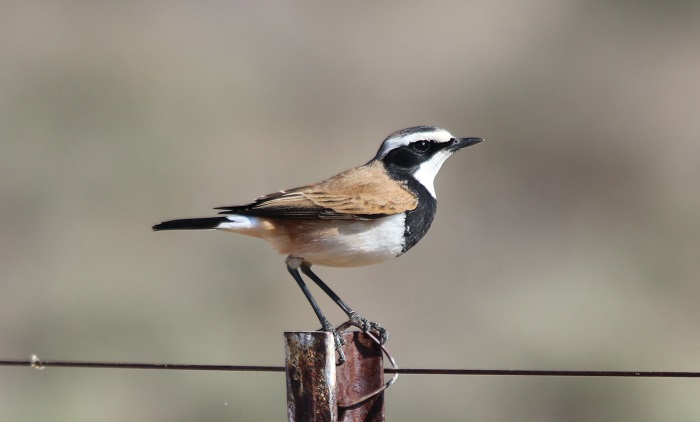
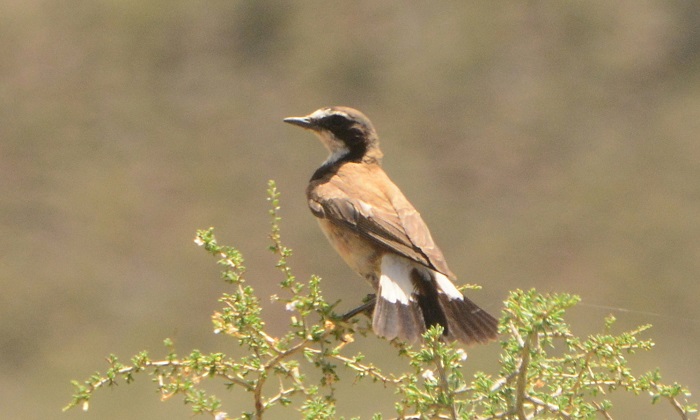
The Capped Wheatear is a strongly marked and attractive species.

The head and facial areas are boldly patterned. The white forehead, supercilium and throat are striking and contrast strongly with the black crown, face, sides of the neck and the broad black chest-band (diagnostic).

The upperparts are warm brown grading to a richer rufous brown on the rump. The underparts are white to cream with warm buffy flanks.

The sexes are alike.

Idenitification - Capped Wheatear
Capped Wheatear (Oenanthe pileata)
Near Vanrhynsdorp, Western Cape
Photo by Les Underhill

The Capped Wheatear is easily recognisable in flight. The combination of rich rufous rump and the black and white tail is distinctive.

Identification rear view Capeed Wheatear
Capped Wheatear (Oenanthe pileata)
Near Gouritz, Western Cape
Photo by Pamela Kleiman

Juveniles are dull brown above with whitish-buff spotting. The underparts are off-white to buff with darker brown mottling on the breast.

Juvenile Cappes Wheatear
Capped Wheatear (Oenanthe pileata) Juvenile
Near Graafwater, Western Cape
Photo by Zenobia van Dyk

Similar Species: Adults are unlikely to be mistaken for other species. Juveniles could be mistaken for those of various wheatears and chats but the diagnostic rump and tail pattern should help to alleviate confusion.

Status and Distribution

Overall the Capped Wheatear is a common species. They are resident in some areas and seasonal or erratically present in others. Their seasonal movements are not well understood but may be in response to food availability in arid areas.

SABAP2 distribution map for Capped Wheatear
SABAP2 distribution map for Capped Wheatear (Oenanthe pileata) – download in July 2023.
Details for map interpretation can be found here.

It occurs widely in Southern and East Africa, its range only extending north of the equator in Kenya. In Southern Africa it has a wide but discontinuous distribution. The species is only absent from the eastern lowlands of KwaZulu-Natal, eSwatini (Swaziland), southern Mozambique, the Drakensberg Mountains, Lesotho and the former Transkei in the Eastern Cape. The highest reporting rates come from the Kalahari and the winter rainfall region of the Western Cape province. It is also present in good numbers throughout the Karoo.

It is likely in some areas that the Capped Wheatear has benefitted from bush clearance for agriculture. It is not considered threatened.

Habitat

The Capped Wheatear inhabits dry grassy plains with bare or overgrazed patches, short or recently burnt grass and semi-arid shrublands across the Karoo. They are often found around stock pens and fallow and recently harvested croplands. Capped Wheatears have a preference for flat terrain.

Habitat for Capped Wheatear
Habitat – Near Near Vanrhynsdorp, Western Cape
Photo by Les Underhill

Its association with fynbos is largely secondary as a result of having adapted to tilled ground and wheat croplands.

Moves into arid habitats after rains but leaves again once dry conditions return.

Behaviour

Oenanthe pileata
Capped Wheatear (Oenanthe pileata)
Near Albertinia, Western Cape
Photo by Johan and Estelle van Rooyen

The Capped Wheatear is a conspicuous species owing to its habit of perching boldly in the open on bushes, fence posts, rocks or termite mounds. Has a typically upright posture when perched or looking about in between foraging. Flies low between perches. Upon landing it has a habit of bobbing its head and tail up and down while bowing its body.

They are usually encountered singly or in pairs but may also be found in family groups towards the end of the breeding season.

Most foraging takes place on the ground after flying down from its perch. The Capped Wheatear prefers to search for prey on bare or recently burnt ground. Mostly consumes arthropods like insects, spiders, centipedes and millipedes. They are especially fond of ants and termites and are also known to feed on small fruits and seeds.

Oenanthe pileata
Capped Wheatear (Oenanthe pileata)
Near Alberton, Gauteng
Photo by Lance Robinson

Capped Wheatears are monogamous and territorial. Pairs defend their territories against conspecifics as well as from other species such as the Karoo Chat (Emarginata schlegelii).

Breeding mostly takes place during Spring and early Summer, from September to December. Capped Wheatears are dependant on rodent burrows in which to nest. The nest is placed at the end of the burrow where it widens into a chamber. The nest is sometimes located as much as 2m underground but more usually at a depth of 50 to 100cm. Nest burrows are normally located on open ground. The nest is relatively large and cup-shaped. It is composed of grass, leaves and other fine plant material and lined with hair, feathers and other soft material.

Two to four eggs, or occasionally five are laid per clutch. The eggs are pale greenish-white or bluish-white and usually lack other markings. Further details regarding incubation and the nestling or fledgling periods are unrecorded.
Capped Wheatear
Capped Wheatear (Oenanthe pileata)
Carnarvon district, Northern Cape
Photo by Ryan Tippett

Further Resources

Species text adapted from the first Southern African Bird Atlas Project (SABAP1), 1997.

The use of photographs by Johan and Estelle van Rooyen, Lance Robinson, Les Underhill, Pamela Kleiman, Sybrand Venter and Zenobia van Dyk acknowledged.

Virtual Museum (BirdPix > Search VM > By Scientific or Common Name).

Paper in Biodiversity Observations on Capped Wheatears breeding in rodent burrows

Other common names: Hoëveldskaapwagter (Afrikaans); Inkotyeni, Isixaxabesha (Xhosa); Ntidi (Tswana); Traquet du Cap (French); Erdschmätzer (German); Aardtapuit (Dutch); Chasco-de-barrete (Portuguese)

List of bird species in this format is available here.

Recommended citation format: Tippett RM 2023. Capped Wheatear Oenanthe pileata. Biodiversity and Development Institute. Available online at http://thebdi.org/2023/07/17/capped-wheatear-oenanthe-pileata/

Bird identificationbirding

Oenanthe pileata
Capped Wheatear (Oenanthe pileata)
Sani Road, KwaZulu-Natal
Photo by Pamela Kleiman

BDI bird ringing courses and events : links to reports

BDI bird ringing courses and ringing events

This is a list of bird ringing courses and other ringing events with reports on the BDI website. The most recent event is at the top, and we work backwards to finish with the first report, on an event in December 2019, at the bottom. Future ringing courses and events are listed here.

2025

Bird ringing Open Day at Zandvlei, brunch at Marina da Gama : 20 December 2025

Bird ringing Open Day at Grotto Bay Private Nature Reserve : 29 November 2025

Environmental education through bird ringing at Nuwejaars Wetlands SMA : 2 to 7 November 2025

Bird ringing at Ouberg : 21 to 24 October 2025

Bird ringing at Nuwejaars Wetlands SMA : 19 to 23 September 2025

Bird ringing at Botuin, Vanrhynsdorp : 23 to 27 August 2025

Bird ringing at Nuwejaars Wetlands SMA : 9 to 14 August 2025

Bird ringing at Nuwejaars Wetlands SMA : 30 May to 4 June 2025

Bird ringing at Nuwejaars Wetlands SMA : 7 to 11 April 2025

Bird ringing at Botuin : 29 March to 4 April 2025

Bird ringing at Ouberg : 14 to 17 February 2025

Bird ringing at Alte Kalköfen Bird Observatory : 5 to 12 February 2025

Male Cape Weaver with the marie biscuit-coloured eye
Cape Weaver, ringed at Grotto Bay, 31 August 2024: Photo Suzette at Grotto Bay

2024

Bird ringing and brunch at Zandvlei : 21 December 2024

Bird ringing course 10 : Botuin, Vanrhynsdorp : 15 to 20 November 2024

Bird ringing at Nuwejaars Wetlands SMA : 7 to 12 October 2024

Bird ringing at Vondeling Wine Farm : 17 to 19 September 2024

Bird ringing course 9 : New Holme : 9 to 15 September 2024

Bird ringing at Grotto Bay : 31 August 2024

Bird ringing (and flowers) at Botuin : 4 to 7 August 2024

Bird ringing at Botuin : 2 to 5 June 2024

Bird ringing course 8 : Ouberg – 1 to 7 May 2024

Bird ringing course 7 : Botuin – 31 January to 6 February 2024

2023

Bird ringing course 6 : New Holme : 2 to 10 September 2023 – Part 1

Bird ringing course 6 : New Holme : 2 to 10 September 2023 – Part 2 – “rare is common and common is rare”

Bird ringing at Vondeling Wine Farm : 17 to 20 August 2023

Bird ringing at Vondeling Wine Farm : 3 to 6 August 2023

Bird ringing course 5 : Botuin : 28 June to 4 July 2023

Bird ringing at Vondeling Wine Farm : June 2023

Bird ringing at Botuin : Summary 2020 to 2023

Bird ringing at Grotto Bay : 27 May 2023

Bird ringing course 4 : Ouberg Nature Reserve : 10 to 16 May 2023

Bird ringing at Alte Kalköfen Bird Observatory : January to April 2023

Bird ringing at Vondeling Wine Farm : April 2023

The value of bird ringing to research and conservation

Bird ringing courses in South Africa

Bird ringing at Ouberg : 14 to 17 February 2023

Bird ringing course 3 : Botuin : 1 to 7 February 2023

Dieter Oschadleus leads the bird ringing events and courses
Dieter Oschadleus leads the majority of these bird ringing events. His main ornithological research interest is in the weavers. He is holding a Southern Masked Weaver

2022

Bird ringing course 2 : New Holme, Hanover : 30 October to 6 November 2022

Bird ringing course 2: Citizen science and birding in the Karoo : a visitor’s impressions

Bird ringing course 1 : New Holme, Hanover: 1 to 7 September 2022

2020

Bird ringing at Botuin, Vanrhynsdorp : January 2020

Colour ringing birds at Fynbos Estate

Ringing the Dark-backed Weaver

Bird ringing at Sonop farm, Paardeberg

2019

Establishing a long-term bird ringing site. Part 1: the place

Establishing a long-term bird ringing site. Part 2: some birds

Fynbos Estate bird ringing expedition : 3 to 12 December 2019

Bird ringing at New Holme, Hanover, in the Karoo : 10 to 12 November 2019

Boegoeberg Dam BioBash: Where Kalahari Meets Karoo : October 2019

Second Calvinia BioBash: Citizen Science in the Hantam : 12 to 17 June 2019

The BDI visits the Karoo Gariep Nature Reserve : May 2019

2018

Calvinia BioBash: Citizen Science in the Hantam : 8 to 12 November 2018

Bird ringing at Vondeling Wine Farm : 28 March 2018

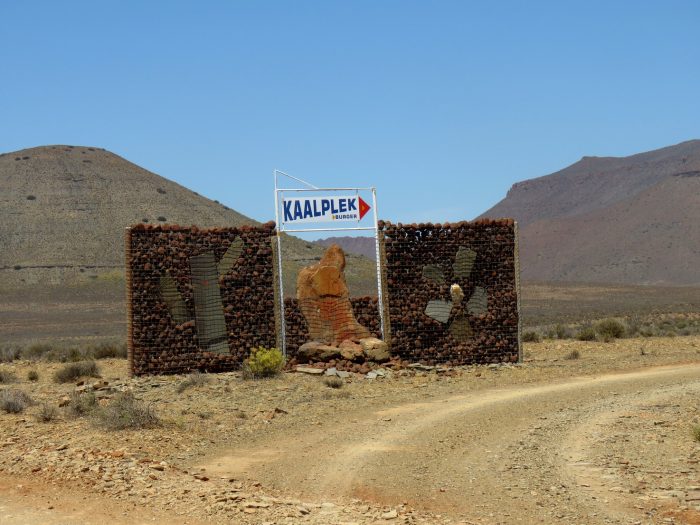
Calvinia BioBash: The entrance to the farm Kaalplek, “naked place”, i.e. almost no vegetation cover. A farm in the Hantam

Wrap!

Most of the bird ringing events have been led by Dieter Oschadleus. All the data collected is embedded in SAFRING, the South African Bird Ringing Unit. The value of bird ringing to our understanding of bird biology, and the contribution that bird ringing makes to conservation is described here.

A list of future bird ringing courses and events is maintained on the BDI website.

Mistsnets at Vondeling ... bird ringing courses and events
Mistnets near the interface between natural vegetation and agriculture at Vondeling Wine Estate

Crowned Lapwing (Vanellus coronatus)

Cover image of Crowned Lapwing by Pieter Cronje – Moreleta Kloof Nature Reserve, Gauteng – BirdPix No. 89394

Identification

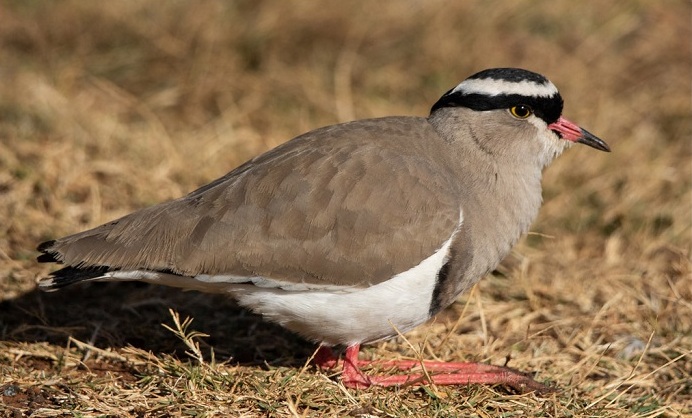
The Crowned Lapwing is a distinctively marked and conspicuous species. The black and white banded plumage on the head is diagnostic. The upperparts, neck and breast are plain sandy-brown. The belly, vent and undertail coverts are white, while the breast and belly are separated by a black band. The legs are bright pinkish red and the bill is red with a black tip.

Identification of Crowned Lapwing
Crowned Lapwing (Vanellus coronatus) – Near Cape Town, Western Cape
Photo by Gerald Wingate

In flight the primaries are black and contrast strongly with the white primary coverts and brown back.

The sexes are alike. Juveniles resemble the adults but have scalloped upperparts, buffy barring on the crown and yellowish, not red legs.

Juvenile Crowned Lapwing
A juvenile Crowned Lapwing (Vanellus coronatus) showing the buffy, scalloped plumage.
Mkhuze Game Reserve, KwaZulu-Natal
Photo by Colin Summersgill

Status and Distribution

The Crowned Lapwing is considered a common to very common resident and local migrant.

The distribution stretches from Ethiopia and Somalia south through East Africa to southern Angola and South Africa. It is found throughout southern Africa, but is mostly absent from the arid south-west of Namibia, and is scarce in the western parts of the Northern Cape, Lesotho, the former Transkei (Eastern Cape) and parts of southern Mozambique.

SABAP2 distribution map for Crowned Lapwing
SABAP2 distribution map for Crowned Lapwing (Vanellus coronatus) – June 2023. Details for map interpretation can be found here.

The core of its range lies in Botswana, North West Province, Gauteng and Free State, as well as the agricultural lands of the Western Cape.

The Crowned Lapwing is not threatened and has expanded its range as a result of human activities such as bush-clearing, overgrazing and allowing fields to lie fallow.

Habitat

Habitat Crowned Lapwing
Crowned Lapwing (Vanellus coronatus) – A pair in typical habitat with short grass and bare patches.
Pilanesberg National Park, North West
Photo by Phillip Nieuwoudt

Crowned Lapwings inhabit dry, open grassland, sparse woodland and open areas in Karoo scrub, favouring sites with short grass. It has adapted well to man-modified habitats, including short pastures, open fields, airports, golf courses, sports fields and roadsides. It is frequently attracted to burnt grasslands and normally avoids areas of tall grass. The Crowned Lapwing is not generally associated with water, but occurs in dry salt-marsh vegetation and around pans and usually avoids mountainous areas.

Behaviour

Vanellus coronatus
Crowned Lapwing (Vanellus coronatus) – Krugersdorp Municipal Nature Reserve, Gauteng
Photo by Lia Steen

The Crowned Lapwing is typically encountered in loose flocks of varying sizes but is found in pairs during the breeding season.

It is mostly a dry season visitor to regions of higher rainfall but it can remain year-round in dry years. It frequently undertakes local movements but neither the scale nor regularity of these movements is understood.

When feeling threatened, Crowned Lapwings will call whilst bobbing the body up and down. They stand in a hunched posture or sit on the ground when not foraging. Bathes by standing in water up to breast and using the wings to flap and splash water onto the body. Crowned Lapwings roost on the ground, usually in slightly elevated places.

Vanellus coronatus
Crowned Lapwing (Vanellus coronatus) – Rietvlei Nature Reserve, Gauteng
Photo by Neels Jackson

Forages by standing or walking slowly, while scanning for potential prey and then dashing in to peck at it in typical plover fashion.

Foraging groups often move in a regularly spaced line. They feed primarily on harvester termites. Other prey taken includes ants, beetles and small numbers of grasshoppers, spiders and millipedes. Also consumes earthworms after heavy rain showers.

Frequently associates or forages with other Lapwing species, most notably the Black-winged Lapwing (Vanellus melanopterus). The two species show few aggressive interactions and sometimes defend feeding territories together. This association is mutualistic in that both species benefit from from the interaction. The larger and more aggressive Crowned Lapwing helps to defend the less aggressive Black-winged Lapwing. The Black-winged Lapwing is the more alert and vigilant of the two and this allows the Crowned Lapwing to spend more time feeding.

Vanellus coronatus
Crowned Lapwing (Vanellus coronatus) – Bronkhorstspruit Nature Reserve, Gauteng
Photo by Phillip Nieuwoudt

Crowned Lapwings become largely inactive when temperatures rise above 24°C or fall below 10°C.

They are monogamous and only rarely polygynous. Crowned Lapwings are territorial and solitary nesters, but often breed in small, loose aggregations. Breeding in groups provides an advantage against predators through group mobbing and safety in numbers. Males defend small territories which they acquire by calling continuously from an elevated position and also during circular display flights around 50 m above the territory.

Crowned Lapwing
Crowned Lapwing (Vanellus coronatus) – Walter Sisulu Botanical Gardens, Gauteng
Photo by Lia Steen

The nest is a shallow scrape in the ground, lined with dried grass, roots, small stones and dried dung. Nests are often situated among large stones in order to disguise the shape of the incubating bird. The nest site is usually located within 10-20 m of shade, and is frequently reused in successive years.

Egg laying can occur at any time of the year with a peak from August to December, but is slightly earlier in the winter-rainfall regions of the Western Cape. The female lays 2 to 4 eggs per clutch. The eggs are yellowish-brown to olive-brown, boldly spotted with black and grey. The female usually lays a replacement clutch if the previous clutch fails and up to 6 clutches may be laid in a single season.

Incubation begins after the full clutch has been laid in cool conditions but starts after the first-laid egg during hot conditions. The incubation period lasts for around 30 days and the female is responsible for most of the incubation duties. Pairs will aggressively defend the nest site from threats including terrestrial and aerial predators as well as large herbivores that could trample the nest. Nest defence also includes false-brooding and other distraction displays to lure terrestrial predators away from the nest. The intensity of their nest defence grows as incubation progresses.

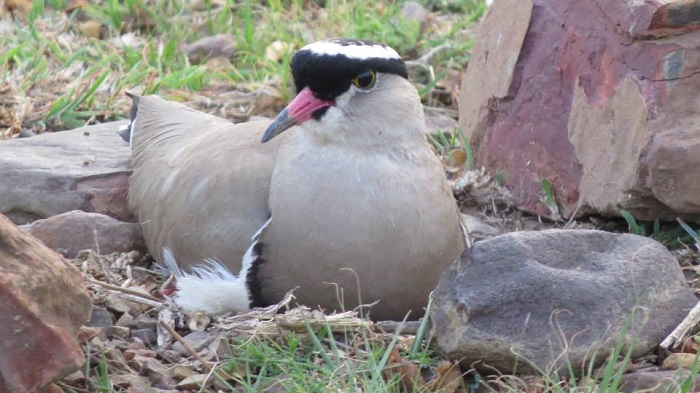
Incubating Crowned Lapwing
Crowned Lapwing (Vanellus coronatus) – An incubating bird at the nest.
Moreleta Kloof Nature Reserve, Gauteng
Photo by Pieter Cronje

Eggs hatch within a 4 to 6 hour period. The female removes broken eggshells, carrying them 20-30 m from the nest before breaking them up and discarding them. Newly hatched young are precocial and covered in down. They are speckled buff and black above with a black stripe down the back. Hatchlings remain at the nest for around 4 hours until their down has dried, after which they will then join and follow the parents. Chicks self-feed from their first day, but the adults still direct them to food items. The parents will defend the chicks vigorously through distraction displays and aerial mobbing, often almost striking intruders with trailing legs or wings.

The fledging period lasts for about 30 days but some chicks remain with the parents for almost a year, leaving before the start of the next breeding season. Fledglings from the first brood sometimes help with nest defence during the second breeding attempt.

Vanellus coronatus
Crowned Lapwing (Vanellus coronatus) – Albert Falls Nature Reserve, KwaZulu-Natal
Photo by Colin Summersgill

Further Resources

Species text from the first Southern African Bird Atlas Project (SABAP1), 1997.

The use of photographs by Colin Summersgill, Gerald Wingate, Karis Daniel, Lia Steen, Neels Jackson, Phillip Nieuwoudt and Pieter Cronje is acknowledged.

Virtual Museum (BirdPix > Search VM > By Scientific or Common Name).

Other common names: Kroonkiewiet (Afrikaans); iHoye (Zulu); lgxiya (Xhosa); Nghelekele (Tswana); Diadeemkievit (Dutch); Vanneau couronné (French); Kronenkiebitz (German); Abibe-coroado (Portuguese)

A list of bird species in this format is available here.

Recommended citation format: Tippett RM 2023. Crowned Lapwing Vanellus coronatus. Biodiversity and Development Institute. Available online at http://thebdi.org/2023/07/07/crowned-lapwing-vanellus-coronatus/

Bird identificationbirding

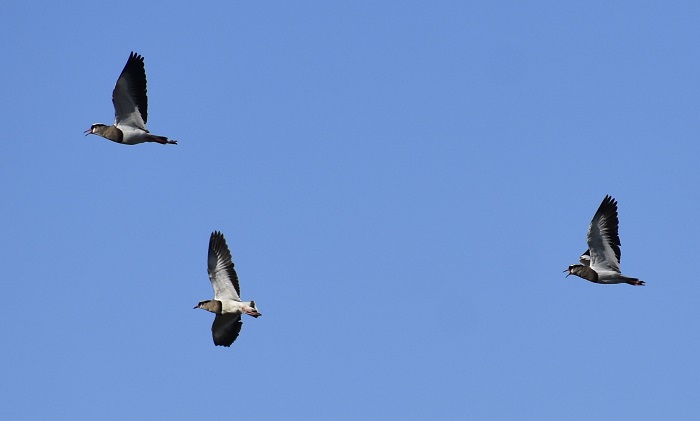
Crowned Lapwing in flight
Crowned Lapwing (Vanellus coronatus) – Near Baardskeerdersbos, Western Cape
Photo by Karis Daniel

Bird ringing course at Botuin : 28 June to 4 July 2023

Although mid winter, we had a great bird ringing course at Botuin, in Vanrhynsdorp. The days were shorter and colder, and the migrants had left (except for one! see below). Two trainees with no previous experience did very well getting started on their ringing training adventure.

Bird ringing course at Botuin
Ringing training on the go!

Very unexpectedly a Eurasian Golden Oriole was found in a net at Botuin near a fig tree. This oriole is a migrant species, breeding in the northern hemisphere. The bird we caught was an immature bird that was overwintering in South Africa. Trevor Hardaker comments: “Eurasian Golden Oriole turns up annually in the Western Cape and I saw them at Somerset West and Mamre earlier this year. They have also been seen at several places on the Garden Route this past summer. I don’t know of any records from Vanrhynsdorp though, but they have previously been recorded as far north as Citrusdal. As far as I recall, this record is the northernmost on the West Coast”. This is the first time a Eurasian Golden Oriole has been ringed in the Western Cape.

Weavers and sparrows

As usual weavers and sparrows were the most ringed species, with more Laughing Doves caught than usual. One male Cape Weaver had started nest building in the large Prosopis tree in the Botuin garden, but most breeding activity was in the next door garden and at the sewage works. Several females had brood patches. A few juveniles were also ringed, suggesting that these birds had been breeding for the last few weeks.

A few Southern Masked Weaver males were in near full breeding plumage and 3 females had brood patches. Southern Red Bishops showed no brood patches, but one male was completing his moult into breeding plumage. Several recently fledged Cape Sparrows were also ringed – the gape flanges were distinct.

Southenr Red Bishop getting into breeding plumage at the bird ringing course at Botuin
Southern Red Bishop – male with last vestiges of non-breeding plumage

Laughing Doves

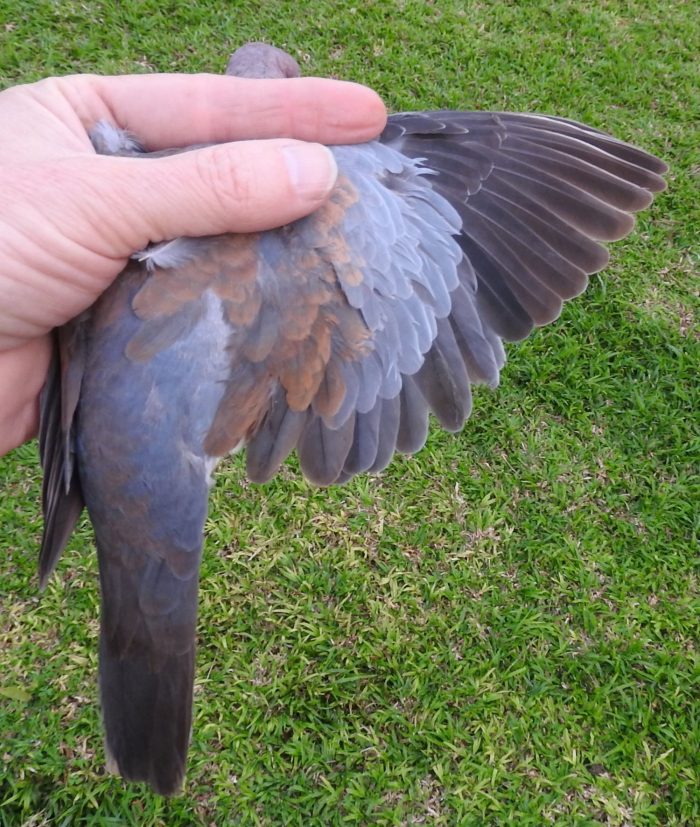
We had a larger mesh net up in the area that they scattered to when disturbed from the seed in the driveway – we only discovered this on the second last day! So next time these doves may be at the top of the list. Some of the doves were showing primary moult.

Laughing Dove in moult
Laughing Dove with the first primary newly replaced (black) and the outer nine primaries older (dark brown)

Sewage works

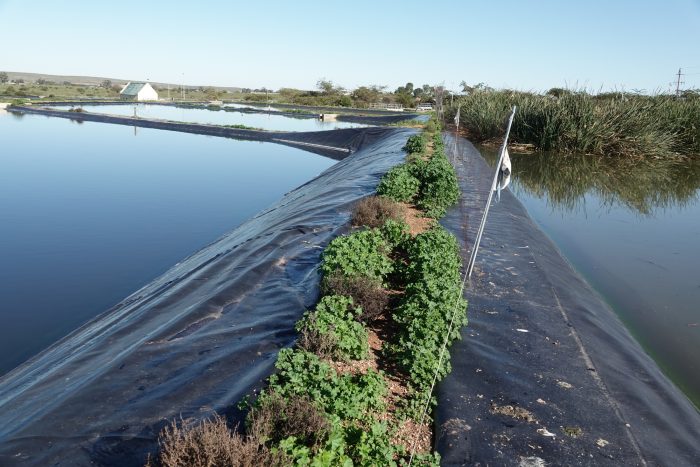
The Vanrhynsdorp Sewage Works is about a kilometre out of town. It consists of a series of plastic lined pans. By the time the “water” reaches them it has been through the main processing stages! We have special permission to ring here. We put mistnets up along the dividing walls between pans. One of the pans has a substantial reedbed, used both as a roost and as a breeding colony by Cape Weavers and Southern Masked Weavers. About half the birds we handled were weavers.

Vanrynsdorp Sewage Works
The neatly maintained Vanrhynsdorp Sewage Works. Mistnets along the dividing walls target species moving between pans

There was a roving flock of starlings at the sewage works, and we caught a few African Pied and Wattled Starlings. There was a variety of ducks at the sewage ponds, but we did not catch any this time. However, two adult moorhens that flushed into the nets were exciting catches. A Three-banded Plover was also great to catch and ring.

Moorhen at the sewage works during the bird ringing course at Botuin
The brightly coloured beak of the Moorhen contrasts with its black body plumage. Note the large legs and long slender toes, in comparison with the size of the bird

Karoo birds

We spent one morning in nearby karoo veld. It gave us a chance to get close up to the block of rock that defines Vanrhynsdorp. The !Khoi name for the mountain is Maskam, “the mountain that gives water”. It is most widely known as the Gifberg, because this is the only place in the world where the Gifboom Hyaenanche globosa grows.

In spite of the very long line of mistnets, the catch, as expected, was low. But we come here because the site offers some great birds that cannot be caught anywhere else. This time it delivered two Sickle-winged Chats. Until you have the bird in the hand, and have a chance to inspect the outermost primary, the motivation for the name is a mystery! Look at the shape of the primary with the arrow in the photo below:

Sickle-winged chat mistnetted during the bird ringing course at Botuin
Sickle-winged Chat – outer primary indicated by arrow; note also the rump pattern differs from the similar Familiar Chat

Recaptures

We ringed 202 birds and caught 49 birds with rings, giving a high recapture rate of nearly 20%. All recaptures had been ringed at the same site (except some Cape Weavers) and within the last three years, when ringing at Botuin first started (see blog).

Four Cape Weavers (two males and two females) had been ringed at Botuin previously and were recaptured at the sewage works, presumably to breed here. The distance is only 1.5 km as the weaver flies, but no other ringed species seems to have traversed this distance.

The district had had the most amazing rainfall in the weeks before the course. The countryside was uncharacteristically green. The upcoming flower season in Namaqualand will be spectacular. It will also be early. The photo below was taken on 3 July …

The Namaqualand wild flowers will be magnificent this spring

.. and the spring flowers had already started … over the next couple of weeks, this scene will morph into a carpet of colour. And all the birds will be breeding!

THANKS, Salome. for hosting us so well at Botuin! This was our second bird ringing course at Botuin; the blog on the first one, in February this year. is here. That course had two interns from the Global Training Programme of the Basque Country, Spain … in exchange for learning skills in bird ringing, they gave us the skills to make Spanish omelettes:

Salome, Spanish omelettes, and some red wine at the end of a superb day’s ringing!

Since 2019, we have done increasingly regular ringing at Botuin. Here is a summary. This course brought the ringing total to almost one thousand birds. Continuing ringing here will soon enable us to estimate survival rates for at least the most commonly caught species. Estimating survival is one of the values of bird ringing.

For more ringing courses and other opportunities, go to Events on the BDI website! Do join us on a future event. There will be another bird ringing course at Botuin early in 2024.

Total catch at three sites in Vanrhynsdorp, 28 June-4 July 2023

Sp noSpeciesBotuinSewageGifbergTotal
210Common Moorhen2 2
238Three-banded Plover1 1
317Laughing Dove221 23
391White-backed Mousebird42 6
506Rock Martin3 3
519Eurasian Golden Oriole11
544African Red-eyed Bulbul15116
566Karoo Chat 11
570Familiar Chat11
572Sickle-winged Chat 22
581Cape Robin-chat22
583Karoo Scrub Robin2125
604Lesser Swamp Warbler 55
646Levaillant’s Cisticola112
653Namaqua Warbler22
665Fiscal Flycatcher22
678Fairy Flycatcher11
707Southern Fiscal33
735Wattled Starling33
746Pied Starling33
784House Sparrow516
786Cape Sparrow35237
799Cape Weaver193958
803Southern Masked Weaver72532
808Southern Red Bishop268
843Common Waxbill1010
873Cape Bunting11
1104Karoo Thrush (split)77
1172Cape White-eye88
Total152927251

Blacksmith Lapwing (Vanellus armatus)

Cover image by Sybrand Venter – Carnarvon district, Northern Cape – BirdPix No. 233365

Identification

The Blacksmith Lapwing is a boldly marked and unmistakable species. The distinctive black, white and grey colouration combined with its loud and bold behaviour make it a conspicuous bird wherever it occurs.

The sexes are alike.

Blacksmith Lapwing (Vanellus armatus) – Near Jongensfontein, Western Cape
Photo by Gerald Gaigher

In flight the black flight feathers contrast strongly with the grey wing coverts.

Blacksmith Lapwing (Vanellus armatus) – Robben Island, Western Cape
Photo by Itxaso Quintana

Juveniles are duller and mottled brown and black above. They are also mottled blackish-brown and grey on parts where the adults are coloured in black.

Juvenile Blacksmith Lapwing (Vanellus armatus) 
Near Vryheid, KwaZulu-Natal
Photo by Lappies Labuschagne

Status and Distribution

The Blacksmith Lapwing has an African range, breeding from Kenya and Angola southwards. It occurs over most of Southern Africa. The distribution is fragmented in northeastern Zimbabwe, the Namib Desert and the Northern Cape Province.h are also conspicuous gaps in the distribution in Lesotho, the Transkei and the most arid parts of the Kalahari in Botswana.

The Blacksmith Lapwing is not threatened. The species underwent a dramatic population and range increase during the 1900s.

SABAP2 distribution map for Blacksmith Lapwing (Vanellus armatus) – June 2023. Details for map interpretation can be found here.

Habitat

The Blacksmith Lapwing is an inhabitant of marshes, moist, short grasslands and the shores of dams, pans, lakes, rivers and estuaries. It also inhabits areas of mown grass such as sports fields, golf courses and airports. It feeds on grasslands, both natural and irrigated. Due to its reliance on moist habitats it does not enter desert, forest or mountainous habitats, except where artificial wetlands or grasslands occur.

Typical habitat near Manguzi, KwaZulu-Natal
Photo by Ryan Tippett

Behaviour

The Blacksmith Lapwing is usually encountered singly, in pairs or small groups. However, non-breeding birds may gather in daytime roosts of up to 500 in exposed and safe places such as sandspits or islands. They are alert and noisy, especially when breeding. Typically among the first species, alongside the Black-winged Stilt, to detect an intruder. Once a potential threat is spotted they begin bobbing and calling from ground, they will then fly aggressively over the intruder while calling loudly and persistently, until the threat has been seen off.

Blacksmith Lapwing (Vanellus armatus) – Rhorick, KwaZulu-Natal
Photo by Pamela Kleiman
They are aggressive towards other birds particularly during the breeding season when they chase many other species such as Black-winged Stilts and other waders, gulls, herons, crows, starlings and raptors. Performs aggressive threat displays on the ground that are intended to intimidate and startle an enemy, for example, holding the spread wings forwards, to repel attacks from birds of prey.

The Blacksmith Lapwing has a broad diet that includes many small aquatic and terrestrial invertebrates like molluscs, crustaceans, worms and insects.

Blacksmith Lapwing (Vanellus armatus) – Near Riversdale, Western Cape
Photo by Johan and Estelle van Rooyen

Searches for food by standing or walking slowly while scanning for potential prey before dashing in to peck at it. Most foraging takes place at or near the waters edge but occasionally wades into deeper water, picking prey from the water surface. Inspects dung for insect larvae, flicking over cowpats with its bill. Also forages among kelp debris washed up along the coast.

Blacksmith Lapwings are monogamous, but may be polygynous on rare occasions. The breeding pair are are strongly territorial and defend a nesting territory of at least 3.6ha from predators, intruders and rivals.

Nest sites are usually close to water or in seasonally flooded areas. The Nest is a shallow scrape on the ground that is usually lined with vegetation and then ringed with stones for disguise. In very wet sites, the nest is a more substantial mound of vegetation in order to raise the eggs off the damp ground. They do not re-use the same nest site. Breeding can take place year-round, but seasonal peaks vary from region to region.

Clutch size ranges from 1 to 4 eggs (usually 3 or 4). The eggs are dark yellow-red to brownish-yellow and boldly blotched and spotted in black and grey. Incubation commences once the full clutch has been laid. Both sexes share the incubation duties which can last up to 33 days.


Blacksmith Lapwing (Vanellus armatus) eggs are are laid in a shallow depression and are well camouflaged .
Carnarvon district, Northern Cape
Photo by Ryan Tippett

Hatching is fairly synchronous and the newly hatched chicks are precocial, leaving the nest within hours of hatching. They are very attentive parents and both parents take turns guarding the chicks while the other is away foraging. Chicks initially remain near the nest but gradually begin to wander further afield as they grow. The parents remain vigilant throughout, and warn the chicks at the first hint of danger. Once the parents sound the alarm the chicks crouch and freeze until the threat has passed. The adults may also attempt to lead a predator away with distraction displays.

Fledglings remain with the adults during the incubation of a second brood, and are only driven away when that next brood hatches.

Blacksmith Lapwing (Vanellus armatus)
Fountain Hill Nature Reserve, KwaZulu-Natal
Photo by Colin Summersgill

Further Resources

Species text from the first Southern African Bird Atlas Project (SABAP1), 1997.

The use of photographs by Colin Summersgill, Gerald Gaigher, Itxaso Quintana, Johan and Estelle van Rooyen, Lappies Labuschagne, Pamela Kleiman and Sybrand Venter is acknowledged.

Virtual Museum (BirdPix > Search VM > By Scientific or Common Name).

Other common names: Bontkiewiet (Afrikaans); Ndudumela (Zulu); Comela-khwatsi (Tswana); Smidsplevier (Dutch); Vanneau armé (French); Waffenkiebitz, Schmiedekiebitz (German); Abibe-preto-e-branco (Portuguese)

A list of bird species in this format is available here.

Recommended citation format: Tippett RM 2023. Blacksmith Lapwing Vanellus armatus. Biodiversity and Development Institute. Available online at http://thebdi.org/2023/06/28/blacksmith-lapwing-vanellus-armatus/

Bird identificationbirding

Blacksmith Lapwing (Vanellus armatus) – Addo Elephant National Park, Eastern Cape
Photo by Zenobia van Dyk

Mountain Chat (Oenanthe monticola)

Cover image of Mountain Chat by Gerald Wingate – Britannica Bay, Western Cape.

Identification

The Mountain Chat or Mountain Wheatear is a handsome and conspicuous bird. They are polymorphic, meaning that the males are found in two differing colour forms. Males can be either grey or black, and with or without white shoulder patches and grey or white crowns. Black form males are slightly more common, accounting for some 54% of the population, while grey birds make up the remaining 46% of males.

Identification of Mountain Wheatear
Mountain Chat (Oenanthe monticola)
Rooiklip Farm, Namibia
Photo by Johan and Estelle van Rooyen

Black morph: The overall colouration is jet black. The crown, forehead and nape can be white, black, dark ash-grey or pale grey. The upper tail coverts and rump are white and the tail is black with white outer feathers (diagnostic). The shoulder patch may be absent or strikingly white. The belly is most often black but can be white or mottled white and grey. The flight feathers are dark brownish-black. The bill, legs and feet are black and the eyes are dark brown.

Grey morph: The entire body and underwings are ash-grey. The upper tail coverts and rump are white and the tail is black with white outer tail feathers (diagnostic). The white shoulder patch is variable in size and in some males may be absent all together. The crown is normally ash-grey but can sometimes be white. Underparts are pale ash-grey and the belly too can occasionally be pure white. The under tail may be black, white or grey. The flight feathers are dark brownish-black. The bill, legs and feet are black and the eyes are dark brown.

Grey morph Mountain Wheatear
A grey morph male of the Mountain Chat (Oenanthe monticola)
Bushmanskloof, Western Cape
Photo by Zenobia Van Dyk

Females and juveniles are more uniform in their appearance and are entirely sooty brownish-black but share the black and white rump and tail pattern of the males.

Female Mountain Wheatear
A female Mountain Chat (Oenanthe monticola) showing the conspicuous tail pattern.
Bushmanskloof, Western Cape
Photo by Zenobia Van Dyk

Similar species: Black males are most easily mistaken for Arnot’s Chat (Myrmecocichla arnoti) but that species has an all black rump and tail. Additionally, the ranges of the two species are not known to overlap and they both occupy very different habitats.

Confusion is perhaps most likely between female/juvenile Mountain Chats and the Ant-eating Chat (Myrmecocichla formicivora). Both species co-occur over a wide area, but they have different habitat preferences. The Ant-eating Chat is smaller and shorter-tailed with a dark rump and tail and conspicuous white panels in the wings.

The Karoo Chat (Emarginata schlegelii) may also be mistaken for the grey morph Mountain Chat but the Karoo Chat is smaller and has a grey not white rump.

Status and Distribution

The Mountain Chat is a common resident but may move locally in response to food availability in arid areas. It is near-endemic to Southern Africa and extends from south-western Angola along the western and central parts of Namibia into South Africa where it is widespread across the interior. The Mountain Chat is essentially absent from the Kalahari and the Lowveld, as well as the eastern and southern coastlines in South Africa.

Major historical changes in distribution are unlikely. Its preferred habitat remains relatively secure and the species is under no immediate threat.

In the Transkei region of the Eastern Cape, the Mountain Chat appears to have benefitted from acute overgrazing. This has led to the formation of deep and extensive erosion gullies providing suitable habitat for this species.

SABAP2 distribution map Mouintain Wheatear
SABAP2 distribution map for Mountain Chat (Oenanthe monticola) – download in May 2023.
Details for map interpretation can be found here.

Habitat

The Mountain Chat inhabits rugged mountain slopes, rocky hills and outcrops, valley slopes, erosion gullies, quarries and also boulder-strewn flat terrain. Vegetation in its habitat ranges from arid Karoo scrub to grassland. The Mountain Chat generally avoids woodland. It will utilise human habitations such as houses and farmyards where these occur close to suitable natural habitat.

Habitat for Mountain Wheatear
Habitat – Near Carnarvon, Northern Cape
Photo by Ryan Tippett

Behaviour

Oenanthe monticola
Mountain Chat (Oenanthe monticola)
Graafwater, Western Cape
Photo by Gerald Wingate

Mountain Chats are usually found singly, in pairs or small family groups. Flies low from perch to perch and moves restlessly over rocks with long hops. It usually perches conspicuously on boulders, rocks, termite mounds, trees, or buildings. The Mountain Chat becomes tame, yet remains wary in and around human settlements.

Forages on the ground and on rocks and captures prey by pecking items from the substrate or after a short dash. Also drops onto prey from a perch or hawks insects in flight, frequently returning to the same perch. The Mountain Chat eats mainly invertebrates such as spiders, solifuges, millipedes, centipedes, grasshoppers, termites, ants, flies, bugs, and beetles. They are also known to consume some small fruits and seeds.

Oenanthe monticola
Mountain Chat (Oenanthe monticola)
Spitzkoppe Nature Reserve, Namibia
Photo by Johan and Estelle van Rooyen

Mountain Chats are monogamous birds that nest solitarily. They are also territorial and defend the nest area against conspecifics, other chats, Fiscal Flycatcher (Melaenornis silens), and the Southern Fiscal (Lanius collaris).

The nest is a neat, shallow cup lined with hair, wool or the plumes of fluffy seeds. The nest is built on a messy foundation of debris that can include twigs, grass, trapdoor spider nest entrances and other spider webs, assorted insect larval and pupal cases, bark, dried moss, bits of dung, snake skins and small stones etc. A nest site is selected under a hillside boulder, a cavity in a rock, wall or building, or almost any suitable space around farmyards or abandoned buildings. Nests are built entirely by the female. Successful nest sites are frequently used in successive years and breeding is opportunistic after rain in arid areas.

2-4 (usually 3) eggs are laid per clutch and all incubation is performed by the female only. The female will leave the nest at times to forage and the males presence near the nest increases as incubation progresses. He is most attentive just before hatching, when he becomes very protective, chasing conspecifics and any other black-and-white bird species.

Newly hatched young are fed a diet of insects and their larvae, by both parents. Mountain Chats often raise two or three broods per season, and some broods are parasitised by Diderick Cuckoo (Chrysococcyx caprius).

Oenanthe monticola
Mountain Chat (Oenanthe monticola)
Near Matjiesfontein, Western Cape
Photo by Itxaso Quintana

Further Resources

Species text adapted from the first Southern African Bird Atlas Project (SABAP1), 1997.

The use of photographs by Itxaso Quintana, Johan and Estelle van Rooyen, Gerald Wingate, Pieter La Grange and Zenobia van Dyk is acknowledged.

Other common names: Mountain Wheatear (Alt. English); Bergwagter (Afrikaans); Khaloli (South Sotho); Traquet montagnard (French); Bergschmätzer (German); Bergtapuit (Dutch); Chasco-montês (Portuguese)

A list of bird species in this format is available here.

Recommended citation format: Tippett, R.M. 2023. Mountain Chat Oenanthe monticola. Biodiversity and Development Institute. Available online at https://thebdi.org/2023/06/22/mountain-chat-oenanthe-monticola/

Bird identificationbirding

Capped Wheatear
Mountain Chat (Oenanthe monticola)
Heidelberg, Gauteng
Photo by Pieter La Grange

White-breasted Cormorant (Phalocrocorax lucidus)

Identification

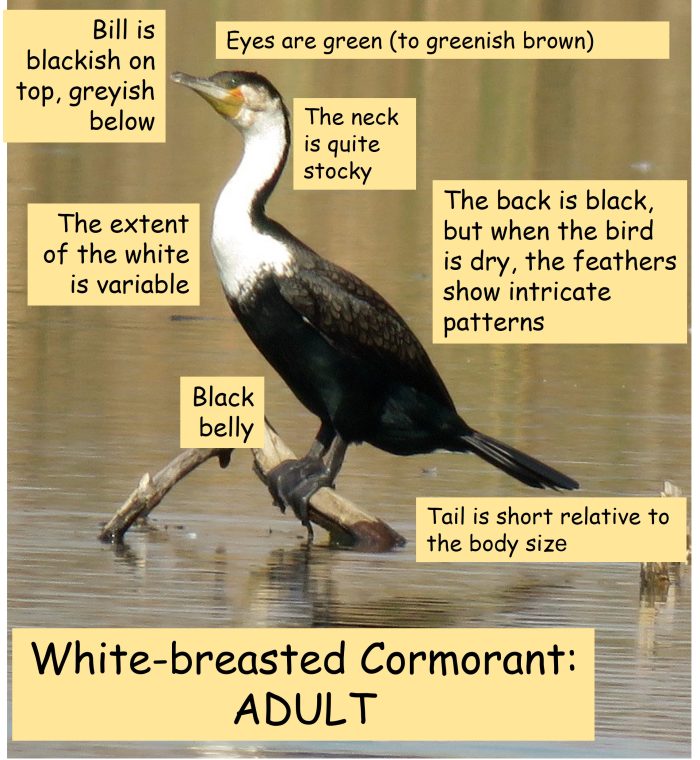
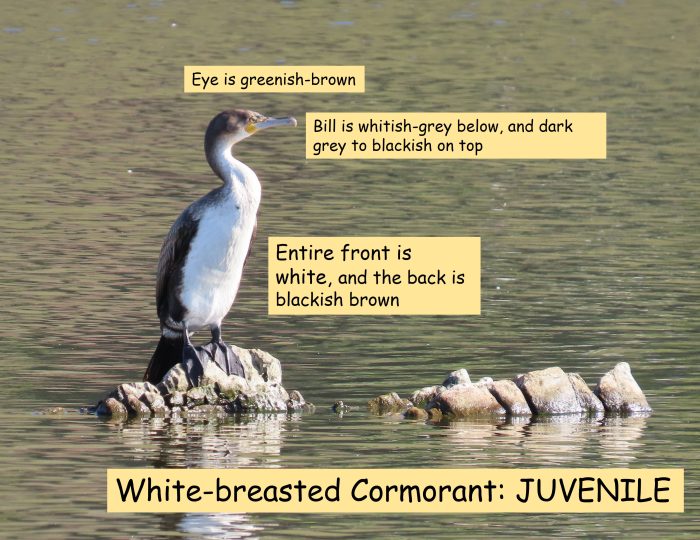
In theory, the White-breasted Cormorant is an easy species to identify (but there are imposters, see later). In adults the top half of the front is white, in immatures the front is entirely white (see the two images below). In adults, the amount of white is variable, and so is the detail of the yellow/orange markings on the head. This also varies with stage of breeding; the colours are more intense while breeding than outside the breeding season. Males and females have the same plumage, with males averaging larger than females.

Adult White-breasted Cormorant identification
Kevin Lavery, Gauteng. BirdPix 170031
Juvenile White-breasted Cormorant identification
Johan and Estelle van Rooyen, Vermont Salt Pan, Western Cape, BirdPix 247548

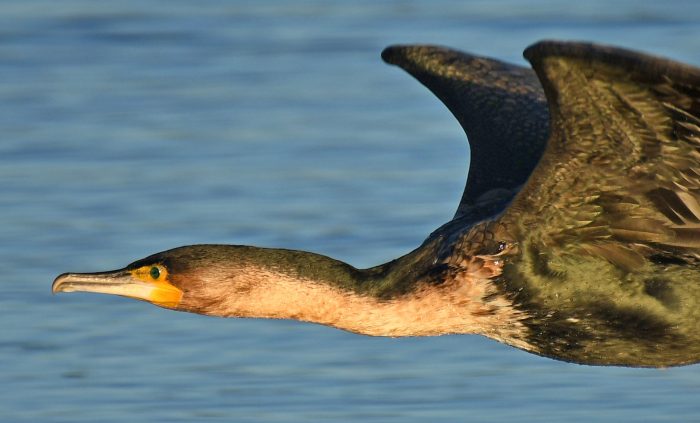
This head and shoulders photo shows the detail of the structure of the face and neck. This particular bird could be called the white-necked cormorant; the white “breast” does not extend to the breast. This photo also illustrates the green sheen of the apparently black body feathers, something seldom seen.

White-breasted Cormorant in flight
Head and shoulders of a White-breasted Cormorant in flight. Sewage Works, Stilbaai, Western Cape.
Derek Oosthuizen. BirdPix 123538

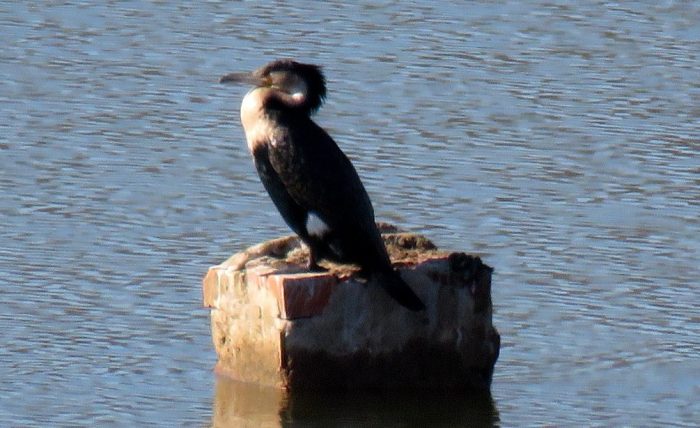
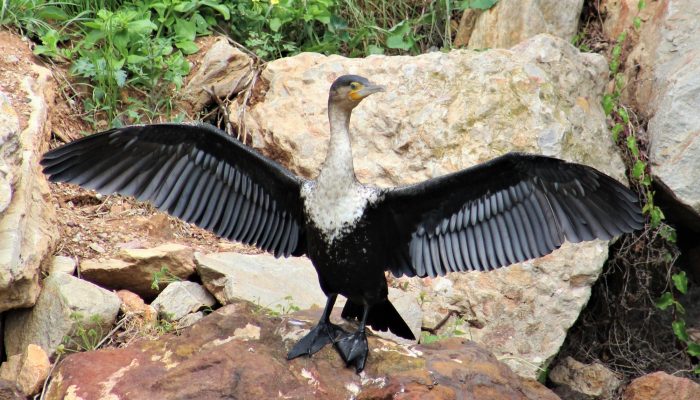
The fieldguides tend to illustrate White-breasted Cormorants with their white thigh patches on display, as in the photo below. In reality these are seldom visible; out of more than one thousand photographic records in the Virtual Museum, there were only a handful in which the white thigh patches could be seen.

White-breasted Cormorant with white thigh patch
White-breasted Cormorant with white thigh patch. Farm dam, Robertson, Western Cape
Les Underhill BirdPix 56881

Confusing species

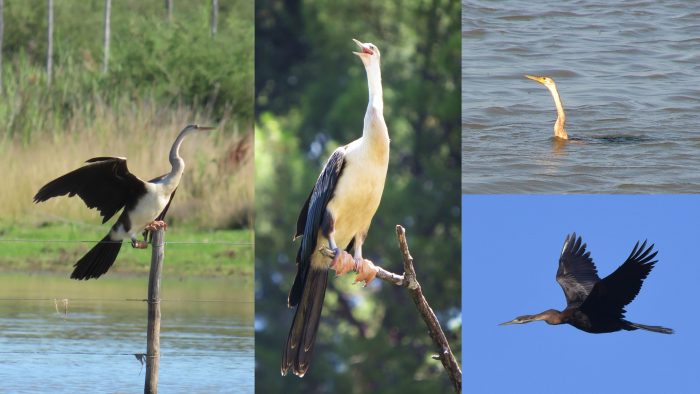
The African Darter Anhinga rufa and two of southern Africa’s other four cormorant species are sometimes sufficiently “white-breasted” that they can be identified as White-breasted Cormorants by the unwary birder! The two confusable cormorants are Reed Cormorant Microcarbo africanus and Crowned Cormorant M. coronatus. Juvenile Cape Cormorant Phalacrocorax capensis are sometimes a pale brown in front, and Bank Cormorants P. neglectus are never white in front.

We look at the African Darter first:

African Darters doing White-breasted Cormorant imitations
Three “white-breasted” African Darters, and a normal African Darter with a dark front (bottom right).
Left: New Holme Dam, Northern Cape, Jon Blanco, BirdPix 214771; centre: Grootfontein, Eastern Cape, Tino Hershelman, BirdPix 48320; top right: David Kennedy, Berg River estuary BirdPix 7446;
bottom right: Vanschoorsdrift, Western Cape, Gerald Wingate, BirdPix 192923

The three photos of African Darters with white fronts are juveniles. Not all juveniles are as white as these, but the front is always a pale shade of brown. The key distinction is the neck. The darter has a long thin neck; the neck of the White-breasted Cormorant is, by comparison, short and stocky. This difference between the species is conspicuous in flight too; the African Darter is a walking stick with wings attached.

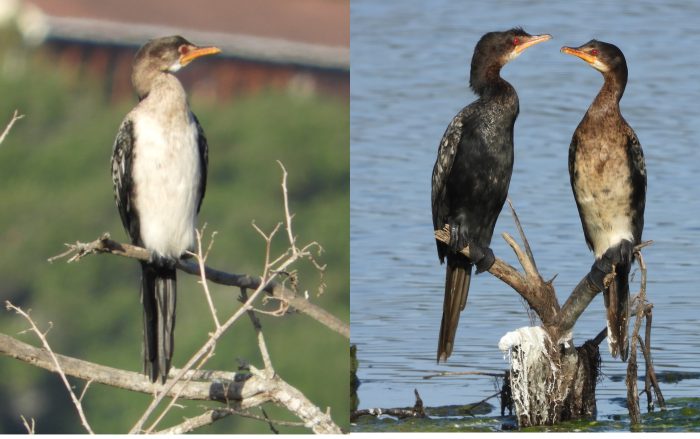
Reed Cormorants. Juvenile with very white front (left), adult with black front (centre-right), and a bird in transition, moulting into adult plumage (right). Left: Sedgefield, Western Cape, Gerald Gaigher, BirdPix 219198; right: AD Reis, Grootbrak, Western Cape BirdPix 215963

Young Reed Cormorants also sometimes have completely white breasts, but this is variable. They are substantially smaller than White-breasted Cormorants, but at a distance it is non-trivial to gauge relative sizes. The tail of the Reed Cormorant is relatively much longer than that of White-breasted. If you are close enough and the light is good, then look at the eyes! Reed Cormorants have reddish eyes, brownish in juveniles, and White-breasted Cormorants have blue eyes in the breeding season, and green eyes out of it, but the juveniles also have brownish eyes. These eye colour are surprisingly conspicuous, even at quite long distances. Another useful diagnostic feature is the bill, somewhere between yellowish and yellow in Reed Cormorants, and somewhere between along the continuum whitish via blueish to blackish in the White-breasted Cormorant!

Crowned Cormorants. Young with palish front (left) and adult (right)
Left: Yzerfontein, Western Cape, Fanie Rautenbach, BirdPix 3667; right: Blaauberg, WC, Les Underhill, BirdPix 183328

Along the coastline, the only potential confusion is with young Crowned Cormorants. But these have brownish fronts, and are never really white. Crowned Cormorants have relatively longer tails than White-breasted Cormorants. The eyes are shades between red and brown.

Habitat

If a place has enough water for it to swim and dive in, then White-breasted Cormorant is a possibility. It is equally at home in seawater as in freshwater, the only cormorant in southern Africa to have both coastal and freshwater populations.

In the interior it occurs at dams of all sizes, from farm dam to large reservoirs, at sewage works and along rivers and streams. On the coast, in occurs on both sandy and rocky shorelines, but seldom far from land.

Distribution

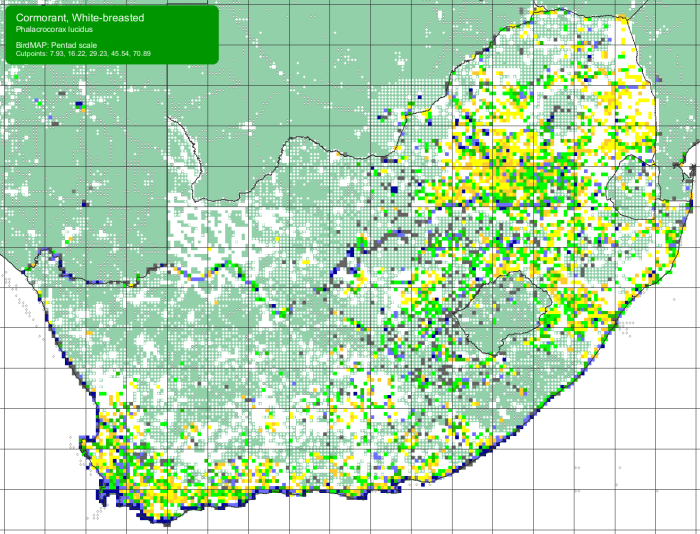
The primary message from this distribution map from the bird atlas is that White-breasted Cormorants occur both on the coastline and in the interior. Of the five cormorant species in South Africa, this is the only one to be equally at home in seawater and freshwater.

SABAP2 distribution map for the White-breasted Cormorant
SABAP2 distribution map for White-breasted Cormorant, downloaded 21 April 2023. Details for map interpretation can be found here.

For the interior of South Africa, this distribution map from the bird atlas is effectively a map of the distribution of wetlands. The single most striking thing about this map is how it traces out the route of the Orange River through the otherwise arid Northern Cape. The Vaal River is also clearly defined. The rest of the distribution across the interior defines the regions where wetlands, either natural (such as pans) or artificial (such as farm dams, reservoirs, sewage works) occur. Likewise, it demonstrates where wetlands are rare: the Karoo, Kalahari, and parts of the Eastern Cape and KwaZulu-Natal, etc).

The distribution map shows that the entire coastline of South Africa is occupied by White-breasted Cormorants. The coastal distribution continues northwards in Africa to about Angola in the west coast and Tanzania on the east coast.

Behaviour

Most seabirds have water-repellent feathers, so that when they dive their plumage traps air, which becomes a layer of insulation between the warm-blooded bird and the cold water. Cormorants, including White-breasted, get wet in water. On the one hand this means that, compared to other seabirds, they are less buoyant, they can dive deeper and they can swim faster. This gives them an edge in catching their prey, mostly fish. On the other hand, their plumage gets waterlogged and they get cold. So the most characteristic behaviour of cormorants is to stand, preferably in the sun, with wings outstretched, to get dry and warm.

White-breasted Cormorant drying! Voorbaai, Mossel Bay, Western Cape, Andrew Middleton, BirdPix 62352

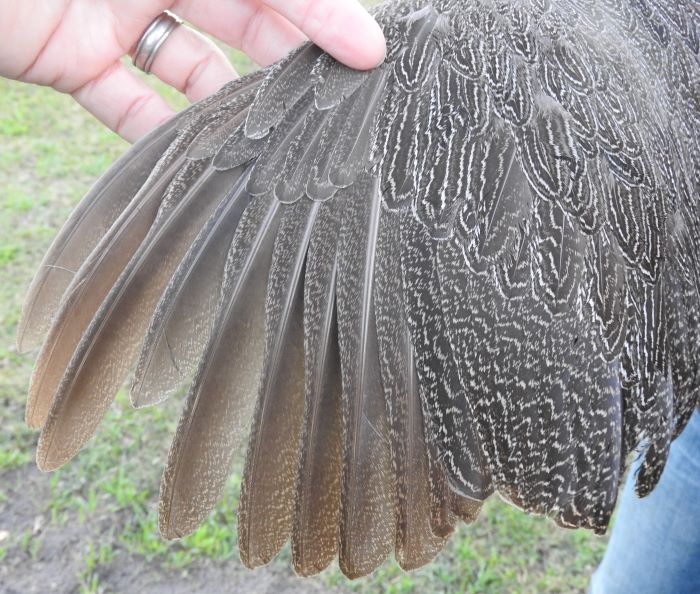
This White-breasted Cormorant is holding out its wings to get dry and warm. This activity is called wing-spreading, and it is done after every bout of feeding. Most birds have a total of 19 wing feathers; cormorants are exceptional and have more than 30!

Breeding

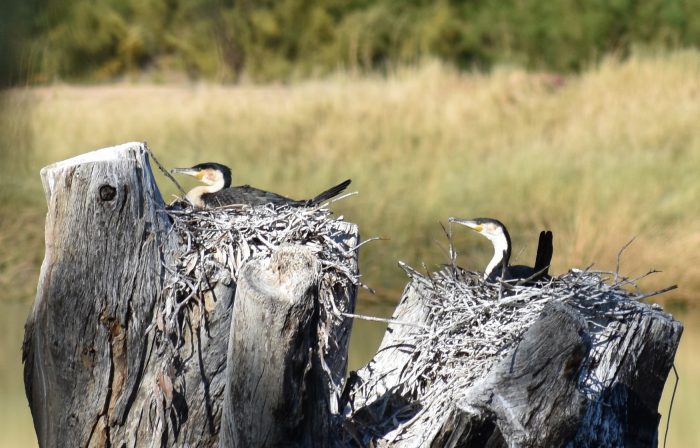
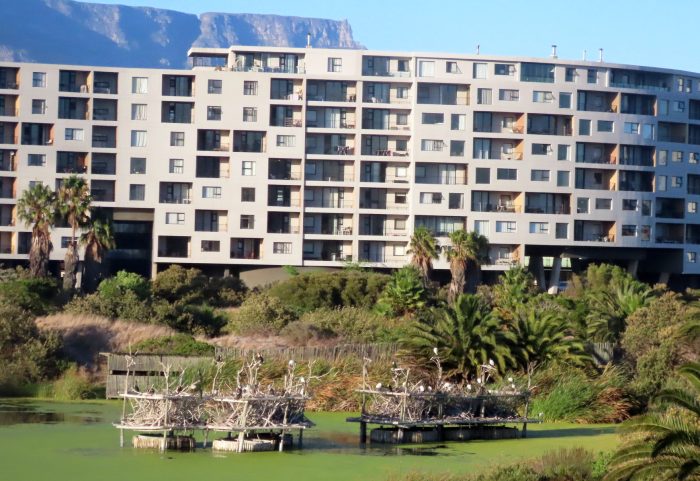
Nest sites have one thing in common. They aim to find places where there is safety from predation. White-breasted Cormorants usually breed in colonies, often with other species of waterbirds. On the coastline it breeds on ledges on cliffs, on offshore rock stacks, on islands and wrecks. Inland breeding sites are usually trees, and often dead tree skeletons left standing in dams long after the dam has filled with water. They breed on platforms, custom-built for the purpose. A selection of breeding sites is illustrated below.

White-breasted Cormorants breeding on cut off trees
Breeding on tree stumps in farm dam north of Citrusdal, Western Cape. Karis Daniel, BirdPix 164578
White-breasted Cormorants, Edith Stevens Wetland Park
Breeding in alien tree at Edith Stevens Wetland Park, Cape Town, Western Cape.
Dieter Oschadleus, BirdPix 35785
Shipwreck, Port Nolloth, breeding White-breasted Cormorants
Breeding on a wrecked ship north of Port Nolloth, Northern Cape. Louise Geldenhuys, BirdPix 165146
White-breasted Cormorant, Intaka Island, Century City. Breeding platform
Breeding on specially constructed platforms, Intaka Island, Century City, Western Cape.
Les Underhill, BirdPix 254631

Predator free breeding sites are in short supply, so suitable places are quickly adopted: some are created by accident, such as shipwrecks, and some are created by design, such as breeding platforms.

Further resources: A selection of papers

More common names: Witborsduiker (Afrikaans), Cormoran à poitrine blanche (French), Weißbrustkormoran (German), Corvo-marinho-de-faces-brancas (Portuguese), Cormorán grande (Spanish), Afrikaanse Aalscholver (Dutch).

Photographic acknowledgements: The photographs in this identification guide are from the BDI Virtual Museum. The photographers continue to own the copyright on these images.

Recommended citation format: Underhill LG 2023. White-breasted Cormorant Phalacrocorax lucidus. Biodiversity and Development Institute. Available online at http://thebdi.org/2023/06/18/white-breasted-cormorant-phalocrocorax-lucidus/

List of bird species in this format is available here.

Tractrac Chat (Emarginata tractrac)

Cover image of Tractrac Chat by Gregg Darling – Spitzkoppe, Namibia – BirdPix No. 13744

Identification

The Tractrac Chat is a small, pale coloured species with an upright stance and longish legs. Appears long-billed and short-tailed in the field. The bill, legs and feet are black and the sexes are alike.

It is a somewhat variable species with five recognised races across its range. Birds from Namibia are very pale and can appear almost pure white, while birds from the south of its range in the Karoo are typically darker with browner, more buffy plumage.

Darker form of the Tractrac Chat (Emarginata tractrac) from the central Karoo.
Carnarvon district, Northern Cape
Photographs by Sybrand Venter and Ryan Tippett (inset)

The upperparts vary in colour from almost white (Namib) through pale grey-brown to sandy-brown (central Karoo). The ear coverts are slightly darker than the rest of the upperparts. The flight feathers in the folded wings have pale whitish to buff edges. Underparts are mostly whitish but may be grey-white with sandy-buff flanks in the central Karoo. By far the most important distinguishing feature is the colouration and patterning of the rump and tail. The Tractrac Chat has a white to off-white rump and tail base with a broad, black wedge-shaped marking on the lower tail. This is diagnostic and most easily observed in flight.

Juveniles resemble the adults but are spotted with buff above and have dusky mottling below.

White Namibian form of the Tractrac Chat (Emarginata tractrac)
Near Swakopmund, Namibia
Photo by Gerald Wingate

In South Africa the Tractrac Chat is most easily mistaken for the Sickle-winged Chat (Emarginata sinuata). The two can bear a close resemblance, especially from distance. They are best told apart by the colouration of the rump and upper tail which are white or off-white in the Tractrac Chat and pale rufous in the Sickle-winged Chat. Both species show a black triangle or wedge-shaped marking on the lower tail.

The near-white Namibian birds are most likely to be confused with the Karoo Chat (Emarginata schlegelli) but that species has a longer tail and all-black central tail feathers (Note that Karoo Chats in Namibia are also markedly paler than their South African counterparts and have cream-white to buff rumps).

Tractrac Chat (Emarginata tractrac) showing the diagnostic tail markings.
Carnarvon district, Northern Cape
Photo by Ryan Tippett

Status and Distribution

The Tractrac Chat is a common resident. It is, however, known to be locally nomadic due to unpredictable rainfall in the arid regions it inhabits.

It is near-endemic to Southern Africa, ranging from south-western Angola through western and southern Namibia to the central Karoo in South Africa where it is most widespread. The Tractrac Chat’s major population concentration is centred on Bushmanland in the Northern Cape province. There is a distinct, narrow extension of its range in the south-west that follows the arid corridor of the Tanqua Karoo.

The Tractrac Chat is not threatened, but influenced by land use as it is rare in heavily grazed Karoo shrublands.

SABAP2 distribution map for Tractrac Chat (Emarginata tractrac) – download in June 2023.
Details for map interpretation can be found here.

Habitat

Typical habitat with sparse, low bushes and open bare patches.
Near Carnarvon, Northern Cape
Photo by Ryan Tippett

The Tractrac Chat inhabits arid areas with flat, open plains and sparse scrub, low bushes and plenty of bare ground. Favoured habitats include gravel plains, sandy flats, sparse stony grassland, dry dwarf shrublands and low dunes with scant vegetation. It is not generally found in broken terrain. It is often the most conspicuous bird species in such desolate habitats.

Normally avoids human habitation in South Africa but may associate with buildings in the true desert regions of Namibia.

Tractrac Chat (Emarginata tractrac)
Near Eksteensfontein, Northern Cape
Photo by Johan and Estelle van Rooyen

Behaviour

The Tractrac Chat is usually encountered singly or in pairs, and rarely in family groups. Perches on top of low bushes, stones or fence posts. It is known to defend its foraging and nesting area against rivals and also from Karoo Chats. It may occasionally flick its wings and raise the tail, but less deliberately than the Sickle-winged or Familiar chat (Oenanthe familiaris). Hovers briefly before dropping down to perch or ground when alarmed, otherwise tame and inquisitive.

Forages mainly on the ground, including on gravel roads, where it scavenges road-killed insects. Feeds primarily on insects and other invertebrates such as flies, beetles, termites, ants, plant hoppers, spiders and snails.

Tractrac Chat (Emarginata tractrac) juvenile
Carnarvon district, Northern Cape
Photo by Ryan Tippett

The Tractrac Chat is a monogamous and solitary nester. The nest is a neat, deep cup lined with fluffy seeds, and set on a foundation of dry twigs. Nests are placed on the ground under a shrub or againtst a stone or rock. The nest is not reused, but several old nests may be clustered within in the vicinity. Egg laying dates vary according to rainfall but is mainly during September and October. 2-3 eggs are laid per clutch and incubation is discontinuous and performed by both sexes. The duration of the incubation period is unrecorded. The newly hatched young are rufous coloured, with long, dark grey down on dark feather tracts. The fledging period lasts around 18 days.

Tractrac Chat (Emarginata tractrac)
Carnarvon district, Northern Cape
Photo by Sybrand Venter

Further Resources

Species text adapted from the first Southern African Bird Atlas Project (SABAP1), 1997.

The use of photographs by Gerald Wingate, Gregg Darling, Johan and Estelle van Rooyen and Sybrand Venter is acknowledged.

Virtual Museum (BirdPix > Search VM > By Scientific or Common Name).

Other common names: Woestynspekvreter (Afrikaans); Traquet tractrac (French); Namibschmätzer (German); Woestijn-spekvreter (Dutch); Chasco-pálido (Portuguese)

Recommended citation format: Tippett RM 2023. Tractrac Chat Emarginata tractrac. Biodiversity and Development Institute. Available online at http://thebdi.org/2023/06/12/tractrac-chat-emarginata-tractrac/

List of bird species in this format is available here.

Bird identificationbirding

Bird Ringing at Vondeling Wine Farm, June 2023

We had a few excellent days of bird ringing at Vondeling Wine Farm, from 8 to 11 June. We occupied two comfortable cottages, recently transformed into visitor accommodation. The farm is on the eastern edge of the Paardeberg, and the closest large town is Wellington. Our previous ringing visit was in April, and is summarized here.

We are still exploring the enormous potential at Vondeling for long-term bird studies, and we have only scratched the surface of the available opportunities. We chose new sites for our mistnets on this trip. Some of the senior staff of the farm live in neighbouring cottages, so there is lots of bird activity on the “werf”. Putting seed on the ground quickly brought weavers and sparrows into a nearby net.

Vondeling Wine Farm, Paardeberg
Yellow-billed Ducks flying over Vondeling Wine Farm. Our cottages are in the “werf” under the grove of oaks and pines in the foreground. The vineyards, where the peafowl feed, have just lost their autumn colours as we head into winter. On the slope above the vineyard is an olive grove. The backdrop is the fynbos-covered Paardeberg, a big granite dome. There is a track to the top! (The ducks are in the BirdPix section of the Virtual Museum, record 256506)

The farm nestles up against the edge of the Paardeberg, so there are opportunities to do studies of fynbos birds. Mistnets on the slopes just above the vineyards produced a Cape Grassbird, five Bar-throated Apalis, and an interesting variety of other species.

In addition to some regular mist-netting, we also tried catching birds in special nets with a larger mesh … …

… … Indian Peafowl

At least 60 Indian Peafowl Pavo cristatus live ferally at Vondeling. The Vondeling peafowl were already present when the farm changed ownership three decades ago. Because they have not been fed or looked after in any way during this entire period, they are considered feral. Studies of introduced species in their new location are rare. For example, there is not a single full-length scientific paper on the other species famously introduced from India, the Common Myna Acridotheres tristis! So this represents another interesting opportunity.

We tried herding some peafowl into the large mesh nets on three occasions and caught one female, and had several close catches. We are learning! They roost in a small grove, consisting mostly of large oak trees, pine trees and other exotics. In the early morning the peafowl fly directly out from the trees to the vineyards where they forage during the day, so this makes catching in the morning unlikely. In the evening they walk back to the trees slowly and then fly up into the trees to roost. However, their slow and cautious walk results in them spotting the nets, and simply walking around them. If they are disturbed they simply go back to the vineyards or fly up. But we will be back and try again!

The bird we caught was ringed, measured and weighed, the first to be ringed in southern Africa, and probably a first for Africa. The weight was 2.5kg!

… … Spotted Eagle Owl

Both Spotted Eagle Owl and Barn Owl were heard at Vondeling. An adult Spotted Eagle Owl was caught in one of the large mesh nets early one morning. The owl weighed 760g.

Woodpeckers

Both Cardinal and Olive Woodpeckers are recorded at Vondeling. A female Olive Woodpecker was caught, a species I have never ringed before! Several Cardinal Woodpeckers have been ringed at Fynbos Estate, a farm diagonally over the Paardeberg from Vondeling. Cardinal Woodpecker is the most commonly ringed woodpecker in southern Africa (904 ringed), while the total for Olive is only 178 after this bird.

To join a future ringing event, see here.

Birds ringed at Vondeling, 8 to 11 June 2023

The species with links have texts with photos on the website of the Biodiversity and Development Institute.

Species
number
CountEnglish
3161Ring-necked Dove
3681Spotted Eagle Owl
3912White-backed Mousebird
4521Olive Woodpecker
5815Cape Robin-chat
6181Cape Grassbird
6225Bar-throated Apalis
6653Fiscal Flycatcher
7072Common Fiscal
7091Southern Boubou
7846House Sparrow
7861Cape Sparrow
7998Cape Weaver
80318Southern Masked Weaver
8101Yellow Bishop
8671Streaky-headed Seedeater
10211Indian Peafowl
11724Cape White-eye
41391Karoo Prinia


Bird ringing at Botuin: summary 2020 to 2023

This blog is a summary of bird ringing at Botuin, Vanrhynsdrop. Over our first three bird ringing visits to Botuin, we have caught 748 birds of 57 species! Botuin is situated on the outskirts of Vanrhynsdorp and accessible with a normal car. Compared with the surrounding countryside, it is a bit of an oasis and has an amazing variety of birds. There are resident Namaqua Warblers, Karoo Scrub Robins, Fiscal Flycatchers, sparrows and weavers, and other species in the garden area. Some other special birds caught here include European Bee-eater, Pearl-breasted Swallow and Red-headed Finch. We never know which species will surprise us next!

Karoo Scrub-Robin caught during bird ringing at Botuin
Karoo Scrub-Robin


Not far away are the sewage works where we have caught a variety of waterbirds in special nets, including Cape Teal, Common Moorhen and several wader species. In future we will also try other trapping methods here.

Cape Teal ringed at the Vanrhynsdorp Sewage Works
Cape Teal caught at sewage works


In the nearby karoo veld we have caught four lark species, Rufous-eared Warblers, various canaries, and other species. The ringing rate is slower here, but worth it for the exciting birds we catch. And while waiting for birds, we enjoy the amazing Karoo scenery, and walk around to birdwatch.

Spike-heeled Lark during bird ringing at Botuin
Spike-heeled Lark

Blogs about the visits summarized here: 23-26 Jan 2020, 27 Nov-1 Dec 2021, 1-7 Feb 2023 [blog].

Birds caught at Botuin during three visits from 2020 to 2023

Sp noCountEnglish
982Cape Teal
2101Common Moorhen
2371Kittlitz’s Plover
2384Three-banded Plover
2454Blacksmith Lapwing
2534Little Stint
31730Laughing Dove
31811Namaqua Dove
39113White-backed Mousebird
39217Red-faced Mousebird
40410European Bee-eater
4181African Hoopoe
4632Large-billed Lark
4742Spike-heeled Lark
4856Grey-backed Sparrow-lark
4882Red-capped Lark
4954White-throated Swallow
4983Pearl-breasted Swallow
5061Rock Martin
5092Brown-throated Martin
5251Southern Grey Tit
54410African Red-eyed Bulbul
5702Familiar Chat
5761African Stonechat
5816Cape Robin-chat
58311Karoo Scrub Robin
6045Lesser Swamp Warbler
6069African Reed Warbler
6192Rufous-eared Warbler
6462Levaillant’s Cisticola
6536Namaqua Warbler
6584Chestnut-vented Warbler
66510Fiscal Flycatcher
6784Fairy Flycatcher
6869Cape Wagtail
7073Southern Fiscal
7221Bokmakierie
7331Common Starling
7451Red-winged Starling
7609Southern Double-collared Sunbird
78427House Sparrow
786144Cape Sparrow
79995Cape Weaver
80379Southern Masked Weaver
8051Red-billed Quelea
80864Southern Red Bishop
8202Red-headed Finch
8434Common Waxbill
86518White-throated Canary
8662Yellow Canary
8671Streaky-headed Canary
8716Lark-like Bunting
8734Cape Bunting
11041Karoo Thrush
117274Cape White-eye
41396Karoo Prinia
41423Southern Greyheaded Sparrow