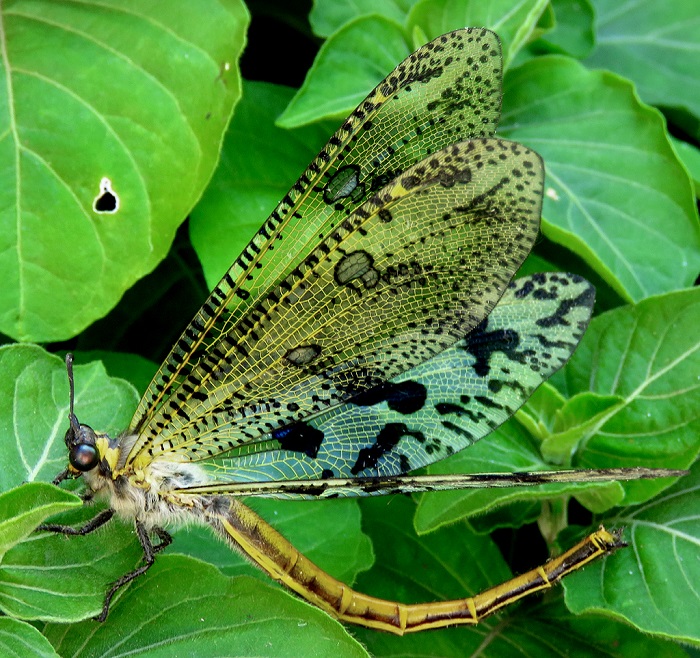
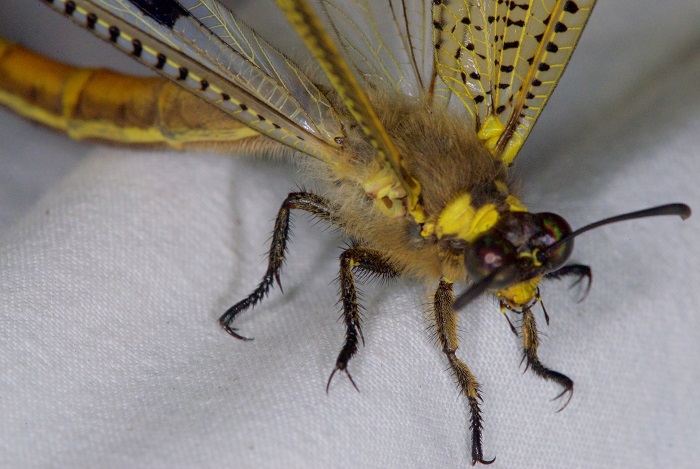
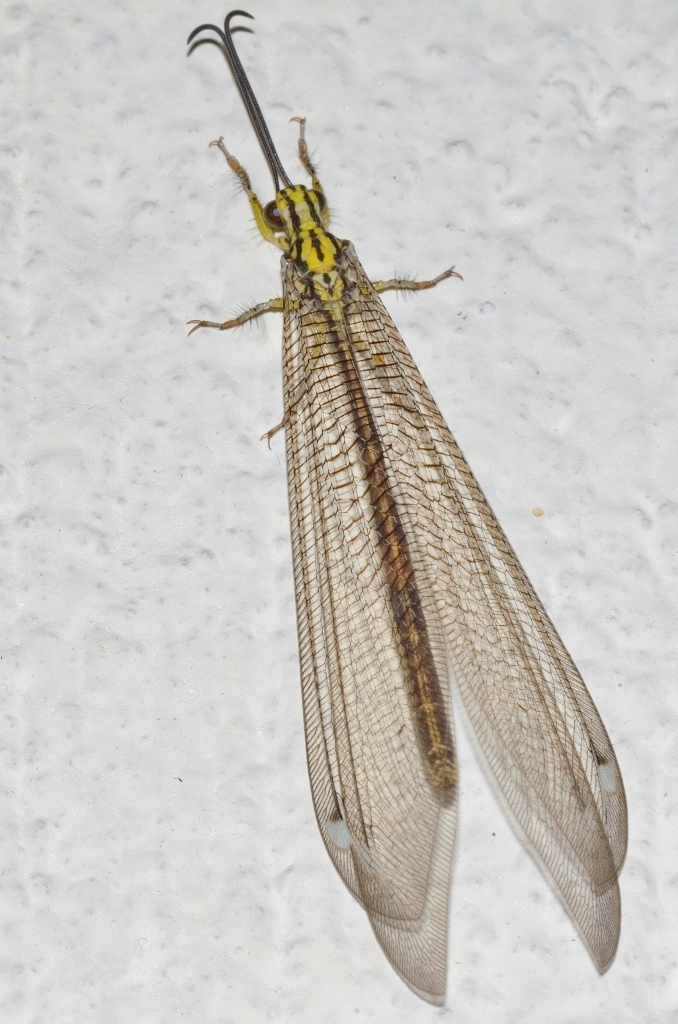
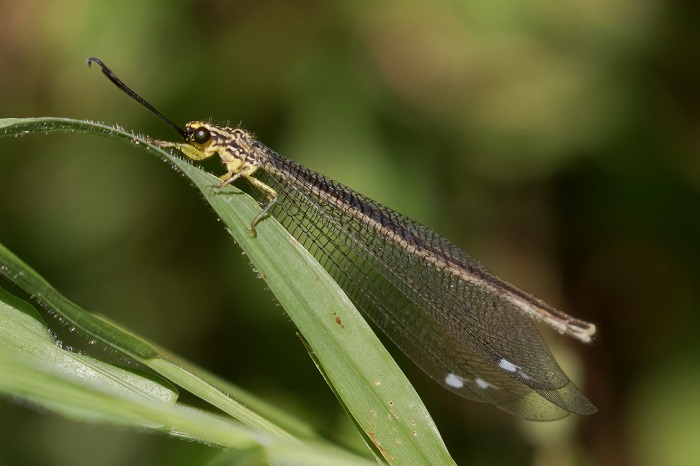
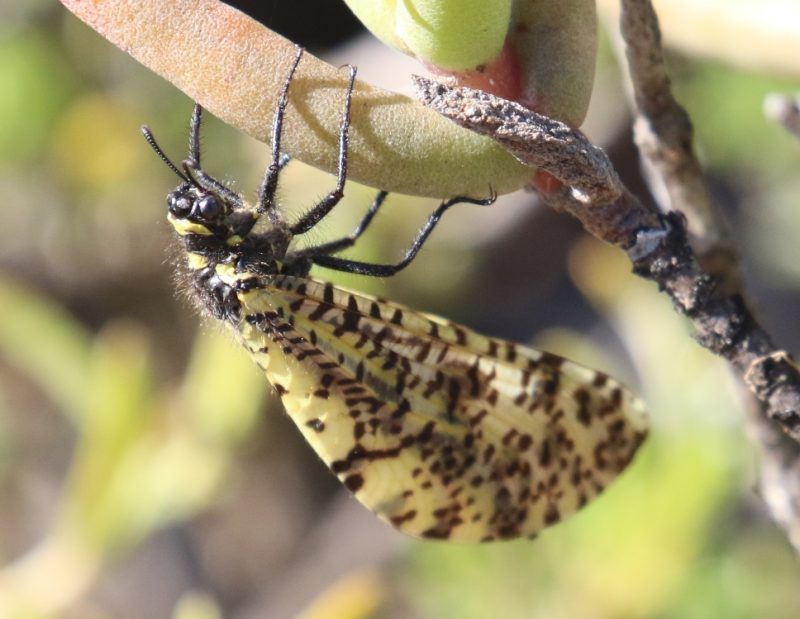
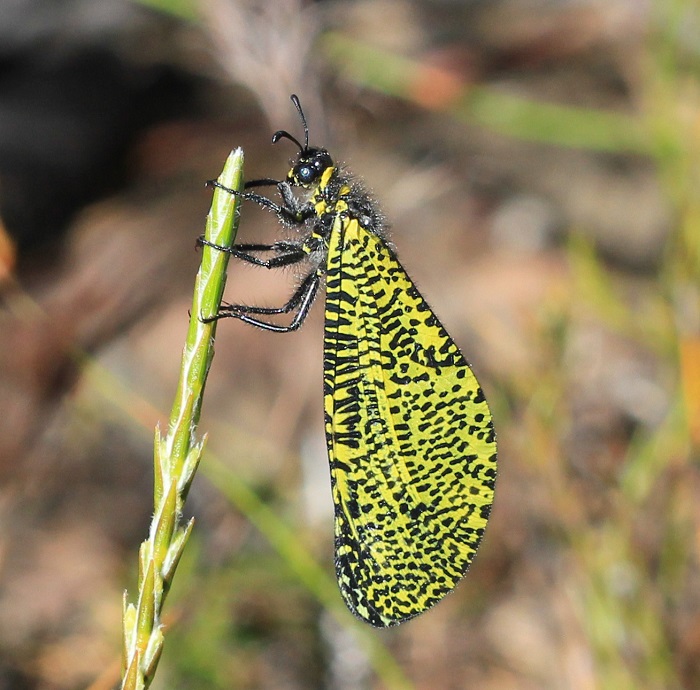
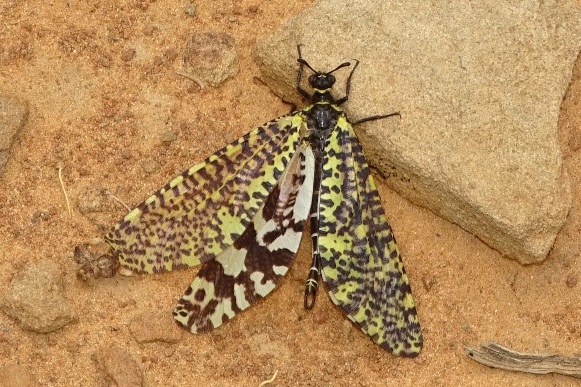
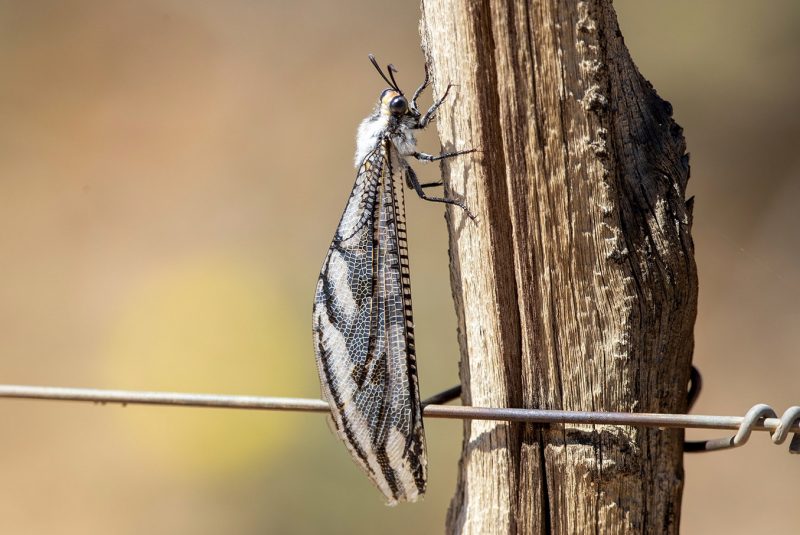
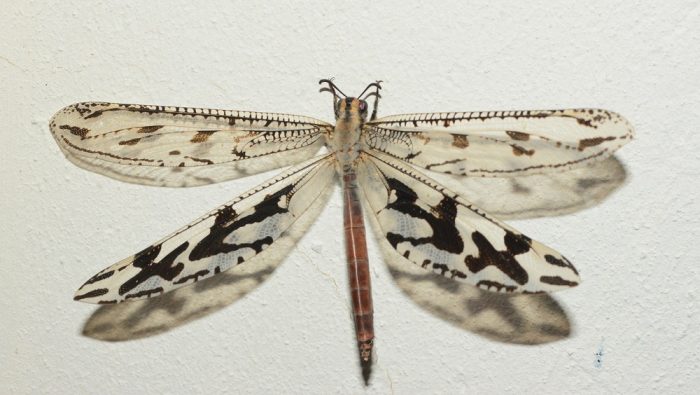
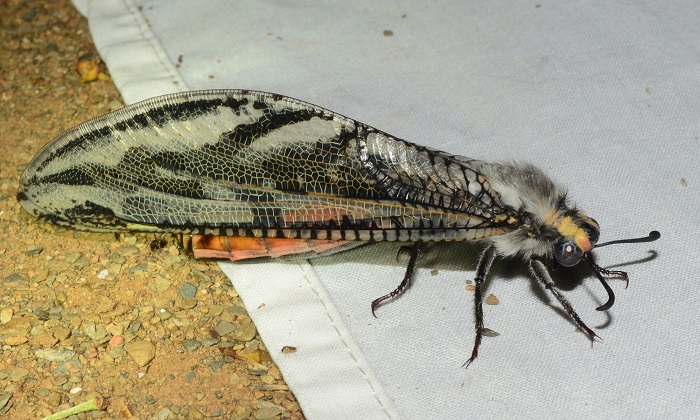
M. obscurus inhabits a very wide range of habitat types and has been recorded from all terrestrial biomes in South Africa.
Behaviour
Adults are most active during the summer months from October to April, but have been recorded throughout the year in the warmer parts of South Africa.
Frequently attracted to lights.
Members of the genus Myrmeleon are considered to be the most primitive antlions.
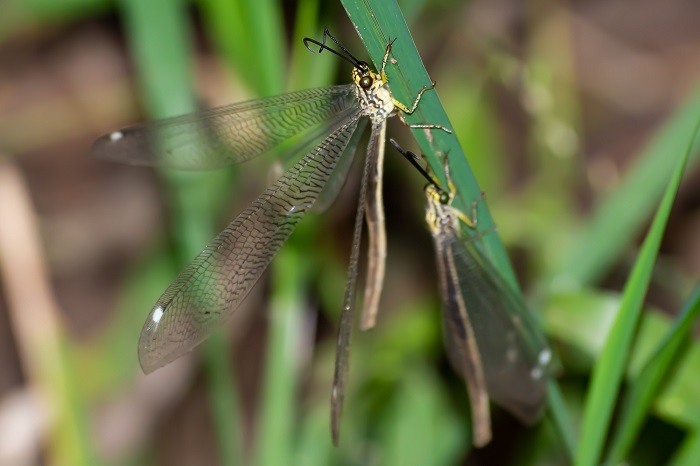
Myrmeleon obscurus – Mating pair – Near Carnarvon, Northern Cape Photo by Ryan Tippett
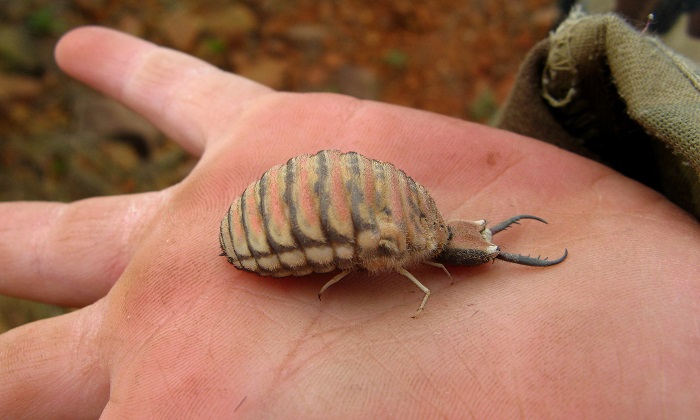
The larvae walk backwards and are pit-builders. Their pits are the most frequently encountered of all Myrmeleon species and occur in a variety of situations – even city pavements where there are sand pockets.
Myrmeleon obscurus – Boknesstrand, Eastern Cape Photo by Zenobia van Dyk
Status and Distribution
Myrmeleon obscurus is common and very widespread. It occurs over most of southern and eastern Africa. It is also found on the islands of Mauritius and Madagascar in the Indian Ocean.
Distribution of Myrmeleon obscurus. Taken from the LacewingMAP database, July 2022.
Myrmeleon obscurus – Bushmanskloof, Western Cape Photo by Zenobia van Dyk
Further Resources
Virtual Museum (LacewingMAP > Search VM > By Scientific or Common Name)
Acknowledgements:
The use of photographs by Alan Manson, Garth Aiston, Richard Johnstone and Zenobia van Dyk is acknowledged. This species text has benefited enormously from comments made by Mervyn Mansell on records he has identified in LacewingMAP. We acknowledge his important contribution.
Recommended citation format for this species text:
Tippett RM 2022. Myrmeleon obscurus. Biodiversity and Development Institute, Cape Town. Available online at http://thebdi.org/2022/08/03/myrmeleon-obscurus/
Myrmeleon obscurus– Bushmanskloof, Western Cape Photo by Zenobia van Dyk
View the above photo record (by Stephen Ball) in LacewingMAPhere.
Palpares caffer
(Burmeister, 1839)
Identification
Size: Large (Wingspan up to 112mm)
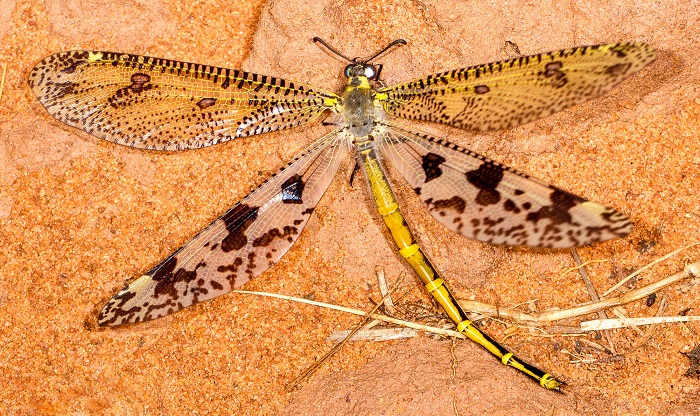
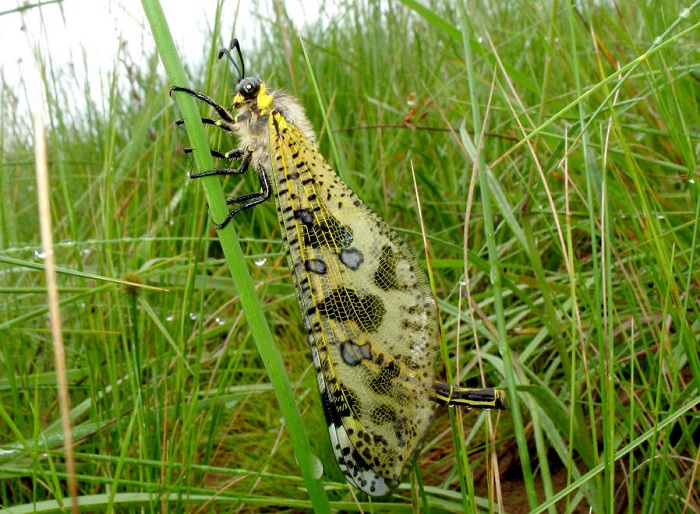
P. caffer is an overall yellow with dense black markings. The thorax is yellow and black and partially covered in thick grey setae. The abdomen is dark yellow with variable, broad black lines along the sides.
The fore wings show conspicuous yellow veining with black spotting. There are two distinctive lead-grey blotches near the middle of each fore wing. The hind wings are whiteish with three evenly spaced black patches and scattered smaller black spots.
Superficially resembles Palparesspeciosus. That species differs in showing four irregularly spaced black patches on the hindwing.
Larvae: The larvae are large and black.
Palpares caffer– Near Impendle, KwaZulu-Natal Photo by Christeen GrantPalpares caffer– Near Vaalwater, Limpopo Photo by Walter Neser
Habitat
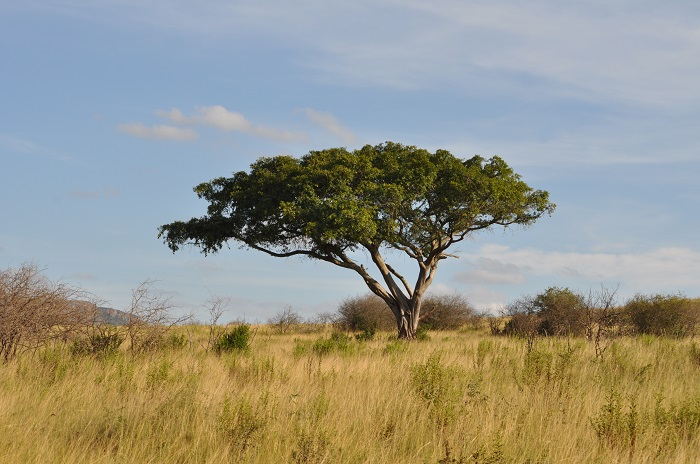
P. caffer inhabits grasslands at low to high altitudes. It is also widespread in open savanna with stands of taller grasses.
Habitat – Ithala Game Reserve, KwaZulu-Natal Photo by Ryan Tippett
Behaviour
Adults are often found at rest in long grass. They flush and fly off easily but will quickly settle again. Palpares caffer is often attracted to lights.
Adults are active during the summer months and are on the wing from October to April.
The larvae live freely in soil among grass tussocks. They are voracious predators feeding mainly on other arthropods. The larvae are seldom encountered.
Palpares caffer– Cumberland Nature Reserve, KwaZulu-Natal Photo by Geoff Prosser
Status and Distribution
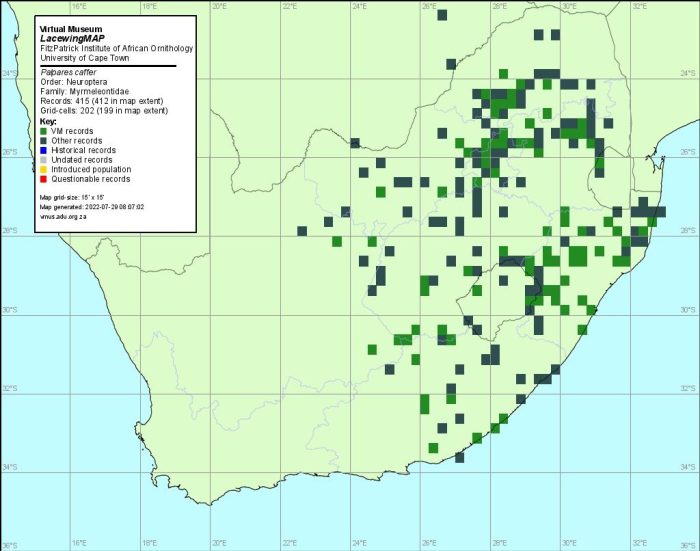
Palpares caffer is a common species. It occurs fairly widely in South Africa from the Eastern Cape (Grahamstown area) northwards. It seems to be confined to southern Africa, not extending beyond Zimbabwe. It is replaced in the south by its sister-species, Palpares speciosus.
Distribution of Palpares caffer. Taken from the LacewingMAP database, July 2022.
Virtual Museum (LacewingMAP > Search VM > By Scientific or Common Name)
Acknowledgements:
The use of photographs by Christeen Grant, Geoff Prosser, Len de Beer, Marita Beneke, Stephen Ball and Walter Neser is acknowledged. This species text has benefited enormously from comments made by Mervyn Mansell on records he has identified in LacewingMAP. We acknowledge his important contribution.
Recommended citation format for this species text:
Tippett RM 2022. Palpares caffer. Biodiversity and Development Institute, Cape Town. Available online at http://thebdi.org/2022/07/28/palpares-caffer/
Palpares caffer – Near Mbazwane, KwaZulu-Natal Photo by Len de Beer
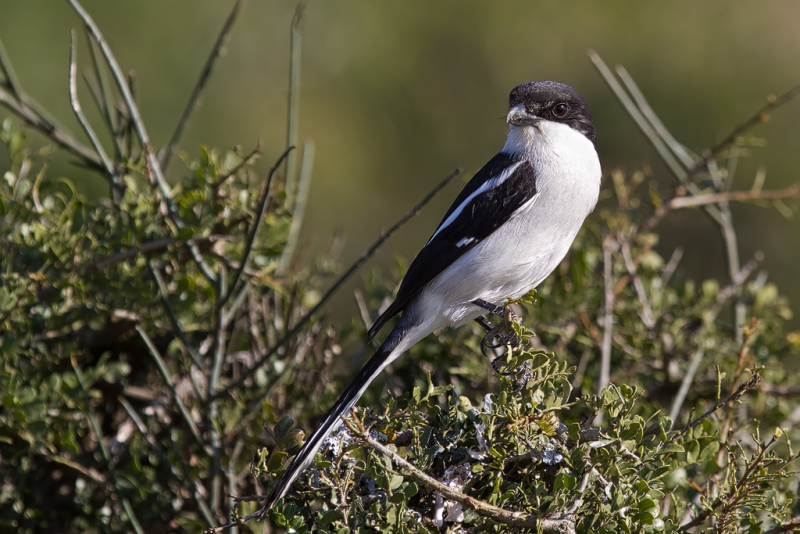
The Southern Fiscal can be identified by its distinct black and white colouration and its strongly hook-shaped bill. It has a black bill, face, and legs. It has a characteristic white “V” on its back and a relatively long black tail with white outer feathers. Adult male and female Southern Fiscals are quite similar apart from the rufous/chestnut patch of feathers the female has on her sides. The Fiscal Flycatcher has a similar black and white pattern, but it has a thinner and pointed bill.
Photo right: BirdPix 80962 – Neels Jackson, Pretoria, Gauteng, 06 June 2019. Photo left: BirdPix 5920 – Gregg Darling, St Francis Bay, Eastern Cape, 13 August 2013. Inset photo: BirdPix 3424 – Vaughan Jessnitz, St Lucia, KwaZulu-Natal, 20 May 2012.
The north-western subspecies of the Southern Fiscal has a distinct white eyebrow as shown in the photos below.
Photo left: BirdPix 172075 – Deon Van der Hoven, Pretoria, Gauteng, 19 June 2021. Photo right: BirdPix 4322 – John & Stephen Tinkler, Upington, Northern Cape, 24 April 2013.
Their call is a jumbled mix of shrike-like swizzling sounds including some imitations. Also a harsh “Dzzzttt-dzzzt-dzzzt” alarm call.
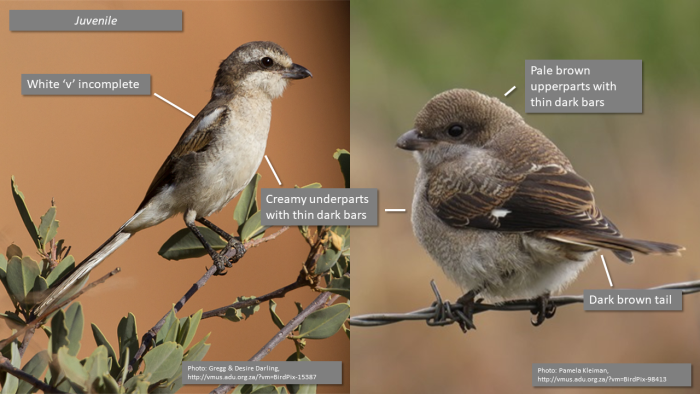
Juveniles have pale brown upperparts and creamy underparts with thin dark barring.
It occupies a wide variety of habitats but generally prefers open habitats with scattered trees, such as savanna, open woodland, shrubland and grassland. It is also very common in human-altered habitats like gardens, parks, farmland, and roadsides. They love places with good perches from where they can scan for potential prey.
Top left: BirdPix 48865 – Dewald du Plessis, Mokala National Park Northern Cape, 04 May 2014. Top right: BirdPix 24820 – Martyn Drabik-Hamshare, Pietermaritzburg, KwaZulu-Natal, 28 February 2016. Bottom left: BirdPix 209722 – Jon Blanco, New Holme Lodge, Northern Cape, 27 February 2022. Bottom right: BirdPix 2479 – Fanie Rautenbach, Table View, Cape Town, Western Cape, 19 May 2013.
Distribution
Widespread across sub-Saharan Africa, but absent from much of the Democratic Republic of Congo, Somalia and Ethiopia. In southern Africa it occurs almost everywhere in South Africa, extending into much of Namibia, Zimbabwe and southern Botswana. The Southern African Bird Atlas Project (SABAP2) data on the Southern Fiscal are displayed in the map below. The blue and green squares (i.e., pentads) are the core of its range in South Africa, Lesotho and eSwatini. These are the pentads where their reporting rate is highest.
SABAP2 distribution map for Southern Fiscal, downloaded 01 June 2022. Details for map interpretation can be found here.
Behaviour
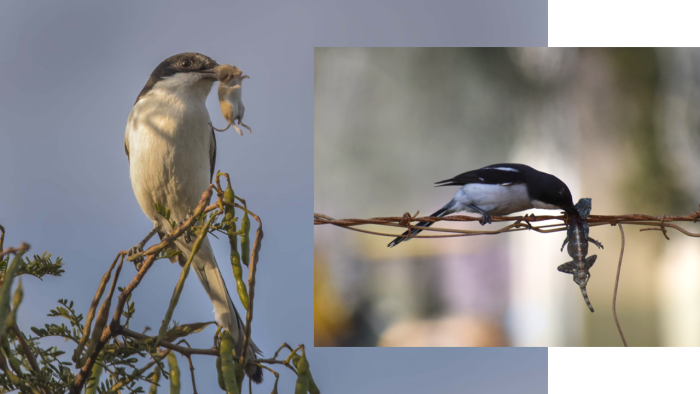
The Southern Fiscal is usually solitary and hunts insects and small rodents from an exposed perch and can often be seen at the tops of shrubs or small trees. They have a habit of impaling their prey on thorn tree thorns or fences so as to store the prey items for later consumption. This is why they are also known as Jackie Hangman or the Butcher Bird.
Southern Fiscals with various prey items. Photo left: BirdPix 52574 – Anthony Archer, Hartbeesfontein, North West Province, 27 April 2018. Photo right: BirdPix 130461 – Karis Daniel, Worcester, Western Cape, 12 September 2020.
Further resources
Species text from the first Southern African Bird Atlas Project (SABAP1), 1997.
Virtual Museum (BirdPix > Search VM > By Scientific or Common Name).
More common names: Fiskaallaksman (Afrikaans); Inxanxadi (Xhosa); iLunga (Zulu); Pie-grièche Fiscale (French); Fiskalwürger (German); Gekraagde Klauwier (Dutch).
List of bird species in this format is available here.
Recommended citation format: Loftie-Eaton M, Daniel KA 2022. Southern Fiscal Lanius collaris. Bird Feeder Project. Biodiversity and Development Institute. Available Online at http://thebdi.org/2022/06/01/southern-fiscal-lanius-collaris/
View the above photo record (by Gary Brown) in LacewingMAPhere.
Banyutus lethalis
(Walker, 1853)
Identification
Size: Small to medium sized (Wingspan around 58mm)
Banyutus lethalis is mimicked by the gregarious African antlion, Hagenomyia tristis and the two bear a close resemblance. B. lethalis has longer antennae and clear wings with prominent black veining and a bicoloured pterostigma. H. tristis has shorter antennae, slightly irridescent wings with inconspicuous black veins and has smaller white pterostigmas.
Banyutus lethalis – Mtubatuba, KwaZulu-Natal Photo by Toy BodbijlBanyutus lethalis – Sango, Zimbabwe Photo by Ian Riddell
Larvae: The larvae have dark, blackish colouration.
Habitat
Banyutus lethalis inhabits savanna woodland and forest regions. Adults are often found among tall grass in the dappled light beneath trees.
Habitat – Ndumo Game Reserve, KwaZulu-Natal Photo by Ryan Tippett
Behaviour
The adults are nocturnal and spend the day resting among tall grass. They are frequently attracted to light. Banyutus lethalis is gregarious and often flies in mixed swarms with Hagenomyia tristis, which it closely resembles – in a mimicry complex.
The black larvae live freely in fine, shallow sand and often prey on other antlion larvae.
In South Africa adults are on the wing from September to May, although it is most commonly recorded from November to March.
Banyutus lethalis is often gregarious – Hectorspruit, Mpumalanga Photo by Gert Bensch
Status and Distribution
B. lethalis is common and has a very wide distribution in eastern South Africa, extending northwards into Mozambique, Kenya, Tanzania, Malawi, Zambia, Zimbabwe, DRC.
Distribution of Banyutus lethalis. Taken from the LacewingMAP database, July 2022.
Banyutus lethalis – Near Thabazimbi, North-West Province. Photo by Andre Harmse
Further Resources
Virtual Museum (LacewingMAP > Search VM > By Scientific or Common Name)
Acknowledgements:
The use of photographs by Andre Harmse, Chris Meyer, Gert Bensch, Gary Brown, Ian Riddell and Toy Bodbijl is acknowledged. This species text has benefited enormously from comments made by Mervyn Mansell on records he has identified in LacewingMAP. We acknowledge his important contribution.
Recommended citation format for this species text:
Tippett RM 2022. Banyutus lethalis. Biodiversity and Development Institute, Cape Town. Available online at http://thebdi.org/2022/07/28/banyutus-lethalis/
View the above photo record (by Cornelia Rautenbach) in LacewingMAPhere.
Pamexis karoo – Butterfly Antlion
Mansell, 1992
Identification
Size: Medium (Wingspan up to 60mm)
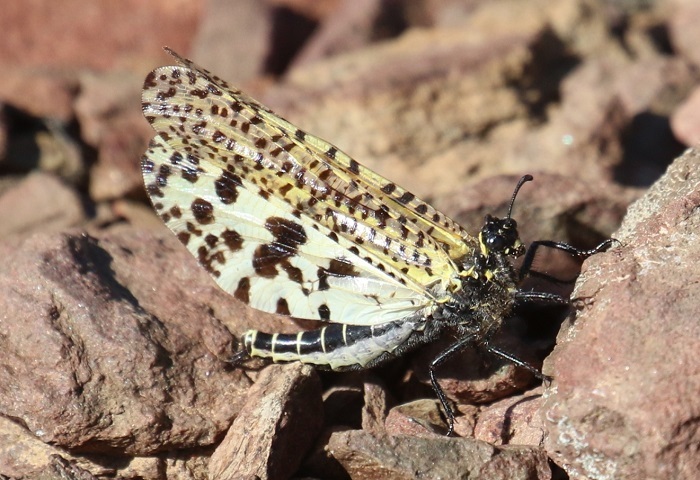
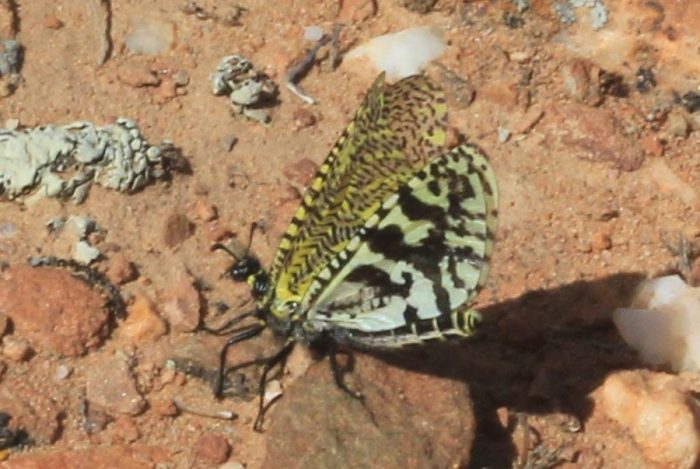
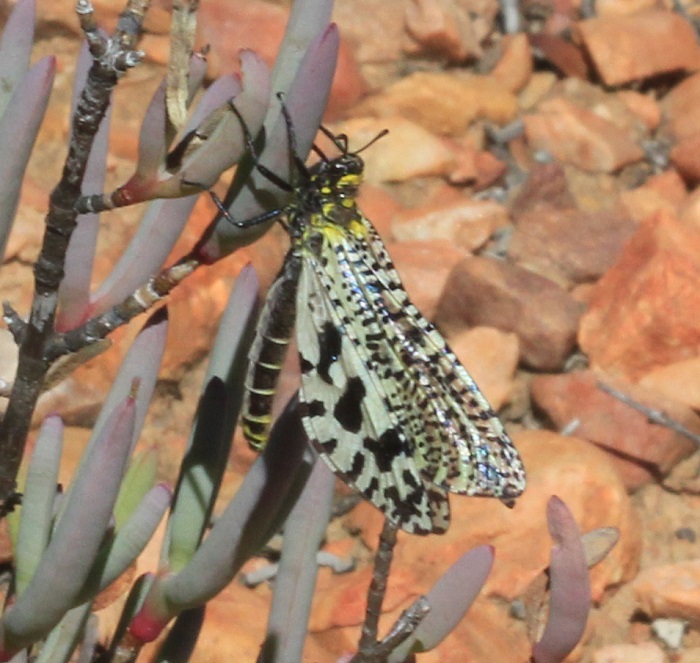
P. karoo has an overall yellow and black colouration. Forewings are bright yellow, richly adorned with black spots. The hindwings are creamy white to pale yellow with distinctive, broad black patterning. The abdomen is black with pale yellow sides and fine yellow lines above.
Larvae: Unknown.
Pamexis karoo – Dasklip Pass, Western Cape Photo by Fanie RautenbachPamexis karoo – Sutherland, Northern Cape Photo by Christopher Willis
Habitat
Inhabits dry fynbos, succulent karoo and the southern Nama Karoo in areas with sparse, low vegetation.
Habitat – Montague. Western Cape Photo by Ryan Tippett
Behaviour
Adults emerge between October and February.
Pamexis karoo – Ladismith, Western Cape Photo by Cornelia Rautenbach
Often found on sparse, open patches of ground between vegetation. Flies rapidly when disturbed and usually resettles on a low shrub. They are highly cryptic when resting amongst fynbos, karoo vegetation or on lichen covered rocks. Unlike most antlions Pamexis karoo is not attracted to lights.
Nothing is known about the larvae of this species.
Pamexis karoo – Matroosberg, Western Cape Photo by Fanie Rautenbach
Status and Distribution
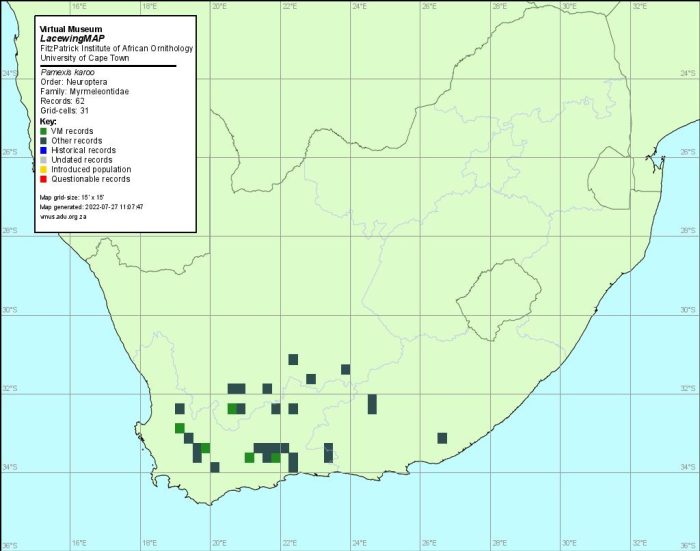
Pamexis karoo is uncommon but is the most widespread species in its genus. Its range extends from the Cedarberg Mountains eastwards to the Grahamstown area, and possibly comprises a species complex. Pamexis karoo has been recorded from the Western, Eastern and Northern Cape provinces.
Distribution of Pamexis karoo. Taken from the LacewingMAP database, July 2022.
Pamexis karoo – Near Calitzdorp, Western Cape Photo by Fanie Rautenbach
Further Resources
Virtual Museum (LacewingMAP > Search VM > By Scientific or Common Name)
Acknowledgements:
The use of photographs by Christopher Willis, Cornelia Rautenbach and Fanie Rautenbach is acknowledged. This species text has benefited enormously from comments made by Mervyn Mansell on records he has identified in LacewingMAP. We acknowledge his important contribution.
Recommended citation format for this species text:
Tippett RM 2022. Pamexis karoo. Biodiversity and Development Institute, Cape Town. Available online at http://thebdi.org/2022/07/27/pamexis-karoo/
View the above photo record (by Niall Perrins) in LacewingMAPhere.
Palpares immensus
McLachlan, 1867
Identification
Size: Very Large (Wingspan up to 160mm)
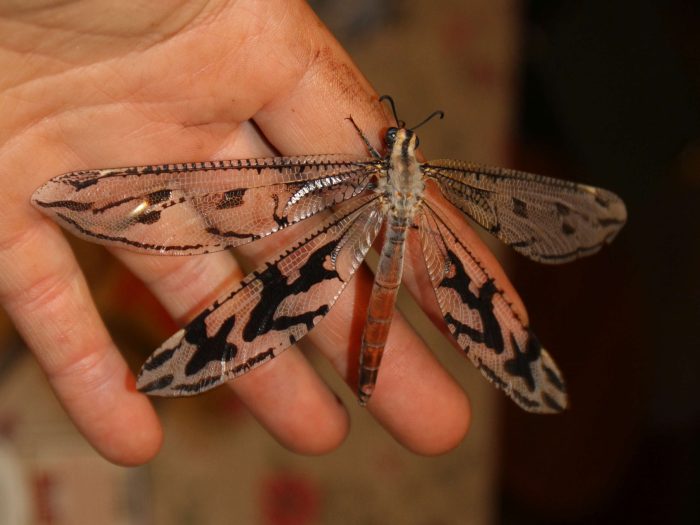
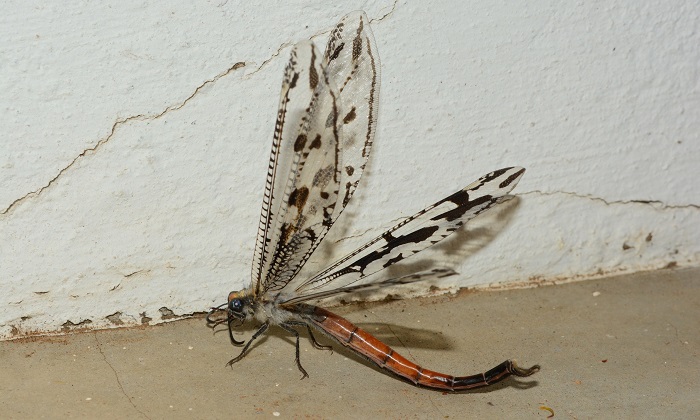
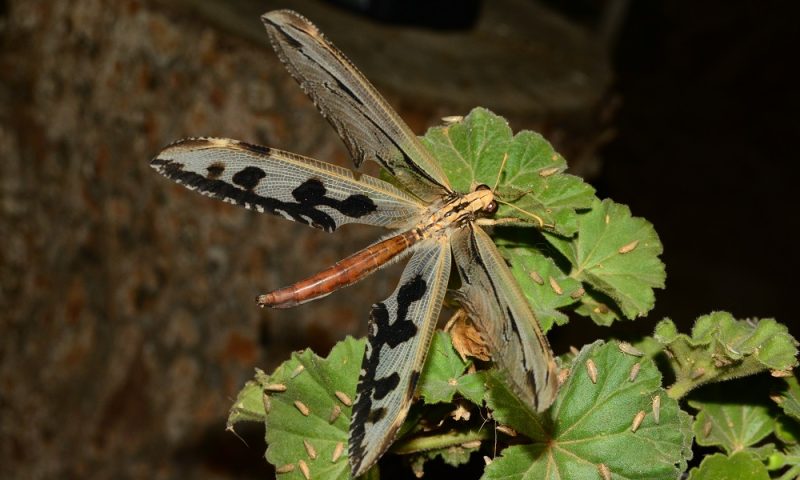
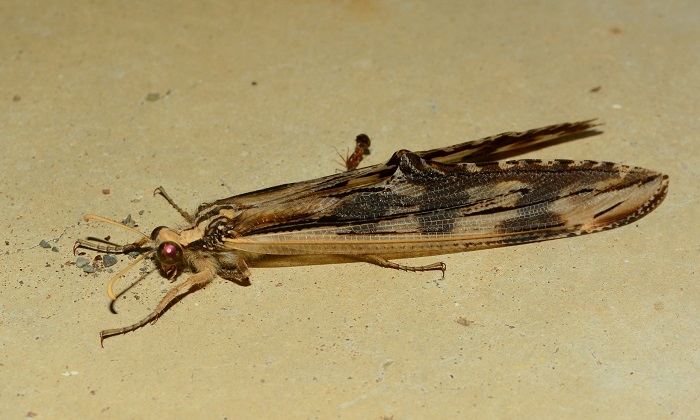
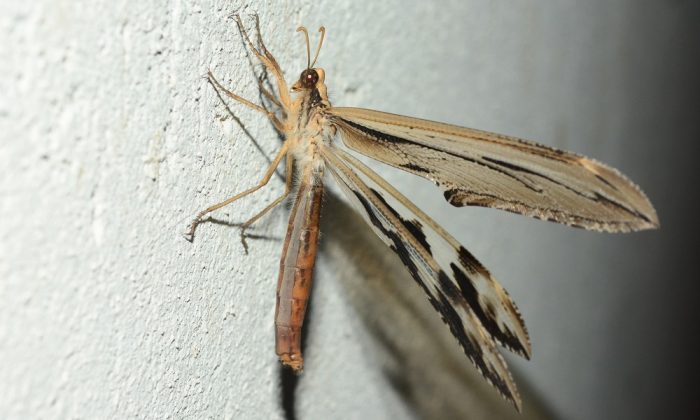
Palpares immensus– Near Carnarvon, Northern Cape Photo by Ryan TippettPalpares immensus – Near Carnarvon, Northern Cape Photo by Ryan Tippett
Palpares immensus is one of the world’s largest antlion species. It has long wings with characteristic black patterning. It has a generally pale appearance with its wings folded at rest. The abdomen is rufous-brown, often with black terminal markings.
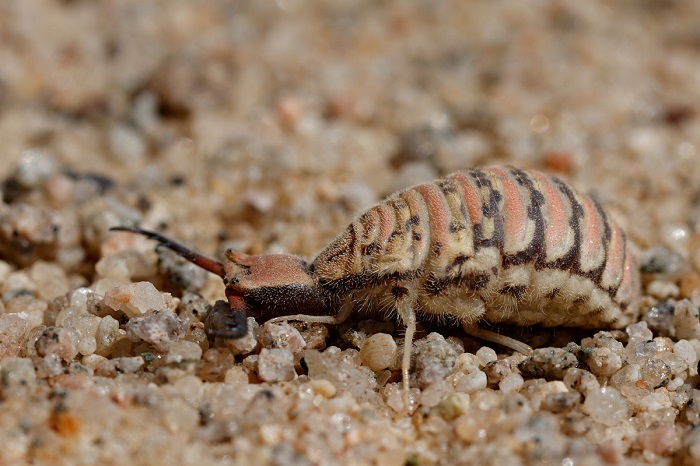
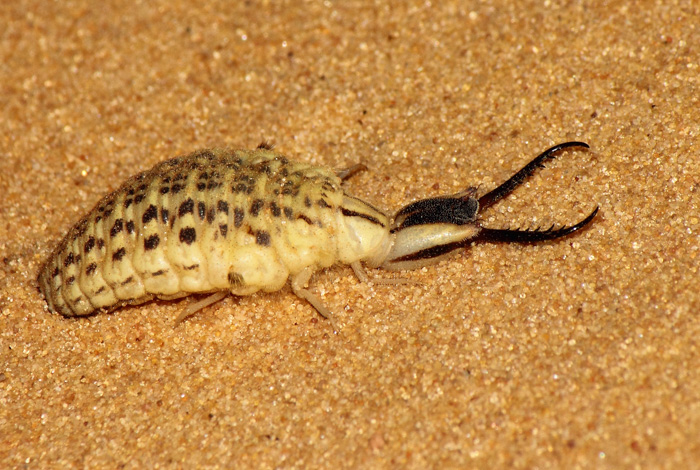
Larvae: The larvae are very large and have distinctive reddish, beige and black colouration.
The larvae live freely in sand and are ambush hunters. They are voracious predators and feed mainly on other arthropods, but have been known to attack geckos and, in one case a small adder. They are unable to feed on these reptiles and usually die as a result of not being able to extract their jaws from the vertebrate prey.
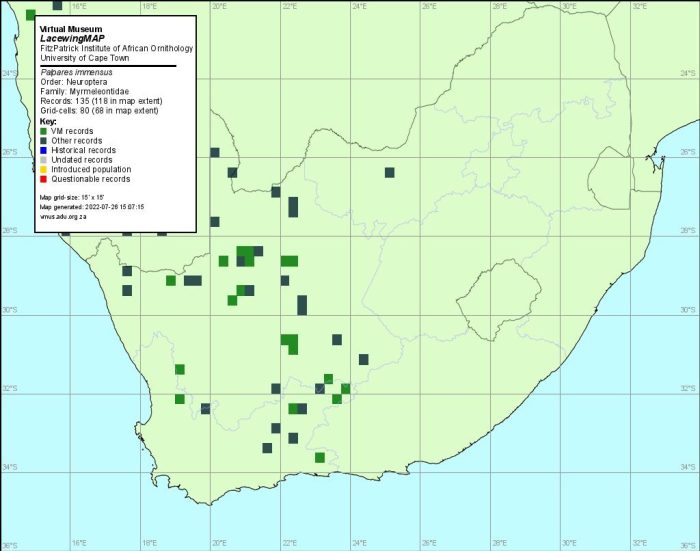
Fairly common and widespread in the drier western areas of South Africa, being concentrated in the Northern and Western Cape Provinces. It extends into Namibia, Botswana and up into southern Angola.
Distribution of Palpares immensus. Taken from the LacewingMAP database, July 2022.
Virtual Museum (LacewingMAP > Search VM > By Scientific or Common Name)
Acknowledgements:
The use of photographs by Alex Dreyer, Katharina Reddig and Niall Perrins is acknowledged. This species text has benefited enormously from comments made by Mervyn Mansell on records he has identified in LacewingMAP. We acknowledge his important contribution.
Recommended citation format for this species text:
Tippett RM 2022. Palpares immensus. Biodiversity and Development Institute, Cape Town. Available online at http://thebdi.org/2022/07/26/palpares-immensus/
View the above photo record (by Ryan Tippett) in LacewingMAPhere.
Golafrus oneili – Kalahari Phantom Antlion
Péringuey, 1911
Identification
Size: Very Large (Wingspan 120mm)
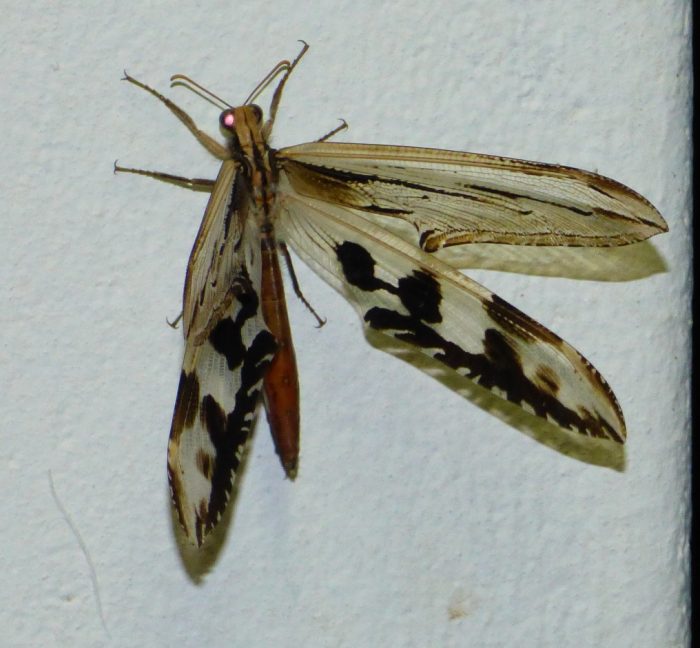
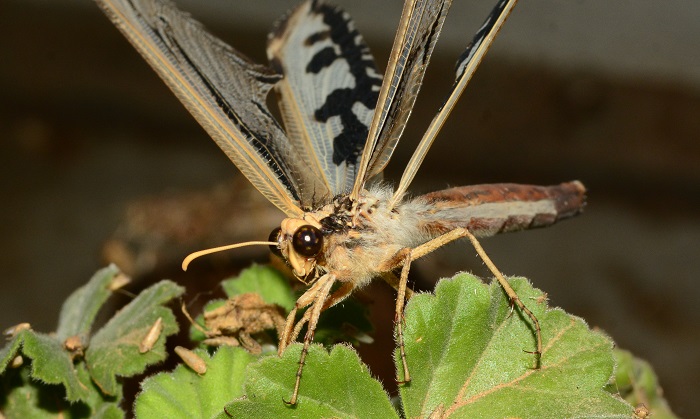
Golafrus oneili is one of southern Africa’s most magnificent antlions. The adults have long, narrow wings. The posterior margin of each wing is incised, forming a raised ridge when folded at rest. The wings provide effective camouflage when inactive during the day. G. oneili has extremely long legs relative to other Palparinae.
Golafrus oneili– Near Carnarvon, Northern Cape Photo by Ryan TippettGolafrus oneili – Near Carnarvon, Northern Cape Photo by Ryan Tippett
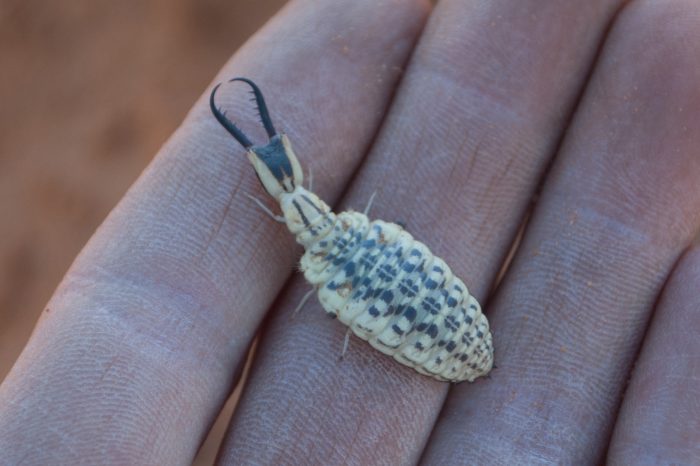
Larvae: The larvae are large and imposing with striking white and black colouration.
Golafrus oneili– Venetia Nature Reserve, Limpopo Photo by Vaughan Jessnitz
Habitat
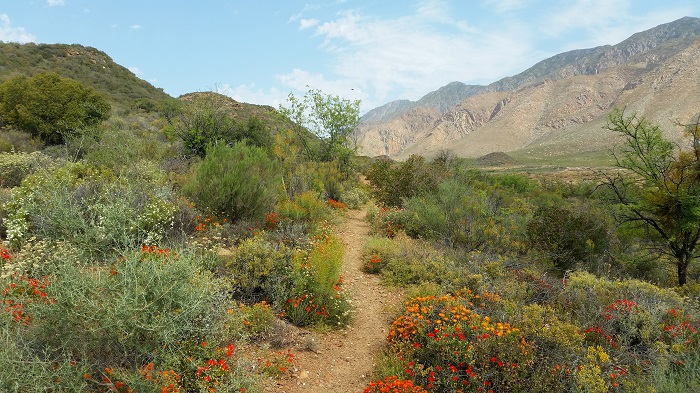
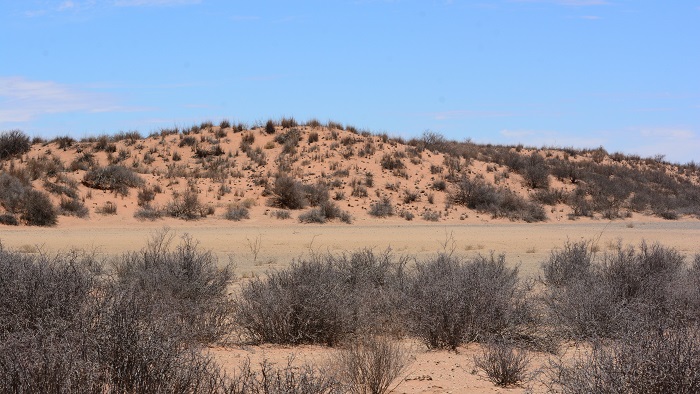
A sand specialist frequenting open karoo vegetation and dry savanna, usually on red kalahari sands. Most numerous in Bushmanland and the Kalahari where it inhabits red sand dunes with scattered bushes and tall grasses.
Habitat – Near Vanwyksvlei, Northern Cape Photo by Ryan Tippett
Behaviour
Adults are nocturnal and spend the day resting among tall grass. They are frequently attracted to light.
Adults are on the wing from December to April
Golafrus oneili– Near Keimoes, Northern Cape Photo by Cornelia Rautenbach
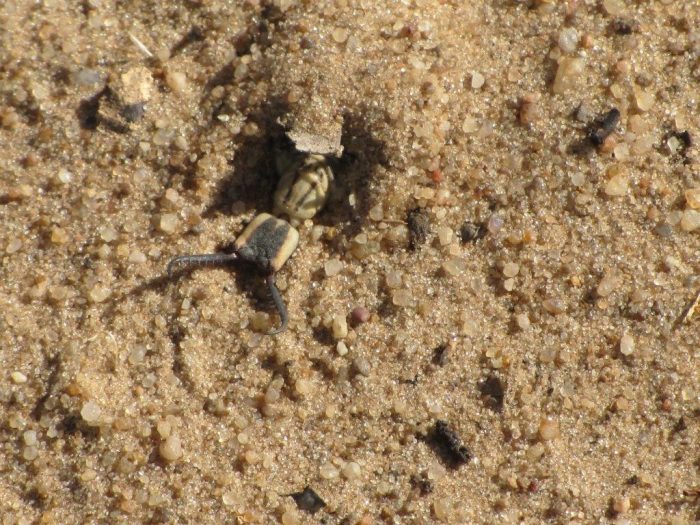
The very large larvae are voracious predators, which inhabit deep sand. They come to the surface at night to lie in wait for prey and leave characteristic tracks in the sand where they surface. They ambush their prey and do not construct pit-fall traps. The white body is thought to be an adaptation to reflect heat in the arid, hot environments in which they live.
Golafrus oneili – Near Sekoma, Botswana Photo by Mark StantonGolafrus oneili– Kuruman River Reserve, Northern Cape Photo by Kyle Finn
Status and Distribution
This species is seldom encountered and is generally scarce but may be fairly common in suitable habitat.
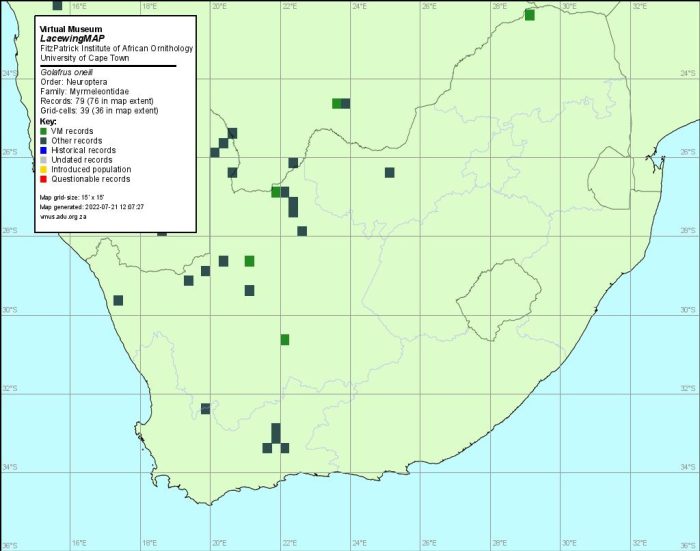
Golafrus oneili has been recorded from South Africa, Botswana and Namibia. It South Africa it occurrs mostly in the Northern Cape with some records from the Western Cape, Limpopo and North-West province.
Distribution of Golafrus oneili. Taken from the LacewingMAP database, July 2022.
Virtual Museum (LacewingMAP > Search VM > By Scientific or Common Name)
Acknowledgements:
The use of photographs by Vaughan Jessnitz, Kyle Finn, Mark Stanton and Cornelia Rautenbach is acknowledged. This species text has benefited enormously from comments made by Mervyn Mansell on records he has identified in LacewingMAP. We acknowledge his important contribution.
Recommended citation format for this species text:
Tippett RM 2022. Golafrus oneili. Biodiversity and Development Institute, Cape Town. Available online at http://thebdi.org/2022/07/25/golafrus-oneili-kalahari-phantom-antlion/
Golafrus oneili – Near Carnarvon, Northern Cape Photo by Ryan Tippett
The Southern Double-collared Sunbird Cinnyris chalebeus is a small sunbird in the family Nectariniidae. The male and female look different from one another. The male has a pale grey belly and relatively narrow red breast band. The female is overall grey-brown. The only similar species it overlaps with in geographic range is the Greater Double-collared Sunbird Cinnyris afer. It differs from the Southern Double-collared Sunbird by being about 20% larger, with a longer, heavier bill, a much broader red breast band in the male, and a slower song.
Main photo: BirdPix 4828 – Michael Brooks, Cape Town, Western Cape, 30 September 2013. Left inset: BirdPix 34605 – Dieter Oschadleus, Cape Town, Western Cape, 11 February 2017. Right inset: BirdPix 118561 – Johan & Estelle van Rooyen, Vermaaklikheid, Western Cape, 02 May 2016.
Left: BirdPix 103512 – Karis Daniel, Citrusdal, Western Cape, 26 January 2020. Top right: BirdPix 64119 – Zenobia van Dyk, Reneen, Northern Cape, 9 November 2018. Bottom right: BirdPix 68560 – Willem Van Zyl, Cape Town, Western Cape, 6 January 2019.
The female might not be as flashy in her colouration, but still just as elegant. She has brown upperparts and yellowish-grey underparts. Juveniles resemble the females. It can be tricky to tell the difference between female Southern Double-collared Sunbirds and other female sunbird species. In general, Southern Double-collared Sunbird females are greyer below than female Orange-breasted Sunbirds, and darker below than female Dusky Sunbirds.
This beautiful little sunbird gives a characteristic short two-note “cher-cher” call and a rapid high-pitched song of up-and-down notes. Take a listen in the video below:
Habitat
It prefers fynbos, Karoo shrubland, as well as woodland, Afromontane forests, gardens, and even Eucalyptus plantations.
Male Southern Double-collared Sunbird in its natural habitat enjoying some nectar: BirdPix 218221 – Josu Meléndez, Simon’s Town, Western Cape, 29 April 2022.
Distribution
Southern Double-collared Sunbirds are endemic to southern Africa, occurring from the far south of Namibia to South Africa. The core of their distribution is centred around the Western Cape extending east and north to KwaZulu-Natal, Mpumalanga and Limpopo Province.
SABAP2 distribution map for Southern Double-collared Sunbird, downloaded on 02 May 2022. Details on how to interpret the map can be found here.
Behaviour
The Southern Double-collared Sunbird is usually seen singly or in small groups. Its flight is fast and direct on its short wings. It feeds mainly on nectar from flowers, but also eats fruit, and, especially when feeding young, insects and spiders.
Male and female having a sip of nectar from a bottle-feeder: BirdPix 155231 – Gerald Wingate, Bellville, Western Cape, 04 February 2021.
The nest is built solely by the female in about 25-30 days. The nest has an an oval-shaped structure with a side entrance, built of grass, strands of old man’s beard Galium tomentosum, rootlets, and twigs. All of this is then strongly secured with spider web. There are exceptions though, as some nests (especially in forests) can be constructed entirely out of old-man’s-beard Usnea barbata.
Female Southern Double-collared Sunbird building a nest: BirdPix 191442 – Marius Meiring, Kirstenbosch Botanical Garden, Cape Town, 18 October 2021.
Egg-laying season is almost year-round, peaking from July to September. Southern Double-collared Sunbirds lay 1-3 eggs, which are incubated solely by the female for about 13-16 days. The chicks are fed by both adults, and they leave the nest after about 15-19 days. The parents feed the chicks until they are about 42-46 days old, at which point the young become fully independent.
Further Resources
Species Text from the first Southern African Bird Atlas Project (SABAP1), 1997
Virtual Museum (BirdPix > Search VM > By Scientific or Common Name)
Other common names: Klein-rooibandsuikerbekkie (Afrikaans); Ingcungcu (Xhosa); iNcuncu (Zulu); Souimanga Chalybée (French); Halsband-nektarvogel (German).
List of bird species in this format is available here.
Location: New Holme Lodge (Karoo Gariep NR), Northern Cape – between Hanover and Colesburg [coords for turn-off]
For: trainees and ringers
Email: ring@thebdi.org if you are interested in attending
There is great potential for a wide variety of birds, including some Karoo specials. Some of the sites and birds that could be caught for ringing are listed (with species ringed to date in the table below).
There is a patch of reeds near the research station, hosting warblers and breeding Southern Masked Weavers and some Southern Red Bishops in summer. These birds roost in the reeds when not breeding.
In autumn berry bushes attract fruit eaters like Red-eyed Bulbuls, White-backed Mousebirds, Wattled Starlings and others.
Wattled Starling
Extensive gardens with lawns and large trees host Fiscal Flycatcher, Cape Robin-chat, Karoo Thrush and others. Seeds on the lawn attract large numbers of Cape Sparrows, with some doves, weavers, queleas, bishops, and Red-headed Finches.
At the farm house Greater Striped Swallow, Rock Martin and possibly White-rumped Swifts breed under the roof eaves, so high nets can be used here.
White-throated Swallow
In the karoo veldt we can try to catch specials like Spike-heeled Lark and other larks, prinias, Rufous-eared Warbler, chats and wheatears.
There are some surrounding farms where we will be able to ring as well.
Previous ringing totals
Previous ringing: 10-12 November 2019 and from 16 March to 21 April 2022.
Species summary for 2019 and 2022 ringing at New Holme (ringed and recaptured):
During late-April and May, Curlew Sandpipers, and lots of other migrant waders, will be migrating through Ukraine. They will be joined by many passerine migrants, such as the warblers. There will also be some of the migrant raptors, such as Steppe Buzzard and the big eagles (such as Lesser Spotted Eagle), and the small falcons (such as Lesser Kestrel). They will be on their way to breeding grounds in the Russian tundra, the taiga and the steppes.
But this blog focuses on the Curlew Sandpiper. This is because the information for this wader is readily available (as you will see below), and because it has all been neatly assembled into one monograph, in International Wader Studies, a publication of the International Wader Study Group.
Most Curlew Sandpipers breed in a relatively small area in northern Asia, the tundra zone of northern Siberia. They don’t spend long on their breeding grounds. They arrive near the beginning of the thaw, in June and they leave at the end of July/beginning of August, when cold and snow return.
Breeding range of the Curlew Sandpiper (from Lappo & Tomkovich 2006). The largest concentration of “core breeding area” lies in an area known as the Taimyr Peninsula. This is in Asia directly north of India. Most of Africa’s Curlew Sandpipers breed here.
Once on the breeding grounds, there is quite a lot of variability in the start of egg-laying due to inter-year fluctuations in the timing of the thaw. The incubation period is 20 days, and the fledging period is an incredibly short 15 days. So the period from laying eggs to independent young is little more than a month. Males play no role in incubation and chick-rearing, so they leave on southwards migration around the end of June. Females leave as soon as their chicks have fledged. These immature birds head south a week or two later, without parental guidance! This ordering of migration is observed at bird ringing stations on the migration route: males first, then females, and finally the juveniles.
This newly hatched chick will be a flying bird in 15 days. Chicks are prococial, and feed themselves from hatching! Lake Pronchishcheva, northeastern Taimyr Peninsula, Russia. July 1991
Curlew Sandpipers migrate to a vast area of Africa and Australasia during the non-breeding season:
The non-breeding area of the Curlew Sandpiper is shaded blue. The map of the breeding area (brown) is generalized compared with the accurate map above. Yellow purports to show staging areas in migration, but is very incomplete. Source Wikimedia
After the breeding season, arrival on migration at the southern end of Africa starts near the end of September, and numbers at wetlands build up in October-November. The average weight of a Curlew Sandpiper at the non-breeding site at Langebaan Lagoon in the West Coast National Park, South Africa, from arrival until February is 57g. After this they gradually increase in weight. When they depart on migration, the weigh 80–90g. Most of this additional mass is fat, fuel for migration. But this is not enough fuel for the entire journey to the tundra. Far from enough!
The mean departure date on northwards migration from Langebaan Lagoon is estimated to be 24 April. The mean arrival date on the breeding grounds in Siberia is estimated to be 10 June. That is 42 days. Mean flight speed is 65km/hour. The distance from Langebaan Lagoon to the breeding grounds on the tundra of the Taimyr Peninsula is about 13,000km. At 65km/hour, flying 24 hours per day, a Curlew Sandpiper can cover 1,560km/day. Finally, 13,000/1,560 = 8 days to fly the distance. The remaining 42–8=34 days is used for refuelling. This can only be done at high-quality wetlands where food is abundant. According to flight-range formulae obtained during experiments in which birds flew in wind tunnels, a Curlew Sandpiper needs 132g of fuel to travel from Langebaan Lagoon to the breeding grounds. 99g must be obtained on the journey during the 34 non-fly days: 99/34=2.7g per day. This is well within their capabilities, so it is a believable number. (This information is sourced from this paper).
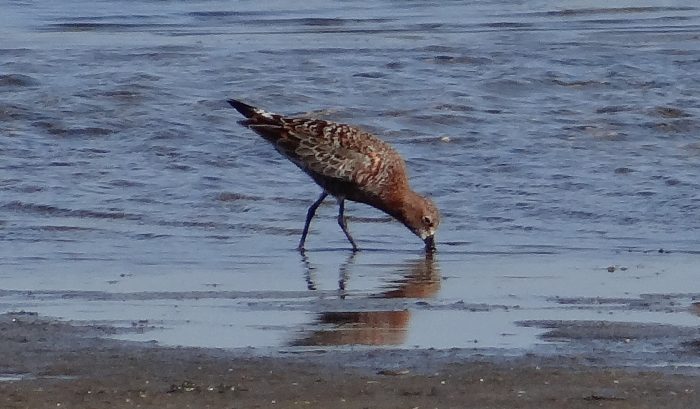
This Curlew Sandpiper was in full breeding plumage in Richard’s Bay, South Africa, and would have been about to leave for the breeding grounds on 15 April 2016. Its route to the tundra might have taken it through the Ukraine. The photograph is by Richard Johnstone, and is curated in BirdPix, as record 25818
Not all Curlew Sandpipers migrating from their non-breeding grounds in Africa to the breeding areas in Siberia follow the same route. But the total number of really good wetlands for refuelling is small.
One of the best is the Sivash, in the western edge of the Sea of Azov, which in turn is in the northeastern part of the Black Sea, in the disputed territory of the Crimean Peninsula:
Location of the Sivash, in Ukraine (when this study was done). The two wetlands marked SC-22 and SE-41 were the main ringing sites used by researchers from the Azov-Black Sea Ornithological Station, headquartered in Melitopol, Ukraine. This map is from Diadicheva & Khomenko 2006)
Researchers at the Azov-Black Sea Ornithological Station estimate that around 66,000 Curlew Sandpipers refuel in the Sivash on northwards migration (and 160,000 on autumn migration). Most refueling sites for Curlew Sandpipers (and other waders on migration) are tidal. This results in extensive areas of mud and sand becoming available at every low tide for feeding. But the Black Sea is too small to have any tides at all, and this applies also to the Sea of Azov, and especially the Sivash.
So how come the Sivash a great refueling site? The answer is the wind. It is a complex area of shallow lagoons. As the wind blows in one direction, it pushes water along with it, and this results in some mudflats being exposed for a while. Then it blows in a different direction, and another set of mudflats are exposed. The refueling waders continuously redistribute themselves opportunistically to use the best areas under any one set of wind conditions.
In studies which started in 1974, it is known that northward passage of Curlew Sandpipers through the Sivash starts in mid-April. Peak migration is in the period 11-20 May, and it tapers off by the end of the month.
So in the next few weeks, Curlew Sandpipers, and many other birds, probably counted in millions, are going to migrate through the battle zones of the eastern half of Ukraine. It will be migration in a time of war. We simply have no idea of whether the habitats they will use have been impacted by military activity.
The Ukrainians based at the Azov-Black Sea Ornithological Station have done extensive bird ringing (see the map above for the main ringing sites). They have retrapped Curlew Sandpipers from other countries, and theirs have been retrapped elsewhere. This information is summarized in this map:
Long-distance recoveries and retraps of Curlew Sandpipers either ringed or recovered** in Ukraine. The lines on the map do not imply that the birds have taken this route! For almost all of these recoveries there was a trip to the breeding grounds in Siberia, or the non-breeding grounds in Africa between the ringing observation and the retrap/recovery observation. This map is from Diadicheva & Khomenko 2006). **In the terminology used in ringing, “recovery” means that it is the ring that was “recovered” and that the bird is dead! In “retraps”, the bird was caught again, its ring number was recorded, and the bird was let loose, alive!
From the Ukrainian perspective, their Curlew Sandpipers are linked with a remarkable number of countries: Norway, Finland, Poland, Swede, Germany, UK, France, Spain, Hungary, Italy, Bulgaria, Russia, Greece, Tunisia, Morocco, Senegal, Benin, Mali, Sudan, Chad, Namibia and South Africa – that is 22 countries that have shared individual Curlew Sandpipers with the Ukraine via bird rings. In reality, there are many more.
The media coverage of armed conflict and war rightly tends to focus on the humanitarian impacts. But it is important to grasp that war also has impacts on biodiversity. The land over which the war is fought is frequently degraded (think defoliants, bomb craters, soil compaction and chemical contamination from weapons such as tanks), so that important habitats are damaged and species loss accelerated. Conservation initiatives fall by the wayside. Research, and especially the type of research that provided the data used in this blog, stops. In some parts of the world, war leads to increases in wildlife poaching and human encroachment on protected areas. Sadly, the impacts of war on biodiversity are so widespread (and so poorly understood) that a subdiscipline of ecology known as “warfare ecology” has come into existence (see Machlis, G.E. & Hanson, T. 2008. Warfare ecology. BioScience 58: 729–736).
Recommended citation format: Underhill LG 2022. Migration in a time of war: through the battle zone. Biodiversity and Development Institute. Available Online at http://thebdi.org/2022/04/07/migration-in-a-time-of-war-through-the-battle-zone/