View the above photo record (by Alice Altenroxel) in LacewingMAPhere.
Myrmeleontidae (Antlions)
Cueta punctatissima
(Gerstaecker, 1894)
Identification
Size: Small (Wingspan around 58mm)
Flesh-coloured antlions with dark brown patterning and stripes on the abdomen and thorax. The wings are clear with numerous, small dark brown speckles.
There are several other similar looking species in the genus. Cueta punctatissima is easily confused with C. trivirgata, but generally seems to have more spotting in the wings.
Larvae: All Cueta larvae are pinkish in colour, and are impossible to distinguish from one another.
Virtual Museum (LacewingMAP > Search VM > By Scientific or Common Name)
Acknowledgements:
The use of photographs by Alice Altenroxel, Garthb Aiston, H. Bernitz, Kate Braun and Vaughan Jessnitz is acknowledged. This species text has benefited enormously from comments made by Mervyn Mansell on records he has identified in LacewingMAP. We acknowledge his important contribution.
Recommended citation format for this species text:
Tippett RM 2022. Cueta punctatissima. Biodiversity and Development Institute, Cape Town. Available online at http://thebdi.org/2022/11/18/cueta-punctatissima/
View the above photo record (by Zenobia van Dyk) in LacewingMAPhere.
Myrmeleontidae (Antlions)
Cueta trivirgata
(Gerstaecker, 1885)
Identification
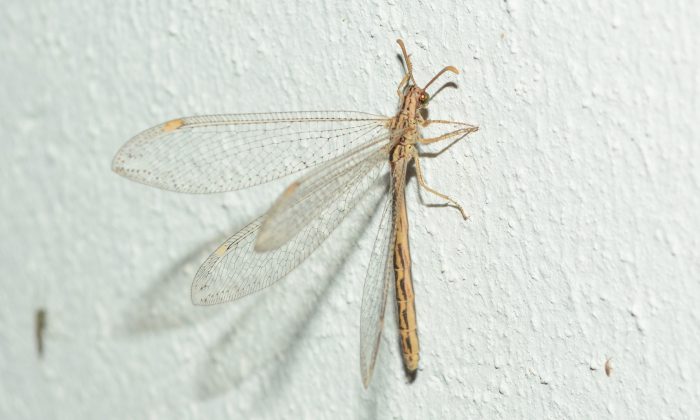
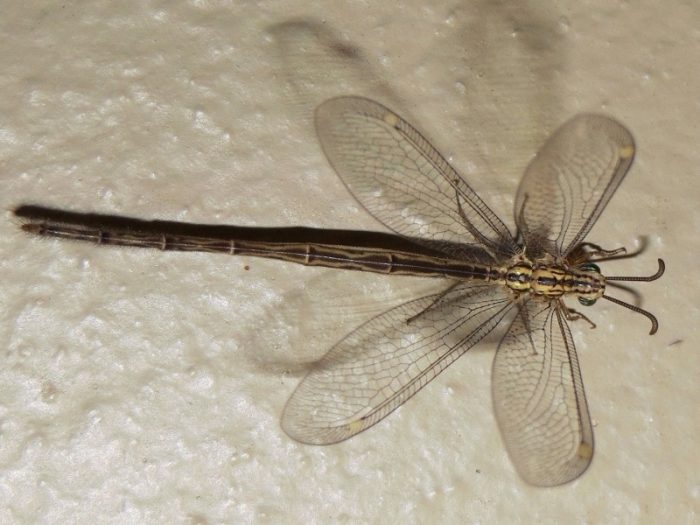
Size: Small (Wingspan around 58mm)
Most Cueta species are flesh-coloured antlions with dark brown patterning and stripes on the abdomen and thorax. The wings are clear with numerous, small dark brown speckles or dark veins. Males have more elongate abdomens than females.
Cueta trivirgata is distinguished by its abdomen pattern and feint dark speckling in the wings as well as its genitalic features.
There are several other similar looking species in the genus.
Larvae: The larvae are pinkish and largely indistinguishable from those of other Cueta species.
Cueta trivirgata(female) – Near Carnarvon, Northern Cape Photo by Ryan TippettCueta trivirgata(male)– Near Carnarvon, Northern Cape Photo by Ryan Tippett
Habitat
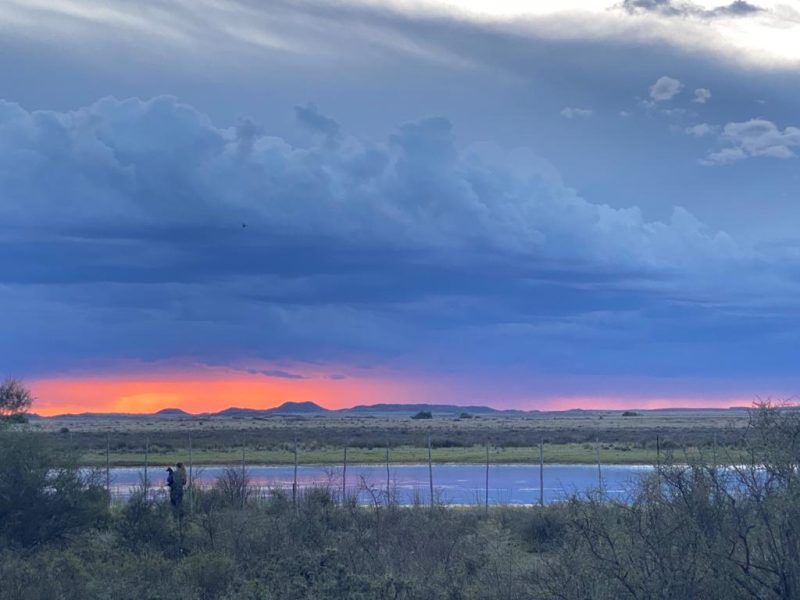
Inhabits a range of habitats from arid Karoo shrublands to dry savanna and grasslands.
Habitat – Karoo-Gariep Nature Reserve, Northern Cape Photo by Ryan Tippett
Behaviour
Adults are nocturnal and they are regularly attracted to lights. They are active throughout Summer and have been recorded from October to April.
The larvae are typical pit-builders and often construct pits in completely exposed situations, and are able to tolerate fairly high temperatures.
Cueta trivirgata – Karoo National Park, Western Cape Photo by Sharon Stanton
Status and Distribution
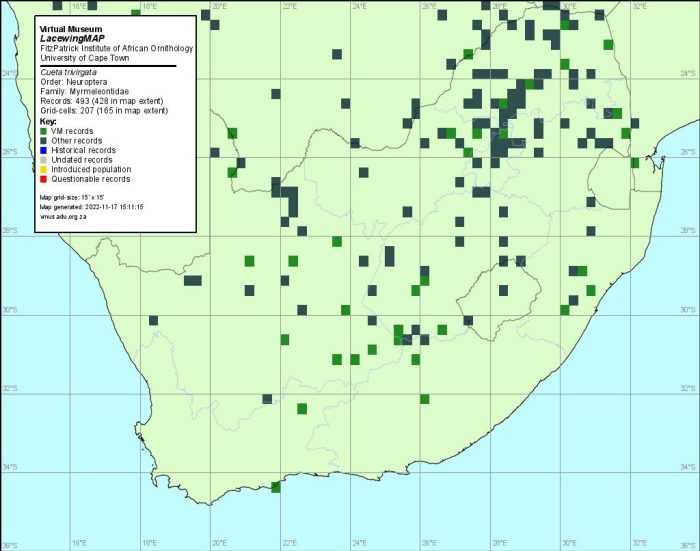
Cueta trivirgata is Common and widespread across most of southern Africa. In South Africa it has been recorded from all nine provinces.
Distribution of Cueta trivirgata. Taken from the LacewingMAP database, November 2022.
Cueta trivirgata – Near Carnarvon, Northern Cape Photo by Ryan Tippett
Further Resources
Virtual Museum (LacewingMAP > Search VM > By Scientific or Common Name)
Acknowledgements:
The use of photographs by John Wilkinson, Sharon Stanton and Zenobia van Dyk is acknowledged. This species text has benefited enormously from comments made by Mervyn Mansell on records he has identified in LacewingMAP. We acknowledge his important contribution.
Recommended citation format for this species text:
Tippett RM 2022. Cueta trivirgata. Biodiversity and Development Institute, Cape Town. Available online at http://thebdi.org/2022/11/17/cueta-trivirgata/
Cueta trivirgata – Near Tshipise, Limpopo Photo by John Wilkinson
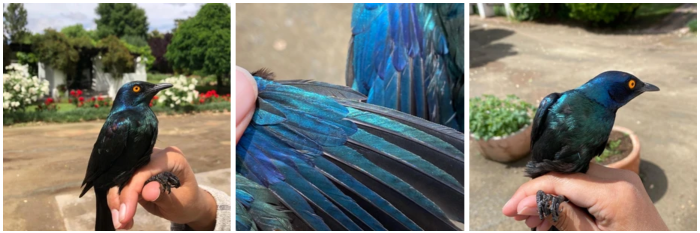
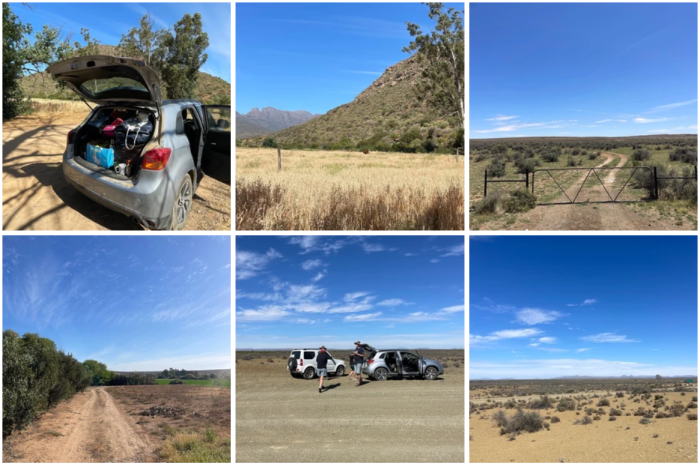
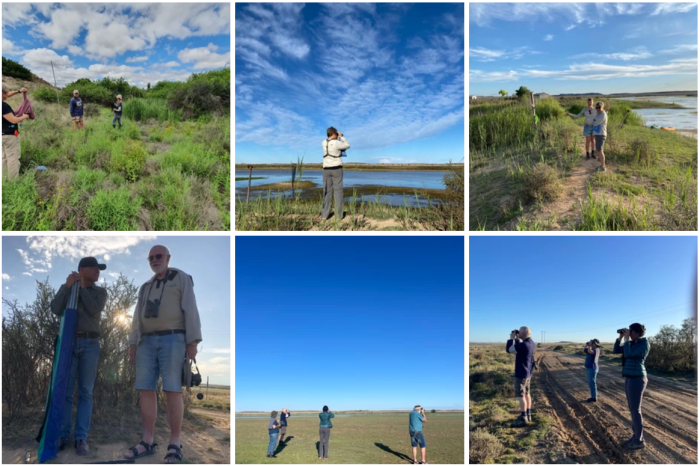
“Oh, it’s a glossy starling!” The car comes to a stop on the side of the highway. The passengers grab their binoculars and cameras and hop out of the vehicle, determined to get a closer look. New to the South African birding scene, I am not quite sure what I am looking for, but the team points my gaze in the right direction and suddenly I am acquainted with the Cape Glossy Starling for the first time. Its shimmering iridescent feathers, piercing yellow eyes, and regal appearance were a wonder to behold. We were about 40 minutes into our 700km drive from Vanrhynsdorp to Hanover. At first glance South Africa’s N10 Highway seems like it cuts through an endless, relatively homogenous, and languid landscape. After traveling caravan-style with a team of avid birders, I know for certain that this is not the case. I quickly learn to take in the scenery with an eye to the sky, ground, fences, and bushes; one can discover birds everywhere if they know to look for them.
Cape Glossy Starlings in hand
This is how my week-long adventure in the Karoo—an expanse of semi-desert wilderness in South Africa’s Northern Cape—began. I was fortunate enough to be invited along on a citizen-science based bird ringing course offered by the Biodiversity & Development Institute and led by Dieter Oschadleus at the New Holme Lodge. I spent the week observing citizen science in action, learning about the region’s birds and biodiversity, and getting to know some remarkable, enthusiastic, and knowledgeable individuals.
Moments from our Road Trip
The Karoo
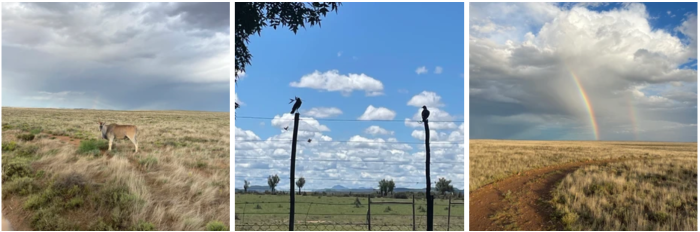
The Karoo is a semi-desert region in Southern Africa. Its vegetation consists primarily of succulents, low shrub bushes, and grasses. The Karoo is widely devoid of surface water beyond small streams and constructed dams, explaining why it is known as the “land of thirst” in Khoisan. Despite its dryness, the Karoo is home to a vast array of birds and mammals, some of which we were acquainted with during our week at the KhoiSan Karoo Conservancy.
Some of the mammals we saw included:
Aardvark
Spring Hare
Aardwolf
African Wild Cat
Cape Porcupine
Steenbok
Scrub Hare
Black-Backed Jackal
Skunk
Cape Fox
Blesbok
Warthog
Eland
Sable
Roan
Bird Ringing in the Karoo
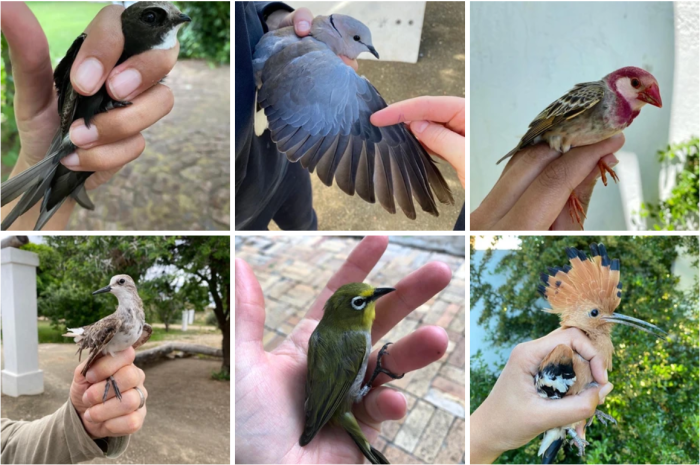
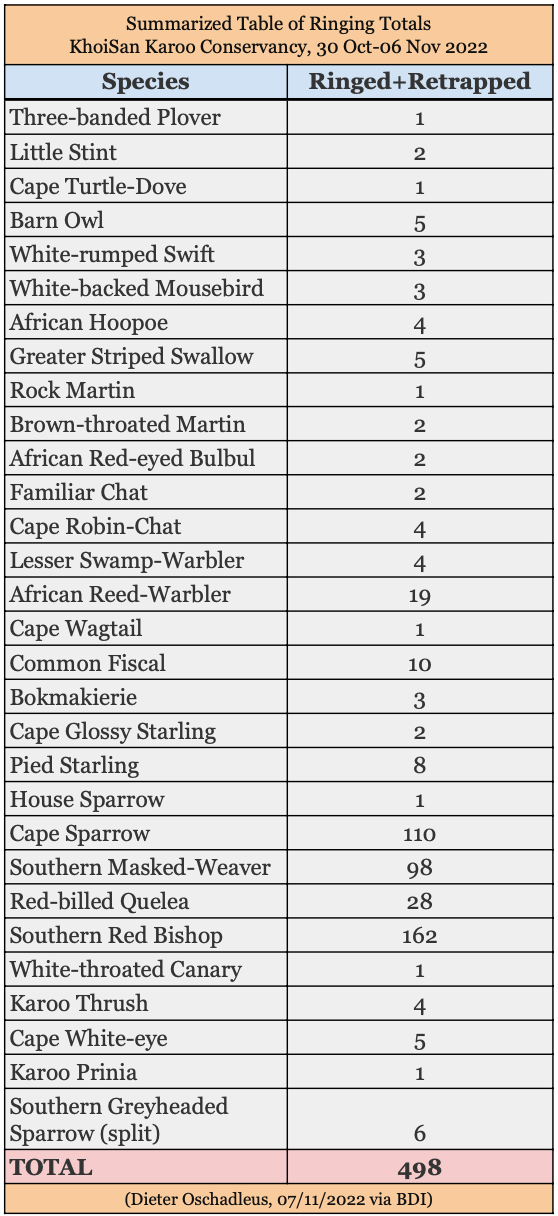
Bird ringing (i.e., bird banding) assists scientists in studying the lifespan, migration patterns, and habits of individual birds. During the course, Dieter and the trainees set up the ringing nets at various locations across the New Holme Farm. The nets gently captured birds and trainees carefully extracted them. Once captured, the birds were identified, weighed, measured, checked for brood patches (evidence of nesting), and adorned with a small aluminum ring that had a unique identification number.
When ringed birds are recaptured, found deceased, or otherwise discovered, information about the sighting should be uploaded to SAFRING. This contributes to an online database for ringed birds in Southern Africa which can be used for research and policy purposes.
To view the complete dataset and read Dieter’s summary of the bird ringing course please check out his post here.
Birding, Citizen Science, and Connections to Nature
During our final dinner as a team, I conducted some brief, informal interviews so I could better understand the significance of birding and citizen science for participants. I’ve transcribed excerpts from these conversations below.
***
Interviewer: How does it feel to contribute to something bigger than a personal passion? To feel like your interest in birds is going somewhere else?
A: It feels amazing. I’ve asked questions about where the data we’ve collected this week will be applied to. Because the data you collect is so small, you don’t realize that it can actually make a contribution… that it can make a big difference and have a bigger outcome. This is the first time I’ve been in the company of actual scientists, and it’s a very new territory for me. It feels exciting and refreshing to contribute to something like this…
A: I think it’s very important for people like myself to come on these courses because I’m not going to change my profession, but I am going to influence and teach people like myself by speaking in layman’s terms. Being in the field and being able to ask questions is invaluable because it helps me build knowledge and understanding.
Interviewer: It brings science down to the conversation level and the life level.
A: Yes, because it happens in your garden. The way I actually got into birding—which I think is a common story—is that I liked birds but I couldn’t identify most of the species at my bird feeder. I really wanted to know the specific details.
Interviewer: Has knowing the specific details influenced your relationship to birds?
A: Of course, definitely, it has made me more curious, more adventurous to go out and listen, to tune myself more into the environment and new areas, even if I don’t know what to expect there.
***
Interviewer: What is your perspective on birding and citizen science? What motivates your involvement?
S: For me it’s just a passion for birds, I’m just an enthusiast. I’m not a scientist.
Interviewer: Do you find that your experiences with birds impacts other areas of your life? Does birding become more than just a passion?
S: Yes, of course. It impacts on everything. It’s everything. It’s the spiders, it’s the scorpions, it’s the lifestyle, it’s the recycling, it impacts everything.
***
Note: Some of the responses were edited for clarity, brevity, and grammar. To protect privacy, full names were omitted.
Throughout the course of our trip to the Karoo, the team and I had many conversations about citizen science, ecological knowledge, and birding. It was really interesting to see how a passion for a birds can ignite involvement in citizen science-based courses and fieldwork, which in turn allows people to further cultivate their personal relationships with nature. As these interviews demonstrate, citizen science may have a ripple effect on behaviours, relationships, and perspectives.
I am grateful for Les Underhill and Dieter Oschadleus for inviting me along on the course and for being such kind, generous, and helpful people. Ryan and Jana, thank you for hosting us for lunch at Rietaar and for showing us around the farm! To the staff of New Holme Nature Lodge, many thanks for your wonderful hospitality. Finally, to A, K, S, J, and D: thank you for sharing your passion for birds with me, entertaining my questions, and making me feel so welcome. I am inspired by you!
Cover image of Fiscal Flycatcher by Michael Brooks – Citrusdal, Western Cape – BirdPix 4619 Fiscal Flycatcher
Identification
The Fiscal Flycatcher is smaller (17–20c m) and less aggressive bird than its shrike look-alike – the Southern Fiscal – despite being similar in many other attributes such as perching and hunting habits. An easy way to distinguish the Fiscal Flycatcher from the Southern Fiscal is by the Southern Fiscal’s stronger hook on the bill and its white, V-shaped shoulder markings.
Male and female Fiscal Flycatchers look a little different from one another. Males have a black head and back with white underparts and a white wing marking about midway down the wing.
Fiscal Flycatcher (male): BirdPix 8398 – Gregg & Desire Darling, St. Francis Bay, Eastern Cape, 22 June 2014. Fiscal Flycatcher (female): BirdPix 17733 – 23 May 2015.
Females and juveniles are similar in appearance to the males but are more blackish-brown or greyish-brown in colour. Juveniles are often duller and more mottled than females. Fiscal Flycatchers have black eyes, bill, feet and legs.
Juvenile Fiscal Flycatchers – Left: BirdPix 116658 – Johan & Estelle van Rooyen, Vermaaklikheid, Western Cape, 20 January 2017. Right: BirdPix 47066 – Tony Archer, Klerksdorp, North West, 10 December 2017.
Distribution
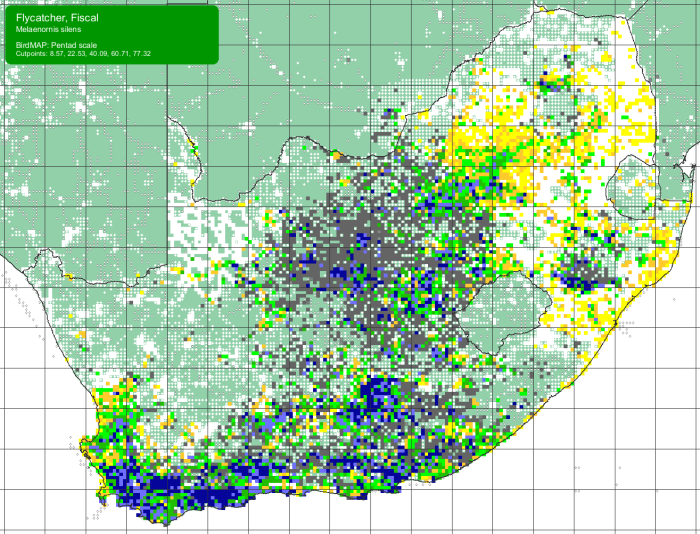
The Fiscal Flycatcher is endemic to southern Africa. It occurs from south-eastern Botswana and southern Mozambique to Swaziland and most of South Africa.
SABAP2 distribution map for Fiscal Flycatcher, downloaded on 10 November 2022. Details for map interpretation can be found here.
Habitat
Fiscal flycatchers generally favours open habitats with scattered trees or bushes, such as moist and semi-arid grasslands, woodlands, and savannas. They are also found in fynbos and Nama Karoo scrubland. This species is most common in ecotones between two habitats; one with fairly dense thicket used for nesting and another with large patches of open ground for foraging.
Fiscal Shrikes use trees, bushes, and fenceposts as perches to scan for prey (insects).
Perched on a thorn tree – BirdPix 21777 – Dewald du Plessis, Heuningneskloof, Northern Cape, 07 June 2007.
A fence post makes for a great perch! – BirdPix 88449 – Keir Lynch, Bredasdorp, Western Cape, 16 August 2019.
Behaviour
The Fiscal Flycatcher mainly eats small insects supplemented with fruit. It does most of its foraging from a high perch, pouncing on prey on the ground or occasionally hawking insects from the air.
Grubs up! – BirdPix 112541 – Andrew Keys, Hartebeespoort, North West, 12 May 2020.
Breeding season starts in July and peaks from October to December. The female constructs the bulky cup-shaped nest which is made from stems of dry grass and combined with other plants, such as everlastings (Helichrysum) and slangbos (Stoebe). In urban areas items like string and bits of rags will also be used for the nest.
The female lays two to four eggs, which she incubates for about 13-16 days. During this time, the male brings food for the female.
Chicks in the nest – BirdPix 23880 – Dewald du Plessis, Doornkloof, Lindley, Free State Province, 21 November 2009.
Fiscal Flycatchers are important insectivores; together with other bird species they help control ant, termite, moths, mealy bugs and other ‘pest’ species.
Further Resources
Species text from the first Southern African Bird Atlas Project (SABAP1), 1997.
Virtual Museum (BirdPix > Search VM > By Scientific or Common Name).
Other common names: Fiskaalvlieëvanger (Afrikaans); Icola (Xhosa); Klauwiervliegenvanger (Dutch); Gobemouche fiscal (French); Würgerschnäpper (German).
List of bird species in this format is available here.
Recommended citation format: Loftie-Eaton M and Daniel KA 2022. Fiscal Flycatcher Melaenornis silens. Bird Feeder Project. Biodiversity and Development Institute. Available Online at http://thebdi.org/2022/11/15/fiscal-flycatcher-melaenornis-silens/
View the above photo record (by Craig Peter) in LacewingMAPhere.
Myrmeleontidae (Antlions)
Cueta infima
(Gerstaecker, 1885)
Identification
Size: Small (Wingspan around 58mm)
Most Cueta species are flesh-coloured antlions with dark brown patterning and stripes on the abdomen and thorax. The wings are clear with numerous, small dark brown speckles or dark veins.
Cueta infima is very similar to other species of the genus, but may be distinguished by more heavily marked wing veins, genitalic features and abdominal pattern.
There are several other similar looking species in the genus.
Larvae: The larvae are pinkish and largely indistinguishable from those of other Cueta species.
Cueta infima– Riebeek East, Eastern Cape Photo by J.A. HarrisonCueta infima– Karoo-Gariep Nature Reserve, Northern Cape Photo by Ryan Tippett
Habitat
Inhabits Nama-Karoo and thicket habitats, mainly in the Summer rainfall zone.
Habitat – Karoo-Gariep Nature Reserve, Northern Cape Photo by Ryan Tippett
Behaviour
Adults are nocturnal and they are regularly attracted to lights. They are active during Summer and have been recorded from November to April.
The larvae are typical pit-builders and often construct pits in completely exposed situations, and are able to tolerate fairly high temperatures.
Cueta infima – Karoo National Park, Western Cape Photo by Alan Manson
Status and Distribution
Cueta infima is common but has a fairly limited distribution. Its range is mainly centred on the Eastern Cape but also occurs in neighbouring parts of the Western Cape and the south-eastern parts of the Northern Cape.
Distribution of Cueta infima. Taken from the LacewingMAP database, November 2022.
Cueta infima – Karoo National Park, Western Cape Photo by Alan Manson
Further Resources
Virtual Museum (LacewingMAP > Search VM > By Scientific or Common Name)
Acknowledgements:
The use of photographs by Alan Manson, Craig Peter and J.A. Harrison is acknowledged. This species text has benefited enormously from comments made by Mervyn Mansell on records he has identified in LacewingMAP. We acknowledge his important contribution.
Recommended citation format for this species text:
Tippett RM 2022. Cueta infima. Biodiversity and Development Institute, Cape Town. Available online at http://thebdi.org/2022/11/15/cueta-infima/
Cover image by Gregg Darling – St Francis Bay – Eastern Cape – BirdPix 10073 House Sparrow
Identification
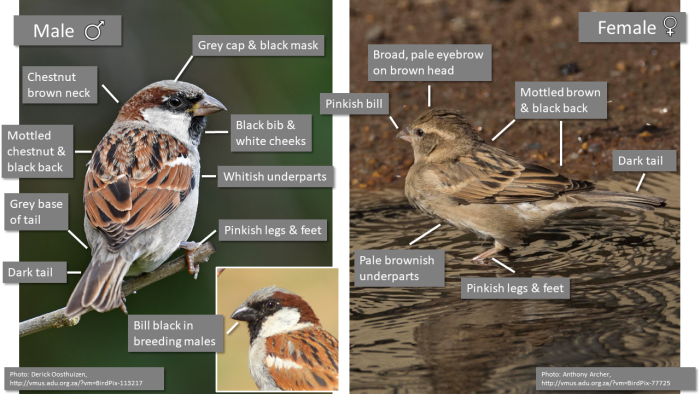
Females and young House Sparrows are pale brown and grey in colour, whereas the males have brighter black, white, and chestnut brown markings. The male has a grey cap, black face mask and chestnut brown neck. Its back and wings are chestnut and black in colour.
House Sparrow (male): BirdPix 113217 – Derick Oosthuizen, Stilbaai, Western Cape, 21 April 2020. House Sparrow (female): BirdPix 77725 – Anthony Archer, Klerksdorp, North West, 11 May 2019. Breeding male inset photo: BirdPix 158053 – Janet du Plooy, Evander, Mpumalanga, 20 August 2018.
Distribution
House Sparrows are native to Eurasia, but was introduced to Australasia, the Americas, and Africa. It is one of the most widespread species in the world. In Africa, it was introduced along the Nile River and separately from southern DRC through to Zambia, Angola, and South Africa. In South Africa it is locally common, especially in urban and suburban areas.
SABAP2 distribution map for House Sparrow, downloaded on 08 November 2022. Details for map interpretation can be found here.
Habitat
The House Sparrow is strongly associated with human habitation. They prefer to live in urban or rural settings. They can be found in widely varied habitats and climates, but they typically avoid extensive woodlands, grasslands, and desert habitats that are far away from human development.
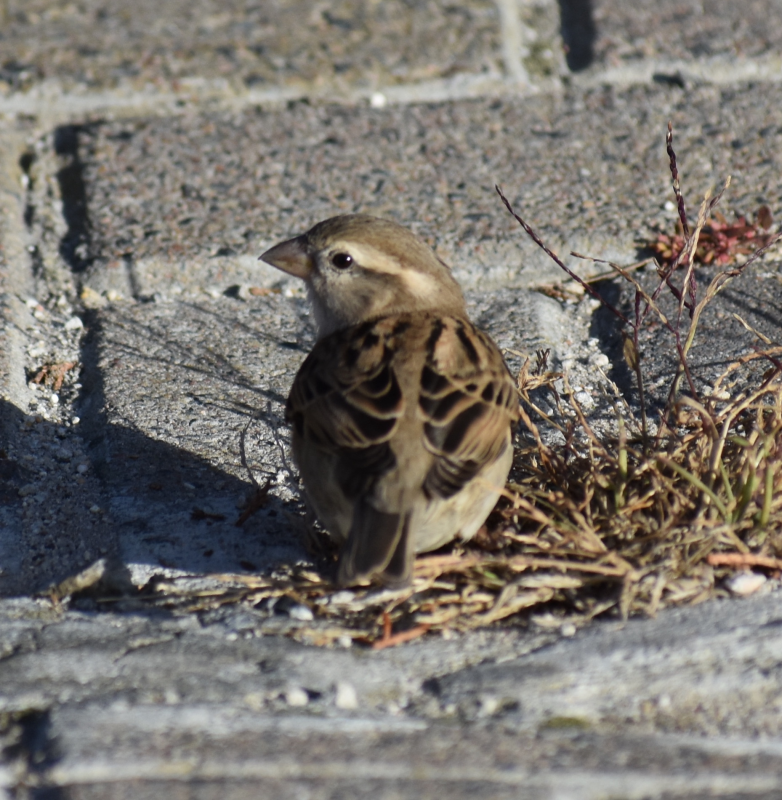
Looking for seeds on the pavement – BirdPix 225631 – Karis Daniel, Kleinbaai Harbour, Western Cape, 13 May 2022.
Behaviour
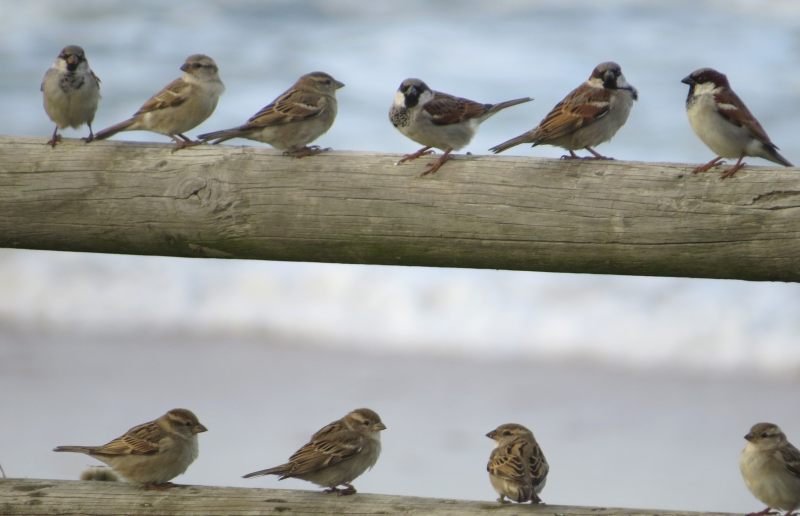
The House Sparrow is a very social and gregarious bird. When foraging for food, it often forms flocks with other bird species.
A group of House Sparrows – BirdPix 224642 – C. Elstadt, Jeffreys Bay Caravan Park, Eastern Cape, 05 June 2015.
They have a varied diet which includes seeds, nectar, fruit and invertebrates. House Sparrows most frequently pluck food items from the ground, but they also glean insects from plants or hawk small prey in the air.
In towns and cities, House Sparrows often scavenge for food in garbage containers and they often congregate near restaurants with outdoor areas and supermarkets to feed on leftover food and crumbs.
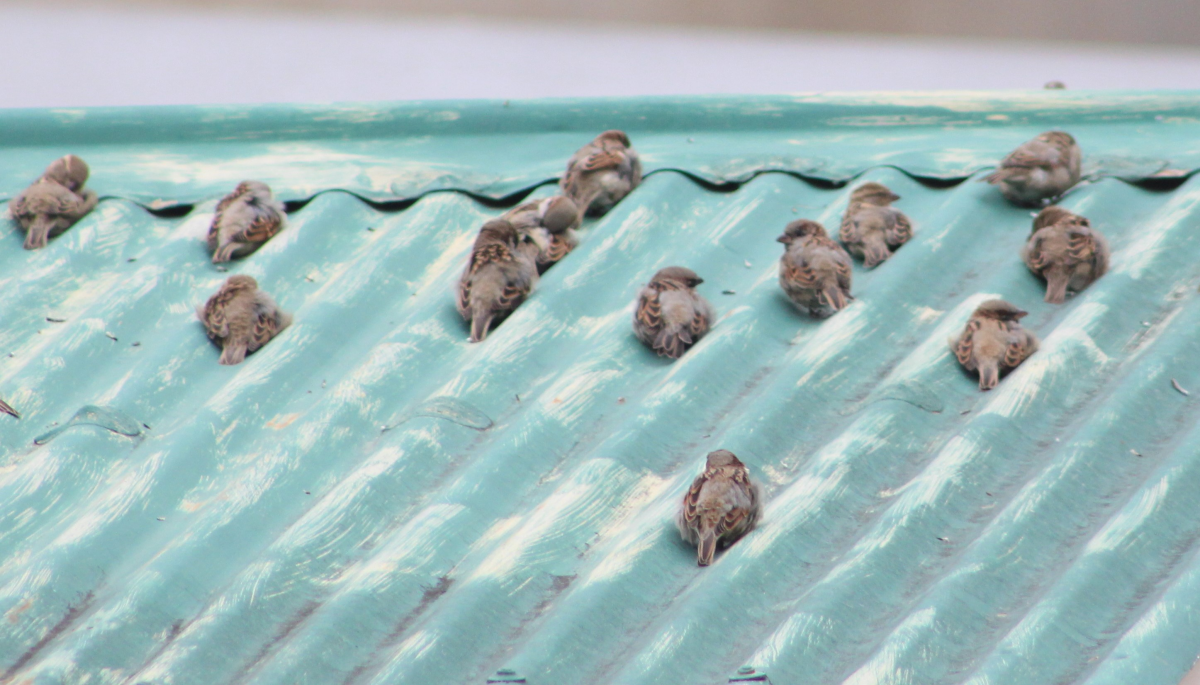
Sunbathing on the roof – BirdPix 213914 – J. du Plooy, Winburg, Free State Province, 20 March 2022.
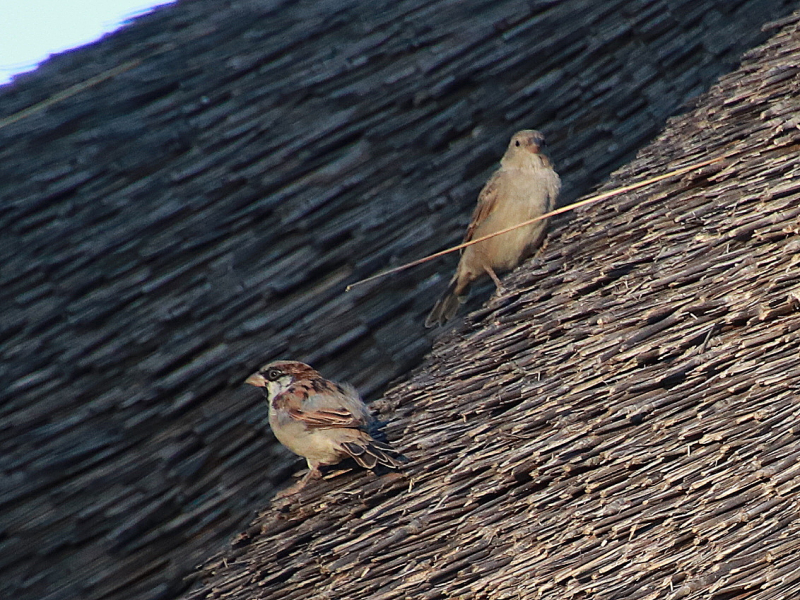
House Sparrows are monogamous and form a pair bond for life. The male and the female construct the nest. It consists of a ball-shaped structure with an entrance on the side or on the top. Usually, the nest is made of grass, feathers, wool, and other soft material. They typically place the nest in a building, under eaves or in a thatched roof. They may also use a tree or an unused swallow nest.
A pair of House Sparrow looking for a nesting location on a thatched roof – BirdPix 206931 – Marius Meiring, Bloemfontein, Free State Province, 10 February 2021.
Further Resources
Species text from the first Southern African Bird Atlas Project (SABAP1), 1997.
Virtual Museum (BirdPix > Search VM > By Scientific or Common Name).
Other common names: Huismossie (Afrikaans); Jolwane (Swazi); Enzunge (Kwangali); Moineau domestique (French); Haussperling (German).
Recommended citation format: Loftie-Eaton M and Daniel KA 2022. House Sparrow Passer domesticus. Bird Feeder Project. Biodiversity and Development Institute. Available Online at http://thebdi.org/2022/11/15/house-sparrow-passer-domesticus/
Cover image by J. Jordaan – Addo Elephant National Park – BirdPix 31413 Red-faced Mousebird
Identification
The Red-faced Mousebird has a slaty-grey head and crest with a pale cinnamon forehead. As its name suggests, it has a distinctive red patch around its eyes which continues to the base of its bill. Its upperparts and long tail are blue-grey. The sexes are similar, but juveniles lack the crest and have a pale mask.
Juvenile Red-faced Mousebirds. Left: BirdPix 44007- Anthony Paton, Klipriviersberg, Gauteng, 16 April 2015. Right: BirdPix 50184 – Tony Archer, Klerksdorp, North West, 19 February 2018.
The Red-faced Mousebird occurs from southern Angola, Zambia and Malawi, through to southern Africa, where it is common in non-arid areas. The blue and green squares in the Southern African Bird Atlas Project (SABAP2) map below indicates the core of its range in South Africa.
SABAP2 distribution map for Red-faced Mousebird, downloaded on 10 November 2022. Details for map interpretation can be found here.
Habitat
It generally prefers is savanna habitat with thickets, fynbos scrub, open woodland, as well as gardens and orchards.
In the scrub, gathering twigs for a nest – BirdPix 59112 – Dave Rimmer, Cape Town, Western Cape, 28 April 2017.
Behaviour
Red-faced Mousebirds are almost always found in pairs or small groups. Their diet consists mainly of fruit, supplemented with nectar, flowers, and leaves. They typically forage in groups of 3-10, landing in trees and bushes in search of food.
Frugivore! Eating some delicious fruits. Left: BirdPix 16370 – Pamela Kleiman, Steyterville, Eastern Cape, 17 March 2015. Top Right: BirdPix 20422 – Dewald du Plessis, Bloemfontein, Free State, 05 September 2006. Lower Right: BirdPix 57886 – Gregg Darling, St Francis Bay, Eastern Cape, 06 August 2018.
Mousebirds love taking a sand bath! They are social birds and often engage in allopreening.
Having a good sand bath – BirdPix 72958 – Norman Barrett & Rajagopalan Padmanabhan, Lusaka, Zambia, 11 February 2019.
They breed throughout the year, but breeding activity peaks during spring and summer (September to February). The nest is a small cup of made of twigs, leaves and stems, and placed 2-8 metres above the ground in a tree or bush.
Red-faced Mousebirds lay 1-7 eggs, which are incubated by the male and female for 14-20 days. The chicks stay in the nest for 14-20 days after hatching, before becoming independent.
Baby Red-faced Mousebird in the nest! – BirdPix 9108 – Pieter Cronje, Luanda, Angola, 30 July 2014.
Further Resources
Species text from the first Southern African Bird Atlas Project (SABAP1), 1997.
Virtual Museum (BirdPix > Search VM > By Scientific or Common Name).
More common names: Rooiwangmuisvoël (Afrikaans); Intshili (Xhosa); umTshivovo (Zulu); Fariki (South Sotho); Rotzügel-mausvogel (German); Roodwangmuisvogel (Dutch).
A list of bird species in this format is available here.
Recommended citation format: Loftie-Eaton M, Daniel KA 2022. Red-faced Mousebird Urocolius indicus. Bird Feeder Project. Biodiversity and Development Institute. Available online at https://thebdi.org/2022/11/14/red-faced-mousebird-urocolius-indicus/
View the above photo record (by Alan Manson) in LacewingMAPhere.
Cueta mysteriosa
(Gerstaecker, 1893)
Identification
Size: Small (Wingspan around 58mm)
Flesh-coloured antlions with dark brown patterning and stripes on the abdomen and thorax. The wings are clear with numerous, small dark brown speckles.
There are several other similar looking species in the genus.
Larvae: The larvae are pinkish and largely indistinguishable from those of other Cueta species.
Cueta mysteriosa– Near Hluhluwe, KwaZulu-Natal Photo by Ryan TippettCueta mysteriosa– Near Hluhluwe, KwaZulu-Natal Photo by Ryan Tippett
Habitat
Inhabits woodland, coastal forest, sand forest and woodlands, mainly on sandy soils, in the humid coastal region of north-eastern KwaZulu-Natal.
Dry sand forest habitat – Mkhuze Game Reserve, KwaZulu-Natal Photo by Ryan Tippett
Behaviour
Adults are nocturnal and they are regularly attracted to lights. They are active during Summer and have been recorded from September to April.
The larvae are typical pit-builders and often construct their traps in the open.
Cueta mysteriosa– San Sebastian Nature Reserve, Mozambique Photo by Rick Nuttall
Status and Distribution
In South Africa Cueta mysteriosa is largely confined to the coastal areas of KZN where it is fairly common. It extends further north through Mozambique (including Inhaca island) to Kenya.
Distribution of Cueta mysteriosa. Taken from the LacewingMAP database, November 2022.
Cueta mysteriosa– Near Hluhluwe, KwaZulu-Natal Photo by Ryan Tippett
Further Resources
Virtual Museum (LacewingMAP > Search VM > By Scientific or Common Name)
Acknowledgements:
The use of photographs by Rick Nuttall is acknowledged. This species text has benefited enormously from comments made by Mervyn Mansell on records he has identified in LacewingMAP. We acknowledge his important contribution.
Recommended citation format for this species text:
Tippett RM 2022. Cueta mysteriosa. Biodiversity and Development Institute, Cape Town. Available online at http://thebdi.org/2022/11/11/cueta-mysteriosa/
Cover image: White-backed Mousebird by Ryan Tippett – BirdPix 103558 White-backed Mousebird
Identification
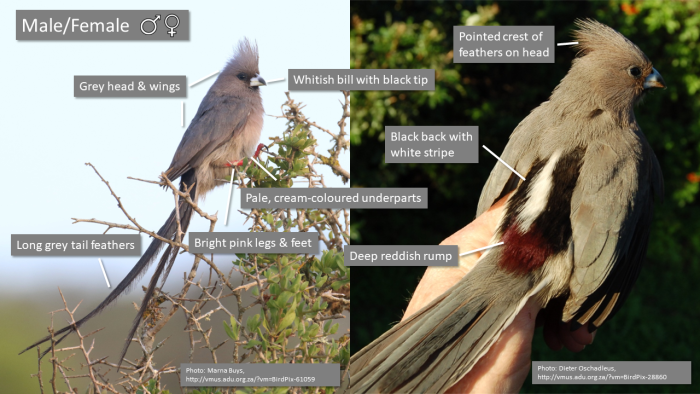
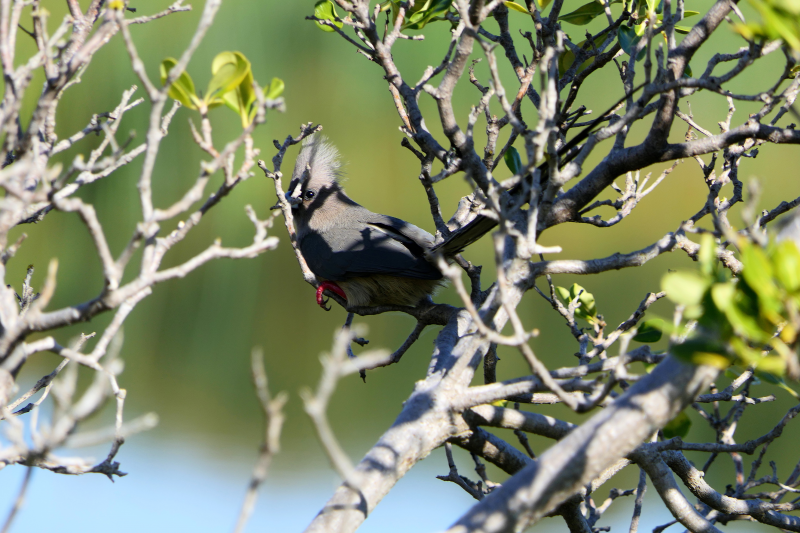
The White-backed Mousebird has a grey head, prominent crest, and grey upper parts and breast. It has a white stripe on its back which is flanked by two broad black stripes and a dark red, or maroon, transverse band at the base of its tail. The white stripe is not visible unless the wings are at least partly open. White-backed Mousebirds have bright pink legs and feet and a whitish bill with a black tip.
Left: BirdPix 61059 – Marna Buys, Cape Town, Western Cape, 24 September 2017. Right: BirdPix 28860 – Dieter Oschadleus, Bellville, Western Cape, 09 August 2016.
It has a whistled zwee-wewit call. It also has a buzzing or crackling call that might be for alarm or keeping in contact with the group.
It is a Near-endemic to southern Africa, occurring from south-western Angola to Namibia, western and central South Africa and southern Botswana. In the SABAP2 map below the blue and green squares represent the core of the White-backed Mousebird’s range in South Africa.
SABAP2 distribution map for White-backed Mousebird, downloaded on 11 November 2022. Details for map interpretation can be found here.
Habitat
The White-backed Mousebird generally prefers riverine habitat in sparse woodland areas. It can also be found in farmyards, gardens and orchards. In the Western Cape it is quite common in Port Jackson Acacia saligna and Rooikrans Acacia cyclops thickets.
BirdPix 222218 – Sharon Stanton, Helderberg Village, Somerset West, Western Cape, 05 June 2022.
Behaviour
The White-backed Mousebird is a frugivore which subsists on fruits, berries, leaves, seeds and nectar. Its fruit-eating habits are an important factor in spreading the seeds of indigenous berry-producing plants such as Halleria lucida.
Left: BirdPix 117558 – Terry & Maria Terblanche, Twee Rivieren, Northern Cape, 16 August 2013. Right: BirdPix 85393 – Les Underhill, Melkbosstrand, Western Cape, 20 July 2019.
When breeding, the nest is built by both sexes, consisting of a small, shallow bowl of twigs, leaves and grass. It is often lined with fluffy seeds, down, and occasionally sheep’s wool. Egg-laying season is year-round, peaking from September-October.
White-backed Mousebirds are very social birds. During the day, they feed together in small groups and engage in allopreening. They also roost in groups at night. Their perching habits can be quite amusing; almost hanging from their legs rather than perching normally like most birds. It’s very common for them to grip different upright branches of a plant with each leg.
Hanging in there – BirdPix 221622 – Itxaso Quintana, Laingsburg, Western Cape.
Further Resources
Species text from the first Southern African Bird Atlas Project (SABAP1), 1997.
Virtual Museum (BirdPix > Search VM > By Scientific or Common Name).
More common names: Witkruismuisvoël (Afrikaans); Letsôrô (Tswana); Coliou à dos blanc (French); Weißrücken-mausvogel (German); Witstuitmuisvogel (Dutch).
A list of bird species in this format is available here.
Recommended citation format: Loftie-Eaton M, Daniel KA 2022. White-backed Mousebird Colius colius. Bird Feeder Project. Biodiversity and Development Institute. Available online at http://thebdi.org/2022/11/11/white-backed-mousebird-colius-colius/
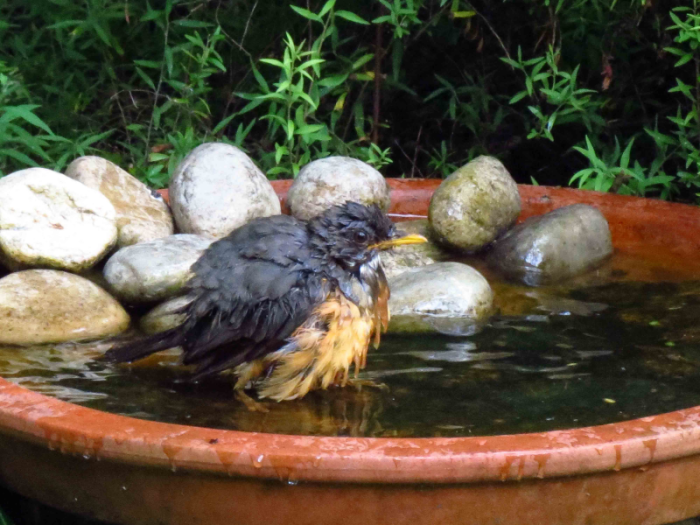
The Olive Thrush has a dark grey head, back, and tail, an orange belly, and a white rump. It has a yellow bill with a dark base and on its throat it has a white patch with dark streaks. Its legs and feet are orange. Males and females look alike. Juvenile birds are quite spotty and pale in colour.
BirdPix 125616 – Robyn Dickinson, Waterfall, KwaZulu-Natal, 15 August 2020.
Juvenile Olive Thrush – BirdPix 189934 – Marius Meiring, Keurbooms Forever Resort, Western Cape, 28 January 2021.
It has a wonderful melodious call! Take a listen here.
Distribution
The Olive Thrush is endemic to southern Africa, with the bulk of its distribution centred on South Africa’s eastern and southern coast. Its range extends into Lesotho and Limpopo Province, with a smaller population in Zimbabwe’s eastern highlands.
SABAP2 distribution map for Olive Thrush, downloaded on 08 November 2022. Details for map interpretation can be found here
Habitat
It prefers riverine bush and montane forest. It has adapted to alien tree plantations, gardens, parks and fruit orchards. In particular, Olives Thrushes like well-shaded places with damp soil and moist leaf litter. They also love a bird bath!
Olive Thrush in the garden – BirdPix 237844 – Lia Steen, Shellybeach, KwaZulu-Natal, 03 October 2022.
Splish-splash I was taking a bath – BirdPix 193803 – George, Western Cape, 8 January 2012.
Behaviour
The Olive Thrush is a rather shy and unobtrusive bird. It can often be found in the quieter corners of a garden, under trees and bushes, while it is looking for food. Although you can encounter this species at any time of the day, you are most likely to see it at dawn or dusk, because that is the time when it is most active. So it can be described as crepuscular.
It mainly eats earthworms supplemented with insects. It also eats other invertebrates and fallen fruit. It does most of its foraging on the ground, flicking through leaf litter in search of prey.
An apple a day keeps the doctor away – BirdPix 167131 – A. Collett, Wilderness, Western Cape, 16 June 2008.
The female builds a cup nest, typically up to 6 m above the ground in a tree. The Olive Thrush especially likes to nest in gardens, so keep an eye out! The two to three eggs are incubated mainly by the female for 14-15 days to hatching, and the chicks fledge after about another 16 days. The young ones remain dependent on their parents for up to two months after fledging!
In the nest! – BirdPix 16489 – Doug Harbottle, Cape Town, Western Cape, 03 March 2015.
Further Resources
Species text from the first Southern African Bird Atlas Project (SABAP1), 1997.
Virtual Museum (BirdPix > Search VM > By Scientific or Common Name).
Other common names: Olyflyster (Afrikaans); Umswi (Xhosa); umuNswi (Zulu); Kaapse lijster (Dutch); Kapdrossel (German).
A list of bird species in this format is available here.
Recommended citation format: Loftie-Eaton M and Daniel KA 2022. Olive Thrush Turdus olivaceus. Bird Feeder Project. Biodiversity and Development Institute. Available online at http://thebdi.org/2022/11/09/olive-thrush-turdus-olivaceus/