
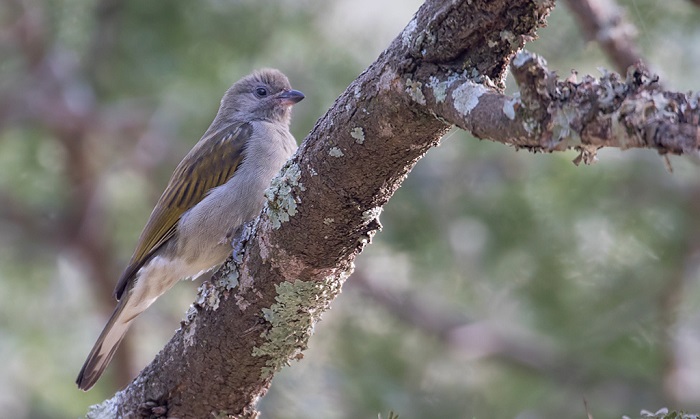
Cover image: Lesser Honeyguide by Gregg Darling – Baviaanskloof Conservation Area, Eastern Cape
Honeyguides belong to the Family INDICATORIDAE. This is the only family of birds in which every member is exclusively brood parasitic. All are drab, secretive inhabitants of forest and woodland. They are intriguing and unusual birds with an array of fascinating adaptations. Honeyguides are morphologically unique among the non-passerines in having nine primaries. The Indicatoridae are distributed across the Old World tropics of Africa and Asia. The family comprises 16 species from four genera. Africa is home to 14 species, with two found in Asia. Six species are known from southern Africa.
Identification
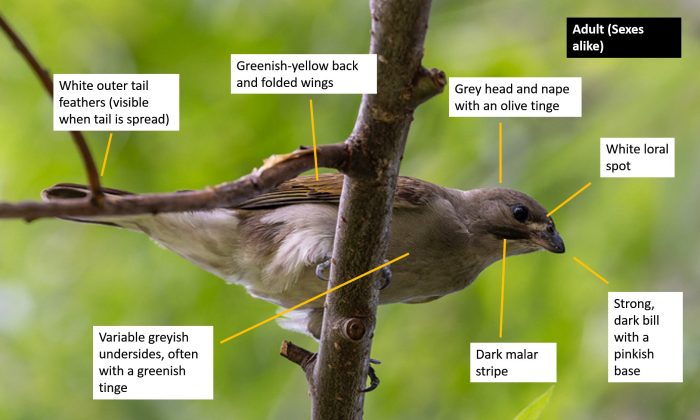
Near Krugersdorp, Gauteng
Photo by Roelof van der Breggen
In adult Lesser Honeyguides, the sexes are alike. The forehead to the nape and the sides of the neck are grey with an olive tinge. A white loral spot is present between the eye and the bill. The ear coverts, and the area below the eye are pale grey. An untidy, dark malar stripe is present on the face (diagnostic in southern Africa). The back, folded wings, and rump are yellowish green, somewhat greyer on the upper back, and greener on the wings, lower back and rump. The chin is greyish-white. The breast and belly can vary from grey-white to yellowish grey, or brownish-buff, often with a greenish tinge. The flanks are pale greyish white, with dark feather shafts. The tail is grey-brown, with a green wash and white outer tail feathers which are only visible when the tail is spread. The undertail coverts are whitish.
The bill ranges from black to blackish-horn, often with a pinkish base. The eyes are dark brown, and the legs and feet are olive-grey. Like all honeyguides, they have well-developed nostrils and zygodactyl feet.
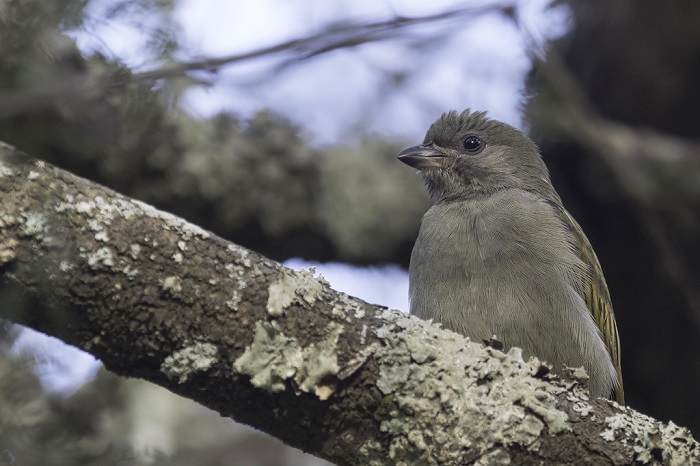
Baviaanskloof Conservation Area, Eastern Cape
Photo by Desiré Darling
Juveniles and immatures are darker overall than adults. The throat is finely streaked, and the breast is buffier. They also have pointed tail feathers and lack the white loral mark and malar stripe.
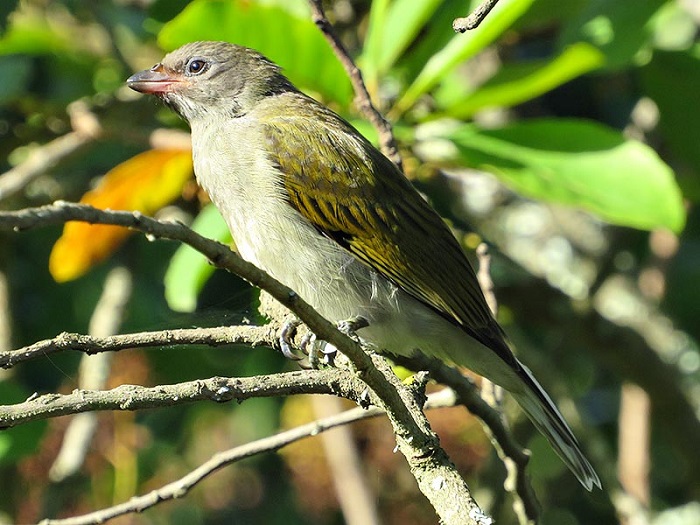
Hhohho, eSwatini
Photo by Kate Braun
The Lesser Honeyguide is most likely to be mistaken for the Pallid Honeyguide (Indicator meliphilus) and the Green-backed Honeybird (Prodotiscus zambesiae), both of which are similarly plumaged but lack the dark malar stripe of the adult Lesser Honeyguide. In poor light, the Lesser Honeyguide could also be mistaken for the larger Scaly-throated Honeyguide (Indicator variegatus), but the latter has a scaled, not plain, head, throat and breast.
Status and Distribution
The Lesser Honeyguide is widespread in sub-Saharan Africa, from Senegal across to Ethiopia, and down to South Africa. It is absent from the tropical forests of West and Central Africa. In southern Africa, it is found in northern and central Namibia, extreme northern and eastern Botswana, and throughout Zimbabwe, south through eastern South Africa and along the coast to the Western Cape. It is generally not found in arid areas. However, the Lesser Honeyguide’s range does extend west along the Orange River into the arid Northern Cape. The distribution of the Lesser Honeyguide is closely linked to its primary brood hosts and not to that of its main food source, the African Honeybee (Apis mellifera).
The Lesser Honeyguide is fairly common in southern Africa.
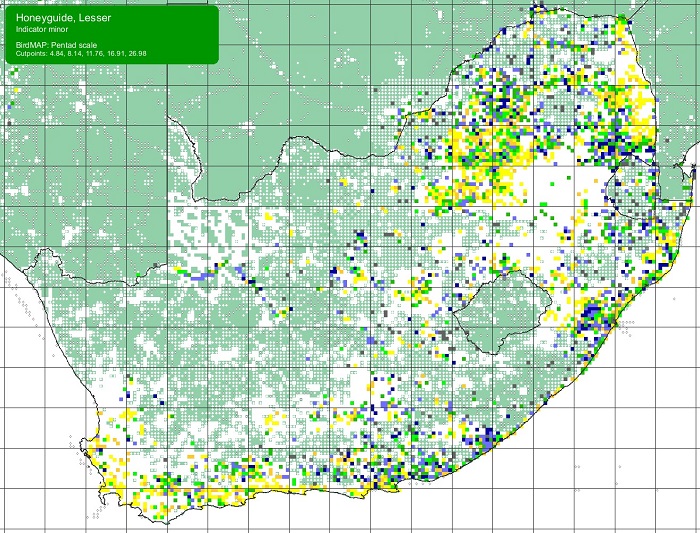
The Lesser Honeyguide is not threatened. It has expanded its range considerably in South Africa during the 20th century, particularly into the Western Cape. Its extension into the Western Cape has been attributed to following one of its main hosts, the Acacia Pied Barbet (Tricholaema leucomelas), into the alien tree infestations of the Fynbos biome.
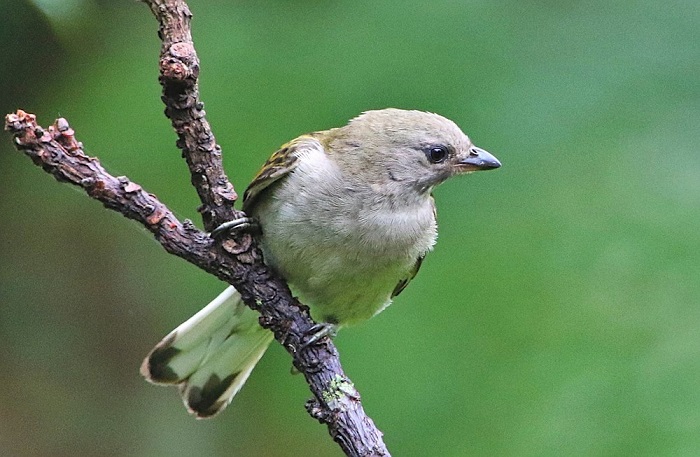
Shelly Beach, KwaZulu-Natal
Photo by Lia Steen
Habitat
The Lesser Honeyguide occupies a wide range of wooded habitats, from savannas with scattered trees to dense woodland, forest edges, secondary forest regrowth, riverine woodland, plantations, parks and gardens.

Wartberg district, KwaZulu-Natal
Photo by Colin Summersgill
Behaviour
The Lesser Honeyguide is resident. Males remain in the general vicinity of their call posts and are more sedentary than females. Females range across large areas as they track the movements of their brood hosts. Lesser Honeyguides are solitary, unobtrusive and easily overlooked unless calling. They spend long periods perched motionless in a hunched posture. They are aggressive towards small birds that perch nearby.
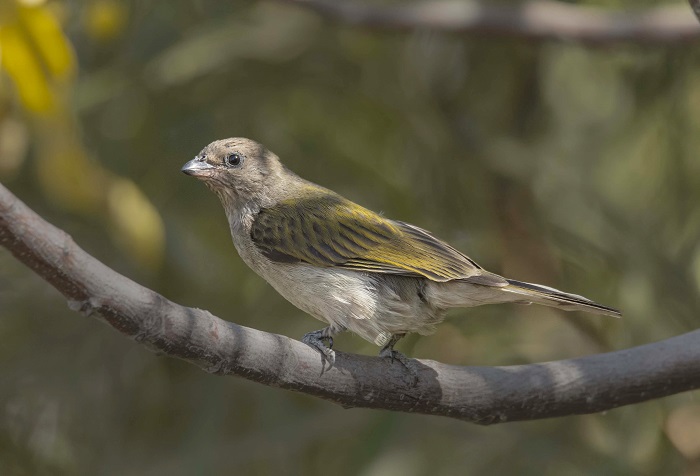
Klerksdorp, North West
Photo by Tony Archer
Their flight is fast and either undulating or direct. Lesser Honeyguides are inquisitive and readily attracted to disturbances, like the alarm calls of other birds and the mobbing of predators. They regularly attend mixed-species foraging flocks. They also drink frequently and are often seen at bird baths.
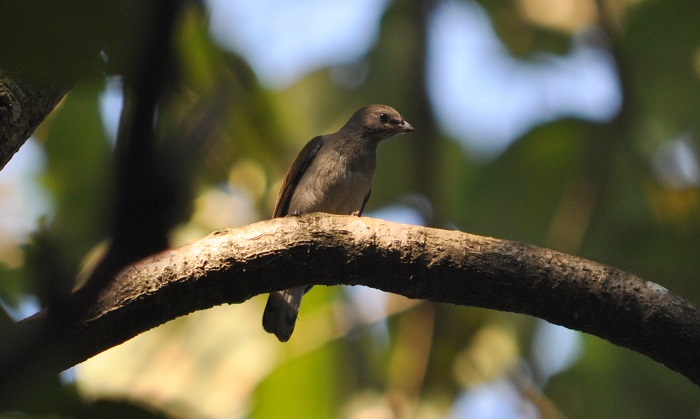
Mtunzini, KwaZulu-Natal
Photo by Ryan Tippett
In common with other honeyguides, the Lesser Honeyguide has a remarkably acute sense of smell, which it uses to identify specific chemical compounds in beeswax. Unlike most birds that rely strictly on sight and sound, honeyguides have enlarged olfactory regions in the brain and prominent, raised nostrils that aid in odour detection. This enables them to locate hidden beehives. They are very adept at finding beeswax and dry honeycombs and have long been documented flying into enclosed spaces in buildings, such as church altars, guided entirely by the scent of lit or unlit beeswax candles! Furthermore, honeyguides are not limited to finding beehives by smell. Their observant nature, keen eyesight and strong hearing are also used to detect the presence and activities of bees.
Unlike the Greater Honeyguide (Indicator indicator), the Lesser Honeyguide does not guide humans to beehives.
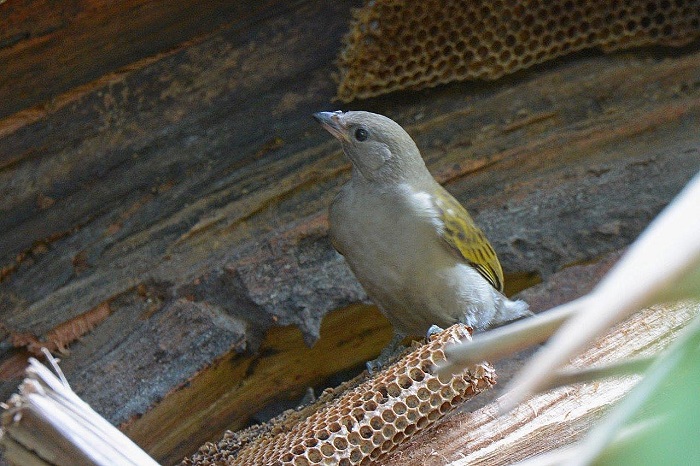
Pigeon Valley Park, KwaZulu-Natal
Photo by Dave Rimmer
The Lesser Honeyguide forages by gleaning insects from leaves and branches and investigating crevices in bark and holes in trees. They also readily hawk aerial insects.
Honeyguides have one of the most interesting and specialised diets of any bird. They prefer to feed on beeswax, aided by symbiotic gut microbes that help digest the wax. This ability to eat wax is known as cerophagy and is rare in other vertebrates. It is unknown exactly how important beeswax is in their diet. Honeycomb is a relatively scarce and hard-to-obtain food source that the birds themselves are not well equipped to access. In most instances, honeyguides would require help to access honeycomb. Honeyguides are not immune to bee stings either, but they do have a tougher-than-usual skin and dense feathering that provides some protection. Both Lesser and Greater Honeyguides are known to be able to survive for extended periods on beeswax alone. Contrary to their name, honeyguides do not eat honey. They largely avoid honey, as it is extremely sticky and can impair the function of their feathers.
Aside from beeswax, Lesser Honeyguides also consume adult bees, their eggs and larvae, as well as wasps, their larvae and pupae. Other arthropods eaten include mayflies, termite workers and alates, ants, caterpillars, beetles, and spiders.
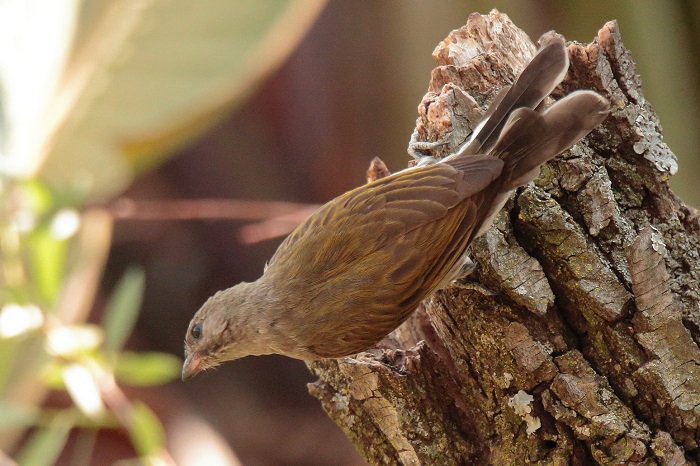
Pretoria National Botanical Gardens, Gauteng
Photo by Johan Heyns
Lesser Honeyguides are brood parasites. Their most frequent hosts in southern Africa are the Black-collared Barbet (Lybius torquatus) and the Acacia Pied Barbet (Tricholaema leucomelas), but a range of other hosts have been recorded. These include other barbet species, woodpeckers, kingfishers, bee-eaters, and starlings. In contrast to the Greater Honeyguide (Indicator indicator), which mainly parasitises species that nest in banks, the hosts of the Lesser Honeyguide mostly nest in tree holes. There are frequent skirmishes with these hosts, which the Lesser Honeyguide is fully capable of fighting off. Their rapid flight also easily allows them to evade attacks.
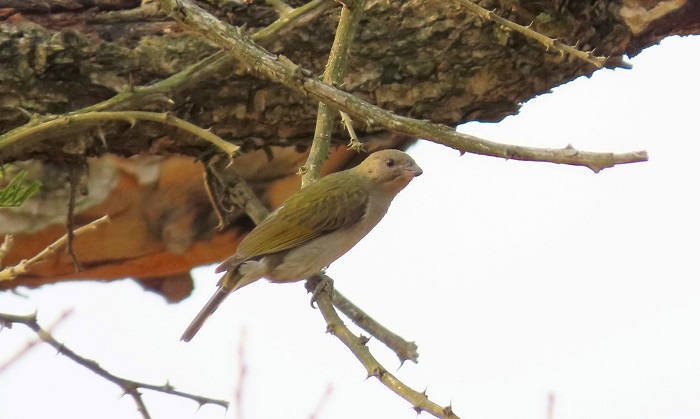
Wartberg District, KwaZulu-Natal
Photo by Colin Summersgill
Breeding occurs from August to February in southern Africa, with a peak from October to December. However, their breeding system appears complex and variable and is not well understood. Lesser Honeyguides are polygynous, meaning that a male mates with multiple females through the breeding season. Males then play no further role in the breeding process.
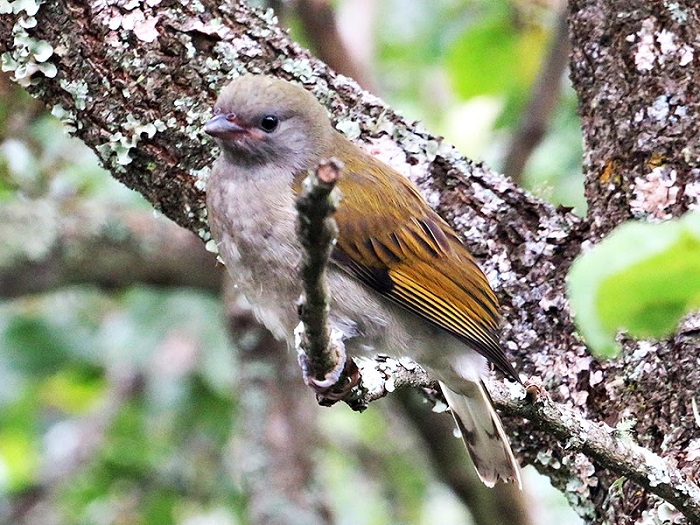
Hhohho, eSwatini
Photo by Kate Braun
During the breeding season, males sing from song posts mostly between 08h00 and 13h00. The same song posts are used for several months of the year and may be used continuously for many years. Different males may sing from the same song post at different times. Females visit these song posts for mating, timing their visits to coincide with ovulation. Males also perform a flight display which may serve a courtship or territorial function, or possibly part of a honeyguide-host interaction. 1 or 2 birds fly in an undulating circle high above a female. Each male flies fast to a peak and then flutter-glides down with stiffened wings and tail fanned. The stiffened wing and tail feathers catch the air and vibrate, producing a mechanical buzzing or drumming sound.
Males are sometimes highly aggressive to one another, often fighting over host barbet pairs. Barbet pairs are guarded by males and followed by females who investigate holes at any time of year, possibly to monitor hosts, and they may even monitor their own young.
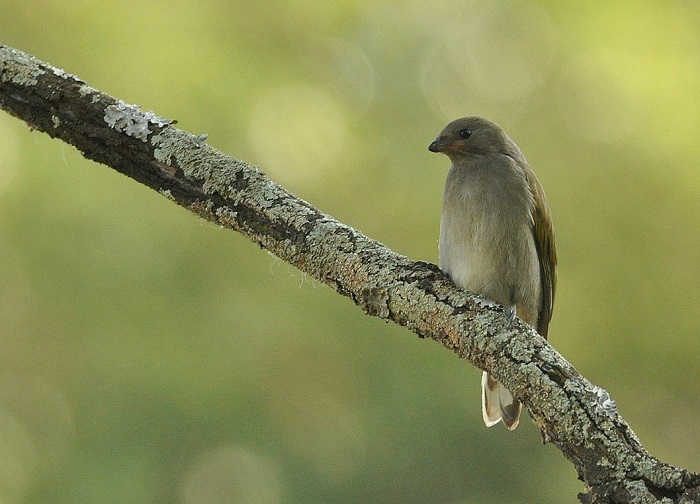
Bloemfontein, Free State
Photo by Rick Nuttall
The egg-laying behaviour of the Lesser Honeyguide is not well known. It has been observed that one or two birds will approach a barbet nest. When two birds approach, one will draw the host’s attention while the other slips into the nest, sometimes very briefly. A single bird that approaches a host nest will wait quietly nearby for an opportunity to sneak into the nest. 1 egg is usually laid per host nest, and a host egg may be punctured or removed in the process. The Lesser Honeyguide’s eggs are oval, white and slightly glossy. A female is estimated to lay about 18 to 20 eggs per breeding season at an average interval of 5 days. The female honeyguide internally incubates the egg for an extra day before laying it. This gives the embryo a head start. Lesser Honeyguide embryos develop quickly, and their eggs have a shorter incubation period (12 days) than those of their primary hosts (14 to 18 days). All of this ensures an advantage for the honeyguide chick, as it usually hatches before the host’s chicks.
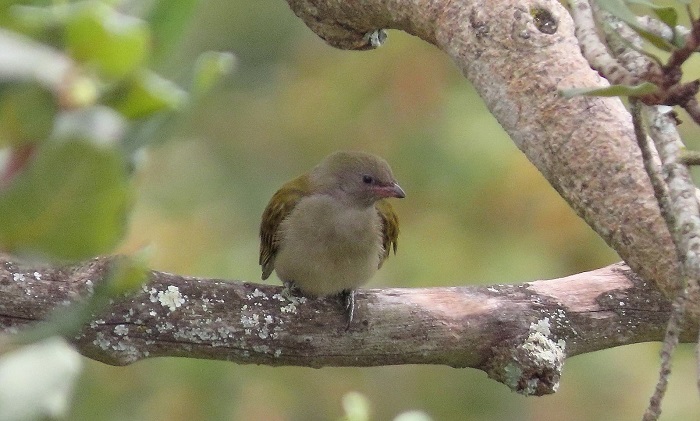
Wartberg District, KwaZulu-Natal
Photo by Colin Summersgill
The freshly hatched chick is altricial and is blind and naked, with pinkish skin. It is equipped with a formidable hook at the tip of each mandible. It uses these bill hooks within the first week to aggressively kill the hosts’ chicks. The bill hooks are lost at around 12 days of age. The Lesser Honeyguide chick remains in the host nest for a long time (up to 38 days). It is independent upon leaving and does not return.
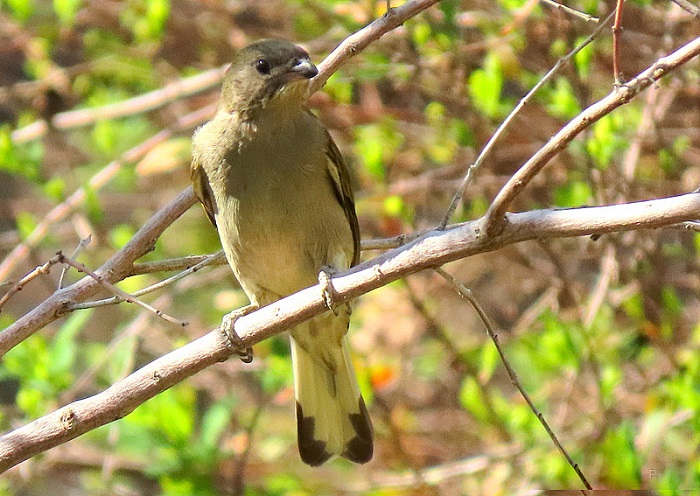
Near Bela-Bela, Limpopo
Photo by Joanne Putter
Further Resources
Here is the species text the First Southern African Bird Atlas Project (SABAP1), 1997.
The use of photographs by Colin Summersgill, Dave Rimmer, Desire Darling, Gregg Darling, Joanne Putter, Johan Heyns, Kate Braun, Lia Steen, Rick Nuttall, Roelof van der Breggen, Ryan Tippett, and Tony Archer is acknowledged.
Virtual Museum (BirdPix > Search VM > By Scientific or Common Name).
Other common names: Kleinheuningwyser (Afrikaans); iNhlava (Zulu); Intakobusi (Xhosa); Kleine Honingspeurder (Dutch); Petit Indicateur (French); Kleiner Honiganzeiger (German); Indicador-pequeno (Portuguese).
List of species available in this format.
Recommended citation format: Tippett RM 2026. Lesser Honeyguide Indicator minor. Biodiversity and Development Institute. Available online at https://thebdi.org/2026/08/20/lesser-honeyguide-indicator-minor/
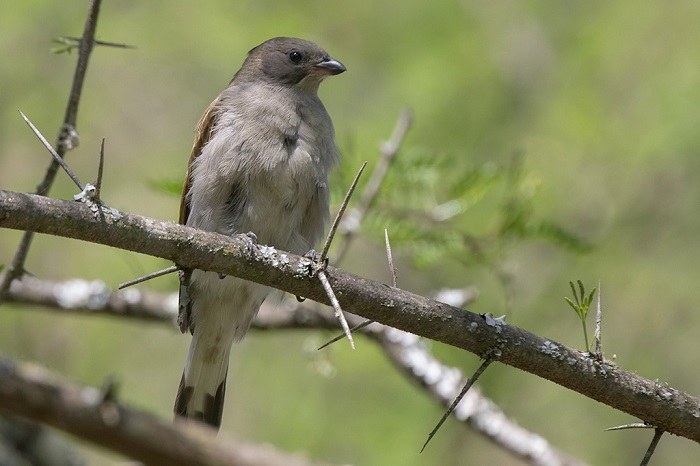
Baviaanskloof Conservation Area, Eastern Cape
Photo by Gregg Darling
