
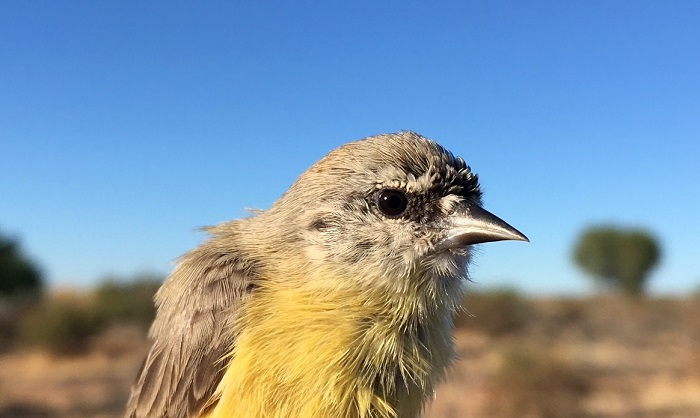
Cover image of Cape Penduline Tit by Roy Earle – Karas, Namibia
The Cape Penduline Tit belongs to the Family REMIZIDAE (Penduline Tits). These are tiny passerine birds related to the true tits but with finer, sharply pointed bills. Their wings are short and rounded, and their short tails are mostly notched. The common name of these birds derives from the globular suspended nest that most of them build. Some of these nests are unmatched in their ability to deceive predators. A conspicuous side entrance leads to a shallow false cavity, and the entry to the true nest chamber is a tube that, when not being used, lies flattened as the roof of the false entrance. This family comprises 11 species from 3 genera. 2 species occur in southern Africa.
Identification
The Cape Penduline Tit is one of the smallest bird species in southern Africa, reaching a length of 10cm and weighing just 7.5 grams.
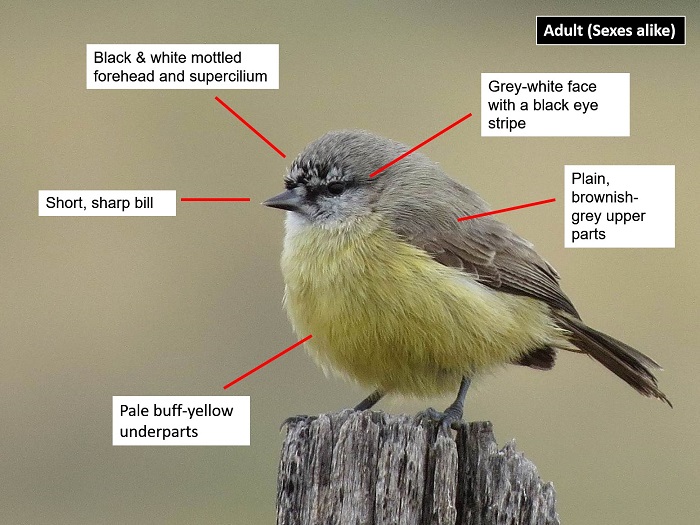
Middelburg district, Eastern Cape
Photo by Tino Herselman
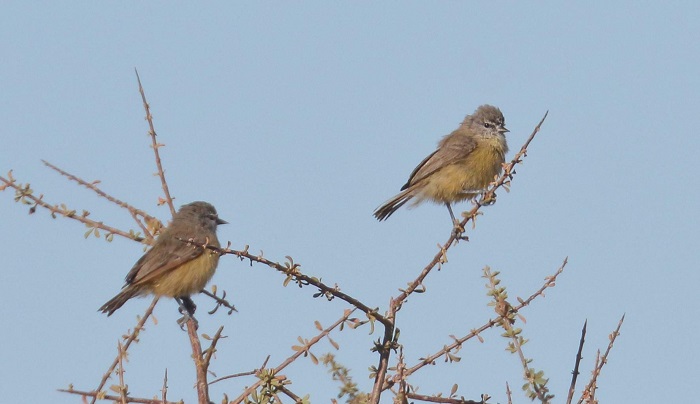
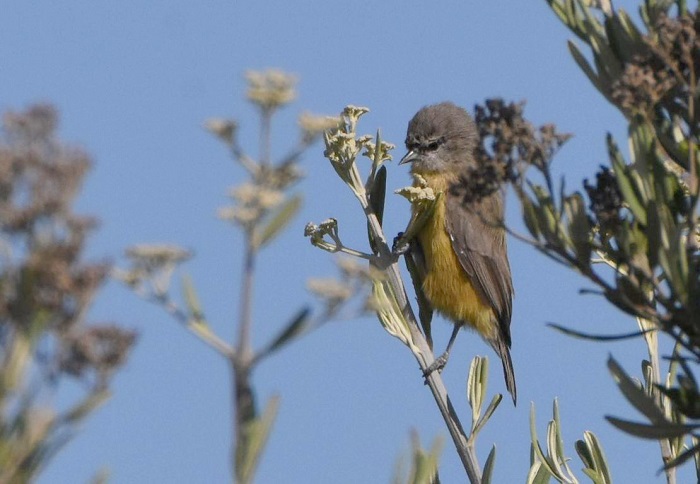
The sexes are alike. In adults, the forehead and short supercilium are mottled black and white, colour extending back into short supercilium. A narrow black eye stripe extends from the lores to just behind the eye. The cheeks and ear coverts are whitish-grey. The rest of the upper parts are pale brownish grey. The tail is darker greyish-brown with buffy tips. The chin and throat are white and the breast, belly and undertail coverts are pale buffy yellow. Colouration of the bill varies from grey to greyish-black. The eyes are pale brown, surrounded by an indistinct whitish eye ring. The legs range in colour from black to dark blueish-grey.
Juveniles are like adults, but their upper parts are browner and their underparts are paler yellow. Additionally, the edges of the flight and tail feathers are washed pale yellow.
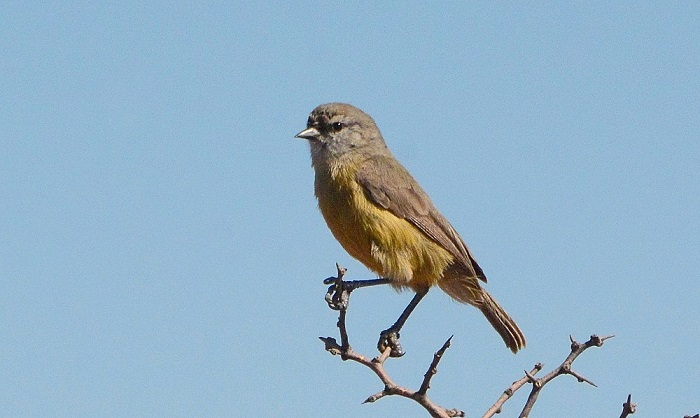
Carnarvon district, Northern Cape
Photo by Ryan Tippett
The Cape Penduline Tit is most likely to be mistaken for the similarly sized Grey Penduline Tit (Anthoscopus caroli). The latter has a plain buff (not black-and-white) forehead and buff (not pale yellow) underparts. The Yellow-bellied Eremomela (Eremomela icteropygialis) is also similar, but has a plain grey forehead, and a grey (not pale yellow) breast and a longer bill.
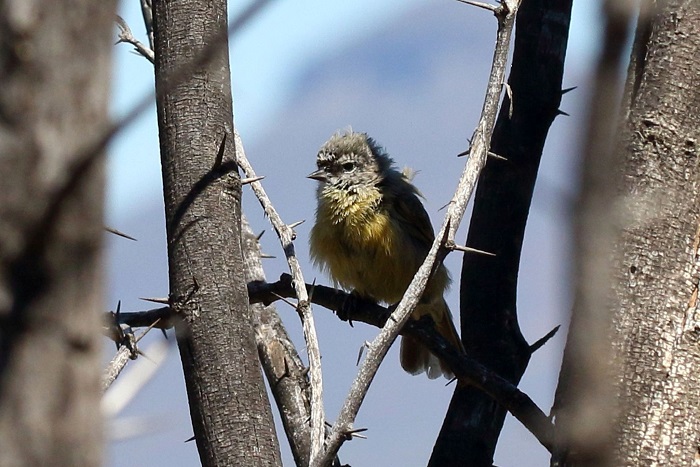
Near Calvinia, Northern Cape
Photo by Alan Manson
Status and Distribution
The Cape Penduline Tit is locally common and near-endemic to southern Africa. It ranges from south-western Angola, across much of Namibia, throughout Botswana, south-western Zimbabwe and most of South Africa, except for the Limpopo lowveld, most of Mpumalanga, the eastern Free State, KwaZulu-Natal, and the north-eastern parts of the Eastern Cape. The Cape Penduline Tit is also absent from Lesotho.
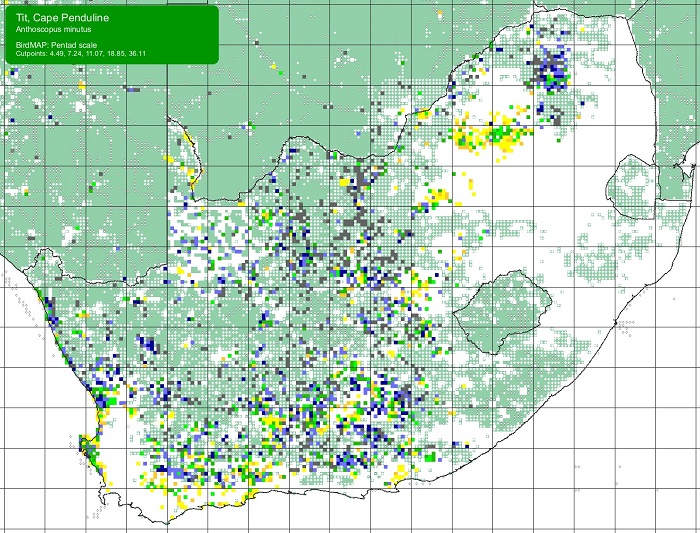
Details for map interpretation can be found here.
The Cape Penduline Tit is not threatened. It remains widespread and responds positively to bush encroachment from overgrazing in drier areas.
Karoo National Park, Western Cape
Photo by Alan Manson
Habitat
The Cape Penduline Tit is found in several arid and semi-arid habitats throughout the region, particularly succulent and Nama Karoo shrublands and Kalahari thornveld. In the Fynbos biome, it is confined to lowland renosterveld and coastal strandveld. It is not found in mountain fynbos. In the Eastern Cape province, the Cape Penduline Tit is also found in Vachellia karoo thickets along watercourses. In the dwarf dwarf shrublands of the Karoo, it is most partial to areas of taller shrubs, especially along drainage lines.
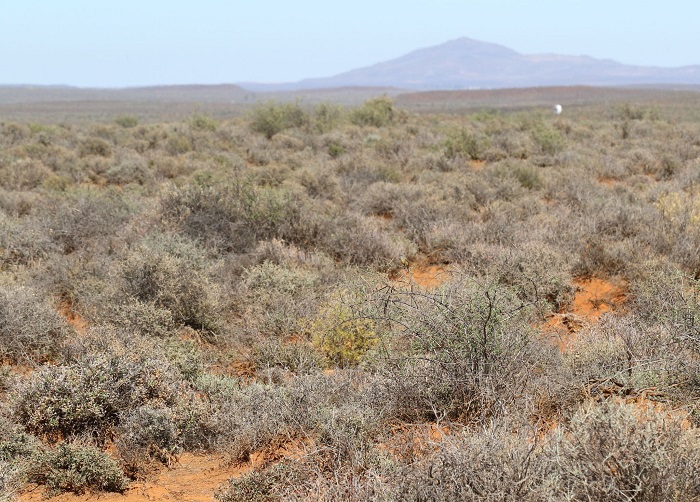
Photo by Alan Manson
Behaviour
The Cape Penduline Tit is resident and locally nomadic in response to rainfall. It is most often found in small family groups of up to 8 birds, rarely more. It is occasionally found in pairs. Groups are smallest in the non-breeding season.
Near Bloemfontein, Free State
Photo by Rick Nuttall
Cape Penduline Tits roost in the nest, sometimes also in old Southern Masked Weaver nests. During the breeding season, 4 to 8 birds may roost in 1 nest. After breeding, up to 18 birds may roost in a single nest.
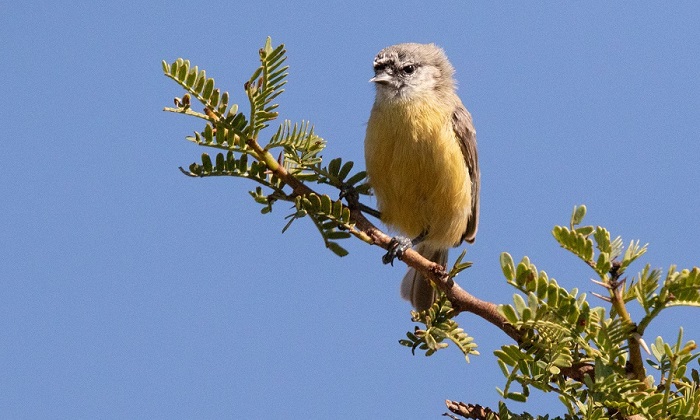
Near Bultfontein, Free State
Photo by Lance Robinson
Cape Penduline Tits forage in family groups, venturing up to 1.5 km from the roost nest. They forage among the branches of shrubs and trees, gleaning insects from leaves, twigs, and bark. They occasionally hang upside down to access hard-to-reach places. The Cape Penduline Tit probes galls and searches spider webs. Large food items are held with 1 foot and torn into smaller pieces.
The diet consists of insects like beetles and caterpillars, including their eggs and larvae, as well as spiders. They also consume small fruits, including those of honey-thorns (Lycium spp).
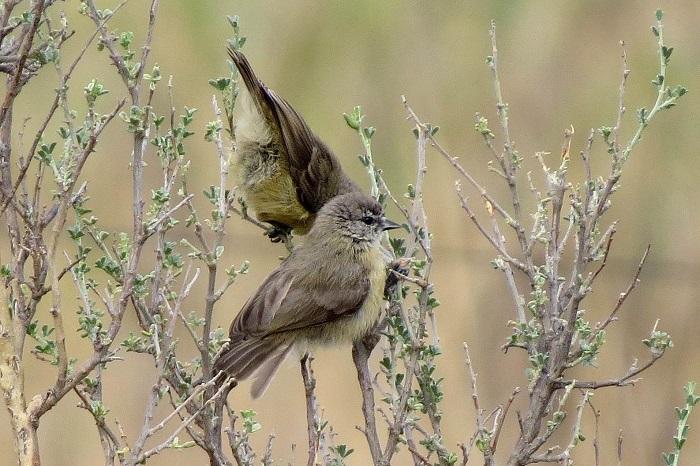
Middelburg district, Eastern Cape
Photo by Tino Herselman
In the winter rainfall zone of the Western Cape province, egg-laying has been recorded from July to November but extends from September to March across the rest of its range. The Cape Penduline Tit breeds in response to rainfall. The Cape Penduline Tit is monogamous and nests solitarily. They are facultative cooperative breeders. The nest is built by both sexes and takes around 1 month to construct. Following nest destruction by a predator or severe weather, a replacement nest may be constructed.
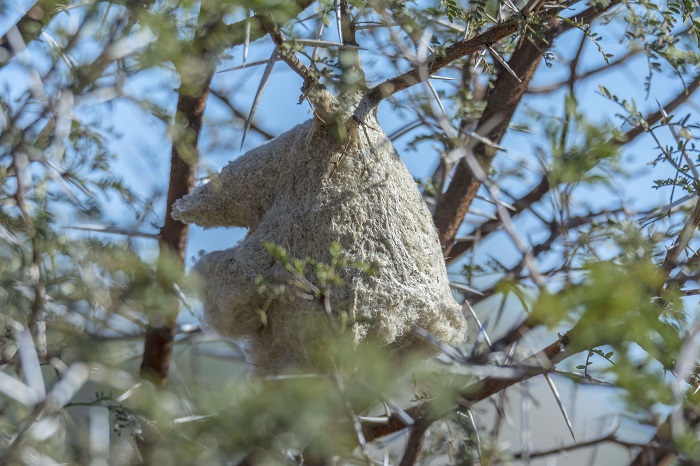
Klerksdorp district, North West
Photo by Tony Archer
The nest is an oval bag, made from plant down, especially the pappuses of Asclepiadaceae, Karoo rosemary/Kapokbos (Eriocephalus spp) and the Camphor Bush Tarchonanthus camphoratus, as well as the fur of hares and the wool of Angora goats and sheep. It is bound together with spider webs. The outside is sometimes decorated with spider egg capsules. The nest is usually whitish, but may be almost black where Karakul and Nama sheep occur, or a patchwork of white, brown and black wool. Near the top is a soft and collapsible entrance spout, below which is a small, curved ledge, used as perch by the incoming bird as it opens the entrance spout with 1 foot. The opening closes automatically, forming a roof over the ledge which creates a ‘false entrance’ to deceive predators. The nest is usually attached at the top and sides with spider web to thin branches inside a thorny tree or shrub. In the Karoo, the nest is usually situated 1 to 3 m above the ground, but up to 7m high in other regions.
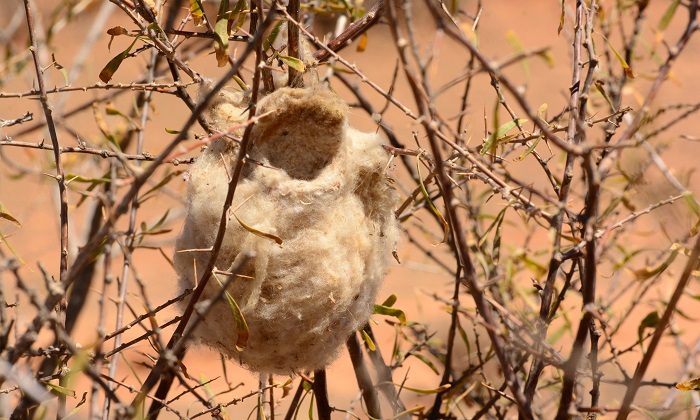
Carnarvon district, Northern Cape
Photo by Ryan Tippett
4 to 7 plain white eggs are laid per clutch at daily intervals. The incubation period lasts up to 15 days and is done by both sexes. Newly hatched young are altricial, and the nestling period lasts for up to 22 days. The young are fed by both parents and 1 or 2 helpers. Fledglings from the first brood roost in the nest at night along with the eggs and young of the second brood. The Cape Penduline Tit is frequently double-brooded.
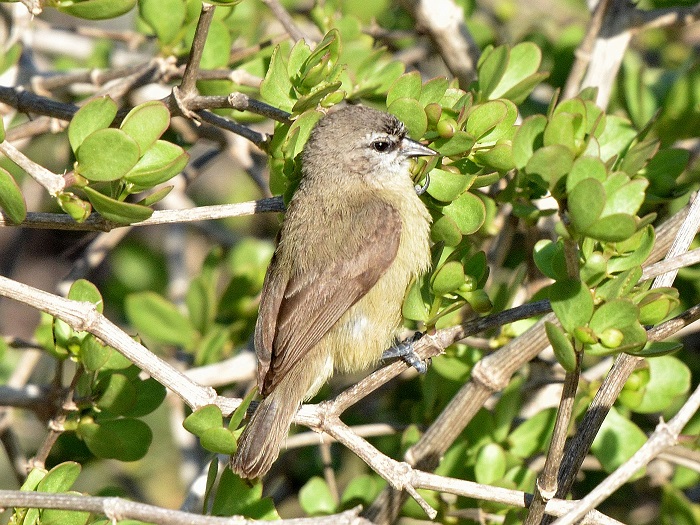
Stompneusbaai, Western Cape
Photo by John Todd
Further Resources
This species text is adapted from the first Southern African Bird Atlas Project (SABAP1), 1997.
The use of photographs by Alan Manson, John Todd, Lance Robinson, Rick Nuttall, Roy Earle, Ryan Tippett, Tino Herselman, and Tony Archer is acknowledged.
Other common names: Kaapse kapokvoël (Afrikaans); Unogushana, Unothoyi (Xhosa); Rémiz minute (French); Kaapse Kapokmees (Dutch); Weißstirn-Beutelmeise (German); Pássaro-do-algodão do Cabo (Portuguese).
Recommended citation format: Tippett RM 2026. Cape Penduline Tit Anthoscopus minutus. Biodiversity and Development Institute. Available online at https://thebdi.org/2026/08/12/cape-penduline-tit-anthoscopus-minutus/
A list of bird species in this format is available here.
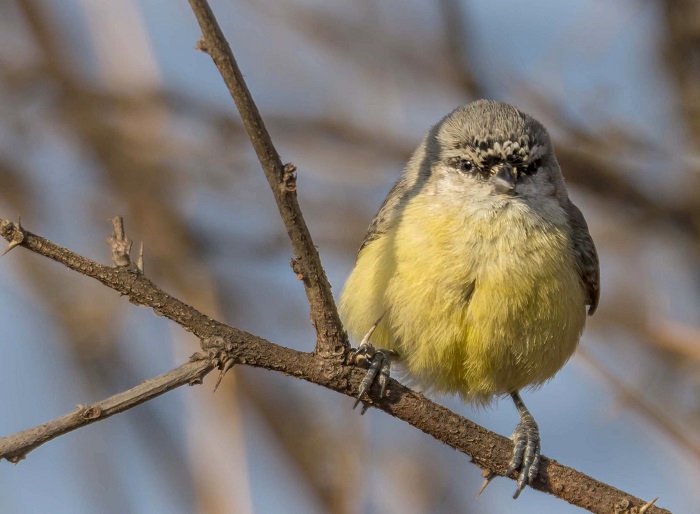
Klerksdorp district, North West
Photo by Tony Archer
