
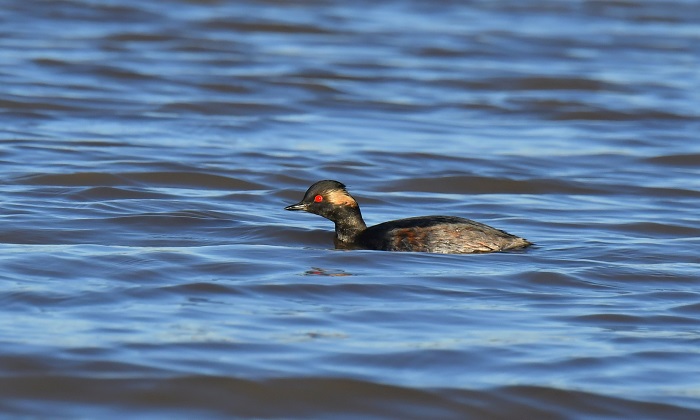
Cover image of Black-necked Grebe by Ryan Tippett – Carnarvon district, Northern Cape
Grebes are the sole members of the Family PODICIPEDAE. The family has a cosmopolitan distribution, occurring on all the world’s continents except Antarctica. Grebes are specialised for life on and under the water. Their legs are set so far back on the body that they have great difficulty walking on land. The toes are lobed for swimming. They also have sharp, pointed bills, short wings and tails, and soft, silky plumage. The family contains 22 species in 6 genera. 3 species have been recorded from southern Africa.
Identification
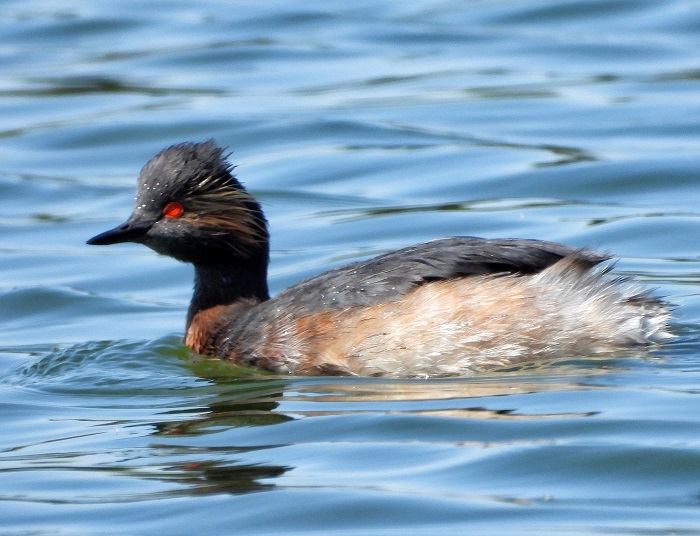
The Black-necked Grebe is an attractive species with distinct breeding and non-breeding plumage. The sexes are alike.
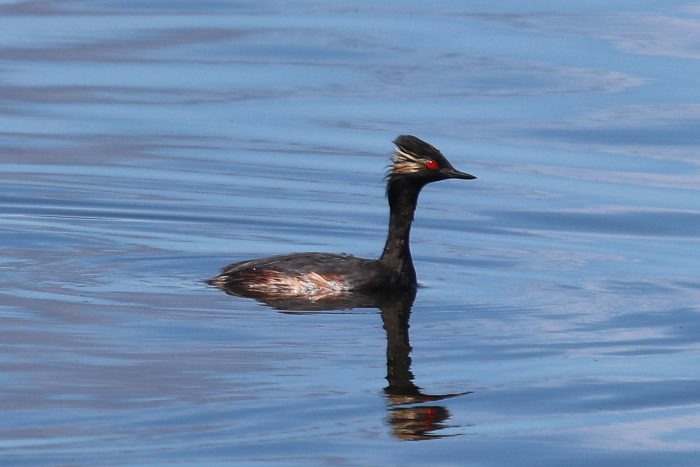
Strandfontein Sewage Works, Western Cape
Photo by Sybrand Venter
In breeding plumage, the forehead, crown, neck, mantle and scapulars are black. They have a patch of long, glossy golden-yellow feathers below and behind the eyes, extending past the ear coverts. The back is dark brown, and the rump is black. The short tail is black above and brownish below. The chin and throat are also black, while the upper breast is mottled with dark-chestnut and white. The sides of the breast and flanks are chestnut with black and grey mottling. The lower breast and belly are silky white, and the vent is pale brown. They have greyish-black bills and striking, bright red eyes. The legs and feet are blackish.
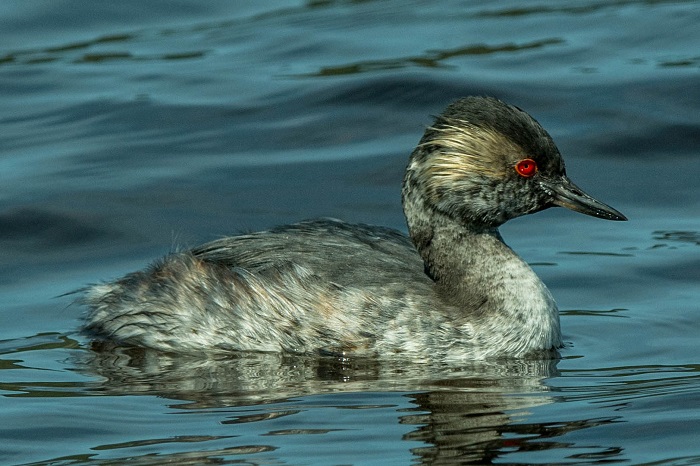
Garden Route National Park, Western Cape
Photo by Jean Hirons
In non-breeding plumage, they are greyish black above, and the ear coverts are grey, and the sides of the neck are black. The face, chin and upper throat are white. The lower throat is grey, and the remainder of the underparts are white. Their bills are also paler than in breeding plumage, and the feet are brown.
Juveniles resemble non-breeding adults, but are generally paler and browner. Additionally, the sides of the head are mottled, and the flanks are pale grey.
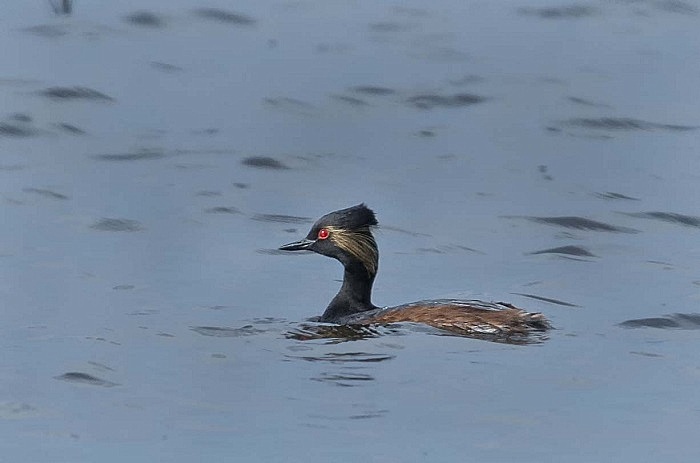
Near Klerksdorp, North West
Photo by Tony Archer
Black-necked Grebes in full breeding plumage are unlikely to be mistaken for another species. However, non-breeding birds are often confused with the Little Grebe (Tachybaptus ruficollis). Non-breeding Black-necked Grebes are much paler below than Little Grebes, and have longer and thinner necks. Little Grebes also have stubbier and less sharply pointed bills.
Status and Distribution
The Black-necked Grebe is uncommon to locally common in southern Africa. The species has a very wide distribution across much of Eurasia, North and South America, and Africa. In Africa, the Black-necked Grebe is found along the Mediterranean coast and at scattered sites south of the Sahel. In southern Africa, it mainly occurs in the central interior, from the highveld across to the drier south-western and western areas, with much of the population wintering along the Namibian coast.
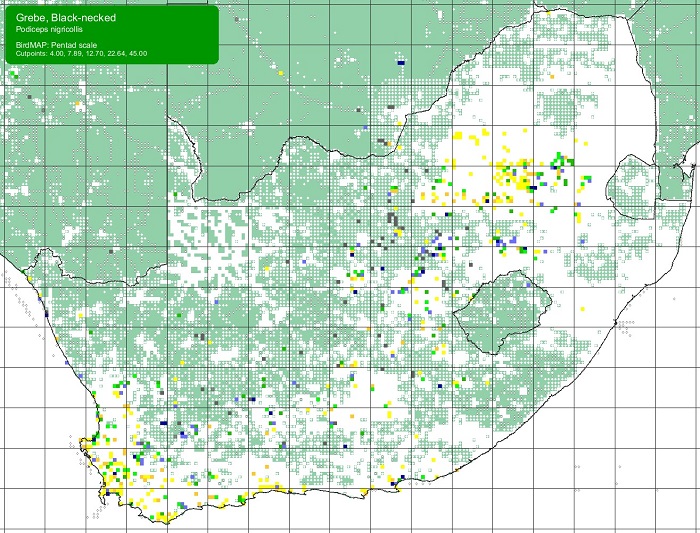
The Black-necked Grebe is not threatened. Its population has probably increased due to the widespread construction of man-made impoundments that offer ideal habitat. In southern Africa, the Black-necked Grebe now breeds in areas that formerly lacked suitable breeding habitat, such as the central Karoo.
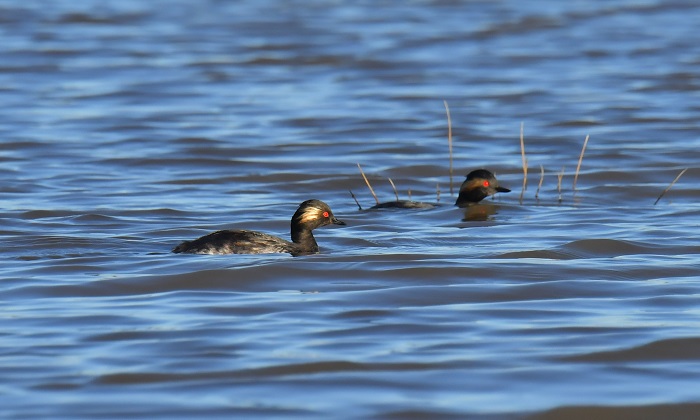
Carnarvon district, Northern Cape
Photo by Ryan Tippett
Habitat
The Black-necked Grebe favours seasonal water bodies like large pans, ephemeral water bodies, and farm dams, particularly those that fill rapidly after heavy rainfall. They are less regular at more permanent waters. They are also frequently found on natural and commercial saltpans, and, in Namibia, in sheltered coastal bays. The Black-necked Grebe has a preference for open waters with sparse emergent vegetation, and they seldom enter areas with dense plant cover.
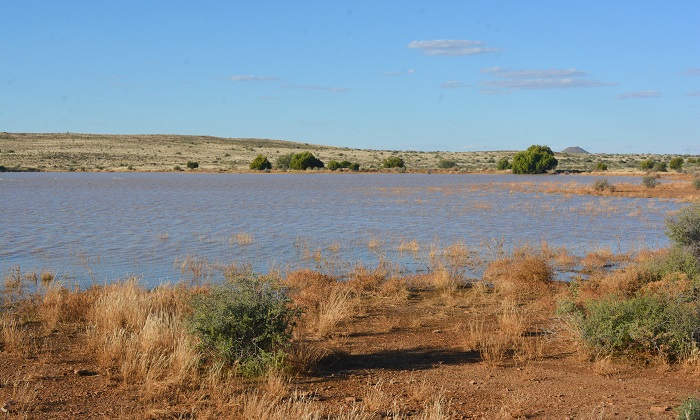
Carnarvon district, Northern Cape
Photo by Ryan Tippett
Behaviour
Black-necked Grebes are usually seen in small groups or in pairs when breeding. Non-breeding birds may form large aggregations of 1000 or more, sometimes in association with Little Grebes. They roost on water at night.
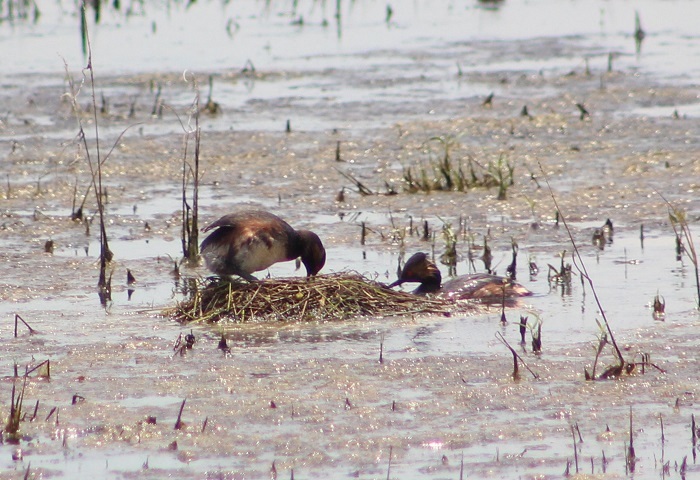
Near Welkom, Free State
Photo by Janet du Plooy
Black-necked Grebes are highly nomadic and are probably not resident anywhere in southern Africa. They breed sporadically when environmental conditions become suitable. Some of the population also move to inshore wintering areas along the Namibian coast. The only records at sea from the Northern Cape are from Port Nolloth. Black-necked Grebes are seldom recorded at sea off the Western Cape.
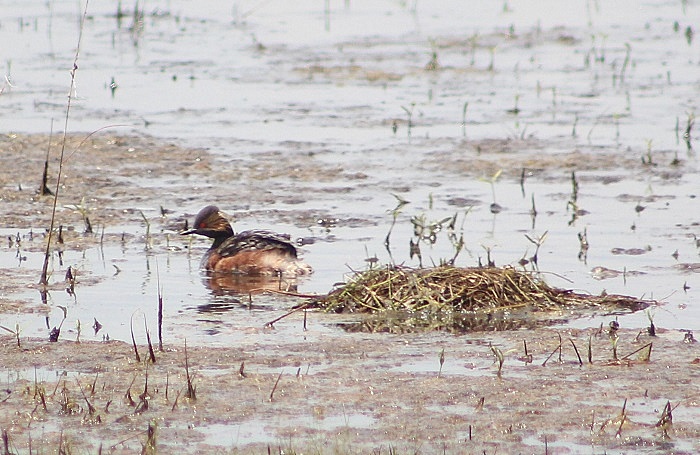
Near Welkom, Free State
Photo by Janet du Plooy
Foraging behaviour of the Black-necked Grebe in southern Africa is largely undescribed, except for observations of groups of 75 to 100 individuals feeding in association with Greater Flamingos. Dives for food, including small fish, tadpoles, aquatic insects and their larvae, as well as crustaceans and molluscs. Black-necked Grebes regularly swallow feathers, which are probably eaten to wrap fish bones for regurgitation in pellets.
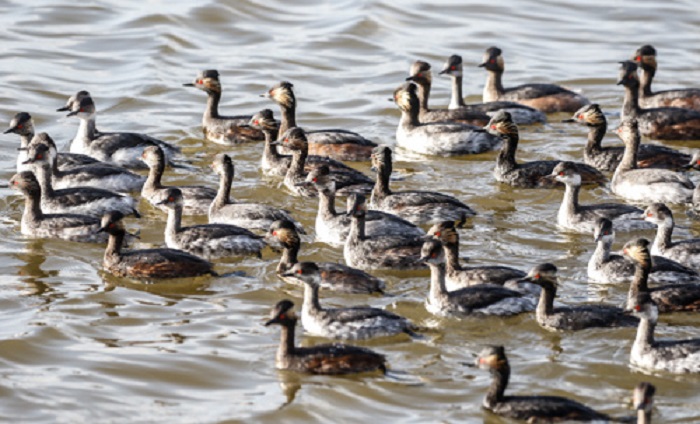
Walvisbaai, Namibia
Photo by Carel van der Merwe
The Black-necked Grebe breeds irregularly and opportunistically at flooded ephemeral pans, dams, and seasonal wetlands. In southern Africa, it has been recorded breeding from October to April, but the species may not breed at all for several years during drought conditions. The suitability of breeding sites in southern Africa is unpredictable. The Black-necked Grebe is monogamous and pairs may breed solitarily or in loose colonies. It seems that pair formation likely occurs only after a breeding site has been selected.
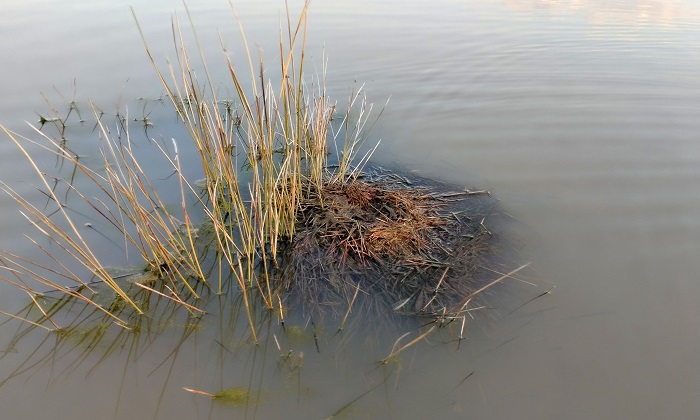
Carnarvon district, Northern Cape
Photo by Ryan Tippett
In Europe, Black-necked Grebes perform a range of ritualised and coordinated threat and courtship displays. In southern Africa, the only described early courtship display, involves the pair facing each other, shaking their heads from side to side, then lowering their heads, first to one side and then the other, after which they glide across the water side by side, with heads raised, showing their white breasts. Once a nest site has been selected, the pair constructs 1 or several nest platforms, followed by an additional courtship display where the pair rear up with quivering wings, followed by copulation.
The nest is a floating mound of algae, bulrush leaves, and other soft water plants, usually on open water. It is anchored on underwater or emergent growth or even a submerged termite mound, and the nest cup is often barely above the water level. Nests can be flimsy or rather substantial, measuring up to 200 mm in diameter and up to 500mm thick, and new material is added throughout the incubation process. The nest is cooperatively built in under a week by both sexes.
1 to 7 eggs are laid per clutch at intervals from 1 to several days. The eggs are symmetrically oval with a conical point at both ends. They are Yellowish-white but become brown-stained from the nest. The incubation period lasts up to 22 days and incubation duties are shared by both sexes. The eggs are sometimes covered with nesting material when the pair leave the nest. The newly hatched young are brownish-black overall, with black crowns and black-and-white striped faces. They also have bare pink to scarlet spots on their lores and crown. The chicks are highly precocial and leave the nest immediately after hatching. They are carried on the backs by both parents who also feed them.
Breeding success in southern Africa is low due mainly to the predation of eggs and fluctuating water levels. Additionally, many nests are also destroyed by strong winds.
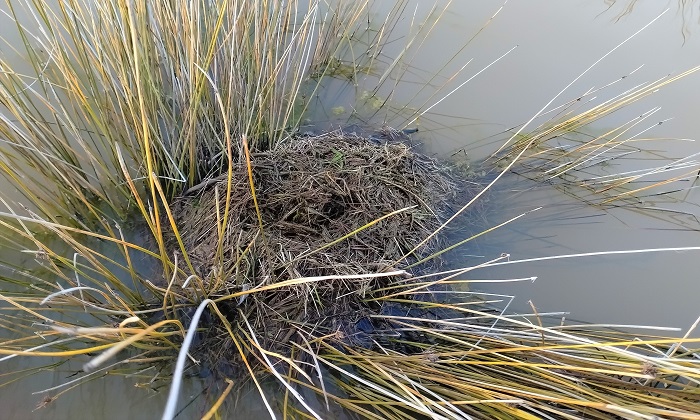
Carnarvon district, Northern Cape
Photo by Ryan Tippett
Further Resources
Species text adapted from the first Southern African Bird Atlas Project (SABAP1), 1997.
The use of photographs by Carel van der Merwe, Janet du Plooy, Jean Hirons, Lappies Labuschagne, Ryan Tippett, Sybrand Venter, and Tony Archer is acknowledged.
Other common names: Blacknecked Grebe, Eared Grebe (Alt. English); Swartnekdobbertjie (Afrikaans); iDada (Zulu); Grèbe à cou noir (French); Schwarzhalstaucher (German); Mergulhão-de-pescoço-preto (Portuguese); Geoorde Fuut (Dutch).
A list of bird species in this format is available here.
Recommended citation format: Tippett RM. 2026. Black-necked Grebe Podiceps nigricollis. Biodiversity and Development Institute. Available online at https://thebdi.org/2026/06/29/black-necked-grebe-podiceps-nigricollis/
Walvisbaai, Namibia
Photo by Lappies Labuschagne
