
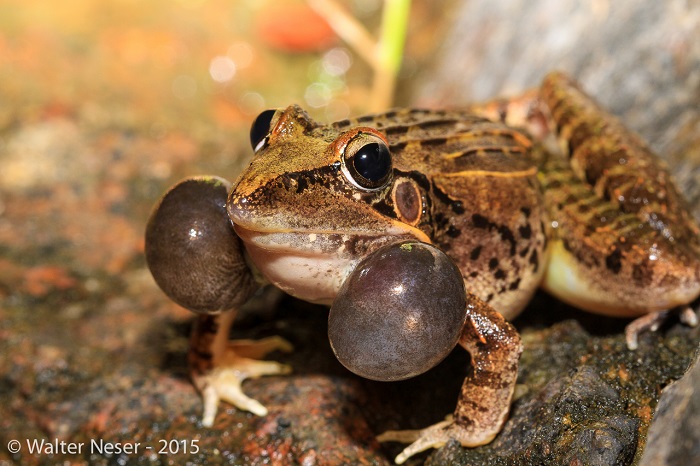
View the above photo record (by Walter Neser) in FrogMAP here.
Find the Sharp-nosed Grass Frog in the FBIS database (Freshwater Biodiversity Information System) here.
Family Ptychadenidae
SHARP-NOSED GRASS FROG – Ptychadena oxyrhynchus
(Smith, 1849)
Identification
Habitat
P. oxyrhynchus inhabits relatively moist, open savanna and woodland, and is less specific in its choice of breeding site than the other Ptychadena species, using vleis, inundated grassland and sedge pans, as well as temporary pools, such as roadside puddles and pools on rock outcrops (Stewart 1967; Passmore 1978; Poynton and Broadley 1985b). It occurs in most of the bushveld vegetation types in the northeastern parts of the atlas region, from the coast to 850 m a.s.l., which receive 450–>1000 mm of rain p.a. (Jacobsen 1989; Low and Rebelo 1996). When foraging it may enter indigenous forests and plantations of pine and eucalypts (Poynton and Broadley 1985b; Passmore 1978).
Behaviour
P. oxyrhynchus presumably survives dry conditions in the same way as other Ptychadena species, for example, by retreating into deep mud-cracks, although no specific details are recorded in the literature. In summer these frogs forage a considerable distance from their breeding sites (e.g., 600 m; Passmore 1978), and when disturbed, make use of their exceptional leaping ability to escape.
Breeding takes place October–January in KwaZulu-Natal. Males call from the periphery of breeding sites, and most activity takes place within 48 hours of rain. Sporadic calling may occur during the day and early evening, but choruses reach their peak intensity between midnight and 04:00 (Passmore 1978).
Eggs are laid in shallow water. The female raises her cloaca out of the water as the eggs are extruded and the male releases his sperm directly onto them by using his feet to form a funnel between his cloaca and that of the female. In this way, fertilization may be achieved before the eggs reach the water (Passmore 1978). Newly laid eggs float, but the slightest disturbance causes them to sink. A recorded batch totalled 3476 eggs (Channing 2001). The tadpoles hatch within two days and metamorphosis is completed in eight weeks (Pienaar et al. 1976).
Food items include a variety of terrestrial arthropods, mainly Orthoptera and Arachnida (Passmore 1978).
Advertisement Call
Status and Conservation
The occurrence of P. oxyrhynchus in the atlas region is marginal in terms of its global distribution. Jacobsen (1989) noted that it is threatened by extensive habitat destruction and recommended that surveys be undertaken, particularly in conservation areas.
Distribution
This widespread species occupies savanna and woodland from Senegal, through West Africa and southward to Angola, eastern Namibia (Caprivi), northern Botswana, Zimbabwe and Mozambique (Poynton 1964; Poynton and Broadley 1985b; Channing 2001). In the atlas region, P. oxyrhynchus is recorded from only a few scattered localities in Limpopo Province, extending as far west as Bochum (2329AC), but is more common in eastern Mpumalanga, most of Swaziland and KwaZulu-Natal, and the northeastern part of Eastern Cape Province, almost reaching East London in the south (3327BA).
This is a robust species with a distinctive call that can be heard from a considerable distance. It is not as common as P. anchietae or P. mossambica. The atlas data are accurate but incomplete. Further surveys should reveal the presence of additional populations.
Further Resources
Virtual Museum (FrogMAP > Search VM > By Scientific or Common Name)
More common names: Skerpneusgraspadda (Afrikaans)
Recommended citation format for this species text:
Minter LR, Passmore NI, Tippett RM. Sharp-nosed Grass Frog Ptychadena oxyrhynchus. BDI, Cape Town.
Available online at http://thebdi.org/2021/11/11/sharp-nosed-grass-frog-ptychadena-oxyrhynchus/
Recommended citation format:
This species text has been updated and expanded from the text in the
2004 frog atlas. The reference to the text and the book are as follows:
Minter LR, Passmore NI 2004 Ptychadena oxyrhynchus Sharp-nosed Grass Frog. In Minter LR
et al 2004.
Minter LR, Burger M, Harrison JA, Braack HH, Bishop PJ, Kloepfer D (eds)
2004. Atlas and Red Data Book of the Frogs of South Africa, Lesotho and
Swaziland. Smithsonian Institution, Washington, and Avian Demography
Unit, Cape Town.
